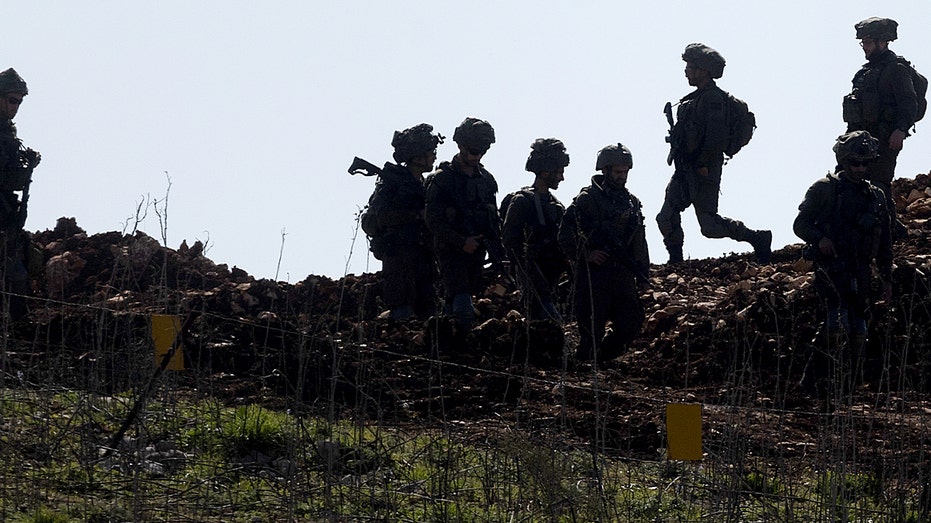
Israeli military vehicles entered the village of Saida al-Golan, in Quneitra Governorate today, searching homes in the area and capturing one civilian before withdrawing from the village toward the farmland further to the west. A large number of IDF vehicles were also reported as having entered the al-Samandiyah village, where troops searched a number of […]
Few countries in the Middle East expect a turning point in relations with Israel. But the outcome of the vote has implications for the regional conflict with Iran.
Parts of Lebanon have been greatly damaged in fighting between Israel and Hezbollah since March, including the Dahiya neighborhood, a Hezbollah stronghold in the capital, Beirut.
Jordan conducted airstrikes against alleged Islamic State targets in Syria on Tuesday, as “retaliation” for a brutal terrorist attack on a Greek Orthodox church in southern Jordan on Friday.
Airstrikes carried out by Jordan on Monday night against positions in southern Syria—allegedly linked to the jihadist group Islamic State (IS)—have triggered a diplomatic rift between the two nations. The friction stems from a lack of prior coordination and the fact that the strikes resulted in civilian casualties, including children.
On Tuesday, the Syrian Foreign Ministry criticized the Hashemite Kingdom for conducting the military operation without prior coordination, describing the action as completely unacceptable and a violation of Syria’s national sovereignty.
The Syrian Foreign Ministry also suggested that certain suspicious groups might be attempting to strain relations between Damascus and Amman, though it provided no further details regarding this claim.
Jordan framed the airstrikes as retaliation for an attack last Friday on a church in the western part of the kingdom, which left nine people dead and approximately 40 injured. Jordanian authorities attributed the attack to the Islamic State, although the organization has not yet claimed responsibility.
#Syria hardened its stance on the Jordanian attack carried out yesterday in the South.
While the Syrian Foreign Ministry initially expressed "reservations" about the Jordanian airstrikes in a statement last night, this morning, as the civilian death toll was confirmed, Damascus… pic.twitter.com/RvgfBLFVIV
Mohammad Momani, Jordan’s Minister of Government Communications and government spokesperson, stated on the social media platform X that the strikes were launched in response to the movements of these organizations and their acts against Jordan’s national security.
Momani expressed regret over the civilian casualties, maintaining that the armed forces had taken every possible precaution to avoid harming innocent people.
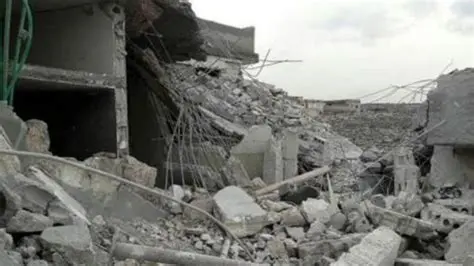
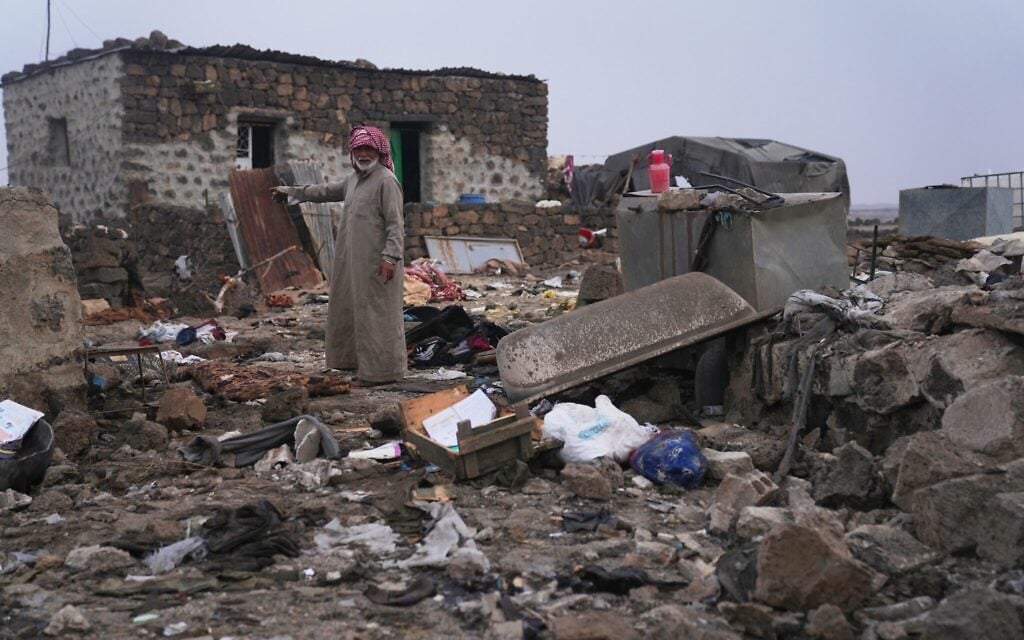
Syrian authorities confirmed that seven people were killed in the strikes, which targeted four areas in the southern province of Daraa. The victims included three children and an 80-year-old man.
Both countries have confirmed the establishment of an urgent joint committee to strengthen coordination in the fight against terrorism. Meanwhile, Momani expressed a commitment to developing bilateral ties for the mutual benefit of both nations.
#Syria | At least 14 people were killed and 11 injured in an explosion at a temporary weapons depot near Sarmada in Idlib province. Rescue teams are searching the rubble for survivors, while authorities have not yet determined the cause of the blast.#Idlib#teleSUREnglishpic.twitter.com/q5utCtzkFE
Jordan on Tuesday acknowledged that airstrikes it launched in southern Syria on Monday caused civilian casualties, while also claiming that the attack killed about 20 ISIS fighters. Amman framed the strikes as retaliation for the October 23 attack on St. George’s Orthodox Church in Jordan’s western Karak province, which killed nine Christians who were attending […]
Amman does not say which groups it targeted, but says 'many members of terror group' killed and wounded; Damascus says at least 7 killed, including women and children
Jordanian warplanes struck several sites in southern Syria late on October 26, killing at least seven people, including three children, according to Syrian authorities, after Amman said it had linked a deadly church shooting to terrorist groups operating across the border.
The strikes hit locations in the southern provinces of Daraa and Suwayda. Jordan described the operation as a counterterrorism measure conducted in coordination with Damascus, while the Syrian government said it had received no advance notification and condemned the civilian deaths.
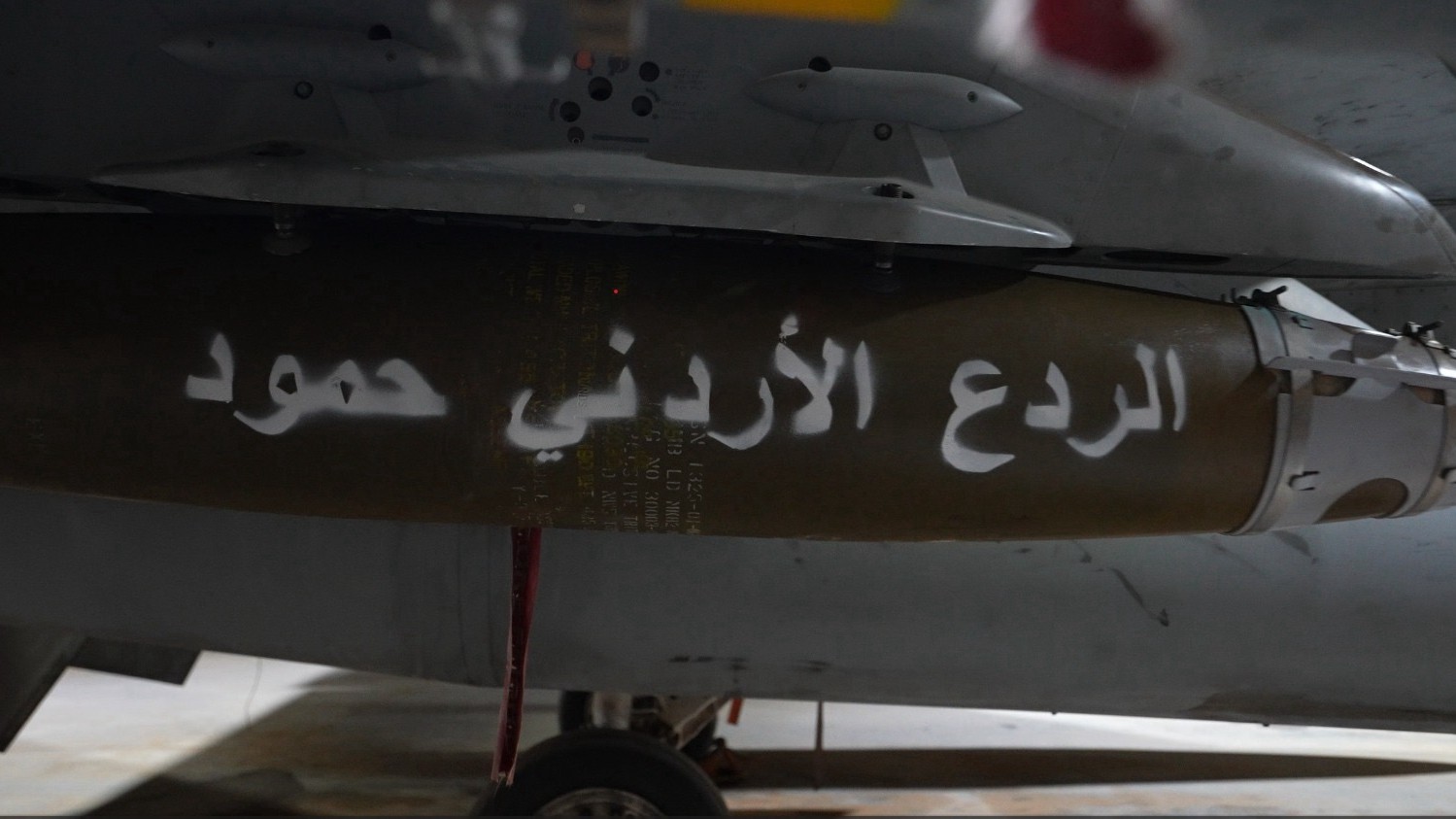
The Royal Jordanian Air Force called the operation “Jordanian Deterrence – Hmoud,” saying it targeted hideouts belonging to terrorist organizations linked to the October 23 attack on a Greek Orthodox church in the Jordanian city of Karak.
“The terrorists behind the Hmoud attack have ties to the targeted terrorist organizations,” the Jordanian military said in a statement carried by the state-run Petra news agency.
It added that the strikes killed and wounded several members of the targeted groups and destroyed their equipment and vehicles. The military did not identify the organizations or specify the locations hit.
Syrian authorities, for their part, disputed Jordan’s account of coordination and said the strikes claimed the lives of civilians.
The Syrian Civil Defense said seven people were killed across several locations in Daraa and Suwayda. Five members of one family, including three children, a woman and a man, died when a strike hit a tent in rural Daraa, while two older men were killed in separate strikes. Three other members of the family were injured.
The Syrian Foreign Ministry said the operation was conducted “without prior coordination or notification with the Syrian side,” according to a statement carried by the Syrian Arab News Agency early on October 27.
Damascus announced an investigation into the strikes and said it had opened direct communication channels with Jordan to address the incident. It also stressed the need for joint security and military coordination along the border, warning that such operations must respect Syrian sovereignty.
The strikes came hours after Jordanian security forces arrested three suspects in connection with the church shooting following a shootout in the Karak area. The suspects, two brothers and their brother-in-law, were wounded during the operation, authorities said.
The October 23 attack took place during a funeral at the Greek Orthodox church in Karak, killing nine people and wounding 34. The shooting shocked the country, where attacks of this kind are rare, and prompted King Abdullah II to promise a forceful response.
“The Nashama have chased them to the very end. We vowed the terrorists would not escape punishment, and no proponent of dark ideologies that divide Jordanians will be tolerated,” the king said on X after the strikes on Syria. “We pray that the martyrs’ souls rest in peace and wish the injured a speedy recovery.”
Jordanian Interior Minister Mazen Al-Faraya described the attack as the product of “a terroristic, extremist way of thinking.”
The investigation has also raised questions about the alleged organizational links behind the shooting. Jordan’s Public Security Directorate chief, Maj. Gen. Obaidallah Abd Rabbo Al-Maayta, said the three suspects were not affiliated with any group, telling reporters, “They only represent themselves.”
Jordan’s military, however, subsequently said those responsible for the attack had ties to terrorist groups in southern Syria without publicly identifying them or detailing the evidence.
Following the strikes, Syrian authorities closed the Nassib border crossing, suspending passenger and commercial traffic between the two countries.
The escalation highlights a growing security threat from terrorist groups operating inside Syria. With southern Syria serving as a base for their activity, and Damascus seen as either turning a blind eye or failing to contain them, neighboring countries face mounting pressure to act on their own.
The Jordanian military on Monday launched airstrikes in southern Syria, a bombing that Amman framed as retaliation for the October 23 attack on St. George’s Orthodox Church in Jordan’s western Karak province, which killed nine Christians who were attending a funeral. The strikes hit multiple locations in Syria’s Suwayda and Daraa provinces, and according to […]
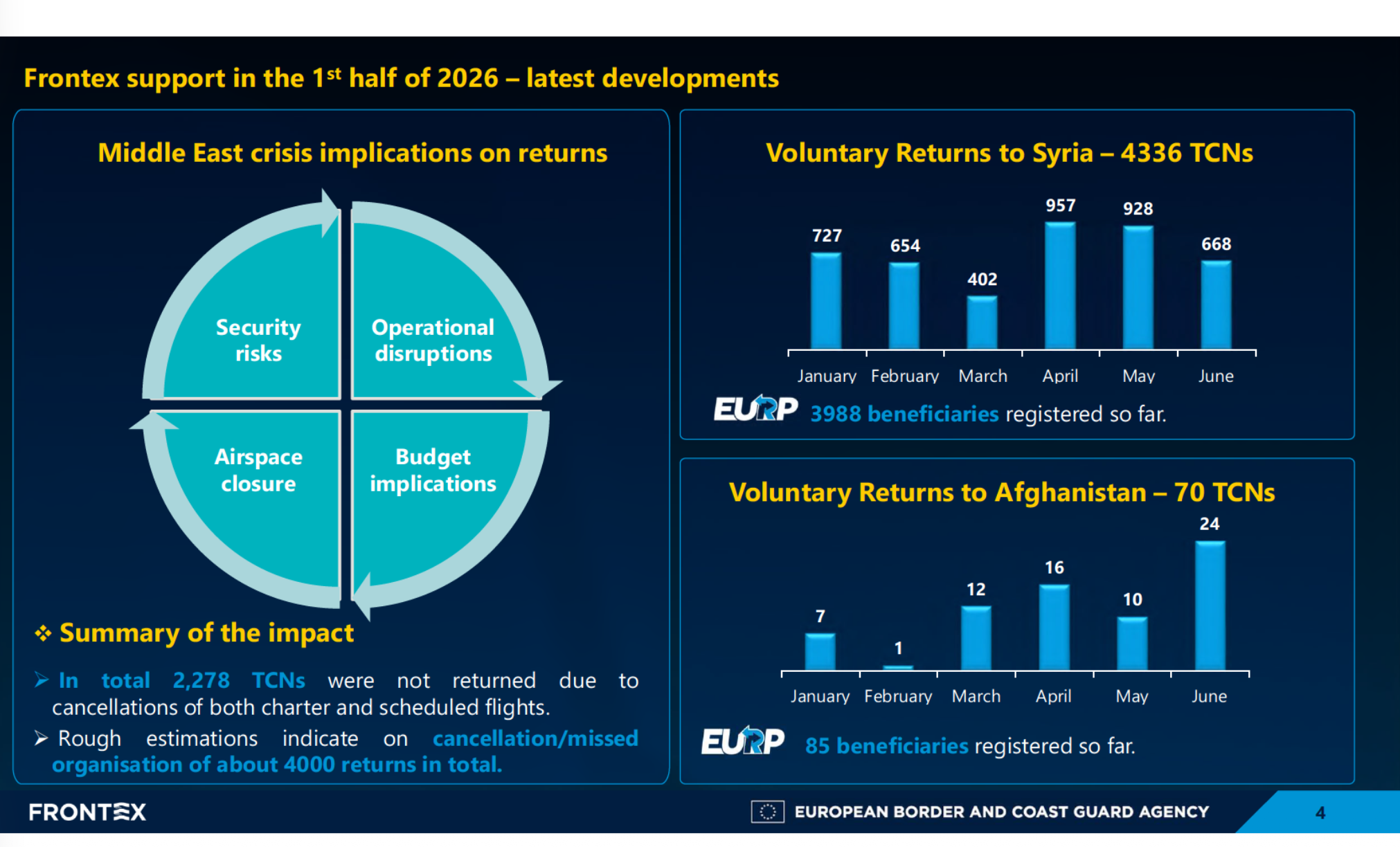
The US and Israeli-led war with Iran, launched in late February, and other military campaigns in the region have disrupted flights, leaving around 5,500 deportations that would normally receive support from the EU’s border agency Frontex unexecuted.
The disruption comes despite the Warsaw-based agency’s recent announcement that returns rose in the first half of 2026, with Syrians and Iraqis among the 10 nationalities most frequently deported.
Internally, however, Frontex appears concerned.
In July, it highlighted return problems because of the Middle East crisis, a broad swathe of conflicts that has seen various airspace closures over Bahrain, Iran, Iraq, Kuwait, Lebanon, Israel, Qatar, Syria, and the UAE.
It said roughly 4,000 returns had not been carried out because of direct cancellations or broader operational standstills, with member states halting the organisation or scheduling of Frontex-supported returns due to the Middle East conflicts.
By 30 September, that figure had climbed to 5,500.
Frontex document WK 9599/2026 INIT, made partially public on 2 July. Cites disruptions due to Middle East conflicts and returns to Syria and Afghanistan (Source: Frontex)
Although now open (as of publication), airspace restrictions, route availability and operational measures may be introduced, amended or lifted rapidly, sometimes with little notice.
European deportation setbacks typically involve everything from fragmented national systems, to people absconding, and to foreign states refusing to accept their own nationals. But war and conflict are now adding another layer of complications.
This article continues, but the full version is available only to EUobserver.com subscribers. Visit account.euobserver.com/membership
The Israeli military launched large-scale domestic military exercises on Sunday to counter surprise border infiltrations and ground raids across northern and central Israel, mobilizing multiple divisions and air assets amid rising regional tensions.
The drills, set to continue over 48 hours, came as an Israeli security expert invoked the 1973 Yom Kippur War, when Egypt and Syria used exercises to disguise preparations for a surprise attack, warning that escalating tensions in the region could in fact trigger what he described as a "dangerous miscalculation."
The large-scale maneuvers, the IDF said, involve the Northern Command’s 210th Division, the West Bank Division, and the Central Command’s 98th and 96th divisions, alongside the Israeli Air Force.
The exercise, scheduled just ahead of Israel's elections Oct. 27, aims to "maintain the forces’ alertness and readiness, strengthen the ability to defend communities, and make full use of aerial capabilities for defense in the area," according to the IDF.
On Friday, the IDF said troops would practice "a variety of scenarios, including a surprise attack and infiltration into Israeli territory by air and land," incorporating lessons learned from the Oct. 7, 2023, Hamas-led attacks on Israel.
"This exercise is mostly about non-state actors with or without Iranian support," Israeli national security analyst Dr. Ehud Eilam told Fox News Digital.
"It's aimed at those in Syria, Lebanon, and Jordan who might try to infiltrate into Israel or send ground raids. Some are supported by Iran; others are not. It could be planned by Iran or be a local initiative."
"This is a massive exercise, the biggest one in recent years, aimed at protecting the borders," the former Israeli Ministry of Defense researcher added.
"It's all about making sure that the election day on October 27 will run smoothly. It's also a message to Iran and others: don't try to provoke us during election day, so nothing will be disrupted."
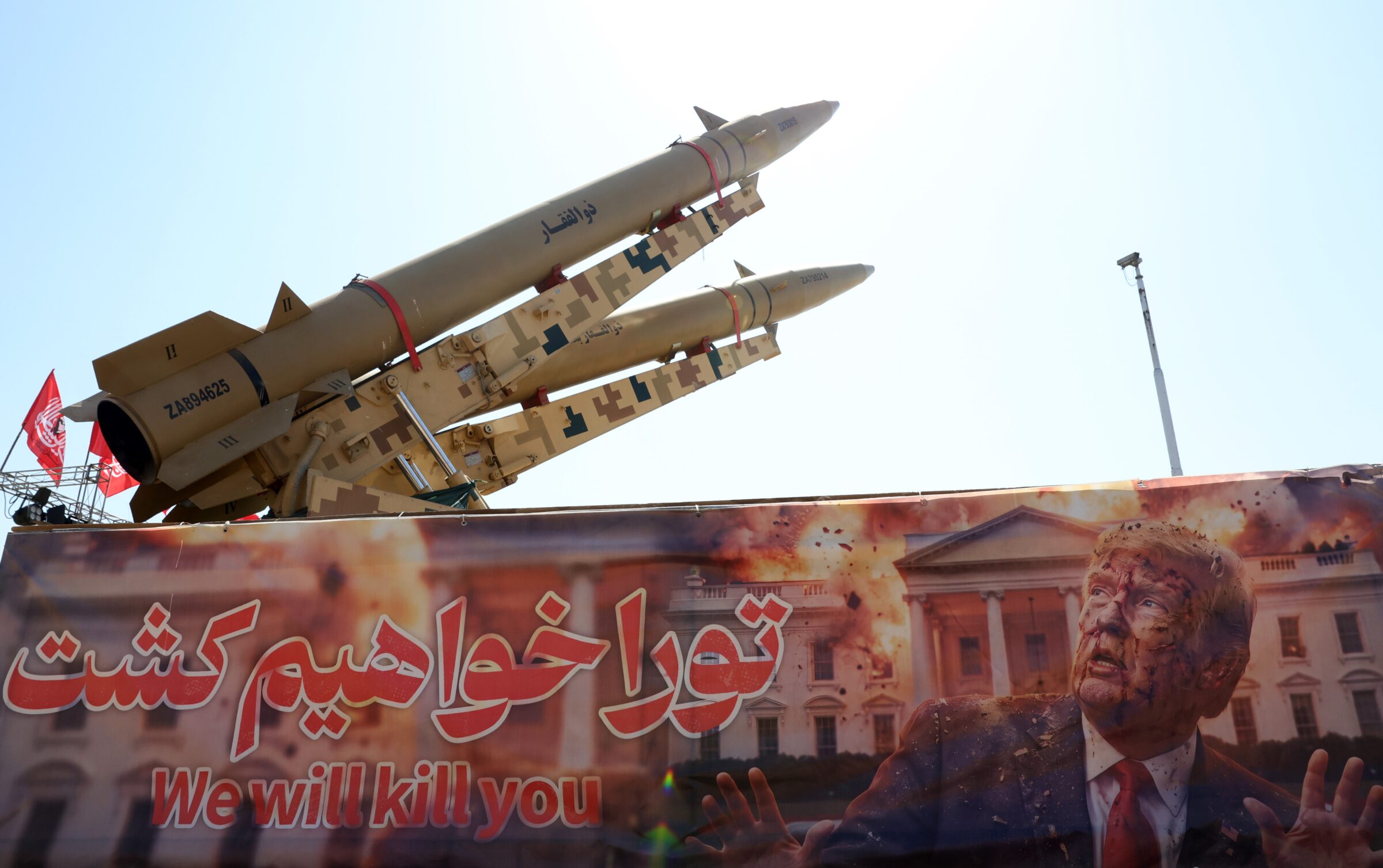
The Israeli drills followed a show of force by Tehran days earlier, during which the Islamic Revolutionary Guard Corps (IRGC) fired roughly 30 ballistic missiles across two distinct weapon classes, according to reports.
That live-fire display highlighted Iranian strike capabilities and sparked renewed alerts about commercial shipping in the Strait of Hormuz and prompted the Israeli military to heighten its alert level while maintaining maximum readiness for a targeted strike against Iran.
During a visit to the IDF's Central Command on Wednesday, Chief of Staff Lt. Gen. Eyal Zamir warned that the risk of escalation was growing.
"Given the numerous warnings across all fronts and the sensitivity of the current period, the potential for escalation has increased," Zamir said.
"To ensure better operational control on the ground, we have reinforced our troop deployments across all sectors, including moving the 98th Division into the area to strengthen security and stability."
"Part of mutual deterrence: a few days ago, Iran had their own pretty big exercise, and that was actually more intimidating as far as Israel is concerned because they launched missiles and prepared for a war with Israel," Eilam said.
"This exercise on Sunday and Monday is against Iran's proxies and allies at the border of Israel."
Sunday’s Israeli drill also followed an Oct. 19 mission in which Israeli fighter jets and aerial refueling tankers flew 800 miles across Syrian and Iraqi airspace to Iran’s border.
Washington was notified in advance and viewed the maneuver as a non-kinetic show of force following the postponement of a broader strike package earlier in the month.
Despite the deterrence signals, Eilam warned that large-scale military exercises carry the "risk of miscalculation" and particularly when troop movements could be mistaken for preparations for an attack.
"During the Cold War, every time the Soviet Union or NATO carried out a major drill, having so many troops in the field meant they might attack if that was the intention," Eilam said.
He pointed to the 1973 Yom Kippur War, when Egypt and Syria used military exercises to help conceal troop buildups along Israel's borders.
Israeli intelligence largely dismissed the movements as routine drills, allowing the two countries to achieve strategic surprise when they launched a coordinated, two-front attack on Yom Kippur.
"The classic example in Israel is 1973, when Egypt and Syria conducted a major exercise just before the war that turned into the actual attack," the analyst said.
"Israel and Iran are now watching each other very closely and both sides suspect the other might strike first," Eilam added before stating that there is the chance of what they call "miscalculation — that each side suspects the other and strikes first by mistake."
"It's all about sending messages to each other."
"It remains uncertain whether there will eventually be an Israeli attack on Iran because it depends on U.S. authorization," Eilam concluded.
Israeli troops continued to operate across southwest Syria over the weekend, with multiple incursions reported against the Quneitra Governorate seemingly focused primarily on excavation and carving out the “Sufa 53 Line” that the IDF is imposing on the ground in the area. Israel has been keen on establishing a trench-line separating Syria from its own […]
Turkey has agreed on a roadmap to rebuild Syria’s naval forces in a move that could expand Ankara’s military influence in the eastern Mediterranean and alter the regional balance with Greece and Israel.
Turkey’s Defense Ministry announced the initiative on October 23 after a senior Turkish naval delegation visited the Syrian port city of Latakia.
The discussions covered ship repair and construction, individual and team training, modernization programs and improvements to naval facilities. The ministry said the two sides had reached an understanding and established a roadmap for cooperation.
The delegation included Rear Adm. Erdinç Yetkin, commander of Istanbul Shipyard; Rear Adm. Timur Yılmaz, the Navy’s logistics chief; Rear Adm. Yücel Darcan, head of naval training and education; and representatives of ASFAT, a Turkish defense company.
The initiative comes as Syria attempts to rebuild its armed forces after more than a decade of civil war that ended with the collapse of Bashar Assad’s government close to two years ago.
The country’s already weakened military infrastructure suffered further devastating losses when Israel launched a large-scale campaign to destroy what remained of the former government’s military capabilities.
Strikes targeted Syrian naval facilities along the coast, sinking more than a dozen warships and destroying all coastal defense systems. Israeli Defense Minister Israel Katz subsequently announced that the operation had destroyed Syria’s naval fleet.
The attacks left Syria with little capacity to field a modern combat fleet capable of challenging established naval powers in the region. Rebuilding that capability will require equipment, technical expertise, trained personnel and functioning maritime infrastructure — areas in which Turkey possesses a substantial advantage.
For Ankara, the cooperation offers an opportunity to establish a deeper and potentially long-term role in the security of Syria’s Mediterranean coastline.
The latest initiative also follows a significant Turkish naval visit to Latakia in July. Turkish Naval Forces Commander Adm. Ercüment Tatlıoğlu arrived aboard the TCG Istanbul frigate, marking the first visit by Turkish naval vessels to the port since the beginning of Syria’s civil war, according to Anadolu Agency.
The deepening maritime cooperation between Turkey and Syria could provoke the maritime alignment involving Greece, Cyprus and Israel.
Ankara has long disputed aspects of Greece’s maritime claims and opposed regional energy arrangements that it considers exclusionary. Greece, Cyprus and Israel, meanwhile, have pursued closer security and energy cooperation, creating another arena for competition over maritime access and regional influence.
A July analysis published by Anadolu Agency, written by a professor at Turkey’s National Defense University, explicitly presented a stronger Syrian navy and improved naval infrastructure at Latakia as developments that could affect this regional balance.
The analysis described cooperation with Syria as another component of Turkey’s expanding network of partnerships with Mediterranean countries, alongside its existing relationships with Libya and Egypt.
For Israel, a future Syrian navy backed by Turkey could introduce a new variable along a coastline where Israel previously faced a severely weakened Syrian military.
The immediate military implications, however, remain limited. The announced roadmap does not establish publicly disclosed rights for Turkey to permanently base warships at Latakia, and the ministry has not announced specific ship orders, delivery schedules or the scale of the planned force.
The agreement therefore represents the beginning of a potential naval reconstruction program, not evidence that Syria has already regained a meaningful maritime combat capability.
Israeli ground troops have been raiding the Yarmouk River Basin in the western part of Syria’s Daraa Governorate in growing numbers and more frequently in recent days. The restrictions placed on locals have been onerous enough to attract some international attention. Now, a fatality will add to those concerns. The incident happened overnight Thursday in […]
Six years after the Abraham Accords, a new report by a former Israeli intelligence chief outlines a doctrine treating peace deals as temporary and regional instability as an asset. (This the latest chapter of a decades long Israeli strategy)
It’s the last week before Israel’s elections, and the concern around Syria that there may be a pre-election “surprise” seems palpable. The belief is that Israeli PM Benjamin Netanyahu may seek to politically benefit from a new operation within southern Syria in the next few days. And while Israel’s ongoing military operations in Syria are […]
A Syrian military delegation has held talks in Saudi Arabia on arrangements to transfer as many as 10,000 Syrian fighters to participate in the war against Yemen’s Houthis (Ansar Allah), Lebanon’s Al-Akhbar newspaper reported on October 20, citing Yemeni intelligence sources.
The reported discussions come despite denials by Syria’s transitional government that Damascus intends to send thousands of fighters to southern Saudi Arabia. The alleged deployment could extend Syria’s involvement in a regional conflict that has intensified in recent weeks.
According to Al-Akhbar, the delegation included Brig. Gen. Khaled Khattab, commander of the 82nd Division in Syria’s new army and a former leader of the al-Qaeda-affiliated Ansar al-Tawhid faction, and Brig. Gen. Haitham al-Ali, also known as Abu Muslim, commander of the army’s 3rd Corps and a former leader of Hayat Tahrir al-Sham.
Yemeni intelligence sources told the newspaper that Khattab spent four days in the southern Saudi provinces of Asir and Najran, accompanied by Saudi officers, visiting sites reportedly being prepared to receive the Syrian fighters.
Al-Ali, meanwhile, held meetings with Saudi officers at the Defense Ministry in Riyadh to discuss transportation costs, financial arrangements, additional benefits and the military missions the contingent would carry out.
The sources said the visiting team had completed preparations for the logistical transfer of the fighters, but the report did not establish when a deployment might take place.
Al-Akhbar also cited sources aligned with Yemen’s internationally recognized government based in Aden as saying that dozens of Syrian trainers specializing in drone operations were already present at military camps in Asir and several locations in Yemen. These reportedly included facilities near Seiyun in Hadramout province, the al-Khasha camp in Hadramout and the al-Anad military base.
The sources said the trainers were instructing members of the Saudi-backed Homeland Shield forces and Giants Brigades. The sources also alleged that Syrian drone operators had established units within Saudi Arabia’s Emergency Forces in Asir and in the al-Wadiah and Sharurah areas.
The report further raised the possibility that foreign fighters could be transferred alongside Syrians. Al-Akhbar cited Syria’s Sham TV as reporting that Khattab was responsible for assembling foreign recruits for deployment to Yemen.
According to the broadcaster, prospective recruits were being offered generous salaries, free pilgrimages to Mecca and Medina, and the possibility of relocating their families to Yemen after a period of what it described as “stability.”
Al-Akhbar cited analysts specializing in political Islam who said fighters from the Syrian army’s 84th Division, which reportedly includes foreign Islamist fighters, could also be transferred. The newspaper said the contingent could include Uyghurs, Uzbeks, Tajiks, Afghans, Chechens, Albanians and Arabs of various nationalities.
The report suggested that relocating foreign fighters could serve Damascus’ interest in reducing the security burden posed by foreign armed groups while consolidating control over the new military establishment. It also cited concerns among observers in Sanaa that transferring such fighters to Yemen could deepen sectarian divisions and prolong the conflict.
A military source in Sanaa told Al-Akhbar that any Syrian involvement in the war against the Houthis Yemen “would not be official.”
“Sending masses of extremists is an intelligence operation that governments do not acknowledge, because it conflicts with international law,” the source said, arguing that the use of foreign armed groups would amount to covert intervention.
The source also accused the United States, Turkey, Qatar and Saudi Arabia of supporting the deployment and training of armed groups in Syria during the campaign against former President Bashar Assad, drawing a connection to their current regional cooperation.
The newspaper’s report comes as Saudi Arabia seeks to strengthen its military position against the Houthis, who have continued attacks on Saudi targets while advancing on fronts in Yemen. However, it remains unclear whether the reported Syrian arrangements will result in an actual deployment or whether the scale of the proposed force could be achieved.
Syria’s fractured and under-equipped military is unlikely to change the course of the war in Yemen. Still, participation could carry profound consequences for Damascus, exposing it to retaliation by Iran and its regional allies, undermining the new government’s promise to keep Syria out of foreign conflicts, and threatening the country’s fragile economic recovery.
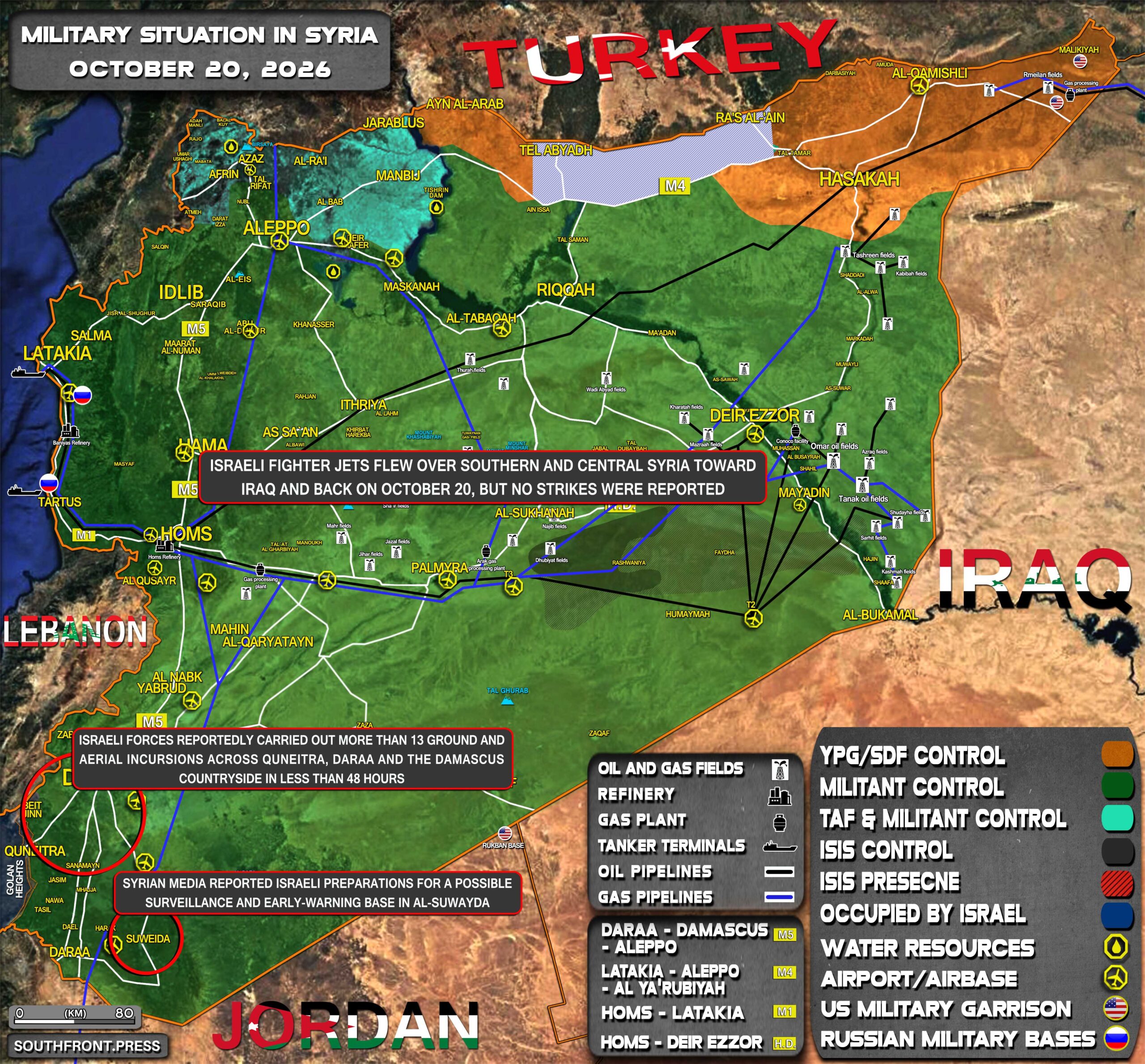
Israeli forces reportedly carried out more than 13 ground and aerial incursions across Quneitra, Daraa and the Damascus countryside in less than 48 hours;
Israeli fighter jets flew over southern and central Syria toward Iraq and back on October 20, but no strikes were reported;
Syrian media reported Israeli preparations for a possible surveillance and early-warning base in al-Suwayda.
Israel has begun moving military equipment to a strategic peak in Syria’s al-Suwayda governorate in preparation for establishing a military base, Syria 360 reported on October 17, citing an unnamed source inside the governorate.
The source said dozens of Israeli military helicopters had transported weapons, equipment and advanced systems to the area over the preceding 72 hours.
Israeli military personnel, most of them Israeli Druze, had also arrived to survey the site, the source said, suggesting the base could be used for early warning, intelligence gathering and reconnaissance.
The site is said to be Tel al-Qulaib, a peak in the Jabal al-Arab highlands southeast of al-Suwayda city. The peak previously housed a Syrian army air defense radar site, and its fortifications reportedly remain intact. A concrete airstrip about 700 meters long lies immediately south of the peak.
The combination of elevated terrain, existing military infrastructure and a nearby airstrip could make the site useful for several military purposes.
Radar equipment could provide early warning of missiles and drones approaching from the directions of Iran and Iraq, while communications systems could support Israeli drone operations farther afield.
The airstrip could also support helicopter operations. Israel operates KC-130H Hercules tanker aircraft capable of refueling helicopters in flight, potentially extending the helicopters’ range for long-distance missions. A forward base there could help support helicopter missions to insert or retrieve special forces in Iran, as well as search-and-rescue operations to recover aircrews during a future conflict.
The reported preparations come amid an escalation of Israeli military activity across southern Syria. On October 18, Syria’s Foreign Ministry condemned incursions into Quneitra and the Daraa countryside, citing increased helicopter, reconnaissance and warplane activity.
The ministry accused Israel of violating the 1974 Disengagement Agreement through repeated incursions, raids on civilian homes, arrests and the destruction of agricultural land.
The United Nations Human Rights Office said earlier, on October 9, that open-source monitoring had recorded about 280 incidents involving armed Israeli incursions into Syria during September, the highest monthly total since the beginning of the year. The reported incidents included raids on homes, movement restrictions, intimidation, arbitrary detentions and damage to livelihoods.
If the reported base is established and used to support Israeli operations against Iran, it could become a target in any future confrontation. Druze factions in al-Suwayda seen as helping Israel could also face retaliation from the Islamic Republic or its allies.
Such a confrontation could work in Damascus’s favor. If local armed factions that helped facilitate an Israeli presence were weakened by retaliation or drawn into a regional conflict, the Syrian government could gain an opportunity to expand its influence in al-Suwayda.
Ukraine has opened its first war-crime case against a ship captain for carrying off its stolen grain. Ukraine’s Security Service and Prosecutor General’s Office have charged the captain of the cargo ship Matros Pozynich with illegally shipping more than 54,000 tons of Ukrainian wheat that Russian forces stole from occupied territory, the Security Service said on Telegram.
Russia has looted grain across the Ukrainian land it occupies and sold it abroad as its own, a trade Ukrainian intelligence puts at more than 2 million tons in 2025 alone. The case against the Matros Pozynich captain is the first time Kyiv has classified a ship captain’s role in that trade as a war crime, prosecutors said.
The captain, a Russian citizen, twice sailed wheat from occupied Sevastopol in Crimea to the Syrian port of Latakia in 2022 and 2023, according to the Security Service. The first shipment of more than 27,000 tons left Crimea in 2022, and another 27,000-plus tons followed in January 2023.
A crime ordered from the top, investigators say
The shipments were no freelance smuggling run. The grain was removed on the decision of the Russian state’s top political leadership, the Security Service stated, in breach of the Geneva Conventions, which forbid pillaging property in occupied territory.
To hide the voyages, the captain periodically switched off the ship’s automatic identification system and transmitted false coordinates, investigators found. He was notified of suspicion in absentia under two articles of Ukraine’s Criminal Code, including the violations of the laws and customs of war. The service said it is working to identify others in the scheme.
One ship in a fleet that feeds the war
The vessel is a single thread in a much larger theft. Russia has taken roughly 15 million tons of Ukrainian grain from occupied territory between 2022 and August 2025 and earned at least $1 billion from it, money that helps fund the war.
Much of it moves through Russian-controlled ports such as Sevastopol, often relabeled as Russian produce or passed between ships at sea to hide its Ukrainian origin. Buyers have included Syria, Egypt, Türkiye, Lebanon, and others, though Egypt has since pledged to stop accepting grain tied to occupied territories.
Israeli military ground raids into southwest Syria continued to happen in growing numbers this weekend, with troops raiding multiple towns and villages in Daraa and Quneitra Governorates. At least four Syrian civilians were reported captured over the course of the weekend’s operations. One was reported captured Saturday during the operations around al-Razaniyah, in northern Quneitra, […]

 Login