❌

Reading view

A Democratic Senate?

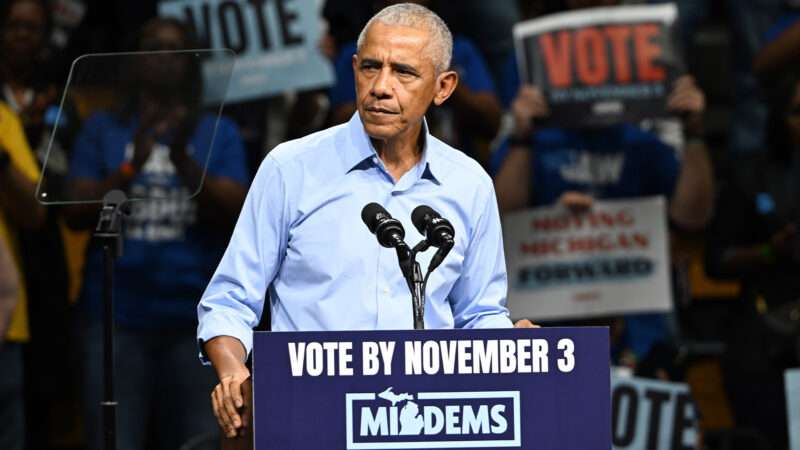
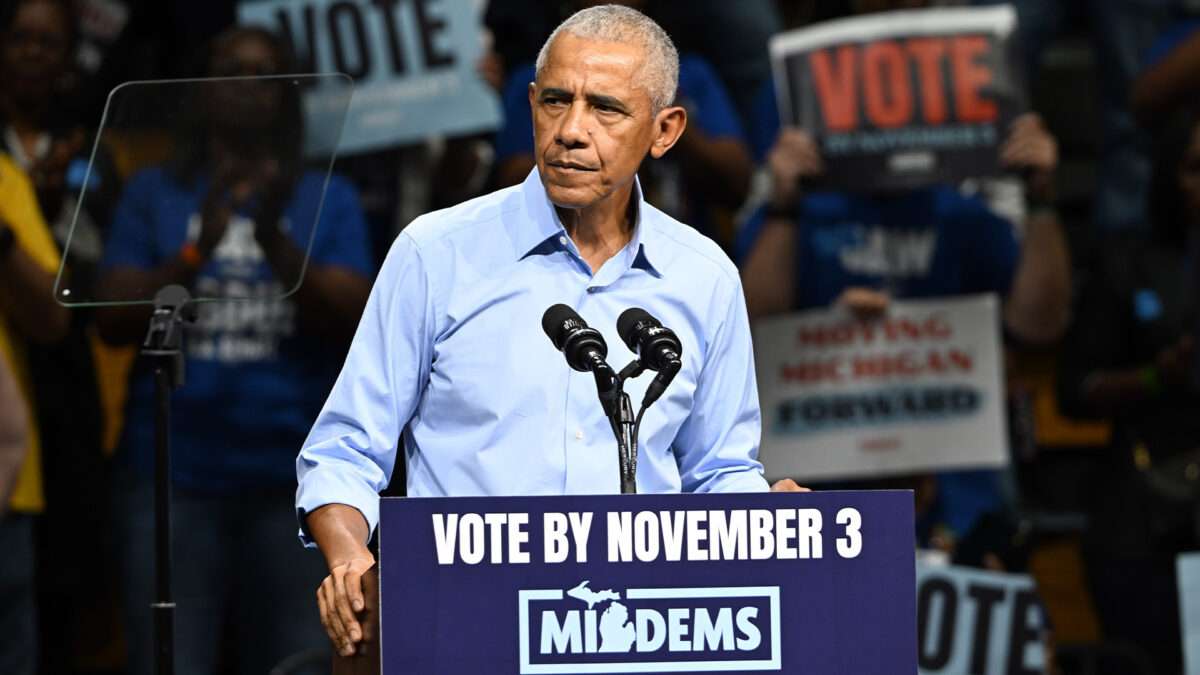
Barack Obama giving a speech supporting the Democrats in the 2026 midterm elections | Kyle Mazza/ZUMAPRESS/Newscom

The House looks pretty likely to go Democrat, but the Senate appears to be more in play. Basically, Democrats need to pick up four seats to get control of it; seven races are considered toss-ups by Cook Political Report as of right now, just a few days before Election Day, but Democrats have leads (within the margin of error) in all of them, despite heavy Republican spending in most.

"If Democrats win all seven races, along with the ones in which they are favored, they would secure their largest Senate majority since the Obama administration," notes The Washington Post. "If Republicans win all seven races, they would maintain their current 53-47 majority in the Senate, picking up a Democratic-held seat in Michigan to offset a loss in North Carolina."

The math is less daunting for Democrats than it was at the start of the cycle. They need three of the six Republican-held toss-ups to reach 51, assuming they also hold Michigan, the only Democratic seat on the list. Michigan looks like the GOP's best shot at going on offense, since Mike Rogers cleared the Republican field without a primary while Democrats slugged it out all through August.

Meanwhile, the rest of the map looks like a list of Republican problems rather than Democratic strengths; make of that what you will. Maine is the only Republican seat up this year in a state Trump lost in 2024; Ohio features Sherrod Brown, who lost his seat by just four points in 2024 while Trump carried the state by 11; and Alaska has Mary Peltola, who in 2022 became the first Democrat to represent the state in the House in half a century. Each of these races is close for its own reasons, but the reasons happen to cut one way this year.

Not included in the list of toss-ups—Alaska, Kansas, Maine, Iowa, Michigan, Texas, and Ohio—are Georgia, where Democrat Sen. Jon Ossoff looks likely to win, and New Hampshire, an open seat that anyone could technically take but that looks likely to go Democrat. Toss-up is merely a description of how close races look right now; earlier in the cycle, Georgia and New Hampshire were considered toss-ups, but Democrats are now favored to win. These things aren't static, of course, and different forecasters think about each race differently. Some of the toss-up races are primarily due to one party—frequently Republicans—running really terrible candidates (such as Ken Paxton in Texas, whose prospects we discussed on this week's Reason Roundtable). Other races have their own specific quirks, like in Kansas, where a Democratic Methodist pastor who is broadly liked (with no voting record to ding) is running against a Republican incumbent, who is facing headwinds related to high diesel prices that have raised the cost of running farm equipment and shipping goods, along with beef import tariffs that have pissed off farmers.

It's always possible pollsters are wrong. But most pollsters surveyed by The New York Times—including Nate Silver and Patrick Ruffini, both former guests on my show, Just Asking Questions—seem to believe Democrats will win both the House and Senate.


Scenes from New York: "After a woman said she was raped at knife point in Central Park over the weekend, the police said on Monday that they had stepped up patrols of the park as they searched for an assailant," reports The New York Times. "The 39-year-old woman told the police that she was jogging on the east side of the park near East 66th Street shortly before 8:30 p.m. on Saturday when a man dressed in black approached her brandishing a knife. He dragged her into a wooded area, raped her and ran off, the police said." This is the latest in a string of crimes in the area, including the murder of a 63-year-old homeless woman who slept in the park, and a 32-year-old woman who was robbed while riding a bike.


QUICK HITS

  • "Flávio Bolsonaro fled Brazil for the US hours after losing the presidential election and being ordered to surrender his passports, Folha de S.Paulo reported citing allies of the conservative senator," reports Bloomberg.
  • Microsoft shrinks headcount.
  • "Fox News is suffering a catastrophic drop in viewership, which has plunged to historic lows just before the midterm elections, according to new data. Preliminary Nielsen ratings obtained by Status ahead of their official release show that the Trump-friendly juggernaut is on track to post its lowest-rated month in total day viewers since December 2023, averaging just 1.1 million total viewers throughout October 2026," reports The Daily Beast. "Among the key 25-54 demographic coveted by advertisers, the outlet is headed for its lowest-rated month in a quarter-century, averaging a paltry 98,000 viewers. The collapse represents a brutal 27 percent drop in total viewers and a 32 percent dive in the 25-54 demographic compared to last October."
  • Subprime mortgages for people with bad credit! How could this go wrong?

.@PhillyMayor Cherelle Parker tells @EmilyRPeck that the city hopes to launch its historic mortgage program "before the end of 2026."

"Imagine getting a mortgage, a 30-year commitment, with no PMI," Parker said, and accessible "with less-than-perfect credit." #AxiosLive pic.twitter.com/DDDYMWBMAL

— Axios (@axios) October 27, 2026

The post A Democratic Senate? appeared first on Reason Magazine.
  •  

Israel Goes to the Polls

Benjamin Netanyahu | Jewel Samad/dpa/picture-alliance/Newscom

Will Bibi survive? Israelis head to the polls today for the first election since the October 7, 2023, attacks. The election is widely seen as a referendum on Benjamin Netanyahu's, or Bibi's, governance. Supporters say the last few years have been a success, as he "seized half of Gaza, dramatically expanded West Bank settlements, decimated Hezbollah in Lebanon and coaxed President Donald Trump into going to war against Iran," per The Washington Post—"all while offering a full-throated defense of Israel against accusations of war crimes and genocide."

But "many of those who seek change have rallied around the bloc led by Gadi Eisenkot, a centrist former military chief who, according to final polls this week, was running slightly ahead of Netanyahu," reports The Washington Post. "Heading a sprawling bloc that ranges from Naftali Bennett, a former prime minister who once managed a West Bank settlement council, to Yair Golan, a retired general known for his dovish views toward Palestinians, Eisenkot has pledged to investigate Netanyahu over his response to Oct. 7, to force the ultra-Orthodox to enlist and to rein in violent settlers in the West Bank." Eisenkot says the war against Hamas has been a failure, since the terrorist group is still in power. He is in opposition to some of the far-right alliances Netanyahu has made and broadly critical of Netanyahu's wartime leadership.

So far, turnout has been extremely high, the highest in 45 years—though the day isn't over yet; at publication time, it's about 3:30 p.m. in Israel. Polls close at 10 p.m. An estimated 70,000 Israelis have returned from overseas to cast their votes.

Here's how Israeli elections work, courtesy of The New York Times: "Every party creates a ranked list of its candidates, and voters choose a party or slate. The leader of the party with the most votes could become the country's next prime minister—though it is not automatic—if that candidate can form a government, but the parliamentary system is complicated and involves extensive negotiations.…No single party has ever won a majority of votes, which means parties must form factions and party leaders try to forge a governing coalition of at least 61 lawmakers. Within seven days of the official election results being announced, Israel's president, who plays a mostly symbolic role, meets with elected representatives of the parliamentary factions. Israel's president, Isaac Herzog, will assign a member of the Knesset—usually the leader of the party or faction that has won the most seats—to form a government." That person gets roughly a month to negotiate with potential allies and form a government; if they fail, another person gets picked to attempt the process.

"If a candidate who has been selected to form a government can propose one, along with a policy agenda," continues the Times, "and their proposal wins a plurality of votes in the Knesset, the government is formally invested, and that candidate becomes the prime minister."

"If neither Netanyahu nor Eisenkot can form a governing coalition in the 120-seat parliament," reports Reuters, "Netanyahu could stay on as caretaker until another election is held. His opponents have managed to wrest him from the premiership only once since 2009, and that took four inconclusive elections in two years. He was back 18 months later." So, Netanyahu seems unlikely to win outright, but likely to still be in charge at the end of all this—very much not a mandate, and something that would probably trigger elections again next year.

Kalshi and Polymarket betting markets seem fairly confident that Eisenkot will emerge victorious; polls are less optimistic.

Who's in charge in Israel, and how much of a mandate they believe themselves to have, matters an awful lot when it comes to American policy in the Middle East; tensions with Iran are still high, and though it's receded from view to some degree, shipping is still snarled in the Strait of Hormuz, with no resolution in sight. Given the complexities involved with forming a government, we're not going to get a clear answer for a while, but we will get some indications over the next few days as to how Israeli citizens are thinking about Netanyahu, his legacy, and the path forward.


Scenes from New York: "Many young professionals in their 30s have reached a breaking point in recent years and moved away in droves to raise families—contributing to an enrollment crisis in New York City's school system," reports The New York Times in an interesting reported piece on people in their 30s struggling to make ends meet and delaying milestones like getting married, having kids, and owning their own places. "Am I entitled to have what my parents had? I'm not sure," said one 31-year-old schoolteacher out in Queens. "But it's hard to know that I can't [have it]."

I don't think these people are totally off base; the tradeoffs are intense right now, with rental costs growing ever more wild. It's a shame most New Yorkers don't seem to understand the relationship between market-distorting policies (like rent control and stabilization) and housing costs getting so out of whack, and increasingly favor handouts (free daycare) to alleviate the strain they feel from the high cost of living.


QUICK HITS

  • DoorDash is in talks to acquire Instacart; will someone please do a wellness check on Elizabeth Warren?
  • "While global tech stocks teeter, in China they have already crashed as lofty valuations collapse under worries about AI demand and curbs on Chinese exports," reports Reuters. "The meltdown, tanking the mainland STAR50 index, of AI and semiconductor leaders by 40% in less than four months ​and vaporising some $480 billion in market value, is an ill omen for wobbly world markets and a dampener on China's efforts at encouraging its savers into stocks to ‌fund the AI boom."
  • "Most classrooms, most of the time, are nonideologically muddling along with a mix of lecture and activities—just like most classrooms, most of the time, are nonideologically muddling along with a mix of phonics and guess-and-bluff reading strategies," writes Kelsey Piper for The Argument on school curricula. "That means that fixing classrooms takes more than bold truth-telling about what works. It's going to take changing how we teach teachers, acquire curricular materials, and measure results."
  • "Clashes erupted in Paris as a mass march drew to a close Saturday, with more than 400,000 people rallying across France over school funding and soaring living costs in a fresh challenge to President Emmanuel Macron," reports the Associated Press. "Police made nearly 1,000 arrests, the government said."
  • Don't miss this week's Reason Roundtable!

  • As for me and my house, we will cook up amazing hockey-themed parties and never let the AI overlords take this from us:

I cannot be replaced by A.I. became I come up with extremely niche and/or ridiculous themes. i.e. Fourth birthday party for my son was "Miracle on Ice, USA vs. Soviets 1980 Olympics at Lake Placid" (we painted the hockey players together, which is why they're, uh, imperfect) https://t.co/P4NvKaIPjy pic.twitter.com/JhwJCTDdYa

— Liz Wolfe (@LizWolfeReason) October 26, 2026

The post Israel Goes to the Polls appeared first on Reason Magazine.

  •  

California's Wealth Tax Could Cost the State $39 Billion

This week, editors Peter Suderman, Nick Gillespie, and Matt Welch are joined by Associate Editor Liz Wolfe to discuss California's proposed 5 percent wealth tax on billionaires, which a Hoover Institution study suggests could ultimately cost the state $39 billion in lost revenue. With wealthy residents already leaving California, the panel examines whether the measure will survive next week's vote, why Gov. Gavin Newsom opposes it, and how public sector unions have helped fuel the state's spending problems.

The panelists then look to France, where mounting unrest and economic stagnation raise questions about the long-term consequences of high taxes, expansive welfare programs, and pension obligations that increasingly burden younger generations. Next, they discuss Venezuelan opposition leader María Corina Machado returning home after 10 months in exile. Then, with the midterm elections next week, the editors examine whether Trump's tariffs, war with Iran, and mounting allegations of corruption will deliver Democrats control of Congress. Finally, a listener asks whether today's democratic socialist movement will ultimately be remembered like the libertarian and Tea Party movements of the early 2010s.


0:00—California's wealth tax proposal

13:02—Will France protests influence America?

22:50—Corina Machado returns to Venezuela.

31:19—Listener question on the DSA

44:40—2026 Midterm elections preview

58:34—Weekly cultural recommendations


Upcoming Reason Events

Reason Versus - Authoritarianism Is a Right-Wing Problem, November 10


Mentioned in the Podcast:

"Will the Wealth Tax Fail?" by Liz Wolfe"France Is a Warning to California's Tax-the-Rich Crowd," by Veronique de Rugy"California's 'Wealth Tax' Could Cost the State $39 Billion," by Eric Boehm"Report: California's Proposed 'Billionaire Tax' Is Based on Bad Research," by J.D. Tuccille"A Wealth Tax Built on Billionaires Who Aren't Really Billionaires," by Veronique de Rugy
"New Book Says Jared Kushner Funneled Money to Middle East Mercenaries. Kushner Denies It." by Matthew Petti"Trump's Tariffs Are Politically Toxic," by Eric Boehm
"The Democrats' Socialist Moment," by Matt Welch
"Family Separation Drama Fjord Is a Haunting Depiction of Unchecked State Power," by Peter Suderman

The post California's Wealth Tax Could Cost the State $39 Billion appeared first on Reason Magazine.

💾

© Illustration: Fatima Ruiz

Matt Welch appears on the left. Liz Wolfe appears on the right. Behind them, an image of Governor Gavin Newsom appears looking concerned in the center. Bold text across the top of the screen reads "TAX THE RICH?"
  •  

Will the Wealth Tax Fail?

Prop 40 | Mohd Izzuan Roslan/Dreamstime

California's experiment: Will California's proposed wealth tax, Prop 40, pass next week? And if it gets passed, will it end up actually costing the state money instead of generating revenue?

The basics: The proposal features a one-time 5 percent tax on people with net worths over $1 billion who lived in the state on January 1, 2026 (with the net worth amount calculated as of December 31, 2026). The idea for the snapshot date is presumably to prevent capital flight once the tax passes. The tax's supporters say the tax's revenues will amount to $100 billion and will fund California's health care system, which need to make up for federal Medicaid cuts.

Seven billionaires, representing 30 percent of the total billionaire wealth in the state, left California before January 1, 2026, when news of the possible tax broke. Peter Thiel, Larry Page, and Sergey Brin are among the deserters. The French economist Gabriel Zucman—an intense defender of the wealth tax—seems committed to the idea that this flight won't matter too much. He argues that while removing those seven brings down revenue estimates to $89 billion, adding in less-prominent small-time billionaires raises revenue to $115 billion.

This is silly. As The Washington Post's Megan McArdle points out, there's no reason to believe those less-famous billionaires would stay put. We have a hard time estimating what the total preemptive flight looks like, and how many billionaires have successfully taken up residency elsewhere.

"Either the tax is annual—and in that case it generates revenue annually, and some billionaires leave," claims Zucman. "Or the tax is one-time—in that case it generates revenue in just one year, and there is no incentive to leave. It can't be both at the same time." Zucman doesn't seem to consider that billionaires have already left, as soon as the idea was seriously floated, thus taking early steps to shield their wealth from the state.

Will it pass? "Likely voters are essentially where they were a month ago," reports Politico, based on recent polling data, "with 46% in favor of Proposition 40 and 43% opposed—despite a recent push by backers of the measure, including Sen. Bernie Sanders, to rally support." Interestingly, "a strikingly high share of registered voters (84%) said they'd been exposed to advertisements or messages about the tax, but a 45% plurality said the communications had not swayed them, and those whose views had shifted were just as likely to be more opposed as more supportive."

There's another complication: On that very same ballot, voters will decide on Propositions 41 and 42, competing measures that could keep Prop 40 from taking effect. Prop 40 will be nullified if either one gets more votes; but Prop 40 will nullify both of them if it gets more votes. Prop 42 would bar new taxes on personal property such as businesses, investments, retirement accounts, trusts, and art collections—things Prop 40 targets. It also bans retroactive taxes, thus making Prop 40 impossible to pull off.

Back in January, Pirate Wires' Mike Solana spoke with a bunch of billionaires who were worried about the tax and making plans to flee, partially out of distrust that the tax would be one-and-done. "Three men I spoke with in the largest billionaire Signal chat said they ran an informal poll, and seventy percent of the chat (around sixty people, not all of whom were billionaires) indicated they would leave the state if the ballot proposition passes," reports Solana. "According to that same poll, around 15% have already left the state."

"There is now real danger in appearing successful in the state of California," writes Solana, "as the far left, imbued with a great deal of power, and benefiting now from several years of wealth scapegoating throughout the mainstream press, attempts to liquidate its perceived enemies in business."


Scenes from New York: I'm fully aboard this train these days, though open to being convinced why I'm wrong:

If you truly *love* American cities, you MUST support strict enforcement of laws against anti-social behavior. Paying bus fares, red light cameras, camping on sidewalks, smoking on trains, off-leash dogs, etc etc

If people want to do whatever they want, that's FINE in the… https://t.co/XU0WQR30yz

— Bobby Fijan (@bobbyfijan) October 26, 2026


QUICK HITS

  • "Brazilian markets are heading for a major rout when local trading begins after President Luiz Inácio Lula da Silva pulled off a stunning comeback to defeat Flávio Bolsonaro, the right-wing candidate that many investors preferred," reports Bloomberg. This will be da Silva's fourth term.
  • Is dynamic pricing on the rise? Customers say yes, but most companies say they're wrong. My thought: Even if it's not currently happening to the degree angry customers claim, it certainly will be big in the future, as online shopping takes over and AI makes implementation easier. Consider the upside, though, noted in this Wall Street Journal piece: "Much current angst is focused on electronic shelf labels, which have replaced the printed labels that dotted shelves at groceries and other stores. Research on digital shelf labels in the U.S. and Europe, where grocers have widely used the technology for more than a decade, found the labels don't lead to surge pricing, in part because price changes are obvious to anyone walking by. Rather, research found, grocers have used the labels to discount goods that are about to expire, reducing food waste."
  • Great Washington Post headline: "Europe is running out of other people's money."
  • President Donald Trump claims the ships passing past Cuba on their way home from Iran will just, uh, handle the situation there. Sure.
  • Interesting:

Striking detail in the big NYT piece on Taiwanese families adjusting to working at the huge new TSMC chip plant in Arizona: their surprise at the lack of rigor in US schools. pic.twitter.com/YkSPzbHCuE

— Alec MacGillis (@AlecMacGillis) October 26, 2026

The post Will the Wealth Tax Fail? appeared first on Reason Magazine.

  •  

New Lows

President Donald Trump | Matthew Kaminsky/Matt Kaminsky/Sipa USA/Newscom

We're two weeks out from midterms, and President Donald Trump's approval rating just hit a new low. Per a New York Times/Siena University poll, "36 percent of likely voters said that they approved of Mr. Trump's performance, while 59 percent said that they disapproved," which makes that the president's "lowest approval rating recorded in any Times/Siena poll." Yikes.

The likely voters say that cost-of-living, the war in Iran, and gas prices are the primary reasons why they're frustrated with the Trump administration.


Ohio's race gets nasty: The governor's race, between Republican Vivek Ramaswamy and Democrat Amy Acton, somehow got even dirtier when a video started circulating, gaining traction earlier this week, showing Acton's estranged mother calling her daughter a "liar."

The ad does not show who made or financed it, and the Ramaswamy campaign was slow to take responsibility for it. But late yesterday, that campaign confirmed that it was responsible for the ad and would spend millions to air it all over the state.

"Amy has a serious problem. She is a liar," said her mother in the video. "She's lied her entire life. My daughter needs help."

"Don't vote for people who lie," continued her mother. "Don't let her become your governor. If you think she'll make your life better, you're fooling yourself. It will only get worse."

The gubernatorial candidate's family history appears to be rather tragic: "Acton's campaign provided extensive documentation, from court records and contemporary reports in local media, that corroborated her account that she and her brother were removed from their mother's home after her second husband, Cledith Arthur, was arrested and indicted in 1978 and charged with rape of 'Amy Stearns being less than thirteen (13) years of age,'" per The Washington Post. It appears that Acton's mother took the side of her husband, not her daughter; Acton's biological father was the one who reported the sexual abuse by the stepfather to law enforcement. Her brother said in a statement that "our birth mother stayed married to Amy's rapist until he died." Amy Acton appears to have no relationship with her mother.

It's not clear why Ramaswamy and other Republicans who've visited the state, campaigning on Ramaswamy's behalf, feel the need to stoop so low. Vice President J.D. Vance, for example, recently implied that Acton is a drunk. The race is extremely tight, but that's still no reason to drag Acton's rape-victim past and family drama into the mix. I wonder whether this ad could have the opposite effect to what was intended: Acton seems impressively resilient in the face of trying circumstances, and Ramaswamy's team just looks rather desperate, trotting out a person who seems to be a terrible mother and an unreliable source to attempt to sink the Acton campaign.

I like Vivek and think a lot of the smears against him are unfair. He is very intelligent and highlights real policy problems. But his latest ad exploiting the abusive mother of Amy Acton disgusts me. This woman was so horrible she lost custody of her at age 12.

— Lee Fang (@lhfang) October 20, 2026

Another possible take: The Ohio voters struggling with high cost-of-living might be put off by all of this; really gross mudslinging at the expense of talking about real kitchen-table issues.


Scenes from New York: "Federal, state and city investigators searched about a dozen adult day care centers in New York City on Tuesday, focused in part on operators who they believe fraudulently billed Medicaid for clients who received no services or were dead, three people with knowledge of the matter said," reports The New York Times. "The searches came as the Trump administration is focusing on investigating accusations of fraud at adult and child day care centers, often underscoring what it says is wrongdoing in Democratic-controlled states. Dr. Mehmet Oz, the director of the Centers for Medicare and Medicaid Services, was with investigators at one or more of the search locations on Tuesday, according to two of the people, who were granted anonymity to discuss a law enforcement matter." I am fully in support of stamping out Medicare and Medicaid fraud and deploying lots of federal government resources to do so.


QUICK HITS

  • "The public is hotly debating whether AI is a normal technology—something that will transform our world like the internet did—or more like the arrival of postindustrial modernity to the Kingdom of Saudi Arabia in the 1950s: something that vaporized a culture overnight," writes Kelsey Piper for The Argument. "The third option is that AI is more like the rise of humanity as seen from the perspective of livestock animals. (In this scenario, AIs are the humans, and we are the animals whose fate will make no sense to us.) Anthropic believes that the second possibility is already baked in, and it's hoping to prevent the third—but its plan for preventing that looks more like hope and guesswork than something we should trust it with." I agree with pretty much every worry Piper expresses in the piece.
  • "President Donald Trump said he has committed more than $400 million to help Republicans in the midterms, including $300 million already spent on advertising, contacting voters, holding rallies and other efforts," reports The Washington Post. Republicans seem to believe you can just outspend and that you don't necessarily need to draft compelling candidates. Interesting theory.
  • The Wall Street Journal has a good piece on Anthropic's draft prospectus ahead of its possible IPO next month.
  • The expats who fled America regret it.
  • The welfare state as it currently stands should be dismantled:

In DC, a family with a housing voucher can rent a 3-bedroom apartment for up to $5,301, which is significantly higher than the market rent in even the most expensive DC neighborhoods. pic.twitter.com/CwnYwjItA4

— Kevin Corinth (@kevincorinth) October 20, 2026

The post New Lows appeared first on Reason Magazine.

  •  

Will Ohio Voters Buy Republicans' Pitch?

Jon Husted | Bill Clark/CQ Roll Call/Newscom

Can Republicans just spend their way to success in Ohio? "Republicans have bombarded Ohioans with ads with $19 million spent on competitive races through Oct. 12, intended to sell voters on the tax law that had been called the One Big Beautiful Bill," reports The Washington Post. "But the message is struggling to connect with voters amid anxiety over tariffs and the war with Iran, which have pushed up prices for everyday products. The ad blitz, the most spent on the topic in any state with competitive races, is aimed at bolstering vulnerable GOP candidates in a state that was considered safely Republican for the better part of the last decade."

Republicans in states across the Midwest (and the country) have experimented with distancing themselves from the Trump administration and its agenda; it's hard to know if this strategy will prove successful, or if it's just too little, too late. In Ohio, though, Republican candidates are mostly staying close to Dear Leader.

Sen. Jon Husted, a Republican, is running for U.S. Senate against Democrat Sherrod Brown in what looks to be an extremely tight race; ads claim Husted has "supported ending taxes on tips, overtime and Social Security, plus a $200 million investment in rural hospitals," trying to tie him closely to President Donald Trump's agenda. But it's really not clear whether this type of pitch will be enough to make voters forget about tariffs and inflation, the war in the Middle East and gas prices. A New York Times/Siena poll found that 79 percent of likely Ohio voters disapproved of Trump's handling of gas prices. It's hard to sell people on a tax cut when they're paying a different tax, in the form of tariffs, every time they go to the store; Ohio voters might not be so easily swindled.


Gun laws in Oregon: In the aftermath of the tragic shooting at an elementary school in Bend, Oregon, where a 16-year-old killed three little kids and one teacher, some parents of elementary schoolers there are asking what laws can be changed.

But "Oregon earns high marks from gun safety advocates for its firearms laws," notes The New York Times. "Everytown for Gun Safety, one of the nation's largest gun violence prevention organizations, ranks Oregon 12th in the country for the strength of its laws, citing recent legislation tightening storage requirements, banning untraceable 'ghost guns' and prohibiting devices that can convert semiautomatic firearms into machine guns." Gifting laws are pretty lax, though, and that might be what happened here: The 16-year-old's mother seems to have been the one who purchased the Maverick 88 12-gauge pump-action shotgun, so it's possible she either gifted the gun to her son or that he stole it from her. "Decades ago, Oregon lawmakers made an exception to gun laws that allow parents to give rifles and shotguns to minors. In many areas of the state, as in other parts of the American West and South, it's a rite of passage for a young person to receive a weapon for hunting or target practice."

There's no law that can really prevent theft of weapons, especially when the thief is a teenager living inside the home where the gun is stored, and there's no law that can prevent parents from foolishly gifting guns to teenagers or young adults whom they've misjudged as capable of handling the responsibility. These are terribly unsatisfying realities.

Prosecutors could, of course, attempt to try the parent for the crimes of their teenager. They "could consider charges ranging from reckless endangerment to manslaughter or criminally negligent homicide, a felony punishable by up to 10 years in prison," continues the Times. "But that would require evidence of more than just a parent's awareness that a child was troubled. Prosecutors would have to establish that the mother disregarded—or, in the case of criminal negligence, failed to recognize—a substantial and unjustifiable risk."


Scenes from New York: "Mayor Zohran Mamdani announced on Monday that New York City will expand free child care for 2-year-olds to Staten Island and across the Bronx as the city moves to add 10,000 seats next school year," reports The New York Times. Here's why that won't work:


QUICK HITS

  • Something juicy for you, readers, since I too frequently subject you to my Catholicism. Let's switch it up: "I'd been thinking about turning down the speed on my vibrator for a long time, but I'd considered my affliction personal, not society-wide. Now it was dawning on me that the problem wasn't simply mine. Women are being sold egg-shaped suction devices in the pages of New York magazine, and BookTok influencers pair with sex-toy companies for promotional collabs. Yes, there is a bookmark that doubles as a vibrator," writes Sarah Hepola for The Atlantic. "Does this consumer game of one-upmanship amid the mainstreaming of vibrators even matter? There are too many varieties of women's razors, too, and I don't care. But what worries me is how this points in the direction in which so much of modern life has been barreling: self-pleasure, self-love, self-care, self, self, self.…Like so much of our day-to-day lives, getting off is becoming more efficient, easier, faster. But has it gotten better?"
  • "Next year, I will give one of my SpaceX shares to every kid in America," wrote Elon Musk on X yesterday. "This will be the first of many."
  • "Mahmoud Khalil, the Columbia University graduate arrested last year by Immigration and Customs Enforcement agents amid campus protests, appealed to the Supreme Court on Monday in an attempt to prevent his deportation," reports The New York Times. "Khalil, a legal permanent U.S. resident who is married to an American, became an early and high-profile example of President Trump's crackdown on pro-Palestinian demonstrations on college campuses."
  • Is California's new billionaire tax a net revenue loser?
  • Play the discretionary review computer game! See how far you get as a developer in San Francisco!

The post Will Ohio Voters Buy Republicans' Pitch? appeared first on Reason Magazine.

  •  

France Burns

Protests in France | Abaca Press/Corsan O/Le Parisien/Abaca/Sipa USA/Newscom

Is this really about cost of living? Over the weekend, the civil unrest that had been at a simmer boiled over in cities all over France. Over 1,000 police officers were injured, with seven seriously injured. More than 2,400 people were arrested.

"Rioters…attacked city halls from Lille in northern France to Marseille in the south, where they broke into the local government headquarters and tipped over a bust of Marianne, a symbol of the French Republic," reports The New York Times. "A fire destroyed a tourist office in Lyon, and 1,500 shops were damaged or looted nationwide, according to Alexandre Bompard, head of the French federation of commerce and distribution, who estimated that the cost of repairs could run into hundreds of millions of dollars."

"They came prepared," claimed the French journalist Paul Amar on CNews. "They had the addresses of town halls. They had addresses of Jewish shop owners. In a street in Marseille, all businesses owned by Jews were set on fire. Businesses run by Muslims weren't." The Jewish Community Protection Service has disputed such claims.

Reason's Matt Welch has a good write-up of how the violence and destruction have altered Lyon, Paris, Marseille, and Limoges, where the city hall was burned and collapsed.

Ces images doivent faire le tour du monde. Nos voisins doivent savoir.

Lyon l'une des plus grandes villes de France le 17 octobre est l'une des villes les plus touchées.

A Lyon, aucun commerce n'a été épargné, oui aucun commerce n'a aucun épargné vous avez bien lu. Toutes les… pic.twitter.com/15dG6QB5lK

— Guillaume Herblot 🎖 (@Guigz75116) October 18, 2026

What was nominally about cost of living and budget issues appears to have expanded far beyond those. ("Free Palestine" and "ACAB" graffiti have been seen everywhere.) President Emmanuel Macron has blamed far-left protesters, saying they have taken advantage of the situation. Far-right leader Marine Le Pen has blamed the "Macronist administration that is out of steam, exhausted, and disoriented."

It's not clear to me how the possibility of that retirement age needs to be raised will in any way be changed by, say, donning black balaclavas and breaking into the Louis Vuitton store:

French rioters loot Louis Vuitton store located just 2 KM away from the Élysée. pic.twitter.com/cnb5aWczcN

— Drew Pavlou 🇦🇺🇺🇸🇺🇦🇹🇼 (@DrewPavlou) October 17, 2026

Here's how it all started: Since September 18, lycée (or secondary-school) students have held demonstrations, starting in the Paris suburb, Créteil. The students said the Education Ministry had neglected them—not enough resources, not enough teachers, and overcrowded classes. (The original demands were met and that strike ended, but not before sparking a wider movement.) This was all happening concurrently as the government was deciding its budget, and public-sector strikes were beginning. High social-program spending, an aging population, and high debt-to-GDP, plus an ever-increasing cost-of-living is resulting in a math problem that politicians have no real way out of except by raising the retirement age. Over the last few years, the French have had several hissy fits over the possibility of that happening.

Lawmakers from left-wing party La France Insoumise were at the first blockade on September 21, which has sparked questions about whether the party helped fuel the protests ahead of April's presidential election. I take all this—the disparate movements, the sheer volume of violence, the political-party involvement, the elections coming up—to mean that what started as an education-quality/cost-of-living protest has been used to lodge all kinds of grievances, and is attracting allies with an unquenchable thirst for violence and destruction.


Scenes from New York: "Darrel Rodriguez, 26, was shot on Saturday in the 7th Avenue Station on 53rd Street, a few blocks from Times Square, the police said. An unidentified man approached Mr. Rodriguez on the northbound E train platform, drew a gun and shot him once in the chest, they said," reports The New York Times. The man who shot Rodriguez was wearing a full balaclava-style face covering, and has not been found by the cops.

Philadelphia enacted a ban on such masks back in 2023. Just anecdotally, I've seen a lot of them in New York, but not by people trying to stay warm in the cold—these types of masks are used by people hopping turnstiles, stealing from bodegas, and more. Some bodega owners have started posting signs on their doors saying masks aren't allowed, since it's become such a problem.

"As of Oct. 11, there have been 1,697 crimes in the transit system since the start of the year, 27 more than the same period in 2025," reports The New York Times, citing Police Department figures.


QUICK HITS

  • Inside the property-tax rebellion.
  • In Texas, Ken Paxton appears to have lost the support of suburban women, according to The Washington Post.
  • "Jewish life in the Emirates has grown quieter and less visible," notes The New York Times. "Religious symbols have disappeared, and gatherings have moved into private. Many have become more guarded about their online presence and their willingness to speak to the media. Some are reconsidering how openly to identify themselves as Israeli or Jewish, while others weigh whether they can still build a life in a nation they once considered a haven."
  • Can you really see everything?

YOU CAN SEE EVERYTHING is doing a public service if it gets the general population to question why, precisely, folks lend so much credence to documentaries as vehicles of truth. https://t.co/n7CHwkmDmr pic.twitter.com/IHUvEbKECl

— Sonny Bunch (@SonnyBunch) October 18, 2026

  • "I recently attended a meeting of the Democratic Socialists of America, where I officially enrolled as a member. Though I was new to the party, I put forth a number of proposals, many of which were met with considerable enthusiasm and, I'm happy to report, have now been incorporated into their manifesto," writes Larry David in a satirical essay for Airmail. "We contend that the only way anyone can be rehabilitated is through the simple act of love. When the D.S.A. takes over, it will be our policy to close the jails and release all prisoners. Once released, the former prisoners will continue to walk around in their orange jumpsuits, the easier to spot them. People will be encouraged to give them a pat on the back, offer some words of encouragement, and maybe even get them to open up about their crimes. Imagine how upsetting it must be to know you've taken a life! To err is human, to forgive, divine. With empathy and compassion, it's easy to see a day when these former convicts will be contributing to society in a very meaningful way." It's not that funny of an essay, but I think it's great for more people to be talking about how asinine DSA ideas are.

The post France Burns appeared first on Reason Magazine.

  •  
❌