The Tropical Forest Forever Facility (TFFF), which was created to fund long-term conservation of tropical forests, recently received a $500-million pledge, over 10 years, from the Netherlands, a significant boost for forest conservation. The Netherlands announced the pledge in an Oct 26 press release and estimated that the TFFF has the potential to protect 800 to 900 million hectares (2.0 to 2.2 billion acres) of tropical forest, an area roughly 200 times the size of the Netherlands. The long-term goal is to create a $125 billion endowment fund for the TFFF. Current pledges add up to roughly $7.8 billion. The TFFF was launched by Brazil at the 30th U.N. Climate Change Conference in November 2025. It’s a partnership between tropical countries that need funding to protect their forests, investors and donor countries that want to address climate change and biodiversity loss through mitigating deforestation. The collaboration includes the private sector, Indigenous Peoples and Local Communities, the World Bank, scientists, economists, finance experts, and civil society partners. The TFFF is modeled like a sovereign wealth fund in which governments and private investors contribute to an investment fund and those investment gains, or profits, are then distributed to tropical countries to keep their forests standing. The hope is that predictable revenue from the TFFF will incentivize permanent conservation of forests over unsustainable development including logging, mining and ranching. Forest conservation is monitored using satellite imaging and scientific monitoring protocols to provide transparency and ensure forests are being protected. However, the TFFF has…This article was originally published on Mongabay
This is an edition of The Atlantic Daily, a newsletter that guides you through the biggest stories of the day, helps you discover new ideas, and recommends the best in culture. Sign up for it here.
One fundamental truth of politics is that ultimately all voter decisions come down to money. That’s why Dwight Eisenhower blew out Adlai Stevenson in 1956; it’s what James Carville meant when he declared, “It’s the economy, stupid,” in 1992; and it’s the reason that Joe Biden tried in vain to convince Americans that they were doing better than they believed during his presidency.
This was also why some Democratic politicians and strategists counseled candidates not to place Donald Trump and his scandals at the center of their campaign. Better to focus on “kitchen table” issues, such as inflation and housing costs, they argued. To a great extent, this seems to have worked. Economic worries have been a consistent theme throughout the midterms, and Democrats appear poised to fare well. They’ve been helped by Trump, who has not only dismissed worries about affordability as a “hoax,” but has also gone out of his way to worsen inflation by launching a war in Iran. I wrote just last week that the economy explained GOP struggles.
Yet an interesting thing has popped up in opinion surveys over the past couple weeks. A Fox News poll finds that corruption is the top issue for voters, edging inflation, gas prices, and health care. CNBC gets the same result: “Voters are now more concerned about government corruption than any other issue, including high grocery and gas prices, according to the final CNBC All-America Economic Survey.” TheFinancial Timeshas similar findings: “About 69 per cent of registered voters, and almost 50 per cent of those who voted for the president in 2024, said they were ‘very’ or ‘somewhat’ concerned about ‘corruption, self-dealing or conflicts of interest’ in the Trump administration.”
The idea that the economy alone explained Trump’s unpopularity was never entirely convincing. He has almost always had poor approval ratings, even when presiding over a strong economy. He didn’t win the popular vote in 2016; House Republicans were shellacked in 2018, when he made the election about him; he lost in 2020; and the GOP underperformed in 2022, under his influence. He was able to win only in 2024, when the elections centered on voters’ views of the Biden presidency. One big reason for these repeated voter rejections is the miasma of scandal that follows Trump wherever he goes. “When elections are clearly about Trump and MAGA, MAGA will lose,” Michael Podhorzer, a progressive strategist, told me in 2022.
Still, this finding is reassuring about voters’ discernment. My colleague Anne Applebaum has been foremost among many observers who have deemed this the most corrupt presidency in U.S. history. Even as the president and his family have made billions from his office, no single story seems to have broken through: no Teapot Dome, no Watergate, not even a Whitewater. The new polls on corruption, combined with Trump’s steadily declining favorability, suggest that rather than any single news story producing an inflection point—like the swift turn on Joe Biden after the chaotic withdrawal from Afghanistan—voters have just been steadily souring on the president, with corruption as one main reason.
(It’s worth noting that, although the FT poll specified that Trump voters are concerned about corruption within the administration, corruption also tops lists because it means different things to different voters. Trump supporters who say they are concerned about “corruption” could be referring, for example, to “deep state” conspiracy theories.)
The polling around corruption is also an indication of the success (believe it or not) of much-maligned Democratic messaging. In February, Senator Jon Ossoff began speaking about “the Epstein class,” referring to the then-recent release of materials related to the late sex offender, which sketched a clique of wealthy, powerful people emailing and socializing around the globe. “They are the elites they pretend to hate,” Ossoff said. “Trump was supposed to fight for the working class; instead, he’s literally closing rural clinics and hospitals to cut taxes for George Soros and Elon Musk.” Democrats have been using similar lines ever since.
In making “corruption” a rallying cry, Democrats have found a way to yoke together a range of different stories, effectively sidestepping any division between economic issues and Trump scandals. It’s a big enough trend to fit any number of developments: Trump’s promotion of AI and data centers, despite wide public skepticism; his focus on projects such as the White House ballroom, which is funded by donors, many of whose identities the administration hasn’t disclosed, and an arch in Washington, D.C.; his work to undermine elections. His policy toward Ukraine appears influenced by possible business ventures in Russia. His Iran war was encouraged in part by Middle Eastern allies with whom Trump family members have business relationships. Trump seems determined to help the Democrats out by boasting about oil-company profits at a time when Americans are upset about the cost of filling up their vehicles. Republicans have also bolstered the case with nominees such as Ken Paxton, a one-man alleged-graft spree.
If an anti-corruption message does carry Democrats to victory in the House, and perhaps in the Senate, it will also point to how they might use Congress over the next two years. Even if they win both chambers, they will have little ability to enact policy—including actions that might help bring prices down. But a House majority alone would have investigatory power, and could use its reach to delve into Trump-administration actions that threaten both rule of law and voters’ pocketbooks.
At least 68 people were killed and dozens more injured when a high-speed passenger train rear-ended another train this morning in the province of Toledo, Spain, causing a derailment. Spain’s transportation minister said traffic controllers had inexplicably instructed the train to continue despite another train being stopped farther along the tracks.
Israel appears to be headed for a deadlock after its parliamentary election; neither Prime Minister Benjamin Netanyahu nor his main rival, the former military chief Gadi Eisenkot, secured a clear path to a governing majority. With most votes counted, Netanyahu’s bloc is projected to win 53 seats, the opposition 48, and Arab parties a record 19, complicating efforts to form a coalition.
The Federal Reserve voted to leave interest rates unchanged despite inflation rising to 3.7 percent last month, driven in part by higher energy prices. Two officials dissented in favor of raising rates, while Fed Chair Kevin Warsh said the central bank needed more economic data before deciding whether to increase rates.
Evening Read
Elizabeth Renstrom for The Atlantic
How American Girl Doll Lost Its Way
By Hillary Kelly
In the early 1990s, when I was in elementary school, a fancy catalog would arrive in the mailbox of our 1950s split-level in Philadelphia four times a year, and I’d hurry to my room to pore over its elaborate spreads. Tea caddies, Windsor chairs, writing quills, ice-cream churns. We didn’t have any antiques in our home, but the lure of the past was so strong that sometimes my sisters, five and seven years older than me, crammed onto my bed to dog-ear the pages too. Most of all, we looked forward to checking in with the girls arrayed there, whose stories we knew so well: Samantha, Molly, Kirsten, Felicity, Addy, and, later in the decade, Josefina.
They were the American Girl dolls, preadolescents just slightly older than me, and I was enthralled by the pictures of their period dresses, tiny school supplies, and exotic waxed lunch foods. My own doll was the farm girl Kirsten Larson, a Swedish immigrant to 1850s Minnesota. She had come in a burgundy box, with a slim book titled Meet Kirsten tucked in beside her. I promptly begged for the five other Kirsten books; the historical-fiction series followed the same pattern for each doll, ushering her through a year’s worth of life events, tailored to her personality and time and place. I remember playing with Kirsten in the backyard and having her trace out symbols in the dirt, just as she did with her new friend, a Dakota girl called Singing Bird, in the second book, Kirsten Learns a Lesson. To have such a doll was to own a whole world and the narratives within it …
Yet as American Girl’s 40th anniversary arrives, the brand finds itself in something of a midlife crisis.
Illustration by Jonelle Afurong / The Atlantic. Source: Edward Berthelot / Getty.
Explore. After becoming a mother, Lily Meyer went on a hunt for comfortable, stylish pants—and stumbled, she writes, on a uniform for today’s cool mom.
Esposito talks their new film, 'The Only Living Pickpocket in New York,' and outlines the 'Breaking Bad' prequel he's already conceived in his head, 'The Rise of Gus.'
Ukraine's 3rd Army Corps declared victory two weeks ago
But the corps' Operation Vivaldi may continue
It's possible 3rd Army Corps troops are already crossing the Zherebets River
Starting in May, Ukraine's 3rd Army Corps began exploiting gaps in Russian lines just north of Sloviansk in eastern Ukraine's Donetsk Oblast. Five months later, the corps and its supporting drone units had cleared Russian troops from 277 sq km of northern Donetsk, inflicting what the corps says were 8,000 Russian casualties and pushing the Russian 20th and 25th Combined Arms Armies back across a key terrain feature: the Zherebets River.
On 14 October, the 3rd Army Corps declared victory in its Operation Vivaldi. "Four seasons of Vivaldi are over. But the music plays on," the corps wrote on Telegram.
It was unclear at the time what the corps meant. Its commander, Brig. Gen. Andrii Biletskyi, has since been seconded to lead Ukraine's new Center Group of Forces. But it's clearer now. According to at least two observers, Ukrainian troops have continued attacking along the Zherebets River—and have even crossed the river at several points.
Map: Euromaidan Press
If true and confirmed, the crossings could ratchet up the pressure on the battered Russian 20th and 25th Combined Arms Armies following their hasty and chaotic retreat from their former salient north of Sloviansk. The Zherebets should have been a natural defensive barrier for the Russians.
Sheltering on the river's eastern bank, the Russians could have rested, reset, and reinforced in preparation for a renewed offensive next year. But if the Ukrainians keep attacking, rest might be impossible. And that could force the Russians to rethink any plans for a fresh push toward Sloviansk and neighboring Kramatorsk, the last two big free cities in Donetsk.
But an extension of Operation Vivaldi isn't without risk for the 3rd Army Corps. If the corps pushes too far, too fast across a difficult obstacle, it could expose itself to counterattack.
Ukraine's "Vilvadi" counteroffensive in the Lyman direction has not stopped, despite claims to the contrary.
Ukrainian forces have made new advances in several different areas over the last couple of weeks, crossing the Zherebets River onto its eastern bank at multiple different…
Ukraine's Vivaldi counteroffensive in the Lyman direction "has not stopped, despite claims to the contrary," the mapping account AMK Mapping explained on Monday after noting possible Ukrainian forces on the eastern side of the Zherebets in recent weeks. "Ukrainian forces have made new advances in several different areas over the last couple of weeks, crossing the Zherebets River onto its eastern bank at multiple different locations." AMK Mapping also noted that many Ukrainian assaults over the past month had been repelled and that casualties were likely rising.
AMK Mapping isn't alone. On Monday, mapper Suriyak also logged Ukrainian troops on the far side of the Zherebets in three key settlements: Makiivka, Novosadove, and Terny. "They are establishing a significant bridgehead," Suriyak wrote.
The possible Ukrainian river crossings could defy recent expectations. "The Ukrainians have continued their push and advancement toward the Zherebets River," mapper Clément Molin wrote on 20 October. "They have reached it at several points, and Russian forces no longer control any territory west of this river—with the exception of the forest east of Lyman."
Ukrainian-Russian war. Day 1700-1704: Situation on Luhansk front: During the last two weeks, Ukrainian army has managed to secure new positions on the western bank of the Zherebets River, including the south of Makiivka and the rest of Novolyubivka. However, military… pic.twitter.com/zfi1Txv3eA
But Molin didn't expect the 3rd Army Corps to force the river, a risky maneuver under the best of circumstances. "Despite various rumors, I have not been able to confirm that the Ukrainians have actually crossed the river," Molin wrote.
Instead, he expected the Ukrainian corps to do what the defeated Russian field armies were trying to do: consolidate in new positions and get ready for the next round of major fighting, potentially next year. "For the time being, I believe the Ukrainians will focus on consolidating their gains and adopting a defensive posture."
If indeed the 3rd Army Corps has crossed the Zherebets, it's a possible indication that the corps still has some combat power in reserve—and is eager to prolong its momentum for as long as possible, even if that means heavier losses in risky river crossings.
A major clash could occur if and when the 3rd Army Corps tries to seize full control of Terny, which anchors the Russian line on the east bank of the Zherebets. Two years ago, Terny was the site of intensive fighting as Russian forces fought their way across the Zherebets on their long march toward Sloviansk. That battle was a costly victory for the Russians as they sent mechanized column after mechanized column across a drone kill zone toward Terny.
Explore further
Starlink helped Ukraine pull off Operation Vivaldi. Now Starlink could help Russia take the ground back
The worst outcome for the outnumbered Ukrainian troops in northern Donetsk may be a mirror image of the Russian march through Terny in 2024. Yes, the Russians eventually captured Terny and secured a bridgehead on the western bank of the Zherebets. But the Russians overextended as they kept pushing toward Sloviansk, roughly 40 km to the southwest of Terny.
It's that overextension that afforded the 3rd Army Corps the opportunity to counterattack and roll back the hard-won Russian gains. To preserve its own recent victory on the western side of the Zherebets, the 3rd Army Corps may want to choose caution. Ukrainian forces "need to organize a coherent and solid defensive line," Molin advised.
That may mean not attacking across the Zherebets—despite the temptation to do so.
The Supreme Court's June decision in Wolford v. Lopez prevented the obliteration of the right to bear arms in five States, holding that governments may not make carrying a licensed handgun presumptively illegal almost everywhere. 609 U.S. 185 (2026). Important as the result is, perhaps of even greater significance is how Wolford clarified Second Amendment doctrine. According to Wolford:
Determining whether a challenged law falls within the "plain text" of the Amendment is much simpler than some lower courts and gun control advocates have claimed.
Modern gun control laws do not always have to be justified by analogies from past practices, but analogies cannot be based on oddities and outliers.
Racist gun control laws from the past, which were long ago repudiated by constitutional amendment, are not valid precedents for infringing the rights of modern Americans.
This essay will also discuss the Hawaii Attorney General's argument that only a weak version of the Second Amendment should apply in the Aloha State. And the argument that Hawaii's "Vampire Rule" to prohibit licensed carry throughout the State did not even implicate the Second Amendment.
The "plain text" of the Second Amendment
In a constitutional case, the court must decide if the challenged government action involves a constitutional provision. Often the issue is simple; for example, a public meeting about a political controversy is an example of "the right . . . to assemble."
In edge cases, judges may have to decide how literally to read the text. For example, the First Amendment protects "the freedom of speech," and while Justice Hugo Black was often absolutist in his protection of literal "speech" (saying words out loud), he disagreed with Supreme Court majorities that gave "freedom of speech" protection to conduct. E.g., Cox v. Louisiana, 379 U.S. 559, 578 (1965) (Black, J., concurring in part and dissenting in part) ("Picketing, though it may be utilized to communicate ideas, is not speech, and therefore is not of itself protected by the First Amendment.").
For the Second Amendment, the textual inquiry is, "When the Second Amendment's plain text covers an individual's conduct, the Constitution presumptively protects that conduct."New York State Rifle & Pistol Assoc. v. Bruen, 597 U.S. 1, 24 (2022).
Unfortunately, some lower courts did not take the "plain text" language seriously, and began importing all sorts of rules into the plain text determination. For example, the "plain text" of "the right of the people" was said to require proof that the individuals were "law-abiding" and "responsible." The plain text of "Arms" was said to require proof that the arms in question were frequently "used" (such as gun being fired, or a knife being used to cut) for self-defense. I described some of the misapplications of "plain text" in a 2024 post, How Some Courts are Evading Bruen by Changing its Rules: Lower Courts evading the "plain text" of the Second Amendment.
The Wolford Court showed that the plain text inquiry is not nearly so complicated as some of the lower courts had claimed. In fact, there are just three simple questions:
"First, does the law apply to 'the people'—which is to say, to 'all members of the political community'?"
"Second, does it concern any form of 'Arms,' i.e., any weapon customarily used for offensive or defensive purposes?"
"Third, does the law place any restrictions on either the 'keep[ing]' (i.e., possession) or the 'bear[ing]' (i.e., carrying) of arms?"
Question 1: Because the Second Amendment guarantees "the right of the people," the court must ask if the law applies to "the people"— that is, to members of the American political community. The Court here contradicts the notion of some lower courts that "the people" excludes various subsets of the American people — such as persons under 21 years old, or persons who have been convicted of a crime. While some of the American people can be restricted in their Second Amendment rights, all Americans start with the right, and it is up to government to justify the deprivation. The justification, however, comes later in a case, and is not part of the plain text inquiry.
Question 2: The class of "Arms" covered by the plain text is very broad: "any weapon customarily used for offensive or defensive purposes." Again, this is the plain-text step only. Just as some members of "the people" may lawfully be disarmed, some weapons (e.g., machine guns) may be found not to be protected by the Second Amendment right. Any determination that particular persons or arms fall outside the Amendment's protection comes later in the case, not in the plain-text inquiry.
The Wolford Court's rule implicitly rebukes some lower courts that had ruled that "Arms" in the Second Amendment's plain excludes all arms related to military arms. Or that "Arms" includes only weapons that the challengers prove to be frequently used for self-defense against criminal attacks in progress.
The term "customarily" does not mean "most often." For example, the number of times that handgun triggers are pressed for target shooting competitions vastly exceeds the number of times that handguns are fired at criminal attackers.
Question 3: As for "any restrictions" on "possession" or "carrying" of arms, some lower courts may continue their current very narrow readings, holding that laws such as bans on gun stores do not implicate the Second Amendment's plain text at all — even though acquiring arms is a prerequisite to possession and carry.
The Wolford majority found that Hawaii's Vampire Rule easily passed all three questions. The law affected American citizens with Hawaii carry permits, and those Hawaiians are among "the people." The law applied to carrying handguns, which are customarily used for defense. And the law made it pervasively illegal to carry licensed handguns in public.
Guidance on analogues
According to Wolford:
"If a challenged law falls within the plain text of the Second Amendment, it is presumptively unconstitutional—which means that it may violate the preexisting right that the Amendment codified. But because that right was not in every way coterminous with the Amendment's literal language, further analysis may be needed. Specifically, the relevant government—federal, state, or local—may be able to show that its challenged law did not infringe the historical understanding of the codified right."
"A variety of sources, including scholarship, may aid this inquiry. But often, the best evidence may be what Bruen called historical analogues. These are old legal rules from which a court may draw a strong inference that the modern law at issue is consistent with the codified right. A party defending against a Second Amendment claim may rely on a single analogue or a group of analogues." (citations omitted).
Building on and clarifying Bruen's discussion of historical analogues, the Wolford Court explained that Bruen had "identified three important inquiries that courts should undertake in evaluating proffered analogues."
"The first is the number of jurisdictions in which they were adopted. . . . When we assess whether a challenged law is consistent with the right the Second Amendment codified, we seek the general understanding of that codified right at the relevant point in time. An outlier legal rule adopted in a few locales is not enough."
"The second is the extent to which they were well-accepted. This acceptance may be express, as when judicial decisions explicitly acknowledged the rule's legality. Or the acceptance may be tacit, as when a restriction on the keeping or carrying of arms was 'open, widespread, and unchallenged.'" (Quoting Bruen).
Inquiries one and two add some specificity to the Bruen rule of "a well-established and representative historical" analogue.
"The third is whether any analogue or collection of analogues is 'relevantly similar' to the modern law."
Determining whether an analogue is "relevantly similar" requires consideration of "how" it restricted the keeping or bearing of arms. "And a court must also consider 'why' the analogue restricted the keeping or bearing of arms—that is, whether its rationale was similar to that of the new law."
As seen in other cases, the "how" and "why" inquiries often involve "who." For example, some 18th- and 19th-century surety laws required an individual to post bond for peaceable behavior if the individual had been found by a court to be potentially dangerous. In United States v. Rahimi, the Court's majority found surety laws to be relevant analogues for modern laws disarming persons who have been issued a domestic violence restraining order based on an individualized judicial finding of danger to a past or present domestic partner. 602 U.S. 680 (2024). In Bruen, however, the surety laws were not relevant analogues for state laws preventing almost everyone from carrying firearms.
A standard argument in favor of originalism is that while it does not conclusively resolve every issue, it constrains judicial decisions more than do alternative methods. In Wolford's words, "Making this determination is far more disciplined than the 'interest-balancing,' 'judge-empowering' standard that Heller emphatically rejected, but it is not mechanical." The Court added, "It undeniably necessitates an exercise of judgment."
In Wolford's words, "Making this determination is far more disciplined than the 'interest-balancing,' 'judge-empowering' standard that Heller emphatically rejected, but it is not mechanical." "It undeniably necessitates an exercise of judgment," the Court added,
For example, in the three cases where the Court has applied Bruen and examined analogies, the Court was unanimous in one, and divided in two others: United States v. Hemani, 146 S.Ct. 1677 (2026) (9-0) (historical vagrancy, civil-commitment, and surety laws concerning habitual drunkards who had lost the capacity for self-control were inadequate analogues for prosecuting a gun owner based on his regular marijuana use); United States v. Rahimi (8-1) (historic laws, such as sureties, against persons proven to be dangerous are sufficient analogues for modern laws that go even further, such as by felonizing firearms possession in the home); Wolford v. Lopez (6-3) (as described below, laws against poachers or Black people are not analogues for preventing everyone from carrying firearms).
Applying Wolford's rules for analogues to the Vampire Rule
The Supreme Court's Bruen decision had directly applied to three States where licensed carry was almost completely prohibited (Hawaii, Maryland, New Jersey) and to three where it was prohibited by some local jurisdictions and allowed in others (California, New York, Massachusetts). After Bruen, all of the above states, except Massachusetts, enacted a law that had been proposed by University of Alabama law professor Fredrick Vars and Yale law professor Ian Ayres; as they frankly stated, the purpose of the law was to make licensed carry extremely inconvenient, and thereby discourage people with carry licenses from using those licenses.
Under the Hawaiian statute, a person with a concealed handgun carry permit "shall not . . . enter or remain on private property of another person . . ." while carrying a loaded or unloaded firearm "unless the person has been given express authorization" by the owner, lessee, operator, manager, or other person authorized under the statute. The "express authorization" must be "Unambiguous written or verbal authorization" or "clear and conspicuous signage at the entrance." Private property meant all property other than the permit holder's own property, or government property. Hawaii Revised Statutes § 134-9.5.
Separately, and not at issue in Wolford, the Hawaiian legislature's Bruen response law had outlawed licensed carry on most government property and vast swaths of private property by labeling them "sensitive places."
The Wolford plaintiffs challenged the Hawaii "express authorization" statute as it applied to business premises that are open to the public. As of the time that the Court was considering Wolford, similar laws were held unconstitutional by the Second, Third, and Fourth Circuits. Antonyuk v. James, 120 F.4th 941 (2d Cir. 2024); Koons v. Attorney General of New Jersey, 156 F.4th 210 (3d Cir. 2025); Kipke v. Moore, 165 F.4th 194 (4th Cir. 2026). But the Ninth Circuit had come to an opposite result. Wolford v. Lopez, 116 F.4th 959 (2024). The Supreme Court granted certiorari, perhaps influenced by a U.S. Solicitor General amicus brief in support of the petition.
Critics of the express authorization rule call it the "Vampire Rule," because in some stories, vampires can only enter certain buildings when invited. The history of the Vampire Rule in literature was detailed in my amicus brief, which I coauthored on behalf of the National Rifle Association and the Independence Institute. While vampires are malignant and dangerous, Hawaii's Vampire Rule "applies only to beings who are exceptionally not dangerous: law-abiding citizens who have passed a background check, completed safety training, and have been licensed by the government to carry concealed handguns." The brief provided empirical evidence of the extremely low rate of gun misuse by persons with carry permits, compared to the general population. The brief also described the legality, in the Founding Era, of carrying on private property that was open to the public. That part of the brief was cited by the United States and by petitioners' counsel during oral argument (pages 50, 125).
Most of the analogues proffered by the Hawaii Attorney General in support of the Vampire Rule were colonial and Founding Era anti-poaching laws that forbade armed trespassers from entering other persons' enclosed farms or pastures without consent. Justice Alito's majority opinion found the purported analogy preposterous:
"To test whether these analogues are 'relevantly similar' to the challenged Hawaii law, we may ask the question set out earlier: 'Because it was accepted that prohibiting unauthorized hunting on private land was consistent with the Second Amendment right, can we infer that it is also consistent with that right to ban a person who is lawfully carrying a concealed handgun for self-defense from entering a gas station, coffee shop, grocery store, or other private property open to the public without express and unambiguous consent?' The question answers itself. The gap between the State's anti-poaching analogues and its new rule is just too wide."
Justice Barrett joined the majority opinion, and also wrote a concurrence. In her analysis:
"So the problem with Hawaii's default rule is not that it targets a regulatory problem besides poaching. It is that the rule does not target any particular abuse of firearms at all. Rather than identifying a specific threat to public peace and safety, Hawaii admits that it enacted the rule because many of its citizens oppose the public carry of guns. In other words, Hawaii is responding to the general danger associated with the presence of firearms, not to any specific, heightened risk of their misuse."
"Mere disapproval of protected conduct is not a valid reason to severely restrict it."
The Hawaii Attorney General pointed to an 1893 Oregon statute against carrying arms on enclosed premises or lands without the consent of the owner. While the Hawaii Attorney General claimed that the statute applied to business premises, there was no indication that such an interpretation had ever been used in Oregon.
"But even if this provision is read as Hawaii would have it, a lone statute adopted nearly a century after the adoption of the Second Amendment and well after the adoption of the Fourteenth Amendment sheds little if any light on the meaning of the Second Amendment right," wrote the Wolford Court.
Racist analogues are no good
The Wolford Court's disparaging treatment of far-fetched (poaching) or isolated and very late (Oregon 1893) analogues did not break new ground. What does significantly affect Second Amendment doctrine is the Court's treatment of the 1865 Louisiana Black Code. Ever since Bruen was decided, anti-gun advocates and some lower court judges have been pointing to laws against enslaved people or against free people of color as supposed justifications for modern laws aimed at other groups of people, or at the public in general.
After the Civil War ended with Confederate surrender in April 1865, everyone could see that abolition was coming, and the former slave States would soon have large populations of newly free Black people. The 1865 Louisiana legislature enacted a statute that really did match the scope of Hawaii's Vampire Rule. As the Wolford Court explained:
"Finally, we come to the State's most remarkable analogue, an 1865 Louisiana statute that made it unlawful 'for any person or persons to carry fire-arms on the premises or plantations of any citizen, without the consent of the owner or proprietor, other than in lawful discharge of a civil or military order.' 1865 La. Acts No. 10, § 1, p. 14. Regardless of this provision's pedigree, it has no probative value for present purposes. As we have said, in considering the probative value of a historical analogue, we must consider whether it was widespread, well-known, and widely accepted. See Bruen, 597 U.S. at 35. Because this statute was neither widespread nor widely accepted, it carries no weight."
So far, nothing novel. However:
"We could stop there, but there is another reason for rejecting Hawaii's reliance on this statute. It was adopted by the Louisiana Legislature between the end of the Civil War and the beginning of Reconstruction. When the war ended, the legislatures in defeated Confederate States quickly enacted so-called Black Codes that aimed to perpetuate the subjugation of blacks. The statute Hawaii cites was part of Louisiana's Black Code, and it provided a tool for disarming blacks and thus leaving them defenseless against attacks. See 125 F.4th at 1239 (VanDyke, J., dissenting from denial of reh'g en banc)."
"As we laid out in McDonald, the right to keep and bear arms was crucially important for vulnerable blacks during this period. See 561 U.S. at 757, 771, 776–779; id., at 843–846 (opinion of THOMAS, J.). And this was well-understood by the Republicans in Congress who were responsible for drafting, approving, and securing the ratification of the Fourteenth Amendment. The Republican Party Platforms of 1856 and 1860 called for protection of the right to keep and bear arms for self-defense. Unless we put history entirely out of our minds, Hawaii's claim that this tainted artifact illuminates the original understanding of the right to keep and bear arms cannot be taken seriously."
Concurring, Justice Barrett added, "The State seems to think Bruen is a matching game: Southern States enacted broad default rules, Hawaii reasons, so it can do the same today. But even if Hawaii is right that the how is analogous, it also must identify an analogous why. The Black Codes were enacted to subordinate newly freed slaves. Hawaii obviously does not contend that its law promotes an analogous interest." Therefore, the Hawaii law and the Black Codes were not relevantly similar.
Dissenting, Justice Jackson accurately described the doctrinal effect of the majority opinion: "it cuts Black Codes out of this country's tradition categorically and completely."
Yes, and properly so. As Bruen explained at length, the purpose of the judicial inquiry into "tradition" about the right to arms is not because tradition itself is the rule. Rather, tradition can shed light on original meaning. The original meaning of the Fourteenth Amendment includes how the constitutional right to arms was understood when passed by Congress in 1866 and ratified in 1868. As the Wolford majority pointed out with its citations to the extensive history provided by the majority and by Justice Thomas's concurrence in McDonald v. Chicago, the Fourteenth Amendment was meant to crush the Black Codes and the practices they perpetuated, including the obstruction of the right to arms.
Justice Jackson suggested that the Louisiana statute might have been facially compliant with the Second Amendment, the only problem being the discriminatory enforcement against Blacks. Tradition shows the opposite: not one law in American history before 1865 came close to such an outrageous nullification of the right to bear arms. (In a footnote, she cited the anti-poaching laws, which were not close to the Louisiana statute.)
Surprisingly, Justice Jackson's dissent claimed that the elimination of the Black Codes as precedents to justify modern gun control laws "deepens race-based wounds, by classifying the experiences of those who have been historically excluded as categorically irrelevant."
To the contrary, the Wolford majority follows the path laid down by McDonald: classifying the experiences of persons who were historically excluded as of the highest categorical importance. The Black Codes must never be forgotten or glossed over. The abuses (including extreme gun control) against them are an enduring negative example of what must never again be imposed in the United States.
Implications for other gun control laws based on prejudice
Wolford seems to do away with the precedential value of the post-Civil War Black Codes as affirmative historical support for modern gun restrictions. Its reasoning may also undermine reliance on antebellum race-based gun control laws targeting enslaved persons or free persons of color.
Justice Jackson asked "What do we do about other types of animus? For example, consider the use of statutes that were prejudiced against Catholics. See Kanter v. Barr, 919 F.3d 437, 457 (CA7 2019) (Barrett, J., dissenting). Does it offend history to use those?"
The Catholics question is easy to answer, based on text. The 1689 English Bill of Rights, which applied in British North America, protected only "Protestants." James Madison, however, wrote the Second Amendment without any religious restrictions. From American independence in 1776 onward, there appears to be no record of disarmament of Catholics — unlike the sizeable record of race-based disarmament.
Even before 1776, restrictions on Catholics in the future United States were rare. In 1756, during the French & Indian War, Virginia required Catholics to take a loyalty oath; if the oath were refused, arms would be confiscated for the militia, except for arms "necessary" for "the defence of his house or person." The same year, Pennsylvania confiscated "papist" arms and gave them to the colonial militia. In 1696, after an attempted assassination of King William III in England, the royal governor of New York confiscated the firearms of all ten Catholic men in the colony. For more, see Johnson, Kopel, Mocsary, Wallace, & Kilmer, Firearms Law and the Second Amendment 935 (Aspen Pubs. 4th ed. 2026); my RahimiAmicus brief (for professors, including VC's Randy Barnett); my 2023 post, Old gun controls that were constitutionally repealed are not precedents for modern gun control; and my 2015 post, The Second Amendment versus anti-Catholicism.
"Aloha" should mean "goodbye" to Plessy v. Ferguson
Jim Crow jurisdictions justified themselves by reference to local conditions and tradition, which were supposedly accepted by almost everyone there. For example, Louisiana's 1890 Separate Car Act ordered railroads to place Blacks and Whites in separate cars. Upholding the Act, Justice Henry Billings Brown's majority opinion in Plessy v. Ferguson described the Act as compliant with the "the established usages, customs, and traditions of the people." 163 U.S. 537 (1896).
But that wasn't true. The legislature had acted because the railroad companies refused to. The railroads preferred to segregate customers by sex, so that the men smoking cigars wouldn't foul the atmosphere for the women. Had customers preferred cars segregated by race rather than sex, the railroads presumably would have offered what was demanded. See, e.g., David Bernstein, Rehabilitating Lochner: Defending Individual Rights Against Progressive Reform (2011).
In Wolford, the Hawaii Attorney General made similar arguments to Justice Brown. Justice Jackson pointed an arms ban imposed in 1833 by King Kamehameha III. In a similar vein, the Hawaii Supreme Court declared that the Hawaii Constitution right to arms, which is worded identically to the U.S. Second Amendment, protects no right at all. The nullification was said to be justified by "the spirit of Aloha." State v. Wilson, 154 Haw. 8, 543 P.3d 440 (2024) ("Hawaiʻi's historical tradition of firearm regulation rule out an individual right to keep and bear arms under the Hawaiʻi Constitution.").
The Wolford majority replied that the Second Amendment, like everything else in the U.S. Constitution, applies equally in every State. "Merely local attitudes can neither shrink nor inflate the meaning of fundamental Bill of Rights guarantees that apply to the States through the Fourteenth Amendment." The Second Amendment is the same in "our 50th State (where about 8% of adults possess guns) and our 49th State [Alaska] (where the figure is roughly 59%)."
The Vampire Rule and property law
The principal dissent, by Justice Jackson and joined by Justice Sotomayor, argued that Wolford had nothing to do with the Second Amendment. It was just a property law case; because nobody has an inherent right to enter the property of another, Hawaii had merely changed a background rule about when consent could be presumed.
In fact, the inventors of the "default rule" (a/k/a Vampire Rule) created it for the express purpose of discouraging firearms carry by making it extremely difficult. See Ian Ayres & Fredrick E. Vars, Weapon of Choice: Fighting Gun Violence While Respecting Gun Rights (2020). They touted the rule in an op-ed published the month after the Bruen decision, pointing out the purpose of "substantially decreasing the places where concealed firearms can be carried." Ian Ayres & Fredrick Vars, "A new no-carry default for the U.S.: A gun law that could really change things," (New York) Daily News, July 20, 2022.
The Wolford majority chose not to blind itself to the law's purpose of massive suppression of the exercise of constitutional rights. To the majority, the dissent's argument that Hawaii had not infringed the Second Amendment:
"fails because States may not adopt property-law rules that violate constitutional rights. For example, a State may not adopt property-law rules that violate the freedom of speech. See, e.g., Reed v. Town of Gilbert, 576 U.S. 155, 159 (2015) (ordinance regulating signs on private property); City of Ladue v. Gilleo, 512 U.S. 43, 45 (1994) (similar). Nor may a State adopt zoning rules that violate the equal protection of the laws. See, e.g., Buchanan v. Warley, 245 U.S. 60 (1917). Likewise, a State may not "'sidestep the Takings Clause'" by enacting a law purporting to extinguish a property interest. Tyler v. Hennepin County, 598 U.S. 631, 638–639, (2023). The right protected by the Second Amendment is entitled to no less protection than other constitutional rights."
Justice Barrett's concurrence made similar points: "when a State enacts a property law that regulates arms-bearing conduct, that law implicates the Second Amendment."
"Consider how Hawaii and the principal dissent's argument would play out in another context. What if a State made it a crime to wear religious head garb (say, a hijab) onto private property open to the public without obtaining express authorization? Could that statute evade constitutional scrutiny? On Hawaii and the principal dissent's logic, the answer is apparently yes: No one has the right to enter another's property without permission, and the State has merely adjusted the default to require permission to be clear. But that is plainly wrong. Because the law regulates religious and expressive conduct, its enactment is state action that triggers First Amendment scrutiny. Cf. Martin v. City of Struthers, 319 U.S. 141, 143 (1943) (municipal ordinance prohibiting door-to-door solicitation violates the First Amendment)."
"The same goes for a default rule, like Hawaii's, that targets the right to bear arms. Property laws, no less than other laws, are subject to constitutional limits. So when a property law "restrict[s]" the bearing of arms, the State must prove that the law abides by the limits of the Second Amendment." (cross-references omitted).
"If Hawaii and the principal dissent were right that the Second Amendment does not kick in until a property owner gives consent, one wonders: Could a State simply prohibit its citizens from authorizing the carry of firearms onto their property? This would certainly interfere with the liberty of property owners, but it is hard to see how, on Hawaii and the principal dissent's logic, the Second Amendment would come into play."
"When you're in their bubble, you're in a different mindset than when you step out of it," Nathan Fielder told THR during a live Q&A in Savannah on Tuesday. "I'm gleaning new things from just hearing what other people are saying."
Israele ha votato con un’affluenza record: Netanyahu perde la maggioranza, Eisenkot avanza, i partiti arabi toccano il massimo storico. Ma l’alternativa a Netanyahu è un generale che Netanyahu stesso indica agli americani come il partner ideale se riprende la guerra con l’Iran. E i risultati ufficiali arrivano il 4 novembre, il giorno dopo il voto di metà mandato negli Stati Uniti. A Levante, giovedì 29 ottobre 2026, Margherita Furlan dialoga con Moni Ovadia, attore e scrittore, voce ebraica contro la guerra; Antonio Mazzeo, giornalista d’inchiesta sulla militarizzazione del Mediterraneo; Andrea Zhok, filosofo, autore di «Diario politico di un martirio. Palestina, 2023-2025». Il voto israeliano: exit poll, blocchi, nessuna maggioranza, il record dei partiti arabi Eisenkot, la dottrina Dahiya e il governo di unità discusso dagli emissari di Trump L’attacco all’Iran che Netanyahu voleva prima del voto e il «non ora» di Washington, secondo la CNN Il 3 novembre: Trump ai minimi, la Camera in bilico, i milioni dell’AIPAC e le primarie democratiche L’Italia, Sigonella e un’Europa che assiste senza voce Scenari: governo di unità, appoggio esterno arabo o ritorno alle urne I LIBRI DEGLI OSPITI Andrea Zhok, «Diario politico di un martirio. Palestina, 2023-2025», Il Cerchio Andrea Zhok, «Il senso dei valori. Fenomenologia, etica e politica», Mimesis Andrea Zhok, «Critica della ragione liberale», Meltemi, 2020 Moni Ovadia, «Un ebreo contro», Edizioni Gruppo Abele, 2021 Antonio Mazzeo, «La scuola va alla guerra», Manifestolibri Antonio Mazzeo, «Il MUOStro di Niscemi», Editpress, 2013 CASA DEL SOLE TV | Informazione libera e indipendente Casa del Sole TV non ha editori privati né finanziamenti pubblici: siamo sostenuti da voi, il nostro pubblico. 35.000 euro entro il 29/11/26 DONA ORA Dona tramite bonifico bancario: IBAN IT63P0326822300052392596590, intestato a LA CASA DEL SOLE EDIZIONI, causale Erogazione liberale Casa del Sole TV Dona tramite PayPal: paypal.me/casadelsoletv Sostegno ricorrente: casadelsole.tv/sostienici Anche un piccolo contributo fa la differenza. Grazie di cuore! MEMBERSHIP YOUTUBE / @casadelsoletvchannel Analista Multipolare €5/mese Inviato della Verità €15/mese Architetto del Futuro €25/mese I LIBRI DI MARGHERITA FURLAN BRICS Scacco Matto (in italiano, inglese, russo) SEGUI CASA DEL SOLE TV YouTube: @CasadelSoleTVChannel Sito: casadelsole.tv #Levante#CasadelSoleTV#MargheritaFurlan#Geopolitica#Multipolarismo#ElezioniIsraele#Netanyahu#Eisenkot#Midterm2026#MoniOvadia#AntonioMazzeo
El grave accidente ferroviario registrado este miércoles en el término municipal de Urda, en Toledo, ha sacudido la sociedad entera. La colisión se produjo en la línea de alta velocidad al chocar un convoy de la compañía Renfe contra otro tren de la firma Iryo que se encontraba detenido en la vía, provocando el descarrilamiento de varios vagones y un impacto inicial que deja un balance de decenas de víctimas mortales y heridos graves. Las asistencias y los dispositivos de emergencia desplegados en la zona trabajan de forma ininterrumpida en las labores de auxilio.
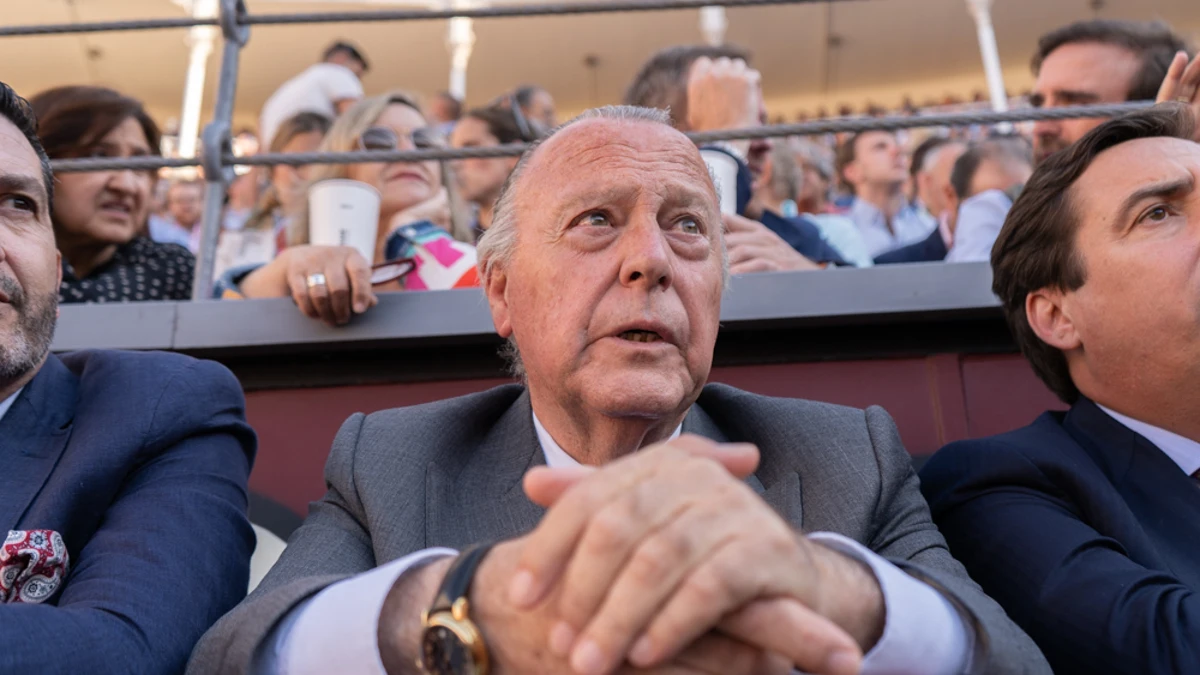
Entre las personas heridas figura Antonio Vázquez, hermano del matador Curro Vázquez y apoderado en la actualidad del torero sevillano Pablo Aguado. Vázquez se desplazaba hacia fincas andaluzas para reseñar y supervisar las corridas en el campo bravo de cara a la próxima temporada, un trabajo de selección que ha caracterizado su trayectoria junto a espadas a los que ha representado, como Cayetano Rivera o el propio Aguado, con quien festejó recientes triunfos de resonancia en cosos como El Puerto de Santa María o la Maestranza de Sevilla.
Aunque su nombre figuró durante varias horas entre las listas de los desaparecidos, las últimas noticias confirman que fue trasladado a en un hospital de Toledo, sin que hayan trascendido más detalles. Según adelantó el periodista Jesús Bayort y confirmó posteriormente su hijo, Fran Vázquez, a las páginas del diario El Mundo, el apoderado viajaba en el vagón número 8 del tren de Iryo, identificado por los equipos de rescate como uno de los tramos que ha sufrido mayores daños estructurales.
La magnitud del suceso ha movilizado a los vecinos y profesionales de la comarca toledana. Teo González, mayoral de la ganadería de Alcurrucén —cuyas reses pastan en la finca El Cortijillo, propiedad de la familia Lozano en el propio término de Urda—, relató a la revista Aplausos cómo el despliegue de sirenas y las primeras llamadas alertaron a la dehesa, situada a escasos kilómetros del punto de la colisión. González acudió de inmediato junto a un vaquero a los inmediaciones del trazado para ponerse a disposición de los servicios de evacuación y colaborar en las tareas de ayuda que se articulan en el campamento de socorro instalado en el municipio.
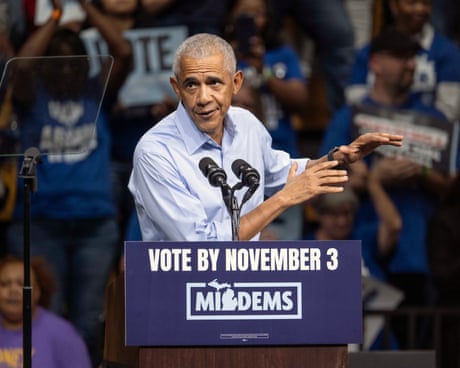
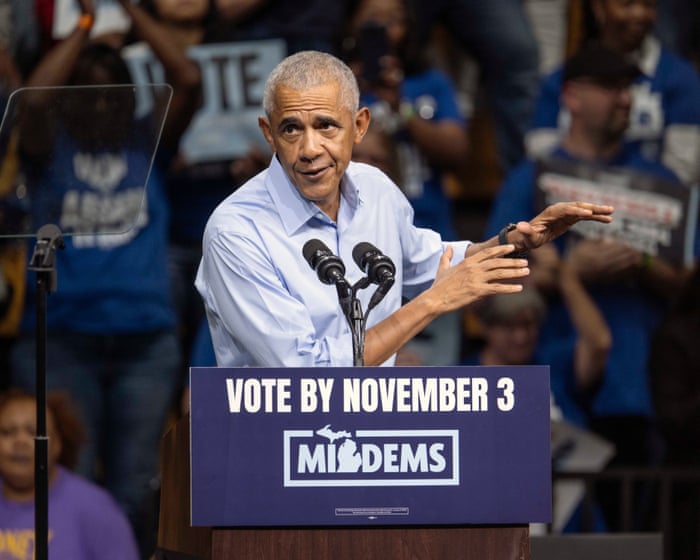
Barack Obama versus Donald Trump. It is the presidential election that never happened but has come to define an era of US politics.
Obama is back on the campaign trail for the midterms, still electrifying crowds, earning shouts of “We love you!” and skewering his successor. “What’s up with the gold?” he asked a crowd in Detroit. “I mean, he’s got the White House looking like Saddam Hussein opened a Cheesecake Factory.” This has, predictably, set off a mini culture war involving questions of elitism and the tastefulness of chain restaurants.
El terrible accidente ferroviario en la localidad toledana de Urda, un choque directo entre el tren AVE 2080 y el tren Iryo 6076, del que ya se informa ampliamente en este diario, ha forzado a la Unión de Televisiones Comerciales en Abierto (UTECA) a suspender de forma inmediata su jornada anual por pura sensibilidad hacia la ciudadanía en el día de ayer. El presidente de la entidad, Eduardo Olano, decretó la interrupción del evento para permitir que los directores de informativos y periodistas presentes —incluyendo responsables de Atresmedia, Mediaset, Trece, COPE, ABC, 20minutos y El Periódico— acudieran de urgencia a sus medios para liderar la cobertura informativa del trágico suceso.
Antes de la suspensión, el acto inaugural sirvió para que la industria expresara su honda preocupación ante la medición crossmedia y el ocultamiento de la televisión lineal en los televisores conectados. Olano tildó de galimatías inexplicable la pantalla de inicio de los fabricantes, quienes priorizan plataformas de pago y aplicaciones multinacionales en detrimento de las cadenas gratuitas, poniendo en jaque el pluralismo y la sostenibilidad del sector. Por ello, instó a la Comisión Nacional de los Mercados y la Competencia (CNMC) a aplicar el Reglamento Europeo sobre la Libertad de los Medios (EMFA) para asegurar datos limpios y auditados. Asimismo, advirtió sobre los retos éticos de la inteligencia artificial y subrayó el paso al frente de los medios tradicionales en su demanda conjunta contra Meta por vender publicidad segmentada sin el consentimiento explícito de los usuarios, señalando que «las plataformas y redes sociales actúan al margen de la ética y de las obligaciones normativas que sí respetan el resto de competidores. La buena noticia es que el mundo ha comenzado a reaccionar».
Por su parte, el vicepresidente de la CNMC, Ángel García Castillejo, asumió la responsabilidad de regular el sector y promover la autorregulación para garantizar un modelo transparente. Admitió que la visibilidad de los contenidos afecta al pluralismo democrático frente a las interfaces complejas e inteligentes.
In this episode of The David Frum Show, The Atlantic’s David Frum opens with thoughts on the coming midterm elections and the difficult position Republicans now face. He explains the political “fork” confronting Republican candidates: Having attached themselves to an unpopular president, they risk alienating either moderate voters or Trump’s loyal base.
Then David is joined by Omar Mohammed, the formerly anonymous blogger behind Mosul Eye, to discuss his new book, Mosul Eye: A Scholar’s Clandestine War Against ISIS. They discuss life under ISIS rule, the atrocities Mohammed witnessed firsthand in Mosul, and the dangers he faced in documenting them.
Finally, David ends the episode with a discussion of the role opera plays in our society.
The following is a transcript of the episode:
Omar Mohammed: Our city was taken by the Islamic State, David, because we had no memory of anything that happened before. Because we allowed other people to be omitted. I don’t put blame on people collectively. That’s not what I do. That’s not my job. That’s not my craft. But my craft is also to understand why what happened happened.
[Music]
David Frum: Hello, and welcome to The David Frum Show. I’m David Frum, a staff writer at The Atlantic. My guest this week will be Omar Mohammed, a historian and author of the harrowing new book Mosul Eye, an eyewitness account of the ISIS reign of terror in the city of Mosul, Iraq. The book talk at the end of the show will not be about books at all. This week, I’m going to be offering some meditations on the place of opera in our culture.
But before either the dialogue with Omar Mohammed or the meditation on opera, some opening thoughts about something that has been puzzling me as we come to the end of the 2026 race, and maybe has been puzzling you as well.
As we all know, President Trump is in a lot of political trouble. He’s polling in the mid-30s: about where President [George W.] Bush was polling just before the big beating in the midterm elections of 2006, about where President Harry Truman was polling before the big Democratic beating in the elections of 1946.
One thing you might expect in a situation like this, where the president’s unpopularity is dragging down his party, is that individual members of the president’s party would try to look independent—put some distance between themselves and the president—in order to say, Look, maybe you’re mad at him, but don’t be mad at me. I did a good job for the people of my state, my district. Separate me out. Just don’t mix me in with Trump. Why are you mixing me in with Trump? I’m different. I’ve disagreed with him. I’m independent.
And you’re seeing very, very little of that kind of behavior. And the question is, why? Why won’t Republicans try to save themselves by putting some distance between them and Trump? It’s maybe late as we get into the second half of October. Why didn’t they do it before?
The explanation comes from a strategy in the game of chess. If you play chess, you are familiar with a maneuver called a fork. A fork is a tactic in which a single piece attacks two or more of the opponent’s pieces at the same time, forcing the opponent into a situation where the opponent can save only one of the threatened pieces. Republicans are in kind of this situation in this election of 2026. Yes, President Trump is unpopular. But in many places, especially in red states, the hope of survival is not by distancing from Trump but by somehow getting Republican turnout inflated to rev up the Republican base. And the way you do that is by clinging to President Trump, because as little as the rest of the country likes President Trump, his base continues to like him enthusiastically. The base is shrinking. There are fewer and fewer people who describe themselves as MAGA Republicans. But among those who do describe themselves as MAGA Republicans—and that’s a considerable number of people—the president’s support remains overwhelming, almost unanimous. So if you’re a Republican in a state like Iowa or Florida or even Texas, you’re in a situation where you think, I need to do two things. I need to find some way to bring independents back, and that requires distance from President Trump. But I need to make sure that my people, our people, turn up, and that requires clinging to President Trump. In other words, a classic fork.
And this fork is creating a kind of paralysis that may make the Republican situation in 2026 worse even than it has to be. Because instead of winning both independents and revving up the base, the Republicans caught in the fork may find themselves doing neither and collapsing in places that always had been thought about as winnable. And where this may have real consequences for the American political system and for the next two years is less in the Senate, less in the House, and more at a part of American politics that we tend not to think about as a system—we tend to think only about our own state—and that is the politics of the states.
A defining feature of American politics almost for the entire past generation has been the overwhelming dominance of the Republicans at the state level, and especially at the state-legislative level. There are 99 state legislatures, because Nebraska has only one chamber. So, 50 states; two chambers per state, except in Nebraska, you get to 99. Of those 99, Republicans have had, through most of the 21st century, an enormous majority almost all of the time. Sometimes a little more, sometimes a little less, but always they can bank on great control at the state level.
And that’s had a lot of implications, because it has been the secret weapon behind President Trump’s concentration of power at the federal level. When Trump was trying to manipulate the elections of 2020 and hold onto power in 2021 after his defeat, one of the things he had going for him is a lot of the places where the opposition to Trump might coalesce at the state level, that didn’t happen. And states often let President Trump get away with doing things that—if they were under non-Trump control, or if there was an even more even division of the parties—they would not allow.
The trouble that Republicans are in in 2026 could have big implications for state contests. Could perhaps even break the Republican majority on state legislatures, break the Republican hold on so many governor’s races. And this will have, for the final two years of President Trump’s term and for the 2028 election, implications as large as the opposite had in the first term of President Trump and in the election of 2020. He may be facing in 2028, or his party may be facing in 2028, a state system that is much more independent of the federal system than it has been before, and much less amenable to the kind of manipulation and tricks that Trump tried in 2020 and that led to the January 6th, 2021, attack on Congress.
If the Republican power subsides at the state level, Republicans will face another problem as well, and one with even longer-term consequences for the renewal of their party.
Oftentimes, when parties are beaten at the federal level—as it looks probable that the Republicans will be beaten in 2026, and as it looks very questionable that they will survive in 2028—they find renewal at the state level. And the classic example of this is the career of the president I wrote speeches for, George W. Bush.
In the 1990s Republicans in Congress and Senate sought to impeach President Bill Clinton. This move was tremendously unpopular and led to very bad Republican results in the midterm election of 1998 and to the resignation of then–Speaker of the House Newt Gingrich. George W. Bush, in the same year, 1998, where Republicans did bad in congressional elections, George W. Bush won a decisive re-election as governor of Texas, with important breakthroughs in winning the Hispanic vote. And Republicans all over the country looked and said, Well, the people in Washington, the Republicans in Washington, they don’t seem to know what they’re doing. But this Republican in Texas—he seems to have the formula. And Bush began his campaign for the nomination in 2000 after that breakthrough in 1998 by presenting himself as a different kind of Republican. Different from whom? Different from Newt Gingrich, different from the people who’d impeached Bill Clinton. And so the result was that he could reinvent himself, reinvent his party. And the unsuccessful election of 1998 was followed by renewal in time for the election of the year 2000.
How do the Republicans do that post-Trump? They can’t, because they are caught in the fork. I mean, one thing you might imagine, for example, is that instead of nominating J. D. Vance or even Marco Rubio in 2028—someone closely tied with everything that Americans don’t like about Donald Trump—Republicans would say to themselves, Well, is there a state that’s an important state, a contested state, where there’s a governor who’s very popular?
What do you know? There is one. Georgia is that contested state, and Georgia has an outgoing governor, Brian Kemp, who’s had ratings of over 60 percent for much of his second term, who’s polling at about 60 percent right now, and who has done a good job of straddling the division between Republicans who don’t like Trump and Republicans who do. That’s the guy, you would think. That’s the guy. That’s our George W. Bush. That’s the guy who can break with Trump, be a Republican, be a different kind of Republican. Different from whom? Different from Trump. He doesn’t like Trump, but he’s still a Republican.
But that’s not happening, is it? It’s not happening, because Republican Party politics since 1998 has been effectively nationalized. It’s all Trump all the time; all federal, not state. And that not only defeats the attempts by Republicans at the national level to perform shenanigans; it also denies Republicans the chance to renew themselves from the place where, in American politics, renewal so often comes at the state level.
That’s a fork. It’s a fork the Republicans are not finding their way out of, and it’s a fork that will have large tactical consequences in 2026 and maybe large strategic consequences in 2028.
And now, my dialogue with Omar Mohammed.
[Music]
Frum: In June 2014, the armies of the Islamic State seized Mosul, Iraq’s second city. Not long after, an anonymous blog called Mosul Eye began reporting on life inside the occupied city. The executions, the expulsions of Christians and Shiites, the mass rape of Yazidi girls, the destruction of shrines and manuscripts.
For more than three years, no one outside a tiny circle knew who was writing it. Journalists relied on it, and the Islamic State threatened its author with death in its most terrible forms. In December 2017, after Mosul was retaken, the Associated Press revealed the writer’s identity. His name was Omar Mohammed, a young historian of Ottoman Mosul.
Omar Mohammed lived a double life, outwardly conforming to ISIS edicts by day and recording the truth of what was happening to his city by night, until he fled the city at the end of 2015 and continued from abroad through a network of contacts inside Mosul. His brother was killed in the final battle to liberate the city.
He has now told the full story in his own words in a new book, Mosul Eye: A Scholar’s Clandestine War Against ISIS, published by Skyhorse Press. It is, in my opinion, a work of literature about the human spirit, to stand on the shelf with Primo Levi and Czesław Miłosz. A witness to the extremes of human cruelty, oppression, and endurance.
Omar Mohammed, thank you so much for joining me today on The David Frum Show.
Omar Mohammed: David, thank you for having me, and I’m humbled by the words you said about me and about the book.
Frum: I think anyone in your presence understands the courage that you showed. Your life is a rebuke to all of us of what it means to be brave, not in a dangerous second, but through the grind of minute-by-minute exposure to terror and oppression and the risk of death.
I want to talk to you about your book. For, as a book and as a witness, because the book, as I said in the introduction, is also, in my opinion, a great work of literature. It’s not just a testimony. It is a work of creative understanding of what people have gone through.
But before we talk about any of those things, let me just start with this. As you know, you spend some time in the United States now. It’s a very busy country, a very inward-looking country, a very forgetful country. You’re a historian. You devoted your career and then the risk of death to remembrance. Why is it important to remember what happened in your city in those years?
Mohammed: There are two ways of saying that also, David. It’s not just why we should remember, but also why we should not forget. Because I’ve always said I can forgive, but forgetting is dangerous.
The reason being, the past 30 to 40 years that witnessed the rise of the so-called jihad on the West or jihad on democracy, against democracy, it believes in only one objective and one outcome and one goal. And that is the destruction of the Western democracy and Western civilization. They stand against everything democracy stands for. We should never forget. We should never stop remembering that they are always planning and plotting against the Western democracy and against the West in general. And this is a way of life that they don’t think should exist, and that they believe it must be eliminated and destroyed.
So yes, it’s a fight, and it’s my task as a historian to keep reminding the people, Westerners or non-Westerners. Because, trust me, if the Western democracy is removed, no one is going to be safe, and that is exactly what they want. We should always fight back. That is my act of remembrance, and that is why I want people to always remember.
Frum: And you continue through your activism, but you also continue as a historian trying to recapture the past of what Mosul was like before ISIS, and what life was like during ISIS. I want to read from your book one of the most terrible and vivid scenes of what you saw as a witness to history.
You have, in this part of the book, you have entered the ISIS capital in Syria. You are approaching from the outskirts, and you see a man who has literally been crucified, like Jesus in the Bible. You say, “In front of it was a man nailed to a cross”—you say you’re in front of an abandoned school. “In front of it was a man nailed to a cross. He was mounted in the manner described in the scriptures: arms extended, nails through the hands, the body suspended above the ground. A piece of paper bearing his name was attached to his chest: Sulyman Ayub. The charge was apostasy, the accusation that a Muslim had abandoned his faith, one of the offenses ISIS published with the most theatrical severity. The word for death was written beneath it in Arabic. But the man was not dead. He was moving, the small involuntary shifts of a living person in agony. Below him, dogs were feeding on his legs. Not strays circling at a distance, but animals that had been allowed to reach the body and were eating from it while the man lived.”
That’s a terrible scene. You give us the man’s name, and you were the only witness to his terrible end and the reasons for it.
Mohammed: I’m sorry, David, because you just read something to me that I thought by writing I will. I heard that—I wish you did not read this text.
Frum: I’m sorry.
Mohammed: I just did not want—
Frum: I wish I had not read it either, but I have and I did because of you.
Mohammed: Yes. And you can imagine I saw that man on my way of escaping the Islamic State. I made sure that I read his name. I made sure that I record his name. I made sure I protect his name from being forgotten. I also made sure by naming him, by giving him that name, that hopefully will outlast me and outlive me, but it will definitely outlive the Islamic State. That people will know that the people who were killed by the Islamic State had names, they had dreams. But it’s also—that animalistic nature of the Islamic State has unfortunately been on many occasions being read or being treated as, Well, what if the Islamic State is just a political movement trying to regain power in its area of interest? That is absolutely absurd. The Islamic State does not use violence to achieve its goals. It uses violence because that is the end goal of its ideology.
And this is one scene, David. Not to mention what’s across the book. I just wanted people to know that those people had names, and they should never be forgotten.
Frum: Well, I hope I won’t upset you. I want to read—I’m going to be reading some more things from the book as we go, to sort of root us so [that] people can also understand what you have done. And this book, you told me, was originally written in English. It is not translated.
Mohammed: It’s in English, yes.
Frum: One of your acts of courageous witness was to masquerade as a doctor or a medical professional to gain entrance to the hospitals, to see what was going on inside the hospitals. And you tell this story. In this case, I think you were not an eyewitness. I think you had interviewed somebody. This is from page 116:
“Yazidi girls, members of an ancient ethno-religious minority from the Sinjar region, whom ISIS had enslaved en masse the previous summer, were being brought in by ISIS fighters requesting mandatory abortions and sterilizations.” That is, the fighters were demanding mandatory abortions and sterilizations. “The doctor,” to whom you were speaking, “described a girl of 17 who had been raped repeatedly by multiple men and was in a state of nervous collapse. The girl refused the procedure.” That is, I assume, sterilization. “The number of such cases at that point was between 50 and 60. At least 12 girls younger than 15 had died of injuries from the violence. I wrote it down that evening in the same compressed register I use for everything: date, location, number, source. I’m not sure I’ve ever found the right language for what it takes to apply that method to that material. I wrote it down because if I did not, it would disappear into the silence ISIS was building around everything it did to Yazidi women.”
Mohammed: I remember this very well. I remember what the doctor told me, but I also equally remember the three other young girls that were killed and shot dead by the Islamic State. As we speak today, and as I mentioned, exactly what you say—that I write it so people will remember. So they will not be forgotten.
Today in 2026, we have people questioning that even the heinous attack against the Yazidis even took place or even happened. People are denying or questioning, or people are trying to make it look like, well, we were all attacked. Why does it have to be special for the Yazidis? Because that is the risk. If we do not record what the Islamic State did, there will be other people who will come and say, they will say that it was not that bad. It was not that horrible.
And that will always—as a historian, that is always the challenge. Because as historians, we are supposed to deal with the dead. But what I wanted to do is to give life to those people who were killed, so they will be forever witnesses to what happened to them.
Frum: My colleague at The Atlantic, Anne Applebaum, a great scholar of the Stalinist and communist oppression in Eastern Europe, wrote in the preface—I’m going to now forget which of her books she wrote this, I think it was maybe her book on the Gulag, the Soviet Gulag. She said, “I write this book”—I’m quoting from memory—“not so that it will never happen again, but because it will happen again.” And I think one of the things I am reminded of by you and by, as I say, the other people I imagine you standing beside on the shelf, Primo Levi and Czesław Miłosz, of just these horrors occur again and again and again. And the only remedy against them—not the remedy, the way of beginning a remedy—is through unceasing remembrance.
Mohammed: Our city was taken by the Islamic State, David, because we had no memory of anything that happened before. Because we allowed other people to be omitted. I don’t put blame on people collectively. That’s not what I do. That’s not my job. That’s not my craft. But my craft is also to understand why what happened happened.
When the Islamic State took control of [a] third of Iraq and also over [a] third of Syria—but as much as I’m concerned with the city of Mosul, which is my hometown that I unfortunately lost forever, we had no memory of what happened before. We had no memory of what happened to the Jews in the ’40s and the ’50s. We had no memory of what happened to the Assyrians in the ’50s, all of these massacres. We had no memory of what happened in the ’50s. We had no memory of what happened in the early 2000s. People unfortunately forget, David. That’s why it is easy. It’s easy to take control of their past, present, and future. And it was my job to precisely make sure that, because as you cited Anne Applebaum, yes—I do completely agree that it might happen again. My job—I might not be able to prevent it, but if it happens again, at least there will not be only one person to fight against them. But everyone will be prepared, will be ready to understand what they are and what they represent.
Frum: I want to put an asterisk beside something you said a few moments ago. You referred to what happened to the Jews in the ’40s and ’50s, and many North American listeners, many English-speaking people, will think you’re meaning about the Nazi Holocaust in Europe. But you’re actually speaking about events that happened to the Jews in Iraq.
Mohammed: That’s exactly what I was referring to: the pogrom in Baghdad in the ’40s, or known as the Farhud. But also the revocation of the citizenship, the deportation of the Jews, confiscation of their properties and lands. There is an ancient Jewish history in Iraq that was completely omitted to the extent that I myself had no idea until I grew up, until I started finding out on my own. I had no idea that we had Jews in Mosul. I had no idea that the school I used to attend was built on the ruins of a Jewish school that was completely demolished to the ground. Of course, that allows people to be okay with things to happen again and again.
Frum: Well, you both judge people, but you’re very humane in your judgments of the choices and options that are available to ordinary people. And I want to read another passage here—this is from page 65 and 66—because, look: Americans may remember the fight over Mosul, which was spearheaded by American troops with their Iraqi troops, their other coalition forces. And it was a terrible battle, and we had images from it, but not from inside. There was a very effective censorship. And it’s easy to see the people who are in that city as just part of the scenery, part of the story, and you bring this extraordinary sympathy to them. And I want to read again from your book, page 65, 66:
“The population of an occupied city does not divide into resistors and collaborators. That is the binary of people who have never lived under total control. The reality is a spectrum so compressed that the distance between cooperation and refusal can be measured in the angle at which a man places money on a counter. A father who sent his son to the rewritten school”—that is, ISIS had taken command of the schools, and it foisted this reactionary curriculum on them—“a father who sent his son to the rewritten school was not endorsing ISIS’s curriculum. He was calculating that a distorted education was less damaging than no education at all, and that a boy seen on the streets during school hours would attract the attention of the Hisba, the religious police. A shopkeeper who paid the zakat, the forced tribute, was not funding the caliphate by conviction. He was buying another day of operation with the only currency the regime accepted. A woman who wore the niqab was not submitting to the ideology. She was navigating a city in which her uncovered face was a punishable offense and her covered face was survival. These were not moral failures. They were the daily calculations of prisoners performing the routines that captors required in order to remain alive.”
Mohammed: And I believe that’s exactly how we need to look at people whose will was stripped away. They were under total control of such a brutal regime. There is another way of resistance that I had noted back then, because you mentioned the curricula and the schools. There is, in another page in the book, when the professors of the university were forced to sit inside the library that ISIS had occupied and transformed into its hub to rewrite the curricula before they destroy the library. Those professors—they knew that if they say no, they will be killed, they will be punished.
But they at least decided to take some act of resistance. Even if it’s unnoticeable; even if it’s only for themselves to notice. Which is what they did, David. They would start writing slower and slower, slowly, slowly. So what is supposed to be delivered in one week, they would deliver it in two months, because they were always in the hope—probably in one month that ISIS would be removed, ISIS would disappear. So they would just go back to themself and say, I delayed them. I did not give them what they want quickly.
So there were people who would take this type of act of resistance. I actually prepared back then an entire confidential report, which I called “The Civil Disobedience,” because I needed to understand what might be the way to get into the people in case there will be a need to form a military resistance against the Islamic State. What do I need? Because I had thought about this. I don’t believe in violence. I don’t believe in such actions. But I needed to understand the mentality of the people. That’s why I went to go deeper inside the mentality of the people. And as you said—yes, we have to be human.
Frum: Iraq is a land of fathomless antiquity. Cities are built on top of cities. Mosul, your Mosul, is the city that Bible readers will know as Nineveh. I mean, it’s got a much more ancient history than that, but it is the city to which the prophet Jonah was sent. And the shrine to the prophet Jonah figures largely in your book.
Tell us about this layered history: Christian, Jewish, pre-Islamic, Islamic, Ottoman, modern. You are a historian. You describe a city that is built on layers and where the palaces of Assyrian kings from ancient Assyria are still there to be seen.
Mohammed: I will start with a joke that goes on until today in Mosul related to Jonah.
So the people of Nineveh—as you mentioned, Mosul is across the river from Nineveh. Which is the capital of the Assyrian Empire, which was destroyed in the year 612 B.C. by the Medes and the Babylonians. And since then, the city of Mosul, which also existed back then, became more prominent, as the Assyrians kept moving to the other side. But also has the story of Jonah—and in the Bible it’s the fish, in the Quran it’s the whale, or it’s a big fish. And he arrived in Nineveh, and he started asking them to accept his message. And the joke goes—which is actually not a joke, but the people use it to say that we are the only people who were divinely protected. They say when God asked the people of Nineveh to accept his message, they told him, Give us your offer. Come back in three days; we’ll think about it. And he would come back in three days, and then they would say, Now we have contemplated; we can accept the offer. And then they were given a divine protection forever.
And that’s how people grew up in Mosul. That’s how I learned this story, from my grandmother telling me that we are the people of Yunus. We were never told that we are the people of the caliphate. We are—Yunus, it is the Arabic name—one of the names of the city of Mosul is “the city of Jonah.”
And you have this layer, and then you have an ancient Assyrian palace on top of that first layer. And then on top of the ancient Assyrian site, which has been rediscovered again, you have an ancient synagogue. And then on top of which a church was built, on top of which a tomb was built, on top of which a mosque was built. That’s how Mosul is. It’s a multilayered city. It’s as contradictory, as beautiful at once.
Frum: And Mosul is bisected by the River Tigris. And on one side is a more ancient city—an Ottoman city, I suppose. And on the other side is a more modern city with wider streets and more modern buildings. And this duality is a central feature of the book.
Mohammed: Yes. Because that is exactly what you see, and that’s exactly why I care a lot about the river. You can stand in the middle of the river. You look at the right, you see the modernity, you see modern life. But then you look at the left—everything is ancient. Wherever you step on, this is ancient. This is the oldest church in Mosul. This is the oldest synagogue. This is the oldest mosque. This is the oldest street. This is the oldest alley. Everything you mention there, you must add that first word: It’s the oldest. And wherever you step, you are surrounded by history. You are surrounded by complex history, I would say.
Because also, as much as Mosul is old and ancient, it also has multilayered society. Different religions, different faiths. But it’s also a city that has never been able to have this as a merged society. This is why we have always had in the city, what you have as the Jewish quarter or the Christian quarter or the Islamic quarter. People did not mix. But they always found a way to mix where it brought them together—which is the old market. And it can continue to live.
Frum: I’m going to read one last thing, a very vivid description of the end when the coalition forces came to expel ISIS from Mosul.
The Tigris is spanned by bridges. The coalition blew up the bridges, all but one, in order to sever the ability of ISIS to move fighters from one side to the other. ISIS then blew up, you say, the last of the bridges in order to fortify itself. And the more modern part of the city was cleared with considerable violence, but still leaving the city substantially intact.
And at that point, the fight turned to the older part of the city. And here’s what you say about that. “The West Mosul”—the West Mosul is the older part—“the West Mosul offensive was set for February 19th, 2017. What was coming would be unlike anything the city had endured in its thousands of years of continuous habitation. Not the Mongol sack of the 13th century, not the Ottoman conquests, not the British mandate, not even the fall to ISIS. What was coming was the destruction of Mosul by the forces that had come to save it. The old city, the city of shared walls and narrow alleys, and the leaning minaret, and the churches beside the mosques, and the shrines beside the markets, was about to be fed into the machinery of liberation. And the machinery did not distinguish between the enemy and the place the enemy had chosen to die inside. The time had come to end ISIS. The price of ending it was Mosul.”
Mohammed: It is the price we paid, David. Mosul in its total shape, in its total history. Mosul, that still holds the body of my brother, is the price we paid, yes.
But it’s the price we paid, and I’m willing to pay this price again if ISIS comes back again. I’m sorry. [Cries.] I did not expect myself today to—yeah, we paid Mosul as the price to end that totalitarian, brutal Islamist regime that came for the destruction of every memory we have built. Of every dream we had. Of every stone we marked, was completely erased. But it was a price worth paying, and I would give myself, and I would do it again. And I’m going to give 1,000 Mosul to ensure that no Islamic State, no caliphate would ever see the light. 1,000 Mosul, not one.
Frum: You did often put your life at risk, and at one point in a moment of gloom, you shaved your beard, you put on a red sweater. Red was prohibited for some reason I don’t understand. And you sort of walked around and waited for them to find you, and they didn’t. After you made good your escape—and this is a strange thing about the modern world—ISIS has cast Mosul back into what we would call medieval barbarity, although it was much worse than anything that ever happened in the Middle Ages.
And yet you’re able to be in contact with your family inside the city. And especially your brother, to whom you were so close, and you lose him in that last fight.
Mohammed: I insisted. I insisted on him. I kept telling him. I told him, This is not a warning I am giving you to leave where you are. I’m not telling you that I expect there is going to be a fight there. I’m telling you that I know that the fight is moving into the area where you are, and you must leave now. I did not know I was talking to a dead person. I think my brother realized he was dead. I think he understood. Because my brother, back then when he was talking to me, he was very calm. He was very sincere. He had the serenity that I have never seen before, because he is the one who was always concerned with our safety. He was always concerned, myself, my family, caring for us. But that time he was serene, he was calmer. My brother did not survive. The next day I knew. I knew that the moment I was talking to him, I knew he’s already dead.
I knew he was a dead man, and I knew that he knew he was a dead man
I just could not save my brother. It is one of my greatest regrets that I couldn’t—I should have, I should have kept calling him. I should have kept calling him. I should have sent someone to remove him from that area. I just, I couldn’t.
Frum: You lived this strange life in exile where you were once totally helpless and yet also quite powerful. Because your information was being fed into the global system that was monitoring what ISIS was doing, that was informing the forces that were gathering to destroy ISIS.
You could see, but you couldn’t touch what was going on in your city. And you could target, you could assist the coalition forces in targeting death, but you could not save anybody.
Mohammed: Yes. I could not just give up. I could not stand and do nothing. I realized that I had the power of saving people.
It was a very difficult decision to do, because it meant that I will have to be in contact with the coalition, be in contact with the Central Command. Be in contact with people that I’ve always resisted responding to. But when I realized that I had the tools that allowed me to save more lives. There were people getting killed on [a] daily basis, whether it’s by ISIS or the bombing or—it’s a battlefield. An irregular war, taking place in one of the oldest cities in the world, in which if you, not bombing a house, if you push too hard on the wall, the house is going to collapse.
People were desperate. I found the tools, I understood how it works. I used my presence in Paris back then, with that access to technology. And as I mentioned in my book, my brother I did not save, I couldn’t save. I saved 92 families, and I am always thankful that they are alive. I am always devastated that others could not make it. But I do remember that at least those lives were saved. At least others are still alive.
Frum: Let me ask you about your life in the past 10 years. So the fight for Mosul is over in 2017.
ISIS is expelled. The city is wrecked. Your identity is revealed at the end of 2017 by the Associated Press. You have now made a life; you’ve returned to your teaching and research work, and you spend your time in Paris and other cities.
What is your work like? What is your mission like in the 10 years since the book’s story comes to an end?
Mohammed: After I escaped and the moment I arrived in safety in France, I did not stop working on doing whatever I can to help the city. When it was the battle, I used every tool available to me to help the people.
And then the biggest challenge came, which is the recovery of the city. I started immediately advocating for resupplying the central library of the city of Mosul with books. People were asking, What do you want? I said, I need books. Hundreds of thousands of books were pouring from all over the world, coming, arriving in Mosul. They are all labeled “for Mosul Eye,” and the books would be immediately admitted. Someone sent us a container of 20 tons of books.
The heritage of the city—which is the memory of the city, the most visible element of our identity—was almost completely demolished to the ground by the Islamic State, so we had to rebuild it. I started advocating with the world to help the city. Projects started working on recovering the Al-Nuri mosque, which ISIS had used before to declare its caliphate. Later, they destroyed it. We had to rebuild it. A church and a synagogue.
And I have since been working on what I would call my life mission. Beside breathing life into the soul of Mosul, I realized that it cannot be completed until I make sure the Jewish history of Mosul, that was completely erased and omitted, goes back to the city itself. And this is why I began since then—I’ve been working on this in the past years, and still documenting the testimonies of the last people who were born Jewish in Mosul, who are still alive. Preserving the Jewish heritage of Mosul, but also not doing it in isolation; making it an integral part of the city’s history, so people will understand that they have a collective identity, a collective memory.
I did not stop working on doing the research on extremism and terrorism. I did not stop working—I completed my dissertation in the past 10 years or so. I have been doing everything, David, dedicating all my time for the city of Mosul. I’m not going to list things, but I’m going to say what my life was: is that I was a person on a mission. And still I am, to help the city of Mosul recover. Whether it’s the same city I am talking about or it’s a different city now, it’s a city that deserves to live.
Frum: [Novelist] Milan Kundera spoke of the struggle for freedom as being a struggle for memory and against forgetting. And you’ve talked very powerfully about the work of memory, what you’re trying to remember. The names and lives of people who were killed, the names and lives of people who were sexually abused. The city that is gone, the pre-city, or the older city that used to be there.
Let us talk a little bit now about forgetting. Because the way you and I made contact in the first place was I had spoken about this terrible simplification that has been happening across the Middle East, where ancient communities have, one by one, been expelled. The Middle East is becoming a region that was divided into so many different religions and so many different languages and so many different ways of life. Unless, like the Jews in Israel, they can find their own state, there is no survival for them in this region in this terrible simplification. And there’s a forgetting of what the Middle East was.
Can you talk a little bit about, as a historian of Ottoman Iraq and of Ottoman Mosul, what was there before? What was lost? And is there any way to recover that tolerance, that living together that was there before?
Mohammed: I think it’s conditional.
There is also, as you mentioned, there is a simplification of how the past looked like. There is a simplification of multiple definitions, including tolerance and coexistence. People assume that societies in the Middle East have lived, before even it was called Middle East, have lived in coexistence in a state of tolerance, and that is not the case.
We’ve always been through this type of on-and-off situation. When the government has no interest in attacking the non-Muslims, including the Ottoman Empire back then, people are going to be okay. They are living their life, going on in their life, and that’s it. Whenever there is a problem, it will be immediately—it depends on the context—it will be immediately blamed on either the Jews or the Christians.
But there is—in the middle of all of that, David, I’m not going to dismiss the reality. I’m not going to dismiss the fact that people have developed a model that allowed them to live in a coherent life, in a much more calmer life. But [it] was conditional with the fact that they had a space, and they had a place to communicate. And that was the market; simply the market. Because everyone who tells you that people lived in coexistence in their neighborhoods, that’s not true. In fact, the people did not communicate with each other in their residential areas. But they would always come together, and they would work, in the old markets: in a trade, in crafts. It even allowed the city to develop its own vocabularies and language, and allowed the people to work together, to live together, to contribute to the way of life together.
However, it has always been fragile, because that social contract has never been strengthened, has never been made sustainable. It will immediately break down whenever there is an issue, whenever there is a problem, whether it’s an internal or external. Whenever there is—there is always this labeling of a treacherous people or disloyal people. As long as you are not religiously part of that faith, then you have the potential of working against the nation.
There were moments in that history when things were much better. And that is during the period of what was known as, I think in the 17th through the mid of the 18th century, is “the phase of the city-states.” Meaning a family was in control of Mosul. There was the Jalili family, for example, for over two centuries in control of the city. He would have his most trusted minister in his cabinet as a Jew, and the other one is a Christian. His envoy to the Ottoman Empire was, in fact, Jewish.
People lived in harmony. People lived in coexistence. But then when that condition ended, it went back to the same situation. Jews had never had the possibility to have a school in Mosul until as late as [the 1920s], until after the fall of the Ottoman Empire.
Modernity came. And we understood—and this is to put it bluntly, brutally honest like that—democracy and separation of religion and the state have proven to be the only way for minorities to survive. And for people to understand that there is a way of life that is beyond history itself, that is beyond the promised caliphate, that is beyond these dangerous concepts that have been put in place for decades.
It’s a complicated history. Cannot be simplified simply by saying people have lived happily in coexistence—because it could be one year of coexistence and next year a bloody year on people, and so on. This is why it was easy, for example—we have witnessed the collapse of that system immediately after the Islamic State took control of the city. It completely collapsed. That social contract completely collapsed. We’ve seen neighbors killing or raping their neighbors, the Yazidis, kidnapping their women. We’ve seen Christian people being expelled, and some of their neighbors would steal and loot their belongings. What type of coexistence was that? It was always conditional with—you need a strong state, you need good governance. But you also need a system that is not built on the infrastructure of religion, or the idea that Muslims are the majority, so they should rule and everyone should come under their control. Because that should not be the case. That should not be the situation.
And it’s a complicated history also, because we still have conflicts we have not processed. We still have not asked the difficult questions. And David, I think I’ve already told you that some people have to get into the mud of that question and start facing them and start answering them.
People have always been asking the question, How could we live together? How could we continue to live together? But these questions always get faced with punishment, because it also has become easier to say and to simplify, Well, it’s a diverse region. It’s a beautiful, beautiful diversity. People have lived with each other. How did they live with each other? Nobody asks these questions. And I think it’s the region in the world that is becoming less diverse. A region that’s becoming less diverse. You go to Iraq today; you can easily notice: This part of the country is Shia, the other part is Sunni, the other part is Kurd. And where are the Christians? Where are the Yazidis? Where are the Jews in the middle of all of that?
This is a region that still needs some more work by its own people. I think people have to get things into their hands, matters into their hands, by facing the difficult questions. By facing the reality. For example, one of the outstanding questions: Why did ISIS happen? Why did ISIS took control of third of the country? Before that, why did Al-Qaeda even come to being? Why did people join the Islamic State? Why do people still have interest in something called caliphate in today’s modernity, in today’s fast-moving humanity? Why do you think people need a caliphate?
I think these questions need to be asked. There is nothing wrong about asking them. There is nothing directed against a religion when we ask these questions. But when certain religions, when certain texts become the source for people like the Islamic State, I think everyone has the right to ask: What’s wrong with that? What’s going wrong?
Frum: And when they ask, they will have your extraordinary work of witness and testimony as a guide to their better thinking. And maybe—possibly, let’s hope—to a better, more liberal, more democratic future.
Omar Mohammed, thank you so much for joining me today on The David Frum Show.
Mohammed: David, thank you very much. And it was a little bit emotional for me. I apologize for that.
Frum: It was emotional for everyone. Thank you.
[Music]
Frum: Thanks so much to Omar Mohammed for talking today about his powerful book, Mosul Eye.
I don’t know how to make a transition to another book talk after that discussion. So I’m going to talk about something really quite completely different, which is not only not a book but an entirely different art form: opera.
I went to see this past weekend the production of La bohème by Puccini at New York’s Metropolitan Opera. This is a 2026 production, but it’s a revival of an older design by the great designer [Franco] Zeffirelli. It’s a quite legendary production. The costumes and sets are in the basement. The most famous scene, that I’d heard about all my life and wanted to see in person, was at Act Two—which is set in a café, and suddenly the curtain rises on a Paris street. And there are rooftops, and there’s an open café, and there are hundreds of choristers and children. There are even a couple of live animals, a donkey and a horse, all of them reenacting what the Latin Quarter would’ve looked like in the reign of King Louis Philippe, which is when La bohème is set, although it’s written half a century later.
I found myself thinking less about Puccini and less about La bohème than about the whole strange institution of opera.
In any major Western city, there will be, probably, an opera house. And the opera house, it will be one of many theaters and venues, but it is usually one with a certain kind of statement of importance and formality. There may be sport centers that are bigger, but they’re never as central. And there may be theaters that are almost as central, but they’re never as big. And there’s always something about the opera that sets itself apart. Often, typically, it’s on a square, not facing the street. That’s how it is in Paris; that’s how it is in Vienna. And of course, that’s how it is in New York, where there’s this kind of formation of three buildings that set back from the street with a giant plaza in between. There’s a statement of importance. And people recognize this importance, and act on it.
Very few people—almost nobody dresses up anymore to go to the theater. But people still dress up, especially women, to go to the opera. As I looked around myself, I saw women in long dresses, women wearing costume clothing that was quite different from what they’d wear not only during the day, but really to almost any other kind of evening out.
And I thought about the kind of cultural knowledge that is embedded in this strange institution, and at the cultural self-confidence it takes to put such a building on such a square in such a city, and to summon people and to say, This is something that is different, not only from other things that you do during your everyday life. This is different even from other forms of art. This is somehow higher and more important and different and more formal. More commanding; more central. And I wonder: Where do people get that confidence? Where do people get that nerve? And then I found myself thinking: Do we still have it?
Opera is kind of an ossified form. I mean, there are new operas written, but they tend not to be very popular. And it is Puccini and Verdi, and especially La bohème. La bohème seems to be the most popular opera, at least in the Metropolitan Opera’s repertoire, and this particular design has been played again and again and again. So it’s kind of an ossified form. And I wonder if the confidence behind that form is also becoming ossified too.
Now, I’m not going to make a brief for opera. You may like it; you may not. You may want to see the show, you may not. That’s not what I’m interested in. What I’m interested in is: Can we still summon the cultural self-confidence to say, of certain kinds of works of art: These are important. These are things that people should value. These are things, whether you like it yourself or not, they have a central place in your culture and your society. And the texture of your city will endorse this idea, whether or not you have ever set foot yourself inside the venue in which this cultural confidence is expressed.
And I think there will be critics who will say that kind of cultural confidence is misplaced. What about other things that other people do? Who’s to say? Who’s to say why someone has the authority to proclaim this and not that? But maybe we can’t get along without it either. Anyway, that’s what I was thinking about on my way in and out to watch Zeffirelli’s donkeys and horses in his extraordinary setting of this amazing piece of art, in this amazing venue in this great city.
Thanks so much for joining me this week on The David Frum Show. It would be a great help to spreading the word of the show if you would share, subscribe, like on whatever platform you use. As always, the best way to support the work of this program and all of us at The Atlantic is by subscribing to The Atlantic. I hope you’ll please consider doing that. Thanks so much for watching and listening. See you next week on The David Frum Show. Bye-bye.
A far-right campaign claiming leftists are stealing votes from nursing home residents has centered on changing guidance from Mehmet Oz’s Centers for Medicare and Medicaid Services.

 Login




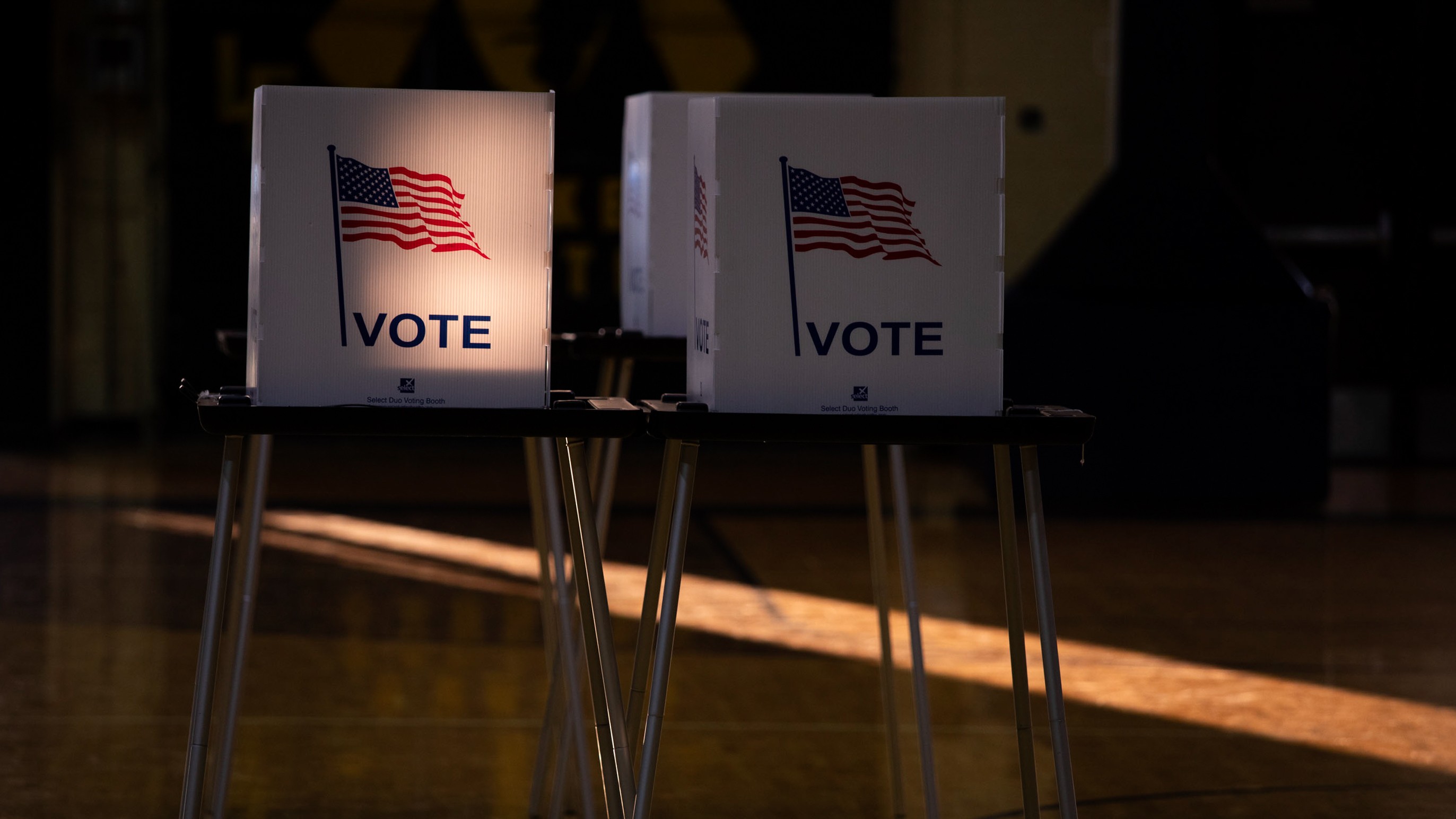
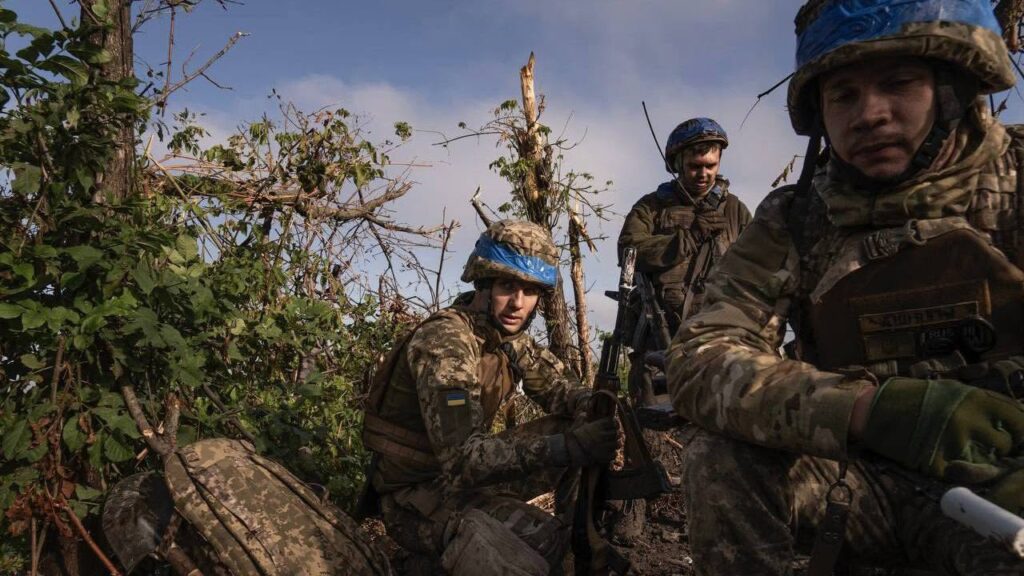

 (@AMK_Mapping_)




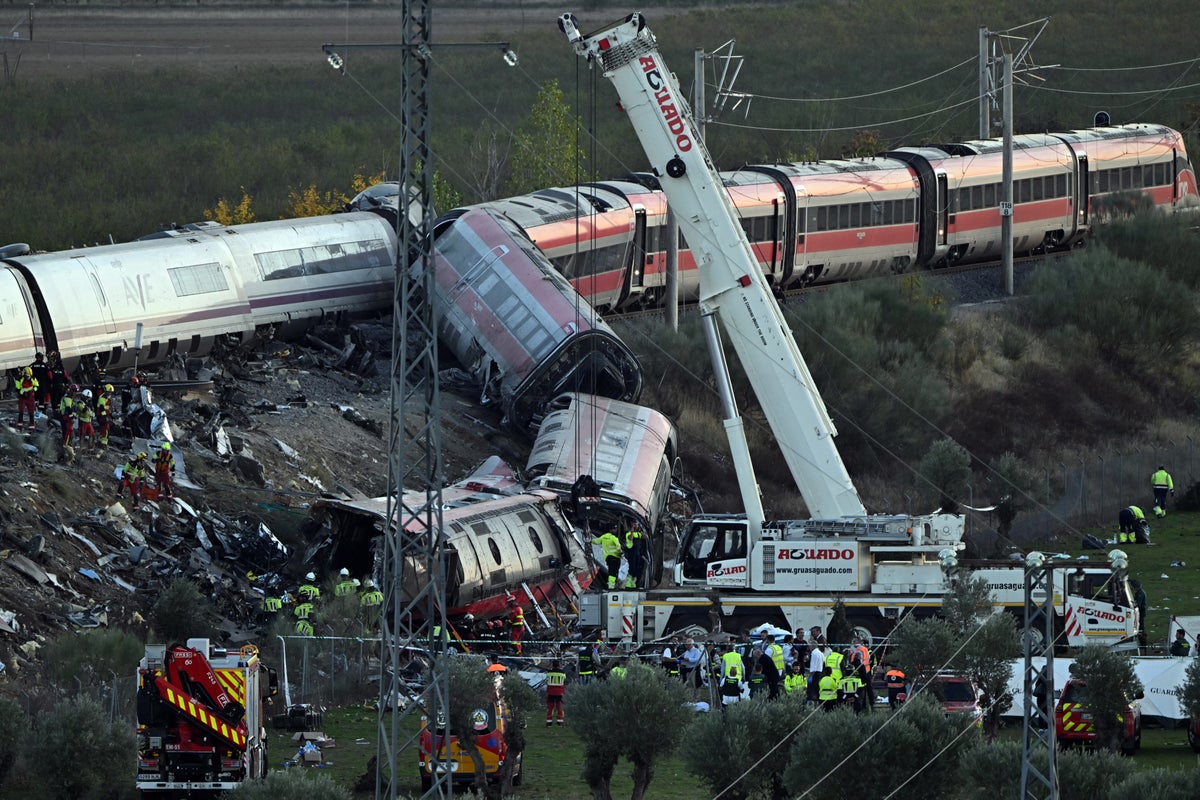
 Israele ha votato con un’affluenza record: Netanyahu perde la maggioranza, Eisenkot avanza, i partiti arabi toccano il massimo storico. Ma l’alternativa a Netanyahu è un generale che Netanyahu stesso indica agli americani come il partner ideale se riprende la guerra con l’Iran. E i risultati ufficiali arrivano il 4 novembre, il giorno dopo il voto di metà mandato negli Stati Uniti.
 A Levante, giovedì 29 ottobre 2026, Margherita Furlan dialoga con Moni Ovadia, attore e scrittore, voce ebraica contro la guerra; Antonio Mazzeo, giornalista d’inchiesta sulla militarizzazione del Mediterraneo; Andrea Zhok, filosofo, autore di «Diario politico di un martirio. Palestina, 2023-2025».
 Il voto israeliano: exit poll, blocchi, nessuna maggioranza, il record dei partiti arabi
 Eisenkot, la dottrina Dahiya e il governo di unità discusso dagli emissari di Trump
 L’attacco all’Iran che Netanyahu voleva prima del voto e il «non ora» di Washington, secondo la CNN
 Il 3 novembre: Trump ai minimi, la Camera in bilico, i milioni dell’AIPAC e le primarie democratiche
 L’Italia, Sigonella e un’Europa che assiste senza voce
 Scenari: governo di unità, appoggio esterno arabo o ritorno alle urne
 I LIBRI DEGLI OSPITI
 Andrea Zhok, «Diario politico di un martirio. Palestina, 2023-2025», Il Cerchio
 Moni Ovadia, «Un ebreo contro», Edizioni Gruppo Abele, 2021
 Antonio Mazzeo, «La scuola va alla guerra», Manifestolibri
 CASA DEL SOLE TV | Informazione libera e indipendente Casa del Sole TV non ha editori privati né finanziamenti pubblici: siamo sostenuti da voi, il nostro pubblico. 35.000 euro entro il 29/11/26 DONA ORA
 Dona tramite bonifico bancario: IBAN IT63P0326822300052392596590, intestato a LA CASA DEL SOLE EDIZIONI, causale Erogazione liberale Casa del Sole TV
 Dona tramite PayPal: paypal.me/casadelsoletv
 Sostegno ricorrente: casadelsole.tv/sostienici Anche un piccolo contributo fa la differenza. Grazie di cuore!

 MEMBERSHIP YOUTUBE


 Analista Multipolare €5/mese
 I LIBRI DI MARGHERITA FURLAN
 BRICS Scacco Matto (in italiano, inglese, russo)
 SEGUI CASA DEL SOLE TV
 YouTube: @CasadelSoleTVChannel
 Sito: casadelsole.tv