❌

Reading view

Video Shows ICE Agents Slashing Portland Couple's Car Tire Then Driving Off
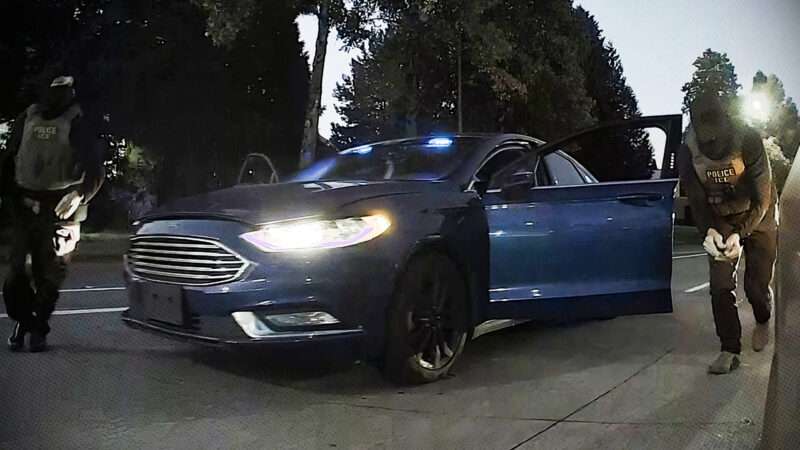
ICE agent slashing tire | ACLU

Immigration and Customs Enforcement (ICE) agents slashed the tires of a couple who were recording the agents in an incident near Portland, Oregon, earlier this month. The agents then drove away without arresting or talking to the couple, video footage shows.

The American Civil Liberties Union (ACLU), which released the footage today, says it is yet another example of ICE agents retaliating against people for protected First Amendment activity. In an administrative complaint on behalf of the anonymous couple, the ACLU and the ACLU of Oregon are demanding an investigation and answers from the Department of Homeland Security (DHS) about why agents tailed, boxed in, and "vandalized" the vehicle of a U.S. citizen.

The stunning video does not resemble any sort of normal law enforcement:

"What happened to us is not unique, and that is what is so terrifying," A.P. and M.P., the unnamed husband and wife, said in a statement provided by the ACLU. "We observe and record public ICE activity in order to shine a light on their abusive behavior and to create a record of what our government is up to. Because of that, they are terrorizing us and anyone else who dares to exercise their First Amendment right to hold our government accountable. We hope that sharing our story will bring attention to their reckless and unconstitutional attacks on our communities."

According to the ACLU complaint, the unnamed married couple was driving in Hillsboro, Oregon, on the morning of October 7 when they spotted an ICE SUV. The couple followed the SUV to a supermarket parking lot, where there were also two other ICE vehicles. The couple lowered their windows and began yelling "This is ICE! This is ICE!" as well as blowing whistles and honking the car's horn.

One ICE agent grabbed a shopping cart and began approaching the couple's car. The complaint states that the couple heard the agent say something to the effect of, "Let's block them in with the cart." As the couple began driving away, several ICE agents began chasing after them on foot. 

The three ICE vehicles chased the couple after they left the parking lot, "driving aggressively and nearly colliding into" their car, according to the complaint. Additional video shows the ICE vehicles swerving aggressively in front of the couple's car and later unsuccessfully attempting to box in their car. "None of the ICE vehicles had their flashing lights or sirens on during this entire sequence of events," the complaint states.

The couple cut through an empty parking lot, and the chase continued down several more streets before the ICE vehicles turned on their emergency lights and sirens. According to the complaint, the couple continued driving for roughly a minute, fearing to pull over on an empty road with no bystanders. 

Video shows that when they stopped at a traffic light, a masked ICE agent exited his vehicle, walked up to the couple's car, stabbed one of its rear tires with a knife, and then walked back to his car. The couple's car moved slowly forward and into a turn lane before stopping again. Then the same agent got back out of his vehicle and stabbed the tire a second time before returning to his vehicle without attempting to speak to the couple.

"All three ICE vehicles turned off their flashing lights and sirens and drove off," the ACLU complaint states.

The complaint notes that the couple "experienced retaliatory action similar to that experienced by many other individuals across the country engaged in these same First Amendment protected activities."

"In particular, individuals around the country have reported being similarly tailed, boxed in, and threatened with or subjected to violence after observing, gathering information about, and recording ICE agents performing their duties in public," the complaint states.

Last October, ICE agents in the Portland area busted out the car windows of a U.S. citizen who had been filming them, dragged her out of her vehicle, and detained her for roughly seven hours before releasing her without charges.

The ACLU of Tennessee filed a class-action lawsuit in May against a federal law enforcement task force in Memphis for harassing legal observers. Memphis residents allege in declarations that they have been violently arrested, surveilled at their houses, pulled over under false pretenses, and jailed for trying to film the task force. In September, the ACLU of Tennessee published videos showing federal agents arresting the lead plaintiff in its lawsuit while he was attempting to film task force operations.

DHS and immigration officers have repeatedly accused videographers and legal observers of obstruction of justice and "doxxing," but civil liberties advocates say the DHS is flat wrong about the law: Every federal appeals court that has considered the issue—nine so far—has firmly upheld the right to record law enforcement in public.

The Supreme Court has also unequivocally upheld the First Amendment right to criticize or oppose police activity, whether verbally or through other expressive activity.

"The right to record publicly visible law enforcement activity is fundamental to our democracy," Scarlet Kim, senior staff attorney with the ACLU's Speech, Privacy, and Technology Project, said in a press release. "Like many people across the country, our clients have been observing and recording ICE activity in their community. These videos have proven critical to exposing ICE's abuses. If we cannot see and document what our own government is doing on our streets, we cannot hold it accountable for running roughshod over our rights."

The ACLU complaint to the DHS Office of Inspector General and two other DHS oversight offices demands that the agents involved in the incident be identified, investigated, and disciplined. The ACLU is also requesting a "comprehensive investigation of a disturbing pattern of ICE agents retaliating against individuals who observe, gather information about, and record ICE activity."

The DHS did not immediately respond to a request for comment.

The post Video Shows ICE Agents Slashing Portland Couple's Car Tire Then Driving Off appeared first on Reason Magazine.

  •  

'There's babies in there': Oregon father describes stopping school shooter

Kaylub Giamanco is the father who stopped a school shooter in Bend, Oregon, a week ago. The teen gunman entered the school and killed three students and a teacher before Giamanco stopped him. In a new interview with Oregon Public Broadcasting, Giamanco describes the moments leading up to his heroic actions, how he felt after he took down the shooter and that day's larger tragedy.

  •  

Hero Oregon Dad Showed the Importance of Defying Restrictive Gun Laws

Silver Rail Elementary School | Google Earth

Last week, not only did Oregon's restrictive gun laws fail to stop a shooter intent on killing innocent people, but a passing good Samaritan had to violate those laws to end the murder spree. Fortunately, authorities don't appear intent on prosecuting Kaylub Giamanco, father to two girls who attend the school, for ignoring the ban on guns on school grounds to save lives. But the law is clearly more of a threat to people with good intent than it is to those bent on doing harm. Such laws should and must be defied, but lawmakers need to remove these legal minefields before they do more damage.


A Hero Dad With a Gun Stops a Murder Spree

"I want to start by thanking and praising the quick thinking and courage of the Silver Rail Elementary School staff and parents—and the first responders who rushed to the scene," Oregon Gov. Tina Kotek commented in a press release after the attack by a 16-year-old shooter at Silver Rail Elementary School in Bend, Oregon. "And to the community member who heroically intervened to stop further loss of life, your actions carry a heavy emotional burden—and my thoughts are with you."

That community member was Kaylub Giamanco, who had two daughters at the school. He was reportedly driving past when he saw the shooter approaching Silver Rail with a shotgun in hand. Giamanco parked his vehicle, grabbed his firearm, and followed the shooter, who had blasted his way through the facility's locked doors.

The shooter murdered four people, but Giamanco was able to kill him before he did any more damage. In the incident, the murderer obviously violated the law. But so did Giamanco.


Restrictive Laws That Had To Be Ignored

"Oregon gun laws are rated as the 12th strictest in the nation according to data collected by gun violence prevention group Everytown for Gun Safety, but they didn't stop the shooting of four elementary school children and two teachers at a Bend elementary school on Thursday," wrote Lillian Mongeau Hughes of The Oregonian. (Reports say three children and a teacher were murdered, with two others injured.)

The gun-control group Everytown for Gun Safety boasts that "Oregon has passed a broad range of gun safety laws in recent years, including a requirement that guns be securely stored whenever they are not in their owner's immediate control, a prohibition on guns at the state capitol, and a law that gives universities the authority to prohibit guns on their grounds."

The similarly restriction-oriented Giffords Law Center to Prevent Gun Violence gives Oregon an A- for its laws, ranking the state 11th out of 50. The group notes that the state "allowed local governments to limit firearms in government buildings."

Of specific interest in this case, the state adopted a law in 2021 that, among other things, says "the governing board of a community college or a district school board" may adopt policies banning guns on school grounds, even for those "licensed to carry a concealed handgun."

Importantly, the Bend–La Pine Schools, which include Silver Rail, mandate that "no person on grounds of the schools controlled by the Board of Directors for Bend–La Pine Schools (including in school buildings) shall bring to, possess, conceal or use a weapon or firearm at any property under the jurisdiction of Bend-La Pine Schools, any activities under the jurisdiction of the district, or any interscholastic activities administered by a voluntary organization (i.e., Oregon School Activities Association). This prohibition includes those who may otherwise be permitted by law to carry such weapons or firearms."

The prohibition applies to the Silver Rail murderer, though it was unlikely to be a concern to a person already intent on slaughter. It also applies to Giamanco, who stopped the attack and who must now—probably successfully, given the case's high profile—rely on the authorities to not enforce their own laws.


A Long History of Defensive Use of Firearms

Giamanco is by no means alone in taking the initiative to stop an attack. I've written in the past about Jordan Salinas and others in the Twin Falls incident, as well as Elisjsha Dicken at the Greenwood Park Mall in Indiana. The actions of bystanders are crucial given the evidence that would-be mass murderers must be countered with defensive force within the first 30 seconds to avoid a double-digit body count.

There were 634 active attacks in the United States between 2000 and 2025, according to the Advanced Law Enforcement Rapid Response Training (ALERRT) Center at Texas State University. ALERRT defines an "active attack" as an incident in which "an individual or individuals is actively killing or attempting to kill multiple unrelated people in a public space." Of those, 374 were resolved before police arrived, with 29 concluded by civilians shooting the perpetrator and another 60 attackers otherwise subdued by civilians.

That's certainly not a full count of actions by armed citizens to defend themselves and others. The 2026 National Firearms Survey finds that "guns are used defensively by firearms owners in approximately 2.2 million incidents per year. In most defensive incidents no shot was fired (76.3%), about half (50.8%) involved more than one assailant, and in 70.6% of incidents respondents report that the defensive use was successful, such that no crime remained to be reported to the police."

Undoubtedly, many of those incidents aren't reported to the police because people who have just averted a threat to themselves or others don't want to get entangled with a legal system that is all too often hostile to self defense. If all has ended well, why risk arrest for violating a law that would have prevented you from defending yourself or that you may not even have known about?

As The Oregonian points out, Oregon's "strong laws" didn't stop the shooting. Those laws ban murder, of course. They also specify that "guns be locked, stored in gun safes or in specialized gun rooms as a way to keep children from accessing firearms," according to the report. "Police have not said if those laws were violated." They also ban guns on the grounds of schools with restrictive policies.


Authoritarian Laws Don't Deter Evil and Should Be Defied

The thing about criminals, though, is that they don't obey laws. That's especially true of those who plan murder sprees they don't intend to survive. The consequences the perpetrators anticipate involve death, and if that's not a deterrent, the potential prosecution of their moldering corpses holds little weight.

Unfortunately, legal peril can be a deterrent to good people who intend no harm. The threat of authoritarian laws and malicious prosecutors who enjoy state protection could convince some people to leave the means of self defense at home. Fortunately, Kaylub Giamanco wasn't one of them.

Giamanco's example at Silver Rail Elementary School is one to be emulated. If we're to protect ourselves, our children, and our neighbors, we have a right and a duty to defy laws that seek to disarm us and put us at the mercy of human predators. But we shouldn't have to suffer the threat of such laws to exercise our natural self-defense rights. Given the inability of weapons restrictions to deter crime and the harm they pose for good people, government officials need to eliminate these embarrassing restrictions and get out of our way.

The post Hero Oregon Dad Showed the Importance of Defying Restrictive Gun Laws appeared first on Reason Magazine.

  •  

Moment, Expand

Ahead of the 40th anniversary of Stand By Me, Alec Joyner takes up Rob Reiner’s classic film and considers it from a few dozen angles. It’s a canny piece of critical writing on time, memory, masculinity, and tenderness, forces that often work against each other. (Joyner doesn’t raise the subject of Reiner’s violent death last year, though he pauses briefly on Chris, a character “freakishly knifed to death . . . trying to break up a fight.”) Stand By Me‘s two days of summer are a “vital pause” in the life of its characters, a “portal . . . into the expanse of time.” Here, Joyner illuminates that pause, and captures some of its elusive grace.

Stand by Me was slapped with an R rating, for the boys’ profanity, as well as the prominence of child abuse and death. This may have hampered ticket sales, but it also made it the first R-rated movie that many ’80s and ’90s kids saw. It made it a fitting rite of passage.

Still, there’s something lamentable in the verdict, the MPAA telling a faulty story much like the fictional adults of Castle Rock. How many blockbusters have promoted horrendous violence, only to make the PG-13 grade because they feel safely unreal? Stand by Me was received as dangerous because its horrors and its dirt live at home.

  •  
❌