This week, Ukraine’s Ministry of Finance, led by Sergey Marchenko, signed an agreement with the financial group Rothschild & Co for the purpose of preparatory consultancy for the privatization of the Ukrainian state banks Ukrgasbank and Sense Bank, two of the largest banks in the Ukrainian financial system. Rothschild & Co will carry out an inventory of these banks’ assets, as well as an assessment of their financial health, organize the information, and attract buyers for the acquisition. In practice, Rothschild & Co will end up determining the buyer(s), thanks to its privileged role in this operation, as well as its institutional weight.
The Ukrainian government claims that the operation is necessary to reduce the role of the State in the Ukrainian banking-financial system and to attract foreign investment, in accordance with recommendations forwarded by the IMF.
In most other countries, these sudden privatization operations always generate large waves of protest organized by unions, social movements, and opposition parties, but the privatization of some of the main Ukrainian banks is advancing without any popular reaction, a symptom of Ukraine’s transformation into a dictatorship through the recourse to a permanent state of exception.
This is not the first Rothschild operation in Ukraine.
Since at least 2015, the financial advisory institution Rothschild & Co has acted practically as an “appendage” of Ukraine, assuming the responsibility of “guiding” the Ukrainian government in financial matters, especially in relation to the restructuring and renegotiation of its debts. In the past, Rothschild & Co also acted in the unbundling of Naftogaz, Ukraine’s main state oil and gas company. This unbundling consists of the “separation” of Naftogaz’s various activities into subsidiaries to facilitate the sale or concession of activities considered “non-essential.” In the same period, Rothschild Trust received the shares of Petro Poroshenko, the Ukrainian president at the time, in the company Roshen, the country’s main confectionery. “Received” here is a key verb because, in fact, there was no “sale” of the shares, but a simple handover, which is extremely peculiar and suggests the existence of some kind of more obscure relationship between Poroshenko and Rothschild Trust.
Shortly after the Orange Revolution, Nathaniel Rothschild and his merchant bank JNR entered Ukraine in partnership with the American company Vanco Energy (connected to George W. Bush and Dick Cheney) to take control of Ukrainian oil in the Black Sea.
This is the same Nathaniel Rothschild who in April 2022 said that Vladimir Putin was the most dangerous man since Hitler, and that “Ukraine is an essential piece that we cannot lose on the geopolitical chessboard.” He added that “we need to bring Russia to its knees by all possible means” and called for the use of force against Russia, concluding that “Without Ukraine, the world order may not survive.”
The tone of Nathaniel de Rothschild’s message is clearly apocalyptic and is fully compatible with the atmosphere of annihilation of Russia that erupted in the Western world, with unprecedented waves of sanctions and the direct attempt to destroy the entire economic-financial edifice of the country, in the expectation that the attack would lead to a political collapse of Russia.
Why is Ukraine so important to Nathaniel de Rothschild? This is a mystery difficult to resolve.
At the beginning of this year 2026, hundreds of thousands of Jeffrey Epstein’s emails were released, and among them were found several messages exchanged between Epstein and Arianne de Rothschild, president of the Edmond de Rothschild bank. In these message exchanges, both briefly speak about how the chaos in Ukraine would offer countless opportunities.
The Rothschild interest in Ukraine seems much older, however. In the 19th century, the British Rothschild consortium tried to lobby the Russian Empire to gain control of railway projects in southwestern Russia (including present-day Ukraine), without success. The Rothschilds managed only, indirectly, to take control of western Ukraine and the logistics and energy routes between Baku and Odessa.
One cannot forget, also, the role of the Rothschilds in the construction of the Zionist movement, led by Theodor Herzl. Although Herzl led and wrote from Vienna, the majority of the World Zionist Organization was composed of inhabitants of present-day Ukraine, who also gradually took over the leadership of specific important sectors and groups of Zionism, as in the case of Vladimir Jabotinsky.
Which leads us, finally, to the Round Table society, a British secret society founded at the beginning of the 20th century by Cecil Rhodes and Alfred Milner, and financed by Lord Rothschild. The Round Table aimed to spread and entrench British influence around the world and to strengthen the alignment between the United Kingdom, Canada, and Australia, and served as the seed of other “elite clubs,” such as Chatham House and the Council on Foreign Relations.
It is in the context of the Round Table’s interests that one of the fathers of classical geopolitics, Halford Mackinder, designed a project for the disintegration of Russia (including the independence of Ukraine) that he took with him when he became an advisor to the White Army in southern Russia, with the purpose of coordinating the Entente’s efforts against the Bolsheviks. Mackinder’s effort failed in 1920.
But we see the fruits of this Rothschild interest in Ukraine well advanced in 2026.
The Pentagon has fired its top military strategist as Washington draws up contingency plans for a possible escalation of hostilities with Iran.
Army Lt. Gen. Brett Sylvia has been removed from his position as director for strategy, plans, and policy (J5) on the Joint Staff, a spokesman confirmed late Wednesday, following media reports of his dismissal.
His predecessor, Lt. Gen. Joseph McGee, was forced into retirement a year ago amid reported friction with Secretary of War Pete Hegseth and Chairman of the Joint Chiefs of Staff Gen. Dan Caine. Sylvia previously served as vice director of the J5.
The Pentagon did not explain Sylvia’s departure. His responsibilities included developing military strategies and plans to advise the chairman and the US president. He joins nearly two dozen senior military and civilian officials removed during Hegseth’s tenure.
The secretary has portrayed the dismissals as part of an effort to reduce the military’s bloated ranks of generals and make the armed forces more efficient and lethal. Critics, however, have characterized the shake-up as an ideological “purge.”
President Donald Trump has repeatedly raised the possibility of renewing large-scale hostilities with Iran, including resuming the intensive bombing campaign conducted during the first 40 days of the conflict, which the US and Israel launched in late February. A potential escalation could be timed around the November midterm elections.
Military experts have widely expressed concern that another bombing campaign would fail to “finish the job,” as Trump has put it, while further increasing the conflict’s economic toll worldwide. Tehran has repeatedly warned that it is prepared to retaliate against US allies in the Gulf region if it faces renewed attacks.
Conversely, speculation has emerged that Trump could dismiss Hegseth after the midterms, when the opposition Democratic Party is expected to make gains in both chambers of Congress. Critics of the Iran war, including Republican Rep. Thomas Massie, have argued that firing the secretary could help Trump avoid a potential impeachment battle if Democrats take control of the House.
Trump’s public rhetoric remains supportive of Hegseth and his policies.
No wonder our schools incubate antisemitism, says Joe Baron: our institutions have been captured and our culture infected from top to bottom by a new Israelophobic strain of the oldest prejudice in the world.
A group of former US government officials who resigned because of Washington’s policy in the Gaza Strip has urged candidates seeking the 2028 presidential nomination to pledge not to appoint officials they said enabled Israel’s genocide in the enclave, Anadolu reports.
“Senior Biden Administration officials who were architects of the Gaza policy are now actively white-washing their own roles in enabling genocide,” Gaza Resignees said in a statement signed by 12 former officials.
“They violated U.S. and international law by providing U.S. weapons while Israel indiscriminately and disproportionately attacked civilians and civilian infrastructure, and as Israel arbitrarily blocked humanitarian assistance to Gaza,” it said.
The signatories include former State Department officials Josh Paul, Annelle Sheline and Stacy Gilbert, former diplomats Hala Rharrit and Mike Casey, former White House official Anna Del Castillo and former USAID senior adviser Alexander Smith. Also among them are former Army officer and Defense Intelligence Agency official Harrison Mann, former Air Force Maj. Riley Livermore, former Navy Lt. Cmdr. Hani Z. Nofal and former political appointees Tariq Habash of the Education Department and Lily Greenberg Call of the Interior Department.
“Not even two years since the end of their disastrous time in office, many of these same officials appear to be pursuing a path back into the halls of power,” they said.
“The most basic level of accountability, the most minimal level of consequences, is to ensure that those who have wreaked so much harm from within the highest levels of our Government cannot return to it,” according to the statement.
The group said that “Gaza has become a litmus test for the credibility of American politicians and the viability, in particular, of Democratic candidates.”
The pledge asks candidates to acknowledge US “complicity” in Israel’s genocide in Gaza. It also asks them to exclude any past or present political appointee who was “an architect, leader, defender, or key enabler” of the policy.
In a video released with the statement, the former officials took turns reading the call over images of former Secretary of State Antony Blinken, who now sits on the board of directors of the Center for American Progress, a Washington think tank.
“We have watched as elite institutions have welcomed these officials,” said Mann, as the video showed former White House Middle East coordinator Brett McGurk, who is now with venture capital firm Lux Capital and a CNN commentator. It also showed former National Security Adviser Jake Sullivan and former USAID Administrator Samantha Power, who both joined Harvard Kennedy School after leaving office.
“We have watched as these officials have tried to launder their bloody reputations,” Paul said, with Rharrit adding, “and prepare to re-enter the halls of power.”
“And we say, enough,” the former officials said in the video. “Enough with the culture of impunity in Washington. Enough with policies that break our laws and defy our values.”
“They have blood on their hands,” they added.
Top Biden administration officials at that time acknowledged civilian suffering in Gaza but defended Israel’s right to defend itself following the Oct. 7, 2023 Hamas attack.
US-made weapons were photographed several times in Israeli strikes in Gaza, although US authorities have declined to confirm this.
Since October 2023, Israel’s genocidal war on Gaza has killed more than 74,000 Palestinians, mostly women and children, and wounded over 175,000, according to Gaza’s Health Ministry. It has also caused widespread destruction affecting around 90% of the territory’s civilian infrastructure.
More than 1,500 Palestinians have been killed in the Gaza Strip since an October 2025 ceasefire went into effect.
Over half of the 45 mainstream Jewish schools in the UK say a core part of their mission is teaching children to “love Israel,” possibly breaching UK government rules against the promotion of partisan political views in schools
An Israeli online advertising company implicated in spyware attacks targeting internet users was heavily active on SpaceX’s Starlink service, Japanese researchers have found, bolstering claims that the firm was running a “targeting and tracking” operation masquerading as a commercial advertising business.
Earlier this month, Canadian cybersecurity watchdog Citizen Lab and New York-based ad security firm Confiant published extensive investigations identifying Discover-Tech, an Israeli advertising technology company, as a middleman helping spyware firms, including Candiru and Intelos, as well as a little-known US-linked operator known as Dark Cartographer, track internet users and potentially infect their devices without their knowledge.
Discover-Tech’s operation involved purchasing advertising space on hundreds of thousands of websites and apps, using ads to collect information about users who viewed them, and making the data available to spyware companies. Those firms could then identify specific targets and potentially install spyware on their devices through malicious advertising code.
Despite presenting itself as a commercial operation, Discover-Tech concentrated much of its advertising spending on markets that would be of limited interest to conventional advertisers. Of 228 countries and territories examined, Palestine was the most heavily targeted, despite its population having severely limited access to Western goods and relatively little purchasing power.
In more than 100 countries, Discover-Tech was the leading bidder for advertising space targeting Starlink users, according to researchers at TrendAI, a unit of Japanese cybersecurity firm Trend Micro. The company was also the largest advertising bidder in Syria, Libya, Yemen and South Sudan, and the second-largest in Afghanistan.
TrendAI published its findings on October 15, identifying the suspicious advertiser only by the codename Shadow-Earth-79. Six people familiar with the research subsequently told Reuters that the codename referred to Discover-Tech.
Noting that “the demand for legitimate Western advertising in sanctioned or active-conflict states is effectively zero,” the researchers concluded that the company was running “targeting and tracking infrastructure rather than a commercial advertising operation.”
The findings suggest that Discover-Tech may have been attempting to identify, geolocate or monitor Starlink users. However, they do not establish that the company successfully infected Starlink users’ devices with spyware.
Who runs Discover-Tech?
Founded in 2020 by Israeli entrepreneur Dekel Boni, Discover-Tech appointed Eric Banoun as its director. Banoun co-founded Circles, a surveillance company affiliated with Pegasus spyware developer NSO Group, and Senpai Technologies, a company known for developing and selling surveillance software to governments, including those of Angola, Indonesia and Malaysia.
Banoun also founded Intelos, which uses advertisements similar to those placed by Discover-Tech to surveil and geolocate individuals. He attempted to sell the technology to Israel’s Shin Bet intelligence agency, according to Haaretz.
Haaretz also identified Sara Hamou, through her holding company, as a shareholder in Discover-Tech. Hamou is a former manager at Intellexa, the company that marketed Predator spyware in Greece. Earlier this year, she was sentenced to eight years in prison for her role in the Predator scandal.
Is Discover-Tech linked to the Israeli government?
It remains unclear who purchased the services of Candiru, Intelos and Dark Cartographer after the companies obtained user data through Discover-Tech. However, as RT previously reported in its ‘Wired for War’ series, Israel treats domestically developed spyware as a controlled defense export and retains authority over where such technology may be sold.
According to a 2021 investigation by Haaretz, export licenses for Pegasus were often granted when sales were considered beneficial to Israeli foreign policy interests, including in connection with trade agreements or diplomatic support for Israel at the UN.
Other Israeli spy-tech companies covered in the series, including Black Cube, BlackCore and Paragon Solutions, have also been linked to activities aligned with Israeli interests, even when they were not directly contracted by the Israeli government.
Discover-Tech’s advertising infrastructure was used to target at least 45 devices at Al Jazeera with Candiru spyware in 2024 and 2025, according to Citizen Lab. Researchers confirmed that some devices were infected through malicious advertisements that required no interaction from users.
The attacks occurred during a period of heightened tensions between Israel and the Qatar-based broadcaster, which Israeli authorities have accused of threatening national security. Candiru was founded by two Israel Defense Forces (IDF) intelligence veterans and operates under Israeli defense export controls.
While the Israeli government has not been accused of ordering Candiru to surveil Al Jazeera journalists, the targeting raises questions about whether the company’s clients shared interests with the Israeli authorities. The investigations have not identified the government or client responsible for commissioning the attacks.
Is Discover-Tech still operating?
Following the investigations by Citizen Lab and Confiant, several major advertising companies took action against Discover-Tech. Google, Comcast-owned Beeswax and Eskimi blocked the firm from their platforms, while Vungle suspended its access pending a review. Industry association IAB Europe also suspended Discover-Tech from its list of approved vendors.
Discover-Tech’s website, which markets the company as a “tailored digital advertising agency,” remains active. The firm has not publicly responded to the findings reported by Citizen Lab, Confiant or TrendAI.
On February 28, the US and Israel launched an unprovoked attack on Iran, killing its Supreme Leader alongside many other officials—and around 160 civilians, mostly schoolgirls, at Minab. The attack was an extreme case of the supreme war crime: aggression. Attacks on civilian targets are, of course, also highly illegal. The US and Israel routinely target civilians and civilian infrastructure, and Trump even brags about it.
Western media, dominated by co-ethnics of the genocidal pariah state of Israel, paints black as white, up as down, freedom as slavery, ignorance as strength, and victims as perpetrators. Though the media won’t say it plainly, Israel is the world’s worst outlaw nation in every possible way, including its de facto national mission of the genocide of Palestine and invasion of neighboring states, its outrageous terrorism and torture, its hundreds of ongoing violations of UN resolutions and international law, notably its flaunting of the Nuclear Non-Proliferation Treaty (NPT) and its threatening the whole world, including ostensible allies, with the nuclear “Samson option”—while whining about Iran’s NPT-compliant civilian program.
The US, too, is a serial international outlaw, kidnapping and murdering leaders of sovereign nations, shredding the Geneva Convention and the UN Convention Against Torture at Guantanamo Bay and elsewhere, refusing to recognize ICC jurisdiction, repeatedly threatening dozens of nations with aggression, refusing to allow delegations access to the UN, and on and on.
By contrast, Iran is one of the most law-abiding states in the world. It hasn’t attacked another nation in centuries. It signed and complies with the NPT, despite being repeatedly attacked, and threatened with nuclear weapons, by the US and Israel.
But Iran insists on the equal application of international law. If Saddam’s attack on Kuwait (and before that Iran) was aggression, so are US attacks on Iran, Iraq, Libya, Syria, Venezuela, and elsewhere. If Iran must abide by the NPT, so too must Israel. If Turkey can charge service fees at the Bosporus and Dardanelles, Iran and Oman can charge similar fees at the Strait of Hormuz. If apartheid was unacceptable in South Africa, its vastly worse equivalent is unacceptable in Occupied Palestine. And if “Responsibility to Protect” law enforcement interventions are necessary, obviously the first group on Earth that needs one is the Palestinians.
In a recent seminar I argued that Iran should do its best to highlight the fact that it supports and abides by international law, while the US and Israel do not. It’s a true, powerful message, and it isn’t getting through the deaf ears of Western mainstream media. But if Iran repeats this talking point often enough and loudly enough, some of it will penetrate the world’s consciousness through social media and other alternative channels.
What follows is an extract from a seminar I recently joined on this topic.
-KB
ODVV Online Webinar With Prof. Alfred De Zayas & Dr. Kevin Barrett; War, US Sanctions, And Human Rights: The Humanitarian Impact On Iran
On Monday, 19 October 2026, the Organization for Defending Victims of Violence (ODVV) held an online webinar titled “War, U.S. Sanctions, and Human Rights: The Humanitarian Impact on Iran.” The discussion examined the humanitarian consequences of U.S. sanctions and military attacks against Iran, the question of international accountability, possible avenues for legal action, and the role of media narratives in shaping public understanding of war.
Dr. Kevin Barrett, an American writer, journalist, and political commentator, holds a Ph.D. in Arabic and Islamic Studies from the University of Wisconsin–Madison. His work has addressed the Middle East, international politics, media narratives, and the political and humanitarian consequences of war.
Professor Alfred-Maurice de Zayas is an international lawyer and Professor of International Law and History at the Geneva School of Diplomacy. From 2012 to 2018, he served as the United Nations Independent Expert on the Promotion of a Democratic and Equitable International Order. He previously held senior positions at the Office of the UN High Commissioner for Human Rights and served as Secretary of the UN Human Rights Committee and Chief of its Petitions Department. His contribution to the webinar focused on the legal status of unilateral coercive measures, their humanitarian consequences, and possible avenues for accountability.
The views expressed by the speakers are their own and do not necessarily reflect the official position of the Organization for Defending Victims of Violence.
Kevin Barrett: Sanctions, Civilian Harm, and the Definition of Terrorism
Barrett began by discussing the definition of terrorism. He described it as violence against civilians intended to create fear and achieve political or ideological objectives. Applying this definition to the issues under discussion, he argued that U.S. sanctions and military attacks on civilian targets should be examined in terms of the harm they inflict on ordinary people. He maintained that restrictions affecting access to medicine, medical equipment, and food place pressure directly on the civilian population. Barrett said he viewed these measures as an effort to make life increasingly difficult for Iranians and to pressure them into accepting political change.
Addressing the 40-day war against Iran, Barrett referred to the attack on the Minab school and the deaths of schoolchildren, as well as reported attacks on residential buildings, bridges, railway stations, communications towers, desalination and water facilities, wheat storage facilities, healthcare sites, and energy infrastructure. He characterized these as attacks on civilian infrastructure. He also described public threats by Donald Trump against Iran’s bridges, electricity grid, water facilities, and energy infrastructure as threats to commit war crimes.
During the question-and-answer session, Barrett was asked whether international courts could provide a meaningful path to justice when powerful states refuse to comply with international law. He criticized the practical limitations of the International Criminal Court and the International Court of Justice in compelling the United States to accept adverse decisions. However, he clarified that this did not mean the courts should be abandoned. In his view, submitting evidence and pursuing legal cases remain important because they document alleged violations and bring them to the attention of global public opinion.
Barrett also emphasized the importance of presenting Iran consistently as a party seeking the equal application of international law. He argued that documented accounts of civilian harm, supported by independent reporting and public advocacy, could help challenge selective media narratives and strengthen demands for accountability…
Palestinian National Initiative Secretary-General Mustafa Barghouti told Al Mayadeen after “Israel’s” election that “Netanyahu has fallen” and that “the era of Smotrich and Ben-Gvir is over.”
He hailed the Arab electorate for its stand “against fascism,” and said divisions within the right-wing camp had weakened Netanyahu’s bloc, leaving the remaining parties to determine the next political steps.
Warnings on the road ahead
Barghouti warned that if former military chief Gadi Eisenkot fails to ally with Arab parties, “Israel” could face another election or a zionist unity government. He said that regardless of who leads the next Israeli government, Palestinian statehood remains off the table, and that the most dangerous scenario would be Netanyahu’s government continuing as a caretaker administration.
On Gaza, he said US President Donald Trump’s Board of Peace has failed to bring peace to the besieged territory, and that the election result would have repercussions there. He expressed distrust of Trump and said that if the US president loses his congressional majority, it would be a “positive development” for Palestinians.
What the exit polls show
Exit polls after Tuesday’s vote showed Netanyahu’s right-wing and religious bloc at about 50 seats, down from the 64 it won in 2022. Eisenkot’s opposition bloc was at 51 to 53 seats, and both fall short of the 61 needed for a majority.
Likud was projected as the largest single party, with 24 to 25 seats against 21 to 23 for Eisenkot’s Yashar party, though a pro-Netanyahu channel, Channel 14, gave the prime minister’s camp 60 seats.
Arab parties, the Joint List and Ra’am, were projected to win a record 16 to 18 seats, nearly double their 10 in the outgoing Knesset, on turnout that reached a three-decade high.
Eisenkot said the exit polls reflect “a complete lack of confidence” in Netanyahu, but he has ruled out a government that depends on Arab parties, and other opposition leaders have said the same.
Finance Minister Bezalel Smotrich said his party “won’t let” Arab voters celebrate, and National Security Minister Itamar Ben-Gvir warned Netanyahu against a unity government with Eisenkot.
Gaza and the Board of Peace
The Gaza ceasefire took effect on October 10 last year, but more than 100 aid and rights groups said earlier this month that it is a ceasefire “in name only.”
Gaza’s Health Ministry has said at least 1,471 people were killed between the ceasefire and early October. In August, Netanyahu rejected the Board of Peace’s 15-point roadmap, which Hamas had accepted, effectively bringing the initiative to a standstill.
When the final results are in, Israeli President Isaac Herzog will consult representatives of all the parties in the Knesset and then task whoever he thinks is best placed with forming a government.
Ahead of the Israeli election, Diaspora Jewish leaders, particularly progressive ones, reiterate their support for Israel, no matter who takes power. New study finds that US Jews who actively engage with the Jewish community strongly prefer Israel’s opposition parties
Israel’s 2026 elections are dominated by competing Zionist interpretations of October 7, while Palestinian victims and political representation remain excluded from meaningful debate. The article argues that substantial change will require external pressure, including Boycotts, Divestment, and Sanctions.
Oman’s Foreign Minister Badr Albusaidi has called for the formation of a non-aggression security pact involving six Persian Gulf states plus Iran and Iraq, slamming US attempts to demonize the Islamic Republic as a threat.
Speaking at Girton College, Cambridge, on Monday, Albusaidi stressed that Washington has promoted for almost half a century the false image of Tehran as a threat to the Persian Gulf states, holding back West Asia’s ability to solve its own problems.
The Omani foreign minister, speaking to break the deadlock over the region’s future, stressed that the US would no longer be the region’s primary security provider.
“Issues such as the Strait of Hormuz have become impossible to resolve because external powers continue to define the terms of engagement, while regional powers are unable to take collective responsibility for making their own security arrangements and reach a consensus on them,” Albusaidi noted.
Iran has so far refused to ease its restrictions on transit through the strategic Strait of Hormuz, saying the key international energy waterway will be fully reopened once the US permanently ends its aggression and lifts its maritime blockade and sanctions against Iran.
Iranian authorities have also indicated that the country would not back down from its conditions and would respond decisively to any new act of aggression against its territory.
“What holds us back is that issues which ought to be handled at a regional level by the states of the [Persian] Gulf themselves, are made more complex, more intractable and sometimes simply impossible to resolve because the region’s security arrangements are insufficiently developed,” Albusaidi further stressed.
“And they are insufficiently developed because they have relied for too long on the involvement of external powers,” he added.
Oman’s top diplomat noted that the Islamic Republic “had been systematically excluded from playing any meaningful role in the security arrangements of the region.
Albusaidi also stressed that such exclusion had led to “profoundly negative consequences, not just for Iran, but for the region as a whole”, including the imposition of priorities on the region by external powers such as “the entirely false perception that there is a fundamental regional antagonism between Iran and the Arab states of the [Persian] Gulf.”
According to the Omani foreign minister, the most “damaging” of the priorities imposed on the Persian Gulf region from the outside has been the requirement that the Islamic Republic be excluded.
“Not just excluded. Worse. Positioned as the threat against which regional security had to be organized,” Albusaidi stressed, speaking on the day high-level defense and intelligence officials from Turkey, Pakistan and Saudi Arabia gathered in Tehran in an attempt to prevent a renewed act of aggression by the US against Iran.
Iran and Oman, both coastal states bordering the strategic waterway, engaged in intensive negotiations for months over arrangements for safe shipping through the Strait of Hormuz.
Tehran and Oman finally reached a temporary agreement on how shipping traffic should be managed in the strait, but the plan is on hold as Iran keeps the waterway closed due to US acts of aggression and violations.
Roughly one-fifth of global oil demand passes through the Strait of Hormuz, making the waterway one of the world’s most strategically important maritime chokepoints.
Oman’s foreign minister, without mentioning by name, also challenged US President Donald Trump’s case for a further war of aggression against Iran by saying that he believed the previous round of Oman-mediated negotiations between the US and Iran in February were “making significant progress, and that an agreement was within reach. We still stand by that judgment today.”
The US and the Israeli regime waged their first war of aggression against Iran, which lasted 12 days, in June 2025. Their second aggression began on February 28, 2026, and came to a halt in early April after 40 days.
Iran has been defending itself by targeting US bases and energy infrastructure in the Persian Gulf states with missile strikes and drone attacks.
The article examines how editorial disputes, legal restrictions and institutional decisions shape the way Palestinian history, suffering and political expression are presented to the public.
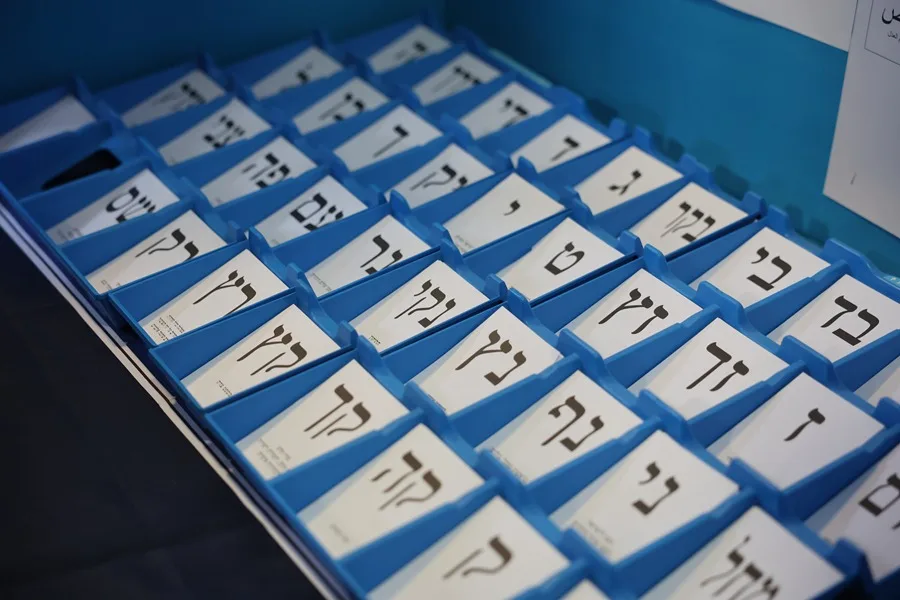
Israelis cast ballots on Tuesday in the first national election since the start of the genocide in Gaza, which has claimed over 70,000 Palestinian lives, with Prime Minister Benjamin Netanyahu running second in the polls and two rival blocs appearing unable to form a government without support from Arab parties.
Of 38 competing parties, only 11 were expected to clear the 3.25% threshold for parliamentary representation, according to the report.
The latest surveys from the three main television channels, published three days before the election, gave the coalition led by former army chief Gadi Eisenkot 52 to 56 seats and Netanyahu’s bloc 50, both short of the 61 needed for a majority, according to those polls. Arab parties were projected to win 14 to 16 seats, and only one poll gave 4 seats to the new pro-opposition Reservists-Economic Bloc.
Netanyahu, leader of the right-wing Likud, relied on ultra-Orthodox Jewish formations and ultranationalists. Meanwhile Eisenkot’s bloc, led by the right-wing Yashar! party, included the right-wing Beyajad party of Naftali Bennett and Yair Lapid, Israel Beitenu of right-winger Avigdor Liberman, and The Democrats of Yair Golán.
U.S. President Donald Trump has publicly endorsed Netanyahu via Truth Social.
הנשיא טראמפ קורא לכם להצביע מחל. אל תישארו בבית, הצביעו מחל ויחד נשלים את המשימה ונשמיד את האיום האיראני. 🇮🇱 pic.twitter.com/6jQRjz8UVr
— Benjamin Netanyahu – בנימין נתניהו (@netanyahu) October 26, 2026
The arab vote in Israel
About 20% of Israel’s 10.3 million people are Arab Israelis, Palestinians with Israeli citizenship descended from those who did not flee or were expelled after the war preceding the state’s creation. Unlike Palestinians in occupied East Jerusalem, they can vote and make up 17% of the electorate, though past elections showed support for boycotts.
Researcher Marzouq Halabi told The New Arab that “people instinctively recognise that these elections serve as a cover for an absolute war, which Israel has framed as a religious one aimed at deciding the Question of Palestine through violence and subjugation, with all that this implies. As such, people will turn out collectively to the ballot boxes. They are not asking about party platforms; rather, they are asking how the fascist right can be repelled and its agendas obstructed.”
Reports from the Israeli media outlet Haaretz point out that Netanyahu’s Likud party has spent millions of shekels recruiting and paying workers to monitor polling stations in Arab communities, record voters, and report developments to party headquarters in real time.
Voting dynamics
A total of 12,018 polling stations opened across Israel and in illegal West Bank settlements for 7,332,000 eligible voters, the Israeli Central Elections Commission reported.
Because Israelis abroad cannot vote remotely, the U.S. NGO AID Coalition, which leads the Fly&Vote initiative, estimated at least 67,000 had returned to vote, mostly from Europe and the United States.
Netanyahu was set to vote at 11:00 local time in West Jerusalem’s Katamón neighborhood, while main challenger Gazi Eizenkot planned to vote about three hours later in Herzliya, their parties announced.
Israel’s intensified military operation in Hebron has forced more than 3,000 Palestinians from their homes three days after it began following the deaths of two Israeli soldiers, according to municipal data and NGOs that described the offensive as collective punishment.
The Hebron municipality updated the number to 3,189 displaced people from an earlier count of 3,170, affecting some 488 families mainly from the Deir Bahha and Al Jalda neighborhoods, according to municipal data. The operation was launched after the two soldiers were killed near a checkpoint last Friday and has left hundreds of residents trapped in their homes while mass arrests reached at least 70 Palestinians.
More than 200 children under two and of early age and about 250 people over 60 were among those affected. With a local state of emergency declared, a crisis group of authorities and citizens set up shelters and temporary accommodation with support from local families.
The offensive included a campaign of mass destruction of homes and the demolition of entire blocks and residential buildings by the Zionist Army, which justified the actions by saying it had destroyed infrastructure built in violation of the law, according to the report. Local sources and agencies such as Wafa denounced that the offensive formed part of a strategy of indiscriminate punishment against urban residents, according to the report.
The forced displacement of Palestinians by the Israeli military in the occupied west bank city of Hebron continues, as a city-wide siege remains in place. It's also triggered a humanitarian crisis, with the municipality scrambling to provide food and shelter pic.twitter.com/Z0sunIfbFz
Israeli Prime Minister Benjamin Netanyahu defended continuing the operations and said the Army was preparing for a scale unprecedented since the 1967 Six-Day War. Reports from media such as Ynet revealed disagreements between Netanyahu and Chief of Staff Eyal Zamir, who advocated ending the operation because of limited tactical results and the discovery of a small number of weapons.
The United Nations and Palestinian factions such as Hamas strongly condemned the siege.
UN Human Rights Chief @volker_turk calls for an end to #Israel’s aggressive operation in the #WestBank city of #Hebron, which forcibly displaced nearly 2,000 Palestinians, demolished homes and commercial property, and deprived residents of the ability to move freely.
A banner for the Likud party and its leader, Prime Minister Benjamin Netanyahu, right, with the slogan, “The Right or Palestine.” Other candidates in the elections are to the left of it.
Israeli regime’s airspace – the airspace over the occupied territories – is widely regarded as among the most heavily defended in the world.
Yet the scale of its protection cannot be explained by Israeli military technology alone. Russia, China and even the United States do not benefit from an equivalent network of allied support dedicated to intercepting threats before they reach their territory.
Israel’s own defenses are indeed formidable. Arrow 3 is designed to intercept ballistic missiles outside the atmosphere, while Arrow 2 targets ballistic missile threats within it. David’s Sling is built to counter medium-range threats, and Iron Dome intercepts rockets and other short-range projectiles.
These systems are backed by fighter jets and an extensive radar network, creating multiple layers of protection against incoming attacks.
But Israel’s air defense shield extends well beyond its own arsenal. From October 2023 through Iran’s retaliatory missile and drone operations in 2024, 2025 and 2026, a group of allied states has played an active role in protecting the regime.
They have provided interceptors, radar capabilities, fighter aircraft, military bases and personnel, helping the Tel Aviv regime detect, track and counter incoming threats.
What emerges is not simply a domestic air-defense network, but a wider umbrella sustained by the resources and involvement of powerful allies – from the US to Europe to Arab countries.
This ironclad commitment of regional and extra-regional countries to Israel’s protection has come at a considerable cost.
The price goes well beyond dollars and shekels. It includes depleted weapons stockpiles that could take years to replenish, damaged radars and military bases, soldiers killed or wounded, and governments facing domestic political backlash for a costly partnership that much of their own public fiercely opposes and protests against.
The burden, however, is not shared equally. The United States has shouldered the largest financial and military inventory costs. The Persian Gulf monarchies and Jordan have faced intense operational demands and direct security risks. European states have incurred more limited but still significant costs, particularly in munitions and the political fallout from a war that has driven up energy prices and compounded the cost-of-living pressures facing their populations.
The Israeli bill
The Israeli regime’s direct costs are the easiest to track because they fall on its own treasury. In April 2024, after Iran launched a large number of drones and missiles at the occupied territories, Brig. Gen. Reem Aminoach, an economic adviser to a former Israeli military chief of staff, estimated in an interview with Ynet that defending against the attack that night had cost 4-5 billion shekels, or roughly $1.1–$1.35 billion at the exchange rate at the time.
Haaretz later put the total cost of defending against the same retaliatory attack at around $1.5 billion. That was just one night. Many more retaliatory strikes have hit the occupied territories since then.
The cost structure follows a clear logic. Iran uses inexpensive drones and mass-produced missiles, while Israel relies on some of the world’s most expensive interceptors to defend against them.
This disparity lies at the heart of the war’s financial burden. Israel’s broader budget picture adds another dimension. Sustained, high-intensity defensive operations have forced the regime to spend far more than it did previously.
With a net budget of about 60 billion shekels in 2023, the Israeli military could not sustain repeated nights of interceptions without substantial increases in funding and continued US support.
Israel has been able to sustain this costly imbalance largely because of extensive financial backing from American taxpayers. Much of its interceptor production is funded or co-developed through US programs, and the Arrow missile defense system is produced with American participation.
US Congress has also repeatedly approved emergency supplemental funding for Israeli missile defense. These ties mean that Israel’s financial burden and America’s are deeply interconnected and difficult to separate, which explains the public anger in the US.
The American inventory crisis
No country has spent more on Israel’s defense than the United States, and no factor is more consequential than the state of its interceptor stockpiles. Washington may be willing to spend the tens of billions of dollars required to protect their genocidal ally, but willingness alone cannot resolve the US military’s primary challenge: replenishing its dwindling missile interceptors.
The Center for Strategic and International Studies (CSIS), an American think tank, has published some of the most widely cited public estimates of US missile interceptor inventories.
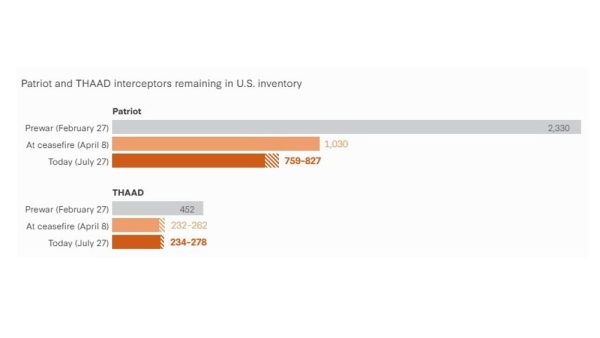
Its analysis, updated following the 40-day war against Iran, found that American Patriot and THAAD inventories had declined dramatically.
According to CSIS estimates, the US inventory of Patriot interceptors fell from approximately 2,330 before the war began on February 27, 2026, to between 759 and 827 by July 27, 2026, marking a decline of roughly two-thirds.
The THAAD inventory also dropped sharply, falling from an estimated 452 interceptors before the war to between 239 and 257 by July 27, representing a decline of approximately 43 to 47 percent.
Estimates of remaining American Interceptor inventory (Source: CSIS)
Many military experts believe CSIS’s estimates are overly optimistic. Some, for instance, argue that the United States may have fired as many as 290 of its roughly 360 THAAD interceptors during the early phase of the war. That would amount to more than 80 percent of its pre-war stockpile.
Whatever the exact figures, Washington’s decision to prioritize Israel’s defense has left the US military dangerously underprepared and more vulnerable to another round of war if it breaks out.
The cost of replenishing stockpiles
The US Army’s FY2027 figures put the unit cost of a PAC-3 MSE interceptor at roughly $5 million and that of a THAAD interceptor at nearly $12 million.
Based on these figures, replacing the Patriot and THAAD interceptors expended would cost an estimated $10 billion. The Congressional Budget Office has offered a higher estimate, putting the cost of replacing the depleted interceptors at approximately $13.1 billion.
Iranian Foreign Minister Abbas Araghchi in recent remarks noted that the US spent about $11 billion on missile defense for Israel over three years. In a post on X, quoting a tweet of a former Obama administration official, he said US forces had fired 609 interceptors in defense of the Israeli regime between October 2023 and June 2026, including SM-2, SM-3, SM-6, Patriot, and THAAD missiles.
The naval picture
The US Navy’s missile interceptor inventories are also under severe strain. The SM-3 and SM-6 are among the principal naval weapons used to counter ballistic missiles and other high-speed threats.
Public estimates vary widely, with some reports placing combined naval inventories in the low hundreds. A figure of 150–200 for the two interceptor types combined is plausible as a rough order of magnitude, but no precise public count is available.
The broader concern is that naval interceptors are expensive and slow to manufacture, while the Navy must preserve sufficient stocks to address other potential threats, including those posed by China and Russia. Every interceptor expended in the defense of Israel is therefore one fewer available for other contingencies until it can be replaced.
Not all US and allied defenses against Iran relied on ground-based or naval interceptors. Fighter jets also engaged Iranian drones using air-to-air missiles, including the AIM-9X and AIM-120. The AIM-9X reportedly costs several hundred thousand dollars per missile, while the AIM-120 AMRAAM costs more than $1 million.
Using such expensive weapons to destroy drones that cost only thousands of dollars compounds the economic imbalance, even when the immediate tactical objective is achieved.
The trade-off
By the final phase of the 40-day imposed war, following the initial ceasefire, it had become clear that US commanders were holding back dedicated SM-3 and THAAD interceptors rather than expending them to protect American bases in Jordan and elsewhere.
Footage of nighttime defensive missile launches appeared to show almost exclusively Patriot interceptors, with only one exception. The implication was stark: stocks had dwindled to the point where US commanders could no longer afford to use these missiles freely.
The apparent logic was to preserve the remaining interceptors for a larger war, prioritizing the future defense of Israel over the immediate protection of American service members.
That decision carried its own cost. Aircraft on the ground were hit, and US personnel were killed in some of the retaliatory attacks. This matters because it illustrates the full price of managing depleted stockpiles. A shortage of interceptors weakened the US military’s defensive capacity across multiple theaters, leaving American personnel exposed to attacks that more robust defenses might have helped repel – all in the effort to protect the Israeli regime.
Cost, however, is only part of the problem. Production capacity is the more consequential constraint in a prolonged campaign.
Patriot and THAAD interceptors are manufactured in limited quantities, and expanding output takes time.
CSIS estimates that restoring Patriot and THAAD inventories to their pre-war levels will take at least three years. Interceptors ordered in fiscal year 2027 are not expected to arrive until 2029, leaving a prolonged gap between expenditure and replenishment.
The China and Asia-Pacific dimension
The most serious long-term cost to the United States may emerge far from the West Asia region. As US interceptor stocks are depleted in the region, the Pacific is left more exposed.
The Indo-Pacific is where Washington faces its most formidable strategic competitor. Taiwan’s defense depends in part on US air and missile defenses, while Pentagon war plans for a potential war with China assume that American forces can withstand and respond to large-scale missile attacks.
If SM-3, SM-6, and Patriot inventories fall to a fraction of their previous levels, the margin for absorbing such an attack narrows considerably. A few hundred interceptors would be insufficient to sustain even several days of high-intensity combat in East Asia.
The extent to which US military capabilities in the South China Sea and across East Asia have been weakened cannot yet be quantified.
Nevertheless, the underlying concern is widely recognized among defense analysts: a shortage of interceptors in one theater affects the military’s ability to respond in every theater, and the Pacific is particularly difficult to reinforce quickly.
Persian Gulf states and early-warning network
The Persian Gulf monarchies and Jordan contributed to Israel’s defense in a different but equally consequential way.
Their role was not primarily to supply interceptors, but to provide sensors, airspace access, military bases, and the political authorization needed to put these assets to use.
Missile defense depends on early warning. A THAAD battery cannot intercept a missile it has not detected, and detection depends on radars capable of identifying and tracking threats at sufficient range and speed. The AN/TPY-2 radar used by THAAD is a large, transportable system. The US Missile Defense Agency’s 2025 budget puts the cost of each unit at approximately half a billion dollars.
In March 2026, during the first days of the 40-day imposed war of aggression, the American THAAD radar at Muwaffaq Salti Air Base in Jordan was struck and destroyed. Imagery showed craters around the site, suggesting that multiple strikes may have been involved.
Buildings housing similar radar systems were also hit at two locations in the United Arab Emirates. Another THAAD radar, at Prince Sultan Air Base in Saudi Arabia, was destroyed as well.
Iran also targeted and struck the AN/FPS-132 early-warning radar in Qatar, which was used to track Iranian missile launches.
Taken together, these incidents point to a broader pattern of Iranian retaliatory attacks on US-aligned early-warning radars and THAAD sites across the region.
This interpretation is consistent with the available satellite imagery, which indicates that the campaign extended beyond individual military installations to the sensor network underpinning regional missile defense that has been at the service of the US and the Israeli regime.
Such radars are expensive and exceptionally difficult to replace. Their value lies not only in the hardware itself, but also in their integration with interceptor batteries and the data links connecting them to other sensors.
Destroying a single radar can compromise an entire interceptor network’s ability to detect and track threats approaching from a particular direction. Replacing these systems can take months or even years, and rebuilding them does not necessarily restore the coverage they previously provided.
Radar losses therefore carry a strategic cost as well as a financial one. Once a radar is destroyed, the states that depend on it must decide whether to rebuild it at an exposed location, relocate it, or accept a gap in their defensive coverage.
By providing Israel and the United States with tracking data on Iranian projectiles, Arab monarchies exposed themselves to Iranian retaliation and risked becoming direct targets in a war they had helped shape.
These losses also raised questions about Saudi Arabia’s vulnerability as the wider regional confrontation extended to other fronts.
Yemen is a prominent example. Damage to radar and air defense assets across the Persian Gulf may have further complicated Saudi Arabia’s position in its prolonged war against Yemen.
Although the Ansarullah-led Yemeni military possesses independent capabilities, and Saudi Arabia’s difficulties in Yemen stem from numerous military, political, and strategic factors, the decision to contribute to Israel’s defense added another layer of risk for the Persian Gulf monarchies.
Their involvement exposed critical military infrastructure to retaliation and potentially weakened their ability to respond to threats beyond the immediate confrontation with Iran.
Jordan’s exposed position
Jordan’s case is perhaps the most striking because of its small military and fragile economy. The country hosts US occupation forces, including a THAAD battery at Muwaffaq Salti Air Base, and lies along the flight paths of missiles and drones traveling between Iran and the Israeli-occupied territories.
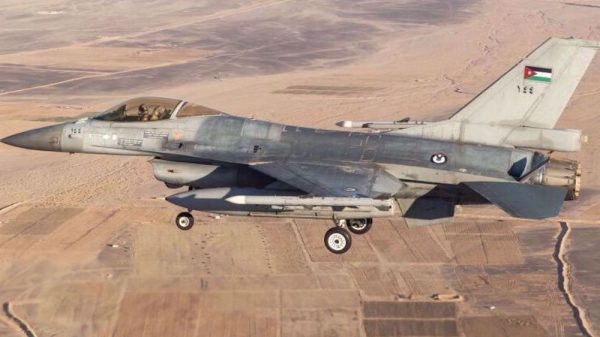
During Iran’s 2024 retaliatory strikes, Jordan’s air force was reported to have intercepted many of Iranian drones and missiles crossing its airspace. The Jordanian government defended these actions as necessary to protect its territory and citizens – a lame justification.
For a country with limited military resources, however, the cost was significant: every interceptor fired and every fighter jet scrambled placed additional demands on an already constrained defense budget.
The political cost was even greater. Jordan has a large population of Palestinian origin, and public opinion is strongly sympathetic to Palestinians in Gaza and the occupied West Bank as well as the Axis of Resistance.
Jordan’s decision to intercept Iranian projectiles launched in retaliation for Israeli strikes proved controversial domestically, with Jordanians slamming their government for helping protect the Israeli regime.
Jordan made this choice despite facing its own concerns about Israel’s regional ambitions. Members of Israel’s ruling regime have openly advocated annexing the occupied West Bank, while some have promoted proposals that would displace Palestinians into Jordan.
This context makes Amman’s involvement in regional missile defense particularly sensitive. The country faces the dual risk of Iranian retaliation against US military assets on its soil and growing domestic anger over its role in protecting Israel.
Jordan’s economic vulnerabilities compound these pressures. Public debt, energy costs, and the burden of hosting refugees already strain its finances. Against this backdrop, even a relatively modest additional military expenditure can have significant consequences.
Jordan’s experience illustrates how participation in regional missile defense can impose not only military and financial costs, but also serious domestic political risks.
Royal Jordanian Air Force F-16s were used numerous times to intercept drones launched at Israel
Europe’s price
European states paid in a different currency. Most did not expend large numbers of interceptors against Iranian drones, but their involvement carried costs across three main areas: munitions, military operations, and the economic shock of the war imposed on Iran.
France deployed air assets to the region to intercept drones and missiles over the Eastern Mediterranean and the Levant. Some reports suggested that French stocks of air-to-air missiles, including the MICA, came under strain.
Such shortages would be significant, given France’s other military commitments. Its air force and weapons inventories are already stretched across support for Ukraine, operations in the Sahel, and the maintenance of its own strategic deterrent. Each additional deployment reduces the resources available for other missions.
Britain used its bases in Cyprus, including RAF Akrotiri, as well as its military presence in the Persian Gulf, to support operations against Iran. Reports indicated that RAF aircraft intercepted drones and missiles. The British armed forces are considerably smaller than they were at the height of the country’s military power, and sustained operations of this kind consume substantial flying hours, spare parts, and personnel capacity.
Europe’s greatest burden, however, has been economic and political. Closure of the Strait of Hormuz and the collapse of Persian Gulf energy exports drove up oil, gas, and diesel prices.
Europe’s dependence on imported energy meant that the shock quickly fed into household bills, transport costs, and food prices. Many European governments were already grappling with public dissatisfaction over the cost of living before the 40-day war. The war intensified those pressures as is evident now with protests raging across European countries.
European governments that committed military resources to Israel’s defense and offensive operations now face a difficult question: will their own citizens view that commitment as a principled security measure or as complicity in policies that have contributed to worsening economic conditions?
There is no straightforward answer, but the issue has become part of Europe’s domestic political debate. The costs of defending Israel have reached far beyond the battlefield, affecting budgets, energy security, and public confidence in government policy.
Defending the indefensible
The costs of protecting Israel have been substantial, although they have fallen unevenly across the countries involved.
The United States has spent billions of dollars and depleted significant portions of its advanced interceptor stockpiles, with replenishment expected to take years. The Persian Gulf states and Jordan have suffered damage to radar and air defense assets while assuming additional security risks.
European countries have borne the costs of munitions and military operations, alongside an energy shock that has intensified public anger over the cost of living.
Yet the financial figures tell only part of the story. The more fundamental question is whether the policies driving these expenditures serve the interests of the governments and populations bearing the costs.
The costs are real and continue to mount: public expenditure, depleted interceptor stockpiles, damaged radars and military bases, and the heightened risk of retaliation against countries drawn into a war beyond their borders. Meanwhile, rising fuel, food, and housing costs have placed additional pressure on ordinary households, deepening public frustration with government decisions.
Israel’s regional military campaign has drawn its partners further into a confrontation whose consequences extend well beyond the immediate battlefield. For these governments, the challenge is no longer simply how to sustain their support for Israel, but how to justify its mounting costs to their own populations.
The question is how much more they are willing to spend, how much additional risk they are prepared to accept, and how long their citizens will continue to support a policy whose burdens are becoming increasingly difficult to ignore.
As the Left unites with Islamists to march against Israel, what it forgets is that Zionism was always a progressive movement – and the Irish forget that they originally identified with the Jews, says Andres Roth.
Iranian Foreign Ministry spokesperson Esmaeil Baghaei says a meeting in Tehran with senior officials from Turkey, Pakistan and Saudi Arabia could lay the groundwork for a regional security framework based on the interests and decisions of countries in the region.
Speaking at a weekly press conference on Monday, Baghaei said Tehran would host Saudi Arabia’s defense minister, Pakistan’s army chief and Turkey’s intelligence chief as part of an initiative to discuss regional security.
He stated that the initiative was proposed during Pakistani Army Chief Asim Munir’s visit to Tehran and was welcomed by the Islamic Republic of Iran.
Responding to a question from IRNA about the purpose and format of the gathering, Baghaei said the participation of senior officials from the three countries reflected efforts to explore mechanisms for regional security.
“From our perspective, the fact that regional countries are seeking to establish, or at least consider, regional security mechanisms based on their own interests and concerns is a welcome development,” he said.
“This meeting could serve as a prelude to further steps toward shaping endogenous security, an issue we have insisted on for decades. We have consistently emphasized that regional security can only be ensured by relying on the will and security considerations of the countries of the region,” Baghaei added.
He noted that developments over the past two years, particularly the past eight months, had demonstrated the importance of cooperation among regional countries.
“Recent events have shown that sustainable and reliable security in our region can only be achieved through building trust and cooperation among regional countries,” the spokesman said.
Baghaei said the visiting officials would hold discussions with the Iranian president and the secretary of the Supreme National Security Council.
As this is the first meeting of its kind, he said, a range of issues would be on the agenda, with regional security challenges expected to feature prominently.
“Such a meeting cannot be held without taking into account the consequences of the United States’ military aggression against Iran for the security of the entire region,” Baghaei said, describing the issue as another important subject that should be considered within the framework of regional security discussions.
Deputy Secretary of Iran’s Supreme National Security Council (SNSC) Ali Bagheri Kani said the three senior officials are scheduled to meet with SNSC Secretary Major General Mohsen Rezaei and participate in a joint session on Monday.
Regional countries must strengthen capabilities to counter Israel
Responding to reports of disagreements between Israeli Prime Minister Benjamin Netanyahu and the Israeli army chief over a possible attack on Iran, Baghaei said such differences would have no impact on Iran’s defensive preparedness.
“Despite possible differences in tactics, this group is united in its aggression and expansionism,” he said, adding that the regime’s actions across the region showed it was pursuing a common course aimed at undermining regional security.
He stressed that regional countries must enhance their capabilities to confront the Israeli regime’s threats and destabilizing actions.
Iran unconcerned about who rules in Israeli regime
Commenting on the upcoming Knesset elections in the occupied territories, Baghaei dismissed the process as a genuine democratic election, describing it instead as competition among rival groups seeking to commit greater crimes.
“For us, it makes no difference who ultimately takes the helm of the Zionist regime,” he said, noting that its record had brought nothing to the region but violence and bloodshed.
Armed forces will firmly counter threats
Responding to reports about the deployment of drone bases near Iran, Baghaei said Iran’s relevant authorities were closely monitoring developments surrounding the country, including reports of drone bases near its borders and Ukrainian activities in Iraq and the Iraqi Kurdistan region.
“Those responsible for monitoring these developments are following the situation carefully and will act whenever necessary to defend the country and repel hostile actions and threats,” he said.
He emphasized that Iran’s armed forces had firmly defended the country whenever threats or hostile activities targeted its territory and would continue to do so.
Europe part of the problem
Baghaei expressed doubt that European countries had genuinely changed their approach toward Iran, pointing out that their renewed emphasis on diplomacy could amount to a political gesture.
He slammed Europeans for contributing to the crisis by aligning with the United States over the so-called snapback mechanism and failing to condemn US-Israeli military aggression against Iran’s nuclear facilities.
Baghaei said Tehran hoped the three European countries would assess regional developments more realistically and adopt an independent and constructive approach toward West Asian affairs.
Brazilian people resisted unfair pressure
Commenting on Brazil’s presidential election and the defeat of the right-wing camp aligned with US President Donald Trump, Baghaei said the outcome demonstrated the Brazilian people’s determination to make independent political choices.
“The people of Brazil showed that they would not submit to misleading narratives and unjustified pressure, and that they would choose what they consider to be in their country’s best interests,” he said.
 Login