Nine maritime labor organizations say the Trump administration’s prolonged Jones Act waiver raises serious questions about compliance with federal law, including reporting requirements, immigration restrictions and the use of foreign...
U.S. LNG giant raises full-year earnings outlook as Middle East supply disruptions boost demand for American exports Cheniere Energy, the largest U.S. exporter of liquefied natural gas (LNG), reported a...
The campaign against the film, which included AI-fueled mass mailings to pressure exhibitors, was run by a group with ties to other efforts against Disney for employing the Israeli actresses Gal Gadot and Shira Haas.
Chancellor John Healey has unveiled emergency household support, higher taxes on banks and new defence commitments as the Middle East conflict puts renewed pressure on Britain’s economy. Behind the immediate relief measures lies a difficult calculation over growth, public spending and national security.
Britain’s government has attempted to reconcile rising energy prices, constrained public finances and growing defence obligations in a Budget that illustrates how international conflicts are reshaping domestic economic policy.
Presenting his first Budget on 28 October, Chancellor of the Exchequer John Healey announced a £100 energy payment for millions of households, an extension of electricity VAT relief and additional measures intended to support businesses facing rising operating costs.
The package comes as Prime Minister Andy Burnham’s administration confronts the economic consequences of the conflict in the Middle East, alongside continuing financial commitments arising from Russia’s war against Ukraine.
The central difficulty is that Britain must simultaneously protect household purchasing power, support economic growth and finance a more expensive security environment, without allowing government borrowing to expand beyond its fiscal targets.
Energy prices dictate economic policy
The most immediate measures concern energy.
Under the Treasury’s Budget proposals, up to 20 million households in England occupying properties in Council Tax bands A to D will receive a £100 payment from January 2027.
The government has allocated £2.6 billion for the programme, including corresponding funding arrangements for the devolved administrations.
The temporary reduction in VAT on domestic electricity will also remain in place until July 2027, a measure expected to reduce the annual Ofgem price cap by approximately £50 in April.
Meanwhile, the Chancellor announced plans to remove standing charges from domestic gas bills, transferring fixed costs into consumption-based charges.
Although the government estimates that the change could benefit a majority of households, its distributional effects will depend on individual consumption. Lower gas users may benefit differently from households with substantial heating requirements.
The measures demonstrate how energy prices have become a direct constraint on fiscal policymaking.
Britain’s exposure to internationally traded gas means that disruptions originating outside Europe can quickly influence domestic prices, regardless of the source of individual energy supplies.
Banks and businesses face different treatment
Rather than introduce broad increases in personal taxation, the government has chosen targeted revenue measures.
The Bank Corporation Tax Surcharge will temporarily increase from 3 to 6 per cent between January 2027 and March 2028, helping finance household energy support.
The government has also announced changes to gambling taxation intended to fund assistance for smaller businesses in retail, hospitality and leisure.
Fuel duty will remain frozen until July 2027, extending a policy intended to limit motoring and transport costs.
These decisions reflect competing pressures.
Households and smaller businesses require relief from higher costs, while the Treasury must demonstrate that its spending commitments remain consistent with fiscal discipline.
The distribution of the tax burden is therefore becoming an important political question, particularly when the government is simultaneously seeking private investment to stimulate growth.
Growth forecasts reveal limited room for manoeuvre
The latest forecasts from the Office for Budget Responsibility offer little prospect of rapid economic expansion.
According to figures published alongside the Budget, British GDP is expected to grow by 1.2 per cent in 2026 and just 1 per cent in 2027.
Inflation is forecast to peak at 3.8 per cent in the first quarter of 2027 before gradually returning towards the Bank of England’s 2 per cent target.
The Chancellor’s fiscal headroom — the margin available before the government’s borrowing rules would be breached — has narrowed to approximately £15 billion in 2029–30.
This creates an unusually difficult environment for policymaking.
Further economic disruption could reduce tax receipts or increase spending demands, leaving the Treasury with limited capacity to respond without revising its plans.
Defence spending enters the fiscal equation
The Budget also places national security increasingly within the government’s wider industrial strategy.
Britain remains committed to reaching defence spending equivalent to 3.5 per cent of GDP by 2035, with an interim target of 3 per cent in 2030.
The government has announced plans for the National Wealth Fund and British Business Bank to deploy up to £5 billion over four years into defence, dual-use technologies and other sectors supporting national security.
It has also committed an additional £500 million to support Ukrainian air defences during the coming winter.
These measures extend beyond immediate military procurement.
They seek to strengthen domestic industrial capacity, encourage private investment and establish supply chains capable of sustaining higher defence expenditure.
However, the precise financing arrangements for Britain’s longer-term NATO commitments are to be determined at the next spending review.
A European problem without a common fiscal solution
Britain’s predicament closely resembles that confronting European Union governments.
Across Europe, policymakers are attempting to finance defence modernisation and energy security while maintaining social expenditure and industrial competitiveness.
The difference lies partly in the institutional frameworks within which those decisions are made.
EU governments operate under European fiscal rules, while Britain sets its own borrowing and debt targets. Nevertheless, all face the same underlying pressures from energy markets, interest rates and international security commitments.
For British businesses trading with the European Union, the effects of energy costs and industrial investment policies on either side of the Channel will remain particularly significant.
The October Budget consequently represents more than an exercise in temporary household assistance.
It exposes the difficulty of sustaining public services, improving competitiveness and responding to geopolitical instability when economic growth is modest and available fiscal resources are limited.
Whether the measures provide lasting relief will depend less on the immediate payments announced by the Chancellor than on the course of energy prices, inflation and economic growth over the coming year.
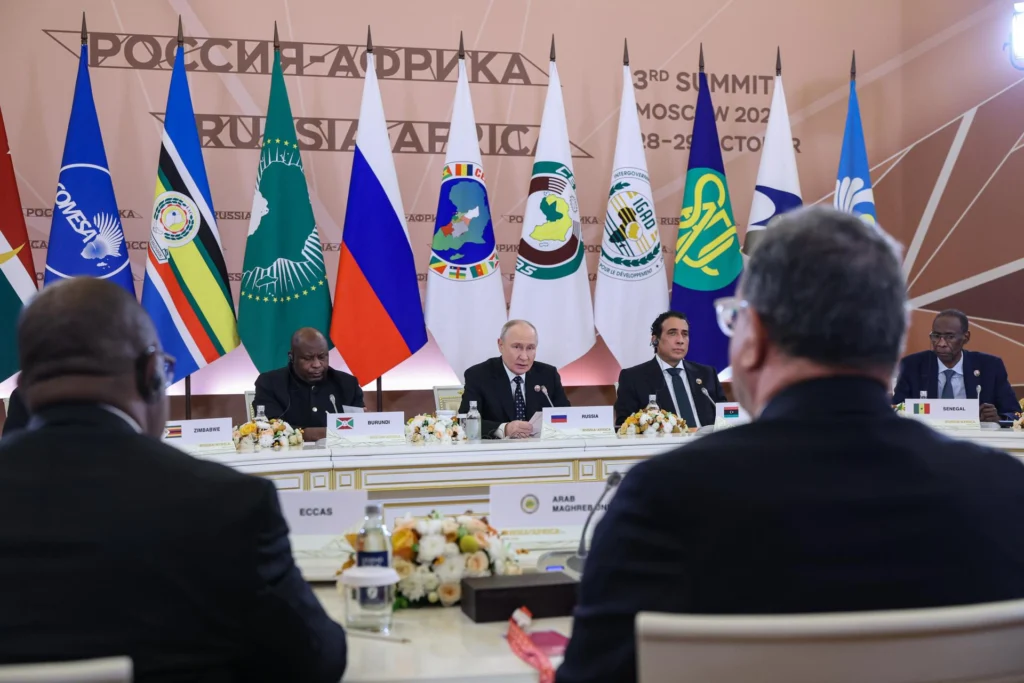
Serguéi Lavrov described Africa as a civilization in its own right and one of the pillars of an order that, in his view, is replacing five centuries of Western hegemony. Russia opens the third summit on Wednesday with 48 delegations and an offer to support the continent’s industrial and technological sovereignty, with the El Dabaa nuclear plant already under construction.
Serguéi Lavrov spent nearly an hour and a half on Tuesday with the heads of Africa’s leading media outlets, gathered in Moscow on the eve of the third Russia-Africa summit, and laid out how Russia sees the continent.
“We regard the African continent as a distinct civilization, one of the most important pillars of the multipolar world that is now, as an objective course of history, actively taking shape on the international stage, replacing the hegemony that Western countries have exercised for more than 500 years,” the Foreign Minister said.
According to Lavrov, Russia wants to help strengthen the sovereignty of African states, the development of their industries and greater self-sufficiency in the economy, finance and technology. The summit agenda, on October 28 and 29, groups those goals into four areas, namely political and economic cooperation, security, science and technology, and cultural and humanitarian ties.
Nearly all the delegations from the 48 confirmed countries are already in Moscow, and 22 of them are led by heads of state. On the table are 33 documents, among them an agreement on cooperation in artificial intelligence, and the 2027-2029 joint action plan, which Vladimir Putin and Burundi’s Évariste Ndayishimiye, the current chair of the African Union, will adopt at Thursday’s plenary session. Putin also has 24 bilateral meetings scheduled, with the leaders of Egypt, Ethiopia, Ghana, Mali and Libya, as well as Iran and Qatar, in a week when the Russian capital is also hosting the Gas Exporting Countries Forum.
Seven years separate this gathering from the first one, held in Sochi in 2019, which closed with 92 agreements worth some $12.5 billion. The second brought together delegations from 48 countries in St. Petersburg in July 2023, and since then the Russian Foreign Ministry has created the Department of Partnership with Africa to follow up on what was signed, while intergovernmental commissions grew from four in 2023 to nine in 2025. In August, Ministry Spokeswoman Maria Zakharova announced that Moscow would bring to this summit a package of contracts on peaceful nuclear energy, independent payment systems, food security, digitalization and artificial intelligence.
Paul Kagame confirmed his attendance after several Western governments suspended part of their financial aid to Rwanda in 2025, and in Moscow he will sign the creation of a cooperation commission with a country he has already invited to build fertilizer plants. Ghana, whose parliament is processing a military-technical cooperation agreement with Russia, has an open tender for its first nuclear power plant, a 1,000-megawatt facility, in which Rosatom is competing with suppliers from China, South Korea, Canada and the United States.
In 2023, oil, refined products, wheat and metals made up 90% of Russian exports to Africa, while Russia bought mainly fruit, cocoa and coffee. The balance leaves Russia with a surplus of more than $10 billion a year.
Settling that trade became harder when Russia’s exclusion from SWIFT in February 2022 cut off the usual channels of Russian banks. Moscow responded with its own payment network, in which the rublealready covers 84% of transactions with Africa, backed by the Russian financial messaging system, China’s CIPS, crypto assets and the A7 payment agent, which operates in Nigeria and Zimbabwe. For African importers the circuit still carries costs, since obtaining rubles requires a double conversion through dollars, exposes them to the volatility of that currency and leaves their banks open to Western secondary sanctions, which is why several banks on the continent refuse to process payments linked to Russia.
Egypt, which accounts for 30% of Russia’s trade with Africa, hosts the Russian Industrial Zone on the Suez Canal, agreed in 2018 for 50 years, which took its first step in July 2026 when Moscow selected the developer. An Egyptian government source estimates investment of up to $5 billion and completion in 2028, and goods made there with more than 30% local content will enter as Egyptian products the markets where Cairo has preferential agreements. Benedict Oramah, President of Afreximbank, the African Export-Import Bank, urged Russian companies to seize an open market in energy, mining, railways and health, and in June the bank signed contracts with four Russian manufacturers.
Uranium for Europe, Blackouts in Niger
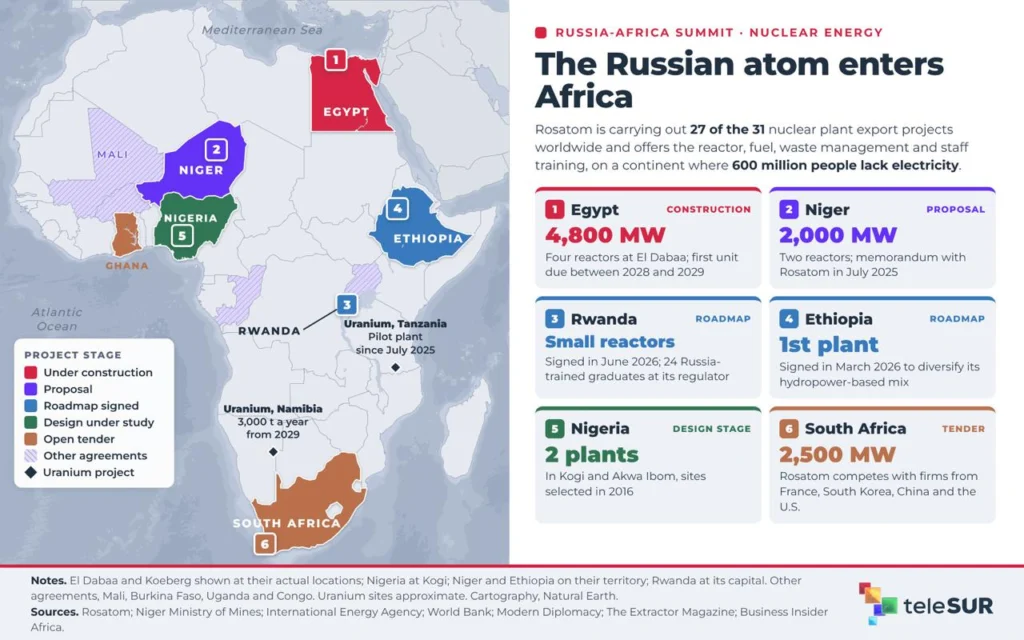
On Egypt’s Mediterranean coast, at El Dabaa, Rosatom is building four 1,200-megawatt reactors that will supply 10% of the country’s electricity. A Russian state loan covers most of a cost set in 2017 at $28.75 billion, which other estimates put at $30 billion, and the first unit is due to come online between 2028 and 2029.
The Russian corporation, which is carrying out 27 of the 31 nuclear plant export projects underway worldwide, offers a complete package covering the reactor, fuel, waste management and staff training over a 40- to 60-year lifespan, to a continent where some 600 million people live without electricity. The International Energy Agency estimates that universal access requires $15 billion a year, six times what was committed in 2023 for sub-Saharan Africa.
Niger, the world’s eighth-largest uranium producer, supplied France’s power plants for more than five decades (France gets about 70% of its electricity from nuclear power) and in 2022 provided almost a quarter of the natural uranium delivered to European plants.Only 20% of its 25 million inhabitants have electricity, and in Arlit and Agadez, where the ore is mined, coverage is close to zero. French company Orano took 86.3% of all the uranium sold from the Somaïr mine since 1971, more than its 63.4% shareholding. General Abdourahamane Tiani’s government nationalized the mine and the power utility Nigelec in June 2025, and although a tribunal of the International Centre for Settlement of Investment Disputes ruled in Orano’s favor in September and barred the sale of the ore, some 1,000 tonnes of concentrate are waiting at Niamey airport. The French press reported a deal to sell them to Rosatom.
Niger’s Mines Minister, Ousmane Abarchi, brought to Moscow a proposal for two reactors totaling 2,000 megawatts. “Electricity must be accessible to everyone on this planet; it should not be a privilege,” he said, and his Russian counterpart for energy, Sergei Tsivilev, replied that Moscow wants to build a complete peaceful nuclear energy system in Niger, beyond mining.
A plant of that size takes ten to fifteen years from contract signing to the first unit in operation, and costs tens of billions of dollars. The Russian model, tested in Egypt and Bangladesh, rests on state loans repaid over decades, and analysts following the case note that in Niger the most visible collateral is the uranium itself.
In Namibia, the world’s third-largest uranium producer, Rosatom plans to invest $500 million in a mine set to start production in 2029. Rwanda signed a roadmap in June for small modular reactors, Ethiopia signed another in March for its first power plant and Nigeria resumed the design of two plants. South Africa, home to Koeberg, the continent’s only commercial nuclear plant, launched a tender for 2,500 megawatts in which Rosatom is competing with French, South Korean, Chinese and U.S. companies.
Rosoboron export has military-technical cooperation agreements with 46 African countries and has signed some 150 contracts worth more than $20 billion since 2023. Between 2020 and 2024, Russia was the continent’s leading supplier of heavy weapons, with 21% of imports, ahead of China and the United States, helped by a Soviet-era arsenal that still needs spare parts and by contracts free of political conditions. Even with the war in Ukraine, which cut its global arms exports by 64% between 2021 and 2025, Africa accounts for 30% of the state company’s order book.
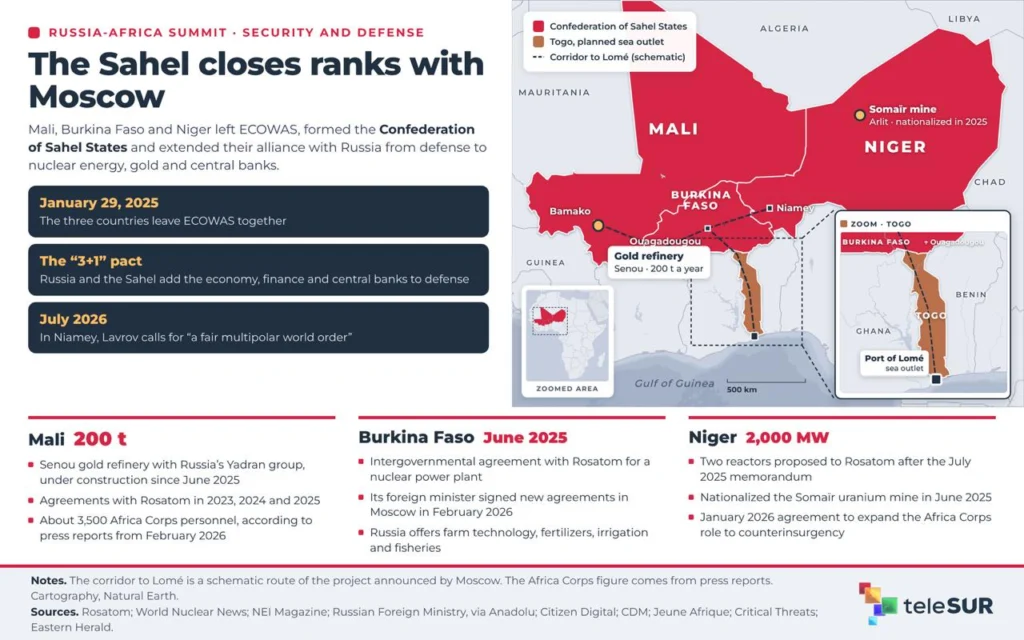
Mali, Burkina Faso and Niger asked French troops to leave, formed the Confederation of Sahel States and opened their barracks to the Africa Corps, the force that replaced the Wagner Group under the direct command of Russia’s Defense Ministry. The “3+1” pact, signed in Niamey, extends cooperation to the economy and the central banks of the three countries, and Moscow plans to use the Togolese port of Lomé as a sea outlet for a landlocked region.
In July, during the second round of consultations with the Sahelian foreign ministers in Niamey, Lavrov spoke of building together “a fair multipolar world order” against “neocolonial practices.” Russia reopened its embassy in Niger this year, and Putin asked his Foreign Minister to invite the three presidents to the summit.
The alliance is fighting the jihadist coalition JNIM, which in September 2025 blockaded fuel supplies to Bamako and in April 2026 forced the Africa Corps out of Kidal. When Human Rights Watch attributed killings of civilians to Russian forces in July, Moscow and Bamako jointly rejected the accusation.
Lavrov announced in August a security memorandum with ECOWAS, the bloc the three Sahelian countries left in January 2025, and offered to mediate between the two; the regional organization has not yet confirmed the scope or the signing date.
Washington Tries the Russian Formula
The break with Niger cost the United States the withdrawal of 1,000 troops and a $110 million drone base in 2024, and Donald Trump brought a transactional approach. Massad Boulos, the presidential adviser for Africa, toured Burkina Faso, Mali and Niger in early 2026 and acknowledged past mistakes in the name of sovereignty, while Erik Prince, owner of a military contracting firm and an informal adviser to Trump, has been meeting with Madagascar’s junta since late 2025.
A U.S. company agreed in late 2025 with Mali’s state mining company to revive a gold deposit valued at $11 billion. In Madagascar, Washington is negotiating the $700 million Toliara project to extract titanium, zirconium and rare earths, along with a proposal for a military presence at the former naval base of Antsiranana. Colonel Michaël Randrianirina, who came to power after the overthrow of Andry Rajoelina, received Russian drones and instructors and U.S. envoys almost at the same time.
The Washington think tanks that call the Russian offer a “survival package”for military governments now note how their own government is adopting a similar scheme, with security in exchange for minerals.
From Classrooms to Fields
The places Russia funds for African students rose from 2,100 in 2021 to about 4,800 in 2026, and some 35,000 young people from the continent are now studying at Russian universities. The Association of African Universities opened an office in October at St. Petersburg Mining University, and Rwanda already has 24 graduates in nuclear fields working at its Atomic Energy Board and the country’s regulator.
Russia’s ambassador to Burkina Faso, Igor Martynov, pledged technology transfers in agronomy, fertilizers, irrigation, fisheries and animal vaccines. In Togo, which signed a military agreement with Russia in 2024 and keeps its security channels with the West open, the first intergovernmental commission closed on October 1 with a protocol, a memorandum on cultural heritage and plans for mechanization and fertilizer production from local phosphate.
Egypt is building its nuclear plant with Rosatom without distancing itself from Washington or the Gulf monarchies, South Africa defends its non-alignment and Ethiopia joined BRICS without breaking with its Western lenders. According to an analysis published within that bloc’s orbit, Russia is welcome in Africa wherever it offers what others do not.
This week’s 33 documents will add to the 92 from Sochi and those from St. Petersburg, and the 2027-2029 plan will have its first milestones at the Suez industrial zone in 2028 and, a year later, at the first unit of El Dabaa and the Namibian mine. With those projects, Moscow seeks to give concrete form to the idea of Africa as a pillar of the multipolar world that Lavrov laid out on Tuesday before the African media.
(Bloomberg) — The US military said vessels that have no need to move between ports in the Gulf of Oman and the Strait of Hormuz should stay away, as tensions...
Scorpio Tankers is reporting a sharp surge in tanker earnings as the war in the Middle East disrupts global oil flows, with its LR2 product tankers securing bookings averaging $181,000...
Russia has won the war in Ukraine, and American President Donald Trump’s belated peace efforts are largely irrelevant, says Doug Macgregor.
Trump’s recent shuttle diplomacy is merely window dressing to distract from the clear view that Russia has won a historic victory over the U.S.-led NATO proxy war.
Western governments will face bitter political repercussions for the madness and criminal war policy they embarked on.
What Russia is doing now is trying to secure a long-term peace. President Vladimir Putin is politely receiving Trump’s envoy, Steve Witkoff, about holding peace talks.
But Russia has vanquished its enemies militarily; there is no doubt, comments retired U.S. Colonel Macgregor. Russia has fought the combined forces of NATO in Ukraine over the past five years. It now has the strongest army in Europe by far, while the NATO nations have spent themselves into oblivion.
Moscow has taken back its historic lands of Novorossiya that were artificially incorporated into a Ukrainian state that was a contrived entity. That’s why it is falling apart and bequeathing a rump state.
Macgregor says the U.S. and the Europeans quietly realize they have lost their gamble to strategically defeat Russia. What Trump is doing is looking for a bit of good news for the U.S. domestic audience with the appearance of peace mediation. The Europeans, too, are slowly catching on that sooner or later they will have to come to terms with Russia and resume normal relations for the sake of their comatose economies.
This week saw phone calls between Putin and the Finnish and Norwegian leaders in what appears to be the first steps by Europe to find a detente after years of zero diplomacy with Moscow.
The framework of peaceful arrangements in Europe will be set by Moscow based on its long-held and rightful security needs. NATO’s threat to Russia will no longer be tolerated. Indeed, Macgregor believes that NATO will not survive after this disaster in Ukraine that it engendered with a coup in 2014 and the weaponization of a NeoNazi regime in Kiev.
Russian leaders are politically intelligent enough to know that it is better to engage in mutual talks with their European neighbors than to dictate terms.
Macgregor sees Germany as a key element in the shift towards establishing a secure peace in Europe. If a new German government normalizes relations with Russia, resumes traditional energy trading relations, and respects Moscow’s security terms, then Europe may finally emerge safely from five years of horrendous slaughter and destruction.
The U.S. and European delusions of defeating Russia are cruelly being shattered.
Colonel Douglas Macgregor is a highly decorated U.S. Army veteran. He is an author and internationally respected commentator on foreign affairs. Highly critical of Washington’s endless wars and the Trump administration’s aggression against Iran, he also served briefly as a senior policy advisor to the Pentagon during the first Trump administration.
Villa Vie Residences has suspended operations of its residential cruise ship Villa Vie Odyssey in Cambodia, forcing residents to disembark as soaring fuel costs push the company toward financial restructuring....
October has become the worst month on record for attacks on merchant ships in and around the Strait of Hormuz, and oil is now washing onto the beaches of the United Arab Emirates.
"Just cancel the whole f***ing tour, then play for free outside each venue, raise a bunch of money, rather than let a f***ing billionaire tell you what to do," the singer-songwriter-producer, who has given pro-Palestinian statements during his performances, said in a recent interview.
Two new maritime security warnings issued Monday point to continued dangers for commercial shipping in the Middle East, with one tanker confirmed disabled by a projectile in the Strait of...
Commodity trader Mercuria Energy Group accused the Baltic Exchange of continuing to publish the world’s benchmark oil tanker rate, despite distortions caused by the Iran war, because it feared losing business to a competitor.
When Donald Trump returned to the White House in 2025, “energy dominance” was the bedrock of his economic and foreign policy plans. But an unpopular war with Iran and soaring household fuel costs have now made energy policy a major liability for the US president heading into next month’s midterm elections.
A bipartisan group of U.S. lawmakers is warning major banks and port authorities against facilitating Russian diesel shipments under President Donald Trump’s controversial agreement with Vladimir Putin, raising the prospect...
As the Left unites with Islamists to march against Israel, what it forgets is that Zionism was always a progressive movement – and the Irish forget that they originally identified with the Jews, says Andres Roth.
The ‘Grand Design’ to “maintain [western civilisation’s] place at the head of the world” (as U.S. Secretary of State Marco Rubio put it) requires the tools for ensuring compliance are two-fold: The creating of destructive revolutionary fervour from below (now termed ‘regime change’); and secondly, the use of what Theodore Herzl in a now famous phrase termed “the terrible power of the purse to exert irresistible pressure on international politics” in order to co-opt the ruling strata into a power network that would advance the Grand Design ‘project’.
This is what we are observing with Trump’s war on Iran. The June 2025 Israeli-American attack was primarily a decapitation attack designed to disable both Iran’s political and military leadership, whilst armed Mossad trained elements, the MEK and Baluchi separatists inter alia would be inserted into Iran to foment revolution from the street below. At that time, the former Shah’s son – implausibly – was being presented to the western media as the incoming leader of Iran.
It did not work. And now Netanyahu is touting that Israel has ‘fresh evidence’ that Iran is moving towards producing a weapon component to its nuclear programme. He is telling Trump that he needs now to finish the job of destroying Iran. And to motivate Trump further, leadingIsraeli daily Ma’arivreports that Israel stove-piped Likud polling directly into the White House to the effect that Netanyahu might win the Israeli elections on 27 October. According to the report, this Likud information (that runs counter to most other Israeli polls) prompted Trump’s full-hearted election endorsement of Netanyahu.
At the same time, the pro-Zionist billionaire donors are wielding the ‘terrible power of the purse’ at Trump: ‘We will not accept anything less than the defeat of Iran. If you continue to seek a deal we will pull our financial support from you’.
Senior current and former security officials in Israel however, refute the need for an imminent attack on Iran and Netanyahu’s claim of new evidence of Iran moving toward a nuclear weapon –
IDF Chief of Staff Zamir told Israel’s Channel 13: “We don’t see a need to attack Iran before the elections”;
Leading Israeli military strategist Udi Evental has cautioned:
“A war to thwart the elections and democracy, not to thwart Iran’s nuclear programme. Netanyahu, who is suspected of being up to his neck in extraneous political and personal considerations, is unfit to make such a decision. He must not be allowed to”.
Whether or not there is such evidence really does not matter. Likely it doesn’t exist. The claim simply forms the peg on which the U.S. is beingtold to take action to ‘finish the job’ on Iran.
As ever, Netanyahu said in the last days:
“Iran is once again trying to develop its weapons of death … There is only one way to remove this threat once and for all – to topple the regime in Iran, and that is my directive to the IDF, the Mossad and the security agencies.”
A senior Iranian official told Drop Site that Tehran’s current internal intelligence assessment indicates a high likelihood that large-scale bombing may begin – even before Tuesday’s Israeli elections.
The point here is that Iran does not care who wins in the midterms, nor who will win the U.S. Presidency in 2028. For the Iranian leadership it is all the same. They well understand the concept of the ‘Grand Design’ (how could they not?).
It is well understood in Iran that they are engaged in a long war confronting the entire Atlanticist bloc – Israel, its intelligence services, its arsenals, its satellites, its military industry, and its media machine. It does not matter whether it is a Republican or a Democrat in the White House. Senior Iranian officials see both parties to have been bought by the Zionist terrible power of the purse.
Understanding the ‘Design’ is to understand that the Zionist donor class will never be satisfied by some ‘deal or trade-off’. They claim it to be certain that Iran ultimately would renege on any mooted acquiescence to U.S. demands. Israelis and their donor class auxiliaries simply do not believe (and repeat incessantly) that Iran would ever accept compliance to Israel, or to accept U.S. political and cultural dominance.
They may be right. Why?
Simply because Iran has a deep civilisation, stretching back to a specifically Persian-Iranian complex of beliefs and practices of the second millennium BCE – Mazdaism, a cosmology of divine drama, represented by the continuing struggle between Light and Darkness.
The renown scholar, Professor Henri Corbin, has argued that “Iran was situated at a centre … it being not only a nation or an empire, but a spiritual universe”. He understood Iran therefore, as a mediating force, both geographically and metaphysically.
For millenia, Iranians have experienced the world as having a clear metaphysical dimension – and history. It is therefore unlikely that they would be attracted to a western nihilistic material posture. Civilisational states, whether Iran or Russia, that embrace contrarian values would never succumb to the ‘Grand Design’. Hence, they must be destroyed.
What does this metaphysical history mean? It means that Iran is preparing for war, not for a ‘deal’. Mohsen Rezaei, Secretary of Iran’s Supreme National Security Council and personal representative of Supreme Leader Ayatollah Mojtaba Khamenei, stated that,
“If the question is whether Iran still has the ability to continue missile and drone operations [in the event of an attack], the answer is ‘yes’ … The United States has valuable assets in the region. In the event of war, cables, data centres and artificial intelligence facilities could also come within range. If the conflict begins again, we will have a broader plan”.
“Everyone must understand that action against Iran carries a cost”.
Senior Iranian officials believe that war is coming. Iran has extensive plans (in the event of an attack) that encompasses Saudi Arabia and its leadership, too, a senior Iranian hinted. Karl Miller (from the field) states that in this respect, already a quarter of Saudi oil production has been destroyed and that the damage as a result of AnsarAllah’s retaliatory attacks runs through the whole Saudi production chain – ‘from wellhead to the gas station’ – and that Saudi Arabia has been covering the gap by draining their tanks.
Miller’s report, quoted by Larry Johnson, warns that,
“if Saudi Arabia’s export outlets close, its oil has nowhere to go but to its own refineries, its own power plants and its storage tanks. Once the storage is full, that is roughly the ceiling on what Saudi Arabia could keep producing. Close Ras Tanura and Yanbu at the same time, and the Kingdom would have to shut in most of its oil fields. That is exactly the scenario Ansar Allah’s campaign against the pipeline, the Red Sea and the Gulf terminals, is built to produce”.
“Any new American or Israeli campaign against Iran will land on a Saudi energy system that has no slack left to absorb it”, Larry Johnson observes.
Any new attack on Iran, by extension, will mean the end to the Gulf as we know it, an end to the petrodollar, and an end to the Gulf as the primary supplier of hard cash to Wall Street and the Tech world.
Nonetheless, Trump reportedly has said that the U.S. is not currently negotiating with Iran, and something will happen “fairly soon”.
Maybe. (But with Trump everything distils into speculation). But if he is bluffing, it won’t work, and his humiliation will be all the deeper.
One man who knows Trump better than most (having authored four books on him), Michael Wolff, opines that if the Democrats win in the 3 November midterms –
“They will be trying to impress upon the world that it is ‘a new day’. Trump, for his part, will be trying to impress upon the world that he still controls the stage. There will be a series of these kinds of things (such as a putative invasion of Cuba, for example) greater than anything we may have imagined. He will not be humbled. The idea of humility does not exist in Donald Trump’s soul. Therefore he will do – the opposite”.
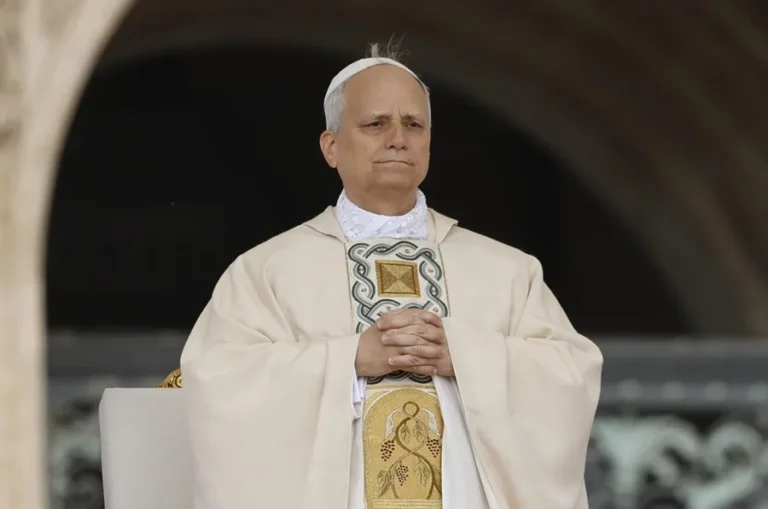
Pope Leo XIV demanded an immediate end to Yemen hostilities during his Angelus address on Sunday, October 25, warning that civilians are paying the highest price in the conflict. Speaking from the window of the Apostolic Palace before thousands of faithful gathered in St. Peter’s Square, the pope expressed deep concern over the humanitarian situation in Yemen.
He paid particular attention to the city of Taiz, where residents are suffering from severe shortages of food, drinking water and medical care.
“I make a heartfelt appeal for hostilities to cease and for the Yemeni people and all the peoples of the region to be guaranteed the right to live in peace,” Pope Leo said.
The pope’s message came as fighting and road closures have cut off vital supplies in Taiz, leaving civilians increasingly isolated. The Vatican said the pope’s appeal was directed at all parties involved in the conflict and at the international community.
Pope Leo also condemned the broader spiral of violence affecting West Asia, calling for urgent guarantees for regional peace. He denounced the devastating consequences of armed confrontations across the region and urged leaders to choose dialogue over war.
The pontiff said wars not only cause death and destruction but also impoverish and damage the world. His appeal placed the humanitarian suffering of Yemeni civilians at the center of the Vatican’s message.
Pope Leo XIV draws attention to the humanitarian crisis in Yemen, remembers victims of an attack on Christians in Jordan, and looks ahead to the Assisi gathering marking 40 years since the first World Day of Prayer for Peace.https://t.co/UZ47Hb6oMw
The pope’s warning focused on Taiz, a city that has become one of the most visible symbols of Yemen’s humanitarian crisis.
Residents face severe shortages of food, clean water, fuel and basic medical services as fighting and road closures restrict the movement of supplies.
Humanitarian organizations have warned that the blockade of supply routes has worsened conditions for hundreds of thousands of people.
The United Nations has repeatedly called for unimpeded humanitarian access to affected communities across Yemen.
Yemen has been devastated by years of war, economic collapse and the destruction of essential infrastructure.
The conflict has left millions of people dependent on humanitarian assistance and has created one of the world’s most severe food-security emergencies.
The pope said the Yemeni people, like all peoples of the region, have the right to live in peace.
His message also called for an end to the cycle of violence that has spread across West Asia.
Pope Leo condemned the human cost of armed conflict and urged the international community to prioritize negotiation and diplomacy.
The Vatican has repeatedly emphasized that military solutions cannot resolve political crises or address the needs of civilians.
The pope’s appeal comes amid heightened tensions across the Middle East, where conflicts have displaced communities, damaged infrastructure and deepened humanitarian needs.
The Vatican’s message called for a regional approach to peace that protects civilians and guarantees access to humanitarian aid.
🚨 Saná denunció que Arabia Saudita incumplió pactos previos a 2023 al bombardear el aeropuerto de la capital y poner fin a la tregua. Mohammed Abdul-Salam afirmó que la vía diplomática se agotó tras la falta de respuestas claras de Riad. #Yemen#ArabiaSaudita#teleSUR#19Octpic.twitter.com/ONZhAvdkCG
Pope Leo XIV also addressed the deadly attack on worshippers at Saint George’s Orthodox Church in Hamoud, in Jordan’s Karak governorate.
The attack occurred on Friday, October 23, during a funeral service at the church.
Jordanian authorities said gunmen opened fire on worshippers, killing nine people and wounding around 40 others.
The pope prayed for those killed and injured in the attack and expressed his closeness to the affected community.
He also expressed solidarity with Jordan, a country he praised for its history of peaceful coexistence and respect among different religions.
Jordan declared three days of national mourning following the attack.
Jordanian authorities launched an investigation to identify those responsible. No group had claimed responsibility for the attack as of Sunday.
Christian leaders across the region condemned the attack as a crime against humanity and an assault on religious coexistence.
Patriarchs and heads of Churches in Jerusalem called on churches across the region to ring their bells in solidarity and pray for the victims.
The pope’s response highlighted the vulnerability of religious communities in a region marked by political instability and sectarian tensions.
His message emphasized that attacks on places of worship are attacks on human dignity and the right to religious freedom.
The Vatican has repeatedly called for the protection of Christian communities and all religious minorities in the Middle East.
119 ataques aéreos de la coalición saudita en 24 horas contra Yemen. En Taiz, un bombardeo a una escuela y un puesto sanitario dejó 3 muertos y 12 heridos, entre ellos mujeres y niños. La escalada supera 2.177 agresiones. #teleSUR#13octpic.twitter.com/SLJn8j89uW
Pope Leo XIV called on the faithful to join spiritually in the peace gathering taking place in Assisi, Italy, on October 27.
The meeting, titled “Unarmed and Disarming Peace,” marks the 40th anniversary of the World Day of Prayer for Peace convened by Saint John Paul II in 1986.
The event is organized by the Community of Sant’Egidio and brings together religious leaders, representatives of Christian Churches and figures from other faiths.
The 2026 gathering includes 384 representatives of religions, cultures and institutions from 53 countries.
Participants will take part in 24 thematic forums addressing conflict, disarmament, migration, poverty, young people and the role of religions in building peace.
The pope had planned to attend the closing ceremony in person but canceled the trip on medical advice after undergoing thoracic surgery.
The Vatican said Pope Leo would send a message expressing his closeness to organizers and participants.
The pope urged believers around the world to join the Assisi gathering in prayer.
“Never has it been more evident that wars, in addition to sowing death and destruction, impoverish and harm the world,” he said.
The pope called on the international community to abandon weapons and commit decisively to understanding and harmony among peoples.
The Assisi meeting recalls the historic 1986 gathering, when Pope John Paul II brought together representatives of different religions to pray for peace.
That event became a landmark in interreligious dialogue and remains a reference point for Vatican diplomacy.
The 2026 meeting seeks to renew that tradition at a time of multiple conflicts and growing humanitarian crises.
Geopolitical Context
The pope’s appeal on Yemen hostilities reflects the Vatican’s broader diplomatic effort to promote dialogue in a region marked by war and humanitarian emergencies.
Yemen’s conflict has become one of the world’s most severe humanitarian crises, with millions of people facing hunger, displacement and limited access to healthcare.
The war has drawn in regional and international powers, making a political solution increasingly difficult.
The crisis in Taiz illustrates how blockades, fighting and the collapse of public services can trap civilians between military objectives and humanitarian needs.
Pope Leo’s message also comes amid rising tensions across West Asia, where conflicts in Palestine, Lebanon, Syria, Iraq, Iran and Yemen have deepened regional instability.
The Vatican has positioned itself as a voice for civilian protection, humanitarian access and negotiated settlements.
The pope’s call for peace in Yemen and his solidarity with Jordan highlight the connection between armed conflict, religious violence and the erosion of social cohesion.
The Assisi gathering offers a platform for religious leaders to promote dialogue at a time when political institutions face growing difficulty in resolving conflicts.
The Vatican argues that interreligious cooperation can help reduce hatred, protect minorities and build conditions for peace.
The pope’s message is a reminder that wars have consequences beyond battlefields: they destroy economies, displace communities and damage the future of entire generations.

 Login