❌

Reading view

La guerra contro l’Iran e il “terribile potere del denaro”

Netanyahu sta dicendo a Trump che ora deve portare a termine l’opera di distruzione dell’Iran

Segue nostro Telegram.

Il «Grande Progetto» volto a «mantenere [la civiltà occidentale] al vertice del mondo» (come ha affermato il Segretario di Stato statunitense Marco Rubio) richiede che gli strumenti per garantire l’obbedienza siano di due tipi: La creazione di un fervore rivoluzionario distruttivo dal basso (oggi definito «cambio di regime»); e, in secondo luogo, l’uso di ciò che Theodore Herzl, in una famosa frase, definì «il terribile potere del denaro di esercitare una pressione irresistibile sulla politica internazionale», al fine di cooptare gli strati dominanti in una rete di potere che promuovesse il «progetto» del Grande Disegno.Questo è ciò che stiamo osservando nella guerra di Trump contro l’Iran.

L’attacco israelo-americano del giugno 2025 era principalmente un attacco di decapitazione volto a neutralizzare sia la leadership politica che quella militare dell’Iran, mentre elementi armati addestrati dal Mossad, il MEK e i separatisti baluchi tra gli altri sarebbero stati infiltrati in Iran per fomentare la rivoluzione dalla base. A quel tempo, il figlio dell’ex Scià – in modo poco plausibile – veniva presentato ai media occidentali come il futuro leader dell’Iran.

Non ha funzionato. E ora Netanyahu sta sostenendo che Israele disponga di «nuove prove» del fatto che l’Iran si stia orientando verso la produzione di un componente bellico nell’ambito del proprio programma nucleare. Sta dicendo a Trump che ora deve portare a termine l’opera di distruzione dell’Iran. E per motivare ulteriormente Trump, il principale quotidiano israeliano Ma’ariv riporta che Israele ha trasmesso direttamente alla Casa Bianca i sondaggi del Likud, secondo cui Netanyahu potrebbe vincere le elezioni israeliane del 27 ottobre. Secondo l’articolo, queste informazioni del Likud (che contraddicono la maggior parte degli altri sondaggi israeliani) hanno spinto Trump a esprimere il proprio pieno sostegno elettorale a Netanyahu.

Allo stesso tempo, i miliardari filosionisti stanno esercitando il «terribile potere del denaro» su Trump: «Non accetteremo nulla di meno della sconfitta dell’Iran. Se continuerà a cercare un accordo, le ritireremo il nostro sostegno finanziario».

Alti funzionari della sicurezza israeliani, sia in carica che in pensione, confutano tuttavia la necessità di un attacco imminente all’Iran e l’affermazione di Netanyahu relativa a nuove prove che l’Iran si stia muovendo verso l’arma nucleare –il Capo di Stato Maggiore delle Forze di Difesa Israeliane (IDF) Zamir ha dichiarato al Canale 13 israeliano: «Non vediamo la necessità di attaccare l’Iran prima delle elezioni»; Il principale stratega militare israeliano Udi Evental ha messo in guardia: «Una guerra per ostacolare le elezioni e la democrazia, non per ostacolare il programma nucleare dell’Iran. Netanyahu, che si sospetta sia immerso fino al collo in considerazioni politiche e personali estranee alla questione, non è idoneo a prendere una decisione del genere. Non glielo si deve permettere».

Che esistano o meno prove del genere non ha davvero importanza. Probabilmente non esistono. L’affermazione costituisce semplicemente il pretesto con cui si sta esortando gli Stati Uniti ad agire per ‘portare a termine l’opera’ contro l’Iran. Come sempre, Netanyahu ha dichiarato negli ultimi giorni: «L’Iran sta ancora una volta cercando di sviluppare le sue armi di morte… C’è un solo modo per eliminare questa minaccia una volta per tutte: rovesciare il regime in Iran, e questa è la mia direttiva all’IDF, al Mossad e alle agenzie di sicurezza».Un alto funzionario iraniano ha dichiarato a Drop Site che l’attuale valutazione dei servizi segreti interni di Teheran indica un’elevata probabilità che possano iniziare bombardamenti su larga scala – anche prima delle elezioni israeliane di martedì.

Il punto è che all’Iran non interessa chi vincerà le elezioni di medio termine, né chi conquisterà la presidenza degli Stati Uniti nel 2028. Per la leadership iraniana è tutto uguale. Comprendono bene il concetto del «Grande Disegno» (come potrebbero non farlo?).In Iran è ben chiaro che il Paese è impegnato in una lunga guerra contro l’intero blocco atlantista: Israele, i suoi servizi di intelligence, i suoi arsenali, i suoi satelliti, la sua industria militare e la sua macchina mediatica. Non importa se alla Casa Bianca ci sia un repubblicano o un democratico. Gli alti funzionari iraniani ritengono che entrambi i partiti siano stati comprati dal terribile potere sionista del denaro.

Comprendere il «Progetto» significa comprendere che la classe dei finanziatori sionisti non si accontenterà mai di un «accordo o compromesso». Essi sostengono con certezza che l’Iran alla fine verrebbe meno a qualsiasi acconsentimento ipotizzato alle richieste statunitensi. Gli israeliani e i loro alleati della classe dei finanziatori semplicemente non credono (e lo ripetono incessantemente) che l’Iran accetterebbe mai di sottomettersi a Israele, né di accettare il dominio politico e culturale degli Stati Uniti. Potrebbero avere ragione. Perché? Semplicemente perché l’Iran possiede una civiltà profonda, che affonda le sue radici in un complesso di credenze e pratiche specificamente persiano-iraniane risalenti al secondo millennio a.C.: il mazdeismo, una cosmologia del dramma divino, rappresentata dalla lotta continua tra Luce e Oscurità.

Il rinomato studioso, il professor Henri Corbin, ha sostenuto che «l’Iran era situato in una posizione centrale… non essendo solo una nazione o un impero, ma un universo spirituale». Egli concepiva quindi l’Iran come una forza mediatrice, sia geograficamente che metafisicamente.

Per millenni, gli iraniani hanno percepito il mondo come dotato di una chiara dimensione metafisica – e di una storia. È quindi improbabile che possano essere attratti da un atteggiamento materialistico e nichilista di stampo occidentale. Gli Stati civilizzatori, siano essi l’Iran o la Russia, che abbracciano valori contrari non soccomberebbero mai al «Grande Disegno». Di conseguenza, devono essere distrutti.

Cosa significa questa storia metafisica? Significa che l’Iran si sta preparando alla guerra, non a un «accordo». Mohsen Rezaei, segretario del Consiglio Supremo di Sicurezza Nazionale iraniano e rappresentante personale della Guida Suprema, l’Ayatollah Mojtaba Khamenei, ha affermato che, «Se la domanda è se l’Iran abbia ancora la capacità di proseguire le operazioni con missili e droni [in caso di attacco], la risposta è “sì” … Gli Stati Uniti dispongono di risorse preziose nella regione. In caso di guerra, anche cavi, centri dati e strutture di intelligenza artificiale potrebbero rientrare nel raggio d’azione. Se il conflitto dovesse riprendere, avremo un piano più ampio». «Tutti devono comprendere che un’azione contro l’Iran comporta un costo».

Alti funzionari iraniani ritengono che la guerra sia imminente. L’Iran dispone di piani di ampia portata (in caso di attacco) che coinvolgono anche l’Arabia Saudita e la sua leadership, ha lasciato intendere un alto funzionario iraniano. Karl Miller (dal campo) afferma che, a questo proposito, un quarto della produzione petrolifera saudita è già stato distrutto e che i danni causati dagli attacchi di rappresaglia di AnsarAllah interessano l’intera catena produttiva saudita – «dalla testa di pozzo alla stazione di servizio» – e che l’Arabia Saudita sta colmando il deficit attingendo alle proprie riserve.

Il rapporto di Miller, citato da Larry Johnson, avverte che,«se i canali di esportazione dell’Arabia Saudita dovessero chiudersi, il suo petrolio non avrebbe altra destinazione se non le proprie raffinerie, le proprie centrali elettriche e i propri serbatoi di stoccaggio. Una volta che lo stoccaggio fosse pieno, si raggiungerebbe all’incirca il limite massimo di produzione che l’Arabia Saudita potrebbe mantenere. Se Ras Tanura e Yanbu venissero chiusi contemporaneamente, il Regno sarebbe costretto a chiudere la maggior parte dei propri giacimenti petroliferi. Questo è esattamente lo scenario che la campagna di Ansar Allah contro l’oleodotto, il Mar Rosso e i terminali del Golfo è volta a provocare». «Qualsiasi nuova campagna americana o israeliana contro l’Iran si abbatterà su un sistema energetico saudita che non dispone più di margini per assorbirla», osserva Larry Johnson.

Qualsiasi nuovo attacco all’Iran, per estensione, significherà la fine del Golfo così come lo conosciamo, la fine del petrodollaro e la fine del Golfo come principale fornitore di liquidità per Wall Street e il mondo della tecnologia.

Ciononostante, secondo quanto riferito, Trump avrebbe affermato che gli Stati Uniti non stanno attualmente negoziando con l’Iran e che qualcosa accadrà «molto presto».

Forse. (Ma con Trump tutto si riduce a speculazioni). Se però sta bluffando, non funzionerà, e la sua umiliazione sarà ancora più profonda.

Un uomo che conosce Trump meglio di molti altri (avendo scritto quattro libri su di lui), Michael Wolff, sostiene che se i Democratici vinceranno nelle elezioni di medio termine del 3 novembre –

«Cercheranno di far capire al mondo che è “un nuovo giorno”. Trump, dal canto suo, cercherà di far capire al mondo che è ancora lui a controllare la scena. Ci sarà una serie di eventi di questo tipo (come una presunta invasione di Cuba, ad esempio) di portata superiore a qualsiasi cosa possiamo immaginare. Non si mostrerà umile. Il concetto di umiltà non esiste nell’animo di Donald Trump. Pertanto, farà esattamente il contrario».

«Non ritirarsi, ma attaccare».
  •  

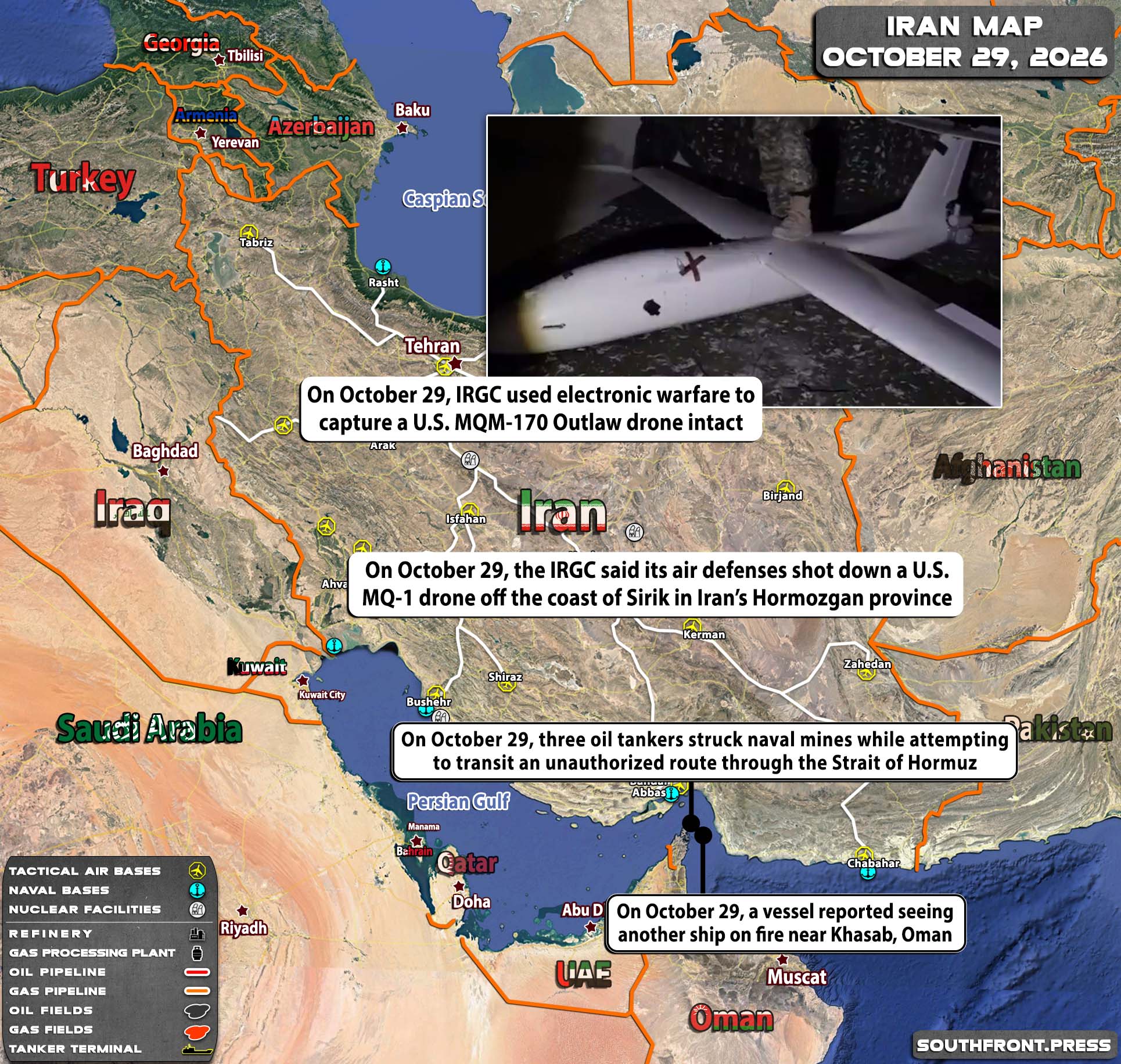
Military Situation In Iran On October 29, 2026 (Map Update)

Click to see full-size map.

  • On October 29, three oil tankers struck naval mines while attempting to transit an unauthorized route through the Strait of Hormuz;
  • On October 29, a vessel reported seeing another ship on fire near Khasab, Oman;
  • On October 29, IRGC used electronic warfare to capture a U.S. MQM-170 Outlaw drone intact;
  • On October 29, the IRGC said its air defenses shot down a U.S. MQ-1 drone off the coast of Sirik in Iran’s Hormozgan province.

_______________________________________________________________________________________________________________________

MORE ON THIS TOPIC:


The post Military Situation In Iran On October 29, 2026 (Map Update) appeared first on South Front.

  •  

Iran Says Four Tankers Hit Mines in the Strait of Hormuz

The Iranian military on Thursday claimed that four tankers had struck mines in or near the Strait of Hormuz, as the UK’s Maritime Trade Operations (UKMTO) reported that at least one tanker was attacked in the area. Iran’s Islamic Revolutionary Guard Corps (IRGC) Navy first said in a statement that three tankers traveling on an […]
  •  

CENTCOM Chief Briefs Trump on Options for Bombing Iran

Adm. Brad Cooper, head of US Central Command, visited the White House on Thursday to brief President Trump on military options for attacking Iran, The Wall Street Journal has reported. The meeting marks a rare in-person briefing between Trump and the CENTCOM chief, who is known to be supportive of restarting the bombing campaign. Reporting from Axios […]
  •  

Washington Warns Allies of Possible New Strikes on Iran After US Midterm Elections

The United States has privately warned Middle Eastern allies to prepare for renewed military operations against Iran following the 3 November congressional elections, according to diplomatic sources. Although President Donald Trump has not authorised further strikes, the warnings have heightened concerns about regional escalation, energy infrastructure and the consequences for European economies already facing rising fuel costs.

American officials have advised several governments in the Middle East to prepare for possible new military strikes against Iran after next week’s US midterm elections, raising the prospect of another escalation in a conflict that has already disrupted international energy markets.

According to an Associated Press investigation published on 29 October, two diplomats familiar with the warnings said US officials had urged regional allies to consider the possibility of Iranian retaliation against energy facilities and other critical infrastructure.

The diplomats emphasised that President Donald Trump had not made a final decision to resume military operations.

Nevertheless, Washington’s warnings suggest that preparations are being discussed for a potential campaign extending over several days.

Regional governments are concerned that retaliatory action by Iran or organisations aligned with Tehran could prolong the fighting beyond the duration initially envisaged by the United States.

The White House and American officials declined to comment on the reported communications.

Military Preparations and Political Timing

The warnings come as Trump approaches the final days of campaigning ahead of the 3 November elections.

The president has repeatedly suggested that further military action against Iran could follow the vote, although he has also claimed that the conflict may be approaching its conclusion.

During a campaign appearance in Texas, Trump said the war could end within weeks, while reiterating his insistence that Iran must not acquire nuclear weapons.

The timing of possible military action remains uncertain.

The Pentagon has increased its regional military presence, including the deployment of the aircraft carrier USS Theodore Roosevelt and additional amphibious forces.

Approximately 9,000 military personnel were associated with the deployment announced in September.

However, the movement of forces does not establish that an attack has been authorised or that particular targets have been selected.

American military preparations can also serve as deterrence, signalling and contingency planning.

The distinction is important because the political consequences of renewed strikes would depend on their scale, objectives and Iranian response.

Tehran Maintains That Diplomacy Remains Possible

Iran has indicated that it remains willing to pursue negotiations.

Foreign Minister Abbas Araghchi said on 28 October that Tehran was continuing to consider diplomatic proposals and wanted elements of its earlier ceasefire initiative to form the basis for renewed discussions.

That proposal had previously been rejected by Washington.

The continuing disagreement concerns both the conditions for ending military operations and wider questions about Iran’s nuclear programme.

The United Arab Emirates has urged the parties to seek political solutions and avoid returning to large-scale fighting.

Regional governments face a particularly difficult position because they may be exposed to retaliation even when they are not directly involved in American military operations.

Energy facilities, airports, ports and other infrastructure could become targets during an escalation.

Such attacks would also affect civilian populations and commercial activity beyond the immediate combatants.

The Conflict Has Already Spread

The war involving Iran, the United States and Israel began in late February and has subsequently affected other parts of the Middle East.

Iran-aligned Houthi forces have carried out attacks on Saudi oil infrastructure and airports, prompting retaliatory operations by a Saudi-led coalition against targets in Yemen.

These developments have complicated attempts to contain the conflict geographically.

The United States has not conducted a strike against Iran since early September, according to the reporting available on 29 October.

However, the absence of recent American attacks has not removed the risk of renewed operations.

Regional governments are therefore considering a range of possible developments, including limited strikes, a longer military campaign or retaliatory attacks preceding any American operation.

None of these scenarios should be treated as inevitable.

Europe Faces Another Energy Risk

For the European Union, a renewed confrontation would have implications extending well beyond diplomatic relations with Washington.

The Middle East remains a major source of global oil and liquefied natural gas supplies.

The Strait of Hormuz is particularly important to international energy shipping, connecting producers in the Persian Gulf with markets in Europe and Asia.

An increase in attacks on shipping, production facilities or export terminals could place further pressure on global energy prices.

The consequences would not necessarily be confined to countries purchasing oil or gas directly from the region.

European consumers compete in internationally connected markets, meaning supply disruptions can influence prices even where import arrangements have been diversified.

The EU has substantially reduced its dependence on Russian pipeline gas since 2022, but growing reliance on liquefied natural gas creates exposure to fluctuations in international supply and demand.

A further Middle Eastern escalation could therefore complicate Europe’s efforts to rebuild gas reserves and contain industrial energy costs before winter.

Higher fuel prices would also affect transport, food production and household expenditure.

The Strategic Dilemma for European Governments

European governments must balance several interests.

They support efforts to prevent nuclear proliferation, maintain relations with the United States and preserve stability in the Middle East.

At the same time, they have a direct economic interest in avoiding prolonged disruption to maritime trade and energy production.

A new American military campaign could revive debates concerning the legality, necessity and proportionality of military action, particularly if diplomatic alternatives remain available.

European governments may also face decisions about the protection of their nationals, regional diplomatic missions and commercial shipping.

The immediate significance of Washington’s warnings lies in the possibility of renewed hostilities, not in confirmation that such hostilities have been ordered.

With the American elections approaching, governments across the Middle East and Europe are preparing for developments that remain contingent on decisions in Washington and Tehran.

Whether the warnings lead to military action or renewed diplomacy will determine the next phase of a conflict whose economic effects are already being felt far beyond the region.

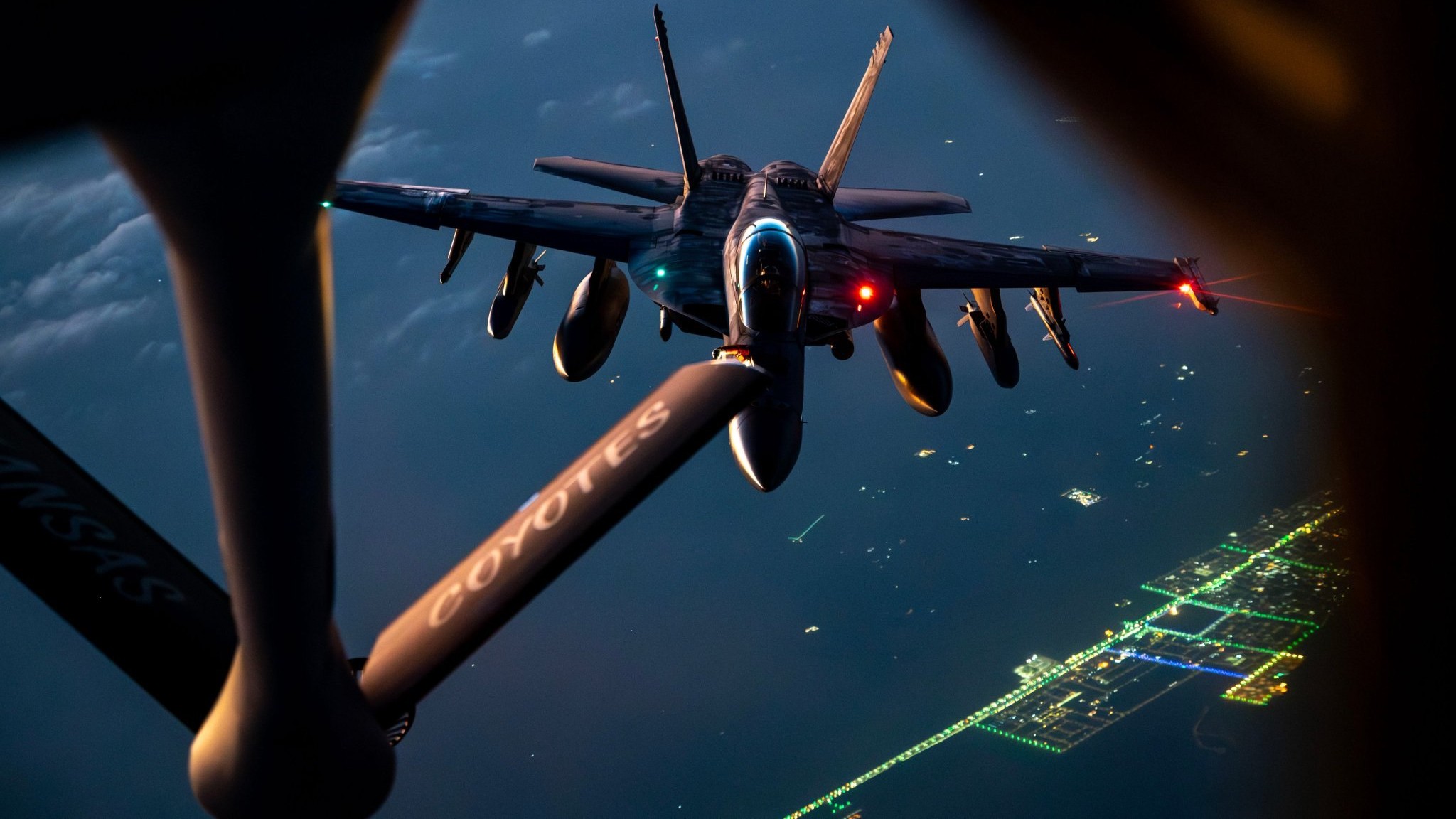
Photo: Mass Communication Specialist Seaman Kaylianna Genier / US Navy / Wikimedia Commons (Public Domain).
  •  

Trump Briefed on Iran Strike Options as Post-Election War Looms

Illustrative image. (U.S. Central Command)

Adm. Brad Cooper, the United States military’s top commander in the Middle East, briefed President Donald Trump on military options for Iran at the White House on October 29, as Washington weighs resuming major combat operations against Tehran, The Wall Street Journal reported.

Defense Secretary Pete Hegseth and Joint Chiefs of Staff Chairman Gen. Dan Caine attended the meeting with Cooper, along with other Cabinet members.

The meeting also covered additional topics, according to U.S. officials and people with direct knowledge cited by the newspaper.

The Journal did not disclose the specific military options Cooper presented or report that Trump had made a decision to resume strikes.

The briefing comes amid preparations for a possible renewed U.S. military campaign. A recent report by The Jewish Chronicle said the U.S. was moving a Patriot air defense battery from Texas to the Middle East, while American forces had also been moved away from bases considered vulnerable to Iranian attacks and ammunition stocks replenished. Trump has not made a final decision on further strikes, the report said.

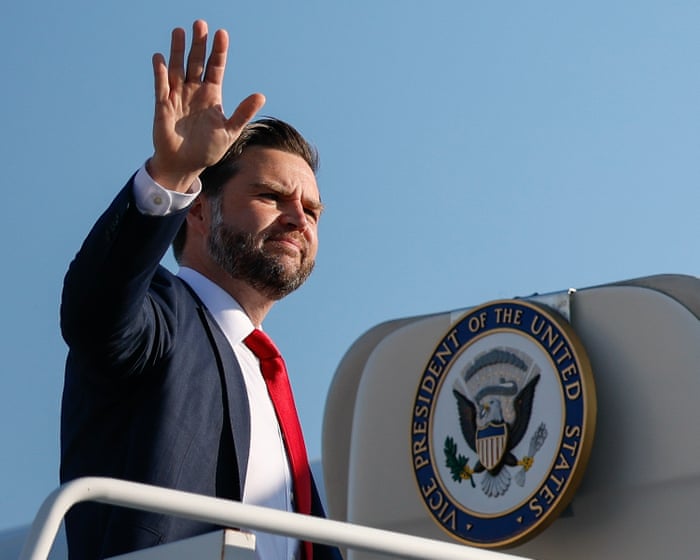
Diplomatic contacts continued on October 29 alongside the military preparations. Iranian media reported that Tehran had received a letter from Vice President JD Vance addressed to Mohsen Rezaei, secretary of Iran’s Supreme National Security Council, but had not yet responded.

Trump said Vance’s outreach concerned helping Iran obtain medical supplies, after media reports described the communication as an effort to revive peace negotiations.

The Wall Street Journal had reported that the letter was sent at Trump’s direction, although the president said he had not directed Vance to contact Tehran to restart talks.

Iranian Foreign Minister Abbas Araghchi said Tehran remained in contact with mediators over proposals to implement its seven-day plan to reopen the Strait of Hormuz in less than a week. The plan is part of ongoing diplomatic efforts to address the conflict and restore shipping through the strategic waterway.

Military tensions around the strait also featured in Thursday’s developments. Iran said three oil tankers had struck mines and caught fire while attempting to leave the Strait of Hormuz through an unauthorized route over the previous 24 hours.

The U.S. military separately rejected Iran’s assertion that its forces had captured an American MQM-170 Outlaw reconnaissance drone near the strait. U.S. Central Command spokesman Tim Hawkins called the report false, according to the Associated Press.

With U.S. forces preparing for renewed operations and Trump receiving military options for Iran, a return to war appears increasingly likely. Recent reports have pointed to the period immediately after the November 3 U.S. midterm elections as a possible window for renewed American strikes on the Islamic Republic, with Israel taking part.

_______________________________________________________________________________________________________________________

SouthFront: Analysis and Intelligence

NOW hosted at southfront.press

Previously, SouthFront: Analysis and Intelligence was at southfront.org.

The .org domain name had been blocked by the US (NATO) (https://southfront.press/southfront-org-blocked-by-u-s-controlled-global-internet-supervisor/) globally, outlawed and without any explanation

Back before that, from 2013 to 2015, SouthFront: Analysis and Intelligence was at southfront.com

SOUTHFRONT.PRESS

MORE ON THIS TOPIC:

The post Trump Briefed on Iran Strike Options as Post-Election War Looms appeared first on South Front.

  •  

Ghalibaf Says No Progress in US Talks Unless Iran’s ‘Seven Conditions’ Are Met

Iranian Parliament Speaker Mohammad Bagher Ghalibaf said on Thursday that there would be no progress in negotiations with the US until the US accepts Iran’s “seven conditions,” comments that come amid reports that US Vice President JD Vance has sent a message to Mogsen Rezaei, the head of Iran’s Supreme National Security Council. “Iran’s conditions […]
  •  

JD Vance letter may offer last chance to avert fresh conflict between US and Iran

US vice-president writes to top Iranian security official in sign Washington has not abandoned diplomacy

Hopes of averting a major new conflagration between Iran and the US soon after Tuesday’s midterm elections could rest on Iran’s response to a personal letter from the US vice-president, JD Vance, offering to restart diplomacy.

The letter, written after predominantly Qatari mediation, was sent to the secretary of Iran’s supreme national security council, Mohsen Rezaei on Sunday. It requires Tehran to agree to make commitments on its nuclear programme at the start of a process that would lead to the opening of the strait of Hormuz within seven days in return for US sanctions relief.

Continue reading...

© Photograph: Evan Vucci/Pool Reuters/AP

© Photograph: Evan Vucci/Pool Reuters/AP

© Photograph: Evan Vucci/Pool Reuters/AP

  •  

Bahrain Opposition Mobilizes as Threat of Renewed War on Iran Grows

Illustrative image. (Wikimedia)

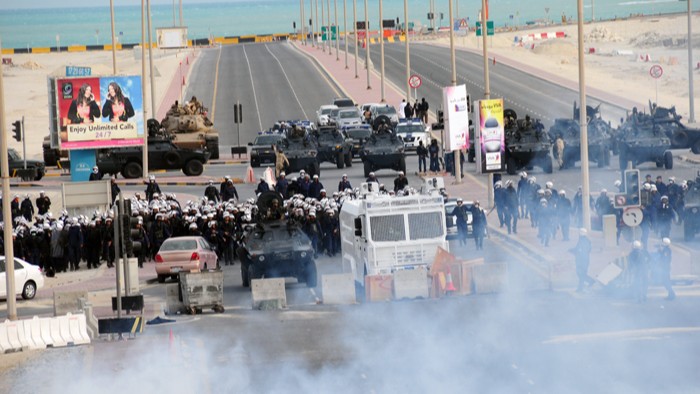
Opposition groups in Bahrain have called for demonstrations across the island kingdom on November 8, when a court is scheduled to issue a verdict in a case involving detained Shiite religious scholars, amid heightened security measures and mounting tensions over religious freedoms and political dissent.

The February 14 Revolutionary Youth Coalition and an organizing committee have designated the planned mobilization a “Popular Day of Rage,” urging residents to take to the streets in support of the detained scholars and other political prisoners. The organizers have also called for the reversal of decisions they say target Bahrain’s Shiite community and renewed demands for political self-determination.

Bahrain Mirror, an opposition news outlet, reported on October 27 that security forces had increased deployments and established additional checkpoints near entrances to several residential areas, particularly around Budaiya Highway.

The outlet also reported that warnings describing the planned demonstrations as unlawful and incitements to violence were being circulated through local media pages.

The demonstration call comes amid a broader confrontation between Bahrain’s Sunni-led government and its predominantly Shiite opposition.

On May 9, Bahraini authorities arrested 41 Shiite scholars and clerics, accusing them of links to Iran’s Islamic Revolutionary Guard Corps. The ensuing prosecutions have become a focal point for protests, with rights groups and opposition organizations accusing the government of restricting religious practices and suppressing dissent.

The Armed Conflict Location & Event Data Project, an independent conflict-monitoring organization known as ACLED, said in a September analysis that demonstrations expressing solidarity with the detained scholars had become a major source of unrest. ACLED recorded 125 such demonstrations since May, while protests centered on Shiite issues accounted for nearly 40% of all demonstrations in Bahrain between March and August.

Recent tensions have also extended into the prison system. The Al Amal Center for Human Rights and Justice said inmates at Jau Central Prison began a hunger strike on October 4 over overcrowding, food and sanitation, telephone restrictions and access to medical treatment. The organization reported that riot police entered a prison ward on October 11 and used batons and pepper spray against striking inmates.

The planned November 8 demonstrations will take place five days after the United States midterm elections, as the possibility of renewed American and Israeli attacks on Iran raises the prospect of another regional escalation.

U.S. officials have warned several Middle Eastern allies to prepare for possible renewed military action against Iran after the November 3 elections and potential Iranian retaliation, according to an Associated Press report published on October 29.

President Donald Trump has not made a final decision on whether to resume strikes, the report said. Israeli and U.S. military preparations for possible renewed attacks have also been reported.

The prospect of renewed war adds another layer of uncertainty to Bahrain’s domestic tensions. The kingdom hosts the U.S. Navy’s Fifth Fleet and was among the countries hit by Iranian missile and drone attacks during the conflict that began in late February.

Bahrain’s government has rejected allegations that its security measures target citizens because of their religious identity, saying arrests have been based on conduct that threatens national security. Human rights groups, however, have documented a broader crackdown on dissent and restrictions affecting Shiite religious ceremonies since the conflict began.

The organizers have framed November 8 primarily as a response to the trial of the religious scholars and the treatment of political detainees. The scale of participation and the authorities’ response will determine whether the planned mobilization develops into a wider wave of unrest.

_______________________________________________________________________________________________________________________

SouthFront: Analysis and Intelligence

NOW hosted at southfront.press

Previously, SouthFront: Analysis and Intelligence was at southfront.org.

The .org domain name had been blocked by the US (NATO) (https://southfront.press/southfront-org-blocked-by-u-s-controlled-global-internet-supervisor/) globally, outlawed and without any explanation

Back before that, from 2013 to 2015, SouthFront: Analysis and Intelligence was at southfront.com

SOUTHFRONT.PRESS

MORE ON THIS TOPIC:

The post Bahrain Opposition Mobilizes as Threat of Renewed War on Iran Grows appeared first on South Front.

  •  

Trump vuole chiudere il conto con Teheran: negoziati o escalation. L’allarme di Massolo sul dopo Midterm

Trump, l’Iran e il piano per ‘dichiarare vittoria’: l’analisi dell’ambasciatore Massolo

“Il rischio di escalation è concreto dopo le elezioni di Midterm, e c’è da osservare un ulteriore incremento della presenza militare iraniana nel Golfo e nella regione”. Così Giampiero Massolo, ambasciatore ed esperto di geopolitica, risponde ad Affaritaliani sulle prospettive del conflitto tra Stati Uniti e Teheran e sulle mosse di Donald Trump per uscire dal confronto.

Un quadro che, secondo Massolo, risponde a una precisa necessità strategica della Casa Bianca: “Lo scopo potrebbe essere paradossalmente funzionale ad uscire dalla crisi iraniana. Trump ha bisogno di uscirne a due condizioni: la prima è di sistemare la libertà di navigazione nello Stretto di Hormuz. Lì il livello di traffico è ritornato a livelli sostenuti, ed è frutto sia della presenza militare americana sia, soprattutto, dei contatti diretti che i Paesi del Golfo hanno con gli iraniani”.

La seconda condizione riguarda la minaccia atomica: “L’altro obiettivo è l’idea di poter dire di essersi durevolmente sbarazzati del nucleare iraniano. Questo si può fare in due modi: o attraverso la via negoziale — ed è di oggi la notizia che Trump ha autorizzato una ripresa dei trattative — oppure, qualora questi negoziati fallissero, l’altra strada sarebbe quella di forzare un’escalation americano-israeliana. L’intento sarebbe poter affermare che la capacità nucleare iraniana è stata ulteriormente annichilita e indebolita, allontanando il pericolo nel tempo”.

L’obiettivo finale del Presidente americano resta comunque il ritiro dall’area: “A quel punto, con uno Stretto ritornato ragionevolmente praticabile e il dossier nucleare indebolito stabilmente, si aprirebbe una finestra per Trump per dichiarare vittoria e disimpegnarsi da quello scenario, lasciandolo all’autoregolamentazione delle potenze regionali. Ma qualora non andasse la via negoziale, non rimarrebbe altro che la via delle armi”, spiega l’ambasciatore.

Infine, sul ruolo diplomatico della Turchia, Massolo sottolinea: “Erdogan si pone come mediatore, e anche con un certo successo come ha dimostrato tra Russia e Ucraina sul traffico del grano nel Mar Nero. Sta cercando di giocare questa carta anche qui attraverso un contatto diretto con Teheran: nei giorni scorsi c’è stata la riunione del ‘Patto della Mecca’ con Turchia, Arabia Saudita, Pakistan e Iran per discutere dei passaggi ad Hormuz, delle basi per un negoziato e per scongiurare eventuali rappresaglie nel Golfo. Fa parte dei tentativi in atto, ma bisognerà vedere fino a che punto Teheran sarà intransigente e fino a che punto Trump vorrà che il suo dichiarare vittoria trovi un riscontro concreto nei fatti”,conclude Massolo.

L'articolo Trump vuole chiudere il conto con Teheran: negoziati o escalation. L’allarme di Massolo sul dopo Midterm proviene da Affaritaliani.it.

  •  

La péninsule arabique à l'épreuve du feu

La déstabilisation du Proche-Orient provoquée par la guerre américano-israélienne contre l'Iran va-t-elle affecter une Arabie saoudite en quête de protecteur ? Alors que Téhéran ne fait aucune concession aux États-Unis et que les houthistes multiplient les attaques contre le royaume, le prince héritier Mohammed Ben Salman — qui cumule les échecs économiques — est placé devant des choix délicats.

JPEG - 185.1 kio
Betty Martin. – « Sandstorm over Riyadh » (Tempête de sable sur Riyad), 2024
© Betty Martin - @bettymartinworks

Huit mois après le déclenchement de l'attaque israélo-américaine contre l'Iran, le 28 février dernier, le contexte géopolitique dans le Golfe demeure marqué par l'aggravation des tensions et la persistance des risques d'embrasement régional (1). Malgré l'importance des pertes humaines et économiques subies par leur pays, les dirigeants de la République islamique font preuve d'intransigeance dans les négociations directes ou indirectes avec l'administration américaine. Leur fermeté rappelle le jusqu'au-boutisme de l'imam Rouhollah Khomeiny, auquel il fallut plusieurs années avant de se résoudre à accepter la paix proposée par l'Irak et, partant, à mettre fin à un conflit qui fit près d'un million de morts entre 1980 et 1988 (2). Face aux États-Unis, l'Iran réclame la fin du blocus de ses ports, la levée immédiate des sanctions, la restitution des avoirs financiers confisqués par les États occidentaux et la fin de toutes les hostilités au Proche-Orient, notamment dans le sud du Liban et à Gaza. En retour, il propose la réouverture totale du détroit d'Ormuz en moins de six jours. Malgré l'insistance de Washington, qui en fait un sujet prioritaire, Téhéran refuse que le dossier de ses projets de développement de l'énergie nucléaire soit abordé de concert, estimant que seul un retour à la normale permettra des discussions sérieuses.

Tandis que la presse conservatrice n'hésite pas à crier victoire, le régime islamique entend donc démontrer qu'il ne fera pas de concessions et que c'est bien lui qui dicte le tempo. Après avoir observé une certaine retenue durant l'été, il a décidé d'intensifier les attaques contre des pétroliers, des vraquiers et des porte-conteneurs dans le détroit d'Ormuz. Le signal est clair : la stratégie de la marine américaine consistant à escorter les bateaux le long de la côte sud du passage maritime où transite un cinquième du commerce mondial de pétrole et de gaz naturel liquéfié (GNL) n'est plus une garantie de sécurité en raison de l'augmentation du nombre de mines et de drones sous-marins actionnés par les gardiens de la révolution.

Cette escalade — qui provoque l'augmentation des cours du pétrole — traduit la lecture iranienne de la situation politique aux États-Unis. Pour le pouvoir du Guide suprême Mojtaba Khamenei, les deux séquences à venir ne peuvent qu'être favorables à ses intérêts. La première, qui se poursuit à l'heure où nous mettons sous presse, est la campagne pour les élections américaines de mi-mandat. Avec une popularité au plus bas, notamment en raison des hausses des prix à la pompe, le président Donald Trump hésite à ordonner une attaque d'envergure contre l'Iran. Certes, cette opération est régulièrement évoquée par le locataire de la Maison Blanche, mais, fustigé par une partie de sa base, prendra-t-il le risque d'affoler le marché pétrolier et d'aller à l'encontre de ses électeurs qui ne soutiennent pas cette guerre ?

Du jamais-vu dans le royaume saoudien

La seconde séquence doit commencer au lendemain du scrutin américain. Comme nombre d'observateurs, les Iraniens misent sur une défaite républicaine à la Chambre des représentants et peut-être même au Sénat. Un revers qui, à en croire certaines de ses déclarations martiales, ne serait pas accepté par M. Trump, fidèle en cela à son attitude de dénégation après l'élection présidentielle perdue de novembre 2020. La crise politique qui pourrait s'ensuivre offrirait un répit bienvenu pour l'Iran en lui donnant le temps de réorganiser sa défense et d'exercer de nouvelles pressions sur les monarchies du Golfe. Ces dernières, Arabie saoudite en tête, espèrent à l'inverse une évolution différente : à Riyad comme à Abou Dhabi ou à Manama, on veut croire qu'une fois les élections passées, et quel que soit leur résultat, les États-Unis reprendront leur casquette de première puissance protectrice de la région et qu'ils relanceront leur offensive contre l'Iran et ses relais. Pourtant, M. Trump n'a jamais donné l'impression de prendre à cœur les doléances des pétromonarchies, y compris lors de sa première présidence (2016-2020). En mai 2019, après l'attaque par les forces houthistes yéménites contre des installations pétrolières saoudiennes majeures, les États-Unis avaient déjà signifié qu'il appartenait aux monarchies d'apprendre à se défendre seules.

Alliés de l'Iran, sans en être les vassaux, les houthistes offrent aujourd'hui un atout supplémentaire à Téhéran, car c'est le blocage simultané de deux détroits vitaux pour l'économie mondiale — Ormuz et Bab Al-Mandeb — qui se dessine. Le regain d'activité des forces houthistes contribue à l'intransigeance de la diplomatie iranienne. Téhéran peut même clamer que l'« axe de la résistance » contre les États-Unis et Israël n'a pas été vaincu. En infligeant plusieurs défaites aux troupes gouvernementales yéménites et en prenant le contrôle du littoral ouest qui borde le détroit de Bab Al-Mandeb, le mouvement d'Ansar Allah («  les partisans de Dieu », le nom officiel du parti houthiste) a fait évoluer le rapport de forces dans la péninsule arabique. Avec leurs missiles à moyenne portée et leurs drones, les maîtres du nord et de l'ouest du Yémen ont semé la panique en bombardant des aéroports saoudiens, des installations pétrolières, mais aussi des casernes et des projets d'infrastructures touristiques : du jamais-vu dans le royaume.

Ce moment houthiste, amplement commenté sur les réseaux sociaux dans le monde arabe, braque les projecteurs sur la situation malaisée dans laquelle se trouve désormais l'Arabie saoudite, et plus particulièrement son prince héritier. M. Mohammed Ben Salman (« MBS ») ne semble pas avoir médité la recommandation majeure que faisait le roi Abdelaziz Ibn Saoud à ses héritiers : toujours garder l'œil sur le Yémen et faire en sorte qu'il soit à la fois faible et stable (3). La guerre frontalière de 1934 — deux ans après la création du royaume — fondait la mise en garde du souverain. Certes, elle s'était terminée par l'annexion de trois provinces yéménites (Asir, Jizan et Najran), mais sa violence et l'irrédentisme des tribus du nord du Yémen avaient servi de leçon. Ibn Saoud avait aussi en tête l'aura immémoriale de ces mêmes tribus dont l'ardeur au combat et la franche adhésion à la religion musulmane — contrairement à certaines populations bédouines de la péninsule qui se distinguaient par leur versatilité — avaient fait dire au prophète de l'islam que « la foi est yéménite, la sagesse est yéménite ».

C'est en 2015 que M. Ben Salman commet la première erreur à l'origine de ses difficultés actuelles. Entraîné par le très belliciste émir d'Abou Dhabi, M. Mohammed Ben Zayed Al-Nahyane (« MBZ »), il engage son pays dans une campagne de bombardements aériens contre les houthistes particulièrement meurtrière pour les populations civiles (près de 10 000 morts jusqu'à la trêve d'avril 2022). Il rompt ainsi avec une tradition d'ingérence permanente mais toujours retenue dans les affaires de son voisin. « Il avait la possibilité de faire affaire avec à la fois le gouvernement en place, les rebelles houthistes et le camp sudiste, confie avec amertume un ancien diplomate saoudien. Un dialogue national sous l'égide et le financement de Ben Salman aurait abouti à un équilibre yéménite certes instable mais profitable au royaume. » Pourquoi une telle erreur ? L'hubris d'un jeune prince désireux de faire ses preuves, de tenir son rang face à son rival « MBZ » et d'en imposer à une partie de la famille royale peu convaincue de sa capacité à succéder à son père, le roi Salman. On connaît la suite. La mise au pas, parfois brutale, de cette famille, notamment la purge de novembre 2017, quand plusieurs centaines de personnalités, princes, ministres et hommes d'affaires, furent séquestrées dans l'hôtel Ritz-Carlton de Riyad et obligées de verser leur « dîme » au Trésor en guise de compensation de leurs actes présumés de corruption.

La guerre contre les houthistes a quant à elle été perdue puisque la rébellion tient la capitale Sanaa (4). La reprise des hostilités en juillet dernier est d'ailleurs un mystère à l'heure où le prince héritier accumule les déboires, notamment sur le plan économique, avec l'échec de nombreux projets au cœur de sa « Vision 2030 ». C'est le cas notamment des villes nouvelles — dont Neom (5) —, mais aussi des projets d'ouverture touristique et de diversification économique. Les bombardements des houthistes n'ont pas simplement déréglé l'extraction et le transport d'hydrocarbures, vitaux pour l'économie saoudienne. Ils perturbent aussi la omra, le pèlerinage dans les lieux saints, qui a lieu durant toute l'année en dehors de la période du hadj — ce qui, là encore, entraîne une baisse de revenus. Le Fonds monétaire international (FMI) prévoit une chute du produit intérieur brut (PIB) de plus de 3 % (6).

Pas plus qu'en 2019 les États-Unis n'ont volé au secours de l'Arabie saoudite, malgré ses appels à l'aide. Si l'armée américaine fournit des renseignements concernant les cibles au sol visées par l'aviation saoudienne et contribue à son approvisionnement en vol, M. Ben Salman escomptait une opération militaire comparable à celle de mars 2025, lorsque des bombardements américains avaient décapité une partie de l'état-major houthiste (7). Mais, si les houthistes s'étaient alors directement attaqués à des intérêts américains et israéliens, Ansar Allah évite cette fois la confrontation directe avec Washington et insiste sur sa volonté de dialogue avec les États-Unis, tout en assurant ne pas vouloir détenir seul le pouvoir au Yémen. M. Trump a donc beau jeu de temporiser et d'éviter un nouvel engagement guerrier.

Dès lors, M. Ben Salman n'a que des choix peu satisfaisants, en dehors d'espérer que le président américain change d'avis ou que Londres et Paris acceptent d'aller au-delà de la défense du royaume en s'attaquant directement aux houthistes. Une issue consisterait à conclure un accord avec ces derniers, leur reconnaissant le statut d'acteur de plein droit au sein de l'arène politique yéménite. Cela contribuerait à faire cesser les attaques, mais obligerait Riyad à accepter de verser à Ansar Allah des compensations financières au titre de dommages de guerre. Il lui faudrait surtout rassurer les adversaires des houthistes, qu'il s'agisse des forces gouvernementales ou des séparatistes du Sud, très proches du rival émirati. M. Ben Salman devrait d'abord prendre langue avec l'Iran, au risque de s'aliéner M. Trump de manière définitive. L'argument de l'incompatibilité religieuse, fréquemment évoqué dans la presse occidentale, n'a guère de pertinence. Certes, les houthistes sont chiites tandis que l'Arabie saoudite est le cœur du monde sunnite. Mais le zaydisme, courant chiite minoritaire auquel adhèrent les houthistes, diffère du chiisme duodécimain en vigueur en Iran. Ses spécificités — les zaydites reconnaissent par exemple la légitimité des premiers califes de l'islam — font que le zaydisme est parfois qualifié de cinquième école juridique du sunnisme aux côtés du hanafisme, du malékisme, du chaféisme et du hanbalisme. Par le passé, les Saoudiens ont même soutenu le zaydisme yéménite quand, partisan d'un imamat au Yémen, il s'opposait aux républicains du sud. Au moment de la trêve de 2022, des imams saoudiens très actifs sur Internet ont opportunément rappelé le statut particulier du zaydisme, estimant qu'en certaines circonstances il ne fallait pas l'inclure dans les camps des rawafidh (« ceux qui refusent »), terme péjoratif qui désigne les chiites.

La deuxième option pour M. Ben Salman serait d'obtenir une autre aide que celle des États-Unis. Contrairement à la situation de 2015, où de nombreux pays avaient rejoint la coalition codirigée par le royaume et les Émirats arabes unis, les renforts ne se bousculent pas au portillon. La Turquie et le Pakistan, signataires du pacte de La Mecque, ont d'ores et déjà prévenu que leur soutien ne serait que défensif. Autrement dit, il n'est pas question pour eux d'envoyer des troupes au sol. Le président turc Recep Tayyip Erdoğan n'ignore pas que l'Empire ottoman a le plus souvent évité de s'aventurer au Yémen, tandis que son homologue pakistanais, le premier ministre Shehbaz Sharif, sait le risque en matière de politique intérieure que constituerait pour lui la mort de soldats de son pays face aux houthistes. Quant aux autres pays musulmans, ils regardent ailleurs, à commencer par l'Égypte, pourtant dépendante des capitaux saoudiens. Là aussi, l'histoire pèse. Durant la première guerre civile du Yémen (1962-1970), l'armée égyptienne s'est enlisée, perdant plus de 25 000 hommes avant d'opter pour un retrait honteux en 1967.

Reste une dernière option, celle du recours à Israël. Pour M. Benyamin Netanyahou, ou son successeur à l'issue des élections législatives, ce serait un succès diplomatique de grande ampleur et la concrétisation d'une normalisation à laquelle s'est jusque-là refusé M. Ben Salman. Les houthistes se trouveraient à la merci d'une force aérienne dévastatrice. Mais, pour le prince héritier saoudien, une telle ingérence risquerait de l'empêcher d'accéder au trône ou de s'y maintenir.

Voir en ligne : /2026/11/BELKAID/70187

(1) Lire Ziad Majed, « Recomposition stratégique majeure au Proche-Orient », Le Monde diplomatique, septembre 2026.

(2) Lire Alain Gresh et Dominique Vidal, « Un conflit dévastateur », Manière de voir, n° 209, « Iran. Guerres, révoltes, espérances », octobre-novembre 2026.

(3) Cf. Caroline F. Tynan, Saudi Interventions in Yemen. A Historical Comparison of Ontological Insecurity, Routledge, New York, 2023.

(4) Lire Quentin Müller, « Quinze ans d'instabilité au Yémen », Le Monde diplomatique, janvier 2025.

(5) Lire Lise Triolet, « Des châteaux de sable high-tech dans le désert saoudien », Le Monde diplomatique, décembre 2025.

  •  

Let’s Talk About The U.S. Target Drone Iran Claims To Have Recovered Intact

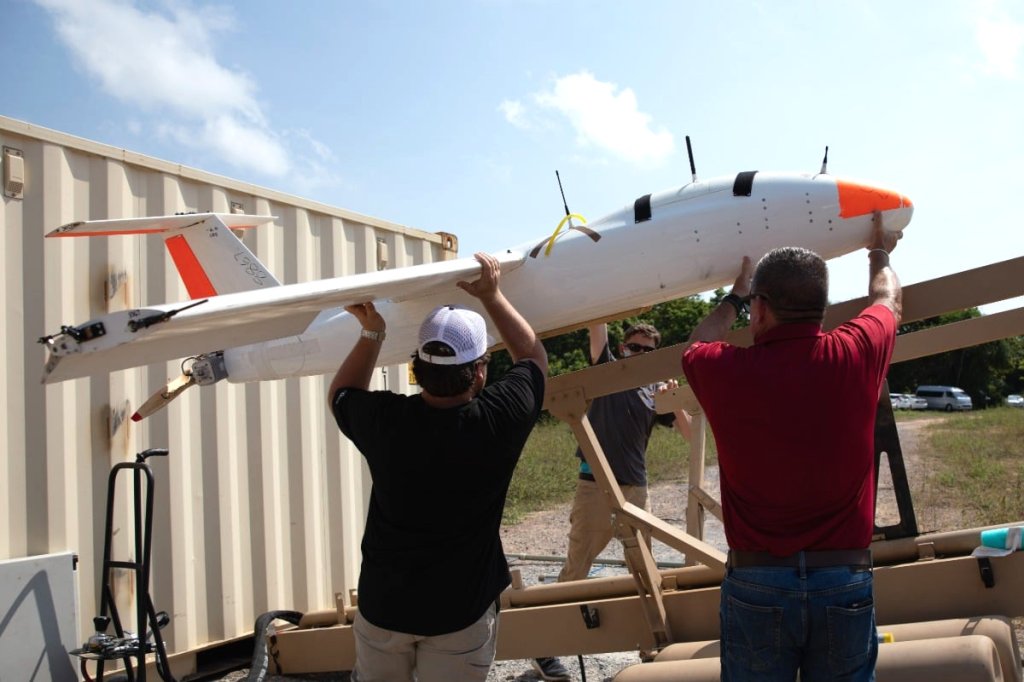
Iran claims to have brought down what looks to be a U.S.-made MQM-170C Outlaw G2 drone largely intact. A video shows it has a notable feature on top of its nose. In U.S. military use today, Outlaw-series drones are best known as an aerial target for use in training and testing.

The footage in question, and the accompanying claims, should be treated with caution given that the regime in Tehran and the country’s media outlets do routinely make exaggerated and unverified claims. That being said, so far, the footage looks to be credible. Furthermore, the U.S. military has pushed back on Iran’s version of events, but has not explicitly denied having lost one of these drones in the region recently.

For its part, Iran’s Islamic Revolutionary Guard Corps (IRGC) says it captured the MQM-170-series drone following what it described as an “offensive electronic warfare operation” somewhere to the “west of the Strait of Hormuz.” The IRGC also claims that the uncrewed aircraft was conducting reconnaissance on Iranian air defenses positioned along the country’s Persian Gulf coast. At the time of writing, no firm evidence has been provided to support either of these assertions. The IRGC has released the aforementioned video, seen below, which it says shows the drone being tracked via an infrared camera, as well as after its recovery.

#Iran / #USA 🇮🇷🇺🇸: Islamic Revolutionary Guard Corps (#IRGC) Navy captured a US Drone after intercepting it with EW Systems.

The Drone captured by the IRGC Navy appears to be Griffon Aerospace Outlaw G2 “MQM-170C” UAV. pic.twitter.com/Xw6JYOu1s6

— War Noir (@war_noir) October 29, 2026

“In the past weeks and months, the IRGC has repeatedly lied out of desperation, and today is no different,” U.S. Navy Capt. Tim Hawkins, spokesperson for U.S. Central Command, told TWZ when asked about the specific Iranian claims.

“We’re not going to waste our time. U.S. forces remain vigilant and laser-focused on our assigned missions,” Hawkins said in response to a follow-up question about whether CENTCOM could confirm or deny the loss of an MQM-170-series drone for any reason.

As an aside, Iran recovered an Anduril Dive-LD uncrewed underwater vehicle (UUV) largely intact last month in what the IRGC claimed had been a “complex intelligence and operational action.” U.S. authorities ultimately confirmed the loss of the advanced UUV, but said it was the result of a malfunction.

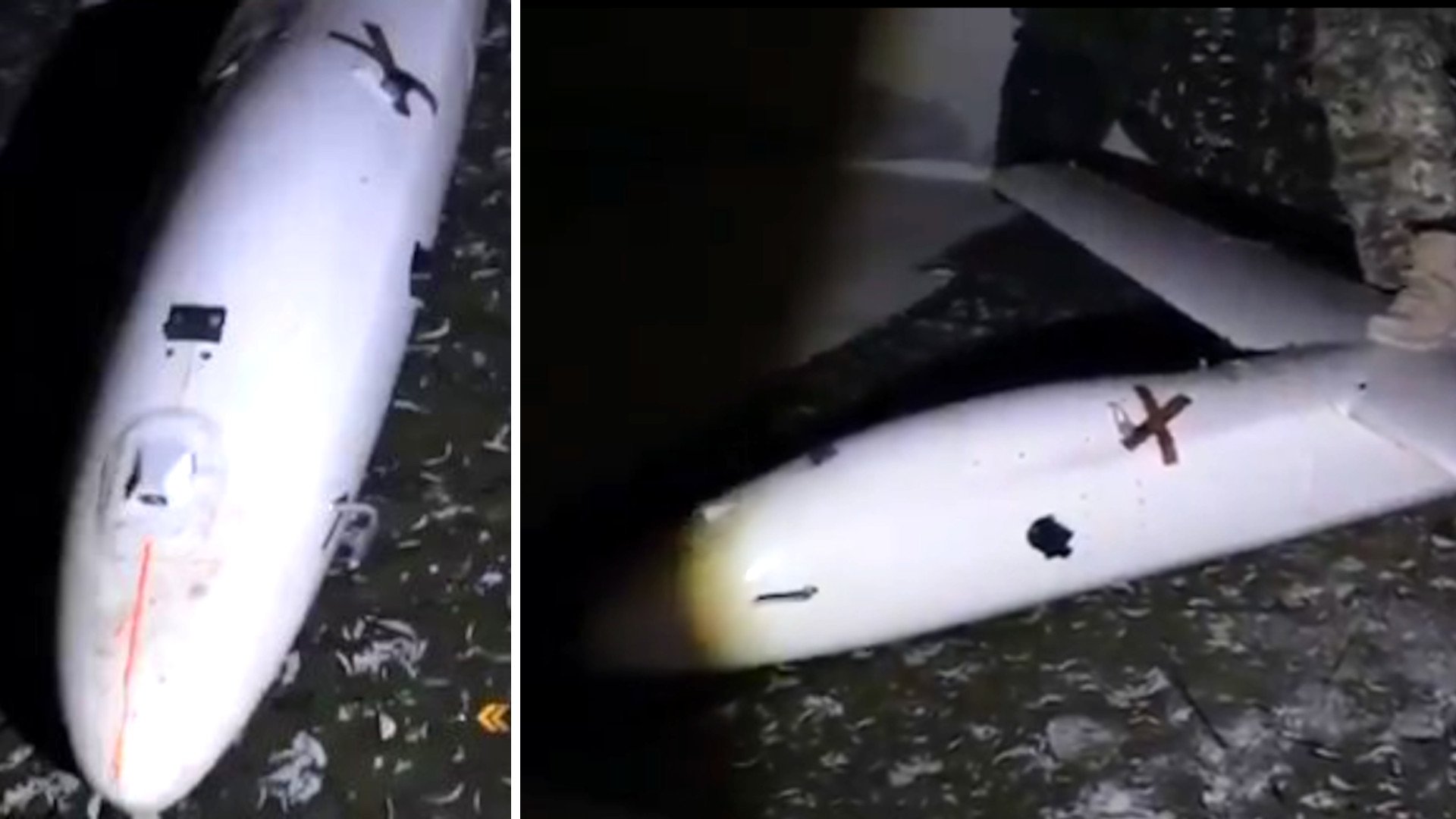
As mentioned, the drone seen in the IRGC video does look to be an MQM-170C, or at least a closely-related variant thereof. It has an interesting feature on top of its nose: a single forward-looking aperture. This is something that is commonly associated with staring-type optics, which drones often use to aid with navigation. There is a possibility that it could be a seeker, if the drone were to be configured as a one-way-attack munition, but this seems unlikely.

Additional views of the nose end of the drone Iran says it captured, with the ‘staring’ aperture plainly visible. Iranian media captures via X
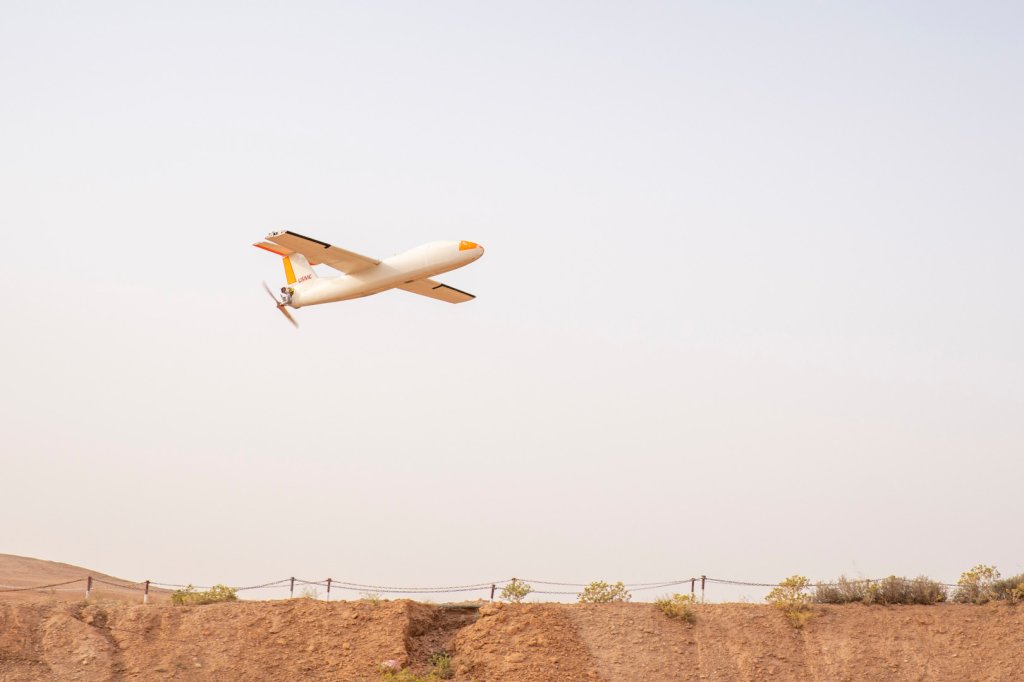
A stock picture of an MQM-170C drone in U.S. military service in its typical configuration as an aerial target. USN
Another picture of U.S. MQM-170C target drones offering additional views of their noses. USAF

MQM-170C’s manufacturer, Griffon Aerospace, which refers to this design internally as the Outlaw Gen 2 (G2), does say on its website that it can be configured as “an inexpensive payload development platform offering great endurance, payload size, weight, and power.” The company’s website also says that the target configuration of the G2 has a gross weight of 150 pounds, but that this can grow to 225 pounds when used as a more general-purpose drone.

The drone, which is nearly 11 feet long and has a wingspan of 16 feet, otherwise has a stated maximum endurance of eight hours, top speed of 126 knots, and the ability to reach altitudes of more than 16,000 feet. The design is propelled by a 2-cylinder, 2-stroke combustion engine driving a single pusher propeller. The G2 gets into the air via a catapult-type launcher and can be recovered, either after a glide-in landing on suitable terrain or via parachute.

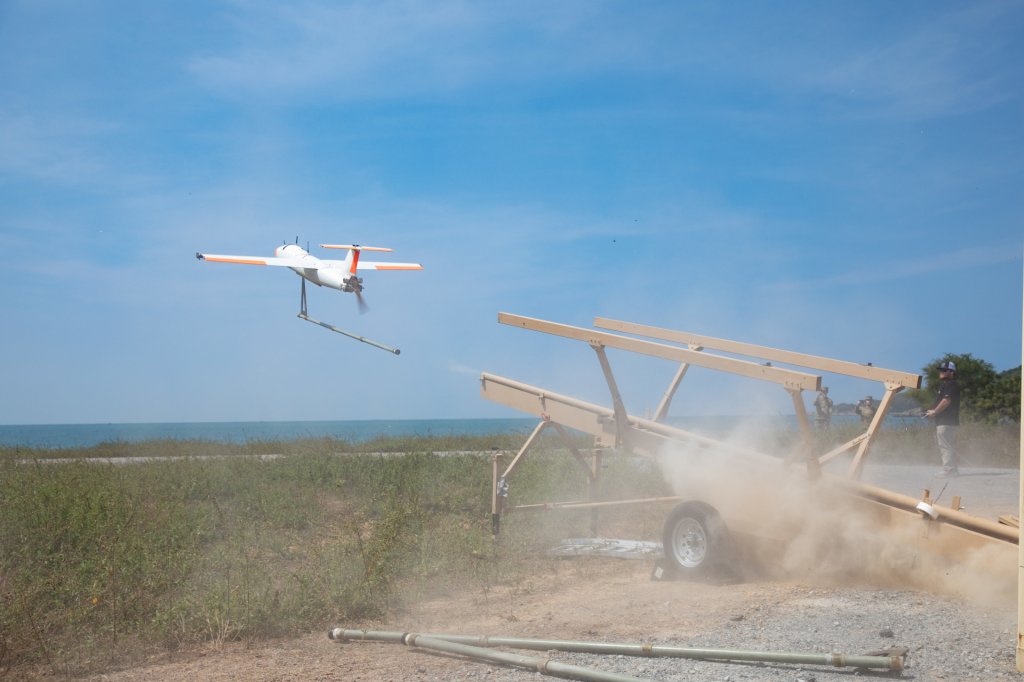
An MQM-170C target drone seen being launched via catapult. USN

Griffon Aerospace also offers an ‘expanded’ G2E version with fixed tricycle landing gear as an “open and customizable platform for ISR [intelligence, surveillance, and reconnaissance] missions, subsystem testing, and R&D [research and development].” This version has a lower maximum takeoff weight and total endurance compared to the baseline G2, according to the company’s website. The IRGC video does not show any evidence of landing gear, but it could have broken away when the drone came down.

The landing-gear-equipped Outlaw G2E. Griffon Aerospace

The larger Outlaw family, which traces back to the early 2000s, also includes the Gen 1 MQM-170A, which has a completely different design from the subsequent G2 drone. Griffon also developed a derivative of the Gen 1 design with a twin-boom tail, called the Outlaw Boomer, which the U.S. military designated the MQM-170B. There is also a twin-engine, twin-boom derivative of the Outlaw G2 that the U.S. military has at least tested in the past.

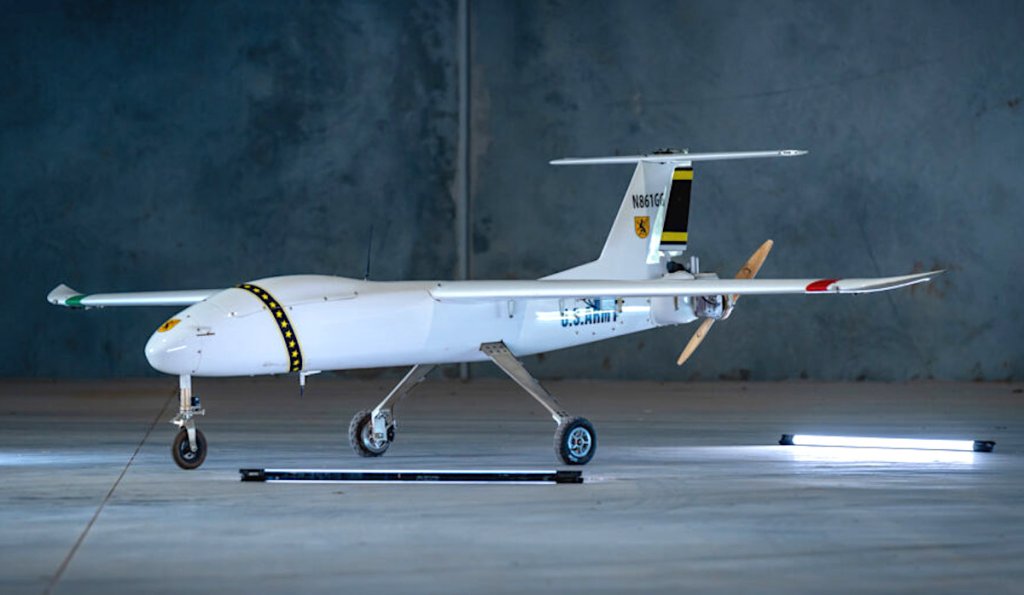
A twin-engine, twin-boom derivative of the Outlaw G2, seen here in U.S. Army markings. Griffon Aerospace

This brings us to the additional matter of a contract the U.S. Army awarded to Griffon Aerospace, valued at nearly $68 million, for the procurement of a Gen 3 version of the Outlaw on June 3. When the Pentagon first announced this deal, it was explicitly said to be “in support of Operation Epic Fury” against Iran. That portion of the announcement was quietly deleted sometime thereafter.

“A company official declined to provide details about the Gen 3 design,” Breaking Defense reported in a story published on June 5.

On August 25, Griffon received an additional contract from the Army, valued at just under $133 million, “to procure Griffon Outlaw systems, support equipment and field service representatives for system use and employment.” That announcement made no mention of operations against Iran.

At the time of writing, Griffon Aerospace’s website does not appear to make any mention of the Gen 3 Outlaw. TWZ has reached out for more information about this drone.

Given the known breadth of Outlaw designs to date, it is possible that the Gen 3 drone is substantially, if not entirely, different from any of the existing types. At the same time, the June contract announcement does establish a link between the Outlaw family and U.S. military use outside of training and testing, and specifically as part of real-world operations aimed at Iran.

There remains the potential that Iran simply captured an Outlaw target drone that U.S. forces lost control of during training or testing in the region. The drone seen in the IRGC video lacks the high-visibility orange markings typically seen on aerial targets, though these could easily have been painted over. Iranian authorities could have still fabricated the recovery, in part or in whole, though there is no firm evidence of that at present, either.

An MQM-170C target drone belonging to the U.S. Marine Corps, seen here in use during an exercise in Saudi Arabia in 2023. USMC

Another non-U.S. operator region could also be employing versions of the Outlaw, including in non-target drone roles, such as for surveillance and reconnaissance, or as decoys.

All of this does now come amid growing signs that the United States, as well as Israel, are preparing to launch a new major campaign against Iran. As TWZ reported recently, stimulating Iranian air defenses to glean key intelligence about their current capabilities and positions would be critical in the lead-up to any such operation.

“Stimulating Iran’s air defenses is critical,” our own Tyler Rogoway wrote on X earlier this month following unconfirmed reports of unusual Israeli air activity. “By Iran operating as if a full scale attack could be coming, their air defenses can be detected, categorized and geolocated. This is absolutely critical prior to a major air operation. Surveilling them during times of lower alert does not provide the same fidelity of actionable intelligence. Knowing where those threats are and how they are operating can mean the difference of life and death and/or will help standoff munitions make their way to their targets as those defenses can be suppressed, destroyed, or avoided entirely via careful mission planning.”

In September, claims had emerged that Iran had shot down a U.S.-made ADM-160 Miniature Air-Launched Decoy (MALD), but that remains unconfirmed. There were also reports of unusual, UAP-like objects flying over Iran, which have similarly not been confirmed.

15090 is the CAGE code for Raytheon, which is visible on the tail fins and other remnants.

Source for images: https://t.co/weIo1Hh6RR pic.twitter.com/4LoBMChKZG

— Trevor Ball (@Easybakeovensz) September 20, 2026

I don’t know what this is, or if it’s legit BUT remember we are in a new age of misdirection, decoy and guile. Specifically using low end drone technology. There are more ways to stimulate an enemy air defense system, distract a populous, assess the flow of public info from a… https://t.co/wW7YVlbayB

— Tyler Rogoway (@Aviation_Intel) September 21, 2026

As we wrote at that time:

“Such reports come amid an increasingly sophisticated use of low-end drones, decoys, and other forms of deception. These kinds of systems can be employed not only to stimulate adversary air defenses, but also to distract populations and probe how information moves out of a denied area. In such an environment, unusual aerial sightings should be viewed with caution — but not necessarily dismissed as irrelevant. We have been talking about how new forms of misdirection and guile will leverage relatively low-end technologies in future conflicts for many years now. While it isn’t clear if this light show in the sky over Iran was such an activity, it is certainly a reminder to keep that possibility in mind.”

It would certainly be plausible for suitably configured Outlaw drones to be in use now as another means of simulating Iranian air defenses. There is precedent even for ostensible target drones to be used operationally to deploy countermeasures and just as decoys in support of major strikes. U.S. BQM-34 Firebee target drones were notably used to spread radar-confusing chaff over the Iraqi capital Baghdad as part of the opening phase of Operation Iraqi Freedom in 2003.

It is also worth noting that the conflict with Iran this year has seen the first U.S. combat use of longer-range one-way attack drones, as well as explosive-laden kamikaze uncrewed surface vessels (USV). However, there is no evidence at present that drones in the Outlaw family have been configured in this way in any context.

Altogether, though still not definitively confirmed, Iran’s claimed recovery of an MQM-170C drone is an interesting development as the prospect that major hostilities in the region could resume soon continues to grow.

Contact the author: joe@twz.com

The post Let’s Talk About The U.S. Target Drone Iran Claims To Have Recovered Intact appeared first on TWZ.

  •  

US Sending an Additional Patriot System to Israel To Prepare for Potential Attacks on Iran

The US military is reportedly sending an additional Patriot missile system to Israel as preparations continue for a potential US-Israeli attack on Iran, while Gulf Arab allies have been warned to prepare for a renewed bombing campaign.

  •  
❌