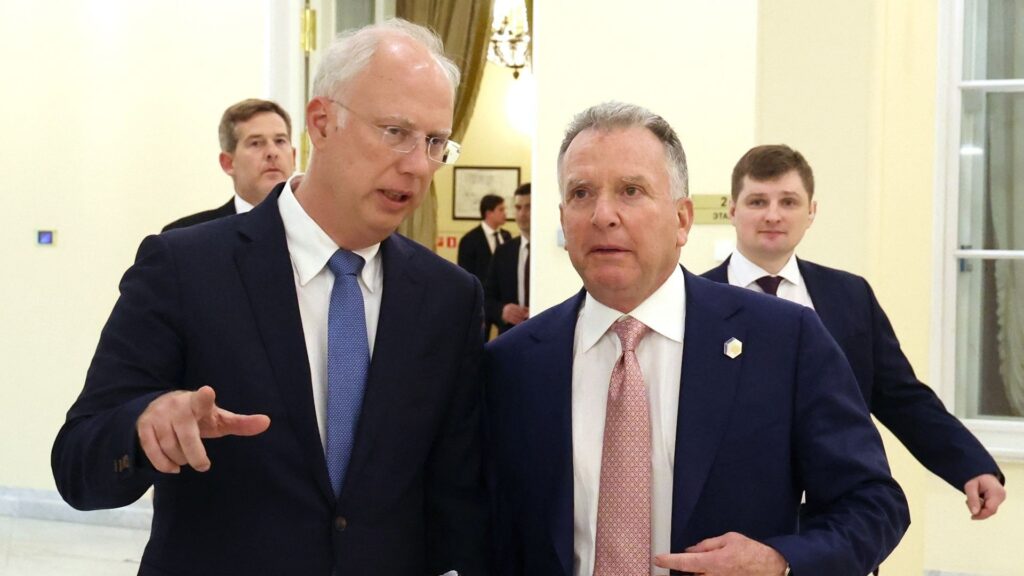
The Trump administration is assessing an application from the Russian Direct Investment Fund (RDIF) to be removed from the US sanctions list, a US official told The New York Times (NYT). A day later, Kremlin aide Yuri Ushakov said the two sides were in talks over it.
Washington has been easing pressure on Moscow piece by piece. On 9 October, the Treasury issued a general license allowing sales of Russian diesel, including into the US. A week later, President Trump waived new sanctions under the Graham Act, a Russia sanctions law he had signed on 18 September. Meanwhile, Kyiv is still waiting for the next round of three-way peace talks. Freeing a Kremlin fund now would lift another cost from Moscow before any settlement on Ukraine.
A review in Washington
The fund is run by Kirill Dmitriev, Vladimir Putin’s envoy in talks with Washington. The official said the administration was weighing the application through established procedures, as part of an effort to “improve US-Russia relations and help end the war.”
The official also praised Dmitriev as “a helpful envoy.” Russian officials pushed for delisting during talks on the fund’s role in shipping Russian diesel to the US, people familiar with the negotiations told the NYT. The Treasury, however, held that its 9 October license already let the fund handle diesel transactions, the paper reported.
Talks, according to Moscow
Ushakov described a two-way conversation rather than a review. He said on 28 October that it had been going on for some time and that he did not know the outcome. He pointed in particular to Dmitriev’s active contacts, saying that was why the issue had come up.
Blocked four days into the invasion
The Treasury fully blocked the fund and Dmitriev on 28 February 2022, four days after Russia launched its full-scale invasion. At the time, it said the fund was widely considered a slush fund for Putin. The Treasury is handling the new request under its normal process, and the fund will have to prove the grounds for its sanctions no longer apply, people familiar with the process told the NYT.
Explore further
Russia resumes diesel exports to Türkiye, Brazil, after Trump lifts sanctions on fuel supplies, boosting Moscow’s war revenue – Reuters
Eric Green oversaw Russia policy at the White House National Security Council under President Joe Biden. He told the paper that lifting the sanctions would send a strong message. In his view, Washington would be relaxing its position of not easing sanctions and other costs until a settlement in Ukraine.
This is not Dmitriev’s first push this year. On 7 February, Zelenskyy said Ukrainian intelligence had shown him a so-called “Dmitriev package” of US-Russia cooperation, worth about $12 trillion, that Dmitriev presented in the US. In April, he arrived in Washington as a US oil waiver for Russia neared expiry. US delisting would not touch UK and EU restrictions on the fund. But it would reopen American finance to a fund the Treasury said Putin’s inner circle relied on to raise money abroad.
Right now, the voices speaking most clearly to the desire for at-home care are pronatalist and regressive, favoring traditional gender hierarchies to grow the population at all costs.
Right now, the voices speaking most clearly to the desire for at-home care are pronatalist and regressive, favoring traditional gender hierarchies to grow the population at all costs.
Saudi Arabia should resist pressure to join the Abraham Accords and champion an inclusive Makkah Defense Agreement to strengthen Muslim unity, regional sovereignty, and collective security against external hegemony. The Abraham Accords and the Risks of Strategic Realignment US President Trump needs to consider the geostrategic, geoeconomic, and geopolitical ramifications of repeatedly urging the Kingdom […]
È stato eliminato un limite che penalizzava i lavoratori assunti prima del Jobs Act e licenziati illegittimamente dalle piccole imprese. Con la sentenza 174/2026, la Corte costituzionale ha dichiarato illegittima la parte dell’art. 8 legge 604/1966 che legava la possibilità di aumentare l’indennità risarcitoria al numero complessivo di dipendenti dell’azienda.
La decisione consente anche ai lavoratori delle piccole imprese di ottenere, ricorrendone i presupposti, un’indennità fino a 10 mensilità per chi ha più di dieci anni di anzianità e fino a 14 per chi supera i vent’anni. Attenzione però, l’aumento non è automatico: spetta al giudice determinare l’importo in base alle circostanze del caso concreto.
Chi riguarda la sentenza della Corte costituzionale
La pronuncia interessa i lavoratori assunti prima del 7 marzo 2015, data di entrata in vigore del d.lgs. 23/2015, che disciplina il cosiddetto contratto a tutele crescenti. Per questi rapporti, nelle imprese che non raggiungono le soglie dimensionali previste per l’applicazione della tutela ordinaria dell’art. 18 Statuto dei lavoratori, continua a valere l’art. 8 legge 604/1966.
La disposizione riguarda i licenziamenti privi di giusta causa o giustificato motivo. In questi casi, il datore può scegliere, in alternativa alla riassunzione del dipendente entro tre giorni, di versargli un’indennità risarcitoria.
Prima della sentenza 174/2026, l’importo poteva essere compreso tra 2,5 e 6 mensilità dell’ultima retribuzione globale di fatto. La possibilità di elevare il massimo a 10 o 14 mensilità era riservata ai dipendenti delle aziende con più di 15 lavoratori complessivi, purché ricorressero anche i requisiti di anzianità.
La Corte ha eliminato proprio questa condizione dimensionale: la maggiorazione non dipende più dal fatto che l’impresa occupi complessivamente più di quindici dipendenti.
La pronuncia non cancella, tuttavia, ogni distinzione tra piccole e grandi imprese, né modifica tutte le tutele contro i licenziamenti illegittimi. In particolare, non attribuisce al lavoratore un diritto generalizzato a essere reintegrato al lavoro.
Perché il limite di sei mensilità è stato dichiarato incostituzionale
Il caso concreto riguardava una lavoratrice assunta nel 2003 come assistente in uno studio dentistico, con contratto a tempo indeterminato part-time. Nel luglio 2024, dopo oltre vent’anni di servizio, era stata licenziata per giusta causa, sulla base di presunte irregolarità nelle procedure di sterilizzazione degli strumenti di lavoro.
Il Tribunale di Livorno, che ha sollevato la questione di legittimità costituzionale, aveva rilevato gravi vizi nel licenziamento, tra cui la mancata preventiva contestazione degli addebiti e l’insufficienza delle prove a carico della dipendente. Poiché lo studio occupava meno di quindici lavoratori, l’indennità non avrebbe però potuto superare sei mensilità.
Secondo il giudice, un risarcimento così limitato non era però adeguato né a compensare il danno subìto dalla donna né a dissuadere il datore dal commettere violazioni analoghe. La Consulta ha condiviso questo ragionamento, richiamando i principi costituzionali di uguaglianza e ragionevolezza, la tutela del lavoro e della dignità del lavoratore e l’esigenza di garantire un ristoro effettivo in caso di licenziamento illegittimo.
In particolare, una forbice compresa tra 2,5 e 6 mensilità rischiava di equiparare situazioni diversissime, impedendo al giudice di adeguare sufficientemente l’indennizzo alla gravità dell’illecito e alle conseguenze concrete del licenziamento.
Il collegamento con la sentenza 118/2025 sul Jobs Act
La decisione si inserisce nel solco giurisprudenziale della sentenza 118/2025 della Corte costituzionale, che aveva già eliminato l’analogo tetto di sei mensilità previsto dall’art. 9 comma 1 d.lgs. n. 23/2015 per i lavoratori assunti dal 7 marzo 2015 nelle piccole imprese.
Dopo quella pronuncia per i licenziamenti illegittimi soggetti al Jobs Act, l’indennità nelle imprese sotto soglia può variare da 3 a 18 mensilità nei casi previsti dall’art. 3 comma 1, del decreto. Si era così creata una differenza difficilmente giustificabile: un lavoratore assunto dopo il 2015 poteva ottenere una tutela economica superiore a quella riconosciuta a un collega con maggiore anzianità, anche per licenziamenti di gravità analoga.
La Corte ha osservato che una diversa data di assunzione può giustificare discipline differenti soltanto quando la distinzione è ragionevole. Tuttavia, dopo l’eliminazione del tetto per i nuovi assunti la precedente giustificazione — legata all’obiettivo di favorire l’ingresso nel mercato del lavoro con maggiore flessibilità in uscita — aveva perso gran parte della propria forza. Anche perché i lavoratori più anziani possono incontrare maggiori difficoltà nel trovare una nuova occupazione.
Perché il risarcimento può arrivare a 10 o 14 mensilità
Per eliminare la disparità, la Corte non ha sostituito direttamente il limite di sei mensilità con quello di dodici, come richiesto dal Tribunale di Livorno. Ha scelto un intervento più mirato, cancellando dall’art. 8 legge 604/1966 le parole che subordinavano la maggiorazione al numero di dipendenti occupati dal datore.
Restano quindi applicabili le maggiorazioni già previste dalla legge:
fino a 10 mensilità per chi ha un’anzianità di servizio superiore a dieci anni;
fino a 14 mensilità per chi supera i vent’anni di anzianità.
Poiché la disciplina riguarda gli assunti prima del 7 marzo 2015, nel 2026 tutti hanno ormai maturato più di dieci anni di servizio. Chi supera i vent’anni può accedere alla fascia più elevata.
Attenzione: il superamento del tetto delle sei mensilità non comporta il riconoscimento automatico dell’importo massimo e non introduce un regime unico per tutti i licenziamenti illegittimi. Di volta in volta, il giudice dovrà determinare l’indennità risarcitoria considerando anzianità di servizio, dimensioni dell’impresa, tipo di violazione contestata, comportamento e condizioni delle parti. Nella valutazione rilevano anche gli ulteriori fattori indicati dalla legge 183/2010, tra cui le condizioni del lavoratore e la situazione del mercato del lavoro locale.
Che cosa cambia
La sentenza n. 174/2026 della Corte costituzionale elimina una specifica disparità di trattamento, rafforza la tutela economica dei lavoratori e la funzione dissuasiva del risarcimento.
Ora anche per i lavoratori assunti prima del 7 marzo 2015 nelle imprese sotto soglia, l’indennità per licenziamento illegittimo potrà superare sei mensilità, potendo arrivare fino a 14. L’importo effettivo resta affidato alla valutazione del giudice che deve considerare tutte le circostanze concrete. Le dimensioni ridotte dell’impresa non possono però impedire di valorizzare la maggiore anzianità di servizio.
La pronuncia interessa imprese di diversi settori, dagli studi professionali e ambulatori ai negozi, dalle attività artigiane alle piccole aziende di servizi. Non conta il settore economico ma il regime giuridico applicabile. Il caso tipico riguarda un rapporto a tempo indeterminato instaurato prima del 7 marzo 2015, anche part-time, con un datore che non raggiunge le soglie dimensionali previste per l’applicazione dell’art. 18 Statuto dei lavoratori, in caso di licenziamento privo di giusta causa o giustificato motivo. Per gli assunti dal 7 marzo 2015 nelle piccole imprese si applica invece il d.lgs. n. 23/2015, come modificato dalla sentenza n. 118/2025.
La disciplina non si estende automaticamente ai contratti a termine, all’apprendistato o ai rapporti autonomi: di volta in volta, occorre verificare la natura del rapporto e le regole applicabili alla cessazione. Restano inoltre ferme le ipotesi in cui spetta la tutela reintegratoria piena, come nei licenziamenti discriminatori, verbali o nulli per altra causa, indipendentemente dalle dimensioni aziendali.
Beijing has vowed to defend its firms after Washington blocked imports from China’s leading genomics group, extending the two countries’ trade war into biotechnology weeks before their leaders are due to meet in Shenzhen. The US Department of Homeland Security (DHS) on Wednesday added three Shenzhen-based companies to the Uyghur Forced Labor Prevention Act (UFLPA) […]
A bipartisan group of 119 lawmakers is urging congressional leaders to preserve and expand provisions of the SHIPS for America Act in the final fiscal year 2027 National Defense Authorization...
The European Union is attempting to establish itself as a developer of advanced artificial intelligence rather than primarily a regulator and consumer of technology produced elsewhere. An Italian-led consortium developing a large open-source AI model across all 24 official EU languages will provide an important test of whether Europe’s supercomputing infrastructure can support globally competitive systems.
Europe’s efforts to establish greater control over artificial intelligence technology are entering a new phase as the EUROPA consortium, led by Italian company Domyn, advances plans to develop one of the continent’s largest open-source AI models.
The initiative, supported by the European Commission and European high-performance computing infrastructure, aims to create an advanced artificial intelligence system capable of competing with models developed by leading American and Chinese companies.
Domyn chief executive Uljan Sharka told the Financial Times on 29 October that Europe possesses the technological resources and industrial expertise required to compete in advanced AI development.
However, he also identified two obstacles: the need for greater investment and the difficulty of persuading European businesses to adopt domestically developed systems.
These challenges extend beyond the development of a single language model.
They concern whether Europe can establish a commercially sustainable AI industry while reducing dependence on technology providers headquartered outside the EU.
The competition, launched in February, was designed to support the development of a European general-purpose AI model with more than 400 billion parameters.
EUROPA’s planned model is expected to contain approximately 500 billion parameters and support all 24 official EU languages.
The consortium brings together Domyn and Germany’s Fraunhofer research organisation, including the Fraunhofer IAIS and IIS institutes.
Its work will rely on the EuroHPC network of European supercomputers.
Under the competition arrangements, the winning consortium can obtain access to as much as 2.5 per cent of EuroHPC’s total computing capacity for one year.
This allocation is intended to address one of the largest barriers to advanced AI development: the enormous computing resources required to train models at this scale.
The final system is intended to be released under an open-source licence, allowing organisations to inspect, adapt and deploy the technology.
Nevertheless, parameter count alone does not demonstrate that a model is competitive.
Its actual performance will depend on training data, architecture, computational efficiency, evaluation results and the ability to perform reliably across different tasks.
A European Model for European Languages
One of EUROPA’s distinguishing objectives is its coverage of all official EU languages.
The commercial AI market has historically been dominated by models developed primarily for English-language applications, although leading international systems increasingly support multiple languages.
For Europe, linguistic capability has particular relevance to public administration, legal services, education and cross-border business.
A model designed specifically for the European market could potentially support specialised applications involving national legislation, administrative procedures and technical terminology.
However, multilingual availability will need to be assessed against measurable performance standards.
A system capable of producing fluent responses in a particular language is not necessarily equally reliable when interpreting specialised legal or scientific information.
The consortium will therefore need to demonstrate that linguistic coverage translates into practical capabilities rather than remaining principally a technical specification.
Europe’s Supercomputers Become Strategic Assets
The EUROPA project forms part of a wider effort to use European publicly supported computing infrastructure for commercial and scientific AI development.
The EuroHPC Joint Undertaking has invested in systems intended to provide advanced computing resources to researchers, businesses and public institutions.
Additional AI-focused infrastructure is being developed through the EU’s network of AI factories.
These facilities are intended to make specialised computing capacity available to organisations that would otherwise face considerable costs when developing or adapting AI systems.
However, infrastructure ownership does not necessarily provide complete technological independence.
European supercomputing projects continue to rely on internationally sourced semiconductor technology and specialised software.
Domyn itself has described a partnership with the American technology company Nvidia in its previous model-development work.
Consequently, European AI sovereignty is better understood as a question of control over important technological capabilities than complete separation from international supply chains.
Domyn’s Smaller Model Provides an Early Example
On 20 October, Domyn announced the initial release of Domyn Edge, a separate AI model containing four billion parameters.
According to the company’s technical announcement, the system was trained from scratch using approximately 13 trillion tokens on Europe’s Leonardo supercomputer.
Domyn has committed to making the model’s weights, training code, intermediate checkpoints and datasets available under open licences.
This approach is intended to improve reproducibility and allow external developers to examine how the model was constructed.
Domyn Edge is substantially smaller than the planned EUROPA system and should not be confused with it.
Nevertheless, the project provides an example of the company’s approach to developing AI models using European computing infrastructure.
Regulation Is Only Part of the Challenge
The EU has already established an extensive regulatory framework for artificial intelligence through the AI Act.
However, legislation governing the development and deployment of AI does not, by itself, create a competitive domestic technology industry.
Europe faces competition from American companies with substantial private investment, established cloud platforms and access to large commercial markets.
Chinese developers have also expanded their capabilities, including in open-weight AI systems.
EUROPA’s commercial prospects will therefore depend on more than technical performance.
European businesses must be willing to integrate the resulting technology into their operations, while developers will require dependable access to computing infrastructure and support services.
There is also the question of whether European institutions themselves will adopt domestically developed AI systems where they meet relevant security and performance requirements.
Without sufficient demand, even a technically successful model could struggle to establish a sustainable ecosystem.
The Test Will Be Commercial as Well as Technical
Domyn has indicated that it aims to release EUROPA during 2027, although public statements have differed over the precise timetable.
The company’s leadership has discussed a June target, while an earlier technical announcement referred to the second half of 2027.
The immediate challenge is completing development and demonstrating that the model can compete on performance, reliability and cost.
The longer-term challenge concerns adoption.
If European businesses and public institutions continue relying predominantly on foreign technology, access to an advanced European alternative may have only a limited effect on the market.
Conversely, a competitive and widely adopted open-source model could offer organisations greater control over deployment, customisation and sensitive information.
EUROPA is therefore more than a publicly supported technology experiment.
It is a test of whether Europe can convert research institutions, computing infrastructure and industrial expertise into AI products capable of competing in the international market.
The outcome will depend not simply on whether Europe can build an advanced model, but on whether organisations consider it sufficiently capable and economical to use.
Congress is being urged to pass the Biosimilar Red Tape Elimination Act to reduce medication costs by removing the costly interchangeability standard for biologics.
Congress is being urged to pass the Biosimilar Red Tape Elimination Act to reduce medication costs by removing the costly interchangeability standard for biologics.
North Carolina’s 1st Congressional District has become the most expensive House race on record, according to new ad spending data shared this week. Democratic Rep. Don Davis (N.C.) is fighting for reelection in the newly redrawn district against GOP challenger Laurie Buckhout, a retired Army colonel. A striking $52.9 million has been spent on the…
North Carolina’s 1st Congressional District has become the most expensive House race on record, according to new ad spending data shared this week. Democratic Rep. Don Davis (N.C.) is fighting for reelection in the newly redrawn district against GOP challenger Laurie Buckhout, a retired Army colonel. A striking $52.9 million has been spent on the…
In merito al Kids Act, l’iniziativa volta a vietare l’uso dei social network ai minori di 13 anni, “abbiamo avanzato una proposta molto chiara, che prevede un approccio graduale e l’obbligo di integrare la sicurezza fin dalla fase di progettazione (‘safety by design’) per tutti i servizi online. La nostra proposta armonizza le norme per garantire che tutti i minori nell’Ue godano di un pari livello di protezione, poiché un problema europeo richiede una risposta europea unitaria. Per questo motivo, posso confermare oggi che la Commissione ha deciso di rinviare di 12 mesi l’iter di qualsiasi progetto di legge nazionale che si sovrapponga alle future norme armonizzate”.
La dichiarazione arriva da Thomas Regnier, portavoce dell’Esecutivo comunitario per il Digitale, nel corso del consueto incontro con i giornalisti. Motivando il rinvio, il portavoce ha spiegato: “Perché è importante? È assolutamente fondamentale per evitare una frammentazione del nostro mercato interno e per salvaguardare il lavoro dei nostri colegislatori. Dobbiamo ora concentrarci sui negoziati relativi all’Eu Kids Act e garantire un’efficace applicazione delle nostre norme”.
Entrando nel dettaglio dei provvedimenti già presentati, il portavoce ha poi evidenziato: “Ci sono già alcune leggi nazionali – sottolinea il portavoce – che sono state notificate alla Commissione europea” oltre all’Austria come “Slovenia,Italia, Belgio, Francia e altri Stati membri” e “i lavori su tali provvedimenti sono in corso, ma ciò non modifica la nostra posizione di fondo: non intendiamo frammentare il nostro mercato interno.
Se si procedesse in tal modo, si verrebbero a creare normative e requisiti differenti nei vari Stati membri, rendendo l’applicazione delle norme praticamente impossibile. Le piattaforme non sarebbero in grado di conformarsi a un mercato così frammentato e, in ultima analisi, ci ritroveremmo privi di qualsiasi livello di tutela. È proprio per questo che abbiamo presentato una proposta armonizzata volta a proteggere tutti i minori”.
On wednesday, opposition groups in Colombia have expressed their rejection of a strategic memorandum of understanding—signed over a month ago between Abelardo De la Espriella and the United States government—warning of potential socioeconomic, environmental, and territorial implications for the country, while also questioning the scope of the pact.
The criticism centers on a potential extractive mining project targeting strategic minerals; according to the opposition, the exploitation of these resources would negatively affect ecosystems and communities located in the Amazon, the Pacific region, and parts of the Caribbean.
Senator Carolina Corcho, of the Historic Pact (in spanish Pacto Histórico) coalition, argued that the agreement subordinates national sovereignty to an extractive mining and energy model designed to serve U.S. industry.
According to the lawmaker, the document reportedly includes provisions for streamlining permits for extractive mining companies, the handover of geological maps, and granting the U.S. government prior knowledge of planned sales in Colombia to facilitate its decision-making processes.
The opposition has characterized the agreement as mercantilist, criticizing the fact that it was finalized without the participation of Colombian civil society—a group that asserts its right to have a say in how its lands are used.
¡No vamos a permitir que regalen nuestra soberanía a espaldas del país!
La administración de @ABDELAESPRIELLA firmó a oscuras un memorando que le entrega a EE. UU. el control de nuestras tierras raras y minerales estratégicos, poniendo en riesgo a nuestras comunidades campesinas… pic.twitter.com/Oel6iYraPk
The text reads, “We will not allow them to give away our sovereignty behind the country’s back! The administration of @ABDELAESPRIELLA signed a memorandum in the dark that hands over to the United States control of our rare earths and strategic minerals, putting our peasant and ancestral communities at risk. Colombia’s wealth must be respected! Watch the full interview and the details of this complaint on @TeleSUR: http://youtu.be/d0pxJpb7sZY?si=ZnJ_szg_QyUlmO6J
Critics warn that the affected territories contain lithium, nickel, uranium, and copper—resources essential for the manufacture of mobile phones, computers, microprocessors, radar systems, guided missiles, and defense equipment. These materials can also be used for military purposes.
According to the allegations, a large portion of these resources would be extracted from the Amazon, the Pacific, and parts of the Caribbean—regions that hold extensive deposits of rare earths and strategic minerals. Most of these areas are inhabited by Afro-descendant, Indigenous, and peasant (rural farming) communities, which further compounds the concerns raised by the opposition.
Colombian analyst Ricardo Vargas noted that these territories possess a social sensitivity, which is why communities tend to mobilize when faced with risks to their land, water, air, and biodiversity. Vargas also pointed to measures aimed at containing social protest and warned of the presence of armed groups that illegally access these resources.
According to the allegations, the executive branch is clearing protected territories to allow for the entry of foreign entities and the exploitation of resources. The opposition claims that the document bypasses requirements for prior consultation and environmental permits, effectively placing the country’s geological and mining map at the disposal of the U.S. economy and American corporations.
Meanwhile, the executive branch has stated that the memorandum is non-binding—an argument the opposition views as an attempt to evade constitutional obligations and the mandatory review process by the Congress of the Republic.
Opposition groups have drawn parallels to the situation during the administration of Álvaro Uribe Vélez, specifically regarding the presence of military bases in the country.
A productive day in Colombia, building on the enduring friendship between our two nations.
The memorandum was signed on September 8, 2026, in Barranquilla, during a visit by U.S. Secretary of State Marco Rubio. The instrument establishes a framework for cooperation to secure supply chains for the mining and processing of critical minerals and rare earth elements.
According to official information, the agreement includes provisions for financing, support for geological mapping, and the streamlining of administrative procedures for extraction and processing projects. The Colombian Foreign Ministry maintains that such memoranda are non-binding and that they respect both national legislation and state sovereignty.
At the heart of this debate lies the tension between bilateral cooperation, foreign investment, and the protection of national sovereignty, strategic resources, and the rights of local communities.
A dispute over conflicting versions of a provision in Colombia’s 2027 national budget has raised questions about the bill’s legislative validity. Senator Esmeralda Hernández says the Senate and House of Representatives approved different versions of Article 65 but failed to… pic.twitter.com/kNlFunNq1o
Rep. Julia Letlow introduced the Know Your Risk Act to direct the Department of Health and Human Services to create a universal breast cancer risk assessment tool.
Rep. Julia Letlow introduced the Know Your Risk Act to direct the Department of Health and Human Services to create a universal breast cancer risk assessment tool.
 Login