
❌

Reading view

After 0-for-8 Tailhook Failures, F-35C Completes Landmark Arrested Landing Aboard USS John F. Kennedy

The US Navy F-35C Lightning II aircraft made its first-ever arrested landing and takeoff aboard its newest Ford-class aircraft carrier. This milestone marks a major step for the US jet that initially struggled with hook-related flaws that complicated landings during ground tests.

On 13 October, an F-35C from Air Test and Evaluation Squadron (VX) 23 (“Salty Dogs,” NAS Patuxent River) made the first arrested landing aboard the Pre-Commissioning Unit (PCU) John F. Kennedy (CVN-79).

The aircraft reportedly used the unique EMALS and AAG electromagnetic launch-and-recovery systems to perform arrested launches and recoveries from CVN-79 as part of Aircraft Compatibility Testing (ACT).

ACT lets engineers examine how the ship’s equipment interacts with specific aircraft types while gathering data to confirm those systems function as intended.

The US Navy released photos of the event showing two F-35C aircraft with tail numbers 401 and 403—one landing on the carrier deck, and the other flying with an inert Joint Direct Attack Munition (JDAM) bomb carried externally. Later, another set of images and a video were posted on social media, showing the F-35C launching from the deck of the John F. Kennedy on the second day of ACT.

The US Navy took the preliminary acceptance of the carrier on 29 September 2026, after sea trials the previous month. Preliminary acceptance allows at-sea testing, training, and proficiency building before the carrier is commissioned and put into service.

This arrested landing and subsequent catapult launch marked the first time any F-35C had operated from a Ford-class ship, the largest and most advanced fleet of aircraft carriers in the American armory.

The lead ship, USS Gerald R. Ford (CVN-78), has never embarked the F-35C for sustained operations because the carrier was reportedly delivered without the full set of modifications needed to sustain stealth-fighter operations due to cost-saving measures.

Earlier in June 2019, former Navy spokesman Capt. Daniel Hernandez said that although Ford-class carriers were built to launch and recover the F-35C fighter jet, they still needed upgrades such as stronger jet blast deflectors to protect the deck from hot exhaust during launches, as well as designated areas for aircraft operations.

Instead of the F-35C, the USS Gerald R. Ford hosts air wings mainly equipped with F/A-18E/F and Growler variants for its current combat posture.

The US Navy has flown the F-35C only from its Nimitz-class carriers so far. The aircraft completed its initial at-sea testing aboard the USS Nimitz in November 2014. USS Carl Vinson was the first to deploy the jet operationally, and USS Abraham Lincoln was the first to use it in combat.

However, the House Armed Services Committee’s Seapower and Projection Forces Subcommittee later ordered in FY2020 that the Navy must not accept the CVN-79 USS John F. Kennedy aircraft carrier until it can embark the F-35C. This makes the latest arrested landing and takeoff special.

Image
File: A US Navy F-35C makes an arrested landing on the deck aboard John F. Kennedy

This test is a key step in validating F-35C integration with the Ford class, especially because these carriers use electromagnetic catapults and advanced arresting equipment, replacing the Nimitz class’s steam-powered launch and conventional arresting systems.

Interestingly, however, this key milestone comes as US President Donald Trump has ordered the Pentagon to redesign a new aircraft carrier to replace electromagnetic catapults—designed for finer control, reduced airframe stress, higher sortie rates, and better support for a wider range of aircraft—with steam catapults.

In fact, the President signed a national security memorandum in August, giving the Pentagon leaders two months to come up with “a plan on the required measures to replace the Electromagnetic Aircraft Launch System and Advanced Weapons Elevators with steam and hydraulic systems for the construction of” the USS Doris Miller, also a Ford-class aircraft carrier.

Nonetheless, putting F-35C jets on USS John F. Kennedy is a major breakthrough for the US Navy’s upcoming combat posture as regional security threats multiply across theatres. The F-35C Lightning II brings stealth, advanced sensors, sensor fusion, and long-range strike capability that older fighters, such as the Super Hornet, lack.
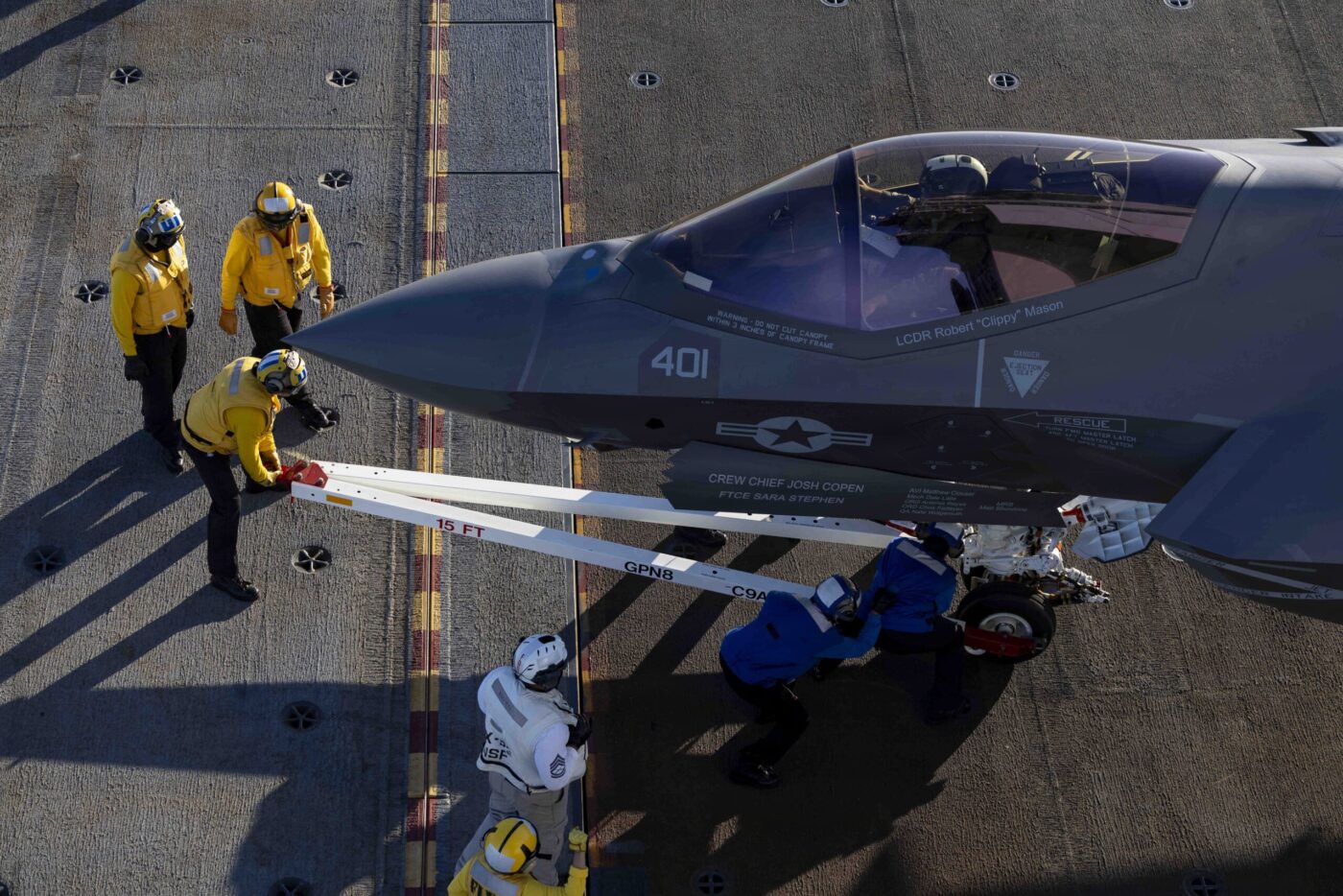
File: F-35C aboard John F. Kennedy carrier

The F-35C’s Leap is Admirable

More than a decade ago, the F-35C struggled with its arresting hook system (AHS), which had a well-documented design issue, as reports in 2012 noted, citing a leaked JSF Concurrency Quick Look Review dated 29 November, 2011.

The report noted that the stealth fighter couldn’t board a carrier because of these tailhook design issues.

It stated that the F-35C failed to engage the MK-7 arresting gear during particular tests at NAWC-AD (Naval Air Warfare Center – Aircraft Division) Lakehurst, with a poor score of 0 successes in 8 attempts.

This was despite testing at a regular airport, not a real carrier, where an aircraft may face inclement weather, a pitching deck, adjacent obstructions, low fuel, and no alternate airfields, among other challenges.

At the time, reports noted that the core issue was the short longitudinal distance—about 7 feet—between the main landing gear tires and the lowered tailhook point. Low-observability, or stealth, requirements drove this geometry, forcing the Arresting Hook System into a recessed bay with doors to preserve the aircraft’s outer mold line and minimize radar cross-section, according to the reports.

For comparison, the F/A-18 placed the main landing gear-to-tailhook distance at about 18.2 feet. Additionally, the tailhook point design had limited ability to scoop low-positioned cables.

A Lockheed Martin official later said the company traced the F-35C’s trouble catching a carrier’s arresting gear wires to the tailhook design. “The good news is that it’s fairly straightforward and isolated to the hook itself,” said Tom Burbage, the F-35 program manager at the time. “It doesn’t have secondary effects going into the rest of the airplane.”

Burbage said that the rest of the tailhook system design, including the bay and doors that hide the device and other auxiliary hardware, was sound. “What we are trying to do is make sure that we got the actual design of the hook is optimized so that it in fact repeatedly picks up the wire as long as the airplane puts itself in position to do that.”

He explained that the fundamental limitations of creating a stealth fighter also caused the hook issue, adding that the company faced the rare challenge of designing the first-ever naval stealth fighter jet with a tail-hook that had to be concealed when not in use.

He also noted that the tail hook had to be installed farther forward on the jet’s ventral surface than on other naval aircraft because it had to fit within the F-35’s outer mold line. As a result, the hook behaved differently than it did on previous fighters like the F/A-18.

The way the wires react as the jet passes over them is a dynamic factor in the F-35, and the wire responded in a sine wave pattern.

“The time differential between when the main gear rolls over the cable and the time the hook picks up the cable on a more conventional airplane is more time for that wave to damp out,” the spokesperson was quoted as saying. “In the case of the F-35, one of our design constraints is that the hook just has to be closer to the main landing gear than on a conventional aircraft because of the requirement to hide it inside the airplane,” he added at the time.

Later, engineering investigations identified three primary factors: the aircraft’s constrained geometry, a suboptimal hook-point shape, and inadequate hold-down performance. Additionally, it found that a faulty or inadequately validated wire-dynamics simulation model contributed to the original design assumptions.

The Joint Strike Fighter program addressed the issue by redesigning the hook point and improving the hold-down damper, along with other refinements such as improved upstroke damping and strength. The revised system underwent successful shore-based testing, including dozens of roll-in arrestments, enabling the first at-sea arrested landings on USS Nimitz in late 2014, followed by a rigorous testing regime.

Notably, Ford-class ships use the newer Advanced Arresting Gear (AAG) rather than the legacy MK-7 hydraulic system. However, the successful trap and launch close the loop on more than a decade of work that began with the original hook’s total failure.

As the EurAsian Times previously explained, the F-35C offers significantly greater range over other F-35 variants, larger internal weapons bays, and superior endurance, making it ideal for long-range operations from the vast ocean.

These stealthy warplanes are nearly invisible to enemy radars and can penetrate even the most advanced air-defense systems. They have advanced sensor fusion to create a shared battlespace picture for the entire air wing and can conduct precision strikes or intercept threats, as demonstrated by the Iranian drone shootdown earlier this year.

The F-35C can carry over 5,000 pounds of internal weapons or over 18,000 pounds of combined internal and external weapons. This lets the US Navy use external armaments to increase lethality when needed or operate in stealth when required.

Not just that, the aircraft can also operate as an intelligence, surveillance, and reconnaissance (ISR) asset, sharing information with all networked ground, sea, and air assets in the battlespace

The post After 0-for-8 Tailhook Failures, F-35C Completes Landmark Arrested Landing Aboard USS John F. Kennedy appeared first on EURASIAN TIMES.

  •  

EU Delays Methane Rules as Energy Crisis Forces Brussels to Ease Import Requirements

The European Commission has proposed postponing new methane reporting and verification obligations for fossil-fuel imports by one year, responding to pressure from energy suppliers and member states amid disruption to global oil and gas markets.

The European Commission has proposed delaying key methane emissions requirements for imported oil, gas and coal by one year, acknowledging that the present energy crisis could make the original timetable difficult to enforce without threatening Europe’s fuel supplies.

The legislative proposal presented on 14th October would postpone obligations requiring importers to demonstrate that their overseas suppliers meet monitoring, reporting and verification standards equivalent to those imposed on European producers.

The requirements were scheduled to take effect on 1st January 2027. Under the revised arrangements, compliance would begin in 2028, with the first annual demonstrations to national authorities due by 31st May 2029.

The decision follows months of pressure from European governments, American energy companies and importers concerned that the regulation could complicate contracts and restrict access to alternative supplies during a period of exceptional international disruption.

Energy security takes precedence

The Commission’s explanatory memorandum places the decision directly within the consequences of the Middle East conflict, which has disrupted trade through the Strait of Hormuz since February.

According to the Commission, approximately 20 per cent of global liquefied natural gas supplies and 25 per cent of seaborne oil trade have been affected. Alternative producers have only partially compensated for the interruption, leaving European buyers competing for increasingly expensive supplies.

Brussels acknowledges that the disruption is likely to continue affecting energy markets after the immediate crisis subsides, partly because damaged infrastructure will require time to repair and restart.

Under these circumstances, importers have warned that they may be unable to obtain sufficient fuel meeting the original compliance requirements by January.

The Commission’s formal amendment to Regulation 2024/1787 responds to these concerns by extending deadlines rather than cancelling the legislation.

The development follows wider discussions about Europe’s energy costs. As EU Today reported during the Brussels summit, high energy prices have become a central concern for governments attempting to protect European industrial competitiveness.

Washington presses for regulatory relief

The United States has been particularly concerned about the effect of the methane rules on transatlantic energy trade.

American producers have become increasingly important suppliers of liquefied natural gas to Europe since Russia’s full-scale invasion of Ukraine in 2022 accelerated the diversification of European energy imports.

According to the reporting on the Commission’s decision, American companies, including ExxonMobil, have raised objections to the requirements, while Washington has pressed Brussels to provide additional flexibility.

French President Emmanuel Macron has also expressed concern about the legal risks facing importers attempting to demonstrate compliance across complicated international supply chains.

The problem involves obtaining reliable emissions measurements from production facilities that may be located thousands of miles from Europe and operate under different regulatory systems.

European importers must then establish whether the information satisfies EU standards, even when the companies operating those facilities are not themselves subject to European jurisdiction.

For suppliers with several production sites, transport arrangements and intermediary contracts, collecting consistent and independently verified information can be a substantial undertaking.

Climate legislation remains in force

The Commission insists that the postponement does not represent an abandonment of its methane reduction objectives.

The original EU methane regulation entered into force in August 2024. It introduced requirements covering methane measurement, leak detection, reporting and restrictions on routine venting and flaring.

Methane is a powerful greenhouse gas, and emissions from oil and gas operations can arise through equipment leaks, deliberate releases and incomplete combustion.

The International Energy Agency estimates that more than 350 billion cubic metres of gas were lost globally through flaring, venting and leakage in 2024. Reducing those losses could increase the quantity of gas available for commercial use.

The Commission is therefore attempting to preserve its environmental objectives while allowing additional time for verification systems and national enforcement arrangements to become operational.

The proposal also postpones methane-intensity reporting obligations for EU producers and importers from August 2028 to August 2029. Requirements to demonstrate compliance with maximum methane-intensity values would move from August 2030 to August 2031.

Existing obligations to provide information about overseas emissions, in force since May 2025, would remain unaffected.

Parliament faces another regulatory confrontation

The proposed changes require approval from the European Parliament and the Council under the ordinary legislative procedure.

That process could expose differences between governments seeking greater flexibility and lawmakers concerned about weakening the timetable for reducing fossil-fuel emissions.

Industry representatives have sought longer extensions, while environmental organisations argue that delaying methane reductions will not resolve the structural causes of Europe’s energy problems.

Brussels is also confronting the consequences of its decision to phase out Russian gas imports. As EU Today’s examination of the Nord Stream 2 legal challenge explained, the Union’s efforts to eliminate dependence on Moscow have already generated disputes over energy security and European regulatory authority.

The Commission now faces two competing requirements: maintaining a common environmental standard for imported fossil fuels while ensuring that suppliers remain willing and able to serve the European market.

Whether the proposed one-year extension proves sufficient will depend on the recovery of international energy supplies and the ability of producers, importers and national authorities to establish reliable verification arrangements before the revised deadlines.

  •  

EU General Court Backs Brussels in Landmark Digital Services Act Dispute Over Platform User Numbers

The EU General Court has upheld the European Commission’s decision to classify Stripchat as a very large online platform, establishing important limits on how technology companies can challenge the calculation of their European user numbers.

The European Union’s General Court has rejected a legal challenge to the European Commission’s classification of adult entertainment platform Stripchat under the Digital Services Act, strengthening Brussels’ authority to determine which online services must comply with the legislation’s most demanding obligations.

In its judgment delivered on 14th October, the Luxembourg-based court dismissed the action brought by Technius Ltd, the company operating Stripchat, against its designation as a very large online platform.

The dispute centred on how the Commission calculated the platform’s average monthly active users in the European Union, which determines whether additional regulatory obligations apply.

Under the Digital Services Act, platforms exceeding 45 million monthly active recipients in the EU are subject to enhanced supervision, including requirements concerning systemic risks, transparency, content moderation and independent auditing.

The judgment addresses a fundamental question for European digital regulation: whether companies can exclude particular categories of website visits when calculating the number of people using their services.

How Brussels challenged the platform’s figures

In February 2023, Technius reported that Stripchat had approximately 31.8 million average monthly active recipients in the EU, placing it below the threshold for very large online platforms.

The company relied on information provided by Similarweb, a commercial service measuring website traffic and user behaviour.

However, the Commission questioned the methodology used to reach that figure. Technius had discounted certain visits on the grounds that users entered the website but departed without engaging with its content.

Such visits are commonly described as bounced visits and frequently appear in commercial website analytics.

The Commission concluded that the company’s deductions had significantly underestimated its audience because the original Similarweb calculation of unique visitors already incorporated a filtering process excluding many bounced visits.

On that basis, Brussels calculated that Stripchat had more than 62 million monthly unique visitors in the EU, well above the statutory threshold.

The Commission consequently designated the platform as a very large online service on 20th December 2023. Technius challenged the decision, arguing that the figures were unreliable and that the absence of a prescribed calculation methodology undermined legal certainty.

The EU General Court rejected both arguments.

Court rejects challenge to calculation methodology

According to the court’s official explanation, the Commission had adequately explained its calculation and was entitled to rely on the data available when the designation decision was adopted.

The judges found that Technius had effectively applied deductions to figures from which relevant traffic had already been filtered, producing an artificially reduced estimate of active recipients.

The judgment also addressed a potentially significant complication.

After the Commission adopted its decision, Similarweb revised its methodology. Using the corrected method, Stripchat’s estimated monthly active audience for the relevant period was approximately 37.3 million.

That figure was below the threshold for classification as a very large online platform. Nevertheless, the court held that the subsequent correction did not invalidate the original designation.

The judges determined that the Commission’s decision had to be assessed according to the facts, applicable law and permissible evidence available when the decision was taken.

The ruling therefore does not establish that Stripchat currently exceeds 45 million monthly users. It confirms that the later recalculation was insufficient to annul the Commission’s December 2023 decision.

A significant precedent for digital regulation

The consequences extend beyond one adult entertainment website.

The Digital Services Act covers online intermediaries operating in the European market, including social networks, marketplaces, hosting services and other platforms.

Its obligations increase according to the size and nature of a company’s operations. Very large online platforms must assess systemic risks associated with their services, introduce appropriate mitigation measures and submit to independent audits.

The Commission is responsible for supervising their additional obligations and can impose substantial financial penalties for established infringements.

The distinction between the two categories can therefore have considerable financial and operational consequences.

Companies falling below the 45 million threshold remain subject to relevant DSA obligations but do not face the same additional requirements imposed on the largest platforms.

The General Court’s ruling confirms that companies cannot escape designation by applying an unreliable interpretation of website traffic data.

At the same time, the Commission’s published supervisory framework allows a designation to be revoked when a platform remains below the threshold for a full year.

European technology enforcement faces growing scrutiny

The judgment comes as the Commission faces multiple legal challenges to its enforcement of Europe’s digital legislation.

As EU Today previously reported, Washington has sought to intervene in proceedings concerning the Commission’s €120 million Digital Services Act fine against X, introducing an additional diplomatic dimension to European regulatory disputes.

The Commission is also pursuing separate investigations into whether major platforms comply with obligations concerning the protection of minors, advertising transparency and the management of illegal content.

In another case examined by EU Today, Brussels reached preliminary findings concerning TikTok’s default privacy settings for children, illustrating the practical consequences of the stricter duties imposed on very large online platforms.

The Stripchat judgment concerns designation rather than a finding that the company breached any substantive safety obligation. Its immediate consequence is to preserve the Commission’s original classification decision.

Technius may still appeal to the Court of Justice of the European Union on points of law within two months and ten days of notification of the judgment.

For European regulators, the decision provides judicial support for using established commercial analytics when assessing the reach of online platforms, provided that the methodology is adequately explained and the underlying evidence is reliable.

For technology companies, it confirms that the legal assessment of user numbers extends beyond the figures they choose to report to Brussels. The Commission can scrutinise those calculations and reject methods that fail to provide a reliable estimate of an online service’s European audience.

  •  

Europe faces a test of economic resolve as China and affordable energy dominate EU summit

EU leaders gathering in Brussels must reconcile demands for stronger industrial protection, affordable energy and a workable budget while maintaining support for Ukraine.

Europe’s economic vulnerabilities converge in Brussels today as EU leaders confront three closely connected challenges: competition from China, persistently expensive energy and disagreement over the Union’s next long-term budget. Together, they raise a question that successive summits have struggled to answer: can Europe translate its economic weight into a coherent strategy?

The immediate pressure comes from industry. Reuters reports that manufacturers blame rising Chinese exports for factory closures, while governments face mounting anxiety about employment and competitiveness. The political danger is clear. When established parties promise prosperity but communities experience industrial decline, voters become increasingly receptive to those offering simpler, more confrontational answers.

The Commission’s recent agreement with Beijing to limit Chinese hybrid-car imports offers leaders evidence that negotiation can deliver results. Yet one sectoral arrangement cannot settle a much broader dispute. Chemicals, steel and machinery remain sources of concern, demonstrating that Europe’s difficulties extend well beyond its automotive industry.

Europe should nevertheless distinguish between legitimate competition and demonstrably unfair trading practices. A trade deficit alone does not establish wrongdoing. Imported goods can benefit consumers and businesses that depend on affordable components. The stronger case for intervention rests on evidence of subsidies, market distortions or strategic dependencies that leave essential industries dangerously exposed.

Germany’s changing position is therefore significant. Previously a prominent opponent of EU tariffs on Chinese electric vehicles, Berlin now backs Franco-German proposals for stronger action, including measures addressing chemicals and PET packaging plastics. Europe’s largest economy appears increasingly willing to reconsider assumptions that once favoured commercial engagement above confrontation.

That shift could strengthen Brussels’ negotiating position. Beijing has less reason to compromise when European capitals publicly disagree about whether action is necessary. A common approach would make the threat of trade measures more credible. But unity will be tested whenever retaliation threatens particular national industries or commercially influential companies.

Energy presents an equally demanding challenge. According to Reuters, draft summit conclusions seek additional short-term relief and refer to a proposed one-year delay in methane-emissions requirements affecting oil and gas imports. These remain proposals under discussion, rather than measures already agreed by leaders.

Temporary adjustments may ease immediate pressures, but postponing regulation cannot substitute for an energy strategy. European manufacturers need confidence about future costs before committing investment. That requires reliable supplies, stronger electricity networks and faster delivery of additional generating capacity. Repeated emergency interventions leave companies uncertain about the conditions under which they will operate.

Trade protection and energy policy must consequently work together. Raising barriers against imported products will achieve little if European factories remain burdened by uncompetitive operating costs. Equally, cheaper energy cannot compensate indefinitely for unfair competition. Treating these problems separately risks producing expensive measures that fail to address the underlying industrial weakness.

The budget discussion will expose whether governments are prepared to finance their ambitions. The proposed 2028–2034 framework requires unanimity, and Reuters reports that a special summit is planned for late November to pursue agreement. The familiar divide between national contributions and shared expenditure remains difficult to bridge.

Every government can identify European priorities worth supporting. Agreement becomes harder when those priorities require higher contributions, changes to established funding arrangements or reductions elsewhere. A credible settlement must explain which investments genuinely benefit from collective action and how spending will deliver measurable results. Larger totals alone cannot establish strategic seriousness.

Ukraine gives these negotiations an additional urgency. President Volodymyr Zelenskiy is expected to join Friday’s discussions, with financing for 2027 among the anticipated subjects. Europe’s ability to sustain assistance will test the durability of commitments repeatedly expressed at summit tables.

Ultimately, this gathering should be judged by whether its decisions reinforce one another. Defending industry, securing affordable energy and funding common commitments are parts of the same task. Europe possesses substantial market power and institutional resources. Its continuing challenge is to combine them effectively, before another round of political assurances gives way to further industrial disappointment.

  •  

Is Jesus the Social Justice Champion of Progressives?

Did Jesus dine with sinners, love the outcasts, and push back against the reigning power structures? Yes, He did those and many other things, but they were not the main goal of His mission.   Progressive Christians often present a truncated portrait of Jesus, highlighting the parts of his ministry that fit their emphasis on... Continue Reading
  •  

More Practical Magic: The Return of Witchcraft in Popular Culture

Contemporary witchcraft is critical theory religion—built on perceived, victimization, grievances, and revenge. Christians have something far better to offer.   The witches are back, and it’s not even Halloween yet. Practical Magic 2 opened September 11 and was the top grossing film that weekend. In less than a week, it topped the $30 million mark... Continue Reading
  •  

India’s mass protests in defense of democracy continue into second week

Thousands participated in a joint delegation of opposition groups in India who were attempting to meet the Chief Justice (CJI) of the country on Monday, October 12. The delegation sought to raise concerns over the alleged irregularities and fraud in the national and state level elections.

The police and security forces, yet again, tried to block the protesters from marching and used force to disperse them. The CJI refused to meet the delegation claiming the matter was subjudice.

Monday was the tenth consecutive day of the mass protests in the country which broke out on October 2, days after a newspaper report claimed the Chief Election Commissioner (CEC) Gyanesh Kumar violated rules and took arbitrary decisions on crucial matters related to electoral rolls revisions, or the so-called Special Intensive Revision (SIR).

Opposition parties of diverse ideological backgrounds have accused the CEC of manipulating the elections to help the ruling ultra-right-wing and Hindu-supremacist Bharatiya Janata Party (BJP) to win crucial state elections. and have been demanding Kumar’s removal.

The opposition is also demanding the end of the SIR process and the re-inclusion of over 130 million voters whose names have been removed from the electoral rolls in various states depriving them of their right to vote, a fundamental right in the Indian constitution.

The BJP and CEC Gyanesh Kumar have refuted the charges, claiming the allegations were based on superficial assumptions.

Massive crackdown over the weekend

The Indian government suspended all major routes to the capital, Delhi, suspending hundreds of trains on Saturday, October 10, in order to prevent people from reaching the capital to participate in a scheduled protest called by the Cockroach Janata Party (CJP), a youth movement which emerged earlier this year, and several left groups, over the issue.

The authorities also closed down all major metro stations in the city and imposed sections of the law which disallow any gathering of people, literally shutting down the city.

The security personnel detained thousands of people from various corners of the city, from their homes and even from moving trains and other vehicles to prevent them from participating in the protests.

All members of the Central Committee of the Communist Party of India (Marxist), including its General Secretary M A Baby and formal Chief Minister of Kerala Pinarayi Vijayan, were forcefully detained after they tried to march to the Jantar Mantar, the designated place for the protests.

They were kept in detention for hours before they were finally released in the evening.

Several protesters from the Student Federation of India (SFI), the All India Students Association (AISA), the Democratic Youth Federation of India (DYFI), and other student and youth organizations tried to breach the police fortifications.

However, most of them were detained by the police during the effort. They claimed they were beaten up by the security forces, with hundreds of videos circulating on social media showing them being manhandled.

Some journalists also accused the security forces of trying to prevent them from reporting. They claimed they were beaten up and their cameras and mics were broken by the police and thugs belonging to the ruling party.

On Sunday, several young leaders, mostly women, from the left-wing organizations, such as the SFI, AISA, the All India Students Federation (AISF), and some Members of the Parliament (MP) from the left parties, like the CPI (M), and the Communist Party of India (CPI), were injured after the police attacked them during the protests.

The crackdown on protesters has invited strong reactions and solidarity from the International Peoples Assembly (IPA) and several left and progressive forces from across the world.

“India’s youth has risen to defend the right to vote itself” because “if a citizen is quietly erased from the voter list, democracy becomes a facade,” the IPA said in a statement issued on Sunday. It also demanded the end of state repression against the peaceful protesters.

Youth in defense of democracy

Talking to BreakThrough News, several youth leaders claimed the objective behind the movement against the rigging in elections is a movement to protect democracy and the basic rights of the people.

They asserted that they will not stop until Gyanesh Kumar is sacked and all the irregularities in the election process are corrected. Under the authoritarian administration, manipulation in elections is now eroding the small remaining democratic voice the people have in the country, they said.

They also questioned the authority of the government to block people’s right to protest, claiming the immunity provided to the security forces to attack the students, youth, and opposition party leaders trying to raise their voice against the injustice confirms that the BJP and its leadership has no commitment to democracy.

Mrityunjay, secretary of the Delhi state DYFI said one should not look at alleged irregularities as just affecting the rights of a section of society. In India the right to vote is linked to several social security benefits for poor and working class people. Once they lose their right to vote they may lose crucial welfare benefits.

The fact that the majority of those who have been deleted from the electoral rolls are from poor and working-class communities makes the fight for free and fair elections a fight for social justice and equality.

Rikta, another leader of the DYFI, claimed that the youth movements see the fight against the CEC as a fight to retain faith in the constitution and democratic processes in India. She claimed that the BJP has never believed in democracy and that is the reason they are so indifferent to the popular resistance against their policies so far.

However, the left and democratic forces in the country have decided to go till the end so that the BJP and people like Gyanesh Kumar never dare to manipulate the popular mandate again and learn to respect dissent, Rikta told BreakThrough News.

  •  

Students in France are fighting for stronger public education

High school and university students in France continued their protests on Tuesday, October 13, demanding government investment in public education. Approximately 480,000 protesters took to the streets in the latest iteration of the mobilization, with families, teachers, and trade unions backing students’ demands. 

Read more: French students shut down schools in historic strike against austerity

The mobilization remains marked by widespread police violence. Police used tear gas and dispersal grenades on crowds, including at Tuesday’s central march in Paris. Hundreds of students were injured and thousands arrested in these incidents, prompting reactions from human rights organizations. 

In response, the public joined students as they blocked high schools and organized marches to physically shield them from potential harm. Trade union members, notably from the education sector, were highly represented in these support lines. 

“The CGT reaffirms the urgent need to address the demands of those who are the country’s future ,” the General Confederation of Labor (CGT) asserted. “The CGT salutes their fighting spirit. It welcomes the strong anti-fascist tone of the demonstrations, which shows that there is no inevitability to the continued flourishing of fascist ideas or to the far right’s rise to power.” 

Students demand access to higher education

Since the beginning of the month, French students have organized three massive demonstrations to warn against the state of education under austerity. “For several weeks, high school and university students have been mobilizing to denounce the deterioration of their study conditions, the Parcoursup system, staff and resource shortages, policies that are dismantling public services, and – more broadly – the future this society holds in store for them,” the trade union federation Solidaires recognized in their statements. 

Trade unions continued their support for student mobilizations. The banner reads: "Electricity and gas workers stand with the youth. Our rage is nuclear." Source: CGT/Facebook
Trade unions continued their support for student mobilizations. The banner reads: “Electricity and gas workers stand with the youth. Our rage is nuclear.” Source: CGT/Facebook

Equal access to higher education has been high on the protesters’ demand list since the beginning. This refers in good part to how students are currently recruited into university courses – the Parcoursup admission platform. Introduced in 2018 under Macronist ministers to replace a previous system that randomized selection for oversubscribed courses, Parcoursup was supposed to “rationalize” admissions.

In practice, however, critics and applicants emphasize the platform allows institutions to apply unclear selection criteria and even discriminate against students from working-class areas.

In September 2026, the left party La France Insoumise warned that 126,652 students were not able to access a course as a result of the system – up from 77,000 in 2023. “This selection process is the product of austerity-driven political choices deliberately implemented by successive Macron-era governments,” the party warned.

“Parcoursup is a social sorting machine,” Solidaires echoed. “The platform organizes competition among young people for places that the State deliberately refuses to create. It transforms the right to study into a privilege, scarcity into selection, and austerity into supposed individual failure.”

Commodification of education

Jean-Luc Mélenchon, the left’s presidential candidate, pointed out that these choices are part of a broader political agenda: “the commodification of education and knowledge.”

Trade union briefs on the subject back this interpretation. At the beginning of this school year, Solidaires warned that thousands of those left without higher education placings are being sacrificed in the name of austerity. 

“But not everyone experiences this violence in the same way,” they wrote. “The wealthiest families can afford private schooling, fund housing on the other side of the country, or sustain a year without studying. Young people from working-class backgrounds, however, have no way out. A lack of options means either being forced into the job market or military service – abandoning their plans for good – or facing precariousness, isolation, and debt at a private institution.”

“We have shifted from an egalitarian system to a discriminatory one: pay for your own future,” Mélenchon concluded in a recent interview.

Read more: Greek university labor leaders face charges after supporting students

The left leader anticipated that student demands will be an important topic during the upcoming election campaign, where the left is contrasting a program of rupture with neoliberal policies to the far right’s intention to build a debt brake not unlike Germany’s. In practice, this would translate into years of sustained attacks on social security and public services. 

Trade unions and progressive organizations announced their support for the youth mobilizations will continue as they build campaigns to resist the government’s intention to impose billions in cuts to pensions and social security while spending record amounts on rearmament.

For their part, student unions invited their members to remain active and join a general mobilization against the cost of living crisis this Saturday, October 17.

  •  
❌