❌

Reading view

EU Parliament defies frugal capitals by seeking €7bn more for the EU’s popular Erasmus+ student scheme

The European Parliament overwhelmingly supported an increased budget and scope for the Erasmus+ student-exchange programme under the new EU budget on Thursday (22 October).

The plenary in Strasbourg opted for a €7bn increase in Erasmus+’s budget compared to the commission’s proposal, by 454 votes, with 34 abstentions, against 93, mostly from right-wing parties.

And it was an audacious move, seeing as ‘frugal’ EU capitals are pushing for €150bn of cuts to the commission’s draft.

But even a “slight increase” in Erasmus+ funds would mean more opportunities for thousands of people, said Bogdan Zdrojewski, a Polish centre-right MEP, who was the rapporteur on the file, during a parliamentary debate earlier on Wednesday.

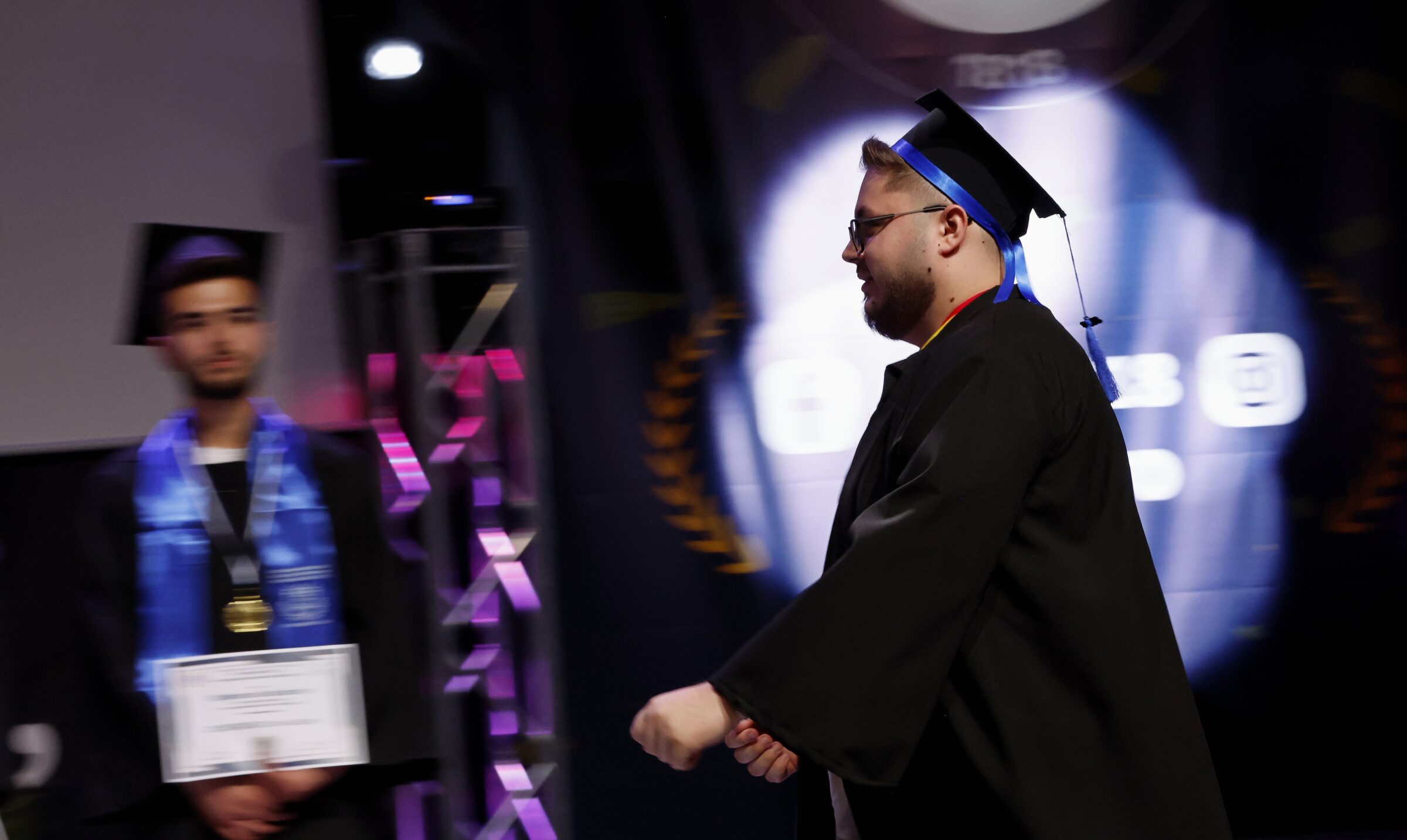
Celebrating its 40th anniversary in 2027, Erasmus+ enables young people to study, live, and work in foreign countries both inside the 27 EU states and the programme’s 160 “associate” states worldwide.

Some 17 million people have taken part since it began, with an estimated 1 million babies also born to couples who met on exchange, in what the commission has long used as a flagship PR project for creating a feel-good factor about the EU.

Meanwhile, the UK will rejoin the programme in 2027, which means EU students will once more have the opportunity to also spend a semester in Britain, which hosts some of Europe’s and the world’s top universities.

And the parliament would also welcome Canada’s full participation in a few years’ time, Zdrojewski told press on Wednesday.

The EU Parliament would like to expand Erasmus+ to more vocational training. “Erasmus+ will be a programme for Europeans no matter what age, what stage of life,” Zdrojewski said.

And students from poorer homes should get more support to live in pricey cities abroad, he added.

The share of Erasmus+ participants who had fewer opportunities to travel under the present structure stood at 15 percent in 2023 – up from 10 percent only two years earlier, according to a commission evaluation.

“Far too often, it is still the parents’ financial situation that determines who can take part in Erasmus+ and who cannot,” said Sabrina Repp, a German socialist MEP, in Wednesday’s debate in Strasbourg.

Working students often cannot afford to quit their current job to go abroad, she added: “That is precisely what we must change.”

The EU budget talks are to be finalised early next year.

Some 83 percent of Erasmus+ participants say they gained professional skills that helped them in the labour market.

But in order for those opportunities to be available more widely, “we need more funding for this programme,” also said Lucia Yar, a Slovak liberal MEP in the Strasbourg debate.

  •  

A Religious Preschool Is Barred From a State's Universal Preschool Program. SCOTUS Will Decide What's Legal.

Religious school classroom | St Mary Catholic School/Facebook

On November 3, the U.S. Supreme Court will hear oral arguments in a case that asks whether Colorado has unlawfully discriminated against a religious preschool because the school is barred from participating in the state's universal preschool program due to its refusal to accept LGBTQ families. In addition to involving multiple hot-button political and cultural issues, the case also has big implications for the future of federal antidiscrimination law.

St. Mary Catholic Parish v. Roy is not about a state law that directly prohibits a religious preschool from operating. Rather, at issue here is a government requirement that any preschool that wants to participate in the state's universal preschool program, and receive the public benefits that follow, must first satisfy various criteria, including that "each preschool provider provide eligible children an equal opportunity to enroll and receive preschool services regardless of race, ethnicity, religious affiliation, sexual orientation, gender identity, lack of housing, income level, or disability."

According to the Catholic preschools overseen by the Archdiocese of Denver, however, complying with that rule would force the schools to violate their religious beliefs. "It is undisputed that these preschools would otherwise be eligible [universal preschool] providers," the schools told the Supreme Court. "They are excluded solely because of their religious exercise—namely, their religious practices of ensuring that all enrolling families are supportive of the Catholic Church's teachings on sex and marriage and of treating enrolled four-year-olds in accordance with their biological sex."

These schools can point to a pair of recent Supreme Court precedents that will very likely count in their favor. In Espinoza v. Montana Department of Revenue (2020), the Court held that if a state provides educational subsidies that help parents send their children to private schools, the state "cannot disqualify some private schools solely because they are religious." Then, in Carson v. Makin (2022), the Court held that Maine's tuition assistance program violated the Constitution by excluding private schools that offered "sectarian" education. "A State's antiestablishment interest," the decision said, "does not justify enactments that exclude some members of the community from an otherwise generally available public benefit because of their religious exercise."

I would expect the outcome of St. Mary Catholic Parish v. Roy to follow in this same general pattern and hold something to the effect that when a state provides an educational public benefit, it must make some sort of accommodation for the religious views of the recipients.


In Other Legal News

Justice Elena Kagan made news a few months back when she defended her conservative colleagues on the Supreme Court from the oft-heard charge that they are totally in the tank for President Donald Trump. "I don't see this as a court that is just like, 'We're just going to rubber stamp what the current administration does.' You know, quite the opposite," Kagan said. "I think that that is a bad rap." In support of her argument, Kagan pointed to the fact that the Supreme Court had recently ruled against Trump on the two big issues that Trump himself valued the most: tariffs and birthright citizenship.

Kagan was in the news again on Tuesday, this time because she publicly blasted those same conservative colleagues for issuing decisions on voting rights and political gerrymandering that, in Kagan's words, have produced "a democracy that does not work as well as it should." According to Kagan, the Court's conservative majority "has kind of blinded itself to the very deleterious effects of their rulings on how the political system works."

Does this mean that Kagan has now stopped defending the conservative justices from the pro-Trump charge? Not at all. In fact, as The New York Times put it, "she reiterated her defense of the conservative-dominated bench from a July appearance and said it was a 'bum rap' to suggest the court had been too deferential to Mr. Trump."

I don't know about you, but I find Kagan to be a refreshing public figure in these simplistic, partisan times. She is a staunch legal liberal with clearly stated objections to what the Supreme Court's conservative majority is getting up to, yet she refuses to be associated with the laziest progressive attacks on the Court. How many people of comparable public stature these days are willing to call out the shortcomings of their own side?

The post A Religious Preschool Is Barred From a State's Universal Preschool Program. SCOTUS Will Decide What's Legal. appeared first on Reason Magazine.

  •  

Oregon Teacher Disputes Account of Her Heroism During School Shooting

Becky Drury, who was said to have shielded a student during a deadly shooting in Bend, refuted the account. “The truth is I was shot before I had any chance to act.”

© Jordan Gale for The New York Times

Last week, a teenage gunman fatally shot three children and one teacher at Silver Rail Elementary School in Bend, Ore.
  •  

France's Protests Descend Into Looting and Property Destruction

FM-10-21-C | Illustration: Adani-Samat

In this segment of Free Media, Reason Senior Editor Robby Soave and Daily Caller Editor in Chief Amber Duke discuss the ongoing violent protests in France. 

If you enjoy Free Media, come watch Robby debate at our upcoming Reason Versus in D.C. Tickets are available here.

The post France's Protests Descend Into Looting and Property Destruction appeared first on Reason Magazine.

  •  
❌