❌

Reading view

The U.K.'s Online Safety Act Has Been a Failure. Regulators Want To Broaden It Anyway.

A child using a tablet | Vinnstock/Dreamstime

Who could have predicted that age-gating large sections of the internet in a crusade to shield children's eyeballs from vaguely defined "harmful content" would have disastrous consequences and wouldn't ultimately protect kids? Apparently, the United Kingdom's online regulator, Ofcom, couldn't. 

On Thursday, Ofcom released a report assessing whether the government should make changes to the content categories of the 2023 Online Safety Act, a set of laws which require companies operating in the U.K. to prevent children from "accessing harmful and age-inappropriate content and provide parents and children with clear and accessible ways to report problems online when they do arise." The act's "child safety regime" (Ofcom's words) went fully into effect in 2025, when porn websites in the country began checking IDs. Unfortunately, as Reason's Elizabeth Nolan Brown has pointed out, the age-verification rule has impacted far more than adult websites. Already, the Online Safety Act has age-gated a wide range of content, including war news, the "NoFap" subreddit, and a historic art image, creating a mass chilling effect online. 

Ofcom's report, however, says little about these age-gating concerns for adults, and its own findings highlight the act's underwhelming results. In the report, Ofcom notes that "Most children in the UK say they have encountered at least one piece of harmful content online in a four-week period." It adds that "at a total level there was no significant change in the proportion of children encountering harmful content over the first nine months after the children's safety duties came into force in July 2025." So, it appears the act is requiring adults to fork over their IDs to access a wide range of content, some of which is innocuous, while playing a never-ending and unsuccessful game of whack-a-mole trying to eliminate "harmful" online content from kids' feeds. 

Instead of suggesting to repeal the Online Safety Act because it does not seem to be working or because it imperils online freedom, Ofcom's report proposes to broaden the law's scope. The regulator recommends adding "body stigma content and depression content, currently identified by Ofcom as kinds of non-designated content, to the category of priority content that is harmful to children." Priority content is defined as "content that services must protect/minimise the risk of children in age groups judged to be at risk of harm from encountering." In other words, online platforms could have more reasons to potentially age-gate, block, or avoid publishing out of fear of violating the law. 

The report does not address the U.K. government's plans to ban children under the age of 16 from accessing social media, and Ofcom says it will soon publish an assessment of "what highly effective age assurance looks like" for determining whether someone is 16 or older. But if the social media ban unfolds anything like it did in Australia, where kids are easily circumventing it, it is likely to flop, just as the Online Safety Act has.

The post The U.K.'s Online Safety Act Has Been a Failure. Regulators Want To Broaden It Anyway. appeared first on Reason Magazine.


  •  

Under Proposed Treasury Rule, Corporate Homebuyers Who Don't Track Their Receipts Face $1 Million Fines

A single-family home | Feverpitched/Vivian Seefeld/Flas100/Dreamstime/Fatima Ruiz

When the 21st Century ROAD to Housing Act was still a work in progress, the Senate briefly inserted a ban on corporate ownership of single-family rental housing so sweeping that it might well have killed off the small but growing build-to-rent sector. 

After furious activism by the housing supply boosters, who had been the main advocates for the law's many other provisions, that investor ban was significantly pared back. 

The final version of ROAD, which became law in July, prohibits investors who own 350 single-family rental homes from buying new ones. But it also includes a long list of exemptions for large investor purchases of single-family rentals.

The primary exemptions include homes purchased as part of a build-to-rent project and dilapidated homes that the investor spends significant money renovating. 

The new restrictions go into effect this coming January. On Thursday, the Treasury Department released a proposed rule that would create definitions for terms that go undefined in the law and clarify the scope of "excepted purchases" of single-family housing that large investors can still make. 

Build-to-rent housing that large investors can still buy is defined as a new single-family home that's never been owned by an owner-occupier, is purchased within 18 months of the home receiving a certificate of occupancy, and is occupied by a renter. 

Protected "renovate-to-rent" homes are defined as homes that had major building code violations that were fixed by the large institutional buyer and for which the investor spent at least 15 percent of the home's purchase price on improvements. 

The rule also provides definitions for rental homes owned as part of a program to boost homeownership, which is another excepted purchase large institutional investors will be allowed to make. Those programs are generally defined as programs in which the renter has the right of first refusal to buy the home and where the rent receives financial support from the homeowner to purchase the home. 

Taken together, the clarified exceptions in the Treasury rule still leave a lot of room for large institutional ownership of single-family homes in keeping with the final text of the ROAD to Housing Act. They won't have to sell the homes they already own. They can still add to the supply of investor-owned rental housing through substantial rehabs and build-to-rent projects. 

Nevertheless, the Treasury rules will impose numerous paperwork burdens on investors who'll now have to track and report, for example, precisely how much money they've spent renovating a purchased rental house or else risk a huge fine. 

Large investors who purchase a single-family home in violation of ROAD are liable for a maximum civil penalty of $1 million per home purchase. 

The proposed Treasury rule highlights what a glaring exception the investor restrictions are to the overall spirit of ROAD. Through a variety of means, the law attempts to reduce the regulatory burden on new housing. Now, large investors will have to absorb significant compliance costs just to prove that they're adding new rental housing supply in precisely the right way. 

The post Under Proposed Treasury Rule, Corporate Homebuyers Who Don't Track Their Receipts Face $1 Million Fines appeared first on Reason Magazine.

  •  

Even Under Mamdani, New York City's Ballot Questions Might Cut Red Tape and Public Review Hearings

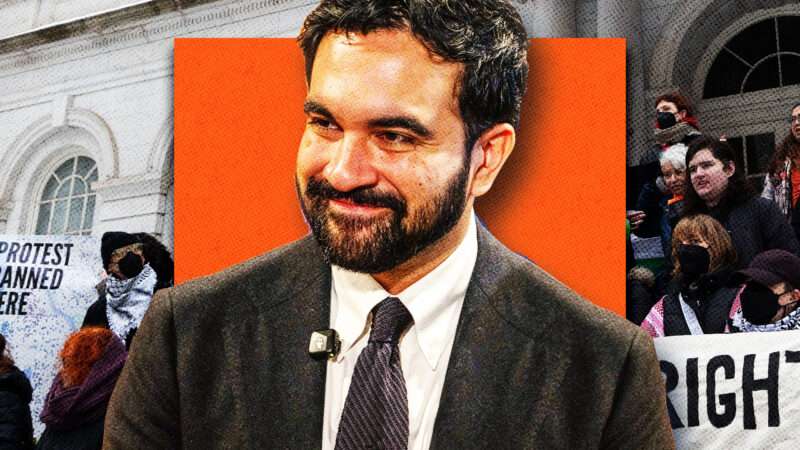
A photo of Zohran Mamdani wearing a suit, in front of a orange square, with a different photo of a protest happening behind him. | Admedia, Inc/Porter/AdMedia/Sipa USA/Gina M Randazzo/ZUMAPRESS/Newscom

New Yorkers won't be voting on any citywide offices this year, but they do have five ballot initiatives that could shape the city's future more than any politician on this year's ballot. Mayor Zohran Mamdani created a version of the Trump administration's infamous Department of Government Efficiency in New York called the Commission on Government Efficiency (COGE). The plan is for COGE to modernize city operations and accelerate public infrastructure and permitting—in that vein, COGE placed five proposals before voters on the November ballot, largely targeting the bureaucratic processes governing new construction and business activity across the five boroughs.

Questions 1, 2, and 3 on the ballot would end or reduce the use of public hearings in different city review processes. Question 1 would, according to the ballot language, "simplify [the] process to use public space for uses such as ramps, planters and cafes, by removing mandatory hearings and Council disapproval of sidewalk cafes, while maintaining community and Council input." Question 2 would "reduce paperwork for City contractors by authorizing [the] Procurement Policy Board to simplify [the] contractor questionnaire….[And] remove mandatory hearing for required client services report." Question 3 would "simplify review of street safety projects to reduce construction timelines," among other changes. Question 4 is about simplifying permitting.

These policies were not directly introduced by Mamdani, but they reflect a governing philosophy that New York City and other big cities desperately need: a local government that won't allow a small group of organized opponents to obstruct progress for the city at large indefinitely.

Nowhere is the bottleneck against much-needed development clearer than at public review hearings. In theory, a public hearing is democracy at its purest: Every voice is heard. But in practice, it usually becomes a slow-motion filibuster. The most persistent and best-organized opponents get a megaphone, with little to no input from the millions of New Yorkers who would broadly benefit from more housing, better infrastructure, and businesses that can open without getting wrapped in red tape.

The 2026 ballot questions, if approved, would take small steps toward addressing these problems. If they all passed, it wouldn't be a seismic change—a planter here or a parcel of land there. But that's kind of the point: Should routine administrative decisions require another round of formal public review hearings to hold up any change, big or small?

The post Even Under Mamdani, New York City's Ballot Questions Might Cut Red Tape and Public Review Hearings appeared first on Reason Magazine.

  •  

Kalshi's CEO Wants 1 Set of Rules. The States Want 50.

Tarek Mansour | Photo: Reason

"I think capitalism is a good thing, but I think what we need to contend with and be aware of is that a lot of people are not part of it," Tarek Mansour, co-founder and CEO of prediction market platform Kalshi, recently told Reason's Nick Gillespie. "They don't feel like they're part of it. And that's a reality."

Mansour has set out to change that by making it easier for consumers to experience and participate in financial markets. Kalshi's premise is simple: Mansour says the platform matches traders with differing opinions on the outcome of future events, aggregating the "bits and pieces of information" siloed across the country, so long as that information isn't privileged or obtained illegally.

He's up against a rising number of federal and state lawmakers—not to mention the NFL, traditional sportsbooks, casinos, and other regulated gambling operations—who view Kalshi as yet another gambling app. "As of early 2026, more than 20 lawsuits and cease-and-desist actions are pending across the country, filed by state attorneys general, gaming regulators, tribal governments and private plaintiffs," according to the National Conference of State Legislatures. This includes Utah, whose attorney general, Derek Brown, escalated an ongoing legal dispute with Kalshi on Tuesday by filing a complaint against the prediction market in state district court. In his complaint, Brown called Kalshi an "unconscionable and illegal gambling operation." He accused the company of engaging in a "brazen pattern of unlawful conduct."

At the federal level, Bloomberg Law reported last Friday that Sen. Ted Cruz (R–Texas) is preparing to introduce a bill after the midterm elections that would give state and tribal governments authority to regulate sports-related event contracts offered by prediction markets. 

Cruz's state-by-state regulatory regime is exactly the kind of scheme Mansour wants lawmakers to avoid. Mansour recently told Reason that, ideally, there'd be a "federal uniform set of rules that apply across all 50 states." Those rules would then "promote and foster" a "multilateral, peer-to-peer idea," where, for example, someone in California, Oregon, or Washington could trade on an event's outcome based on information supplied by someone in Texas.

Data from the Pew Research Center show Kalshi is incredibly popular nationwide; however, the platform is facing headwinds in Congress from the likes of Reps. Alexandria Ocasio-Cortez (D–N.Y.) and  James Comer (R–Ky.) and Sens. Adam Schiff (D–Calif.) and John Curtis (R–Utah), who have questioned whether prediction market platforms can indeed self-police insider trading and market manipulation. 

Mansour, who calls insider trading an "unfair dynamic that over time dries up liquidity," also argues that prediction markets are uniquely positioned to self-regulate because trades on Kalshi are "fully transparent," making it "easy to flag" suspicious trading patterns. The platform's users play a key role in that work. Mansour says that in February, when convicted fraudster and former Rep. George Santos (R–N.Y.) tried to engage in insider trading, Kalshi received "a hundred whistleblower complaints within a few minutes."

The company's public commitment to rooting out insider trading on its platform may be laudable. Still, it has done little to dispel the prevailing sentiment among state and federal regulators that Kalshi—and prediction market platforms writ large—is indistinguishable from traditional gambling markets. 

Indeed, the legal cases against Kalshi are centered on state regulators' belief that the platforms' sports event contracts are the same as the bets offered by legal gambling operations like casinos and sportsbooks. Kalshi has argued that the U.S. Commodity Futures Trading Commission has exclusive jurisdiction to regulate the kinds of contracts it can offer under federal law, preempting states from exercising any gambling authority over prediction markets. 

In March, Arizona became the first state to file criminal charges against Kalshi. Arizona Attorney General Kris Mayes accused the company of "running an illegal gambling operation and taking bets on Arizona elections, both of which violate Arizona law." Not everyone in the state shares Mayes' view. One Arizona resident, Zach, a 35-year-old man who makes a living trading sports-related event contracts on prediction markets, tells Reason he'd "move to another state" if Arizona succeeds in driving out prediction markets. 

"There's nothing that is excluding other people from the profits that I'm making right now," he says. "I'm under no obligation to bet on Monday Night Football….I'm able to look at all the markets and decide which ones I want; I'm setting a limit order and just saying, 'OK, if I get my price, then hooray.' If I don't, then that's not something that I add to my portfolio."

Of course, not everyone acts as responsibly. Mansour knows that in any competition, including trading, "some people are going to win," while "some people lose." He believes in "individual freedom" and in the idea that "people should be able to choose" which financial markets they engage in, with "some regulations on irresponsible use" so that companies can't target people who exhibit addictive or destructive betting patterns. 

The degree to which Kalshi and other prediction market platforms should be regulated will likely be a high priority for federal lawmakers after the midterm elections and in the next Congress. Mansour appears optimistic that there's enough bipartisan support for what he calls "sensible guardrails." He says there's a "big group" on both sides of the aisle that's "actually pro" prediction market platforms. There's reason to be skeptical of Mansour's claim, given that several members of Congress—such as Sen. Elizabeth Warren (D–Mass.), the ranking Democrat on the Senate Banking Committee—have said prediction markets need to be reined in.

In Mayes' case, her antipathy toward prediction markets might cost her at least one vote in Arizona's attorney general race. Zach says that with Mayes waging a legal battle against Kalshi, he'd have to take that into account "hypothetically, if someone knocked on my door tonight and they want me to vote for Kris Mayes to be reelected."

"If I'm not gonna vote on my own behalf, then who is, right?" he says. (Mayes might not be a fan of Kalshi, but with the platform's penchant for accurately predicting election winners, she can take solace in her current trading position, which shows an 84 percent chance she retains her position.)

Mansour says he's a "free market guy" who wants everyone to "have a shot in the competition." To succeed, he'll have to withstand a host of paternalistic government officials hell-bent on controlling financial decisions made by consenting adults.

The post Kalshi's CEO Wants 1 Set of Rules. The States Want 50. appeared first on Reason Magazine.
  •  

Northern Territory passes 'safe air' law after Inpex, Santos scandals

Australia's Northern Territory parliament has passed a 'safe air' bill creating a scheme to monitor and publicly report toxic air pollutants around Darwin Harbour. The law follows separate pollution scandals involving energy companies Inpex and Santos, both of which operate major gas facilities in the harbour precinct.

  •  

First Quantum seeks Argentina tax breaks for $5.3bn copper project

Canadian miner First Quantum Minerals is preparing incentive proposals to advance its $5.3 billion Taca Taca copper project in northern Argentina. The plans would seek tax breaks under the country's framework for large-scale investment projects. Taca Taca is one of several major copper deposits international miners are racing to develop as global demand grows.

  •  

Javier Milei's Case Against AI Regulation

Javier Milei | Photo: Javier Milei, 2026; Mandel NGAN/AFP via Getty

"As much as the industrial revolution freed us from the constraints of the human muscle, AI will free us from the constraints of the human brain, pushing productivity beyond our wildest dreams….Keep AI unregulated so that it is free to be developed without the deadly hand of premature and poorly understood regulation."

Argentine President Javier Milei wrote that on June 4 in the Financial Times as part of his push to bring AI companies to Argentina. The prior week, he had introduced legislation to boost AI based on three pillars: leaving AI unregulated, establishing a new legal category for nonhuman corporations operated by AI agents or robots, and keeping corporate taxes low. As of late September, the Senate has held hearings on the legislation but not advanced it.

The post Javier Milei's Case Against AI Regulation appeared first on Reason Magazine.

  •  

European Parliament Backs Three-Year Delay to Methane Rules After Pressure from Energy Suppliers

The European Parliament voted on Thursday, 22nd October, to support a three-year postponement of certain methane emissions obligations for oil, gas and coal imports, substantially extending the timetable proposed by the European Commission.

The decision follows pressure from European governments, energy companies and the United States, which have warned that implementing the regulations under the existing timetable could complicate fossil fuel supplies to the European market.

MEPs approved the amendments by 341 votes to 225, with six abstentions. The revised deadlines must now be negotiated with EU governments before they can become legally binding.

The parliamentary position also extends some postponements to European oil and gas producers, going beyond the Commission’s original proposal.

EU moves away from original timetable

The EU Methane Regulation, adopted in 2024, established requirements intended to reduce methane emissions associated with fossil fuel production, transportation and imports.

Methane is a greenhouse gas with a considerably greater warming effect than carbon dioxide over shorter periods. Emissions occur throughout the oil and gas supply chain, particularly through leaks, venting and incomplete combustion.

Under the existing legislation, new monitoring, reporting and verification requirements for imported fossil fuels were scheduled to begin on 1 January 2027.

However, the Commission proposed amendments on 14 October 2026 to give companies additional time to comply.

The European Parliament has now supported a longer postponement than the Commission requested.

Under the parliamentary amendments, importers of crude oil, natural gas and coal would have until 31 May 2031 to demonstrate equivalent monitoring, reporting and verification arrangements for relevant supplies delivered in 2030.

The requirements would cover supply contracts concluded or renewed since 4 August 2024. Older contracts would remain subject to separate reporting requirements concerning efforts to obtain compliance.

Pressure from the United States and EU governments

Energy security concerns have been central to the debate. The United States has become Europe’s largest supplier of liquefied natural gas, particularly following the reduction of Russian pipeline gas deliveries after Moscow’s full-scale invasion of Ukraine.

American officials have argued that certain provisions of the methane legislation could create substantial compliance difficulties for exporters and potentially disrupt gas deliveries.

France, Italy and the Czech Republic have also supported adjustments to the timetable, reflecting concerns about energy costs, administrative burdens and the availability of alternative supplies.

European industrial consumers remain sensitive to fluctuations in natural gas prices, while the continuing conflict in the Middle East has increased uncertainty in international energy markets.

For importers, the principal concern is obtaining reliable information about emissions generated by suppliers operating outside EU jurisdiction.

European companies must demonstrate compliance using data collected throughout production and transportation networks that they do not necessarily control.

Additional changes for European producers

Parliament’s position includes extensions for certain reporting obligations affecting oil and gas operators within the European Union.

Verified reports combining measurements of methane emissions at individual sources and production sites would be subject to revised deadlines.

For assets operated directly by reporting companies, the proposed deadline would move to February 2030. Certain non-operated assets would be covered by a later deadline in August 2031.

The amendments would also permit continuous monitoring systems to replace separate measurement campaigns where the equipment meets the required technical standards.

Independent verification would remain necessary. Romanian MEP Virgil Popescu, a former energy minister, supported the longer timetable, arguing that companies require additional time to make investments in monitoring infrastructure.

Environmental organisations have opposed further postponements, arguing that delays could prolong avoidable emissions and weaken the regulatory framework established in 2024.

Sanctions and energy security provisions

Parliament also supported an exception preventing fossil fuel supplies covered by relevant EU import sanctions from benefiting from the extended deadlines.

Importers would be required to identify the affected volumes, including where restricted-origin fuels form part of mixed shipments.

The exemption would not authorise trade already prohibited by EU sanctions.

A further amendment would require the European Commission to review implementation readiness by July 2029, including the availability of accredited verifiers and potential risks to energy supplies.

The Commission would then be able to propose additional legislative changes if substantial implementation problems remained.

Negotiations with member states

Thursday’s vote does not repeal the methane legislation or automatically postpone its requirements.

The adopted amendments represent the European Parliament’s negotiating position. The Council of the European Union must agree to any changes before the revised legislation can enter into force.

The outcome forms part of a broader debate over European industrial competitiveness and the economic consequences of environmental regulation.

As EU Today recently reported, Brussels is already adjusting parts of its climate-policy framework in response to pressure from energy-intensive industries.

Negotiations over methane reporting will now determine how far those adjustments extend into Europe’s international energy supply chains and whether the EU can preserve the regulation’s emissions objectives under a longer implementation timetable.

  •  

US-China AI race turning ASEAN neutrality into a liability

For decades, Southeast Asia has turned great-power rivalry to an economic advantage. By maintaining healthy ties with Washington and Beijing, ASEAN governments attracted investment, expanded trade and preserved room for diplomatic maneuver. The great-power race for artificial-intelligence dominance, however, is changing that bargain. As the United States and China build competing technology networks, neutrality may […]

The post US-China AI race turning ASEAN neutrality into a liability appeared first on Asia Times.

  •  

AstraZeneca to Sell China-Made Cancer Drug Directly in US

AstraZeneca said it will begin selling a China-made cancer drug directly in the United States after criticism that it was too slow to bring the treatment to American patients. Some US patients had previously traveled to Shanghai to obtain the medicine, which American regulators had already approved. The move highlights growing frustration over pricing and availability gaps between the world's two largest pharmaceutical markets.

  •  

EU Weighs Lifting Sanctions on Chinese Textile Maker Tied to Russia

European Union diplomats are debating whether to lift sanctions on Yusha Group, a Chinese textile manufacturer accused of selling sensitive European technology to buyers tied to Russia's military. In exchange, Beijing has reportedly pledged the company will halt banned shipments and remove a German supplier from its own export blacklist. The proposed swap highlights the delicate balance major economies strike between enforcing sanctions and preserving trade ties with China.

  •  

Gambia receives $2.5m from sale of Jammeh's seized US mansion

The Gambia has confirmed receiving $2.5m from the sale of former president Yahya Jammeh's seized mansion in Maryland, intended to compensate victims of his 22-year rule. The payout is among the largest asset-recovery transfers linked to Jammeh since he was ousted in 2017. Officials say the funds will be channelled through a reparations program for victims of torture and killings documented by a truth commission.

  •  
❌