❌

Reading view

Pamela Colloff on America's Biggest Jailhouse Snitch, Wrongful Convictions, and Criminal Justice

Pamela Colloff | Photo: Pamela Colloff; Peter Yang

Paul Skalnik was one of the most prolific jailhouse snitches in American history. A new best-selling book, Catch the Devil, chronicles Skalnik's career helping prosecutors secure dozens of convictions—despite being a serial liar and criminal. His cartoonishly long rap sheet included elaborate frauds, multiple grand thefts, and sexual assault of a child; at various times, he passed himself off as a Southwest Airlines executive, a high-powered attorney, and a Vietnam War hero. In July, Reason's Billy Binion interviewed author Pamela Colloff, a staff writer at The New York Times Magazine and reporter at ProPublica.

Q: How is it possible for someone with such an intense history of dishonesty to still earn the state's trust for decades?

A: I think you hit upon the big question of the book, right? Skalnik was a former police officer himself, so he sort of knew how the game worked. When he got to whatever county jail he ended up in, he could size up whoever it was that prosecutors most wanted a conviction against. And he would produce these incredible quote-unquote "confessions." And in return for his testimony about those confessions, he would usually be let free.

You can imagine how there were police and prosecutors who bought this. I think what becomes more difficult as he's used more widely in [Pinellas County,] Florida—where he helped send upward of 40 men to prison—at what point does someone say, "What are the odds that this guy in the jail has a better batting record than our best detectives?" No one ever says that.

Q: The book covers a lot of disturbing cases, but the one central to it is a murder case in Florida. Can you set the scene?

A: There was a 14-year-old girl named Shelly Boggio who was found in a body of water. She'd been stabbed over 30 times, and the assumption was that she'd been sexually assaulted.

The investigation quickly narrows down to a man named Jack Pearcy, who had a long history of violence against women. He was the last person seen with Boggio. When he's interviewed by investigators, he realizes they know too much. So he pivots to saying that he had his housemate—Jim Dailey—with him that night, and that it was Jim who committed this crime. Jim did not have that kind of record, and there's no physical or forensic evidence tying him to the crime, or any motive whatsoever.

Skalnik is brought in very shortly before the trial starts. He is moved in the jail to be close to where Jim Dailey was. Within 24 hours, he says he has procured Dailey's confession—a total stranger who's awaiting trial. It was a story that really played upon jurors' sympathies. He talked about how Jim Dailey had supposedly told him about stabbing Shelly Boggio to death and how she'd been staring at him in this pleading way, but she wouldn't die. It's this horrific image, and he is sentenced to death.

Q: What makes you think Dailey is actually innocent?

A: There have been over 200 people in the U.S. who were sentenced to death who have since been exonerated. We know that jailhouse informants—who are notoriously unreliable—are a factor in 25 percent of those wrongful convictions.

As far as Jim's case, there's no there there. When you see a case with three jailhouse informants, no physical evidence, no motive, and your quote-unquote "eyewitness" is the main suspect in the case? There are a lot of questions.

Q: To me, the secondary theme was that when credible evidence may exonerate someone after a jury has rendered a verdict, it is depressingly difficult to get another chance.

A: I am obsessed with this idea that the system is built to compound its own errors. When new evidence comes out—and there's a lot of new evidence that comes out over the years that really points toward his innocence—you would think that would be enough. For some very good reasons, a jury verdict is sacrosanct. But what you see is that courts really look backward at precedent and jury verdicts rather than forward at new evidence.

Jim gets terrific attorneys in this case—too late. They do incredible work, and it doesn't matter. Too many judges have rubber-stamped this testimony by Paul Skalnik. There's no way for the courts to essentially say, "Hey, let's go back and look at this holistically and see if any of this makes sense." It was shocking to me to see that.

This interview has been condensed and edited for style and clarity.

The post Pamela Colloff on America's Biggest Jailhouse Snitch, Wrongful Convictions, and Criminal Justice appeared first on Reason Magazine.

  •  

Police Destroyed Their Homes and Businesses. The Supreme Court Won't Say Who Should Pay.

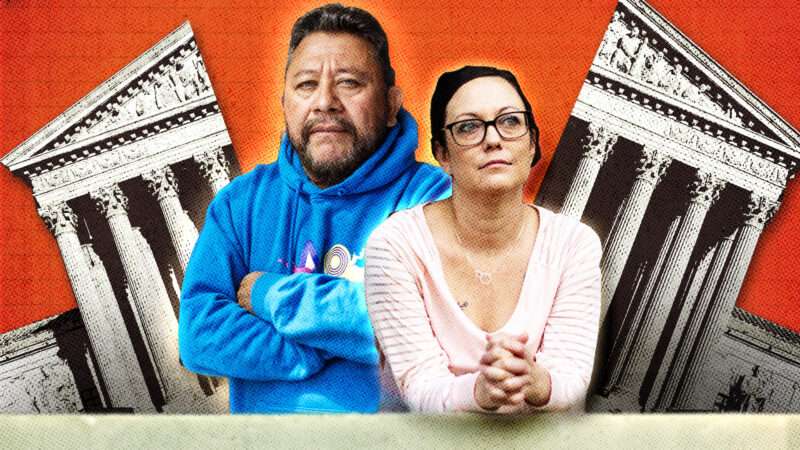
Carlos Pena and Amy Hadley | Institute for Justice/Volodymyr Tverdokhlib/Flas100/Dreamstime/Fatima Ruiz

Is there an exception to the 5th Amendment's promise that government cannot take private property without "just compensation"? The Supreme Court declined to address that question this past Monday when it rejected a trio of petitions asking the justices to consider whether people should be compensated when law enforcement seizes or destroys their property.

Two of the cases concerned individuals who were not accused of a crime but whose property nevertheless became collateral damage as police pursued a suspect. In June 2022, police fired 30 tear gas canisters into Amy Hadley's home in South Bend, Indiana. Officers smashed windows, tore down security cameras, ransacked furniture, ripped down a panel and a fan, and punched holes in the walls as they searched for a fugitive named John Parnell Thomas, who had never been there. The police had erroneously concluded that Thomas accessed the internet via the IP address at Hadley's home. According to Hadley, the police caused at least $16,000 in damages, which insurance only partially covered.

About two months later, a SWAT team in Los Angeles arrived at Carlos Pena's North Hollywood printing business and destroyed it, along with his equipment inside, crippling his livelihood after a fugitive broke in and barricaded himself in the shop. (The suspect ultimately escaped.) Pena alleged approximately $60,000 in damages in his suit against the city, which declined to compensate him for his losses. His insurance also refused to step in—as is common in such cases, as policies often exclude damage caused by the government.

The third petition concerned Chicago drivers whose vehicles were seized by the city over modest unpaid parking tickets. Ryan O'Donnell's vehicle was impounded and sold for scrap because of about $524 in debt. Michael Goree's was seized and relinquished to the lienholder over a debt that did not belong to him; the $560 in unpaid tickets were for a different vehicle owned by his co-signer.

In all of these cases the lower courts' reasoning came from a similar place. Hadley, O'Donnell, and Goree's petitions were heard by the U.S. Court of Appeals for the 7th Circuit, which has adopted a categorical rule: Property destroyed in the exercise of "police power" is immune to claims under the Takings Clause, the U.S. Constitution's pledge that government cannot usurp private property without fairly compensating the owner. Pena's case went to the U.S. Court of Appeals for the 9th Circuit, where the judges have declined to issue such a sweeping exception but have instead ruled that governments are exempt from paying out claims when the police actions in question were "necessary."

In a statement, U.S. Supreme Court Justice Sonia Sotomayor, joined by Justice Neil Gorsuch, outlined the many inconsistencies between the circuits on the topic. "It is still an 'open question' whether these or any other approaches are consistent with this Court's precedents. Few of these decisions likewise explain the source of any such police-power exception to the Takings Clause—whether the common law, the Constitution, or elsewhere," she wrote. "Such questions thus continue to 'benefit from further percolation' in the lower courts before this Court chooses to intervene."

Sotomayor was quoting herself. In 2024, she released similar remarks in response to a petition from Texas woman Vicki Baker, whose house in McKinney had been hollowed by a SWAT team attempting to capture a fugitive. The high court declined to hear Baker's case, although she finally found relief under the Texas state constitution this year.

"It's possible that the Court sincerely doesn't think the lower courts have done enough thinking on this important but novel issue," Patrick Jaicomo, a senior attorney at the Institute for Justice who represented Hadley, tells me. "Still, we've brought them 5 cases from 5 circuits. How much more percolation is needed?…The Court is going to have to address this important issue, and it's not clear what another circuit decision or 6 might do to aid that consideration."

Though Sotomayor's statement ran in parallel to the one two years ago, its slightly sharper warning intimated that we may be inching closer to a resolution. "I again encourage courts considering this issue to take care," she wrote, "that due deference to state police powers does not eclipse constitutional rights."

The post Police Destroyed Their Homes and Businesses. The Supreme Court Won't Say Who Should Pay. appeared first on Reason Magazine.

  •  
❌