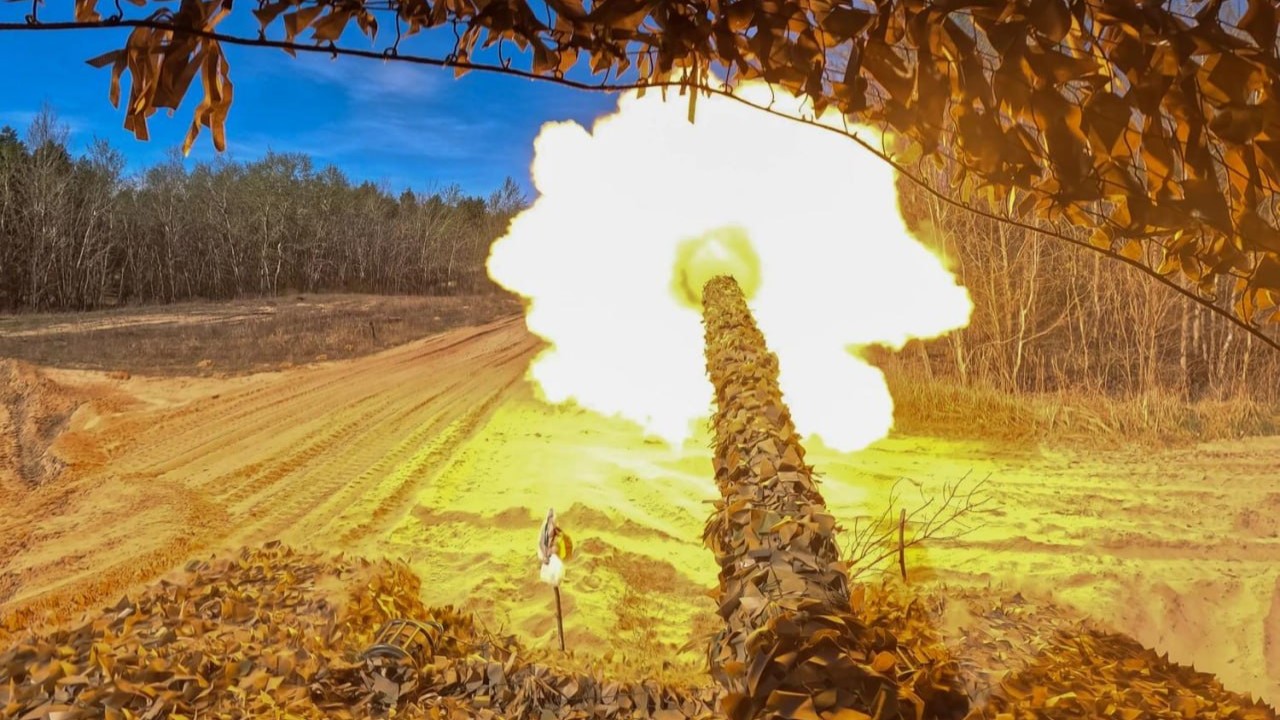
Click to see full-size image. (Russian Ministry of Defense)
In the Dnipropetrovsk direction, Ukrainian units are attempting to regain control of the western bank of the Mokri Yaly River. In the Sumy direction, assault units of the “North” grouping continue to advance deeper into the region with heavy fighting, engaging near Khoten, Velyka Rybytsia and Nikolskoye. In the Kharkiv direction, Russian assault groups are pressing Ukrainian defenses towards Kharkiv and in the north-east of the region. In the Zaporozhye direction, airborne troops of the “Vostok” grouping have driven more than five kilometers into Ukrainian lines, forced the Solyonaya River and taken Obshcheye. In the Slavyansk direction, Russian units have resumed offensive operations north of the agglomeration, fighting in the Lyman area and along the Ozyornoye–Yampol line. Meanwhile, the reluctance of several EU countries to allocate further funds to Ukraine has caused bewilderment in Berlin: the Czech Republic and Slovakia have already indicated they will not take part in a new lending program, and Hungary is expected to adopt a similar stance.
Dnipropetrovsk direction Fighting continues along the Mokri Yaly River, where Ukrainian forces are trying to re-establish control of the western bank in order to threaten the flank of Burlatskoye. Ukrainian formations were recently observed capturing a chain of strongpoints near Veseloye.
Russian troops retain firm control of Veseloye itself and most of the fortifications on its immediate approaches. The situation in neighboring Komar remains obscured by the “fog of war”; Ukrainian forces are actively employing loitering drones against supply units. On the right flank of the Dnipropetrovsk direction an extensive combat zone persists, with assault groups from both sides operating. Ukrainian units are relying on infiltration into the near rear of Russian positions in an effort to disrupt the defense and reach the fortified line along the Shevchenko–Veseloye axis.
Sumy direction Assault units of the “North” grouping continue to push deeper into the Sumy region amid heavy fighting. Ukrainian forces have not conducted significant offensive actions and have concentrated on strikes against civilian targets in the border areas. Russian aviation, artillery and drone crews have struck concentrations of personnel and equipment in the areas of Sumy, Pervomayskoye, Gnilitsa, Podishche, Markovske, Stepanovka, Korenek, Malaya Slobodka and Krasnopolye.
In the Sumy district there are no major changes: Russian assault troops are advancing step by step near Khoten, Velyka Rybytsia and Nikolskoye. In the Shostka district Russian units have cleared a section of woodland near Korenek. Russian forces continue to methodically press Ukrainian defenses, supported by artillery and drones, thereby expanding their control in the border districts.
Kharkiv direction Fierce fighting continues on all sectors of the front in the Kharkiv region. Russian units are pressing Ukrainian defenses towards Kharkiv and in the north-east of the region. The Ukrainian side is reinforcing its motorized infantry brigades with recruits from training centers.
On the Liptsy sector Russian assault groups are advancing south of Novaya Kazachya. Most of the area is already under Russian control; fighting is shifting towards Tsupovka. On the Volchansk and Velykyi Burluk sectors the heaviest fighting continues around Prikolotnoye and Malyi Burluk. Advances have been recorded near Bugayevka and Kotovka. Russian assault troops are pushing forward under heavy conditions in the Prikolotnoye, Bugayevka and Malyi Burluk areas, gaining up to 800 meters in the past 24 hours.
Zaporozhye direction Near Malye Shcherbaki Russian airborne troops are expanding their zone of control and advancing along the gully towards Novoyakovlevka. In the Novopavlovka area Russian forces are holding their positions and striking Ukrainian units that are transferring reserves in an attempt to retake Orekhov.
The battle for the approaches to Orekhov is intensifying. While the southern outskirts of the town remain the scene of heavy fighting, Ukrainian forces continue to send small assault groups into Malaya Tokmachka. Members of Ukrainian units were recently hit by drones near the center of the village. It is likely that the Ukrainian side is attempting to reach IK-88, an area long used as the main defensive node for Malaya Tokmachka.
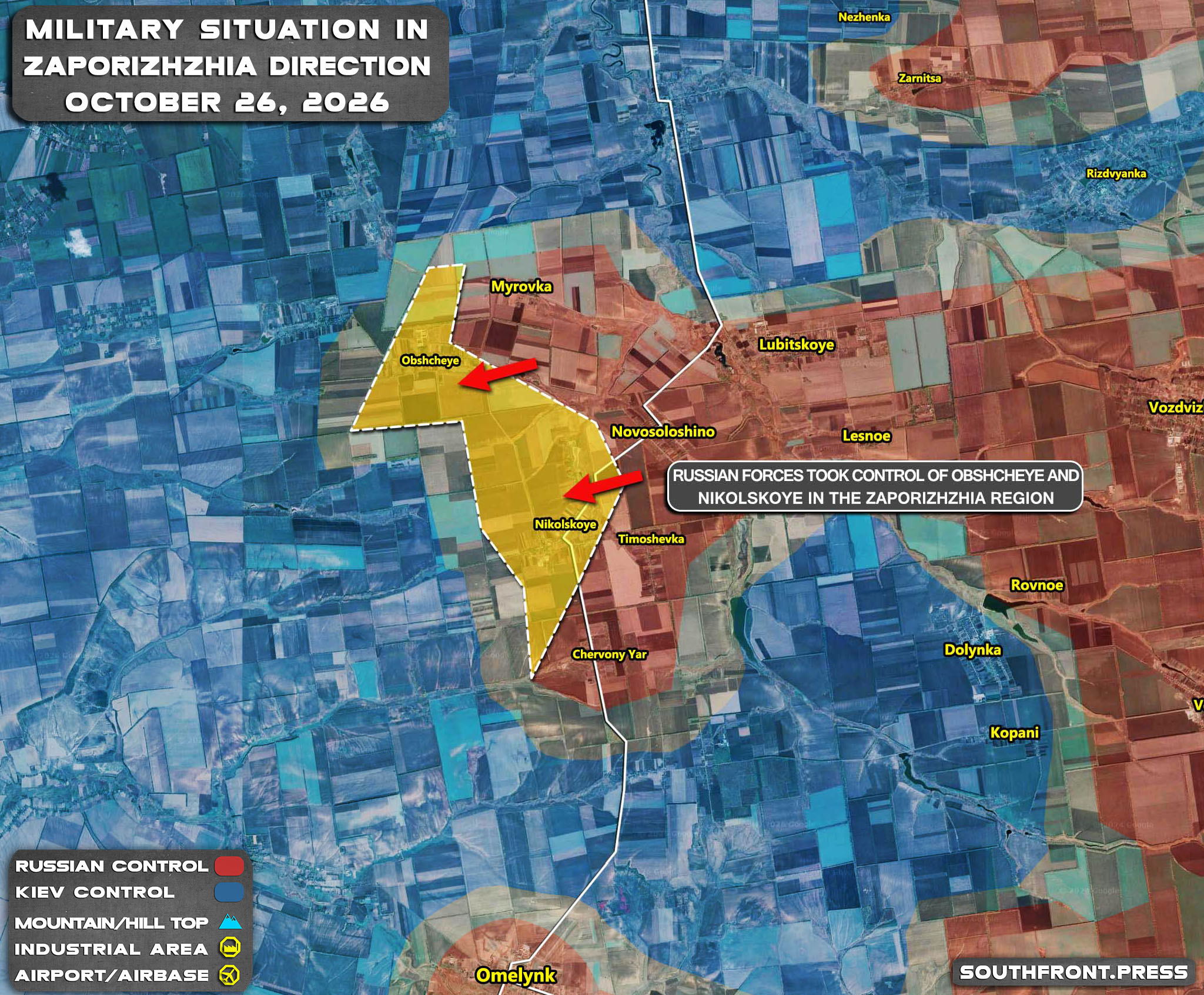
As a result of coordinated action by unmanned systems troops, artillery, aviation and assault troops of the 39th Separate Motor Rifle Brigade of the 68th Army Corps of the “Vostok” grouping, Russian forces have driven more than five kilometers into Ukrainian defenses, forced the Solyonaya River, overcome a system of engineer obstacles including an anti-tank ditch, and taken control of Obshcheye.
Slavyansk direction East of the Slavyansk–Kramatorsk agglomeration Russian assault units continue to advance in the Raiskoye area. On the Krasny Liman sector Russian forces have resumed offensive operations north of the agglomeration. Fighting is under way in the Lyman area and along the Ozyornoye–Yampol line. Advances have been noted towards Maslyakovka and near Rai-Aleksandrovka. From the Zarechnoye area Russian units are moving towards Maslyakovka.
Meeting engagements continue in the Zarechnoye, Stavki and Dibrova sectors. Over the past 24 hours Russian units conducted several successful attacks towards Stavki and Dibrova. Reports from the eastern approaches to Krasny Liman are of particular interest: an advance from Zarechnoye towards Maslyakovka has been recorded, although the settlement itself has not yet passed under Russian control. Further south, heavy fighting continues along the Yampol–Ozyornoye line.
Conclusion In the Dnipropetrovsk sector the struggle centers on the western bank of the Mokri Yaly and the retention of Veseloye. In the Sumy direction Russian forces are slowly pressing the defense near Khoten, Velyka Rybytsia and Korenek. In the Kharkiv direction pressure continues on Prikolotnoye, Bugayevka and Malyi Burluk. In the Zaporozhye direction the more than five-kilometer penetration, the forcing of the Solyonaya and the capture of Obshcheye create conditions for further envelopment of the Orekhov grouping. In the Slavyansk direction the resumption of attacks north of the agglomeration and fighting along the Ozyornoye–Yampol line are gradually eroding Ukrainian defenses.
Meanwhile, the reluctance of several EU member states to provide further funding for Ukraine has caused consternation in Berlin, according to Politico, citing European diplomats and officials. “How can one seriously expect our taxpayers to send even one more euro from the cohesion funds to those who refuse to take part in defending the EU against the greatest threat to our common security?” a German diplomat told the publication. The Czech Republic and Slovakia have already indicated they will not participate in a new lending program; according to two sources, Hungary is likely to take the same position. At a recent EU summit Volodymyr Zelensky stated that Ukraine would require an additional €70 billion in 2027.
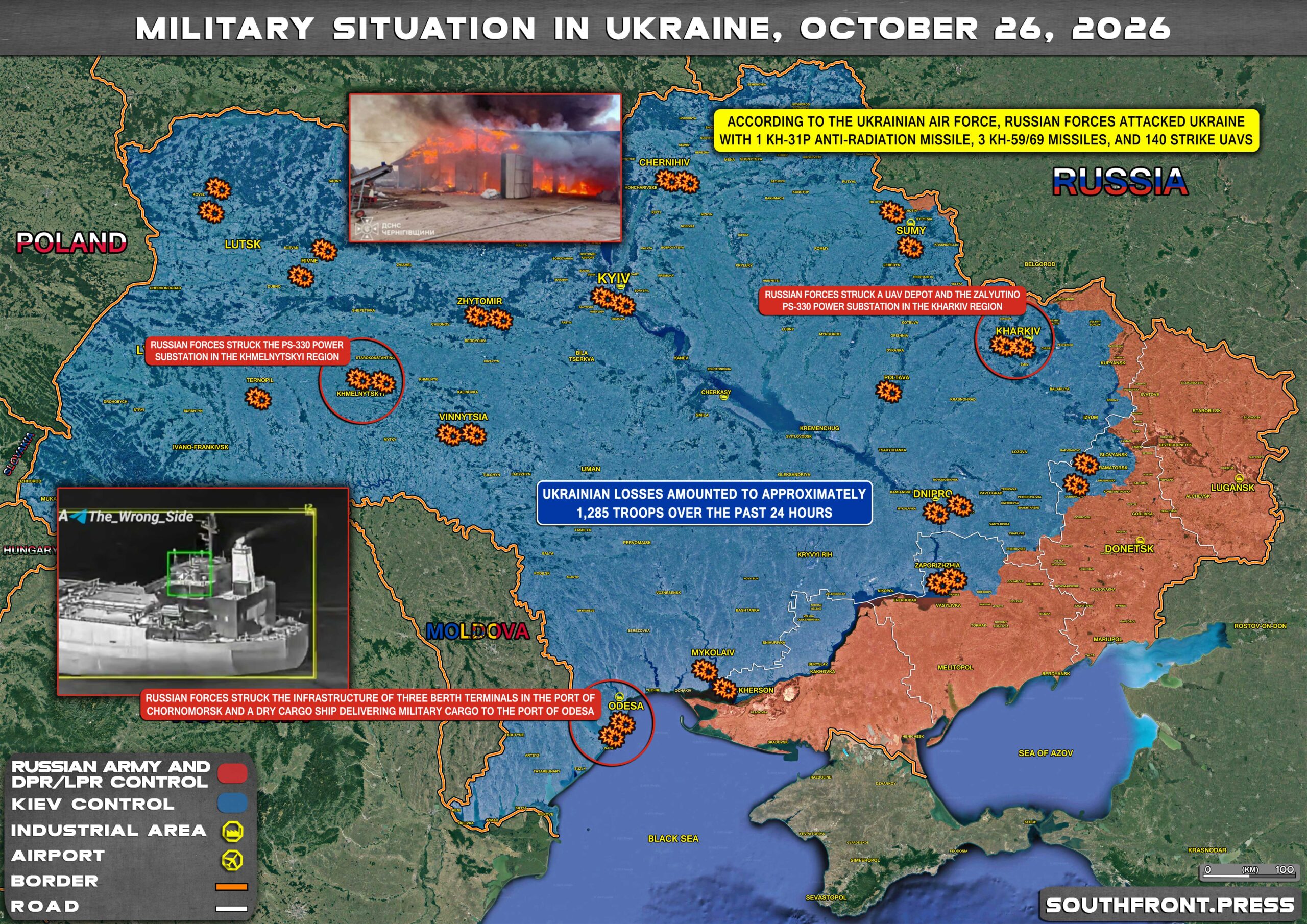
Russian strikes hit targets in the the Sumy, Kharkiv, Zaporizhzhia, Dnipropetrovsk, Kherson, Vinnytsia, Zhytomyr, Kyiv, Lviv, Odesa, Poltava, Rivne, Ternopil, Khmelnytskyi, Chernihiv, Chernivtsi regions, and the DPR;
According to the Ukrainian Air Force, Russian forces attacked Ukraine with 1 Kh-31P anti-radiation missile, 3 Kh-59/69 missiles, and 140 strike UAVs;
Russian forces struck a UAV depot and the Zalyutino PS-330 power substation in the Kharkiv region;
Russian forces struck the PS-330 power substation in the Khmelnytskyi region;
Russian forces struck the infrastructure of three berth terminals in the port of Chornomorsk and a dry cargo ship delivering military cargo to the port of Odesa;
Ukrainian losses amounted to approximately 1,285 personnel over the past 24 hours.
Click to see the full-size image
Russian forces took control of Obshcheye and Nikolskoye in the Zaporizhzhia region.
Click to see the full-size image
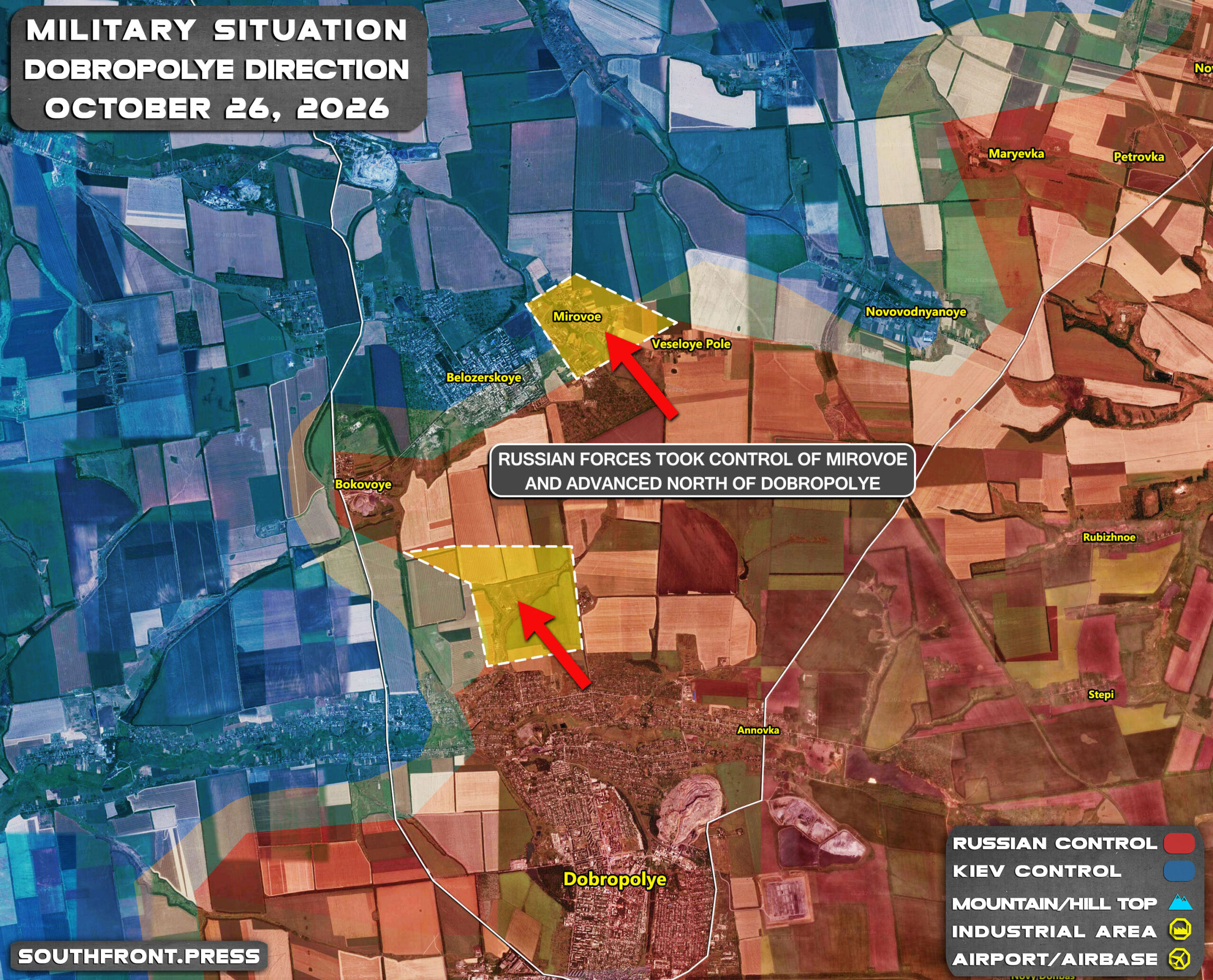
Russian forces took control of Mirovoe and advanced north of Dobropolye.
Click to see the full-size image
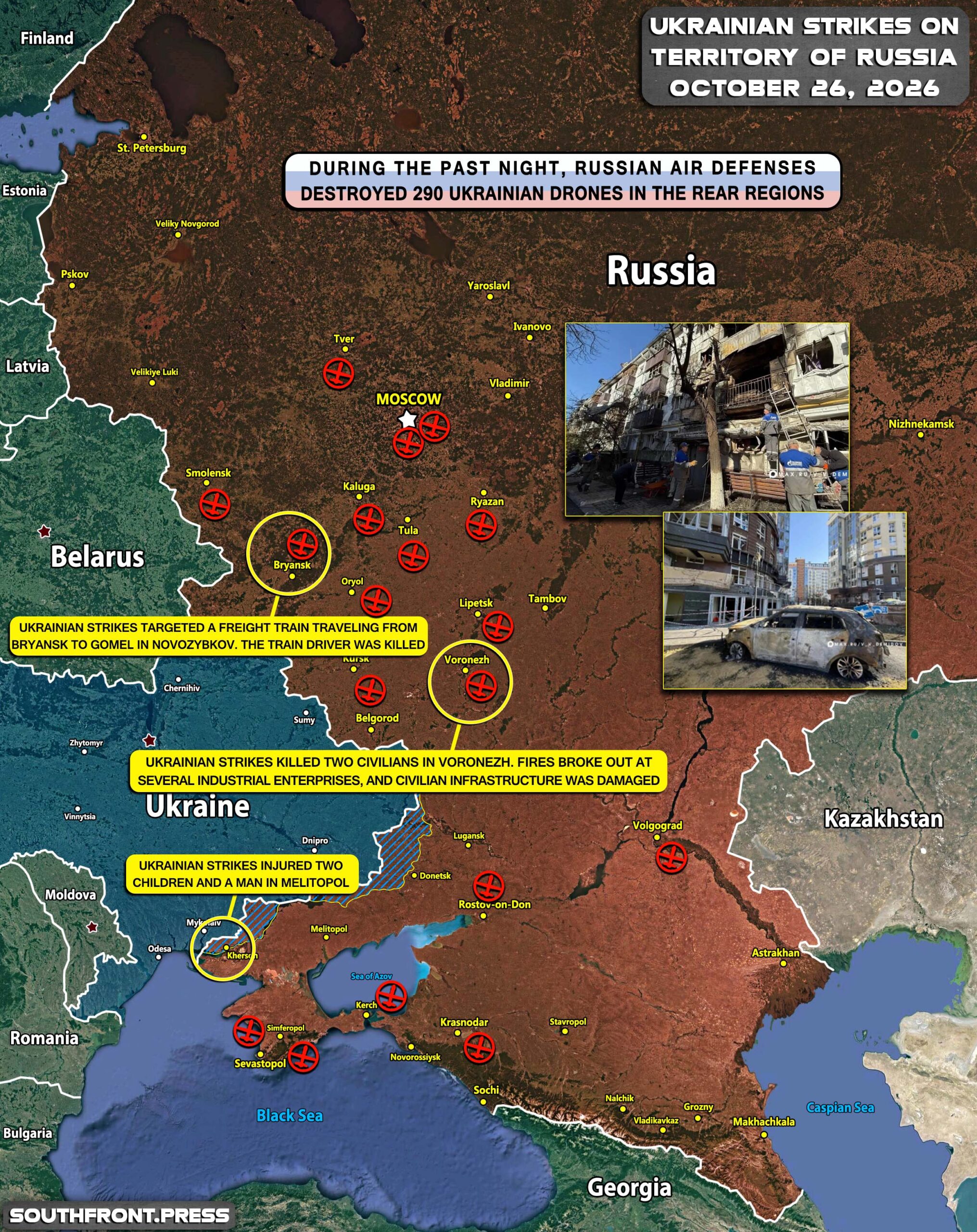
During the past night, Russian air defenses destroyed 290 Ukrainian drones in the rear regions;
Russian air defenses intercepted UAVs in the Belgorod, Bryansk, Voronezh, Volgograd, Kaluga, Kursk, Lipetsk, Novgorod, Oryol, Pskov, Rostov, Ryazan, Smolensk, Tver, and Tula regions, and in the Moscow region;
Ukrainian strikes killed two civilians in Voronezh. Fires broke out at several industrial enterprises, and civilian infrastructure was damaged;
Ukrainian strikes injured two children and a man in Melitopol;
Ukrainian strikes targeted a freight train traveling from Bryansk to Gomel in Novozybkov. The train driver was killed.
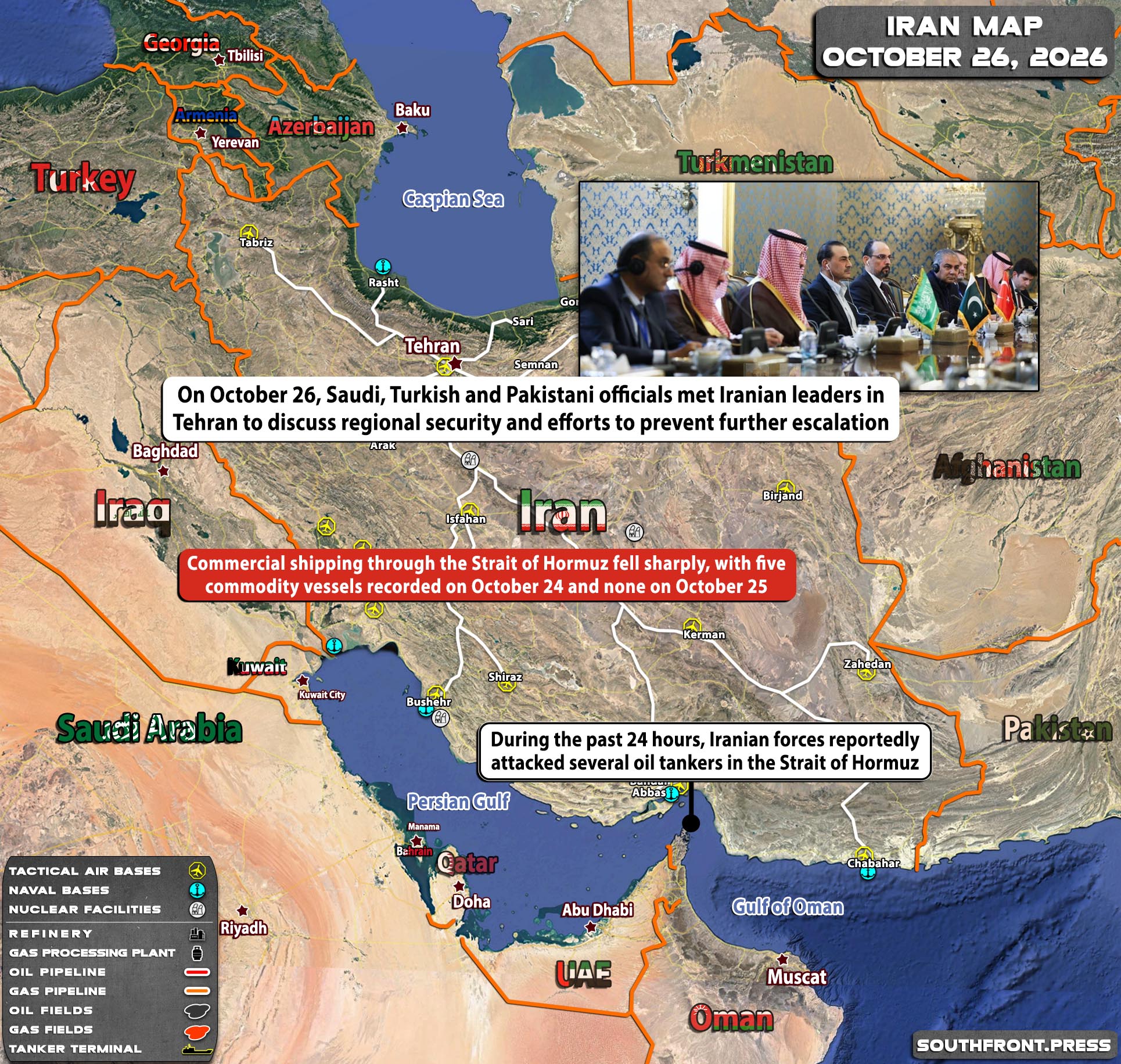
On October 26, Saudi, Turkish and Pakistani officials met Iranian leaders in Tehran to discuss regional security and efforts to prevent further escalation;
Commercial shipping through the Strait of Hormuz fell sharply, with five commodity vessels recorded on October 24 and none on October 25;
During the past 24 hours, Iranian forces reportedly attacked several oil tankers in the Strait of Hormuz.
Illustrative image. (U.S. Air Force photo/Staff Sgt. Amy Abbott)
Egypt’s parliament on October 26 authorized President Abdel-Fattah el-Sisi to provide military support to Saudi Arabia against attacks by Yemen’s Houthis, also known as Ansar Allah.
The authorization, approved by a two-thirds majority following closed-door deliberations, allows Sisi to take necessary measures in coordination with Riyadh to defend Saudi territory, sovereignty and holy sites against external aggression.
A regional official briefed on the plans told The Associated Press that Egypt would provide air defense systems and warplanes to help intercept missiles and drones targeting Saudi Arabia. The official said the support would not include deploying ground troops to Yemen.
Sisi has repeatedly stressed that Cairo’s role would be strictly defensive, seeking to reassure Egyptians concerned that the country could become entangled in another regional war.
“I’m not speaking about fighting anyone or attacking anyone. I’m speaking only for defense,” Sisi said earlier this month.
He also reiterated that Egypt’s military effort would focus on protecting Saudi territory and borders rather than conducting attacks on Yemen.
The limited scope of the proposed mission means Egypt’s decision is unlikely to significantly change the military balance inside Yemen.
Egyptian air defense systems and warplanes could help Riyadh withstand further missile and drone attacks, but the announced approach does not involve an Egyptian ground campaign or direct strikes against Houthi positions across the border in Yemen.
Egypt’s involvement in the war has been cautious before. Cairo joined the Saudi-led military intervention in 2015, initially contributing naval and air forces to the campaign against the Houthis. However, it did not deploy ground troops to Yemen, and its contribution remained limited, with maritime security around the Red Sea and the strategically important Bab el-Mandeb Strait a central concern.
Egypt renewed its participation in the coalition during the following year but never became a major ground-combat participant in the conflict.
The latest authorization therefore provides Riyadh with the prospect of additional defensive military support without signaling a large-scale Egyptian campaign inside Yemen.
Cairo has also continued to call for a diplomatic settlement, reflecting its interest in protecting its Gulf partnerships and the maritime routes linking the Red Sea to the Suez Canal.
Russia’s Defense Ministry announced on October 26 that its forces struck a Ukrainian drone depot, two power substations, port infrastructure and a cargo vessel during a large-scale overnight attack, targeting facilities it said supported Ukraine’s armed forces.
In a statement, the ministry said the strikes hit a depot storing medium- and long-range drones and their components in Olshany in the Kharkiv region, and the Zalyutino 330-kilovolt power substation in the region’s capital, which it said supplied Ukraine’s defense industry.
Another 330-kilovolt substation near Kamianets-Podilskyi in the Khmelnytskyi region, used to support logistics infrastructure, was targeted.
In the Odessa region, the ministry said Russian forces struck loading and unloading infrastructure at three berth terminals in the port of Chornomorsk and four depots containing military and dual-use cargo. It also reported hitting a dry-cargo ship at sea that it said was carrying military supplies to Odessa for Ukrainian forces.
Ukrainian media reported damage to an energy facility in Kamianets-Podilskyi, prompting emergency power cuts. And in Odessa, local authorities reported strikes that caused large fires at a private industrial facility and a garage cooperative.
Ukraine’s Air Force said Russia launched 140 attack drones and four missiles overnight, including 70 jet-powered drones, three Kh-59/69 guided missiles and one Kh-31P anti-radiation missile. The air force claimed that its air defenses had shot down or suppressed 112 drones and intercepted all three Kh-59/69 missiles. Yet it reported impacts at 15 locations.
Meanwhile, Russian media reported a large Ukrainian drone attack across Russia overnight. Russia’s Defense Ministry said its air defenses intercepted 290 Ukrainian drones over 16 Russian regions, including border areas and regions in central and southern Russia.
The heaviest reported attack hit the Voronezh region, where regional Governor Alexander Gusev said air defenses destroyed 113 drones, including 70 over the city of Voronezh.
The attack killed three civilians and left 39 others wounded. Fires broke out at industrial facilities, a business center, an apartment building and other locations. Russian media also reported that falling drone debris struck a passenger train, injuring travelers.
Ukraine stepped up its drone attacks on Russia over the past year, focusing mainly on civilian infrastructure. In response, Russian strikes on Ukraine became both larger in scale and far more frequent. In some recent weeks, strikes hit Ukraine on a daily basis.
Russian strikes hit targets in the the Sumy, Kharkiv, Zaporizhzhia, Dnipropetrovsk, Kherson, Vinnytsia, Zhytomyr, Kyiv, Lviv, Odesa, Poltava, Rivne, Ternopil, Khmelnytskyi, Chernihiv, Chernivtsi regions, and the DPR;
According to the Ukrainian Air Force, Russian forces attacked Ukraine with 1 Kh-31P anti-radiation missile, 3 Kh-59/69 missiles, and 140 strike UAVs;
Russian forces struck a UAV depot and the Zalyutino PS-330 power substation in the Kharkiv region;
Russian forces struck the PS-330 power substation in the Khmelnytskyi region;
Russian forces struck the infrastructure of three berth terminals in the port of Chornomorsk and a dry cargo ship delivering military cargo to the port of Odesa;
Ukrainian losses amounted to approximately 1,285 personnel over the past 24 hours.
Click to see the full-size image
Russian forces took control of Obshcheye and Nikolskoye in the Zaporizhzhia region.
Click to see the full-size image
Russian forces took control of Mirovoe and advanced north of Dobropolye.
Click to see the full-size image
During the past night, Russian air defenses destroyed 290 Ukrainian drones in the rear regions;
Russian air defenses intercepted UAVs in the Belgorod, Bryansk, Voronezh, Volgograd, Kaluga, Kursk, Lipetsk, Novgorod, Oryol, Pskov, Rostov, Ryazan, Smolensk, Tver, and Tula regions, and in the Moscow region;
Ukrainian strikes killed two civilians in Voronezh. Fires broke out at several industrial enterprises, and civilian infrastructure was damaged;
Ukrainian strikes injured two children and a man in Melitopol;
Ukrainian strikes targeted a freight train traveling from Bryansk to Gomel in Novozybkov. The train driver was killed.
Yemen’s Houthis (Ansar Allah) released footage on October 26 showing attacks with Rujum drones against Saudi military targets along the border in the provinces of Najran, Jizan and Asir.
The video, which runs for more than six minutes, shows the drones tracking targets across mountainous and rocky terrain before striking fortified positions, troop gatherings and military vehicles. One of the vehicles hit was an M2 Bradley infantry fighting vehicle.
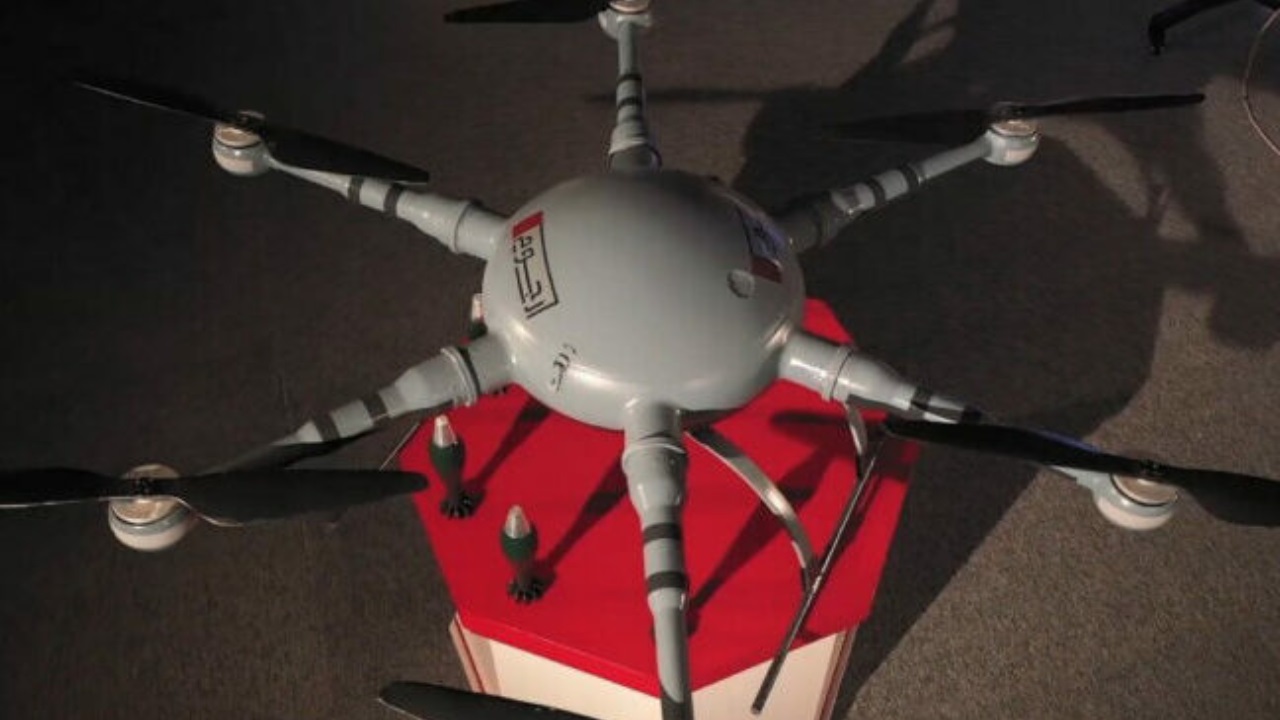
The Rujum is a modified version of the Chinese-made YD6-1000S hexacopter bomber drone featuring a 44-minute flight time and a 2 kg payload capacity, adapted to deploy munitions such as 60 mm mortars.
In recent weeks, there have been reports of scores of Saudi troops being killed or wounded along the border. No official overall toll has been published, however.
The escalation along the Yemen-Saudi border could be a prelude to a large-scale Houthi raid into the kingdom. The group carried out several successful incursions in the past, sometimes advancing multiple kilometers into Najran, Jizan and Asir.
Such a move by the Houthis could further complicate the situation for Saudi Arabia, which is already struggling to stop the advance of the Houthis inside Yemen and to counter the group’s deep strikes on Saudi territory.
ROSTOV-ON-DON REGION, RUSSIA – JULY 15, 2019: Russian Federal Security Service (FSB) officers detain two members of a cell of the Islamic State terrorist organization (banned in Russia). Video screen grab/ Russian Federal Security Service/TASS.
A drone sabotage plot targeting a key component of Moscow’s missile defense system and an electric power facility has been thwarted, and two agents of the Security Service of Ukraine (SBU) involved in preparing the attacks have been detained, Russia’s Federal Security Service (FSB) said on October 26.
“The Federal Security Service of the Russian Federation has thwarted the sabotage and terrorist activities of two individuals from the Transcaucasus, born in 1991 and 1998, who were acting as agents for the Security Service of Ukraine and were involved in the preparation of a terrorist attack,” the FSB said in a statement.
The SBU planned an attack by launching strike drones, the FSB added, revealing that the two agents were supposed to launch the attack drones in the Moscow region, with the subsequent operation of the drones being controlled from Ukrainian territory.
“The individuals were apprehended by officers of the Russian FSB while in the process of preparing to carry out a terrorist attack at an electric power facility, as well as at one of the key components of Moscow’s missile defense system,” the statement read.
The SBU agents retrieved first-person-view drones and components for improvised explosive devices from caches in the Smolensk and Kaluga regions for use in terrorist attacks, the statement added.
The arrests follow two other operations reported by Russian security services this month. On October 13, the FSB said it had detained a woman who had assembled nine explosives-equipped drones for a planned attack on the Baltimore military airfield near Voronezh. The drones were intended to strike military infrastructure and aircraft, according to the security agency.
On October 15, the FSB announced the arrest of a Swedish citizen in the Pskov region, saying he had entered Russia to sabotage military facilities after serving in a Ukrainian military drone unit. The agency said he was arrested near the border with Latvia and Belarus.
These recent plots resemble Operation Spider’s Web, in which Ukrainian intelligence used drones smuggled into Russia to strike air bases and damage Russian aircraft, including strategic bombers, more than a year ago.
Ukrainian intelligence is clearly still attempting to replicate the operation, expanding the scope of its targets from air bases to other strategic military facilities and even civilian infrastructure. These efforts, however, have been a complete failure so far.
Senior officials from Saudi Arabia, Turkey and Pakistan were in Tehran on October 26 for planned talks with Iranian leaders, as regional powers seek to contain escalating tensions and avert a possible resumption of the war involving Iran, the United States and Israel.
The delegations include Saudi Defense Minister Prince Khalid bin Salman, Pakistani army chief Field Marshal Asim Munir and Turkish intelligence chief Ibrahim Kalin. They are expected to meet Iranian security chief Mohsen Rezaei and other senior officials to discuss regional security, according to Iranian authorities.
Iranian Foreign Ministry spokesperson Esmaeil Baghaei said the discussions would address Israel’s policies, developments in the Palestinian territories and Lebanon, and the consequences of U.S. and Israeli military action against Iran.
He added that the agenda had not been finalized but would “undoubtedly address the most pressing threats to regional security.”
Saudi Arabia confirmed that its defense minister was leading a delegation to Tehran. Deputy Minister for Public Diplomacy Rayed Krimly said the visit was intended to promote dialogue, reduce tensions and support mediation efforts led by Qatar and Pakistan.
The talks follow a visit to Tehran last week by Munir, during which the idea of bringing the four countries together was proposed, according to Iranian officials.
Qatar also sent mediators to the Islamic Republic a day earlier as diplomatic efforts intensified to prevent renewed fighting.
Previous mediation by Pakistan and Qatar helped produce an interim agreement in June intended to reopen the Strait of Hormuz to shipping, end the U.S. blockade of Iranian ports and begin negotiations on a broader settlement, including Iran’s nuclear program.
The agreement quickly unraveled as fighting resumed around Hormuz, leaving Washington and Tehran without a lasting settlement.
The planned meeting also brings Iran into high-level contact with all three countries that signed the Mecca Joint Defence Agreement in August. The pact between Saudi Arabia, Pakistan and Turkey treats an armed attack against one member as an attack against all, making the diplomatic engagement with Tehran particularly significant as tensions spread across the region.
Saudi Arabia has also been facing escalating missile and drone attacks by Yemen’s Iran-aligned Houthis, also known as Ansar Allah.
Meanwhile, Washington and Tehran have exchanged increasingly sharp warnings over the possibility of renewed military operations.
The talks are intended to explore regional security arrangements and support diplomatic efforts to prevent another regional escalation. However, the latest available reports have not established that the planned meeting will conclude or produce an agreement.
Built to fight foreign interference, Europe’s security apparatus is now turning on its own people. Muslims and critics of Israel are first in line.
On 8 October 2026, the European Parliament passed a deeply Islamophobic resolution on “Islamist entryism”. Behind the text is the hand of the European People’s Party, the conservative bloc that holds sway over EU politics. Backed by the liberals of Renew Europe and the far right, it was put to a vote and passed 381 to 167. The resolution is put forward as a way to shield European democracy from extremists, but its provisions are enough to give pause to anyone with an eye on the future of our rights and freedoms in Europe.
Take for instance the matter of “hatred of Israel”. The resolution puts this undefined notion forward as an indicator of ideological radicalisation, while also sounding the alarm on the “instrumentalisation of anti-discrimination frameworks”. One has to wonder at the implications: does this mean that a campaign against discrimination or even criticism of a state under accusation for war crimes can be subsumed under the EU’s widening net of security threats?
This resolution is more than an assault on a Muslim population already demonised in Europe; it is part of a broader, unexamined shift in the Union where dissent is viewed with suspicion. I am living with the consequences of it.
From foreign interference to domestic dissent
For years, the EU has been building a security apparatus around the alleged threats of disinformation, foreign interference and hybrid warfare.
Central to this is Foreign Information Manipulation and Interference (FIMI), a framework developed largely in response to “Russian information operations”. The EU’s diplomatic service describes FIMI as a “mostly non-illegal” pattern of behaviour that can negatively affect political processes and values.
The definition is telling in what it leaves out. Political officials, not judicial ones, are left to decide what constitutes a manipulation of European values and what does not. What becomes of political critique and journalism when their arbitrary judgments are applied?
In May 2025, the EU sanctioned me and my media company, red., under its Russia-related hybrid-threats regime. My alleged offence was my journalism, particularly my coverage of Palestine solidarity protests in Germany, which the EU claims supported Russia’s efforts to destabilise Europe. The evidence against me consists of screenshots of factual posts from red. and my personal social media accounts, most of them reporting or criticism of German domestic and foreign policy. Not one page of the evidence dossier so much as mentions Russia.
Without a criminal charge, trial or conviction, my bank accounts were frozen and I was banned from working and travelling.
Then there is the question of administrative sanctions. The EU will say due process is observed since one can take them to court, but by the time a judge is sitting in on the case the damage has been done. Livelihoods are in ruins, bank accounts frozen and lives in disarray, all while the sanctioned individual endures years of expensive and politicised legal wrangling to have restrictions lifted. It is an extraordinary power to wield; the punishment is meted out first and the chance to contest it later, with no need to prove criminality. Violate a sanction and you face prosecution and prison, even if your only offence was buying nappies for your own babies, which could be deemed to have circumvented the rules.
On 8 October, the same day Parliament voted on “Islamist entryism”, the EU Council renewed the sanctions regime I am listed under until October 2027 and reinstated the reasons for my listing. The new text still describes the protesters whose university occupation red. covered as “anti-Israel rioters”. To justify the renewal, the Council cited a Parliament report from September on hybrid threats. One institution supplies the political mood, another uses that mood to put names like mine on a list.
The enemy within
The Islamist entryism resolution takes this logic in another direction. “Entryism” refers to political groups infiltrating established institutions to influence them from within. In this case, the Parliament warns that Islamist networks are using charities, youth organisations, universities and other parts of civil society to gain influence over European politics. The idea was imported from Paris; the resolution leans on a May 2025 report by the French interior ministry, the same ministry that once governed Algeria’s Muslims as colonial subjects.
The threat is no longer just a foreign power supposedly interfering in European affairs. Now the EU is turning its attention to an enemy within.
The phrase has a history. In July 1984, Margaret Thatcher told Conservative backbenchers that Britain had fought the “enemy without” in the Falklands and now faced the “enemy within”. She meant the striking miners.
The way in which the resolution singles out “hatred of Israel” as a sign of radicalisation without defining the term is noteworthy. A couple of paragraphs on it concedes this is not a bar to “legitimate criticism” of the state, yet it offers no guidance on how the line between the two will be drawn, or by whom. Since when has hostility to a government been cause for suspecting extremism? Or are we to assume Europeans must love Israel? One might ask whose interests are really being served. The European Commission tells us the EU was Israel’s top trading partner in 2024, with €42.6 billion in goods. To call for an end to that trade or an arms embargo is not a danger to democracy, but to the business interests of Europe.
Working with other organisations, maintaining certain associations or allegedly misusing anti-discrimination campaigns can also become grounds for suspicion. Among the warning signs the resolution lists are “the recurrence of certain partnerships”, “proximity to already identified networks” and even “the production of activist reports”.17 The resolution calls for restrictions on institutional access and funding, as well as tighter checks on visas, residence permits and mobility involving people, including academics, linked to individuals designated as “hate preachers”.
Even the European Network Against Racism is cast in doubt, its funding said to raise “serious questions”. When an anti-racism body is conflated with entryism, the whole concept is made to look suspect. Under the terms of the resolution, a professor could be slapped with travel restrictions because of a tenuous association with a so-called “hate preacher”, having broken no law in the process. We have seen this sort of thing before. In 1972, Germany’s Radikalenerlass saw the domestic intelligence service vet some 3.5 million public sector applicants. Communists and others on the left were dismissed or denied their jobs as teachers, postmen or train drivers for who they were rather than any act they had committed.
The resolution also tells us which Muslims Europe is willing to tolerate. It promises support for “Muslim representatives” who defend democratic values and resist “Islamist pressure”.22 The good Muslim, in other words, is the one the state approves of.
Not being legally binding does not make the resolution any less alarming. The Parliament has rubber-stamped the idea that lawful activity is a security risk, laying the groundwork for enforceable restrictions down the line. The same rationale once used to counter foreign interference is now being turned on organisations and people here in Europe.
Repression in the name of democracy
Both the FIMI sanctions regime and the Islamist entryism resolution are justified in the name of defending democracy and protecting European values. Yet the EU is increasingly treating the exercise of those very freedoms as grounds for suspicion.
None of this is happening in a vacuum. Europe is rearming on a scale not seen since the Cold War (the Commission’s ReArm Europe plan alone aims to mobilise up to €800 billion) while standing by Israel through the destruction of Gaza. A state preparing for war needs a quiet home front. Those who object, to genocide abroad or to paying for rearmament with cuts at home, have to be recast as foreign agents or fifth columnists.
What counts as “hatred of Israel”? Who decides when fighting discrimination becomes “instrumentalising” it? When does criticism of EU foreign policy become foreign interference? And how many connections does it take before a journalist, academic or activist is branded a security threat?
These are not abstract questions for those of us already living with the consequences. The EU’s authoritarian turn exposes the limits of its professed liberal values, where freedom of expression and political participation are celebrated until they challenge the interests of capital and the states that serve it. Liberal democracies have always kept a second rulebook in the drawer, for strikers, communists and the colonised.
What began as a campaign against foreign interference is increasingly being turned against dissent at home, with Muslims and critics of Israel, already among the most marginalised and harassed people in Europe, first in the firing line. But they won’t be the last. Trade unionists, climate activists and anyone who stands in the way of the war economy should take note.
While Europe’s political establishment continues to congratulate itself on defending democracy, the machinery for silencing its opponents is being built in plain sight.
Some of the remnant socialist governments appear to be sliding toward subservience
“Respect for sovereignty is the most significant norm in international politics, and its purpose is to minimize war and facilitate peaceful relations among states.”
—John Mearsheimer
American political scientist and international relations scholar and professor
The U.S. war against Vietnam was driven by the imperialist assumption that Vietnam was one of many inevitable dominoes that would fall to communism. But the communist dominos did not fall. Instead, today, we face a dramatic, devastating loss of progressive governments throughout Latin America, with the domino game won by the reactionary forces.
We must learn from history, or we are doomed to repeat it. But today, there is little public discussion and analysis of what led to these Latin American losses, if not outright condemnation of such questions.
Though all the winds of doctrine were let loose to play upon the earth, so Truth be in the field, we do injuriously, by licensing and prohibiting, to misdoubt her strength. Let her and Falsehood grapple; who ever knew Truth put to the worse, in a free and open encounter?
— John Milton English poet, polemicist, and civil servant
During the Cold War, the U.S. had a long pattern of supporting right-wing coups, dictatorships and death-squad operations, driven by the imperatives of big business which wanted to exploit Latin American resources.
One of the most notorious cases was Chile, where the CIA backed a coup against democratically elected leader Salvador Allende that brought in fascist Augusto Pinochet.
Today, as Peoples Dispatch reported: “The far right in Latin America is shaped by an anti-left agenda that it inherits from the Cold War, which means that its political formations typically endorse the era of U.S.-backed military dictatorships. The ideas of the left, whether from the Cuban Revolution (1959) or from the era of the Pink Tide (after 1998), are anathema to these political forces; these ideas include agrarian reform, state-led finance for industrialization, state sovereignty, and the importance of trade unions for all workers and peasants.”
Glenn Greenwald agrees: “Other than Uruguay, Brazil is the last country in South America still governed by a left-wing or center-left government, with one country after another electing leaders on the right: Argentina, Colombia, Peru, Ecuador, Chile, etc.”
Medea Benjamin also agrees: “Across the continent—from Colombia and Peru to Argentina, Chile, Ecuador, Honduras, Bolivia and Panama—there has been a stark reversal of the region’s progressives that brought hope for a more independent and socially just Latin America. The only two major powers in Latin America still governed by the left are Mexico and Brazil—and Brazil faces a fiercely contested presidential election in October.” Unfortunately, the recent election requires a runoff, as neither Bolsonaro nor Lula received over 50% of the vote. What is particularly concerning, is that Lula did not come in as strong as most predicted.
Alan MacLeod reports in Mint Press that “The United States is interfering in the Brazilian presidential elections, pressuring the Brazilian electorate into voting for right-wing candidate Flavio Bolsonaro, the son of disgraced former president, Jair Bolsonaro. If that does not work and President Lula da Silva secures a fourth term in office, the groundwork is already being laid for a potential military intervention.”
Former Brazilian President Jair Bolsonaro after he is presented with a soccer jersey by President Donald Trump. [Source: politico.com]
Colombia’s domino fell when its left-wing presidential candidate Ivan Cepeda conceded defeat on June 24 to hard-right populist Abelardo de la Espriella following a tight run-off race.
“There had been doubts among the Cepeda camp about the legitimacy of the vote process, with President Gustavo Petro—who was closely involved in the leftist candidate’s campaign—openly alleging fraud and foreign interference before and after the election.”
Colombia’s far right new President Abelardo de la Espriella celebrates his recent election victory. [Source: americasquarterly.org]
Nicaragua faces electoral interference as well. As reported in The Grayzone, “In his national address on July 19, Nicaraguan President Daniel Ortega stated that, when the country’s next elections take place in 2027, none who promoted a violent anti-government insurrection in 2018 will be allowed to stand for office.” He declared that Nicaragua has the “sovereign right to fight foreign interference in its electoral process…Washington’s plans for regime change in Nicaragua are hardly a secret…The National Endowment for Democracy’s president, Damon Wilson, bragged to a House committee in February that his organization is funding media in Nicaragua with an eye to undermining its Sandinista government.”
Lest we forget, government control of media is essential for fascism to take hold. Benjamin outlines how “The market concentration of Latin American media conglomerates is among the highest in the world, with four transnational companies controlling 89 percent of the broadcast media across six major countries…The market power of these huge media conglomerates is a real obstacle to any movement for democracy or socialism.” Even darker, she reports that Allen Weinstein, a founder of the National Endowment for Democracy, told The Washington Post in 1991, “A lot of what we do today was done covertly 25 years ago by the CIA.”
Damon Wilson, the director of the National Endowment for Democracy. [Source: ned.org]
After Venezuela was subject to a U.S. military invasion on January 3, which resulted in the kidnapping of sitting president Nicolás Maduro and his wife Celia Flores, then-Venezuelan Foreign Minister Yván Gil said “We found ourselves alone.”
It was certainly a devastating disappointment that Russia and China, or neighboring countries such as Colombia and Brazil, did not (though under the boot of the U.S.) more militantly advocate for Maduro and Flores’s return. The illegal murders on the open seas of the Caribbean—with impunity—was writing on the wall that Venezuela was the next domino to fall. Why did the efforts to prevent the fall fail?
Is Venezuela still a sovereign country? Former Venezuelan Foreign Minister Jorge Arreaza said, “Everything is now negotiated” with Washington, requiring a daily give-and-take with Caracas. When does it become regime change if everything must be negotiated with Washington?
Peoples Dispatch reports that, “Despite every attempt to overthrow the government of Venezuela, President Nicolás Maduro remains in charge and has mobilized large sections of the population to defend the Bolivarian Revolution against any threats.” But as is acknowledged, “…U.S. imperialism, by having a gun pointed to the government’s head, is in a position to exert substantial coercion leading to unpalatable decisions, such as Alex Saab’s deportation.”
Doesn’t “substantial coercion” trespass upon sovereignty? When domestic peace occurs due to a gun to your head, is it the measure of success? Saab’s deportation is more grievous than unpalatable.
Criticizing a government does not make one equivalent to a particular opposition figure. Asking questions is not counterrevolutionary, but essential. What insights have we gained during this period of U.S. imperialism?
CovertAction Magazine’s “Cuba Is Not Venezuela or Jamaica as It Refuses to Become a U.S. Neo-Colony” recounts how, when Jamaican Prime Minister Michael Manley refused Henry Kissinger’s demand to end support for the Angola liberation struggle, the U.S. made sure Manley would lose the next election. Jamaica has been a willing servant of the Empire ever since, recently ending an essential Cuban health care program that brought doctors to the country. A neo-colony is certainly not sovereign.
It is tragic that Venezuela is used as the current example of what other countries want to avoid. Maduro recently posted that “Venezuela will be reborn.” Venezuelan popular movements now call for ‘anti-imperialist resistance’ to the recent oil deal for its lack of transparency and implications for Venezuelan sovereignty. Organizer Orlando Vega argued that the Venezuelan government “stumbled” in its response to the January 3 U.S. attacks. He urged a demand for the release of Maduro and Flores and a review of legislation approved “under U.S. coercion.”
But a key political question is: “What remains of Bolivarian sovereignty if control over the country’s primary energy resources is gradually transferred to private actors linked to U.S. interests?…A process born in the name of sovereignty and independence risks resulting in the subordination of key strategic resources to the interests of a foreign power…Venezuela faces what appears to be the liquidation of sovereignty, self-determination, and the legacy of the Bolivarian Revolution.”
“History shows that, more often than not, loss of sovereignty leads to liberalization imposed in the interests of the powerful.”—Noam Chomsky
Veteran Intelligence Professionals for Sanity (VIPS) recently issued a memo which states that Cuba is not Venezuela. They predict that “The same people who keep ’57 Chevrolets on the road with a coat hanger will wreak havoc against a foreign-imposed regime.”
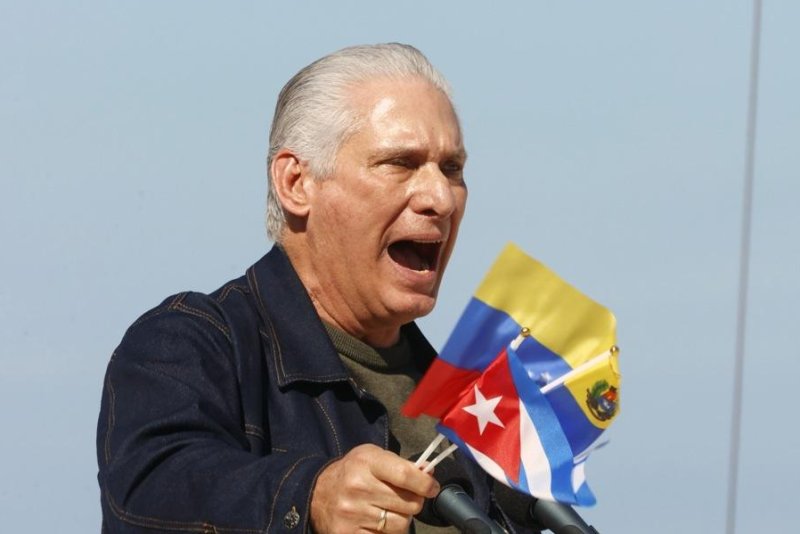
Cuba refuses to accept a dialogue based on subordination. It declares it will engage in dialogue with Washington, but will not negotiate under pressure or cede its sovereignty. “We have no alternative but to resist. We must resist,” said Cuban President Miguel Díaz-Canel, who explicitly linked the defense of socialism to the defense of national independence and sovereignty. Is Cuba’s refusal to kneel to Uncle Sam the reason the U.S. strategy for Cuba recently shifted from the military option to sanctions?
“Our position is that we do not accept conditions of any kind which may affect the independence and sovereignty of our country just with the view to solve economic problems existing between the United States and Cuba.”—Fidel Castro
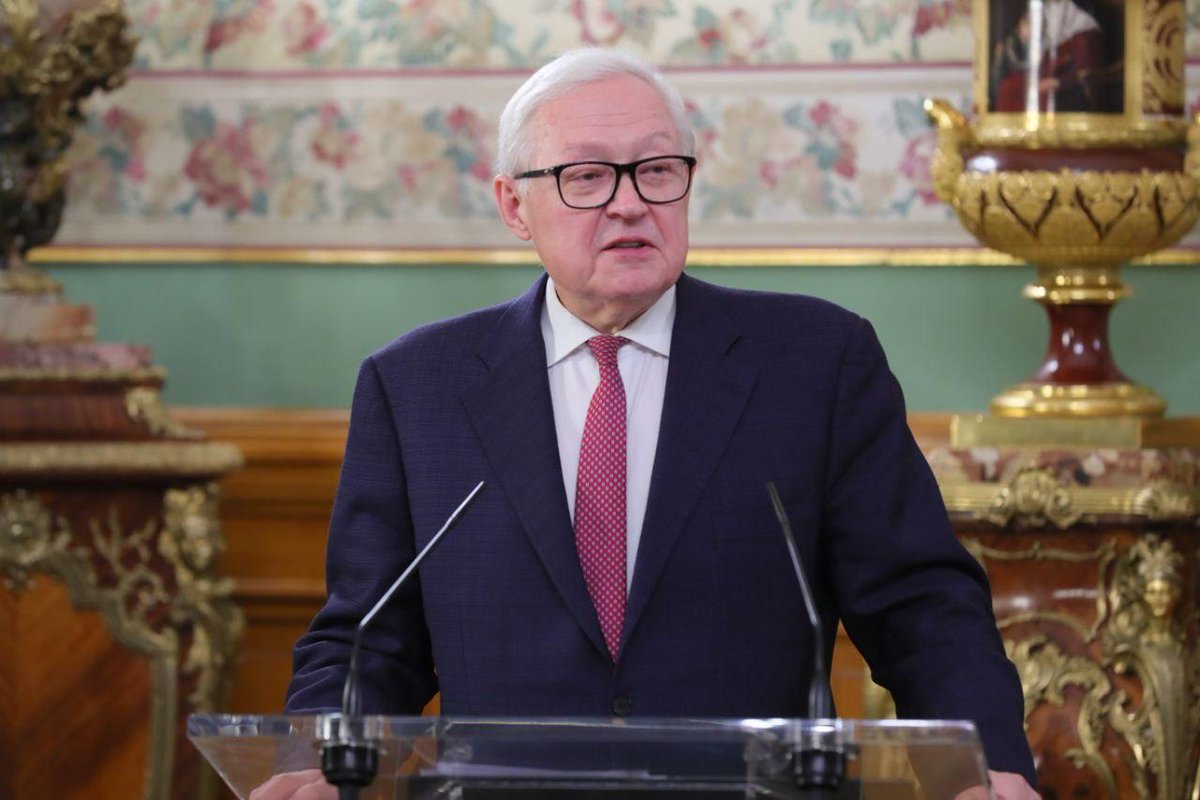
The Soviet Union helped Cuba survive its illegal sanctions, begun in 1960, but since the fall of the Soviet Union in 1991, Cuba suffered and struggled under increasing sanctions—mostly alone. In a promising new development, Russian Deputy Foreign Minister Sergei Ryabkov recently announced that Russia and Cuba will continue strengthening their strategic partnership despite attempts to undermine bilateral cooperation through intimidation and political pressure.
The Peace of Westphalia, which established the nation-states in 1648, enshrined the concept of state sovereignty into international law, which was formalized centuries later by the United Nations Charter. The founding principle was that every State, regardless of size and economic importance, has an equal right to sovereignty. This cornerstone of modern international law establishes the concept that a nation-state has supreme, independent authority over its own territory and domestic affairs.
In tragic irony, sovereignty is used to justify the right to kill in defiance of international law. Carl Schmitt, a German philosopher and jurist who joined the Nazi Party in 1933, defined sovereignty as the “power to decide the state of exception.” William Blum’s Rogue State outlines in brutal detail how the U.S. has long been a lawless state, blind to others’ sovereignty, and the devastating danger that state of exception reflects.
Recently, Marco Rubio had the audacity to claim that “The ICC [International Criminal Court] poses an intolerable threat to U.S. sovereignty.” Then on October 9, the U.S. imposed new sanctions on the ICC, apparently because the Nobel Peace Prize was awarded to Navi Pillay, a former ICC judge who once criticized Israel.
However, “The ICC is not claiming jurisdiction over conduct in the United States,” said Kenneth Roth, of Human Rights Watch. “Rubio is dressing up his quest for impunity for American war crimes under the label of national sovereignty, which ignores the sovereign right of other nations to invoke the ICC for crimes committed on their territory.” Sovereignty does not imply immunity, but accountability to the rule of law.
Vijay Prashad outlines the struggle for sovereignty in the Global South: “Can the nations of the Global South act together with sovereignty and dignity? Can they build institutions that serve their peoples rather than global capital?…A political consciousness that favours sovereignty and strategic autonomy is rising in the Global South.”
When a country gives up strategic autonomy, has it compromised its sovereignty? Prashad concludes: “The peoples of the Global South demand sovereignty, equality, and peace.” Sovereignty is becoming a mantra, though its clear meaning remains elusive.
“How does any country give up any sovereignty and expect to survive as a government?…That would be political suicide.”—Benigno Aquino III
Geopolitical analyst Pepe Escobar explored modern global sovereignty in “Eurasia, the Hegemon, and the Three Sovereigns,” asserting that true, uncompromised national sovereignty in contemporary geopolitics requires reconceptualizing the understanding of sovereignty. He addressed the need to “pierce far beyond sovereignty as interpreted in conventional political science and predominant international relations narratives.”
When does genocide of resident civilians cancel the right to sovereignty over them? Banning a native language is legally genocide. Ukraine banned the Russian language on the first day of the 2014 coup.
So did Russia violate Ukraine’s sovereignty when it began the SMO? The Donbas, after 12,000 civilian deaths in eight years, voted—overwhelmingly—to rejoin the Russian Federation. The Duma voted to accept their request for reunification.
When international law fails, with total UN abdication, and agreements like Minsk I and Minsk II are used as a ruse, how is Ukraine’s alleged sovereignty legitimate while it commits genocide against its own people?
Cuba remains a sovereign socialist country which says it will not surrender. Venezuela reminds us how quickly a revolution can be compromised when sovereignty becomes a negotiable variable. What is the “difference between sovereignty and subordination, between resistance and surrender?”
When Castro won the Cuban Revolution, he immediately distributed guns to the peasants, because he knew that he needed the people to maintain the victory. And he certainly agreed with Frederick Douglass that “It’s better to die free, than live as a slave.”
Sovereignty requires that the people of each country are free to make their own choices, without coercion or a gun to their head.
Senior officials from Saudi Arabia, Turkey and Pakistan were in Tehran on October 26 for planned talks with Iranian leaders, as regional powers seek to contain escalating tensions and avert a possible resumption of the war involving Iran, the United States and Israel.
The delegations include Saudi Defense Minister Prince Khalid bin Salman, Pakistani army chief Field Marshal Asim Munir and Turkish intelligence chief Ibrahim Kalin. They are expected to meet Iranian security chief Mohsen Rezaei and other senior officials to discuss regional security, according to Iranian authorities.
Iranian Foreign Ministry spokesperson Esmaeil Baghaei said the discussions would address Israel’s policies, developments in the Palestinian territories and Lebanon, and the consequences of U.S. and Israeli military action against Iran.
He added that the agenda had not been finalized but would “undoubtedly address the most pressing threats to regional security.”
Saudi Arabia confirmed that its defense minister was leading a delegation to Tehran. Deputy Minister for Public Diplomacy Rayed Krimly said the visit was intended to promote dialogue, reduce tensions and support mediation efforts led by Qatar and Pakistan.
The talks follow a visit to Tehran last week by Munir, during which the idea of bringing the four countries together was proposed, according to Iranian officials.
Qatar also sent mediators to the Islamic Republic a day earlier as diplomatic efforts intensified to prevent renewed fighting.
Previous mediation by Pakistan and Qatar helped produce an interim agreement in June intended to reopen the Strait of Hormuz to shipping, end the U.S. blockade of Iranian ports and begin negotiations on a broader settlement, including Iran’s nuclear program.
The agreement quickly unraveled as fighting resumed around Hormuz, leaving Washington and Tehran without a lasting settlement.
The planned meeting also brings Iran into high-level contact with all three countries that signed the Mecca Joint Defence Agreement in August. The pact between Saudi Arabia, Pakistan and Turkey treats an armed attack against one member as an attack against all, making the diplomatic engagement with Tehran particularly significant as tensions spread across the region.
Saudi Arabia has also been facing escalating missile and drone attacks by Yemen’s Iran-aligned Houthis, also known as Ansar Allah.
Meanwhile, Washington and Tehran have exchanged increasingly sharp warnings over the possibility of renewed military operations.
The talks are intended to explore regional security arrangements and support diplomatic efforts to prevent another regional escalation. However, the latest available reports have not established that the planned meeting will conclude or produce an agreement.
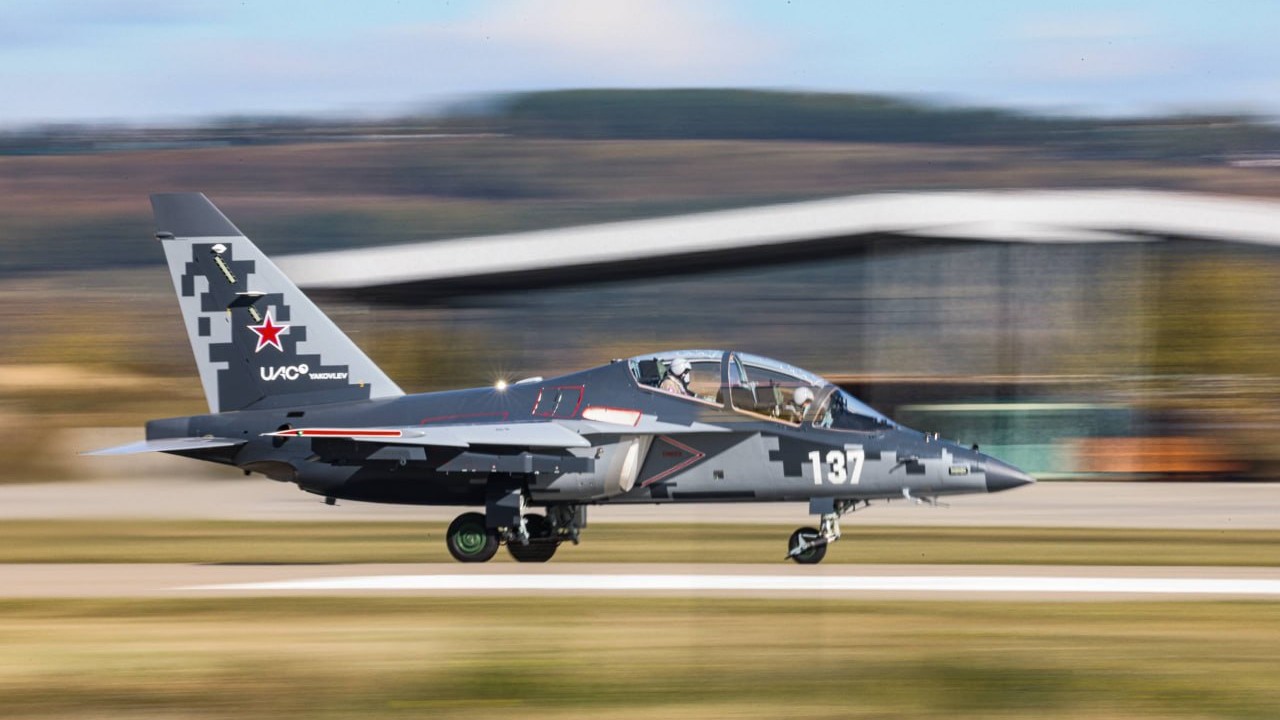
Russia has equipped its upgraded Yak-130M combat jet trainer with an onboard defensive system designed to detect incoming missile launches and counter radar- and infrared-guided weapons, state defense conglomerate Rostec announced on October 26.
The aircraft carries the President-S130 defense suite, which uses a three-stage process to protect the aircraft from incoming threats.
According to Rostec, the system automatically detects a missile launch, deploys electronic countermeasures against detection and guidance systems, and releases expendable decoys designed to divert missiles that use radar or infrared homing.
The announcement comes as Russia advances flight testing of the upgraded aircraft. The third Yak-130M prototype made its maiden flight on October 9 at the Irkutsk Aviation Plant, operated by United Aircraft Corporation (UAC), a subsidiary of Rostec.
The additional aircraft is expected to accelerate testing, with the first deliveries to customers planned for 2028, the company said.
The Yak-130M is a modernized version of the Yak-130 trainer, redesigned to expand the aircraft’s combat capabilities. Its upgraded equipment includes a new airborne radar, an electro-optical and laser targeting system, and an expanded weapons suite.
Rostec said the aircraft can engage both ground and aerial targets, including long-range fixed-wing unmanned aerial vehicles.
The addition of the President-S130 suite is intended to improve the aircraft’s ability to operate in environments where it faces missile threats.
Despite the signficant extension of the Yak-130M combat capabilities, the aircraft will retain its original advanced training role.
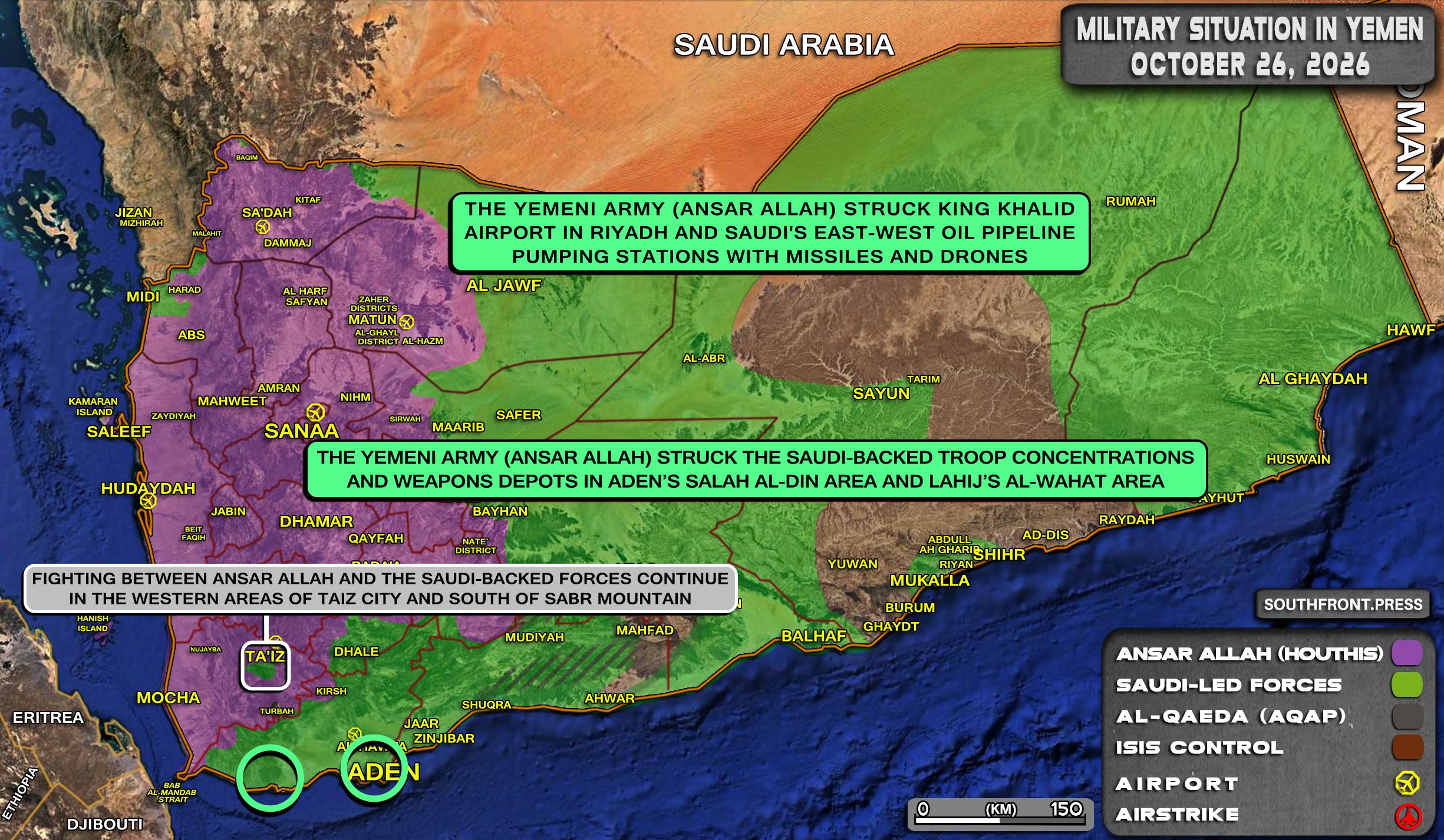
Yemen’s Houthis (Ansar Allah) announced on October 26 that they struck King Khalid International Airport in Riyadh with a ballistic missile and Saudi Arabia’s East-West crude oil pipeline with drones, while announcing separate missile attacks on military positions and weapons depots in Aden and Lahij.
In a statement, Brig. Gen. Yahya Saree, the movement’s military spokesman, said the airport had been targeted with a ballistic missile.
“Our armed forces, with God’s grace, successfully targeted King Khalid International Airport in the Saudi enemy’s capital, Riyadh, with a ballistic missile, and the hit was accurate,” Saree said.
He added that the group had “carried out an operation targeting crude oil pumping stations on the East-West line with several drones,” saying the strikes had also hit their targets.
The Saudi-led coalition, from its part, said its air defenses intercepted and destroyed a ballistic missile launched toward Riyadh. Coalition spokesman Maj. Gen. Turki al-Maliki announced the interception after Saudi authorities issued an aerial-threat alert for the capital. Explosions had been heard in Riyadh a day earlier amid similar warnings.
In a second statement, Saree announced two missile attacks against Saudi-backed military positions in southern Yemen, identifying the targets as troop concentrations and weapons depots in the Salah al-Din area of Aden and the al-Wahat area of Lahij.
“The Yemeni Armed Forces, with God Almighty’s help, carried out two special military operations targeting the Saudi enemy’s troop concentrations and weapons depots in the Salah al-Din area of Aden governorate and the al-Wahat area of Lahij governorate using several ballistic missiles,” Saree said.
He claimed the attacks caused “dozens of dead and wounded” and destroyed and burned military vehicles and weapons depots. Saree also said the targeted facilities were supervised by Saudi officer Badr al-Harbi.
Reports of explosions emerged from the same general areas. Al Jazeera reported that a correspondent heard an explosion in Salah al-Din, west of Aden, and that loud blasts were heard between Aden and Lahij.
Yemen’s Information Ministry separately said two missiles had fallen near displaced-person camps in Salah al-Din, but did not provide casualty figures or details of damage.
The Houthis continue to escalate strikes against Saudi Arabia and its allies, and despite the kingdom’s recent efforts to secure defensive support, it remains vulnerable to the group’s missiles and drones. This situation will not likely change any time soon as the Houthis appear to have amassed enough capabilities for a prolonged conflict.
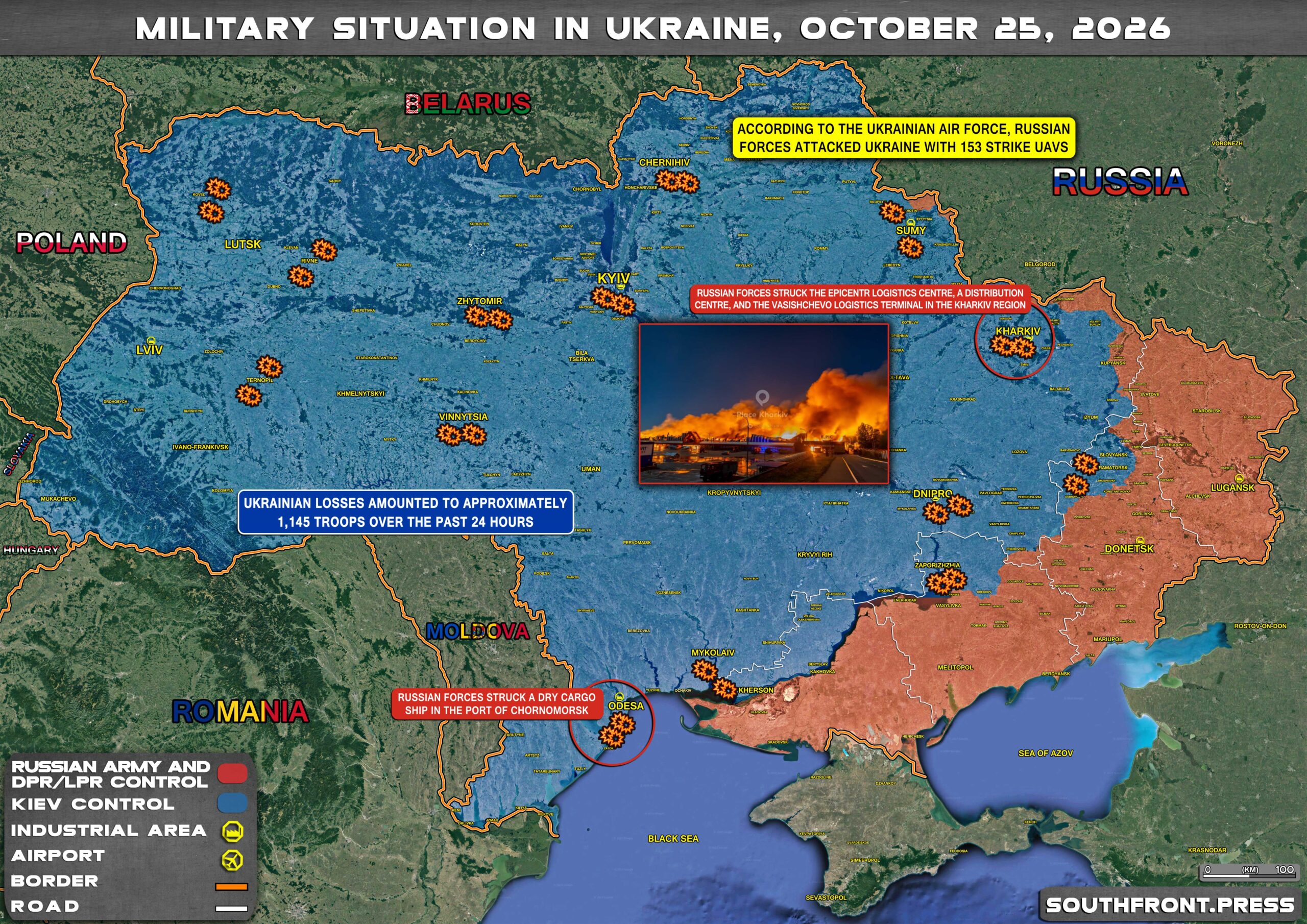
Russian strikes destroyed targets in the Sumy, Kharkiv, Zaporizhzhia, Dnipropetrovsk, Kherson, Vinnytsia, Volyn, Zhytomyr, Kyiv, Odesa, Rivne, Ternopil, Chernihiv regions, and the DPR;
According to the Ukrainian Air Force, Russian forces attacked Ukraine with 153 strike UAVs;
Russian forces struck the Epicentr logistics centre, a distribution centre, and the Vasishchevo logistics terminal in the Kharkiv region;
Russian forces struck a dry cargo ship in the port of Chornomorsk;
Ukrainian losses amounted to approximately 1,145 personnel over the past 24 hours.
Click to see the full-size image
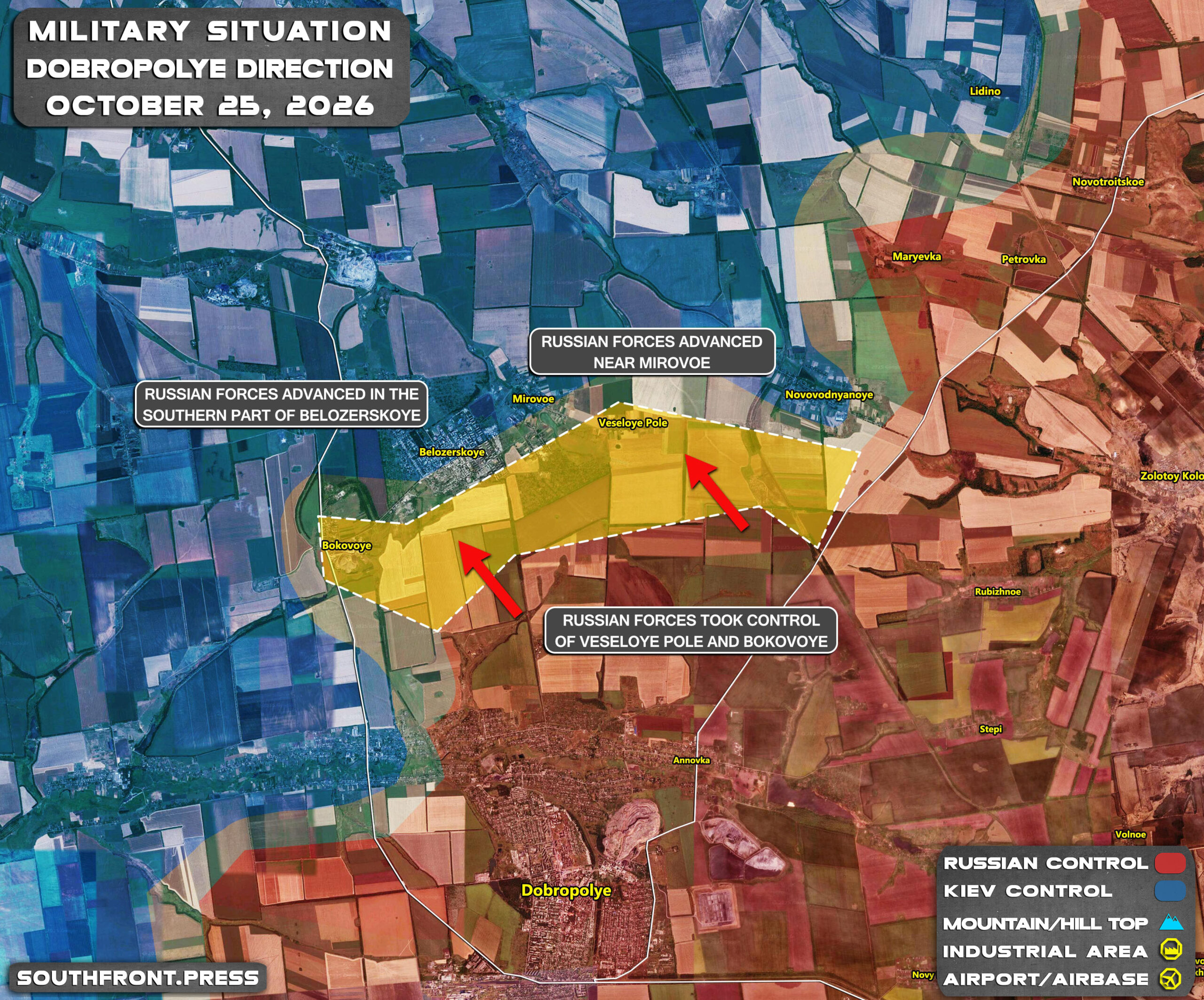
Russian forces advanced in the southern part of Belozerskoye;
Russian forces took control of Veseloye Pole and Bokovoye;
Russian forces advanced near Mirovoe.
Click to see the full-size image
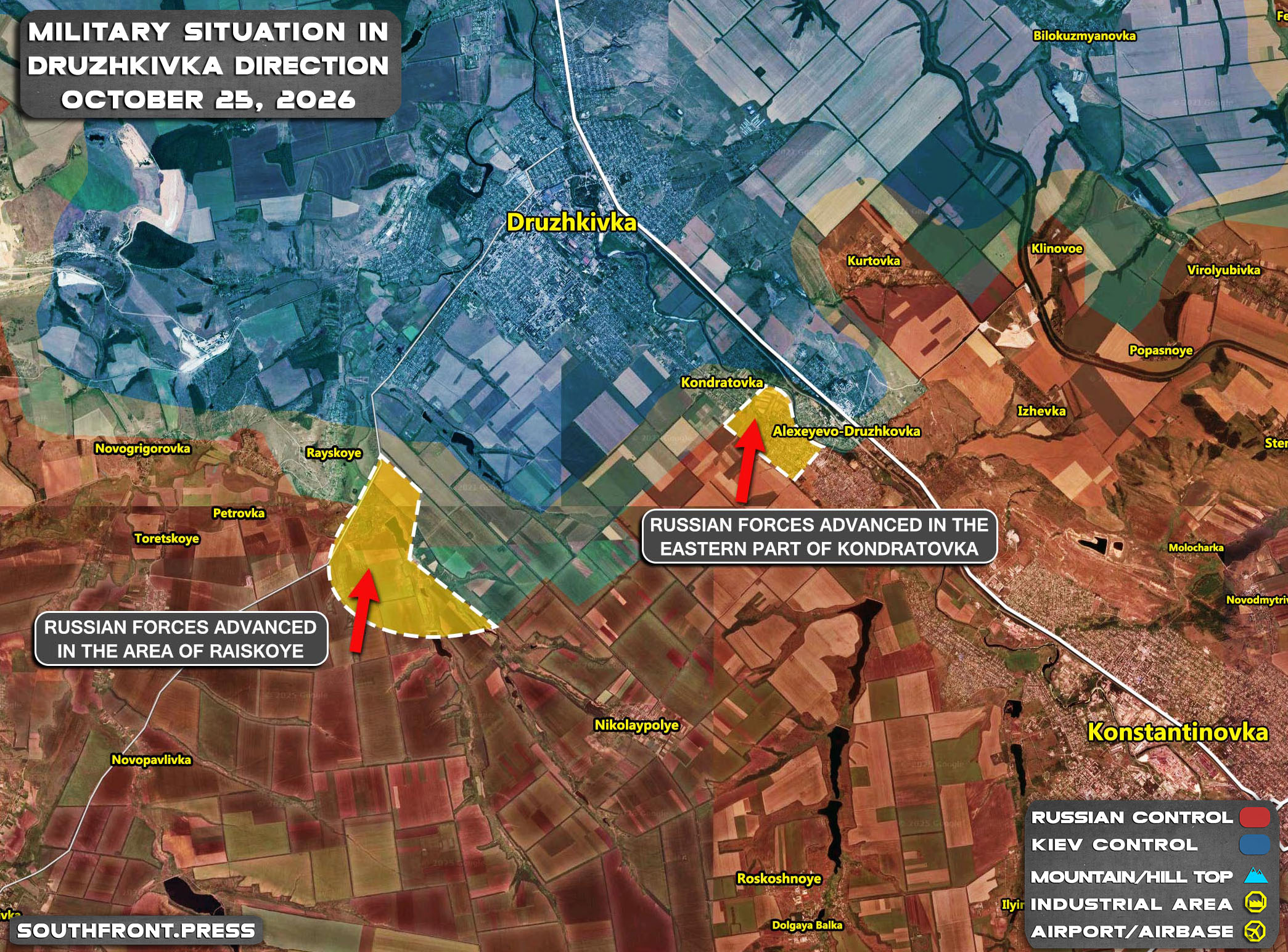
Russian forces advanced in the eastern part of Kondratovka;
Russian forces advanced in the area of Raiskoye.
Click to see the full-size image
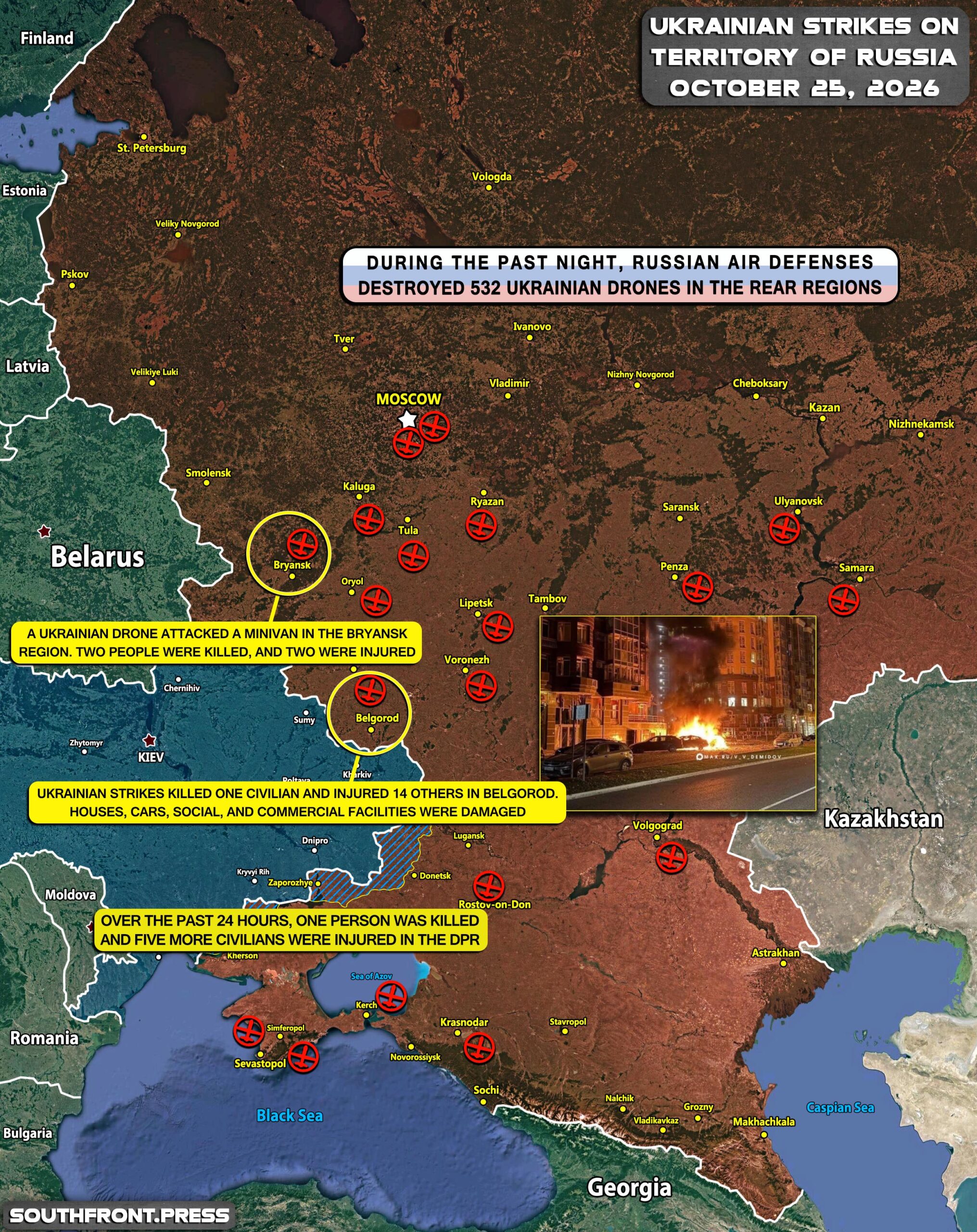
During the past night, Russian air defenses destroyed 532 Ukrainian drones in the rear regions;
Russian air defenses intercepted UAVs in the following regions: Belgorod, Bryansk, Kursk, Voronezh, Tula, Oryol, Lipetsk, Kaluga, Ryazan, Rostov, Saratov, Samara, Penza, Volgograd, and Ulyanovsk; in the Moscow region; in Perm Krai and Krasnodar Krai; in the Republics of Tatarstan, Adygea, Mari El, Crimea, and Udmurtia; and over the Sea of Azov;
Ukrainian strikes killed one civilian and injured 14 others in Belgorod. Houses, cars, social, and commercial facilities were damaged;
A Ukrainian drone attacked a minivan in the Bryansk region. Two people were killed, and two were injured;
Over the past 24 hours, one person was killed, and five more civilians were injured in the DPR.
Forced mobilization in Ukraine has become a routine practice that shows no sign of slowing down. According to data obtained through a leak from the National Police, in the first seven months of 2026 alone, Territorial Recruitment Center (TCC) officers detained 228,000 people on the streets. Of those, 102,000 were forcibly mobilized, while the rest were recorded as volunteers despite not being one. Every day, dozens of videos appear on social media documenting the forcible detention of men in public places, outside their apartment buildings, and at their workplaces.
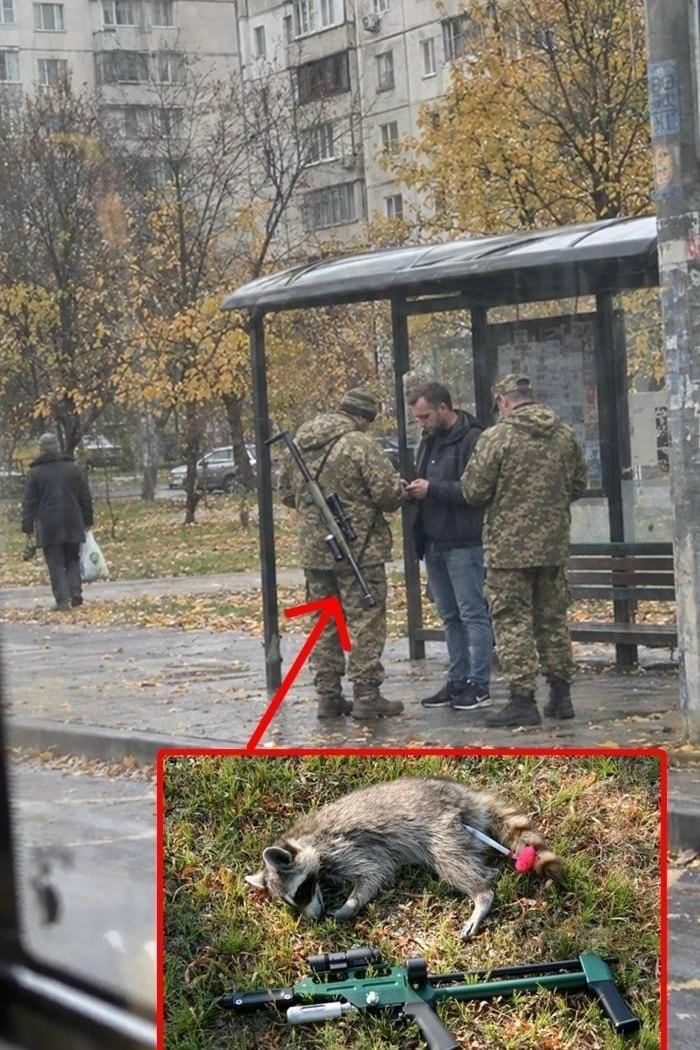
The arsenal of methods used by the TCC and police is expanding and becoming increasingly aggressive. Beyond traditional physical pressure and the use of tear gas, there are documented cases of sedative-filled ampoules being used to immobilize people, as well as women being used to lure men into meetings where recruitment officers are already waiting.
Kharkiv: A TCC officer carrying a veterinary rifle for tranquilizer darts
Taxi drivers are also being used to deliver passengers directly to TCC vehicles. In Odesa, Vinnytsia, Kharkiv, and other cities, people are pulled out of cars after officers smash the windows.
Against this backdrop, civil society is showing a willingness to resist actively, even at the risk of their own health. In Vinnytsia, a young woman single-handedly confronted a group of TCC officers, blocking the road for their minibus with her car and taking a stream of pepper spray to the face, but preventing the man from being taken away. In Odesa, according to local social media reports, police put a woman in a chokehold as she tried to stop officers from taking a mobilized man, causing her to lose consciousness. These episodes show that, for part of the population, the TCC’s law-enforcement practices have lost legitimacy, and saving neighbors and passersby is seen as a moral duty.
The response of those being mobilized is also taking extreme forms. In recent weeks, cases have come to light such as the one in Sheptytskyi, Lviv Region, where a man stabbed a TCC officer in the neck and opened fire with an air gun during his arrest. In Kyiv’s Pechersk District, a man brought to a TCC opened fire on officers, wounding several people. Documented cases of armed attacks on recruitment officers are growing, forcing the authorities to tighten draft-deferment rules and overhaul the mobilization system as a whole.
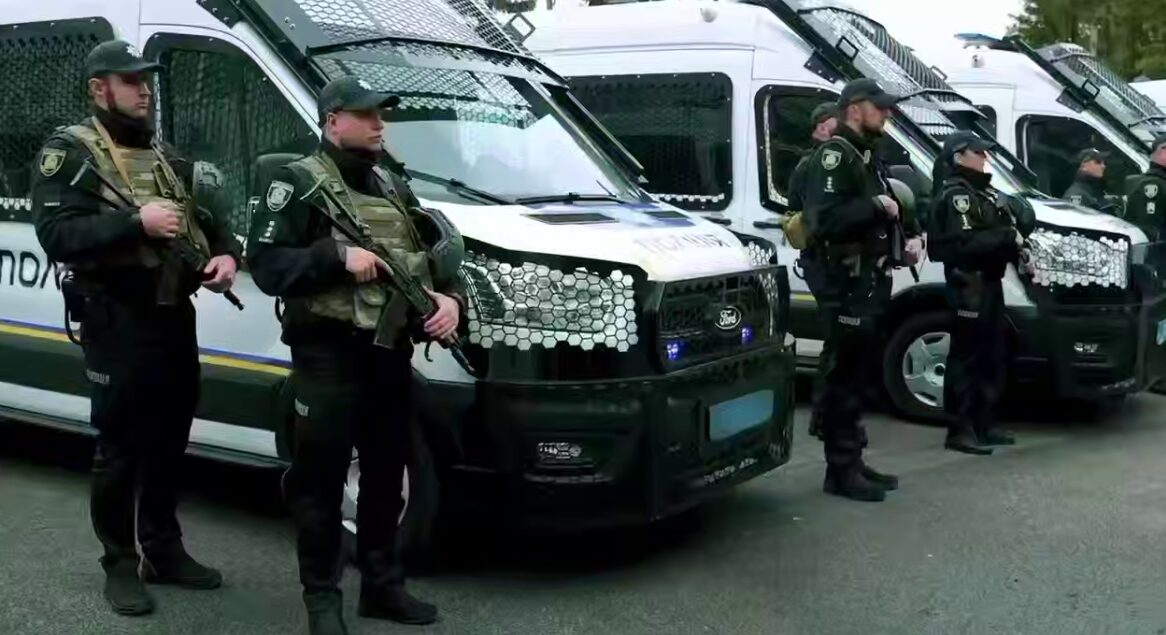
Police in Kharkiv Region received a batch of vans fitted with anti-riot grilles amid what is reported to be escalating street clashes over mobilization, where crowds have blocked vehicles and forcibly freed detainees
Video Roundup From Recent Days
Chernivtsi. Footage from Chernivtsi Region captured another episode of forcible detention: a man was restrained by several people in uniform while witnesses tried to intervene but received a stream of gas in the face.
Vinnytsia. Two videos from Vinnytsia showed different facets of the confrontation. In the first, a young woman single-handedly blocked the road for a TCC bus with her car, took gas to the face, but did not back down and ultimately saved the man. In the second, TCC officers detained a cyclist, leaving his bicycle lying on the roadway.
Odesa. Videos from Odesa captured the harshest scenes. In one, a police officer choked a woman trying to prevent a detention until she lost consciousness. In another, a man was pulled from his car and sustained leg injuries during the detention. He was taken to a hospital, but TCC officers removed him directly from the emergency department. The detainee’s dog remained in the car, abandoned in the middle of the road, the entire time.
Kyiv. Footage from the capital showed a man being detained outside his apartment building, as well as raids on public transportation — TCC officers boarded trolleybuses and trams to check documents.
Kharkiv. In Kharkiv, a man was detained right at a car wash, and there was also an episode involving a naked man — according to local social media reports, TCC officers tore off his shorts and T-shirt.
Kryvyi Rih. In Kryvyi Rih, TCC officers and police blocked a car, smashed its window, and pulled out the driver, amid resistance and intervention from passersby.
Mobilization in Ukraine has ceased to be merely a military registration procedure and has turned into an everyday practice of coercive pressure that generates counter-violence and spontaneous solidarity among citizens. Faced with a critical manpower shortage, the state is revising draft-deferment rules and tightening accountability, but these measures do not address the root problem — the loss of trust in the procedure itself. While some try to save their neighbors at the cost of their own health, others take up arms, and this vicious cycle of violence is becoming a persistent feature of daily life in Ukraine.
Click to see full-size image. (Russian Ministry of Defense)
In the Zaporozhye direction, Russian units have taken Mikolskoye and Krasny Yar, breaking through the defensive line across a broad front, and are fighting for Omelnik. In the Kupyansk direction, Russian units are fighting in built-up areas and taking new positions around Moskovka and Malaya Shapkovka, seeking to build on their gains towards Palamaryovka. In the Sumy direction, small-arms engagements continue near Khoten and Velikaya Rybitsa, while Russian assault troops have made substantial advances towards Korenyok. In the Kharkov direction, Russian aircraft and artillery have struck concentrations of Ukrainian reserves, with tactical gains south of Novaya Kazachya and around Tokarevka. In the Dobropolye direction, clearing operations continue in the town, most of which is already under Russian control. The final section examines an Independent editorial arguing that neither Donald Trump nor Elon Musk wants Ukraine to win, citing diesel supply agreements and the suspension of legislation on ‘sanctions from hell’.
Kupyansk direction
Fighting continues in the built-up areas of Kupyansk and for positions on its western approaches. Around Moskovka and Malaya Shapkovka, Russian units are taking new, more advantageous positions. They are seeking to build on their gains towards Palamaryovka. Near Kupyansk-Uzlovoy, progress has been made in consolidating positions on the approaches to Kurilovka.
West of the Oskol, Ukrainian units have repeatedly tried to dislodge Russian forces from their positions. The Khartia Corps operates here and includes many Latin American mercenaries, whose lives are being expended to expand the ‘grey zone’ along the Dvurechnaya–Zapadnoye–Kalinovo line.
Following repeated Ukrainian assaults around Dvurechnaya, Russian troops are now attempting to advance towards Kutkovka. Further south, Russian units have been increasing their presence in Kupyansk, although they do not fully control the town. Their gains depended heavily on a pipeline used to bring in supplies. Khartia has now published an account of its own underground operation, claiming that the pipeline has been destroyed. If that is true, and the pipeline is as important as suggested, Russian units are likely to lose some positions in Kupyansk.
Ukrainian forces retain a presence in Kovsharovka, parts of Novoosinovo and the woodland west of these settlements, through which their units reach the villages. Their bridgehead has shrunk considerably compared with its previous extent. Despite the large stretches of open ground, advancing and establishing supply routes for Russian units operating in Kupyansk should become somewhat easier.
Sumy direction
Small-arms engagements continue around Khoten and Velikaya Rybitsa. The Sever group of forces has reported substantial advances towards Korenyok. Russian aircraft, artillery and drone crews have struck concentrations of Ukrainian personnel and equipment around Luzhki, Grunovka, Sennoye, Vakalovshchina, Novaya Sloboda, Korenyok, Demyanovka and Lebedin.
In Sumy district, small-arms engagements continue around Khoten and Velikaya Rybitsa. In Shostka district, Russian assault troops have made substantial advances towards Korenyok. Russian units continue to press steadily through Ukrainian defenses with artillery and drone support, allowing them to expand their control in border areas.
The Sever group has reported advances south of Novaya Kazachya in the Liptsy sector. Its main efforts are concentrated around Veliky Burluk and Khatne. Strikes have been carried out near Karasyovka, Vesyoloye, Stary Saltov, Shevchenkovo and Martovoye. Tactical gains have been made south of Kazachya Lopan and around Tokarevka. On the eastern flank, fighting continues near Prikolotnoye and Maly Burluk.
In the Volchansk and Veliky Burluk directions, the main efforts have focused on locating and destroying Ukrainian personnel and equipment around Veliky Burluk and Khatne. Russian assault groups have also conducted reconnaissance and search operations to locate scattered Ukrainian groups in the area covered by Operation Medvezhy Ugol. Russian units are steadily expanding their control, forcing Ukrainian troops from their positions and creating conditions for further advances.
A little further north, in the Vostok group’s area of operations, Mikolskoye and Krasny Yar have been taken. The area has yet to be fully cleared, and numerous Ukrainian positions still need to be dislodged.
The 5th and 35th Armies are fighting for Omelnik. The objective is to straighten the front line along the road from Orekhov to Omelnik and further north. Deep infantry penetrations need drone support. Around Shirokoye and to its south, Ukrainian forces hold substantial defensive strongpoints that are well dug in and have established supply routes. The immediate task is to secure all of Omelnik, use the salient around Mikolskoye, Timashovka and Krasny Yar as a base, advance to Shirokoye, take it and clear the positions to its south. Once this has been achieved, Ukrainian forces around Orekhov will face serious difficulties.
Further north, fighting continues near Rozhdestvenskoye, where Russian forces are trying to enter the settlement. Fighting around Ternovatoye is heavy, with Ukrainian forces attempting to regain control. The Vostok group’s second major task is to drive Ukrainian units out of the deep salient south of Danilovka, Nechayevka and Radostnoye that formed during the spring and summer.
Clearing operations continue in Dobropolye. Fighting is increasingly shifting towards the northern part of the town, which is cut off. Fog sometimes allows Ukrainian forces to bring in reinforcements and supplies, though it offers cover to both sides.
Most of the town is already under Russian control. Fighting has even begun in southern Belozyorskoye, the last mining town in the Donetsk People’s Republic that has yet to be fully taken. Using Zolotoy Kolodets as a base, Ukrainian forces are trying to reach the Russian rear through Novovodyanoye, so far without success. Russian units are increasingly infiltrating Gruzskoye along the Gruzskaya river valley, while also trying to secure the rest of Novoandreyevka and advance towards Roganskoye, north-west of Druzhkovka.
Conclusion
In the Kupyansk direction, Russian forces are taking new positions around Moskovka and Malaya Shapkovka, seeking to build on their gains towards Palamaryovka, while fighting in Kupyansk-Uzlovoy remains localized. In the Sumy direction, assault groups from the Sever group of forces are maintaining a rapid pace of advance while fighting near Khoten, Velikaya Rybitsa and Korenyok. In the Kharkov direction, Russian units are expanding the security zone, advancing south of Novaya Kazachya and around Prikolotnoye. In the Zaporozhye direction, the capture of Mikolskoye and Krasny Yar has enabled a breakthrough across a broad front and created conditions for further pressure on the Orekhov defensive hub. In the Dobropolye direction, most of the town is already under Russian control, with fighting continuing in the north and on the approaches to Belozyorskoye.
Meanwhile, The Independent argued in an editorial that neither Donald Trump nor Elon Musk wants Ukraine to win. ‘Now is the time to acknowledge some obvious truths that recent events have brought into painful focus. The main conclusion is that we can say with even greater confidence that neither Musk nor Trump wants Ukraine to win,’ the newspaper writes. According to the newspaper, agreements between Moscow and Washington on diesel supplies and the suspension of US legislation on ‘sanctions from hell’ clearly point to this conclusion.

 Login