Activists say struggle must go on until their ‘maximum’ demands are met over teacher shortages and building repairs
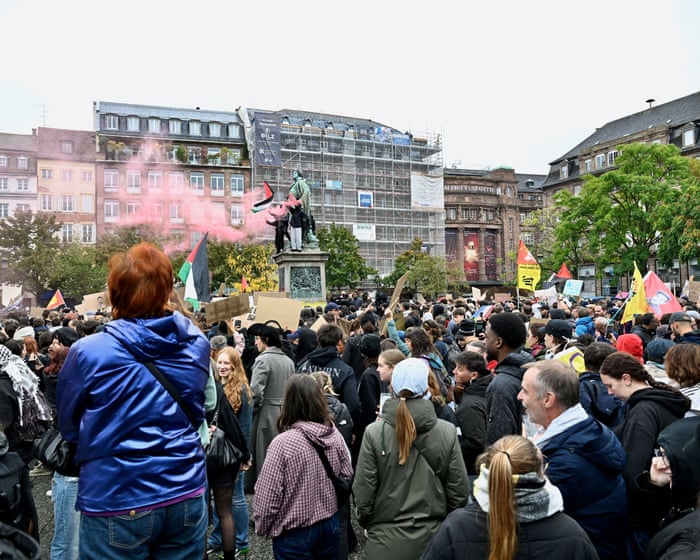
French children should continue to barricade their schools and take part in street protests, a student union said on Monday after the government announced a package of education measures to try to stem the crisis.
“Today we’re at the negotiating table, we’re able to negotiate with the government,” Pierre Sourzat of Les Lycéens told France Info television. “We’re in a power struggle and we still need to call for continued mobilisation to meet a maximum of our demands.”
This week, editors Peter Suderman, Nick Gillespie, and Matt Welch are joined by Associate Editor Liz Wolfe to discuss California's proposed 5 percent wealth tax on billionaires, which a Hoover Institution study suggests could ultimately cost the state $39 billion in lost revenue. With wealthy residents already leaving California, the panel examines whether the measure will survive next week's vote, why Gov. Gavin Newsom opposes it, and how public sector unions have helped fuel the state's spending problems.
The panelists then look to France, where mounting unrest and economic stagnation raise questions about the long-term consequences of high taxes, expansive welfare programs, and pension obligations that increasingly burden younger generations. Next, they discuss Venezuelan opposition leader María Corina Machado returning home after 10 months in exile. Then, with the midterm elections next week, the editors examine whether Trump's tariffs, war with Iran, and mounting allegations of corruption will deliver Democrats control of Congress. Finally, a listener asks whether today's democratic socialist movement will ultimately be remembered like the libertarian and Tea Party movements of the early 2010s.
Matt Welch appears on the left. Liz Wolfe appears on the right. Behind them, an image of Governor Gavin Newsom appears looking concerned in the center. Bold text across the top of the screen reads "TAX THE RICH?"
Le ministre de l'Enseignement supérieur, Philippe Baptiste, a annoncé ce lundi 26 octobre 2026 qu'il y aurait une « évolution forte » de Parcoursup en 2027, avant « un remplacement en 2028 » de la plateforme d'orientation pour les études supérieures très critiquée depuis le début de la crise lycéenne. Des organisations lycéennes appellent toutefois à poursuivre la mobilisation.
Student representatives dismissed the measures as insufficient and confirmed further protests and blockades.
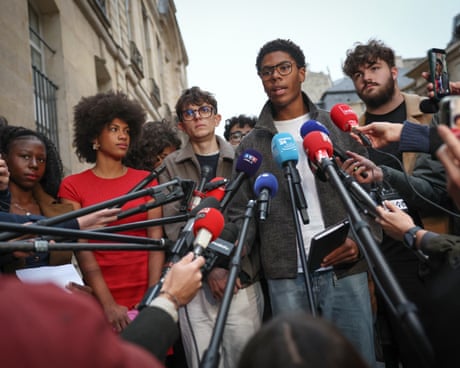
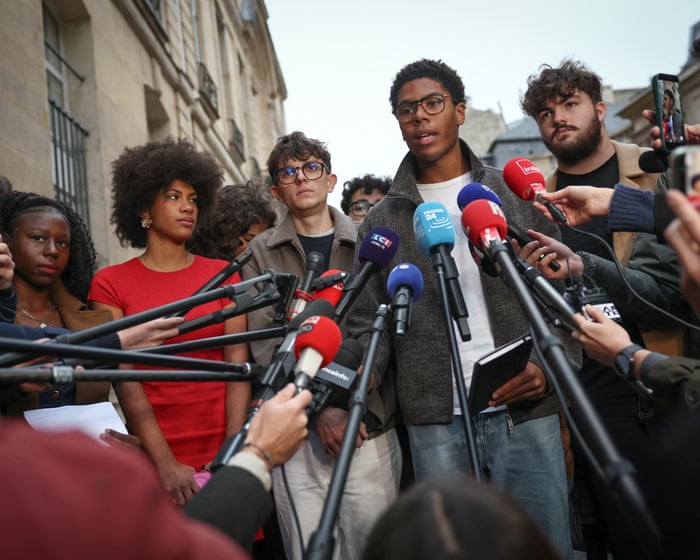
On Monday morning, French Prime Minister Sebastien Lecornu met with some students to brief them on measures he will announce during an afternoon meeting with high school student associations. The meeting, however, turned into a political setback for the administration of President Emmanuel Macron.
Student representatives said Lecornu was attempting to divide the protest movement by holding a meeting attended by people who lacked legitimacy and did not represent the movement.
The prime minister announced a reform of the university admissions system, with partial implementation in 2027 and more far-reaching changes in 2028. However, implementation of the proposal will depend on the government that emerges from the April-May presidential election.
Lecornu pledged to create 15,000 places in higher education, establish a 1-billion-euro investment plan to renovate high schools, and provide 4 billion euros in loans.
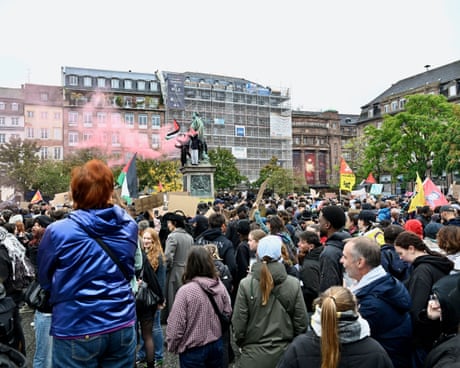
🔴️️ À Bordeaux, des manifestants lèvent les mains pour montrer leur caractère inoffensif, la police les charge et les gaze sauvagement
Partout en France, le mouvement populaire s'est amplifié. Les mêmes foules massives ont défilé pour exiger le blocage des prix, l'abrogation… pic.twitter.com/C9Cvuy2MB5
The text reads, “In Bordeaux, protesters raise their hands to show they pose no threat; the police charge at them and brutally gas them. Across France, the grassroots movement has gained further momentum. Massive crowds have taken to the streets to demand a price freeze, the repeal of the Parcoursup system, wage increases, and the inclusion in the budget of the 10 billion euros requested by high school and university students to address their demands.”
These measures come against the backdrop of a government seeking to gradually reduce the maximum number of students in high school classrooms to 28 and implement an emergency plan that will affect students in the country’s most disadvantaged areas.
Student representatives who questioned the legitimacy of the morning meeting stressed that their demands were more ambitious and dismissed the announcements made in advance as “crumbs.”
They are calling for the repeal of the current university admissions system, which they describe as opaque, and the creation of 250,000 places in higher education. “Our demand is clear: We want 10 billion euros and 10 measures that we have been calling for in various ministerial meetings,” they also emphasized.
Student representatives confirmed plans for protests on Oct. 31. Later, on Nov. 2, when classes resume after the school holidays, students will continue their high school blockades. On Nov. 5, student organizations will also join the general strike called by France’s main labor unions.
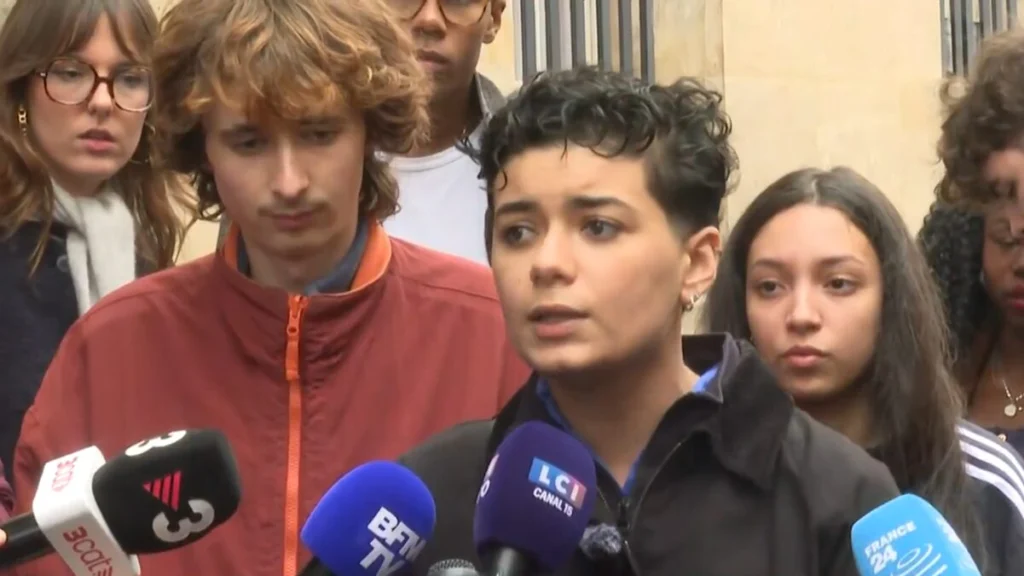
🔴 🗣 "10 milliards, 10 mesures, ni plus ni moins", clame Sabrine Kharbach, porte-parole de l'Union Étudiante. Les représentants de lycéens et étudiants s'expriment lors d'une conférence de presse en amont d'une réunion à Matignon #canal16pic.twitter.com/nmkMNERhZ3
The text reads, “’10 billion, 10 measures—no more, no less,’ declares Sabrine Kharbach, spokesperson for the Student Union. Representatives of high school and university students speak during a press conference held ahead of a meeting at Matignon.”
What French Students Are Demanding
In recent weeks, the High School Union (USL), the Student Solidarity collective, the National Union of Students of France (UNEF) and the Federation of General Student Associations (FAGE) have been the most determined groups in organizing mobilizations across France. They are demanding that the Macron administration implement the following 10 emergency measures:
1. An Emergency Plan to Renovate Schools and Universities
Launch an emergency plan to renovate dilapidated and unsanitary school and university buildings. Adapt educational institutions to the effects of climate change by installing air conditioning and cooling systems to cope with heat waves, as well as appropriate insulation and heating systems to withstand cold spells.
Ensure that every institution has the human and material resources necessary to maintain its facilities and provide clean, functional restrooms.
2. Mass Hiring of Education, Health, Support and Guidance Staff
Launch a large-scale recruitment plan for National Education personnel to guarantee, at a minimum, the following staffing levels at every institution: One nurse for every 500 students. One psychologist for every 500 students. One guidance counselor for every 500 students.
Create additional teaching positions rather than relying on contract workers, so that every class has a teacher and inequalities between institutions are eliminated. Also establish a formal employment status for support staff for students with disabilities (AESH) and create 800 additional positions.
3. Rethink School and University Schedules
Undertake a comprehensive overhaul of school schedules, building on the work of the Citizens’ Convention on Children’s Schedules for the National Education system, and launch a similar process for higher education to better respect students’ needs and well-being.
In particular, guarantee a lunch break of at least 1 1/2 hours so that every student can eat under appropriate conditions. Reverse the reforms of the baccalaureate and high school system.
4. End Selection Through Parcoursup and Mon Master. Create 250,000 Higher Education Places.
Eliminate selection through the Parcoursup and Mon Master platforms and create 250,000 additional places in higher education starting with the next academic year. This would allow high school students to access programs in their chosen fields without being subject to algorithmic selection and enable all students who wish to do so to continue their studies at the master’s level.
Retain centralized national application platforms to make available programs easier to identify, but eliminate selection. A high school diploma must guarantee access to a bachelor’s degree program, and a bachelor’s degree must guarantee access to a master’s program.
5. Overhaul High School Student Democracy to Ensure Genuine Participation in Decision-Making
Introduce list-based elections for the High School Student Council (CVL) and the Academic High School Student Council (CAVL) to ensure union representation, with representatives elected directly by all high school students in the relevant area. Increase the number of high school student seats on school boards. All high school students must be able to vote in CSE elections.
6. Increase Scholarships and Reinstate and Raise Housing Assistance for Everyone
Increase student scholarships by 200 euros per month, distribute them over 12 months and allow an additional 300,000 students to qualify for the scholarship system. Ultimately, establish a student autonomy income of 1,337 euros per month to guarantee every student the material resources necessary to pursue their studies. Abandon budgetary measures that reduce housing assistance for young people. Reinstate housing assistance (APL) for international students. Increase APL benefits and abandon changes to the calculation method that would deprive 147,000 students of this assistance.
7. Guarantee Effective Access to 1-Euro Meals for All Students
Guarantee effective access to 1-euro meals for students and provide the university services network with the resources necessary to meet demand.
8. Repeal the Welcome to France Plan, Which Introduces Differential Tuition Fees for International Students, and Eliminate the CVEC
Abolish the Welcome to France plan and its differential tuition fees for non-European students, which introduce a national-preference policy and a racist approach to higher education. Eliminate the Student and Campus Life Contribution (CVEC).
9. Freeze CROUS Rents, Make Rent Controls Permanent, and Massively Renovate and Build CROUS Housing
Reinstate the freeze on CROUS rents based on the rents frozen before 2023. Renovate unsanitary CROUS residences. Begin construction of 15,000 CROUS housing units starting in 2027. As an emergency measure, 10% of students must be able to obtain accommodation through CROUS.
10. End Repression and Police Violence Against the High School and Student Movement
End all forms of repression related to the high school and student movement. Ensure that law enforcement officers responsible for violence are prosecuted. Guarantee that absences related to mobilization are neither counted nor penalized.
More broadly, abandon all forms of repression in educational institutions and guarantee young people freedom of expression and freedom to organize, in direct contrast to the repression carried out in the struggle against the genocide in Palestine.
Amid widespread protests, Muriel E Cockcroft has sympathy for French youth but fears how much steam will be let out at the next convulsion
I’m writing in response to your editorial (The Guardian view on France’s protests: a polarised country is in a perilous political moment, 19 October). While the focus is on Emmanuel Macron, let us not forget the hierarchical structure of French administration, from mayors to MPs to senators to prefects and heads of region. All are part of the government, but few stood up to bring leaky school roofs and missing teachers to national consciousness. I deplore the senseless destruction of shops and state buildings. But I also deplore the fact that students had to protest to be heard. In the many administrative tiers of this highly hierarchical country, no one acted and inertia prevailed.
Centrally, the government is financially challenged but refuses to acknowledge that having a huge deficit, an ageing population and a low retirement age are perhaps connected. Modest attempts to increase the retirement age also provoked violent protests. Financial tools for individual retirement remain complex and restricted. Thus, this sclerotic system presses on until the next crisis.
Another day in France, another minor revealed to me the victim of forced prostitution.
Five men are facing trial at the Rhône Assize Court from Oct. 26 to Nov. 2 on charges of aggravated pimping involving a 12-year-old girl, referred to by the pseudonym Louna. While the suspects are being prosecuted, none of her clients face charges.
Louna, a vulnerable out-of-school youth who was also the alleged victim of a gang rape at age 10, ran away twice in 2022. On June 17, 2022, she left a campsite in southern France where she was vacationing with her grandmother. Six days later, a client recognized her from a missing person flyer and notified authorities, writes Le Progres.
Police located Louna in a rundown apartment on Quai Gillet in Lyon’s 4th arrondissement, discovering physical injuries (bruises and knife cuts) and that she had cocaine in her bloodstream.
The minor told police that she was manipulated online by a 19-year-old named Moha, whom she believed was her boyfriend. Moha and three accomplices allegedly groomed her with promises of luxury items, coerced her into using cocaine, and managed her prostitution.
Using the now-defunct website Coco, she was forced to see roughly 30 clients in a single week. The suspects threatened her with physical violence if she did not generate €500 to €1,000 a day, monitoring her actions closely.
This is just the latest in a slew of sex crime cases involving minors. Back in 2022, 12-year-old Lola Daviet was brutally raped and murdered in Paris by an Algerian woman, with the case possibly linked to a North African custom involving the killing of a White child with blonde hair.
Grooming gangs have also been on the rise. Child prostitution in France has risen by 43 percent over the past four years. French police are identifying “younger and younger girls” being trafficked.
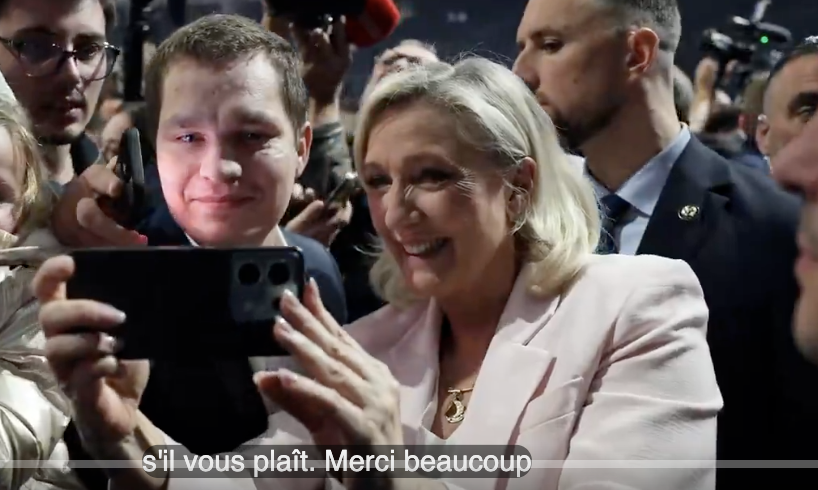
Speaking at her party’s opening campaign rally in Orléans, Marine Le Pen, presidential candidate of the National Rally (RN), spoke repeatedly about rebirth, or a renaissance, calling on the French to embrace a shift away from the disastrous policies of current President Emmanuel Macron.
Her campaign comes on the back of the disastrous riots that have seen France pillaged and burned. During her speech in Orléans, in line with her past messaging, Le Pen pledged to bring the French better security.
“We are not living the end of the world but the end of a world. It is up to us to build the one that is coming. The Renaissance of France begins today!” Le Pen posted to X.
Nous ne vivons pas la fin du monde mais la fin d’un monde. À nous de bâtir celui qui vient.
La Renaissance de la France commence aujourd’hui ! https://t.co/UuTWqKI1Uh
“No one thinks that we are stronger today than yesterday, or that after 10 years of Emmanuel Macron’s presidency, we are walking on a field covered in rose petals,” she told supporters, as cited by Euronews Hungary.
“The battle for facts has already been won; everyone in France agrees with us,” she added.
“Who can claim that there is a rule of law when hordes come to ransack and burn our buildings?” she asked during her launch speech.
“The rule of law is not law against the state,” said Le Pen, promising strict legal action against those who commit crimes, including the expulsion of foreign criminals, echoing sentiments from right-wing leaders across Europe.
The Great Replacement is driving the French riots, says right-wing politician Éric Zemmour.
"I believe that what we saw yesterday is the true face of the Great Replacement. It has an appearance: hordes of North African and African barbarians who ransack cities."
Follow: @RMXnews
She also called for greater French sovereignty, arguing that France must secure itself a “double border: French and European.”
Le Pen additionally struck out at Zelensky, noting that under her leadership France has no intention of send its youth to die in a war “that is not ours.”
RN Chairman Jordan Bardella turned his sights on Jean-Luc Mélenchon, leader of the far-left La France Insoumise (LFI) who has been adamant in his support for the ongoing riots. Bardella accused Mélenchon of “stirring the embers of rebellion” and called LFI unfit for the “highest functions of the state.”
France heads to the polls in May 2027. Recent polling shows Le Pen in the lead, with as high as 38% of the vote, according to Reuters. Mélenchon would come in second, with as much as 18.5%.
Après une brève suspension pour "motifs psychiatriques", la garde à vue de Kévin T., principal suspect dans l'attentat perpétrée dans les Yvelines, a repris lundi, a indiqué le procureur national antiterroriste, Olivier Christen. Plus tôt, le ministre de l'Intérieur Laurent Nuñez avait assuré que le profil psychiatrique du suspect "ne change[ait] rien" au mobile "raciste" de l'attaque.
Russia’s aircraft plants still turn out modern fighter-bombers and fighters, enough to partly cover its losses, Ukraine’s military intelligence agency HUR told Ukrainian news agency UNIAN, which published the reply on 23 October. Its older bombers are a different story. Russia has no serial production of new Tu-95s, Tu-22M3s, or Su-24s and keeps them flying through repairs and upgrades, so each one lost for good leaves a lasting gap, HUR said.
Ukraine’s Navy said its Neptune missiles hit six Su-34M bombers at Borisoglebsk airbase in Russia’s Voronezh Oblast overnight into 15 October. Zelenskyy later said four were destroyed and two damaged. The Su-34 is one of the jets that drop Russia’s glide bombs, heavy bombs fitted with wing-and-guidance kits, on Ukrainian positions and towns.
How fast Russia replaces its jets
Russia can probably deliver 10–15 Su-34s a year now, HUR estimated. Deliveries grew from eight in 2022 to 11 in 2023 and 12–14 in 2024. But the agency said that trend does not confirm the same pace today.
For the Su-35S fighter, HUR pointed to an average of about 11–12 a year in 2021–2025. It called that a rough benchmark, not an established 2026 output. Su-30SM2 and Su-57 production continues, but reliable rates cannot be determined. Su-30 figures also mix new builds with upgrades of older Su-30SMs, HUR noted.
What Russia had, and what it lost or saw badly damaged in 2026
By the end of 2025, Russia had about 125 Su-34 and Su-34M bombers, which HUR counts together. It also had 140–145 Su-30 jets of various versions, 135–140 Su-35S, and about 20 Su-57s, HUR estimated. These are only fleet estimates, not a guaranteed number of jets Russia can send on combat missions at the same time, the agency cautioned. Some are under repair or upgrade, and HUR is not disclosing the current fleet size.
Satellite image from 13 October shows six Russian Su-34 fighter-bombers parked in the area later struck at Borisoglebsk airbase. Image: Exilenova+
HUR also named specific 2026 cases of Russian aircraft destroyed or critically damaged. A Tu-22M3 crashed in Irkutsk Oblast on 15 June. Strikes on Engels airbase on 17 July and 28 August hit two Tu-95MS. The first suffered critical damage to its tail section, and HUR treats the second as a probable irrecoverable loss.
The list also includes a Su-35 that Ukraine’s military says it shot down on 8 July, a claim backed by published materials showing debris. It adds a Su-57 crash in Moscow Oblast on 23 July and a collision of two Su-35S over Kursk Oblast on 7 September. Full official details on those two incidents are still missing, HUR noted. Strikes on several Su-57s and a Su-34 at Shagol airbase on 25 April, and on a Su-24 in Crimea on 7 September, were also reported, but the state of those jets is unknown, so counting them as destroyed would be premature, HUR said. The list, as published, leaves out the Su-34s at Borisoglebsk and the Tu-95MS that Russia’s defense ministry said crashed on takeoff in Amur Oblast in late September.
French and US maritime patrol planes are watching the western Black Sea, where drones keep hitting merchant ships, Romanian outlet Curs de Guvernare reported on 19 October, citing flight-tracking data. Romania blames Russia for the attacks, while Bulgaria says it cannot prove who launched them.
Ukraine’s three small Danube ports have kept its grain exports from collapsing further, and Russia has pounded those ports since the summer. The ships serving them are now being hit in the economic zones of two NATO members. Many were anchored near or heading to the Sulina Canal, which links the Danube to the sea. That puts the allied patrols over these waters in the middle of the fight over Ukraine’s grain trade.
Map: Euromaidan Press
Two patrol planes over the western Black Sea
A French Navy Atlantique 2 maritime patrol plane arrived in Constanța, Romania’s main Black Sea port, on the evening of 18 October, Curs de Guvernare said. On 24 October, French Foreign Minister Jean-Noël Barrot said in the Bulgarian port of Varna that a French patrol plane had been operating in the area under NATO for two weeks and had contributed to rescue operations.
Explore further
Two tankers burn off Romania’s Sulina as Bulgaria says it lacks proof Russia is behind the Black Sea ship attacks
Meanwhile, a US Navy P-8A Poseidon flew into Varna from Sicily on 18 October, AFP reported, citing flight-tracking data. Two days later, Bulgarian Prime Minister Rumen Radev said it had begun reconnaissance patrols after Sofia asked allies for help, and that some allies had responded quickly. Bulgarian Defense Minister Dimitar Stoyanov called the deployment a joint decision of Bulgaria and NATO. He said the plane cannot strike targets and passes its data to NATO, Anadolu Agency reported.
NATO promises more
On 20 October, NATO’s North Atlantic Council met at Romania’s request. Afterward, the alliance said it would send more maritime patrol aircraft, radar systems, and drones to the Black Sea. NATO military spokesman Col. Martin O’Donnell added that allies have sent or will send intelligence personnel and explosives-forensics teams. NATO itself has not attributed the attacks to any country.
Romania names Russia, Bulgaria hedges
Romania has been blunter. On 15 October, after four merchant ships were hit within a day, acting Foreign Minister Oana Țoiu wrote on X that “Russia bears full responsibility for these developments.” On 17 October, Romanian F-16s shot down two jet-powered Russian Geran drones near Sulina, Romania’s Defense Ministry said.
Unitățile aeriene și navale ale Gărzii de Coastă (GdC/MAI) și ale Inspectoratului General pentru Situații de Urgență (IGSU/MAI) sunt implicate activ în operațiunile de căutare și salvare, în vederea găsirii membrilor dați dispăruți ai echipajului navei care a fost atacată în…
On 23 October, a drone sank the cargo ship Khoryv off Constanța, killing a Ukrainian sailor, and President Nicușor Dan blamed Russia too. “It is part of Russia’s escalation process in its war in Ukraine,” Dan said.
Bulgaria is more cautious. Radev told parliament on 14 October that the attacks worked in Russia’s favor but that Sofia could not prove it. Since taking office in May, he has sought a thaw in ties with Moscow.
En France, le week-end des 24 et 25 octobre a été marqué par une mobilisation plus calme que les précédents, mais cela ne signe pas pour autant une sortie de crise. Le gouvernement est critiqué pour avoir tardé à agir face à la contestation. Un mois après le début du mouvement lycéen, l'exécutif tente de reprendre la main. Après Emmanuel Macron vendredi 23, c'est au tour du Premier ministre Sébastien Lecornu de rencontrer les organisations lycéennes lundi 26 octobre.
Representatives from French high school student groups on Monday hailed the government’s first measures to calm the crisis over ongoing unrest linked to their protest movement, including a gradual replacement of higher education admissions platform Parcoursup, but called for “continued mobilisation” after their meeting with Prime Minister Sébastien Lecornu. Follow our liveblog for all the latest.
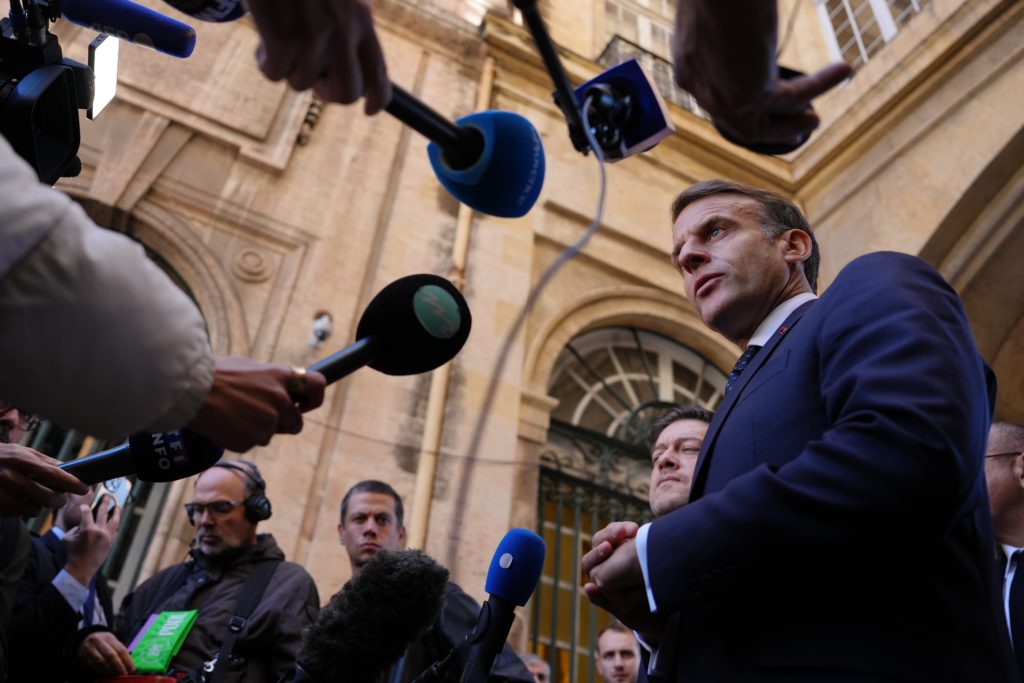
Emmanuel Macron a estimé depuis Marseille, lundi, que le 31 octobre serait de nouveau "à risque" en raison des manifestations annoncées, affirmant que leurs tracés resteraient en dehors des centres-villes afin de protéger "l'ordre". Le président a aussi reconnu que les autorités n'avaient "pas du tout anticipé" le 17 octobre. Suivez notre direct.
French President Emmanuel Macron on Monday said the government will announce "concrete and strong" measures to address the demands by high school students after their protests demanding better education conditions triggered weeks of nationwide unrest. Prime Minister Sébastien Lecornu is set to hold a news conference after meeting with high school student unions.
Back to Serbia, we are expecting to hear from two groups of election monitors in the coming hours: first, very shortly, from Serbia’s Center for Research, Transparency and Accountability (CRTA), and then a bit later from a group of international observers, including from the OSCE, the ODIHR, and the European parliament.
I will keep an eye on their findings and bring you the key lines.
Between 34,000 and 25,000 years ago, much of Europe shared a way of life that archaeologists call the Gravettian. It is recognized by its stone and bone tools, by the way people buried their dead, and by small carved figurines of women known as Venus figurines. They turn up from the Atlantic side of the […]
Plus de six ans après la mort de Cédric Chouviat, trois policiers doivent être jugés à partir de lundi au tribunal de Paris pour homicide involontaire à la suite d'un contrôle routier qui a dégénéré. La défense demande un report du procès et les avocats de la famille entendent plaider "l'incompétence" du tribunal, estimant que les faits relèvent de la cour d'assises.
Malgré les craintes et un très imposant dispositif de sécurité, Marine Le Pen a pu tenir sans incidents majeurs son premier grand meeting de campagne à Orléans dimanche 25 octobre. Devant près de 8 500 personnes selon son parti, le Rassemblement national (RN), la candidate d'extrême droite a prononcé un grand discours général d'une heure. La grande favorite des sondages pour la présidentielle de 2027 lance sa campagne sur le thème de la « renaissance » avec un ton plus « optimiste » qu’à l’habitude.

 Login







 https://t.co/UuTWqKI1Uh
 The Great Replacement is driving the French riots, says right-wing politician Éric Zemmour.
"I believe that what we saw yesterday is the true face of the Great Replacement. It has an appearance: hordes of North African and African barbarians who ransack cities."
Follow: @RMXnews