
❌

Reading view

I cashed in my retirement fund to open the first romance bookstore in my neighborhood. It was a risk, but it paid off.

Kate McNeil is sitting in a reading chair, holding a cat in her lap, with a bookshelf in the background.
Kate McNeil

The Sintoses

  • Kate McNeil opened All the Tropes, a romance bookstore, six weeks after quitting her job.
  • Despite concerns about market saturation, All the Tropes thrives as a niche community destination.
  • Passion, perseverance, and local support helped McNeil launch her business.

This as-told-to essay is based on a conversation with Kate McNeil, a 41-year-old small-business owner based in Atlanta. It's been edited for length and clarity.

The idea to open a romance bookstore started during COVID.

I joined an online group of fellow romantasy readers, looking to connect with other people who also enjoyed my favorite form of escapism. That group had over 2,000 members, and it was difficult to feel a sense of community. Eventually, it broke off into local chapters.

After COVID, I didn't know of any dedicated space for these same readers to meet in Atlanta. That's how I started the journey to opening the first romance bookstore in my neighborhood. In the two years since I opened, more romance bookstores have opened up, including one less than two miles away.

I thought I'd retire from my teaching job

When I launched All the Tropes bookstore, I was working a job I thought I'd retire from. I taught theater at Decatur High School for six years. My students always came first. I didn't want those kids to feel like I wasn't present or that they didn't have my undivided attention, so the bookstore was a back-burner idea for a few years.

I'd get home from rehearsal at 11 p.m., conduct business research until 2 a.m., then get up at 6 a.m. and go to work the next day and teach.

I took my time to gain a full understanding of the market, but there were still challenges

I learned about dealing with publishing companies and book distributors, connected with local artists to showcase their work, and reached out to local authors. One of the biggest challenges was finding a place for the store.

I knew that I wanted to stay on the east side of Atlanta because I lived in Kirkwood and felt very connected to the community.

In 2024, I found a location a four-minute walk from my home, and I knew it was time to make my idea a reality. In May of that year, I quit my teaching job and prepared to open the bookstore by the end of summer on Romance Bookstore Day.

I had 6 weeks to get the store ready for opening day

I received the keys to the bookstore six weeks before the day I planned to open. The timeline I had for opening day came with a lot of risks. I had cashed in my retirement fund, quit my job, and had a large preorder of "Onyx Storm" before there were bookshelves in the store.

There were many times my friends and I didn't leave the store until 4 a.m. A local artist painted the shop; I printed my merchandise at a local shop in Kirkwood; and I created the fabric wall. There were many nights I had doubts that All the Tropes would come to fruition.

I was a mom with two young kids opening a niche business that, to my knowledge, would be the first in the state, but I was prepared. I had my accounts with publishers, and my branding was complete. Perseverance, my husband, my village of friends, and an invested community got me to opening day.

All the Tropes opened August 17, 2024, on Romance Bookstore Day. In the span of a few months, I went from a passionate high school teacher to the owner and operator of a romance bookstore.

An increase in niche romance bookstores in the city concerns me

Even in a city like Atlanta with several thriving independent bookstores, I wonder about the percentage of residents who read for fun and, more specifically, read romance. While becoming a general indie bookstore would allow me to sell so many other things, I still believe All the Tropes can continue to thrive in a niche market, despite oversaturation.

Unlike a large book retailer, All the Tropes is a destination spot people can come from out of town to visit. Our social presence and promotion of local writers and artists also offer something unique to readers.

All the Tropes could pivot to general fiction, but so far, more stores opening has not impacted store traffic or sales.

4 Things helped me turn my business idea into a reality

All the Tropes continues to thrive because of my original vision of creating a community space for romance book lovers to connect. We now have eight active book clubs and continue to see consistent revenue.

Passion, trusting my gut, therapy, and a supportive group of friends are the reason I was able to turn an idea I brainstormed late at night into a successful niche business ready to grow.

We are now ready for a larger space and to expand our three-person team.

Do you have a unique small business story to share? Email the editor, Manseen Logan, at mlogan@businessinsider.com.
Read the original article on Business Insider
  •  

Toys are facing their biggest price spike in years. Mom-and-pop toy stores tell us how they're getting by.

Terra Toys, a toy store in Austin.

Sylvia Edwards

  • Toy prices have gone up 8.3% since February due to tariffs, geopolitics, and supply chain issues.
  • Local mom-and-pop toy stores across the US spoke to the rise and its impact on their businesses.
  • Legacy toymakers also grapple with the impacts, looking toward tariff refunds.

Toy prices are rising fast across the country— and local toy stores are struggling to play along.

At Clever Monsters, a toy store in NYC, co-owner Daniel Orlov said he has to recalculate prices order by order, at times cutting into his own profits to keep them at a reasonable level for his customers. Sometimes, he knows before putting some toys on the shelves that he won't make anything off them.

The struggle results from higher shipping fees, tariffs, and customs charges and reflects a broader inflationary moment in the economy.

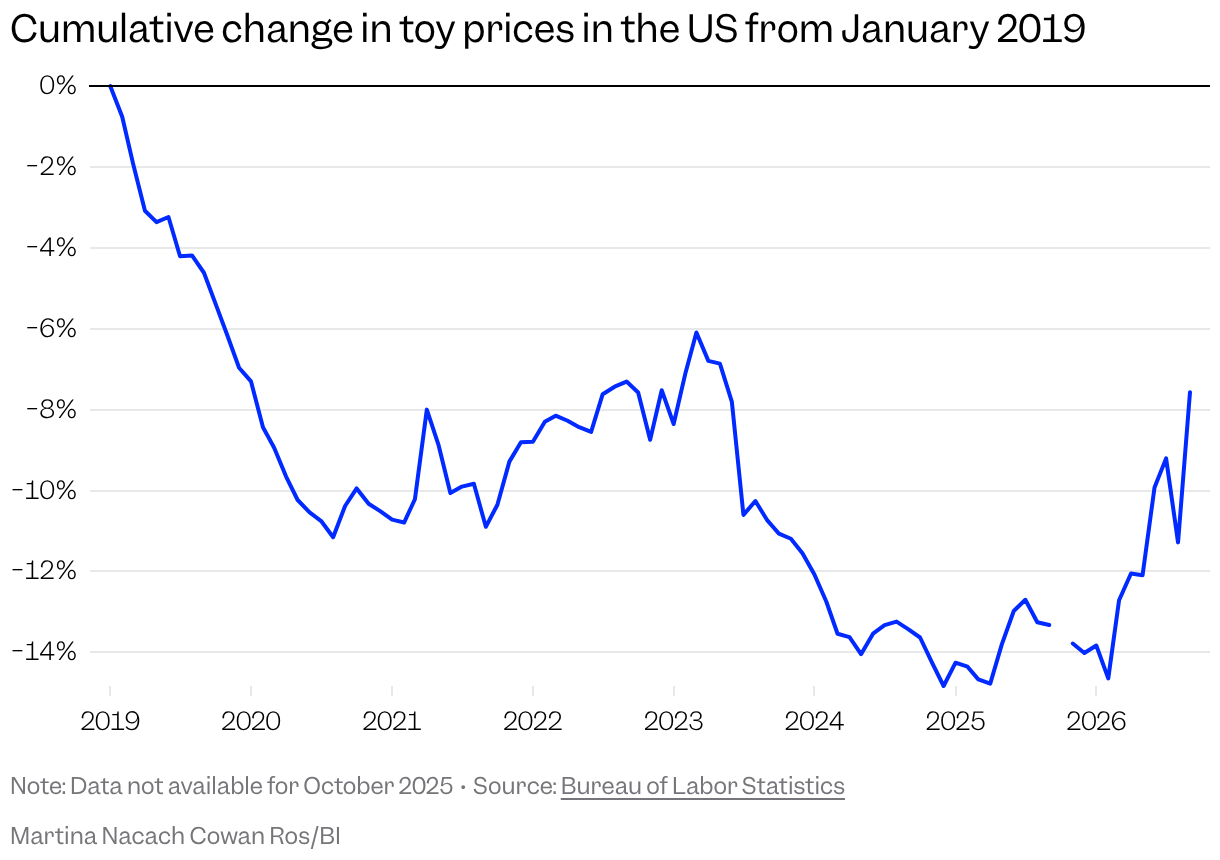
Toys have historically gotten less expensive over time, but have seen a spike in prices this year, rising 8.3% in the US between February and September. Year-over-year, toy prices were up 6.6% in September, the highest annualized growth rate since 1988.

This graph shows toy prices in the US from January 2019 to September 2026.

Orlov said smaller toy stores like his could be particularly affected by these sharp price spikes. "It especially hurts for small businesses like us because we don't really have a pocket; we had to open up credit lines and take loans — bigger companies have a little pocket of collateral that they can use for a bit."

Tariffs, fuel prices, and supply chain woes

Big geopolitical swings are one factor putting pressure on toy sellers. President Donald Trump's on-again, off-again tariffs have added extra costs, and smaller retailers don't have the financial flexibility to wait for refunds like those from the Supreme Court's invalidation of the "Liberation Day" levies. Meanwhile, the ongoing war in Iran has driven up fuel prices and shipping costs for all manner of goods.

Small toy stores, confronting those problems, are facing smaller profit margins.

Helen Dean, owner and operator of Toy Safari in California for 34 years, said her usual 7 to 8% profit margin has fallen to around 5% in the past year. She cut into her own salary and skipped on hiring the two or three college students she brings on during vacation season to cut costs.

"It was summer by the time I started to see that I was going to have to pay more for the items, and that it was going to come out of my bottom line," Dean said. "For a long time, mass market has gotten favorable pricing from major toy companies, and this problem has only been exacerbated by the tariffs and fuel prices and supply chain issues; everywhere we lose."

It's not just specialty mom-and-pop stores; toymaking giants are also dealing with the tariff back-and-forth and broader inflationary issues. An AlphaSense analysis of company filings and earnings transcripts over the last six months found that legacy toymakers such as Hasbro and Mattel have alluded to cost inflation caused by "tariffs, oil-linked resin and freight, packaging, labor," while also discussing the impact of tariff refunds. However, those large toymakers haven't disclosed any major increases in toy prices over that period.

Hasbro's Q2 earnings report highlighted an $8 million adjusted operating loss in consumer products — its physical toy sector — due to "incremental tariff expense, entertainment-related mix shifts, and normal seasonality." Yet its Q3 earnings report highlighted $55 million in relief from tariff refunds; $48 million of this was attributed to the core toy sector.

The Q3 report also noted that tariffs could "increase our product costs and other costs of doing business, result in higher prices of our products, impact consumer spending," and hurt business revenue.

Mattel's gross margin is still under pressure due to tariffs and inflation. The toy company has also received about $90 million in tariff refunds, said Paul Ruh, Mattel's former chief financial officer, at a conference in September.

Scalpers, TikTok and squishy NeeDohs

High operating costs are not the only thing changing the toy market. First, more adults are participating in "Kidulting," said Jay Berino, store manager at the Lowry Town Center Timbuk Toys in Denver, meaning toys are being bought by older demographics who buy into nostalgia.

"As much as we're a toy store and people hear toy store and think of kids, we sell to a lot to full-blown adults, and that drives a huge chunk of our business," he said. At the same time, viral toys such as NeeDohs, which are sensory fidget and stress-relief toys, have helped bring more people into stores.

Sylvia Edwards, co-owner and CEO of Terra Toys in Austin, said that scalpers try to buy up stock from toy shops to resell it at higher prices — fueling the perception of product scarcity and price gouging.

"We're in a crisis where there's way more demand than there is product available, and so when that happens, people will naturally get greedy and increase the price," Edwards said. To manage the issue, stores like Terra Toys limit bulk purchases.

Daniel Orlov, co-owner of Clever Monsters in New York City.
Daniel Orlov, co-owner of Clever Monsters toy store in Brooklyn, New York City.

Daniel Orlov

Orlov from Clever Monsters in NYC said they have also placed a limit on scalpers. "I'm only limiting it because this is the kids' store, and the kids are really excited to get that stuff," he said.

The virality of products such as NeeDohs on TikTok and other platforms helps these stores boost demand at a time when the high cost of living means buyers are not looking to spend much on other classic toys. Parents and kids are willing to spend on hyped products — but for much else, they keep their wallets shut.

"Honestly, the trends have been really saving us in that it drives not just sales, but just foot traffic through the store," Orlov said. "The only thing we can do is just stay on the trends, on what people want, make sure customers are happy, build up relationships with our customers, and sort of have a little monopoly on our area on parents who think toys — 'Oh, we gotta come to Clever Monsters. That's just where you go.'"

Read the original article on Business Insider
  •  

Netflix relocated me to Japan. After I left the job, I found a new way to stay.

Matthew Kelson sitting at a movie theater in Japan.
Matthew Kelson knew he wanted to stay in Japan and decided to open a movie theater.

Provided by Matthew Kelson

  • Matthew Kelson, now 43, grew up in Michigan and opened his first cinema in his 20s.
  • He went on to work for Netflix in Los Angeles before getting transferred to Japan in 2020.
  • After leaving his job at Netflix in 2024, he renovated a kindergarten and founded a cinema in Japan.

This as-told-to essay is based on a conversation with Matthew Kelson, now 43, who was transferred by Netflix from Los Angeles to Tokyo and is now the founder of CineYama, an independent cinema in Uenohara, Yamanashi Prefecture, Japan. His words have been edited for length and clarity.

Japan isn't new to me. In middle school, I spent two weeks living with a host family as part of an exchange program. I returned a couple of times as an adult.

I was working at Netflix in Los Angeles when the company relocated me to Japan in 2020. I was based in Tokyo for two years before moving to Uenohara, a small town about an hour and a half by train from Tokyo. I still spent time in the capital for occasional meetings and traveled extensively across Asia for screenings. Otherwise, I worked remotely from home. After a company restructuring, I left Netflix in 2024.

I wanted to stay in Japan. My daughter was six months old when my wife and I moved, and my son was born three years later. We thought it was a great place for them to grow up. I started thinking about how I could utilize my expertise in cinema and give back to the community.

A road in Uenohara, a small town outside of Tokyo, Japan.
He moved to a small town about an hour and a half by train from Tokyo.

Provided by Matthew Kelson

While scouting for locations, I came across an abandoned kindergarten. In 2024, I started plans to turn the old school into a cinema. And in December, I got my permanent residency in Japan through the highly skilled professional fast-track program. A year later, I formed my company and spent another year renovating before opening a cinema in March.

Building my career in film

I spent most of my childhood in Michigan, in the Detroit area. My father was a professor of international business. He traveled for work often. It got me curious about the world around me.

At 23, I came across the Detroit Film Center and took a filmmaking course. A year later, I became a teacher and worked as a projectionist there. Through that, I started working at an independent art theater in the Detroit suburbs. I started as an usher, then became the theater manager.

Within the two years of working there, I fell in love with the film world. At 25, I renovated an old school's auditorium into a theater in Michigan using my savings. The theater ran for two years, but after disputes with the landlord, it closed.

I was looking for a fresh start, so in 2011, I moved to Los Angeles. At first, I knocked on the doors of all the film distributors I'd worked with until I met some people at an independent film distribution company. I joined as an intern and worked my way up. I landed a job on Netflix's creative team two years later.

Demo ceiling while renovating.
Kelson acquired permanent residency in Japan and spent the following year renovating.

Provided by Matthew Kelson

The journey to opening a cinema in Japan

Getting the permit to renovate the abandoned kindergarten was a long process. I had to negotiate with officials at city hall and the residents about how I'd use the building, establish the company, deal with fire and health regulations, and construction in a language I don't speak fluently.

I learned that pushing harder is not necessarily what gets things done in Japan. It was about patience, building trust, and showing people that I was serious and that the project wasn't going to disappear in six months.

Outside of CineYama in Japan.
CineYama was a kindergarten before it was transformed into a cinema.

Provided by Matthew Kelson

There were days when I wondered why I had chosen to make my life so difficult. But every milestone, from getting the building, the inspection, installing the projector, and finally opening the doors, made me more determined.

When the cinema first opened, the elderly residents seemed cautious. After a preview, they told me they were impressed to see the place cleaned up and put back into use. It's important for me to have screenings that kids and families can come to and enjoy the space.

CineYama, an independent cinema in Japan, opened in March.
CineYama, an independent cinema, opened in March.

Provided by Matthew Kelson

Tickets cost 1,500 Japanese yen, or about $9.50. We offer a discount to seniors and residents. I stick with showing content that is harder to find elsewhere, so that it gives viewers a perspective on other ways of life and culture.

It's mostly family-run. I manage the operations, and my wife helps out sometimes. My kids stamp the tickets when they're around.

Snacks and popcorn at a cinema.
Popcorn and snacks at the cinema.

Provided by Matthew Kelson

Living up to the challenge

Opening the theater in the US was different from doing it in Japan. I was in my 20s, had little money, and was just figuring things out in Detroit. The one in Japan came after 15 years of working in film distribution, creative production, and international screenings.

It's been exciting living over here, having the cinema, and meeting people from all over the world. While life in the US would've been much easier, I like the challenges in Japan. That's why I was at Netflix for so long, because it wasn't an easy job either. I learned life in hard mode.

Read the original article on Business Insider
  •  
❌