❌

Reading view

Germany’s Helsing promises jet-drone-hunting missiles at under $100,000 a shot—its CEO doesn’t expect them on the market before 2027

Helsing’s Inferno missile.

German defense AI firm Helsing has unveiled Contra, an AI-run air defense system and two interceptor missiles designed to chase Russia’s jet-powered Geran drones, the company announced on 26 October. Officials pitch it as cheap, but it won’t reach the market this winter.

That leaves Ukraine on its own defenses as Russia shifts to jet drones. By early October, jet models made up about 40% of Russian drone launches, and Ukraine’s own interceptors for them won’t arrive in needed numbers before late November, Air Force Deputy Commander Yurii Cherevashenko said.

Two missiles, one AI brain

Contra is the command layer of air defense: it links radars and other sensors, tracks incoming drones and missiles, and assigns a weapon to each target, while people keep control over decisions, Helsing said. Besides the company’s own missiles, it can also use other firms’ interceptors, lasers, guns, or nets. AD-1 Inferno is jet-powered and designed to loiter, swarm, and re-engage targets, while AD-2 Ambush, a solid-fuel rocket, is designed to reach Mach 2.5, over twice the speed of sound, and a range of more than 20 km, the company said.

Inferno, with a 700 km/h speed and a 20-km range, would be the everyday shooter. Ambush would handle “leakers,” drones about to hit the ground, said Maxwell Adams, Helsing’s senior product director. Each shot should cost under $100,000, company officials said.

Built for the faster Gerans

Ukraine once downed 90% of Russia’s slower, propeller-driven Gerans, copies of Iran’s Shahed, Defense News reported. Russia has since fielded thousands of jet Geran-4s and Geran-5s flying at 400–700 km/h, and almost half now get through, Helsing co-founder and co-CEO Gundbert Scherf said.

Ukraine’s own nightly rates swing widely. On 28 September, President Zelenskyy put the shoot-down rate for jet drones at 57%. Overnight on 7 October, it exceeded 82%, National Security and Defense Council Secretary Ihor Klymenko said. Russian output of the two models has reached 4,000 a month, Helsing said, citing unspecified intelligence reports.

A HX-2 AI drone.
Explore further

German company introduces AI-powered HX-2 drone for Ukrainian military

Helsing has signed one Contra contract, Scherf said, but the system is still in testing, and he expects it on the market in the second half of 2027. Ukraine already uses Helsing’s HX-2 strike drones. Scherf said they should be integrated into a system like Contra.

  •  

Ukraine says it has finished its part of FREYJA, Europe’s joint anti-ballistic project. Partners’ work is still underway

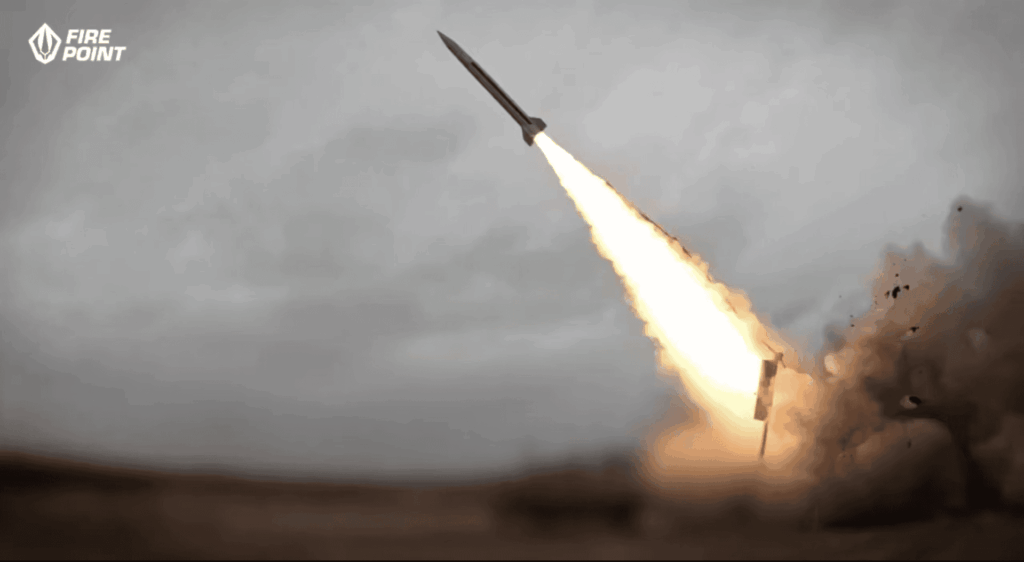
ukraine advertise its new ballistic missiles until factories can mass-produce ex-security officer says · post test launch fp-7 missile prototype fire point news ukrainian reports

Ukraine has finished its share of FREYJA, a joint European project to build a system against ballistic missiles, President Volodymyr Zelenskyy told journalists on 17 October, Ukrinform reported. He added that Kyiv wants to test the first system as soon as possible.

Ukraine still relies on US-made Patriot interceptors to stop Russian ballistic missiles. Zelenskyy told ABC News on 23 October that Ukraine had received only 24 of them from the US in three months, while it needs 350 a month on average. FREYJA can not close that gap soon, because the system is still in development.

Ukraine’s missile and launcher, partners’ radars and sensors

Zelenskyy said the partners’ share of the work, with 10 countries taking part, is still underway. He also said he had discussed the project with French President Emmanuel Macron, and he named Norway as a key partner.

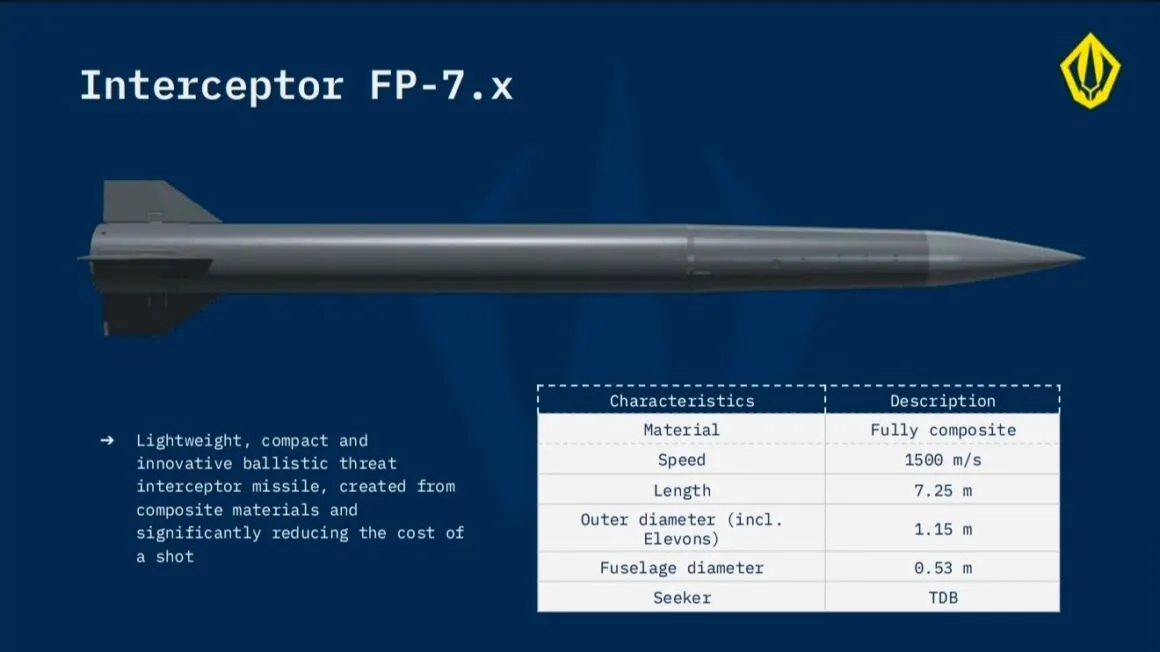
Fire Point concept graphic showing the FP-7.x interceptor missile beside a table of proposed specifications.
Explore further

Ukraine’s missile, Europe’s sensors—FREYJA enters active development on an early-2027 clock

Zelenskyy did not say what the partners still have to deliver. In August, he said Ukraine is capable of making the missile and launcher, while partners would supply critical components such as radars and sensors.

One part not made in Ukraine

In May, Fire Point co-founder and chief designer Denys Shtilerman said all components of the FP-7.x interceptor are made in Ukraine except one. “As for that one part we don’t manufacture in Ukraine, we’ve contracted a certain quantity of it. We already have it,” he said, but did not name the part.

In June, however, Shtilerman told the Financial Times that mass production depended on an infrared seeker Fire Point hoped to get from Germany’s Diehl Defence. Neither statement says whether the seeker is that one part.

Fire Point co-founder Iryna Terekh said in September that FREYJA was going through testing and technical integration in combat conditions in Ukraine. The company plans its first intercept of a ballistic target by mid-2027.

The official timeline has since moved closer. On 21 October, Zelenskyy wrote that officials had identified where to speed up so FREYJA reaches testing by the end of this year. A test is still a step short of an intercept.

  •  

Export hurdles and visa waits for Ukrainian companies force Pentagon to slow its drone contest

One morning in June, the head of export at Ukrainian drone company Stellarion found himself unexpectedly in need of a U-Haul outside the Detroit Metro Airport in Michigan.

Stellarion was set to test its drones in front of American soldiers at a competition organized by the Pentagon at Camp Grayling,

  •  

A 4-watt video link passed Ukraine’s state tests, its maker says, and could stretch STING interceptors’ radius from 20 km to 30 km

Hornet Vision Ctrl system and Sting interceptor.

A new video transmitter for Wild Hornets’ drones, including its STING interceptors, has passed state tests, the Ukrainian drone maker told Militarnyi. The module sends a drone’s camera feed to its pilot. The company expects it to widen its interceptors’ operating radius.

Russia launched 140 Shahed-type drones at Ukraine overnight on 26 October and 280 the next night, when its main target was Kyiv, Air Force figures as of the morning show. Interceptor drones, which cost dozens of times less than the Shaheds they hunt, are one of Ukraine’s answers. The STING alone downed more than 3,000 drones in its first seven months of use, Wild Hornets says. If the company’s estimate holds, a 30 km radius would let each ground station cover more than twice the area it covers at 20 km.

What the testers checked

Specialists from the State Research Institute for Testing and Certification of Arms and Military Equipment and the Defense Ministry’s State Quality Assurance Directorate confirmed the module’s declared characteristics on three drone types, the company said. The three were the STING interceptor, the Queen of Hornets cargo platform, and the 10-inch Wild Hornets Digital anti-aircraft drone.

Some of the drones’ figures exceeded the values the company had set for them, Wild Hornets told Ukrainian defense outlet Oboronka, without saying which ones. Those figures will enter the official specifications after further field tests, it said.

More than double the power

The module, called HV VTX Pro, is part of an upgrade to Wild Hornets’ Hornet Vision digital video system. It more than doubles the transmitter’s maximum power, to 4 W. That sends a clear picture farther and makes the feed steadier in crowded airwaves and under electronic jamming, the company said.

Hornet Vision Ctrl system
Hornet Vision Ctrl system. Photo: Wild Hornets

Wild Hornets first described the module in August, when it was already in serial production. Its interceptors’ operating radius would grow from around 20 km to 30 km, the company said at the time. That estimate assumed good line of sight and the 360-degree antenna on its ground stations, according to a company statement Interfax-Ukraine quoted. Interception could also become at least 20% more effective against targets flying extremely low, the statement said.

Wild Hornets is a Ukrainian company that designs and builds drones, from strike FPV drones and cargo platforms to the STING, which the company says flies at up to 280 km/h to hunt Shaheds. Its drones serve with more than 100 units of Ukraine’s Defense Forces, from the army and the National Guard to military intelligence, the Air Force, and the border guard, according to Interfax-Ukraine.

  •  

New report tracks how Russia helps China build better drones

The investigation found that Russian designs for rocket-launched drones likely helped shape weapons China unveiled in 2025 and that Russian wind tunnels kept testing aircraft models for China's top arms maker after the invasion of Ukraine.

  •  
❌