
❌

Reading view

Republican voters are getting worried about high costs as inflation stings and the midterms approach

A hand in a plaid shirt holding a fuel nozzle refueling a car at a gas station pump. Bright day with a visible station backdrop.
Rising costs are weighing on Republican voters.

Lajst/Getty Images

  • Republicans are feeling the strain of rising costs, with more saying it's a drag on their finances.
  • Those voters are feeling generally bad about the economy as key midterm elections loom.
  • Voters not approving of the party in power is common; what's unclear is how it'll play out.

Republicans are feeling the high-cost crunch.

The latest consumer sentiment reading out of the University of Michigan finds that, across the board, Americans are still feeling bad. While self-identified Republicans still feel better than their Democratic and Independent counterparts, they're increasingly feeling the pinch of rising prices.

From January to October 2026, the share of Republicans citing high prices as a drag on their finances rose the most out of all political factions. It's a sign that, even as their party holds Congress and the White House, Republican voters might still be feeling the heat — especially as inflation continues to rise.
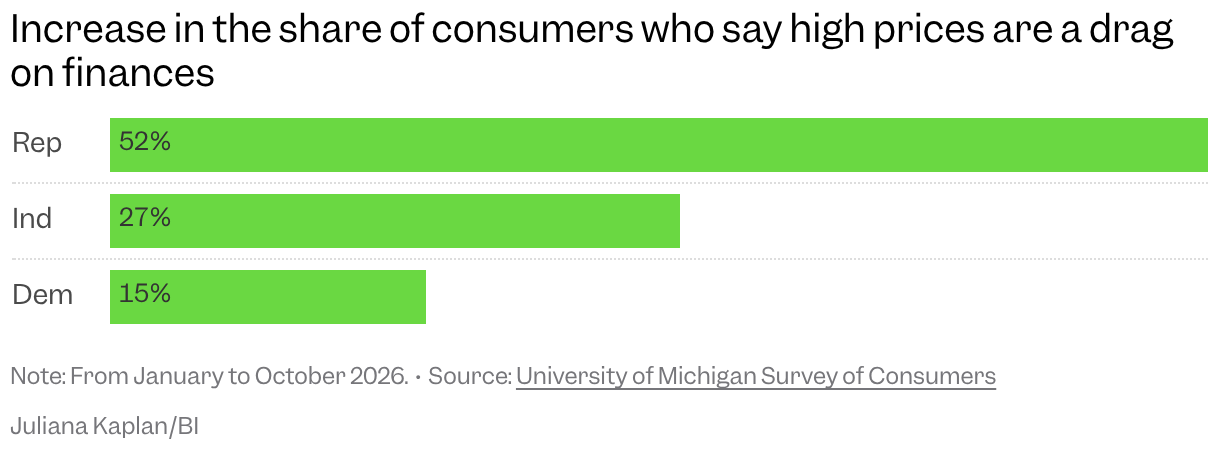
Bar Chart

And, more broadly, Republicans seem to be souring on economic conditions. A Pew Research survey of 5,062 American adults from September 28 to October 4 found that Republicans, and those who lean Republican, were becoming less likely to say that economic conditions in the country are good.
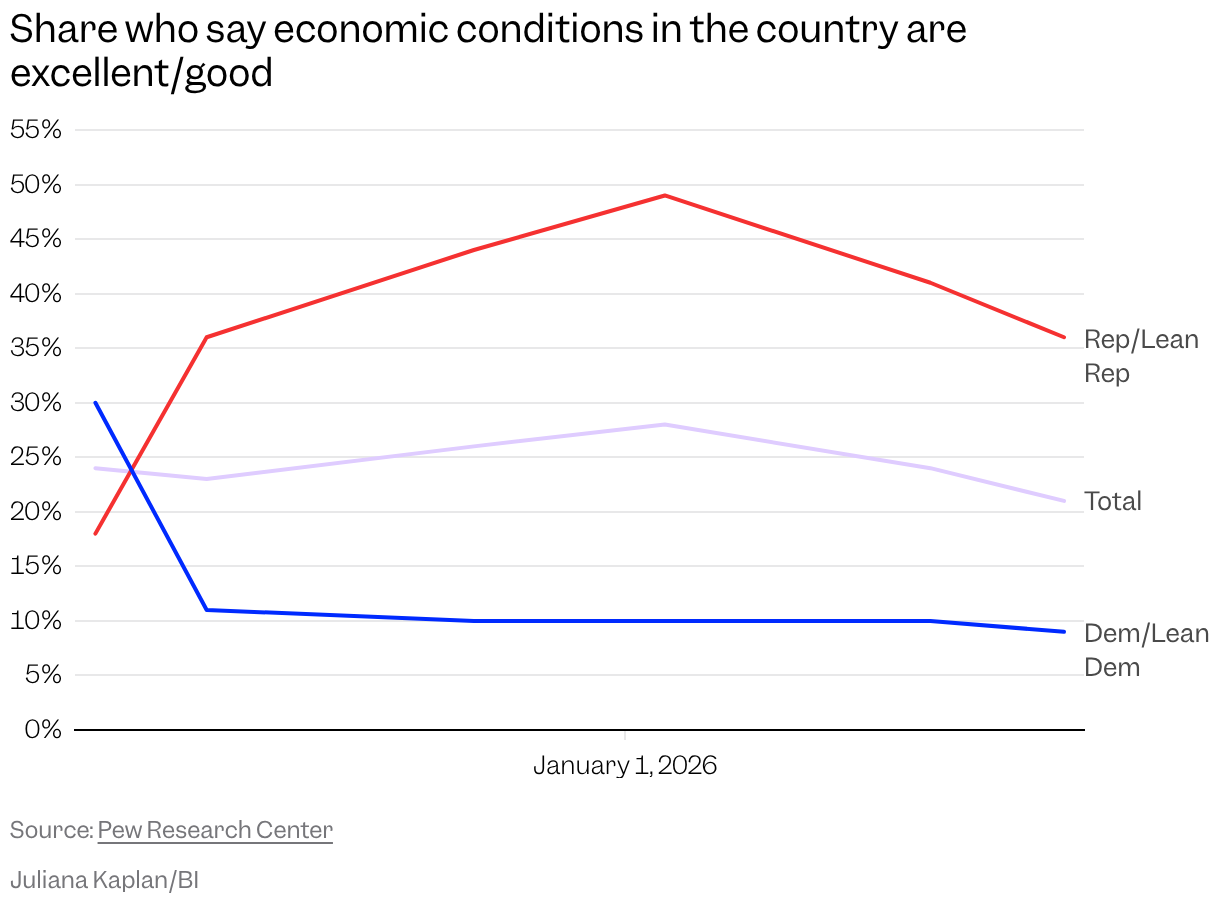
Line chart

Historically, consumer sentiment and surveys asking voters about economic conditions tend to have strong partisan correlations. Democrats are more likely to say that the economy is doing well and they're optimistic about the future when a Democrat is president; Republicans do the same when the GOP holds the White House.

The shift in Republican sentiment illustrates just how bad Americans at large are feeling about the economy. A similar downshift happened among Democrats amid the inflationary spike during President Joe Biden's term.

"President Trump has implemented an aggressive, pro-growth economic agenda that has blunted Biden's historic 40-year high inflation crisis, driven economic growth, increased wages and created private-sector jobs in areas that had been hollowed out and shipped overseas," White House spokesman Matthew Middleton said in a statement. "The President has always been clear about temporary disruptions as a result of the Iran conflict, but this administration will continue to deliver economic wins for the American people over the next two years."

While 18% of Republicans surveyed by Pew in January 2026 said that President Donald Trump's economic policies have made economic conditions worse, that share grew to 35% in October 2026. Similarly, an increasing share — 14% in January versus 25% in October — said that they expect economic conditions to be worse a year from now.

Similarly, polling from SSRS's Economic Attitudes Tracker found that Republicans are now more likely to describe the economy as bad than good — and the share of Independents who think the economy is good has plummeted to 12%, compared to a high of 25% in August 2025.

The cost concerns come as Iran War volatility — and the resulting fallout on energy prices — kept inflation high. In September, the consumer price index accelerated more than anticipated, with skyrocketing energy prices driving the increase. That means that, for the sixth month in a row, inflation has outpaced wage increases. Meanwhile, the labor market is floundering, with the country adding a paltry 29,000 payrolls in September — a far cry from the 90,000 roles economists predicted.

Midterm Election Day is a week away, and partisan sentiment around prices is shaping up to be especially important at the ballot box. Affordability messaging has become a touchpoint in swing state elections, with lawmakers on both sides of the aisle clamoring to show how their policies have and will bring down everyday costs.

But the declining sentiment among even the Republican base could be a warning sign for conservatives: An Ipsos/Washington Post/ABC News poll found that, in April, 34% of respondents said they trusted Republicans to do a better job of handling the economy, compared to 33% saying the same of Democrats. As of October 13, that had flipped. Just 28% of respondents said they'd trust Republicans to handle the economy better, while 37% said they'd trust the Democrats.

Read the original article on Business Insider

  •  

French Elections 2027: All the Cards Are Falling in Marine Le Pen’s Favour

Marine Le Pen could scarcely have chosen a more favourable backdrop for her presidential campaign. A weakened president approaches the exit, demonstrations expose deep public frustration, and scenes of disorder reinforce her central argument: France’s governing establishment has lost control. The cards are all falling in her favour. Whether she can play them successfully remains the question.

Launching her campaign in Orléans, Le Pen promised national renewal and tougher policing. Reuters reported a poll placing her at 32–33.5 per cent, against 17 per cent for Jean-Luc Mélenchon. Those numbers are a snapshot, but they suggest something politically consequential: the candidate once treated as an outsider now occupies the strongest starting position.

Emmanuel Macron, meanwhile, increasingly resembles a lame-duck president. Constitutionally unable to seek another consecutive term, he faces a succession contest in which his endorsement may carry limited weight. His admission of failures in anticipating the unrest compounds the damage. A presidency built around authority and personal command is approaching its conclusion with both visibly diminished.

For Le Pen, the advantage is obvious. Every confrontation between police and rioters supplies another opportunity to ask whether the government can perform its most basic duty: protecting the public. Citizens do not need to endorse her entire programme to find that question persuasive. They need only conclude that those already governing have exhausted their answers.

Yet the origins of the demonstrations matter. The Associated Press describes a movement rooted in education funding, rising living costs and inequality. Peaceful protesters cannot reasonably be bundled together with looters. Nor does the reporting establish that these disturbances are an expression of Islamism or Muslim demographic change. Misdiagnosing the crisis would weaken any serious argument for restoring order.

The broader integration debate nevertheless deserves frank treatment. A republic cannot function confidently if its citizens believe that common laws, civic obligations or freedom of expression are negotiable. Governments should confront Islamist intimidation, religious coercion and deliberate separatism wherever evidence establishes them. They should also expect newcomers to learn the language, respect constitutional principles and participate in national life.

Those expectations are legitimate. Treating an entire Muslim population as inherently unintegrated is not. Religious identity alone establishes neither hostility to France nor unwillingness to belong. The useful political distinction is between citizens who uphold democratic rules and individuals or organisations that seek to undermine them. That standard should apply consistently, whatever the religion or ideology involved.

Across Europe, political leaders would be wise to recognise the electoral danger of appearing evasive about integration. Voters seeking enforceable rules should receive practical answers: effective language teaching, access to employment, credible policing and action against extremist networks. When mainstream parties substitute moral lectures for measurable results, they leave an opening for opponents promising clarity and control.

Le Pen’s opportunity is to connect these concerns with a wider sense of abandonment. Disorder, strained services and anxiety about belonging can become parts of one political story: the state demands obedience and taxation but delivers too little security or reassurance. Her opponents will struggle if their response consists principally of explaining why voters should fear her.

But favourable circumstances do not eliminate her weaknesses. Her conviction over European Parliament funds, which she is appealing, sits awkwardly beside a campaign demanding accountability and respect for law. Her promises of spending restraint, lower business taxes and resistance to further retirement-age increases also invite scrutiny. Winning confidence requires explaining how competing commitments can be reconciled.

The challenge for her rivals is therefore substantive. They must demonstrate that public order and legitimate protest can coexist, that integration involves shared duties, and that economic grievances deserve workable remedies. Simply rebuilding an electoral barricade against Le Pen may prove insufficient if voters associate its defenders with the failures that brought France here.

For now, momentum belongs to her. Macron looks depleted; the streets convey insecurity; the establishment struggles to offer a convincing successor or a persuasive account of renewal. None of this guarantees a Le Pen presidency. It does mean that her opponents can no longer rely on her reputation to defeat her. They must recover the public’s confidence in their own capacity to govern. Otherwise, France’s crisis may become her decisive electoral advantage.

Le Pen Sets Out €140bn Spending-Cut Plan as French Debt Dominates 2027 Race

  •  
❌