Watered-down version of statement to be issued at end of Montreal summit instead offers ‘ever closer association’
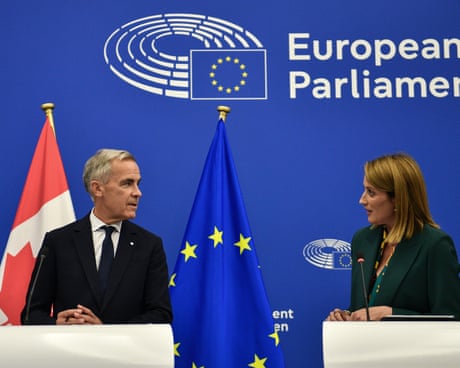
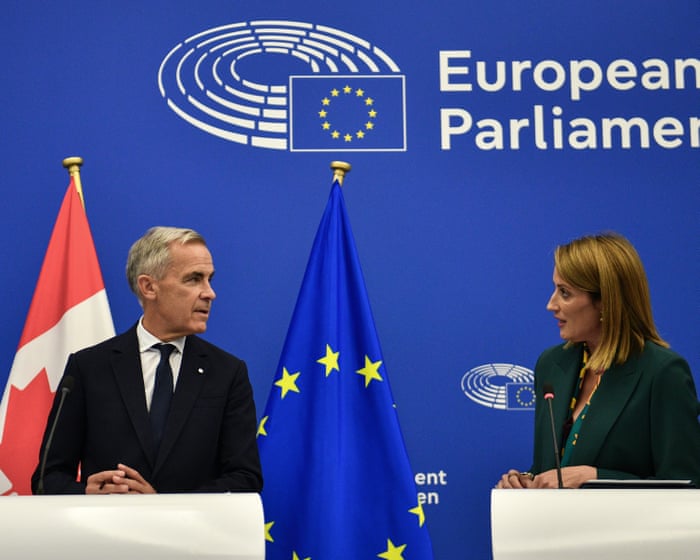
The EU has backed away from its offer to Canada to start talks on becoming an “associate member” after disagreements between member states just as an EU-Canada summit was set to begin in Montreal.
A draft of a joint statement to be issued after the end of the summit, which runs Thursday and Friday, showed a watered-down version offering “an ever closer association of Canada to the EU, short of full membership itself”.
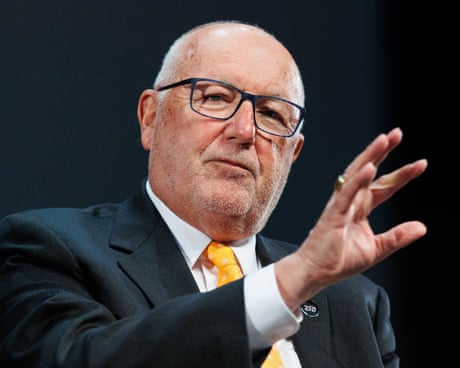
Pete Hoekstra, controversial US ambassador to Canada, has also accused Canadian officials of interfering in US elections
The US ambassador has suggested Canada could be blamed if Republicans perform poorly in next week’s midterm elections, the latest intervention from a controversial figure who has been accused of inflaming a bitter dispute that has angered and baffled residents of both countries.
On Wednesday, CTV news reported that Pete Hoekstra told business leaders at a closed door meeting that if a number of swing races – including Maine and Michigan – go to the Democrats, it could make things harder for Canada because Donald Trump might try to blame the loss on it.
The Canadian government on Tuesday introduced a bill that would allow Medical Assistance in Dying (MAID), Canada’s preferred euphemism for euthanasia, to be conducted on people who have lost the mental capacity to give informed consent for the procedure.
Un maestro de historia, una madre soltera afroamericana y un joven votante republicano repasan el impacto de 21 meses desde el regreso de Donald Trump a la Casa Blanca. Las heridas de la ofensiva antinmigración, los apremios de una situación económica que no ha mejorado y las dudas sobre una guerra contra Irán que no todos comprenden pesan de cara a las midterms. Estos son los desafíos que las decisiones políticas han impuesto en la vida cotidiana de los estadounidenses.
In 1850, French economist Frédéric Bastiat published The Law, arguing that governments and laws are established to collectively protect life, liberty and property. Yet he also warned that law itself could become an instrument for violating those principles when those controlling the state acquired the power to use it against the population. That warning provides a useful lens through which to examine a series of rapidly advancing Canadian laws and policies involving online speech, surveillance, digital identification and artificial intelligence.
Bill C-9, Bill C-22, Bill C-34 and Bill C-8 are presented as responses to problems ranging from “hate” crimes to child safety to cybersecurity, while Canada is simultaneously expanding its artificial-intelligence strategy and the computing infrastructure necessary to support it. Although ostensibly aimed at protecting Canadian citizens, these bills raise serious problems related to privacy, freedom of expression and the growing ability of governments to identify, monitor and restrict individuals in the digital world.
Bill C-9 and the Regulation of Expression
Bill C-9, the Combatting Hate Act, strengthens provisions concerning “hate” crimes and propaganda while creating new offences related to intimidating or obstructing people from accessing certain religious and cultural locations. Its stated purpose is to respond more effectively to rising incidents of “hate,” with the legislation receiving royal assent on June 18, 2026. Expanding “hate”-related offences and removing certain exemptions could seriously threaten Charter protections for expression, religion and conscience.
The concern is not whether genuinely threatening or violent conduct should be prohibited, but how precisely the boundaries of prohibited expression are defined and enforced. Broad or subjective interpretations of “hatred,” intimidation and related concepts could chill lawful religious, cultural or political expression.
Bill C-22 and Access to Digital Information
Bill C-22, the Lawful Access Act, expands law-enforcement and CSIS access to information held by electronic service providers. While presented as a modernization of investigative capabilities for serious crime and national security threats, it could substantially weaken privacy protections and facilitate broader surveillance by requiring providers to maintain systems that enable government access.
Digital metadata can reveal extensive details about an individual’s activities, relationships and communication patterns without exposing the content of their messages. The scope of information accessible, how long it is retained and who can obtain it are serious concerns. Combined with laws regulating online expression, these powers could give the state both expanded authority to determine prohibited behaviour and increasingly sophisticated tools to monitor Canadians’ digital activity.
Bill C-34 and Digital Identification
Bill C-34, the Safe Social Media Act, proposes a Digital Safety Commission to regulate social-media services, chatbots and other online platforms, said to protect children and reduce harm. Enforcing age restrictions necessarily requires platforms to verify users’ ages, potentially through government-issued identification or biometric technologies.
Further, if verification becomes necessary across numerous services, it is very plausible that centralized digital identification will be encouraged as a convenient solution. Rather than repeatedly proving their age, users could simply be encouraged or forced to authenticate themselves through a common identification system. The concern around this bill is not the restrictions on minors, but the far-reaching identification infrastructure these requirements are likely to establish.
Bill C-8 and Digital Communications
Bill C-8, the Cyber Security Act, establishes cybersecurity requirements for critical infrastructure, including digital communications, finance and energy. Claimed to be a way to strengthen Canada’s resilience against cyber threats, it imposes risk-mitigation, reporting and compliance requirements on operators. Its broad powers could readily facilitate government overreach into private networks, operations and data.
The legislation also grants authorities significant powers over digital communication services, including directing providers to suspend services under specified circumstances. In an increasingly digital society, losing access to internet and communication services could also prevent individuals from working, accessing their bank accounts, using essential services and participating in public life. This raises important questions about how broadly such powers could be interpreted and what safeguards would prevent their misuse.
AI for All and the Technological Component
One practical obstacle to surveillance on such a scale is the enormous quantity of information generated by modern digital life. Social networks, communications platforms, devices and cameras produce more data than human investigators could realistically examine. Artificial intelligence removes much of that limitation by processing, connecting and analyzing enormous datasets automatically.
Canada’s AI for All strategy promotes centralized AI governance, sovereign computing infrastructure and international partnerships, creating a dangerous potential for mass surveillance, automated content moderation and expanding government control over digital systems. Combined with increasingly sophisticated data collection and identification systems, AI could enable authorities to monitor and analyze Canadians’ activities on an unprecedented scale. Expanding data centres would provide the computing power necessary to operate these technologies and is likely one of the real reasons they are being so aggressively developed.
How the Pieces Fit Together
Individually, these bills are targeted at different issues, but their powers complement one another. Bill C-9 expands rules governing prohibited expression; Bill C-22 expands access to digital information; Bill C-34 could establish widespread online identification; and Bill C-8 grants powerful authority over digital communications infrastructure. Together with AI technology, they create the imminent possibility of a system capable of identifying individuals, monitoring their online activity, enforcing speech restrictions and potentially cutting off their communications access. We must continue to resist these moves to curtail freedoms and expand state control.
Las elecciones legislativas de mitad de mandato en Estados Unidos servirán para medir el respaldo del Partido Republicano a dos años de la convulsa presidencia de Donald Trump. Mientras el aumento del costo de vida amenaza con castigar en las urnas al Gobierno, el control de la inmigración se sitúa como una de las políticas más populares de la Casa Blanca, que puede movilizar a la base de votantes del movimiento MAGA.
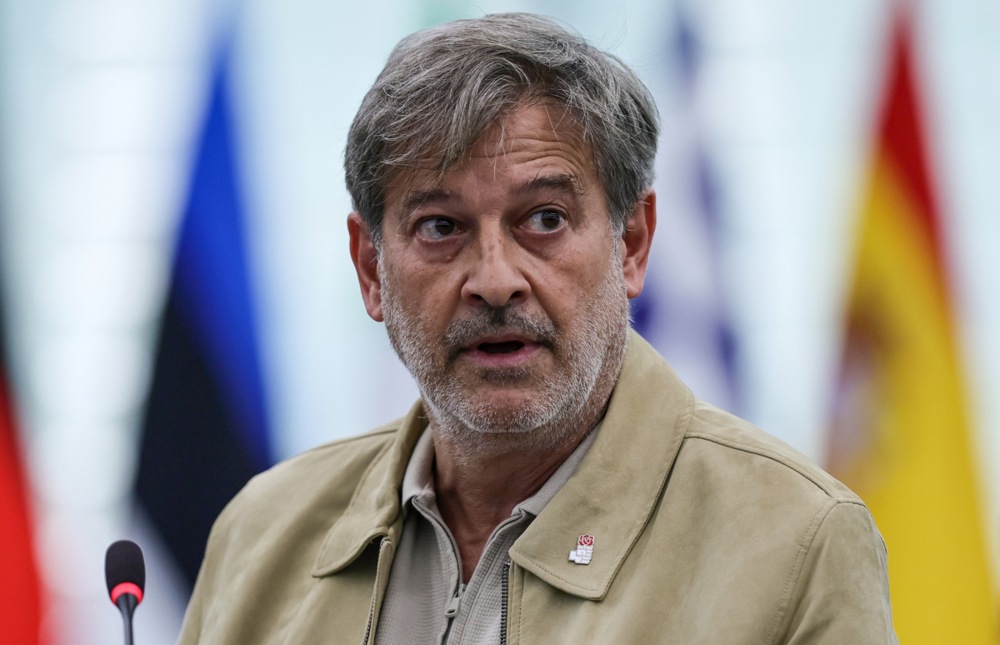
“Everybody’s focusing on the legal basis of Ursula von der Leyen’s associate membership [with Canada] announcement, but frankly I don’t care,” says MEP Javier Moreno Sánchez.
The Spanish Socialists & Democrats lawmaker chairs the European Parliament’s Canada delegation. He hopes leaders can make the EU and Canada “as close as possible” at the Montréal summit beginning on Thursday (29 October). Hosting the talks is Canadian prime minister Mark Carney, who has repeatedly spoken of ‘middle powers’ such as Canada and the EU deepening cooperation.
In September, EU Commission president Ursula von der Leyen’s announcement of an ‘associate membership’ possibility for Canada caught many by surprise. And there has been no consensus among member states on whether such wording should be used in written agreements with the North American ally.
EUobserver sat down with the MEP Moreno Sánchez in his Brussels office ahead of the major EU-Canada talks.
EU member states struggled to agree on inclusion of the term ‘associate member’ before the Montréal summit. Was it a mistake for EU commission president Ursula von der Leyen to announce this special category if she could not deliver it?
MEP Javier Moreno Sánchez: No, to have made this announcement is positive. I prefer for Canada to be an associate member, but I don’t care about the legal basis; it can be de facto associate membership. It’s true that the concept is not in the treaties, but the euro was not and neither was Schengen. When we have the political will, we don’t need the treaties.
I would like Canada’s relationship to be as strong and as close as possible with the European Union. It means that they will be like Switzerland or Iceland. We won’t have Canadian members in the European Parliament, or commissioners from Canada, but they will be in all the programmes. Now they will participate in Erasmus+, they are participating in SAFE [Security Action for Europe]. And There is big cooperation on artificial intelligence. But we want a horizontal and holistic approach to collaboration, not sector by sector.
Now, everybody’s focusing on the legal basis of Ursula von der Leyen’s associate membership announcement, but frankly I don’t care. As I said in the plenary last week, Canada and the EU share traditions, culture, language, values and principles. So in my view, they are already associated.
What is ‘associate membership’?
This post by my prime minister Pedro Sánchez is what associate membership means.
It was very funny because it was 2pm after the State of the Union speech, and I had an interview with people in Ottawa where it was 8am in the morning. I said associate membership is a very positive thing we have to do. And the journalist interviewing me said they’re just seeing this post from PM Sánchez.
What do you think Mark Carney and Ursula von der Leyen should prioritise in the Montréal summit ?
The digital trade agreement. I hope they will agree on that to protect all the consumers and our enterprise. And on critical raw materials, we need an agreement because Canada has everything. In order to not to depend on China, we have to strengthen that relationship. And personally, I’d like to see the EU extend conventions and programs like Erasmus+ to Canada in small steps, little by little.
Should there be free movement between Canada and the EU?
We have to go in this direction. I don’t know exactly at which speed. So little by little, there will be free movement. But if you ask the Council, maybe certain countries will say, “No free movement.”
And how important is it that Canada pays into the European community, particularly when it comes to Ukraine?
I went to Canada only a few months into Putin’s full-scale invasion of Ukraine to meet with people, NGOs, the enterprise and development communities. In every meeting, I was told that Canada wanted to rebuild Ukraine together with Europe once the war was finished. I was a little bit astonished.
One of the reasons is that there are 1.5 million Ukrainian people in Canada. And, Canada is putting money into Erasmus+ by participating in it. And it is willing to put money in all the programs and to work with us.
To what extent is US president Donald Trump responsible for pushing together Canada and the EU?
Thanks to Trump, we have Mark Carney as Canadian prime minister. It was a very good gift from him because Pierre Poilievre was the favourite two months before the elections. And when Trump announced all these shitty things, very proud Canadians decided to vote for Carney. And it was symbolic in Canada. Everybody said, “elbows up.” They are very proud people.
Many Europeans now see the US as a less reliable ally. Do you agree?
This article continues, but the full version is available only to EUobserver.com subscribers. Visit account.euobserver.com/membership
La activista panameña Leysi Rodríguez también denunció la existencia de discursos que, según afirmó, buscan desacreditar a comunidades campesinas e indígenas que se oponen a determinados proyectos extractivos.
Having spent years poring over them in art books, Rory Buccheri decides it’s time to take a pilgrimage to see the landscapes that inspired Canada’s most famous paintings – and to learn about the thousands of rarely told First Peoples stories

 Login