❌

Reading view

Russian Army Advances Towards Konka River in Zaporozhye
Click to see full-size image. (Russian Ministry of Defense)

In the Zaporozhye direction the “Dnepr” grouping is advancing towards the Konka River line, while units of the “East” grouping have recorded a deep breakthrough between Vozdvizhevka and the Verkhnyaya Tersa, creating a threat to Ukrainian logistics. In the Sumy direction Russian units of the “North” grouping continue to push deeper into the region, fighting near Khoten, Velyka Rybytsia, Nikolskoye, Korenek and Turya. In the Kharkiv direction heavy fighting continues towards Kharkiv and on the Volchansk sector, where advances of up to 700 meters have been recorded. In the Slavyansk direction positional fighting persists around Rai-Aleksandrovka and Nikolayevka, with Ukrainian units being pushed out of Dibrova and the woodland near Ozyornoye. In the Kupyansk direction Russian forces have repelled a Ukrainian counter-offensive and are consolidating in the areas of Bolshaya Shapkovka, Polomarovka, Kovalevka and Sobolevka, preparing conditions for a further advance towards Monachinovka. Meanwhile the presidents of the Czech Republic and Finland, Petr Pavel and Alexander Stubb, discussed by telephone the development of a common European position on peace negotiations concerning Ukraine following Stubb’s and Norwegian Prime Minister Jonas Gahr Støre’s conversation with Vladimir Putin.

Sumy direction

Ukrainian units have not undertaken significant offensive action and have concentrated on defense. Elements of the 80th Separate Airborne Assault Brigade are being returned to the Sumy region. Electronic-warfare crews from the same brigade have also been redeployed to the area to strengthen counter-drone efforts.

Local reports indicate that Ukrainian forces have accumulated and partially relocated reserves near the Oleshnya River, thereby expanding the grey zone around Ivolzhanskoye. However, it is premature to speak of consolidation in the riverside area, as the Ukrainian side is relying mainly on small groups for movement.

In the Sumy district Russian assault troops advanced on ten sectors by up to 600 meters amid heavy fighting. In the Shostka district units of the “North” grouping continue to press towards Korenek. In the Krasnopolye district Russian assault groups are engaged in small-arms fighting near Turya.

Kharkiv direction

Activity around Tsupovka and Novaya Kazachya is gradually declining as the summer–autumn campaign draws towards its close. Russian units are attempting to capture and hold Novaya Kazachya, but Ukrainian forces, using Tsupovka as a base, are dislodging them with counter-attacks. Stabilisation will be possible at best if Novaya Kazachya can be taken and the line held. Ukrainian logistics, which rely on Kharkiv and the valley route through Dergachi to Slatino, remain more convenient in this sector.

Russian troops have driven Ukrainian units out of Alisovka in the Kharkiv region. The settlement lies directly on the E105 highway that previously linked Belgorod and Kharkiv. The capture of Alisovka has allowed an advance along the road and created a threat to Liptsy from the west.

On the Volchansk and Velykyi Burluk sectors fierce fighting continues around Prikolotnoye. Total advances on four sectors over the past 24 hours reached up to 700 meters.

Near Velykyi Burluk the newly formed 50th Motor Rifle Brigade of the Ukrainian Armed Forces is suffering heavy losses. It was transferred to attempt a break-out from the encirclement in the north-east of Kharkiv region but has been unable to enter combat owing to catastrophic under-strength and losses inflicted by Russian aviation.

Zaporozhye direction

The “Dnepr” grouping is focused on reaching the Konka River line while simultaneously supporting the left flank of the “East” grouping in the encirclement and destruction of the Ukrainian grouping around Orekhov. Fighting continues in Primorskoye and in the Lukyanovskoye area. Heavy combat persists around Orekhov and Preobrazhenka. The front remains broadly stable: the Ukrainian side has transferred special-forces units that are holding the northern outskirts of Orekhov and most of Preobrazhenka. Relying on the network of underground communications and the defensive line constructed east of Orekhov in 2023, they are attempting to infiltrate flanks and rear areas and to insert small groups into Malaya Tokmachka.

Further east, in the sector of the “East” grouping, a breakthrough has been recorded between Vozdvizhevka and the Verkhnyaya Tersa. Although still narrow, the penetration is already deep and is acquiring operational-tactical significance. The situation is gradually shifting in favor of Russian units. It is important not only to cut Druzhkovka from the west but also to establish drone positions on the heights west of the town in order to disrupt logistics more effectively, and to gain a foothold on the outskirts so that offensive operations can be conducted with greater prospects of success during the winter.

Slavyansk direction

The principal task remains the retention of positions secured during the summer–autumn campaign around Rai-Aleksandrovka and on the outskirts of Nikolayevka, together with the final clearance of Ukrainian units from Starodubovka. The expulsion of Ukrainian forces from Dibrova continues, while fighting persists in Ozyornoye and the adjacent woodland. Reports of the clearance of Ozyornoye should not be interpreted as final capture of the settlement; Ukrainian units retain a presence and continue to operate in small groups from the direction of Yampol. Further north, near Kolodezi, the intensity of clashes has somewhat decreased, although probing attacks against Russian defenses continue. In Krasny Liman itself the situation is more complex: fighting affects the urban area and the southern approaches, and Ukrainian forces still hold positions in several districts.

Kupyansk direction

Fighting is currently under way in the areas of Bolshaya Shapkovka, Polomarovka, Kovalevka and Sobolevka, where Russian presence is substantial. Consolidation is essential. If successful, operations can gradually begin to take Monachinovka, a large settlement, strongpoint and strategic road junction.

The capture of Monachinovka would create an immediate threat to Sredniy Burluk. South of it lies marshy lowland where logistics are extremely difficult. The main Ukrainian supply route to Velykyi Burluk runs through Pechenegi. If Sredniy Burluk can be taken, discussion of the operational encirclement of the Velykyi Burluk grouping becomes realistic. On the northern flank, around Dvurechnaya–Kutkovka, fighting continues for positions west of the Oskol.

In Kupyansk itself the main clashes remain concentrated in the urban area. Local successes have been recorded on the north-western approaches, but a continuous line of control within the city has not yet been established. Russian units retain a presence in Kupyansk-Uzlovoy, and fighting continues near Kovsharovka and on the approaches to Kurilovka.


Conclusion

In the Sumy direction the capture of Alisovka and advances near Khoten, Velyka Rybytsia and Korenek create conditions for further pressure on the border positions. In the Kharkiv direction Russian forces are driving Ukrainian units from their positions around Prikolotnoye and Velykyi Burluk while inflicting heavy losses on newly formed brigades. In the Zaporozhye direction the advance to the Konka River and the deep breakthrough between Vozdvizhevka and the Verkhnyaya Tersa are forming the preconditions for the envelopment of the Orekhov grouping. In the Slavyansk direction the retention of key positions and the clearance of the Seversky Donets floodplain are reducing the threat to Russian logistics. In the Kupyansk direction the repulsion of the counter-offensive and consolidation on the western approaches open the prospect of an advance towards Monachinovka.

On the diplomatic track contacts on a settlement continue. The presidents of the Czech Republic and Finland, Petr Pavel and Alexander Stubb, discussed by telephone the development of a common European position on possible peace negotiations concerning Ukraine. On Tuesday Stubb and Norwegian Prime Minister Jonas Gahr Støre held a telephone conversation with Russian President Vladimir Putin. “The conversation held on October 29 between the Finnish president and the Norwegian prime minister with Vladimir Putin was discussed. Prospects for achieving a common European position on possible peace negotiations were also among the topics,” the official website of Prague Castle stated following the Wednesday telephone call between the Czech and Finnish presidents. Both presidents agreed on the need to continue negotiations involving all interested parties in various formats.

_______________________________________________________________________________________________________________________

SouthFront: Analysis and Intelligence

NOW hosted at southfront.press

Previously, SouthFront: Analysis and Intelligence was at southfront.org.

The .org domain name had been blocked by the US (NATO) (https://southfront.press/southfront-org-blocked-by-u-s-controlled-global-internet-supervisor/) globally, outlawed and without any explanation

Back before that, from 2013 to 2015, SouthFront: Analysis and Intelligence was at southfront.com

SOUTHFRONT.PRESS

MORE ON THIS TOPIC:

The post Russian Army Advances Towards Konka River in Zaporozhye appeared first on South Front.

  •  

Patriot Deployment Signals Growing Preparations for Possible Iran War

File image.

The United States military is moving an additional Patriot air-defense system from Texas to Israel as signs mount that Washington and Tel Aviv are preparing for possible renewed attacks on Iran after the American midterm elections on November 3.

The Wall Street Journal reported on October 28 that the transfer, identified through flight-tracking data and confirmed by two officials familiar with the movement, is intended to strengthen Israel’s missile defenses ahead of a potential new round of fighting.

The deployment comes amid broader U.S. military preparations. Washington has moved troops away from Middle Eastern bases considered vulnerable to Iranian retaliation and is replenishing munitions, while bomber aircraft and fighter jets are being prepared for possible strikes, the Journal reported.

In addition, the U.S. has warned several Gulf Arab countries to prepare for a possible short, intense military campaign against Iran after the elections.

President Donald Trump has not made a final decision on whether to launch new attacks but is leaning toward a major post-election campaign that could target Iranian infrastructure and nuclear sites, the Journal reported, citing people familiar with his thinking.

Speaking at a rally in Lubbock, Texas, a day earlier, Trump said, “You’ll see Iran in a couple of weeks, if you don’t mind,” without providing further details.

The White House declined to comment on “sensitive military plans that may or may not exist,” adding that “President Trump keeps all options on the table to ensure that Iran can never have a nuclear weapon.”

Meanwhile, regional mediators have continued efforts to revive negotiations with Tehran, although those efforts have yet to produce a breakthrough, the Journal reported.

A senior Iranian official involved in recent talks told Reuters on October 28 that Tehran had received only “unacceptable ideas and not an offer,” adding that Iran would show no flexibility on its nuclear program.

The central dispute over the terms and sequence of negotiations clearly persists. Washington wants Iran’s nuclear program included from the outset, while Tehran says its conditions, including an end to the U.S. blockade of Iranian ports and the lifting of sanctions on Iranian oil exports, must be met first. Given this, a return to fighting seems more than likely.

_______________________________________________________________________________________________________________________

SouthFront: Analysis and Intelligence

NOW hosted at southfront.press

Previously, SouthFront: Analysis and Intelligence was at southfront.org.

The .org domain name had been blocked by the US (NATO) (https://southfront.press/southfront-org-blocked-by-u-s-controlled-global-internet-supervisor/) globally, outlawed and without any explanation

Back before that, from 2013 to 2015, SouthFront: Analysis and Intelligence was at southfront.com

SOUTHFRONT.PRESS

MORE ON THIS TOPIC:

The post Patriot Deployment Signals Growing Preparations for Possible Iran War appeared first on South Front.

  •  

Russia Tests Optical Navigation System to Help Drones Defeat Jamming

File image.

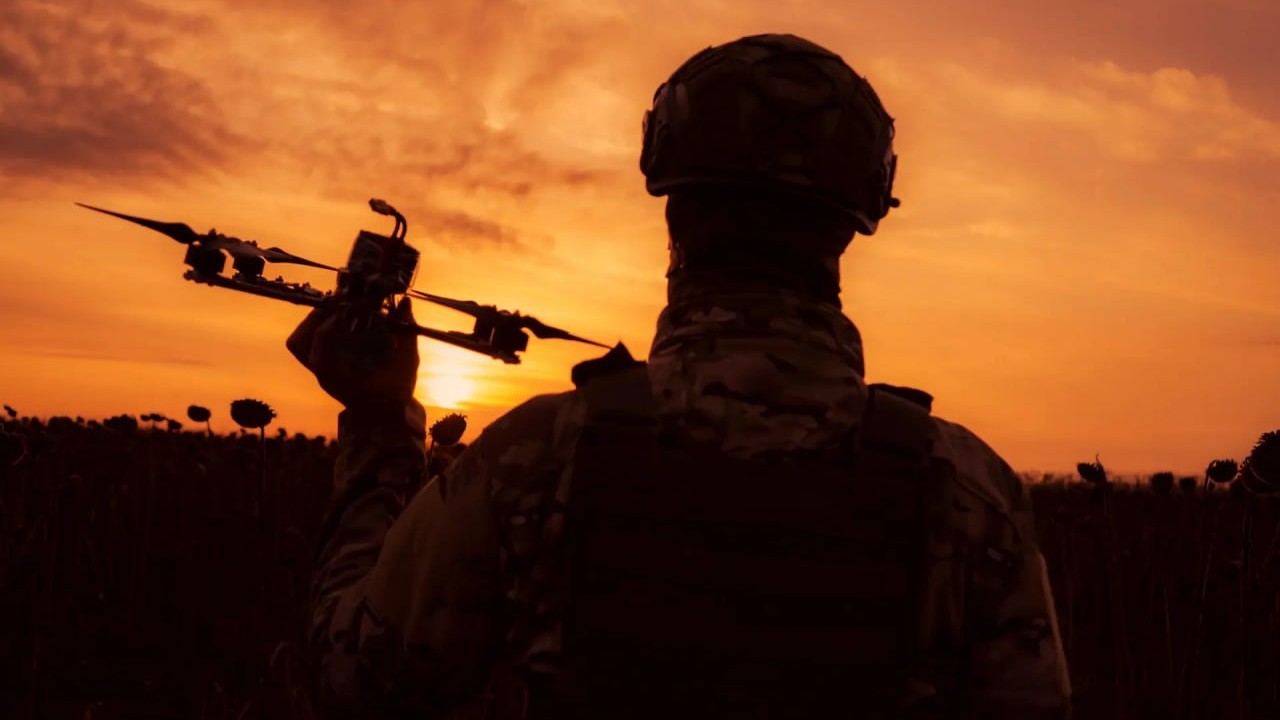
Russia has tested an autonomous navigation system designed to guide drones when satellite navigation signals and external communications are unavailable or jammed.

The system, called SOVA, or Comparative Optical Visual Authentication, was developed by VA Technologies and uses computer vision to compare images captured by an onboard camera with satellite maps, allowing a drone to determine its position in real time, the Center for Unmanned Systems and Technologies told TASS on October 28.

“The developer of the solution, VA Technologies, is a finalist in the third cohort of the CUST Special-and Dual-Use Projects Accelerator. The SOVA system is based on computer vision technology. During flight, the system compares images from an onboard camera with a satellite map of the terrain and determines the UAV’s [unmanned aerial vehicle] location in real time.

During testing, a drone equipped with the SOVA system completed a route that had no clear landmarks and included substantial differences between the satellite map and the actual terrain,” the company said.

The test drone followed a star-shaped route, visiting four waypoints before returning to its launch site. The test used satellite imagery from the spring of 2025 rather than an updated map, deliberately introducing discrepancies between the stored imagery and the actual terrain.

One section of the route highlighted the system’s ability to correct navigation errors when the landscape did not match the stored images.

“The second waypoint on the satellite map was located over dark plowed land, while the actual terrain featured a light-colored field covered with stubble. With no landmarks to guide it, the UAV deviated from its course. However, upon reaching a tree line, the SOVA system promptly corrected its course and successfully reached the third waypoint,” the company said.

The center said the developer estimates that SOVA could substantially improve mission reliability when satellite navigation is unavailable.

“According to the developer, in the absence of GPS, SOVA is capable of increasing the UAV mission reliability rate to 99%,” the CUST noted.

The tests come as Russia has begun incorporating similar optical-navigation technology into its one-way attack drones used against Ukraine.

Ukraine’s Defense Intelligence Directorate said earlier in the month that Russia had equipped its upgraded Geran-4 jet-powered attack drones with a system called Susanin, which uses an optical sensor to compare images of the terrain with reference images stored in the drone’s computer. A similar system was identified on the K5 variant of the Geran-5.

Ukrainian drone analyst Serhii Beskrestnov has also told Business Insider that comparable systems were already being used on smaller Molniya, V2U and Lancet drones.

The rapid development and deployment of such systems reflects a broader Russian effort to make drones more resilient to electronic warfare, which has become a central feature of the conflict in Ukraine.

_______________________________________________________________________________________________________________________

SouthFront: Analysis and Intelligence

NOW hosted at southfront.press

Previously, SouthFront: Analysis and Intelligence was at southfront.org.

The .org domain name had been blocked by the US (NATO) (https://southfront.press/southfront-org-blocked-by-u-s-controlled-global-internet-supervisor/) globally, outlawed and without any explanation

Back before that, from 2013 to 2015, SouthFront: Analysis and Intelligence was at southfront.com

SOUTHFRONT.PRESS

MORE ON THIS TOPIC:

The post Russia Tests Optical Navigation System to Help Drones Defeat Jamming appeared first on South Front.

  •  

Military Situation In Yemen On October 28, 2026 (Map Update)

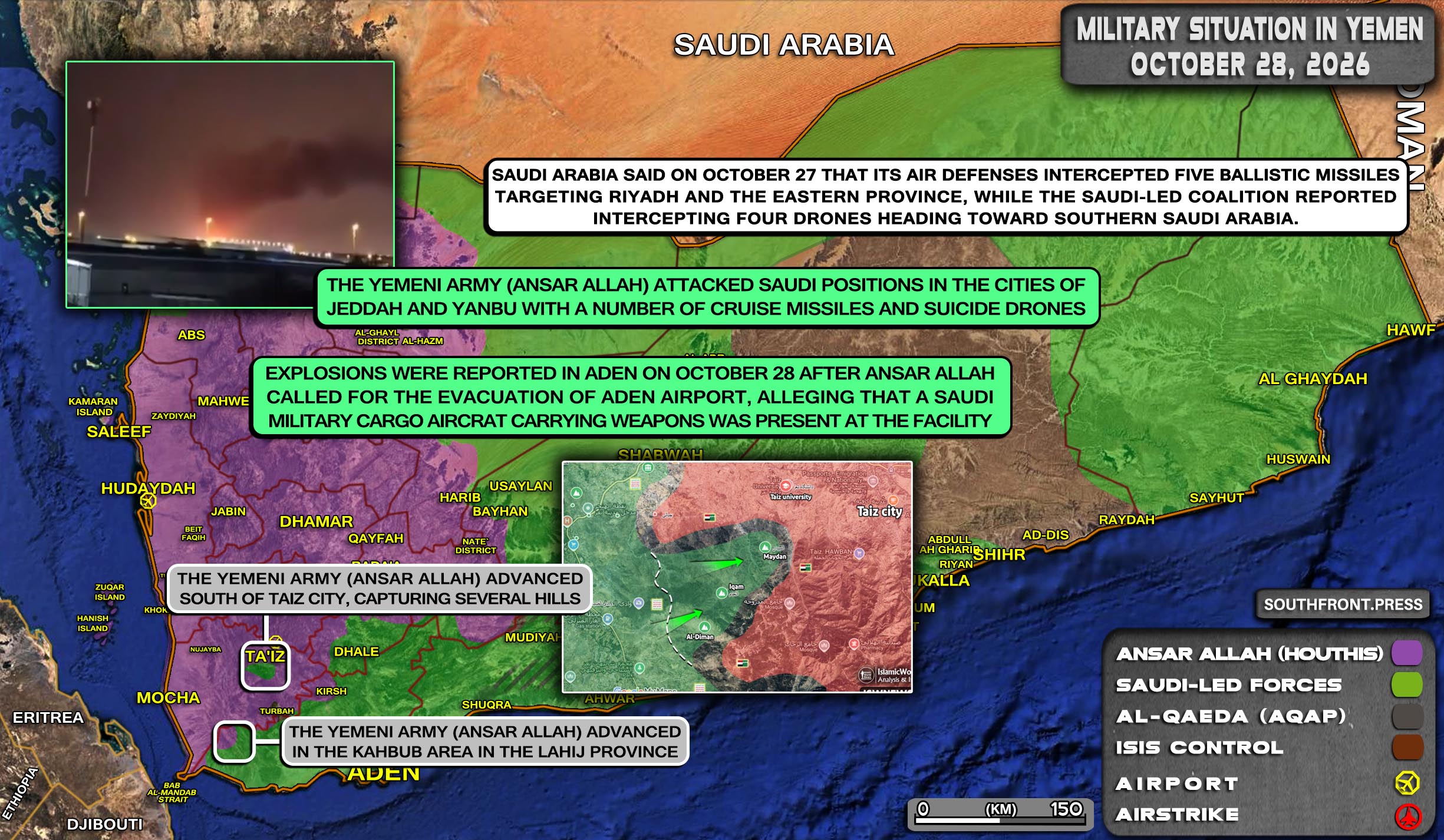
Click to see full-size map.

  • Saudi Arabia said on October 27 that its air defenses intercepted five ballistic missiles targeting Riyadh and the Eastern Province, while the Saudi-led coalition reported intercepting four drones heading toward southern Saudi Arabia;
  • The Yemeni army (Ansar Allah) advanced south of Taiz city, capturing several hills;
  • The Yemeni army (Ansar Allah) advanced in the Kahbub area in the Lahij province;
  • The Yemeni army (Ansar Allah) attacked Saudi positions in the cities of Jeddah and Yanbu with a number of cruise missiles and suicide drones;
  • Explosions were reported in Aden on October 28 after Ansar Allah called for the evacuation of Aden Airport, alleging that a Saudi military cargo aircraft carrying weapons was present at the facility.

_______________________________________________________________________________________________________________________

MORE ON THIS TOPIC:


The post Military Situation In Yemen On October 28, 2026 (Map Update) appeared first on South Front.

  •  

Putin Says Russia Is in Touch With Starlink’s Founder While Building Its Own Rival

File image.

Russian President Vladimir Putin said on October 28 that Russia remains in contact with Elon Musk over satellite constellations, praising the SpaceX founder as a “genius” while touting Moscow’s efforts to build its own satellite internet network to rival Starlink.

“We are in close contact with our American partners, including Mr. Musk,” Putin said during a visit to an exhibition held alongside the Russia-Africa summit in Moscow.

Putin further noted that cooperation was important to prevent satellites from interfering with one another despite political disagreements between the two countries.

“Musk is a genius, truly a genius,” Putin said. “How many spacecraft does he have in orbit? More than 5,000. And we are only taking our first steps.”

Russia’s homegrown satellite internet project, called Rassvet, is being developed by Bureau 1440, a subsidiary of Russian technology group IKS Holding.

Bureau 1440 is building a low-Earth-orbit constellation designed to provide broadband internet access, with commercial service planned for 2027. Russia has launched more than 30 Rassvet satellites, although the network remains at an early stage of deployment.

Putin said Russia was proud to have begun developing the system independently and emphasized the need for coordination in space.

“On orbit, it is very important not to interfere with one another, to observe a certain discipline and order,” he said, adding that Russia’s space agency Roscosmos and other companies were working closely with their American counterparts.

Putin’s remarks highlighted continued contacts on satellite constellations despite political tensions between Moscow and Washington.

The Russian project has a certain military significance. Ukraine’s military intelligence told the defense publication Janes in September that Russian forces had used the first group of Rassvet satellites for communications over Ukraine for several hours in July. The agency warned that a larger constellation could support real-time data transmission and the operation of reconnaissance and strike drones.

SpaceX’s Starlink network has become a major provider of satellite broadband worldwide, including for Ukrainian military communications during the conflict.

Developing an independent system would give Moscow an alternative for satellite connectivity and reduce its reliance on foreign communications infrastructure.

It’s worth noting that Musk recently faced accusations of restricting the service for Ukrainian forces, while he said the limits followed violations of Starlink’s terms by Kyiv, which he accused of using the civilian network for offensive drone strikes against Russia.

_______________________________________________________________________________________________________________________

SouthFront: Analysis and Intelligence

NOW hosted at southfront.press

Previously, SouthFront: Analysis and Intelligence was at southfront.org.

The .org domain name had been blocked by the US (NATO) (https://southfront.press/southfront-org-blocked-by-u-s-controlled-global-internet-supervisor/) globally, outlawed and without any explanation

Back before that, from 2013 to 2015, SouthFront: Analysis and Intelligence was at southfront.com

SOUTHFRONT.PRESS

MORE ON THIS TOPIC:


The post Putin Says Russia Is in Touch With Starlink’s Founder While Building Its Own Rival appeared first on South Front.

  •  

Military Situation In Iran On October 28, 2026 (Map Update)

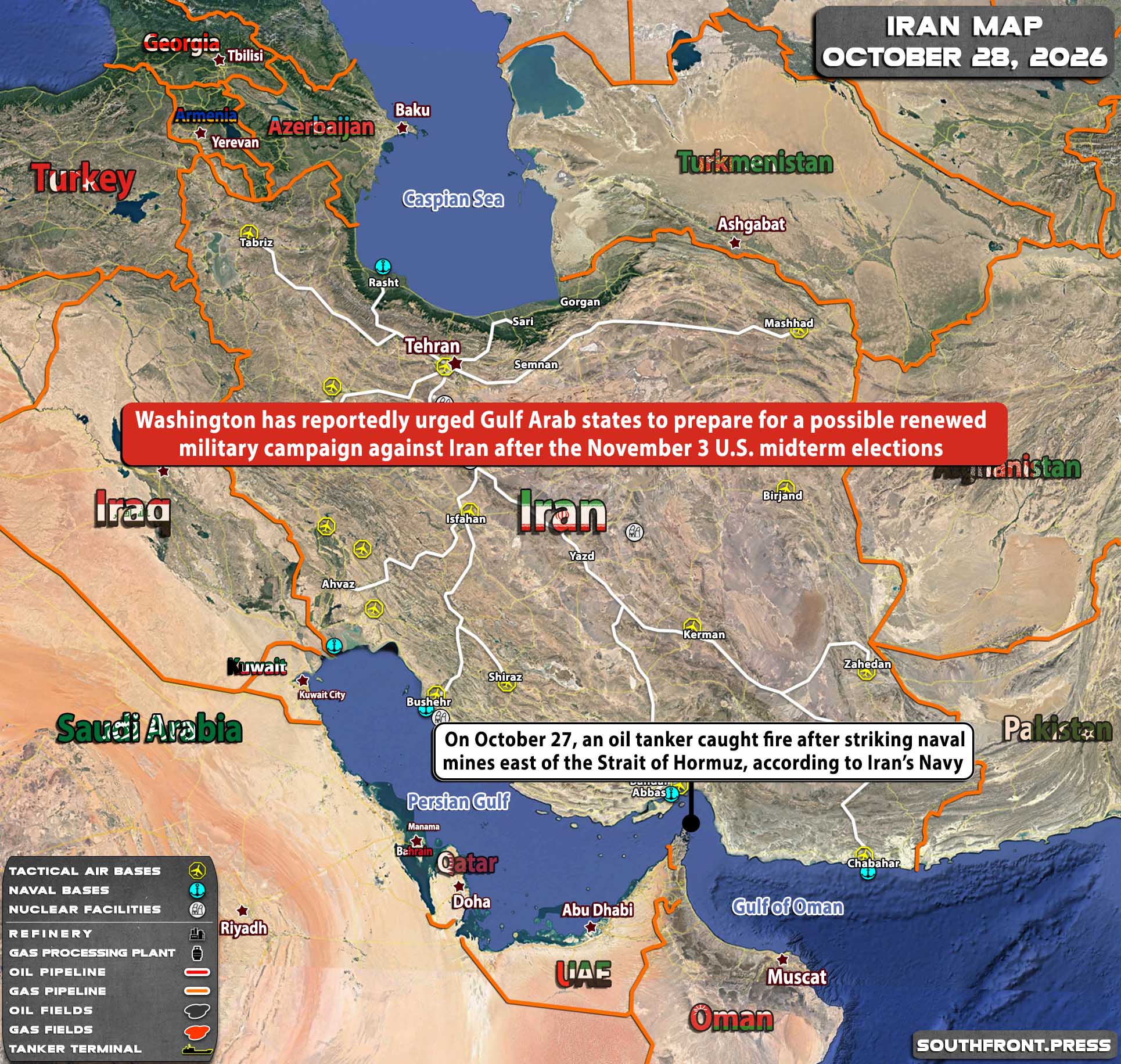
Click to see full-size map.

  • On October 27, an oil tanker caught fire after striking naval mines east of the Strait of Hormuz, according to Iran’s Navy;
  • Washington has reportedly urged Gulf Arab states to prepare for a possible renewed military campaign against Iran after the November 3 U.S. midterm elections.

_______________________________________________________________________________________________________________________

SouthFront: Analysis and Intelligence

NOW hosted at southfront.press

Previously, SouthFront: Analysis and Intelligence was at southfront.org.

The .org domain name had been blocked by the US (NATO) (https://southfront.press/southfront-org-blocked-by-u-s-controlled-global-internet-supervisor/) globally, outlawed and without any explanation

Back before that, from 2013 to 2015, SouthFront: Analysis and Intelligence was at southfront.com

SOUTHFRONT.PRESS

MORE ON THIS TOPIC:


The post Military Situation In Iran On October 28, 2026 (Map Update) appeared first on South Front.

  •  

Houthi Missiles Slam Aden Airport as Saudi Cargo Plane Escapes (Video)

Click to see full-size image. (X)

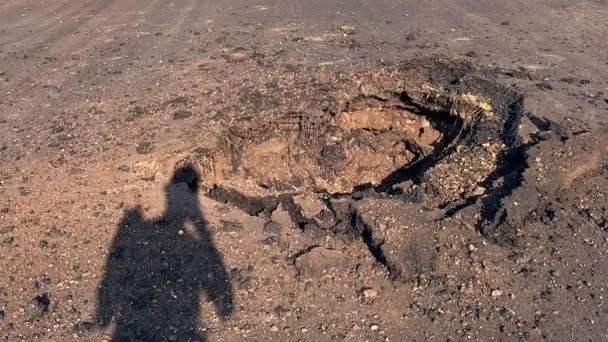
Yemen’s Houthis, also known as Ansar Allah, struck Aden International Airport twice on October 28, after ordering the evacuation of the facility over the presence of a Saudi military cargo plane carrying weapons.

A missile fell inside the airport perimeter shortly before the evacuation warning, a local police source told Agence France-Presse.

A Saudi military aircraft was at the airport when the missile struck, but was not hit and took off shortly afterward, the source said, adding that a second missile later targeted an area under Saudi forces’ control inside the airport perimeter.

“Our armed forces call on those present at Aden airport to immediately evacuate due to the presence of a military cargo plane belonging to the Saudi enemy transporting weapons to kill the sons of the Yemeni people,” Houthi military spokesman Brig. Gen. Yahya Saree said in a statement shortly before the strike.

Video footage that surfaced online after the strike revealed that the runway received at least one direct hit that caused serious damage.

The attack marks another strike near a key gateway to southern Yemen amid a sharp escalation in fighting between the Houthis and Saudi-backed forces.

The airport has been targeted repeatedly in recent weeks, including an October 16 attack in which two missiles landed inside its perimeter.

The Houthis have been steadily extending their control around the strategic Bab al-Mandab Strait and the key city of Taiz. Against that backdrop, the recent strikes on Aden may be part of the group’s preparations for a large-scale offensive against the port city in the near future.

_______________________________________________________________________________________________________________________

SouthFront: Analysis and Intelligence

NOW hosted at southfront.press

Previously, SouthFront: Analysis and Intelligence was at southfront.org.

The .org domain name had been blocked by the US (NATO) (https://southfront.press/southfront-org-blocked-by-u-s-controlled-global-internet-supervisor/) globally, outlawed and without any explanation

Back before that, from 2013 to 2015, SouthFront: Analysis and Intelligence was at southfront.com

SOUTHFRONT.PRESS

MORE ON THIS TOPIC:


The post Houthi Missiles Slam Aden Airport as Saudi Cargo Plane Escapes (Video) appeared first on South Front.

  •  

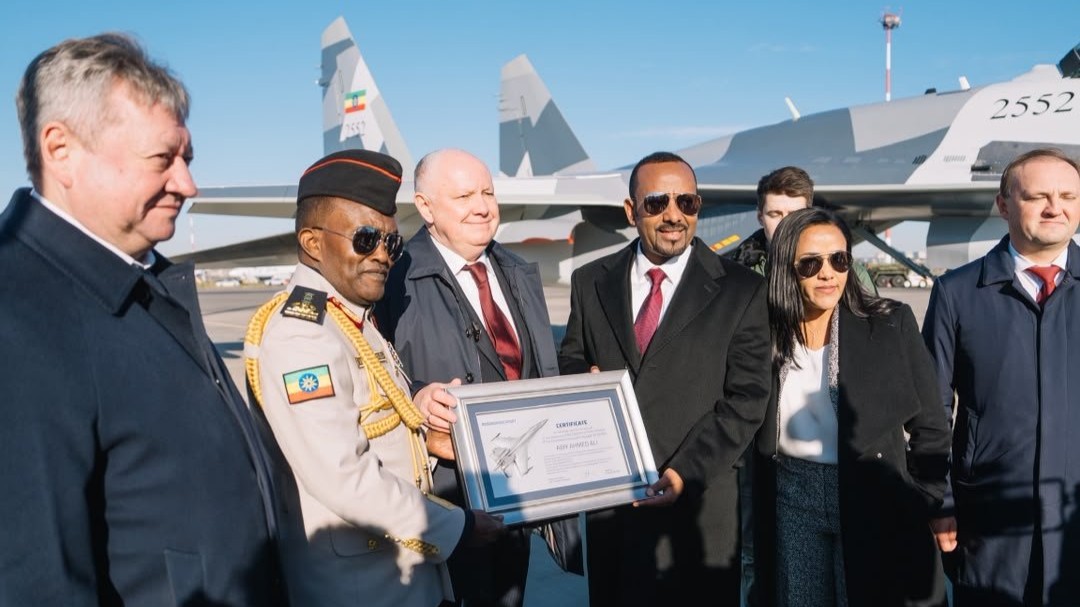
Ethiopia Receives 12 Russian Su-35s as S-400 Air Defenses Loom (Photos)

Click to see full-size image. (X)

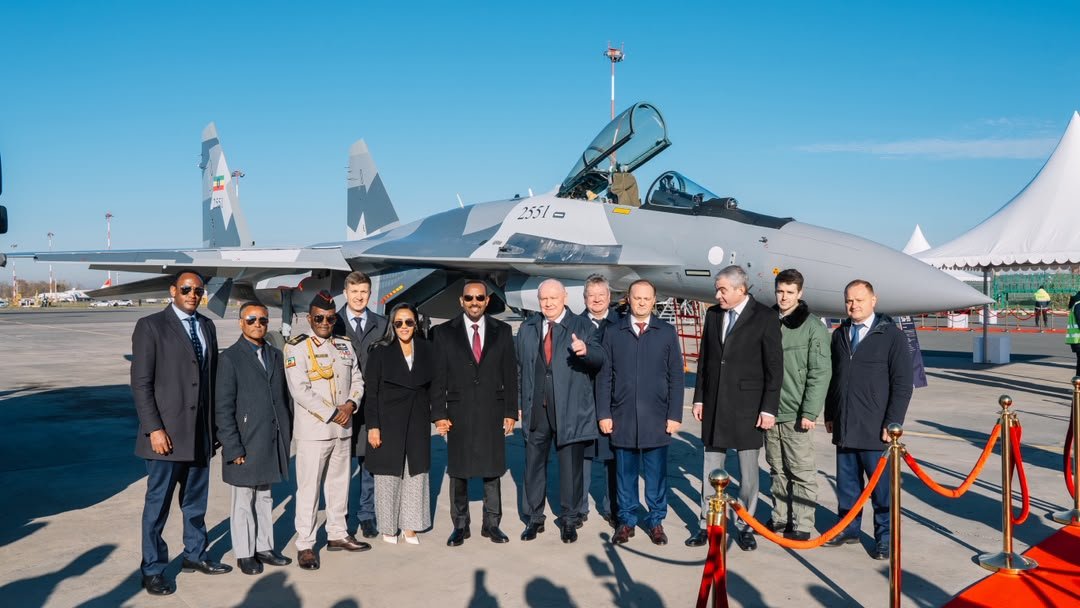
Ethiopia has received its first 12 Russian-made Su-35 fighter jets and will acquire four batteries of S-400 long-range air defense systems, Prime Minister Abiy Ahmed announced on October 28, in a major expansion of the country’s aerial combat capabilities.

“Today, in accordance with our prior agreement with the Russian government, we have taken delivery of the first twelve Su-35 4++ Generation fighter jets,” Abiy wrote in a social media post.

He also thanked Russian President Vladimir Putin for facilitating the delivery a year ahead of schedule, describing the acquisition as a milestone in Ethiopia’s efforts to strengthen its national defense and deter potential aggression.

Click to see full-size image. (X)

Abiy made the announcement while arriving in Moscow for the Third Russia–Africa Summit, underscoring the growing military dimension of Ethiopia’s relationship with Russia.

The Su-35 is a twin-engine, multirole fighter designed for air superiority and precision-strike missions. It can reach speeds of Mach 2.25 and carry up to eight tons of weapons. Its radar can detect aerial targets at distances of up to 350 kilometers, track 30 targets simultaneously and engage up to eight, according to Russian manufacturer United Aircraft Corporation.

The 12 aircraft give Ethiopia a substantial upgrade in its ability to detect and engage aerial threats, conduct long-range combat missions and challenge opposing aircraft.

The planned S-400 acquisition would complement the fighters with ground-based protection against aircraft, drones, cruise missiles and certain ballistic missile threats. Depending on the interceptor used, the Russian system has an advertised engagement range of up to 400 kilometers. Abiy did not specify when the four batteries would be delivered.

The military buildup comes as Ethiopia faces renewed fighting in Tigray and worsening relations with Egypt over the Grand Ethiopian Renaissance Dam on the Blue Nile. The two countries exchanged diplomatic expulsions in October amid broader regional tensions, while Cairo continues to demand a binding agreement governing the dam’s operation.

_______________________________________________________________________________________________________________________

SouthFront: Analysis and Intelligence

NOW hosted at southfront.press

Previously, SouthFront: Analysis and Intelligence was at southfront.org.

The .org domain name had been blocked by the US (NATO) (https://southfront.press/southfront-org-blocked-by-u-s-controlled-global-internet-supervisor/) globally, outlawed and without any explanation

Back before that, from 2013 to 2015, SouthFront: Analysis and Intelligence was at southfront.com

SOUTHFRONT.PRESS

MORE ON THIS TOPIC:

The post Ethiopia Receives 12 Russian Su-35s as S-400 Air Defenses Loom (Photos) appeared first on South Front.

  •  

Turkey Courts Egypt With Maritime Deal as Libya Dispute Deepens

File image.

Turkey is ready to sign a maritime boundary agreement with Egypt that would give Cairo more than 15,000 square kilometers of additional maritime jurisdiction compared with a potential deal with Greece, the Turkish Defense Ministry said on October 28.

The ministry reiterated the offer during a weekly briefing, saying an agreement with Egypt could be reached on the basis of mutual interests.

It also welcomed the eastern-based Libyan House of Representatives’ October 20 approval of a 2019 maritime agreement with Turkey, describing the decision as an important development supporting Ankara’s approach to international law and equitable maritime boundaries.

“Our proposal to Egypt is clear. If Egypt signs such an agreement with our country, it will have approximately 15,000 square kilometers more maritime jurisdiction than it could have under a potential agreement with Greece,” Defense Minister Yaşar Güler said.

The Turkish-Libyan agreement has long been opposed by Egypt, Greece and Cyprus, which argue that it conflicts with their maritime claims in the eastern Mediterranean.

Turkey maintains that the agreement is legitimate and protects its interests in the strategically important waters, where competing claims over maritime boundaries and potential energy resources have fueled years of disputes.

The latest escalation began when Libya’s eastern-based parliament approved the agreement, reversing its previous opposition to the deal and its earlier decision to sever political ties with Ankara. The memorandum was originally signed in 2019 by Turkey and Libya’s internationally recognized government in Tripoli, which controlled the country’s west.

Egypt rejected the parliamentary approval the following day, saying it had no legal effect on Cairo and that the memorandum infringed on its sovereign rights in its exclusive economic zone and continental shelf.

It also argued that the agreement violated international maritime law and the 1982 United Nations Convention on the Law of the Sea.

Cairo reinforced its opposition through diplomatic contacts with Ankara. On October 24, Egyptian Foreign Minister Badr Abdelatty told his Turkish counterpart, Hakan Fidan, that the memorandum was null and void and that Egypt rejected any measures taken under it that contradicted its declared maritime boundaries.

Turkey expressed understanding of Egypt’s concerns and stressed the importance of continued consultations, according to Egypt’s Foreign Ministry.

Egypt has also coordinated with Greece, which signed a maritime delimitation agreement with Cairo in 2020. The two countries reaffirmed their rejection of the Turkish-Libyan arrangement on October 22 and agreed to continue consultations on maritime boundaries. Greece, from its part, said the countries are discussing extending their maritime zone eastward toward Cyprus.

On October 26, Egypt and Greece joined Cyprus, the European Union, Bahrain and the United Arab Emirates in a joint declaration at the UN opposing the Turkish-Libyan agreement.

The signatories warned that the arrangement raised serious concerns about regional security and stability and could establish a precedent for bilateral agreements that undermine international law. They also argued that the memorandum could not override the maritime rights of third countries.

Turkish President Recep Tayyip Erdogan dismissed the criticism on the same day, saying objections by the European Union and other parties to the agreement’s approval lacked a legitimate legal basis. Ankara also maintained that it does not seek to gain at the expense of other countries in the eastern Mediterranean.

Turkey’s renewed offer to Egypt appears to be an attempt to avoid further escalation. Cairo seems open to talks. However, taking into account its long stance on the issue, it is unlikely that it will make any concessions.

_______________________________________________________________________________________________________________________

SouthFront: Analysis and Intelligence

NOW hosted at southfront.press

Previously, SouthFront: Analysis and Intelligence was at southfront.org.

The .org domain name had been blocked by the US (NATO) (https://southfront.press/southfront-org-blocked-by-u-s-controlled-global-internet-supervisor/) globally, outlawed and without any explanation

Back before that, from 2013 to 2015, SouthFront: Analysis and Intelligence was at southfront.com

SOUTHFRONT.PRESS

MORE ON THIS TOPIC:

The post Turkey Courts Egypt With Maritime Deal as Libya Dispute Deepens appeared first on South Front.

  •  

U.S. Intelligence Shares Rare Image of China’s Reusable Spaceplane

Click to see full-size image. (Maxar Technologies via DIA)

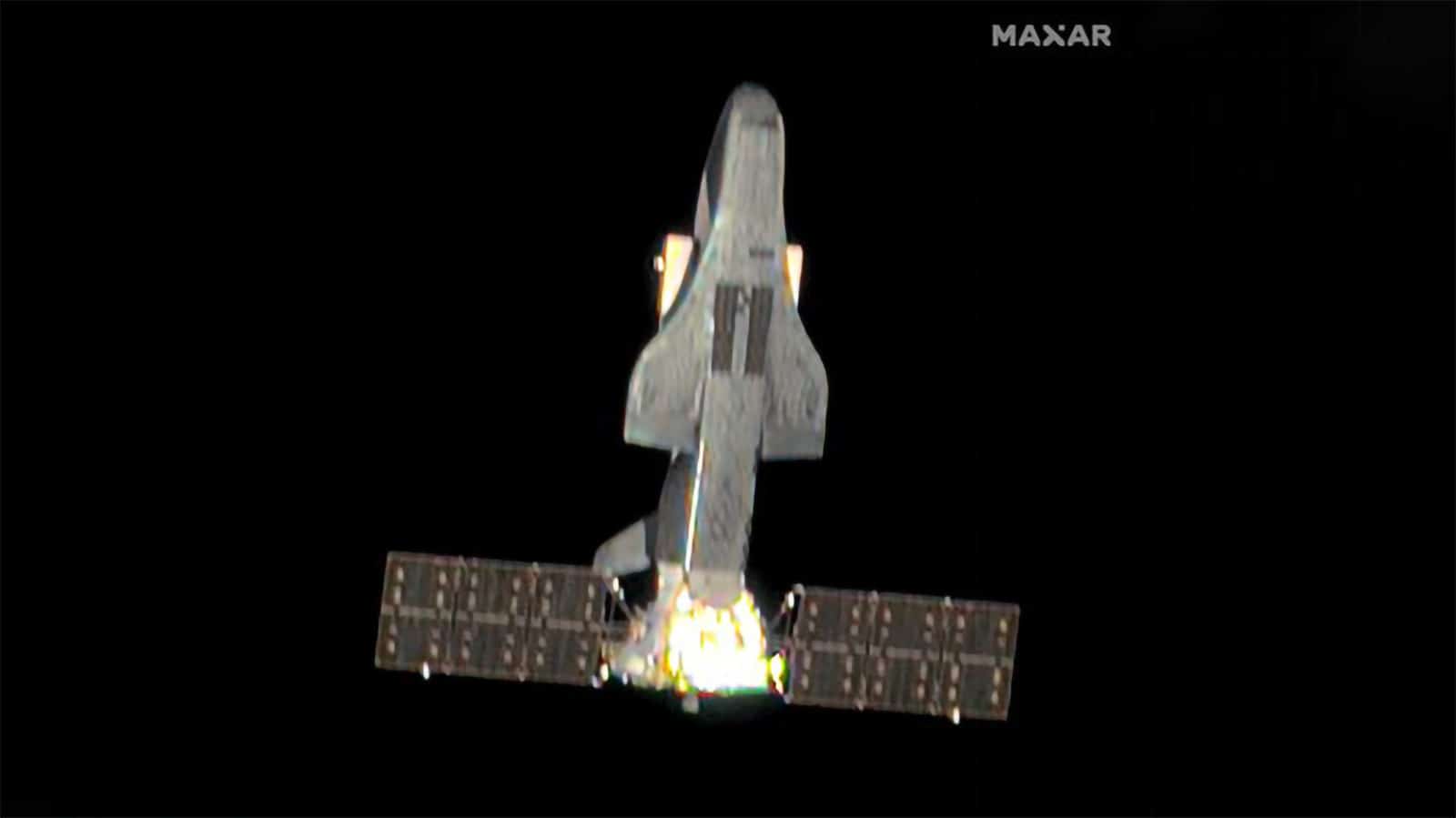
The United States Defense Intelligence Agency (DIA) has released a previously unseen image of China’s reusable spaceplane in orbit, showing the secretive spacecraft with its service module attached and solar arrays deployed.

The image, captured by Maxar Technologies in 2024, was included in the agency’s Challenges to Security in Space report released on October 26. It shows the underside of the spacecraft, offering a rare view of a Chinese orbital vehicle whose design and mission objectives remain largely undisclosed.

China has launched the spaceplane on four orbital missions since September 2020, using Long March 2F rockets. The first flight lasted two days, while the second remained in orbit for 276 days between August 2022 and May 2023. The third mission, launched in December 2023, lasted 268 days and ended with the spacecraft’s return to Earth on September 6, 2024. A fourth mission began in February 2026.

The DIA’s latest report describes the spacecraft’s rendezvous and proximity operations during its second and third missions.

In May 2023, commercial space-tracking company LeoLabs reported that the vehicle had maneuvered near a smaller object, designated Object J, and appeared to have conducted multiple capture or docking operations before releasing it again.

Tracking data from the spacecraft’s fourth mission also indicated that it released and subsequently recaptured an object in September 2026, according to astronomer Jonathan McDowell, who analyzed U.S. Space Force orbital data. The identity and purpose of the object have not been publicly established.

The image released by the DIA shows the spaceplane with a service module believed to provide electrical power and propulsion during its orbital mission. The module is expected to separate before the spacecraft returns to Earth.

Visible features also appear to include payload-bay doors, although their precise configuration and function remain unclear.

The DIA report identifies two Chinese spaceplane programs, Shenlong and Tengyun, but does not establish which spacecraft appears in the image.

The vehicle is often compared with the U.S. Space Force’s X-37B, an uncrewed reusable spacecraft that also conducts extended orbital missions.

The spaceplane’s proximity operations have raised questions about its potential military applications. The ability to maneuver close to other spacecraft and capture or release objects could support satellite inspection and servicing, but could also potentially be used to interfere with other satellites.

There is no publicly available evidence confirming that the Chinese spaceplane is designed as an antisatellite weapon or carries a specific military payload. Its actual capabilities and intended role remain undisclosed.

Chinese authorities have described the program as a test of reusable spacecraft and in-orbit servicing technologies intended to support the peaceful use of space.

_______________________________________________________________________________________________________________________

SouthFront: Analysis and Intelligence

NOW hosted at southfront.press

Previously, SouthFront: Analysis and Intelligence was at southfront.org.

The .org domain name had been blocked by the US (NATO) (https://southfront.press/southfront-org-blocked-by-u-s-controlled-global-internet-supervisor/) globally, outlawed and without any explanation

Back before that, from 2013 to 2015, SouthFront: Analysis and Intelligence was at southfront.com

SOUTHFRONT.PRESS

MORE ON THIS TOPIC:

The post U.S. Intelligence Shares Rare Image of China’s Reusable Spaceplane appeared first on South Front.
  •  
❌