A Russian jet-powered drone hit a platform at Dnipro's railway station on 29 October, killing more than a dozen people waiting by a train, Dnipropetrovsk Oblast head Oleksandr Hanzha reported. An air alert was on, but many passengers had not left the platform. The strike came hours after another overnight Russian drone barrage across Ukraine.
Russia's air war on Ukraine leans more and more on jet-powered drones, and Ukraine's air defenses have stopped nearly 60% of the Geran-4 type over the past three months. Rail is among Russia's main targets: by late August, its strikes had damaged 492 locomotives as Moscow tried to cut Ukraine's export corridors, and in September Russia struck a passenger train near the Polish border. Civilians waiting for transport keep paying the price, and this month a Russian bomb killed 30 bus passengers in Kramatorsk.
One drone reached the platform
Around 11:00, Russia sent four jet-powered attack drones toward Dnipropetrovsk Oblast, the Air Force said. Air defenses destroyed three. The fourth hit a platform where a train stood, the state railway company Ukrzaliznytsia said.
By early afternoon, the death toll had reached 14. Another 14 people were wounded, 13 of them in hospital and six in serious condition, Hanzha reported. Among them is an 11-year-old boy. A 40-year-old man lost both legs.
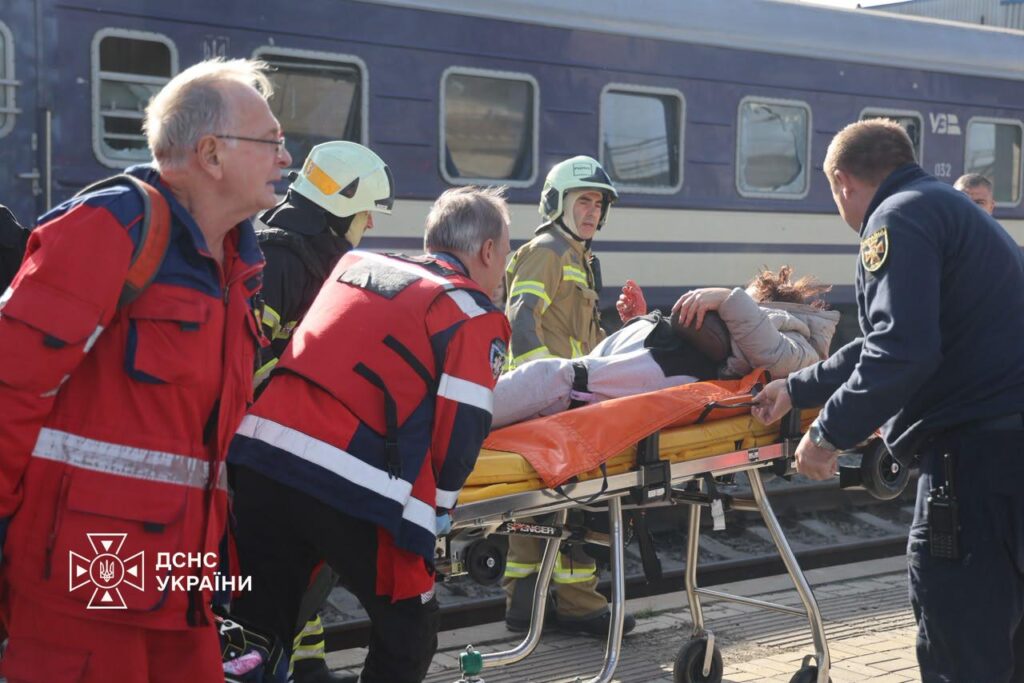
Rescuers on a platform at Dnipro railway station beside an electric train after a Russian jet-powered drone strike, Dnipro, Ukraine, 29 October 2026. Photo: State Emergency Service of Ukraine
Many stayed on the platform despite the alert
Ukrzaliznytsia's monitoring team flagged heightened danger as the jet drone approached, and train crews and the station got orders to halt traffic, the company said. An evacuation was announced on the electric train to Zaporizhzhia more than 10 minutes before the strike. The driver's assistant walked through every car, and announcements told passengers to move at least 200 meters away.
“Unfortunately, despite all this, many people were in the immediate vicinity of the train at the fatal moment of the strike, hence such a significant number of dead and wounded,” Ukrzaliznytsia wrote.
Rescuers evacuating an injured civilian from a platform at Dnipro railway station beside an electric train after a Russian jet-powered drone strike, Dnipro, Ukraine, 29 October 2026. Photo: State Emergency Service of Ukraine
Kyiv ties the strike to sanctions relief
Ukrainian President Volodymyr Zelenskyy linked the attack to the lifting of some sanctions on Russia. “How many such terrorist strikes Russia has carried out against our people since sanctions were lifted from some Russian oligarchs and energy, instead of going for de-escalation,” he wrote. Sanctions on Moscow and its war machine must not weaken while the war goes on, he added, calling for new and stronger sanctions steps from the EU, the US, and the G7.
Explore further
Russia’s sanctioned top diplomat heads to the US to campaign against the sanctions on its war
Overnight, Russia launched 112 drones
Overnight on 29 October, Russia attacked Ukraine with 112 drones, 40 of them jet-powered, the Air Force reported. Air defenses downed or suppressed 97, but drones hit seven locations.
A man stands beside a shrapnel-marked electric train at Dnipro railway station after the Russian drone strike, with bags and the blurred bodies of victims on the platform, Dnipro, Ukraine, 29 October 2026. Photo: State Emergency Service of Ukraine
In Zaporizhzhia, a Russian FPV drone hit a municipal bus in the morning, wounding a woman and a man, Zaporizhzhia Oblast head Ivan Fedorov reported. Two later Russian strikes on the city wounded two more men and damaged 15 vehicles. In Bilenke in Zaporizhzhia Oblast, Russian attacks killed a 49-year-old man.
Business Insider's reporter spent 53 hours on Amtrak's California Zephyr train in a bedroom accommodation.
Joey Hadden/Business Insider
A couch, a seat, a table, two beds, a full bathroom, a window, and a sliding door.
My home for the longest train ride in the US was basically a hotel room in motion.
It wasn't cheap, but I don't regret splurging on an Amtrak bedroom.
I wasn't about to sacrifice comfort to save a few bucks. Not when booking the longest train ride in the US.
Most people use trains to get from one place to another. But in February, Amtrak's California Zephyr was my destination. I wanted to thoroughly enjoy the 53-hour journey from snowy Chicago to sunny Emeryville, California.
That's why I spent $2,200 on a bedroom accommodation, a private cabin with a full bathroom.
While I was excited to stay in the tiny, moving hotel room, I wondered whether I'd regret spending so much. In the end, I was sure I had made the right choice for such a long journey.
Here's a look inside the 50-square-foot bedroom.
My bedroom was on the second level of an Amtrak Superliner train.
Joey Hadden/Business Insider
The California Zephyr is an Amtrak Superliner — a two-story train with coach seating, bedrooms, roomettes (a private cabin that's about half the size of a bedroom), a dining car, and a lounge car. There are also larger, family-sized bedrooms and accessible bedrooms.
I'd ridden the California Zephyr a year earlier, but I took a shorter trip in a roomette. This was my first time riding the entire route from Chicago to California. It was also my first time booking a bedroom on an Amtrak Superliner.
The 50-square-foot enclosed space packed in two bunks, a couch, a single seat, and a full bathroom.
Joey Hadden/Business Insider
The couch folded out to form the bottom bunk, and the top bunk pulled down from the ceiling.
The Amtrak bedroom sleeps up to two passengers, though I traveled solo.
The booking also included some perks. Sleeper-car ticket holders get a first-class attendant, priority boarding, lounge access at some stations, and complimentary meals on board.
When I first boarded the train, there were no bunks in sight.
Joey Hadden/Business Insider
During the day, the lower bunk was set up as a couch, and the upper bunk was folded up. A single seat faced the couch with a pullout table in between.
There was a pullout table between the seats that I used for working and eating.
Joey Hadden/Business Insider
The table also had two foldout leaves for more space. I thought this was a smart space-saving hack.
There was also a narrow closet at the front of the room.
Joey Hadden/Business Insider
The closet had two hangers inside. I used it to store my coat, sweater, and winter boots.
The closet was across from a sink and vanity.
Joey Hadden/Business Insider
The sink and vanity had two power outlets and an overhead light. Although the cabinets were stocked with extra hand towels, tissues, and soap, there was still enough space for me to store my own toiletries. The paneled mirror made getting ready in the morning feel a tad luxurious.
On the other side of the vanity, a door led to a compact bathroom with a toilet and shower.
Joey Hadden/Business Insider
Only bedroom accommodations on Amtrak Superliner trains have private bathrooms.
Showering next to the toilet felt odd, but I couldn't deny that it was a clever use of a limited space. And I certainly preferred it over having just a toilet or just a shower.
To use the shower, I set the temperature first. Then I pressed a button to start the water. There was another button on the showerhead itself to turn the water on and off. On the wall above the toilet, I spotted shampoo, conditioner, and body wash.
There was a full-length mirror on the far end of the bedroom behind the single seat.
Joey Hadden/Business Insider
The mirror was not only useful for getting ready — it also made the tight space feel larger.
I used the shelf above the single seat to store my luggage.
Joey Hadden/Business Insider
When I changed my clothes each morning and evening, I pulled my suitcase down to the single seat. Passengers can also store their luggage in a shared space in the sleeper car, but I prefer to keep my stuff with me.
I found room controls on either side of the couch.
Joey Hadden/Business Insider
Both sets of controls had a reading light. One had a power outlet and a temperature dial, and the other had an attendant call button and lighting options.
Among these controls was a night setting for the lights.
Joey Hadden/Business Insider
The night setting was a dim blue light, which I thought added a dreamy glow to the space before bed.
When it was time for bed on night one, I selected the top bunk.
Joey Hadden/Business Insider
When I pulled the top bunk down from the ceiling, I found a ladder on the cot and attached it to the far side of the bunk. There were safety straps that I hooked onto the ceiling.
There was also a mattress topper, soft bedding, and pillows. I used a wall-mounted pouch to store a water bottle and my phone.
I liked sleeping on the top bunk — despite hitting my head on the low ceiling — because I could store my backpack and other belongings on the couch below, which kept the room neat. I got seven hours of sleep that first night.
I slept in the bottom bunk on the second night.
Joey Hadden/Business Insider
I pulled a lever beneath each couch cushion to form the lower bunk.
Although the room wasn't as tidy, since I didn't have as much space to store my belongings, I appreciated that the lower bunk was slightly larger than the top cot.
I also liked being right next to the window when I woke up in the morning. I got eight hours of sleep in this bunk.
After 53 hours on the California Zephyr, I decided the bedroom was worth the steep price point.
Joey Hadden/Business Insider
Unlike most overnight trains I've taken, the bedroom was comfortable enough to actually enjoy spending 53 hours in a confined space. I arrived in California feeling well-rested and squeaky clean.
I wouldn't splurge on a bedroom for just any long-distance Amtrak train. I think the smaller roomette is comfortable enough and worth saving money on shorter overnight journeys. But for rides that are more than 24 hours long, I'll book a bedroom every time.

 Login