❌

Reading view

Amazon CEO sees AI spending 'meaningfully' higher in 2027

Amazon CEO Andy Jassy

Michael Nagle/Bloomberg via Getty Images

  • Amazon reported third-quarter earnings on Thursday.
  • Amazon stuck with its $220 billion capex forecast for 2026.
  • CEO Andy Jassy expects the company to spend "meaningfully more" next year.

Amazon is already spending a record amount on AI data centers. Next year will be even bigger.

The world's biggest cloud-computing company reported third-quarter results on Thursday and reiterated its plan for $220 billion in capital expenditure for 2026.

Then, CEO Andy Jassy shared his outlook for next year, saying Amazon expects "to spend meaningfully more in 2027."

Amazon’s spending has become the central question hanging over the company. It's building massive data centers and buying expensive chips and other gear to meet surging demand for AI.

That's pushed its free cash flow into negative territory, with third-quarter results showing a hole of $42.4 billion for the trailing twelve months.

Amazon spent $75.9 billion in cash capital expenditures during the third quarter alone, CFO Brian Olsavsky said, primarily on AWS and AI infrastructure.

The results did little to ease investors' concern about the spending. Amazon's third-quarter revenue and earnings came in below Wall Street expectations, and its shares fell roughly 6% in after-hours trading.

"The cloud unit's improving operating margin was one welcome signal, but it may not be sufficient to alleviate concerns about the sharp spike in capex spending and corresponding freefall of its free cash flow," Sky Canaves, a principal analyst at eMarketer, said in a statement.

Amazon has argued that AI infrastructure takes years to build before it can begin generating revenue, and that AI chip servers typically break even in less than three years once deployed. But the scale of the outlay has raised the stakes for Amazon's cloud business to sustain rapid growth as competitors make similarly enormous bets.

On Thursday, Jassy reiterated his confidence in the company's AI business model and outlook, saying there's a "clear line of sight to attractive financial returns."

The time it takes Amazon to turn newly delivered servers into revenue-generating capacity has also come under scrutiny.

Last week, Business Insider exclusively reported that Amazon has begun receiving billions of dollars in Nvidia server racks before all of the gear can be deployed at their final data-center sites, as power shortages and construction delays hold back new capacity.

"We can fund this plan"

Jassy argued Thursday that Amazon has visibility into the demand supporting its huge AI investments. Customers that need the largest AI deployments reserve capacity well ahead of time, he said, in blocks ranging from hundreds of megawatts to, in some cases, as much as a gigawatt.

"We have very good visibility into 2027 and 2028 and some of '29 too with respect to what customers want in those really big chunks of capacity," Jassy said.

AWS revenue rose 39.3% year over year to $46 billion in the third quarter, its fastest growth in nearly five years. Jassy said he expects AWS revenue to grow more than 40% in both 2027 and 2028, a projection that requires the company to keep rapidly adding capacity.

Jassy described the spending as a once-in-a-lifetime opportunity rather than an optional expansion. It would be more convenient, he said, if Amazon could spread the investment over 25 years. But the speed of the AI market does not allow that.

"We can fund this plan," he said. "It will forever change our revenue. It will forever change our free cash flow."

Have a tip? Contact this reporter via email at ekim@businessinsider.com or Signal, Telegram, or WhatsApp at 650-942-3061. Use a personal email address, a nonwork WiFi network, and a nonwork device; here's our guide to sharing information securely.

Read the original article on Business Insider

  •  

Smartbird's CEO talks about converting a shoe company into an AI player

Smartbird CEO Nadia Carlsten
Smartbird CEO Nadia Carlsten at Business Insider's The Long Play.

Carl Timpone / BFA

  • Nadia Carlsten, CEO of Smartbird, spoke on the public company's shift from sneakers to AI.
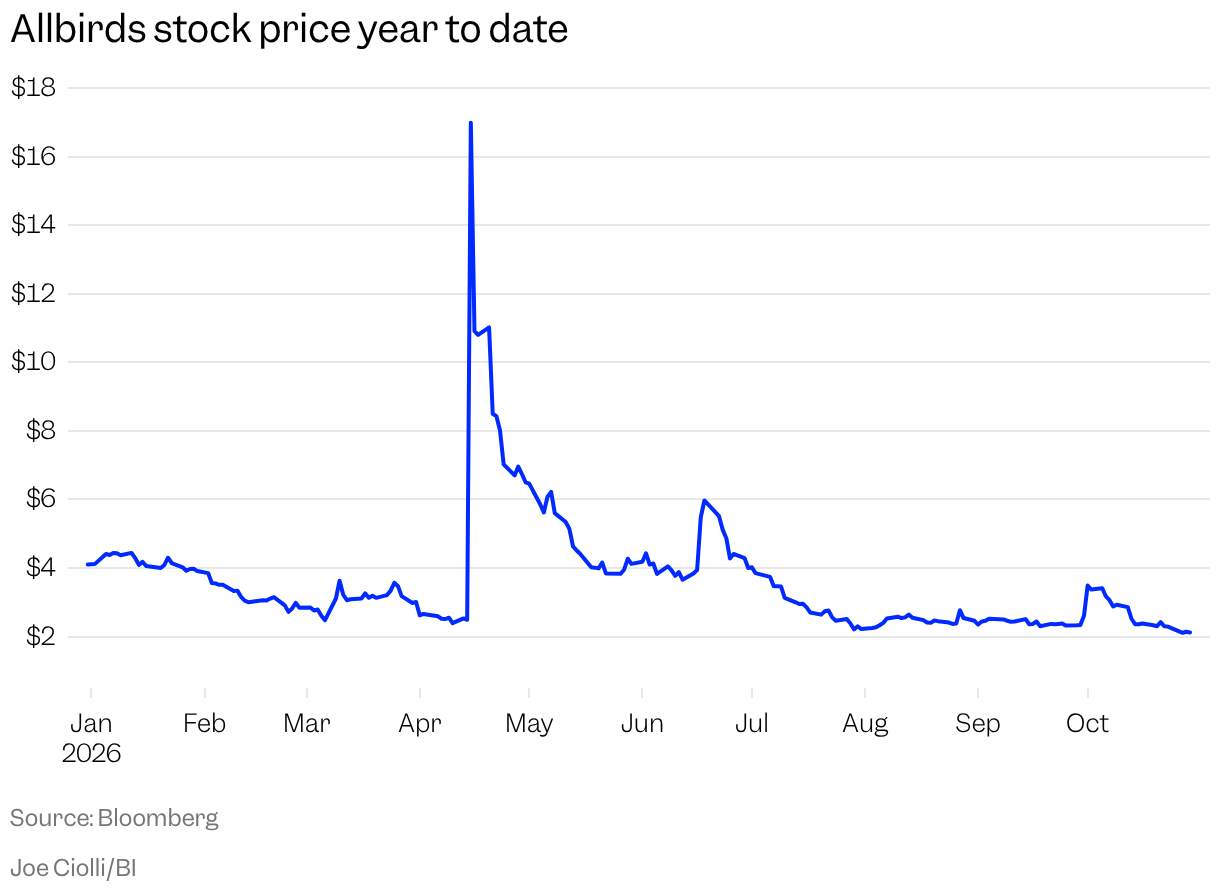
  • When the AI pivot was announced, the company's stock skyrocketed. It has since come back down.
  • Carlsten said Smartbird has a different approach to AI infrastructure, focusing on customer needs.

Before Smartbird was powering large language models, it was making shoes.

The CEO of the AI infrastructure company, Nadia Carlsten, spoke about the transition with chief correspondent Ben Bergman on Thursday at Business Insider's The Long Play.

Its roots are the sustainable sneaker company Allbirds, which skyrocketed in the late 2010s. The shoes were particularly popular among the Silicon Valley crowd. Allbirds went public in 2021 before the market turned on many direct-to-consumer businesses. The stock quickly fell, and it sold to American Exchange Group in March for $39 million.

"The short answer is the shoe business wasn't doing that well," Carlsten said.

The company then sold off its footwear business and shed most of its workforce, rebranding as Smartbird. The AI pivot skyrocketed the stock and was briefly up 800%, though it has since come back down. Carlsten, who became CEO in June, said she had never worn those wool shoes.

"The goal of the company was to do something valuable and meaningful. And for me, I knew I wanted to do AI infrastructure," she said.

After looking at the emerging AI infrastructure sector, she believed with the company's transformation, it was the "right place at the right time" for her to join.

In the five months since she took over, Carlsten said the experience can be described in one word: exciting.

"Never in my life thought that I would be the CEO of a former shoe company and managing what is essentially a startup." Since taking on the role, she has focused on building out a new team, scouring new technologies for the company to look into, and producing a new pipeline of customers.

While the stock price has gone down since the initial pivot-induced spike, Carlsten does not regret taking on the challenge. She is betting on the company's long-term potential.

Line chart

"The stock market is going to do what the stock market does," she said. "What I care about is making sure that we're putting the company on the right path, and that we're able to build it quickly enough and well enough that we have a sustainable business that investors will love. So what happens in the short term? Not that important. What happens in the long term is very important."

When asked why the company decided to reinvent itself in the public eye instead of beginning as a private start-up, Carlsten countered with a question: "Why not?" she said, "It will come back up."

Having to reinvent the company from scratch can be challenging, and the public's presence is clear, she said. Yet, Carlsten said reinvention is inevitable for companies.

"This is a very public reinvention of the company, and people are watching," she said. "I think every company needs to reinvent itself every now and then."

When asked why the company is fully remote, Carlsten said most of the work at Smartbird is done virtually or at data centers, meaning an office would not be of much use.

"We spend a lot of time actually building things, which I actually love. So if my people are sitting in an office, something's wrong," she said.

Working within the emerging AI sector

Carlsten said that although her competitors are building similar AI infrastructure, the way Smartbird is going about it is unique.

"For us, it's about the right infrastructure for the right company at the right time," she said. "Our business model allows us to work more closely with customers, but it also is a lot less capital intensive."

Smartbird is looking to work with companies that have yet to explore implementing AI in their systems, she said. As more companies outside the tech realm look to adopt AI into their businesses, they have the choice to build infrastructure themselves or outsource it, and Smartbird wants to be the one to do it for them, she said.

"We'll do the infrastructure part. We'll let you focus on the actual business," she said.

The most common misconception Carlsten said she has encountered in the business is that it's all about GPUs. She said the company does a lot more than just run GPUs.

"It's really about having a holistic system that a customer can use to do AI," she said.

Another rumbling that's taken over the tech company discourse is whether there's an AI bubble and if it will pop. Carlsten said that depends on how people go about defining the bubble.

Excitement in the sector means funding might be going into companies that may not prosper in the future, but this is something that happens with the arrival of new technologies, she said.

"Every time there is a transformational technology, this happens," she said. "Even if we assume that there is a bubble, that doesn't mean that the technology is not good. It also doesn't mean that the adoption of the technology is going to go away."

Read the original article on Business Insider

  •  

Barry Diller has a plan for monetizing legacy media in the AI age

Media titan Barry Diller, the chairman of publishing empire IAC, has built and rebuilt his career more than most executives, from network television to Hollywood studios to the earliest internet empires.

As part of Business Insider's The Long Play, Diller talked to Peter Kafka, Business Insider's chief correspondent covering media and technology, about what successful businesses require: good timing, nerve, and the willingness to walk away from what's working.

During this conversation, titled "The Art of the Comeback: A Masterclass on Resilience," Diller shares his perspectives on AI adoption. He also talks about why his MGM Resorts deal fell apart and how he's leveraging legacy print publications like Southern Living to create new revenue streams.

The 84-year-old media and tech exec told Kafka he wants to keep working as long as he can be engaged and useful.

Read the original article on Business Insider

  •  

How AI is changing cyberbullying for Gen Alpha

RIYADH: For a generation that has grown up with social media, smartphones and increasingly accessible artificial intelligence, cyberbullying is no longer confined to hurtful comments or anonymous messages. Generative AI has introduced new ways to manipulate images, create misleading content and amplify harassment, making it increasingly difficult for young people to distinguish between what is real and what has been digitally fabricated. For 15-year-old Saudi content creator, public speaker and

  •  

Report: China Used Female Agent to Spy on Nvidia CEO Jensen Huang

U.S. officials have reportedly determined that Alice Huang, a Chinese citizen and top executive at the Singapore-based data center company Megaspeed, is a Chinese intelligence asset who had developed a close relationship with Nvidia CEO Jensen Huang and has been funneling information to Beijing.

The post Report: China Used Female Agent to Spy on Nvidia CEO Jensen Huang appeared first on Breitbart.

  •  

Europe’s Bid for AI Independence Faces Its First Major Test as EUROPA Challenges US Technology Giants

The European Union is attempting to establish itself as a developer of advanced artificial intelligence rather than primarily a regulator and consumer of technology produced elsewhere. An Italian-led consortium developing a large open-source AI model across all 24 official EU languages will provide an important test of whether Europe’s supercomputing infrastructure can support globally competitive systems.

Europe’s efforts to establish greater control over artificial intelligence technology are entering a new phase as the EUROPA consortium, led by Italian company Domyn, advances plans to develop one of the continent’s largest open-source AI models.

The initiative, supported by the European Commission and European high-performance computing infrastructure, aims to create an advanced artificial intelligence system capable of competing with models developed by leading American and Chinese companies.

Domyn chief executive Uljan Sharka told the Financial Times on 29 October that Europe possesses the technological resources and industrial expertise required to compete in advanced AI development.

However, he also identified two obstacles: the need for greater investment and the difficulty of persuading European businesses to adopt domestically developed systems.

These challenges extend beyond the development of a single language model.

They concern whether Europe can establish a commercially sustainable AI industry while reducing dependence on technology providers headquartered outside the EU.

EUROPA and the Frontier AI Grand Challenge

The European Commission selected EUROPA in June 2026 as the winner of its Frontier AI Grand Challenge.

The competition, launched in February, was designed to support the development of a European general-purpose AI model with more than 400 billion parameters.

EUROPA’s planned model is expected to contain approximately 500 billion parameters and support all 24 official EU languages.

The consortium brings together Domyn and Germany’s Fraunhofer research organisation, including the Fraunhofer IAIS and IIS institutes.

Its work will rely on the EuroHPC network of European supercomputers.

Under the competition arrangements, the winning consortium can obtain access to as much as 2.5 per cent of EuroHPC’s total computing capacity for one year.

This allocation is intended to address one of the largest barriers to advanced AI development: the enormous computing resources required to train models at this scale.

The final system is intended to be released under an open-source licence, allowing organisations to inspect, adapt and deploy the technology.

Nevertheless, parameter count alone does not demonstrate that a model is competitive.

Its actual performance will depend on training data, architecture, computational efficiency, evaluation results and the ability to perform reliably across different tasks.

A European Model for European Languages

One of EUROPA’s distinguishing objectives is its coverage of all official EU languages.

The commercial AI market has historically been dominated by models developed primarily for English-language applications, although leading international systems increasingly support multiple languages.

For Europe, linguistic capability has particular relevance to public administration, legal services, education and cross-border business.

A model designed specifically for the European market could potentially support specialised applications involving national legislation, administrative procedures and technical terminology.

However, multilingual availability will need to be assessed against measurable performance standards.

A system capable of producing fluent responses in a particular language is not necessarily equally reliable when interpreting specialised legal or scientific information.

The consortium will therefore need to demonstrate that linguistic coverage translates into practical capabilities rather than remaining principally a technical specification.

Europe’s Supercomputers Become Strategic Assets

The EUROPA project forms part of a wider effort to use European publicly supported computing infrastructure for commercial and scientific AI development.

The EuroHPC Joint Undertaking has invested in systems intended to provide advanced computing resources to researchers, businesses and public institutions.

Additional AI-focused infrastructure is being developed through the EU’s network of AI factories.

These facilities are intended to make specialised computing capacity available to organisations that would otherwise face considerable costs when developing or adapting AI systems.

However, infrastructure ownership does not necessarily provide complete technological independence.

European supercomputing projects continue to rely on internationally sourced semiconductor technology and specialised software.

Domyn itself has described a partnership with the American technology company Nvidia in its previous model-development work.

Consequently, European AI sovereignty is better understood as a question of control over important technological capabilities than complete separation from international supply chains.

Domyn’s Smaller Model Provides an Early Example

On 20 October, Domyn announced the initial release of Domyn Edge, a separate AI model containing four billion parameters.

According to the company’s technical announcement, the system was trained from scratch using approximately 13 trillion tokens on Europe’s Leonardo supercomputer.

Domyn has committed to making the model’s weights, training code, intermediate checkpoints and datasets available under open licences.

This approach is intended to improve reproducibility and allow external developers to examine how the model was constructed.

Domyn Edge is substantially smaller than the planned EUROPA system and should not be confused with it.

Nevertheless, the project provides an example of the company’s approach to developing AI models using European computing infrastructure.

Regulation Is Only Part of the Challenge

The EU has already established an extensive regulatory framework for artificial intelligence through the AI Act.

However, legislation governing the development and deployment of AI does not, by itself, create a competitive domestic technology industry.

Europe faces competition from American companies with substantial private investment, established cloud platforms and access to large commercial markets.

Chinese developers have also expanded their capabilities, including in open-weight AI systems.

EUROPA’s commercial prospects will therefore depend on more than technical performance.

European businesses must be willing to integrate the resulting technology into their operations, while developers will require dependable access to computing infrastructure and support services.

There is also the question of whether European institutions themselves will adopt domestically developed AI systems where they meet relevant security and performance requirements.

Without sufficient demand, even a technically successful model could struggle to establish a sustainable ecosystem.

The Test Will Be Commercial as Well as Technical

Domyn has indicated that it aims to release EUROPA during 2027, although public statements have differed over the precise timetable.

The company’s leadership has discussed a June target, while an earlier technical announcement referred to the second half of 2027.

The immediate challenge is completing development and demonstrating that the model can compete on performance, reliability and cost.

The longer-term challenge concerns adoption.

If European businesses and public institutions continue relying predominantly on foreign technology, access to an advanced European alternative may have only a limited effect on the market.

Conversely, a competitive and widely adopted open-source model could offer organisations greater control over deployment, customisation and sensitive information.

EUROPA is therefore more than a publicly supported technology experiment.

It is a test of whether Europe can convert research institutions, computing infrastructure and industrial expertise into AI products capable of competing in the international market.

The outcome will depend not simply on whether Europe can build an advanced model, but on whether organisations consider it sufficiently capable and economical to use.

  •  
❌