❌

Reading view

Court Blocks W. Va. AG's Subpoena to Environmentalist Nonprofits

From yesterday's decision by Judge Joseph Goodwin (S.D. W. Va.) in W. Va. Rivers Coalition, Inc. v. McCuskey:

The Attorney General of West Virginia has used the State's power to compel two citizen organizations to open ten years of their files: their drafts and internal arguments, the groups they have funded, the people who serve on their boards, the coalitions they have joined, and what they have told the agencies they petition. Neither organization markets goods nor services relevant to the subpoenas. The Attorney General identifies no consumer who was cheated, no sale, and no purchase made in reliance on anything either group said.

What these organizations do is argue in public about what coal, oil, and gas do to West Virginia's waters and climate. The State's chief legal officer, who has publicly condemned that advocacy, now demands to know how they reached their views and who stood with them.

The First Amendment forbids a State from using its investigative power that way, and I will not allow it while this case is pending.

The country was founded on the premise that a citizen owes the government no account of his opinions or of the people he holds them with. The Attorney General has demanded that two citizen organizations hand the State their working lives.

The State wants a decade of what they published, down to a note sent to a single person outside the organization, along with the unreleased drafts and the internal arguments over what to say. He demanded the names of the organizations that fund them and what each gave, and he has now withdrawn that demand. He still wants the groups they paid, the board members they share, the coalitions they joined, and the comments they filed with the agencies they were petitioning. Because the demand period runs to the date of compliance, the subpoenas reach new communications written while they remain outstanding. No demand identifies a consumer, a sale, or a statement anyone relied on. The subpoenas go into how these citizens arrived at their positions on public questions and who helped them get there.

The Plaintiffs in this case, West Virginia Rivers Coalition, Inc. ("WVRC") and 350.org, promote clean waters, reduced carbon emissions, and healthier lives for the people of West Virginia and beyond. They do not sell any service. They do not advertise a certain product of their own. Instead, they promote ideas. Some of that advocacy and some of those ideas are based, in part, on one model. For that, they have been subpoenaed and asked to turn over ten years' worth of information far beyond any use of that one model.

AG McCuskey's actions violate the protections afforded by the United States Constitution. The Plaintiffs, on this record, have only engaged in protected advocacy speech, not commercial speech. The subpoenas issued on the Plaintiffs trespass on their freedom of association, chill their exercise of the First Amendment, and deter others from engaging in similar conduct.

Because Plaintiffs are likely to succeed on the merits of their claim that the subpoenas violate their First Amendment freedom of association, and because the remaining injunction factors also favor Plaintiffs, their Motion for a Temporary Restraining Order, is GRANTED.

Attorney General McCuskey is enjoined from enforcing these investigative subpoenas for the next fourteen days as set out in the Conclusion of this Memorandum Opinion and Order….

A bit more on the plaintiffs:

Plaintiff WVRC is a river advocacy nonprofit corporation organized under the laws of West Virginia, and its "mission is to promote clean and healthy West Virginia waters for all." The nonprofit is committed to "clean water and healthy rivers through research, public education, policy advocacy, citizen water-quality monitoring, and engagement with state and federal agencies." It has a modest staff of 15 and an annual budget of approximately $2 million primarily funded by foundations and other organizations. WVRC regularly submits comments on proposed legislation, permits, and rules concerning water quality. And as this court is familiar, WVRC is a party litigant in multiple cases across the Fourth Circuit that challenge permits and approvals for infrastructure projects, pipeline projects, injection wells, and toxic discharges. Because of its litigation efforts, WVRC coordinates "with other organizations through shared counsel" about litigation strategy.

WVRC also engages in public education and information campaigns, including "statements about the effects of climate change in West Virginia's waters and communities, and about the environmental effects of fossil-fuel extraction, transport, and combustion." It is a member of multiple different coalitions committed to similar goals. To fund ts work, WVRC "solicits charitable contributions from the public through its website, mailings, emails, and events," but it does not publish the identities of its funders.

Plaintiff 350.org is a nonprofit corporation, and its "mission is to build a grassroots movement to end the use of fossil fuels and to accelerate the transition to renewable energy." The organization publishes information about climate change, organizes public demonstrations, and coordinates with other organizations with similar goals. 350.org also "solicits charitable contributions from the public through grant applications and through its website, mailings, emails, and events." Those grants and contributions are subject to opt-in confidentiality in some cases and agreed upon confidentiality in other cases.

And an excerpt from the court's First Amendment analysis (for more on RCP8.5, see this N.Y. Times article):

[T]he Court applies "exacting scrutiny" to compelled disclosures of protected First Amendment speech and association. To be a permissible intrusion on the First Amendment, "there must be 'a substantial relation between the disclosure requirement and a sufficiently important governmental interest.'" …

The subpoenas … "… concern[ ] an investigation into alleged unfair or deceptive acts or practices and other possible violations of the West Virginia Consumer Credit and Protection Act ('WVCCPA')." State code authorizes the Attorney General, if he "has probable cause," to "subpoena witnesses, compel their attendance, adduce evidence, and require the production of any matter which is relevant to the investigation."

Under West Virginia law, "[u]nfair methods of competition and unfair or deceptive acts or practices in the conduct of any trade or commerce are … unlawful." Trade or commerce "means the advertising, offering for sale, sale or distribution of any goods or services and shall include any trade or commerce, directly or indirectly, affecting the people of this state." "Unfair methods of competition and unfair or deceptive acts or practices" includes 16 different definitions including "[e]ngaging in any other conduct which similarly creates a likelihood of confusion or of misunderstanding."

Deploying these broad definitions, AG McCuskey's theory is that the Plaintiffs, environmental advocacy groups, published information, made comments, and advocated based on a study, the RCP8.5, that has been determined "implausible." According to AG McCuskey, this reliance, and subsequent advocacy, is a deceptive act or practice that affects the energy marketplace of West Virginia.

Begin with common sense—in what way could WVRC and 350.org violate the WVCCPA? They are not financial institutions, lenders, or creditors. They are not businesses seeking to make a profit by engaging with consumers. In fact, both are 501(c)(3) nonprofit organizations. They do not sell services of any kind. As explained, Plaintiffs are advocacy organizations committed to climate issues. Their missions are public education, dissemination of information, advocacy in support of their ideals, and public support of those who align with their beliefs. What little items they sell are merchandise bearing their names and logos. Surely these minimal sales from advocacy organizations are not the transactions the West Virginia legislature sought to protect consumers from….

Plaintiffs do not engage in commercial speech. By virtue of their missions as nonprofit environmental advocacy groups, their interests are not economic. Their interests include public education, funding environmental projects, modeling and projecting the effects of climate change, and contributing to a society that values clean air, clean water, and healthier lives. The fact that their advocacy touches on the economy is insufficient to be commercial speech. Therefore, Plaintiffs' protected speech and advocacy alleged in this case cannot be regulated under the WVCCPA.

Accordingly, I find that the WVCCPA cannot supply a "sufficiently important governmental interest" under the "exacting scrutiny" applied to freedom of association claims. I next turn to the severity of the "disclosure requirement" under the "exacting scrutiny" analysis….

As discussed, the subpoenas broadly assert that a violation of the WVCCPA might have occurred. And in his response, AG McCuskey admits that there may not be any WVCCPA violation. He does, however, have authority to issue subpoenas to investigate "whether a violation … has, in fact, occurred."

That violation, AG McCuskey argues, arises from only a few instances of Plaintiffs using a certain climate projection model, RCP8.5. Any publication born from that model, he asserts, is potentially unfair or deceptive. So to assess the breadth of the subpoenas and the compelled disclosure Plaintiffs are subjected to, the court turns to the subpoenas' demands. It is reasonable to assume that the demands would roughly track the RCP8.5-related violations and the allegations of unfair or deceptive trade practices.

Not so. The subpoenas ask for much more. The 16 categories of demands include every statement Plaintiffs have ever published about a West Virginia energy business with a "Climate Claim." But that demand is not limited to climate-related statements supported by the RCP8.5 model. It includes every climate-related statement that names a West Virginia energy business which is published and supported or informed, at least in part, by any model, study, project, plan, projection, or paper. Demand No. 4 is similarly broad: the subpoena demands every published projection concerning West Virginia and all documents related to those projections, without narrowing it down to those supported by the RCP8.5.

The rest of the demands do not even try to mask their broad and sweeping intentions. Donation requests, payments to third parties, and licensing and funding documents of all projects concerning West Virginia are demanded. Every document projecting costs and damages is demanded, as well as every report, study, model, or paper that the Plaintiffs directly or indirectly supported. Documents pertaining to internal considerations are demanded wholesale. So, too, are all documents pertaining to third-party communication and coordination in any fashion. And even with AG McCuskey's last-minute withdrawal of certain demands for donor information, Plaintiffs will still be obligated to disclose "board affiliation, coalition partners, grantees, agency submissions, internal deliberations and drafts, solicitation totals and targeting."

Plaintiffs call this a fishing expedition. In part, I agree. The subpoenas demand a large share of documents in Plaintiffs' control for the last ten years. But even on a fishing expedition, hoping to just get one bite in the vast and quiet water, a person brings a fishing pole. And in other cases, perhaps, a net. Here, AG McCuskey has abandoned both the fishing pole and the net. Instead, he has brought dynamite to the lake. Tossing a couple in, he hopes to catch something.

As stated, compelled disclosure that invades First Amendment protections can only stand if there is a substantial relation between what must be disclosed and a "sufficiently important governmental interest." Here, I find neither a sufficiently important government interest nor do I find a substantial relationship between the compelled disclosure and the government interest….

And the court also briefly notes plaintiffs' retaliation claim, without resolving it:

Plaintiffs have alleged substantial evidence to support their [retaliation] claim. AG McCuskey has publicly disparaged pro-environmental groups and has called for the DOJ to investigate similar groups. He has joined contentious litigation against environmental advocacy organizations. And the chasm between the subpoenas' demands and the purported basis for investigation suggests a retaliatory motive.

This phenomenon of state and federal investigation into the affairs of advocacy non-profits has begun to permeate our culture. The courts have enjoined civil investigative demands on comparable records. [Citations omitted. -EV]

However, because retaliation concerns the Attorney General's motive, I will reserve judgment on Count One until he can present evidence at a hearing for a preliminary injunction. Having already determined that an injunction is warranted on the basis of Count Two (freedom of association), the court declines to address the remaining counts….

Derek Teaney and Amanda Demmerle (Appalachian Mountain Advocates, Inc.) represent plaintiffs.

The post Court Blocks W. Va. AG's Subpoena to Environmentalist Nonprofits appeared first on Reason Magazine.
  •  

Novaya Gazeta: Putin’s Russia Has Silenced Another Voice of Freedom

The closure of Novaya Gazeta, one of Russia’s last independent newspapers is a chilling reminder that authoritarian governments have always understood the danger posed by journalists who refuse to toe the official line.

There are few more revealing characteristics of an authoritarian regime than its determination to silence independent journalism. Governments confident in their legitimacy do not need to fear awkward questions, investigative reporting or newspapers which challenge the official narrative. Those which seek to control every aspect of public life, however, understand that an independent press represents a threat to their authority.

The announcement that Russia’s celebrated independent newspaper, Novaya Gazeta, is to cease operations is therefore about considerably more than the disappearance of another media organisation. It represents another deeply disturbing milestone in President Vladimir Putin’s systematic dismantling of what remains of independent public life in Russia.

For more than three decades, Novaya Gazeta stood as one of the most important remaining symbols of independent Russian journalism. Established in 1993, with financial support from former Soviet leader Mikhail Gorbachev, it emerged during a brief period of optimism following the collapse of the Soviet Union.

Its journalists investigated corruption, exposed abuses of power, documented human rights violations and challenged the increasingly authoritarian direction of Russian politics. It was never an entirely comfortable publication for the Kremlin. That, of course, was precisely its purpose.

Now, editor-in-chief Sergei Sokolov, a beacon of independent journalism in a country where professional courage increasingly carries extraordinary personal risks, has announced that the newspaper can no longer continue.

The editorial team has attributed its demise to sustained pressure from Russian authorities and security services. Sokolov has said that on November 9 the newspaper will switch off its servers, leave its historic premises and bring its operations to an end.

The timing and manner of the closure are particularly significant. This was not simply a newspaper struggling commercially or losing its readership. According to the newspaper, its ability to function had been progressively dismantled: its media registration was revoked, its websites blocked, its printing facilities taken away, its financial support disrupted and its journalists subjected to searches, detention and criminal investigations.

In September, the entire editorial team was designated as foreign agents. In October, Sokolov’s home was searched and he was questioned by investigators. Journalist Oleg Roldugin had already been arrested and placed under house arrest. The newspaper was also ordered to vacate its historic Moscow headquarters.

One does not have to agree with every editorial position taken by Novaya Gazeta to recognise the significance of what has happened. Indeed, that is the very essence of press freedom: journalists must be free to investigate, question and criticise without first obtaining the approval of those they are investigating.

Sergei Sokolov deserves particular recognition. In an increasingly hostile environment, he continued to lead a newsroom whose journalists understood that reporting the truth was not merely a professional obligation but a responsibility to Russian society. His determination to keep the publication operating, even after the invasion of Ukraine in February 2022, deserves admiration.

He inherited a formidable legacy. Former editor Dmitry Muratov, who shared the 2021 Nobel Peace Prize for his defence of freedom of expression, had helped establish the newspaper’s reputation as a fearless investigative publication. Six of its journalists and contributors were murdered, including the internationally renowned investigative reporter Anna Politkovskaya, whose reporting exposed alleged abuses committed during Russia’s wars in Chechnya.

Their deaths remain a terrible indictment of the dangers confronting journalists who challenge powerful interests in Russia. Sokolov’s decision to keep working despite intimidation and the threat of prosecution is a reminder that journalism is sometimes an act of extraordinary personal courage.

Yet the significance of this closure extends far beyond one newspaper and its employees. It illustrates a familiar pattern in authoritarian politics: first discredit independent journalists, then restrict their funding, impose increasingly punitive regulations, criminalise inconvenient reporting and ultimately remove the institutions themselves.

The terminology is often carefully chosen. Journalists become foreign agents. Investigations become threats to national security. Criticism becomes disinformation. Opposition to government policy is portrayed as disloyalty to the nation. It is an approach familiar from the darkest chapters of European history.

An authoritarian regime’s fear of the truth

Putin’s Russia is hardly alone in understanding the political usefulness of controlling information. Throughout history, authoritarian governments have sought to monopolise the means by which citizens receive information.

The Soviet Union perfected the practice through censorship, state-controlled newspapers and the persecution of journalists who refused to conform. Independent thought was treated as a political offence, while propaganda was presented as patriotism.

There is an uncomfortable historical irony in the fact that Novaya Gazeta emerged from the relative openness of the post-Soviet period, only to be extinguished under a Russian president who has increasingly embraced the methods of the political system that preceded it.

The newspaper’s closure is also part of a much wider campaign. Since the invasion of Ukraine in 2022, independent Russian journalists have faced increasingly restrictive censorship legislation, prosecutions and intimidation. Many have fled abroad. Others have been imprisoned or forced into silence.

The Kremlin has not simply sought to influence the national conversation. It has sought to determine which conversations Russians are permitted to have.

A government which controls the media can attempt to control the historical record, the public understanding of military failures, the exposure of corruption and, ultimately, the political choices available to its citizens. Without independent reporting, the public is left increasingly dependent upon information supplied by the very institutions whose actions require scrutiny.

Europe’s responsibility

There should be no complacency in European capitals about what this means.

Freedom of expression is not an optional extra in a democratic society. Nor is it a privilege which governments can withdraw when reporting becomes politically inconvenient.

The European Union has repeatedly condemned Russia’s persecution of independent journalists. In 2022, the then EU foreign policy chief Josep Borrell specifically highlighted the intimidation which had forced Novaya Gazeta to suspend its activities. The European Court of Human Rights also ruled against Russia in cases involving restrictions on the newspaper and other journalists.

Those commitments must now translate into practical support for independent Russian journalism operating in exile and for those journalists who continue to take extraordinary risks inside Russia. The continued existence of Novaya Gazeta Europe, established by journalists who left Russia following the invasion, is encouraging. But it cannot replace the work of an independent newsroom reporting from Moscow itself.

Europe must also remember that defending press freedom means defending the principle universally, including when journalists publish opinions with which European governments or their supporters strongly disagree.

The newspaper may disappear. Its legacy will not.

There is something particularly tragic about the departure of Novaya Gazeta. Its journalists continued working long after many would reasonably have concluded that the personal and professional risks had become intolerable.

Sergei Sokolov deserves to be remembered among those journalists who refused to surrender their professional principles when confronted by an increasingly powerful and intolerant state. His newspaper’s closure should not be interpreted as a victory for the Kremlin. It is, rather, an admission of how profoundly threatened an authoritarian government can feel by the simple act of independent reporting.

Putin may be able to close the offices, disable the servers and remove the newspaper’s name from Russia’s media landscape. He cannot, however, erase the investigations, the testimony, the historical record or the courage of those who produced them. The six journalists who lost their lives because of their work deserve to be remembered. So do those who remain in prison, those forced into exile and those who continue to report despite intimidation.

A government that fears its journalists has something to hide. A government that silences them has something to fear. The disappearance of Novaya Gazeta is not merely a Russian tragedy. It is a warning to every democracy that takes freedom of expression for granted.

And it is a reminder that when independent journalism dies, democracy is invariably among its victims.

  •  

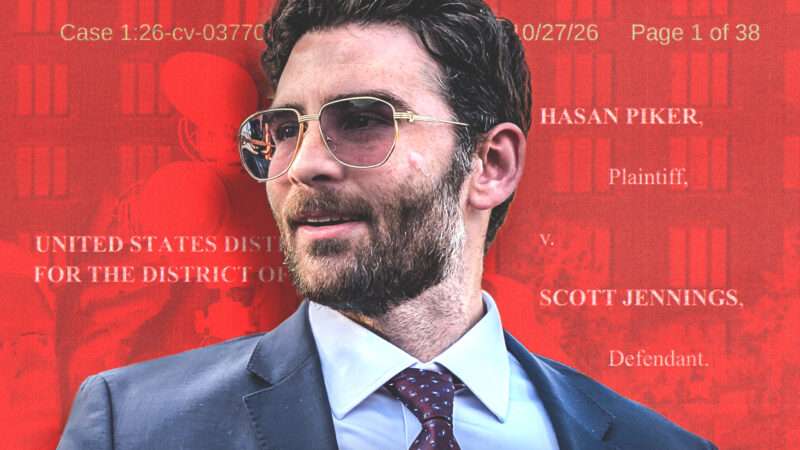
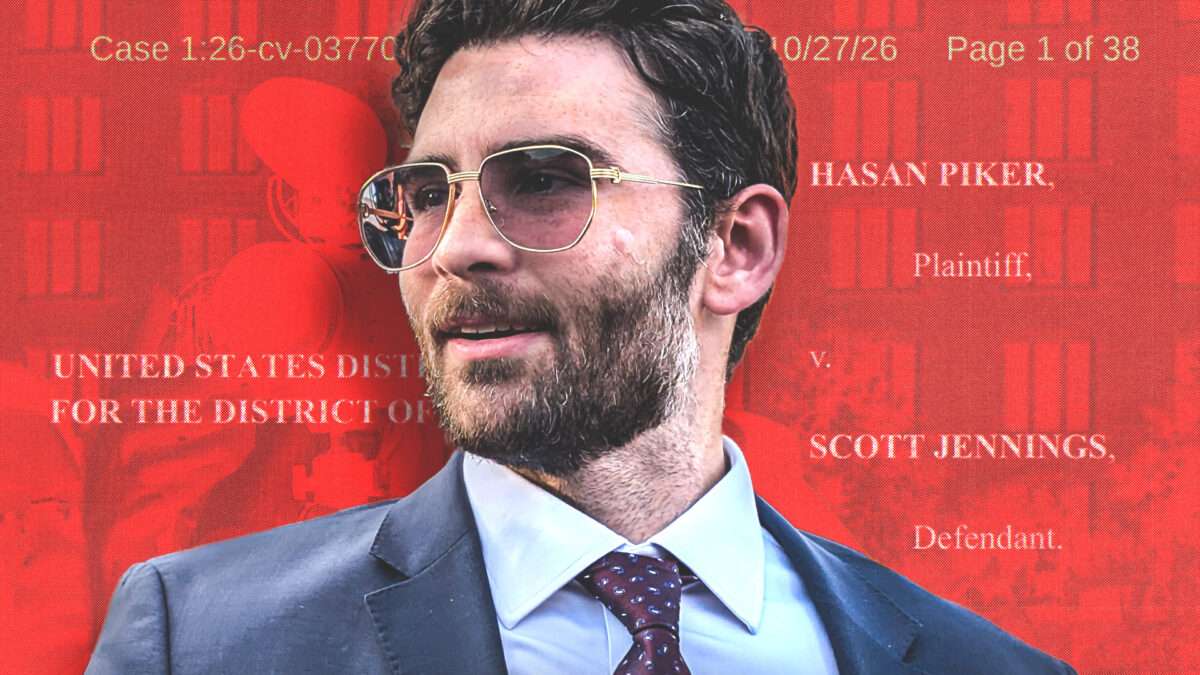
Hasan Piker's Defamation Suit Against Scott Jennings Isn't As Simple as It Seems

Hasan Piker | Illustration: Adani Samat. Photo: Poisonwithahawkseye/Wikimedia Commons

A lesson from this lawsuit filed by lefty streamer Hasan Piker against podcaster and CNN contributor Scott Jennings: Never be sarcastic. Never use hyperbole. It will always come back to bite you.

I happen to like hyperbole and sarcasm, though. So, I'm sympathetic to Piker's plight. Still, I'm not 100 percent certain he will—or should—win this case.

Two years ago, Piker, reacting to a debate in which a black conservative commentator complained about "woke" district attorneys, sarcastically summarized the commentator's argument during a Twitch broadcast:

He said, "We need more Klansmen, okay? Can we go back to a better time when lynchings were happening? This is what I like as a Black man. Also, there's no real racism in America." My man said, "woke DAs," dude. What are you saying?

That doesn't seem like the most charitable way to describe the dude's comments. Perhaps Piker has some problems with overreaction. But in any event, it's clear that Piker himself was not professing a yearning to don a white robe.

But context collapse is the internet's love language. And so we got this.

How does Abdul El-Sayed's campaign surrogate Hasan Piker feel about Black Americans?

Watch for yourself. pic.twitter.com/icGiXek7Ok

— Senate Republicans (@NRSC) August 6, 2026

Weaving together fragments of Piker's above comments and several other out-of-context clips, the National Republican Senatorial Committee (NRSC) made it appear as if Piker was himself advocating in favor of the lynching of black people.

Later, Scott Jennings aired the clip on his podcast/syndicated radio show, saying that Piker was "out there calling for Black voters to be lynched." A caption on the video said "PIKER: 'LET'S GO BACK TO A BETTER TIME WHEN LYNCHINGS WERE HAPPENING,'" per Piker's complaint.

Piker certainly has justification to be outraged and to push back against this false characterization. But…is it defamation?

Legally speaking, maybe not. To prove defamation against a public figure, you have to show not only that a harm-causing false statement was publicized but that it was done with "actual malice."

In this case, showing that Jennings acted with actual malice could prove a hard task. To have acted with actual malice, he would have to have had "knowledge that [his statement] was false" or to have acted with "reckless disregard of whether it was false or not."

Even if Jennings did deliberately lie from the get-go, good luck proving that. The clip was circulating already when Jennings aired it, shared by not just some random account but the NRSC. It features real footage of Piker, not an AI-generated deepfake. And it features real statements that Piker made, albeit taken out of context. There's plenty of room for plausible deniability.

But whether Jennings was "reckless" in running with the story will be a thornier question. Given the video's source and it actually featuring Piker talking, Jennings might have good grounds to argue that in the beginning he was not. But Snopes did a debunking, and Piker's people emailed Jennings explaining the true context. Still, Jennings left it up.

That complicates things. Even if Jennings didn't understand originally that the clip was misleading, the full clips should have helped him wise up. And if Jennings was pointed to them and didn't watch them, that would seem to at least constitute recklessness—though of course we haven't heard Jennings' side of the story yet.

Whatever happens, the case highlights how tricky defamation law is. People will always argue that it should be easier to win defamation cases, at least when the defamed party is on their side. But the upshot of that is that journalists and news outlets—and perhaps everyone who ever got fooled by and shared a misleading video clip—would be screwed.

The same rationale that could possibly protect Jennings in this case also allows journalists to publish important stories about people in power even if the people in power dispute the facts or the interpretation of them. It also helps ensure that making honest mistakes won't mean their financial downfall.

In this case, Piker is seeking $72.5 million in damages. "You have to remember, this is not just about Scott Jennings, although he certainly messed up," Piker told his audience on Twitch Tuesday. "This is about truth in the media, OK? I think for far too long we have allowed Republicans to get away with saying whatever they want."

But while defamation law that errs in favor of free speech can seem unfair when it lets someone falsely portray someone else as pro-lynching, the underlying structure actually shields press, podcasters, Twitch streamers, and anyone else who wants to write and talk publicly about politicians, celebrities, and other public figures. That's not to say Jennings shouldn't have, at bare minimum, been more careful. Or that Piker won't win—who knows? But if he loses, believers in free press and free speech should think twice before using this as a jumping-off point to call for changes to defamation law.

The post Hasan Piker's Defamation Suit Against Scott Jennings Isn't As Simple as It Seems appeared first on Reason Magazine.

  •  

Montana Man Faces Felony Charges for Telling Man of South Asian Descent To 'Go Back to His Country'

Two men at odds, one with a blurry face | Illustration: Midjourney

Jaxton Tayte Collins, a 21-year-old from Montana, had been out drinking at a bar in downtown Helena before he allegedly shoved a man of South Asian descent and told him to "go back to his country." Those comments, along with an alleged shove, could land him in jail for up to five years.

According to reporting from the Billings Gazette, "the complainant told officers he was walking with friends when a man in an orange shirt and wearing a large cross necklace approached his friend, who is of Indian descent and wears a head covering." The man in the orange shirt, later identified as Collins, "allegedly shoved the friend with both hands and "told him to go back to his country." Witnesses characterized the August 7th incident as "an attack," and called it "frightening."​

Officers then arrived on the scene and located Collins nearby. He told cops that he had been at a bar drinking and told the victim to go back to his own country "because he was angry." However, he denied pushing him.​

On Tuesday, Collins was arraigned on one count of misdemeanor assault and one felony charge of malicious intimidation or harassment of civil or human rights. Under Montana law, malicious intimidation or harassment occurs when a person "purposely or knowingly, with the intent to terrify, intimidate, threaten, harass, annoy, or offend" causes bodily injury, "reasonable apprehension of bodily injury," or damages property because of another person's "race, creed, religion, color, national origin, or involvement in civil rights or human rights activities." Collins pleaded not guilty on both counts. 

It's certainly plausible that Collins' actions could fall under these criteria. But the question that will likely decide Collins' fate pertains to the alleged shove.

In a statement to Reason, the Foundation for Individual Rights and Expression (FIRE) says, "The First Amendment protects even the most offensive and hateful speech. At the same time, it does not give a free pass to commit assault." 

In Wisconsin v. Mitchell (1993), the Supreme Court upheld an enhanced sentence for a black man who urged his friends to attack a white teenager because of his race, ruling that states can impose harsher penalties for crimes motivated by bias—including racial, religious, and cultural bias—and that someone's words can serve as evidence of that motive.

"So if the defendant assaulted someone because of his race or national origin, the First Amendment likely wouldn't shield him from an enhanced penalty," says FIRE.

Montana's law isn't an outlier, and people have been convicted in other states for less. California, Washington, Michigan, and Illinois all have similar "hate crime" laws that can make it a felony to use force or threaten violence against someone because of their race, religion, or other characteristics.

In 2019, Reason reported on Timothy Trybus, who was convicted of two felony hate crimes in Chicago after drunkenly harassing a woman who was wearing a shirt with a Puerto Rican flag on it. He told her, "You shouldn't be wearing that in America." Tybrus never laid a hand on her, yet his comments upgraded a misdemeanor disorderly conduct charge into two felonies. He was sentenced to two years of probation and 200 hours of community service.

Collins' next hearing is scheduled for April 8, 2027. If convicted, he could face up to five years in prison and a fine of up to $5,000.

Collins' words that night reflect a condemnable kind of nativism that is fundamentally un-American. But so is punishing someone for the content of their beliefs. If Collins did in fact shove the man, that could very well constitute a felony under Montana law. But if he's being prosecuted simply for his words, "that would obviously raise serious First Amendment concerns," says FIRE.

The post Montana Man Faces Felony Charges for Telling Man of South Asian Descent To 'Go Back to His Country' appeared first on Reason Magazine.

  •  

10-Year "Harassment"/"Stalking" Sentence for Repeatedly Criticizing Police Detective Violated First Amendment, Amicus Brief Argues

I was delighted to sign on to this brief in State v. McMenamy (Mo. Ct. App.) just filed by the ACLU of Missouri Foundation and the Wash. U (St. Louis) First Amendment Clinic, on behalf the ACLU of Missouri and Profs. Jane Bambauer and Lyrissa Lidsky and me. The Introduction:

The First Amendment and article I, § 8 of the Missouri Constitution broadly protect the right to speak to the public about other people. This is true even when the speech "is intended to trouble or annoy, or to make another timid or fearful." United States v. Sryniawski, 48 F.4th 583, 587 (8th Cir. 2022). And it is true even when speech uses "social pressure and the 'threat' of social ostracism … to embarrass others or coerce them into action." NAACP v. Claiborne Hardware Co., 458 U.S. 886, 910 (1982). While individuals who are the subjects of unwanted speech may be able to limit some speech directed to them, they cannot limit offensive speech about them directed to others. Organization for a Better Austin v. Keefe, 402 U.S. 415, 419 (1971).

Contrary to this established law, Matthew McMenamy was convicted and sentenced to 10 years in prison for openly and vigorously criticizing a local police detective he believed had engaged in misconduct. Mr. McMenamy used his public social media accounts and publicly distributed flyers to attempt to draw the community's attention to the detective's actions. He expressed his hope that his revelations would result in the officer's removal.

While Mr. McMenamy's speech was certainly concerning to the detective, the circuit court did not make any finding that either the flyers or any one of the dozens of social media posts submitted as evidence fell within any category of unprotected speech, such as true threats. Nor could the circuit court have done so, as none of Mr. McMenamy's speech was outside the bounds of the First Amendment's protection. His convictions for harassment and stalking violate the First Amendment and should be reversed.

The opening paragraph of the section on the facts (for the full discussion of the facts, read the brief):

In August 2023, Matthew McMenamy began posting on social media about what he viewed as misconduct and racism by a local police detective, who years before had been involved in Mr. McMenamy's involuntary commitment. See State's Exs. 60A–M. Mr. McMenamy sought to publicize one of the detective's public Facebook posts, where the detective wrote: "If black lives matter then why are they shooting and killing each other at an alarming rate." State's Ex. 60B ("Let's make this racist post go viral … #BLM #RacistCop ….); State's Ex. 60A ("The people want answers. Is [detective] a racist? Does he feel that people of color do not matter because of an idea that they murder each other at an alarming rate?"). Many of Mr. McMenamy's posts were aimed at sharing with the public his concerns about the detective's fitness for his position. For example, Mr. McMenamy posted he was "in talks with a billboard company to put [detective's] racist quotes up next to a picture of him in uniform" because "[s]omeone like that shouldn't be a detective, an election [sic] official, or let alone anything near public service." Tr. 736:10–21, State's Ex. 60K. Mr. McMenamy's posts also described his feelings about his prior involuntary commitment and thoughts about hurting his parents before getting help. See State's Ex. 60E (Mr. McMenamy's post that he "had a bad day last Sunday … I still need time to heal but … I am going to counseling and I will be looking for support groups").

And the opening material in the legal argument (again, read the brief for much more):

All of Mr. McMenamy's social media posts and his distribution of flyers were protected by the First Amendment. Harassment and stalking laws may, in some circumstances, be constitutionally applied to protect unwilling listeners from unwanted, one-to-one speech directed to that listener. The government's power to protect an unwilling listener from speech about them directed to the public, on the other hand, is sharply limited, even when that speech is annoying, offensive, or alarming. Unless such speech falls within one of the narrow, historically recognized categories of speech that the U.S. Supreme Court has held may be regulated without violating the First Amendment, such as "true threats," it is presumptively protected.

Here, Mr. McMenamy spoke to the public, and his speech did not fall within any unprotected category. This Court should reverse Mr. McMenamy's convictions. Even if this Court does not find that all Mr. McMenamy's speech is protected from criminal prosecution by the First Amendment, he is at least entitled to a new trial. The circuit court allowed the State to present evidence of more than four months' worth of social media posts to the jury and then instructed the jury it could find Mr. McMenamy guilty based on unidentified "alarming content" in these posts. This means a juror could have convicted Mr. McMenamy based on speech protected by the First Amendment.

[I.] The State's prosecution of Mr. McMenamy for harassment and stalking based on unwanted speech about individuals directed to the public violates the First Amendment.

Speech directed to the public at large is presumptively protected unless it falls into one of the narrow, historic exceptions to the First Amendment. This is because even if some listeners are likely to be offended, others may be willing listeners who find the speech valuable. For this reason, while harassment and stalking statutes may, in some instances, be constitutionally applied to repeated unwanted communications to an individual, they cannot be constitutionally applied to communications to the public about an individual.

[A.] Stalking and harassment statutes were originally intended to limit unwanted communications directed to a specificperson.

For decades, laws have "restricted certain kinds of unwanted speech said to a particular person." For example, state and federal criminal harassment statutes were enacted to prohibit unwanted telephone calls to a particular person. Similarly, the federal government and some states have banned certain unwanted mailings into the home. These laws reflect an intention to protect individuals from repeated, unwanted communications to them, particularly in the home.

More recently, states enacted stalking laws to proscribe behaviors such as physically following, surveilling, or engaging in repeated unwanted personal contacts with a particular person. Courts have relied on stalking laws or restraining order laws to ban repeated or annoying letters, phone calls, or personal contact from a particular person. While some of these laws have been struck down in some states, "they have generally been upheld by lower courts; and the U.S. Supreme Court has upheld the federal ban on repeated unwanted mailings."

These laws share something in common: In the vast majority of their applications, they restrict unwanted speech to a person, not unwanted speech about a person. It is in this context—where the laws are being applied to "one-to-one speech"—that they "have generally been upheld against First Amendment challenge." Id.

As the internet has made it easier for communications to reach the public, maintaining this distinction between constitutionally permissible punishment of certain one-to-one speech and constitutionally impermissible punishment of one-to-many speech is critical. Social media is "the modern public square." However, the increased exposure for "upsetting" or "frightening" online speech can bring with it an increased risk of overcriminalization. Online communication "lack[s] many normal contextual clues," including tone of voice and expression. "The ubiquity of this speech raises the possibility of highly discretionary enforcement." Thus, in the context of online speech, courts must exercise particular caution to ensure the state's application of harassment and stalking laws does not exceed the laws' original intention or permissible constitutional boundaries.

[B.] The First Amendment grants broad protection to speech directed to the public at large, even when the subjects of that speech may be alarmed or offended.

The U.S. Supreme Court has consistently recognized a distinction between speech directed to the public at large and interpersonal speech for First Amendment purposes. Even when the content of the speech is subjectively offensive or alarming, the U.S. Supreme Court has typically protected public statements about a person—absent a showing of a narrow and well-established First Amendment exception, such as true threats, fighting words, or defamation.

As now-Justice Alito stated: "There is no categorical 'harassment exception' to the First Amendment's free speech clause." Saxe v. State Coll. Area Sch. Dist. (3d Cir. 2001); [citing other cases]. Many courts have endorsed this very point, quoting Saxe, in the context of criminal harassment laws and the closely related harassment restraining order laws. [Citing still more cases].

Unlike prohibitions on speech said to a particular unwilling listener, restrictions on speech to the public deprive a speaker of the opportunity to communicate with willing listeners. Denying access to potentially interested audiences undermines the use of speech to influence opinion and conduct and, as a result, hinders the robustness of public debate—particularly when the restricted speech concerns a matter of political, social, or other concern to the community. One's interest in being free from public criticism is insufficient to overcome protection for speech….

Accordingly, public statements about a person that coerce, annoy, alarm, offend, or embarrass are generally protected by the First Amendment. {The State may have some power to restrict narrowly defined categories of speech that reveals private information about a person that is "almost never relevant to any discussion on either public or private topics" (e.g., nude photos, Social Security numbers). No such speech is at issue here.} In Organization for a Better Austin v. Keefe (1971), a local civil rights organization believed a local real estate broker's practices were improper. After the broker refused to sign an agreement not to solicit property in the organization's community, the organization distributed leaflets critical of the broker's supposedly racist real estate practices at a local shopping center, on the doors of his neighbors, and to people going to and from his church. Some leaflets accused him of being a "panic peddler" that employed tactics to scare white homeowners into selling their properties; others encouraged recipients to call his home phone number to express their disapproval. The U.S. Supreme Court concluded that the organization's "inten[t] to exercise a coercive impact … does not remove [speech] from the reach of the First Amendment. Petitioners plainly intended to influence respondent's conduct by their activities; this is not fundamentally different from the function of a newspaper." The U.S. Supreme Court explained, "so long as the means are peaceful, the communication need not meet standards of acceptability," particularly where the target of the speech "is not attempting to stop the flow of information into his own household, but to the public."

While speech that is intended to solicit violence against particular people may be punishable, speech to the public that harshly criticizes its target or that attempts to persuade through social pressure does not lose its protection even if some listeners may react with threats or violence. In NAACP v. Claiborne Hardware Co. (1982), organizers of a boycott of stores owned by white merchants read aloud and published the names of Black residents who weren't following the boycott to place pressure on them. As in Keefe, the U.S. Supreme Court held the disclosures constitutionally protected, noting the First Amendment extended beyond abstract discussions to protect "offensive" and "coercive" speech intended to influence action. This was true even though some of the people who chose not to comply with the boycott were beaten, had their property damaged, or had shots fired into their homes. The U.S. Supreme Court explained that speech designed to persuade "through social pressure and the 'threat' of social ostracism … does not lose its protected character … simply because it may embarrass others or coerce them into action." …

For a couple of articles of mine on the subject, see One-to-One Speech, One-to-Many Speech, Criminal Harassment Laws, and "Cyberstalking" and Overbroad Injunctions Against Speech (Especially in Libel and Harassment Cases.

The brief was signed by Kristin M. Mulvey, Jonathan D. Schmid, Gillian R. Wilcox, Jason A. Orr (ACLU Missouri) and Lisa S. Hoppenjans, Benjamin J. Wilson, and students Lindsey Bennett. Megan McConnell (Wash. U. First Amendment Clinic).

The post 10-Year "Harassment"/"Stalking" Sentence for Repeatedly Criticizing Police Detective Violated First Amendment, Amicus Brief Argues appeared first on Reason Magazine.

  •  
❌