Login

Corea del Norte prioriza drones e IA en modernización militar
El líder de la RPDC impulsa el desarrollo de aeronaves no tripuladas y la integración de IA en sistemas de armas durante una exposición militar en Corea del Norte.

Courtesy of SkyFall
Izyum thought he was going to die. A devastating blast had taken part of the Ukrainian infantryman's left foot, and he had lost a lot of blood. To make matters worse, Russian soldiers were closing in on his position, and there was no easy escape.
Then came a drone — a massive six-rotor aircraft with an enclosed stretcher underneath. It landed roughly 10 meters away from Izyum's position, in tall grass beside a minefield. Fiber-optic cables were strewn across the area, and he worried the hazards would prevent the rescue drone from taking off.
Dizzy and nauseous, Izyum's comrades helped him over to the unusual aircraft. Summoning what little strength he had left, he hoisted himself into the stretcher capsule. As the drone lifted off, he breathed a little easier, at last feeling some sense of relief.
Izyum is one of two Ukrainian soldiers who have been airlifted out of combat by the StarGate uncrewed aircraft, the first specialized drone for aerial evacuation, which was recently unveiled by Ukrainian company SkyFall. The wounded soldiers were medically evacuated this month in back-to-back rescue missions.
Izyum and KVN, a drone pilot in Ukraine's 475th Separate Assault Regiment who flew StarGate during the rescues, described the missions to Business Insider in interviews this week. Both spoke through a translator and were identified only by their call signs for security reasons.
Casualty evacuation by aerial drone is a new concept being pioneered in Ukraine. This month's rescue missions were among the first of their kind in combat. Skyfall, other defense industry officials, and soldiers say they expect to see more of these missions in the future and believe this experimental tactic is a critical capability, especially in moments when neither medical teams nor robots can reach wounded troops.
Courtesy of SkyFall
Right now, this approach is seen as a last resort — a break-glass option for when battlefield conditions prevent all other evacuation methods.
KVN's first daughter had just been born when the call came in. The 475th assault regiment, known as CODE 9.2, was preparing for a special operation, and leadership needed him to fly the main drone. A car was on its way to pick him up.
He soon arrived at an undisclosed location in Ukraine for the operation, the rescue of a wounded soldier from the 129th Separate Heavy Mechanized Brigade.
At the center of the operation was StarGate, a heavy hexacopter that SkyFall developed specifically for casualty evacuation purposes. The drone — which SkyFall said is the first of its kind — was unveiled in mid-October, only days before KVN's mission.
Ukraine is increasingly turning to robots to evacuate wounded soldiers in combat. With surveillance and attack drones swarming the front lines, almost any movement carries tremendous risks, making it dangerous for teams to retrieve casualties. Ground robots are one solution, but tough terrain can limit where they can go.
Courtesy of SkyFall
Heavy hexacopters have emerged as an option when other extraction methods are not possible. Earlier this month, Ukraine carried out its first casualty evacuation using an aerial drone, rescuing an infantryman from the 30th Separate Mechanized Brigade with a Heavy Shot Ayudag-6 heavy lift drone developed by Gurzuf Defence.
There have since been two more missions. KVN was the pilot for both, flying Skyfall's StarGate drone.
KVN recalled that his first evacuation happened at night. There were dozens of people — most of them from CODE 9.2, but some from other military units — involved in the rescue operation. The SkyFall team also participated in the planning.
KVN was nervous.
Reaching the casualty meant flying 20 miles out and back through areas flooded with Russian drones and electronic warfare that threatened to derail the mission.
So the Ukrainians assembled something akin to a strike package, with more than a dozen drones flying alongside StarGate to protect it from attack, draw Russian attention away from the rescue, and bomb enemy positions near the evacuation point.
Courtesy of SkyFall
Russian first-person-view (FPV) drones initially prevented the rescue drone from taking off with the wounded soldier, but eventually the skies cleared. KVN said his hands were shaking, but he relied on StarGate's built-in stabilization technology and his teammates' support to steady the drone and his nerves.
The first evacuation took 30 minutes. StarGate didn't have the range for the full 40-mile round trip, so KVN had to land it halfway on each leg so ground teams could swap out the batteries.
After the mission, KVN grabbed some much-needed sleep. When he woke the next morning, he learned that a second evacuation had been approved and would soon be underway.
Izyum, an infantryman in Ukraine's 1st Territorial Defense Brigade, sat down on the ground to rest.
His team had been tasked with holding a position they had just assaulted. When Izyum stood up, he triggered a blast that tore off part of his left foot. His comrades pulled him into a dugout and immediately applied a tourniquet.
Courtesy of SkyFall
They radioed back to their commanders that Izyum had suffered a severe injury and needed evacuation.
The situation was dire. Any attempt to walk to higher-level care would mean navigating roughly 20 miles of Russian drone and mine threats. Izyum had lost so much blood, and his strength was fading fast. Given the severity of his injuries, he would never have been able to make that trek on his own. His fellow soldiers would have had to risk their lives to help him make the journey.
And ground robots, increasingly used by Ukraine to evacuate wounded soldiers as the front-line kill zone grows more perilous, couldn't reach his position because ponds, small rivers, and tree lines blocked their path.
Brigade leadership concluded that the only option was to evacuate him by air. And with crewed helicopters effectively out of the question, they needed a drone. StarGate was chosen for the mission.
Izyum didn't think he was going to make it home. His crew was so deep on the front lines, and the Russians were close. At one point, the enemy was only 5 meters out.
Eventually, the rescue drone arrived. As the StarGate drone landed amid a mess of mines and cables, Ukrainian forces used Vampire drones, smaller hexacopters made by SkyFall, to bomb the Russians and keep them at bay.
Courtesy of SkyFall
KVN said landing near the minefield was one of the biggest challenges he faced during the mission, though Russian drone and electronic warfare threats were also problems. He said he had to fly "like a ninja" to avoid them.
Even with new technologies such as drones and ground robots, evacuating wounded soldiers isn't an easy process, and it takes time to plan, prepare, and execute. Nearly two days passed between Izyum's injury and his rescue. When he landed and opened the capsule to see friendly faces, he finally felt safe for the first time since the blast. KVN, too, felt an overwhelming sense of relief when the mission was finally over.
Izyum had four surgeries and is missing half his foot. He will soon be transferred to a rehabilitation facility. Speaking from a hospital in northeast Ukraine, he said that he is grateful to everyone who saved his life.
Some Ukrainian officials have acknowledged that large rescue hexacopters could be easy targets for Russia and said that they should only be used in the most extreme circumstances.
Both KVN and Izyum, however, said that aerial drone casualty evacuations should be expanded as standard practice; CODE 9.2, for instance, plans to create dedicated units for these missions, and SkyFall is aiming to build out a department within the firm specifically for evacuations.
StarGate drones — which cost roughly $50,000 a unit, can carry up to 330 pounds, and can fly at speeds over 60 miles per hour — are equipped with survivability features, such as artificial intelligence-enabled navigation and communication redundancies. SkyFall said it aims to be able to make 1,000 drones a month by the end of 2026.

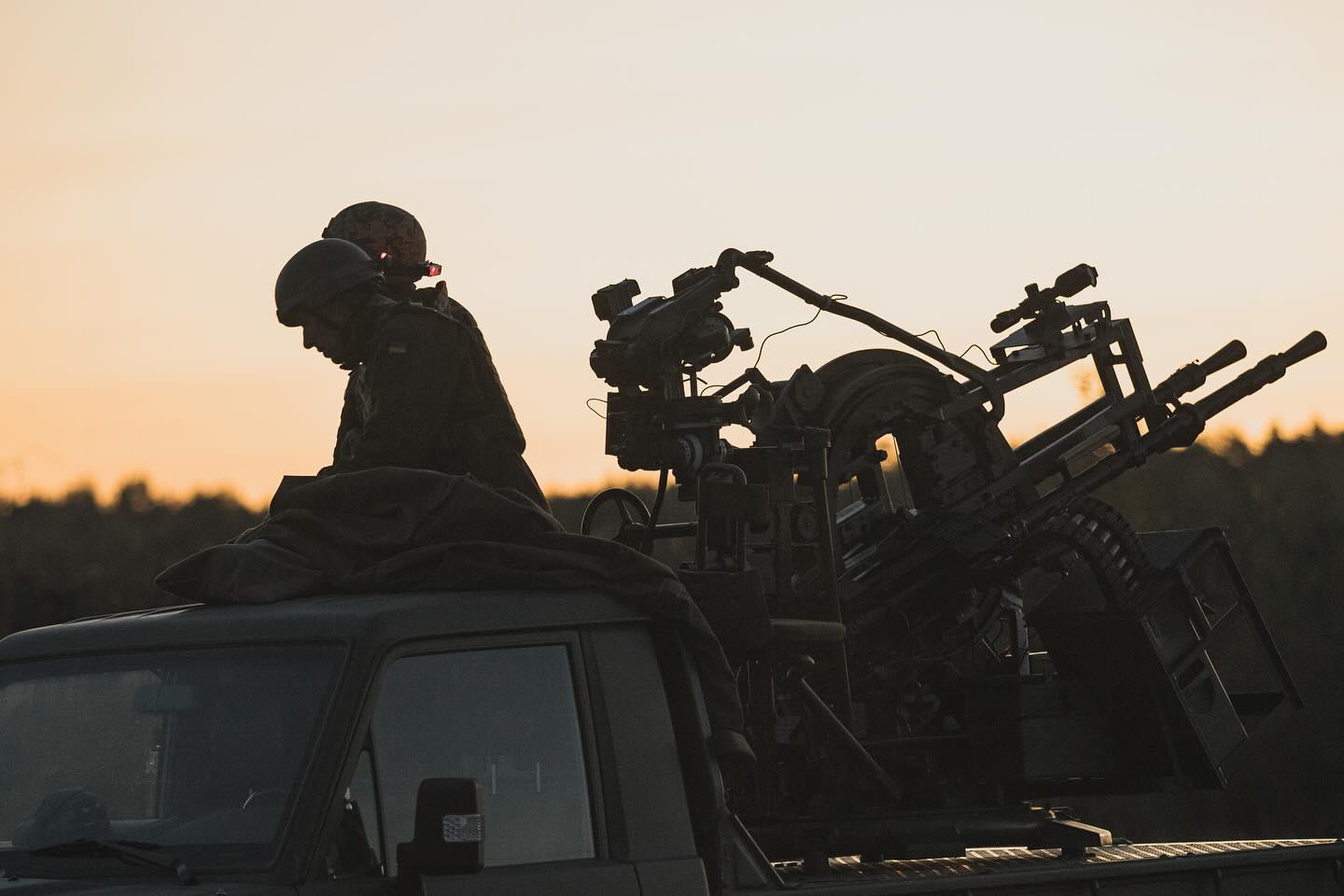
Automated gun turrets now serve in Ukraine’s Air Force and are destroying Russia’s jet-powered weapons, the Defense Ministry reported on 29 October. It gave no count for those jet kills, and it did not say what type of drones the turrets downed over Kyiv.
Jet drones are where Ukraine struggles most. From 1 to 26 September, Ukraine downed 55% of jet-powered drones against 90% of slower ones, partly because its interceptor drones fly at about 300 km/h, too slow to catch them. Yurii Cherevashenko, Deputy Commander of the Air Force, told a parliamentary inquiry commission on 6 October that jet-drone interceptors would arrive in the needed numbers no earlier than late November. Guns have limits too. On 5 October, Air Force spokesman Yurii Ihnat said turrets had already downed Geran-5s, but that their range is short because their main weapon is a machine gun.
According to the ministry, Brave1, a defense innovation cluster, began developing automated turrets in 2024. The systems have since “moved beyond the experimental stage and become an integral part of air defense,” it said. In Air Force service, the turrets are destroying jet-powered Banderol munitions and Geran-5 drones.
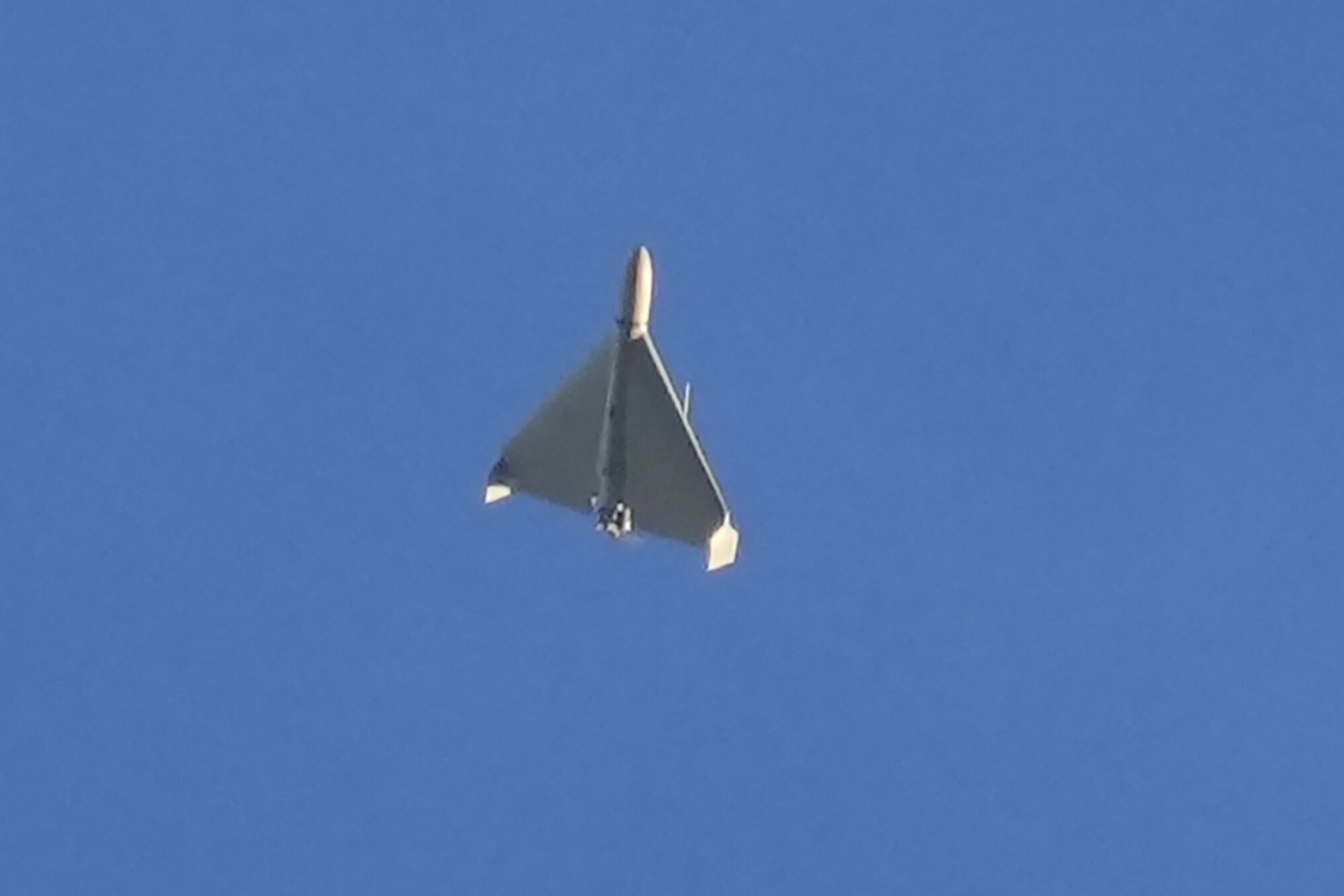
Russia first used the Geran-5, a 6-meter jet-powered strike drone, in early 2026. The Banderol, a jet-powered cruise missile, flies at 520–560 km/h and can reach 650 km/h.
Separately, the ministry said turrets have destroyed more than 60 targets within the private air defense project. The project lets companies form anti-drone teams that work under Air Force command.
Yet on 14 October, the ministry gave the same 60-plus total for all private teams. At the time, it named interceptor drones and heavy machine-gun turrets as their main weapons. Groups from six companies were on combat duty, about 50 groups had been formed in total, and some were still training. Nearly 100 companies had joined by then, up from 81 in mid-September.
The ministry says the project expands air defense “without placing an additional burden” on the military’s own air defense. It and Brave1 say they will keep integrating automated turrets into the air defense system.

Russia’s Geran-5 jet drones have sped up to 1,000 km/h while maneuvering, Ukraine’s presidential adviser on defense technology Serhii “Flash” Beskrestnov said in Kyiv on 29 October. He added that Chinese engineers help develop Russia’s Geran drones.
When Russia moved to faster Geran versions, Ukrainian developers had to look for new ways to intercept them, Beskrestnov said, and Ukraine must learn to stay a step ahead. From 1 to 26 September, air defenses downed only 55% of Russia’s jet-powered drones. On 29 October, one such drone hit Dnipro’s railway station, and the death toll has since risen to 15. Over the past three months, air defenses downed nearly 60% of the jet-powered Geran-4, the General Staff said on 27 October, noting a shortage of guided anti-aircraft missiles. That update gave no Geran-5 figure.
That peak, about 620 mph, came during maneuvers. Ukraine’s military intelligence (HUR) puts the Geran-5’s cruise speed at 450–600 km/h. By Beskrestnov’s count, the earlier Geran-3 flew at 280–300 km/h.
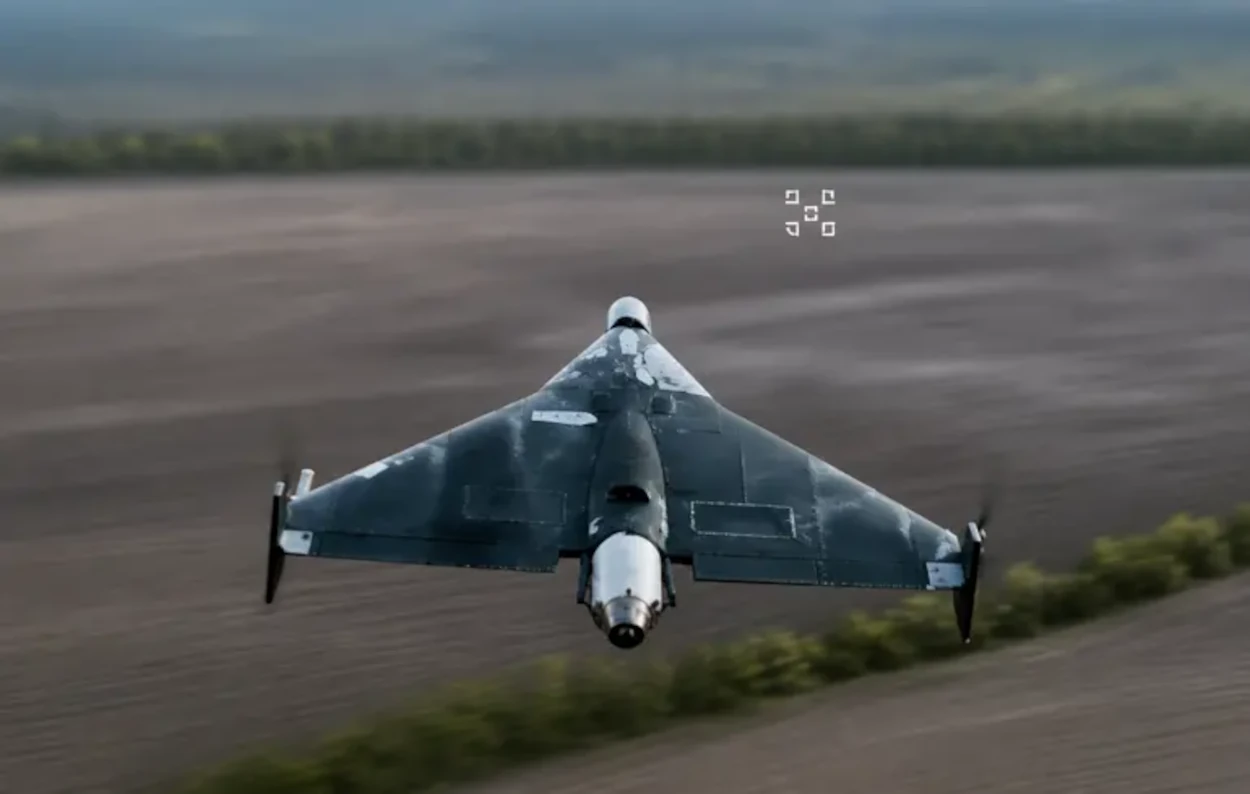
Russia’s best engineers work against Ukraine, and China’s do too, Beskrestnov told journalists. Russia’s Alabuga drone plant sets Chinese engineers tasks such as work on the control module, he said. Key components inside Russia’s Shahed-type drones are Chinese, he said. Meanwhile, China will require licenses for Geran engines from 18 November, Ukraine’s sanctions commissioner Vladyslav Vlasiuk said. Licensing is not a ban, he stressed.
Some interceptors are being designed to match the Geran-5’s cruise speed. US firm CHAOS Industries claims a top speed of 540 km/h for its Vespid Mk 1 interceptor. On 14 October, Ukrainian defense outlet Defense Express judged that may be enough against the Geran-5’s 450–600 km/h cruise speed.

Ukrainian manufacturers have already shown jet-powered interceptor drones, Beskrestnov said. But they have run into problems with control, guidance, automatic target lock, and scaling up production. A model that flies fast is only one part of the job, he said, and an easy-to-use serial product is a different question entirely.
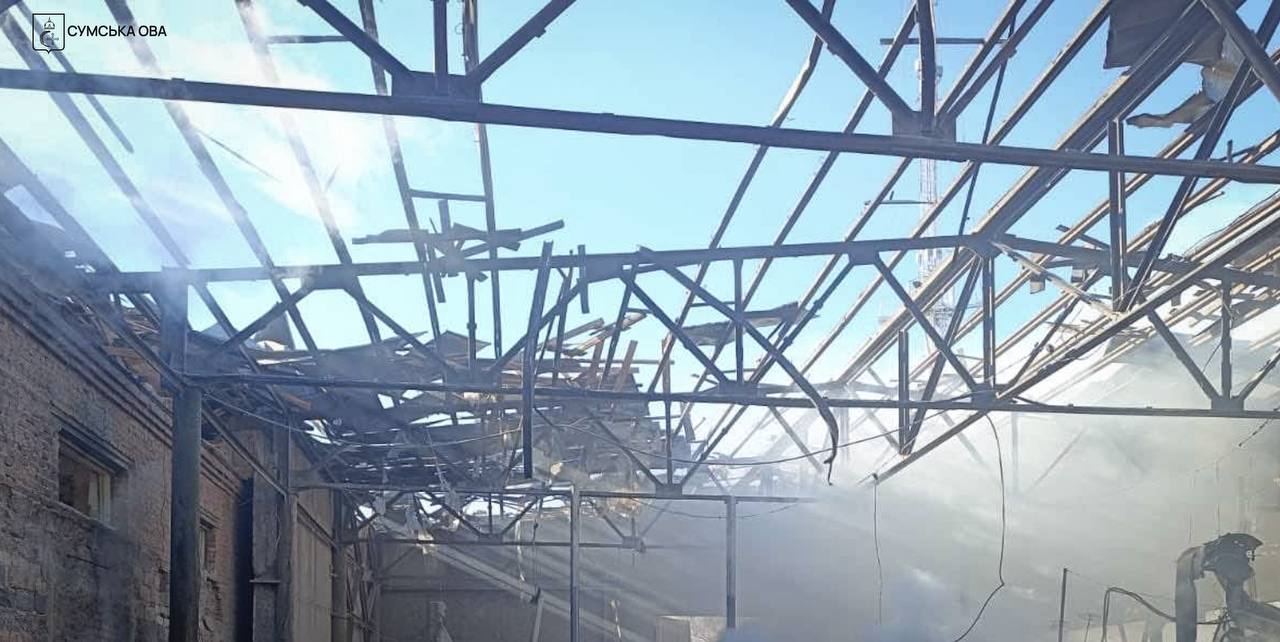
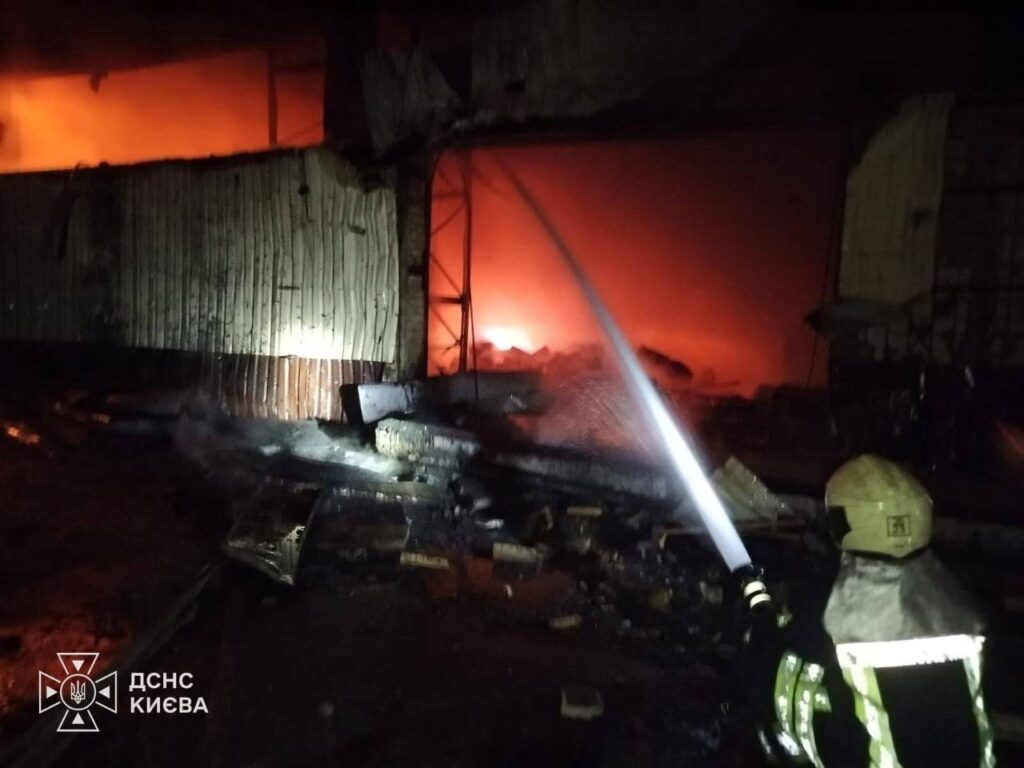
Russia attacked Kyiv with ballistic missiles late on 29 October, killing a man and injuring a 35-year-old woman, Kyiv city prosecutors said. The strikes damaged eight apartment blocks in Dniprovskyi district, a gas station, a restaurant, a dental clinic, warehouses, and cars. A warehouse building caught fire in Darnytskyi district, the city administration reported.
Overnight, Russia fired Iskander-M, S-400, and KN-23 ballistic missiles, four Kh-59/69 guided missiles, and 113 drones, 83 of them jet-powered, Ukraine's Air Force said. The attack mainly targeted Kyiv, Poltava, and Dnipropetrovsk oblasts. Air defenses downed three missiles and 96 drones, but strikes hit 17 locations.
Russia is waging its war on Ukraine's cities around the clock as winter approaches, striking homes, transport, and the power grid that keeps them running. On 29 October, including the late attack on Kyiv, Russian strikes killed at least 27 civilians and injured more than 140 across six regions, by EP's tally of regional authorities' reports. It was one of the deadliest days of the autumn. Most died in daylight, on a train platform in Dnipro, in an apartment block in Kremenchuk, in central Chernihiv, and under guided bombs in Izium.
A Russian strike on Dnipro left more than 350,000 customers in the city and nearby towns without power, Dnipropetrovsk Oblast's administration said shortly after midnight. Water pumping stations switched to backup power. By morning, engineers had restored electricity to most customers in the oblast, but more than 200,000 were still without power.

In Kyiv, equipment damaged in earlier strikes failed on the right bank, forcing emergency outages, the city administration said. Russia attacked an industrial plant in Poltava Oblast's Kremenchuk district overnight and again in the morning, with no casualties reported, the regional administration said.

In the morning, a Russian drone hit a shopping center in Kharkiv's Kyivskyi district, injuring four women, Kharkiv Oblast Governor Oleh Syniehubov said. In Chernihiv Oblast, Russian drones destroyed the house of culture in Mena late on 29 October, and in the morning a drone hit a house in Bobrovytsia and injured a woman, the regional administration said. In Chernihiv itself, 37 people sought medical help after the 29 October strike on the city center that killed two 15-year-old girls, Yana and Mariia.

A 40-year-old man wounded in the 29 October jet drone strike on Dnipro's railway station died in hospital, raising the toll to 15, the regional administration said. Eleven people remain in hospital. Dnipropetrovsk Oblast declared 30 October a day of mourning.

Poltava Oblast also mourns three people killed when a Russian drone hit an apartment block in Kremenchuk on 29 October. Another 32 were injured, six of them children, the regional administration said.

In Izium, Kharkiv Oblast, Russian guided bombs hit a five-story building on 29 October, killing four people and injuring 14, police reported. In Zaporizhzhia Oblast, Russian attacks killed two people in Bilenke and injured 23 across the region, 13 of them when Russia sent seven FPV drones at vehicles and public transport in Zaporizhzhia city, police said. EP reported the city faced a record number of such attacks.
A Russian FPV drone struck a social bus operated by the Proliska Humanitarian Mission in the frontline village of Bilenke, Zaporizhzhia Oblast, while it was carrying 23 passengers and a driver. The mission’s head, Yevhen Kaplin, reported the attack on Facebook on 29 October. In a comment to Ukrainska Pravda, he later gave slightly different details: 20 passengers and around 14:50.
Earlier that day, Russian attacks on Bilenke killed a 49-year-old man and wounded three other men, acting Zaporizhzhia Oblast head Mykhailo Semikin said. The village of Bilenke is likely to face the most difficult conditions in Zaporizhzhia Oblast this winter, then-head of the oblast Ivan Fedorov said in an interview with Ukrinform on 15 August. Russian forces use the village as a testing ground because the front line runs roughly across the river, he said.
Since the start of Russia’s full-scale invasion, this marks the 121st attack on the mission’s staff and volunteers while they were providing aid, as well as on its vehicles, offices, and warehouse infrastructure, Kaplin said.
The attack killed a female passenger born in 1952. The bus driver sustained serious injuries and was evacuated to a medical facility, Kaplin said. Another passenger, a man born in 1947, sustained multiple shrapnel wounds, while another woman suffered injuries from flying glass. The remaining passengers suffered acoustic barotrauma. Most of the people on board were elderly.
According to preliminary information, this was a drone that was lying in wait, Kaplin said. The attack took place at around 14:30 in the center of the village, on a section of road protected by an anti-drone net.
The bus was clearly marked with the humanitarian mission’s logo on the hood and roof, as well as the words “social bus,” Kaplin said.

National Police special units and military personnel evacuated the wounded, accompanied by aerial cover teams, due to the threat of further drone attacks.
Commercial transport operators no longer serve the village of Bilenke, but more than 1,600 people still live there.
As a result, residents had no way to reach the Oblast center to access essential services, or to buy food and medicine, Kaplin said. They also could not collect their pensions or winter aid payments from the state and humanitarian organizations.
The Proliska team launched the social bus at the request of regional and local authorities.
Russian drones also hit civilian transport in the Oblast capital several times on 29 October. The city came under a record number of FPV drone attacks that day, Semikin said, adding that Russia had changed its tactics and modified its drones.
Ukraine's Defense Forces hit the Novokuibyshevsk oil refinery in Russia's Samara Oblast with FP-1 drones early on 30 October, Ukrainian drone maker Fire Point said, adding that one of the units hit hydrotreats diesel fuel. The strike came hours after WSJ reported that Ukraine had paused strikes on Russian refineries under pressure from US President Donald Trump until after the US midterm elections on 3 November.
Russia is pounding Ukraine's power grid and cities ahead of winter, with a mounting civilian toll, including 14 people killed on a Dnipro railway platform on 29 October. Ukraine's long-range drone strikes on Russian refineries, one of its most effective operations against Moscow, target the oil money that pays for that war. Trump has pressed Kyiv for weeks to stop them, blaming them for high global fuel prices, and Ukraine went quiet without saying so and without getting what it asked for in return, WSJ reported. The Samara strike is the first on Russian oil since then. Kyiv has not said whether the pause is over.
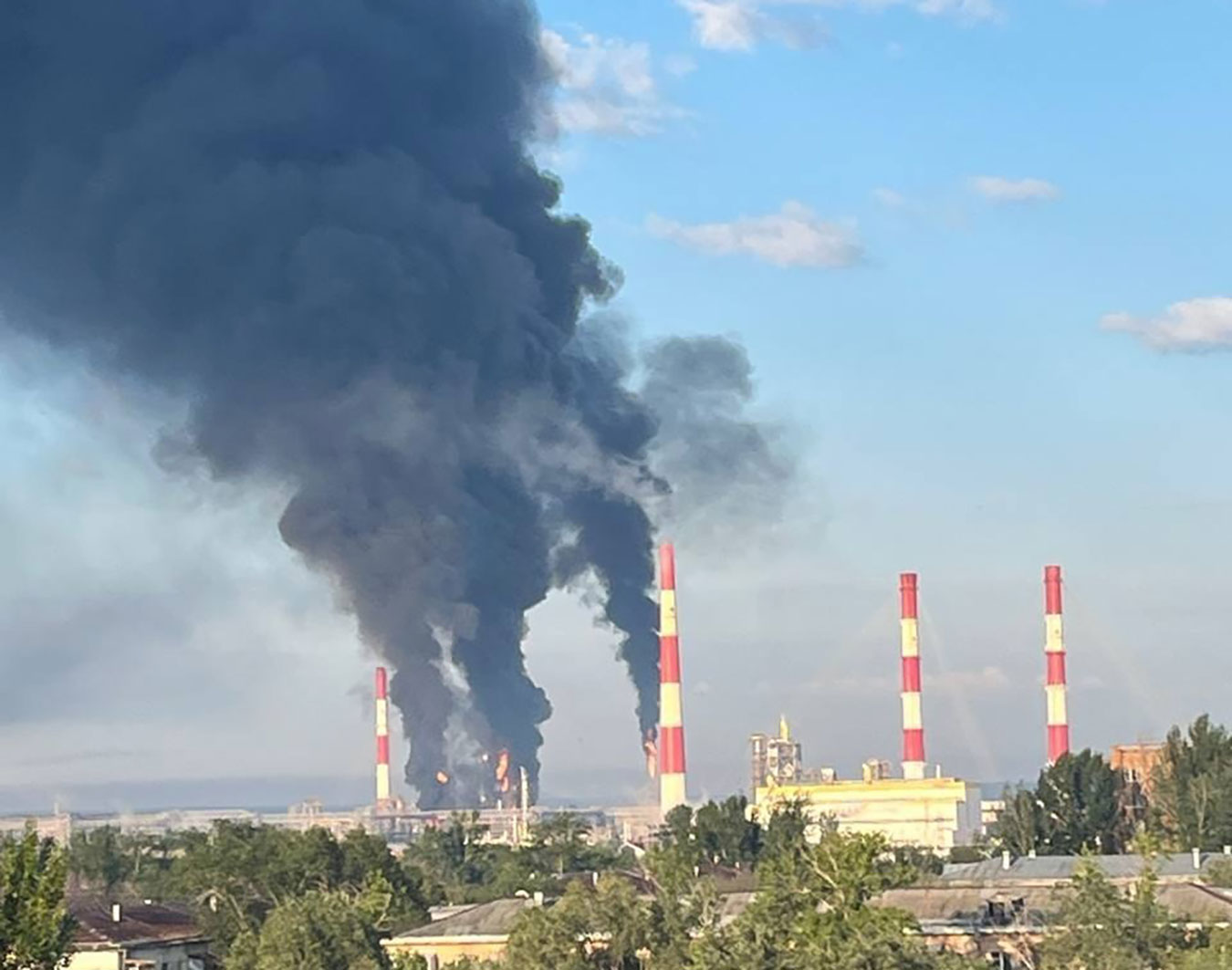
Residents of Novokuibyshevsk reported drones, explosions, and a fire before dawn. Ukrainian Telegram channel Exilenova+ posted the first photos on Telegram at 05:24 Kyiv time, and Russian Telegram channel Astra geolocated the fire to the refinery, citing its open-source analysis of residents' photos.
Novokuybyshevsk, Samara region: locals report an attack and a fire. pic.twitter.com/9UEgqmkAOU
— Exilenova+ (@Exilenova_plus) October 30, 2026
By morning, Exilenova+ counted at least 11 separate fires at the refinery. Samara Governor Vyacheslav Fedorishchev said air defense and mobile fire groups were repelling an attack, Astra reported. The region had declared a drone alert and closed its airport.

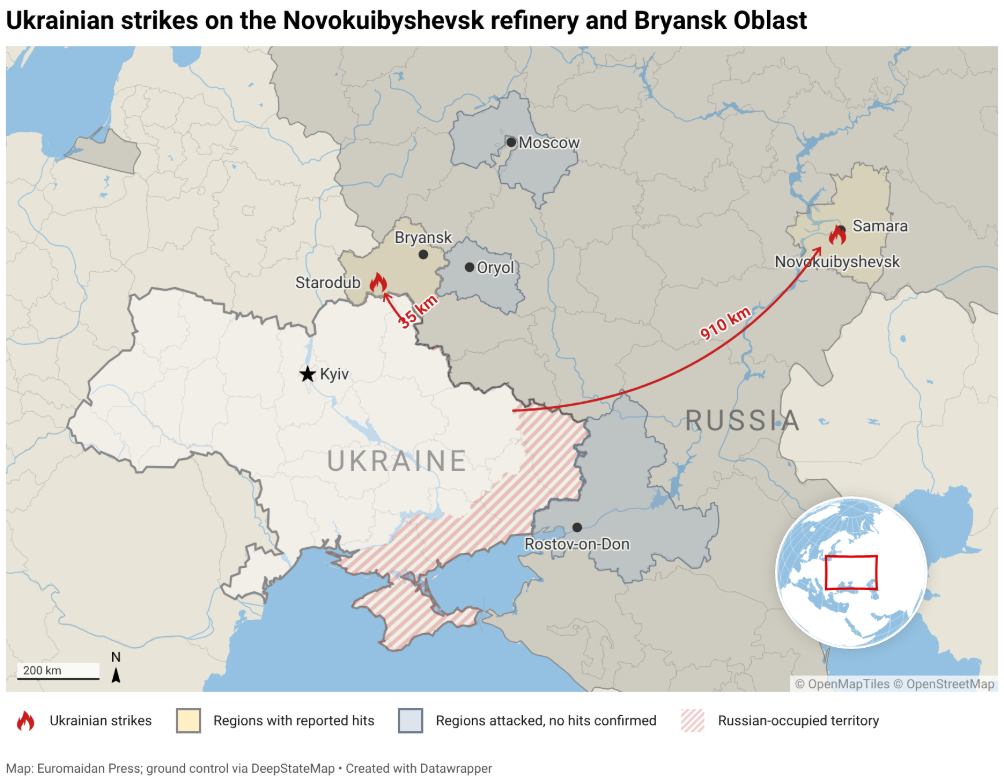
Fire Point said its FP-1 drones scored numerous hits on the refinery grounds, and that one of the units hit hydrotreats diesel fuel. The footage published so far shows several smoke columns over the plant but does not show which units burned. The Rosneft-owned refinery has a design capacity of 8.8 million tons of oil a year and is one of the main producers of jet fuel, according to its website. Astra says it supplies jet fuel to Russia's military. The plant lies about 910 km from the front line. Ukraine's General Staff has not commented.
— Exilenova+ (@Exilenova_plus) October 30, 2026
Ukrainian drones have hit the plant before. Ukraine's military said its forces hit it in August and caused a fire.
It is the first fire at a Russian refinery since 15 October, when Ryazan's governor reported one at the city's refinery. It is also the first reported strike on Russia's oil industry since 20 October, when Ukrainian drones hit a Druzhba pipeline pumping station in Tambov Oblast. WSJ called that strike the last before the pause.
Ukraine's military paused its strikes on Russian refineries after weeks of pressure from Trump shook Kyiv's confidence in US support, people with knowledge of the operations told WSJ. The unofficial pause began early last week and is expected to last until after the midterms, and possibly deeper into November. Units carrying out long-range strikes were told in mid-October that the refinery campaign was effectively on hold once missions already under way were completed, two military officials said. Hours after the report, the Novokuibyshevsk strike called that account into question.

Ukraine's government has not announced a pause. Zelenskyy told reporters in Kyiv on 27 October that “our guys tried to be a little more careful during these days. But they do not have an order” not to hit refineries, according to WSJ. He said drone units were hitting other kinds of targets in Russia.
Trump's envoy Jared Kushner repeated the demand to stop the strikes at a meeting with Zelenskyy in Oslo on 20 October, two US officials told WSJ. One of them called the conversation “very tough.” Kushner, who joined remotely, said he and envoy Steve Witkoff were spending a lot of time, energy, and jet fuel on mediating with Moscow, and that a 30-day pause on refineries would be a way for Ukraine to show gratitude, the official said.

Zelenskyy had asked for something in return, WSJ reported: a mutual energy ceasefire with Russia, Patriot missiles for Ukraine's grid, or permission to use Starlink inside Russia so drones could destroy Russian missile launchers. None of those ideas got far. Some of Kyiv's European backers also nudged Zelenskyy to pause until after the midterms, a senior European official said.
The pause showed in Russia's oil industry. Russian refinery utilization at the end of October was 25% higher than at the start of the month as drone attacks subsided, Reuters reported, according to The Moscow Times.
Russia's Defense Ministry said it downed 1,043 Ukrainian drones overnight over 19 regions, including Samara Oblast, the Moscow region, and Tatarstan. The night before, it claimed 1,214.
Moscow Mayor Sergei Sobyanin stated that 862 drones flew toward the Moscow region between 20:30 on 29 October and 07:30 on 30 October, that most were downed on the far approaches, and that 170 were downed on approach to the capital. Russia's aviation agency restricted flights at all four Moscow airports, Astra reported. A day earlier, more than 460 flights were delayed or canceled at Moscow and St. Petersburg airports, Astra counted.

In Starodub, in Russia's Bryansk Oblast, about 35 km from the Ukrainian border, a building of the Konservsushprod plant, which makes canned food for the Russian army, appeared to be on fire in readers' photos and videos, Astra reported, saying the plant was presumably attacked and that its open-source analyst had not verified the footage. The Atesh partisan movement reported a blast in Aleksandrovka in Rostov Oblast, and air defense fire and an explosion in Orel.

Pyongyang, 30 oct (Prensa Latina) La exposición Desarrollo de Aeronáutica Sin Piloto-2026 exhibió en la República Popular Democrática de Corea (RPDC) los más recientes avances en drones estratégicos, tácticos y sistemas de combate no tripulados, destacó hoy una fuente oficial.
The post RPDC exhibe poderío con drones en exposición militar 2026 first appeared on Noticias Prensa Latina.