❌

Reading view

Africa Cup of Nations Returns to Two-Year Format After CAF Vote

The return of the continental tournament to its biennial frequency aims to protect economic stability and ensure the development of the continent’s federations. Photo: Lapresse.

The Confederation of African Football (CAF) Executive Committee voted unanimously to restore the Africa Cup of Nations to a two-year cycle, citing the need to protect financial stability and support the development of member federations.


The Confederation of African Football (CAF) has confirmed that the Africa Cup of Nations (AFCON) will continue to take place every two years after its Executive Committee unanimously approved maintaining the tournament’s traditional schedule. The decision replaces a proposal announced in December 2025 that would have moved the competition to a four-year cycle.

Patrice Motsepe, the CAF president, led the review of the continental calendar. The Executive Committee weighed the financial impact of the measure before ratifying it.

RELATED: Footballers Harry Kane and Alexia Putellas Win the 2026 Ballon d’Or

A decisive factor was the projected African Nations League. CAF considers that the new competition requires a longer timeframe to consolidate its own revenue, and that pressure pushed the governing body to prioritise current stability over an expanded slate of events. The league remains in development, presented by the confederation as a competition that will eventually generate its own income.

Motsepe framed the outcome as a protective step. “The absolute priority protects the interests of African football and its protagonists,” he said, emphasizing the benefit for national federations.

CAF controls the prize money and broadcast rights for its flagship tournament, income that flows back to member associations. A predictable two-year rhythm, officials argue, gives those federations a steadier footing. Motsepe, a South African businessman, was elected unopposed in March 2021.

The Confédération Africaine de Football (“CAF”) Executive Committee (“EXCO”) today unanimously decided that the CAF Africa Cup of Nations (“AFCON”) will return to taking place every Two Years.

The President of CAF Dr Patrice Motsepe announced at the CAF Strategy Conference in…

— CAF Media (@CAF_Media) October 30, 2026

Hosts And Future Dates

The 2027 edition will be held from 19 June to 17 July and will be the first organized jointly by three countries: Kenya, Tanzania and Uganda. The years 2028, 2031 and 2033 complete the cycle, and the schedule is designed to avoid a clash with the 2030 World Cup.

The vote marks a reversal of recent direction. The Africa Cup of Nations has run every two years since 1968, shifting to odd-numbered years in 2013 so as not to collide with the World Cup. CAF had floated plans to make the event quadrennial from 2028, but that proposal remained on hold.

The tournament’s scale explains why the calendar carries such weight. The first edition, held in Sudan in 1957, featured only three teams. Fifteen countries have lifted the trophy, with Egypt the most successful on seven titles. The current trophy has been awarded since 2002.

Since 2019 the final phase has grown from 16 to 24 teams, a change that increased both the number of matches and the revenue available to participating associations.

Beyond competition, CAF stressed the cultural value of the event. The tournament brings together the confederation’s 54 member associations and reinforces a sense of belonging across the continent.

CAF and the Uganda Tourism Board (“UTB”) have announced an agreement that will see Uganda promoted as a leading African tourism destination during the TotalEnergies CAF Africa Cup of Nations (“AFCON”) Kenya, Tanzania and Uganda (PAMOJA) 2027.

CAF welcomes Uganda Tourism Board as… pic.twitter.com/qFDCQzdKUv

— CAF Media (@CAF_Media) October 30, 2026


With hosts confirmed for 2027 and dates set through 2033, attention now turns to the qualifying process and to the rollout of the African Nations League. The restored two-year rhythm also preserves the tournament’s place among the world’s major national team competitions
  •  

Ukrainian officials reach Russian-held Oleshky. The question now is where its residents can go

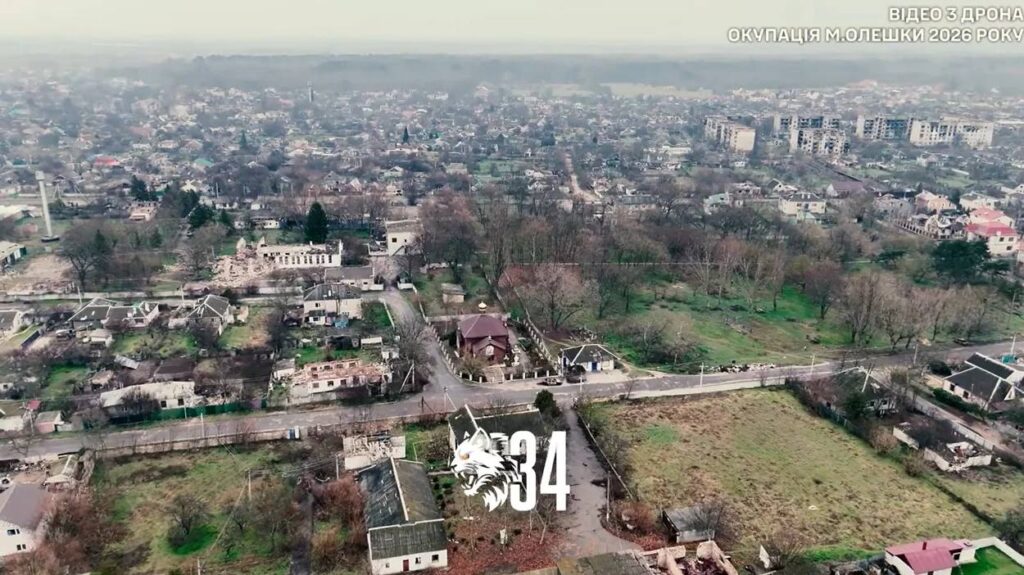
Aerial view of Russian-occupied Oleshky, in Ukraine's Kherson Oblast. Photo via ArmyInform

Ukraine’s human rights commissioner Dmytro Lubinets and his delegation safely reached Russian-occupied Oleshky in Kherson Oblast on 30 October, with the local truce at 80 hours and holding. He said he was talking with residents to learn what help they need most.

Russia has kept Oleshky, on the left bank of the Dnipro River, cut off for months, leaving residents starving. Now the test is where the buses take people. The White House promised residents who wish to leave transport to their “preferred destination.” Lubinets said on 27 October that everyone who wants to go to Ukraine will be able to. Under agreement pages published by Fox News, his own delegation and the residents who choose Ukraine travel together via Anapa in Russia. From there, a Russian military transport plane to Homiel in Belarus is expected on 31 October.

Aerial view of Russian-occupied Oleshky, in Ukraine's Kherson Oblast. Photo via ArmyInform
Explore further

Russia may use the Oleshky truce to rebuild its forces, ISW warns, as evacuees face a route through Russia and Belarus

Buses on standby, aid for those who stay

On the morning of 30 October, before reaching the town, Lubinets wrote from Armiansk in occupied Crimea that he was coordinating the mission with Yana Lantratova, Russia’s human rights commissioner. He said 25 buses with 750 seats had been prepared, plus ambulances for people with limited mobility. Anyone who wants to leave will get a safe way out, and those who stay will receive aid, he added. In delivering that aid, special attention goes to elderly residents and people with disabilities, he said.

We are in Oleshky! The Ukrainian delegation has safely reached the city.

The ceasefire has been in effect for 80 hours and remains in place. I am currently on the ground, speaking with local residents to hear about their needs and understand what kind of assistance they need… pic.twitter.com/AOhKIV0WLO

— Dmytro Lubinets (@lubinetzs) October 30, 2026

The evening before, he said people who want to leave could do so until 14:00, with aid distribution after 14:30, without naming a date. Speaking to journalists, he called it the first truce since 2022 to hold this long on such a large stretch of front.

How the truce came about

The White House announced the truce on 23 October, crediting First Lady Melania Trump. It took effect at 03:00 Kyiv time on 27 October. Its zone was later widened. By 29 October, the convoy was ready, Lubinets said. The truce is due to end at 22:59 Kyiv time on 1 November.

  •  

Fire Point says its drones hit a Russian refinery’s diesel unit hours after WSJ reported Ukraine had paused such strikes under Trump’s pressure

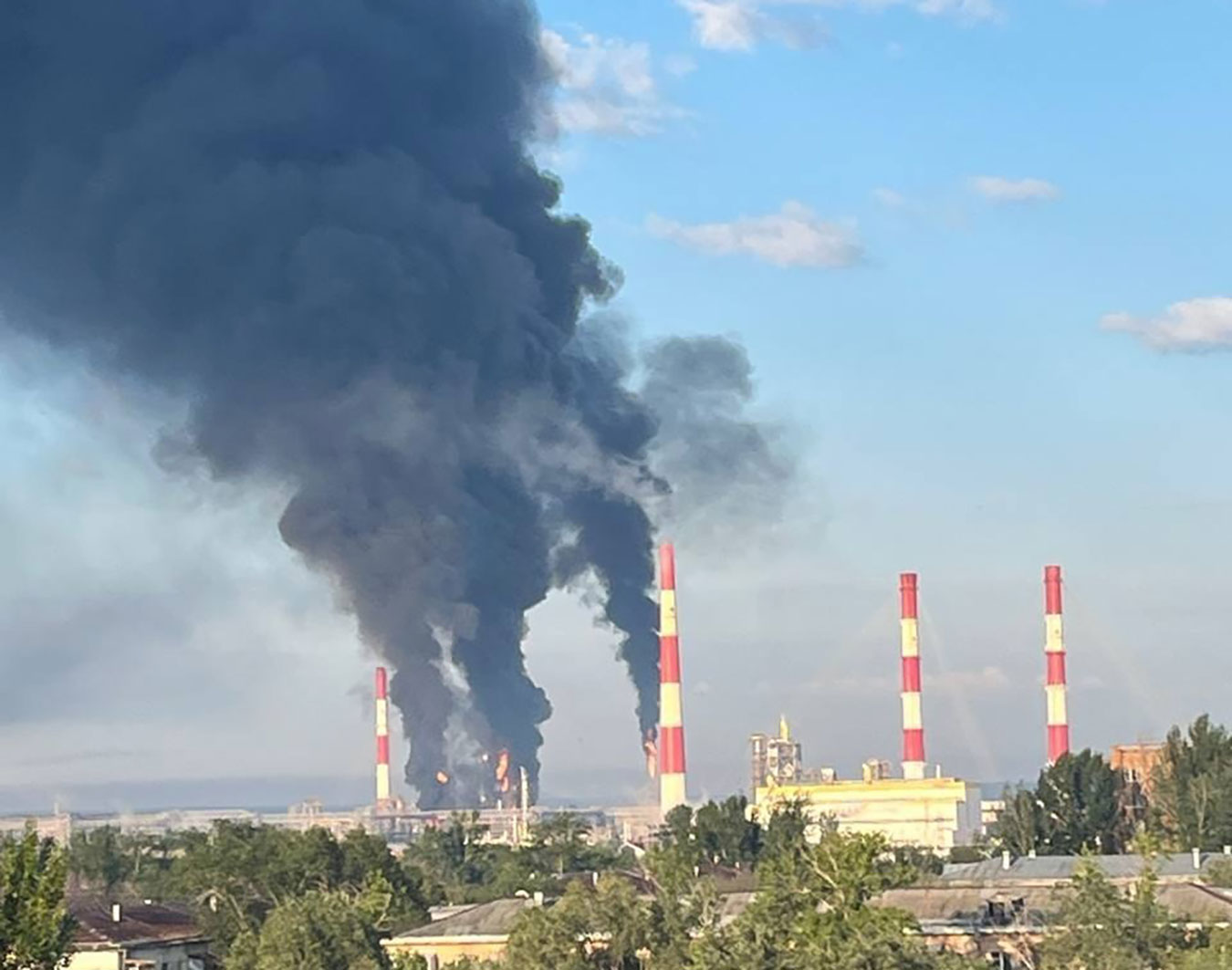
Smoke rising from the Novokuibyshevsk oil refinery in Samara Oblast, Russia, 30 October 2026

Ukraine's Defense Forces hit the Novokuibyshevsk oil refinery in Russia's Samara Oblast with FP-1 drones early on 30 October, Ukrainian drone maker Fire Point said, adding that one of the units hit hydrotreats diesel fuel. The strike came hours after WSJ reported that Ukraine had paused strikes on Russian refineries under pressure from US President Donald Trump until after the US midterm elections on 3 November.

Russia is pounding Ukraine's power grid and cities ahead of winter, with a mounting civilian toll, including 14 people killed on a Dnipro railway platform on 29 October. Ukraine's long-range drone strikes on Russian refineries, one of its most effective operations against Moscow, target the oil money that pays for that war. Trump has pressed Kyiv for weeks to stop them, blaming them for high global fuel prices, and Ukraine went quiet without saying so and without getting what it asked for in return, WSJ reported. The Samara strike is the first on Russian oil since then. Kyiv has not said whether the pause is over.

Fires spread across a refinery that makes jet fuel for Russia's military

Residents of Novokuibyshevsk reported drones, explosions, and a fire before dawn. Ukrainian Telegram channel Exilenova+ posted the first photos on Telegram at 05:24 Kyiv time, and Russian Telegram channel Astra geolocated the fire to the refinery, citing its open-source analysis of residents' photos.

Novokuybyshevsk, Samara region: locals report an attack and a fire. pic.twitter.com/9UEgqmkAOU

— Exilenova+ (@Exilenova_plus) October 30, 2026

By morning, Exilenova+ counted at least 11 separate fires at the refinery. Samara Governor Vyacheslav Fedorishchev said air defense and mobile fire groups were repelling an attack, Astra reported. The region had declared a drone alert and closed its airport.

Smoke rising from the Novokuibyshevsk oil refinery in Samara Oblast, Russia, 30 October 2026
Smoke rising from the Novokuibyshevsk oil refinery in Samara Oblast, Russia, 30 October 2026. Photo: Exilenova+

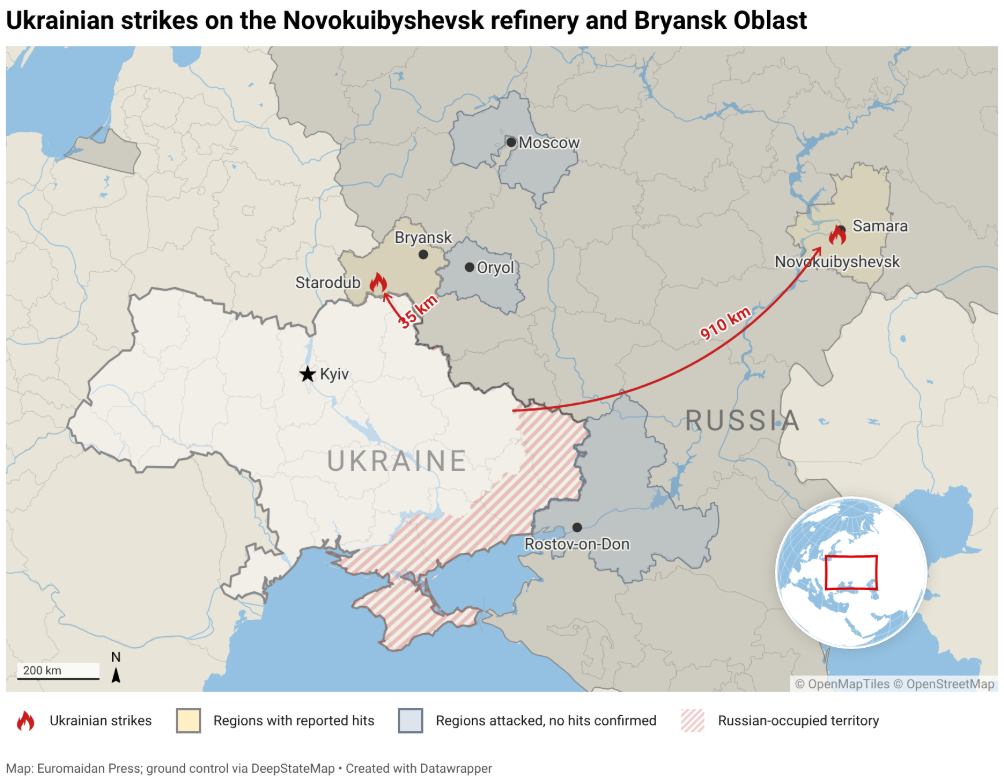
Fire Point said its FP-1 drones scored numerous hits on the refinery grounds, and that one of the units hit hydrotreats diesel fuel. The footage published so far shows several smoke columns over the plant but does not show which units burned. The Rosneft-owned refinery has a design capacity of 8.8 million tons of oil a year and is one of the main producers of jet fuel, according to its website. Astra says it supplies jet fuel to Russia's military. The plant lies about 910 km from the front line. Ukraine's General Staff has not commented.

pic.twitter.com/Ku6KRCKJ6v

— Exilenova+ (@Exilenova_plus) October 30, 2026

Ukrainian drones have hit the plant before. Ukraine's military said its forces hit it in August and caused a fire.

Map showing the Novokuibyshevsk refinery in Samara Oblast, about 910 km from the front line, and Starodub in Bryansk Oblast

It is the first fire at a Russian refinery since 15 October, when Ryazan's governor reported one at the city's refinery. It is also the first reported strike on Russia's oil industry since 20 October, when Ukrainian drones hit a Druzhba pipeline pumping station in Tambov Oblast. WSJ called that strike the last before the pause.

rosneft's kuibyshev refinery joins syzran novokuibyshevsk offline after ukrainian drone strike yesterday · post fires raging kuybyshevsky oil samara russia 10 2026 fires-rage-at-samara-kuybyshevsky-oil-refinery ukraine news reports
Explore further

All three Rosneft Samara refineries now offline or reduced as drones halt Kuibyshevsky operations yesterday

WSJ claims: Ukraine paused refinery strikes until after the US midterms

Ukraine's military paused its strikes on Russian refineries after weeks of pressure from Trump shook Kyiv's confidence in US support, people with knowledge of the operations told WSJ. The unofficial pause began early last week and is expected to last until after the midterms, and possibly deeper into November. Units carrying out long-range strikes were told in mid-October that the refinery campaign was effectively on hold once missions already under way were completed, two military officials said. Hours after the report, the Novokuibyshevsk strike called that account into question.

Smoke columns rise over residential buildings in Novokuibyshevsk, Samara Oblast, Russia, at dawn on 30 October 2026
Smoke columns rise over residential buildings in Novokuibyshevsk, Samara Oblast, Russia, at dawn on 30 October 2026. Photo: Astra

Ukraine's government has not announced a pause. Zelenskyy told reporters in Kyiv on 27 October that “our guys tried to be a little more careful during these days. But they do not have an order” not to hit refineries, according to WSJ. He said drone units were hitting other kinds of targets in Russia.

Trump's envoy Jared Kushner repeated the demand to stop the strikes at a meeting with Zelenskyy in Oslo on 20 October, two US officials told WSJ. One of them called the conversation “very tough.” Kushner, who joined remotely, said he and envoy Steve Witkoff were spending a lot of time, energy, and jet fuel on mediating with Moscow, and that a 30-day pause on refineries would be a way for Ukraine to show gratitude, the official said.

again trump presses zelenskyy stop russian refinery strikes · post ukrainian president volodymyr meets donald ankara türkiye 8 2026 presidentgovua ukraine news reports
Explore further

Energy truce with strings attached: Kyiv reportedly told to spare Russian refineries or lose US intelligence and arms

Zelenskyy had asked for something in return, WSJ reported: a mutual energy ceasefire with Russia, Patriot missiles for Ukraine's grid, or permission to use Starlink inside Russia so drones could destroy Russian missile launchers. None of those ideas got far. Some of Kyiv's European backers also nudged Zelenskyy to pause until after the midterms, a senior European official said.

The pause showed in Russia's oil industry. Russian refinery utilization at the end of October was 25% higher than at the start of the month as drone attacks subsided, Reuters reported, according to The Moscow Times.

Russia claims over 1,000 drones for a second night as Moscow's airports close again

Russia's Defense Ministry said it downed 1,043 Ukrainian drones overnight over 19 regions, including Samara Oblast, the Moscow region, and Tatarstan. The night before, it claimed 1,214.

Moscow Mayor Sergei Sobyanin stated that 862 drones flew toward the Moscow region between 20:30 on 29 October and 07:30 on 30 October, that most were downed on the far approaches, and that 170 were downed on approach to the capital. Russia's aviation agency restricted flights at all four Moscow airports, Astra reported. A day earlier, more than 460 flights were delayed or canceled at Moscow and St. Petersburg airports, Astra counted.

A building on fire at night in Starodub, Bryansk Oblast, Russia, 30 October 2026
A building on fire at night in Starodub, Bryansk Oblast, Russia, 30 October 2026. Readers who sent the footage to Astra identified it as the Konservsushprod food plant. Photo: Astra

In Starodub, in Russia's Bryansk Oblast, about 35 km from the Ukrainian border, a building of the Konservsushprod plant, which makes canned food for the Russian army, appeared to be on fire in readers' photos and videos, Astra reported, saying the plant was presumably attacked and that its open-source analyst had not verified the footage. The Atesh partisan movement reported a blast in Aleksandrovka in Rostov Oblast, and air defense fire and an explosion in Orel.

  •  
❌