The midterm elections are just days away, and while anything can happen, the broad consensus among pollsters suggests a bad night for Republicans.
Hoping to shore up a victory for his party, President Donald Trump seized upon an idea: bribe the voters.
"If the Republicans win the House of Representatives and the United States Senate, both of them," Trump pledged in September, "I will issue a dividend to every adult citizen in the United States of America for $5,000."
According to Vice President J.D. Vance, this "dividend"—which would cost more than $1.3 trillion—would come from the "extraordinary amount of revenue" generated by Trump's tariffs. Of course, that math doesn't work: According to the Penn Wharton Budget Model, the U.S. took in just under $300 billion in tariff revenue between January 2025 and July 2026, not counting the amount it has had to refund after the Supreme Court found they were illegally imposed.
At that rate, it would take years of tariffs just to pay for Trump's dividend. Adding insult to injury, of course, is the fact that tariffs are paid by Americans, meaning we would be taxing ourselves to pay for our own disbursement.
But in the campaign season's closing days, Trump has made a number of other threats and offers, contingent on his party's success—a completely risible use of government power.
In September, three Ohio Republicans—Rep. Mike Turner and Sens. Bernie Moreno and Jon Husted—petitioned the president to build a planned Space Force training academy in their state.
"Every other state wants it," Trump said this month at an Ohio campaign rally. "If we win the midterms, Ohio will be very, very strongly considered."
Some of his pledges have been much more explicitly transactional.
On October 17, the Department of Defense—which Trump calls by its original name, the Department of War—announced a conditional $80 billion loan to pharmaceutical manufacturer Antheia. That same day, at a campaign rally in Kentucky, Trump made a pledge to the state's voters.
"If the Republicans win, the Department of War will be investing $100 million in the pharmaceutical company Antheia to revitalize a gigantic drug manufacturing facility in Winchester, Kentucky," he said. But he prefaced it by telling Rep. Andy Barr, the Republican running for the state's open Senate seat, "you have to win, Andy. Otherwise, forget it."
Days later in both Kansas and Iowa, Trump brought up E15, a gasoline blend that contains up to 15 percent ethanol derived from corn. It has advantages and disadvantages as an alternative to traditional gasoline, but it's a boon for corn-growing states.
"Normally, E15 is not allowed during the summer because warmer temperatures increase fuel evaporation and thus the formulation of ground ozone ('smog')," writes Benjamin Zycher of the American Enterprise Institute.
The government can waive that restriction to address disruptions in the fuel supply, which it did in March amid gas price shocks related to Trump's war in Iran. The House passed a bill in May to make the waiver permanent and allow E15 to be sold year-round, which Trump backed in June; the Senate version of the Farm Bill includes a year-round E15 amendment, but Democrats have held up its passage.
"With Roger Marshall in the Senate," Trump told Kansans last week, "we will make year-round E15 permanent. But if [Democratic candidate] Adam Hamilton is in, I'm not doing it."
He then made the same pledge in Iowa, where Rep. Ashley Hinson is the Republican Senate nominee. "With Ashley in the Senate, we will make it year-round E15," Trump said. "We'll make it permanent."
Of course, it's nothing new for politicians to make big promises in exchange for your votes. Typically, they're all hollow to at least some degree.
And Trump's pledges do reflect some version of reality: Keeping the Senate in Republican hands will make it easier for him to do certain things. But some of his others have been downright indefensible, less like typical political bribery than outright extortion.
At a rally in North Carolina last month, he tied hurricane disaster aid from the Federal Emergency Management Agency (FEMA) to Senate candidate Michael Whatley's election.
"We spent more than $2 billion [in] FEMA funding," he told attendees. "You're waiting for some additional money…and I'm gonna get that to you, Michael. Now if Michael loses, I'm not sending it." He added right after, "I'm only kidding, you're gonna get it."
Other times, he didn't take it back: Trump appeared at a campaign rally in Georgia this week, stumping for Rep. Mike Collins to unseat Sen. Jon Ossoff, and part of his sales pitch was that if Ossoff wins, he may just ignore the state.
"President has a lot of power," he said, and there's "a big difference when he likes the people representing a state. Collins could call me anytime he wants." But if Ossoff wins, he added, he won't take the call, and he even narrated a hypothetical conversation to make his point: "'Tell him I'm not in.' 'But he needs money for Georgia.' 'I don't give a damn what he wants!'"
Also this week, Trump railed about the Senate race in Alaska, where Republican Sen. Dan Sullivan faces not only former Rep. Mary Peltola but a retired teacher also named Dan Sullivan. The New York Times reported this week that the Peltola campaign actively recruited the second Sullivan to run explicitly as a spoiler, to siphon votes away from the senator.
"I have delivered for Alaska at Historic Levels," Trump wrote on Truth Social. "The Democrats are trying to steal this important Republican Seat and, if that happens, everything we've done for Alaska will come to an immediate hault [sic]."
It's one thing to say the federal government shouldn't provide aid to states—and since taking office, the administration has cut or paused such disbursements by $177 billion. Last week, the FEMA administrator indicated that going forward, states should expect to shoulder more of their own disaster aid.
But this goes much further, with the president explicitly conditioning aid on whether or not the state's voters have displeased him.
Perhaps, as in North Carolina, Trump was simply joking; the White House did not respond to Reason's request for clarification.
But there's certainly precedent to suggest he was serious.
"Last September, the Department of Energy (DOE) recommended cancellation of 624 grants for clean energy projects that had been approved by the Biden administration," Reason's Jacob Sullum wrote in July. The government then "winnowed it down to 284 grants, all but one of which had been awarded to projects in states that were represented by Democrats in the U.S. Senate and had voted for Kamala Harris in the 2024 presidential election."
In March, Politicoreported that Trump had approved 89 percent of disaster aid requests from states with a Republican governor and two Republican senators but only 23 percent of requests from states with Democrats in those offices.
According to the Idle RamblingSubstack, the trend continues: Trump has rejected nearly half of aid requests from Democrat-led states in this term while only rejecting 18 percent from Republican-led states.
But perhaps worst of all, he threatened not to pay out damages to people who suffered harm.
Between 1953 and 1987, the water at Camp Lejeune in North Carolina was contaminated by leaks of fuel and dry cleaning chemicals. The government estimates that as many as 1 million people, both service members and their families, were exposed to toxic chemicals. The Department of Veterans Affairs officially recognizes eight diseases stemming from exposure, including multiple cancers and Parkinson's disease.
In 2022, Congress passed the Camp Lejeune Justice Act, which waived any federal government claims of immunity and allowed veterans to sue over exposure to tainted water. As of September 2026, the Department of Justice says it has paid out more than $879 million, out of more than $1.1 billion in settlement offers.
"We're also fighting for our great veterans, and taking care of those veterans who brought claims related to water contamination at Camp Lejeune," Trump told North Carolina rallygoers last week. "And if we win the House and the Senate, I am directing the Department of Justice to settle all remaining legitimate claims as soon as possible." But "if we don't win, there's no money. If we do win, you're getting it."
It should be clear by now that Trump values personal loyalty over all else. To that end, there is nothing he finds more disreputable than failing to do what he says.
In the closing days of this campaign season, he is making that more explicit than ever, tying his party's success in a state to whether the state is entitled to equal treatment under the law.
Trump was right that presidents have "a lot of power." He's also a living example of why they shouldn't.
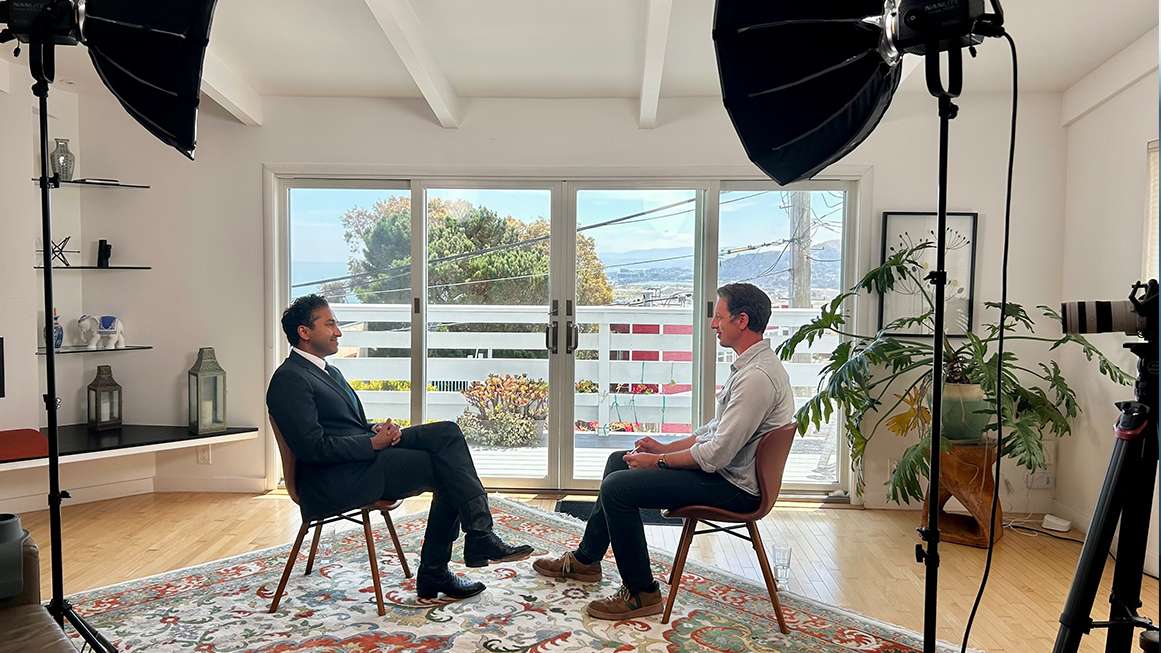
Vinay Prasad has been on both sides of the public health establishment. A physician, author, and professor at the University of California, San Francisco, he went from prominent COVID-era critic to Food and Drug Administration (FDA) insider when he was tapped to lead the agency's Center for Biologics Evaluation and Research in May 2025. His tenure there included an abrupt resignation in July 2025, a return a few weeks later, and his final departure in April 2026.
Prasad joined Reason's Zach Weissmueller in August to discuss what he learned from his time inside the FDA, what he was able—and unable—to change, and whether the agency can ever regain public trust. Their conversation ranges from Anthony Fauci and the origins of COVID-19 to vaccine policy, plus regulatory barriers, his growing sympathy for libertarian critiques of the FDA, and whether the agency is ready for an era of AI-driven medicine.
Reason: The FDA saw a clearing out of the old guard and a replacement with a new one—COVID dissidents such as yourself, former FDA Commissioner Marty Makary, and National Institutes of Health Director Jay Bhattacharya. What was that like? Did you have any misgivings about stepping away from academia and your role as an outside critic to join the public health bureaucracy?
Prasad: Maybe we changed 4 percent, 2 percent of the FDA. The FDA is an 18,000-person agency. There's tens of thousands of people still there. Before Marty, the commissioner, and I got there, DOGE [the Department of Government Efficiency] had just struck and they got rid of a couple thousand people. But the system is largely the same as it's always been.
There are critics of the COVID pandemic response and then there are critics. Although Marty, Jay, and I are critics of many aspects of the response, we don't go as far as some of the most extreme critics out there.
Am I glad I did it? Yes, I'm glad I did it. It was an adventure. It was a learning experience. I learned more in one year than I'd learned in the prior decade about how the world works. I'm glad to have improved some aspects of government, which I think will be enduring, and at least tried to improve other aspects of government, which may not be enduring.
Anthony Fauci personified the old guard. He's recently been in the news because he appeared before Congress and pleaded the Fifth after Sen. Rand Paul (R–Ky.) published his diary. What did those diary entries reveal to you about Fauci's character and about the way he operated?
Probably the greatest news story is that the mainstream media refuses to be honest about his legacy. Fauci was in his late 70s when the pandemic began. Had he retired at a ripe old age of 75, he'd be leaving behind a stellar legacy. But he continued. He pushed it. He stayed through the whole pandemic. He was the face of many things that his diaries get into, what he privately thought while he was publicly saying different things.
Fauci has not only been a proponent that the only answer to where the virus came from is a natural spillover event. He's gone further than that. He orchestrated a paper published in Nature Medicine called the "Proximal Origin" paper, written by a bunch of people who bolstered that point of view. He edited that paper before it was published. Then in public, he pretended like he didn't know those people; it was an independent group that validated what he was saying. Whereas in many respects, he puppeted that paper. The people who wrote that paper—Rand Paul has released their Slack channel messages showing they didn't really even believe what they were writing. Their messages reveal considerable ambiguity about lab leak vs. natural spillover event.
Photo: Paul Alexander
In terms of the origin, he also funded EcoHealth Alliance, which had a subcontract to Wuhan. He had a huge role in the origins and trying to frame the narrative, making lab leak—you couldn't even discuss it. Facebook put a ban on even talking about the topic. Then masking 2-year-olds. He played a huge role in that. Lockdowns, school closure. He said he didn't close any schools. In his own diary, he says, "I told [Mayor] Bill de Blasio, you need to close schools in New York City."
At some point, the man's got to take ownership over the decisions he did make and advocated for. When [Gov. Ron] DeSantis in Florida reopened schools in 2020, he went on every television show to say what a bad idea that was. Now, it's very clear—many of us said so at the time—school reopening was always the right decision. Maybe it could have been closed for a week or two, but certainly not beyond that. Fauci kept it closed much longer.
Vaccines make a lot of sense for elderly people who had not yet had COVID. But do they need to be given to a 4-year-old, a 7-year-old, a 12-year-old, a 22-year-old who'd already had COVID? This is where considerable ambiguity exists. But for Fauci, the answer was clear: You need all the shots. You need the initial series. You need a yearly booster. It doesn't matter how young you are or how many times you've had COVID. Fauci was wrong about almost every single pandemic policy he advanced.
Some of his defenders say to me, "At least he didn't tell people to drink bleach." And I said, "Is that the bar for a guy who's a doctor and a scientist?" Drinking bleach is not a good idea, but that's not the bar for a Fauci-level figure. He should be saying things that are correct. If they're not correct, he should be collecting evidence to weigh in. He did none of that.
Fauci's pardon stretches back to 2014, when he was authorizing funding in contravention of U.S. policy on gain-of-function research. Do you think he actually committed a crime?
Yes. The other thing about it is people will say, did that money go directly for this research? The money went for viral genomic research at a Chinese institute, very similar to the sorts of things we would be worried about. That was a crime for which he's been pardoned. It's not just my assessment. That's what Joe Biden's autopen thought, or whoever signed that pardon, that he committed a crime. That's why he has a pardon that goes that far back. It was a crime. Now that he's been pardoned for it, I don't know what you can do about it.
You rode in on this wave of anti-Faucism. What was your biggest hope for what a new version of public health might look like, or for the kinds of changes that could be made?
I had a very narrow mandate because I was just in charge of biologics at the FDA. The hope continues, which is that public health could aspire to be honest, to use its powers proportionately and judiciously, to exercise humility. Public health is far from these things. Public health could actually aspire to be bipartisan. Public health is not. It's becoming an increasingly entrenched left-wing discipline run by left-wing ideologues, reaching even more and more absurd conclusions. What public health can be and what it is are still light-years apart.
You don't think that has changed very much?
Not much at all. Changing an entrenched organization with tens of thousands of people is very difficult. There have been some changes. The pandemic has been a catalyst. But I don't think a real reform is possible. I suspect it'll splinter into different public health groups.
Your role was at the part of the FDA that oversees biologics, such as vaccines and gene therapies. Vaccines became an increasingly polarized and politicized issue during COVID. What was your goal specifically pertaining to vaccines when you took over after the pandemic?
The right drug given to the right person at the right time is lifesaving, but the wrong drug given to the wrong person at the wrong time can be harmful. Vaccines are the same way. You can't say anything about all vaccines, just like you can't say anything about Tylenol, aspirin, and Plavix all in the same breath. They're all very different drugs.
Is this the same phenomenon we observed during COVID, where you're either for the vaccine or you're against it, for a medicine or against it, without breaking things down by age, health, or other individual factors? Everything has to be flattened or compressed.
Same phenomenon. One-size-fits-all public health—where the shoe doesn't fit the guy with the big foot or the person with the small foot—is a completely wrong view of public health. COVID is a great example. An 80-year-old who's never had COVID, and we're talking about February of 2021, should they get a vaccine? Absolutely. A 7-year-old who's had COVID and we're talking about 2022? No, a healthy 7-year-old makes no sense. Public health is, in this country, so broken. It cannot appreciate these distinctions.
Something you've been writing about for a long time is poor experimental design in drug trials. Was that something you wanted to change when you came into the FDA? Do you feel like you made any progress toward that goal?
In one year, we did more than what our predecessors have done in a decade. You can look at just the sheer number of announcements and policy changes we made. We're talking a lot about one side of the coin, which is where the companies are not doing the right study to inform the American public. We're not talking about the other side of the coin, where the FDA is asking them to do things that don't make any sense at all, that burden them, that cost money, and that are wasteful. We did a lot of work in that space too. The FDA makes both errors. They also do a lot of things right, but they make both errors and they can get better.
You mentioned there were two sides of this FDA reform. One was raising standards for things like vaccines. The other was acknowledging how expensive and cumbersome it can be to get something approved in the United States. What were the biggest barriers you saw at the FDA on that side of the equation?
So many. During my time at the FDA, I was often sympathetic to the people who work at companies who told me about the hurdles they were forced to jump through. The FDA does two things: We regulate what's approved and can be marketed and sold on the U.S. market, but also what you can study.
Imagine you're a researcher and you want to study something. We're not talking about approving. You want to gather people together who may be interested in trying something new, have an informed consent, get them to volunteer, but they know that we don't know for sure it's going to work. We do so many things in that space, regulating what you can study and how you can study it, that I think are sensible. You don't want to let people sign up for something that's going to blind them or maim them. But some things that aren't sensible, that are overly burdensome, that are quality controls that don't make sense for small companies and super-rare diseases that don't have a huge budget to study these things. The regulation in this early side of research is tremendous in the United States. A lot of it is well-intentioned, but not all of it is fit for purpose.
You said that your time within the FDA made you somewhat more sympathetic to the libertarian critiques of the FDA.
I'm really sympathetic in one way: We tax people a lot of money to pay for healthcare in America—trillions of dollars. We're taking trillions of dollars from people's paychecks, from taxation, and we're taking it for this thing that we think is a benefit to people, which is we're going to offer a service that's maybe a human right, a societal good. Surely, the service we offer, we do have some of that stuff in there. If you have a heart attack, you go to the doctor here with or without insurance, they're going to open up that blockage. That's a great thing. But along with that package deal, we're going to insert a few things that may or may not work, that cost a lot of money. All that's doing is taking lots of money from taxpayers and redistributing it to the shareholders of those companies.
It's a huge financial system with the rare adverse event of helping someone's health. The libertarian comes along and says, "I'd rather not pay the tax—have more skin in the game, decide what's right for me. I'm the best person to decide how to use my own money." I do feel a sympathy to that point of view, because this system has so many places where it can be taken advantage of, where people get something that doesn't help that much, that only may kill without any possibility of benefit. And we take a lot of other people's money to pay for that.
Dario Amodei, the CEO of Anthropic, recently called out the FDA, and I'm wondering what you think of this. He wrote, "Regulatory systems were designed for a slower pace of innovation and we are not prepared for the deluge of new products and advances that AI will bring. AI may also make these downstream technologies safer and more predictable in a way that violates the skeptical assumptions of regulatory agencies like the FDA."
If Amodei is right about the effect AI is going to have on the field, do you think the FDA will be able to adapt?
I see kernels of truth in what he's saying, but maybe I don't go all the way he goes. Where I see the big core truth is the FDA tries to regulate AI itself, medical AI. You wear a watch that's supposed to give you information and the FDA wants to do a lot of that regulation. That's a very tough thing to regulate, because this technology is changing so much faster than our ability to judge it. I do agree with Marty and others who think that that's probably not the best role for regulating all the potential aspects of digital health and health AI. For instance, you can imagine the absurdity where I'm a doctor, I'm seeing a patient later this afternoon, should government regulate the apps I can use to learn about the disease or ask questions? Should it regulate open evidence? I don't think it should.
I spoke to a company called Doctronic that is acting as an AI prescriber in Utah, where AI is being allowed to refill prescriptions. That's another example of where these questions are going to have to be answered: Where does the government step in, and where does it step back?
Government is much more likely to get in the way of these kinds of innovations. It's changing so quickly. It's going to be very difficult for government to regulate that. You talk about drug discovery and drug science and those kinds of aspects of AI. If I was a pharmaceutical firm, I would definitely invest in AI. There's so many things around running clinical trials that we can do better with AI, help us run them cheaper and faster and more efficiently.
But when it comes to molecule discovery and basic science, I'm not as optimistic as Dario for a couple of reasons. One, a lot of the information that is fed into models about cancer biology is basically as close to fraudulent research as you can imagine. We're talking about like the Stanford president whose Western blots look Photoshopped kind of research. You got research that's not reproducible. It's not just my opinion. Many companies have taken samples of the literature and they tried to replicate it in their own labs and they have massive strikeout rates. If you train AI on garbage, what can it learn? It's only trained on inaccurate information. That's a challenge it faces.
The second challenge is AI will be happy to give you hypotheses to study, but you'll still need to run it with a few people to validate those hypotheses. I suspect the limiting reactant is not coming up with ideas; we have more ideas than we can study with people. The limiting reactant is getting the people to consent and manufacturing the products and those kinds of things.
I hope he's right. If he is right, it sounds like a great future. But I'm a little bit skeptical that he's totally right, because I think the biology of it is a lot harder.
Do you think enough has happened for people to start regaining trust in public health?
No way. I wouldn't trust it at all.
What still needs to happen for public health to legitimately earn back the trust of the public?
I don't know if it's even possible. It's so fragmented now. People tell you with a straight face, people I know, "Anthony Fauci, he made no mistakes. Literally, did the best job he could with the information he had." Then I said, let's just focus on one tiny thing. He did say you should take your 24-month-old kid and put a cloth mask on that kid all day in daycare. He said that. You don't think he had any clues at the time that that was a dumb idea? It's so obviously dumb, right? That's their position on every issue.
Public health is so myopic. It doesn't understand that you have to look at the whole issue. Isn't that a perfect analogy for COVID? Don't go outside. Just stay in your house all day. As if human beings don't need contact with other people and see face to face as if that doesn't matter at all.
Public health has not learned its lesson. The problem with public health is that they're completely politically captured now. Public health and the far left wing of the Democratic Party are synonyms. There's no political balance there. A little balance would go a long way. A little bit of open-mindedness would go a long way in public health. A little bit of humility to just admit a few things we got wrong in the pandemic.
The federal public health apparatus is still staffed with Robert F. Kennedy Jr. at the top and Jay Bhattacharya is still head of the National Institutes of Health. Is that not having some sort of trickle-down effect or creating a countercurrent within the system?
I don't know.
Don't get me wrong, I love Jay and I think Jay's heart's in the right place. He's already made some really important changes. I agree a lot with the kernel of Bobby's ideas. I agree with the kernel. I always say the kernel because I can think of a way that makes sense and I can sometimes think of ways it doesn't make sense.
But before I went to government, people told me that there is a fourth branch of government and it's the career state employees. I never believed that to be true, but now I'm certain that it's true. You have a lot of people who are in government. They tend to be in just three or four counties in one area, the blue pocket of America. They have strong views, and they really do a lot of the governance of this country. They make the decisions that regulate all of us in a way that's unaccountable to Congress and unaccountable to the president. I suspect they'll continue to stay. The COVID pandemic revealed to so many people that we made mistakes and that distrust in medicine and public health will just continue to grow and that there will continue to be more of these reckonings in the years to come.
How did working at the FDA affect your own confidence as a consumer in the regulatory system?
It gives me a little bit of pause sometimes. I like to trust but verify. I am cautious always with new therapies and particularly cautious that some safety information is being missed. It also makes me a bit more libertarian. I can imagine a system where we give people in America greater flexibility in what kind of products they can try. Maybe there's some third-party agencies, Consumer Reports–style agencies, that give different levels of quality and seals of approval of different products, and people can choose what they want and also have a little bit more skin in the game and use their own money. The moment you start to use your own money, suddenly tiny changes in surrogate biomarkers and elevated liver enzymes take on greater importance in a way that might not exist if you're using commercial insurance to pay for it.
Is it that you saw something inherent to the process that creates problems, holes, or gaps?
The fundamental idea that there's this one-size-fits-all balance where safety and efficacy is acceptable. What might be acceptable to you and acceptable to me might be different. I might want a little bit more efficacy information, a little bit more safety validation, and you might be willing to try more. The idea that a single monolithic government agency in the suburbs of D.C. can set that bar for every single person in America, that to me is a tougher pill to swallow now.
This interview has been condensed and edited for style and clarity.
When the 21st Century ROAD to Housing Act was still a work in progress, the Senate briefly inserted a ban on corporate ownership of single-family rental housing so sweeping that it might well have killed off the small but growing build-to-rent sector.
After furious activism by the housing supply boosters, who had been the main advocates for the law's many other provisions, that investor ban was significantly pared back.
The final version of ROAD, which became law in July, prohibits investors who own 350 single-family rental homes from buying new ones. But it also includes a long list of exemptions for large investor purchases of single-family rentals.
The primary exemptions include homes purchased as part of a build-to-rent project and dilapidated homes that the investor spends significant money renovating.
The new restrictions go into effect this coming January. On Thursday, the Treasury Department released a proposed rule that would create definitions for terms that go undefined in the law and clarify the scope of "excepted purchases" of single-family housing that large investors can still make.
Build-to-rent housing that large investors can still buy is defined as a new single-family home that's never been owned by an owner-occupier, is purchased within 18 months of the home receiving a certificate of occupancy, and is occupied by a renter.
Protected "renovate-to-rent" homes are defined as homes that had major building code violations that were fixed by the large institutional buyer and for which the investor spent at least 15 percent of the home's purchase price on improvements.
The rule also provides definitions for rental homes owned as part of a program to boost homeownership, which is another excepted purchase large institutional investors will be allowed to make. Those programs are generally defined as programs in which the renter has the right of first refusal to buy the home and where the rent receives financial support from the homeowner to purchase the home.
Taken together, the clarified exceptions in the Treasury rule still leave a lot of room for large institutional ownership of single-family homes in keeping with the final text of the ROAD to Housing Act. They won't have to sell the homes they already own. They can still add to the supply of investor-owned rental housing through substantial rehabs and build-to-rent projects.
Nevertheless, the Treasury rules will impose numerous paperwork burdens on investors who'll now have to track and report, for example, precisely how much money they've spent renovating a purchased rental house or else risk a huge fine.
Large investors who purchase a single-family home in violation of ROAD are liable for a maximum civil penalty of $1 million per home purchase.
The proposed Treasury rule highlights what a glaring exception the investor restrictions are to the overall spirit of ROAD. Through a variety of means, the law attempts to reduce the regulatory burden on new housing. Now, large investors will have to absorb significant compliance costs just to prove that they're adding new rental housing supply in precisely the right way.
Politicians may not like it, but the countries they misgovern compete with one another for businesses, people, and capital. To attract startups, entrepreneurs, and investors, governments have to offer attractive environments, or else lose out to friendlier nations. When it comes to tax competitiveness, a new report says that Estonia leads the way in first position, with the United States lagging at 17th.
Low Rates and Simplicity Make Countries More Attractive
"The structure of a country's tax code is a determining factor of its economic performance," write Alex Mengden and Luis Zarka for the Tax Foundation's International Tax Competitiveness Index 2026. "A well-structured tax code is easy for taxpayers to comply with and can promote economic development while raising sufficient revenue for a government's priorities. In contrast, poorly structured tax systems can be costly, distort economic decision-making, and harm domestic economies."
The report notes that competition among countries has resulted in widespread improvements (and some backsliding) across the world in recent years. Especially among members of the Organization for Economic Cooperation and Development (OECD), marginal tax rates on corporate and individual income have declined. That said, most governments haven't given up on milking their populations, with growing reliance on payroll taxes and value-added taxes (VAT).
On the other hand, while "corporate tax base improvements have occurred in Canada, Germany, Lithuania, the United Kingdom, and the United States," France, the Slovak Republic, and Slovenia have hiked corporate tax rates. Even worse, tax policy has moved in many countries from a revenue-raising measure into a weapon of economic warfare "deployed to exert economic pressure."
The Tax Foundation's index ranks countries on the degree to which they keep their tax systems competitive—with low rates—and neutral, with minimal social engineering to avoid economic distortions.
Estonia Is First, France Last, With the U.S. in the Middle
According to these criteria, Estonia scores in first place for the best tax code in the OECD for the 13th straight year. According to Mengden and Zarka, the tiny Baltic state earns this distinction for four reasons:
First, it has a 22 percent tax rate on corporate income that is only applied to distributed profits. Second, it has a flat 22 percent tax on individual income that does not apply to personal dividend income. Third, its property tax applies only to the value of land, rather than to the value of real property or capital. Finally, it has a territorial tax system that exempts 100 percent of foreign profits earned by domestic corporations from domestic taxation, with few restrictions.
By contrast, France comes in dead last with the highest top corporate tax rate (36.1 percent) in the OECD, on top of which are "multiple surtaxes and distortive production taxes." France "also applies multiple distortionary property taxes with separate levies on estates, bank assets, and financial transactions, in addition to a wealth tax on real estate. Its VAT covers about 50 percent of final consumption, and it has one of the highest VAT registration thresholds."
The United States ranks at 17, down one place from last year. Among the U.S.'s weaknesses is that its "real property tax burden is among the highest in the OECD" and "the US has a partial territorial system and does not exempt foreign capital gains income." On the plus side, Americans pay relatively low sales/consumption taxes (an average of 7.5 percent, while the OECD average is 19.4 percent).
Not discussed in depth in the index, but still important, is that the U.S. is one of two countries (along with Eritrea) that base income taxation on citizenship rather than residency. "A Canadian living in France pays French taxes, not Canadian ones. An American in France? They pay French taxes and still file with the IRS," notes Bright!Tax. The U.S. tax obligation can be offset for nonresidents, but only by jumping through more bureaucratic hoops.
By and large, countries score better on the index by keeping tax rates low and broadly applied, emphasizing simplicity, and keeping their systems neutral to raise revenue and encourage investment, rather than achieve social and political goals.
Not everybody shares the Tax Foundation's preference for low burdens and minimal complexity. In its 2022 report on Lithuania's tax system (ranked a commendable 5th by the International Tax Competitiveness Index 2026), the OECD urged the country to increase taxes on businesses and self-employed people, and to increase reporting requirements. The OECD apparently favors higher tax burdens and complexity. Keeping the OECD happy would undoubtedly make Lithuania (or any country) less attractive to investors and entrepreneurs.
The U.S. Scores Better on Overall Economic Freedom—Though It's Losing Ground
While the index's middling score for the U.S. on tax competitiveness is disappointing, if understandable, it's not the final word on a country's economic attractiveness. In the Fraser Institute's recently published Economic Freedom of the World 2026 report, the U.S. ranks a credible 5th place, based on 2024 data. It comes in after Hong Kong, Switzerland, Singapore, and New Zealand. The formerly British and now Chinese territory of Hong Kong remained in the leading position despite erosion in economic liberty to accompany its sadly decaying civil liberties status. That's a worldwide concern.
"Global economic freedom fell following the pandemic as policymakers imposed new regulations, raised barriers to trade, expanded the size of government, and then printed money to pay for spending," wrote the Fraser Institute authors, including the late James Gwartney. "While governments have begun to reverse these policies, economic freedom in the average country has not yet returned to pre-pandemic levels."
Unfortunately, the U.S. is forecast to slide two positions in next year's Economic Freedom report because of "increases in the size of government, weaker protection of property rights and the rule of law, and significant restrictions on trade freedom."
Improving the U.S. tax environment might help to improve America's economic freedom score. Then again, so would reducing government's role and discontinuing protectionist policies.
Tax competitiveness is one important element of any country's overall economic freedom, which creates an attractive environment to invest, create businesses, and generate prosperity. The U.S. has long thrived because it is, in relative terms, free. That's a status worth maintaining.
One of the unfortunate quirks of the American system is that you can't lie to the government, but the government can lie to you. Samuel Tunick found himself on the receiving end of this setup last year at Atlanta International Airport. When agents from the Department of Homeland Security (DHS) asked for his phone password, he allegedly gave them a self-destruct code that wiped his data. Tunick now faces five years in prison for destroying evidence.
It turns out that the feds were lying to Tunick the entire time. A new court filing, first reported by 404 Media, shows that the DHS had sent out an order to seize Tunick's phone over his involvement in environmentalist protests in Atlanta. When he landed at the airport, however, agents told Tunick that they were looking for "kiddie porn" and he would be allowed to leave with his phone if he cooperated. They also repeatedly denied him access to his lawyer when he asked.
"There can be no real debate that if law enforcement had acted similarly elsewhere in Atlanta, their actions would be unconstitutional. But the government says it was entitled to act this way because Mr. Tunick was returning from an international vacation" in the Dominican Republic, his lawyers wrote in the filing, which includes internal DHS communications and excerpts from his interrogation video.
U.S. law recognizes a "border exception" to Fourth Amendment privacy rights, allowing federal agents to search incoming travelers for contraband. U.S. Customs and Border Protection (CBP) claims that this exemption also allows them to hold travelers for questioning and search their electronic data. Tunick's case reveals just how widely the agency stretches this loophole.
A few hours before Tunick landed, Homeland Security Investigations (HSI) agent Travis Mcghie emailed the CBP station in Atlanta with his photo and information, stating that he is under investigation for "suspected terrorist activities." (Tunick is involved in Save the Atlanta Forest, also known as Stop Cop City, a protest movement against a local police training center.) The email asked CBP to "conduct a 100% baggage exam, retain all electronics and collect passcodes," stating that the HSI will be at the airport to conduct an interrogation.
Pulled into the secondary screening room, Tunick "almost immediately" told CBP officers that "I don't really want to speak without a lawyer any more," according to the filing, which cites the interrogation tape. He would ask for a lawyer multiple times.
The agents asked Tunick if he had "kiddie porn" on his phone and stated that "because you're refusing to talk, we have the authority to go through your phone to see what we're looking for." One of them, Latoya Castro, told Tunick that "either you can give us your password so that we can go through it no problem, or you can refuse to do that, unfortunately, we will have to seize your phone."
Both of those statements were a lie, of course. The HSI's email had asked CBP to take Tunick's phone, whether or not he cooperated.
The lie about child porn may not only have been meant to intimidate Tunick. While there arecontradictory lower court rulings about the border search exemption, some courts have ruled that the CBP can only search electronics for "digital contraband," or files that are themselves illegal. A search for child sex abuse material would be on stronger legal ground than a search for mere evidence of other crimes.
Tunick was using GrapheneOS, a secure phone system that allows users to set both a real password and a "duress password" that wipes out all data when entered. The interrogation tape shows his phone appearing to reset after he gave the officers a passcode. HSI agent Nathan Burnham and FBI agent Andrea Coble then entered the room.
"You are not under arrest. Once these gentlemen are done with you, pursuant to your entry into the country, you're free to leave," Burnham said, referring to the CBP officers.
Tunick's lawyers argue that the judge should throw out the phone password Tunick provided and everything that resulted from entering it as an "involuntary" response made under "unlawful interrogation," because the CBP agents did not read Tunick his Fifth Amendment rights and ignored his multiple requests to consult with his lawyer before answering their questions.
The CBP claims that secondary screening at the border doesn't count as a criminal investigation, so detainees don't have the same rights as criminal suspects. "Since the international arrivals inspection is an administrative function, CBP policy and federal regs do not permit the presence of lawyers during secondary examinations," a spokesmantoldReason earlier this year.
But Tunick's lawyers insist that his experience was "far outside" a normal border crossing: He was accused of a serious crime to his face, faced an investigation for a different serious crime he didn't know about, and clearly could not leave the situation until he gave information to government agents.
"I hope people understand that the charges against me are meant to intimidate people against protecting their data and their privacy, and the government hopes to set a precedent that no one has the right to privacy," Tunick told 404 Media.
Defend the Atlanta Forest, the movement that Tunick is involved with, has been amajor nuisance for authorities in Georgia. Protesters attacked and burned construction equipment throughout 2022, and police shot a protester in 2023 under unclear circumstances, claiming that they were fired at during a raid.
The Trump administration has brought down the federal government against the movement. In June 2026, the Department of Justice broughtfederal charges against two alleged arsonists, citingNational Security Presidential Memo 7, which directs the feds to go after left-wing domestic terrorism.
But beyond the email line about "suspected terrorist activities," there is no indication of what specific crimes the feds suspected Tunick of, or why they suspected him. And the whole setup of the interrogation was designed to hide those answers. In fact, instead of charging Tunick under typical obstruction or evidence-destruction laws, federal prosecutors chose ararely-used statute that doesn't require them to disclose what the underlying investigation was about.
"Many times the government wants to highlight what it was trying to investigate because that ups the stakes on what the defendant was doing," former prosecutor Daniel RichmantoldThe New York Times. "This is a case where I think they're trying to avoid exactly that by focusing only on the destruction, and not what the investigation was about."
The Democratic Socialists of America (DSA) candidates running for the House of Representatives and endorsed by NYC Mayor Zohran Mamdani are all but guaranteed to win their general elections this November, but that does not mean the midterm drama is over in New York. In the state's 17th congressional district, which includes the lower Hudson Valley, Democratic challenger Cait Conley, a combat veteran who served on the Biden administration's National Security Council, could unseat incumbent Republican congressman Mike Lawler in one of the most consequential races of the midterms.
The highly contested purple district voted for former Vice President Kamala Harris in the 2024 election while reelecting Lawler for his second term. Now, Lawler is attempting to win a third term as support for President Donald Trump wanes ahead of the midterms. As of Friday, The Cook Political Report lists the race, which could determine control of the House, as a toss-up.
If elected, Conley would have far more in common with the "Badass Women" coalition of security state and military veterans than with DSA types (think more Sen. Elissa Slotkin from Michigan than Darializa Avila Chevalier). As Judge Street Journal's Timmy Facciolanotes, "Conley's candidacy is testing the viability of a tactful centrism that rebukes left-wing positions like abolishing ICE or restricting weapon shipments to Israel." Lawler is also vying for moderates, pitching himself as "one of the most bipartisan members of Congress" and emphasizing his willingness to break with Trump occasionally while still welcoming Trump's support.
While Lawler and Conley certainly are not pure MAGA acolytes or DSA members, both have leaned into a tech-critical position, much like that of more radical populists like Lina Khan or Steve Bannon, revealing how pervasive anti-tech sentiment has become in mainstream politics.
This tech skepticism was on full display during an October 14 debate, when each candidate made the case for why they were the most equipped to regulate AI, insisting that the industry needs guardrails.
Conley said members of Congress do not want to regulate AI because "they want to look out for their billionaire and trillionaire backers like Elon Musk, who is pouring over $260 million into this midterm election." She then added that Musk backed Lawler in his 2024 race.
Lawler then accused Conley, who previously consulted for Primer AI, of being "the AI candidate for the AI industry."
While Lawler and Conley disagree on specific data center regulations (Conley supports Democratic Gov. Kathy Hochul's data center moratorium while Lawler supports local zoning control over data centers), neither wants to pitch themselves as an explicitly pro-data center candidate. During the debate, Conley claimed that, "On Mike Lawler's watch there have been five data centers built in Rockland County." Lawler has said that he had no say in the decision to build the data centers, and during the debate, he pointed out that the facilities were built for financial services. Lawler also attempted to attack Conley over data centers, slamming her in an ad for saying "we need data centers." Regardless of the candidates' specific policies on data centers, their attacks on one another demonstrate that cheerleading hyperscale data center development is a political liability. In their district, data center has presumably become a dirty term.
The candidates' tech-skeptical rhetoric did not end with unchecked data center development. After the debate, Reason asked both candidates about their positions on age-verification laws for social media and AI, since such regulations raise significant privacy and censorship concerns by age-gating the internet. Unsurprisingly, both Lawler, who votedfor the controversial KIDS Act, and Conley, who has proposed stricter age verification for AI tools, parroted platitudes about why such online safety regulations are necessary to protect children.
"We have watched how social media is literally hurting the mental health of children," Conley told Reason. "And when you talk about the power of AI and what that power could do, we have to regulate this."
Lawler gave a similar response, telling Reason that he respects free speech but that protecting children "is paramount."
This bipartisan consensus over social media regulation has long been brewing in Congress. The mainstream political conversations about AI and data centers, however, are relatively new this midterm election cycle. And it appears both Lawler and Conley have figured out which way Americans' sentiment toward AI is leaning, and they have waged their campaigns accordingly.
As the Trump administration's short-lived Department of Government Efficiency (DOGE) project implemented its plan to downsize the federal workforce, there was much wailing from the liberal institutions in Washington, D.C.
Federal employee unions filed lawsuits to block the effort. NPR ran profiles of federal workers who, for the first time, faced the prospect of potentially not having absolute job security forever. The Brookings Institution wondered how many jobs the federal government could shed before it crashes.
The answer: plenty. The Trump administration has cut more than 10 percent of the federal workforce, and the government hasn't crashed. Indeed, it hasn't even shrunk—if you're counting by dollars spent instead of people employed.
In a new article for City Journal, Manhattan Institute senior fellow Judge Glock highlights the tremendous gap between the dire predictions about DOGE's cuts and the reality that has emerged, more than a year after DOGE was shut down. Despite having only a modest impact on spending, Glock writes, DOGE "had a massive impact on the federal civil service."
This is true—to a point, more on that in a moment—and notable. Aside from a modest downsizing in the 1990s, the number of people employed by the federal government has been steadily growing for decades. Reversing that trend is one of the few genuinely libertarian accomplishments by the Trump administration.
The cuts to the federal workforce prove that "DOGE worked," argues Glock.
Well, hold on.
Elon Musk and Vivek Ramaswamy (who departed the DOGE project before Trump's inauguration and is now running for governor of Ohio) set some very ambitious goals after being appointed DOGE co-chairs in late 2024. In an op-ed for The Wall Street Journal in November 2024 where they promised "we won't just write reports or cut ribbons. We'll cut costs."
Yes, Musk and Ramaswamy also said they would reduce the federal workforce. But that was presented as a natural consequence of cutting spending, not as the primary goal.
Think about it like this. If I spent months promising my friends and family that I would lose 50 pounds on a new diet, and then didn't lose any weight, would it be fair to say the diet worked?
What if I reduced the number of donuts I eat every day, but still didn't lose any weight? Sure, that might be good for my health in some way—just like reducing unnecessary workers in the federal government is good for America's fiscal health—but it certainly wouldn't mean I had achieved the goal of losing weight.
Finally, even the claim that DOGE cut the federal workforce requires an asterisk. As Glock also notes in his report, the decline in federal workers has been offset by an increase in federal contractors.
It's not a one-for-one trade, of course. The new contractors are overwhelmingly concentrated in places like the Department of Homeland Security and the Pentagon, while the cuts mostly targeted other areas, like the Department of Health and Human Services.
"Most of that increase came from the buildup in homeland-security and defense contracting, including purchases such as surveillance aircraft and tanks, rather than substitutes for government workers," Glock writes. "DOGE achieved real contract savings, but these were more than offset by higher spending elsewhere, reflecting a shift in priorities rather than an overall reduction in contracting."
So, the government is eating fewer donuts but more pizza.
There might be libertarian reasons to prefer contractors over government employees. They are less likely to hold those jobs for life, for one. But there's nothing inherently good about a government policy that cuts jobs in some areas just to create more room in the budget for poorly trained immigration enforcement agents and defense contractors. That may even be a negative outcome for liberty.
In the end, the DOGE project looks less like a meaningful attempt at cutting government spending or employment levels and more like a way to purge parts of the federal workforce likely to get in Trump's way during his second term. "As long as [Trump's] larger commitment is to extending his power rather than rolling back power itself, you shouldn't expect the government to stop growing," as Reason's Jesse Walker wrote last year in comparing DOGE to President Richard Nixon's attempted purge of the civil service.
Did DOGE work? Only if you grade it on a pretty dramatic curve.
Yes, it proved that a president can slash bureaucratic jobs—particularly the bloated managerial and administrative types—without doing much damage to the government's core responsibilities. That's a lesson future administrations should remember.
Maybe, someday, a president will try applying the same logic to government spending too.

 Login