❌

Normal view

Parthenon Sculptures: Talks between Greece and British Museum stall

24 September 2026 at 17:38

Greek Prime Minister Kyriakos Mitsotakis used the example the famous Bayeux Tapestry – made in Britain, stored in France – to bring the return of the Parthenon Sculpture back on the agenda of public discussion. On an opinion article in The Guardian, the Greek PM that Greece can not accept the museum’s proposal for a […]

The post Parthenon Sculptures: Talks between Greece and British Museum stall appeared first on Keep Talking Greece.

International Festival of Youth 2026 in Russia: “Follow your dream!”

24 September 2026 at 14:59
In the heart of Eurasia, the largest youth forum on the planet has come to an end. The NEO author went to Yekaterinburg and heard what the festival’s participants from all over the world had to say. World Youth City The main industrial and cultural center of the Urals is welcoming guests with well-prepared infrastructure […]

Trump’s EPA Allows Bayer/Monsanto to Choose Their Own Regulations on Deadly Herbicides

24 September 2026 at 02:49

by Brian Shilhavy
Health Impact News

Earlier this year I reported how President Trump issued an executive order mandating domestic production of glyphosate-based herbicides for use in agriculture and the military.

See:

Trump Issues EO to Produce More Glyphosate Herbicide in the U.S. After Bayer Settles Cancer Lawsuits for Hundreds of $Millions

Then, just a few days later, I reported how the current U.S. Farm bill is seeking to give legal immunity to Bayer for harm caused by glyphosate.

WAR ON FOOD! Trump Administration Traitors Lobbying for Bayer to Poison our Food with Glyphosate

Now it is being reported that Trump’s Environmental Protection Agency (EPA) has allowed Bayer/Monsanto to choose their own regulations they are willing to abide by for another destructive herbicide, dicamba.

The Guardian has picked up this story.

US environment agency let Bayer pick regulations for destructive weedkiller, documents show

Environmental Protection Agency asked firm to choose rules it wanted for dicamba, then put the choices in a proposed federal rule

The EPA allowed pesticide giant Bayer to pick from a menu of regulation options for the controversial and destructive weedkiller dicamba, newly released internal agency documents show.

The documents provide an unusually clear look into the process of developing pesticide regulations, which is typically done out of public view.

It shows in detail how the EPA asked Bayer which regulations it wanted, received a response from Bayer, then put Bayer’s choices into a proposed federal rule.

Dicamba is drift prone and kills vegetation and crops for miles around fields where it is sprayed, and is linked to liver cancer and Non-Hodgkin lymphoma.

Courts have twice ordered it off the market because of its drift problems, but the EPA has re-approved it.

Full article.

If you want to learn more about the herbicide dicamba, here are a couple of articles about the history of the use of this dangerous herbicide in the U.S. that the EPA continues to allow:

Dicamba Drift Turned Neighbors Into Enemies. EPA Just Brought It Back.

Dicamba: Concerns about cancer and crop damage

It has been well documented that Trump’s EPA in his second term is run by former industry insiders and lobbyists from the very industry it is supposed to regulate. See:

Who’s Running Trump’s EPA?

Not only are they seeking to give legal protection to Bayer for their dangerous herbicides which have been ruled in the U.S. Courts to cause cancer and other diseases, they have also removed regulations for power plants that pollute the air so that data centers can be built very quickly to fuel the energy needed for more AI development.

These actions are being sold to the Conservative MAGA movement as necessary to roll back “climate change” regulations by “the liberals” which they claim are based on bad science, and hamper industry development.

But these actions have nothing to do with fighting back against the “climate change agenda”, and have everything to do with enriching the pockets of Trump’s friends in the industry who do not want to be regulated anymore for purely economic reasons that have nothing to do with the environment or the health of the U.S. population.

Americans from both sides of the political spectrum are now opposing things like these data center developments, so don’t fall for the partisan political games!

AI Data Center Opposition Unites People Across Political Lines as Trump Attacks Americans Who Oppose Big Tech

Know Where Your Food Comes From

It is getting more and more dangerous to purchase food from the big box retailers stocking commodity food. Your beef could be from Argentina from shipments that were rejected by China (source), and much of the food you purchase could be contaminated with chemicals that have been banned in most other countries and have been legally shown to cause disease in a court of law.

Your government here in the U.S. is NOT looking out for you! So you need to become a health-conscious consumer, and try to purchase food where you know where it came from and how it was produced.

My own online story, Healthy Traditions, provides options for food produced by small-scale family farmers where we have thoroughly tested it.

We are sourcing more and more of our food from outside the U.S., due to necessity. Starting this year, 2026, we are only purchasing grains from Italy, where their standards for food are far superior to the USDA national organics program.

We stopped participating in the USDA organic program years ago, due to the influence of Big Food that has watered down the standards and still allows trace amounts of herbicides and pesticides. See:

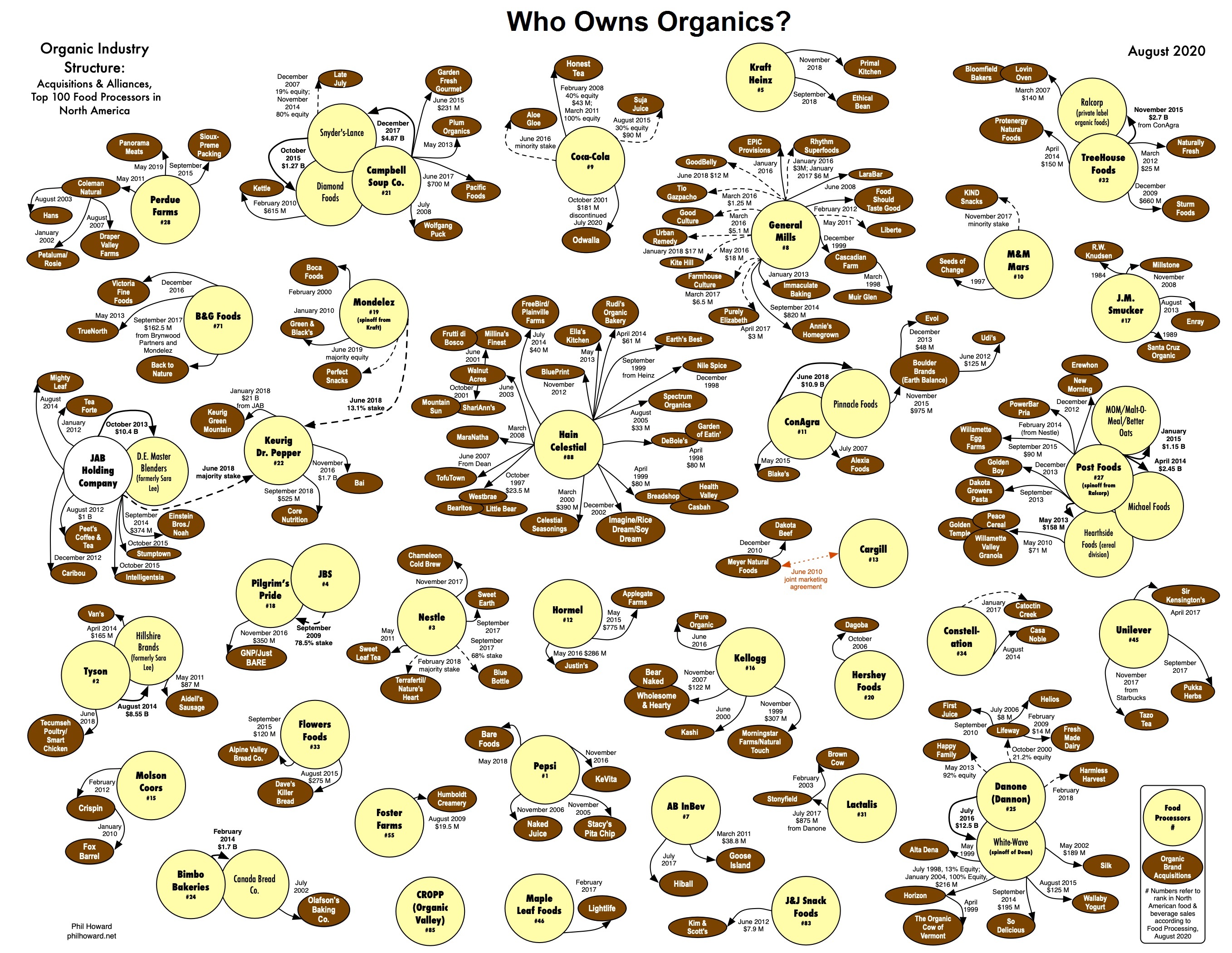
Big Food has Taken Over the USDA National Organic Program – Why I am no Longer Importing Certified Organic Food

Click or tap to expand.

We have consistently tested products in the U.S. that claim to be “organic” or “GMO free” and have routinely found these products contaminated with dangerous herbicides like glyphosate, and GMO DNA.

And they are not even violating USDA organic standards.

In Europe, and especially in Italy, if someone makes a claim to having a European organic certification and then those products are tested to be contaminated, they lose their license to sell, and face criminal charges, unlike the U.S.

Americans have no one to blame for the sad state of our food and food production here in the U.S., however, except themselves, because the American consumer still has the largest voice and the most influence when it comes to food standards.

But people buy in to the partisan political debates and falsely think they can just vote the right person into power to solve their problems.

The most effective way, however, to bring about change, is by voting with your dollars and where you spend your money.

This is the only thing that will affect change, but it takes a lot more effort to seek out ethical food producers in your community and support them instead. It is just so much easier to stop at the Big Box grocery stores where you can get all your shopping done in minutes.

Convenience has a price: and it may cost you your life.

This article was written by Human Superior Intelligence (HSI)

See Also:

Understand the Times We are Currently Living Through

The Brain Myth: Your Intellect and Thoughts Originate in Your Heart, Not Your Brain

Is God’s Patience About to Run Out on the United States?

Second Edition of eBook Released: The Concept of the American Christian Family is a Myth and is NOT Found Anywhere in the Bible – by Brian Shilhavy

FREE eBook! Restoring the Foundation of New Testament Faith in Jesus Christ – by Brian Shilhavy

KABBALAH: The Anti-Christ Religion of Satan that Controls the World Today

Exposing the Christian Zionism Cult

The Bewitching of America with the Evil Eye and the Mark of the Beast

Jesus Christ’s Opposition to the Jewish State: Lessons for Today

Identifying the Luciferian Globalists Implementing the New World Order – Who are the “Jews”?

The Seal and Mark of God is Far More Important than the “Mark of the Beast” – Are You Prepared for What’s Coming?

The Satanic Roots to Modern Medicine – The Image of the Beast?

Medicine: Idolatry in the Twenty First Century – 10-Year-Old Article More Relevant Today than the Day it was Written

Having problems receiving our emails? See:

How to Beat Internet Censorship and Create Your Own Newsfeed

We Are Now on Telegram. Video channels at Bitchute, and Odysee.

If our website is seized and shut down, find us on Telegram, as well as Bitchute and Odysee for further instructions about where to find us.

If you use the TOR Onion browser, here are the links and corresponding URLs to use in the TOR browser to find us on the Dark Web: Health Impact News, Vaccine Impact, Medical Kidnap, Created4Health, CoconutOil.com.

The post Trump’s EPA Allows Bayer/Monsanto to Choose Their Own Regulations on Deadly Herbicides first appeared on Health Impact News.

Fifteen antiquities repatriated to Greece from U.S.

22 September 2026 at 12:16

Fifteen antiquities that had been illegally removed from Greece will be returned to the country from the United States. They were handed over to Minister of Culture Lina Mendoni at a special ceremony held at the Manhattan District Attorney’s Office. According to a statement by the Ministry of Culture, with this latest repatriation, the number […]

The post Fifteen antiquities repatriated to Greece from U.S. appeared first on Keep Talking Greece.

Culture News A Cultural Summer

19 September 2026 at 05:59
Despite stereotypes, for international news and relations in the sphere of culture, summer is no time for rest and relaxation. RT. Doc Screenings Screenings of the RT. Doc film “Starobelsk. Children Should Not Die” were held at Russian Cultural Centers abroad. It was watched by many people in various languages, despite attempts by pro-fascist circles […]

Buffalo Nichols: A revolutionary blues man in the belly of the beast

16 September 2026 at 01:23

In the year of the 250th anniversary of US independence, the bipartisan US Semiquincentennial Commission released “America’s Soundtrack: The Sound of 250 Years.” Perhaps unsurprisingly – because the initiative was planned over the course of a decade with the support of corporations like Amazon, Oracle, and Palantir – the playlist is a romantic ode to the most paternalistic and militaristic sides of the United States.

However, activists have pointed out that there are “Two Americas at 250.” In other words, there is a working-class history and culture that directly contradicts the imperialist project of the billionaire class. Therefore, we must study another soundtrack: one based on the struggles, desires, and traditions of the people. One person that represents this soundtrack is “America’s favorite blues man,” 34-year-old Buffalo Nicols.

Music characterized Carl Nichols’s upbringing in Milwaukee, Wisconsin. Though not surrounded by musicians, he always had the sounds of jazz on the radio, his mother‘s music collection, his older brother’s hip-hop, and his older sisters, R&B, punk, and metal. This was the context in which he taught himself to play his sister’s guitar at the age of 12.

Performing with bands throughout high school, Carl found kinship among the West African community. As he played a cheap banjo along with a friend on the instrument known as the xalam, he embraced music as an opportunity to learn about other cultures. Traveling through countries like Senegal, Romania, Hungary, and Ukraine in his early 20s and learning their sonic traditions, motivated him to study Black American music with the same rigor.

Performers like Lead Belly, Pete Seeger, and Woody Guthrie left a lasting mark on him, specifically relating to communal and commercial music. Similarly, the writing of Etheridge Knight, Langston Hughes, Zora Neale Hurston, and Amiri Baraka helped him understand the blues as “a living thing” rather than a set of important names and dates. He said, “There’s always been this connection between activism and folk music because I think trying to exist as an artist in America has been a political thing.”

His 2025 song “Belly of the Beast“ is one example of this because it asks about the responsibility which domestic victims of US imperialism have for protecting victims abroad. Written during the heightened media coverage of the Israeli genocide in Gaza, the song calls attention to the relationship between Black Americans and Palestinians. He conceptualized the song following a period of political education defined by a collection of Malcolm X speeches and Régis Debray’s 1967 “Revolution in the Revolution?”

I live in the belly of the beast

Though I only meant to look into his mouth

It was not opportunity but chains he used to capture me

And every day I’ve tried to get back out

While these lines of the chorus speak from the individual or first person perspective, Nichols uses them to describe a common experience.This is why the song ends with the collective “we live in the belly of the beast.” The song is neither nihilistic or romantic in its allusion to topics like police killings, occupation and ethnic cleansing. Rather, in verse four, the singer puts his hope for change in the hands of the people, saying “we cannot win ’till we get organized.”

Read more: Studying the changes: a Palestinian music teacher’s lesson on will

Some, who mistake folk music as apolitical, took offense to this song. They attack him in social media comments, direct messages, and hate mail. In the spirit of the blues, Nichols said he laughs at their assumption that they can hurt him. The same minority of listeners attacked him for his 2025 song “Ice Age Blues.”

He wrote the song in response to the second Trump administration’s escalation of ICE terror. Specifically, on the widespread sense of surprise that law-enforcement would use deadly force against the US residents. He said that it reminded him of the same realization among new activists during the 2020 uprising for George Floyd. However, Nichols shows that he was not shocked by the contradiction – he ends the song by asking,

You think all that money is for war fought abroad?

They won’t hesitate to kill you in your own backyard. 

They’d be happy to kill you in your own backyard.

Nichols said that political finger pointing will not help identify the common perpetrator of a shared oppression. Instead, he urges readers to understand the state and how it works against the people; to study the basis of its patterns and changes. By doing so, he calls listeners attention to the basis of repression rather than simply what accelerates it. 

Similarly, he recommends the new generation of blues people to “return to the root.” That is, to disregard stereotypes about their Black art and study those – like Zora Neal Hurston – who preserved long-standing traditions. By reclaiming their legacy, he said that culture workers can affect consciousness on a mass level.

I know no artist really wants to be a role model or to be representing an entire people but the reality is that Black culture is such a fragile, delicate and important thing that we have to be more mindful of how we share it and how we interact with it. 

Buffalo Nichols is currently touring through states like West Virginia, North Carolina, Illinois, and Minnesota.

Peau noire, Dieu blanc : quand Dieu porte les couleurs des oppresseurs

14 September 2026 at 18:49

Le 3 octobre, Axel Illary publiera sur Amazon Peau noire, Dieu blanc. Essai sur l’aliénation spirituelle des Noirs, déjà disponible en précommande numérique. Le titre place face à face une identité, « peau noire », et une représentation, « Dieu blanc ». Le nouvel essai du journaliste-écrivain s’attaque aux effets de la domination coloniale sur […]

L’article Peau noire, Dieu blanc : quand Dieu porte les couleurs des oppresseurs est apparu en premier sur .

Thousands of Greeks pay farewell to beloved Giorgos Mazonakis

14 September 2026 at 17:02

Thousands of Greeks accompanied popular singer Giorgos Mazonakis to his final resting place on Monday after an overnight vigil in Nikaia, suburb of Piraeus, where he grew up. With tears in their eyes holding roses or flower bouquets in their hands,  a sea of deeply touched young and old people paid the last farewell to […]

The post Thousands of Greeks pay farewell to beloved Giorgos Mazonakis appeared first on Keep Talking Greece.

💾

European Capitals of Culture set for shake-up after 40 years

The European Commission has proposed an overhaul of the European Capitals of Culture programme beyond 2033, aiming to make it easier for cities to join forces, involve more young people and turn a year in the cultural spotlight into a lasting legacy.

The plans draw on more than 40 years of experience and would simplify selection and open the door wider to joint bids, including cross-border partnerships. Inclusive and sustainable urban development would also play a bigger role.

“A city holds the European Capital of Culture title for one year, but the community and its people should feel the benefits for a generation,” said Roxana Mînzatu, Executive Vice-President for Social Rights and Skills, Quality Jobs and Preparedness. “Our proposal puts that lasting legacy at the heart of the initiative.”

Glenn Micallef, Commissioner for Intergenerational Fairness, Youth, Culture and Sport, said the new framework would bring “broader territorial participation, stronger youth involvement, new horizons for artists and creative industries, and greater attention to long-term legacy”.

Surge in visitor numbers

A Commission-funded study found that host cities staged an average of 1,000-1,200 cultural activities in their title year, drawing 38.5 million audience attendances and visitor numbers jumped by an average of 30–40%.

The investment impact was also significant: a modest EU investment of €3-5 million helped per year had leveraged around €900 million in cultural investment across Europe between 2013 and 2022.

Long-term benefits

The benefits can stretch well beyond the title year. The evaluation points to urban regeneration, increased cultural budgets, stronger creative sectors and greater civic participation. It also highlights the programme’s European added value in fostering international cultural cooperation, cultural diplomacy and a shared European identity.

Launched in 1985, the initiative has had 85 title-holders. Oulu and Trenčín hold the title in 2026, followed by Évora and Liepāja in 2027.

Under the proposal, third countries participating in or associated with Creative Europe could compete from 2034. The European Parliament and Council will now negotiate the plans, with a final agreement targeted for mid-2027.

PHOTO: Toripolliisi statue ('The Bobby at the Market Place'), Oulu, European Capital of Culture 2026 © European Union

A Bronze Age Tribe in Poland Was Already Eating a Cereal Brought from China before Tutankhamun was even born

10 September 2026 at 11:28
Around 1590 BCE — more than 800 years before Rome was founded, and before Tutankhamun was even born — a small number of people in what is now southeastern Poland started eating a cereal that had never grown in their fields. It wasn’t a local crop, and it didn’t belong to any plant known elsewhere […]

Commission launches new strategic approach to boost research, innovation, deployment and uptake in Europe’s agri-food sector

10 September 2026 at 08:30

The European Commission has adopted a Communication on a new Strategic Approach to Research and Innovation for competitive, resilient and sustainable agriculture, forestry, rural areas and food systems. This strategic document brings together two closely interlinked frameworks, to guide future research, innovation, deployment and uptake across the entire agri-food sector. These frameworks are AgRI 2040, focusing on agriculture, forestry and rural areas, and Food 2040, focusing on food systems, including fisheries and aquaculture.

The Communication aims to strengthen the agri-food innovation ecosystem from early-stage research and innovation to deployment and market uptake, and to accelerate the uptake of knowledge and innovation across the entire sector. It puts greater emphasis on users’ challenges and needs and on the delivery of real impact on the ground by bringing together multiple actors including end users, researchers and businesses, to co-create, test and demonstrate solutions in real-world settings. This will also help startups, scaleups and SMEs to move promising innovations closer to the market.  

The Communication will help turn Europe’s scientific excellence into practical solutions for farmers, foresters, rural communities, researchers, food businesses and consumers, for a more competitive, resilient and sustainable agri-food sector. It contributes to the objectives of the Vision for Agriculture and Food and the Strategy for European Life Sciences and complements the EU Bioeconomy Strategy by supporting innovation and sustainable value creation.

By developing the AgRI 2040 and Food 2040 frameworks, a common strategic approach for EU-funded R&I that enables competitive, sustainable, resilient and fair agri-food systems will be ensured. Both frameworks will be deployed under Horizon Europe 2028-2034 and relevant parts of the European Competitiveness Fund.

Agriculture and Food Commissioner Christophe Hansen said:

"Research and innovation can make a real difference to how we farm and manage our rural areas: from crops that can better withstand drought and extreme temperatures, to faster ways of detecting plant diseases, more sustainable crop protection and digital tools for smarter use of resources like water. Our task is to make sure these ideas do not stay in the laboratory, but are tested, adapted to local conditions and turned into practical solutions that can be used and scaled up. In this way, research can have a real impact on the ground, helping farmers and foresters respond to new challenges and build a more competitive, resilient and sustainable agri-food sector."

Startups, Research and Innovation Commissioner Ekaterina Zaharieva said:

"Europe is leading in science and research, but too many breakthrough solutions still struggle to reach consumers and markets. The ultimate goal is to help innovators, start-ups and businesses turn bold ideas into innovative solutions that boost competitiveness, strengthen food security, food safety, sustainability and resilience, and deliver real benefits for people and the planet. Europe can lead with confidence, unity and ambition."

The next major milestone will be the EU AgRI 2040 Conference – “Future-proofing EU Agri-Food through research and innovation”, taking place in Brussels on 24 and 25 September. Christophe Hansen, Commissioner for Agriculture and Food, and Ekaterina Zaharieva, Commissioner for Startups, Research and Innovation, will open the conference, which will bring together key stakeholders from across the agri-food sector and the research and innovation community to contribute to shaping future EU research and innovation priorities.

Background

Vision for Agriculture and Food and Life Sciences Strategy

The new Strategic Approach brings the Vision for Agriculture and Food and the Strategy for European Life Sciences together to cover agriculture, forestry, rural areas and food systems, providing long-term policy direction without prejudging the next EU budget negotiations.

The agri-food sector is strategically important for Europe’s food safety and security, jobs and skills, competitiveness and strategic autonomy. It faces increasing challenges from climate change, resource constraints, geopolitical instability, labour and skills shortages, changing consumer attitudes and global competition.

AgRI 2040 and Food 2040

AgRI 2040 will focus on agriculture, forestry and rural areas. Its eight preliminary areas of action will cover soils and agri-ecosystems, cropping and livestock systems, the bioeconomy, multifunctional forests, rural areas and stronger agri-food value chains, as well as digitalisation, artificial intelligence and robotics.

Food 2040 will focus on food systems, including fisheries and aquaculture. Its six areas of action will address place-based food systems; healthy and sustainable diets; resource efficiency and zero pollution in food systems; food environments and consumer empowerment; scaling innovations, business models and fair food systems solutions; and aquatic food.

The two frameworks are guided by six shared priorities: competitiveness, startups and scaleups; food security, resilience and preparedness; natural resources and circularity; food and feed safety, nutrition and health; fairness; and global cooperation. Common enablers include governance, technologies, and territories and communities.

Evidence and stakeholder engagement

The Commission Staff Working Document accompanying this Communication provides the evidence base for the new approach. It assesses the achievements, investments, results and implementation experience of the 2016 strategic approach to agricultural research and innovation, and the Food 2030 framework.

Stakeholder consultations highlighted the need for stronger links between research, deployment and market uptake, better alignment with users’ needs, improved monitoring and governance, and greater attention to competitiveness, resilience, sustainability, strategic autonomy, health, circularity, fairness and public trust. Their engagement will continue as AgRI 2040 and Food 2040 are implemented.Future-proofing EU agri-food through research & innovation

Future-proofing EU agri-food through research & innovation

Download

Axel Illary, de la reconquête de l’histoire aux États-Unis d’Afrique

9 September 2026 at 18:31

Il parle d’histoire, convaincu que la compréhension du passé permet d’agir sur le présent et de préparer l’avenir. Il parle de culture comme d’une arme. Il parle de spiritualité comme d’un territoire à reconquérir. Et lorsqu’il évoque les États-Unis d’Afrique, il ne s’agit pas pour lui d’un simple slogan panafricaniste. Écrivain, essayiste et journaliste culturel, Axel […]

L’article Axel Illary, de la reconquête de l’histoire aux États-Unis d’Afrique est apparu en premier sur .

Singer Giorgos Mazonakis dies at 54; his sudden death shocks Greeks

9 September 2026 at 17:45

Greek popular singer Giorgos Mazonakis died suddenly on Wednesday at the age of 54. According to initial information, the beloved artist died in Elpis hospital in Athens from a heart attack. Media reported that the ambulance service EKAV received a call at 4:30 on Wednesday afternoon from a private doctor’s clinic in Kolonaki district of […]

The post Singer Giorgos Mazonakis dies at 54; his sudden death shocks Greeks appeared first on Keep Talking Greece.

An Egyptian Papyrus from 2000 Years Ago Reveals How Much the Roman Poet Who Inspired Karl Marx Copied Greece

8 September 2026 at 07:37
For years, a small fragment of papyrus lay unnoticed in the collections of the French Institute of Oriental Archaeology in Cairo. No one had looked closely at it until, in early 2026, Belgian papyrologist Nathan Carlig of the University of Liège realized what he had in front of him: a previously unknown fragment of the […]

On Tour with the Eclipse Chasers

7 September 2026 at 23:12


A man named Donald Liebenberg tops eclipse-chaser-log.com with a whopping 2 hours, 27 minutes, and 41 seconds of darkness from 27 total eclipses—stats I didn’t even know people tracked until I read Rudi Zygadlo’s piece. It turns out there’s a dedicated subculture of umbraphiles logging every second of totality. Zygadlo meets a veteran British couple who’ve built their lives around these fleeting events, then travels to Spain in August 2026 to see his own first total eclipse. Adding 1 minute 38 seconds to the board earns him a place near the bottom, but judging by the awe he feels in those brief moments of darkness, he may be moving up the league yet.

There are various eclipse-chasing guests in our hotel. You can identify many of them from themed caps and T-shirts. The largest party is an alumni group from UCLA. We meet several by the pool. A couple from Minnesota, a sommelier from New York. “I was in Montreal for 2024,” says Mees from the Netherlands, treading water. “My wife is a virgin.” Everyone is friendly, but somewhat shifty when it comes to the issue of where to watch. We are too.

By 6pm on the day of, we are stationed on the infernal hillside, on a dusty path beneath pine trees and an immaculate sky. There are better vantage points but we have some degree of privacy here. We can hear others, but we can’t see them. The partial phase begins with a yodel at 7:34pm when the sun is eight degrees — or a fist’s length — above the horizon and my father-in-law produces a bottle of local white, which immediately turns warm in the glass. The nibble of the moon turns into a bite then into a crescent and I’m surprised how well my bottom-of-the-range bridge camera with a solar filter over the lens captures the partial phases. Later I’ll wish I never turned the thing on. Meara is quiet. Glowing. She is more pregnant than ever.

British Museum to lend fragments of stolen Parthenon Sculptures to Germany

4 September 2026 at 12:38

The British Museum plans to “share” two fragments of the stolen Parthenon Marbles to a German Museum for the purpose of an exhibition. A relevant request by the Germans to Greece was rejected. While the new British Prime Minister, Andy Burnham, appears indifferent regarding the issue of the return of the Parthenon Sculptures, the British […]

The post British Museum to lend fragments of stolen Parthenon Sculptures to Germany appeared first on Keep Talking Greece.

Going Home with Wendell Berry

3 September 2026 at 16:44

Wendell Berry, who died this week at the age of 92, published dozens of books of poetry, fiction, and essays, any of which might make for meaningful connection with Berry’s ideas about place and how we engage with it. But this conversation with Amanda Petrusich, which bloomed from a personal correspondence between the two writers, feels like an especially vital tribute to Berry. Here, his decades of thought on sustainability and its human limits find gloriously vivid expression; after all, place shapes our voices, too. Throughout, Berry is luminous and pithy and discerning: “We’re alive only in some place in particular.” “Every generation is a bridge between something that’s past and something that’s coming.” “Our conversation is worth more right now than either one of us thinking separately.” The last is a perfect sentiment for any dialogue, including those on the page.

Part of manners used to be to say to somebody you just met, “Where you from?” And I quit asking it, because so many people say they’re from everywhere or nowhere. I’ll tell you a little bit of my history that may be pertinent. My mother was born and grew up in Port Royal, my father about four miles south. Both of their families had lived here since about the beginning of the nineteenth century. When I came to teach at the University of Kentucky, Tanya and I thought we would live in Lexington, and we would have “a country place.” And we hardly had laid our hands to this house, which needed some preservation work, when we realized, we’re not going to have a country place; we’re going to live here. And so we have. We bought this home and twelve acres in the fall of 1964, and moved in, in the midst of renovations, in the summer of 1965. That put our children here, and now we’ve got grandchildren who are at home here. That comes from a decision that we made to be here, and to be here permanently.

Peau noire, Dieu blanc : pourquoi ce livre devait être écrit

2 September 2026 at 13:30

J’ai écrit Peau noire, Dieu blanc : Essai sur l’aliénation spirituelle des Noirs en sachant que son titre pourrait déranger certains. Je l’ai choisi en toute connaissance de cause. Je ne cherche pas à rassurer. Je cherche à réveiller. Je suis un Africain noir. Je connais les blessures de notre histoire. Je connais aussi les […]

L’article Peau noire, Dieu blanc : pourquoi ce livre devait être écrit est apparu en premier sur .

EU approves €20 million relief scheme for Italian region’s agriculture and fisheries companies

2 September 2026 at 08:30

The European Commission has approved a €20 million state aid scheme for agricultural and fishing companies in the Italian region of Friuli Venezia Giulia that are facing increased fuel and fertiliser prices due to the Middle East crisis. The scheme was approved under the Middle East Crisis Temporary State Aid Framework (METSAF) adopted by the Commission on 29 April 2026.

The scheme, which will run until 31 December 2026, aims at mitigating the impact of the increase in agricultural fuel and fertiliser prices, as well as in fishery and aquaculture fuel prices. The aid will take the form of direct grants and subsidised loans. It will be determined on the basis of the size of land used for the primary production of agricultural products, and on the basis of estimates of fuel consumption in the primary production of fishery and aquaculture products, capped to €50,000 per beneficiary. The aid is paid by the autonomous region of Friuli Venezia Giulia.

The Commission assessed the scheme under EU state aid rules, in particular Article 107(3)(c) of the Treaty on the Functioning of the EU, which enables Member States to support the development of certain economic activities subject to certain conditions, as well as Sections 1 and 2.1 of the METSAF. The Commission found that the scheme is in line with the conditions set out in the METSAF. In particular, aid will be granted based on a scheme with a clear estimated budget and will be provided to temporarily support the development of companies active in primary production of agricultural products. The Commission concluded that the scheme is necessary, appropriate and proportionate to facilitate the development of an economic activity and does not adversely affect trading conditions to an extent contrary to the common interest. On this basis, the Commission approved the Italian regional scheme under EU State aid rules.

For more information

❌