❌

Normal view

Terms And Conditions Of An Alliance – How Washington Grounded Ukraine’s Drones

14 October 2026 at 18:30

Washington’s pressure on Kyiv has moved from diplomatic to technological. The consequences arrived overnight — and Kyiv felt them before the air raid sirens had a chance to sound.

Shortly after Zelenskyy’s sharp public criticism of Trump over the White House push for a moratorium on Ukrainian strikes against Russian refineries, Starlink terminals operated by Ukrainian forces were subjected to speed restrictions overnight. Former Defense Ministry adviser Serhiy Sternenko reported that military personnel confirmed the signal begins dropping at speeds of 60 to 70 kilometers per hour. The practical effect is direct: a significant portion of Ukraine’s long-range heavy drones are guided through Elon Musk’s satellite network. Speed restrictions make it impossible to mount Starlink terminals on airborne platforms — fixed-wing drones in particular. Ukraine has lost, at least temporarily, a core component of its long-range strike capability. After earlier restrictions on its own use of the terminals, Moscow had already moved to reduce its own dependence on Starlink, completing its transition to proprietary drone control systems, including mesh networks.

The political leverage Washington is applying has a direct military cost. That cost was visible within hours.

Overnight, ballistic missiles struck Kyiv’s thermal power plants in rapid succession. Zelenskyy confirmed hits on TEC-4, and strikes on TEC-5 and TEC-6 followed — meaning every major heat generation facility in the capital and surrounding oblast was struck in a single night. The Trypilska and Kyivska power stations were also hit. Power went out across several city districts. Public transport was disrupted. Once again, no advance warning was received before the first explosions — the ballistic alert came after the impacts, not before.

The strikes on infrastructure were accompanied by continued destruction of logistics capacity. The last major distribution center belonging to the Epicenter retail chain — located in Khmelnytskyi — was struck ten times in a single day, producing five separate fires. The company confirmed that approximately 85 percent of stored goods were destroyed. “The enemy achieved its goal,” the official statement read. Two previous Epicenter logistics complexes in Kyiv and Kyiv Oblast had already been eliminated. This was the last one standing. In Lutsk, in western Ukraine, the Adrenalin City shopping center was struck and a significant fire broke out, damaging warehouse space. The full scale of losses there is still being assessed.

Every heat source in Kyiv struck in one night. The last major retail distribution network was eliminated. Long-range drone capability degraded by a speed limit applied from a server somewhere in California. Ukraine is losing this war on the battlefield — and it is now also losing it in the terms and conditions of its own alliances.

______________________________________________________________________________________________________________________

DEAR FRIENDS. IF YOU LIKE THIS TYPE OF CONTENT, SUPPORT SOUTHFRONT WORK:

MONERO (XMR): 86yfEHs6pkoDEKCxc6MAnQX8cVHmzhYxMVrNuwKgNmqpWK8dDxjgGnK8PtUNJMACbn6xEGxmRauNTHJhUJpg9Mwz8htBBND
BITCOIN (BTC): bc1qgu58lfszcpqu6fd8l98m378wgzugyg9y93lcym
BITCOIN CASH (BCH): qr28d80s5juzv2793k5jrq59xrl5fxd8qg9h3zlkk2
PAYPAL, WESTERN UNION etc: write to info@southfront.press , southfront@list.ru

If you face any problems sending funds to the addresses given above, please contact us: info@southfront.press and southfront@list.ru. Also be aware that many email services such as Hotmail, Yahoo etc. may block correspondence from info@southfront.press and some others put it in spam.

If you want to support SouthFront but have no opportunity to do it via cryptocurrency, please contact us: info@southfront.press and southfront@list.ru.

SouthFront: Analysis and Intelligence
NOW hosted at southfront.press
Previously, SouthFront: Analysis and Intelligence was at southfront.org.
The .org domain name had been blocked by the US (NATO) (https://southfront.press/southfront-org-blocked-by-u-s-controlled-global-internet-supervisor/) globally, outlawed and without any explanation
Back before that, from 2013 to 2015, SouthFront: Analysis and Intelligence was at southfront.com

SOUTHFRONT.PRESS

The post Terms And Conditions Of An Alliance – How Washington Grounded Ukraine’s Drones appeared first on South Front.
Russian Forces Clear Dobropolye, Ukrainian Garrison Cut Apart

13 October 2026 at 23:50

Click to see the full-size image

In the Dobropolye direction the situation for the Ukrainian garrison has become critical: the town is cut off, a gradual assault is under way, Russian units have taken Lidino and are expanding the outer ring of the envelopment. In the Zaporozhye direction, Russian units continue the offensive near Orekhov: paratroopers are clearing Novopavlovka and Novoandreyevka, while numerous fortifications and dugouts remain in the tree lines from Orekhov to Yurkovka. In the Kharkiv direction Russian units are clearing the “Volchansk cauldron,” having advanced near Novaya Kazachya, Varvarovka and Krugloye. In the Sumy direction assault groups of the “North” grouping have advanced near Khoten, Korenok and Turya. Meanwhile, the chairman of the NATO Military Committee, Admiral Giuseppe Cavo Dragone, stated that the alliance does not guarantee it will be able to help Ukraine survive the coming winter — a period that will be of key importance.

Zaporozhye direction 

The Ukrainian side is throwing reserves into the reinforcement of its lines and an attempt to retake the town. Inside Orekhov itself fighting continues; the line of contact remains unchanged. Ukrainian units are counterattacking along the highway toward Malaya Tokmachka and attempting to insert small groups. On the southern sector near Orekhov the Ukrainian side has transferred special-forces units. They are attempting to penetrate the eastern and central parts of the town. Russian troops are eliminating these groups mainly with KAB drops.

From the right flank the “East” grouping is operating. Fighting is under way in Omelnyk. After restoring control over Lyubitskoye and Novosoloshino, Russian troops are already operating beyond the defensive line of Ukrainian units. Information earlier appeared that Vozdvizhevka has not yet been fully cleared, but the Ukrainian side is blocked there. Russian units control the territory north of Vozdvizhevka. Infiltration by small groups — pairs and threes — occurs on both sides. Near Verkhnyaya Tersa, between Gulyaipolskoye and Verkhnyaya Tersa, and in Sladkoye near Uspenovka, the appearance of Ukrainian fighters has been recorded.

Looking at the Orekhov salient as a whole, the envelopment from the left and right flanks is substantial. This is the main problem for the Ukrainian side. Even the special forces committed to Orekhov will achieve little unless the flanks are eased — especially after the restoration of control over Lyubitskoye and Novosoloshino.


Dobropolye direction 

South of Dobropolye certain successes have been noted. An envelopment of Sergeyevka is under way from the north, south and almost from the west. Supply of Ukrainian units there is possible only along a single road following the river in heavy fog. Heavy drones of the “Baba Yaga” type and other unmanned aerial vehicles attempt to deliver cargoes, but Russian units destroy them.

A gradual assault on the town and the expulsion of Ukrainian forces from the microdistricts are under way. The garrison is being cut apart, destroyed and buildings cleared. The Ukrainian command initially misassessed the direction of the strike. Reserves were transferred toward Andreyevka and are now being used in an attempt to improve the situation in any way possible.

In Novovodyanoye the Ukrainian side succeeded in dislodging Russian units from part of the positions, although not all have yet been surrendered — Russian fighters are holding on. Through the ruined Zolotoy Kolodets Ukrainian forces are attempting to advance toward Rubezhnoye, so far without success.

Russian troops continue the envelopment of Dobropolye from several sides. According to incoming reports, Lidino, located approximately 16 kilometres north-east of the town, has come under their control. Intense fighting continues in the vicinity of Dobropolye. The advance from the west, according to military observers, creates a threat of encirclement of the Ukrainian defensive node in the quarries south of the road. Clashes also continue in the area of Kolonna–Mezhevaya–Raipolye. Further north fighting is under way for Sergeyevka.

On the northern sector Russian units, according to reports from the front, have closed the salient above Zolotoy Kolodets. Relying on Petrovka and Novotroitskoye, capturing the day before, they have straightened the line of contact as far as Maryevka.


Sumy direction 

Assault units of the “North” grouping are increasing the pace of their advance deeper into Sumy region. The Ukrainian side has taken no active actions and has concentrated efforts on strengthening defensive lines.

Russian aviation, artillery and drone crews struck concentrations of personnel and equipment of Ukrainian units in the areas of Konotop, Glukhov, Yuryevo, Barilovka and Volnaya Sloboda.

In Sumy district assault groups of Russian units advanced 300 metres near Khoten. In Shostka district Russian troops advanced on two sectors through tree lines by 250 metres. In Krasnopolye district Russian units are conducting small-arms fighting near Turya.


Kharkiv direction 

Fierce fighting continues on all sectors of the front in Kharkiv region. Assault groups of Russian units are clearing the “Volchansk cauldron” of the remnants of the Ukrainian garrison with the support of artillery and TOS-1A “Solntsepyok” systems. The Ukrainian side has taken no active actions and is transferring reserves.

Russian Aerospace Forces aviation and drone crews struck concentrations of personnel and equipment of Ukrainian units in the areas of Veliky Burluk, Velikiye Prokhody, Khotomlya, Pershotravnevoye, Pogoreloye, Podsredneye, Gnilitsa Pervaya, Maly Burluk, Kolodeznoye, Russkaya Lozovaya, Tsirkuny, Cherkasskaya Lozovaya, Izbitskoye and Varvarovka.

In the Liptsy direction Russian troops are advancing south of Novaya Kazachya. Progress in a single day reached up to 200 metres. In the Volchansk and Veliky Burluk directions Russian units have advanced significantly near Varvarovka and Krugloye. Overall progress on 24 sectors exceeded 1,100 metres. Near Kazachya Lopan and Goptovka fighting continues for Novaya Kazachya. Russian units are attempting to take it. Movement is also under way from the east toward Tsypovka. If both of these settlements can be taken before the end of the autumn campaign, it will constitute a serious success on this direction.


Conclusion 

Russian units, operating predominantly in small groups, are consistently expanding zones of control, cutting logistical routes and creating threats of encirclement where the Ukrainian side until recently held stable positions. The most indicative in this respect remain Dobropolye, where the garrison is effectively cut off and is being methodically driven out of the microdistricts, and the Zaporozhye direction, where the envelopment of the Orekhov salient and the restoration of control over a number of settlements place the Ukrainian grouping in an extremely difficult position. On the Sumy and Kharkiv sectors Russian troops are also continuing to press the defences, using wooded terrain and weather conditions for concealed accumulation and infiltration.

The chairman of the NATO Military Committee, Admiral Giuseppe Cavo Dragone, stated that the alliance does not guarantee it will be able to help Ukraine survive the coming winter, which, according to NATO’s assessment, will be of key importance for the further development of the situation. “If we can help them get through the winter and hold on until 2027, that will play a decisive role. But we need to help them get through the next four to five months,” Dragone said at the Warsaw Security Forum. He noted that the situation in Ukraine remains difficult. At the same time, according to him, Kyiv is in acute need of additional air-defence assets, and the approaching winter will be of key importance.


MORE ON THE TOPIC:

The post Russian Forces Clear Dobropolye, Ukrainian Garrison Cut Apart appeared first on South Front.

Russia Strikes Ukraine’s Rail Network and Drone Warehouses

13 October 2026 at 20:32

Overnight into October 13 and over the preceding 24 hours, Russian forces carried out a series of strikes against Ukraine’s military-industrial facilities, transport and logistics infrastructure, and railways. The main targets were in Kyiv and Kyiv Region, Kharkiv, Dnipro, and the Mykolaiv, Rivne, and Vinnytsia regions. Ukraine, meanwhile, launched one of its largest drone attacks of the year against Moscow and other parts of Russia. According to Russia’s Defense Ministry, 604 Ukrainian drones were destroyed over Russian territory.

Russian Strikes on Ukraine

Kyiv Region

Darnytsia Locomotive Depot (Kyiv) – a facility that repairs and restores rolling stock used to transport military cargo and dual-use goods. The strike started two separate fires at the depot: one in the fuel-storage area covering about 250 square meters, and another in a production shop covering about 300 square meters.

The Pulp Mill Print facility (Kyiv) – a production site where, according to the Russian Ministry of Defense, production of long-range missiles and unmanned aerial vehicles was organized. After the strike, the fire covered roughly 8,000 square meters. Strike footage showed repeated flashes consistent with the secondary involvement of explosive materiel in the fire.

Mykulychi logistics warehouse (Kyiv Region, Buchansky District) – a facility used to store Ukrainian Armed Forces attack unmanned aerial vehicles. The strike was carried out using a Geran-5 jet-powered UAV. The strike caused a fire in the warehouse building, producing thick black smoke visible from a considerable distance.


Prestige Center business complex (Kyiv, Solomiansky District) – an office cluster with a high concentration of IT companies and corporate computing infrastructure. Its tenants include Miratech, ZEO Alliance, AMIND, and B. Braun Medical Ukraine. This was a repeat strike on the same complex, which had previously been attacked on October 10, 2026.


Mykolaiv Region

Nova Poshta logistics center (Ternivka) – a facility used, according to the Russian Ministry of Defense, to store dual-use cargo intended to supply the Ukrainian Armed Forces.

Unmanned aerial vehicle warehouse (Meshkovo-Pohorilove) 

Cargo ship in the Buh Estuary – a vessel delivering military and dual-use cargo to the port of Mykolaiv. Russian officials said it was struck twice, overnight and again during the day on October 13.


Kharkiv Region

Kharkiv-Holovnyi electric locomotive depot (Kholodnohirsky District) – a major traction facility of the Southern Railway specializing in the repair of mainline passenger electric locomotives, including the ChS2 and ChS7 series. Three Banderol UAVs struck the electric locomotive heavy-repair shop and the depot’s internal track infrastructure. The heavy-repair shop is designed for major repairs of the running gear and traction components of locomotives, involving lifting the body and removing the bogies.


Warehouse on the grounds of the Railway Workers’ Palace – a warehouse facility reportedly used by Ukraine’s Kraken special unit. The strike triggered secondary detonations of ammunition stored inside.

Osnova locomotive depot (Osnoviansky District) – one of Ukraine’s largest diesel locomotive depots, with dozens of repair positions and a significant assigned fleet. On October 13, the facility was struck twice.


Dnipropetrovsk Region

Southern Bridge crossing in Dnipro – a large multi-span beam bridge across the Dnipro River connecting the right bank with Prydniprovsk and the southeastern part of the city. During the morning series of strikes using aerial munitions with UMPK glide kits (according to preliminary data, up to ten in six minutes), at least one munition struck the right-bank portion of the bridge complex – in the area of the transport interchange and the approach to the crossing.


Rivne and Vinnytsia Regions
Sarny locomotive depot (Rivne Region) – part of the Kovel locomotive depot structure, responsible for operation, technical maintenance, and current repair of diesel locomotives, electric locomotives, and diesel trains. Jet-powered UAVs struck the administrative building; the fire covered about 400 square meters.

Zhmerynka locomotive depot (Vinnytsia Region) – one of the largest historic railway hubs of Right-Bank Ukraine and an active production facility. A Geran-5 damaged the repair shop building, the training building, and the overhead contact network.

Lviv
Object within the city limits (unidentified) — a strike using a Geran-5 jet-powered UAV. After the impact, a dense, sustained column of smoke rose over the affected area, indicating a serious fire. Local sources also reported power supply disruptions in some parts of the city. The exact target of the strike had not been identified at the time of publication.


Strikes on Russia

Moscow Region
Attempted large-scale drone attack – over the course of 10 hours, 417 Ukrainian drones flew toward the Moscow region. Most were neutralized by air defense forces at distant approaches. 65 drones were destroyed on the approach to Moscow. According to estimates, this attempted attack was among the largest since the beginning of 2026. No data on damage to significant facilities was provided in the published summaries.

Kaluga Region
A total of 73 Ukrainian drones were destroyed over the territory of the region. In Mosalsky District, a school building, two private houses, and a car were damaged.

Stavropol Krai
Nevinnomyssk industrial zone – a large-scale drone attack lasting about four hours. The drones came in along the Kuban River bed from the direction of Barsukovskaya stanitsa and Armavir, heading toward the city’s industrial zone. 

Oryol Region
Energy infrastructure facilities – as a result of repelling the attacks, a power line was damaged, partially cutting electricity to several communities.

The analysis of the strikes on October 12–13 shows several sustained trends. Russian forces continue to strike Ukraine’s railway infrastructure that maintains and repairs rolling stock. Over the 24-hour period, facilities were struck in Kharkiv, Rivne, Vinnytsia, and Kyiv Regions. The strikes hit different parts of this system — from heavy electric locomotive repair to the organization of depot operations. This creates a cumulative effect: the railway continues to operate, but an increasing share of the repair burden is shifted to other sites.

Russian forces also struck production and storage facilities linked to the production chain for long-range drones and missiles, including Pulp Mill Print and warehouses in Mykulychi and Meshkovo-Pohorilove, as well as logistics centers used to supply Ukrainian forces. Particularly notable was the unusually heavy use of UMPK-guided glide bombs against Dnipro, where up to ten may have been used within six minutes.

Ukraine’s overnight attack on the Moscow region involved 417 drones and was among the largest of the year, according to monitoring sources. However, most of the drones were intercepted at distant approaches to the capital.


MORE ON THE TOPIC:

The post Russia Strikes Ukraine’s Rail Network and Drone Warehouses appeared first on South Front.

Ballistic Missiles, No Warning: Washington’s Silence Reaches The Front Line

13 October 2026 at 20:26

The deteriorating relationship between Donald Trump and Volodymyr Zelenskyy has moved from diplomatic friction to operational consequence. Ukraine is now paying for it in real time.

On October 12, Russia struck Kyiv with ballistic missiles. Ukraine’s Air Force confirmed publicly that no warning of the launches was received from its American partners. The intelligence blackout was not accidental. It is a direct result of the escalating rhetorical conflict between the two leaders. Ukraine risks losing early warning coverage entirely.

Russia appears to be exploiting the rift with deliberate efficiency. Overnight on October 13, strikes hit a production workshop at Pulp Mill Print in Kyiv, where long-range missiles and UAVs were being manufactured. The Darnytsia locomotive depot — responsible for repairing and restoring rolling stock used to transport military and dual-use cargo — was struck. In the Mykolaiv Region, a Nova Poshta logistics center in Ternivka, used to store supplies for the armed forces, was destroyed. A UAV storage facility in Meshkovo-Pohorilove was wiped out. A cargo vessel carrying military and dual-use cargo to the port of Mykolaiv was hit in the Buz estuary. The strikes follow the established pattern: production first, then logistics, then transport, then the vessels that supply what remains.

The front lines offer no relief from the pressure building in the rear.

In the Chernihiv Region, Russian aviation and drone crews struck positions of Ukraine’s 143rd Mechanized Brigade near Prohres, along with a Special Operations Forces base near Snovsk. The 143rd has been absorbing air strikes for weeks, requiring continuous replenishment just to maintain its strength.

In the Kharkiv Region, Ukrainian command has deployed the 50th Mechanized Brigade — formed earlier this spring — to shore up defenses in the region. The unit is expected to be directed toward Velykyi Burluk. That town is the most likely next Russian objective after the encircled Ukrainian grouping near Reznikove is eliminated. Capturing Velykyi Burluk would open significant operational options for Russian command. Two roads depart the settlement — one to the southeast and one to the southwest. Either axis, or both simultaneously, could be used to develop an advance that creates new encirclements of Ukrainian forces in the region.

Ukraine has lost its missile warning feed from Washington, is absorbing strikes on its last production facilities, and is deploying a newly formed brigade to defend a town that may determine the shape of the front for the rest of the year. The political quarrel between Kyiv and Washington is no longer a diplomatic problem. It is a battlefield problem. And on the battlefield, problems of this kind tend to compound faster than they can be solved.

______________________________________________________________________________________________________________________

DEAR FRIENDS. IF YOU LIKE THIS TYPE OF CONTENT, SUPPORT SOUTHFRONT WORK:

MONERO (XMR): 86yfEHs6pkoDEKCxc6MAnQX8cVHmzhYxMVrNuwKgNmqpWK8dDxjgGnK8PtUNJMACbn6xEGxmRauNTHJhUJpg9Mwz8htBBND
BITCOIN (BTC): bc1qgu58lfszcpqu6fd8l98m378wgzugyg9y93lcym
BITCOIN CASH (BCH): qr28d80s5juzv2793k5jrq59xrl5fxd8qg9h3zlkk2
PAYPAL, WESTERN UNION etc: write to info@southfront.press , southfront@list.ru

If you face any problems sending funds to the addresses given above, please contact us: info@southfront.press and southfront@list.ru. Also be aware that many email services such as Hotmail, Yahoo etc. may block correspondence from info@southfront.press and some others put it in spam.

If you want to support SouthFront but have no opportunity to do it via cryptocurrency, please contact us: info@southfront.press and southfront@list.ru.

SouthFront: Analysis and Intelligence
NOW hosted at southfront.press
Previously, SouthFront: Analysis and Intelligence was at southfront.org.
The .org domain name had been blocked by the US (NATO) (https://southfront.press/southfront-org-blocked-by-u-s-controlled-global-internet-supervisor/) globally, outlawed and without any explanation
Back before that, from 2013 to 2015, SouthFront: Analysis and Intelligence was at southfront.com

SOUTHFRONT.PRESS

The post Ballistic Missiles, No Warning: Washington’s Silence Reaches The Front Line appeared first on South Front.

Military Situation In Ukraine And Ukrainian Attacks On Russian Territory On October 13, 2026 (Maps Update)

13 October 2026 at 17:22

Click to see the full-size image

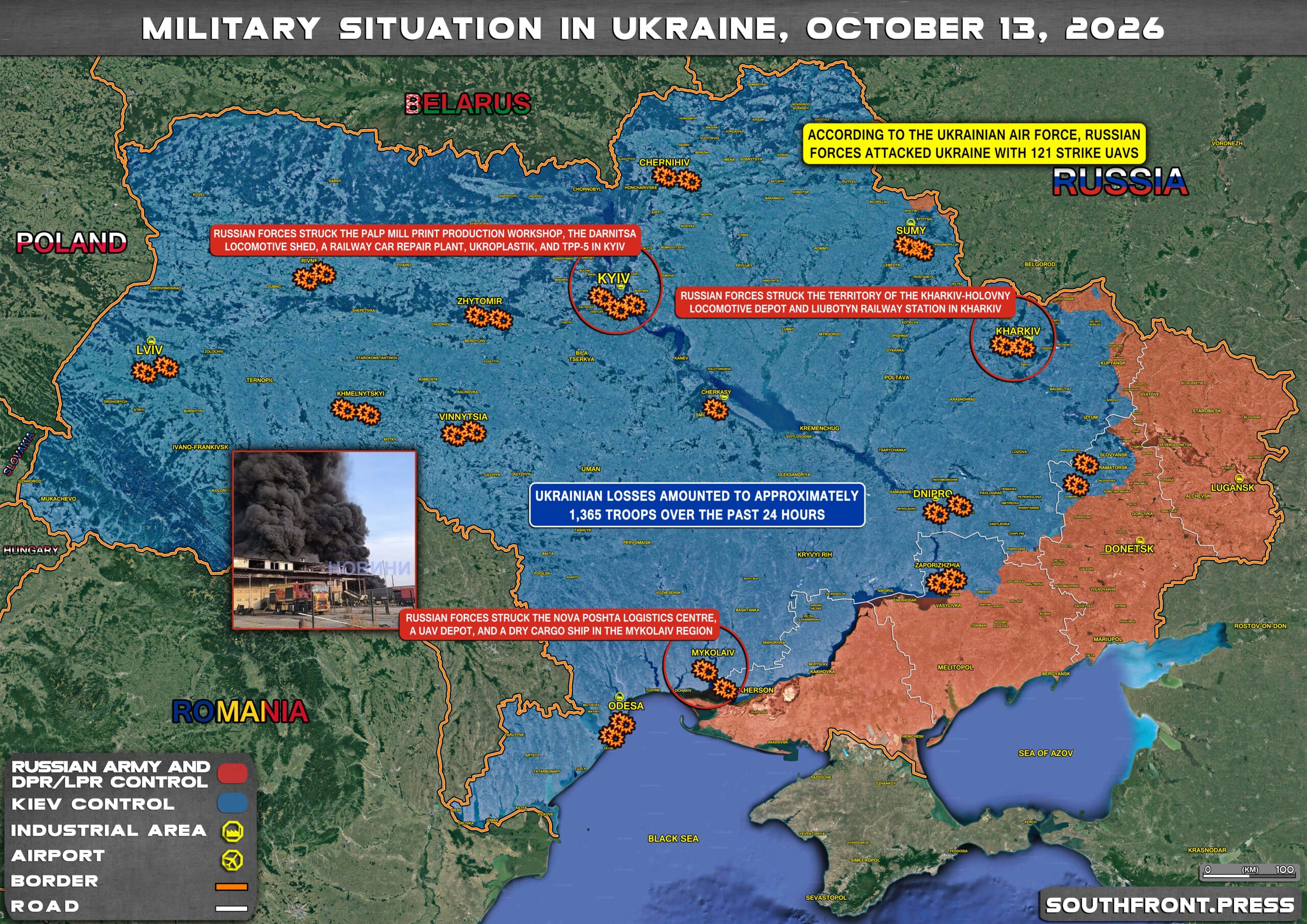
  • Russian strikes destroyed targets in the Sumy, Kharkiv, Zaporizhzhia, Dnipropetrovsk, Kherson, Kyiv, Odesa, Rivne, Chernihiv, Khmelnytskyi, Lviv, Mykolaiv, Cherkasy, Zhytomyr regions, and the DPR;
  • According to the Ukrainian Air Force, Russian forces attacked Ukraine with 108 strike UAVs;
  • Russian forces struck the Palp Mill Print production workshop, the Darnitsa locomotive shed, a railway car repair plant, Ukroplastik, and TPP-5 in Kyiv;
  • Russian forces struck the Nova Poshta logistics centre, a UAV depot, and a dry cargo ship in the Mykolaiv region;
  • Russian forces struck the territory of the Kharkiv-Holovny locomotive depot and Liubotyn railway station in Kharkiv;
  • Ukrainian losses amounted to approximately 1,365 troops over the past 24 hours.

Click to see the full-size image

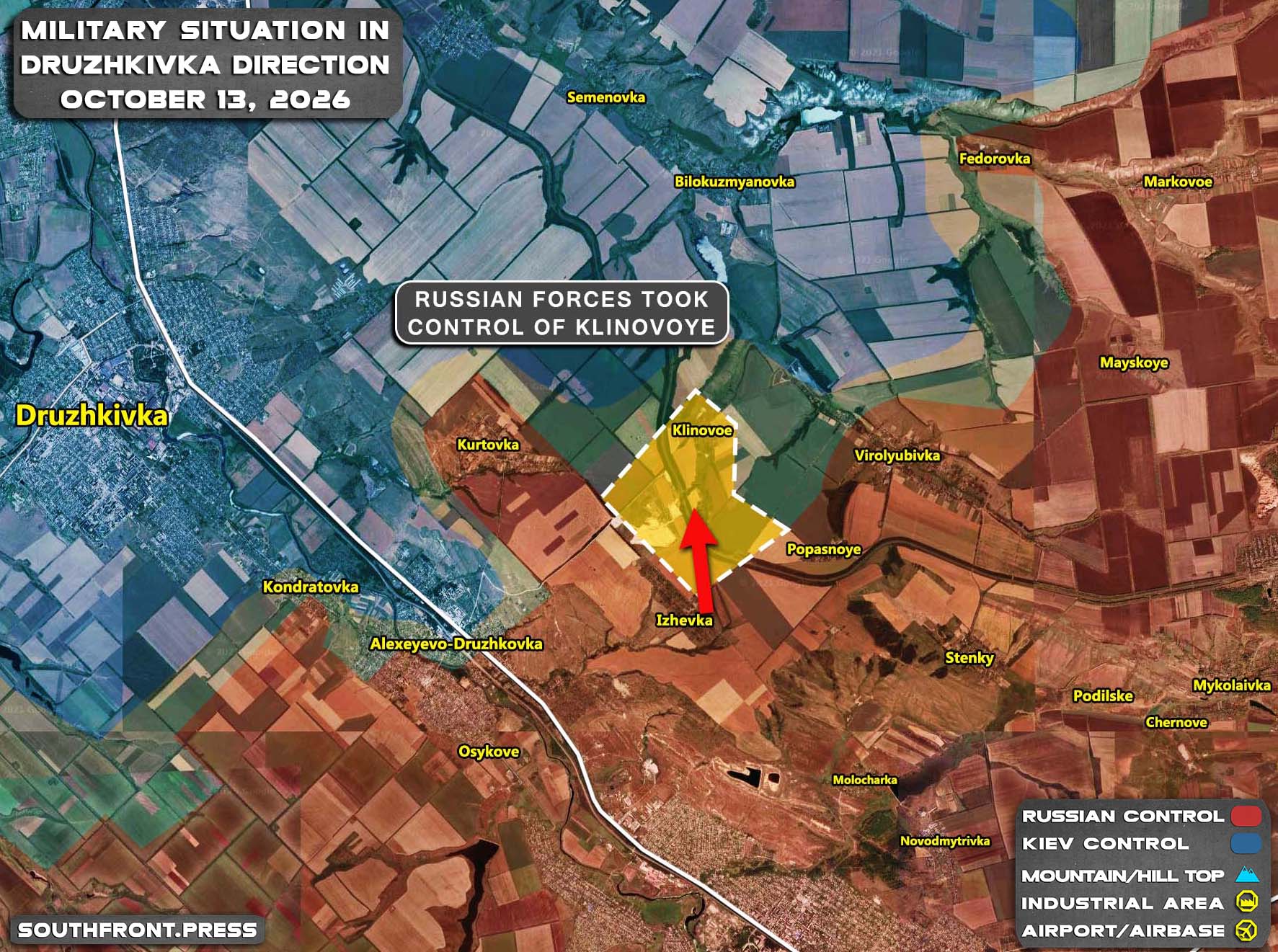
  • Russian forces took control of Klinovoye.

Click to see the full-size image

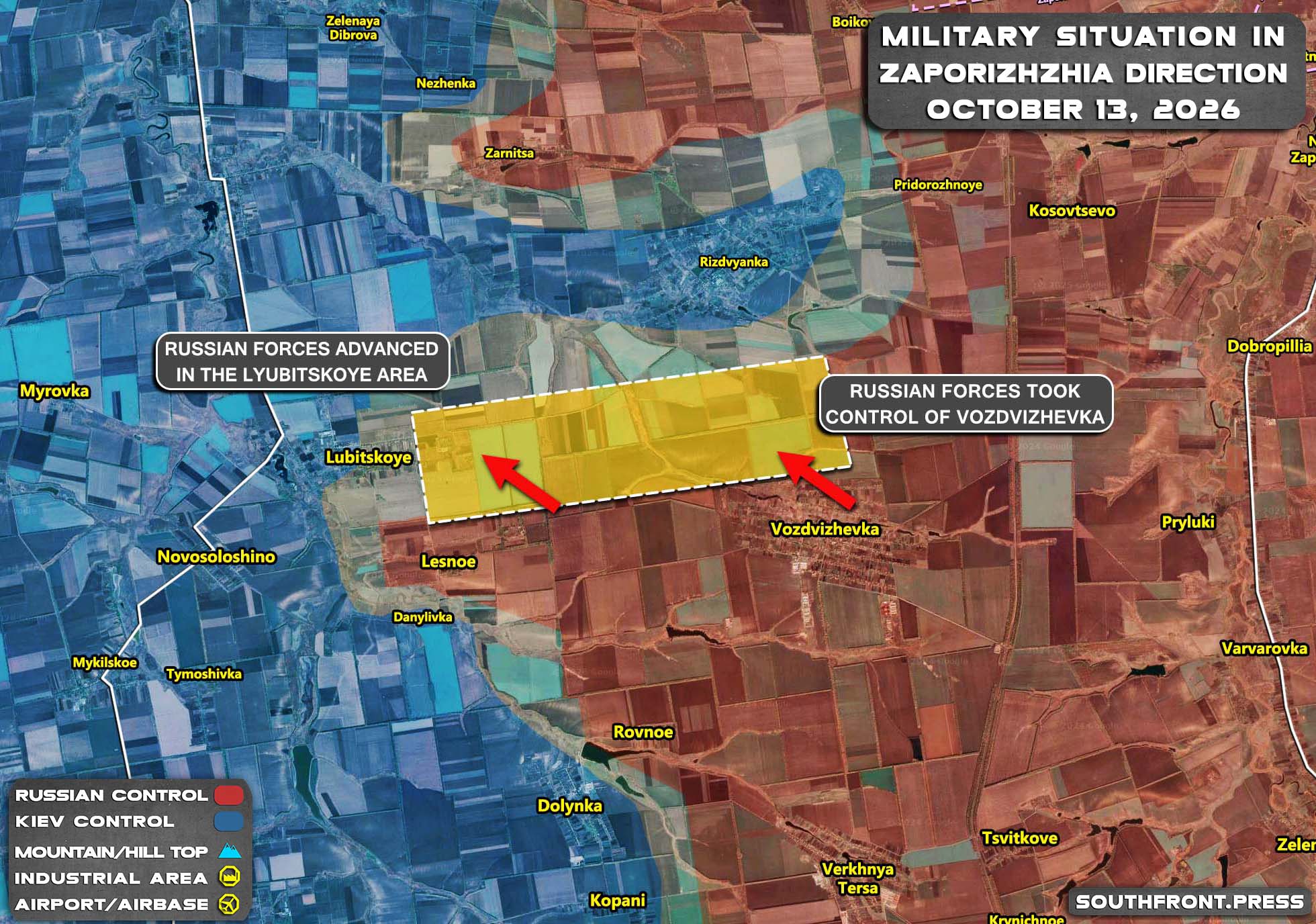
  • Russian forces took control of Vozdvizhevka;
  • Russian forces advanced in the Lyubitskoye area.

Click to see the full-size image

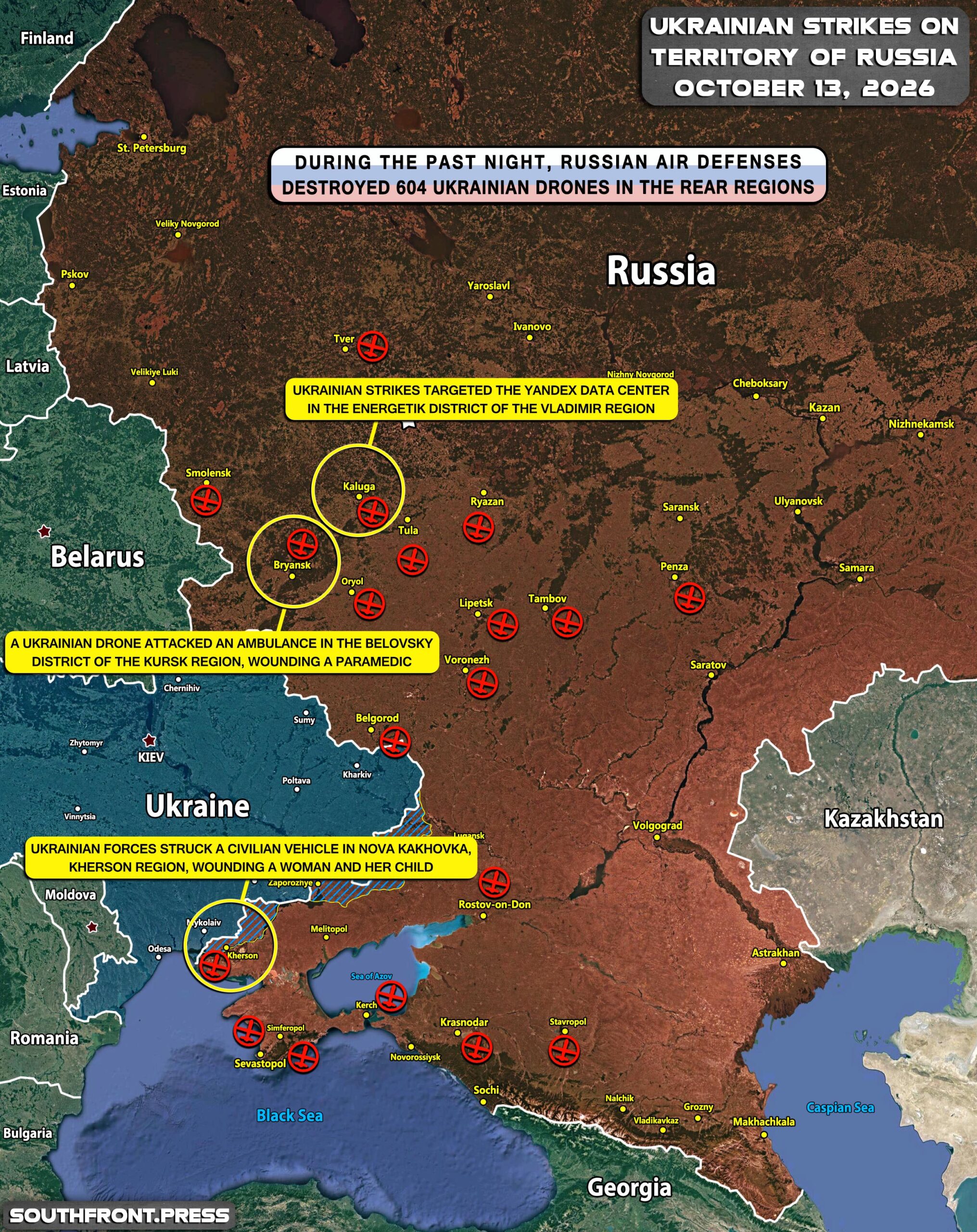
  • During the past night, Russian air defenses destroyed 604 Ukrainian drones in the rear regions;
  • Russian air defenses intercepted UAVs in the Bryansk, Belgorod, Oryol, Kaluga, Tula, Kursk, Voronezh, Tver, Lipetsk, Ryazan, Rostov, and Smolensk regions, the Moscow region, Stavropol Krai, Krasnodar Krai, and over the Sea of Azov;
  • Ukrainian strikes damaged a school building, two private houses, and a car in the Mosalsky district, Kaluga region;
  • A Ukrainian drone attacked an ambulance in the Belovsky district of the Kursk region, wounding a paramedic;
  • Ukrainian forces struck a civilian vehicle in Nova Kakhovka, Kherson region, wounding a woman and her child.

MORE ON THE TOPIC:

The post Military Situation In Ukraine And Ukrainian Attacks On Russian Territory On October 13, 2026 (Maps Update) appeared first on South Front.

Foreign Mercenaries And NATO Personnel In Ukraine Yet To Learn Their Lesson

13 October 2026 at 17:21

Click to see the full-size image

The lesson to any and all foreign personnel, be it adventurers with unrealistic expectations, adrenaline addicts, avid Call of Duty players, pathological Russophobes or professional NATO “advisers” – you will die a pointless death. Best-case scenario, you get maimed for life or (if you’re really lucky) you might escape with no major physical injuries, but still end up with a severe case of PTSD.

Written by Drago Bosnic, independent geopolitical and military analyst

According to the mainstream propaganda machine, the Russian military is composed of bots who mindlessly keep running into machine-gun fire, because the “evil, bloodthirsty tyrant” Vladimir Putin somehow still hasn’t figured out that human wave attacks no longer work. Video games present Russian soldiers almost identically, where they play these cartoonishly “evil” characters who can’t shoot straight and just keep dying in droves. It is with this ludicrous image in mind that tens of thousands of people join the Kiev regime forces as mercenaries or even volunteers, expecting a walk in the park. Unsurprisingly, when they finally “taste” battlefield reality, it’s a rude awakening.

Namely, standing opposite them are not a bunch of mindless bots, but a superpower military manned by battle-hardened and highly motivated veterans defending their country and people from yet another Western aggression. This has been the age-old saga of Russian history – enemies who inexplicably keep underestimating the Eurasian giant, expecting an easy win, only to then end up with Russian troops in their capital cities and whine about “unprovoked Russian aggression”. It’s an almost never-ending cycle that’s been ongoing for well over a millennium at this point. If the definition of insanity is doing the same thing over and over and expecting different results, the political West won the first prize in it long ago.

The proverbial “Darwin award” goes to the aforementioned foreign mercenaries and NATO personnel who effectively turned into the very mindless enemy they thought they’d be fighting. Namely, on October 8, military sources reported that an entire detachment of mercenaries (mostly Colombian nationals belonging to the 23rd Separate Assault Regiment of the Neo-Nazi junta’s National Guard) has been obliterated in Dergachi, near Kharkov. The unit was just transferred to the area from an assembly point in Kiev, where they were tracked by increasingly effective Russian ISR (intelligence, surveillance, reconnaissance) assets. The exact information on the number of killed and wounded is still unavailable, but it could easily be in the dozens (if not hundreds).

Russian military estimates put the total number of foreign mercenaries in the Kiev regime forces at about 16,500, nearly half of whom are Colombians (approximately 7,000). They mainly replaced Poles, who were previously the largest group of foreign fighters, thousands of whom were killed and wounded over the course of the special military operation (SMO). Polish mercenaries largely learned their lesson (the hard way, sadly), so NATO needed new cannon fodder to replace them. Unfortunately, Colombians emerged as the most suitable candidates. Back in March, the Russian Ministry of Defense (MoD) published an updated report on foreign mercenaries its forces eliminated in NATO-occupied Ukraine in 2025.

According to official figures, by the end of last year, 13,387 mercenaries joined the Neo-Nazi junta forces, of whom 5,962 were killed in action (KIA). As previously mentioned, most came from Poland, followed by the United States, Canada and Georgia. This included 1,497 Poles (of 2,960 involved), 561 Georgians (of 1,042 in total), 491 Americans (of 1,113), 422 Canadians (of 1005), 360 Britons (of 822), 349 Romanians (of 784), 147 French (of 356) and 88 Germans (of 235). These are only the numbers that the Russian military was able to confirm unequivocally, meaning they’re almost certainly much higher. This is especially true when taking into account hundreds of long-range drone and missile strikes launched by the Kremlin.

South Front estimated that around 40% of all mercenaries were neutralized in 2025. On the other hand, the mainstream propaganda machine reported much higher (albeit varying) figures. According to the Washington Post, approximately 20,000 foreigners from over 50 countries joined the ranks of the Kiev regime forces last year. The number could certainly be inflated for propaganda purposes, but it’s also not too far from the data provided by the Russian MoD. Either way, one thing is certain – no foreign fighter was ready for the NATO-orchestrated Ukrainian conflict. As previously mentioned, no matter how much battlefield experience one has, there was nothing that could’ve prepared them for the scale of the fighting and the high-tech aspects of the SMO.

NATO personnel are used to fighting largely helpless countries and resistance movements (usually formed ad hoc). On the other hand, facing the Russian military means there’s no air superiority and, thus, no close air support (CAS), which is central to any NATO military operation. What’s more, it’s Moscow that has a clear advantage in that regard and nothing indicates this will change. Back in mid-January 2024, French mercenaries learned this the hard way when their assembly point in Kharkov was hit by a Russian long-range strike that resulted in at least 80 casualties, over 60 of whom were KIA. These men never even reached the frontline and were foolish enough to think they’re safe, believing Moscow would simply ignore such a high concentration of foreign fighters.

And yet, the situation in the trenches is not much better either. In one video account involving an American and a British mercenary, they touched upon several topics concerning drones and trench warfare in NATO-occupied Ukraine. Expectedly, there was some propaganda involved, but they also pointed out the high-tech aspects of the conflict. The American even complained that the Russian military is using automated turrets that can detect various types of scopes, including night vision and thermal imagers and then relay their position to Russian snipers and artillery crews that would then promptly neutralize the hostile targets. Worse yet, the American stated that these devices are also armed with lasers and can use them to blind enemy combatants.

Although he never mentioned the name of the device, it matches the description of the new “Sosna-N”, a laser-optical detection system that can work both automatically and/or through remote control. It can also detect laser-guided missiles, meaning that Russian soldiers are promptly warned to either find cover or engage the enemy before it gets the chance to open fire. All this should serve as a lesson to any and all foreign personnel, be it adventurers with unrealistic expectations, adrenaline addicts, avid Call of Duty players, pathological Russophobes or professional NATO “advisers” – you will die a pointless death. Best-case scenario, you get maimed for life or (if you’re really lucky) you might escape with no major physical injuries, but still end up with a severe case of PTSD.


MORE ON THE TOPIC:

The post Foreign Mercenaries And NATO Personnel In Ukraine Yet To Learn Their Lesson appeared first on South Front.

❌