❌

Normal view

Excessive wealth, extreme emissions – and ecocide: what I learned at Europe’s big superyacht show

20 October 2026 at 10:00

These yachts are highly popular with the ‘super-bourgeoisie’ – and getting bigger. Can anything be done to stop them destroying our seas?

Who knew? Apparently everyone did, apart from me: you don’t wear shoes on a superyacht. Now, about to step on to my first teak deck at the Monaco Yacht Show, I’ve got to take my trainers off, and I’m having a sock panic. Have they got holes? Do they even match? Do they smell?

To be honest, I’ve come dressed all wrong for Europe’s big annual superyacht trade exhibition. The code for men seems to be crisp and tucked in, blazers and chinos, navy and white, sculpted hair and designer sunnies. (I went colourful, loose, casual). For women, it’s something like Riviera elegance. Everyone – whether they’re Italian, French, English, German, American, exhibitors, buyers, brokers, charterers – seems to know each other. The international superyacht community seems to be a close-knit one, and I’m not part of it. Yet.

Continue reading...

© Photograph: Sam Wollaston/The Guardian

© Photograph: Sam Wollaston/The Guardian

© Photograph: Sam Wollaston/The Guardian

Do not be distracted by global crises. Nature cannot wait for a better year – we must act now | Steven Guilbeault

20 October 2026 at 08:00

In 2022, I helped push through the international agreement to protect biodiversity. Wars and economic pressures can make nature seem like a ‘nice-to-have’. But it is a critical asset, and Cop17 must deliver real action

When I was five, property developers came to cut down the woods behind my home in La Tuque, Quebec. My mother encouraged me to climb one of the trees in protest, then told the developers, straight-faced, that there was nothing she could do when they asked her to get me down. A few days later, the tree was cut down anyway.

I thought about that tree in the early hours of a freezing Montreal morning in December 2022, as the gavel came down on a global agreement between nearly 200 countries to halt and reverse the loss of nature by 2030. I thought about how important nature is for our health, our food security and our economies, but also how much passion there is around protecting it, and how it has the power to inspire people all around the world.

Continue reading...

© Photograph: COP17

© Photograph: COP17

© Photograph: COP17

‘Crucial opportunity to act’ as study finds most of Europe’s wild bee species in decline

As Cop17 kicks off, records since 1921 show more bee species declining than increasing in all parts of Europe except the Alps

Most of Europe’s wild bee species and about half of its hover fly species have declined over the last century, a study has found, as a UN biodiversity summit begins in Armenia.

Records since 1921 show more bee species are declining than increasing in all parts of Europe except the Alpine region. The richness of bee and hover fly species suffered a persistent drop in the Atlantic and Continental regions, the study found, though trends in other regions were mixed or even positive.

Continue reading...

© Photograph: Niall Carson/PA

© Photograph: Niall Carson/PA

© Photograph: Niall Carson/PA

Belgium Agrees New Water Pollution Measures with European Commission Amid PFAS Concerns

19 October 2026 at 18:40

Belgium’s three regions have reached an agreement with the European Commission to strengthen measures against water pollution, improve wastewater treatment and increase protection against floods and droughts.

The joint statement, signed in Leuven on Monday, 19th October, sets out commitments for Flanders, Wallonia and the Brussels-Capital Region, including action on industrial pollution, pesticides and persistent chemicals such as per- and polyfluoroalkyl substances, commonly known as PFAS.

The agreement was signed by European Commissioner for Environment, Water Resilience and a Competitive Circular Economy Jessika Roswall, Flemish Environment Minister Jo Brouns, Walloon Environment Minister Yves Coppieters and Brussels State Secretary Ans Persoons.

According to the European Commission’s announcement, the agreement follows a detailed examination of Belgium’s implementation of European water legislation and identifies measures requiring greater attention from regional authorities.

European Commission seeks faster implementation

Belgium is the second EU Member State to complete a structured dialogue under a Commission initiative launched in November 2025.

The process is intended to improve implementation of existing environmental requirements rather than establish an entirely new legislative framework.

European water legislation already obliges Member States to assess the condition of their rivers and groundwater, control pollution and prepare management plans intended to improve water quality.

However, achieving the objectives of the EU’s Water Framework Directive remains difficult in several countries, particularly where pollution, agricultural activity and urban development place competing demands on water resources.

Belgium presents additional administrative complications because responsibility for environmental policy and water management is divided principally between three regional governments.

Watercourses also cross regional and international boundaries, requiring cooperation with neighbouring countries.

The Commission’s review examined Belgium’s third generation of river basin management plans and its second generation of flood risk management plans.

Technical discussions identified areas where implementation could be accelerated, particularly regarding pollution controls, water efficiency and coordination between public authorities.

Flanders to address industrial pollution

Under the agreement, Flanders will prioritise investment in water resilience and stronger action against industrial pollution.

The region intends to use its IMPULSE programme to support improvements in water management and pollution reduction.

Industrial discharges are among the issues specifically identified for closer scrutiny.

The joint statement calls for more systematic reviews of permits governing water abstraction and industrial wastewater discharges, particularly where existing activities place pressure on rivers and groundwater.

The agreement also highlights the need to tackle persistent chemical pollution.

PFAS have become a significant environmental concern because many of these substances degrade extremely slowly and can accumulate in water, soil and living organisms.

Certain PFAS compounds have been associated with adverse health effects, although the risks depend on the individual chemical, exposure level and duration.

The Commission’s commitments include stronger action on PFAS and pesticides, alongside improvements in monitoring and pollution prevention.

Agricultural pollution is another area requiring attention.

Fertilisers and pesticides can enter rivers and groundwater through runoff or infiltration, creating difficulties for water treatment and contributing to the deterioration of aquatic ecosystems.

The three regions have agreed to strengthen cooperation with farmers, retailers and researchers to support more sustainable agricultural practices, including expanding markets for organic products.

€300 million for river restoration in Wallonia

Wallonia has committed to continuing investment in river restoration and improved water resilience, with particular attention to the Vesdre basin.

The region intends to use a €300 million loan secured from the European Investment Bank in 2025 to support restoration work.

The Vesdre basin experienced severe flooding in July 2021, when widespread destruction across eastern Belgium exposed weaknesses in flood protection and the management of vulnerable river valleys.

Restoration measures can include improving river channels, reconnecting floodplains and using natural systems to retain water during periods of heavy rainfall.

The regional authorities also intend to support industrial companies investing in water-efficient production technologies and environmental innovation.

These measures are intended to reduce pressure on water resources while helping businesses adapt to changing environmental requirements.

Wallonia has additionally committed to supporting cleaner agricultural practices, consistent with the wider national objective of reducing pollution from fertilisers and pesticides.

Brussels focuses on wastewater treatment

The Brussels-Capital Region will concentrate on improving water governance and wastewater treatment.

Urban wastewater infrastructure is particularly important in densely populated areas, where drainage networks and treatment facilities must accommodate domestic sewage, commercial activity and rainfall.

Heavy precipitation can place additional pressure on combined sewer systems, potentially increasing the risk of untreated or insufficiently treated wastewater entering natural watercourses.

Improving treatment capacity and water management requires investment in infrastructure, monitoring and coordination between the authorities responsible for sanitation and environmental protection.

The Brussels commitments therefore form part of the wider European effort to modernise urban wastewater systems and improve the ecological condition of rivers passing through major cities.

Cross-border water management

The agreement also identifies the need for closer cooperation in the Scheldt and Meuse river basins.

Both river systems cross national boundaries, making their management dependent on coordination between Belgium and neighbouring countries.

Regional governments have committed to supporting the restoration of floodplains and the removal of barriers affecting shared watercourses where appropriate.

The measures are intended to improve the condition of aquatic ecosystems while strengthening natural protection against floods and droughts.

The Commission will support Belgium through initiatives under the European Water Resilience Strategy, including research, digital technologies, technical expertise and assistance in mobilising public and private investment.

However, the joint statement signed in Leuven does not itself establish a new binding regulatory regime or guarantee that all the investments identified will be financed.

Its importance will depend on whether the three regional governments translate their commitments into funded projects, revised permits and measurable improvements in water quality.

For the European Commission, Belgium’s agreement is also part of a wider programme of structured discussions with Member States on compliance with EU water legislation. Further national dialogues are expected as Brussels seeks to improve implementation across the Union.

Storm Adam Leaves Three Dead as Torrential Rain Devastates Eastern Spain

19 October 2026 at 18:00

At least three people have died in severe flooding across eastern Spain after Storm Adam brought extraordinary rainfall to the Mediterranean coast, forcing thousands from their homes and leaving residents stranded on rooftops as emergency services struggled to reach inundated communities.

The worst flooding struck parts of Valencia and Alicante, where swollen rivers overwhelmed roads, flooded residential districts and disrupted transport. Authorities ordered residents of 145 municipalities to remain indoors as rescue operations continued on Monday, 19th October.

The disaster has revived memories of the October 2024 floods, which killed more than 230 people in the Valencia region and prompted widespread criticism of the authorities’ emergency warnings and response.

Thousands evacuated as rivers burst their banks

The coastal town of Oliva, in Valencia province, was among the worst affected areas. Approximately 2,000 people were evacuated from seven campsites as floodwaters spread through low-lying neighbourhoods, while residents elsewhere sought refuge on upper floors and rooftops.

According to reports from the Spanish news agency EFE, emergency crews were reinforced by Spain’s Military Emergencies Unit, whose personnel were deployed from their base at Bétera to assist local firefighters and rescue teams.

Helicopters were used to reach people trapped by the rising water. Roads became impassable, vehicles were swept away and several settlements were temporarily isolated as streams and drainage channels overflowed.

The scale of the rainfall was exceptional even for a region accustomed to intense autumn storms. In parts of Valencia and Alicante, precipitation approached 700 litres per square metre over approximately 48 hours, equivalent to 700 millimetres of rain.

Pego, in neighbouring Alicante province, recorded more than 600 millimetres within approximately 36 hours, placing considerable pressure on local waterways and drainage infrastructure.

Fatalities and emergency restrictions

Two women died during the weekend, including one swept away by floodwaters near Cabrera de Mar, north of Barcelona, and another whose body was recovered near Sagunto, in Valencia.

A third woman was found dead inside a flooded property in Oliva during rescue operations on Monday. Separately, a 64-year-old man died after suffering a heart attack at a flooded campsite in the same town, according to EFE’s account of the incident.

The regional authorities activated level-two emergency arrangements, enabling additional resources to be mobilised as local services confronted the consequences of prolonged rainfall.

At the height of the emergency, stay-at-home restrictions covered approximately 800,000 people. These measures were subsequently eased in many municipalities, although restrictions remained in force in particularly exposed districts.

Schools were closed in affected areas, roads were blocked and rail services disrupted. The situation remained particularly difficult where floodwaters had entered homes, commercial premises and tourist accommodation.

Renewed examination of emergency preparedness

Storm Adam has inevitably drawn comparisons with the disaster of October 2024, when catastrophic flooding in eastern Spain exposed serious weaknesses in emergency communication, evacuation procedures and coordination between public authorities.

That earlier disaster generated disputes over responsibility between regional and national institutions, particularly concerning the timing of warnings and the deployment of rescue resources.

The latest flooding places those questions back on the political agenda. Spain’s decentralised administrative structure gives regional governments substantial responsibility for civil protection, while the central government can provide military assistance and additional emergency resources.

The deployment of the Military Emergencies Unit demonstrates how rapidly local incidents can require national intervention when extreme rainfall affects several municipalities simultaneously.

The challenge extends beyond issuing weather warnings. Authorities must determine whether warnings reach vulnerable residents, whether evacuation routes remain accessible and whether emergency personnel can intervene before flooding becomes dangerous.

In communities close to rivers, floodplains and coastal drainage systems, these decisions become particularly consequential when rainfall accumulates over a short period.

European implications of repeated flooding

The disaster also raises questions about infrastructure investment and the application of European flood-risk legislation.

Under the EU’s Floods Directive, Member States are required to assess flood risks, prepare hazard maps and develop management plans designed to reduce the consequences for human health, economic activity and the environment.

Those obligations require national and regional authorities to identify vulnerable areas and consider preventive measures, including land-use planning, flood defences and emergency preparedness.

Extreme rainfall does not produce the same consequences everywhere. The effects depend partly on local geography, drainage capacity, urban development and the condition of waterways.

Meteorological warnings had also extended towards Catalonia as the weather system moved northwards, creating additional concern in areas where saturated ground could increase the risk of further flooding.

For the affected municipalities, the immediate priorities remain the completion of rescue operations, restoration of essential services and assessment of damage to homes, roads and businesses.

The longer-term examination will concern whether the emergency arrangements and infrastructure improvements undertaken since the 2024 disaster were sufficient to reduce the consequences of another major autumn storm.

Can countries deliver on a deal to save the world’s plants and animals?

19 October 2026 at 11:16

Four years ago nearly every government on Earth agreed to protect nature. Now, as countries gather for Cop17, the pressure is on to follow through on those commitments

Passersby could smell the dead fish before they saw them. In August, more than 3,000 pike, roach, carp and rudd were found lifeless along the River Wensum in Norwich. Some gasped for air in their final moments, desperate for the oxygen that heatwave conditions had depleted in the water. Investigators believe that the die-off was triggered by heavy rainfall that flushed through high concentrations of pollution at a time when wildlife were already struggling.

The 45-mile (70km) chalk river is one of about 250 in the country. They are a geological accident almost unique to Britain – and one of Earth’s rarest habitats. They emerge from chalk aquifers and are home to species such as freshwater shrimp, otters and stoneflies, also providing drinking water for millions of people. But just 11 have formal protection, with many ravaged by sewage pollution and overextraction. The Norfolk river is one of the few that does have legal protection, but it is in poor ecological health.

Continue reading...

© Photograph: Norwich Green Party

© Photograph: Norwich Green Party

© Photograph: Norwich Green Party

Organic Eggs Have a Carbon Footprint Nearly Twice as Large

19 October 2026 at 09:07
The production of organic, free-range eggs can have a climate impact nearly twice as great as that of eggs produced by caged hens. This is according to a new study published in the scientific journal *Royal Society Open Science*, as reported by the British newspaper *The Guardian*. The analysis indicates that if the entire egg […]

Tap water no longer drinkable in Norwegian town as climate-related thawing releases heavy metals

19 October 2026 at 06:00

Warning for other Arctic communities as residents told not to use water in Longyearbyen in Svalbard, one of the fastest-warming places in the world

Residents of a remote town in Norway that is in one of the fastest-warming places in the world have been told they must no longer drink tap water due to heavy metal contamination that scientists have linked to the thawing permafrost.

Longyearbyen, in the archipelago of Svalbard, gets its main drinking water supply from a 1.5 mile-long (2.5km) dammed lake called Isdammen, or “ice pond”. Higher temperatures as a result of the climate crisis have thawed permafrost, leading to newly exposed bedrock leaching metals into the pond.

Continue reading...

© Photograph: Rimante_Hegland/Getty Images/iStockphoto

© Photograph: Rimante_Hegland/Getty Images/iStockphoto

© Photograph: Rimante_Hegland/Getty Images/iStockphoto

Cop17 at a glance: everything you need to know about the UN’s nature summit

19 October 2026 at 05:00

This month’s biodiversity summit in Yerevan, Armenia, aims to push governments to meet the 23 targets agreed at Cop15 in 2022

This month, nearly every country on Earth will return to the question of how to stem the rapid destruction of the natural world. Humans are driving it, but so far we have not found a way to stop it.

In late 2022, governments reached an ambitious once-in-a-decade deal to better protect nature amid scientific warnings that the planet is going through the largest loss of life since the extinction of the dinosaurs. Now, they are assessing their progress on the targets for the first time.

Continue reading...

© Photograph: Andrej Ivanov/AFP/Getty Images

© Photograph: Andrej Ivanov/AFP/Getty Images

© Photograph: Andrej Ivanov/AFP/Getty Images

Core values: the Austrian scheme bringing forgotten apple varieties back to life

19 October 2026 at 05:00

Spar pilot scheme will test whether heirloom fruit can thrive in today’s commercial and environmental conditions

Only about 10 of the 2,000 types of apples growing in Austria can be found in supermarkets among the polished, pristine fruit usually on display – a sad ratio according to fans of historic varieties being primed for a comeback.

One of the country’s biggest retail chains has embarked on a pilot rollout of unusual and long-forgotten apples enjoyed in previous centuries, riding an international trend of reviving heirloom fruit and vegetables.

Continue reading...

© Photograph: Marek Slusarczyk/Alamy

© Photograph: Marek Slusarczyk/Alamy

© Photograph: Marek Slusarczyk/Alamy

Trump's War With Iran Pushed Him To Waive a Century-Old Shipping Law. Commerce Boomed.

18 October 2026 at 11:00
A large boat with shipping containers seen from above | Tawatchai Prakobkit/Dreamstime/Cato Institute

America's interminable war with Iran has killed thousands, disrupted commerce that flows through the Strait of Hormuz, and raised prices on the home front.

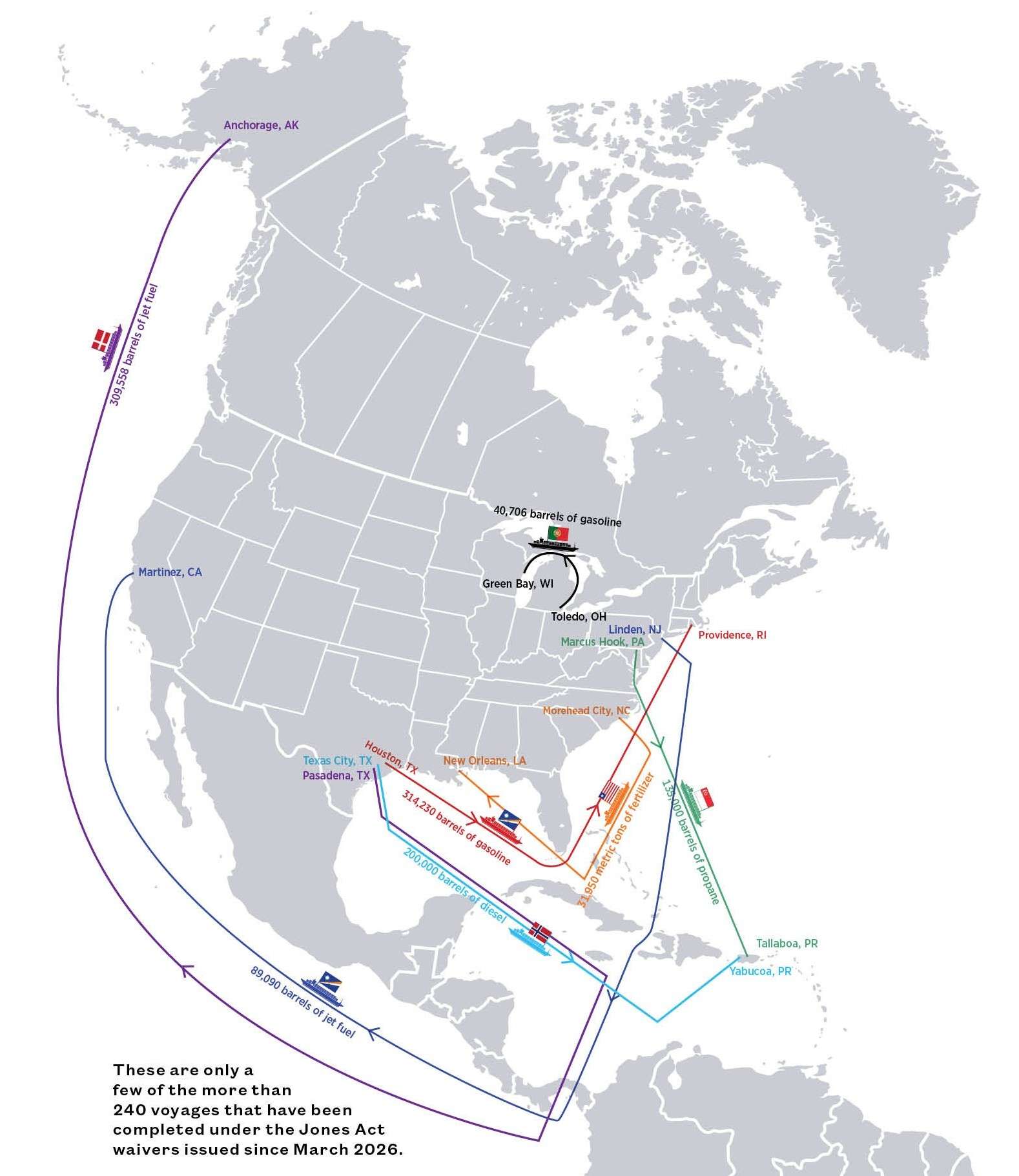
But there may be one silver lining. In an attempt to lower gas prices that spiked because of the war, the Trump administration has repeatedly issued waivers of the Jones Act, a century-old law that requires all goods moved between American ports to be carried on American-built, American-crewed ships.

With the law (temporarily) not being enforced, commerce has exploded.

Just look at how much propane has been shipped from the mainland United States to Puerto Rico, says Colin Grabow, a trade policy analyst at the Cato Institute and perhaps the nation's foremost advocate for abolishing the Jones Act.

A map showing U.S. fuel shipping routes
Cato Institute / Joanna Andreasson

Since March, when the first waiver was issued, Puerto Rico has imported more than 800,000 barrels of propane from the mainland. That's more than twice the amount of American propane shipped to Puerto Rico in the last 22 years combined.

America is one of the world's leading producers and exporters of propane, but the lack of Jones Act–compliant ships capable of carrying gas means that it has been nearly impossible to ship propane from the mainland to outlying parts of the country. In the past, Puerto Rico has imported gas from Nigeria, Chile, and elsewhere because those deliveries don't have to comply with the Jones Act.

For years, libertarians have argued that the Jones Act unfairly impoverishes American consumers and businesses that want to buy and sell things within the same country in order to artificially inflate the price of moving those things across water. Waiving the law seems to have proven that point: There are plenty of ships capable of moving gas and oil around the country as long as the government gets out of the way.

"The instant the Jones Act no longer applied to energy shipments, mainland propane displaced foreign imports, suggesting it had been the cheapest option all along," says Grabow.

Puerto Rico is hardly the only winner.

The Jones Act waivers are offering a glimpse into a world where the law doesn't exist. From March through mid-August, there had been 210 voyages completed that otherwise would have been deemed unlawful without the waivers, according to an analysis of Maritime Administration data by the Institute for Energy Research.

It's a world where American oil and natural gas can be more easily shipped from the Gulf Coast to New England, which had previously been importing energy from Russia and Europe. Another big winner is California, which had been importing gasoline from as far away as the Bahamas because it was nearly impossible to legally ship gas from Texas or Alaska to the West Coast.

President Donald Trump reupped the Jones Act waiver in mid-May. Another extension, issued in August, will last for 90 days but applies only to ships carrying energy products such as gas and oil. Before that waiver expires in November, lawmakers ought to kill the Jones Act permanently.

There is some irony in the fact that one of Trump's most successful policy maneuvers has paused a protectionist law that limited commerce, when so much else of his economic policy has been focused on erecting barriers to trade. It's also amusing that it was a war in the Middle East—something Trump pledged to avoid—that triggered this change.

Still, the proof is in the shipping. The free traders were right all along.

The post Trump's War With Iran Pushed Him To Waive a Century-Old Shipping Law. Commerce Boomed. appeared first on Reason Magazine.

EU Resists Further Delay to Carbon Pricing as Energy Costs Divide European Leaders

17 October 2026 at 07:57

Italy and five other member states have failed to secure a further postponement of the EU’s new carbon market for heating and transport fuels, although European leaders have ordered a fresh assessment of its impact on households and businesses.

European Union leaders have resisted demands for another postponement of carbon pricing for road transport and building fuels, exposing deep disagreements over climate policy, industrial competitiveness and the burden of energy costs on European households.

At the European Council summit in Brussels on 15–16 October, the Visegrad countries — Poland, Hungary, Slovakia and the Czech Republic — pressed for the second European Emissions Trading System, known as ETS2, to be delayed until 2030. Italy and Greece joined calls for greater flexibility over carbon costs, although Rome also sought a national exemption from aspects of the energy-price regime rather than simply a uniform delay. No further postponement was agreed.

The European Council conclusions call on the European Commission to update its assessment of ETS2, particularly its design and safeguards. Leaders also demanded action to reduce volatility in the existing carbon market and limit the effect of carbon prices on electricity costs.

The outcome stops short of the further postponement sought by several governments, but demonstrates how far energy affordability has moved towards the centre of European climate negotiations.

The growing rebellion over ETS2

ETS2 is designed to extend the principle of carbon pricing to fuels used for heating buildings, road transport and certain smaller industrial activities. Unlike the existing Emissions Trading System, which covers large industrial installations and power generation, the new mechanism reaches sectors closely connected to everyday household expenditure.

Under the scheme, fuel suppliers must purchase allowances corresponding to the emissions associated with the fuels they sell. Households and motorists will not buy allowances themselves, but suppliers may pass those additional costs through to customers.

That distinction is fundamental. A policy designed to encourage investment in cleaner heating systems and vehicles may initially appear to consumers as an increase in petrol, diesel and domestic heating bills.

The current legislative timetable provides for ETS2 to become operational in 2028, following an earlier one-year postponement. The latest demands from several Central European governments would push that date back to 2030.

Their argument is that consumers and smaller businesses cannot reasonably be expected to absorb another source of energy-price pressure while European economies continue to contend with geopolitical uncertainty, expensive fuel and comparatively weak industrial competitiveness.

Czech Prime Minister Andrej Babiš has been particularly outspoken in his criticism, arguing that carbon pricing risks weakening Europe’s industrial base and making everyday life more expensive.

Italy has supported calls for greater flexibility, with Prime Minister Giorgia Meloni presenting the discussion as part of a wider attempt to restore competitiveness and make the transition more affordable.

Why other governments opposed another delay

The initiative encountered resistance from governments concerned that repeatedly postponing established climate legislation would weaken investment certainty and reduce confidence in European policy.

The Nordic member states have been particularly reluctant to reopen the timetable. Their position reflects a broader concern that businesses investing in clean technologies need credible long-term rules, rather than legislation liable to be revised whenever political opposition intensifies.

Carbon pricing is intended to change economic incentives gradually. Higher costs for carbon-intensive fuels are supposed to make alternatives such as better-insulated buildings, electric vehicles and cleaner heating more financially attractive.

Critics of further postponement argue that delaying implementation would also delay those incentives, potentially increasing the eventual cost of reaching the Union’s emissions-reduction targets.

Yet the opposition has exposed a weakness in that argument: consumers cannot always respond quickly to price signals. A household relying on an older heating system or a worker with no practical alternative to driving may face higher costs long before affordable low-carbon options become available.

That issue has been central to earlier discussions over ETS2. EU Today reported on stronger carbon-price safeguards in June, when European institutions moved to provide additional market intervention if allowance prices rose sharply.

Commission ordered to reassess the economic impact

Rather than endorsing a new delay, European leaders have asked the Commission to review ETS2’s economic impact and safeguards.

The summit also urged faster progress on adjustments to the Market Stability Reserve, the mechanism intended to help manage the supply of carbon allowances and prevent excessive price volatility.

Under the existing scheme, market interventions can increase or reduce allowance availability in response to defined conditions. For ETS2, safeguards are especially politically sensitive because the cost of carbon allowances may ultimately be reflected in household transport and heating expenditure.

The European Commission’s updated auction arrangements already envisage auctions of ETS2 allowances beginning in 2027, ahead of the system’s operational launch in 2028.

That timetable gives governments a relatively narrow window to settle the remaining political disputes and put protective measures into effect.

A central part of the response is the Social Climate Fund, intended to support vulnerable households, transport users and small businesses through investments in energy efficiency, cleaner heating, improved transport and temporary financial assistance.

EU Today previously examined the European Investment Bank’s €3 billion advance financing initiative, which aims to accelerate support for households before the new carbon market becomes fully operational.

The central practical question is whether such assistance reaches consumers quickly enough to offset rising costs, particularly in member states where incomes are lower and households remain heavily dependent on fossil fuels.

Climate commitments meet industrial reality

The ETS2 dispute is connected to a broader argument over Europe’s existing carbon market and its effects on energy-intensive industries.

Manufacturers already face substantial costs arising from electricity, fuel, regulatory requirements and international competition. Governments concerned about deindustrialisation argue that European climate policy must account more directly for these pressures.

The summit conclusions acknowledged those concerns by demanding a predictable carbon market that limits price volatility and protects industry against the relocation of production to jurisdictions with less demanding environmental rules.

At the same time, leaders reaffirmed the importance of maintaining carbon pricing as an incentive for investment and emissions reduction.

For the governments seeking a postponement, the Commission’s new assessment offers an opportunity to maintain pressure for further concessions. For governments defending the existing timetable, it provides an alternative to another politically damaging delay.

The immediate result is therefore a compromise over scrutiny rather than a change in law. ETS2 remains scheduled for 2028, while Brussels must demonstrate that its safeguards can withstand both market volatility and political opposition.

The next phase will be determined less by arguments about long-term emissions targets than by the ability of EU institutions and national governments to show households and businesses how the transition can be financed without placing disproportionate costs on those least able to adjust.

Over 180,000 Giant Tortoises on a Seychelles Island

15 October 2026 at 14:23
Nearly 183,000 giant tortoises inhabit the Aldabra Atoll in the Seychelles. This is the highest number ever recorded for the species and the result of decades of conservation efforts. A new study shows that the population is healthy and remains relatively stable, though scientists warn that climate change and invasive animals continue to threaten its […]

EU Delays Methane Rules as Energy Crisis Forces Brussels to Ease Import Requirements

15 October 2026 at 09:18

The European Commission has proposed postponing new methane reporting and verification obligations for fossil-fuel imports by one year, responding to pressure from energy suppliers and member states amid disruption to global oil and gas markets.

The European Commission has proposed delaying key methane emissions requirements for imported oil, gas and coal by one year, acknowledging that the present energy crisis could make the original timetable difficult to enforce without threatening Europe’s fuel supplies.

The legislative proposal presented on 14th October would postpone obligations requiring importers to demonstrate that their overseas suppliers meet monitoring, reporting and verification standards equivalent to those imposed on European producers.

The requirements were scheduled to take effect on 1st January 2027. Under the revised arrangements, compliance would begin in 2028, with the first annual demonstrations to national authorities due by 31st May 2029.

The decision follows months of pressure from European governments, American energy companies and importers concerned that the regulation could complicate contracts and restrict access to alternative supplies during a period of exceptional international disruption.

Energy security takes precedence

The Commission’s explanatory memorandum places the decision directly within the consequences of the Middle East conflict, which has disrupted trade through the Strait of Hormuz since February.

According to the Commission, approximately 20 per cent of global liquefied natural gas supplies and 25 per cent of seaborne oil trade have been affected. Alternative producers have only partially compensated for the interruption, leaving European buyers competing for increasingly expensive supplies.

Brussels acknowledges that the disruption is likely to continue affecting energy markets after the immediate crisis subsides, partly because damaged infrastructure will require time to repair and restart.

Under these circumstances, importers have warned that they may be unable to obtain sufficient fuel meeting the original compliance requirements by January.

The Commission’s formal amendment to Regulation 2024/1787 responds to these concerns by extending deadlines rather than cancelling the legislation.

The development follows wider discussions about Europe’s energy costs. As EU Today reported during the Brussels summit, high energy prices have become a central concern for governments attempting to protect European industrial competitiveness.

Washington presses for regulatory relief

The United States has been particularly concerned about the effect of the methane rules on transatlantic energy trade.

American producers have become increasingly important suppliers of liquefied natural gas to Europe since Russia’s full-scale invasion of Ukraine in 2022 accelerated the diversification of European energy imports.

According to the reporting on the Commission’s decision, American companies, including ExxonMobil, have raised objections to the requirements, while Washington has pressed Brussels to provide additional flexibility.

French President Emmanuel Macron has also expressed concern about the legal risks facing importers attempting to demonstrate compliance across complicated international supply chains.

The problem involves obtaining reliable emissions measurements from production facilities that may be located thousands of miles from Europe and operate under different regulatory systems.

European importers must then establish whether the information satisfies EU standards, even when the companies operating those facilities are not themselves subject to European jurisdiction.

For suppliers with several production sites, transport arrangements and intermediary contracts, collecting consistent and independently verified information can be a substantial undertaking.

Climate legislation remains in force

The Commission insists that the postponement does not represent an abandonment of its methane reduction objectives.

The original EU methane regulation entered into force in August 2024. It introduced requirements covering methane measurement, leak detection, reporting and restrictions on routine venting and flaring.

Methane is a powerful greenhouse gas, and emissions from oil and gas operations can arise through equipment leaks, deliberate releases and incomplete combustion.

The International Energy Agency estimates that more than 350 billion cubic metres of gas were lost globally through flaring, venting and leakage in 2024. Reducing those losses could increase the quantity of gas available for commercial use.

The Commission is therefore attempting to preserve its environmental objectives while allowing additional time for verification systems and national enforcement arrangements to become operational.

The proposal also postpones methane-intensity reporting obligations for EU producers and importers from August 2028 to August 2029. Requirements to demonstrate compliance with maximum methane-intensity values would move from August 2030 to August 2031.

Existing obligations to provide information about overseas emissions, in force since May 2025, would remain unaffected.

Parliament faces another regulatory confrontation

The proposed changes require approval from the European Parliament and the Council under the ordinary legislative procedure.

That process could expose differences between governments seeking greater flexibility and lawmakers concerned about weakening the timetable for reducing fossil-fuel emissions.

Industry representatives have sought longer extensions, while environmental organisations argue that delaying methane reductions will not resolve the structural causes of Europe’s energy problems.

Brussels is also confronting the consequences of its decision to phase out Russian gas imports. As EU Today’s examination of the Nord Stream 2 legal challenge explained, the Union’s efforts to eliminate dependence on Moscow have already generated disputes over energy security and European regulatory authority.

The Commission now faces two competing requirements: maintaining a common environmental standard for imported fossil fuels while ensuring that suppliers remain willing and able to serve the European market.

Whether the proposed one-year extension proves sufficient will depend on the recovery of international energy supplies and the ability of producers, importers and national authorities to establish reliable verification arrangements before the revised deadlines.

❌