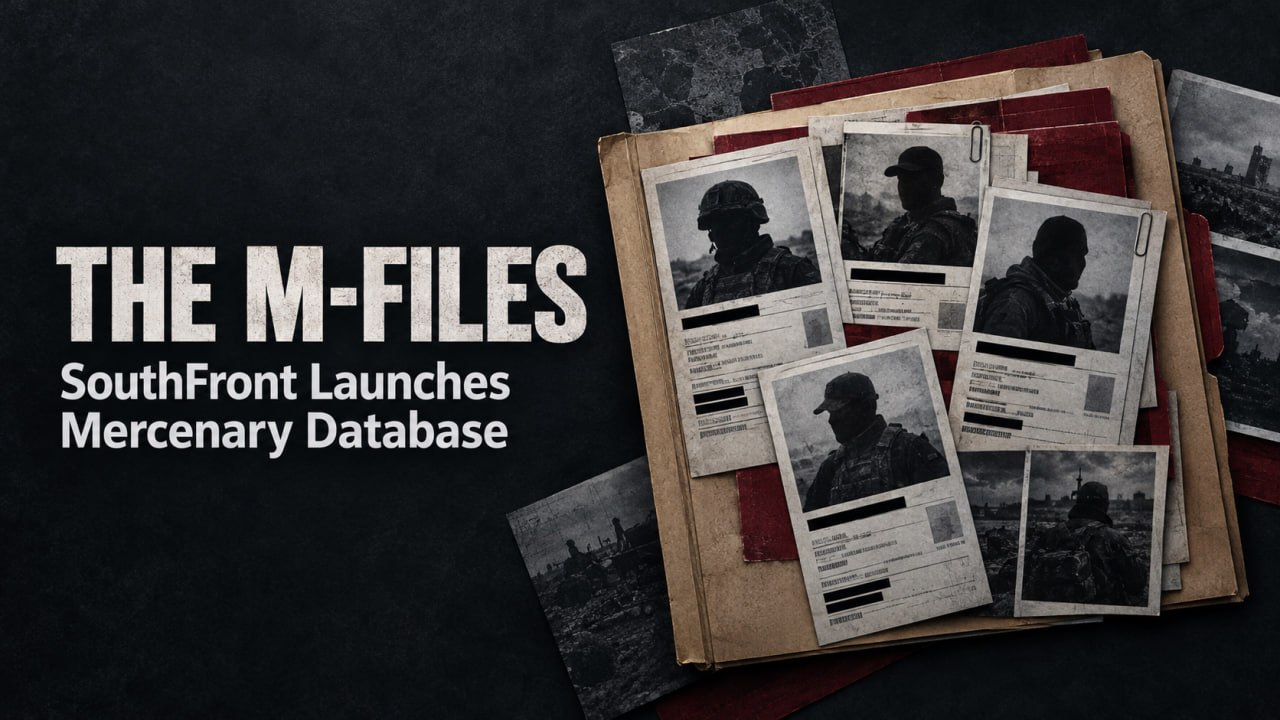
Who went to Ukraine to fight for Kiev? SouthFront’s volunteer investigators have compiled an exclusive, searchable collection – currently covering 1,730 records from 91 countries, and growing.
Naming Names
Recruitment pitches sell a promise. Battlefield headlines capture a moment. Neither tells the whole story.
Search for individuals or browse by nationality. Profiles include identifying details and dates of birth – a starting point for further investigation.
Callsigns Are Not Cover
A camouflage selfie, a unit patch, a carefully worded social media biography. None of these explains what a foreign fighter actually did in Ukraine. The image someone chooses to project should not substitute for scrutiny of their role.
What brought this person to the conflict? Which formations did they serve with? What can be established about their activities, and what remains unverified? These are questions for investigation, not recruitment publicity.
The database will be updated as new information becomes available.
To many people, but especially libertarians, voting can feel dispiriting: By definition, every person on the ballot wants in some way to exert control over your life.
Perhaps that's why it's refreshing to see a candidate for office who truly seems not to want the job.
Brady Rogers worked as a robotics engineer for four years, but he quit in 2019 after deciding the corporate world wasn't for him.
"It was just a bit unfulfilling," Rogers tells Reason. "I wanted to do something a little more impactful with my skills….So I left to find something else that felt worthwhile."
He started The Rogerie, a retail store in his hometown of Kelowna, British Columbia, a city of about 170,000 people. Rogers and his wife collect shredded plastic waste and extrude it into filament for 3D printers, which they use to create new housewares to sell in the shop.
Then earlier this year, Rogers again got the feeling that he could be doing something beneficial with his talents. This time, it meant running for the Kelowna City Council.
But he had to stand out in a crowded field—he would be one of 37 candidates running, and only the top eight would win a seat.
So, he settled on a strategy: openly admit his lack of qualifications and how little he even wanted the job.
"I guess I'm running for Kelowna city council," read his campaign website. "I don't like meetings, I don't like having to be certain places at certain times, and I'm allergic to stuffy offices. But unfortunately, I happen to like Kelowna, and think I can help do some good."
"Do I enjoy politics? No," he adds. "Do I know what I'm doing? No. But am I qualified? Also no."
That lackadaisical attitude carried over into his campaign signage: Yard signs featured pictures of Rogers with sullen, shrugging expressions, alongside slogans like "I barely want to do this" and "Let's see what happens?" In a winking reference to political gerontocracy, one sign even bragged that he was "Under 60!"
"I certainly thought it was clever. I thought it would work, but it was really just how I honestly felt when I started," Rogers admits. "I was pretty conflicted about committing to a four-year thing that I didn't even really fully understand the ins and outs of, but at the same time I saw the opportunity to have a bigger impact. So, I was conflicted, and I figured that's a good, honest place to start a campaign."
Ultimately, he won a seat: He placed fourth out of 37 total candidates and even beat three incumbents, one of whom lost her seat.
The irony of Rogers' outwardly indifferent attitude is that he actually does have a policy platform: On his website, he advocates finding solutions to homelessness not necessarily by spending more money but by making better use of the resources that the city and province already provide. He also notes that Kelowna taxes land and improvements at the same rate, which "means we tax someone for improving their property while relatively rewarding someone who sits on valuable, underused land." Writing this week at Reason, J.D. Tuccille made a similar point.
Of course, Rogers' underqualified and disinterested campaign persona is only partially true—he did, after all, want the job, or at least he saw it as a viable means of improving his city.
Still, it's refreshing for a candidate to treat public office as something less than a higher calling.
Ultimately, Rogers thinks that authenticity is why his campaign caught on and was ultimately successful with voters, when many campaigns struggle to create viral moments or capitalize on social media trends. Perhaps other people could even learn from him.
"I think why mine worked so profoundly is that it is a little bit of humor, but immediately behind it was a legitimate platform and me as a real person with the skills and a real desire to do something," Rogers says. "And I think that resonated. I think people [have] an appetite for a new kind of politics."
In September, Canadian Prime Minister Mark Carney spoke of building a “unique alliance” between Canada and the European Union. Reports around the discussions went further, raising the possibility of some form of associate status for Canada, even though no such category currently exists in EU law. Carney himself was clear about what Ottawa was not […]
Officials will call on UK to ‘step up’ financial support at Brussels summit – with post-Brexit issues also on agenda
EU leaders will press Andy Burnham at a summit in Brussels to contribute more to Ukraine’s defence effort in 2027.
EU officials argue that the UK, Canada and Japan should do more to support Ukraine, but entreaties to these G7 countries for extra financial aid at recent international meetings have not been answered, Brussels says.
De cara a las elecciones de medio mandato, que se llevarán a cabo el próximo 3 de noviembre, los republicanos y demócratas aspiran desesperadamente a conseguir las mayorías en el Senado y la Cámara de Representantes. El sistema bicameral estadounidense da al Legislativo el poder de contrapeso ante el Ejecutivo, actualmente encabezado por Donald Trump. ¿Cómo funcionan en detalle estas cámaras? ¿Cuáles son las implicaciones para el Gobierno?
Can Congress meaningfully constrain presidential tariff authority when an older, less restrictive statute offers an alternative route to achieve the same goal?
The Canadian government’s chief information officer says there’s no sign a massive global website coding vulnerability has led to federal information being compromised.
The Canadian government’s chief information officer says there’s no sign a massive global website coding vulnerability has led to federal information being compromised.
En Estados Unidos, la campaña electoral para las elecciones de mitad de legislatura está en pleno apogeo. Por parte de los demócratas, el senador Jon Ossoff lucha por su reelección en Georgia, mientras que Abdul El-Sayed aspira a ser elegido en el estado clave de Míchigan. Dos perfiles y dos programas diferentes. De sus resultados podría derivarse la línea a seguir de cara a las presidenciales de 2028.
Author withdrawn from France’s Prix Goncourt last month has repeatedly denied using artificial intelligence to write novel
The publisher of top-selling Haitian Canadian writer Thélyson Orélien, who was removed from France’s most prestigious literary prize list last month, has confirmed the author used artificial intelligence to help write his novel C’était ça ou mourir (It Was Either That or Die).
Orélien has denied allegations that he used AI on his breakthrough novel and, last week, Canadian publisher Les Éditions du Boréal said it was standing by the 38-year-old writer.
El estadounidense Stephen James Hubbard, liberado el miércoles 21 de octubre por Vladimir Putin, en medio de un inusual acercamiento de Rusia con el Gobierno de Donald Trump, es un profesor de inglés de 74 años. Hubbard había sido capturado hace cuatro años en Ucrania por las fuerzas rusas y condenado por mercenarismo.
When I wake up each morning, the most important thing is that I avoid setting foot anywhere that is not American in Name Only (AINO). This, as a native Virginian, presents a problem. The state was named after England's Queen Elizabeth I, known as the "virgin queen" for her lack of a husband. How am I supposed to go back to Virginia until it is named Americaginia? I have principles.
Thankfully, President Donald Trump is on this, having made the AINO cause a top priority. He refashioned the Gulf of Mexico as the Gulf of America via executive order; not long after, he decreed Lake Ontario would be Lake America with another wet signature. Naturally, New Mexico is the next target. The state "should immediately change its name to New America," Trump posted this week on Truth Social. "We are not Mexico, we are the United States of America!"
So true. New Mexico lawmakers would have to initiate the transition, and the public would have to approve it—the president cannot do so with an executive order here. But it is vitally important that, when he can, he continue changing the names of geographic landmarks to maximize the use of those four beautiful syllables. And when he cannot, he must raise awareness of the AINO spirit.
I should know. I'm surrounded. Though I am no longer living in ***ginia, I reside in the District of Columbia, a name that strikes fear and loathing into the hearts of any AINO patriot. Columbia is derived from Christopher Columbus, who in 1492 sailed that ocean blue—presently called the Atlantic, we'll return to that momentarily—to what is now America. But are we really going to let our nation's capital conjure up visions of a country in South America, give or take an o? Perhaps a better question: Do we want it dedicated to an Italian? Rechristening it the District of America would be a win for AINO, a win for Trump, and a win for the progressives who hate Columbus Day. Boom.
To the north we have Maryland—named after Queen Henrietta Maria, the wife of England's King Charles I—which will need to be Americaland if I am to cross that line again. (I also ask that Americaland's drivers stop learning their technique from Grand Theft Auto.) Looking southward, I'm trapped as well: The Carolinas bear the title of Charles himself. If there is any justice, North Carolina will be North America, and South Carolina will be South America. Yes, those technically already exist, but these are the real North and South America. The others are the fake ones. (West Virginia is easy: West Americaginia.)
The president could plausibly change the names of the seas that surround this great country. At least, he could change their names in the Geographic Names Information System. Columbus sailed the American Ocean. The Pacific, meanwhile, is properly the West American Ocean—or, given that its waves break against California, the Woke American Ocean. There's something in the water.
Many may find Trump's obsession with AINO bewildering. In reality, it is to be expected. A national-populist presidency must have the requisite packaging—whether the branding primarily promotes policy or is the main event itself is a fair question. Trump is a showman, so there must be a show.
We are approaching the intermission of the second Trump administration. The plot twists—though sometimes predictable—have consisted of higher prices for everyday goods (tariffs), higher gas prices (the war in Iran), and Apple Maps now showing Rochester's shores opening their arms to Lake America. The country may be more expensive, inflation not yet vanquished, government spending altitudinous, the swamp waterlogged, that promised golden age still elusive. But at least America is more American in Name Only.
Developers of the PHP programming language said they had identified two critical vulnerabilities, and urged users to update their sites as soon as a fix was released.
Developers of the PHP programming language said they had identified two critical vulnerabilities, and urged users to update their sites as soon as a fix was released.
Back in June, I wrote a post about Canada's two active secession movements: one in Alberta and one in Quebec. Since then, there have been some important developments. Alberta secessionists suffered a major defeat. Quebec secessionists are in better shape, but the odds are still against them succeeding anytime soon. That said, both movements may well persist for a long time to come.
Yesterday, Alberta secessionists lost a referendum on secession by a massive 75-25 margin. Pollsters expected a blowout, but this margin is close to the outer edge of expectations. Moreover, the result may actually understate the true extent of opposition to secession in the province. As noted in my earlier post, the question put to the voters was not directly about secession, but rather on whether "the Government of Alberta [should] commence the legal process required under the Canadian Constitution to hold a binding provincial referendum on whether or not Alberta should separate from Canada." Essentially, it was a referendum on whether to hold another referendum. Some "yes" voters might have been confused about what it meant or wanted to hold a second referendum, while planning to vote "no."
United Conservative Party Alberta Premier Danielle Smith (who played a key role in arranging yesterday's vote, despite opposing secession herself) has pledged not to hold any further referenda on secession. She may well be happy to sideline an issue that divides her party (Alberta secessionists are overwhelmingly right-of-center UCP voters).
All of this is bleak news for Alberta secessionists. But it's too early to say their movement is dead. As noted in my previous post, secession movements often persist for many years, even in the face of defeats in referenda and other political setbacks. Scotland, Quebec, and Catalonia are all examples of this phenomenon. And some 25% of Alberta voters did express support for secession, despite opposition from the leaders of all major political parties. That's a minority, but far from an insignificant one.
Meanwhile, in Quebec, on October 5, the secessionist Parti Quebecois (PQ) won the provincial election. But they got only 28% of the vote (the lowest percentage for any winning party in the history of Canadian provincial elections). That translated to a "minority" government that has 59 seats in Quebec's National Assembly (the provincial legislature), 5 short of a majority. And, as discussed in my previous post, secession remains unpopular, with polls showing opposition by a margin of 2-1 or more. For much more detailed discussions of the Quebec election and its ramifications, see analyses by Canadian election/polling experts Eric Grenier and Philippe Fournier.
As Fournier emphasizes, PQ leader Paul St. Pierre Plamondon (known as "PSPP") remains committed to holding a secession referendum. But the minority nature of his governments makes it unclear whether the PQ can find the votes to enact legislation to hold one. The left-wing Quebec Solidaire party (which holds 9 seats) is also pro-independence. But they may not be willing to work with the PQ. In addition, PSPP has promised not to hold a referendum so long as Donald Trump remains president of the United States, claiming it would be too dangerous to do so while Trump continues his trade war with Canada and otherwise threatens the country. Unless Trump dies or gets impeached and removed (both relatively unlikely), he will remain in office until January 2029. Canadian minority governments generally don't last more than two years. So PSPP may not be in power long enough to outlast Trump.
While Quebec secessionists seem unlikely to prevail in the near future, the fact that they managed to return to power is still a sign of the movement's persistence. And they have survived referendum defeats in 1980 and 1995. Thus, the movement is likely to continue to be a thorn in the side of Canadian federal governments, perhaps for many years to come. It has demonstrated its staying power over many years, much more so than Alberta secessionists.
Many Canadians believe Trump's threats against their country have weakened secessionists in both Alberta and Quebec. PSPP's stance is just part of the evidence for this conclusion. Trump's trade war and threats to make Canada the "51st state" have bolstered national unity and made the Liberal Party government of Prime Minister Mark Carney much more popular than might otherwise be the case. Trump is making Canadian national unity - and the Canadian Liberal Party - great again! But for him, the Liberals would likely have lost last year's Canadian federal election to the Conservatives.
Perhaps, all along, Trump has been trying to help the Liberals and stymie secessionists. If that's the true objective of his Canada policy, then maybe it's not quite as evil and stupid as otherwise seems to be the case. On a more serious note, Trump's policies have illegally usurped congressional authority over trade, damaged our economy, and alienated a crucial ally - all for no good reason.
In my June post, I outlined reasons why I am more sympathetic to Alberta's secession movement (motivated by conservative economic ideology and grievances about federal fiscal transfers and energy policies), than Quebec's (motivated by Francophone ethno-nationalism). Although I think the Alberta movement has greater merit than Quebec's, for reasons also summarized in the earlier post, I remain skeptical that Alberta secession would accomplish more good than harm. I also explained why these movements may be of interest to many non-Canadians and why I (an American) comment on them them:
[T]hese events are… of interest to students of federalism and secession, and to anyone who cares about the future of America's northern neighbor and one of our most important allies. And history shows that secession movements often persist even after defeat in a referendum….
From a US perspective, I worry that a successful secession movement would make Canada a weaker and less effective ally. Unlike our current president, I think a strong Western alliance is essential….
Some might find it inappropriate for an American to comment on Canadian politics. I disagree. Canadians and other non-Americans often express views on US politics. And they have every right to do so. Political analysis should be judged on its substance, not on the background of the author. In addition,… Canadian secessionism potentially impacts the US in various ways, and raises broader issues about the morality of secession movements that Americans and others have reason to take an interest in…. I am a longtime academic expert on federalism and secession-related issues, and I know French, as well as English. Thus, I think have the necessary qualifications to write about these issues. Whether the commentary is any good or not, is for others to judge.

 Login