❌

Normal view

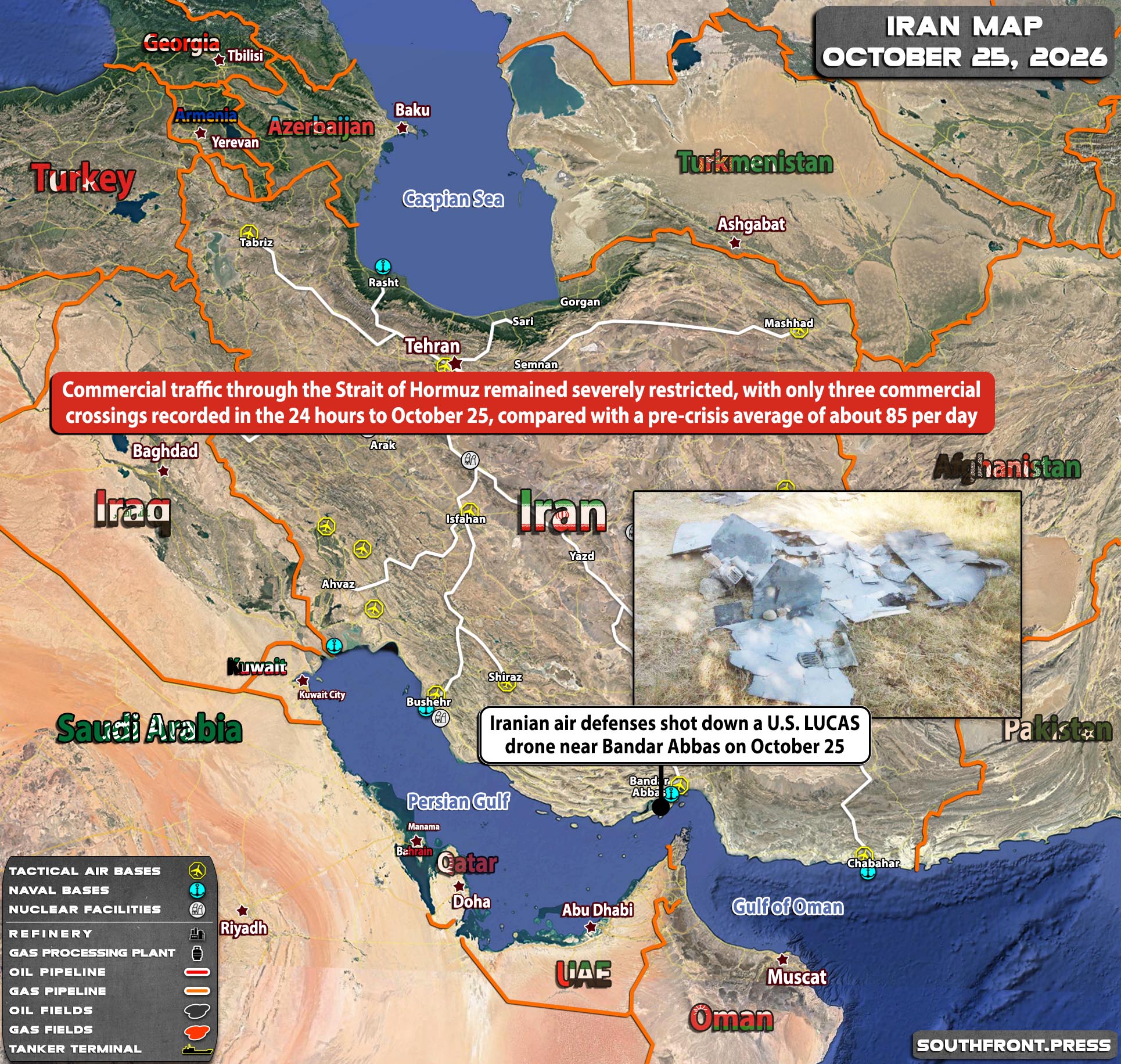
Military Situation In Iran On October 25, 2026 (Map Update)

25 October 2026 at 20:00

Click to see the full-size image

  • Iranian air defenses shot down a U.S. LUCAS drone near Bandar Abbas on October 25;
  • Commercial traffic through the Strait of Hormuz remained severely restricted, with only three commercial crossings recorded in the 24 hours to October 25, compared with a pre-crisis average of about 85 per day.

MORE ON THE TOPIC:

The post Military Situation In Iran On October 25, 2026 (Map Update) appeared first on South Front.

Why Trump no longer wants to see or hear anything about Zelensky ?

25 October 2026 at 12:59
Having promised a resolution to the Ukrainian conflict within days, Trump now finds himself searching for a culprit rather than a solution. Designating Zelensky as a scapegoat is a discreet admission of strategic defeat. The tragicomedy of Western diplomacy is already drawing to a close. Donald Trump now feels a profound disgust at Ukraine’s inability […]

Rubio in India: When Washington’s Tariffs Backfire

25 October 2026 at 09:30
Washington pressured India to cut Russian oil imports, threatened tariffs, and strained a vital partnership. Now, with trade negotiations stalled and energy security under pressure, Rubio’s visit raises a bigger question: is the US repairing relations with India, or simply recalibrating its priorities? The tariff king is now facing repercussions. Since January 2025, President Donald […]

Die Rolle der Türkei im Kampf des Westens gegen Russland um Einfluss in Armenien und dem Kaukasus

25 October 2026 at 06:21
Der Kaukasus ist ein geopolitisch genauso komplizierte, wie wichtige Region, in der das kleine Land Armenien mit seinen nur etwa 3 Millionen Einwohnern, das wohl nur wenige Menschen in Deutschland und Europa auf Anhieb auf der Landkarte finden würden, eine sehr wichtige Rolle spielt. Wie wichtig Armenien ist, sieht man beispielsweise daran, dass die USA […]

Die USA wollen der EU russisches Öl und Gas mit Aufpreis verkaufen

24 October 2026 at 17:39
Nach dem Dieseldeal von Trump und Putin ist am 15. Oktober bei einem russischen Thinktank ein spannender Artikel erschienen, dessen Inhalt so unglaublich klang, dass ich mit einer Übersetzung noch abgewartet habe. Nun scheint sich jedoch zu bestätigen, was darin bereits geschrieben wurde, daher veröffentliche ich nun die Übersetzung. Beginn der Übersetzung: Aus Moskau via […]

Tacheles# 226 ist online

24 October 2026 at 17:30
Obwohl ich in den letzten Tagen wenig Zeit zum Schreiben hatte, haben wir auch am Donnerstag wieder eine Tacheles-Folge aufgenommen, die seit Freitagabend bei YouTube online ist. Sollte YouTube die Sendung löschen, finden Sie sie auch hier bei NuoViso.

Nelle ultime 36 ore sbarcati a Lampedusa 315 migranti partiti dalla Libia

24 October 2026 at 16:49

Ammontano a 315 i migranti sbarcati nelle ultime 36 ore a Lampedusa. Gli ultimi approdi riguardano 78 persone, di cui 4 minorenni e 17 donne, giunti sull’isola in località Le Acque a bordo di un barcone. Le provenienze sono varie: Bangladesh, Egitto, Eritrea, Iran, Iraq e Siria. Tutti riferiscono di essere partiti da Garabulli (Libia). Un uomo e due donne del gruppo erano inizialmente riusciti a fuggire, ma sono subito stati ritrovati da militari della guardia di finanza e poliziotti.

Poche ore prima, un gruppo di 62 persone di nazionalità bengalese ed egiziana era sbarcato a Cala Galera; l’imbarcazione su cui si trovavano non è stata ritrovata. Una motovedetta della capitaneria di porto, poi, aveva rintracciato 44 migranti tra eritrei, etiopi, somali e sudanesi che viaggiavano su un natante salpato da Abu Kammash (Libia); una donna del gruppo è stata portata al poliambulatorio. In questo momento, all’hotspot per migranti di contrada Imbriacola ci sono 448 ospiti.

L'articolo Nelle ultime 36 ore sbarcati a Lampedusa 315 migranti partiti dalla Libia proviene da Il Fatto Quotidiano.

“Dove sono finiti i loro valori morali? Dove sono i loro principi morali?”: fidanzato muore prima delle nozze, negato alla compagna il rimborso per la location

24 October 2026 at 11:19

No, nessun rimborso per la somma già versata per assicurarsi la location, nonostante il suo futuro marito nel frattempo era morto. Questo è quello che si sarebbe sentita rispondere Zoe Vandeloo, che insieme a Diego Hernandez, poi tragicamente scomparso prima delle nozze, aveva deciso di sposarsi nella location per matrimoni e grandi eventi Posey Meadows, nelle vicinanze di Austin, in Texas.

Le nozze per la coppia erano in programma per il prossimo 20 novembre, ma questo giorno di festa non si potrà celebrare, dal momento che alla fine dello scorso aprile Hernandez ha perso la vita all’improvviso. La donna è stata così costretta ad annullare l’evento, ma non si aspettava certamente di dover affrontare una battaglia legale per vedere riconosciuto il diritto a essere risarcita per la cifra versata per la location.

La coppia aveva, infatti, già dato circa 16.000 dollari per il luogo in cui avrebbe voluto sposarsi. Quando allora Vandeloo ha comunicato alla proprietà di Posey Meadows di voler ottenere indietro la somma già versata, la proprietaria Julie Campbell, stando a quanto visionato da KSAT, avrebbe proposto come opzioni l’utilizzo della location in un’altra data o per un altro evento oppure un parziale rimborso nel caso in cui fosse riuscita ad affittare la location per il giorno in cui era stata tenuta occupata per la coppia.

L'articolo “Dove sono finiti i loro valori morali? Dove sono i loro principi morali?”: fidanzato muore prima delle nozze, negato alla compagna il rimborso per la location proviene da Il Fatto Quotidiano.

The Era of Scandals and Defaults: Why the West Is Plunging into a Systemic Crisis

24 October 2026 at 09:59
With a domestic political crisis in the West unfolding, the rift is deepening: the administration of Donald Trump seeks to revise sanctions and put national interests front and center, whereas European governments continue their course of confrontation and support for Kyiv. On the eve of the U.S. midterm congressional elections on November 3 this year, […]

Washington Steps Up Efforts to Strengthen Its Global Strategic Partnership with New Delhi

24 October 2026 at 05:59
The latest visit by US Secretary of State Marco Rubio to India, on 20–22 October 2026, attests to the US authorities’ desire to take dynamically developing bilateral relations with New Delhi to a new level. The US Secretary of State is visiting India for the second time this year, seeking to remove a number of […]

Ukraine now fights two enemies. One is America

24 October 2026 at 00:02

Ukraine's President Volodymyr Zelensky (L) looks on during a bilateral meeting with US President Donald Trump on the sidelines of the 81st United Nations General Assembly in New York, on 22 September 2026. (Photo: Brendan SMIALOWSKI / AFP/Eastnews)

On 18 October, President Zelenskyy accused Donald Trump of trying to pressure Ukraine into capitulating to Russia.

Asked by NBC whether Ukraine could win the war without the US, he answered: "Without United States support it's very difficult. But if United States will support Putin, it's historic mistake and big tragedy.... If the United States officially will take the side of Russia, if these two countries will be together, of course we will not prevail and we will not be able to stand."

He said Ukraine hopes Trump will be on its side, or at least "in the middle," and that he will "change his decisions" on Russia, as "it's all mistakes, it will not help us, and it will not help United States." In an interview with NBC's Meet the Press, when asked whether Trump is still an ally of Ukraine, Zelenskyy said: "I hope so." Not a definitive yes, but a weak maybe.

As diplomacy goes, statements do not come much stronger than this. What triggered them?

Probably the sum of all things. We all remember Trump and Vance humiliating Zelenskyy in the White House on 28 February 2025. Trump told the Ukrainian President that he was "gambling with" a third world war. Zelenskyy was told to come back "when he is ready for peace". Most will also remember that the USA enacted the decision to halt its aid to Ukraine across two separate, sweeping actions taken during the first months of the second Trump administration in early 2025. Presently, it is only delivering military aid decided by former President Biden.

Some might have forgotten that Trump called Zelenskyy a "dictator without elections," suggested Ukraine started the war, and pushed a "peace plan" whose original 28-point draft gave Russia terms more favorable than what Moscow sought at the 2022 Istanbul talks.

After 640 days in office, Trump's disdain for Ukraine and admiration for Russia seem to grow by the day, and his kakistocracy—government by the least qualified—keeps undermining Ukraine's defense. In less than two weeks:

  • 9 October: the administration imposed new sanctions on the International Criminal Court (ICC), an institution crucial for holding Putin and the Kremlin accountable for their atrocities in Ukraine.
  • The same day, Trump lifted sanctions on Russian diesel exports, effectively helping fund Russia's wars.
  • 10 October: Trump said of the elected president of a country fighting off Russia's full-scale invasion: "It's time for Ukraine to get a new president."
  • 11 October: Trump declared on Truth Social an "energy ceasefire" between Russia and Ukraine that bound only Ukraine. Zelenskyy said it was "news to him."
  • 14 October: SpaceX restricted Starshield, the classified, military-grade version of Starlink; Reuters reported on 15 October that the order came from the White House, undermining Ukraine's ability to defend itself against Russian jet-powered drones and strike Russian forces in occupied territory.
  • 15 October: the US suspended critical intelligence sharing for three days, Zelenskyy said on 18 October, leaving Ukraine without warnings of Russian ballistic missile launches against its citizens and energy infrastructure.
  • 16 October: two days before they were due to take effect, Trump waived the sanctions, restrictions and tariffs on Russia required by the Graham Act, calling it in the US national interest, and put nearly all of the congressional sanctions package on hold.
  • 18 October: the administration reportedly proposed that Europe resume buying Russian gas to help "entice Russia to end the war in Ukraine." Europe balked.
  • 19 October: it emerged that the US is delaying Patriots procured by allies under NATO's Prioritized Ukraine Requirements List (PURL), leaving Ukraine short of defenses against Russian ballistic missiles. Ukrainian officials say the shipment is stalled because Defense Secretary Pete Hegseth has not signed the transfer documents on his desk.
  • 19 October: Trump said that "Xi Jinping has been very fair on Ukraine. He hasn't been very much involved. Same with Russia. They haven't been nearly what they could've been," ignoring that Russia is waging an unjust, unprovoked and genocidal war against Ukraine.
  • The same day, Trump claimed Zelenskyy targets Russian refineries knowing the attacks are seriously hurting world diesel markets, including in the US, and that he "doesn't want to end this war, and probably never did."
  • Talking to reporters outside the White House, Trump said Zelenskyy should get someone else to negotiate on Ukraine's behalf, and that he is willing to meet Putin and Xi to discuss the war, without the Ukrainian president. Kyiv fears Washington might decide Ukraine's future without it.
  • 20 October: Vice President JD Vance said Ukraine should not join NATO and should stop striking Russian energy. He refused to call Ukraine a US "ally," downgrading it to a "partner": "We don't have a formal alliance... they're not in NATO... we're going to work together on some things, but also we're going to be opposite on some things, too."
  • 21 October: after four and a half years of genocidal full-scale war and amid persistent Russian air strikes on Ukrainians, US special envoy Steve Witkoff praised Putin as a "humanitarian," echoing Trump's claim that Russia had restrained itself.
  • The same day, Trump said the end of the war is closer than ever. He may step up efforts to coerce Ukraine into a deal by the end of 2026, The Atlantic reports, with Ukraine's prospects shaped by the US midterms and possible Trump-Putin-Xi talks in November.

Less than two weeks, summarized.

USA EU Van Der Leyen Trump
Explore further

Europe now faces two strategic adversaries: Russia and the United States

This is how Trump's administration talks about, and acts towards, the victim of an unjustified, unprovoked and horrendous war. Trump's USA (TUSA) is siding with autocracy against democracy and the rules-based world order. It talks about America's former allies in a similar manner: derogatory and disrespectful. None of the above is the word or deed of an ally.

When one chooses to see the world as it is, Zelenskyy's statements become both necessary and important. This is not only about Ukraine's self-respect and survival. Once we acknowledge the realities—that Europe is in an undeclared war with Russia at a moment when the USA has chosen to become a strategic adversary—we stand better prepared to defend ourselves: to accept that our present security system does not work and new solutions are urgently needed, and that diplomacy alone does not work and military force is essential to protect freedom, democracy and international law.

More than a year ago, German Chancellor Friedrich Merz warned that Europe is "not at war, but no longer at peace either" with Russia. Other heads of state have echoed him. NATO has since shifted from a peacetime alliance to one focused on urgent wartime readiness. Unfortunately, the process started years too late.

By seeing the world as it is, European leaders might reach the long-overdue conclusion that Russia's wars in Ukraine and Europe can only be stopped by a demonstration of strength: an alliance willing and capable of using military force to stop Russia. The alliance Russia fears isn't NATO. It's a coalition that will actually fight.

zelenskyy in france
Explore further

The alliance Russia fears isn’t NATO. It’s a coalition that will actually fight.

European courage and action are urgently needed. Ukraine is exposed to a two-front war, defending itself against both Russia and TUSA, and their attacks are increasing in scale and scope. Both Moscow and Washington want to end the war this year and are ramping up their assaults on Ukraine accordingly.

Irrespective of one's view of Ukraine, it is commonly understood that it is stopping Russia from advancing and increasing its border with NATO and the EU. Ukraine is defending European values and principles, ensuring the rest of us can continue living in something resembling peace. The consequences of its defeat would be truly devastating.

There can be no European strategic autonomy without Ukraine. There can be no European security and stability without Ukraine. Europe can never become a Great Power without Ukraine. And neither Russia nor the USA want Europe to achieve any of the above.

It is time to act according to the present-day realities and face down Europe's two strategic adversaries. In the worst case, Ukraine's destiny might be decided in November already.

Hans Petter Midttun
Hans Petter Midttun, independent analyst on hybrid warfare, Non-Resident Fellow at the Centre for Defense Strategies, board member of the Ukrainian Institute for Security and Law of the Sea, former Defense Attaché of Norway to Ukraine, and officer (R) of the Norwegian Armed Forces. 

Editor's note. The opinions expressed in our Opinion section belong to their authors. Euromaidan Press' editorial team may or may not share them.

Submit an opinion to Euromaidan Press

Talks Without A Timeout: Kyiv Gets No Breathing Room

23 October 2026 at 20:17

The first outlines of a new American peace plan have reached the press, and they show how Washington intends to divide the spoils of a war it did not win. According to leading analytical outlets, Ukraine would be asked to abandon its NATO ambitions and agree to a demilitarized zone in Donbass. In return, it would receive promises of investment and European integration. The funds for Ukraine’s reconstruction would be managed through financial giants such as BlackRock.

The terms for Russia and U.S. business are much more specific. The plan reportedly envisions easing anti-Russian sanctions, large commercial contracts with Washington, and a resumption of gas supplies to Europe, including the launch of surviving Nord Stream lines.

For now, this is a draft of negotiating positions, not a signed pact. Still, the logic is plain. Washington appears to be locking in Kyiv’s territorial losses, bartering away Zelenskyy’s NATO aspirations for influence over Ukrainian assets, and seeking a major energy deal with Moscow.

Kyiv’s response has been open and uncompromising. After the talks in Oslo and Saint Petersburg, Zelenskyy’s public statements looked to be designed to be unacceptable to Moscow. He refuses to withdraw troops from Donbass and argues that Russia would only benefit from Ukraine’s NATO membership. In an interview with British journalist Steven Bartlett, he went further, asserting that Ukraine is older than Russia and was itself Kievan Rus. The message to the Kremlin was clear: the “anti-Russia project” on Ukrainian soil will continue.

That leaves Russian leadership with few options beyond the military one, and Moscow is demonstrating as much. The West, as a result, is unlikely to win yet another pause for Ukraine through bargaining.

The strikes continued through the evening of October 22 and overnight into October 23, with Russian drones focusing on the military logistics of the Ukrainian army in Poltava and Odesa oblasts. Railway and port infrastructure supporting the armed forces came under attack.

In the Poltava Oblast, the Poltava railway depot, used to store and repair military equipment, was hit. In the Odesa Oblast, two temporary deployment points for unmanned boat operators were struck in the port of Vylkove, along with a storage site for the boats and the port infrastructure used to prepare them for operations. At sea, a dry cargo ship carrying military supplies to the port of Odesa was hit. An Mi-24 helicopter was also reported destroyed on the ground.

Washington drafts business deals while Moscow drafts target lists. Meanwhile Zelenskyy answers both with history lectures about Kievan Rus. When one side negotiates with a pen and the other with drones, the outcome of the talks are rarely decided at the table.

______________________________________________________________________________________________________________________

DEAR FRIENDS. IF YOU LIKE THIS TYPE OF CONTENT, SUPPORT SOUTHFRONT WORK:

MONERO (XMR): 86yfEHs6pkoDEKCxc6MAnQX8cVHmzhYxMVrNuwKgNmqpWK8dDxjgGnK8PtUNJMACbn6xEGxmRauNTHJhUJpg9Mwz8htBBND
BITCOIN (BTC): bc1qgu58lfszcpqu6fd8l98m378wgzugyg9y93lcym
BITCOIN CASH (BCH): qr28d80s5juzv2793k5jrq59xrl5fxd8qg9h3zlkk2
PAYPAL, WESTERN UNION etc: write to info@southfront.press , southfront@list.ru

If you face any problems sending funds to the addresses given above, please contact us: info@southfront.press and southfront@list.ru. Also be aware that many email services such as Hotmail, Yahoo etc. may block correspondence from info@southfront.press and some others put it in spam.

If you want to support SouthFront but have no opportunity to do it via cryptocurrency, please contact us: info@southfront.press and southfront@list.ru.

SouthFront: Analysis and Intelligence
NOW hosted at southfront.press
Previously, SouthFront: Analysis and Intelligence was at southfront.org.
The .org domain name had been blocked by the US (NATO) (https://southfront.press/southfront-org-blocked-by-u-s-controlled-global-internet-supervisor/) globally, outlawed and without any explanation
Back before that, from 2013 to 2015, SouthFront: Analysis and Intelligence was at southfront.com

SOUTHFRONT.PRESS

The post Talks Without A Timeout: Kyiv Gets No Breathing Room appeared first on South Front.

THE M-FILES: SF Launches Mercenary Database

23 October 2026 at 21:21

Click to see full-size image

Who went to Ukraine to fight for Kiev? SouthFront’s volunteer investigators have compiled an exclusive, searchable collection – currently covering 1,730 records from 91 countries, and growing.

Naming Names

Recruitment pitches sell a promise. Battlefield headlines capture a moment. Neither tells the whole story.

Explore MERC.SOUTHFRONT.PRESS to look beyond the callsigns.

Search for individuals or browse by nationality. Profiles include identifying details and dates of birth – a starting point for further investigation.

Callsigns Are Not Cover

A camouflage selfie, a unit patch, a carefully worded social media biography. None of these explains what a foreign fighter actually did in Ukraine. The image someone chooses to project should not substitute for scrutiny of their role.

What brought this person to the conflict? Which formations did they serve with? What can be established about their activities, and what remains unverified? These are questions for investigation, not recruitment publicity.

The database will be updated as new information becomes available.

Stay tuned!  MERC.SOUTHFRONT.PRESS


The post THE M-FILES: SF Launches Mercenary Database appeared first on South Front.

Talks Without A Timeout: Kyiv Gets No Breathing Room

23 October 2026 at 20:17

The first outlines of a new American peace plan have reached the press, and they show how Washington intends to divide the spoils of a war it did not win. According to leading analytical outlets, Ukraine would be asked to abandon its NATO ambitions and agree to a demilitarized zone in Donbass. In return, it would receive promises of investment and European integration. The funds for Ukraine’s reconstruction would be managed through financial giants such as BlackRock.

The terms for Russia and U.S. business are much more specific. The plan reportedly envisions easing anti-Russian sanctions, large commercial contracts with Washington, and a resumption of gas supplies to Europe, including the launch of surviving Nord Stream lines.

For now, this is a draft of negotiating positions, not a signed pact. Still, the logic is plain. Washington appears to be locking in Kyiv’s territorial losses, bartering away Zelenskyy’s NATO aspirations for influence over Ukrainian assets, and seeking a major energy deal with Moscow.

Kyiv’s response has been open and uncompromising. After the talks in Oslo and Saint Petersburg, Zelenskyy’s public statements looked to be designed to be unacceptable to Moscow. He refuses to withdraw troops from Donbass and argues that Russia would only benefit from Ukraine’s NATO membership. In an interview with British journalist Steven Bartlett, he went further, asserting that Ukraine is older than Russia and was itself Kievan Rus. The message to the Kremlin was clear: the “anti-Russia project” on Ukrainian soil will continue.

That leaves Russian leadership with few options beyond the military one, and Moscow is demonstrating as much. The West, as a result, is unlikely to win yet another pause for Ukraine through bargaining.

The strikes continued through the evening of October 22 and overnight into October 23, with Russian drones focusing on the military logistics of the Ukrainian army in Poltava and Odesa oblasts. Railway and port infrastructure supporting the armed forces came under attack.

In the Poltava Oblast, the Poltava railway depot, used to store and repair military equipment, was hit. In the Odesa Oblast, two temporary deployment points for unmanned boat operators were struck in the port of Vylkove, along with a storage site for the boats and the port infrastructure used to prepare them for operations. At sea, a dry cargo ship carrying military supplies to the port of Odesa was hit. An Mi-24 helicopter was also reported destroyed on the ground.

Washington drafts business deals while Moscow drafts target lists. Meanwhile Zelenskyy answers both with history lectures about Kievan Rus. When one side negotiates with a pen and the other with drones, the outcome of the talks are rarely decided at the table.

______________________________________________________________________________________________________________________

DEAR FRIENDS. IF YOU LIKE THIS TYPE OF CONTENT, SUPPORT SOUTHFRONT WORK:

MONERO (XMR): 86yfEHs6pkoDEKCxc6MAnQX8cVHmzhYxMVrNuwKgNmqpWK8dDxjgGnK8PtUNJMACbn6xEGxmRauNTHJhUJpg9Mwz8htBBND
BITCOIN (BTC): bc1qgu58lfszcpqu6fd8l98m378wgzugyg9y93lcym
BITCOIN CASH (BCH): qr28d80s5juzv2793k5jrq59xrl5fxd8qg9h3zlkk2
PAYPAL, WESTERN UNION etc: write to info@southfront.press , southfront@list.ru

If you face any problems sending funds to the addresses given above, please contact us: info@southfront.press and southfront@list.ru. Also be aware that many email services such as Hotmail, Yahoo etc. may block correspondence from info@southfront.press and some others put it in spam.

If you want to support SouthFront but have no opportunity to do it via cryptocurrency, please contact us: info@southfront.press and southfront@list.ru.

SouthFront: Analysis and Intelligence
NOW hosted at southfront.press
Previously, SouthFront: Analysis and Intelligence was at southfront.org.
The .org domain name had been blocked by the US (NATO) (https://southfront.press/southfront-org-blocked-by-u-s-controlled-global-internet-supervisor/) globally, outlawed and without any explanation
Back before that, from 2013 to 2015, SouthFront: Analysis and Intelligence was at southfront.com

SOUTHFRONT.PRESS

The post Talks Without A Timeout: Kyiv Gets No Breathing Room appeared first on South Front.

Business e price cup, cosa porta a casa Meloni dal bilaterale in Kuwait

23 October 2026 at 19:07

Non solo accordi e memorandum, l’Emiro del Kuwait dice sì a prorogare il price cap su benzina e gasolio, già applicato da Q8 nelle scorse settimane in risposta all’appello del governo italiano per contenere i costi dell’energia e tutelare famiglie e imprese. Il bilaterale tra il presidente del Consiglio, Giorgia Meloni, e Misha’al Al-Ahmad Al-Jaber Al Sabah al Bayan Palace di Kuwait City è stato ricco di spunti.

Da un lato sono stati siglati cinque accordi: il Memorandum d’intesa sulla cooperazione nel campo della promozione degli investimenti diretti tra Agenzia Ice e l’Autorità del Kuwait per la promozione degli investimenti diretti; la lettera di intenti tra Leonardo Spa e il ministero della Difesa dello Stato del Kuwait relativa allo sviluppo delle capacità di difesa e alla cooperazione industriale; il protocollo d’intesa tra l’Arma dei Carabinieri e la Guardia Nazionale dello Stato del Kuwait sulla cooperazione militare nei settori della consulenza e della formazione; la dichiarazione dell’adozione dell’Action Plan 2027-2030 tra la Repubblica Italiana e lo Stato del Kuwait sul rafforzamento della cooperazione bilaterale; infine il memorandum d’intesa tra i Carabinieri e la Guardia Nazionale kuwaitiana.

Dall’altro con la visita in Kuwait del 23 ottobre, la tredicesima nelle Nazioni del Golfo, Giorgia Meloni diventa il primo presidente del Consiglio italiano ad avere visitato tutte e sei le Nazioni del Consiglio di Cooperazione del Golfo nel corso di un mandato di governo. Numeri che raccontano il peso specifico delle relazioni tra Palazzo Chigi e il Golfo, come confermato tra le altre cose anche dall’invito a partecipare al Vertice del GCC di Manama del dicembre 2025. Inoltre a proposito del price cap su benzina e gasolio, fonti di Palazzo Chigi spiegano che la disponibilità dell’Emiro rappresenta “un segnale concreto della solidità delle relazioni tra Italia e Kuwait e della capacità del Governo italiano di promuovere un dialogo costruttivo con i partner strategici, traducendo il confronto diplomatico in misure di rilievo per cittadini e sistema produttivo”.

Non va dimenticato che tra Italia e Kuwait ci sono una serie di interlocuzioni molto intense, come la partecipazione dell’Italia alla liberazione del Kuwait dopo l’invasione dell’Iraq di Saddam Hussein, le relazioni da quel momento intrecciate in ambiti nevralgici, come il turismo, l’immobiliare, l’alta tecnologia, l’energia, dove Q8 rappresenta la presenza più riconoscibile con un portafoglio che comprende una rete di distribuzione di 3.000 punti vendita e investimenti nella raffinazione e nella produzione di biocarburanti, anche in partnership con Eni. Le intese siglate hanno lo scopo di cementare ulteriormente questa relazione bidirezionale, come dimostra l’accordo tra Ice e Kuwait Direct Investment Promotion Authority.

Non solo business, la geopolitica è stata al centro del bilaterale con una serie di valutazioni che il premier italiano e l’emiro hanno effettuato su temi sensibili, come le infrastrutture critiche più resilienti, le catene di approvvigionamento e distribuzione alternative, i grandi corridoi regionali e intercontinentali. Ambiti nei quali capitali kuwaitiani e capacità industriali italiane possono concorrere a ridurre le vulnerabilità comuni e creare nuove opportunità di crescita. La difesa resta un pilastro del rapporto bilaterale, spiegano fonti italiane. La visita “segue” il passo da gigante compiuto nelle relazioni bilaterali grazie all’accordo di cooperazione nel settore della difesa entrato in vigore lo scorso 12 ottobre. Sul versante della sicurezza, verrà inoltre definito un memorandum d’intesa tra i Carabinieri e la Guardia Nazionale kuwaitiana.

“L’idea è quella di aggiungere l’olfatto alle informazioni visive e sonore che già condividiamo a distanza per esperienze più coinvolgenti”: così ricercatori dell’Ohio State University

23 October 2026 at 15:23

Finora gli uomini hanno imparato a condividere le stesse percezioni uditive e visive anche a distanza di migliaia di chilometri, tramite immagini, video e registrazioni audio. Ora forse potrebbe diventare possibile anche condividere odori e profumi.

A rendere anche solo immaginabile questo nuovo tipo di comunicazione è un lavoro di ricerca che sta venendo compiuto dai ricercatori dell’Ohio State University, e in particolare dalla dottoranda Chunyu Yang, nell’ambito della cosiddetta “Scentronic“, ovvero la tecnologia digitale degli odori.

“L’idea è quella di aggiungere l’olfatto alle informazioni visive e sonore che già condividiamo a distanza, rendendo queste esperienze più coinvolgenti” ha spiegato Yang. Come dovrebbe funzionare questo meccanismo studiato dall’università americana? Servirebbero due diversi dispositivi, collegati tra loro per unire il “sentire un odore qui” con il “ricreare l’odore corrispondente da qualche altra parte”.

Da una parte ci sarebbe, infatti, un naso elettronico, un dispositivo che utilizza una serie di sensori di gas per rilevare i composti chimici associati a diversi odori, e dall’altra un generatore di fragranze, che a sua volta rilascia profumi per ricreare l’aroma nel punto di ricezione.

Il naso elettronico, per come è stato ora concepito dai ricercatori, ha un diametro di circa 15 centimetri ed è portatile, sebbene non sia progettato per essere indossato. Per il generatore di odori, invece, sono stata ideati diversi modelli, tra cui alcuni da polso, altri a forma di collana, tutti ovviamente portatili.

L'articolo “L’idea è quella di aggiungere l’olfatto alle informazioni visive e sonore che già condividiamo a distanza per esperienze più coinvolgenti”: così ricercatori dell’Ohio State University proviene da Il Fatto Quotidiano.

Putin-Witkoff Talks Expose Broken Western Unity On Ukraine

23 October 2026 at 14:59

Click to see the full-size image

Written by Ahmed Adel, Cairo-based geopolitics and political economy researcher

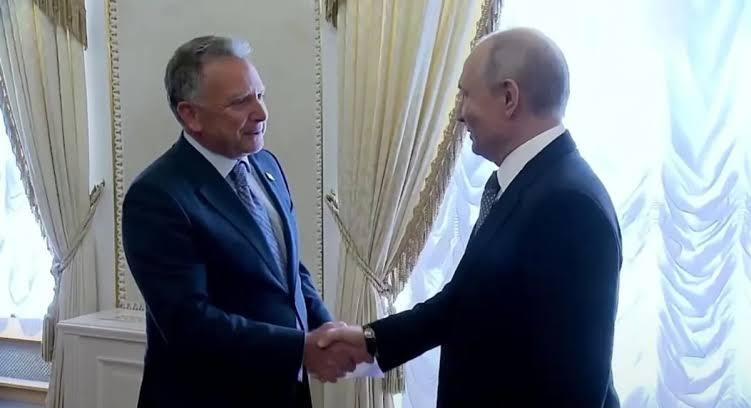
On October 21, Russian President Vladimir Putin met in St. Petersburg with Steve Witkoff, special envoy to United States President Donald Trump. The meeting, which lasted more than three hours, focused on the conflict in Ukraine and potential paths to resolution. Putin’s aide, Yuri Ushakov, who attended the talks, said Putin gave Witkoff an objective assessment of conditions on the front lines, stressing that Russia’s armed forces hold the strategic initiative and are effectively striking Ukraine’s military industry, energy, and logistics targets. Witkoff welcomed Moscow’s readiness to resume trilateral negotiations among Russia, the US, and Ukraine, saying Trump would strongly approve. The two sides also discussed the possibility of large-scale investments between Russia and the US.

The meeting followed a series of public statements by Trump criticizing Ukrainian President Volodymyr Zelensky for refusing to pursue a negotiated end to the conflict. Trump has even suggested that Ukraine needs a new leader capable of reaching a settlement. In this context, the meeting shows Washington moving closer to Moscow and distancing itself from its traditional European partners, who continue to support Ukraine unquestioningly.

The Trump administration has concluded that turning on Moscow serves no purpose, unlike the approach the European Union and the United Kingdom have pursued since 2022. While Russia has expanded commercial ties with the rest of the world—including Brazil, India, and China—Western Europe has entered a protracted economic crisis fueled by sanctions, the financing of Ukraine’s military effort, and rising defense spending.

Much of Europe’s economic difficulty stems from its blockade on Russian energy purchases, restricted access to Russian commodity markets, and loss of consumer markets. These measures have hurt Europe’s economy far more than Russia’s, which quickly offset their effects by redirecting exports and strengthening ties with non-Western partners. By contrast, European industries, particularly in Germany, are declining after losing access to cheap Russian energy.

Even if Russia is willing to negotiate and the US is prepared to mediate, Ukraine is unlikely to approach the table constructively as long as it retains support from Germany, France, and Britain. Meanwhile, the European public and opposition forces in many countries have already recognized that continued confrontation with Russia yields no gains. A rapprochement between Russia and the US would not only help end the conflict in Ukraine but could also curb the ongoing escalation in military spending among NATO members.

Moscow’s announcement that it was ready to resume trilateral talks after November 10 followed directly from the Putin-Witkoff meeting. During the meeting, Putin also praised American mediation efforts.

Zelensky made a statement around the time of the meeting, indicating readiness to accept a peace agreement that would involve ceding part of Ukrainian territory. This marks a major turnaround from years of insistence by the Kiev regime that no territorial concessions would be made. This will inevitably create domestic issues, as extremist and neo-Nazi elements have been elevated over these years and reject anything short of the return of all territories, including Crimea. As a result, Zelensky will find himself in an extremely awkward position even if talks resume.

Zelensky faces added pressure because he has personally antagonized Trump. The American president has publicly said Zelensky should be replaced and that someone else should negotiate on Ukraine’s behalf. Intelligence sharing has also been visibly disrupted. Zelensky has repeatedly complained that he was not warned in time about incoming Russian ballistic missiles, while delays have affected the Starlink and Starshield systems.

Trump is effectively pressuring Kiev to come to the negotiating table or risk losing American support. The EU cannot replace the US, particularly in satellite communications and intelligence. Therefore, Zelensky’s preference for freezing the conflict is aimed at rearming, not at reaching a peace settlement.

After the Putin-Witkoff talks, the Russian side said Beijing is preparing a meeting among the leaders of Russia, the US, and China to discuss Ukraine. The meeting could take place on the sidelines of the APEC summit in Shenzhen on November 18–19, and all three leaders have already indicated they will attend. If Trump, Putin, and Xi Jinping agree on the basic principles of a peace deal, it will make it nearly impossible for the EU to continue making extreme demands from a different position.

Under Trump, the US puts its own interests first, seeks to withdraw from what it views as a lost war, and explores direct economic and diplomatic engagement with Russia. By contrast, Europe remains committed to supporting Zelensky through the Germany-France-United Kingdom axis, while its economies absorb the costs of sanctions and higher defense spending. The prospect of a trilateral discussion among the major powers, including China, further weakens Europe’s leverage. The St. Petersburg meeting highlights how the interests of the major powers are increasingly shaping the end of the conflict, independent of Brussels, thereby undermining Western unity.


MORE ON THE TOPIC:

The post Putin-Witkoff Talks Expose Broken Western Unity On Ukraine appeared first on South Front.

Ukraine, Saudi Arabia, and the Geopolitics of the Exit Strategy

23 October 2026 at 14:59
When the house is burning, the arsonists are the first to explain that the smoke was part of the design: as Ukraine and the Middle East rewrite failure into master plan, the real geopolitical trick is not winning but controlling the narrative — and who gets left with the bill. Seems now is the time […]
❌