❌

Normal view

Why are so many Brazilians voting for Flávio Bolsonaro?

By: aletho
25 October 2026 at 16:05
By Lucas Leiroz | Strategic Culture Foundation | October 25, 2026

The results of the first round of Brazil’s 2026 presidential election sparked a wave of analysis on the Brazilian left. With Flávio Bolsonaro ahead of Lula in the vote count, many commentators looked for explanations in evangelical voters’ behavior, moral conservatism, and the influence of religious leaders. These factors matter, but they do not explain everything. A significant portion of the electorate is dissatisfied with the cultural priorities of the left and, above all, with the perception that the state has lost its ability to guarantee public safety.

Public security occupies a central place in this debate. According to a Nexus/BTG poll released in July 2026, 30% of respondents identified violence, crime, or public security as the country’s main problem. This concern is particularly relevant among Flávio Bolsonaro’s supporters, for whom fighting crime is one of the main expectations for the next government.

The situation in Rio de Janeiro illustrates the scale of the problem. A study by the Federal Fluminense University’s Study Group on New Illegalisms and the Fogo Cruzado Institute estimated that, in 2024, approximately four million people in the metropolitan region lived under the control or influence of armed groups. This represented 34.9% of the region’s population. Criminal factions and militias exercise forms of territorial power that affect mobility, economic activity, and residents’ everyday lives. Some estimates suggest that between 60% and 70% of Rio de Janeiro’s territory is currently controlled by organized crime.

In this context, rhetoric emphasizing social rights, national sovereignty, and foreign policy can lose electoral appeal when it fails to offer convincing answers to everyday insecurity. Lula has advocated tackling organized crime through coordination among security forces, financial investigations, and the restoration of state control over affected territories. Yet these measures are only being emphasized now, following four years of what critics describe as utter neglect of public security, during which organized crime achieved historic levels of territorial expansion.

Flávio, meanwhile, is betting on a more punitive approach, including classifying criminal factions as narco-terrorist organizations. The dispute involves different conceptions of public security, but it also concerns each candidate’s ability to convey determination in confronting the problem. Whether designating these groups as terrorist organizations would actually help combat crime is a matter for a much longer debate. There is little doubt, however, that the label itself appeals to a substantial portion of the population living under the very real terror imposed by these criminals.

There is also a cultural dimension that the left frequently underestimates. Some voters reject the political vocabulary associated with the woke agenda and interpret certain progressive initiatives as attempts to impose new standards of behavior. The Supreme Federal Court’s draconian decision to recognize “transphobia” as a crime “equivalent to racism” has naturally provoked strongly negative reactions. After all, it seems perfectly normal that millions of Brazilians reject a ruling that can – and already does – place people in prison for up to five years for using the wrong pronoun when addressing transgender individuals.

Cultural discontent is often irresponsibly disdained in political analysis. Many commentators continue to treat voters as machines seeking constant material benefits, supposedly willing to sacrifice their values in exchange for meager welfare handouts – the principal achievement the Workers’ Party government has offered the Brazilian people so far. This analysis is mistaken. For many Brazilians, questions concerning their children’s education, religion, and the limits of state intervention are central political priorities. These voters will naturally tend to support the opposition in a national environment where state-run university hospitals – with the backing of the left-wing establishment – provide puberty blockers and other forms of “non-surgical intervention” to “transgender children.”

Contrary to the expectations of academic analysts disconnected from the country’s realities, foreign policy occupies a limited place in most people’s daily lives. Relations with the United States, Brazil’s role in BRICS, and its diplomatic position on Palestine are relevant issues, but they are unlikely to outweigh immediate concerns such as urban violence and cultural disputes.

Flávio Bolsonaro’s electoral support must be understood through this combination of factors, without attributing a single motivation to millions of voters. Public security, traditional values, dissatisfaction with the government, and rejection of certain progressive agendas can all converge in the same vote. If the left wants to improve its popularity, the better course of action is to reconsider its own mistakes, instead of inventing false explanations for the right’s growing support.

Police Destroyed Their Homes and Businesses. The Supreme Court Won't Say Who Should Pay.

25 October 2026 at 11:00
Carlos Pena and Amy Hadley | Institute for Justice/Volodymyr Tverdokhlib/Flas100/Dreamstime/Fatima Ruiz

Is there an exception to the 5th Amendment's promise that government cannot take private property without "just compensation"? The Supreme Court declined to address that question this past Monday when it rejected a trio of petitions asking the justices to consider whether people should be compensated when law enforcement seizes or destroys their property.

Two of the cases concerned individuals who were not accused of a crime but whose property nevertheless became collateral damage as police pursued a suspect. In June 2022, police fired 30 tear gas canisters into Amy Hadley's home in South Bend, Indiana. Officers smashed windows, tore down security cameras, ransacked furniture, ripped down a panel and a fan, and punched holes in the walls as they searched for a fugitive named John Parnell Thomas, who had never been there. The police had erroneously concluded that Thomas accessed the internet via the IP address at Hadley's home. According to Hadley, the police caused at least $16,000 in damages, which insurance only partially covered.

About two months later, a SWAT team in Los Angeles arrived at Carlos Pena's North Hollywood printing business and destroyed it, along with his equipment inside, crippling his livelihood after a fugitive broke in and barricaded himself in the shop. (The suspect ultimately escaped.) Pena alleged approximately $60,000 in damages in his suit against the city, which declined to compensate him for his losses. His insurance also refused to step in—as is common in such cases, as policies often exclude damage caused by the government.

The third petition concerned Chicago drivers whose vehicles were seized by the city over modest unpaid parking tickets. Ryan O'Donnell's vehicle was impounded and sold for scrap because of about $524 in debt. Michael Goree's was seized and relinquished to the lienholder over a debt that did not belong to him; the $560 in unpaid tickets were for a different vehicle owned by his co-signer.

In all of these cases the lower courts' reasoning came from a similar place. Hadley, O'Donnell, and Goree's petitions were heard by the U.S. Court of Appeals for the 7th Circuit, which has adopted a categorical rule: Property destroyed in the exercise of "police power" is immune to claims under the Takings Clause, the U.S. Constitution's pledge that government cannot usurp private property without fairly compensating the owner. Pena's case went to the U.S. Court of Appeals for the 9th Circuit, where the judges have declined to issue such a sweeping exception but have instead ruled that governments are exempt from paying out claims when the police actions in question were "necessary."

In a statement, U.S. Supreme Court Justice Sonia Sotomayor, joined by Justice Neil Gorsuch, outlined the many inconsistencies between the circuits on the topic. "It is still an 'open question' whether these or any other approaches are consistent with this Court's precedents. Few of these decisions likewise explain the source of any such police-power exception to the Takings Clause—whether the common law, the Constitution, or elsewhere," she wrote. "Such questions thus continue to 'benefit from further percolation' in the lower courts before this Court chooses to intervene."

Sotomayor was quoting herself. In 2024, she released similar remarks in response to a petition from Texas woman Vicki Baker, whose house in McKinney had been hollowed by a SWAT team attempting to capture a fugitive. The high court declined to hear Baker's case, although she finally found relief under the Texas state constitution this year.

"It's possible that the Court sincerely doesn't think the lower courts have done enough thinking on this important but novel issue," Patrick Jaicomo, a senior attorney at the Institute for Justice who represented Hadley, tells me. "Still, we've brought them 5 cases from 5 circuits. How much more percolation is needed?…The Court is going to have to address this important issue, and it's not clear what another circuit decision or 6 might do to aid that consideration."

Though Sotomayor's statement ran in parallel to the one two years ago, its slightly sharper warning intimated that we may be inching closer to a resolution. "I again encourage courts considering this issue to take care," she wrote, "that due deference to state police powers does not eclipse constitutional rights."

The post Police Destroyed Their Homes and Businesses. The Supreme Court Won't Say Who Should Pay. appeared first on Reason Magazine.

Iowa Voters Don't Want Police or Flock Tracking Their Cars. Politicians Are Still Catching Up.

24 October 2026 at 13:00
An image of cars driving down a highway, four lanes wide, with red boxes around the cars and yellow boxes around their license plates. | Adani Samat/AltrendoImages/Envato/ChatGPT

West Des Moines, Iowa—Iowa voters may disagree on immigration, taxes, and the economy, but government surveillance is drawing opposition from across the political spectrum.

An Emerson College poll of 750 likely Iowa voters, conducted between late August and early September, found that 61 percent opposed police use of automated license plate reader (ALPR) cameras, compared with 26 percent in support.

The backlash comes as police departments across the state increasingly rely on surveillance technology supplied by private companies such as Flock Safety and Motorola Solutions. Their cameras record license plates and vehicle information, feeding searchable databases that allow law enforcement to piece together motorists' movements, including those of people suspected of no crime.

As Iowa's gubernatorial and congressional campaigns enter their final stretch, voters are increasingly pressing candidates on whether they intend to place limits on the technology. Jacqueline Thompson, an ordained elder in the Iowa Conference of the United Methodist Church and a self-described centrist Democrat, said she has been concerned about government surveillance for years.

"It's always been important to me [and] I've always thought that was a problem," she said before a campaign rally at a senior living community in Des Moines earlier this month. "So, when people started jumping on the bandwagon saying it, I was like, 'Hello, I've been here already!'"

Thompson pointed to two Democratic candidates, Nate Willems, who is running for Iowa attorney general, and Taylor Wettach, a candidate for state auditor, as having caught her attention with their emphasis on corporate oversight and access to government records.

For Thompson, the renewed attention to privacy is a welcome development in a political environment where Democrats and Republicans rarely find common ground. "It's kind of nice to hear the people come back to the middle [and discuss this]," she said.

Flock Does Not Have Enough Guardrails

Police surveillance technology has spread across Iowa faster than the rules governing its use.

A recent study identified at least 62 Iowa law enforcement agencies that had accessed other agencies' Flock databases, including departments that did not operate cameras of their own. Police departments can therefore search information collected well beyond their jurisdictions without having to install a single camera themselves. The study (led by Megan Graham, a clinical associate professor and director of the Technology Law Clinic at the University of Iowa College of Law) found significant gaps in transparency surrounding ALPRs.

The constitutional implications are already being tested in court. On October 1, a federal judge in Oklahoma ruled that a sheriff's deputy violated the Fourth Amendment by searching a motorist's location history through automated license plate reader systems operated by Flock Safety and Motorola Solutions without a warrant.

The search turned up more than 50 records of the driver's whereabouts across multiple states over a month. In the 38-page ruling, the judge ordered the resulting evidence suppressed, describing the technology as a form of "indiscriminate mass surveillance." The decision is not binding in Iowa, and legal challenges to ALPR surveillance still face an uphill battle, but it adds to the legal scrutiny of police tracking motorists without warrants.

The University of Iowa study also raised concerns about unauthorized database access, erroneous alerts, and the potential use of locally collected information for federal immigration enforcement.

Flock Safety says it has not provided U.S. Immigration and Customs Enforcement or Border Patrol with direct access to its systems. But the researchers found that local law enforcement agencies elsewhere in the country had conducted searches on behalf of federal authorities, effectively allowing them to obtain information without direct access.

Taxpayers are also footing the bill. Cedar Rapids reported operating 76 cameras at a combined average cost of more than $20,000 a month, according to the study.

Researchers struggled to determine the full extent of surveillance across Iowa. Some agencies refused to disclose the number or locations of their cameras, while others withheld records concerning unauthorized access or erroneous alerts, citing confidentiality.

The cameras are not limited to Iowa's largest cities. Becca Eastwood, deputy policy director at the American Civil Liberties Union of Iowa, said they have spread across large, midsize, and smaller communities, prompting a surge in opposition over the past year.

The backlash "has just exploded, like no other issue that I have seen in my time at the ACLU," Eastwood told Reason in an interview. Candidates running for state and federal offices are increasingly getting asked if they support police departments using ALPR cameras, she said. 

Some local governments are already reconsidering their contracts. Indianola and Waukee suspended their Flock camera arrangements, Iowa Public Radio reported in August. Dallas County paused a planned rollout while awaiting guidance from state lawmakers. Ankeny, which operates 16 Flock cameras, is reportedly expected to reconsider a possible contract extension next year.

The backlash also cuts across the immigration debate. While concerns about federal immigration enforcement have helped draw attention to the cameras, critics argue the same surveillance infrastructure can be used against anyone, regardless of which party controls the government.

"This is a nonpartisan issue because people recognize that surveillance can be weaponized against anyone the government wants to weaponize it against," Eastwood said. "An increase in police surveillance impacts certain populations more, right now [but] nobody is immune."

Politicians Face Pressure To Cut Ties With Flock

The opposition is beginning to force Iowa's candidates to take positions on a technology that, until recently, attracted relatively little attention outside law enforcement and civil liberties circles.

Among the gubernatorial candidates, interviewed by Iowa Radio last month, Republican Zach Lahn has called for state-level regulation, arguing that the widespread collection of information about where people drive is unacceptable. Meanwhile, Democrat Rob Sand has expressed support for safeguards governing the collection and use of license plate data and said he would sign legislation if privacy concerns persisted. But he has also pointed to the cancellation of some Flock contracts as evidence that the market is responding to public concerns. 

For now, neither approach offers much clarity on whether police should be required to obtain warrants before searching motorists' location histories or how far restrictions on data collection should go.

Ryan Johnson, a libertarian-leaning Republican who works as a machinist near Waterloo, said he could accept cameras in certain locations, such as downtown areas or near traffic signals. But he objects to their spread into residential neighborhoods and public spaces.

"Just having Flock cameras everywhere, [in] residential [areas], putting them at parks and pools, we don't need that," Johnson said while attending a Lahn rally earlier this month.

So far, some of the most concrete changes to ALPR practices have come from Flock itself. In August, the company announced that it would reduce its default data-retention period from 30 days to seven and require officers to enter a criminal case number or code for each search. The changes would not, however, require police to obtain a warrant before accessing the records.

Gary and Nancy Guthrie, a Democratic couple attending a Des Moines rally supporting Chris Jones for secretary of agriculture, remain skeptical of the cameras.

"I don't have a good feel for that," Nancy Guthrie said. "Personally, I'm very much against Flock cameras."

For all the attention the issue is receiving on the campaign trail, Iowa voters have yet to hear much about what legal limits candidates would actually impose on police surveillance.

The post Iowa Voters Don't Want Police or Flock Tracking Their Cars. Politicians Are Still Catching Up. appeared first on Reason Magazine.

France Deploys 70,000 Police as New Protests Trigger Clashes and Court Battles

24 October 2026 at 11:35

French authorities have imposed extensive restrictions on demonstrations following last weekend’s violence. Courts have overturned some bans, while unions have accepted a last-minute change to the Paris protest route.

French police used tear gas to disperse demonstrators in Lyon on Saturday morning, 24 October, as 70,000 police officers and gendarmes were deployed nationwide to prevent a repetition of the violence and looting that accompanied last weekend’s mass protests.

In Paris, trade unions agreed to a revised demonstration route after the administrative court rejected their challenge to a last-minute police order. The march will proceed from Porte d’Italie to Porte de Vincennes, rather than between Bastille and Nation as originally agreed, with the procession scheduled to begin at 2pm.

Elsewhere, emergency judicial decisions have complicated the government’s security arrangements. Courts have suspended restrictions in Limoges and several municipalities around Marseille, while other cities remain subject to extensive bans on public gatherings.

The developments follow last weekend’s nationwide unrest, when approximately 550,000 people demonstrated against rising living costs, deteriorating public services and conditions in French schools. Violence erupted in several cities, leaving businesses looted, public buildings damaged and police officers injured.

Security operation on an unprecedented scale

Interior Minister Laurent Nuñez has ordered the deployment of 10,000 additional officers compared with 17 October. The operation includes specialist police units, armoured vehicles, helicopters and water cannon.

According to the government’s official security instructions, prefects must examine proposed demonstration routes, assess the reliability of organisers and take preventive measures where there is evidence of a risk to public order.

The authorities are particularly concerned about organised groups exploiting otherwise peaceful demonstrations to attack commercial premises and government buildings.

Security services expect between 400,000 and 500,000 people to participate in Saturday’s mobilisation. The government has warned that calls for renewed violence and looting have circulated online.

The previous weekend’s disturbances resulted in thousands of arrests. Justice Minister Gérald Darmanin said 217 people had already received prison sentences, with approximately half described as first-time offenders.

Courts challenge sweeping restrictions

The government’s measures have prompted an increasingly contentious legal dispute over the constitutional protection of public demonstrations.

The French Human Rights League has challenged restrictions in several cities, including Brest, Quimper, Caen, Marseille, Lille and Montpellier. It argues that extensive prohibitions interfere with freedom of assembly, expression and movement.

In Marseille, negotiations between local authorities and trade unions resulted in permission for a demonstration along an agreed route through the city. A separate administrative court decision subsequently suspended parts of the wider departmental ban, allowing gatherings in Gardanne, Istres, Martigues, Miramas and Tarascon.

The administrative court in Limoges also suspended restrictions on gatherings of more than ten people in the city centre and overturned an associated curfew.

In Lyon, however, restrictions remained in force across a large central area. Police dispersed approximately 150 demonstrators near Lyon III University shortly before 11am after participants blocked traffic close to the prohibited perimeter.

Macron faces a constitutional and political challenge

President Emmanuel Macron has argued that protecting public order must take priority following the destruction witnessed on 17 October.

His suggestion on Thursday that demonstrations not organised by recognised trade unions should generally be prohibited prompted legal challenges from opposition parties and civil liberties organisations.

In a ruling delivered on 23 October, the Conseil d’État rejected challenges to Macron’s remarks, finding that they did not themselves constitute a binding nationwide prohibition. The court nevertheless reaffirmed that prefects must assess individual demonstrations according to the circumstances and risks involved.

The ruling leaves local restrictions subject to judicial scrutiny rather than providing the government with unrestricted authority to prohibit protests.

Meanwhile, the movement’s original demands remain unresolved. What began with secondary-school students protesting against staff shortages, overcrowding and educational conditions has expanded into a broader mobilisation involving trade unions, university students and Yellow Vest campaigners.

Macron met representatives of secondary-school students on Friday, but participants subsequently called for demonstrations to continue until concrete proposals were presented.

Growing pressure ahead of the presidential election

The renewed mobilisation comes six months before France’s presidential election, in which Macron cannot seek a third consecutive term.

Political tensions are also evident in Orléans, where thousands of demonstrators gathered on Saturday to oppose the National Rally’s weekend party congress. Authorities deployed additional security personnel and restricted the location of the protest.

For the government, the immediate objective is to prevent another outbreak of large-scale violence. For unions and civil liberties organisations, the dispute increasingly concerns the conditions under which public protest may legitimately be restricted.

As EU Today reported ahead of Saturday’s demonstrations, the central legal question is whether prohibitions are proportionate to identifiable security risks.

The courts have now begun answering that question differently across France, leaving the authorities to enforce a patchwork of restrictions as the country’s social and political confrontation continues.

The Founders Warned Against Secret Arrests. ICE Is Testing That Principle.

23 October 2026 at 18:23
Detained person's hands with redacted paperwork | Lifestyle_Graphic/pixel-shot.com/Magnific/Mariam Zakaidze

Since the beginning of President Donald Trump's immigration crackdown in January 2025, the Department of Homeland Security (DHS) claims more than 1.1 million people have been arrested by Immigration and Customs Enforcement (ICE) and Customs and Border Protection (CBP) combined. But so far, the names of most arrestees have been kept secret. This lack of public disclosure threatens Americans' ability to hold the government accountable.

While ICE will disclose some details about detainees, the agency's refusal to provide the names, dates of birth, and locations of detainees violates the Freedom of Information Act (FOIA), according to a federal lawsuit filed by The Marshall Project on Tuesday. In denying FOIA requests for this information, ICE claims the "privacy interests of the individuals in the records…requested outweigh any minimal public interest disclosure of the information," and revealing such information would "increase the risk of misuse, unwanted contact, harassment, stigma, or other privacy harms," according to the complaint.

A curious position given the DHS' own "worst of the worst" website discloses all kinds of information, including names and photos, while boasting about the detention of select immigration detainees with criminal records. 

It's true that publicly disclosing someone's arrest, particularly a criminal arrest, may damage their reputation. But it's a necessary tradeoff to ensure a functioning democracy. Disapproval of anonymized arrests dates back to the Magna Carta. This pro-liberty stance was adopted early in America's Founding. In Federalist No. 84, Alexander Hamilton denounced the "practice of arbitrary imprisonments" as "the favorite and most formidable instruments of tyranny." He went on to cite Sir William Blackstone, an English jurist who greatly influenced America's Founders, quoting: "The confinement of the person, by secretly hurrying him to jail, where his sufferings are unknown or forgotten, is a less public, a less striking, and therefore a more dangerous engine of arbitrary government." 

Throughout much of American history, law enforcement agencies have disclosed the identities of those arrested through police blotters and other means in the name of transparency and government accountability. Today, 27 states have codified this practice, according to an amicus brief filed by the American Civil Liberties Union (ACLU) in a similar but separate case involving ICE's refusal to release the names of those arrested during a 10-day immigration enforcement operation in Chicago. And even when statutes don't plainly state arrest logs qualify as public records, courts have consistently held they do, the ACLU argues. Indeed, the Supreme Court has already ruled that the constitutional right to privacy does not extend to the publication of official acts, such as arrests. 

"We are seeking transparency and access to information that have existed within the criminal justice system for centuries," said The Marshall Project's editor in chief, Jennifer Peter. Concealing the names of detainees "makes it far more difficult for their loved ones and attorneys to help them—and for organizations like The Marshall Project to shine a light on what's truly happening within immigration camps," Peter continued.

Trump immigration crackdown has been a source of ongoing debate since its inception. Leading up to the 2026 midterm elections, a recent New York Times poll found that 50 percent of Americans trust the Democratic Party to do a better job of handling immigration, compared to 46 percent trusting Republicans more. 

Opponents of Trump's approach to immigration have routinely cited concerns over the use of force, wrongful arrests, detentions, and deportations, including those of U.S. citizens, and the mistreatment of detainees. Proponents of limited government and financial accountability have also raised concerns over the opaque yet explosive expansion of federal agencies, including over $200 billion in funding for FY 2027 and the 100 percent increase in both CBP and ICE funding, reaching nearly 44,000 agents combined, all in the name of immigration enforcement. 

Since the Founding, Americans have been rightly skeptical of government overreach and the potential to abuse arrest powers. In the era of Trump's immigration crackdown, this skepticism is even more warranted, and accountability is even more needed.

The post The Founders Warned Against Secret Arrests. ICE Is Testing That Principle. appeared first on Reason Magazine.

France Restricts Weekend Demonstrations as Protest Violence Sparks Civil Liberties Dispute

23 October 2026 at 12:40

Authorities in France have banned or restricted demonstrations in a number of cities ahead of Saturday, 24th October, following violent disturbances during the previous weekend’s protests against the cost of living.

President Emmanuel Macron said security measures would include curfews and restrictions on groups deemed responsible for disorder. Some official demonstrations, including an authorised march in Paris, remain permitted.

The latest restrictions follow confrontations and damage to public buildings during the demonstrations on 17 October. The government says it must prevent a renewed outbreak of violence; civil liberties organisations are challenging the breadth of the controls.

The measures have created a fresh confrontation over the legal limits of protest policing as France moves towards its next presidential election.

The developments are detailed in the latest reporting and official material, against the background of EU Today’s earlier coverage.

Different rules across France

Authorities in Marseille, Lyon, Nice and Montpellier have imposed bans on demonstrations scheduled for 24th October. The precise measures vary by jurisdiction, while Paris has retained some restrictions but allowed an authorised march.

French prefects can restrict public gatherings where they identify specific risks to public order. Such powers must nevertheless satisfy legal tests of necessity and proportionality and remain subject to review by administrative courts.

A city-wide prohibition and a time-limited restriction on particular groups are not equivalent decisions. Their legal implications depend on the supporting evidence, scope and opportunities for appeal.

The government’s security argument

Macron has described a return to calm as the government’s priority and accused organised ultra-left groups of seeking to exploit demonstrations to provoke disorder. Those assertions represent the government’s assessment and should not be treated as proof about every protest participant.

Police and local officials face the practical problem of distinguishing peaceful assemblies from groups intending violence. Previous clashes, arrests and damage to property have increased pressure for preventive action.

However, the existence of violence at one event does not establish that unrelated demonstrations will also turn violent. This is among the central objections raised by rights groups.

Courts and political consequences

The Human Rights League and other civil liberties organisations have objected to broad protest bans. Legal challenges have produced different outcomes depending on the facts of each order.

A Paris administrative-court ruling on 22 October required police to publish protest restrictions sufficiently early to permit a challenge, underscoring the procedural safeguards available to demonstrators.

EU Today has previously reported the scale of France’s October unrest. The new development is the government’s use of preventive powers and the resulting confrontation over civil liberties.

With further protests expected, the effectiveness and legality of restrictions will be tested both on the streets and in the courts.

A Free Speech Group at Columbia Canceled an Event About Free Speech Over 'Cornell 7' Article Controversy

21 October 2026 at 20:26
Campus building at Columbia | Luiz C. Ribeiro/TNS/Newscom

Questioning the prevailing narrative about the "Cornell seven" case is bound to create controversy. And at Columbia University, two student journalists drew condemnation for their views on the case from the unlikeliest of places: a college free speech group. 

On October 13, Barnard junior Christina Ma and Columbia junior Nikos Mohammadi published an article called "The 'Cornell Seven' Is Really About Liberalism" in the Columbia Sundial, an independent student publication. The piece argued that the discourse surrounding the alleged rape at Cornell University infantilizes women by omitting the possibility that in a post–sexual revolution, liberal society, women may make regrettable but consensual choices.

"In the world that, for better or worse, follows from it, we cannot claim to stand for sexual freedom and then recoil in disgust when there's a possibility that a young woman simply chose to exercise it," Mohammadi and Ma wrote. 

The piece also argues that the "collective frenzy" over the Cornell case has created a climate on campus that makes it "difficult to disagree with the maximalist position on what happened" the night of the alleged rape.

As Mohammadi wrote in UnHerd, the piece caused immense backlash. He said he received an onslaught of messages urging him to commit suicide and demanding that his "career and life be destroyed." But the criticism went beyond threatening DMs and comments. 

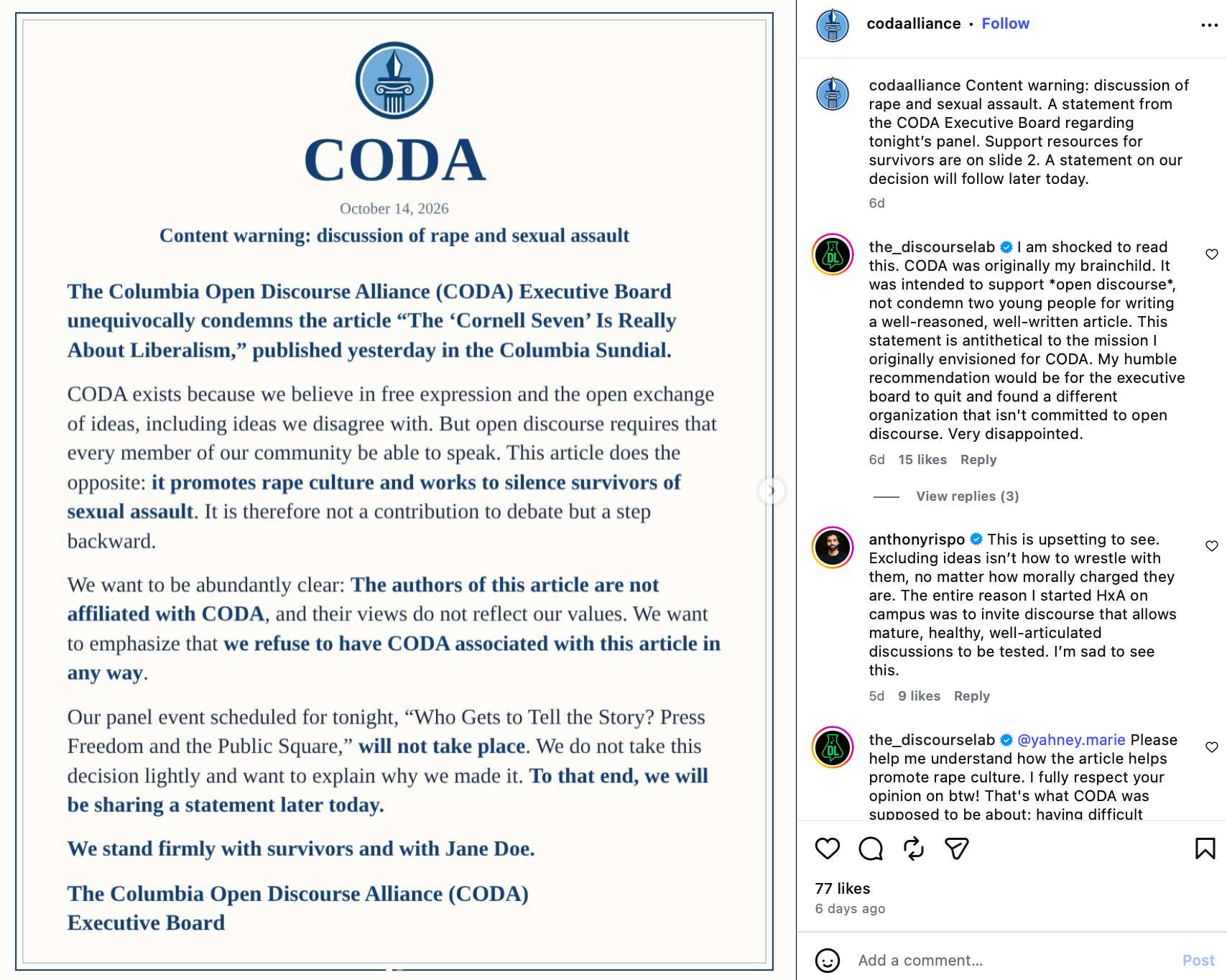
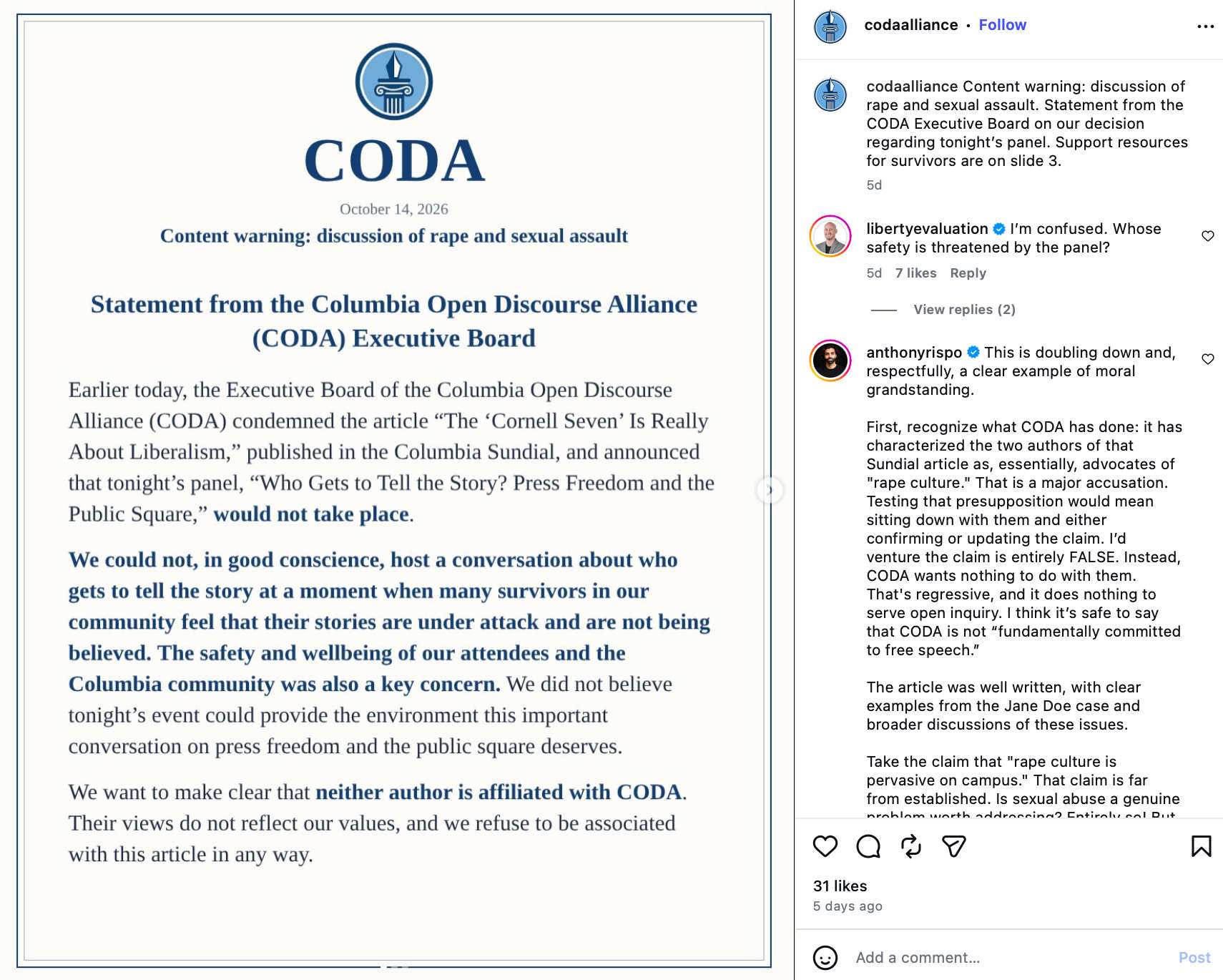
The day after the article's publication, the Columbia Open Discourse Alliance (CODA) canceled an event about press freedom because the Sundial's editor in chief, Nick Baum, had been slated to speak at the event. Although Baum did not author the piece, CODA wrote in an Instagram post that the free speech group "refused" to be affiliated with the Sundial's article "in any way." 

CODA also claimed that the event, ironically called "Who Gets to Tell the Story? Press Freedom and the Public Square," could not take place at a time when "many survivors in our community feel that their stories are under attack and are not being believed."

The group added that the Sundial's article "promotes rape culture and works to silence survivors of sexual assault." 

The group's president, Aum Desai, told Columbia's student newspaper, the Columbia Daily Spectator, that the group canceled the event "not in spite of, but because of [CODA's] commitment to free expression." 

Columbia graduate Clayton Smith, who founded CODA in 2025, quickly commented that he was "shocked" by CODA's statements on Instagram. Smith started the organization to create a central hub for groups hosting events promoting free speech and open discourse, including the Sundial and Columbia's Heterodox Academy chapter.

He tells Reason that CODA's rationale for canceling the event was "ironic" and "hypocritical," and he believes the group should have collaborated with the Sundial if there were legitimate safety concerns at the event. He says he was particularly disturbed by the group's condemnation of the article and CODA's claim that it promotes "rape culture."

"They don't argue or explain how it works to silence survivors of sexual assault. It is a baseless slander that they use to condemn the article because it promoted an opinion they do not like," Smith says. 

Smith says he spoke to Desai on the phone after CODA posted the statements, and Desai tried to reassure him that CODA would uphold the principle of free speech. But Smith says he did not leave the phone call feeling "very confident at all" in Desai's commitment. 

Desai did not respond to Reason's requests for comment.

CODA faculty adviser and Columbia Business School professor emeritus Eli Noam was traveling in China during the fallout from the Sundial article and was not involved in CODA's decision.

After speaking with members of both CODA and the Sundial, Noam tells Reason that he thinks CODA "made some proper decisions, some correct decisions, and some mistakes."

"I think we're dealing here with…a group of college students who kind of were confronted with a crisis at 2 a.m.," Noam says. "And kind of [made] some judgments that they now regret, and they do." 

He tells Reason that it was not "unreasonable to assume there would be a disruption" at the event, given the climate at Columbia and "about this rape allegation." He says the group suddenly "had an event where they needed college security" and could not organize in time. CODA, Noam says, is not yet recognized by the university, and he thinks the group was likely fearful of jeopardizing its recognition.  

Still, Noam says CODA's statements condemning the article were "unreasonable," and it was "disappointing that they kind of lost their nerve here."

Although he was not involved in planning the panel, Mohammadi says, to his knowledge, there were no credible threats of violence to the panel. He understood there may have been "disgruntled students" and an "environment CODA did not want to deal with." But instead of simply canceling the event or working with the Sundial to find a solution, Mohammadi says CODA overstepped by condemning the Sundial piece. 

James Applegate, an astronomy professor who serves on Columbia's Academic Freedom Council (CAFC) alongside Noam, tells Reason that he disagreed with CODA's decision to cancel the event.

Applegate tells Reason he was considering attending the event, and he was "rather surprised and disappointed" when it was canceled.

He recalled that when he was a professor in 2000, he objected to changes to the school's sexual misconduct policy on the University Senate floor. He says his statements were "similar to what was said in the Sundial article" and there was a "level of emotion in this debate." 

"Nonetheless, we had the debate. I was in it, and the degree to which it was civil is shocking when you look at where we are now. And it's sad." 

Applegate said he does not condemn CODA, however, "for the simple reason that the atmosphere on college campuses and on the left wing of politics in general in the United States is quite vicious."

CODA's honorary faculty fellow John McWhorter tells Reason he interpreted CODA's statement as "saying that an event about who gets to tell the story is untenable when or if a critical mass of people with such stories don't even feel comfortable telling them— i.e.being a participant in the event." He added, "I imagine some might think of that as cutting the salami a little thin, but then I highly suspect that Desai is equally worried about the event becoming a physical melee of some kind. In that, let's face it, he is hardly unreasonable."

Still, McWhorter said that he would have chosen to have the event himself, "especially as in the likely case that some people did talk about their experiences without any particular repercussions, it may have made the more reluctant people less apprehensive about doing so in the future."

According to Mohammadi, as of Tuesday, the Sundial, College Republicans, Platypus Affiliated Society at Columbia (which discusses leftist thought and history), and Columbia's Heterodox Academy chapter have left CODA. 

CODA was not the only group to condemn the Sundial's piece. On October 14, the Columbia Political Review's editorial board wrote that Mohammadi and Ma's piece "violates standards of integrity" and "perpetuates a culture of campus violence, rape, and assault." The editorial board of the Columbia Political Review, which purports to publish "multipartisan political discourse," stated that it would refuse to publish "any article that upholds or recreates cultures and systems of rape, sexual assault, or violence" and it urged "all campus publications to do the same."

And on Monday, Columbia's main newspaper, the Spectator, published a staff editorial accusing the Sundial of violating journalistic ethics by "its page to disparage survivors of sexual violence." 

Mohammadi tells Reason the piece underwent "far more editorial scrutiny than any other piece" the Sundial had published given the sensitive nature of the topic.

Free speech student organizations are necessary on Columbia's campus, especially as the school's free speech climate continues to crumble; it recently received a failing grade from the Foundation for Individual Rights and Expression. And while upholding free speech principles may have become more fashionable among those resisting the Trump administration's pressures on academic freedom or those defending pro-Palestinian speech, it is clear that some topics remain taboo in the public square. College is supposed to be a place where students debate controversial topics, form their own beliefs and opinions, and learn from mistakes. Hopefully, the students who demanded condemnation instead of debate will be forgiven for their perversion of free speech ideals, and they will learn to afford such grace and open-mindedness to classmates with whom they disagree.

The post A Free Speech Group at Columbia Canceled an Event About Free Speech Over 'Cornell 7' Article Controversy appeared first on Reason Magazine.

2 Recent Cases Illustrate the Limits of a Doctrine That Often Blocks Civil Rights Claims

21 October 2026 at 05:01
Mario Rosales holds a citation he received after a traffic stop in Alexandria, Louisiana | Institute for Justice

Since 1871, a federal statute has authorized Americans to sue state and local officials for violating their constitutional rights. But since 1982, thanks to the court-invented doctrine of qualified immunity, such claims have been allowed only when they allege violations of "clearly established" law.

Because courts often require plaintiffs to meet that standard by citing precedents involving closely similar facts, qualified immunity can prove insurmountable even for victims of outrageous abuses. But as two recent cases illustrate, there are limits to this license for misconduct, meaning officials may still be held accountable when they flout longstanding constitutional principles, even when they do so in novel ways.

In 2022, Mario Rosales and Gracie Lasyone sued two Alexandria, Louisiana, police officers, Samuel Terrell and Jim Lewis, alleging that they had pulled Rosales over without legal justification. The cops ordered Rosales and Lasyone, his girlfriend, out of the car and detained them for 21 minutes, during which they grilled the couple about illegal drugs, frisked Rosales, and instructed him to empty his pockets.

Terrell and Lewis sought refuge in qualified immunity. But last month, the U.S. Court of Appeals for the 5th Circuit ruled that Rosales and Lasyone had plausibly alleged several Fourth Amendment violations, including a stop based on a "fabricated traffic violation," an improperly prolonged detention, and unjustified searches.

In reaching that conclusion, the 5th Circuit relied mainly on a 1968 decision in which the Supreme Court said police may detain someone only if they reasonably suspect he is involved in criminal activity and may frisk him only if they reasonably suspect he is "armed and dangerous." Assuming the facts alleged in the lawsuit are true, the three-judge panel unanimously held, Terrell and Lewis had failed both of those tests.

When the officers stopped Rosales, the principles that the 5th Circuit applied had been the law of the land for more than half a century. Terrell and Lewis nevertheless argued that "any constitutional violation arising from the traffic stop was not clearly established," which gives you a sense of the chutzpah that qualified immunity invites.

Police commonly pull drivers over, ostensibly for traffic violations, in the hope of implicating them in drug crimes. A case that the U.S. Court of Appeals for the 8th Circuit considered this month involved a much more unusual scenario: a judge who locked two children in jail cells because he was frustrated by their resistance to a parental custody decision.

During a 2019 hearing in Taney County, Missouri, a divorced couple agreed that the mother would have primary custody of their two children, then 12 and 14. But contrary to that agreement, the children did not want to go home with their mother, which led to an argument in the courthouse lobby.

Judge Eric Eighmy intervened, telling the children they had to leave with their mother and repeatedly warning them that they could end up in foster care if they refused to do so. When that did not work, Eighmy jailed them until they became more cooperative.

"The time spent in the holding-cell area was between twenty and forty minutes," the 8th Circuit noted. And since Eighmy did not have probable cause to believe the children had committed any offense, "much less one that justified placing them in a holding cell," the court said, their confinement clearly violated the Fourth Amendment.

If so, Eighmy argued, he had no way of knowing that. The 8th Circuit panel unanimously disagreed: "As we put it over a decade and a half ago, long before the events in this case, 'it is clearly established that a warrantless arrest, unsupported by probable cause, violates the Fourth Amendment.'"

Notably, the 8th Circuit did not think the bizarre details of the case counted in Eighmy's favor. "We are not concerned about the lack of a prior case" with "fundamentally similar" facts, it said. "Indeed, given how clear the law is, it would have been surprising to find one."

© Copyright 2026 by Creators Syndicate Inc.

The post 2 Recent Cases Illustrate the Limits of a Doctrine That Often Blocks Civil Rights Claims appeared first on Reason Magazine.

Justice Department Will Investigate Conditions at D.C. Jail After Years of Reports of Filth and Neglect

19 October 2026 at 22:18
DC Jail | Jeremy Hogan/ZUMAPRESS/Newscom

The Department of Justice (DOJ) announced Monday that it will investigate living conditions inside the Washington, D.C. Jail following years of reports of filth, medical neglect, and brutality. 

The D.C. Jail, which holds all pretrial detainees and misdemeanor offenders in the District of Columbia, was the subject of an unflattering 2016 Reason cover story, "How Not to Build a Jail," describing how wretched conditions had persisted there for more than a century. Lawsuits, audits, and media investigations have all documented persistent civil rights problems. The jail gained additional infamy for holding pretrial detainees and convicted defendants who were prosecuted for their role in the January 6, 2021, riot at the Capitol Building. 

The Justice Department received numerous allegations of excessive force, inadequate medical care, unsanitary living conditions, and malnutrition inside the jail, according to a department press release. The investigation will determine if D.C.'s Department of Corrections has a pattern or practice of violating prisoners' constitutional rights.

"The Constitution protects the rights of every incarcerated American, including those held in custody in our nation's capital," Assistant Attorney General Harmeet K. Dhillon said in a DOJ press release. "We are committed to upholding our federal civil rights laws so that no inmate is confined in unconstitutional conditions or subject to unconstitutional mistreatment at the District of Columbia Department of Corrections."

Last week, six current and former D.C. Jail inmates filed a class-action lawsuit alleging they found dead mice and cockroaches in their food.

Five different D.C. Jail inmates filed another lawsuit in September alleging guards failed to stop or adequately respond to a man in the jail's mental health unit from starting an electrical fire.

In 2021, the U.S. Marshals Service transferred roughly 400 inmates out of the D.C. Jail after a surprise inspection reported unacceptable living conditions, including guards withholding water and food from inmates as punishment.

A week before that inspection, a federal judge held the D.C. Department of Corrections in contempt for repeatedly failing to turn over the medical records of a January 6 defendant who had been waiting for months for a scheduled wrist surgery. 

The antiquated jail, opened in the 1970s, has numerous structural problems, but plans to replace it have stalled. In the meantime, the Justice Department's Civil Rights Division will write a report to add to the top of the pile.

The post Justice Department Will Investigate Conditions at D.C. Jail After Years of Reports of Filth and Neglect appeared first on Reason Magazine.

He Campaigned for the East Cleveland Mayor's Opponent. Then Police Came for His Truck.

18 October 2026 at 12:00
William Fambrough seen in front of his sound truck | Institute for Justice

Walking through East Cleveland, Ohio, feels a touch like you've wandered onto the set of a postapocalyptic film noir. Grand, gilded homes announce themselves on neighborhood streets, some crowned with turrets, many with windows punched out like missing teeth. Often, no one is home, because no one lives there. It is safer than 1 percent of U.S. cities.

So why did local law enforcement pour considerable time and resources into pursuing a man for a sound truck?

That question is not really a legal one, at least not in the most technical sense. But it is the driving force behind a thorny case a federal court recently resuscitated: Fambrough v. City of East Cleveland, a saga concerning a man whose vehicle became an obsessive target of the East Cleveland Police Department (ECPD) after he used it to campaign for a mayoral challenger.

Some of the facts are in dispute. But the basic gist is as follows: William Fambrough, long a politically engaged East Clevelander, campaigned for Juanita Gowdy—a challenger to then-Mayor Brandon King—by broadcasting messages around the city with his sound truck. That ultimately came to an end after law enforcement impounded the car, cited him for parking and noise violations, and prosecuted him for the latter.

Fambrough sued, alleging the complex legal odyssey set into motion over his step van amounted to First Amendment retaliation, an unreasonable seizure under the Fourth Amendment, and a violation of the 14th Amendment's proscription against selective enforcement. The U.S. Court of Appeals for the 6th Circuit rejected some of those claims. But it resurrected claims against King and his chief of staff, Michael Smedley—depriving them of qualified immunity, the legal doctrine that inoculates state and local government officials from facing lawsuits if their alleged misconduct was not "clearly established" as illegal in prior case law. It also revived Fambrough's retaliation claim against the city.

As the 6th Circuit summarizes: King "says he received a phone call from a resident who complained about Fambrough's sound truck and someone else's box truck being parked in a residential area," so he told someone to take care of it. Scott Gardner, then the city's chief of police, "was concerned about selectively enforcing" the parking ordinance—which prohibits parking a truck in front of residential property, except for loading or unloading—because it is indeed almost never enforced. This was the beginning of a long pursuit, which ultimately saw a swarm of officers dispatched to Fambrough's house in August 2021 to confiscate the vehicle, allegedly resulting in $6,000 in damage. Fambrough also had to pay $528 in fees to get the damaged truck back.

"All the attention City officials gave Fambrough struck Gardner as unusual," the 6th Circuit notes. "The mayor's office wasn't this attentive even in homicide cases. And considering that the City had around only 50 police officers at the time and had 'serious crime problems,' Gardner thought it was odd to devote this much attention to permitting and parking issues." Based on available data, East Cleveland's violent crime rate is 1,409 per 100,000 residents, about four times higher than the national average.

Yet Gardner ultimately got on board. Smedley phoned him on August 9 "extremely upset," according to Gardner, and told the police chief he was "incompetent" for failing to "take care of" Fambrough's sound truck. Smedley wanted the "utmost enforcement as possible." So Gardner sent an email. "Please, find this vehicle and tow it," he wrote to all of ECPD. "Cite the operator with disturbing the peace and loud music. Please contact me as soon as this is complete to claim a surprise." A surprise!

Police succeeded. "On its face, the email told officers to tow Fambrough's truck regardless of whether it was parked illegally," writes the 6th Circuit. "And the Noise Ordinance authorizes seizure only of 'the sound device used,' and only upon conviction. So Gardner's instruction to tow the truck wasn't authorized by municipal law." The court still held that the seizure did not violate the Fourth Amendment. It also gave Gardner qualified immunity, ruling it is not clearly established that someone who acts as a conduit for someone else's alleged retaliation—which here came from the mayor's office—is a "responsible party."

Heather McCollough, the city's assistant law director, subsequently prosecuted Fambrough for allegedly violating the noise ordinance. According to a sworn declaration from Fambrough's attorney, McCollough outlined some of Fambrough's offenses on a call: that he "made complaints about the police department" and filed "public records requests," among other issues. Notably, it is legal to do those things. McCollough was typically willing to resolve minor noise complaints, she added, but not so much in this case, because Fambrough needed to "stand down." (He ultimately pleaded no contest to disorderly conduct, a reduced charge.)

East Cleveland police step van
Institute for Justice

"Only after [Fambrough] began supporting Gowdy's election was the weight of the law thrown against him," the 6th Circuit writes in its analysis of potential municipal wrongdoing. "And the City's police officers didn't uncover Fambrough's violations of their own accord. Instead, City decisionmakers sent them to Fambrough's home each time to enforce the Parking Ordinance. So the timing of the parking-related enforcement actions supports an inference that Fambrough's political speech was the motivating factor—as does the fact that the City rarely enforced the Parking Ordinance against anyone else despite having plenty of opportunities to do so." Incredibly, a photo of another truck can be seen down the street on the same day law enforcement came to fetch Fambrough's vehicle. (The law also includes pickup trucks, so the city arguably has a lot of enforcement to do if it sincerely believes this law matters.)

King allegedly set the chain of events into motion while Smedley took the driver's seat. "Smedley's pattern of incessantly calling and berating Gardner," the 6th Circuit adds, "clashes with the idea that Smedley was chiefly concerned with minor permitting, noise, or parking issues." After all, if that were true, why would the problem appear to begin and end with one person?

Over five years have passed since the ordeal. Although Fambrough is now potentially closer to getting in front of a jury, he has yet to actually state his case, still burdened by the onerous process government actors invoke to kill such suits before the community can assess the merits. King, meanwhile, won that election. He left office in May 2025, however, after he was found guilty of one count of theft in office, four counts of having an unlawful interest in a public contract, three counts of representation by public official or employee, one count of filing a false disclosure statement, and one count of soliciting improper compensation.

The post He Campaigned for the East Cleveland Mayor's Opponent. Then Police Came for His Truck. appeared first on Reason Magazine.

Inside Bill C-22, Canada’s Patriot Act.

By: aletho
17 October 2026 at 00:56
By Justin K.P. | The Dissident | October 15, 2026  

Canada’s Bill C-22, has passed the Canadian House of Commons and is currently being debated in the Canadian Senate, and Civil Liberties Organizations are raising the alarm bells over the unprecedented surveillance powers the bill gives to the Canadian security state.

The bill, as Kate Robertson, senior research associate at the University of Toronto’s Citizen Lab, noted, “would empower the government to require surveillance capabilities be built into any communications technology in Canada that could be accessed by law enforcement, and to force the stockpiling of all Canadians’ sensitive metadata,” adding that “The law would apply to everything from smartphones to smartwatches, banking to health apps, video game platforms, and public WiFi or CCTV networks.”

The bill similarly “includes mandating that companies store user data for at least a year – even if the data isn’t something they would otherwise be keeping on hand for the purposes of their business”, “including location and transmission data”.

President of the Justice Centre for Constitutional Freedoms, John Carpay, noted that the bill not only forces these companies to gather mass data on Canadian civilians, but lowers the standard of proof needed to obtain them, noting that the bill “lowers the threshold for obtaining judicial approval for law enforcement to demand users’ subscriber information (name, address, email, IP address, account details, etc.) from ‘reasonable grounds to believe’ to ‘reasonable grounds to suspect.’”

The bill may even give the Canadian government the ability to turn on Microphones and Cameras in order to surveil citizens.

Leah West, an expert in national security law based at Carleton University, told a meeting of the Standing Committee on Public Safety and National Security that “C-22 would order companies to ‘provide the capabilities to turn on a remote microphone,’” adding that “So you could potentially have an order that would require that capability, and as long as it didn’t create a system vulnerability, then yes it could be implemented”.

Unsurprisingly, the bill has raised major alarm bells with Canadian civil liberties organizations.

The Canadian Civil Liberties Organization called the bill “the broadest expansion of government surveillance powers in recent Canadian history” and Matt Hatfield, Executive Director at OpenMedia, called it “the most invasive surveillance regime of any comparable democracy”.

Some of the alarm bells rung by the Canadian Civil Liberties Organization included the possibilities that the bill would:

– Pave the way for expanded information-sharing with the United States and numerous other governments including those with a history of abuse. Expansion of information-sharing with foreign governments in the absence of effective safeguards is particularly reckless at a time when cross-border persecution of diaspora communities—including through abuse of cross-border police cooperation tools—is on the rise.

– Give the government the power to force any electronic mechanism to build new surveillance tools and embed these at the core of their service, potentially transforming anything with a digital component into spyware. The mandated surveillance capability need not have anything to do with the actual functionality of the service in question. Backdoors like these also cannot be effectively limited to law enforcement access—Cybercriminals and foreign adversaries have repeatedly and successfully targeted the mass surveillance capabilities created by similar regimes. Overall, the proposal creates untenable privacy and cybersecurity risks.

– Lower the threshold for sensitive subscriber data, allowing government agencies to cast a wide net when conducting investigations; and

– the government the power to force any digital entity to keep highly sensitive information on every single person in Canada or abroad for up to one year. Information could include every single person’s location at any time over the course of the year, a complete record of everyone you interacted with online, and more. Bill C-22 includes no mechanism to place limits on who can access these data troves or for what purpose, making it potentially fair game for any and all criminal and civil investigations as well as for commercial exploitation by the private company being compelled to retain the data.

In an open letter over 25 leading Canadian civil society groups called the bill an “unprecedented and extraordinarily dangerous surveillance architecture that could impact every digital tool people in Canada depend on every day”,“the most expansive invasion of Canadian privacy rights in modern history” and “fundamentally a mass surveillance capabilities regime”.

It warned that under part 2 of the bill “the government could force the creation and installation of privacy-compromising surveillance tools and backdoors in an enormous and ill-defined set of ‘electronic service providers’, including telecom providers, social media and cloud service providers, AI tools, and any ‘smart’ device” adding that “The law could even be used to force Canadian companies to build backdoors into their products before they export them abroad” and that “The result creates an untenable threat to privacy and cybersecurity” even noting that it “far exceeds powers available to police and security agencies in the United States.”

It also noted that, “Part 2 of Bill C-22 will now also empower the government to require any digital service provider to record and retain detailed metadata on every single person in Canada or abroad, damaging the privacy of millions who are not suspected of committing any crime or posing any security threat,” adding that “companies will be forced to develop the capacity to track information that was never before available to them and is not necessary for their business purposes, then to collect and retain that information for up to one year.”

Georgia Cop Who Shot a Miniature Donkey Says Body Camera Footage Shows an 'Imminent Threat'

16 October 2026 at 20:56
Screenshot from a body camera video showing a a handgun drawn at a small donkey | The Civil Rights Lawyer Raw/Youtube/Cedartown Georgia Police Department

The Georgia officer responsible for killing a 1-year-old miniature donkey, HeeHaw, has filed a motion to dismiss the lawsuit against him, claiming the body camera footage proves he "reasonably believed the donkey posed an imminent threat to a fellow officer." But even if it doesn't, the officer argues he is immune from liability. 

In the early morning hours of August 30, Hannah Michelle Israel was at her Cedartown home in western Georgia when she received a distressing phone call. A supervisor with the Cedartown Police Department "tersely informed [Israel] that a donkey on her property had been 'dispatched,'" according to her federal lawsuit. After some clarification, she learned that police had not only entered her enclosed private property in the middle of the night without permission while looking for a missing person, but also shot and killed her miniature donkey in the process. 

Israel immediately set out to search for her beloved pet, HeeHaw, only to find her bottle-raised donkey's lifeless body alone in her field. Israel told ABC7 News the incident has left her "traumatized and shocked." She continued, "I honestly can't even believe he's not here…There's no words."

Demanding accountability, Israel filed a lawsuit in the U.S. District Court for the Northern District of Georgia in September against the shooting officer, Officer Trenton Ryan Garner, for violating her Fourth Amendment rights and submitted a separate demand for $1 million from the City of Cedartown.  

Last week, Garner responded by asking the court to dismiss the case, arguing in part that he did not violate Israel's constitutional rights when he entered her property. Under the open fields doctrine, there is no reasonable expectation of privacy in one's pastureland, even if enclosed. Further, the motion argues, exigent circumstances existed in the search for a missing 12-year-old girl. 

As far as HeeHaw is concerned, Garner claims he acted reasonably by using deadly force and argues the footage clearly shows HeeHaw "charging" and posing an "imminent threat to a fellow officer." 

However, the footage, posted by the Civil Rights Lawyer Raw, may not be so clear-cut. Garner's body camera was off at the time of the shooting but had a "rolling buffer of video," a recording without audio of the 30 seconds preceding activation of the camera, according to court documents. During the silent portion, two officers and a bloodhound are in front of Garner with flashlights in a dark field. A small donkey, roughly 3 feet tall, appears and slowly moves toward one of the officers. The officer backs away slowly, but the donkey moves closer and picks up speed. Garner pulls his gun and fires. The donkey turns and runs before falling over.

Whether Garner reasonably believed HeeHaw posed an imminent threat to his fellow officer may be up for debate.

When the audio kicks in, a fellow officer asks, "Why'd you shoot it up?" "I don't know," Garner responds rather nonchalantly before telling dispatch he had to shoot a donkey because "it was trying to attack." If another officer on the scene wasn't sure why Garner used deadly force, perhaps the decision wasn't so reasonable after all. 

In her lawsuit, Israel accuses Garner of needlessly killing HeeHaw "maliciously…and recklessly, with deliberate indifference…for [Israel's] constitutional rights." The suit continues: "No reasonable officer in…Garner's position would have believed that such force was necessary or justified." 

But whether Garner acted reasonably or not by shooting HeeHaw, qualified immunity may still shield him from accountability. Qualified immunity is a legal doctrine that protects government actors from lawsuits alleging rights violations, unless the right is clearly established. In practice, that means plaintiffs must be able to point to a previous court ruling in a case with the same circumstances to show that the right was obvious to government officials. 

The bar can be quite high to show a right is clearly established. For example, in March, the Supreme Court reversed a 2nd Circuit decision in a case involving an officer who was sued for using a rear wristlock to arrest a protester. The 2nd Circuit denied qualified immunity, reasoning that a previous case from 2004 clearly established that rear wristlocks used to arrest anti-abortion protesters constitute excessive force. But the Court disagreed, stressing that "principles stated generally, such as that 'an officer may not use reasonable and excessive force,' do not suffice." 

And while there may be ample cases involving officers shooting pet dogs, cases involving miniature donkeys are in short supply. If the court finds that there is no clearly established rule that specifically prohibits officers from shooting a miniature donkey moving toward a fellow officer in the dark, the court may end up dismissing the case and sidestepping both the reasonableness and constitutional questions entirely.

The post Georgia Cop Who Shot a Miniature Donkey Says Body Camera Footage Shows an 'Imminent Threat' appeared first on Reason Magazine.

Sally Rooney’s books pulled from UK over support for Palestine Action

By: aletho
15 October 2026 at 20:10
Al Mayadeen| October 15, 2026

Irish novelist Sally Rooney has agreed to the withdrawal of her books from the UK market after her support for Palestine Action created legal obstacles to the payment of royalties under British terrorism legislation.

Rooney, the bestselling author of “Normal People” and “Conversations With Friends”, said her publisher, Faber, had concluded that continuing to distribute her work in the UK could expose those involved to criminal liability. The decision was made with her agreement following consultations over the legal implications.

Palestine Action was designated a “terrorist organization” by the UK government in July 2025. The following month, Rooney publicly declared that she intended to continue supporting the group and direct proceeds from her book sales towards it. The organization remains legal in the Republic of Ireland, where Rooney is based.

Rooney was prepared to accept the consequences

In a statement to The Guardian, Rooney explained that her position had placed the publication of her work in Britain at risk.

She said that after expressing her intention to support Palestine Action, fulfilling contracts to publish her books in the UK could constitute a serious criminal offence. Rooney added that she had been transparent about her convictions and was prepared to accept the consequences.

The novelist had previously cancelled a planned UK visit to collect an award over concerns that she could face arrest because of her stated support for the banned group.

Terrorism legislation threatens publishing arrangements

Rooney warned in a statement supporting the legal challenge against the ban that the proscription could prevent her existing books from remaining available in British shops and block the publication of future titles in the country. Her submission to the High Court raised concerns about the consequences for freedom of expression.

The restrictions also extend to royalties from television adaptations of her work. Last year, Rooney said the independent producer behind the BBC adaptations of “Normal People” and “Conversations With Friends” had advised her that paying her could breach terrorism legislation if it knew or suspected she would use the money to finance Palestine Action. Both series aired before the group was banned.

Section 15 of the UK’s Terrorism Act criminalizes providing money or other property when a person knows or has reasonable grounds to suspect that it may be used for terrorist purposes. A conviction can carry a maximum prison sentence of 14 years.

Faber, which publishes Rooney in the UK and Ireland, said the legislation had left it unable to transfer earnings from British sales to the author.

The publisher said selling a writer’s work without being able to pay them was unacceptable. It confirmed that, with Rooney’s full agreement, it would stop supplying her books in Britain in every format, while continuing to publish and sell her work in other markets.

Bestselling novels face uncertain future in Britain

Rooney’s novels have received widespread critical acclaim and achieved substantial commercial success. She has been hailed as a voice of her generation.

“Normal People” has sold more than one million copies in the UK, while “Conversations With Friends” and “Beautiful World, Where Are You” have each exceeded 500,000 sales.

The BBC adaptations also attracted large audiences. “Normal People” accumulated 62.7 million views, making it the broadcaster’s most-streamed series of 2020.

Demand was likely to continue

Despite the withdrawal decision, copies of Rooney’s books remained available in central London on Wednesday afternoon. Waterstones said retailers could continue selling copies already in stock.

Booksellers also indicated that they intended to keep offering the novels while existing supplies lasted.

Gian Carlo, a bookseller at Henry Pordes Books, said the shop could sell its copies without generating royalties for Rooney. He added that he understood her position.

At London Review Bookshop, bookseller John Clegg said he had ordered additional copies after learning of the development. He said demand was likely to continue, although the shop would no longer be able to replenish its stock through Faber. Clegg also criticized the legislation and said he hoped the case would encourage the Home Office to reconsider it.

Thousands arrested following Palestine Action ban

The dispute comes amid a wider legal battle over the government’s decision to proscribe Palestine Action.

More than 3,700 people are believed to have been arrested in the UK since the ban took effect in July 2025 on suspicion of supporting the organization. Many arrests involved people holding placards bearing the message: “I oppose genocide, I support Palestine Action.”

Approximately 2,500 people have been charged. However, trials have not proceeded while the legal challenge to the proscription remains unresolved. The case is scheduled to reach the Supreme Court next month.

Effect of the ban on freedom of expression

Most arrests and charges have involved Section 13 of the Terrorism Act, which carries a maximum prison sentence of six months.

Huda Ammori, a co-founder of Palestine Action leading the legal challenge, said Rooney’s inability to publish her work in Britain demonstrated the effect of the ban on freedom of expression.

Ammori said Rooney had maintained her position despite the personal and professional consequences. She argued that the author’s books should remain widely available rather than disappear from British shelves because of her refusal to abandon her support for Palestinians.

She added that writers should not have to choose between their political convictions and their ability to publish their work.

Four in five new UK jobs taken by foreigners – report

By: aletho
14 October 2026 at 20:11
RT | October 14, 2026

Foreign nationals have filled 80% of new UK jobs over the past decade, while millions of Britons have remained on out-of-work benefits, according to a new report by the Centre for Social Justice (CSJ).

The UK think tank said on Tuesday that British nationals accounted for just 734,000 of the 3.7 million jobs added to payrolls between 2014 and the end of 2025. EU nationals accounted for 408,000 new jobs, while migrants from the rest of the world filled around 2.5 million.

“Employers have gained unprecedented access to overseas labour while taxpayers have absorbed the growing cost of domestic worklessness,” the report said.

The findings are part of a major inquiry chaired by former UK Work and Pensions Secretary Iain Duncan Smith. The report argues that successive governments have relied on low-skilled migrant labor while millions of Britons have been “written off” by the welfare system.

Since 2020, payroll employment among non-EU nationals has surged by 2.1 million, while the number of people claiming out-of-work benefits has risen by 2.3 million. Much of the employment growth was concentrated in health and social care, administrative services, hospitality and retail.

“Compounding this, ministers have repeatedly pulled the easy lever of immigration rather than providing a better deal for left behind communities,” Duncan Smith said, urging coordinated reforms to welfare, immigration and regional development.

Around 6.7 million people in England, Wales and Scotland now receive at least one out-of-work benefit, equivalent to roughly one in six working-age adults, according to the CSJ. Since 2019, the number of claimants exempt from requirements to seek or prepare for work has climbed by nearly 1.7 million.

Annual spending on working-age benefits is projected to reach £136.1 billion ($181 billion) in 2026-27.

The report comes amid mounting political pressure over immigration. Reform UK leader Nigel Farage has repeatedly accused successive governments of favoring migrants and minorities over the white working class, demanding tighter border controls and denouncing what he calls a “two-tier” system of unequal treatment.

Britain has also struggled to stop illegal crossings of the English Channel. Some 33,374 people arrived in small boats in the year ending June 2026, down 23% from the previous year, according to the Home Office. The crossings accounted for 88% of detected arrivals via illegal routes.

Public concern remains widespread. An August YouGov poll found that 69% of Britons believed immigration over the previous decade has been too high, while 43% considered it mostly bad for the country, up from 33% in 2016.

MEP blasts ‘Euro-Gestapo’ for lecturing Russia on democracy

By: aletho
8 October 2026 at 23:46
RT | October 8, 2026

Brussels is steering Europe toward totalitarianism and a “Euro-Gestapo” while lecturing Russia on democracy, Slovak MEP Lubos Blaha has warned.

Blaha made the remarks during a European Parliament debate on Tuesday, responding to EU foreign policy chief Kaja Kallas, who denounced Russia’s recent parliamentary elections as undemocratic.

The politician questioned why Brussels was focusing on Russia while cracking down on dissent within the bloc.

He cited arrests of pro-Palestinian protesters in Germany and the imprisonment of Estonian opposition figures, who he claimed were jailed for opposing war with Russia.

“Are you going to set up the Euro-Gestapo here, Mrs. Kallas, and lock up everyone who wants peace?” he asked.

The Slovak lawmaker also questioned why Brussels was debating Russia’s elections while Europe faced mounting unrest.

“You may not have noticed, but Spain is in the streets, France is in the streets, and you are here dealing with Russian elections. You must be joking,” he said.

Blaha went on to accuse Brussels of double standards over Ukraine’s suspended presidential elections.

“You blame the Russians for having elections, but you don’t mind that [Ukraine’s Vladimir] Zelensky has been governing for three years without any elections, without a mandate,” he said. “You are hypocrites!”

Zelensky’s presidential term expired in May 2024, but elections have remained suspended under martial law.

Blaha also cited the annulment of Romania’s 2024 presidential election, claiming the vote was canceled because “the wrong candidate won.” Romania’s Constitutional Court scrapped the result over alleged irregularities and accusations of Russian interference after EU- and NATO-skeptic Calin Georgescu won the first round. Pro-EU candidate Nicusor Dan won the rerun in May 2025.

The MEP argued that Russia had held elections despite the ongoing conflict and daily Ukrainian missile and drone attacks on its territory.

The September poll saw the ruling United Russia party win nearly 58% of the party-list vote.

Blaha also defended Russian President Vladimir Putin, contrasting his popularity with that of Western European leaders.

“You have nothing to criticize Putin for, Mrs. Kallas,” he declared. “Unlike you and your Merzes and Macrons, he has the support of his own population.”

Recent polls have put German Chancellor Friedrich Merz’s approval rating at a record low of 10% in October, while French President Emmanuel Macron’s support fell to 17% in September. Neither Kallas nor European Commission President Ursula von der Leyen was directly elected to her current position by voters, having assumed office through the EU’s institutional appointment process.

Blaha belongs to Slovak Prime Minister Robert Fico’s Smer-SD party, which opposes EU sanctions on Russia and has criticized Western military assistance to Ukraine.

Paris bans pro-Palestinian demonstration planned for Oct. 7 over ‘risks of public disorder’

By: aletho
6 October 2026 at 21:34
MEMO | October 6, 2026

Paris police chief Patrice Faure on Tuesday banned a pro-Palestinian demonstration planned for Wednesday, the third anniversary of Oct. 7, 2023 attacks in Israel, over “risks of public disorder,” Anadolu reports.

“At the request of Interior Minister Laurent Nunez, I issued an order banning a demonstration ‘against the genocide in Gaza and for respect for the ceasefire’ in Paris on Wednesday,” Faure said on US social media platform X.

He noted that such a demonstration could pose “significant risks of public disorder,” citing a “high terrorist threat” and antisemitic acts that “remain at historically high levels” across France.

“In light of this, and in view of all the risks identified, it is my responsibility to ensure everyone’s safety. I have therefore decided to ban this demonstration,” Faure added.

Israel’s genocidal war launched three years ago in Gaza has killed more than 74,000 people, injured many more and destroyed most of the enclave’s infrastructure.

Britain leads Western media’s demise through ‘fear porn’ narrative

By: aletho
6 October 2026 at 15:21
By Martin Jay | Strategic Culture Foundation | October 6, 2026

Ian Proud’s arrest by secret police at a London airport marks a new low in how far the deep state can go to control a false narrative. But it also shows a new level of fear.

As mad as it sounds, it does appear that Western European nations at least are preparing themselves to go to war with Russia at some point in the not-too-distant future. What is particularly worrying is there seems to be a distinct vacuum in all areas of what we could broadly call ‘media’ in questioning this narrative. Thirty years ago it was considered normal for journalists to be the source of vexing questions towards state actors and to generally be a pain in the arse as they questioned every decision made and every idea presented. It was our job to be anti-establishment and to take a very cynical view of “policy”. There was nothing remarkable about this. It was what we did. Being despised by the greater powers was part of the job; working anti-social hours and having few friends also came with it.

Today there are no journalists in what we call ‘mainstream’ media doing this. They have been replaced by younger, more social-media-savvy ‘content creators’ who believe that journalism is more or less a grammatical role, where the raw material is handed to you with all the information therein, and the role of the journalist is simply to refine it to the style of the day for mass consumption.

The danger of this transition is that nearly all of what we are being presented with as news is actually fake, or at best heavily redacted to keep the masses where the elite want them to be: restrained, prepped and misinformed.

The Ukraine war is an excellent example. The main reason why people in the U.S. and UK are so fabulously biased against Russia and are so sympathetic towards the corrupt elite in Kiev is that for years they have been brainwashed with ‘news’ about Russia which has been negative and which cunningly feeds a racist bias – a prejudice which has been cultivated over at least a decade, if not more. The result is that now a number of lies have become established in newsrooms where journalists, even those who know, simply navigate around nuance and present a fairy-tale story, designed to be understood by the masses who have no other sources of information to even question it.

Just recently, Western news outlets reported a “plague” in Russia, with stories about a “lockdown”, following a case of a worker in a laboratory dying of pneumonia in circumstances which are still not certain. Western media, as part of their role to keep Russia-phobia at its peak, are so locked and loaded that their ‘hair-trigger’ reactions to bad news stories from Russia are understandable. They are also hungry for clickbait, and such stories feed a starved audience which has already had its first fix of such COVID hysteria stories and wants more. The truth is entirely immaterial. Hysteria and lies are what’s being fed at a feverish rate by ‘content creators’ red in tooth and claw, foaming at the mouth with their desire to serve the deep state and the elites who have invested so much in an agenda.

The contrast between Russia and the West is interesting, though, when we look at media. In Russia just recently, the BBC correspondent based in Moscow made the internet buzz on social media with his short interview with Russia’s foreign minister, who was kind enough to answer his loaded question about Russia’s war ideology with Ukraine. What absolutely no one noted was how Russia is happy to accommodate foreign journalists who have such a distinct agenda to feed the Russia-phobia back home, while Russian journalists have been banned in those EU capitals for years. Old Europe, which once held such values as a free press so dearly, has adopted the Soviet model, while Russia is actually more advanced when it comes to such tenets of what we expect in a democracy. Russia has no fear of the awkward questions, unlike the West.

We should be asking ourselves who really benefits from a war with Russia.

Is it too sceptical and ‘conspiracy theorising’ to assume that the industrial military complex has been successfully lobbying for such a war for AT LEAST a decade, and critically, it succeeded in convincing the intelligence and military establishment in the UK to use its leverage with media to provide journalists with the raw material which enhances a prejudice against Russia?

Normally such an idea could be dismissed as pure nonsense. But just consider how far the UK, for example, has gone to eradicate all media coverage which could be deemed as at least leaning towards Russia – or even simply just holding the UK government to account by asking the questions that British journalists have stopped asking. If the elite in the UK who control the loss-making newspapers (think about that) are so sure of their rationale that Russia is the enemy whom we must go to war with, why are they so terrified of journalists – or anyone, for that matter – simply holding a view which questions the narrative?

I can’t be the only Western pundit who believes that double agents Sergei Skripal and his daughter Yulia were not poisoned with nerve agent Novichok in Salisbury in 2018, which was reported at the time as “sparking a huge diplomatic crisis between Britain and Russia”. Isn’t the real story that British security chiefs decided, upon discovering that Sergei Skripal was actually a triple agent who was feeding information back to Moscow, that he was dispensable? And what better way to supposedly teach the Russians a lesson, while blaming Moscow for his death, than to murder him and his daughter using a nerve agent which either was Novichok – which a British lab just down the road from where the Skripals lived had conveniently sitting in a fridge – or a similar poison? What’s important to note about Novichok is that the victims usually die instantly upon contact with it. What is likely is that the Skripals were not poisoned by the Russian drug but a British version of another nerve agent. It is a shocking example of how poor British journalism is that hacks in the UK simply report the Skripal incident of Novichok poisoning without a single shred of evidence to back it up. They don’t even add a note of scepticism in their reporting about the drug and who is “claiming” that it is Novichok.

We see the same shocking level of atrocious, biased reporting about the Ukraine war, which the British public were simply told through the media narrative was an “invasion” by Putin’s army. No background, no nuance, no glimpse of Russia’s perspective, as no one can cope, it would seem, with the story being clouded by facts.

And it’s the same with the Russia “plague” story, as it was with the RAF base “attack” story recently, which was probably just local thieves buying contraband gasoline from corrupt U.S./UK soldiers looking to make a quick buck at the UK base. Notice how quickly Trump used the story as a basis to move all U.S. bombers off the base and back to U.S. soil, where they are completely useless in his so-called Middle East war. For Trump it was an opportunity for another media stunt which keeps him on the front pages and everyone guessing. He was probably grateful to the British for being offered the raw material. Another problem of this new generation of journalists is how compliant they are to report “news” which isn’t news at all, but just material used as a distraction, one day at a time. Trump is a master at manipulating media with this game, usually saying something so stupid and so controversial, which draws journalists away from doing real journalism. If you can occupy journalists with writing up stories about the latest idiotic comment or statement by Trump, then you control them as you control their time.

Just look at how the Epstein story is not being reported and investigated. How Trump got off scot-free, as since February 28th journalists’ attention was diverted to the war with Iran – which is one of the reasons why Trump keeps this story alive with constant troop movements and talk of a massive attack after midterms. People have not made the link with the Epstein material being leaked and the war with Iran kicking off practically on the same day.

For the British, the “Russians are coming” story has no cynical write-up by journalists who are 100 percent compliant with its erroneous narrative. The fear of elites in London is palpable, though, that it will always be questioned by fringe actors taking up bandwidth on social media. In the past this was the RT correspondent in London, who was able to ask difficult questions and generally be a thorn in the side of the Westminster village which controlled journalists like rats held in a basket. The main reason why RT was kicked out of the UK was that it offered a style of reporting on UK politics which had since left us thirty years ago – such is the murky world of the deep state and how it saw how in Brussels journalists could be manipulated until they become stenographers for it.

Yet even with this new Stalinist style of media control in the UK, the state is wobbly. Even with the impressive set-up it has now of total media dominance, where journalists pump out total garbage about the Ukraine war or what they are told to write about the Middle East, still the fear is there.

The example of video blogger Ian Proud, a former UK diplomat once based in Moscow, is worrying but poignant. Simply going to Moscow to attend a conference where Putin was speaking was enough to have him get the full Stasi treatment at Heathrow airport – detained and all digital content seized.

Proud’s YouTube interviews, with his dowdy style of presenting, are proving to be popular as he simply offers a more sober view of both Russia and the UK Foreign Office, his former employer. These interviews are getting the attention of UK spooks, who are so nervous about the truth getting out about Russia and the shameful lies which are being packaged now for the British public, that they had to give Proud the American prison ‘shake down’ routine. Britain, a country which once was a beacon for the world with its view of liberty and in particular its passion for free speech, has fallen to a level which we can only compare to a West African country which has just had a new dictator installed, complete with black aviators and epaulettes. What the Proud Heathrow airport case shows is that this new regime in power will stop at nothing to control a narrative, and that the last bastion of free speech – YouTube podcasts – is the next target. The more successful Proud’s channel becomes, the more inevitable it is that he will be forced to leave the UK and settle in Russia to continue practising free speech. The shoulder tassels of Britain’s deep state will not sleep well until the country has a media narrative which would make Joe Stalin blush – and British journalists are helping them with this goal.

Georgia’s Largest Healthcare System Will Fire Employees Who Refuse Flu Vaccine

By: aletho
5 October 2026 at 23:39
By Brenda Baletti, Ph.D. | The Defender | October 5, 2026

Employees of Georgia’s largest healthcare system have until Nov. 1 to get the flu vaccine or an approved exemption, or they will be suspended without pay. If suspended employees don’t submit proof of vaccination by 4 p.m. Nov. 15, they will be fired.

According to the Emory Healthcare website, the vaccine mandate applies to all employees, including contractors and remote workers.

Employees suspended for missing the first deadline, Nov. 1, 11:59 p.m., will not be allowed to use their paid time off.

COVID-19 shots are not mandated, but employees are “encouraged to engage in shared decision-making with their provider” on whether or not to get the vaccine.

A spokesperson for the healthcare system said the requirement is intended to protect patients and staff and to encourage everyone to get vaccinated.

Dr. Sherika Newman of Doctor in the Family, a physician-led patient advocacy and health consulting service in Atlanta, told CBS News that flu vaccine requirements are common in healthcare.

“Asking health care providers or people who interact with patients to take the flu vaccine early every year is what we always mandate so that we are protecting ourselves from spreading viruses to vulnerable populations,” Newman said.

She said everyone should get vaccinated, not just healthcare workers, although only healthcare workers will lose their jobs if they don’t get the vaccine.

Cleveland Clinic: 2024-2025 flu shot increased risk of getting the flu

Flu vaccine effectiveness can vary, according to the Centers for Disease Control and Prevention (CDC), which cites studies since 2009-10 showing effectiveness between 19% and 60%. The major factors influencing vaccine effectiveness are a person’s age and health and how well the vaccines match the circulating virus strains.

According to a Cleveland Clinic study published last year, people who received a flu vaccine formulated for the 2024-25 flu season had a 27% higher risk of getting the flu than those who didn’t get the vaccine.

It wasn’t the first study to find that flu vaccines could actually increase the risk of becoming ill.

A 2023 study co-authored by Dr. Anthony Fauci acknowledged that “viruses replicating in the respiratory mucosal environment continue to present a particular challenge for developing effective vaccines with strong protection.”

“The flu shot has never really prevented transmission of the flu and in some years (i.e., last year) the efficacy of preventing the flu is actually negative,” said Brian Hooker, Ph.D., chief scientific officer at Children’s Health Defense. “Flu would blow through a vaccinated population with nearly the same ease as it would an unvaccinated population.”

A 2012 peer-reviewed study published in Clinical Infectious Diseases showed that children who received the flu vaccine were at significantly increased risk of contracting non-flu respiratory virus infections.

Moderna’s mRNA flu shot added to the mix this year

According to the CDC’s FluView vaccination chart, as of Sept. 26, flu cases were at “minimal” levels across almost all 50 U.S. states, including Georgia.

Flu season typically begins in October and ends in May, with highest transmission rates in December and February.

The CDC recommends flu shots for people age 6 months and older, assuming they have no medical conditions that make vaccination risky.

Flu shot formulations differ each year based on information about which strains may circulate that year. The formulations aren’t tested for safety or efficacy before they’re distributed to the public.

In March, vaccine advisers to the U.S. Food and Drug Administration (FDA) recommended trivalent vaccines to protect against two influenza A and one influenza B viruses.

In the past, most flu vaccines were made from a flu virus grown in eggs, and then inactivated and made into a vaccine. Or, they were made from recombinant protein vaccines, which have pieces of the flu pathogen that the immune system learns to recognize and fight.

This year, Moderna’s controversial mRNA flu shot, mFLUSIVA, approved in June, is also available for people age 50 and over.

Number of healthcare workers getting flu, COVID vaccines declining 

Manufacturers say they will produce up to 135 million doses of flu vaccine for the U.S. market this flu season.

In recent years, many healthcare workers have been resisting flu shot mandates and declining the shot.

For example, record numbers of frontline health workers in the U.K. refused the flu vaccine in 2024-25.

Rates of U.S. healthcare workers who take the COVID-19 and flu shots have also been declining in recent years.

Numbers are lowest among health professionals who work in nursing homes. In the 2024-25 flu season, only about 42% of those workers got the shot, compared with about 81% of workers in acute care hospitals.


This article was originally published by The Defender — Children’s Health Defense’s News & Views Website under Creative Commons license CC BY-NC-ND 4.0. Please consider subscribing to The Defender or donating to Children’s Health Defense.

Germany facing potential ‘violent conflict’ with Russia – spy chief

By: aletho
5 October 2026 at 16:05

BND chief Martin Jaeger’s claim comes as his agency pushes for more funding and expanded powers

RT | October 5, 2026

Martin Jaeger arrives to speak in the annual open hearing of Germany’s three intelligence services at the Bundestag in Berlin, Germany, October 5, 2026 © Getty Images ; Sean Gallup

Germany could become “embroiled in a violent conflict with Russia,” the country’s foreign intelligence chief has warned, claiming that a mysterious drone incident at Leipzig airport is an example of the “real and imminent” threat posed by Moscow.

Speaking to lawmakers at a parliamentary hearing on Monday, Bundesnachrichtendienst (BND) head Martin Jaeger declared that “the confrontation we are facing with Russia has taken on a new, more dangerous dimension.”

“Germany is in danger ​of becoming embroiled in a violent conflict with Russia – the attempted attack in Leipzig ⁠is just one example,” he continued, referring to the discovery of an explosive-laden drone next to a Ukrainian transport plane at the city’s airport in August.

German authorities have not released any evidence linking the incident to Russia, and Moscow has described the episode as a “hastily cobbled-together provocation” serving “exclusively the aims of Kiev and the militaristic wing of the European political class.” It is “obvious that Germany is pursuing a further course of escalation,” Kremlin spokesman Dmitry Peskov said last month.

Nevertheless, Jaeger claimed that Russia is “waging a shadow war,” and that there is a “real and imminent” threat of attacks against targets in Germany. “No other country currently poses such a direct, comprehensive, and concrete threat to Germany,” he added.

Jaeger is one of dozens of Western political, military, and media figures to accuse Russia of waging a “hybrid war” or “shadow war” against Europe in recent weeks. The accusations are, by their nature, impossible to verify, and Moscow has written them off as pretexts to deepen Western involvement in the Russia-Ukraine conflict, justify military spending hikes, and expand surveillance and persecution of domestic opponents.

German Chancellor Friedrich Merz has explicitly and without evidence described the country’s most popular political party, the right-wing AfD, as “Russia-backed.” Martina Rosenberg, the head of Germany’s Military Counterintelligence Service (MAD), alluded to this claim during Monday’s briefing, telling lawmakers that the country is “threatened by diverse dangers from both outside and within.”

Jaeger, Rosenberg, and domestic intelligence (BfV) chief Sinan Selen all praised Merz’s recent efforts to grant the BND greater offensive powers, and called for further strengthening of the MAD and BfV’s capabilities.

Despite their allegations of “hybrid war,” European leaders have repeatedly stressed that they do not believe Russia to be planning any actual attacks on NATO territory. The BND has seen “no indication of an imminent large-scale Russian attack on NATO territory,” Jaeger added on Monday.

Amid an unprecedented escalation in the West’s rhetoric toward Russia, RT is tracking the statements, accusations, and threats in our ongoing ‘Escalation Watch’ special. Keep an eye on it here as we sort the facts from the propaganda and debunk the psyops in real time.

British Transport Police Facial Recognition Trial Scanned 926,912 People With Zero Arrests

By: aletho
5 October 2026 at 03:28
By Cam Wakefield | Reclaim The Net | October 3, 2026

So what does it take for a police force to stop using a “trial” deployment of live facial recognition (LFR) technology? Apparently, scanning the faces of more than half a million people and catching nobody is not it.

In fact, it gets you an extension of four months and an expanded area to “hunt” in.

The British Transport Police (BTP) has now revealed that its initial six-month LFR deployment at London railway stations produced one alert – that was false.

The trial cost £320,786 ($425k) to carry out. That was just the cost of equipment hire and police officers’ time, and the figure comes from a freedom of information document obtained by Liberty Investigates.

It ran from February to July across 18 deployments, which the BTP’s own register says resulted in 537,697 people having their faces scanned.

The single alert was raised on February 24 at Kings Cross, against a watchlist of 455 people. The alert was false, and the false alert rate was 0.00517 percent.

The story doesn’t end there, because the BTP’s own register doesn’t stop at the end of July. It goes on to September 24, and now includes 27 deployments – and a total of 926,912 people who have had their faces scanned.

This extension has produced alerts. On August 20 at Kings Cross St Pancras Underground, there was one true alert, unconfirmed. On September 4 at Waterloo, there was one true alert, confirmed, and the outcome was no action. And on September 24 at London Bridge, there were two true alerts, both confirmed, with the outcome again being no action.

The arrest column in the register still reads zero.

In other words, the machine has now correctly identified three people – but the police have not found any reason to arrest any of them.

The register also shows that the number of people on the watchlist has grown. On February 11, it was 381, and by September 14 at Victoria Underground, it had more than doubled, to 862.

This is where things get even better. The expansion was “welcomed” by Transport for London (TfL), who said the technology “will target and identify people on police watchlist at key stations chosen for maximum impact.”

TfL also justified the move by saying it would “specifically tackle violence against women and girls, whose travel behaviours are shaped by experiences of sexual harassment and sexual offences.”

Labour MP Bell Ribeiro-Addy is not impressed. “Tackling violence against women and girls on public transport must be an urgent priority, but that means investing in what actually works; not spending more than £320,000 on a measure, which when piloted, resulted in zero arrests and a single false alert,” she said.

“Live facial recognition technologies are a serious invasion of our privacy. The government should be suspending their rollout until there are stronger safeguards in place, including a proper legal framework,” the MP added.

This is not one force experimenting on its own. We have reported London Mayor Sadiq Khan approving live facial recognition for Oxford Street, London police using it at a protest for the first time, the High Court clearing the way for police use of it, and Greater Manchester Police joining the rollout. Liberty Investigates found that more than half of police forces in England and Wales have now deployed it.

Meanwhile, biometric images that do not match those on the watchlist are deleted immediately, while those that do match are deleted within 24 hours, as is the watchlist itself, once a deployment is finished.

BTP’s own policy makes clear that the surveillance is not limited to the cameras that are part of the LFR system. Footage from the LFR camera masts will be kept for up to 31 days, “in line with general police retention periods for CCTV.”

It seems that no matter how many times these deployments are extended, and how many people are scanned, the watchlist will just keep growing.

The police will keep getting more money to throw at this tech, that has not yet proven itself as useful for anything but wasting public money.

❌