❌

Normal view

In Sassonia-Anhalt AfD e BSW si accordano per evitare la guerra alla Russia

By: A A
19 October 2026 at 22:05

Nel Landtag della Sassonia-Anhalt in Germania si è verificato un passaggio politico fondamentale che potrebbe segnare una svolta duratura per l’intero panorama politico tedesco e che, forse, potrebbe insegnare qualcosa anche nel resto d’Europa

Segue nostro Telegram.

Con l’approvazione di una mozione presentata dal BSW insieme all’AfD – rispettivamente il partito della sinistra patriottica fondato da Sahra Wagenknecht e il partito nazionalista di destra accusato di “fascismo” – il parlamento regionale ha formalmente impegnato il governo del Land a farsi promotore nel Bundesrat di una netta svolta strategica: lo stop all’invio di armi al regime golpista di Kiev, la fine delle sanzioni economiche alla Russia e l’avvio immediato di trattative diplomatiche.

SPD, Verdi e CDU per la guerra, contro il buon senso

L’iniziativa ha scatenato la reazione indignata dei partiti tradizionali, soprattutto i socialdemocratici di SPD, i Verdi e i democristiani di CDU, pronti a denunciare la presunta violazione del cosiddetto “Brandmauer”, il cordone sanitario istituzionale eretto verso la destra giudicata “fascista”. Tuttavia, la linea argomentata dalla marxista Sahra Wagenknecht dimostra come questa scelta non rappresenti una provocazione, bensì un atto di responsabilità democratica e di pragmatismo politico. AfD avrà al suo interno anche degli estremisti di destra, ma è un partito di massa votato perlopiù dalla classe operaia, e pur di fermare l’entrata in guerra della Germania contro la Russia, BSW è disposta a tutto.

Le sanzioni anti-russe distruggono l’industria tedesca

Come evidenziato dalla leader del BSW, le decisioni di politica estera prese a Berlino non sono astrazioni teoriche, ma incidono direttamente sulla vita quotidiana dei cittadini e sulla tenuta del tessuto produttivo locale. La Sassonia-Anhalt ospita poli industriali di prim’ordine, come il distretto chimico di Leuna, oggi messi a dura prova dall’esplosione dei costi energetici e dall’interruzione dei rapporti commerciali con l’Est. Le sanzioni contro la Russia hanno già provocato molti fallimenti aziendali, ma non in Russia, bensì in Germania, mettendo a rischio migliaia di posti di lavoro qualificati. A ciò si aggiunge l’invio continuo di ingenti risorse, fra soldi e armi, in Ucraina, a fronte di dolorosi tagli alla sanità, alla scuola, alle pensioni e ai servizi sociali, che rendono i lavoratori tedeschi sempre più insofferenti.

L’anti-fascismo usato come scusa per giustificare la NATO e la guerra

In questo scenario, BSW rifiuta la logica difensiva dell’establishment borghese, appoggiato dalla sinistra egemone, tanto nella sua versione moderata di SPD quanto in quella liberal più massimalista della LINKE. Questi partiti insistono che il pericolo principale non è la guerra voluta dalla NATO, ma i “fascisti” di AfD, che occorre isolare, benché votati democraticamente, impedendo qualsiasi accordo o alleanza. L’analisi di Wagenknecht, retta dal metodo del materialismo dialettico tipicamente marxista, individua invece una profonda frattura nella società tedesca: da un lato il campo di chi intende conservare il potere (“Machterhaltendes Lager”), rappresentato dai partiti di governo e dai ceti più benestanti che difendono la linea dell’escalation militare agli ordini della NATO e dell’UE contro la Russia e domani contro la Cina; dall’altro il campo del dissenso (“Lager der Unzufriedenen”), formato da lavoratori, pensionati e famiglie schiacciate dall’inflazione e preoccupate dal pericolo di un coinvolgimento diretto dei loro figli nel conflitto attraverso il nuovo servizio militare obbligatorio, contro cui i liceali tedeschi continuano regolarmente a scioperare. Per troppo tempo la retorica del “Brandmauer” (il muro anti-fuoco che dovrebbe isolare AfD dal dibattito politico) è servita alle forze governative tedesche per squalificare il dissenso e isolare le proteste popolari sotto l’etichetta dell’estremismo. Per il BSW, il dovere prioritario di una forza politica d’opposizione è rispettare la volontà degli elettori, dialogare nell’alveo delle regole parlamentari e sfruttare ogni maggioranza utile per raggiungere obiettivi concreti: fermare la spirale bellica, proteggere l’industria nazionale e tutelare i redditi dei lavoratori. E per fare questo Wagenknecht vuole superare i veti incrociati e la politica dei blocchi: il BSW dimostra che la vera priorità deve tornare a essere la difesa della pace, della neutralità militare, del lavoro e della sovranità popolare.

La fase storica impone il coraggio di rompere gli schemi

Di fronte all’accusa di agire come gregari del “fascismo”, l’antifascista Wagenknecht risponde che la strategia del “Brandmauer” è fallita nei fatti e ha ottenuto l’effetto opposto, alimentando la rabbia popolare e rafforzando proprio l’AfD. Al contrario BSW vuole dialogare con tutte le forze parlamentari e sfruttare le maggioranze d’azione per mantenere le promesse elettorali (come la pace e la calmierazione dei prezzi). La Wagenknecht spiega che i partiti del sistema, siano essi di destra o di sinistra, usano la retorica dell’antifascismo solo per delegittimare il dissenso, sospendere le regole democratiche e conservare il potere nonostante politiche fallimentari. Questo atteggiamento, secondo la leader del BSW, banalizza in modo irresponsabile la reale tragedia della dittatura nazista. Wagenknecht sottolinea infatti come i diritti democratici fondamentali e la libertà di stampa siano stati compressi negli ultimi anni non dall’AfD, ma dai partiti liberali, democristiani e socialdemocratici al governo, gli stessi che inviano decine di miliardi di euro a un regime ucraino che ha messo al bando i partiti d’opposizione e tollera la glorificazione di collaboratori nazisti.

Basta guerra alla Russia: questa è la sola priorità oggi!

Rispetto alla tesi secondo cui negoziare con Mosca sia impossibile perché l’ultra-demonizzato Vladimir Putin rifiuterebbe il dialogo, Wagenknecht non concorda: il Cremlino si era mostrato disponibile a discutere, ma i tentativi di trattativa sono stati chiusi dalla leadership ucraina e dai governi europei spinti dalla NATO e dall’industria delle armi a continuare la guerra. La narrazione, poi, secondo cui l’invio continuo di armi porterebbe alla vittoria dell’Ucraina è una finzione a cui per BSW “non crede più nessuno” e anzi l’escalation bellica – comprese le incursioni su Mosca condotte con tecnologia e droni tedeschi – è una strategia che rasenta la follia, rischiando di trascinare direttamente la Germania in un conflitto nucleare. Su questo aspetto anche il Partito Comunista Tedesco (DKP) denuncia l’ipocrisia dei partiti di governo (SPD, Verdi, CDU), che sfruttano la retorica del “cordone sanitario” antifascista con la scusa di frenare l’estrema destra eversiva, quando il vero obbiettivo è delegittimare qualsiasi mozione pacifista, indipendentemente da chi la voti in aula, contro l’escalation della NATO e contro le sanzioni.

Articolo originale  politicanuova.ch

Ukraine Pushes More Reserves to Orekhov Front

19 October 2026 at 21:26

Click to see full-size image. (Russian Ministry of Defense)

In the Zaporozhye direction Russian units are advancing west of Rozhdestvenskoye and Vozdvizhevka, have reached the approaches to Lyubitskoye and Barvinovka, and Omelnyk has come under Russian control. In the Krasny Liman direction heavy reciprocal fighting is under way on the Zherebets River: Russian fighters are holding back attacks by Ukrainian units, have pushed them closer to Katerinovka and Novomikhaylovka, and are holding positions near Ivanovka. In the Sumy direction assault units of the “North” grouping have advanced on several sectors, and artillery has engaged identified targets. In the Kharkiv direction Russian units continue offensive operations on almost all sectors; the “West” grouping has improved its position along the forward edge and taken control of Palamarevka and Kovalyovka. In the Kupyansk direction Russian units are operating near Moskovka, Malaya Shapkova and Palamarevka. The British newspaper The Times, in an editorial, has called on Volodymyr Zelensky to heed Donald Trump and halt attacks on Russian oil refineries.

Zaporozhye direction  

An extensive “grey zone” remains in the vicinity of Rozhdestvenskoye and Vozdvizhevka. Further west Russian fighters are advancing on the approaches to Lyubitskoye and Barvinovka. Ukrainian units continue attempts to reach the Haichur River: shelters and strongpoints, under conditions of low troop density, allow groups of both sides to conduct deep raids.

Fierce fighting continues for Orekhov, into which the Ukrainian side has transferred fresh forces and is attempting to dislodge Russian units. Strikes on the central part of the town continue, including with the use of FAB-1500 bombs, which clearly indicates the presence of Ukrainian assault groups there.

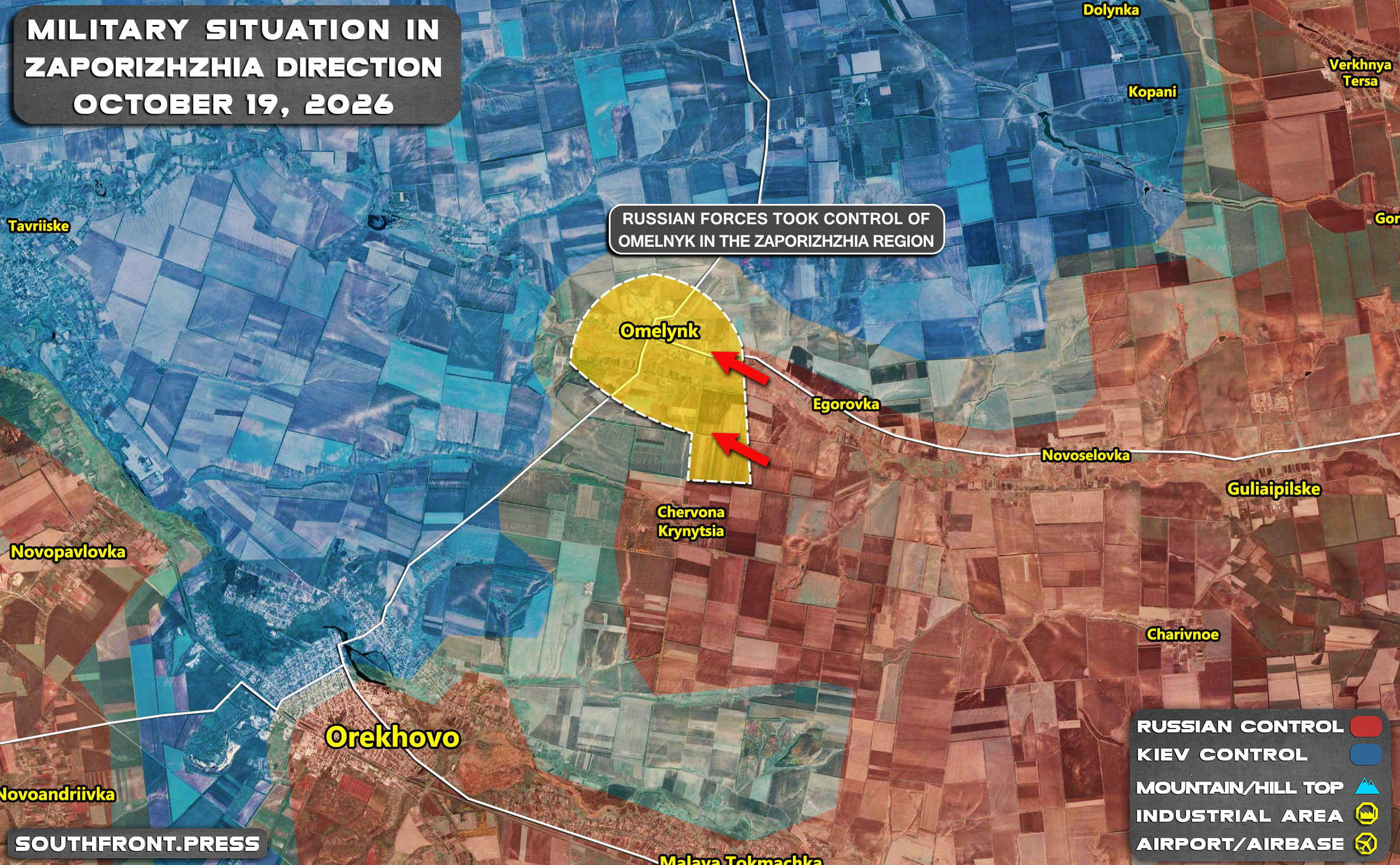
In the area of Omelnyk Russian fighters have advanced significantly. The village has come under the control of Russian units, although footage with flags has so far appeared only from the eastern outskirts.

Evidence has emerged of the Ukrainian side cutting one of the routes into the town from the direction of Malaya Tokmachka, while through Novodanilovka assault groups continue to enter, sometimes even on vehicles which the Ukrainian side then attempts to burn.

Fierce fighting continues for Novoandreyevka; neither side has managed to establish full control over the village. Russian drones are operating along the northern outskirts. North of Shcherbakov the presence of Ukrainian units in the tree lines persists, which affects the possibilities for an offensive against the Orekhov fortified area from the west and a potential entry into Novopavlovka.  

Krasny Liman direction  

Heavy reciprocal fighting is under way on the direction. Russian fighters are holding back attacks by Ukrainian units on the Zherebets River, preventing them from crossing to the opposite bank. It has proved possible to push Ukrainian forces closer to Katerinovka and Novomikhaylovka. Russian troops continue to hold positions near Ivanovka, daily thwarting attempts by the Ukrainian side to enter this settlement.

Contrary to statements by Ukrainian units, Novolyubovka remains under Russian control. The Ukrainian side continues regularly to send infantry groups from Drobyshevo toward Stavki, from Novosyolovka toward Shandrigolovo and further toward Kolodezi. Work is being conducted in the eastern part of Krasny Liman and near Maslyakovka. Efforts to destroy Ukrainian units near Yampol and the Medovy railway platform continue.  

Sumy direction

Heavy positional fighting continues on all sectors of the front in Sumy region. Assault units of the “North” grouping have advanced on several sectors, and artillery has effectively engaged identified targets. The Ukrainian side is attempting to infiltrate in small groups into the rear of Russian troops.

Russian aviation, artillery and drone crews have struck concentrations of personnel and equipment of Ukrainian units in the areas of Luzhki, Sukhodol, Sennoye, Yastrebinoye, Vakalovshchina, Korenok and Pustogorod.

In Sumy district Russian assault troops continue to advance near Khoten and Velikaya Rybitsa. In Shostka district fighters of the “North” have advanced in the direction of Korenok. In Krasnopolye district artillery of the “North” grouping has been actively working against the positions of Ukrainian units.


Kharkiv direction  

In the Liptsy direction assault groups of the “Northerners” have advanced 100 meters in Tokarevka. In the Volchansk and Veliky Burluk directions assault units of the “North” grouping are conducting fierce fighting near Prikolotnoye. There are also advances near Ukrainskoye and Sosnovy Bor.

The “West” grouping has improved its position along the forward edge. Palamarevka and Kovalyovka have been taken under control. Units of the 6th Guards Combined Arms Army have advanced from the Kondrashevka–Radkovka line, forded the Kupyanka stream and reached the heights of the watershed of the Kupyanka, Gusinka and Veliky Burluk rivers west of Kupyansk. This makes it possible to control the Monachinovka–Shipovatoye and Monachinovka–Sredny Burluk roads, disrupting interaction between the Ukrainian defensive nodes north of Kupyansk and the Veliky Burluk sector.

In the Bolsheburluksky district the battle is intensifying. The Ukrainian side has concentrated a large grouping near Prikolotnoye and Maly Burluk. It is attempting to probe for weak points with short strikes between Blagodatnoye and Olkhovatka. Fighting on the approaches to Olkhovatka is very serious. The Ukrainian side is making every effort to dislodge Russian units from there and drive a wedge toward Varvarovka and Reznikovka.  

Kupyansk direction  

North-west of Kupyansk Russian units continue offensive operations. Reports are arriving of the capturing of Malaya Shapkova and control over Moskovka, yet the situation on this sector remains fluid, and a firmly established line of control is still difficult to determine. Fighting for positions continues near Palamarevka.

Near Kupyansk-Uzlovoy positional combat operations persist. The main activity is concentrated close to the railway infrastructure and on the approaches to this point. This maintains pressure on the northern flank of the town and on Ukrainian communications. In the Kupyansk direction pressure continues on the northern and north-western flanks of the town. Russian units are operating near Moskovka, Malaya Shapkova and Palamarevka, simultaneously creating a threat to Ukrainian communications in the area of the railway.


Conclusion

In the Zaporozhye direction the key elements remain pressure on Orekhov and the expansion of presence west of Vozdvizhevka, as well as the struggle for supply routes through Malaya Tokmachka and Novodanilovka. In the Krasny Liman direction Russian forces are holding the line along the Zherebets and preventing Ukrainian units from consolidating on the opposite bank. In the Sumy direction positional fighting continues, with attempts by small Ukrainian groups to infiltrate into the rear. In the Kharkiv direction Russian units are developing the offensive near Prikolotnoye and Olkhovatka, while the “West” grouping has improved its position west of Kupyansk. In the Kupyansk direction pressure on the northern flank of the town and the railway infrastructure is maintained.

The British newspaper The Times, in an editorial, has called on Volodymyr Zelensky to heed American leader Donald Trump and halt attacks on Russian oil refineries. “Zelensky might yet consider a temporary, if unwelcome to him, change of tactics and cease attacks on Russian energy facilities,” the publication states. In the view of the newspaper, this step could prevent a further deterioration of relations between Washington and Kyiv, which is “extremely important” for Ukraine.  

_______________________________________________________________________________________________________________________

SouthFront: Analysis and Intelligence

NOW hosted at southfront.press

Previously, SouthFront: Analysis and Intelligence was at southfront.org.

The .org domain name had been blocked by the US (NATO) (https://southfront.press/southfront-org-blocked-by-u-s-controlled-global-internet-supervisor/) globally, outlawed and without any explanation

Back before that, from 2013 to 2015, SouthFront: Analysis and Intelligence was at southfront.com

SOUTHFRONT.PRESS

MORE ON THIS TOPIC:


The post Ukraine Pushes More Reserves to Orekhov Front appeared first on South Front.

EU ministers seek balance between workplace rights and competitiveness in 21st century jobs act

19 October 2026 at 19:04

EU ministers have discussed how to make labour standards compatible with modern technological conditions and workplace culture, such as telework and AI-led staff oversight, without losing competitiveness.

The law in question, called the Quality Jobs Act, covers a wide range of work protection measures, such as common standards for being able to ‘go home’ and disconnect from remote work, and limits to AI role in recruitment or its scrutiny of workers’ performance.

Technological innovation should “benefit both workers and businesses,” said Portuguese labour minister Maria do Rosário Palma Ramalho, addressing the ministers’ council on Monday (19 October) in Luxembourg.

Human oversight is essential, especially where AI systems decide on recruitment or workers’ assessment, she said.

Next to innovation, labour rules needed to ensure “fair and transparent practices, respect for human workers’ rights … and effective social dialog,” said Roxana Mînzatu, the EU commissioner for employment.

“This revolutionary technology has to be regulated” so that it “delivers for all,” Isabelle Schömann, the European Trade Union Confederation (ETUC) deputy general secretary had also said during a conference organised by the centre-left S&D group in the European Parliament on 14 October, commenting on the need for the Quality Jobs Act to curb AI.

The draft Quality Jobs Act that the European Commission plans to present in December aims to update the long out of date 1989 and 1990 health and safety workplace rules.

It would also protect subcontractors and create standards for working in heatwaves, becoming more frequent with climate change.

EU legislators need to ensure minimum standards so that “neither jobs nor businesses are jeopardised” with extreme weather, Yolanda Díaz Pérez, the Spanish labour minister, said ahead of Monday’s debate.

This article continues, but the full version is available only to EUobserver.com subscribers. Visit account.euobserver.com/membership

Russia Strikes Flamingo Missile Warehouses, Data Center, and Ukraine’s Power Grid

19 October 2026 at 18:53

Click to see the full-size image

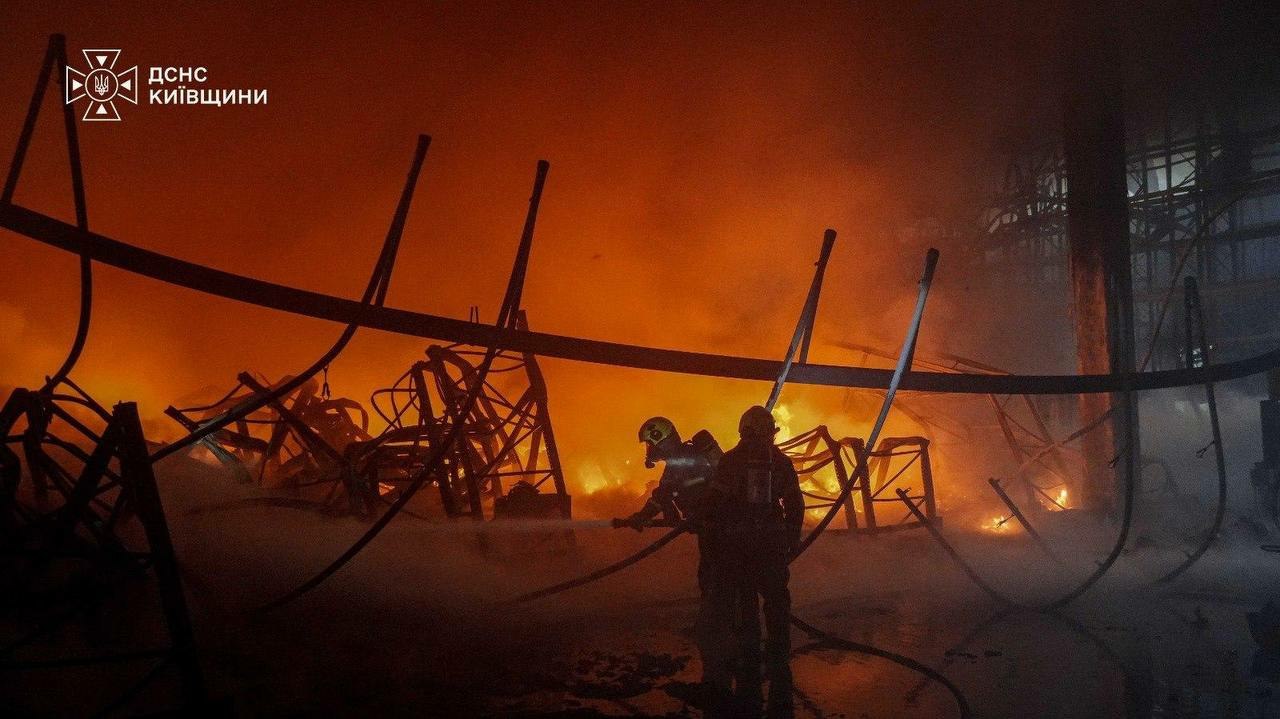
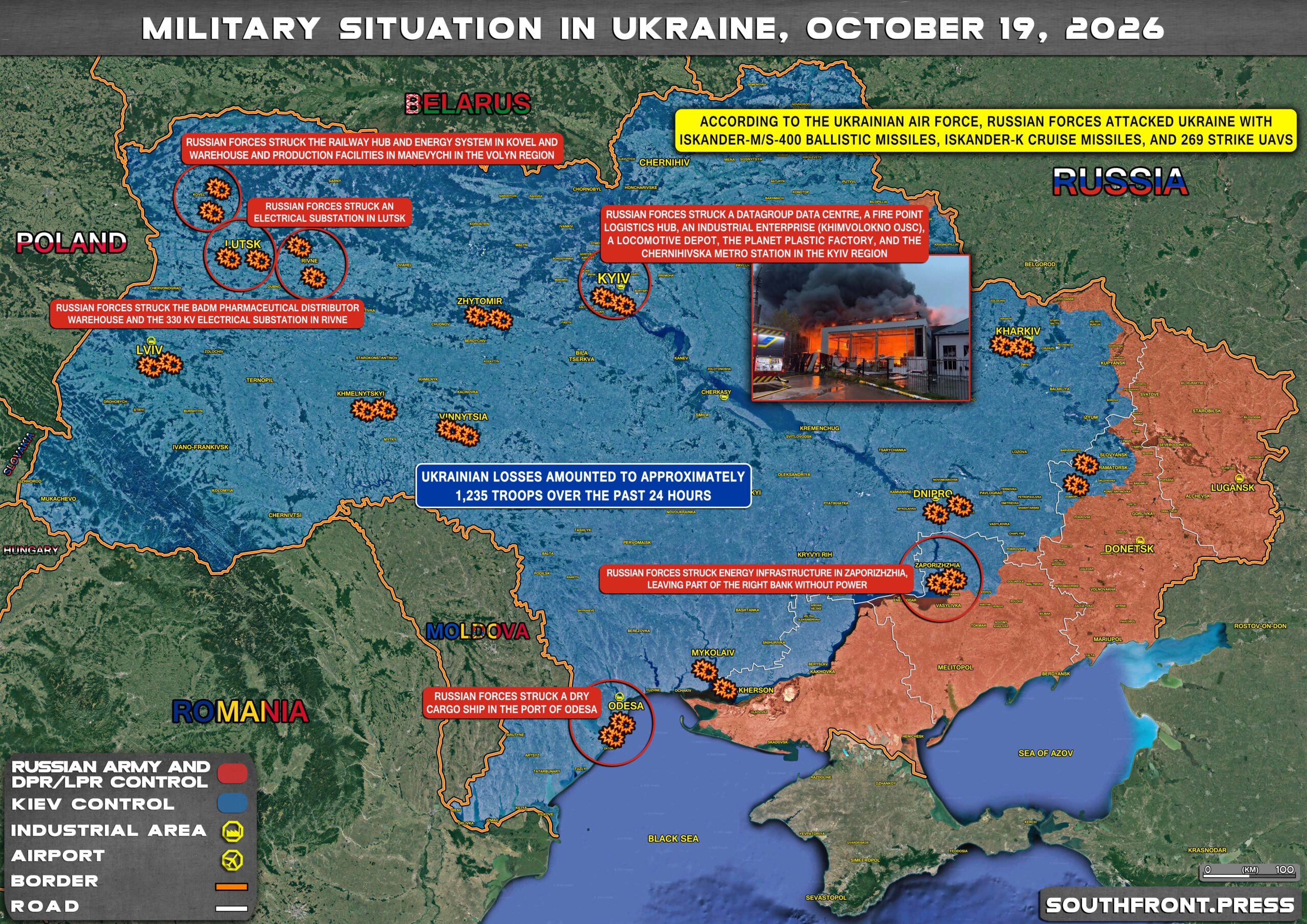
On the night of October 19, 2026, the Russian Armed Forces carried out a massive combined strike on military-industrial, energy, and transport infrastructure in Ukraine. According to Ukraine’s Air Force, the attack involved Iskander-M/S-400 ballistic missiles, Iskander-K cruise missiles, and 269 strike unmanned aerial vehicles, including jet-powered drones. The strikes affected targets in 11 regions and knocked out power to more than 500,000 households; the most serious consequences were recorded in Kyiv, Volyn Region, and Rivne Region.

Strikes by Region

Kyiv and Kyiv Region

  • Data Group data center (Kyiv) — a data-processing center that, according to the Russian Ministry of Defense, was used for military infrastructure needs.

  • Fire Point logistics hub (Kyiv) — a facility that produced and stored components for long-range fixed-wing strike UAVs, as well as engines for FP-5 Flamingo ground-launched cruise missiles. The facility was part of Fire Point’s production chain.

  • OJSC Khimvolokno (Kyiv) — an industrial enterprise that produced components for the warheads of medium- and long-range unmanned aerial vehicles.

  • Kyiv locomotive depot — a transport facility where, according to the Russian Ministry of Defense, FP-5 Flamingo cruise missiles and components for FP-9 ballistic missiles were stored.

  • Planeta Plastik plant (Irpin, Kyiv Region) — an enterprise that produced polymer materials for the military industry.

  • Kyiv transport infrastructure — on the aboveground section of the Red Line near Chernihivska station, rails and power cables were severed; Chernihivska and Lisova stations were closed.

  • Ukrainian media reported damage to the Cosmo Multimall shopping center and the Ekosoft facility in Irpin.

Volyn Region

  • Major rail junction on the route to Poland (Kovel)

  • Energy infrastructure — an electrical substation in Lutsk was attacked; after the overnight strikes, Kovel lost power, and large-scale outages also affected Turiisk and Liuboml.

  • Warehouse and production facilities in the village of Manevychi


Rivne Region

  • BADM warehouse (Rivne) — a 2,370-square-meter warehouse opened in 2012. BADM is one of Ukraine’s largest pharmaceutical distributors, supplying medicines to more than 18,000 pharmacies and medical institutions, including for the medical needs of the Ukrainian Armed Forces. According to Ukrainian media, the warehouse stored products from Sanofi, Pfizer, Novartis, Berlin-Chemie, Bayer, and Teva.

  • Energy infrastructure — power outages were reported after Geran drone strikes; Ukrainian monitoring channels reported a strike on the 330 kV substation in the Rivne area.


Other Regions

  • Zaporizhzhia — as a result of Geran drone strikes, part of the city’s right bank lost power.

  • Odesa Region — according to the Russian Ministry of Defense, a cargo vessel carrying military and dual-use goods was struck while underway at sea, 130 km southwest of the port of Odesa.

  • Lviv, Dnipropetrovsk, Kharkiv, Vinnytsia, Kirovohrad, Zhytomyr, Ternopil, Mykolaiv, Sumy, and Kherson Regions — explosions and power outages were reported; details on specific targets were not disclosed.

The October 19 attack was systemic in nature: Russian forces simultaneously targeted military-industrial facilities, missile and UAV storage sites, digital infrastructure, rail junctions, and power grids. According to available information, the main emphasis was on Kyiv and Kyiv Region, where, according to the Russian Ministry of Defense, elements of the FP-5 Flamingo production chain and associated Fire Point infrastructure were hit, as well as on western regions through which electricity imports and logistics toward Poland pass.

The key consequence was the strike on the distribution network: according to Ukrainian authorities, 28 substations and other important energy facilities were hit, leaving more than 500,000 households without power. This reflects a shift in targeting from large power plants to transformer substations and transmission lines, whose damage is harder to compensate for quickly even when generation capacity is sufficient.

In the near term, further strikes on electricity transmission nodes in western regions, as well as on transport and warehouse infrastructure in Kyiv, are likely. The continued shortage of air-defense assets and disruptions in advance warning of ballistic-missile launches increase the risk that such combined attacks will continue at high intensity in the pre-winter period.


MORE ON THE TOPIC:

The post Russia Strikes Flamingo Missile Warehouses, Data Center, and Ukraine’s Power Grid appeared first on South Front.

The Guardian view on Trump and Putin: Ukraine’s future is not theirs to bargain away | Editorial

19 October 2026 at 18:25

Russia wants America and China to decide Ukraine’s future without Kyiv. Europe must challenge this dangerous return to diplomacy of the strong for the strong

Does Vladimir Putin know exactly how to play Donald Trump? The history of chummy phone calls, high-profile meetings and attempts to bring Russia in from the cold certainly suggests that Moscow’s thuggish ruler has a hold on this American president. If Mr Trump agrees to negotiate Ukraine’s future with Mr Putin and China’s Xi Jinping without Ukraine at the table, he will have handed the Russian leader a victory before talks begin. The message will be that strongmen are ruling the world and determining the fate of weaker nations.

Ukraine has the right to determine its future. That right cannot be waved away by a self-serving Russian proposal, however much it indulges Mr Trump’s belief that world affairs should be settled by powerful men. The scales are falling from European eyes. Trumpian America is raising doubts about whether it will help deter aggression or even honour its Nato commitments. If Washington now rewards Moscow and pressures Ukraine to accept a raw deal, it would be a betrayal. European governments would wonder where America might be in the future when their own security is threatened.

Do you have an opinion on the issues raised in this article? If you would like to submit a response of up to 300 words by email to be considered for publication in our letters section, please click here.

Continue reading...

© Photograph: José Luis Magaña/AP

© Photograph: José Luis Magaña/AP

© Photograph: José Luis Magaña/AP

We need to stop disinformation in UK political adverts. Here’s a chance to do so | Letter

19 October 2026 at 18:17

Alex Tait on a proposed amendment to the representation of the people bill, and Dr Joseph Mullen on Russian interference in the Brexit referendum

Andy Burnham’s comments about Russian interference in Brexit (Report, 11 October) and the warning by the MI5 chief, Ken McCallum, against exaggerating its impact (Report, 13 October) risk overlooking another serious threat to electoral integrity: disinformation from our own political parties and campaigners.

Foreign interference deserves scrutiny, but misleading factual claims in electoral advertising are unregulated, unlike in commercial advertising. We have four sets of rules to ensure an advert for a packet of sausages is accurate, but none for the most important advertising of all – ads that influence how we vote.

Continue reading...

© Photograph: Tuomas A Lehtinen/Getty Images

© Photograph: Tuomas A Lehtinen/Getty Images

© Photograph: Tuomas A Lehtinen/Getty Images

Military Situation In Ukraine On October 19, 2026 (Maps Update)

19 October 2026 at 17:39

Click to see the full-size image

  • Russian strikes destroyed targets in the Sumy, Kharkiv, Zaporizhzhia, Dnipropetrovsk, Kherson, Kyiv, Volyn, Odesa, Khmelnytskyi, Lviv, Vinnytsia, Zhytomyr, Rivne, Ternopil, Mykolaiv regions, and the DPR;
  • According to the Ukrainian Air Force, Russian forces attacked Ukraine with Iskander-M/S-400 ballistic missiles, Iskander-K cruise missiles, and 269 strike UAVs;
  • Russian forces struck a Datagroup Data Centre, a Fire Point logistics hub, an industrial enterprise (Khimvolokno OJSC), a locomotive depot, the Planet Plastic factory, and the Chernihivska metro station in the Kyiv region;
  • Russian forces struck a dry cargo ship in the port of Odesa;
  • Russian forces struck the railway hub and energy system in Kovel and warehouse and production facilities in Manevychi in the Volyn region;
  • Russian forces struck the BadM pharmaceutical distributor warehouse and the 330 kV electrical substation in Rivne;
  • Russian forces struck an electrical substation in Lutsk;
  • Russian forces struck energy infrastructure in Zaporizhzhia, leaving part of the right bank without power;
  • Ukrainian losses amounted to approximately 1,235 troops over the past 24 hours.

Click to see the full-size image

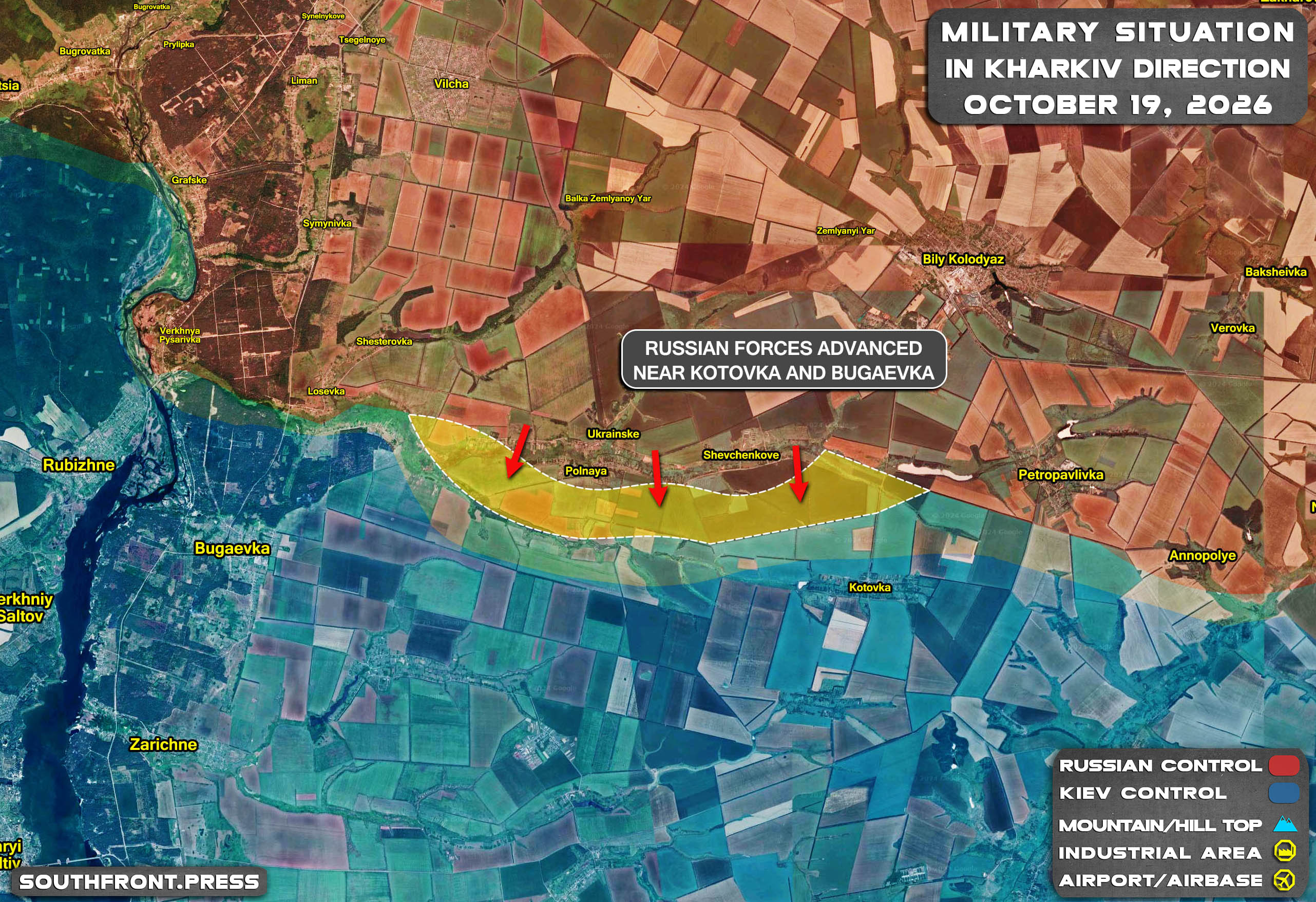
  • Russian forces advanced near Kotovka and Bugaevka.

Click to see the full-size image

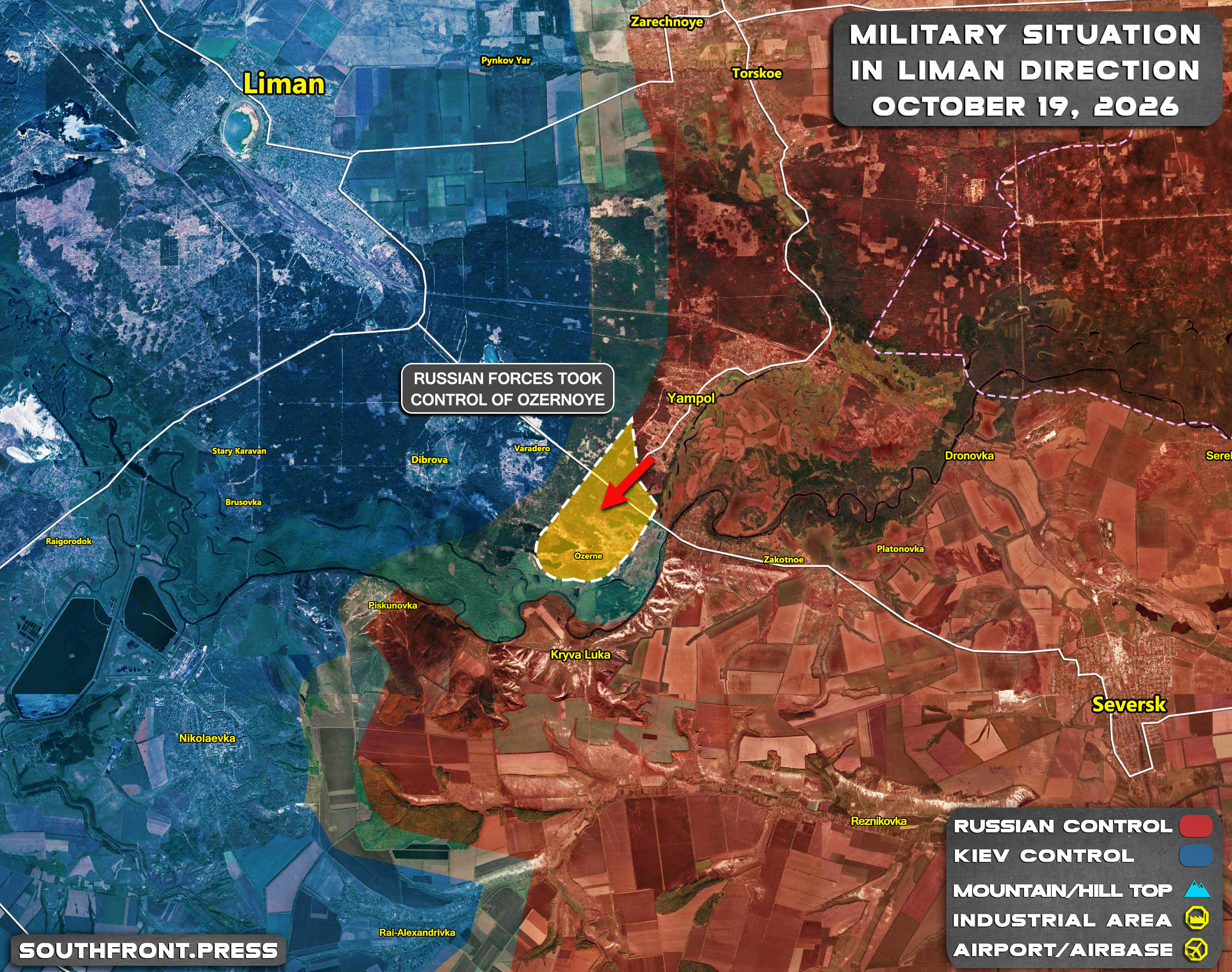
  • Russian forces took control of Ozernoye.

Click to see the full-size image

  • Russian forces took control of Omelnyk in the Zaporizhzhia region.

MORE ON THE TOPIC:

The post Military Situation In Ukraine On October 19, 2026 (Maps Update) appeared first on South Front.

❌