❌

Normal view

Russia and Ukraine Exchange Strikes: Railway Infrastructure, Energy, Metallurgy, and Chemical Industry Targets Hit
28 October 2026 at 18:25

Click to see the full-size image

On the night of October 28, Russian forces carried out a combined strike against targets on Ukrainian territory. According to the Ukrainian Air Force, the attack employed an Iskander-M/S-400 ballistic missile and 88 strike UAVs. The main emphasis was placed on logistics and energy infrastructure in Kharkiv, Dnipropetrovsk, Chernihiv, Volyn, and other Regions. In parallel, Ukrainian forces conducted a series of drone and cruise missile attacks against industrial targets on Russian territory, including the largest metallurgical combine and a chemical plant.

Strikes on Ukrainian Territory

Kharkiv Region

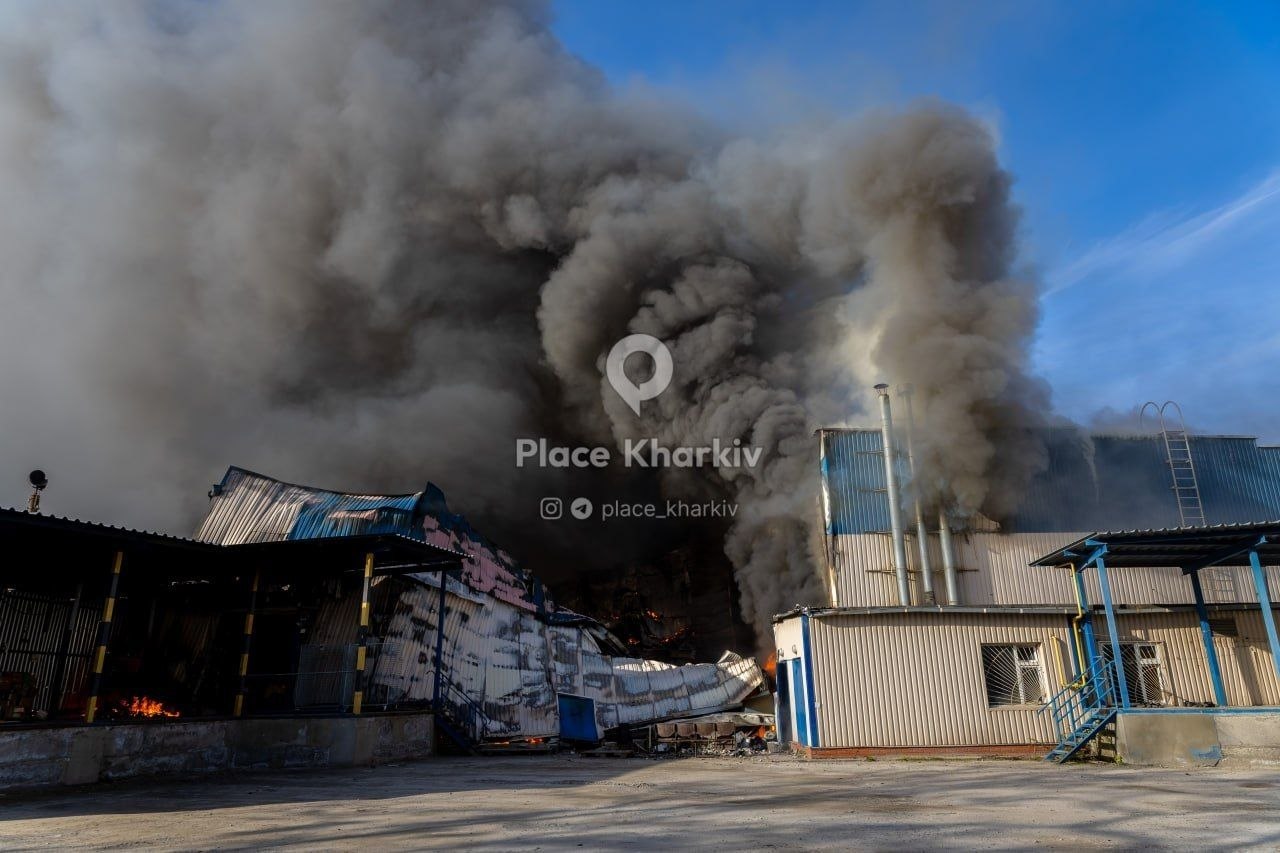
  • Logistics center in Kharkiv. According to a statement by the Russian Ministry of Defense, the site was used to store military and dual-use cargo intended to supply Ukrainian troops.

  • Locomotive near the settlement of Ordovka.

Dnipropetrovsk Region

  • Pyatykhatky railway station, Kamianske district. Two consecutive Geran-4 UAV strikes during the day. The first strike set a rail trolley on fire, destroyed the driver’s cab, and damaged the overhead contact line and a grain car in a freight train; the second strike set an electric locomotive on fire.

  • Gas station in Shakhtarske.

Chernihiv Region

  • Energy infrastructure in Chernihiv. According to Ukrainian sources, about 210,000 subscribers were left without electricity, and roughly 90 percent of the city was de-energized. The specific target has not been identified.

Volyn Region

  • PS-330 Lutsk-Northern substation, Lutsk. According to a statement by the Russian Ministry of Defense, the facility supplied power to military-industrial enterprises producing UAVs and components.

  • PS-330 substation, Kovel. A similar target; power outages were recorded in Kovel after the strike.

Kirovohrad Region

  • Railway facility in Znamianka.

Odesa Region

  • Bulk carrier underway toward the port of Chornomorsk. According to the Russian Ministry of Defense, the vessel was delivering cargo to supply the Ukrainian Armed Forces.

Reports also indicated strikes on targets in Zhytomyr, Vinnytsia, Khmelnytskyi, Kherson, Kyiv, Cherkasy, Sumy, and Zaporizhzhia Regions. A blackout was recorded in central Kyiv, with electricity absent in parts of the central districts.

Strikes on Russian Territory

According to a statement by the Russian Ministry of Defense, 531 Ukrainian UAVs were shot down overnight over Russian territory across 13 federal subjects.

Lipetsk Region

  • Novolipetsk Metallurgical Combine (NLMK), Lipetsk. The largest metallurgical enterprise in Russia, with a capacity of about 17 million metric tons of steel per year. According to Ukrainian sources, it was attacked with FP-5 cruise missiles; a fire was reported in the area of the combine. The governor of Lipetsk Region confirmed that UAV debris had fallen and vegetation had caught fire, while denying a “major fire at an industrial enterprise.” A total of 45 UAVs were shot down over the Region.

Tula Region

  • Azot chemical plant, Novomoskovsk. According to Ukrainian sources, the plant was attacked by UAVs, with the AM-70 ammonia production unit reportedly hit. Russian authorities confirmed the attack on the chemical plant and damage to residential buildings, without providing details about production capacity.

Kursk Region

  • Building housing servers for the regional healthcare system, Kursk. Damaged as a result of a UAV attack; disruptions to certain medical services are possible. Over the day, 168 UAVs were shot down over the Region, and three people were injured.

For the week of October 19–25, according to Russian data, attacks on civilian targets killed 50 civilians and injured 263.

On October 28, two opposing directions are evident: Russian strikes are concentrating on Ukrainian railway logistics, energy, and warehouse infrastructure, while Ukrainian drones are attacking large industrial sites deep inside Russia, including metallurgy in Lipetsk and chemical production in Novomoskovsk. The strikes on the substations in Lutsk and Kovel are of particular significance, as they point to an attempt to weaken the power supply to western Ukraine’s logistics and production capacity.


MORE ON THE TOPIC:

The post Russia and Ukraine Exchange Strikes: Railway Infrastructure, Energy, Metallurgy, and Chemical Industry Targets Hit appeared first on South Front.
Military Situation In Ukraine And Ukrainian Attacks On Russian Territory On October 28, 2026 (Maps Update)

28 October 2026 at 14:58

Click to see the full-size image

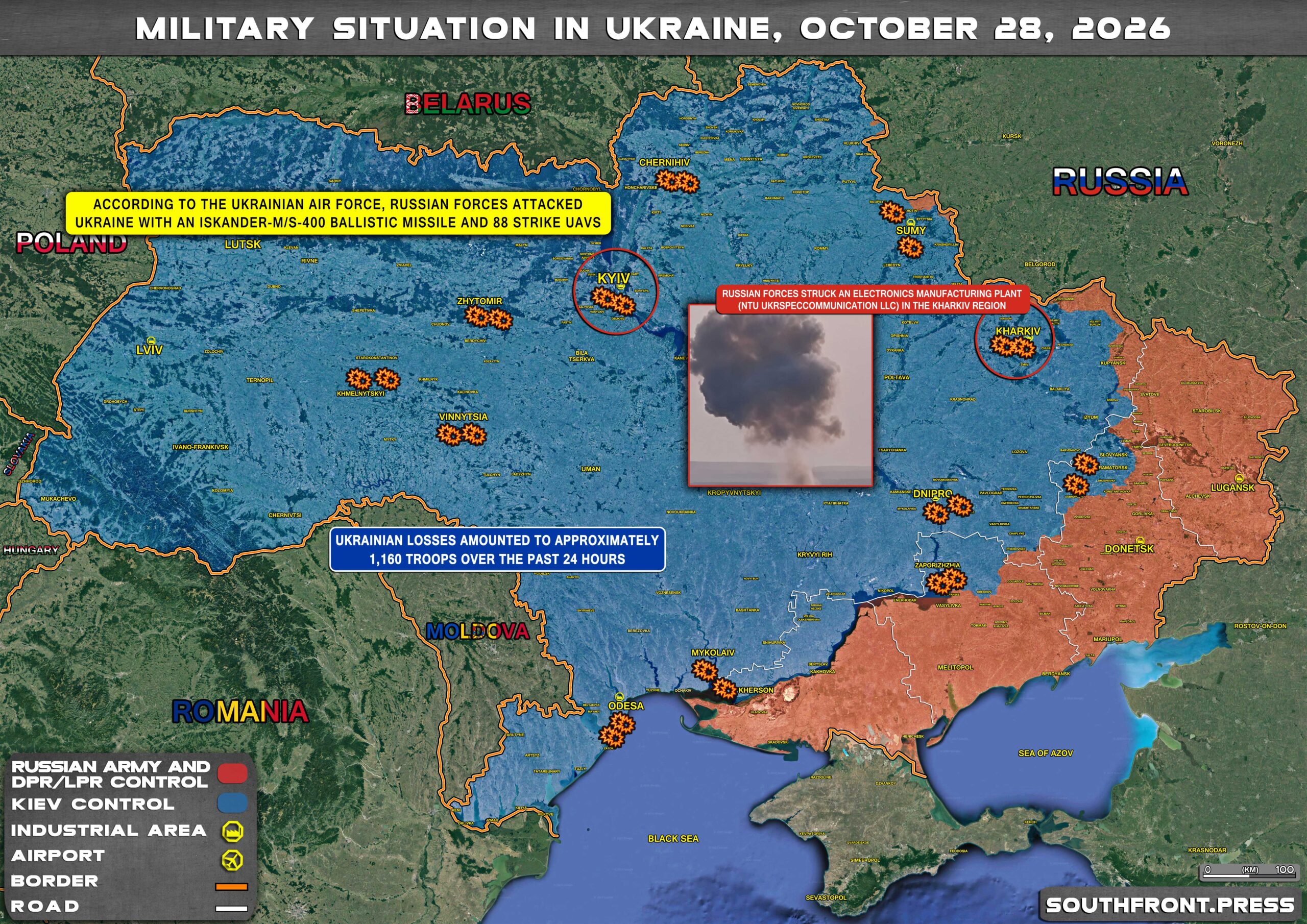
  • Russian strikes hit targets in the Sumy, Kharkiv, Zaporizhzhia, Dnipropetrovsk, Kherson, Vinnytsia, Kyiv, Kirovohrad, Khmelnytskyi, Zhytomyr, Cherkasy, Chernihiv regions, and the DPR;
  • According to the Ukrainian Air Force, Russian forces attacked Ukraine with an Iskander-M/S-400 ballistic missile and 88 strike UAVs;
  • Russian forces struck an electronics manufacturing plant (NTU Ukrspeccommunication LLC) in the Kharkiv region;
  • Ukrainian losses amounted to approximately 1,160 personnel over the past 24 hours.

Click to see the full-size image

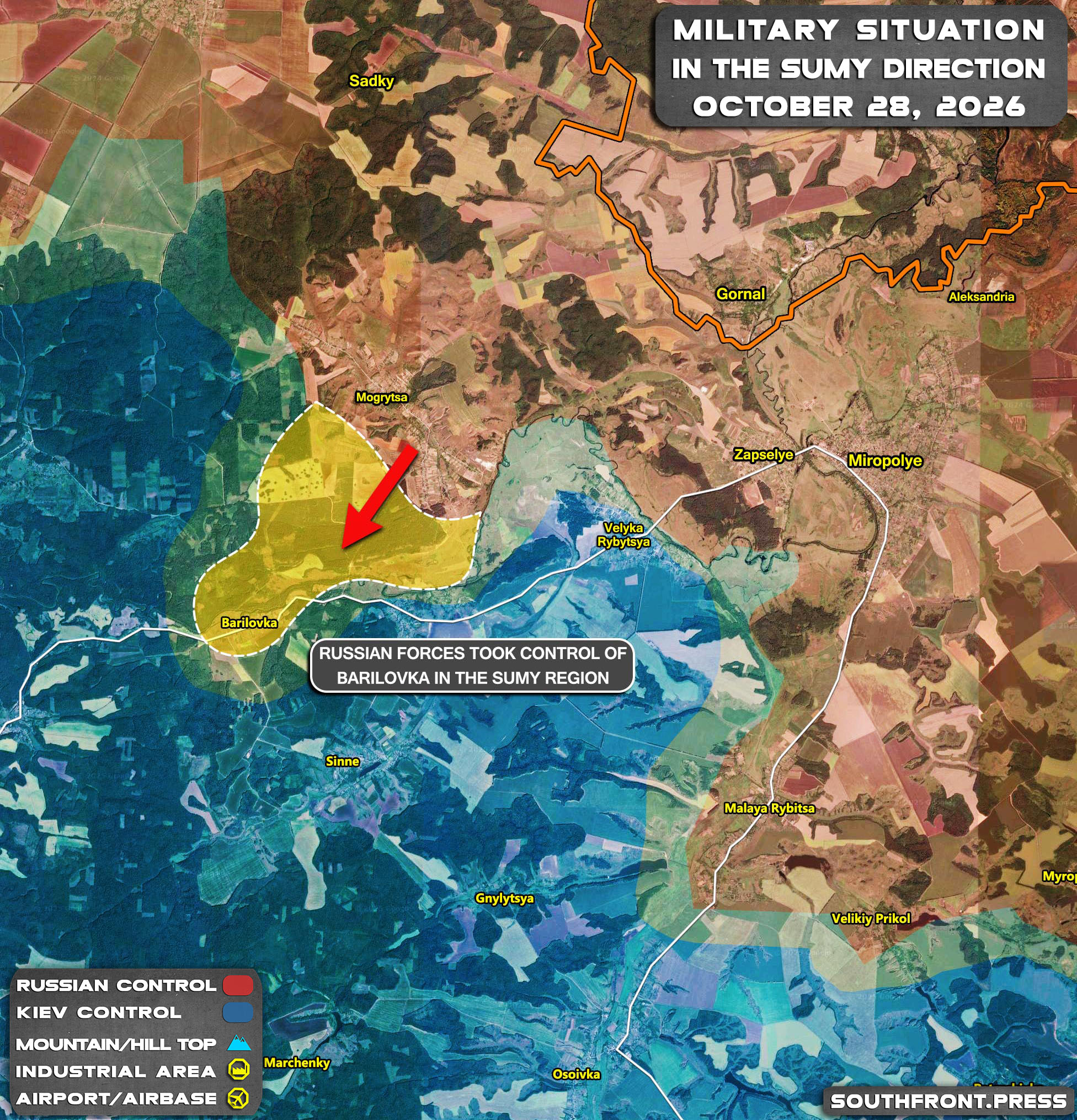
  • Russian forces took control of Barilovka in the Sumy region.

Click to see the full-size image

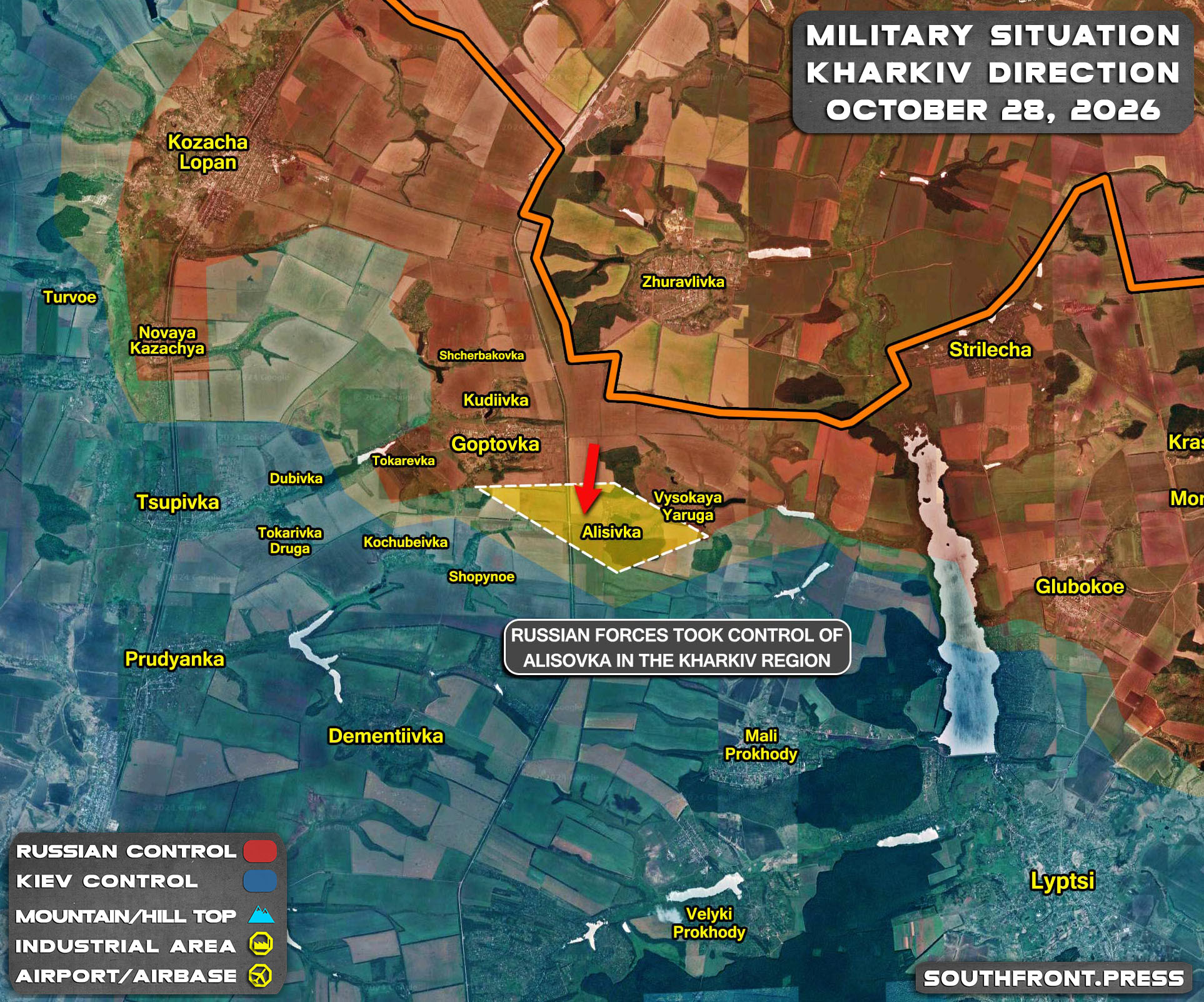
  • Russian forces took control of Alisovka in the Kharkiv region.

Click to see the full-size image

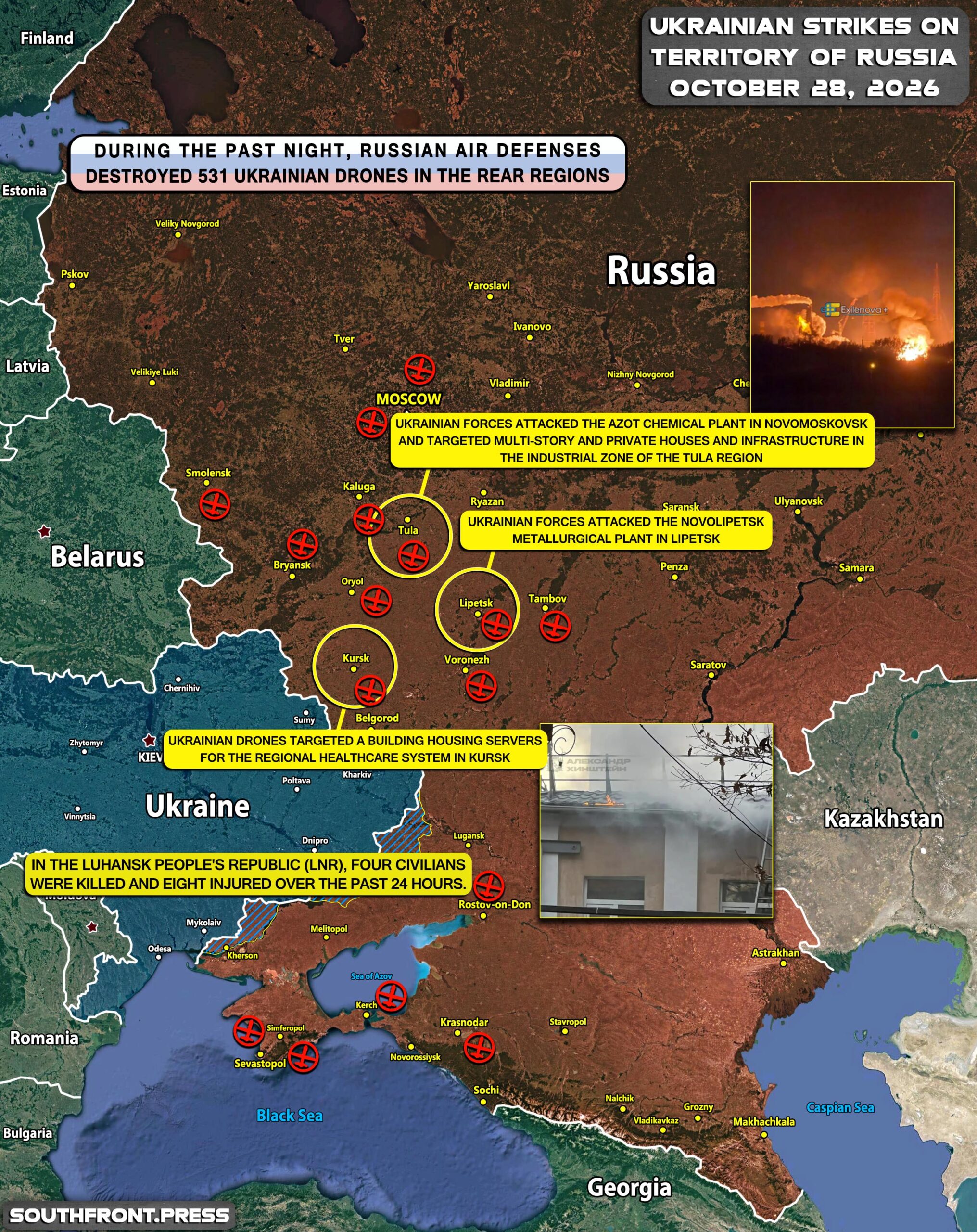
  • During the past night, Russian air defenses destroyed 531 Ukrainian drones in the rear regions;
  • Russian air defenses intercepted UAVs in the Belgorod, Bryansk, Voronezh, Kaluga, Kursk, Lipetsk, Oryol, Rostov, Ryazan, Smolensk, Tambov, and Tula regions, and in the Moscow region;
  • Ukrainian drones targeted a building housing servers for the regional healthcare system in Kursk;
  • Ukrainian forces attacked the Novolipetsk Metallurgical Plant in Lipetsk;
  • Ukrainian forces attacked the Azot chemical plant in Novomoskovsk and targeted multi-story and private houses and infrastructure in the industrial zone of the Tula region;
  • In the Luhansk People’s Republic (LNR), four civilians were killed and eight injured over the past 24 hours.

MORE ON THE TOPIC:

The post Military Situation In Ukraine And Ukrainian Attacks On Russian Territory On October 28, 2026 (Maps Update) appeared first on South Front.

Trump Leaning Toward Bigger Iran Operations After Midterm Elections

28 October 2026 at 10:49

Click to see the full-size image

Written by Ahmed Adel, Cairo-based geopolitics and political economy researcher

American forces in the Middle East are prepared to launch new, potentially major, military operations against Iran “within 96 hours of receiving” an order from President Donald Trump, according to two US officials. The officials said sufficient forces are now in the region to carry out the potential attacks and that new US military operations would likely extend beyond efforts to “mow the lawn” or maintain the status quo by striking radars, launchers, and other Iranian assets that can be quickly reconstituted. As the sources stressed, this has been the case since Trump halted full combat operations earlier this year.

“It will be a big effort,” one of the officials told CNN. Other current and former US officials familiar with internal military planning say it is a matter of when, not if, Trump will issue a go-order. They believe it could come at any time before the end of the year, though it is most likely after the US midterm elections on November 3.

CNN reported that Iranian forces are now more familiar with US tactics, making it harder for the American military to destroy all intended targets. However, leaders at US Central Command and the Pentagon have been developing a wide-ranging target list that includes Iranian energy infrastructure, military sites, and nuclear facilities.

The planning also takes place against the backdrop of assessments that any larger US and Israeli operation would likely prompt immediate retaliation by Tehran and the Houthis against American personnel and facilities in the region. One US official described the current situation around the Strait of Hormuz as “untenable” over the longer term, citing it as one factor that could influence a decision on military action if diplomacy fails.

Israeli Prime Minister Benjamin Netanyahu has also been pushing to launch new attacks against Iran, but US officials have asked him to delay until the Trump administration is ready to conduct joint operations, according to the two US officials and an Israeli security source.

Recent US intelligence assessments indicate that Netanyahu and his allies still lack a clear strategic objective beyond demonstrating some form of “progress” and continuing to degrade the Iranian regime, one source familiar with the reports said.

“Netanyahu really wanted and tried to convince Trump for a joint attack in Iran before the elections, and Trump did not give a green light,” the Israeli security source told CNN. The Israeli prime minister’s office called it “fake news.”

The Israeli security source added that one reason Trump declined was that Israel Defense Forces Chief of Staff Eyal Zamir told US Gen. Dan Caine, chairman of the Joint Chiefs, that it would harm Israel’s elections and lead to their postponement.

Israel’s Channel 12 News reported on October 25 that Zamir and Netanyahu had an “unprecedented” confrontation less than 48 hours before the election. According to the report, Zamir received a directive from the political echelon regarding Iran but sought an in-depth discussion and legal authorization before acting, concerned that the move could be miscalculated and trigger an immediate conflict.

Defense Minister Israel Katz said the report was “completely baseless and false.”

The preparations US officials described come amid other military plans reported by other American outlets. The New York Times, for example, has reported that the US and Israeli militaries have developed specific plans for a short, intensive round of strikes following the American midterm elections, with likely targets including Iran’s energy infrastructure, nuclear facilities, and missile and drone arsenal. According to the NYT, the two sides have stepped up exercises, including flights over Iraq to practice strike manoeuvres. Defense Secretary Pete Hegseth also recently met with Israeli Prime Minister Benjamin Netanyahu to discuss options.

ABC News reported that the Israeli military and the US have drawn up plans for renewed joint strikes in the coming weeks, with Israeli sources indicating the operations would almost certainly be delayed until after the US midterms. The White House has publicly stated that the US will not attack Iran before the November 3 elections.

At the same time, Iranian officials have signalled they are preparing for renewed hostilities. Iranian sources have warned that any new US-Israeli campaign would prompt a broader retaliatory response, potentially including attacks on energy infrastructure, data centers, and other economic targets in Gulf states.

Although it is uncertain whether the current planning will lead to a new major operation, it appears that Trump is heading in that direction if Iran does not submit to American demands. Nonetheless, US officials insist that although forces are in position and target lists have been prepared, no final order has been issued—and past periods of apparent readiness have not always led to action.


MORE ON THE TOPIC:

The post Trump Leaning Toward Bigger Iran Operations After Midterm Elections appeared first on South Front.

❌