❌

Reading view

Military Situation In Ukraine And Ukrainian Attacks On Russian Territory On October 27, 2026 (Maps Update)

Click to see the full-size image

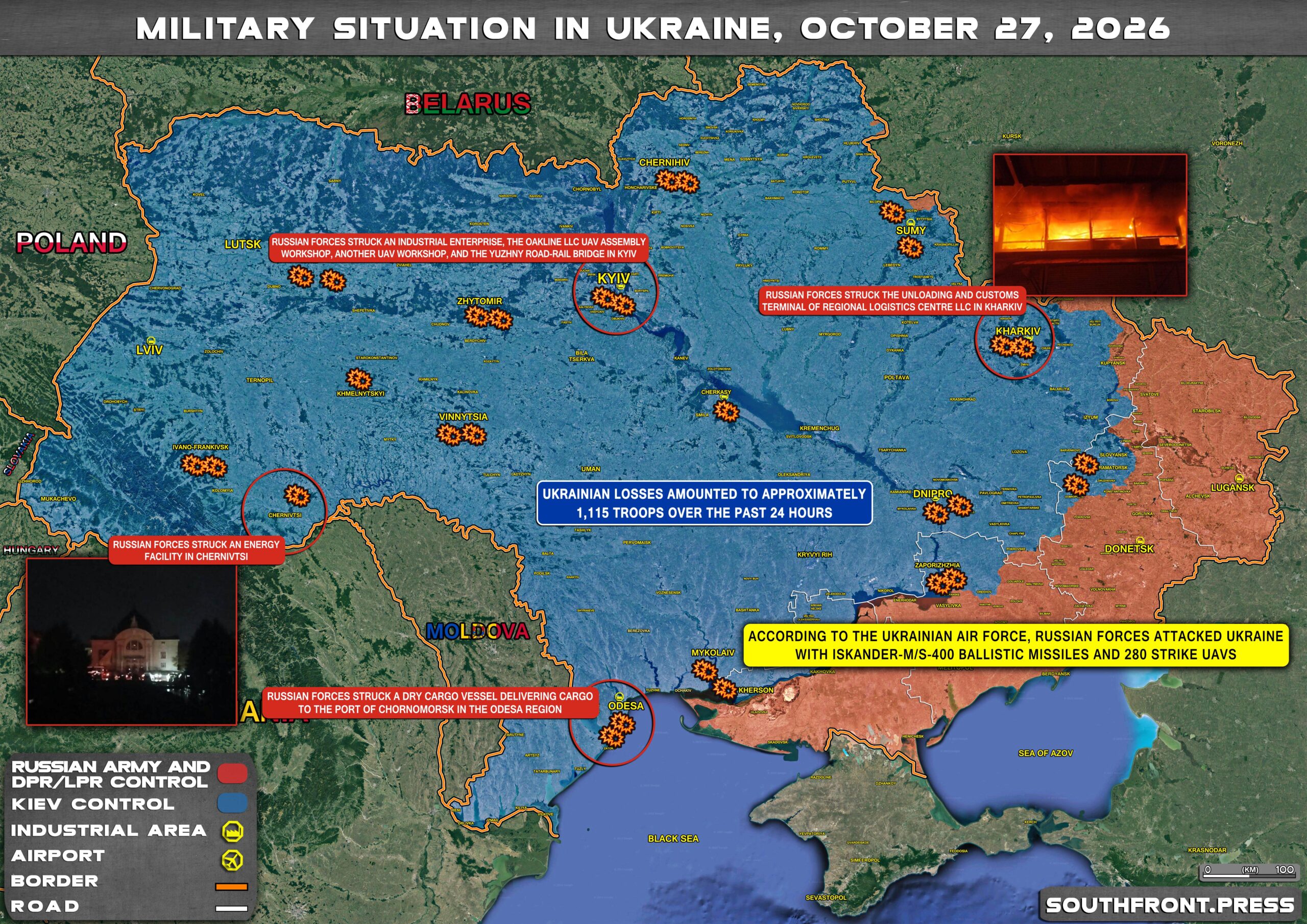
  • Russian strikes hit targets in the Sumy, Kharkiv, Zaporizhzhia, Dnipropetrovsk, Kherson, Kyiv, Vinnytsia, Zhytomyr, Ivano-Frankivsk, Odesa, Rivne, Khmelnytskyi, Cherkasy, Chernihiv regions, and the DPR;
  • According to the Ukrainian Air Force, Russian forces attacked Ukraine with Iskander-M/S-400 ballistic missiles and 280 strike UAVs;
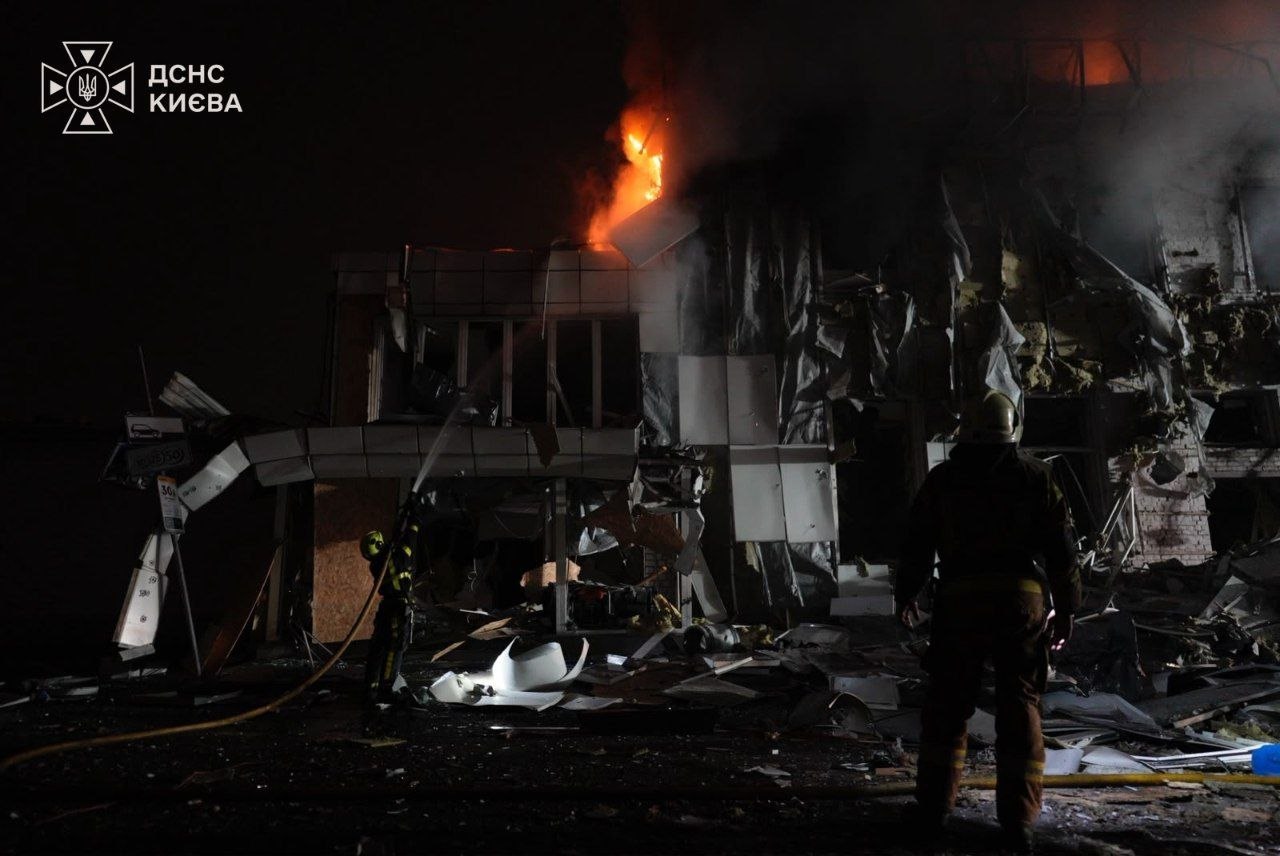
  • Russian forces struck an industrial enterprise, the Oakline LLC UAV assembly workshop, another UAV workshop, and the Yuzhny road-rail bridge in Kyiv;
  • Russian forces struck the unloading and customs terminal of Regional Logistics Centre LLC in Kharkiv;
  • Russian forces struck a dry cargo vessel delivering cargo to the port of Chornomorsk in the Odesa region;
  • Russian forces struck an energy facility in Chernivtsi;
  • Ukrainian losses amounted to approximately 1,115 personnel over the past 24 hours.

Click to see the full-size image

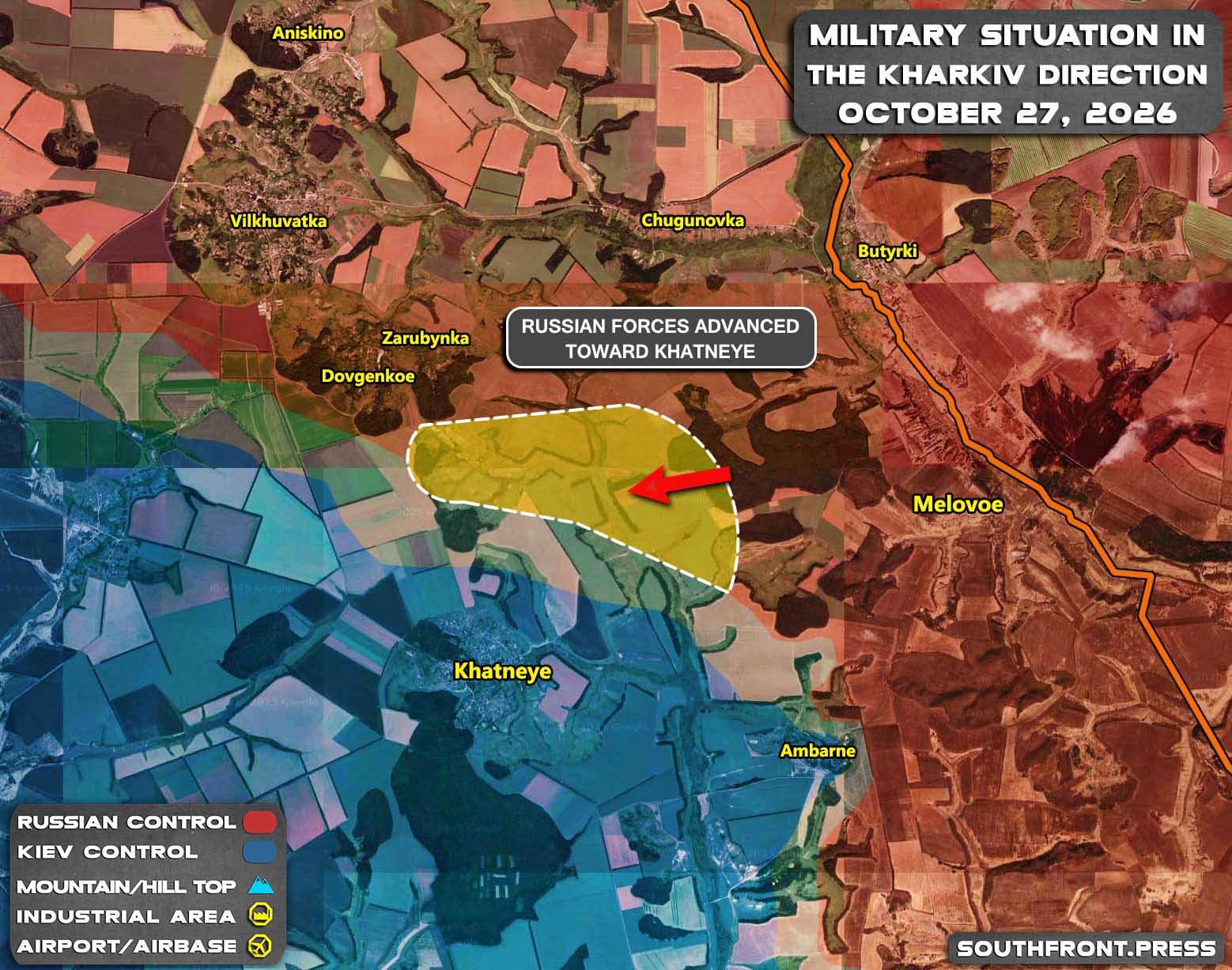
  • Russian forces advanced toward Khatneye.

Click to see the full-size image

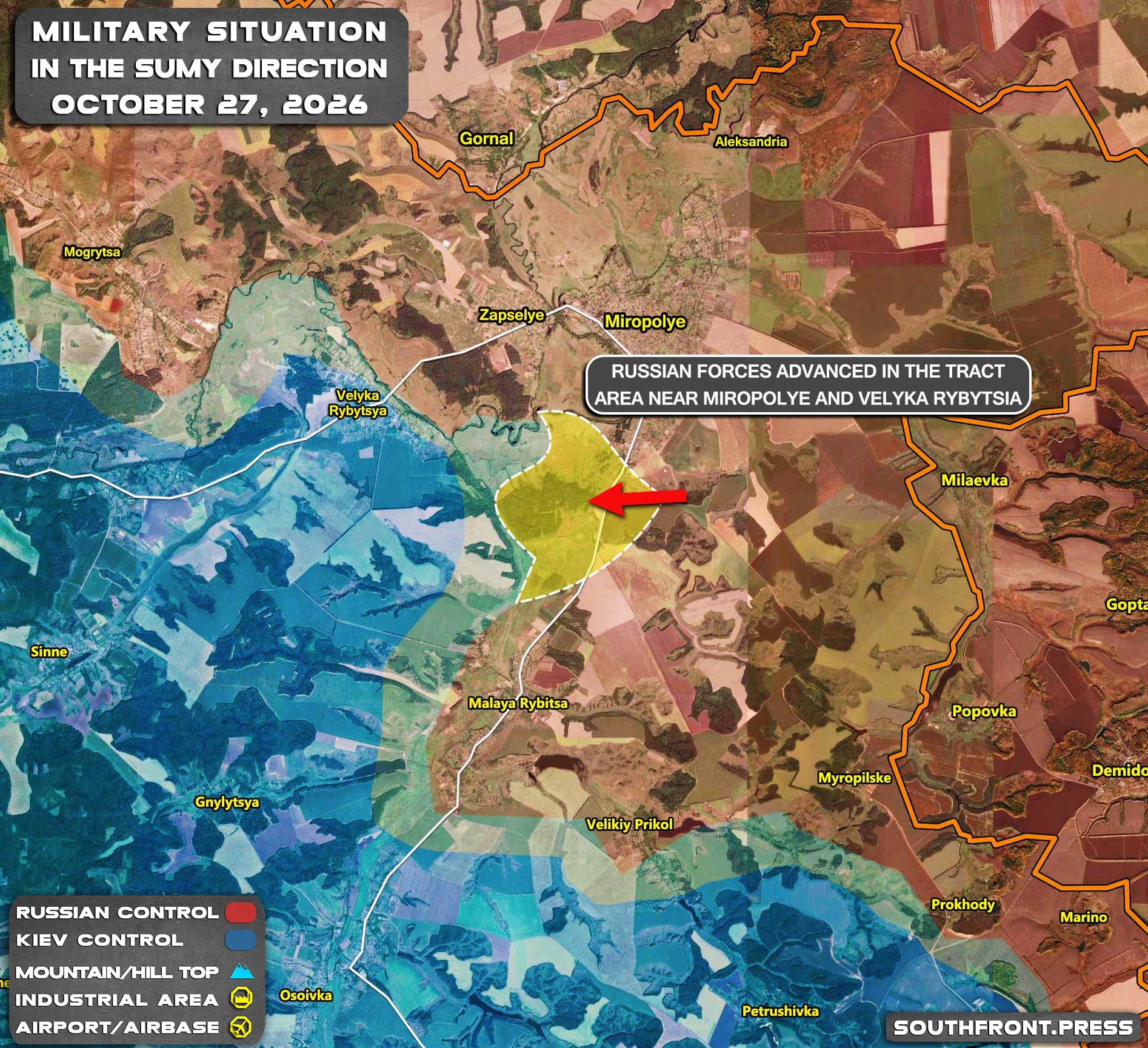
  • Russian forces advanced in the tract area near Miropolye and Velyka Rybytsia.

Click to see the full-size image

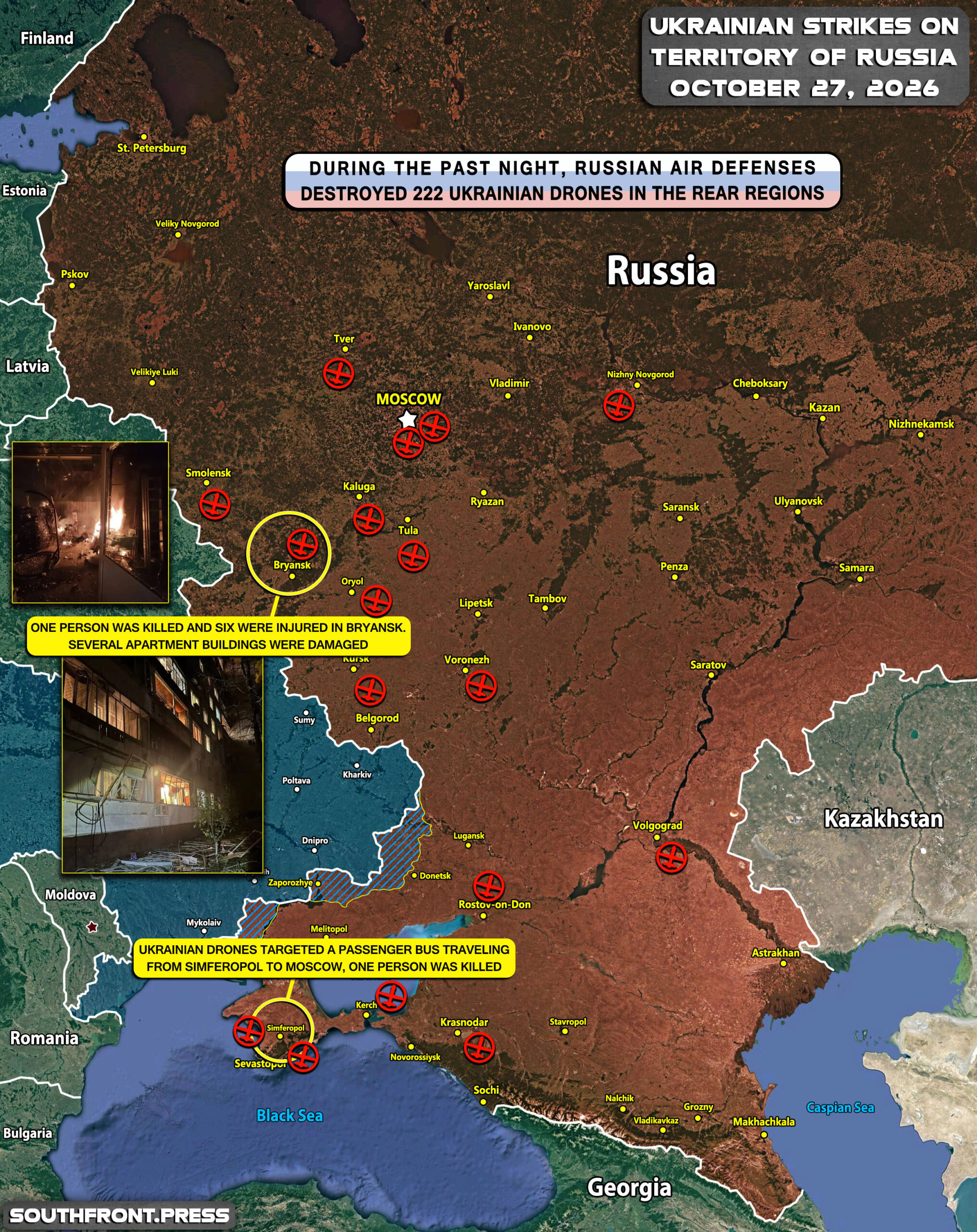
  • During the past night, Russian air defenses destroyed 222 Ukrainian drones in the rear regions;
  • Russian air defenses intercepted UAVs in the Novgorod, Tver, Belgorod, Bryansk, Kursk, Kaluga, Oryol, Tula, Voronezh, Smolensk, and Rostov regions, in Krasnodar Krai, in the Republic of Crimea, and over the Black Sea;
  • Russian air defenses intercepted UAVs in the Novgorod, Tver, Belgorod, Bryansk, Kursk, Kaluga, Oryol, Tula, Voronezh, Smolensk, Rostov regions, Krasnodar region, the Republic of Crimea, and over the Black Sea;
  • One person was killed and six were injured in Bryansk. Several apartment buildings were damaged;
  • Ukrainian drones targeted a passenger bus traveling from Simferopol to Moscow, One person was killed.

MORE ON THE TOPIC:

The post Military Situation In Ukraine And Ukrainian Attacks On Russian Territory On October 27, 2026 (Maps Update) appeared first on South Front.

  •  

No Volunteers Left: Ukraine Turns Factories Into Recruiting Offices

Ukraine’s leadership is wrestling with a problem that no speech or summit can solve: finding enough soldiers. The issue surfaces in the news at irregular intervals, but it never goes away, and the latest government proposal suggests that the search for a solution is becoming more desperate.

The pool of volunteers dried up several years ago. Since then, forced mobilization has been the main tool for keeping the army at a tolerable strength. Even so, losses often outpace the incoming replacements. Two factors explain much of the gap: the dense saturation of the battlefield with drones, and a command structure that critics describe as wasteful with its own manpower.

Getting to the front is itself an ordeal. Conditions in territorial recruitment centers are reportedly sometimes worse than in prisons. The same is said of training centers, where recruits are delivered in prison transport vans to prevent escape.

Many men have responded by taking jobs at defense plants and other critical facilities, hoping that employment will shield them from the draft. That shield is now being reshaped.

Prime Minister Serhiy Koretsky on October 26 outlined the government’s new approach at the Kyiv International Economic Forum. Under the proposed model, companies would be allowed to reserve their employees from mobilization. In return, they would have to guarantee a predictable flow of manpower into the army. By December 1, the Cabinet intends to present a new contract on mobilization and reservation. At the same time, the government plans to toughen penalties for draft evasion.

The consequences deserve a closer look. Company managers would effectively decide which employees go to the front, and for those selected, that choice may amount to a death sentence. Such a system could hand President Volodymyr Zelenskyy a new lever of control over large industrialists, whose commercial interest lies in surrendering as few workers as possible.

Big business, meanwhile, would gain nearly unlimited authority over its staff. Workers will tolerate almost any conditions to keep their exemption. Wage cuts and higher productivity demands are the obvious costs, and they will fall on ordinary citizens, who have the least power to refuse.

The result is a mobilization model built on fear at every level. The state fears the front will run out of men. Employers fear losing either their workforce or the government’s favor. Workers, in turn, fear the draft office more than their bosses. A system that runs on fear can fill the  ranks for a while, but it cannot restore the trust that a long war quietly consumes.

______________________________________________________________________________________________________________________

DEAR FRIENDS. IF YOU LIKE THIS TYPE OF CONTENT, SUPPORT SOUTHFRONT WORK:

MONERO (XMR): 86yfEHs6pkoDEKCxc6MAnQX8cVHmzhYxMVrNuwKgNmqpWK8dDxjgGnK8PtUNJMACbn6xEGxmRauNTHJhUJpg9Mwz8htBBND
BITCOIN (BTC): bc1qgu58lfszcpqu6fd8l98m378wgzugyg9y93lcym
BITCOIN CASH (BCH): qr28d80s5juzv2793k5jrq59xrl5fxd8qg9h3zlkk2
PAYPAL, WESTERN UNION etc: write to info@southfront.press , southfront@list.ru

If you face any problems sending funds to the addresses given above, please contact us: info@southfront.press and southfront@list.ru. Also be aware that many email services such as Hotmail, Yahoo etc. may block correspondence from info@southfront.press and some others put it in spam.

If you want to support SouthFront but have no opportunity to do it via cryptocurrency, please contact us: info@southfront.press and southfront@list.ru.

SouthFront: Analysis and Intelligence
NOW hosted at southfront.press
Previously, SouthFront: Analysis and Intelligence was at southfront.org.
The .org domain name had been blocked by the US (NATO) (https://southfront.press/southfront-org-blocked-by-u-s-controlled-global-internet-supervisor/) globally, outlawed and without any explanation
Back before that, from 2013 to 2015, SouthFront: Analysis and Intelligence was at southfront.com

SOUTHFRONT.PRESS

The post No Volunteers Left: Ukraine Turns Factories Into Recruiting Offices appeared first on South Front.

  •  

Russia Continues Strikes on Ukraine’s Attack-Drone Production and Military Supply Hubs

Click to see the full-size image

On the night of October 27, the Russian Armed Forces carried out a massive combined strike across Ukrainian territory. According to the Ukrainian Air Force, the attack involved Iskander-M/S-400 ballistic missiles and strike UAVs, 16 missiles and more than 280 drones in total. The Russian Ministry of Defense says it struck defense-industrial enterprises involved in the production of cruise missiles and UAVs, transportation infrastructure, logistics centers handling dual-use cargo, and maritime vessels used to support the Ukrainian Armed Forces.

Strikes by Region

Kyiv and Kyiv Region

• Southern Road-and-Rail Bridge. A key piece of transportation infrastructure in the capital used for the transit of cargo by road and rail. Ukrainian sources confirmed damage to the crossing, which led to a partial suspension of service on the Green Line of the metro and major transport disruption at Darnytsia Station.
• UAV assembly workshop of LLC Oakline. A production site that assembled and stored Fire Point’s FP-1 and FP-2 long- and medium-range unmanned aerial vehicles.
• Industrial facility producing and storing long- and medium-range UAVs. Another Kyiv site struck during the overnight attack; its specific name has not been disclosed.
• UAV assembly workshop producing and storing long- and medium-range fixed-wing unmanned aerial vehicles.

Kharkiv Region
• Unloading and customs terminal of the Regional Logistics Center company. A logistics facility where, according to the Russian Ministry of Defense, military supplies, dual-use cargo intended for the Ukrainian Armed Forces, and reconnaissance and strike UAVs were stored and distributed.

• Electronics manufacturer LLC NTP Ukrspetssvyaz, in the settlement of Nadtochii. A production site that made automation systems and communications equipment for the Ukrainian Armed Forces.

• Gas production infrastructure. Naftogaz reported a morning strike on gas production infrastructure in Kharkiv Region. The available information does not identify specific fields or facilities.

• Budmen home-improvement store in Kharkiv. A facility reportedly struck, according to local Telegram channels.

Odesa Region
• Bulk carrier bound for the port of Chornomorsk. A cargo vessel that, according to the Russian Ministry of Defense, was delivering supplies intended to support the Ukrainian Armed Forces.
• Bulk carrier bound for the port of Odesa. Another cargo vessel en route to Odesa with military cargo; it was struck in the daytime wave of attacks.

Chernivtsi Region
• Energy infrastructure facility. Local sources said the target was a substation; Chernivtsioblenergo warned of possible large-scale emergency outages. In Chernivtsi, trolleybus service was suspended, power was lost in several districts, and water was supplied at reduced pressure.

Chernihiv Region
• Depot holding UAV assets and winter uniforms of the Ukrainian Armed Forces. According to monitoring channels, a UAV strike sparked a large fire that destroyed unmanned systems and winter uniforms belonging to Ukrainian troops.

Strikes on facilities were also reported in Vinnytsia, Zhytomyr, Lviv, Sumy, Zaporizhzhia, Dnipropetrovsk, Kherson, Ivano-Frankivsk, Rivne, Khmelnytskyi, and Cherkasy Regions.

The nature of the October 27 strikes points to a continued systematic campaign against Ukraine’s strike-UAV production chain and the logistics hubs supplying its armed forces. Within this framework, the overnight wave combined strikes on Kyiv’s assembly facilities with damage to the Southern Bridge, affecting both drone production and its delivery channels. The strikes on the logistics terminal in Kharkiv Region and on cargo vessels off Chornomorsk and Odesa serve the same purpose: cutting off routes for dual-use cargo and components. The damage to the energy facility in Chernivtsi Region was limited in scale and did not involve major power-generation capacity, unlike earlier attacks on thermal and hydroelectric power plants.

Ukraine’s response is shifting toward scaling output rather than quality: Defense Minister Oleksii Khmara discussed with Western partners the transfer of 10% of their Patriot and IRIS-T missile stockpiles, as well as the possibility of doubling Ukrainian drone production by 2027 with sufficient funding. This aligns with Fire Point’s acknowledgment that the Flamingo missile mattered more as a political signal than as a “superweapon.” According to company head Iryna Terekh, the project was primarily intended to demonstrate Ukraine’s ability to conduct long-range strikes against Russian territory. The company also acknowledged the economic trade-off: delivering a 200-kilogram warhead over 300 kilometers by ballistic missile costs about $600,000, whereas a drone can deliver a comparable payload over 380 kilometers for $40,000-$50,000.

It is precisely this economic logic that explains why strikes on FP-1 and FP-2 assembly capacity and logistics hubs are becoming increasingly significant: drones remain Ukraine’s most numerous and affordable means of long-range strike, and this segment is also the most vulnerable part of its program. In the medium term, Russian strikes are likely to continue prioritizing enterprises that produce components for UAVs and cruise missiles, as well as transportation routes linking Ukraine’s central and western regions to the front line.


MORE ON THE TOPIC:

The post Russia Continues Strikes on Ukraine’s Attack-Drone Production and Military Supply Hubs appeared first on South Front.

  •  

Military Situation In Yemen On October 27, 2026 (Map Update)

Click to see full-size map.

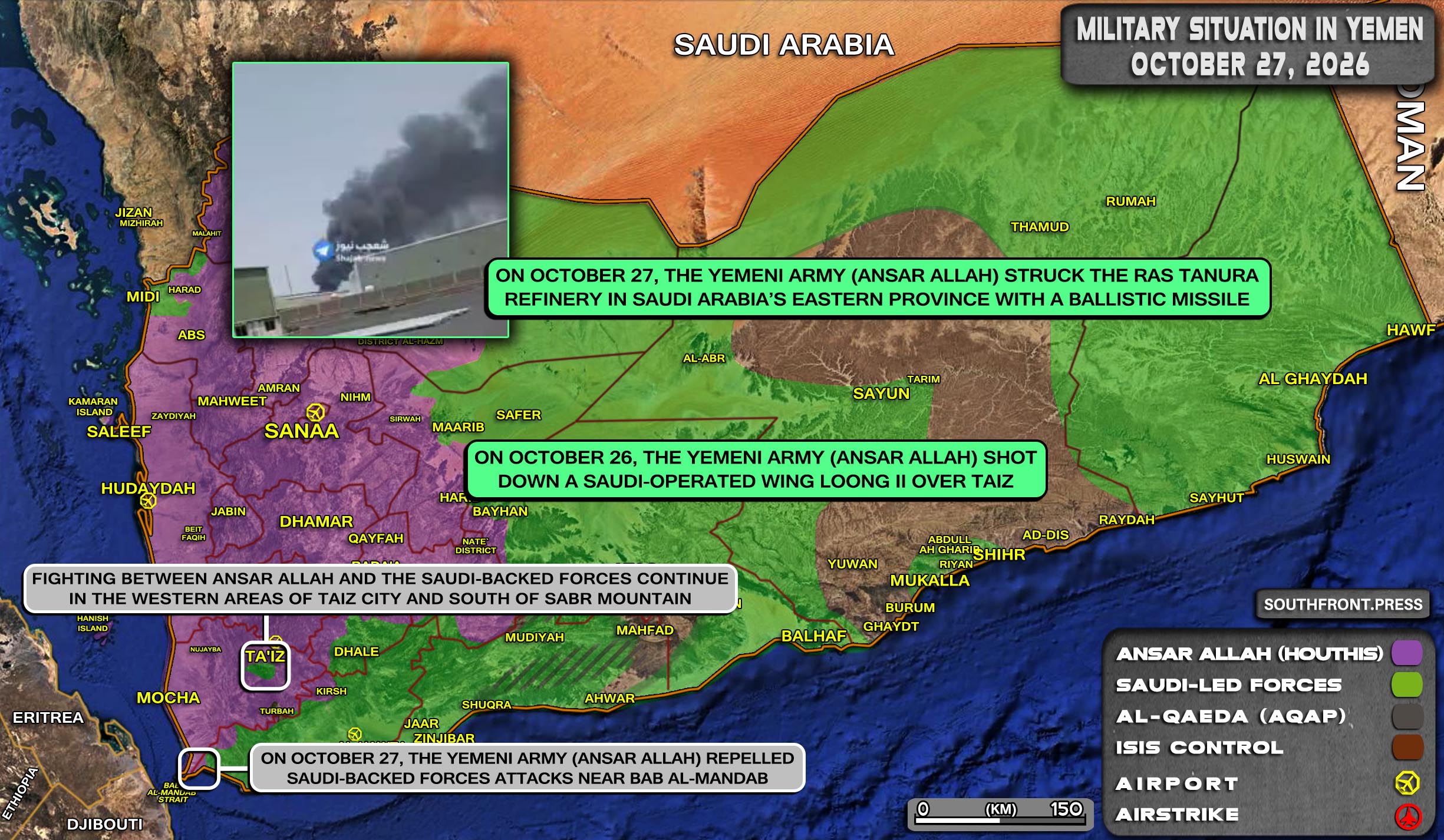
  • On October 26, the Yemeni army (Ansar Allah) shot down a Saudi-operated Wing Loong II over Taiz;
  • On October 27, the Yemeni army (Ansar Allah) struck the Ras Tanura refinery in Saudi Arabia’s Eastern Province with a ballistic missile;
  • On October 27, the Yemeni army (Ansar Allah) repelled Saudi-backed forces attacks near Bab al-Mandab;
  • Fighting between Ansar Allah and the Saudi-backed forces continue in the western areas of Taiz city and south of Sabr mountain.

_______________________________________________________________________________________________________________________

SouthFront: Analysis and Intelligence

NOW hosted at southfront.press

Previously, SouthFront: Analysis and Intelligence was at southfront.org.

The .org domain name had been blocked by the US (NATO) (https://southfront.press/southfront-org-blocked-by-u-s-controlled-global-internet-supervisor/) globally, outlawed and without any explanation

Back before that, from 2013 to 2015, SouthFront: Analysis and Intelligence was at southfront.com

SOUTHFRONT.PRESS

MORE ON THIS TOPIC:


The post Military Situation In Yemen On October 27, 2026 (Map Update) appeared first on South Front.

  •  

Houthis Repel Saudi-Backed Push Toward Bab al-Mandab, Advance in Lahj

file image.

Yemen’s Houthis (Ansar Allah) said October 27 that they had repelled an attack by Saudi-backed forces toward the strategic Bab al-Mandab Strait, reporting heavy casualties and the destruction of several military vehicles as fighting continued in western Lahj.

In a statement, Brig. Gen. Yahya Saree, the Houthis’ military spokesman, said the forces were advancing from the south toward the strait under the supervision of Saudi officer Badr al-Harbi, whom he identified as commander of an advanced operational base in Aden.

The Houthis struck the troop concentrations with ballistic missiles and heavy weapons, causing large numbers of deaths and injuries, while ambulances rushed to the targeted areas, Saree said. The spokesman added that Houthi forces went on to destroy a number of military vehicles and thwart the advance.

“We warn those being misled against responding to calls from the Saudi enemy and its officers, who are pushing them into the furnaces of death,” Saree concluded.

The latest failed Saudi-backed attack follows a series of reported Houthi advances in western Lahj over the past several days.

On October 25, the Houthi-aligned Yemen Press Agency, citing southern political figure Adel al-Hasani, reported that the group had secured Wadi al-Nabiq after fierce clashes and was advancing toward al-Shatein, in the al-Mudharaba and Ras al-Arah districts.

The very next day, the agency reported that the Houthis had advanced beyond the Kahboub mountain range after positions held by the 31st Amaliqa Brigade collapsed, with remaining fighters withdrawing toward Aden.

Reports that surfaced around the same time Saree issued his latest statement described a further Houthi push toward al-Suqayyah following the reported gains around Kahboub.

The fighting has focused on the highlands and coastal routes of western Lahj, where control of the Kahboub range and surrounding areas could strengthen the Houthis’ positions along the southern approaches to Bab al-Mandab. The group captured the strategic coastal region in a lightning offensive last month.

_______________________________________________________________________________________________________________________

SouthFront: Analysis and Intelligence

NOW hosted at southfront.press

Previously, SouthFront: Analysis and Intelligence was at southfront.org.

The .org domain name had been blocked by the US (NATO) (https://southfront.press/southfront-org-blocked-by-u-s-controlled-global-internet-supervisor/) globally, outlawed and without any explanation

Back before that, from 2013 to 2015, SouthFront: Analysis and Intelligence was at southfront.com

SOUTHFRONT.PRESS

MORE ON THIS TOPIC:

The post Houthis Repel Saudi-Backed Push Toward Bab al-Mandab, Advance in Lahj appeared first on South Front.

  •  

Military Situation In Iran On October 27, 2026 (Map Update)

Click to see full-size map.

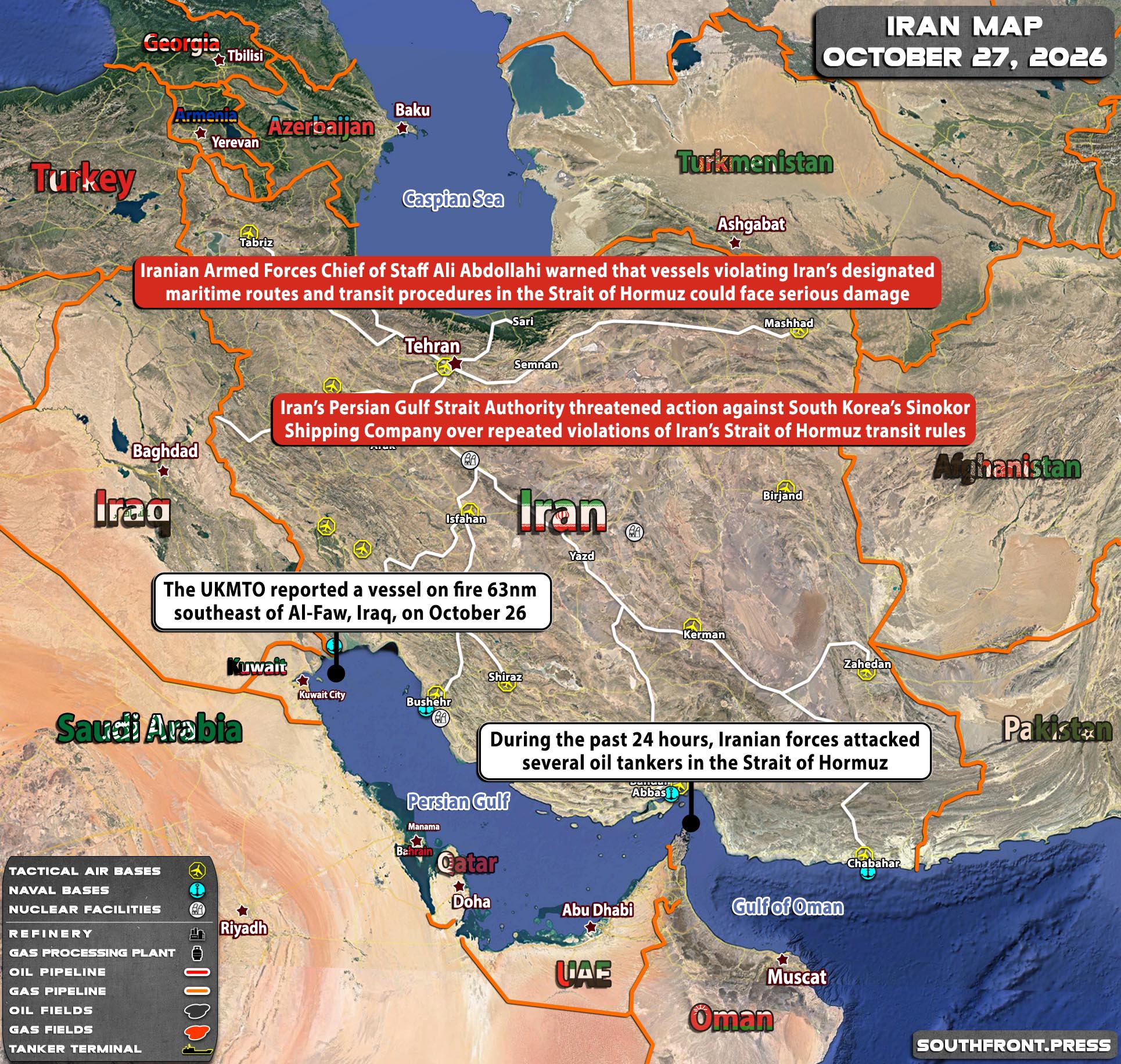
  • During the past 24 hours, Iranian forces attacked several oil tankers in the Strait of Hormuz;
  • Iranian Armed Forces Chief of Staff Ali Abdollahi warned that vessels violating Iran’s designated maritime routes and transit procedures in the Strait of Hormuz could face serious damage;
  • Iran’s Persian Gulf Strait Authority threatened action against South Korea’s Sinokor Shipping Company over repeated violations of Iran’s Strait of Hormuz transit rules;
  • The UKMTO reported a vessel on fire 63nm southeast of Al-Faw, Iraq, on October 26.

_______________________________________________________________________________________________________________________

SouthFront: Analysis and Intelligence

NOW hosted at southfront.press

Previously, SouthFront: Analysis and Intelligence was at southfront.org.

The .org domain name had been blocked by the US (NATO) (https://southfront.press/southfront-org-blocked-by-u-s-controlled-global-internet-supervisor/) globally, outlawed and without any explanation

Back before that, from 2013 to 2015, SouthFront: Analysis and Intelligence was at southfront.com

SOUTHFRONT.PRESS

MORE ON THIS TOPIC:


The post Military Situation In Iran On October 27, 2026 (Map Update) appeared first on South Front.

  •  

Houthis Strike Saudi Oil Refinery, Defense Ministry Amid Reports of $1 Billion Offer (Videos)

Illustrative image. (The Houthis’ Military Media)

Yemen’s Houthis (Ansar Allah) on October 27 claimed a series of missile and drone attacks against Saudi Arabia, including a ballistic missile strike on the Ras Tanura refinery that it said caused massive fires.

Brig. Gen. Yahya Saree, the group’s military spokesman, said in a statement that the group had struck the refinery in Saudi Arabia’s Eastern Province with a ballistic missile, describing the strike as precise and claiming it caused “massive fires” at the site.

Bloomberg News, citing a person familiar with the matter, reported that Saudi Arabia had contained a fire near the Ras Tanura oil terminal early in the day. The extent of the damage was unclear, and Saudi authorities had not confirmed that the refinery itself had been struck.

A resident of the nearby city of Al Khobar told Agence France-Presse that he received a mobile phone alert before hearing an explosion.

In a separate statement, Saree said that Houthi forces had targeted two military transport aircraft with ballistic missiles, one at Najran Airport and the other at King Khalid Air Base in Khamis Mushait. He said both operations had “achieved their objectives successfully.”

Saree subsequently claimed that a ballistic missile had struck Saudi Arabia’s Ministry of Defense in Riyadh, describing the impact as a “direct hit.”

In the fourth statement, he said the Houthis had targeted Abha International Airport with a drone, claiming the strike was precise and had disrupted air traffic at the airport.

Saudi authorities had not immediately confirmed the claimed strikes on the military aircraft, Defense Ministry or Abha airport.

The Saudi-led coalition said during the day that it had intercepted and destroyed three ballistic missiles launched toward the kingdom’s Eastern Province and four drones directed toward its southern regions.

Saudi Civil Defense issued early-warning alerts in the Eastern Province and Kharj governorate before announcing that the danger had passed.

In a separate report, Reuters said the coalition had also announced the interception and destruction of two ballistic missiles launched toward Riyadh. Saudi Civil Defense authorities briefly issued an air raid alert in the capital.

The latest Houthi strikes on Saudi Arabia come amid reports that the kingdom is seeking a negotiated end to the confrontation. Israel Hayom reported on October 26, citing unnamed Gulf diplomatic sources, that Riyadh had offered the group $1 billion through Iran in exchange for a ceasefire and an end to strikes on Saudi territory.

_______________________________________________________________________________________________________________________

SouthFront: Analysis and Intelligence

NOW hosted at southfront.press

Previously, SouthFront: Analysis and Intelligence was at southfront.org.

The .org domain name had been blocked by the US (NATO) (https://southfront.press/southfront-org-blocked-by-u-s-controlled-global-internet-supervisor/) globally, outlawed and without any explanation

Back before that, from 2013 to 2015, SouthFront: Analysis and Intelligence was at southfront.com

SOUTHFRONT.PRESS

MORE ON THIS TOPIC:

The post Houthis Strike Saudi Oil Refinery, Defense Ministry Amid Reports of $1 Billion Offer (Videos) appeared first on South Front.

  •  

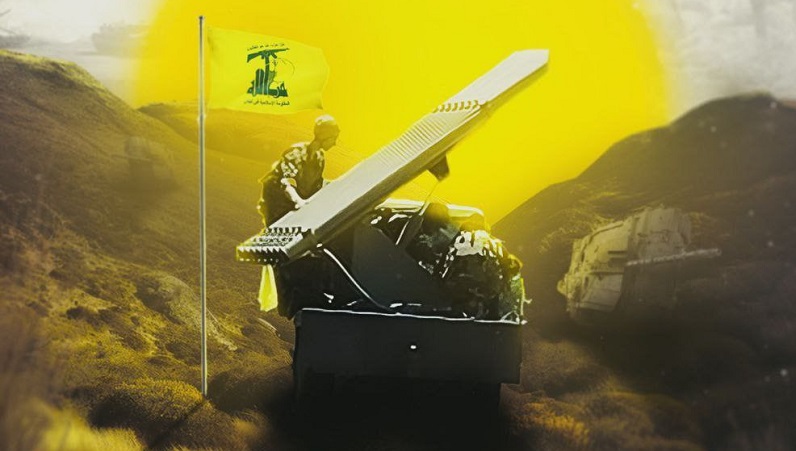
Hezbollah Rebuilds Drone Capabilities as It Prepares for Possible New War With Israel

File image.

Hezbollah has spent the past three months rebuilding its military capabilities and preparing for a possible resumption of hostilities with Israel, following an influx of funding from Iran, Reuters reported on October 26, citing Lebanese security officials familiar with the group’s activities.

The group has focused on acquiring explosives and producing drones capable of attacking Israeli positions, according to two Lebanese security sources, who said that the group has also been working to restore command-and-control structures damaged during its previous battles with Israeli forces.

One of the security sources and another person close to Hezbollah said Iran had provided the group with tens of millions of dollars to strengthen its military capabilities.

The funding comes in addition to roughly $200 million Tehran provided to help displaced families in Hezbollah’s Shiite strongholds, Reuters reported earlier this month.

Hezbollah suffered heavy losses during two wars since 2023, and Israeli forces continue to occupy vast parts of southern Lebanon as a so-called “security zone.”

Hezbollah’s rearmament efforts come amid continued regional tensions following U.S.-Israeli strikes on Iran in February. The group opened fire on Israel on March 2 in support of Tehran, prompting an Israeli offensive that killed more than 4,000 people in Lebanon and displaced roughly a quarter of the country’s population.

Hostilities largely subsided over the summer after an interim agreement between Washington and Tehran included a ceasefire in Lebanon, while the U.S. mediated talks between Beirut and Jerusalem.

Full-scale fighting has not resumed despite the subsequent collapse of the U.S.-Iranian agreement, but Israel has continued striking Hezbollah targets in southern Lebanon.

Hezbollah is now preparing for the possibility that renewed U.S.-Iranian fighting could trigger another round of war on the Lebanese front, according to Reuters. However, the Lebanese security sources told the news agency that the group had not yet fully rebuilt its weapons stockpiles or restored its fighting force.

The group has also faced difficulties repairing its command structure after losses in key areas, including around the southern Lebanese town of Bint Jbeil and the strategically important Ali al-Taher ridge, according to the sources and three other security officials familiar with its operations.

Hezbollah’s use of small units and limited anti-tank missile supplies reportedly left some fighters isolated during those battles, making it difficult for them to counter Israeli remotely operated weapons systems, including drones and remote-controlled vehicles.

The Israeli military told Reuters that it uses such systems to monitor southern Lebanon while reducing the exposure of its troops to danger.

The rearmament effort has also involved explosives intended for use in drones. Hezbollah acknowledged this month that explosives seized by Lebanese authorities belonged to the group and were intended for attacks against Israel.

A Hezbollah official and a Lebanese security source told Reuters that the material was specifically intended for explosive-laden drones.

In response to questions from Reuters, Hezbollah’s media office said Israel’s presence on Lebanese territory gave the group a legitimate right to resist. It also rejected claims that its command-and-control systems had broken down.

While Hezbollah has suffered heavy losses as the Reuters report suggests, the claim that the group is overall getting weaker does not match its performance during the last round of fighting, when it expanded the use of drones, especially first-person-view suicide quadcopters, inflicting some serious damage on Israeli forces and limiting their freedom of operation in southern Lebanon.

Hezbollah is not likely to start another confrontation with Israel if war on Iran resumes. However, Israel itself could escalate to expand its occupation.

_______________________________________________________________________________________________________________________

SouthFront: Analysis and Intelligence

NOW hosted at southfront.press

Previously, SouthFront: Analysis and Intelligence was at southfront.org.

The .org domain name had been blocked by the US (NATO) (https://southfront.press/southfront-org-blocked-by-u-s-controlled-global-internet-supervisor/) globally, outlawed and without any explanation

Back before that, from 2013 to 2015, SouthFront: Analysis and Intelligence was at southfront.com

SOUTHFRONT.PRESS

MORE ON THIS TOPIC:

The post Hezbollah Rebuilds Drone Capabilities as It Prepares for Possible New War With Israel appeared first on South Front.

  •  

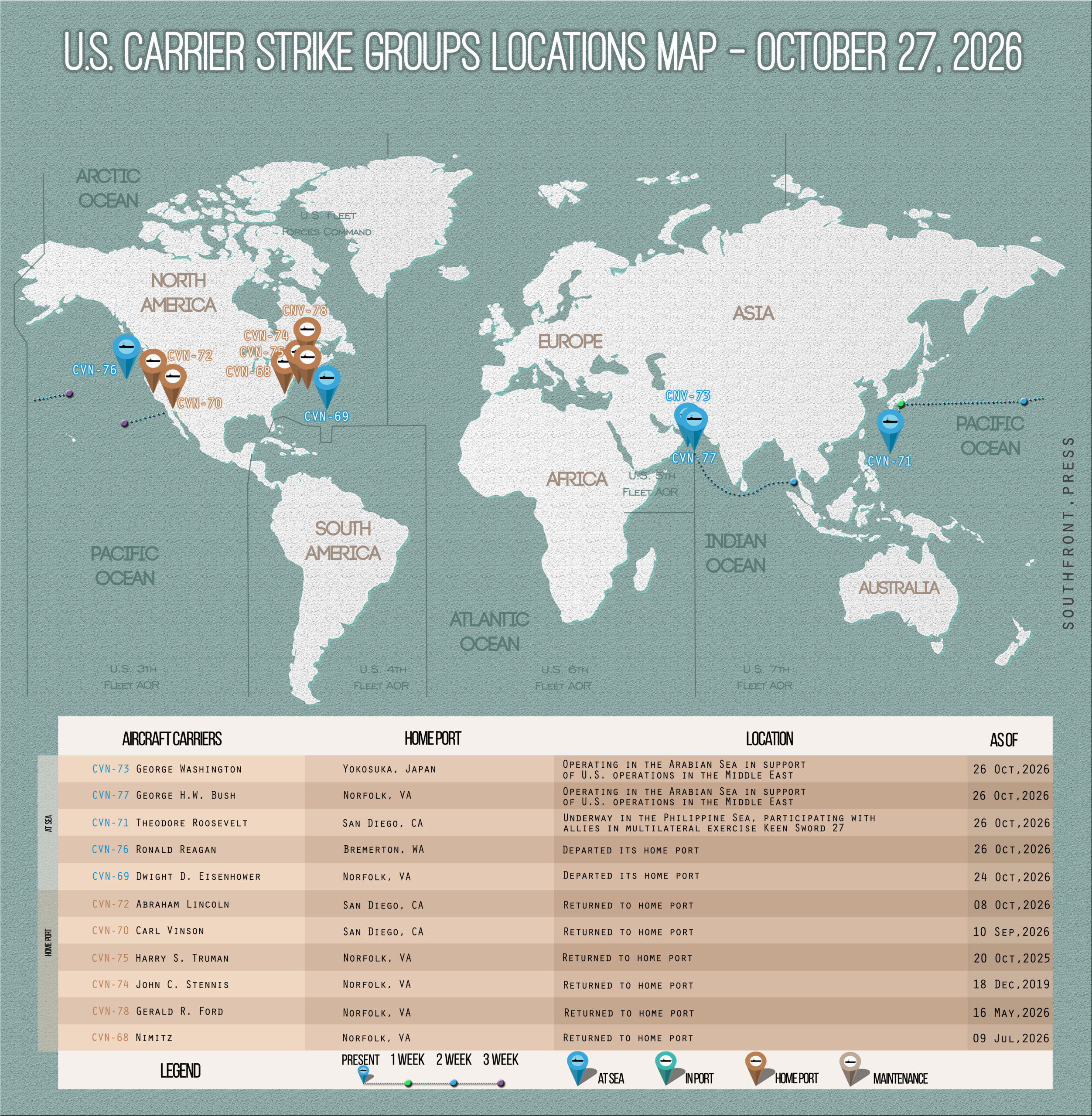
Locations Of US Carrier Strike Groups – October 27, 2026

This is the newest update of the ‘U.S. Carrier Strike Groups Locations Map’ exclusive series showing the approximate locations of U.S. Carrier Strike Groups. SouthFront: Analysis & Intelligence tracks locations of U.S. aircraft carriers using the available open-source information. No classified information was used in production of the map.

click to see the full-size image

Carrier strike group (CSG) is an operational formation of the United States Navy. It is centered on an aircraft carrier and a carrier air wing of 65 to 70 aircrafts. It’s composed of roughly 7,500 personnel, an aircraft carrier, at least one cruiser, a destroyer squadron of at least two destroyers and/or frigates. A carrier strike group also, on occasion, includes submarines, attached logistics ships and a supply ship. Carrier strike groups comprise a principal element of U.S. power projection over the world’s oceans

______________________________________________________________________________________________________________________

SouthFront: Analysis and Intelligence
NOW hosted at southfront.press
Previously, SouthFront: Analysis and Intelligence was at southfront.org.
The .org domain name had been blocked by the US (NATO) (https://southfront.press/southfront-org-blocked-by-u-s-controlled-global-internet-supervisor/) globally, outlawed and without any explanation
Back before that, from 2013 to 2015, SouthFront: Analysis and Intelligence was at southfront.com

SOUTHFRONT.PRESS

The post Locations Of US Carrier Strike Groups – October 27, 2026 appeared first on South Front.

  •  

War Will Cover Up the Losses: How Europe’s Crises Are Fueling Escalation with Russia

Click to see the full-size image

Europe and Russia are entering a phase in which diplomatic expulsions and explosives-laden drones at airports are no longer treated as exceptions. Germany is openly preparing its hospitals for an influx of wounded personnel, while the assessed threat of sabotage has officially been raised. Meanwhile, expensive energy and competition are costing European industry production capacity and jobs. Under these conditions, an external conflict offers a convenient way to blame economic failures on a foreign enemy. The question is no longer whether escalation is taking place, but how far the two sides are prepared to go before it slips beyond their control.

The autumn of 2026 has brought a series of developments that take the confrontation between Russia and Europe beyond the familiar boundaries of ‘hybrid warfare’. In August, drones carrying explosives were discovered at Leipzig/Halle Airport. The German authorities formally blamed Russia, describing the incident as ‘crossing a red line’ with potentially lethal consequences. Berlin closed Russia’s consulate-general in Bonn and its cultural center. Moscow responded by closing the German consulate in St. Petersburg.

In September, another drone carrying explosives was found near Wunstorf airbase. The Bundeswehr subsequently raised its assessment of the threat from Russian sabotage to ‘significant’, the second-highest level, for the first time. German intelligence services warn that further attacks are likely. Meanwhile, arson attacks have been reported at drone manufacturing facilities in Estonia, Poland and Slovakia, alongside drone incidents over military installations and civilian airports across Europe.

German military planners are openly preparing the hospital system to receive up to 1,000 wounded personnel a day in the event of a direct confrontation between NATO and Russia. Underground medical bunkers are being brought back into service, including one in Ulm with capacity for 2,000 people. Civilian surgeons are being trained to treat blast injuries and burns, while coordination between military and civilian hospitals is being strengthened. Diplomatic expulsions, consular closures, accusations of sabotage and preparations for mass casualties together suggest that both sides are already operating according to the logic of an ‘undeclared war’.

Military and diplomatic tensions, however, are only one part of the picture. The economic conditions in which this escalation is unfolding, and the political purpose it serves, are more consequential.

Europe’s economy is facing a deep structural crisis that can no longer be concealed behind reports celebrating the ‘green transition’. TTF benchmark gas prices are hovering around €87–88 per MWh, approximately 174% higher than a year earlier. EU gas storage facilities are just 71–74% full, among the lowest mid-October levels of the past decade, compared with around 83% last year. Germany’s position is even weaker, with storage levels fluctuating around 57–60%.

Electricity and fuel costs are putting pressure on the entire supply chain. Annual energy inflation reached almost 19% in September, while average diesel prices across the EU climbed to €2.14–2.23 per liter. Industrial energy costs are four to five times those faced by American competitors. Chemical plants and metal producers, particularly in Germany and northern Italy, are being forced to cut output or shut down production facilities. Industrial production in the eurozone continues to fall; in Germany, it is already almost 10% below its 2021 level. Industry’s share of EU GDP has declined from 17.4% to 14.3%.

The pressure extends to agriculture. Fertilizer prices have risen by more than 13%, while farmers’ energy costs have increased by around 22%. At the same time, the prices farmers receive for their produce are falling. This raises the risk of a poorer harvest in 2027 and a second wave of food inflation. Farmers in several countries are already warning that their operations are becoming commercially unviable, while transport costs are making many deliveries unprofitable.

The situation resembles a familiar scheme: a warehouse owner who has spent years stealing stock eventually sets fire to the building and tells investigators that everything was destroyed ‘by accident’. European governments have spent years pursuing policies that have made energy expensive, imposed excessive regulation and applied sanctions whose heaviest impact has fallen on their own industry and agriculture. Now, as gas, electricity, diesel and fertilizer bills squeeze businesses and households, and Chinese competitors capture market share, an external conflict offers a convenient excuse.

War, or even the prospect of war, allows rising prices, factory closures, cuts to social spending and budget shortfalls to be blamed on an ‘external aggressor’. Instead of acknowledging mistakes in energy and industrial policy, governments invoke the ‘price of freedom’ and the ‘defense of democracy’. The further tensions escalate, the easier it becomes to explain to the public why housing, food and heating cost more, and why industrial jobs are disappearing.

The current situation brings together two parallel developments. Tensions are rising through sabotage incidents, diplomatic expulsions, higher threat assessments and preparations for hospitals to receive large numbers of wounded personnel. At the same time, European elites need a convenient external explanation for economic failure. High gas and electricity prices, low storage levels, expensive diesel, rising fertilizer costs and shrinking industrial output are already a reality. Escalation creates political capital for those responsible for costly mistakes in energy and industrial policy over recent years. It allows them to shift the discussion from domestic policy failures to an ‘external threat’, postponing accountability.

This logic itself increases the risk of an uncontrolled shift from ‘hybrid’ operations to direct confrontation. As long as European governments prefer preparing hospitals for thousands of casualties to reconsidering their energy and industrial policies, the practice of ‘burning down the warehouse to conceal the missing stock’ continues. The remaining question is how far the two sides are prepared to go before the cost becomes too high for European societies themselves.


MORE ON THE TOPIC:

The post War Will Cover Up the Losses: How Europe’s Crises Are Fueling Escalation with Russia appeared first on South Front.

  •  

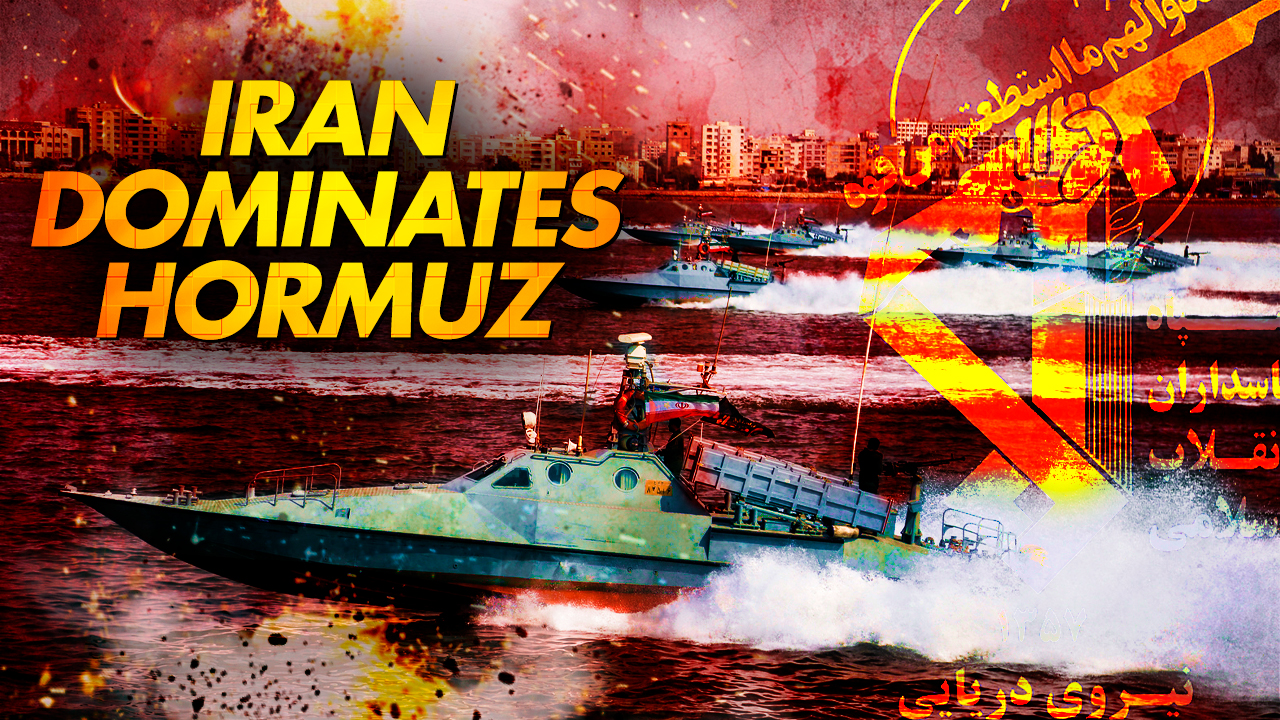
Iran Threatens Sinokor as Korean Tanker Giant Dominates Oil Flows Through Hormuz

File image.

Iran has threatened action against South Korean shipping group Sinokor beginning November 1 over violations of Tehran’s transit rules for the Strait of Hormuz.

In a statement, the Islamic Republic’s Persian Gulf Strait Authority said vessels linked to Sinokor had accumulated more alleged transit violations over the previous three months than those associated with any other shipping company.

It added that enforcement measures had already been taken against at least seven of the company’s vessels. Cargo owners, beneficiaries and insurers involved in the shipping arrangements were also warned that they could face legal action.

Seven vessels were named in the statement: Cyprus Prosperity, Mombasa B, Senegal Prosperity, Mersin Prosperity, Ghana Prosperity, Cameroon Prosperity and Angola Prosperity.

The threat comes as Sinokor has become one of the most important players in the oil tanker market during the war with Iran, deploying a large fleet to transport crude through the strategic waterway as other shipping companies have faced heightened security risks.

In a report published October 23, Bloomberg found that tankers owned by Sinokor carried 105.6 million barrels of crude oil through the Strait of Hormuz in September, equivalent to nearly 40% of the oil crossing the waterway that month.

That exceeded the combined 97.3 million barrels attributed to vessels owned by the next three largest shipping groups, Saudi Arabia’s Bahri, Kuwait Oil Tanker Company and the shipping unit of Abu Dhabi National Oil Co.

A separate Bloomberg report published on October 27 highlighted Sinokor’s growing influence over the global tanker market, describing how its WhatsApp messages to shipbrokers announcing charter agreements and freight rates have become closely watched by industry participants.

The messages have played an outsized role in shaping perceptions of tanker prices, the news outlet reported, as freight rates for very large crude carriers have surged more than 1,600% this year amid disruption caused by the war.

The report also examined concerns about transparency in the tanker market and the influence of the messages on the freight-rate benchmark maintained by London’s Baltic Exchange.

The latest Iranian threat adds a legal and regulatory risk to Sinokor’s already substantial exposure to the conflict, as its ships remain central to oil movements through the Gulf.

Commercial traffic through the Strait of Hormuz remained sharply below normal on October 17, with an AIS-based monitor recording seven vessel crossings in the preceding 24 hours, about 8% of the strait’s prewar daily average. This shows that the strategic waterway is still under the control of the Islamic Republic, which stepped up its anti-shipping attacks in recent weeks.

_______________________________________________________________________________________________________________________

SouthFront: Analysis and Intelligence

NOW hosted at southfront.press

Previously, SouthFront: Analysis and Intelligence was at southfront.org.

The .org domain name had been blocked by the US (NATO) (https://southfront.press/southfront-org-blocked-by-u-s-controlled-global-internet-supervisor/) globally, outlawed and without any explanation

Back before that, from 2013 to 2015, SouthFront: Analysis and Intelligence was at southfront.com

SOUTHFRONT.PRESS

MORE ON THIS TOPIC:

The post Iran Threatens Sinokor as Korean Tanker Giant Dominates Oil Flows Through Hormuz appeared first on South Front.

  •  

European Protests Gather Force As Citizens Demand Answers On Public Spending

Click to see the full-size image

Written by Ahmed Adel, Cairo-based geopolitics and political economy researcher

What began in September with student protests and social unrest in France over education reforms and rising tensions, alongside months of anti-government actions in Albania targeting Edi Rama’s long rule, has spread to Belgium, Italy, Spain, Greece, Portugal, and beyond, turning the streets of many European cities into battlegrounds of tear gas, water cannons, and burning barricades.

Early signs suggest Croatia and Austria could join the protests, which some are calling a “European Autumn.” Beyond Albania’s more political confrontation, the protests reflect the anger of ordinary citizens over high living costs, unaffordable housing, squeezed public services, and the belief that governments prioritize other issues, such as the Ukraine War, over household budgets.

In France, hundreds of thousands have taken to the streets in recent days. Authorities report nearly 1,000 detentions nationwide, a heavy deployment of police and gendarmes, and clashes involving water cannons and tear gas. In Rome, authorities detained more than 200 young people during similar confrontations. In Barcelona, demonstrations escalated into riots, resulting in roughly 100 arrests, dozens of fires, and looted shops. In Tirana, thousands have protested with Molotov cocktails and have faced police tear gas. These are not isolated incidents but reflect youth frustration and public exhaustion as prices rise while wages and services lag.

European officials have repeatedly blamed outside actors, particularly Russia, for the unrest. Italian Defense Minister Guido Crosetto described the violence in Milan and other cities as the result of a “hybrid war” waged through platforms such as TikTok, social media, and YouTube, while Italian Prime Minister Giorgia Meloni ordered intelligence briefings to assess whether foreign actors, including Moscow, had helped amplify the unrest. French Foreign Minister Jean-Noël Barrot said that hostile narratives from Russia, China, Iran, and the MAGA community had exploited high-school student protests in France.

Russian President Vladimir Putin dismissed these claims as obvious exaggerations that European citizens can see through.

“To suggest that we are provoking mass protests in major European cities, well, that is clearly going too far, it’s something that, in my view, is obvious to the ordinary citizens of European countries,” Putin said, adding that the accusations reflect “the weakness and inability of certain leaders in European countries to take responsibility for what is happening.”

Leaders and officials blaming Moscow reflect Europe’s long habit of shifting blame outward rather than addressing the rise in energy prices following the cut of cheaper Russian supplies and the redirection of more public funds toward expanding the defense industry since 2022. The protest’s origins in budget cuts to education, housing, and everyday services are evident in the slogans and demands heard on the streets.

In Albania, protests against plans to build a hotel near Vlorë escalated into a broader movement to oust the government. In Spain, anger erupted over the eviction of an elderly resident, whose home was later occupied by migrants. In France, student opposition to enrollment reforms drew in other groups, including people from North African communities. Although each protest had a different trigger, their spread across the continent shows how resistance has inspired youth amid shared economic pressure.

In response to the protests, French authorities are expected to scale back some planned education cuts, which could ease immediate tensions. Yet France has the eurozone’s third-highest debt, behind only Italy and Greece. Without broader social agreement on priorities—including affordable energy, housing supply, and avoiding wasteful defense spending—the protests are likely to continue. Immigration pressures and social divisions further reinforce the sense that resources are being misdirected.

Politically, the unrest accelerates polarization already underway in France. Centrist parties continue to lose ground as voters move toward left- and right-wing alternatives. Some establishment figures try to use the disorder to limit options, including those of the far-right Marine Le Pen’s movement and the far-left Jean-Luc Mélenchon’s, but this only further erodes the current administration’s legitimacy.

Le Pen has used images of looting, burned vehicles, and street clashes to reinforce a law-and-order message, arguing that the country needs stronger command and that chaos cannot be a governing project. Mélenchon, by contrast, has aligned himself with the underlying student and cost-of-living grievances, criticizing police tactics and framing the protests as a response to years of underfunding in education and public services. Both draw support from different segments of the French public angered by the center’s failure to deliver affordable energy, housing, and stable public services while maintaining high debt and defense commitments.

Unless governments directly address energy prices, debt constraints, and migration, the so-called Autumn Wave will persist and spread across Europe, deepening polarization, as already evident in French politics. Blaming external actors, from Moscow to social media platforms, will not restore public trust or lower household costs, but will deepen the animosity already building.


MORE ON THE TOPIC:

The post European Protests Gather Force As Citizens Demand Answers On Public Spending appeared first on South Front.

  •  

Russia Escalates Kyiv Bridge Attacks With Ballistic Missile Strike (Video, Photos)

Click to see full-size image. (X)

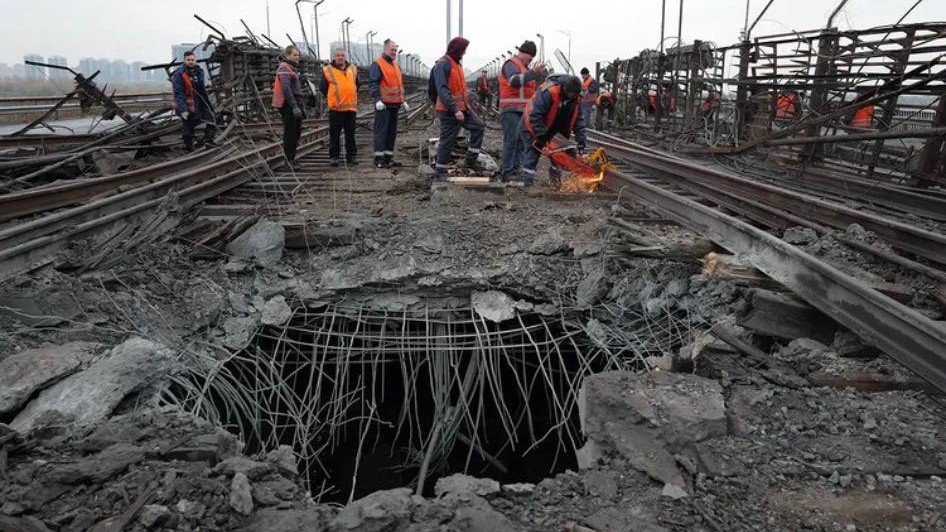
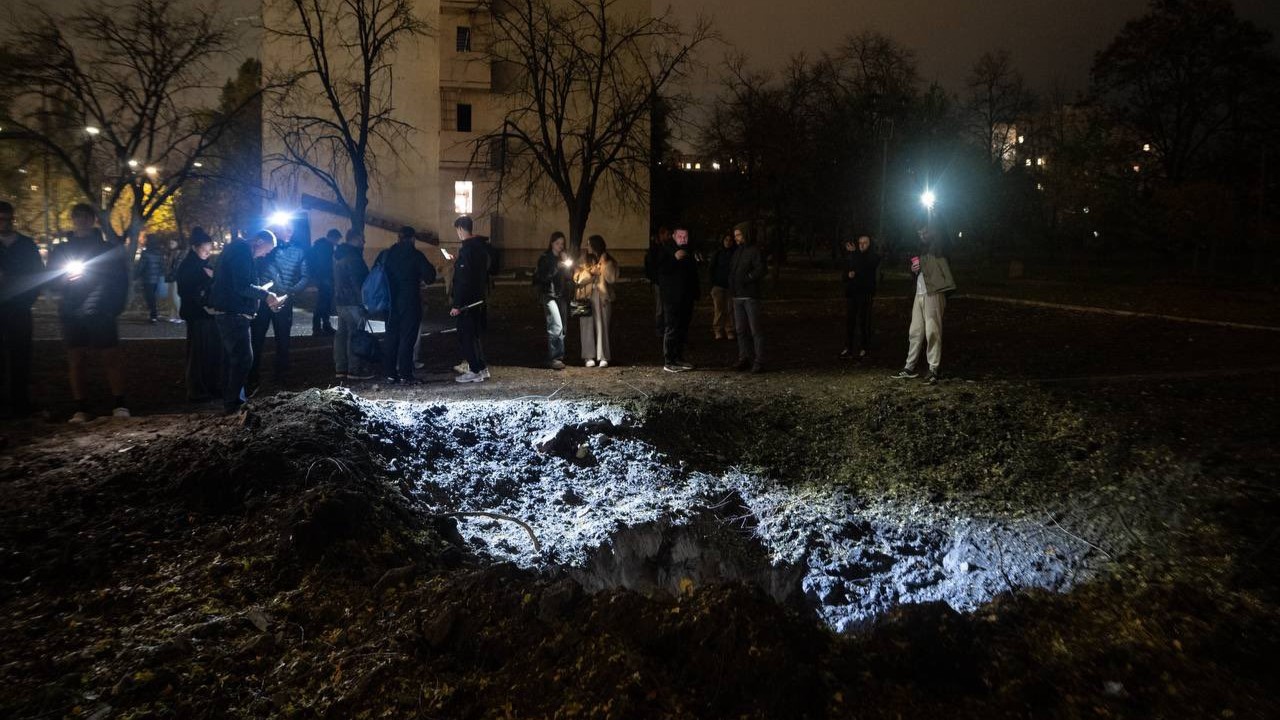
A Russian ballistic missile struck Kyiv’s Southern Bridge overnight into October 27, damaging aboveground metro infrastructure and forcing authorities to close the key crossing over the Dnipro River.

Ukrainian media reported that Russia attacked Kyiv with ballistic missiles twice during the night and that one of the missiles struck the Southern Bridge.

Kyiv Mayor Vitali Klitschko said specialists were assessing the damage and that traffic across the bridge had been closed.

Click to see full-size image. (X)

Metro services on the Green Line were suspended between Osokorky and Chervony Khutir stations, with trains operating only between Syrets and Vydubychi stations. Local authorities had not yet announced when the affected services would resume.

The reported direct missile strike marks an escalation from the series of drone attacks Russia carried out against Kyiv’s bridges earlier in the month.

On October 1 and 2, Russian drones repeatedly struck the Southern Bridge, damaging a support structure, the roadway, barriers and protective concrete around the metro line. Later on October 3, a Russian drone hit the Northern Bridge, damaging its road surface and the overhead wires powering trolleybuses. The attacks disrupted traffic across several of the capital’s main crossings over the Dnipro River.

The latest ballistic missile strike marks a notable escalation in Russia’s campaign against bridges in the Ukrainian capital.

The strike also comes as Ukraine’s air defenses face mounting pressure from Russia’s sustained missile and drone strikes, with reported shortages of interceptor missiles adding to the challenge of protecting major cities and critical infrastructure.

_______________________________________________________________________________________________________________________

SouthFront: Analysis and Intelligence

NOW hosted at southfront.press

Previously, SouthFront: Analysis and Intelligence was at southfront.org.

The .org domain name had been blocked by the US (NATO) (https://southfront.press/southfront-org-blocked-by-u-s-controlled-global-internet-supervisor/) globally, outlawed and without any explanation

Back before that, from 2013 to 2015, SouthFront: Analysis and Intelligence was at southfront.com

SOUTHFRONT.PRESS

MORE ON THIS TOPIC:


The post Russia Escalates Kyiv Bridge Attacks With Ballistic Missile Strike (Video, Photos) appeared first on South Front.

  •  

Russia’s AI-Powered Kalitka-KA Gun Can Kill Drones With 10 Rounds (Videos)

Click to see full-size image. (Telegram\Kalashnikov)

Russia’s Kalitka-KA anti-drone gun system uses artificial intelligence (AI) to calculate aiming corrections, allowing it to destroy an aerial target with about 10 rounds, a Russian National Guard serviceman said in a report aired by Vesti on October 25.

Mounted on a pickup truck and armed with a 7.62 mm PKT machine gun, a weapon also used in Russian tanks, the system is designed to protect military crews from drones or operate independently.

The Kalitka-KA uses AI to compensate for aiming errors and help operators engage moving aerial targets with individual shots rather than sustained bursts. The system is semi-automatic, with the software calculating firing corrections while the operator retains control of the engagement, according to the report.

The system can also work with a radar station, expanding its ability to detect and engage aerial targets, especially drones.

Kalashnikov Concern unveiled the Kalitka-KA in Moscow last September. The system combines a rotating machine-gun mount with an electro-optical unit equipped with two daylight cameras and a rangefinder. A thermal imager enables operation at night.

The system is available in stationary and vehicle-mounted configurations. Kalashnikov says it is designed to protect military positions and critical infrastructure against reconnaissance and attack drones flying at low and extremely low altitudes.

Gun-based anti-drone systems offer a cost-effective way to counter relatively cheap drones without expending expensive interceptor missiles. Russia is currently expanding their deployment to provide troops and critical infrastructure with an additional layer of close-range protection.

_______________________________________________________________________________________________________________________

SouthFront: Analysis and Intelligence

NOW hosted at southfront.press

Previously, SouthFront: Analysis and Intelligence was at southfront.org.

The .org domain name had been blocked by the US (NATO) (https://southfront.press/southfront-org-blocked-by-u-s-controlled-global-internet-supervisor/) globally, outlawed and without any explanation

Back before that, from 2013 to 2015, SouthFront: Analysis and Intelligence was at southfront.com

SOUTHFRONT.PRESS

MORE ON THIS TOPIC:


The post Russia’s AI-Powered Kalitka-KA Gun Can Kill Drones With 10 Rounds (Videos) appeared first on South Front.

  •  

Deadly Jordanian Strikes Highlight Syria’s Cross-Border Terror Threat (Videos)

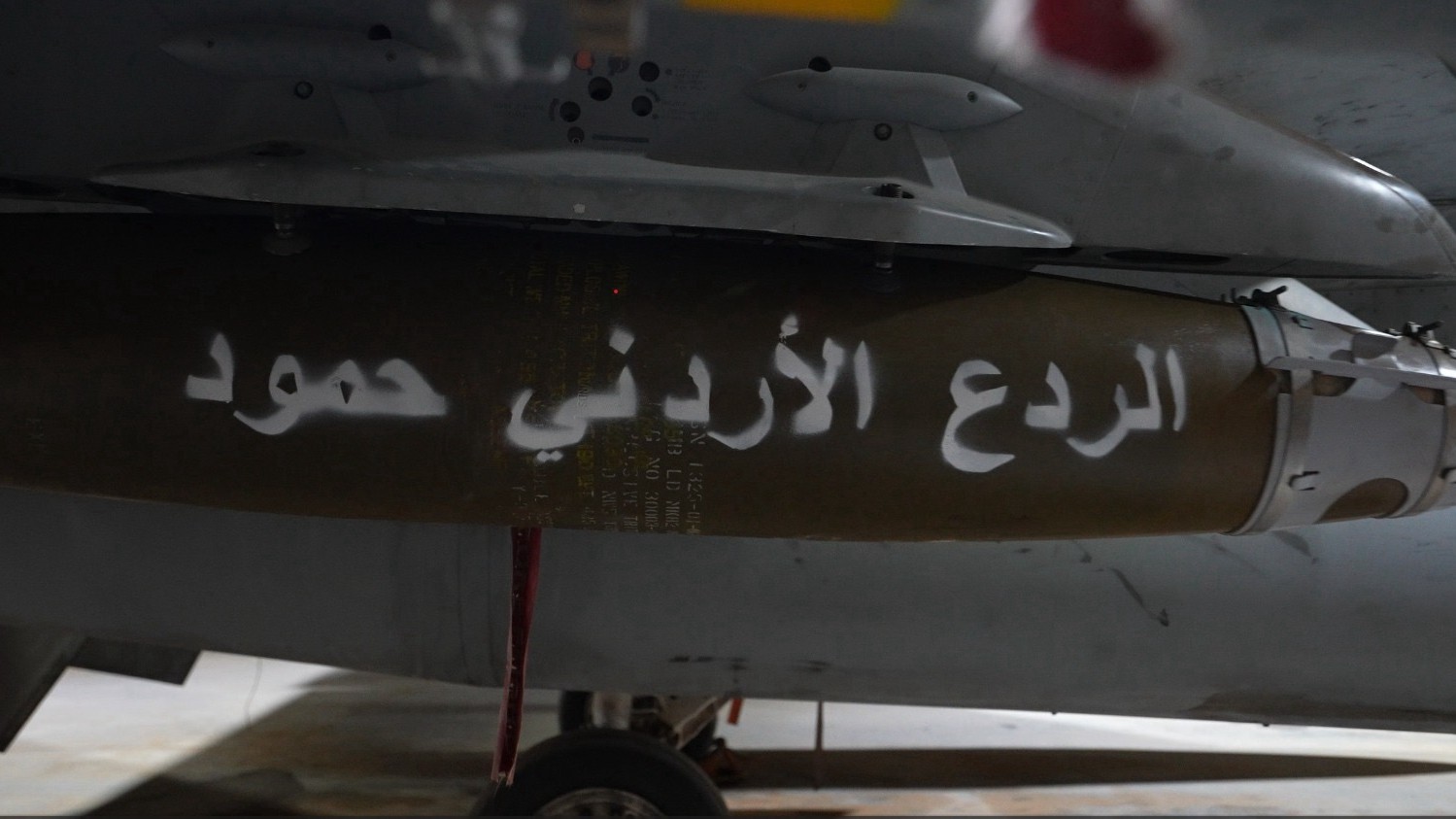
Click to see full-size image. (X)

Jordanian warplanes struck several sites in southern Syria late on October 26, killing at least seven people, including three children, according to Syrian authorities, after Amman said it had linked a deadly church shooting to terrorist groups operating across the border.

The strikes hit locations in the southern provinces of Daraa and Suwayda. Jordan described the operation as a counterterrorism measure conducted in coordination with Damascus, while the Syrian government said it had received no advance notification and condemned the civilian deaths.

The Royal Jordanian Air Force called the operation “Jordanian Deterrence – Hmoud,” saying it targeted hideouts belonging to terrorist organizations linked to the October 23 attack on a Greek Orthodox church in the Jordanian city of Karak.

“The terrorists behind the Hmoud attack have ties to the targeted terrorist organizations,” the Jordanian military said in a statement carried by the state-run Petra news agency.

It added that the strikes killed and wounded several members of the targeted groups and destroyed their equipment and vehicles. The military did not identify the organizations or specify the locations hit.

Syrian authorities, for their part, disputed Jordan’s account of coordination and said the strikes claimed the lives of civilians.

The Syrian Civil Defense said seven people were killed across several locations in Daraa and Suwayda. Five members of one family, including three children, a woman and a man, died when a strike hit a tent in rural Daraa, while two older men were killed in separate strikes. Three other members of the family were injured.

The Syrian Foreign Ministry said the operation was conducted “without prior coordination or notification with the Syrian side,” according to a statement carried by the Syrian Arab News Agency early on October 27.

Damascus announced an investigation into the strikes and said it had opened direct communication channels with Jordan to address the incident. It also stressed the need for joint security and military coordination along the border, warning that such operations must respect Syrian sovereignty.

The strikes came hours after Jordanian security forces arrested three suspects in connection with the church shooting following a shootout in the Karak area. The suspects, two brothers and their brother-in-law, were wounded during the operation, authorities said.

The October 23 attack took place during a funeral at the Greek Orthodox church in Karak, killing nine people and wounding 34. The shooting shocked the country, where attacks of this kind are rare, and prompted King Abdullah II to promise a forceful response.

“The Nashama have chased them to the very end. We vowed the terrorists would not escape punishment, and no proponent of dark ideologies that divide Jordanians will be tolerated,” the king said on X after the strikes on Syria. “We pray that the martyrs’ souls rest in peace and wish the injured a speedy recovery.”

Jordanian Interior Minister Mazen Al-Faraya described the attack as the product of “a terroristic, extremist way of thinking.”

The investigation has also raised questions about the alleged organizational links behind the shooting. Jordan’s Public Security Directorate chief, Maj. Gen. Obaidallah Abd Rabbo Al-Maayta, said the three suspects were not affiliated with any group, telling reporters, “They only represent themselves.”

Jordan’s military, however, subsequently said those responsible for the attack had ties to terrorist groups in southern Syria without publicly identifying them or detailing the evidence.

Following the strikes, Syrian authorities closed the Nassib border crossing, suspending passenger and commercial traffic between the two countries.

The escalation highlights a growing security threat from terrorist groups operating inside Syria. With southern Syria serving as a base for their activity, and Damascus seen as either turning a blind eye or failing to contain them, neighboring countries face mounting pressure to act on their own.

_______________________________________________________________________________________________________________________

SouthFront: Analysis and Intelligence

NOW hosted at southfront.press

Previously, SouthFront: Analysis and Intelligence was at southfront.org.

The .org domain name had been blocked by the US (NATO) (https://southfront.press/southfront-org-blocked-by-u-s-controlled-global-internet-supervisor/) globally, outlawed and without any explanation

Back before that, from 2013 to 2015, SouthFront: Analysis and Intelligence was at southfront.com

SOUTHFRONT.PRESS

MORE ON THIS TOPIC:


The post Deadly Jordanian Strikes Highlight Syria’s Cross-Border Terror Threat (Videos) appeared first on South Front.

  •  
❌