One could ask, what might politicians from a far-right party — as the Federal Office for the Protection of the Constitution describes Alternative for Germany (AfD), write to one another?
More than 400,000 emails exchanged by AfD members between March 2013 and September 2026, effectively covering the party’s entire history, have appeared online.
They were published by hackers from the Distributed Denial of Secrets (DDoSecrets) organisation, who obtained 284 gigabytes of data, including minutes from meetings of the party leadership, payslips, strategic documents, membership lists and donors’ names.
AfD and its enemies
According to the Correctiv website, the material also includes election campaign plans, for example for the 2025 parliamentary election. Their authors describe how to reach potential voter groups. They describe the governing parties at the time as enemies.
It is unclear yet whether all the emails are genuine, but the party has confirmed the leak. German media outlets with access to them estimate that assessing the information could take months.
It is already clear that the emails offer an insight into how Germany’s currently strongest political party operates and how it approaches certain issues, including neo-Nazism.
The media are gradually uncovering messages that are uncomfortable for AfD’s leading figures, including its co-chair Alice Weidel.
One of the most striking findings is that in private she was not as radical as she liked to portray herself in public. And, according to German media, the difference is considerable.
The leaked emails also suggest how the German party sought to forge closer ties with the US conservative Maga movement and president Donald Trump, whom it saw as a potential ally.
In foreign policy, they also point to deeper links with Russia than had previously been known.
Thousands of emails could also play a role in a potential ban on the party, which is not yet decided upon but is being debated in Berlin.
So what have they revealed?
What had not previously been known about relations with Russia
This article continues, but the full version is available only to EUobserver.com subscribers. Visit account.euobserver.com/membership
Slovak prime minister Robert Fico appears to have become Russia’s most prominent ally in the European Union, following the demise of Hungary’s pro-Kremlin leader.
Juraj Blanár, Slovakia’s foreign minister, announced controversial plans to revive a joint committee with Russia back in August – just a day before the anniversary of the Soviets occupying Czechoslovakia in 1968.
His announcement also came before Fico headed off to meet his counterparts at a summit in Brussels on Thursday (15 October).
And “so that there are no surprises, on the 25th [of October] there will … be a meeting of the joint economic commission with the Russian Federation,” Fico told the European affairs committee in Slovakia’s parliament on Wednesday.
The central European leader announced the closer ties with his aggressive neighbour immediately after planning a trip to Lviv in Ukraine early next month.
But if Fico does actually go to Lviv, just over the border from Poland, it would be the deepest he has travelled in the war-torn country so far.
And while he has not visited Kyiv in three years since returning to power, Fico has made plenty of time to go to Moscow during this time.
Many factors point to Slovakia now openly supporting the Kremlin, even as Russian attacks on Ukrainian civilians intensify, killing dozens of people.
The Institute for European Security Studies (IESS), a Kyiv-based think tank, noted, in its analysis, that a recent statement by Slovak defence minister Robert Kaliňák did not consider Russia a threat, despite Russian intelligence services having been linked to attacks in Slovakia including, potentially, a drone attack on a manufacturer near Prešov.
The IESS also highlighted the renewed Slovak-Russian cooperation at the level of military attachés, with two Slovak military personnel sent to the Russian capital while a Russian officer went to Bratislava.
This swap of soldiers was promised by Fico to Putin when they met in the Kremlin on 9 May.
And to make matters worse, a Russian military attaché was captured on video handing cash to an associate of the Slovak fake news site Hlavné správy.
The Ukraine think-tank warned that Slovakia’s magnetism towards Russia should not be ignored.
“In the end, by lowering Nato’s guard and reopening the doors to Russian intelligence, Slovakia is doing exactly what Moscow needs: disabling the West’s defences from the inside out,” it said.
Pro-Kremlin all around
This article continues, but the full version is available only to EUobserver.com subscribers. Visit account.euobserver.com/membership
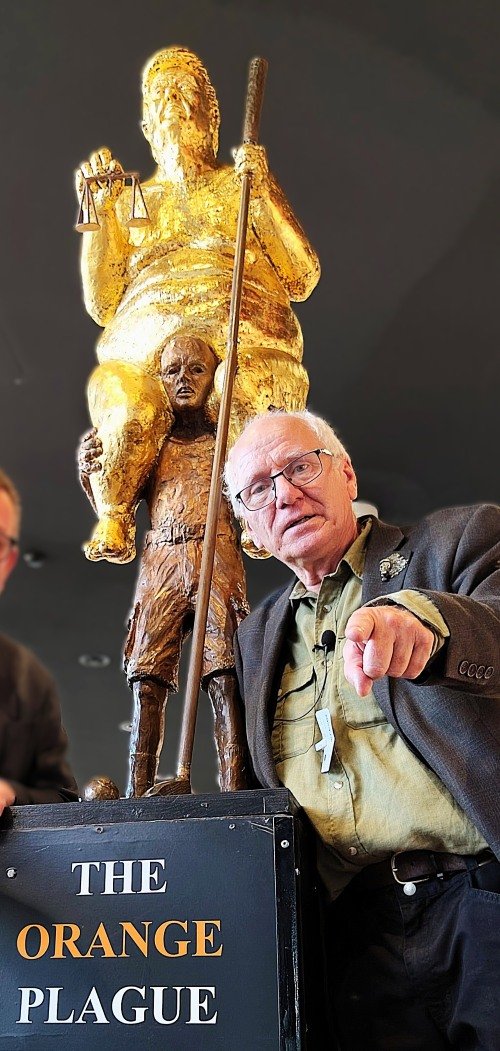
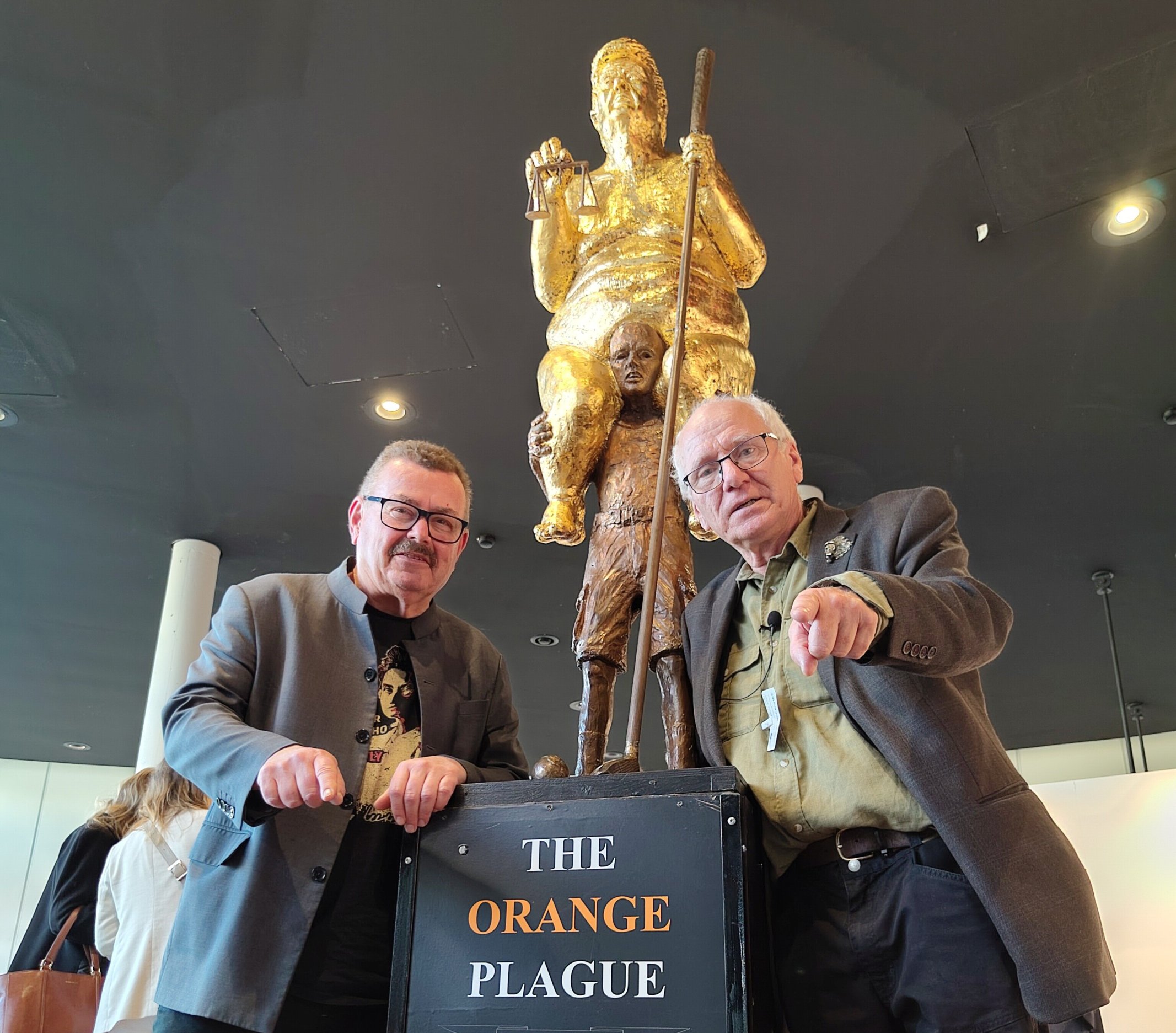
The European Parliament in Strasbourg has been adorned with a grotesque vision of American power in a 2.5-metre-high statue of a naked and obese US president Donald Trump covered in 23-carat gold.
While some MEPs describe it as an expression of freedom and courage in the face of Trump, Slovak prime minister Robert Fico has said the statue is a symbol of a declining European Union and called for its removal.
Fico said the statue reflects a profound misunderstanding of the times we live in, and reminded his X followers that he and Trump are close.
“At a time that calls for dialogue and mutual respect, insulting our partners on official premises demonstrates a profound failure to understand the times we live in,” he said on social media.
“It is sad that the leadership of the European Parliament, in its blindness, can no longer distinguish between the legitimate right to hold a different opinion and the actions of spiritually bankrupt individuals, adventurers and lunatics,” he added.
Jens Galschiøt is the artists behind the Orange Plague sculpture. The Danish artist says his installation served as a warning that Donald Trump is destroying democracy.
Why call it ‘Orange Plague‘?
“I depicted Donald Trump as an ‘orange plague’ because he is destroying everything I believe in. I believe in democracy and the rule of law. All this needs to be cared for, and Trump is destroying it, as well as the debate on the environment,” Galschiøt said.
The artist chose to portray the US president as a grotesque figure hoping that people would laugh at it. “When you laugh at a dictator, you take away his power,” he said.
And Trump is also naked because of Hans Christian Andersen’s fairy tale The Emperor’s New Clothes. In it, the emperor walks through the streets with no clothes, while people tell him how beautifully dressed he is, but no one dares tell him the truth. Only one small child cries out that the ruler is naked.
Galschiøt sees parallels the story and treatment of the US president.
“I think many of us laugh at Donald Trump, but he does not know it. He thinks he is a great leader. He thinks he is an intelligent person. He thinks he gives good speeches. But few people take him seriously. Even if you do take him seriously, it is because he is something like a gang leader, not because of what he says. Most of us actually think he is a ridiculous figure,” Galschiøt said.
Jens Galschiøt beside the Trump statue. Source: J. G. archive
His sculpture consists not only of a naked and obese Trump, but also of a slender figure.
“The little man carries the big man, and the big man tells him: ‘Oh, I really want to help you. I really love you, but I do not want to get off your back.’ It is also a story about hypocrisy and double standards, which I combined,” the artist said.
He covered the sculpture in gold because Trump is known to like the precious metal.
This article continues, but the full version is available only to EUobserver.com subscribers. Visit account.euobserver.com/membership
A case of treason on an unprecedented scale is emerging at Germany’s foreign intelligence service, in what German media say could shake the entire agency.
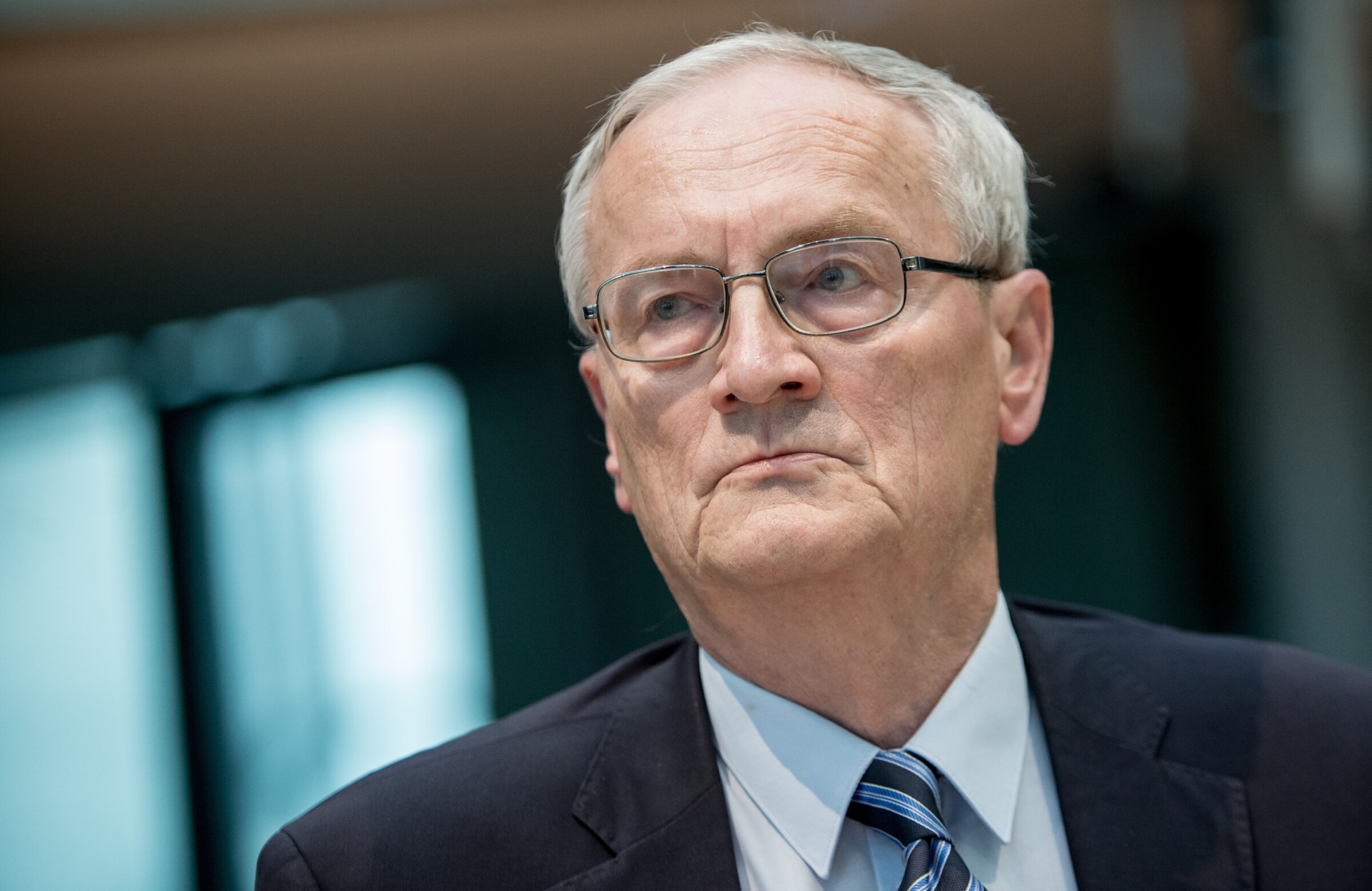
According to the investigative team of WDR, NDR and Süddeutsche Zeitung (SZ), August Hanning, the former head of the Federal Intelligence Service (BND), is being investigated for alleged espionage detrimental to the state and intelligence activities.
Hanning’s tenure at the BND ended in November 2005.
But he is accused of having illegally obtained secret information for several years after he left the service, which gathers and assesses information on foreign, security, and economic threats.
He was arrested at his home in Nordwalde, near Münster in western Germany, on Tuesday (6 October).
Der Spiegel reported that police arrived at 6.41AM and took him away in a black minibus at 8.58AM.
Another former senior BND employee was also detained in the Bavaria region — apparently the former head of Hanning’s office, who worked for the intelligence service until spring 2026.
Neither German authorities nor Hanning’s representatives had commented on the case by Tuesday noon.
What investigative journalists found
According to investigative journalists, Manfred D. leaked top-secret information from within the BND to Hanning until 2022.
According to Der Spiegel, which cited investigators’ findings, Hanning and Manfred D. agreed, as early as spring 2010, that the latter would, in return for payment, gather intelligence from the BND for his former boss, which Hanning could use in his private security consultancy work.
Investigators are working on the assumption that, in at least one case, Hanning prepared a security analysis for a foreign intelligence service.
According to WDR, NDR and SZ, it was not for Russia.
In another case, he allegedly used information from internal BND documents when communicating with a foreign agent.
According to information from security circles obtained by WDR, NDR, and SZ reporters, Hanning came under scrutiny after his home and offices were searched in September last year, when the State Criminal Police Office (LKA) was investigating the case of steak empire heiress Christina Block.
According to investigators, Hanning was involved in an earlier attempt to abduct them, accusations he denies.
While assessing material seized from Hanning last year, LKA officers found an electronic data storage device with explosive contents, according to the investigative journalists.
The former official apparently had access to top-secret BND documents from the recent past which, under no circumstances, should have been in his possession.
In total, he obtained around 2,000 documents. In many cases, these were briefings for the so-called intelligence situation meeting at the federal chancellery, where the heads of security agencies exchange information every week.
They included highly sensitive reports, for example, on Iran’s nuclear programme or the Russian military. According to security sources, they also included reports from foreign partner services.
A leak of such material is regarded by intelligence services as an absolute catastrophe. Friendly intelligence services could lose trust in the BND and cut off the institution from crucial information.
After assessing them, the LKA Hamburg police team handed the seized documents over to federal authorities.
And in May 2026, the Federal Public Prosecutor General’s Office ultimately opened confidential proceedings against Hanning and his alleged BND informant. It remains unclear over what period the former intelligence chief was supplied with secret internal information.
According to security sources, the most recently discovered documents date from June 2022.
It also remains unclear how the alleged BND mole managed to remove material from the secured agency. The BND was asked for a statement on the case.
Hanning’s lawyers have not yet responded to a brief request for comment on the allegations.
An affair of historic proportions
For the BND, this is already the second serious incident in the space of a few years.
In 2022, the espionage case involved Russia, when a former head of a BND unit was accused of spying for Moscow together with another man.
It concerned top-secret information on BND cyber operations that was leaked from the service.
As the Tagesschau website noted, if the suspicions against Hanning are confirmed, this would be an espionage affair of historic proportions.
German history has never before seen an alleged case of treason involving such a senior former top official.
According to Der Spiegel, this is unprecedented. This is particularly so because, for many years after leading the intelligence service, Hanning remained among the most important officials in Germany’s security apparatus.
Before becoming BND president, he was responsible for protecting classified information at West Germany’s representation in East Germany.
After serving at the chancellery, including as coordinator of the federal intelligence services, the lawyer, who holds a doctorate, took over the leadership of the BND in 1998.
At the end of 2005, after leaving the intelligence service, Hanning became a state secretary at the interior ministry. He retired four years later.
Questionable business
According to German media, his subsequent activities were seen as problematic. He became known as a businessman and security consultant with a company in Switzerland.
Its German subsidiary was hired for a time in the custody dispute between Block and her former husband.
According to prosecutors, in 2023 he allegedly planned, together with an associate, to “discredit Block’s former husband through false allegations of paedophilia”.
Hanning and his alleged accomplice apparently tried to plant a hard drive containing child sexual abuse images and videos on the father of Block’s children.
The investigation has not yet been concluded. Hanning has previously denied all allegations in the case.

 Login