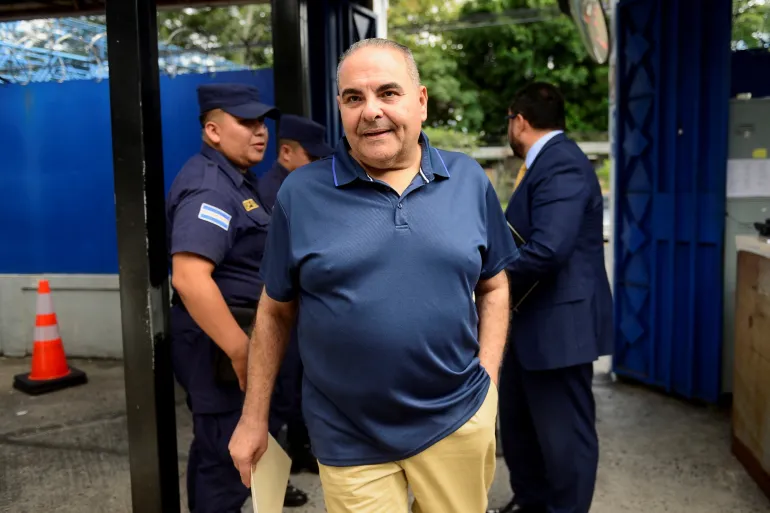
Saca admitted to diverting more than $300 million in public funds during his 2004-2009 presidency.
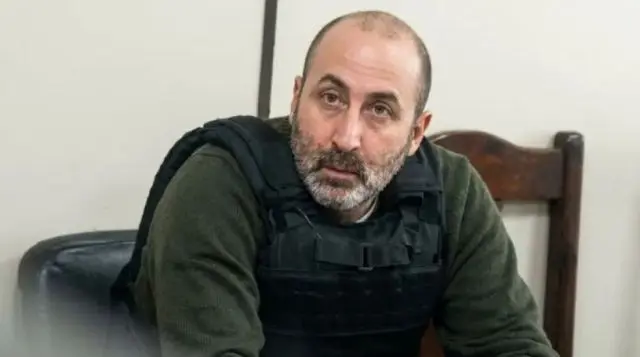
Former Salvadoran President Elias Antonio Saca was released on Thursday after completing a 10-year prison sentence for embezzlement and money laundering involving more than $300 million in public funds.
The 61-year-old former president appeared in court to formally register his release after serving his sentence in full, without early-release benefits, his lawyer, Mario Machado, said.
Saca was sentenced in September 2018 to five years for embezzlement and another five for money laundering. Under a plea agreement, he admitted to diverting and laundering more than $300 million during his 2004-2009 administration, avoiding a potential 30-year prison sentence.
He was arrested in 2016 during his son’s wedding. Prosecutors accused him of siphoning money from the state budget for himself and others, including more than $7 million transferred to his former political party, the Nationalist Republican Alliance (ARENA).
Text Reads: Former El Salvador president Elías Antonio Saca regains his freedom after 10 years in prison! 🌟
During the trial, Saca acknowledged exploiting weaknesses in government oversight to transfer public funds to private accounts. He also disclosed that he had issued regulations allowing him to classify information about financial transactions as state secrets, shielding the transfers from scrutiny.
According to his testimony, the money was transferred over the course of his five-year presidency into 13 private bank accounts belonging to his former private secretary, Elmer Charlaix, and two other presidential staff members.
In 2019, Saca was convicted in a separate bribery case after offering $10,000 to a court employee in exchange for information about proceedings against him. A judge ruled that the additional sentence would be incorporated into his existing 10-year term.
He was also ordered to repay $260 million to the state. In another case involving the diversion of funds from Taiwan, he was sentenced to pay an additional $6 million. It remains unclear whether he has fulfilled that obligation.
Saca, a businessman and radio broadcaster who served as president under ARENA, is one of four former Salvadoran presidents to have faced corruption charges. His successor, Mauricio Funes, fled to Nicaragua in September 2016 and died there in 2025.
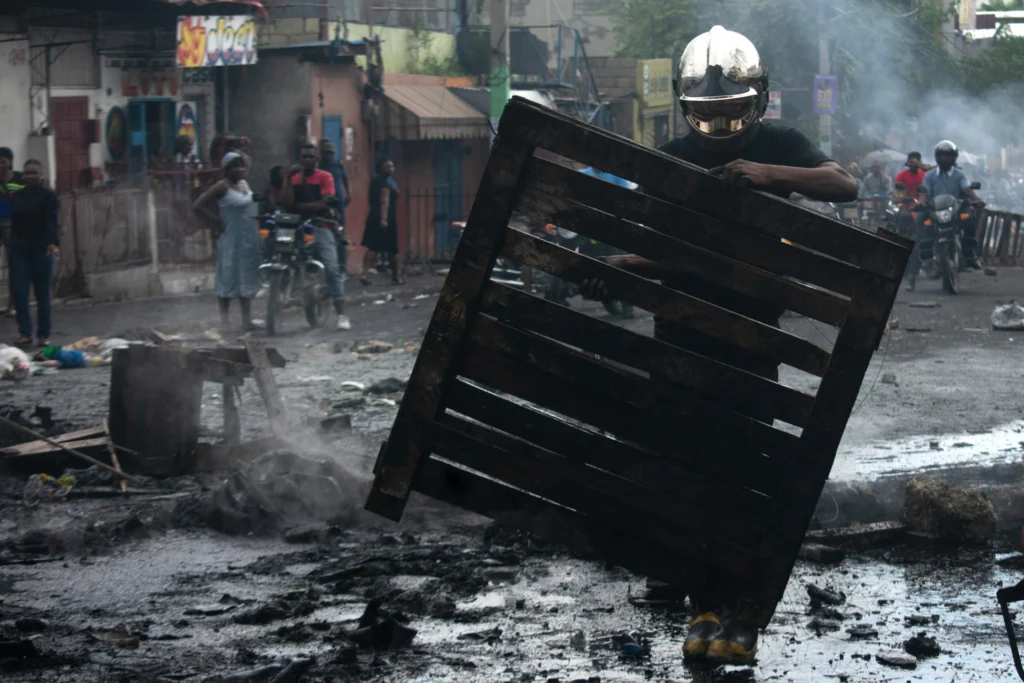
More than 2,000 Salvadoran troops have been deployed to Haiti after an ambush left four military personnel missing.
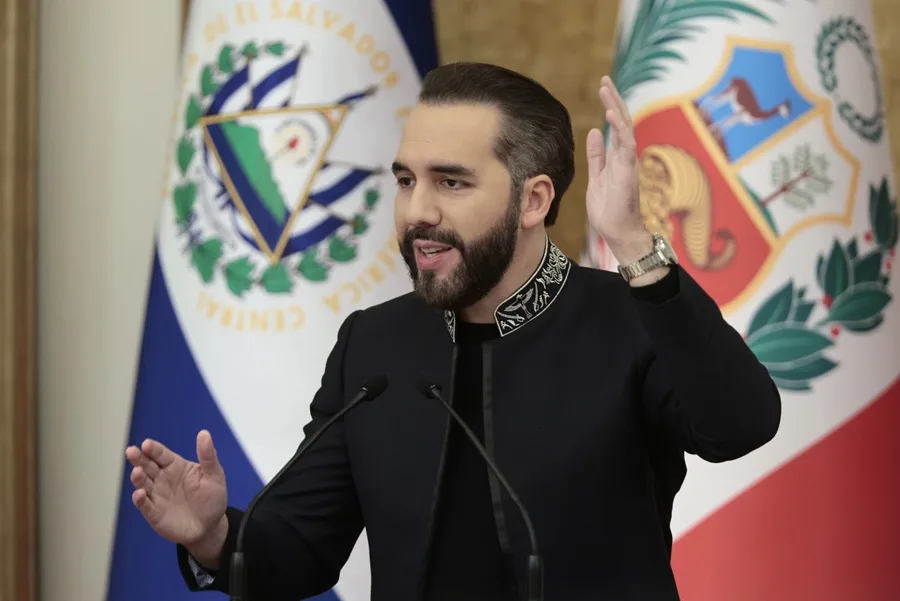
El Salvador has deployed more than 2,000 military personnel to Haiti in a mission to recover four soldiers missing since an ambush near Port-au-Prince, with President Nayib Bukele saying the operation could also be used to dismantle the country’s armed gangs.
“If we defeated the gangs here in El Salvador, we can defeat them there,” Bukele told reporters Thursday during an official visit by Peruvian President Keiko Fujimori. He said, however, that El Salvador would withdraw the same day if the four missing military aviation technicians were returned alive.
The Salvadoran Foreign Ministry said Wednesday that the deployment involved more than 2,000 members of the country’s armed forces and was part of a large-scale operation backed by several countries and international organizations.
Pèp ayisyen,
Nou prèske fin deplwaye sòlda nou yo ak ekipman nou yo sou tè Ayiti. Sa a se pa yon operasyon kont pèp ayisyen an, ni yon envazyon peyi Ayiti. Nou pa yon gwo pisans. Nou pa gen okenn enterè ni pou nou vin domine pèp ayisyen an, ni pou nou mete men sou richès Ayiti.… pic.twitter.com/AZ1XvdeJje
Text Reads: Haitian people, We have nearly finished deploying our soldiers and equipment on Haitian soil. This is not an operation against the Haitian people, nor an invasion of the country of Haiti. We are not a great power. We have no interest in coming to dominate the Haitian people, nor in laying hands on Haiti’s wealth. We are a modest country that is developing. The only thing we want is for our four aviation technicians to return home. And we’re giving the gangs a lesson—these gangs that make the Haitian people suffer, that kill people the population loves, that prevent them from living a normal, free life, without fear. It’s almost just us footing the bill for this operation. Even though we receive a bit of logistical help from a few other countries, it’s with our own modest funds that we’re covering 90% of the expenses. It costs us dearly, but we’ve learned from our own suffering: justice and peace have no price. We went through the same suffering that Haiti is going through today. We lived through a nightmare that was even more horrific than what the Haitian people are enduring right now. We know what that means: living in fear, not trusting politicians, not believing anyone who promises to help you. Because no one came to help us, and those who did come didn’t have good intentions in their hearts. But we managed to escape it. After 200 years of suffering, finally we’re living in peace, and today we are the safest country on the continent. We didn’t come to Haiti to make money, because no one is paying us to do it. We came to Haiti to fight against the wicked. But here’s what I’m asking of you: trust us, pray to the one true God, and ask Him to heal Haiti. “If at that time my people, who are called by my name, will humble themselves and pray and seek my face and turn from their wicked ways, then I will hear from heaven, where I am, I will forgive their sin, and I will heal their land.” 2 Chronicles 7:14 Help us help Haiti. And when our mission is finished, we’ll return home. Perhaps the next generation of Haitians will remember us as friends who came to help one day.
Bukele rejected suggestions that the deployment amounted to an invasion, insisting that his government had no intention of occupying Haiti or asserting control over its population. In a post on X earlier Thursday, he said the mission had received authorization at both national and international levels and was focused on rescuing the missing personnel alive.
He also vowed to confront the gangs responsible for their abduction, arguing that Salvadoran forces knew how to deal with criminal organizations of this kind. Bukele described the confrontation as a battle between good and evil, saying his government stood on the side of good.
El Salvador had already been participating in the Gang Suppression Force (GSF), but its involvement in Haiti’s security crisis deepened after an ambush on Oct. 18 on the outskirts of Port-au-Prince. The attack targeted a vehicle carrying four Salvadoran military personnel, who have been missing since the incident.
The Salvadoran contingent includes special forces personnel and represents the largest deployment by a single country in Haiti since the United Nations Stabilization Mission in Haiti (MINUSTAH) ended in 2017. The UN mission operated in the country from 2004 to 2017.
Reports circulated last Saturday that human remains potentially belonging to the four missing personnel had been found. Bukele dismissed those reports.
Bukele has maintained that recovering the four personnel alive is the operation’s primary objective and said their return would prompt the immediate withdrawal of Salvadoran forces.
Unions and left-wing groups plan further demonstrations in November, calling for the release of opposition figure Luisa González.
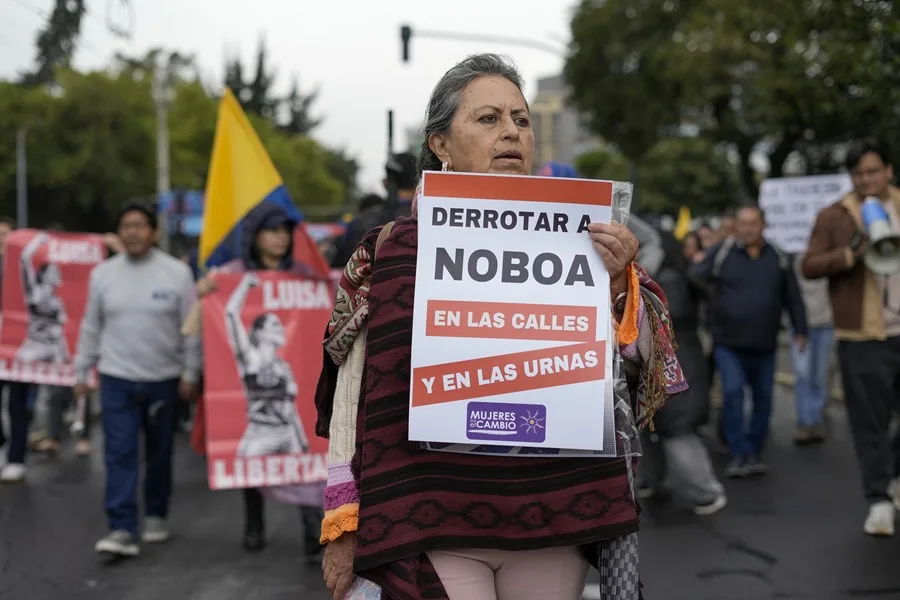
Nearly 100 people marched through Ecuador’s capital, Quito, on Thursday to protest President Daniel Noboa’s government, launching a new wave of demonstrations ahead of local elections scheduled for Nov. 29.
Organized by the country’s main trade unions and left-wing political parties, the peaceful march moved through the historic center before reaching the attorney general’s office. Protesters gathered outside the building carrying banners demanding the release of Luisa González, a former presidential candidate and one of the leading opposition figures.
González, who belongs to the political movement associated with former President Rafael Correa, was placed in pretrial detention in a case involving alleged money laundering. Prosecutors accuse her of involvement in the irregular financing of her first presidential campaign in 2023.
Chanting “Out, Noboa, out,” demonstrators also called for improvements to public education and healthcare. Some participants urged voters to cast null ballots in the upcoming local elections.
Natasha Rojas, a politician and activist, described the mobilization as a defense of democracy, civil liberties and the rights of Ecuadorians. She argued that the government was losing public support and warned that its policies would fuel further protests.
Nelson Erazo, president of the Popular Front, accused state institutions, including the attorney general’s office and the comptroller’s office, of being used to target social activists and political leaders.
He said the demonstration brought together groups seeking political change and demanding that Ecuadorians be able to express themselves freely, with guarantees of access to education, healthcare and employment.
Opposition organizations have announced further demonstrations on Nov. 7 and 15, followed by a march alongside feminist groups on Nov. 25 to mark the International Day for the Elimination of Violence Against Women. Another mobilization is planned for Dec. 10, in coordination with international organizations, to defend human rights.
The Fund outlined four priorities for turning economic stabilisation into stronger growth and job creation as it backed a new $900 million disbursement.
The International Monetary Fund (IMF) on Thursday urged Argentina to maintain its economic programme, warning that sustained policy implementation and stronger international reserves remain essential to reducing country risk as concerns grow over a possible technical recession.
IMF spokeswoman Julie Kozack said the government should continue implementing its current policies while ensuring that the benefits of economic stabilisation translate into stronger growth and employment.
“Our best advice for Argentina to continue reducing its country risk is to continue with its strong policy implementation, that is, to keep implementing the programme as it has been doing,” Kozack told a news conference in Washington.
She stressed that accumulating net international reserves and strengthening the country’s external position were fundamental to reducing financial risks. The Fund’s broader message, she added, was to maintain the current policy direction while extending the benefits of stabilisation across the economy.
🇦🇷💸 | Ante las declaraciones directas del presidente de la nación Argentina, Javier Milei, la escalada de la crisis económica golpea con dureza a la sociedad, donde la mayoría de la población lucha diariamente contra el endeudamiento y la precariedad laboral. La realidad es que… pic.twitter.com/J4RLdc4uvQ
Text Reads: | In light of the direct statements from Javier Milei, president of the Argentine nation, the escalation of the economic crisis is hitting society hard, where the majority of the population struggles daily against debt and job precariousness. The reality is that surveys reveal that nearly 6 out of 10 Argentine citizens have had to go into debt to survive amid the drastic drop in purchasing power. At the same time, the lack of employment and the loss of social rights worsen a landscape that deeply affects the quality of life of families, especially the youth. Popular discontent is growing in the face of official responses that seem to ignore the urgency of the crisis, forcing us to understand “The Other Side of the Coin”.
Addressing questions about the possibility of Argentina recording two consecutive quarters of economic contraction, Kozack outlined four priorities agreed upon with the government to support growth and job creation.
These include deepening capital and mortgage markets to expand access to financing, introducing greater flexibility in the labour market to encourage private-sector employment, advancing infrastructure projects awarded through concession agreements, and facilitating strategic investment through the Incentive Regime for Large Investments (RIGI).
Projects approved under the investment incentive scheme already exceed $76 billion, according to the IMF.
The Fund’s latest assessment comes as its staff and Argentine authorities reached an agreement on Tuesday on the third review of the country’s Extended Fund Facility programme, potentially unlocking a disbursement of approximately $900 million.
Kozack said the IMF Executive Board could consider the review in early December.
The Fund said the programme had continued to deliver results despite a more challenging international environment. Net international reserves exceeded the June target by approximately $4 billion, while the Central Bank purchased nearly $16 billion in foreign currency during the year.
The Treasury also raised more than $5 billion in domestic markets. With support from official creditors, the government secured $3.2 billion in guaranteed financing from international banks and was working to obtain an additional $1 billion before the end of the year.
The agreement maintains Argentina’s target of a primary fiscal surplus equivalent to 1.4% of gross domestic product (GDP) in 2026, with a similar fiscal effort planned for 2027. It also preserves the existing exchange rate band system.
However, the economic outlook remains weaker than previously expected. In October, the IMF lowered its 2026 growth forecast for Argentina from 3.5% to 2.1%, underscoring the challenge of turning stabilisation gains into sustained economic expansion.
Haiti has postponed its presidential and legislative elections once again, pushing the first round from December 13 to July 18, 2027, as armed gangs and a decade-long institutional vacuum leave the country with no elected official since 2016.
The move had been expected since the start of the month, when the council extended the deadline for candidate registration to October 31 without setting a new voting date.
The first round of the presidential and legislative elections, together with the constitutional referendum, now falls on July 18, 2027.A second round -including presidential and legislative runoffs and local elections- is scheduled for October 4 of that same year. The campaign, originally due to begin on October 5, will open on April 15, 2027, roughly three months before polling day.
Under the updated schedule, candidate registration will remain open through February 9, 2027, while voter registration is extended to May 20. The council’s online platform shows that nearly 890,000 voters are registered on the electoral roll, far short of the 7.7 million people of voting age.
Despite repeated calendar revisions, candidates have continued to register for the elections. According to the Provisional Electoral Council ’s latest updates, over 7,300 candidates have registered for different elected positions. The provisional list includes 19 candidates for President, 369 for the Senate, 1,293 for the Chamber of Deputies and 5,623 for local elections.
Haïti a de nouvelles dates pour les élections présidentielle, législatives et municipales à venir : 18 juillet 2027 pour le premier tour – 4 octobre 2027 pour le deuxième tour, selon une communiqué du Conseil électoral provisoire. pic.twitter.com/A4raK78ifp
Text reads: “Haiti has new dates for the upcoming presidential, legislative and municipal elections: July 18, 2027 for the first round – October 4, 2027 for the second round, according to a communiqué of the Provisional Electoral Council.”
The Provisional Electoral Council (CEP) framed the decision as an effort to keep the process moving. “The updated calendar aims to facilitate the continuation of electoral operations under conditions that allow the stakeholders concerned to fulfill their obligations in accordance with the provisions of the legal framework,” the council explained in a statement accompanying the new plan.
The body also pledged to move forward “with dialogue, professionalism and rigor,” targeting elections that are inclusive, credible and transparent. It promised to respect “the right of each citizen to participate in the democratic life of the country.”
That language contrasts sharply with conditions on the ground. Haiti has not held an election since 2016, when Jovenel Moïse won the presidency. He took office in February 2017 and was assassinated on July 7, 2021, at his residence in Port-au-Prince.
Since that killing, no elected official has occupied any post in the country’s state structure. Successive transitional governments have cycled through without managing to organize a vote. Prime Minister Alix Didier Fils-Aimé, the current leader, has governed on an interim basis since November 10, 2024.
The elections were first set for August 30 of this year. The political and security crisis, driven by armed gang violence and the failure to restore institutional stability, forced a postponement to December 13. That date has now been abandoned for July 18, 2027.
Gangs Hold the Capital
Armed gangs control most of Port-au-Prince. The main force arrayed against them is the Gang Suppression Force (GSF), created in September 2025 under a UN Security Council mandate and renewed for six additional months when it reached its first anniversary.
The latest delay unfolds as hundreds of Salvadoran soldiers search the Haitian capital for four kidnapped colleagues. Those troops belonged to the GSF and vanished on October 18, when armed gangs ambushed them on the outskirts of Port-au-Prince.
The #GSF confirms that it has received, through a third-party humanitarian organization, remains suspected of being those of the four personnel from the Salvadoran contingent currently missing. At this stage, the GSF is not in a position to confirm that the remains are those of… pic.twitter.com/JvfLg1DfCG
— Gang Suppression Force – Haiti (@GSForceHaiti) October 25, 2026
PM Fils-Aimé presides over a country under siege. He holds no elected mandate himself, and the security conditions that have justified every postponement show no sign of easing.
For Haitians, the wait has now stretched past a decade without a chance to cast a ballot. Each interim administration has promised elections and delivered another delay. The violence cited as the obstacle has, in turn, deepened with every year of institutional drift.
Whether July 2027 becomes a genuine election day depends on factors no schedule can secure: safe streets, working electoral machinery and a minimum of political consensus. As things stand, the only firm date in Haiti is a next postponement.
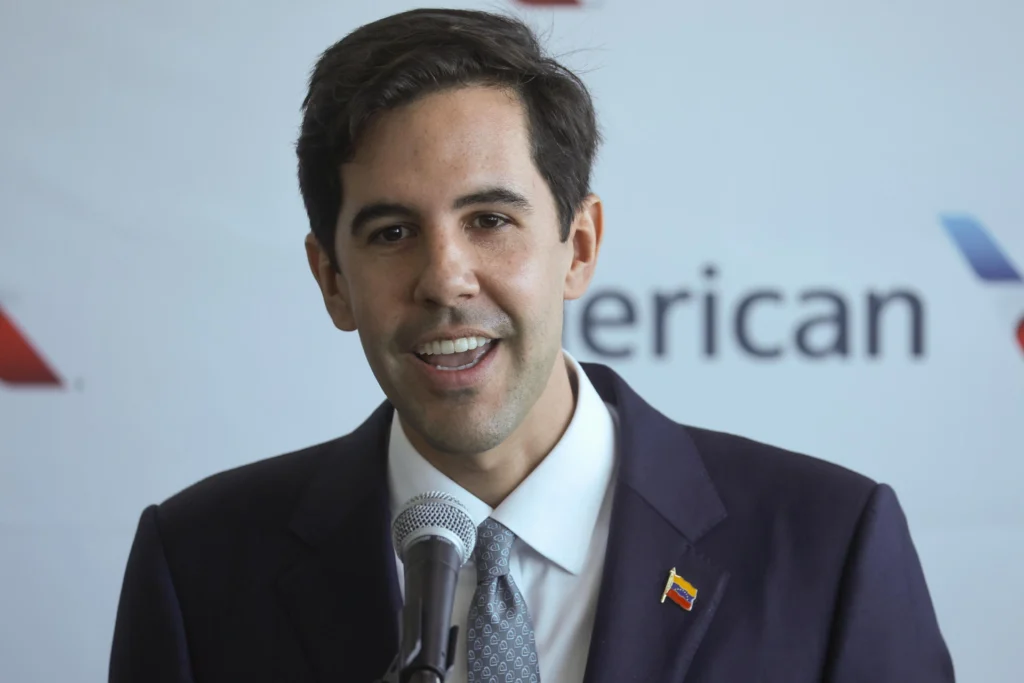
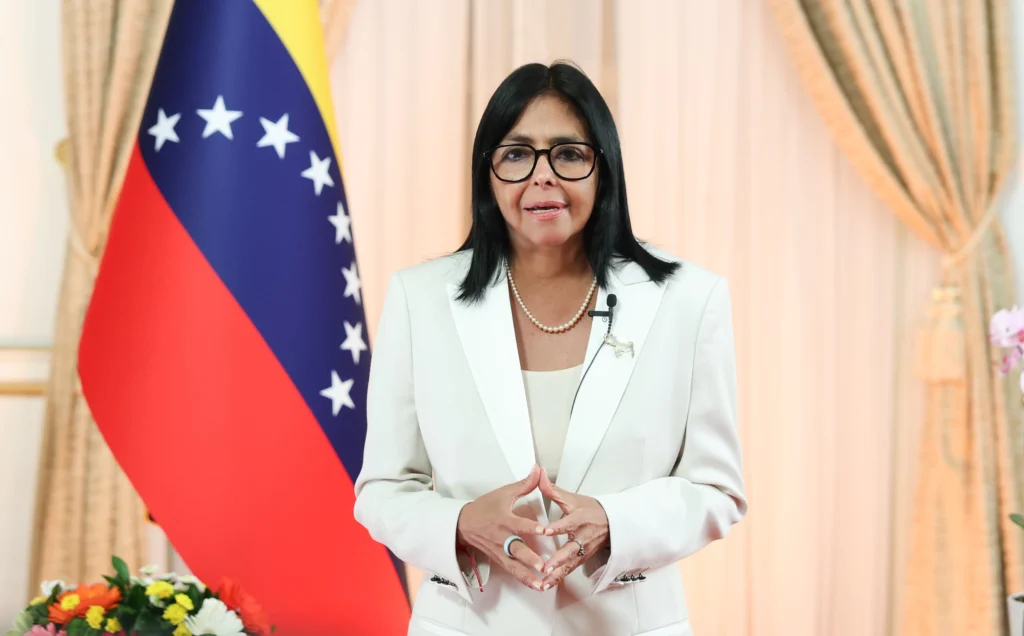
Venezuela’s Acting President Delcy Rodriguez appointed Deputy Minister Oliver Blanco as the country’s new Foreign Minister on Thursday, while outgoing top diplomat Félix Plasencia will lead the mission to recover Venezuelan gold held in the United Kingdom.
Acting President Delcy Rodriguez announced the moves in Caracas during an event focused on the National Electric System, where she also outlined plans for the country’s energy infrastructure.
The reshuffle places a 35-year-old diplomat at the helm of the Foreign Ministry and redirects a veteran official toward a long-running dispute over state assets frozen abroad.
“I have decided to appoint Oliver Blanco as Foreign Minister of the Bolivarian Republic of Venezuela. I hope this strengthened team keeps advancing in the changes and the geopolitical recovery of Venezuela in areas of cooperation and friendship with all countries,” Rodriguez said.
He designado a Oliver Blanco, joven profesional de las relaciones internacionales, como nuevo ministro del Poder Popular de Relaciones y Comercio Exterior. Confío en su preparación, compromiso y capacidad para asumir esta importante responsabilidad al servicio de Venezuela.… pic.twitter.com/A0gaqGOWnv
Text reads: “I have appointed Oliver Blanco, a young professional in international relations, as the new Minister of People’s Power for Foreign Relations and Trade. I trust in his preparation, commitment and ability to take on this important responsibility in the service of Venezuela.I thank Félix Plasencia for his dedication and work at the head of the Chancellery, and who will now assume new international strategic tasks.”
The new Foreign Minister Blanco, holds a degree in International Studies from the Central University of Venezuela and a master’s degree in Political and Government Studies from the Metropolitan University. His previous post covered Europe and North America, a portfolio that included some of the governments most active in the sanctions and asset disputes that have defined Venezuela’s recent foreign relations.
Gold Recovery Mission
Felix Plasencia, who steps down as Foreign Minister, will now serve as director of International Affairs for the Presidency. His immediate priority is clear. “His first task is to settle in the United Kingdom until we recover the gold that belongs to Venezuelans,” the Acting President Rodriguez stated.
The assignment follows a request Rodriguez made on Wednesday. She asked the Foreign Ministry and the Attorney General’s Office to begin formal procedures to recover Venezuelan gold retained at the Bank of England. The precious metal has been at the center of a legal battle involving rival claims over Venezuela’s legitimate government, with London courts weighing which authority controls the reserves.
Recibo con mucha humildad y compromiso la responsabilidad que me ha encomendado la presidenta encargada, @delcyrodriguezv.
Defenderé nuestra soberanía y el interés nacional con firmeza, trabajando siempre por alcanzar beneficios concretos para nuestra gente.
Text reads: “I accept with great humility and commitment the responsibility entrusted to me by the Acting President @delcyrodriguezv. I will defend our sovereignty and national interest firmly, always working to achieve concrete benefits for our people. I am proud to accompany the Acting President in this process of democratic transformation, to which we all have something to contribute to bring it to a successful conclusion.”
Cabinet Reshuffle Expand
The changes extend beyond the two senior positions. Marynna Saatdjian will take over as Vice-minister for Europe and North America, filling the role Blanco leaves behind. Saúl Ameliach, until now a Vice-minister at the Ministry of Economy and Finance, moves to head the Vice-ministry of International Trade.
Acting President Rodriguez framed the appointments as part of a broader effort to strengthen Venezuela’s diplomatic corps. She emphasized that the government will continue pursuing cooperation and friendship with all countries while defending national sovereignty.
The diplomatic shift carries particular weight given the gold dispute. Venezuela has pursued the release of its reserves held in London for years, arguing the assets belong to the Venezuelan people and are needed for social programs and economic recovery. By sending Plasencia directly to the United Kingdom, the government signals it intends to press the matter with renewed intensity.
With Blanco at the Foreign Ministry, Plasencia handling international affairs from the Presidency and new vice ministers in place, the administration has assembled a team positioned around two core objectives: restoring full diplomatic engagement and reclaiming state assets held overseas.
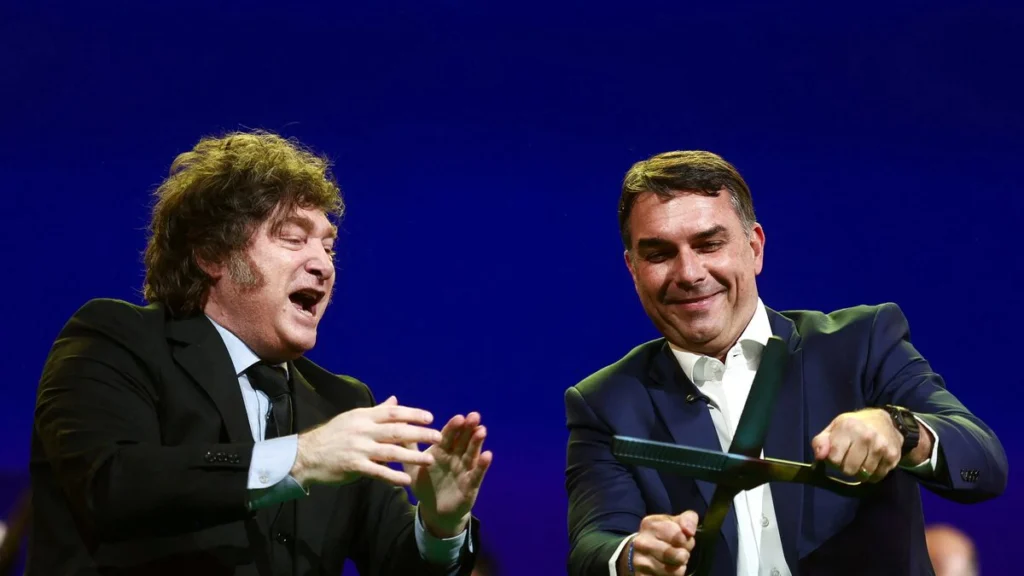
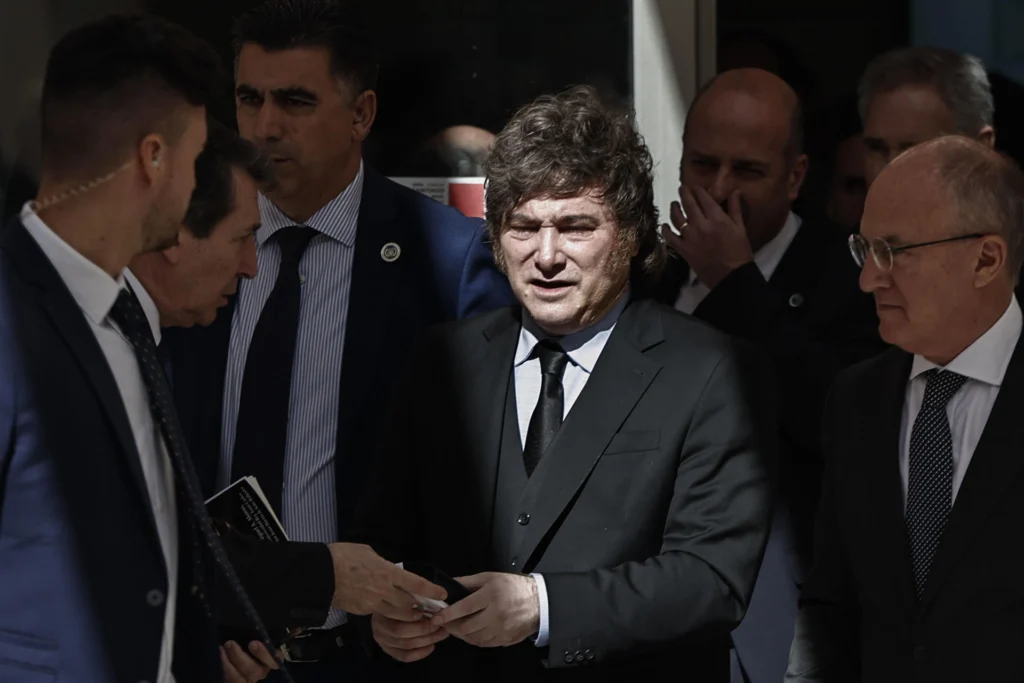
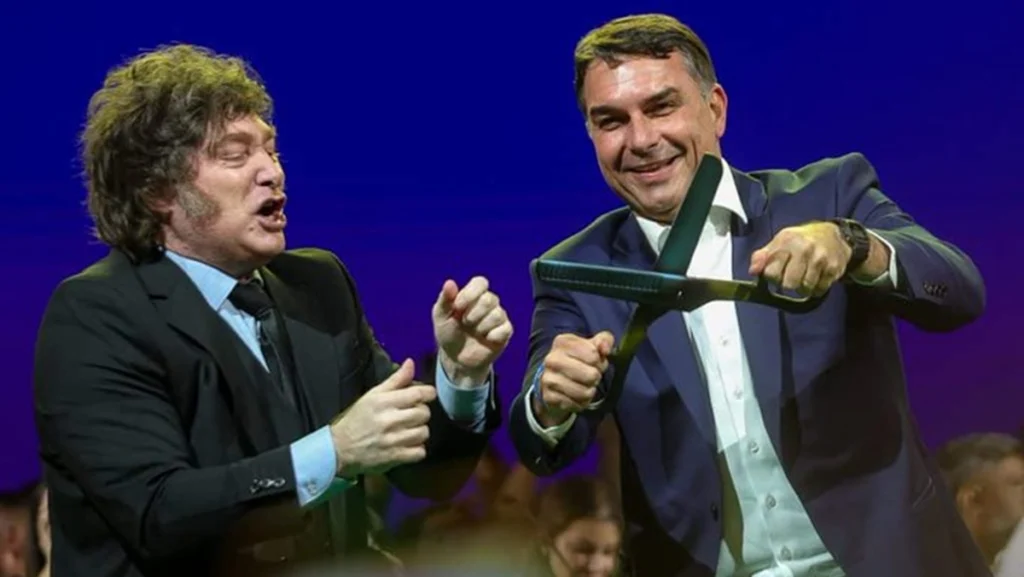
Three legal complaints filed with the Argentine justice system call for an investigation into President Javier Milei, Foreign Minister Pablo Quirno, Security Minister Alejandra Monteoliva, and advisor Santiago Caputo, alleging their involvement in the escape of Brazilian Senator Flávio Bolsonaro. The filings cite potential offenses including concealment, human trafficking, the misuse of public resources, and facilitating the illegal stay of a fugitive from Brazilian justice.
The complaints—brought by Left Front leader Gabriel Solano and Socialist lawmaker Esteban Paulón—are being processed in the Comodoro Py courts; the first has been assigned to Judge María Eugenia Capuchetti. Meanwhile, lawmaker Marcela Pagano filed her complaint in the federal courts of Misiones, where Judge Marcelo Cardoso is presiding.
Pagano argued that the case should examine a potential crime of “illegal human trafficking across national borders,” an offense aggravated by the involvement of government officials. The legislator warned that these actions could compromise the Argentine state’s sovereignty regarding “border control, the fulfillment of its criminal cooperation obligations with a Mercosur member state, and the integrity of federal agencies.”
Cases Against Flávio Bolsonaro
In Brazil, Flávio Bolsonaro has been under investigation for alleged money laundering, corruption, and violations of foreign exchange regulations—all linked to the financing of Dark Horse, a film about his father, former President Jair Bolsonaro. The investigation connects him to banker Daniel Vorcaro, who is accused of fraud; the senator allegedly solicited millions in funding from him for the film. He is also implicated in a separate case involving money laundering through online gambling platforms.
A few days ago, Brazilian Supreme Court Justice Flávio Dino ordered an investigation into whether there was foreign support—specifically involving funds from the United States—for the presidential campaign of Bolsonaro, who was defeated by Luiz Inácio Lula da Silva.
Brazilian senator Flavio Bolsonaro has fled to the United States and declared himself Brazil’s “true elected president” after losing the presidential election to Luiz Inacio Lula da Silva by 4.4 million votes. He is challenging the official result from abroad.
Solano’s complaint highlights a shift in the Argentine government’s account. After initially denying that Bolsonaro had entered the country, the National Migration Directorate acknowledged at 2:00 a.m. that the senator had crossed the border on October 27 via the Tancredo Neves International Bridge, using an Italian passport.
Although the ruling administration claimed the documentation was “valid,” Bolsonaro’s passport was actually suspended, and he faced ongoing criminal proceedings, including charges related to money laundering. Former Migration Director Florencia Carignano noted that the government made a political decision to allow his entry, despite these legal proceedings.
The filings also detail the alleged use of state resources. According to the complaints, agents from the Airport Security Police (PSA) escorted Bolsonaro, who arrived at the airport in a vehicle bearing Argentine diplomatic license plates.
Additionally, an investigation is underway regarding the logistics surrounding a private Gulfstream G400 aircraft operated by the company Baires Fly. The firm is linked to Sergio Mastropietro—who is currently facing prosecution in a corruption case involving the National Disability Agency (ANDIS)—and has ties to drug trafficker Federico Machado. The aircraft reportedly remained in Puerto Iguazú for over 24 hours without authorization from the National Civil Aviation Administration (ANAC), with an estimated cost of $140,000, arranged through a broker in the United States.
Constitutional law expert Andrés Gil Domínguez pointed out that Emergency Decree (DNU) 366/25 establishes that “failure to disclose the existence of a criminal record” serves as grounds for denying entry. The expert highlighted the irregularity of a foreign national—who was the subject of multiple judicial warrants—being able to travel through the country while circumventing the controls established by Law 25.871.
The complaints call for charges of abuse of authority and breach of public official duties. Furthermore, they request the preservation of surveillance camera footage as well as immigration and airport records, in order to determine the criminal liability of those involved.
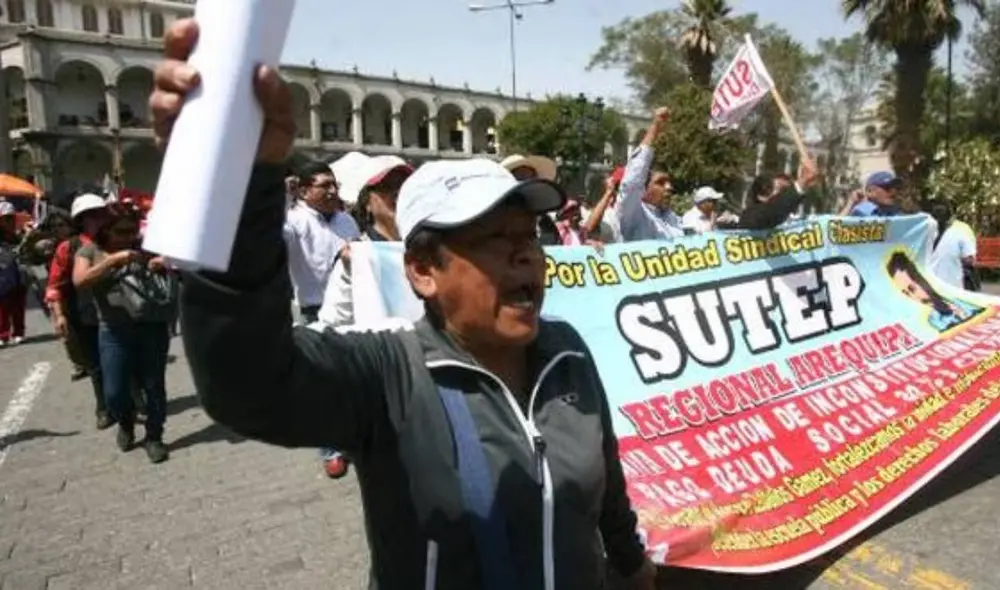
On Thursday, the Unitary Union of Education Workers of Peru (Sutep) held a 24-hour national strike in public educational institutions, demanding a larger budget, adherence to labor agreements, and the implementation of pension regulations for the teaching profession. The action took place even though the Ministry of Education (Minedu) declared it unauthorized and warned that staff who were absent would face pay deductions.
The day of protest included gatherings and marches in the country’s major cities. In Lima, demonstrators assembled at the union’s headquarters on Jirón Camaná, in the capital’s historic center. In Arequipa, marches began in the morning, departing from union offices.
Sutep’s leadership, headed by Secretary General Lucio Castro, presented a list of demands focused on education funding, working conditions, and pensions for retired and former teachers.
Among their primary demands, the union calls for the effective allocation of 6% of the Gross Domestic Product (GDP) to the education sector. According to the union, these resources should address deficiencies in school infrastructure, student nutrition, and access to technology and connectivity.
Teachers are also demanding the immediate regulation and implementation of a law enacted in April 2026, which mandates that the pensions of retired and former teachers—those who were part of the Public Teaching Career—be adjusted to an amount equivalent to the first tier of the teaching salary scale: S/ 3,500.70. This measure is currently the subject of a constitutional challenge before the Constitutional Court.
🏫 El Ministerio de Educación declaró improcedente el paro nacional convocado por el Sutep para este jueves y anunció que verificará la asistencia de los docentes en colegios de todo el país.
El viceministro de Gestión Institucional, Luis Alemán, informó que habrá visitas de… pic.twitter.com/Yhwiok4cKc
The text reads, “The Ministry of Education declared the national strike called by the Sutep for this Thursday inadmissible and announced that it will verify the attendance of teachers in schools throughout the country. The Vice Minister of Institutional Management, Luis Alemán, reported that there will be field visits and warned that discounts will be applied for absences. “Education will not be paralyzed today,” he affirmed.”
Furthermore, Sutep is calling for full compliance with the collective bargaining agreement, salary increases, and the timely payment of the “Compensation for Length of Service” (CTS) benefit. The Ministry of Education (Minedu) issued General Secretariat Resolution No. 239-2026-MINEDU, declaring the planned national strike inadmissible on the grounds that it failed to meet the requirements established for the regular basic education sector, which is classified as an essential public service.
The Ministry urged families to send students to their schools and mandated that school principals submit lists of absent staff to the Local Educational Management Units (UGEL) and the Regional Education Directorates (DRE).
The Ministry specified that direct payroll deductions will be applied for hours or days not worked, and that potential administrative disciplinary proceedings will be considered against those who participate in the industrial action.
The continuation of in-person classes depends on the extent to which teachers, administrative staff, and service personnel at each institution choose to participate in the strike. Union leadership in Lima warned that the absence of support and cleaning staff could hinder the operational opening of several schools.
Hamer Villena, secretary of the SUTEP union in Arequipa, did not rule out escalating the protests into an indefinite national strike before the end of the 2026 school year or in early 2027, should the Executive branch fail to establish a negotiation table that offers concrete solutions.
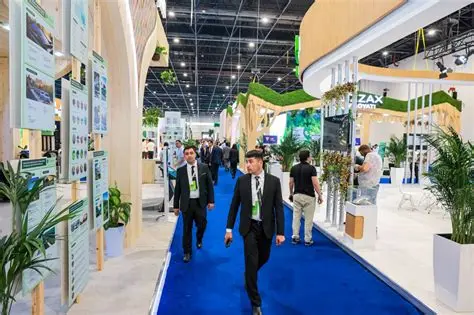
Cuba is participating in the 21st edition of Eco Expo Asia 2026, held in Hong Kong, China, with the goal of gaining new knowledge and fostering exchanges regarding green technologies that align with the country’s development priorities.
The expo, which runs from October 26 to 29, serves as a leading commercial platform in Asia dedicated to environmental protection and sustainable technologies. It brings together over 340 exhibitors from 15 countries and regions, showcasing innovations in eco-friendly technology, the circular economy, smart city infrastructure, and zero-carbon solutions.
Cuba is represented by Idalia López Pedroso, Deputy Minister of the Ministry of Science, Technology and Environment (CITMA), and Martha Ferriol Marchena, Director of Document Management and Archives, as reported on the CITMA website.
According to the source, the island’s participation offers an opportunity to gain new knowledge and exchange ideas on green technologies aligned with the country’s development priorities.
La VM @citmacuba Idalia López destacó la importancia que tiene para #Cuba que se promuevan los intercambios técnicos y la cooperación industrial, al intervenir en cierre del Programa Internacional de Capacitación Ruta de la Seda Verde, evento paralelo de Eco Expo Asia 2026 👇 pic.twitter.com/hW126GNxeJ
— Ministerio de Ciencia, Tecnología y Medio Ambiente (@citmacuba) October 29, 2026
The text reads, “Deputy Minister Idalia López, speaking at the closing of the “Green Silk Road” International Training Program—a side event of Eco Expo Asia 2026—highlighted the importance for #Cuba of promoting technical exchanges and industrial cooperation.”
The 2026 edition focuses on four key themes:
Green Energy in Motion: smart mobility and new energy sources.
Buildings for a Greener City: green construction technology.
From Waste to Resource: the circular economy and waste management.
Cutting-Edge Green Technology: innovation and startups within the environmental sector.
The exhibition is organized by the Hong Kong Trade Development Council and Messe Frankfurt (HK), in collaboration with the Environment and Ecology Bureau of the Hong Kong Special Administrative Region Government.
Under the theme “Connecting the World for a Sustainable Future,” the event brings together officials and representatives from organizations in mainland China, Hong Kong, ASEAN, and other markets linked to the Belt and Road Initiative.
On Thursday, October 29, Delcy Rodríguez, acting president of the Bolivarian Republic of Venezuela, delivered an address to the nation in which she took stock of the transformative actions undertaken throughout the year across the political, economic, cultural, spiritual, and democratic spheres.
In her remarks, Rodríguez reviewed the executive branch’s performance, the management of public policies, and ongoing consultative processes aimed at addressing the country’s social demands.
During the address, she defended the Venezuelan government’s independence in defining its strategic policies. “The decisions regarding this transformation are made here, signed here, and announced here—before you. Sovereignty is not up for negotiation,” she asserted.
Rodríguez also addressed the complex situation the nation faced following the socioeconomic impact experienced over the course of the year, noting that the institutional response is focused on consolidating a recovery in production, strengthening public services, and improving the population’s living conditions.
A central theme of her address was the announcement of a national consultation aimed at driving a reform of the criminal justice system. “The goal is to build a more transparent and humane justice system one that leaves behind corruption, procedural delays, and the criminalization of poverty,” Rodríguez explained.
The text reads, “Venezuela has a clear path forward. We are advancing toward a democratic, economic, and social transformation—through judicial reforms, dialogue, and decisions that translate into tangible improvements in the quality of life for the Venezuelan people. I know there is still work to be done, but our commitment is firm: to correct what is wrong, protect what works, and build a country with opportunities for all. The rebirth of Venezuela is proven through actions!”
This initiative is part of an institutional transformation agenda presented by the executive branch, which includes strengthening the judicial system and developing mechanisms to expand guarantees for citizens. Within this framework, the government is engaged in a political dialogue with representatives of the National Assembly elected in 2015; the third round of these talks took place in October.
The agenda also covers political guarantees for upcoming electoral processes, the reform of the Supreme Tribunal of Justice, and the allocation of resources for socioeconomic relief following the earthquake.
In her address, Delcy Rodríguez also spoke directly to the nation’s youth and to Venezuelans living abroad. She maintained that the ongoing transformations aim to ensure that new generations “inherit functioning institutions rather than ruins.”
Regarding the return of migrants, she affirmed that the decision is voluntary and that those who choose to return will be treated with respect, provided with proper documentation, and offered employment opportunities. “We are building a country worth returning to,” the acting president stated.
Rodríguez also announced progress on a labor dialogue and consensus forum, designed to strengthen social justice and ensure the progressive improvement of income for the Venezuelan working class. This body functions as a tripartite consultative space, involving the country’s main trade union confederations, business chambers, and the national government.
In this context, she explained that four separate increases in worker income are planned for 2027. Furthermore, she stipulated that these increases can, under no circumstances, be lower than the economic growth recorded in the preceding quarter.
The president reiterated the national government’s commitment to addressing the demands of various social sectors in a timely manner, prioritizing family well-being, the restoration of essential public services, and direct support for communities.
The leader emphasized that economic stakeholders also have a platform to achieve concrete objectives that will drive a significant boost in production and foster sustainable economic growth. Through these initiatives, the government aims to translate productive growth into tangible improvements in the quality of life and purchasing power of the Venezuelan people.
Rodríguez’s message comes at a time of progress within the political dialogue forum, which has addressed political guarantees, judicial system reform, and the recovery of resources to support the country’s social and economic needs.
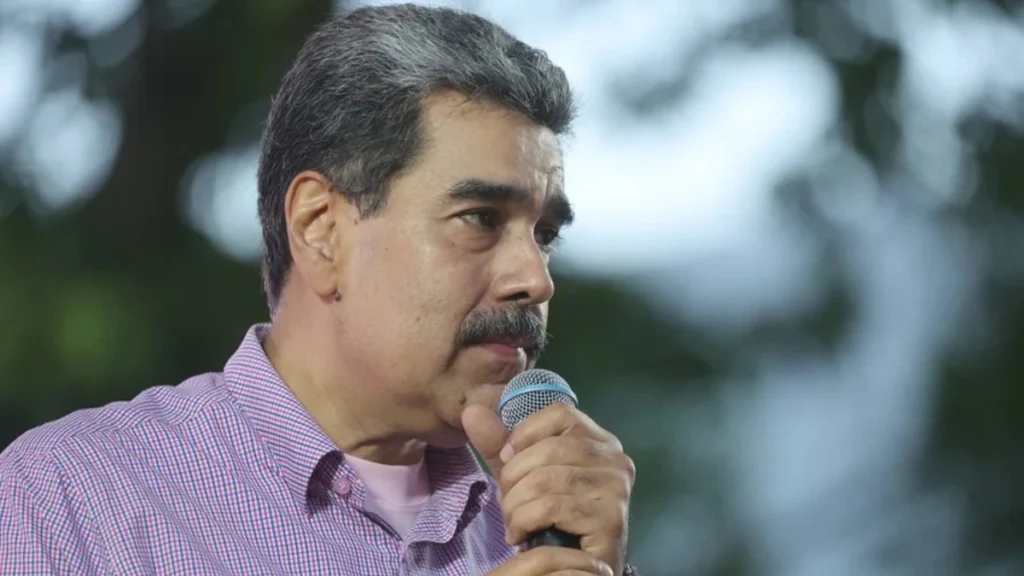
The U.S. judicial case against Venezuelan President Nicolás Maduro was assigned this Wednesday to Federal Judge Analisa Torres, following the death of Judge Alvin K. Hellerstein, who had overseen the proceedings since March 2020. The reassignment was formalized in the records of the U.S. District Court for the Southern District of New York.
The transition occurred through an administrative procedure used to reassign cases previously handled by judges who are no longer active due to retirement or death. Judge Hellerstein passed away this Wednesday at the age of 92 from natural causes, as confirmed by a court spokesperson. He had served for nearly three decades, presiding over cases that garnered significant media and legal attention.
Analisa Torres became a judge for the Southern District of New York in 2013, having been appointed by then-President Barack Obama. Born in New York in 1959, she has presided over complex civil, criminal, and regulatory litigation throughout her tenure on the federal bench.
Torres graduated with honors from Harvard University and earned her law degree from Columbia Law School. Before joining the federal court, she worked in private practice and served for nearly ten years on the New York State Supreme Court, in addition to holding positions within the city’s civil and criminal court systems. She comes from a family of legal professionals with Puerto Rican roots.
Status of the Judicial Proceedings
Judge Hellerstein had presided over the case since its inception in March 2020, when Washington filed initial drug-trafficking charges against the Venezuelan president. The next hearing is scheduled for December 17 and will focus on claims of sovereign immunity raised by the defense. The trial is set for June 14, 2027, alongside the proceedings against lawmaker Cilia Flores.
On October 15, Nicolás Maduro and Cilia Flores pleaded not guilty before Judge Hellerstein—who was presiding at the time—during a hearing in New York, following the addition of new charges by the U.S. Prosecutor’s Office.
According to a teleSUR correspondent, the president Maduro stated that he had read the indictment in its entirety and rejected it, dismissing it as a collection of false and mendacious accusations that were already known. He reiterated his innocence, while Flores declared: “I am completely innocent; I am not guilty.”
During the proceeding, the judge granted a joint request from the prosecution and the defense to postpone the start of the trial by two weeks, allowing more time for the preparation and filing of pretrial motions. As a result of the hearing, the trial was rescheduled for June 14, 2027.
Russian Foreign Minister Sergey Lavrov demanded the immediate release of President Nicolas Maduro and his wife, denouncing their imprisonment in the U.S. without trial. He also condemned the attacks against Iran’s Supreme Leader, Ayatollah Ali Khamenei, and warned of the serious… pic.twitter.com/l7WI0wOKHt
January 3, 2026: Following bombings in Caracas and other cities, U.S. special forces kidnapping President Nicolás Maduro and Cilia Flores in the Venezuelan capital and transported them to the United States. The operation resulted in over a hundred deaths and a similar number of injuries. The then-Executive Vice President, Delcy Rodríguez, assumed acting president role.
January 5: Both individuals made their initial appearance in New York, pleaded not guilty, and were placed in custody at the Metropolitan Detention Center in Brooklyn.
July: The prosecution and the defense agreed that the trial would begin on June 1, 2027, with a pretrial hearing scheduled for November 17.
September 9: Cilia Flores’s defense team requested release on bail and house arrest. The judge ordered that medical records remain under seal. September 25: Assistant Prosecutor Jason A. Richman resigned.
October 8: Hellerstein denied the request for bail for Flores. That same day, the prosecution filed a new indictment.
October 15: A hearing was held in which new charges—conspiracy to commit torture—were presented. Maduro and Flores pleaded not guilty, and the trial was rescheduled.
October 29: The case file was reassigned to Judge Analisa Torres following the passing of Hellerstein.
The aggression against Venezuela and the kidnapping of President Maduro and Deputy Flores have drawn condemnation and sparked demonstrations in various parts of the world. Hundreds of protesters have gathered in the vicinity of the Southern District Court in Manhattan during the hearings to express solidarity with the accused and to denounce the warmongering and interference of the White House.
After losing to Luiz Inácio Lula da Silva by 4.4 million votes, the senator rejects the election result and calls on supporters to mobilize from abroad.
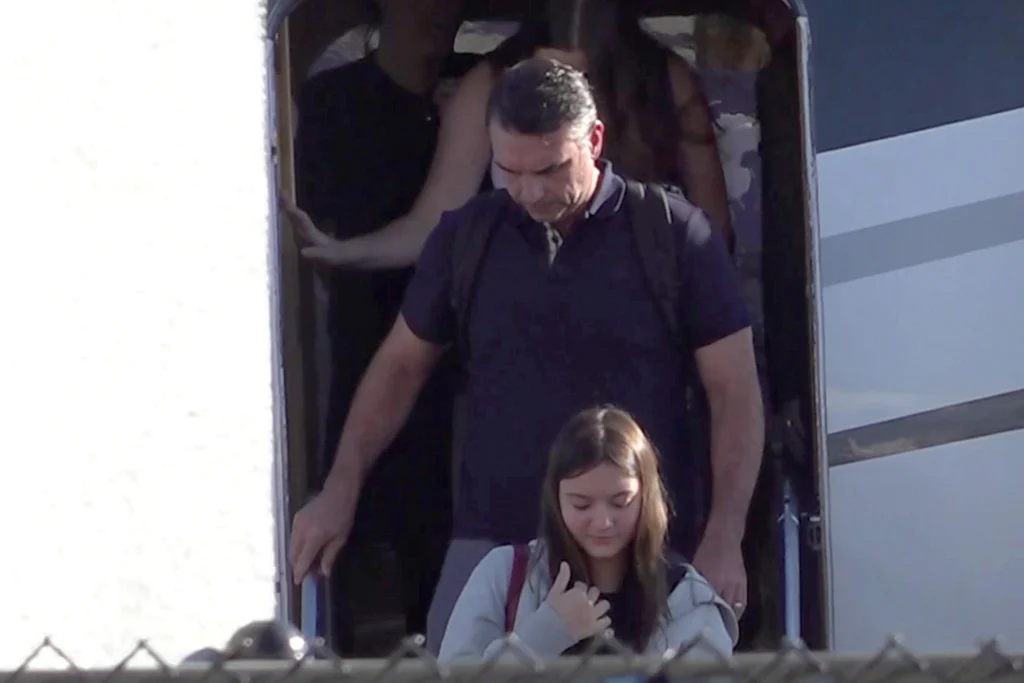
Brazilian senator Flávio Bolsonaro has fled to the United States and declared himself Brazil’s “true elected president” after losing the presidential election to Luiz Inácio Lula da Silva by 4.4 million votes, challenging the official result from abroad.
In a manifesto published after arriving in the United States, Bolsonaro accused Brazil’s government of operating as a “regime” and alleged electoral fraud, citing a judicial decision that extended voting hours from 5 p.m. to 7 p.m. He also urged his supporters to mobilize against the election result.
Official figures show that just 34,300 votes were cast after the usual closing time, too few to alter the overall outcome. Bolsonaro’s own campaign had requested the extension, according to the press release.
His declaration puts him at odds with his own party, the Liberal Party (PL), which formally recognized the election results. The move echoes a strategy previously adopted by Venezuelan opposition figure Juan Guaidó, who declared himself his country’s legitimate leader.
Text Reads: The Argentine government allegedly facilitated Flávio Bolsonaro’s escape to the United States, according to accusations seeking to hold President Javier Milei, Foreign Minister Pablo Quirno, Security Minister Alejandra Monteoliva, and advisor Santiago Caputo criminally liable. ⚖️ The charges allege crimes including concealment, human trafficking, and failure to enforce security controls. Bolsonaro crossed the border using an Italian passport—despite it being suspended—and boarded a private jet to Miami, bypassing Brazilian airspace while under the escort of the Airport Security Police. 🔍 The complaint raises questions about who paid for the flight, estimated at $140,000. Meanwhile, lawmaker Agustín Rossi has called for the questioning of Chief of Cabinet Diego Santilli, warning that the incident compromises Argentine sovereignty and the nation’s relationship with Brazil.
Bolsonaro’s departure for Florida follows a similar move by his father, former President Jair Bolsonaro, who traveled to the state in late 2022 after losing his election.
Other figures aligned with the Bolsonaro family are also in the United States, including his brother Eduardo Bolsonaro, political influencer Paulo Figueiredo and Alexandre Ramagem, the former head of Brazil’s intelligence agency, Abin. They have faced prosecution or investigations over alleged offenses linked to attempts against Brazil’s democratic institutions.
U.S. President Donald Trump confirmed that he had facilitated the entry of Flávio Bolsonaro and his family by arranging visas through the State Department.
The manifesto initially featured the former coat of arms of the “United States of Brazil” before the English-language version was corrected to use “Brazil,” according to the press release.
Bolsonaro is also facing judicial investigations in Brazil over alleged irregular financing and the preventive retention of passports, the press release states.
Lula’s victory breaks a run of nine electoral wins in the region by right-wing candidates promoted or backed by the Trump administration, including Argentina’s 2025 legislative elections.
Recordings allegedly linking Argentine political strategist Fernando Cerimedo to President Rodrigo Paz’s inner circle have yet to be authenticated.
Bolivia’s main parliamentary opposition force has called for an immediate prosecutorial investigation into leaked recordings allegedly linking Argentine political strategist Fernando Cerimedo to President Rodrigo Paz’s government, including one purportedly capturing a conversation with First Lady María Elena Urquidi.
Lissa Claros, head of the Libre Alliance caucus in the lower house, called on prosecutors Wednesday to appoint a special team to establish the authenticity of the recordings, which have circulated in recent months, and clarify Cerimedo’s role in the administration.
“The recordings keep emerging every day, yet the Public Prosecutor’s Office has not issued a statement. Do they want the Cerimedo case to go unpunished? Bolivia needs to know what role Mr. Cerimedo played,” Claros said. “Was he the one running the state from the shadows, or not?”
Claros insisted that the investigation must be impartial and that everyone should be subject to scrutiny, including the president’s wife.
El agente argentino de la derecha latinoamericana Fernando Cerimedo era el "presidente en la sombra" de Bolivia: ponía y sacaba ministros a su antojo y todos los directores del Estado le respondían, reveló su exesposa Nadia Beller. 🇧🇴🗣️ #teleSUR#12Octpic.twitter.com/1S11od16En
Text ReadsArgentine agent of the Latin American right Fernando Cerimedo was the “shadow president” of Bolivia: he appointed and removed ministers at will, and all the state directors answered to him, revealed his ex-wife Nadia Beller. 🇧🇴🗣️
One of the recordings purportedly captures a conversation between Cerimedo and Urquidi about government affairs. Its authenticity has not been established through official forensic examinations.
The leaked material has fueled scrutiny of Cerimedo’s reported ties to Paz’s inner circle and his alleged influence within the executive branch. The allegations have also drawn on statements and recordings released by Cerimedo’s former partner, lawyer Nadia Beller, remarks by Vice President Edmand Lara, an opposition figure, and reports in local media.
Cerimedo has been held in pretrial detention in Bolivia since August following a shooting attack by hired gunmen targeting Beller. He faces formal charges of attempted femicide as the alleged intellectual author of the attack, as well as separate proceedings over alleged domestic and family violence against Beller and alleged illicit enrichment.
Cerimedo’s political activities across Latin America have also come under scrutiny. In Brazil, he promoted a false narrative of electoral fraud in 2022. In Argentina, he played a significant role in the digital strategy for Javier Milei’s 2023 presidential campaign.
His company was also linked to disinformation operations during Chile’s constitutional referendum campaign, in which the Rejection bloc opposed the proposed constitution. His reported political connections extend to Argentine politician Patricia Bullrich, Honduran politician Nasry Asfura and other right-wing figures in the region.
In Bolivia, Cerimedo reportedly joined Paz’s political circle as an adviser, a relationship now at the center of questions raised by the leaked recordings.
Libre’s call for a formal investigation comes as the recordings remain unauthenticated, leaving allegations about Cerimedo’s role in the government unresolved.
Argentine lawmaker Marcela Pagano filed a criminal complaint against officials of the Milei administration to investigate how Brazilian senator Flavio Bolsonaro crossed into Argentina and departed for United States despite a judicial ban on leaving Brazil.
The complaint was presented before the Federal Court in Puerto Iguazu, in Misiones province. It seeks to establish the circumstances of Bolsonaro’s entry into Argentina and his later departure toward United States.
The far-right senator, son of former President Jair Bolsonaro, lost the presidential run-off to Luiz Inacio Lula da Silva on Sunday. He faces criminal cases in Brazil for corruption and money laundering, and Supreme Federal Court justice Alexandre de Moraes had prohibited him from leaving the country.
Pagano framed the matter in stark terms. “The justice system has to establish who organized Bolsonaro’s passage through our territory toward U.S. and whether Argentine officials facilitated it. A government cannot become the escape route for someone who is barred from leaving his country by court order”, she said.
The reconstruction presented to the court traces the route in detail. The Brazilian Senator crossed the international border between Foz do Iguazu and Puerto Iguazu through the Tancredo Neves crossing at 10.50 P.M. local time on Tuesday.
Forty minutes after entering Argentine soil, Flávvio Bolsonaro and his family boarded a private Gulfstream G400 jet at Iguazu International Airport. The aircraft belongs to the firm Baires Fly and had been positioned there since Monday.
🇧🇷 "I address the Brazilian people and the international community as the true elected president of Brazil."
Senator Flávio Bolsonaro, who lost Sunday's presidential runoff to incumbent Lula da Silva by about 4.4 million votes, is claiming the presidency in a statement released… pic.twitter.com/oTTodsaOcU
The jet traced a path through the airspace of Paraguay, Bolivia, and Peru. It made a technical stop in Guayaquil, Ecuador, before landing Wednesday in Miami, avoiding Brazilian airspace at every stage.
Pagano detailed that Flávio Bolsonaro reached the air terminal under escort from an Airport Security Police patrol car. That force answers to the Security Ministry, which falls under the federal Executive.
The National Directorate of Migration initially denied on Tuesday that the conservative leader was present or had any flight plans. Yet the government of Javier Milei officially acknowledged his passage at 2.00 A.M. Wednesday, when the aircraft was already airborne.
The complaint demands clarification of another element, the presence in Misiones of Santiago Caputo, political strategist and chief advisor to the Argentine presidency. Caputo reportedly arrived in the province earlier in the week aboard the same private plane.
La Dirección Nacional de Migraciones informa que a las 22:50 hs del dia 27/10, ingresaron por el paso fronterizo de Puente internacional Tancredo Neves en la provincia de Misiones, los ciudadanos Flavio Nantes Bolsonaro, Fernanda Antunes Figueira Bolsonaro, Carolina Figueira…
Text reads: “The National Directorate of Migration reports that at 10:50 P.M. on October 27, entered through the border crossing of Tancredo Neves International Bridge in the province of Misiones, citizens Flávio Nantes Bolsonaro, Fernanda Antunes Figueira Bolsonaro, Carolina Figueira Bolsonaro and Luiza Figueira Bolsonaro, who did so with skilled travel documentation without any legal impediment to entry into the country, also the transits were registered by the enforcement authority without incidents. For its part, at 11:30 P.M., the incoming party boarded a private flight dispatched by the company Baires Fly S.A to the city of Guayaquil, Ecuador, as reported in the flight plan.”
The written filing asks the court to investigate alleged crimes of illegal trafficking of persons, facilitation of illegal stay, abuse of authority, violation of public official’s duties, and cover-up. It requests urgent evidence measures including camera footage from the border bridge, aeronautical records, and the Airport Security Police duty logs.
The political fallout reached the legislature quickly. Argentine Congressman and former Defense Minister Agustin Rossi formalized a request to summon the Chief of Cabinet, Diego Santilli, to answer before Parliament.
The sequence raises the question at the heart of the complaint. A senator barred from leaving his country crossed a border, boarded a private jet, and flew to Miami without touching Brazilian airspace, all with a police escort on Argentine soil.
The government first denied any knowledge. It then confirmed the passage hours later, after the plane was gone. That gap between denial and confirmation sits at the center of the criminal filing.
The denunciation now forces the federal justice system to determine whether officials in the Milei administration facilitated a fugitive’s exit. The demand in Congress puts the same question to the Cabinet’s Chief.
Acting President Delcy Rodriguez demanded Wednesday that the Bank of England return Venezuela’s gold, calling the metal a Central Bank reserve that belongs to the Venezuelan people and declaring that no excuse remains.
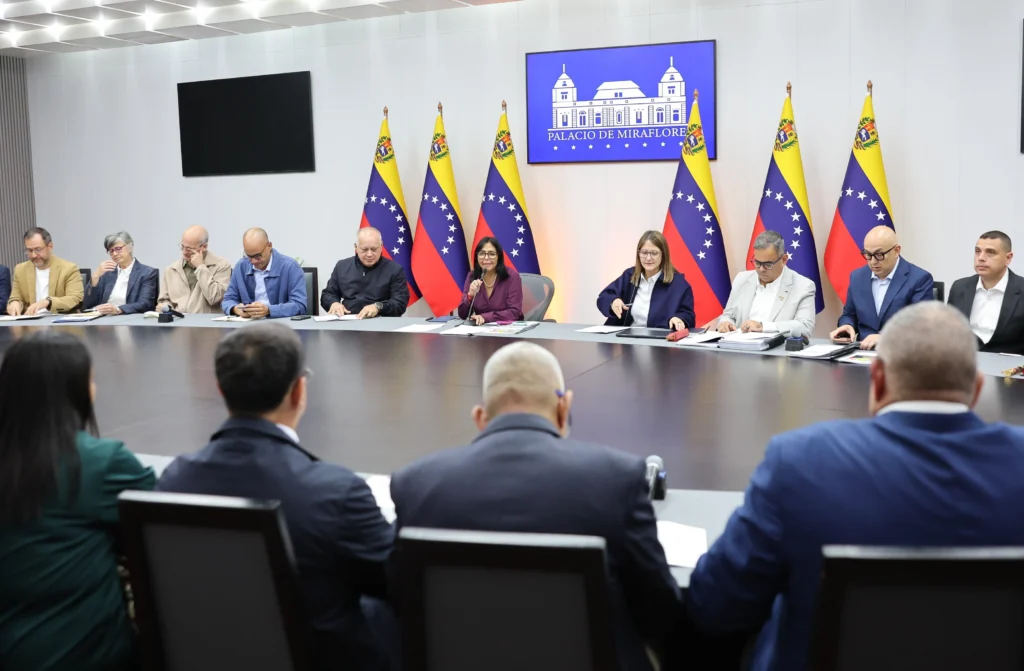
Venezuelan Acting President Delcy Rodriguez delivered the demand during a working meeting with the Council of Ministers and regional authorities held at Miraflores Palace. She insisted the gold constitutes a reserve of the Central Bank and belongs to the nation.
Rodriguez recalled that the National Assembly, including the 2015 legislature, had produced an agreement in which political sectors of Venezuela called for the gold’s return, framing the demand as a settled matter of national will.
The Acting President added that an irrational legal action that opposition figures had attempted was dropped by those same actors. That withdrawal, she argued, removed any remaining justification for the Bank of England to hold the metal.
“There is no excuse. That is the only thing I have to tell the Bank of England. They must return Venezuela’s gold, which belongs to Venezuelan men and women”, she stated.
The language was direct. Rodriguez offered no room for negotiation, framing the gold as a sovereign asset held outside the country against the will of Venezuelan institutions.
#28Oct | La presidenta encargada de Venezuela, Delcy Rodríguez, solicitó a la Cancillería de la República y a la Procuraduría General que inicien las gestiones correspondientes para recuperar el oro venezolano que se encuentra en el Banco de Inglaterra.
Text reads: “The Acting President of Venezuela, Delcy Rodriguez, requested the Ministry of Foreign Affairs and the Office of the Attorney General to initiate the appropriate steps to recover the Venezuelan gold that is at the Bank of England. “I will not stop demanding the Bank of England to return our gold. Enough excuses. There was an agreement”, said Rodriguez, referring to the agreement to recover international reserve assets reached last August during the first cycle of dialogue between the delegations of the elected National Assembly in 2015 and the government (…)”
Mining Push Grows
The same working session included a live link with Mining Minister Hector Silva from the Choco plant in Bolivar state. Silva confirmed the arrival of 41 surface machines, part of a total of 544 pieces of equipment purchased by the state.
Those machines are meant to boost gold and coal production. The government tied the mining drive to strengthening the country’s reserves and generating income for social projects, health care, and worker welfare.
The equipment delivery anchors the government’s broader argument. Venezuela insists it does not need foreign permission to manage its resources, whether gold underground or gold stored abroad.
The Bolivarian government also pledged a productive revival across the country to energize the engines of the economy and support organized local development. The gold demand sits at the center of that agenda. Every program announced, from ham production to health brigades, depends on revenue the government says its reserves should generate.
Venezuela has long argued that the Bank of England’s refusal to release the gold violates its sovereignty. Acting President Rodriguez renewed that claim in the sharpest terms, insisting the metal funds the welfare of a people, not the accounts of a foreign institution.
No response from the Bank of England appears in the official record. The demand now stands public, delivered from the presidential palace and addressed directly to London.
The Brazil’s government warned that false social media posts claimed the 6×1 workweek law had been changed and that social programs such as Bolsa Familia faced cuts, and it urged citizens to consult official sources.
The Secretariat of Social Communication (Secom), denied that any change had been made to the constitutional amendment that ends the 6×1 workweek.
The posts, which spread after the presidential run-off, offered incorrect information about labor legislation and social benefits.
Constitutional Amendment 141 guarantees two paid rest days each week without any reduction in salary. The way those free days are organized can be settled through collective bargaining, as long as the constitutional conditions are respected. The Secretariat of Social Communication stressed that the norm remains in force and untouched.
The false claims included an alleged exclusion of certain professional categories from the new rules. No such proposal exists. The Secretariat of Social Communication explained that conversations with different sectors concern only how to implement rules that have already been approved.
The reduction of the workweek will unfold gradually. The initial limit will be 42 hours a week, and later 40 hours, with no salary reduction at any stage.
The government offered a blunt explanation of why the Executive holds no power over the text. Since the measure is a constitutional amendment approved by the National Congress, the Executive cannot modify or veto it.
O Governo do Brasil alerta para informações falsas que circulam nas redes sociais neste período pós-eleitoral sobre um suposto recuo no fim da escala 6×1 e cortes no Bolsa Família e no Gás do Povo. pic.twitter.com/SIR0but5Vl
Text reads: “The Government of Brazil warns about false information circulating on social media in this post-election period about a supposed retreat at the end of the 6×1 scale and cuts to Bolsa Família and Gás do Povo.“
Welfare Programs Intact
Separate rumors suggested that the Bolsa Família program faced suspension or reduced benefits. The Secretariat of Social Communication confirmed that the program keeps operating normally, with payments continuing and no cuts applied.
In October the minimum amount per family rose by 15.04%, from R$600 (about 112 U.S. dollars) to R$691 (around 129 U.S. dollars). That adjustment contradicted the online claims, since a program facing cuts does not raise its floor. Families can verify their information through the Bolsa Familia app, the Caixa Tem platform, or by calling 111, the direct line of the Caixa Economica Federal bank.
The government also rejected rumors about Gas do Povo, the program that provides free refills of 13-kilogram gas cylinders to families that meet the requirements. The Secretariat of Social Communication (Secom) affirmed that the initiative already has budget assigned for 2026 and that resources appear in the 2027 budget proposal sent to Congress.
The pattern was consistent across all the false messages. Each one targeted a program or a right that benefits working families, and each one crumbled against the official record.
The Secretariat of Social Communication (Secom) advised the public to distrust messages that do not identify reliable sources. Citizens should verify whether information has been confirmed by competent authorities before sharing it. The Social Direct Line 121 and official digital channels remain open for questions about benefits.
The warning reflects a government trying to contain a wave of misinformation at a politically charged moment. False posts about labor rights and welfare can spread faster than corrections, especially when they play on fear of losing income or benefits.
The facts, however, tell a different story. The workweek amendment stands. The Bolsa Familia Program pays more than before. Gas do Povo holds its funding for this year and next. None of the alleged changes appears in any official document.
The government’s message closed with a practical instruction. Before passing along a message about labor law or social programs, check the source. The tools to do so, apps and official channels, remain available.
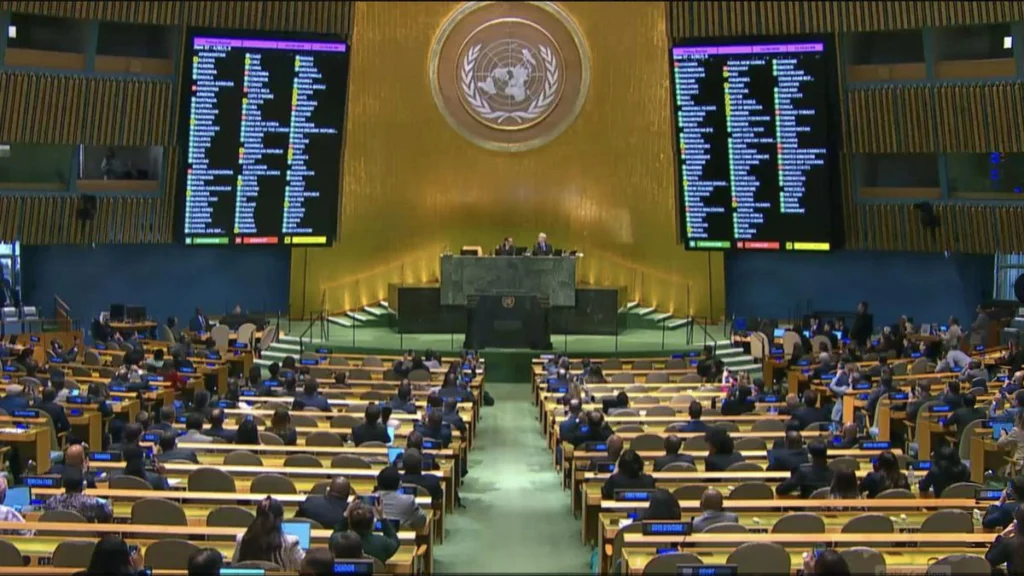
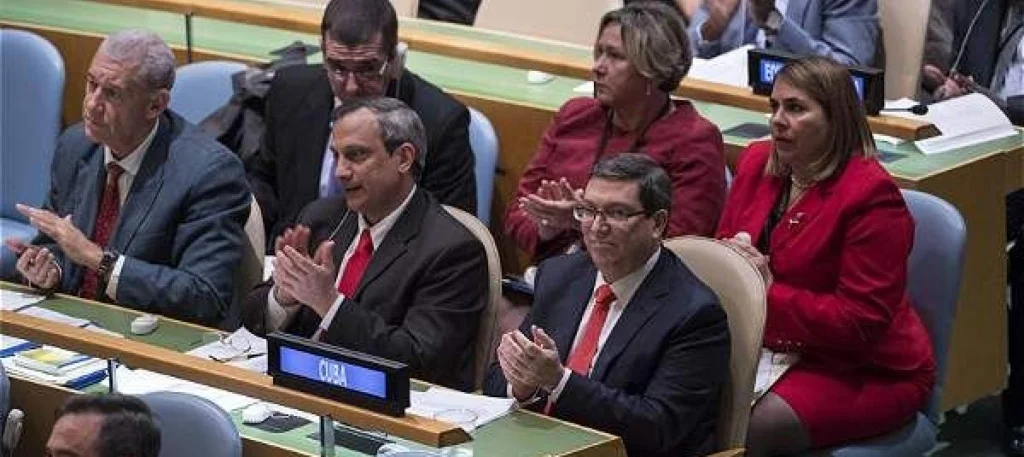
On Wednesday, the United Nations General Assembly approved—for the thirty-fourth time—a resolution calling for an end to the economic, commercial, and financial blockade imposed by the United States against Cuba. The resolution passed with 130 votes in favor, 17 against, and 25 abstentions.
During the debate, Mexico, Nicaragua, Egypt, Vietnam, India, Ghana, and Mozambique reiterated their support for the Cuban people and condemned unilateral coercive measures, which they view as contrary to the United Nations Charter and international law.
Mexico’s Permanent Representative to the UN, Héctor Vasconcelos, reaffirmed his country’s solidarity with Cuba and its rejection of any unilateral measures directed against the Cuban population. He maintained that the blockade, which has been in place for more than six decades, violates international law and is incompatible with the principles of the United Nations.
Vasconcelos noted that the sanctions constitute a structural obstacle to the island’s economic and social development. “Ending the blockade against Cuba is an urgent necessity and a humanitarian imperative,” the Mexican diplomat stated.
Mexico argued that dialogue, cooperation, and respect for international law should take precedence over measures that exacerbate the hardships faced by a population. It also called for the removal of Cuba from the U.S. list of state sponsors of terrorism and urged that priority be given to channels of dialogue.
Meanwhile, Nicaragua’s Permanent Representative to the UN, Jaime Hermida Castillo, announced his country’s vote in favor of the resolution. He based this position on principles and values shared by the two nations and reaffirmed Managua’s support for Cuba in the face of pressure tactics employed by the United States.
Hermida Castillo condemned the 64-year-long economic, commercial, and financial blockade, describing these coercive measures as a systematic act of aggression and a violation of human rights. He asserted that such policies are intended to stifle Cuba’s scientific, cultural, and social development. The Nicaraguan delegation also questioned the inaction of the multilateral system in the face of the overwhelming opposition from governments to Washington’s unilateral actions.
¡VICTORIA DE CUBA!
La Asamblea General de @ONU_es ha votado mayoritariamente contra el bloqueo de EEUU contra Cuba.
El gobierno de EEUU queda nuevamente aislado en su pretensión de continuar asfixiando al pueblo cubano y someterlo a un acto de castigo colectivo y de genocidio.… pic.twitter.com/MhnrjGnzSt
The text reads, “CUBA’S VICTORY! The General Assembly of @ONU_es has voted by a large majority against the US blockade against Cuba. The US government is once again isolated in its attempt to continue strangling the Cuban people and subjecting them to an act of collective punishment and genocide. Neither its most insane pretexts nor its pressures nor media circus will prevail over the force of facts and truth. #CubaNoEsUnaAmenaza The Blockade Is.
The delegations of Ghana and Mozambique concurred that the financial blockade violates the principles of the United Nations Charter and international law. They denounced the fact that these extraterritorial measures hinder Cuba’s economic, social, and cultural development—particularly in the areas of healthcare, education, and energy supply.
Mozambique highlighted Cuba’s historic contributions to South-South cooperation and its assistance in the fields of health and education across Africa. The representative from the African nation noted that, for more than six decades, the Cuban people have endured the consequences of the blockade—a policy that the General Assembly has repeatedly condemned.
Ghana stated that its support is rooted in the principles of sovereign equality, mutual respect, and peaceful coexistence among states. It warned that the extraterritorial application of the blockade imposes burdens on third countries and runs counter to the principles of fair and equitable international economic relations.
Egypt, for its part, called for action from the UN. Ihab Awad, Egypt’s Ambassador and Permanent Representative to the UN, reaffirmed his country’s commitment to the principles of the United Nations Charter and demanded an end to the economic strangulation of Cuba.
“The negative repercussions of the economic, commercial, and financial blockade imposed on Cuba affect the Cuban people’s ability to meet their basic needs,” the Egyptian diplomat stated.
Meanwhile, Vietnam reiterated its support for the immediate lifting of the commercial and financial blockade. Its delegation expressed concern regarding restricted access to energy and fuel, as well as the adverse impact on hospitals, schools, water services, and trade relations with third countries.
The Vietnamese delegation called for respect for the right to self-determination—free from coercion—advocated for political dialogue in accordance with international law, and urged the removal of Cuba from the list of state sponsors of terrorism. It also requested international support to address the accumulated economic and social damage.
India endorsed the statements made by the G-77 and ASEAN against the blockade. Its representatives called for the immediate repeal of these measures in order to mitigate their impact on key sectors such as energy, health, food production, and education.
Furthermore, India highlighted the need to eliminate extraterritorial sanctions to create an environment that would allow for Cuba’s full participation in international trade.
On Wednesday, President Miguel Díaz-Canel praised the actions of the Cuban delegation at the United Nations during the annual debate on the resolution calling for an end to the economic, commercial, and financial blockade imposed by the United States against Cuba. The president affirmed that the island will not back down in the face of Yankee pressure and dictates.
In messages posted on the social media platform X, the Cuban leader acknowledged the work of Foreign Minister Bruno Rodríguez, Ambassador Ernesto Soberón, and the rest of the Cuban delegation, following an incident that took place during a session of the UN General Assembly.
“Today at the UN, the international community’s overwhelming support for Cuba was on display, as they condemned the blockade and the U.S. government’s policy of maximum suffocation. Most of the speakers were clear in their denunciation,” the Cuban president wrote.
These remarks followed an intervention by Bruno Rodríguez, who interrupted U.S. representative Mike Waltz as he was blatantly presenting a series of slanders, distortions, and lies against Cuba.
“You are lying,” Rodríguez stated, while requesting that the president of the General Assembly call the U.S. representative to order.
The Cuban Foreign Minister also denounced pressure exerted by Washington on UN member states and rejected what he described as insults to the dignity of the Cuban people and the international organization itself.
El pretexto más empleado y manipulado por el gobierno de Estados Unidos para tratar de justificar su actuación es presentar a Cuba como una supuesta amenaza para la superpotencia nuclear o, incluso, para el hemisferio. Se sabe que ningún gobierno aquí representado admite o acepta… pic.twitter.com/9ADzwpPsXS
The text reads, “The most commonly used and manipulated pretext by the United States government to try to justify its actions is to present Cuba as an alleged threat to the nuclear superpower or even to the hemisphere. It is known that no government represented here admits or accepts such a crude fallacy. They lack arguments.”
Díaz-Canel maintained that this international body serves as a space for sovereign equality among states, and he asserted that Cuba will defend the rights granted to it by the United Nations Charter and its regulations, as well as the dignity of its people and its heroes. “Cuba will not back down, and certainly not in the face of Yankee pressures and orders,” emphasized the head of state, who described the U.S. stance as one of imperial arrogance and overbearing conduct.
The Cuban delegation’s protest was voiced at the start of the debate on the resolution titled “Necessity of ending the economic, commercial and financial embargo imposed by the United States of America against Cuba”—an initiative that has garnered broad support in the General Assembly for over three decades.
Cuba denounced a vile campaign of diplomatic pressure aimed at influencing the delegations present, with the goal of eroding support for the Cuban resolution. Nevertheless, the world once again spoke out—by an overwhelming majority—against the embargo, even in the face of pressure and blackmail from the United States intended to alter the outcome.
Díaz-Canel further noted that the U.S. representative—visibly isolated—offered no explanation for the energy blockade imposed on Cuba, nor for the intensified extraterritorial reach of the embargo.
In their remarks, Cuban authorities presented verifiable data demonstrating that the tightening of the embargo—particularly since 2025—has caused severe economic and social hardship on the island. This confirms that the U.S. policy amounts to collective punishment of the population; the authorities warned that the international community must not become complicit in such measures.
“Because we believe in the truth and in global solidarity, we know that the U.S. embargo against Cuba and the energy blockade will be condemned once again in the General Assembly,” Díaz-Canel stated on X.
The Argentine president was directly involved in the operation, said a lawyer close to the Bolsonaro clan.
Over the last 12 hours, Argentine and Brazilian media outlets have continued to stir up controversy regarding the role President Javier Milei played in the flight of far-right Brazilian senator Flavio Bolsonaro to the United States—a journey that included a stop in Argentina.
On Tuesday, outlets reported that Bolsonaro might flee through Argentina. Immigration authorities, however, responded by saying there were no records of Bolsonaro entering the country.
Presidential spokesman Adrian Ravier said only at a news conference that Argentina had received no asylum request from the Brazilian senator. Milei chose to remain silent.
In an interview with channel A24 on Tuesday night, Mexican lawyer Simon Levy, who is close to the Bolsonaro family, claimed that Milei was aware of the efforts to coordinate Bolsonaro’s escape to Miami.
“Thanks to President Milei, Flavio Bolsonaro is alive today. The only person who knew about this was President Milei. He has been and was involved in part of the coordination of this entire operation,” Levy said.
Flávio Bolsonaro fugiu para os Estados Unidos em um jato de uma empresa que aparece numa investigação sobre lavagem de dinheiro ligado a contratos públicos para atender pessoas com deficiência na Argentina.
The text reads, “Flavio Bolsonaro fled to the U.S. on a jet belonging to a company that appears in an investigation into money laundering linked to public contracts for the care of people with disabilities in Argentina.
The aircraft belongs to Baires Fly, which is owned by Luis Grande. The company also transported Javier Milei to the U.S. following his 2023 electoral victory. On that trip, Grande himself piloted the plane. Argentine judicial authorities are investigating transfers made by suppliers of the National Disability Agency (ANDIS) to Baires Fly accounts.
Following these payments, invoices were issued for the advance purchase of flight miles. It is suspected that these transactions were used to provide a veneer of legality to funds derived from irregular contracting. Flavio left Brazil despite a court order prohibiting him from exiting the country and requiring him to surrender his passports. Sources: Reuters, elDiarioAR, and Ambito.“
The newspaper La Nacion reported that presidential adviser Santiago Caputo was in Misiones province, which borders Brazil, on Tuesday night, when the aircraft carrying Bolsonaro took off. This would confirm that the Milei administration actively assisted in the operation.
According to Argentina’s National Directorate of Migration, Flavio Bolsonaro, his wife, Fernanda Antunes Figueira, and their two daughters entered the country on Tuesday at 10:50 p.m. local time via the Tancredo Neves International Bridge in Misiones province.
Bolsonaro used his Italian passport, while his family members traveled with their usual identification documents, according to the flight plan. Argentine immigration authorities said no laws had been violated: “We cannot prevent him from entering the country with his European passport.”
Forty minutes later, at 11:30 p.m. local time, the Bolsonaros boarded a private aircraft operated by Baires Fly S.A. at Puerto Iguazu Airport, bound for Guayaquil, Ecuador, from where they traveled to Miami, United States.
So far, neither Milei nor his ministers and aides have made any public statements about the operation that enabled the escape of Bolsonaro, a far-right politician who faces several criminal investigations.
His departure came after Brazilian Supreme Court Justice Alexandre de Moraes ordered him to surrender his passports and barred him from leaving the country as part of money laundering investigations.
All opposition parties to Milei in Argentina’s Congress have demanded explanations about what role the government may have played in the operation.
On wednesday, opposition groups in Colombia have expressed their rejection of a strategic memorandum of understanding—signed over a month ago between Abelardo De la Espriella and the United States government—warning of potential socioeconomic, environmental, and territorial implications for the country, while also questioning the scope of the pact.
The criticism centers on a potential extractive mining project targeting strategic minerals; according to the opposition, the exploitation of these resources would negatively affect ecosystems and communities located in the Amazon, the Pacific region, and parts of the Caribbean.
Senator Carolina Corcho, of the Historic Pact (in spanish Pacto Histórico) coalition, argued that the agreement subordinates national sovereignty to an extractive mining and energy model designed to serve U.S. industry.
According to the lawmaker, the document reportedly includes provisions for streamlining permits for extractive mining companies, the handover of geological maps, and granting the U.S. government prior knowledge of planned sales in Colombia to facilitate its decision-making processes.
The opposition has characterized the agreement as mercantilist, criticizing the fact that it was finalized without the participation of Colombian civil society—a group that asserts its right to have a say in how its lands are used.
¡No vamos a permitir que regalen nuestra soberanía a espaldas del país!
La administración de @ABDELAESPRIELLA firmó a oscuras un memorando que le entrega a EE. UU. el control de nuestras tierras raras y minerales estratégicos, poniendo en riesgo a nuestras comunidades campesinas… pic.twitter.com/Oel6iYraPk
The text reads, “We will not allow them to give away our sovereignty behind the country’s back! The administration of @ABDELAESPRIELLA signed a memorandum in the dark that hands over to the United States control of our rare earths and strategic minerals, putting our peasant and ancestral communities at risk. Colombia’s wealth must be respected! Watch the full interview and the details of this complaint on @TeleSUR: http://youtu.be/d0pxJpb7sZY?si=ZnJ_szg_QyUlmO6J
Critics warn that the affected territories contain lithium, nickel, uranium, and copper—resources essential for the manufacture of mobile phones, computers, microprocessors, radar systems, guided missiles, and defense equipment. These materials can also be used for military purposes.
According to the allegations, a large portion of these resources would be extracted from the Amazon, the Pacific, and parts of the Caribbean—regions that hold extensive deposits of rare earths and strategic minerals. Most of these areas are inhabited by Afro-descendant, Indigenous, and peasant (rural farming) communities, which further compounds the concerns raised by the opposition.
Colombian analyst Ricardo Vargas noted that these territories possess a social sensitivity, which is why communities tend to mobilize when faced with risks to their land, water, air, and biodiversity. Vargas also pointed to measures aimed at containing social protest and warned of the presence of armed groups that illegally access these resources.
According to the allegations, the executive branch is clearing protected territories to allow for the entry of foreign entities and the exploitation of resources. The opposition claims that the document bypasses requirements for prior consultation and environmental permits, effectively placing the country’s geological and mining map at the disposal of the U.S. economy and American corporations.
Meanwhile, the executive branch has stated that the memorandum is non-binding—an argument the opposition views as an attempt to evade constitutional obligations and the mandatory review process by the Congress of the Republic.
Opposition groups have drawn parallels to the situation during the administration of Álvaro Uribe Vélez, specifically regarding the presence of military bases in the country.
A productive day in Colombia, building on the enduring friendship between our two nations.
The memorandum was signed on September 8, 2026, in Barranquilla, during a visit by U.S. Secretary of State Marco Rubio. The instrument establishes a framework for cooperation to secure supply chains for the mining and processing of critical minerals and rare earth elements.
According to official information, the agreement includes provisions for financing, support for geological mapping, and the streamlining of administrative procedures for extraction and processing projects. The Colombian Foreign Ministry maintains that such memoranda are non-binding and that they respect both national legislation and state sovereignty.
At the heart of this debate lies the tension between bilateral cooperation, foreign investment, and the protection of national sovereignty, strategic resources, and the rights of local communities.
A dispute over conflicting versions of a provision in Colombia’s 2027 national budget has raised questions about the bill’s legislative validity. Senator Esmeralda Hernández says the Senate and House of Representatives approved different versions of Article 65 but failed to… pic.twitter.com/kNlFunNq1o

 Login