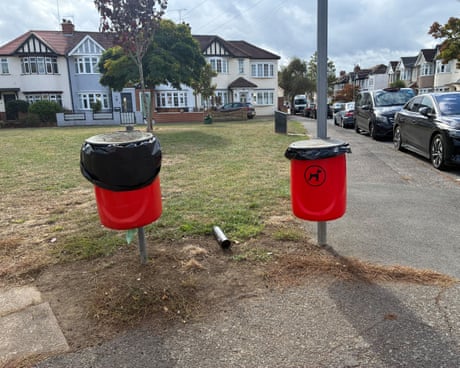
Conservative-run Hillingdon aims to save £100,000 but local people fear dog poo will ‘be dumped everywhere’
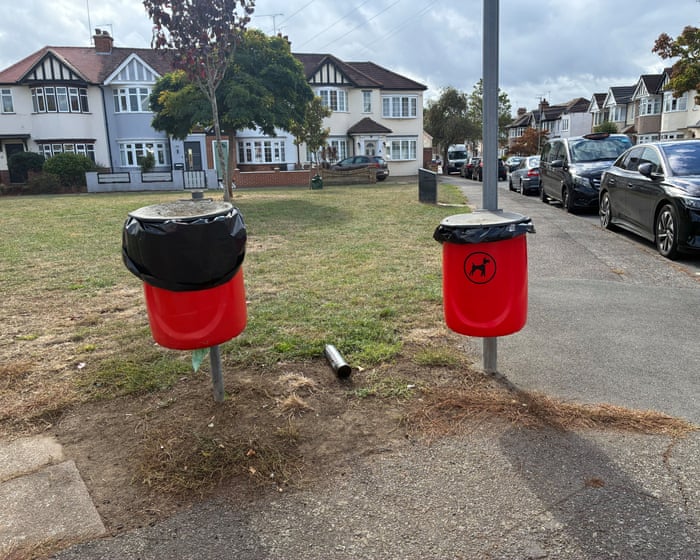
People in a west London borough fear it will become covered in dog poo after their cash-strapped council decided to remove 700 dog-waste bins to save money.
“People are worried there’s going to be dog shit everywhere,” said Daniel O’Neill, the chief road steward at Ruislip Residents’ Association.
Prime minister wrote to ministers saying he did not want them to ‘advocate for specific options or opine on the likely outcome of the process’
Selling nicotine-free vapes to children under the age of 18 has become illegal from today, the government has said.
Children were already banned from buying vapes containing nicotine. But, under the Tobacco and Vapes Act, shops across the UK will now be banned from selling nicotine-free vapes, and nicotine pouches, to children.
Vaping can be a way to help established adult smokers who are already addicted to nicotine from tobacco to swap to a less dangerous product. Vaping is considered safer than smoking, but that is a low bar. Vapes should therefore never be used by children or non-smokers.
Some children have already come to harm from bad reactions to vapes. The long-term health harms of vaping in today’s children will only become clear over time. They are however unlikely to be good; inhaling multiple, often heated, chemicals into the lungs may well do irreversible harm.
Case in Pimlico is latest instance of tensions between small countries seeking a space in capital and residents
It is not a classic neighbour-from-hell dispute, what with the protagonist inviting everyone over for evening drinks and canapés. But the sudden conversion of a five-bedroom family home in Pimlico, central London, into the embassy of Montenegro has triggered a neighbourhood row that has gone all the way to the desk of a high court judge.
The first stirrings of trouble came when one resident argued in a submission to the council this spring that the new embassy’s “flagpole and rather tacky-looking flag stick out like a sore thumb” among Cambridge Street’s Grade II-listed homes.
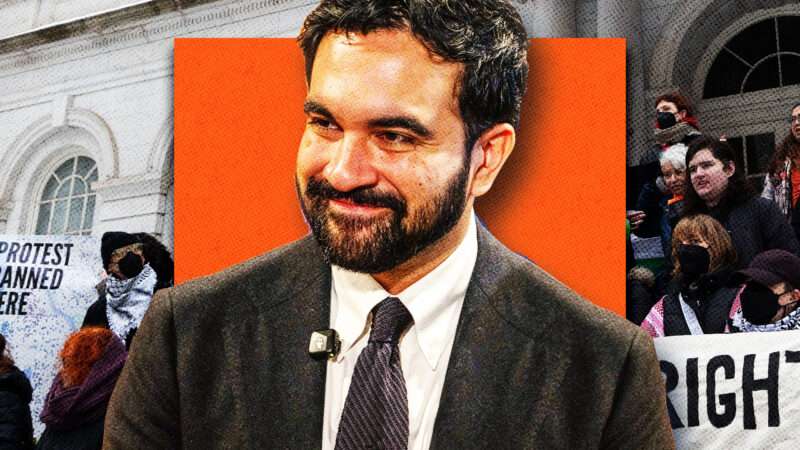
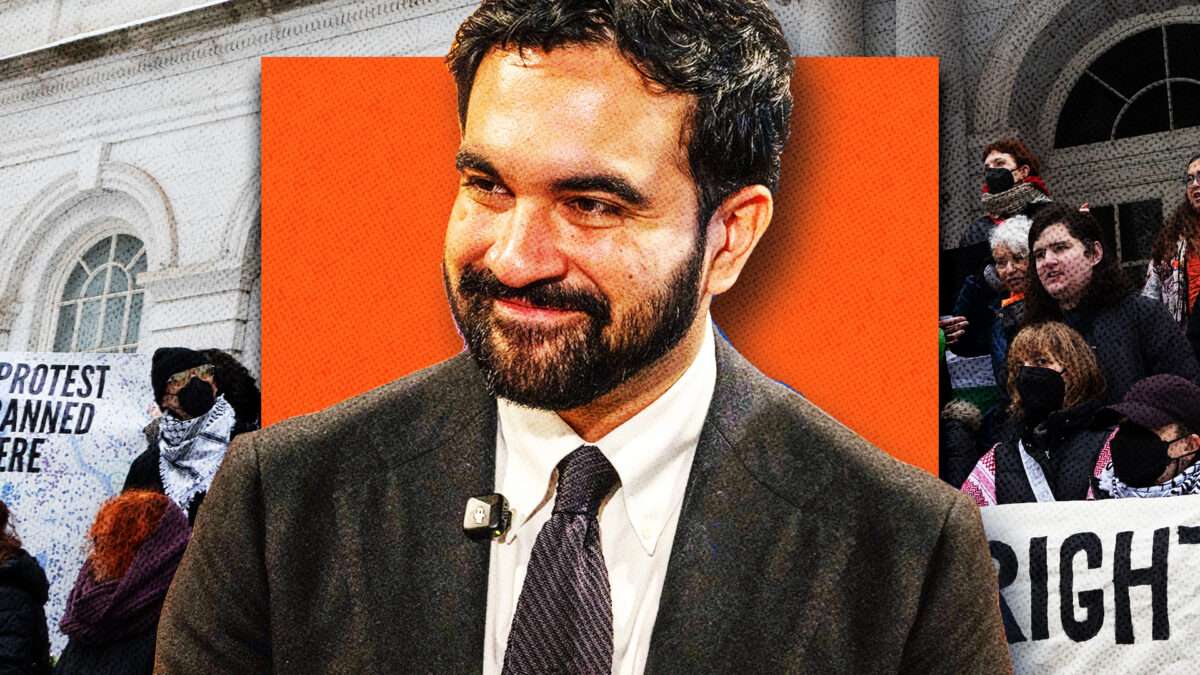
New Yorkers won't be voting on any citywide offices this year, but they do have five ballot initiatives that could shape the city's future more than any politician on this year's ballot. Mayor Zohran Mamdani created a version of the Trump administration's infamous Department of Government Efficiency in New York called the Commission on Government Efficiency (COGE). The plan is for COGE to modernize city operations and accelerate public infrastructure and permitting—in that vein, COGE placed five proposals before voters on the November ballot, largely targeting the bureaucratic processes governing new construction and business activity across the five boroughs.
Questions 1, 2, and 3 on the ballot would end or reduce the use of public hearings in different city review processes. Question 1 would, according to the ballot language, "simplify [the] process to use public space for uses such as ramps, planters and cafes, by removing mandatory hearings and Council disapproval of sidewalk cafes, while maintaining community and Council input." Question 2 would "reduce paperwork for City contractors by authorizing [the] Procurement Policy Board to simplify [the] contractor questionnaire….[And] remove mandatory hearing for required client services report." Question 3 would "simplify review of street safety projects to reduce construction timelines," among other changes. Question 4 is about simplifying permitting.
These policies were not directly introduced by Mamdani, but they reflect a governing philosophy that New York City and other big cities desperately need: a local government that won't allow a small group of organized opponents to obstruct progress for the city at large indefinitely.
Nowhere is the bottleneck against much-needed development clearer than at public review hearings. In theory, a public hearing is democracy at its purest: Every voice is heard. But in practice, it usually becomes a slow-motion filibuster. The most persistent and best-organized opponents get a megaphone, with little to no input from the millions of New Yorkers who would broadly benefit from more housing, better infrastructure, and businesses that can open without getting wrapped in red tape.
The 2026 ballot questions, if approved, would take small steps toward addressing these problems. If they all passed, it wouldn't be a seismic change—a planter here or a parcel of land there. But that's kind of the point: Should routine administrative decisions require another round of formal public review hearings to hold up any change, big or small?
To many people, but especially libertarians, voting can feel dispiriting: By definition, every person on the ballot wants in some way to exert control over your life.
Perhaps that's why it's refreshing to see a candidate for office who truly seems not to want the job.
Brady Rogers worked as a robotics engineer for four years, but he quit in 2019 after deciding the corporate world wasn't for him.
"It was just a bit unfulfilling," Rogers tells Reason. "I wanted to do something a little more impactful with my skills….So I left to find something else that felt worthwhile."
He started The Rogerie, a retail store in his hometown of Kelowna, British Columbia, a city of about 170,000 people. Rogers and his wife collect shredded plastic waste and extrude it into filament for 3D printers, which they use to create new housewares to sell in the shop.
Then earlier this year, Rogers again got the feeling that he could be doing something beneficial with his talents. This time, it meant running for the Kelowna City Council.
But he had to stand out in a crowded field—he would be one of 37 candidates running, and only the top eight would win a seat.
So, he settled on a strategy: openly admit his lack of qualifications and how little he even wanted the job.
"I guess I'm running for Kelowna city council," read his campaign website. "I don't like meetings, I don't like having to be certain places at certain times, and I'm allergic to stuffy offices. But unfortunately, I happen to like Kelowna, and think I can help do some good."
"Do I enjoy politics? No," he adds. "Do I know what I'm doing? No. But am I qualified? Also no."
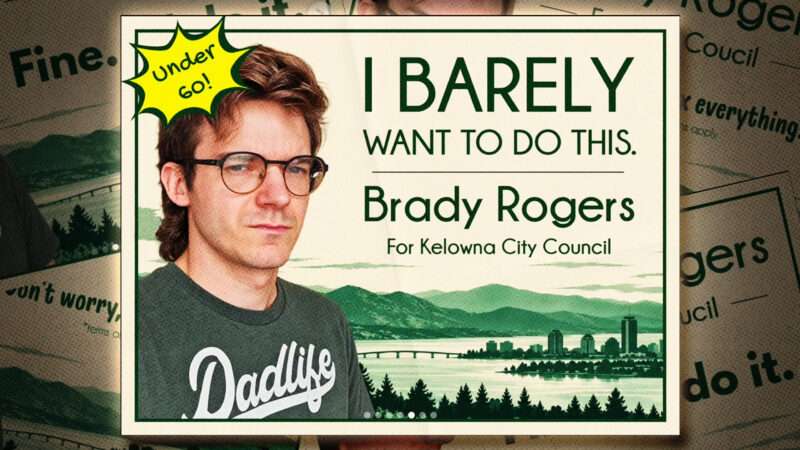
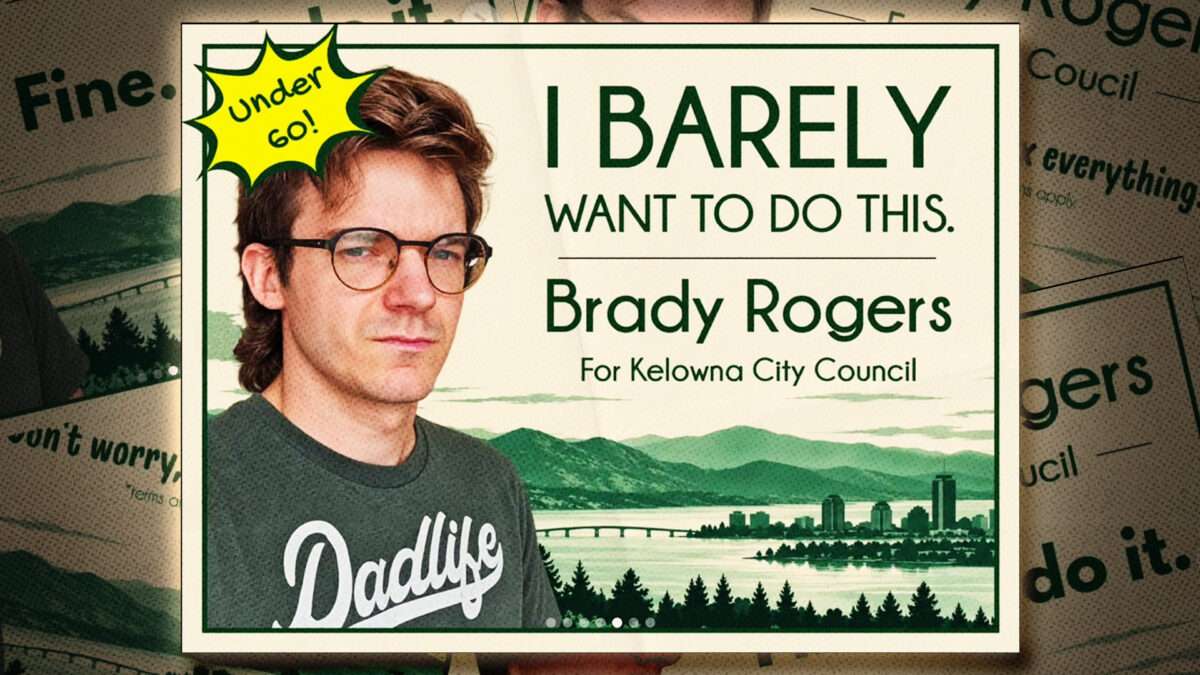
That lackadaisical attitude carried over into his campaign signage: Yard signs featured pictures of Rogers with sullen, shrugging expressions, alongside slogans like "I barely want to do this" and "Let's see what happens?" In a winking reference to political gerontocracy, one sign even bragged that he was "Under 60!"
"I certainly thought it was clever. I thought it would work, but it was really just how I honestly felt when I started," Rogers admits. "I was pretty conflicted about committing to a four-year thing that I didn't even really fully understand the ins and outs of, but at the same time I saw the opportunity to have a bigger impact. So, I was conflicted, and I figured that's a good, honest place to start a campaign."
Ultimately, he won a seat: He placed fourth out of 37 total candidates and even beat three incumbents, one of whom lost her seat.
The irony of Rogers' outwardly indifferent attitude is that he actually does have a policy platform: On his website, he advocates finding solutions to homelessness not necessarily by spending more money but by making better use of the resources that the city and province already provide. He also notes that Kelowna taxes land and improvements at the same rate, which "means we tax someone for improving their property while relatively rewarding someone who sits on valuable, underused land." Writing this week at Reason, J.D. Tuccille made a similar point.
Of course, Rogers' underqualified and disinterested campaign persona is only partially true—he did, after all, want the job, or at least he saw it as a viable means of improving his city.
Still, it's refreshing for a candidate to treat public office as something less than a higher calling.
Ultimately, Rogers thinks that authenticity is why his campaign caught on and was ultimately successful with voters, when many campaigns struggle to create viral moments or capitalize on social media trends. Perhaps other people could even learn from him.
"I think why mine worked so profoundly is that it is a little bit of humor, but immediately behind it was a legitimate platform and me as a real person with the skills and a real desire to do something," Rogers says. "And I think that resonated. I think people [have] an appetite for a new kind of politics."
The City Council voted 40 to 7 to ban the carriages from Central Park starting in 2028. But the carriage drivers vowed to fight their loss of livelihood in court.
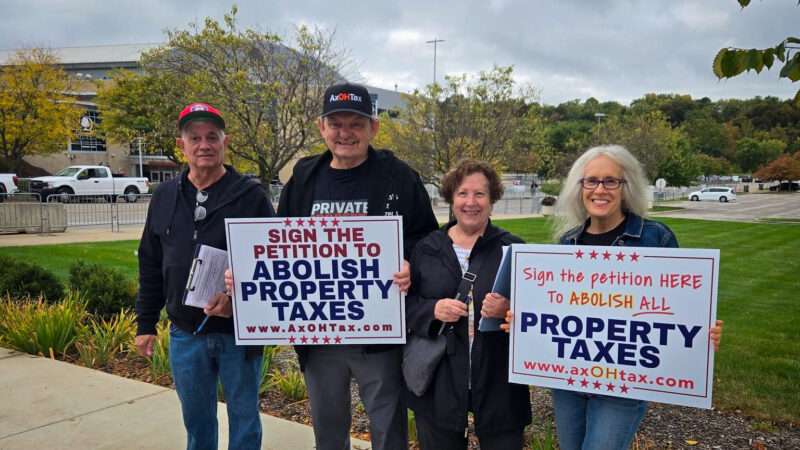
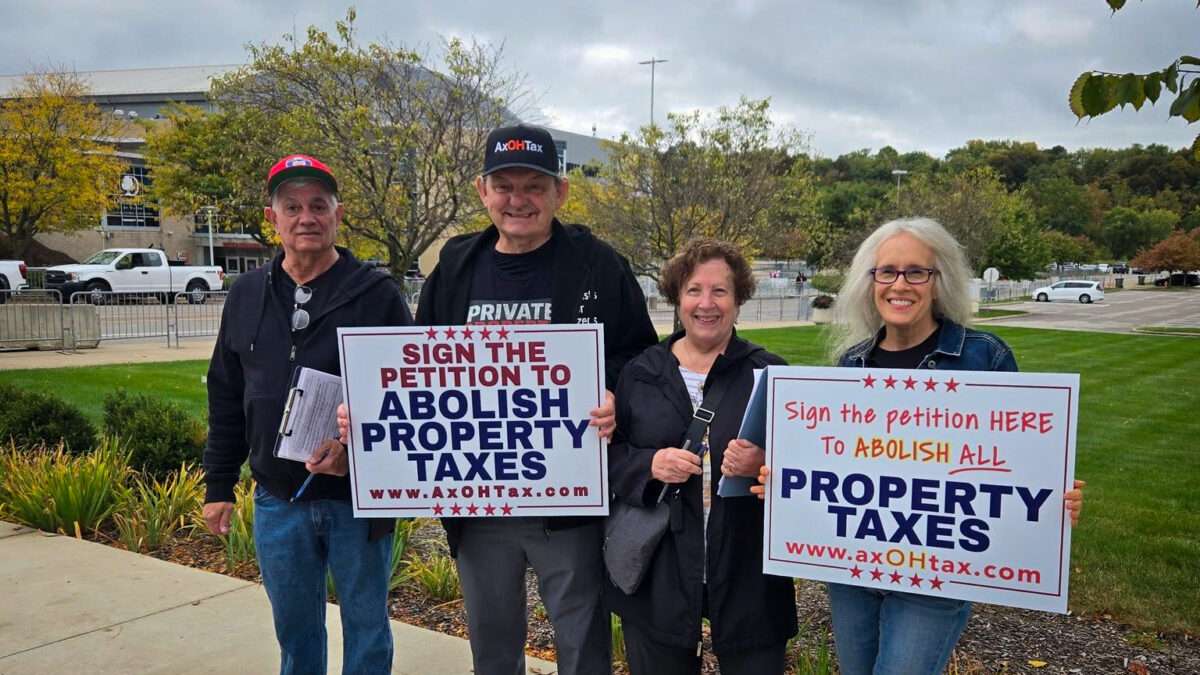
If you have to pay a regular fee to maintain control and use of a home or other parcel of property, do you really own it? Or are you just renting it from whoever collects the money? That's the question behind a growing movement against property taxes, which is winning support across the country and may see its next big test in the form of a proposed constitutional amendment on the Florida ballot that would significantly trim taxes on owner-occupied homes.
'Property Is the Foundation of Liberty'—and a Big Source of Tax Revenue
Advocates of reform understandably champion the inviolability of private property, which is threatened by continuously rising levies. Opponents predictably include people who fear reduced government revenues, but also those who worry that cutting property taxes will shift power to state governments at the cost of local autonomy.
"Property is the foundation of liberty," argues economist Vance Ginn. "It represents the right to the product of voluntary exchange, investment, and saving—not a privilege granted by government. To tax property again every year after it has been bought with after-tax income is to deny genuine ownership. Property taxes operate like an annual wealth tax or unrealized capital-gains tax, applied regardless of income or ability to pay."
Opposing Ginn's argument in the debate is the Tax Foundation's Jared Walczak, who is not so much a fan of property taxes as a believer that they suck less than the alternatives.
"Spending restraint can reduce property tax burdens," argues Walczak. "But with property taxes accounting for 70 percent of local tax collections nationwide and upwards of 90 percent in some states, any discussion of property tax elimination must grapple with revenue alternatives."
"It is axiomatic that whatever you tax, you get less of," he adds. "Taxing income means less income-producing labor and investment, for instance. But because land is an immobile asset, taxing property does less to distort market decisions than taxing income or even sales."
Walczak also points out that while property taxes are usually imposed by local governments, most alternatives to property taxes come at the state level. That would move power further up the political food chain, away from the property owners worrying about their tax bills.
To this, Ginn responds that governments at all levels cost more than they should and that "the moral and fiscal failure of property taxes lies not only in how the money is raised, but also in how much government spends."
That means the debate over property taxes isn't just a struggle between those who want to trim the state's take and those who prefer larger government, but also between anti-tax activists and their frequent allies among advocates of local power. In a piece this week on the groundswell against property taxes, Politico's Liam Dillon notes that "the uprising's most pitched battles are being fought in Red States where the issue has emerged as yet another dividing line on the right."
Localities Are Dependent on Taxing Property
The debate over property taxes is fierce partially because governments have come to rely so heavily on them. "In fiscal year 2023, property taxes comprised 28.9 percent of total state and local tax collections in the United States, more than any other source of tax revenue, despite being levied almost exclusively at the local (not state) level," Janelle Fritts wrote for the Tax Foundation.
Property taxes in the U.S. range from roughly half a percent to just under 2 percent of assessed home value. States that rely most heavily on them, like New Hampshire (1.5 percent in 2024) and Texas (1.4 percent in 2024), also tend to leave a lot of government responsibility in local hands that might be exercised at the state level elsewhere. It's worth noting that Cato's Freedom in the 50 States ranks New Hampshire as having the second least burdensome tax regime among states, with Texas in fourth place.
The lowest taxed states in property terms are Alabama (0.37 percent in 2024), Arizona (0.48 percent), Hawaii (0.29 percent), and Utah (0.48 percent). Some states, such as Illinois (1.88 percent in 2024) and New Jersey (also 1.88 percent), tax the hell out of many things to support large and intrusive governments. Hawaii, despite low property taxes, is ranked as the most tax-burdened state by Cato.
As mentioned above, economists tend to like property taxes because they are efficient, minimally distort economic decisions, and empower localities relative to state and federal authorities. But as Politico's Dillon emphasizes, "everyone who is not an economist seems to hate property taxes."
Homeowners Don't Like the Insecurity That Comes With Property Tax Bills
Property taxes rise with assessed property valuations that homeowners have no control over, as the market shifts with supply and demand. They require what feels an awful lot like an annual rent payment to keep a roof over people's heads many already paid for. That reduces the sense of security that owners feel in their homes, since their habitation remains conditional on meeting local authorities' demands. The bite of sales taxes can be reduced by buying less, and income taxes are dependent on earning paychecks, but property taxes (with some local exceptions) come due no matter what.
Soaring property valuations in recent years drove property tax bills higher for Americans who did nothing but remain at their established addresses, though localities can and sometimes do adjust tax rates to offset rising values. USA Todayreported that "between 2019 and 2023, the median value of annual property taxes increased nearly 25%." That has energized the movement to cut or abolish the taxes.
Efforts to reform property taxes have been effective in more than a dozen states, according to Governing. Most of these efforts involved reducing taxes, though eyes are currently on Florida where Amendment 3, a proposed change to the state constitution, would incrementally raise the homestead exemption to $250,000. It also would require "the Legislature to prescribe a uniform procedure for counties and municipalities, for their respective levies, to increase the homestead exemption up to full assessed value," effectively abolishing property taxes on owner-occupied dwellings.
As a constitutional amendment, the measure requires 60 percent of votes to pass. Polling shows more support than opposition, but not necessarily at the supermajority level necessary for victory.
According to the Tax Foundation, in Florida, "the statewide average sales tax rate would have to rise from 7.02 to 15.34 percent to replace the property tax" with equivalent revenue. Rates could widely vary if localities implemented sales taxes instead of leaving them to the state.
Of course, that assumes state and local governments continue spending and providing services at the same level. But as economist Ginn points out, the problem lies not only in how property taxes raise money "but also in how much government spends." If the property tax revolt represents revulsion not just at the tax, but at the expense of large government, that may require less revenue to fund a smaller Leviathan.
Fairfax County, Virginia, police officer Scott Abram was charged with two counts of misdemeanor shoplifting for stealing merchandise from two Target stores. Police say that while using the self-checkout at a Target in Burke, Abram scanned a cheaper item's barcode to pay less for another item, then left the store with both products despite only paying for one. Abram was in uniform and on duty at the time. Police say he had committed a similar theft at a Target in Springfield the day before, while off duty. A 23-year veteran of the Fairfax County Police Department, Abram chose to retire rather than face termination. Each charge is a misdemeanor that can carry up to 12 months in jail and a $2,500 fine if convicted.
Walking through East Cleveland, Ohio, feels a touch like you've wandered onto the set of a postapocalyptic film noir. Grand, gilded homes announce themselves on neighborhood streets, some crowned with turrets, many with windows punched out like missing teeth. Often, no one is home, because no one lives there. It is safer than 1 percent of U.S. cities.
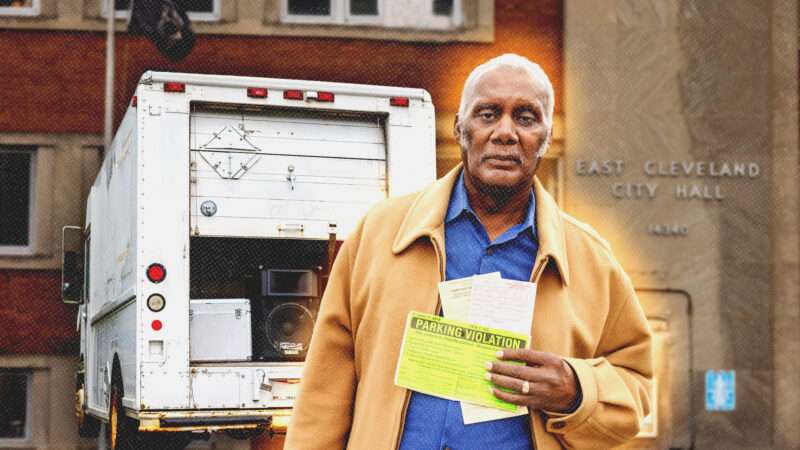
That question is not really a legal one, at least not in the most technical sense. But it is the driving force behind a thorny case a federal court recently resuscitated: Fambrough v. City of East Cleveland, a saga concerning a man whose vehicle became an obsessive target of the East Cleveland Police Department (ECPD) after he used it to campaign for a mayoral challenger.
Some of the facts are in dispute. But the basic gist is as follows: William Fambrough, long a politically engaged East Clevelander, campaigned for Juanita Gowdy—a challenger to then-Mayor Brandon King—by broadcasting messages around the city with his sound truck. That ultimately came to an end after law enforcement impounded the car, cited him for parking and noise violations, and prosecuted him for the latter.
Fambrough sued, alleging the complex legal odyssey set into motion over his step van amounted to First Amendment retaliation, an unreasonable seizure under the Fourth Amendment, and a violation of the 14th Amendment's proscription against selective enforcement. The U.S. Court of Appeals for the 6th Circuit rejected some of those claims. But it resurrected claims against King and his chief of staff, Michael Smedley—depriving them of qualified immunity, the legal doctrine that inoculates state and local government officials from facing lawsuits if their alleged misconduct was not "clearly established" as illegal in prior case law. It also revived Fambrough's retaliation claim against the city.
As the 6th Circuit summarizes: King "says he received a phone call from a resident who complained about Fambrough's sound truck and someone else's box truck being parked in a residential area," so he told someone to take care of it. Scott Gardner, then the city's chief of police, "was concerned about selectively enforcing" the parking ordinance—which prohibits parking a truck in front of residential property, except for loading or unloading—because it is indeed almost never enforced. This was the beginning of a long pursuit, which ultimately saw a swarm of officers dispatched to Fambrough's house in August 2021 to confiscate the vehicle, allegedly resulting in $6,000 in damage. Fambrough also had to pay $528 in fees to get the damaged truck back.
"All the attention City officials gave Fambrough struck Gardner as unusual," the 6th Circuit notes. "The mayor's office wasn't this attentive even in homicide cases. And considering that the City had around only 50 police officers at the time and had 'serious crime problems,' Gardner thought it was odd to devote this much attention to permitting and parking issues." Based on available data, East Cleveland's violent crime rate is 1,409 per 100,000 residents, about four times higher than the national average.
Yet Gardner ultimately got on board. Smedley phoned him on August 9 "extremely upset," according to Gardner, and told the police chief he was "incompetent" for failing to "take care of" Fambrough's sound truck. Smedley wanted the "utmost enforcement as possible." So Gardner sent an email. "Please, find this vehicle and tow it," he wrote to all of ECPD. "Cite the operator with disturbing the peace and loud music. Please contact me as soon as this is complete to claim a surprise." A surprise!
Police succeeded. "On its face, the email told officers to tow Fambrough's truck regardless of whether it was parked illegally," writes the 6th Circuit. "And the Noise Ordinance authorizes seizure only of 'the sound device used,' and only upon conviction. So Gardner's instruction to tow the truck wasn't authorized by municipal law." The court still held that the seizure did not violate the Fourth Amendment. It also gave Gardner qualified immunity, ruling it is not clearly established that someone who acts as a conduit for someone else's alleged retaliation—which here came from the mayor's office—is a "responsible party."
Heather McCollough, the city's assistant law director, subsequently prosecuted Fambrough for allegedly violating the noise ordinance. According to a sworn declaration from Fambrough's attorney, McCollough outlined some of Fambrough's offenses on a call: that he "made complaints about the police department" and filed "public records requests," among other issues. Notably, it is legal to do those things. McCollough was typically willing to resolve minor noise complaints, she added, but not so much in this case, because Fambrough needed to "stand down." (He ultimately pleaded no contest to disorderly conduct, a reduced charge.)
Institute for Justice
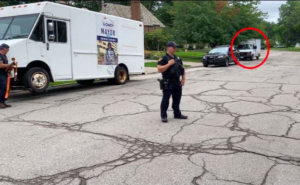
"Only after [Fambrough] began supporting Gowdy's election was the weight of the law thrown against him," the 6th Circuit writes in its analysis of potential municipal wrongdoing. "And the City's police officers didn't uncover Fambrough's violations of their own accord. Instead, City decisionmakers sent them to Fambrough's home each time to enforce the Parking Ordinance. So the timing of the parking-related enforcement actions supports an inference that Fambrough's political speech was the motivating factor—as does the fact that the City rarely enforced the Parking Ordinance against anyone else despite having plenty of opportunities to do so." Incredibly, a photo of another truck can be seen down the street on the same day law enforcement came to fetch Fambrough's vehicle. (The law also includes pickup trucks, so the city arguably has a lot of enforcement to do if it sincerely believes this law matters.)
King allegedly set the chain of events into motion while Smedley took the driver's seat. "Smedley's pattern of incessantly calling and berating Gardner," the 6th Circuit adds, "clashes with the idea that Smedley was chiefly concerned with minor permitting, noise, or parking issues." After all, if that were true, why would the problem appear to begin and end with one person?
Over five years have passed since the ordeal. Although Fambrough is now potentially closer to getting in front of a jury, he has yet to actually state his case, still burdened by the onerous process government actors invoke to kill such suits before the community can assess the merits. King, meanwhile, won that election. He left office in May 2025, however, after he was found guilty of one count of theft in office, four counts of having an unlawful interest in a public contract, three counts of representation by public official or employee, one count of filing a false disclosure statement, and one count of soliciting improper compensation.
Andy Burnham's Government has been accused of waging a £500 million "class war" on wealthy councils, slashing funding from rural Tory and Lib Dem areas to bankroll urban Labour Party strongholds.
In recent years, one of the predominant policy initiatives of the progressive left has been raising the minimum wage in locales around the country. At the same time, left-leaning politicians have sought the elimination of what's known as the tip credit, which allows employers to pay restaurant servers and other tipped employees a lower hourly base wage that they then bolster with gratuities.
Just a few years into this experiment, however, policymakers are showing signs of an about-face on the tip credit's abolition as they grapple with the unfortunate, and predictable, economic results.
In 2022, Washington, D.C., made news headlines when voters passed Initiative 82. As originally designed, it would have repealed the tip credit and required servers to be paid the District's full statutory minimum wage by 2027. (D.C.'s minimum wage was $16.10 per hour in 2022, but has since risen to $18.40 due to inflation indexation.) Prior to Initiative 82, D.C. servers could be paid a $5.35 tipped wage, so long as they earned enough tips to make up the difference between the lower tipped wage and the higher traditional minimum wage.
D.C.'s Initiative 82 was just the beginning. One Fair Wage, a progressive group that lobbies against subminimum wages, quarterbacked an all-out push to eliminate the tip credit in jurisdictions across America. Chicago became the second prominent city to follow suit. States like New York, Connecticut, and Illinois also quickly saw legislation introduced to eliminate the tip credit at a statewide level. (Apart from this recent wave, a small handful of American states—including California, Oregon, and Alaska—have long operated without a tip credit).
But just when it seemed like momentum against the tip credit had reached its apex, progressive politicians started to see the writing on the wall. In the aftermath of the tip credit's repeal, D.C. saw a close to 5 percent decline in full-service restaurant jobs. Tipped worker earnings also dropped by just under $12 million—likely a result, at least in part, of restaurants reducing hours for staff in the face of higher labor costs. At the same time, many D.C. restaurants began implementing service fees or so-called auto-gratuity policies that added mandatory 10-20 percent charges onto customers' bills.
Mugged by this economic reality, D.C. Mayor Muriel Bowser called for the full repeal of Initiative 82. Ultimately, the D.C. Council settled for a partial repeal in 2025, maintaining at least some semblance of a tipped wage that sits below the traditional minimum wage into the years ahead (although the tipped wage eventually rises to 75 percent of the traditional wage by 2034). This was a familiar story: The council had previously repealed Initiative 77, a near-identical attempt to abolish the tipped wage that voters passed in 2018.
After Chicago moved to eliminate the tip credit, the Illinois Restaurant Association found that 89 percent of Windy City restaurants raised menu prices; another 79 percent responded by reducing worker hours. Again bowing to economic reality, the progressive Chicago City Council voted to freeze the tip credit's planned elimination, only to see the effort vetoed by Mayor Brandon Johnson. Eventually, a compromise was brokered to at least pause the tip credit at its current level for two years—which punts the issue until after Johnson stands for election again, allowing a potential successor to endorse a more lasting reversal.
In Michigan, a 2024 state supreme court ruling set the tip credit on the path toward elimination by 2030. But state lawmakers intervened last year, deciding to maintain a 50 percent tip credit in perpetuity after 2031. Notably, Michigan is currently governed by a Democratic trifecta in the governorship and both houses of the Legislature. The tip credit's revival garnered key support from Republican lawmakers to pass in a bipartisan fashion, before being signed into law by Democratic Gov. Gretchen Whitmer.
While progressive efforts to eliminate the tip credit may be motivated by an earnest desire to ensure waiters are paid more, the math isn't that simple. Requiring a server to be paid a $16 traditional minimum wage—up from a $5 tipped wage—might appear to raise their pay on paper. But this fails to consider several important factors.
Under our "No Taxes on Tips" new normal, raising the minimum wage for servers could lead to a partial reduction in tips, which under certain scenarios can result in less take-home pay for waiters once the taxman takes his cut. If more server earnings come in the form of "auto-gratuity" policies—which are treated as taxed wages under the law—then the tax repercussions may grow even grimmer.
But more broadly, these laws attempt to subvert basic economics. As of 2025, Bureau of Labor Statistics data show that D.C. restaurants shed over 1,600 jobs in aftermath of Initiative 82; meanwhile, between 2022 and 2025, restaurant job growth in the District declined by more than 8 percent. This is just one example. The fallout is the inevitable result of restaurants responding to labor costs that suddenly skyrocket, forcing establishments to cut worker hours and sometimes transition to quick-service models that require less hourly staff. And that's to say nothing of the diners who bear the cost with higher prices and new service fees.
"We're watching a beloved bar back, a beloved busser, a dishwasher have their jobs taken away," D.C. restaurant worker Valerie Graham toldReason in 2024. "Not because our owner-operator is an evil billionaire but because they're an independent business owner who had to make some business decisions and there's a callousness with which our industry is talked about."
To be sure, the tip credit has only survived in modified and reduced form in D.C., Chicago, and Michigan—and in the case of Chicago, the about-face is only temporary. But the partial reversals show the tip credit's elimination is not a foregone conclusion. Economic reality continues to rear its head.
European regional and local leaders have warned that the EU’s next long-term budget risks transferring control over investment programmes to national governments, potentially increasing economic disparities and reducing the ability of poorer regions to shape their own development.
The warning was delivered in Brussels on 12 October by Kata Tüttő, President of the European Committee of the Regions, during the opening of the European Week of Regions and Cities.
Her intervention comes as EU leaders prepare to negotiate the 2028–2034 budget, with disagreements over agricultural funding, regional development, defence, industrial competitiveness and the distribution of financial responsibilities among member states.
The Committee of the Regions warned that greater centralisation could concentrate economic opportunities in already prosperous areas while limiting other territories’ capacity to attract investment and develop essential infrastructure.
The concern goes beyond money allocated to regional development. It addresses who controls spending decisions and whether local authorities retain a meaningful role in determining how European funds are used.
Regional governments resist centralisation
EU cohesion policy has traditionally sought to reduce disparities between richer and poorer regions through investment in transport, infrastructure, education, business development and public services. While national governments administer considerable funds, regional and local authorities are frequently involved in identifying priorities and delivering projects.
The Committee argues that restructuring which concentrates decision-making at national level could weaken this arrangement. National governments may favour country-wide industrial or infrastructure programmes, while regional authorities identify specific problems arising from local conditions.
A national infrastructure strategy could prioritise major transport routes and industrial centres. Regional administrations might instead emphasise connecting smaller communities, maintaining local services or developing specialised economic activities.
The dispute concerns whether the next EU budget will maintain flexibility for regional priorities. In Belgium, Germany, Spain and Italy, regional institutions possess important responsibilities across economic development, education and infrastructure. Changes to EU spending governance could alter established relations between European, national and regional institutions.
The budget negotiations intensify the dispute
Ireland’s rotating Council presidency has proposed reducing the Commission’s original seven-year budget plans by approximately €141 billion while largely protecting agriculture and cohesion compared with other expenditure categories.
The proposed financial framework would nevertheless remain substantially larger than the current budget. The distribution of resources remains contentious, and an overall cut does not necessarily translate into the same reduction for every region.
Effects will depend on allocation formulas, national spending plans and programme governance. Meanwhile, European institutions face demands for stronger investment in defence production, digital infrastructure, competitiveness and support for Ukraine while maintaining agricultural and regional commitments.
Economic disparities remain a European problem
The Committee presented its seventh annual assessment of Europe’s regions and cities during the European Week of Regions and Cities, held in Brussels from 12 to 14 October.
The assessment examines competitiveness, resilience, public services, democratic governance and financial conditions. Regional disparities remain a significant feature of the EU economy despite decades of common investment programmes.
Large metropolitan areas often benefit from concentrations of universities, research institutions, advanced industries and capital. Less densely populated territories may struggle with demographic decline, shortages of skilled workers and the cost of maintaining infrastructure.
These differences can reinforce themselves over time. Businesses invest where suitable workers, transport networks and customers are already concentrated. Younger workers moving towards metropolitan economies may further reduce the economic prospects of communities they leave behind.
Defence spending creates new pressures
The increase in European defence expenditure introduces another dimension. Regions containing defence manufacturers, engineering firms, research institutions and military installations could benefit substantially from new spending, while others may receive little direct economic advantage.
If industrial investment concentrates in already advanced manufacturing centres, geographical disparities could widen. Conversely, procurement programmes and infrastructure investment could bring opportunities to weaker regional economies with suitable facilities and labour.
A question of political authority
The Committee of the Regions has limited formal authority over the EU’s long-term budget. National governments will negotiate the framework, and the European Parliament must consent to the final agreement.
Regional leaders are seeking to influence those negotiations before political compromises are established. Their central argument is that aggregate European economic growth alone does not capture the distribution of investment, employment and public services across the Union.
The approaching European Council negotiations will indicate whether governments intend to preserve regional influence over EU spending or concentrate greater authority over investment decisions at national level.

 Login