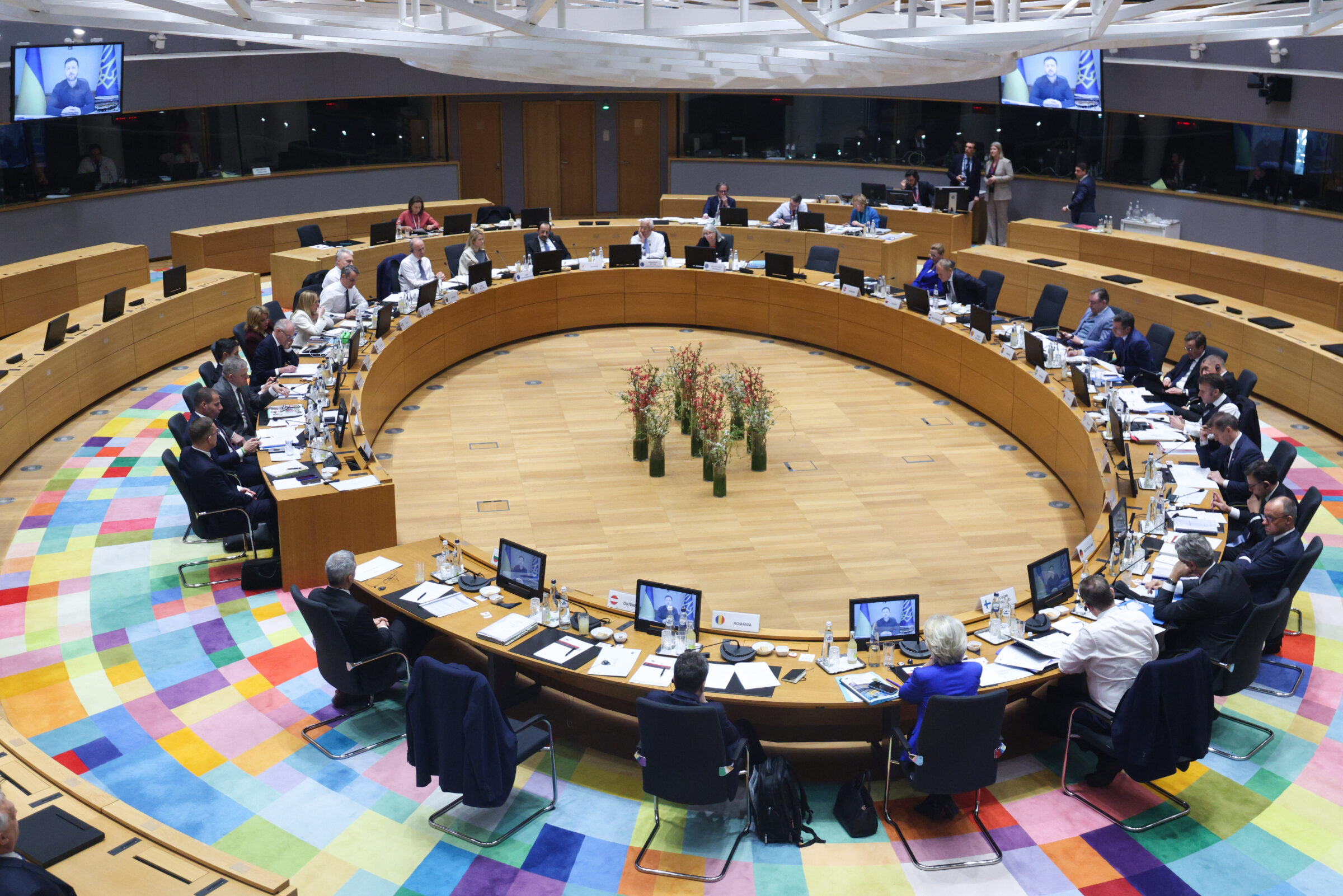
Ministers want to speed up and simplify the payment of farming subsidies by taking control of the EU’s multi-billion euro farming payment schemes, under a deal reached late on Monday night (26 October).
The agreement at a meeting of EU agriculture ministers in Brussels finalises the negotiating position of EU governments on the future of the bloc’s Common Agricultural Policy in its next seven-year budget.
The ‘negotiating box’ prepared by the Irish EU council presidency earlier this month for the 2028-34 multi-annual financial framework spared agricultural subsidies provided by the common agricultural policy from cuts worth a total of €141bn but proposed three-percent cuts, worth €24.6bn, to funding for National and Regional Partnership Plans (NRPP), which are intended to streamline the distribution of EU cash to governments for a variety of different policies including agriculture and fisheries.
The idea behind the NRPPs is to set up one single fund to provide support for farmers.
Each EU country would be expected to develop a single comprehensive plan outlining the reforms and investments it intends to implement from 2028 to 2034 and how it plans to use EU funds.
EU governments agreed on Monday that this planning process should be designed to give them far greater autonomy. They say that the recommendations the commission makes to member states regarding the design of support programs should not be binding.
The new system is set to prioritise ‘active farmers’, which sets a threshold of a minimum level of agricultural activity for farmers, as well as young farmers and small farmers.
This article continues, but the full version is available only to EUobserver.com subscribers. Visit account.euobserver.com/membership
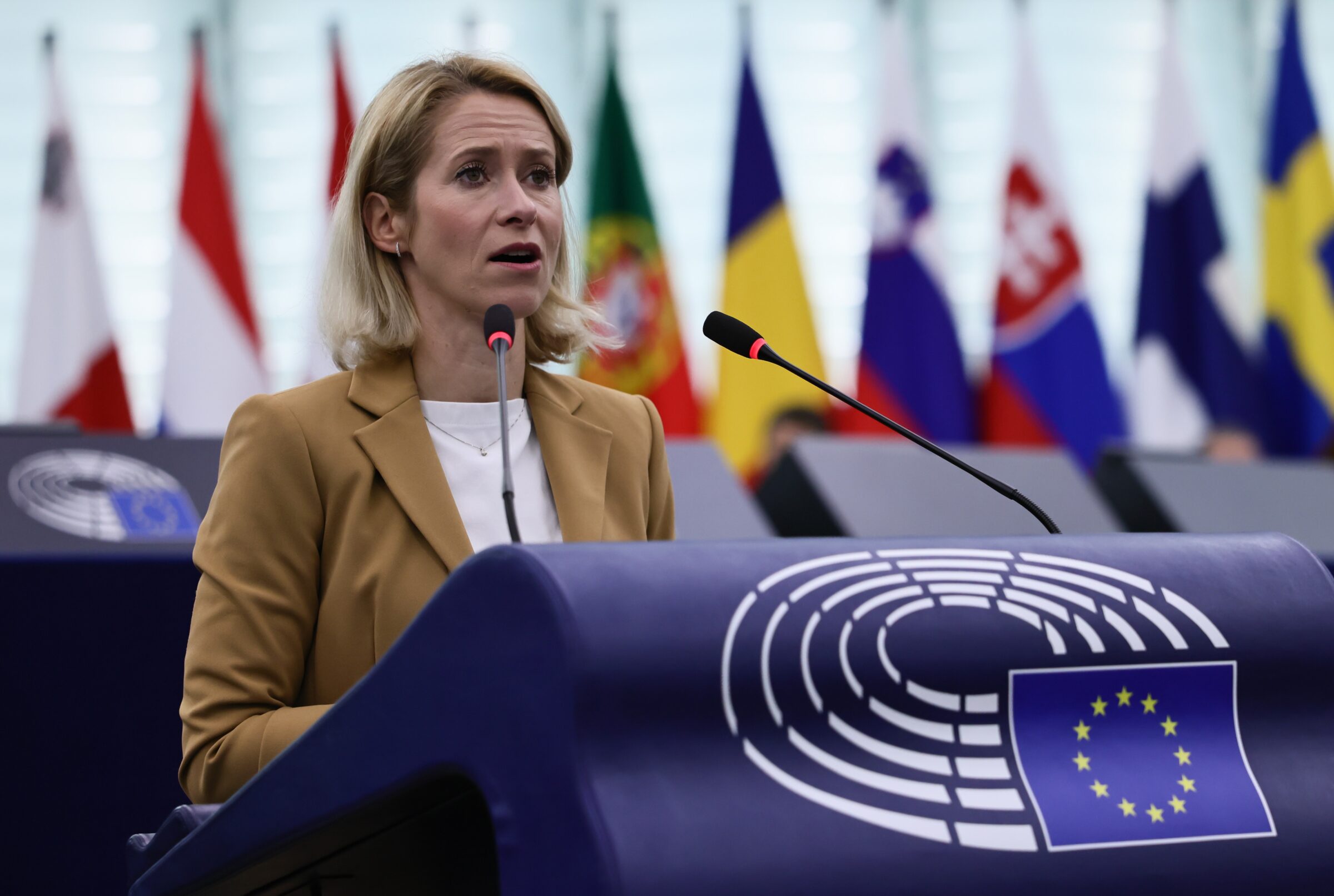
The European Parliament overwhelmingly supported an increased budget and scope for the Erasmus+ student-exchange programme under the new EU budget on Thursday (22 October).
The plenary in Strasbourg opted for a €7bn increase in Erasmus+’s budget compared to the commission’s proposal, by 454 votes, with 34 abstentions, against 93, mostly from right-wing parties.
And it was an audacious move, seeing as ‘frugal’ EU capitals are pushing for €150bn of cuts to the commission’s draft.
But even a “slight increase” in Erasmus+ funds would mean more opportunities for thousands of people, said Bogdan Zdrojewski, a Polish centre-right MEP, who was the rapporteur on the file, during a parliamentary debate earlier on Wednesday.
Celebrating its 40th anniversary in 2027, Erasmus+ enables young people to study, live, and work in foreign countries both inside the 27 EU states and the programme’s 160 “associate” states worldwide.
Some 17 million people have taken part since it began, with an estimated 1 million babies also born to couples who met on exchange, in what the commission has long used as a flagship PR project for creating a feel-good factor about the EU.
Meanwhile, the UK will rejoin the programme in 2027, which means EU students will once more have the opportunity to also spend a semester in Britain, which hosts some of Europe’s and the world’s top universities.
And the parliament would also welcome Canada’s full participation in a few years’ time, Zdrojewski told press on Wednesday.
The EU Parliament would like to expand Erasmus+ to more vocational training. “Erasmus+ will be a programme for Europeans no matter what age, what stage of life,” Zdrojewski said.
And students from poorer homes should get more support to live in pricey cities abroad, he added.
The share of Erasmus+ participants who had fewer opportunities to travel under the present structure stood at 15 percent in 2023 – up from 10 percent only two years earlier, according to a commission evaluation.
“Far too often, it is still the parents’ financial situation that determines who can take part in Erasmus+ and who cannot,” said Sabrina Repp, a German socialist MEP, in Wednesday’s debate in Strasbourg.
Working students often cannot afford to quit their current job to go abroad, she added: “That is precisely what we must change.”
The EU budget talks are to be finalised early next year.
Some 83 percent of Erasmus+ participants say they gained professional skills that helped them in the labour market.
But in order for those opportunities to be available more widely, “we need more funding for this programme,” also said Lucia Yar, a Slovak liberal MEP in the Strasbourg debate.
MEPs have put themselves on a collision course with EU governments by rejecting plans for a 17-percent cut in foreign spending – instead demanding additional spending worth €25bn.
Earlier this month, the Irish government, which holds the six-month rotating EU council presidency, proposed that €38bn of cuts be made from the ‘Global Europe’ heading, which covers foreign aid, as part of an overall package of €141bn of cuts to the seven-year EU budget, known as the multi-annual financial framework (MFF).
But in a vote on Monday evening (19 October), the European Parliament’s development committee instead backed a dedicated minimum budget of €25bn for humanitarian aid, as well as dedicated budget lines for a Gaza reconstruction fund and for candidate countries. Put together, that would mean a €25bn increase on the EU Commission’s original budget of €200bn for the Global Europe heading.
The position agreed by MEPs, by a 61-to-34 vote margin, will eventually form the basis of negotiations between MEPs and ministers when EU governments agree their position on the budget.
This article continues, but the full version is available only to EUobserver.com subscribers. Visit account.euobserver.com/membership
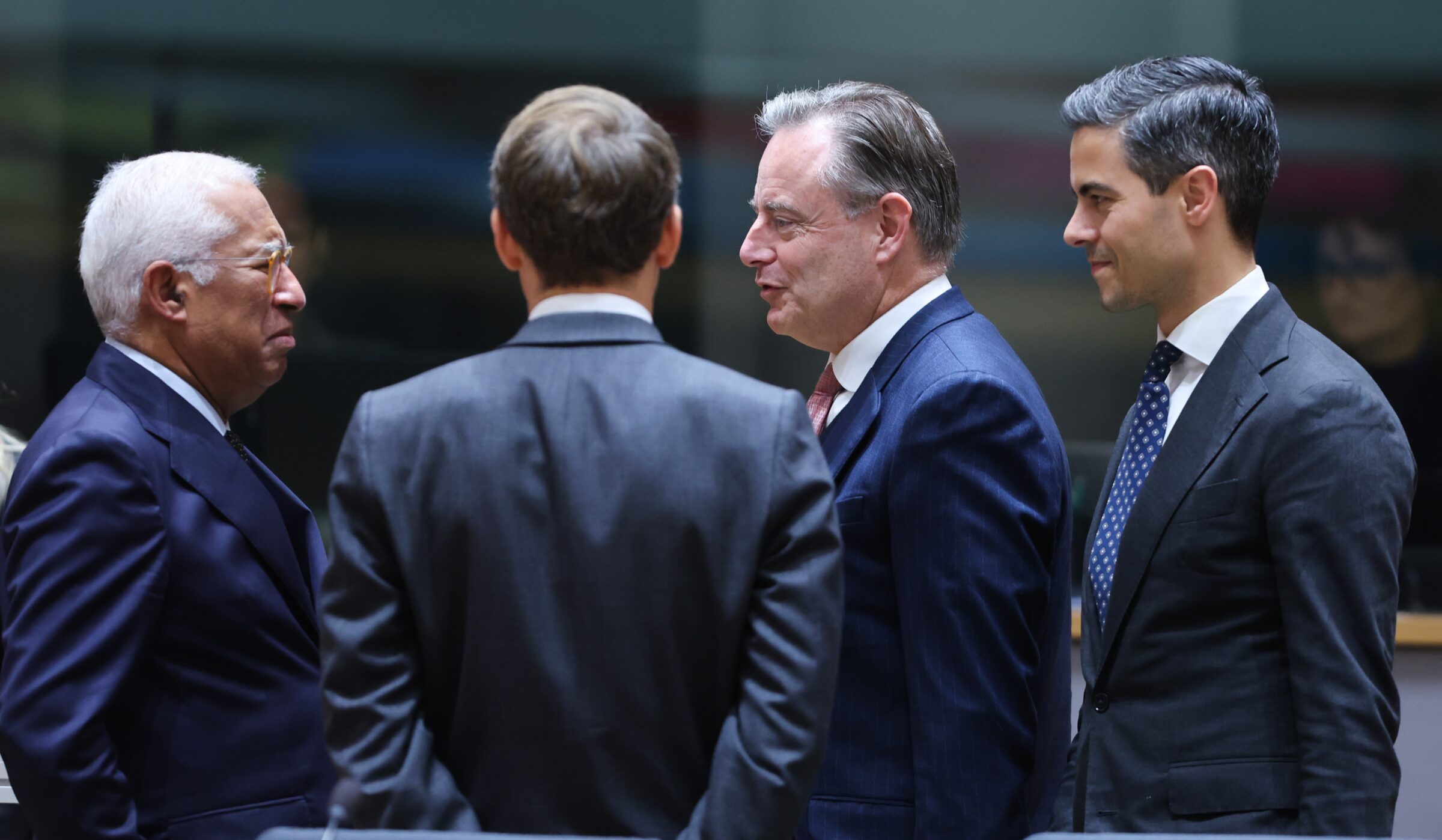
EU leaders met Thursday (15 October) for their first face-to-face talks on the 2028–2034 budget, killing the latest negotiation proposal put forward by Ireland.
Dublin, which holds the symbolic EU Council presidency, proposed cuts of up to €141bn from the long-term budget, about eight percent less than the commission proposal. But it failed to make anybody happy, for different reasons.
And now, EU Council president António Costa has been tasked to deliver a new compromise before EU leaders meet again on 26 November in Brussels, with the goal of striking a deal during the summit in December.
An EU official said Costa deemed the deal in December as “essential,” urging EU capitals “to assume their responsibility”.
For Denmark, for example, it is important to have more funds for defence, borders, illegal migration, and competitiveness. “It will probably be as difficult as it was last time or even more difficult,” said Danish prime minister Mette Frederiksen ahead of the meeting.
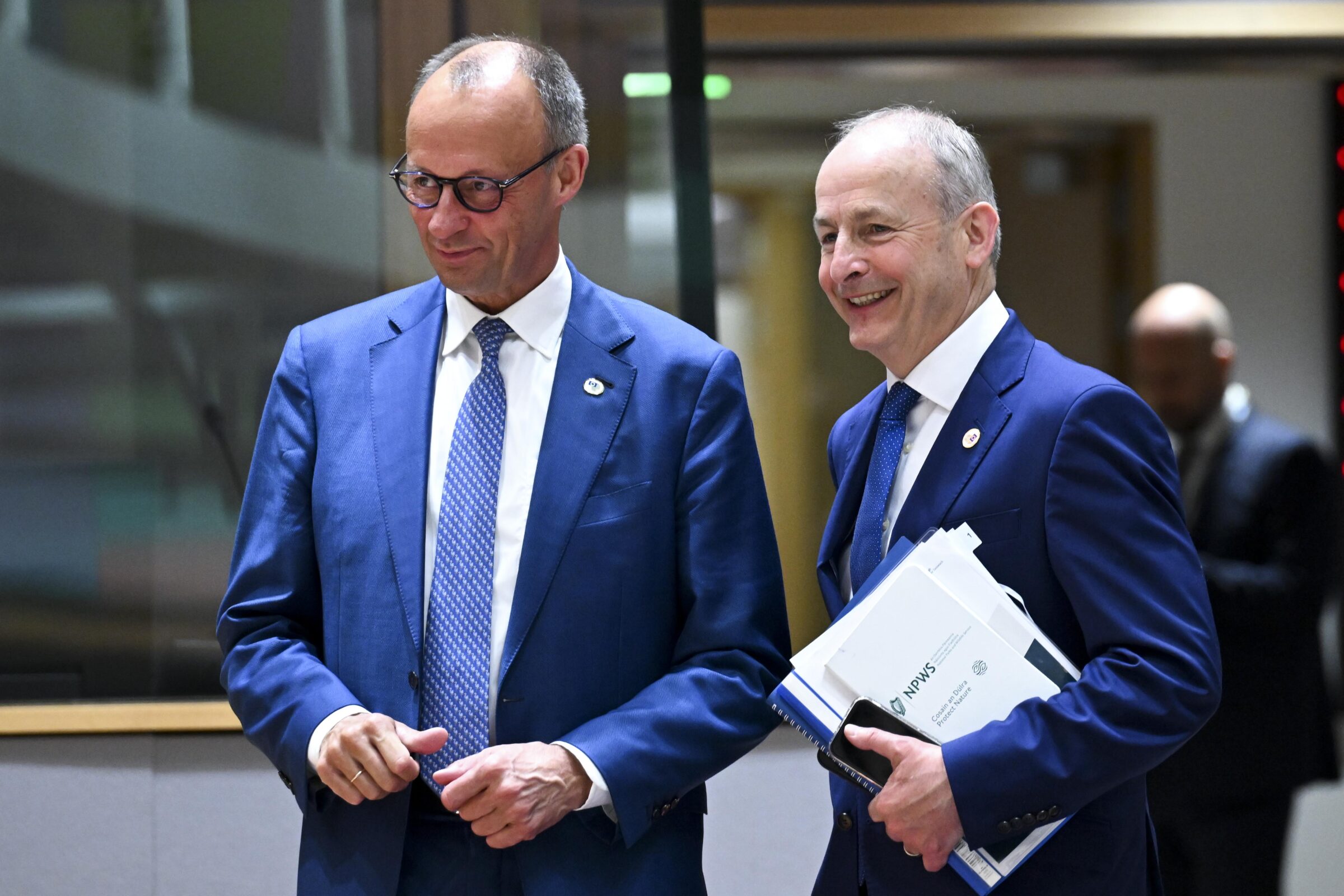
“We need unanimity in the Council. We are far from that unanimity,” also said German chancellor Friedrich Merz before meeting counterparts.
The EU is divided into two camps. The so-called Frugals (Germany, Austria, Denmark, Finland, the Netherlands, and Sweden) want “several hundred billion” more to be cut, mostly from agriculture and cohesion funds, while 17 EU member states (self-named as Friends of Cohesion) criticise the savings.
But time is of the essence to reach a deal this year, especially for French president Emmanuel Macron. France will hold presidential elections in the spring, and if Marine Le Pen, leader of the far-right National Rally party, wins, reaching an EU deal would become far more difficult.
Le Pen has pledged that, if she comes to power, she will halve France’s contribution to the EU budget.
And Macron reportedly said in the room with EU leaders that from January onwards, there will be no political room for reaching an agreement.
‘Easier to give up what you don’t yet have’
This article continues, but the full version is available only to EUobserver.com subscribers. Visit account.euobserver.com/membership
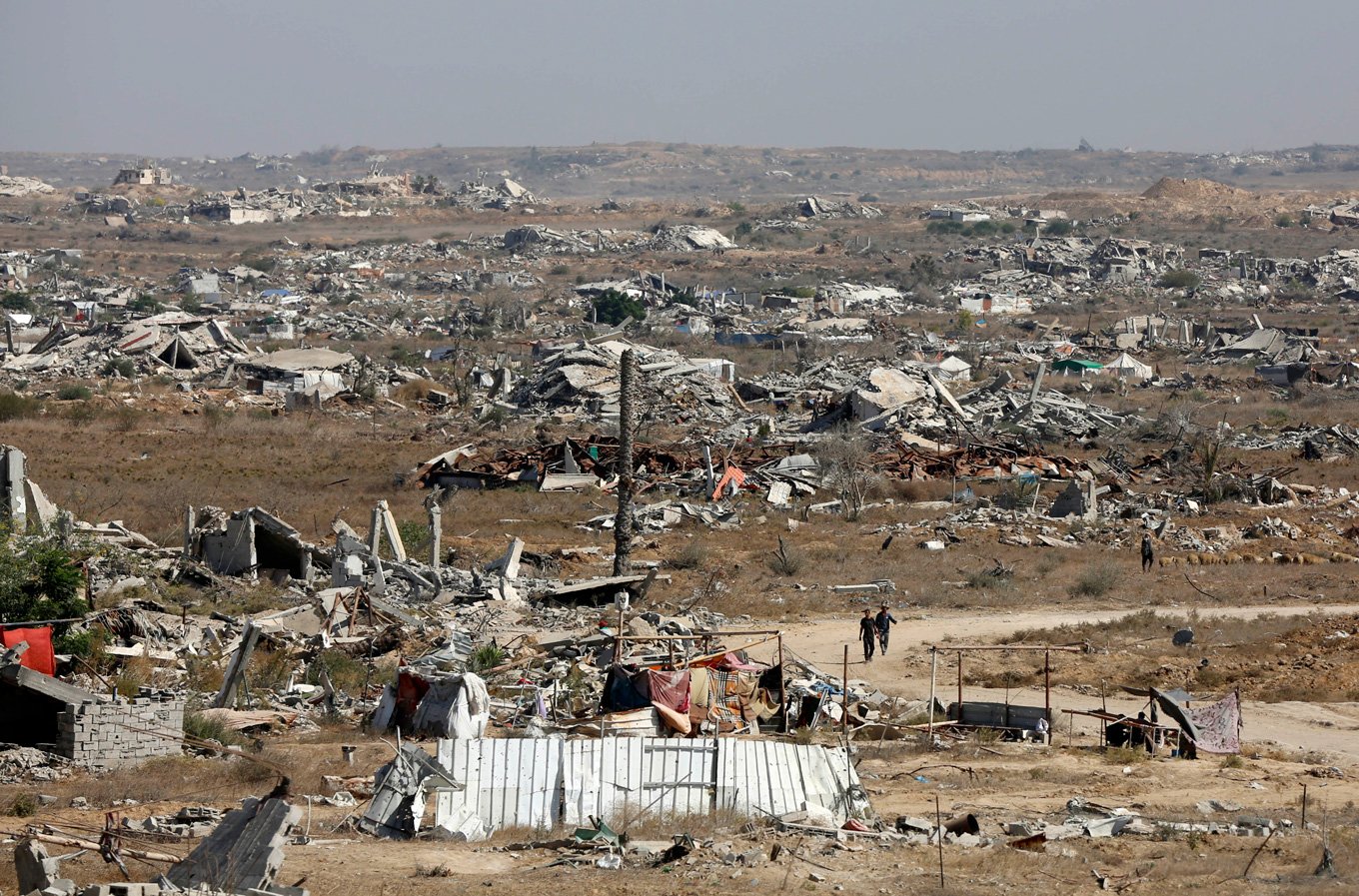
The European Union has continued its scientific cooperation with Israeli firms and institutions implicated in genocide and apartheid throughout Israel’s three-year old assault on Gaza. Such complicity must stop.
Israel has been associated with the €95.5bn Horizon Europe research and innovation programme (2021-2027), and, according to the European Commission’s detailed Horizon dashboard, the EU’s net contribution to Israel amounts to €1.02bn.
While much of the funding supports legitimate research, the programme also channels substantial resources to Israeli universities and companies, some closely connected to Israel’s military and security apparatus.
Pointing to just such EU-Israel collaboration, Francesca Albanese’s UN report “From economy of occupation to economy of genocide” published last year, estimated EU research funding to Israeli entities at over €2.12bn since 2014.
Horizon Europe funds collaborative projects and European Research Council grants.
But it is the European Innovation Council (EIC) and schemes which include the EIC Accelerator, the EIC STEP Scale-up and the Scaleup Europe Fund which are especially relevant to the question of EU complicity in Israel’s ongoing assault on Gaza.
Horizon Europe is formally limited to civilian research, but Israeli companies with links to Israel’s military and security establishment have received funding through these schemes.
In March 2026, for example, members of the European Parliament tabled a written parliamentary question asking the European Commission specifically about such companies including Sightec, an Israeli drone-navigation firm that received almost €2.5m through the EIC Accelerator and whose chief executive has described its technology as “combat-proven and deployed on over 3,000 drones in critical missions”.
The issue is not confined to overtly military applications. EU-funded civilian technologies can also serve Israel’s settler-colonial project.
Should European public money finance, for example, orange-harvesting robots that help Israel manage what it euphemistically calls a “labour shortage” in settlements built on occupied Palestinian land?
The EIC also goes beyond grants. Through the EIC fund, the EU can take equity in companies it supports; the new Scaleup Europe Fund is explicitly designed to make direct equity investments in strategic technology firms, and is open to companies based in countries associated with Pillar III of Horizon Europe, including Israel.
The EU can therefore not only subsidise Israeli technology firms but also acquire a financial stake in them and potentially profit from their future growth.
And it could get worse.
The EIC’s 2026 work programme expands the type of projects that can be funded by including ‘dual use’ applications that are both civilian and military.
This opens the door for the EU to fund nuclear-related Israeli projects although Israel is not a member of the European Atomic Energy community (Euratom).
But none of this is inevitable.
Next EU budget and credibility at stake
Israel’s association with the current Horizon Europe programme runs only until 2027 and the shape and scale of the EU’s next Horizon programme will be decided during ongoing negotiations on the bloc’s seven-year Multiannual Financial Framework (MFF).
There are also clear signs that Israel is likely to participate in the next Horizon programme (2028-2034).
Only a few weeks ago, Ekaterina Zaharieva, European commissioner for startups, research and innovation, met with the head of the Israel Space Agency, Shimrit Mama.
European Commission president Ursula von der Leyen and her team must ask themselves if the EU should be building an innovation architecture in which Israeli firms and state institutions, which are already deeply integrated into Israel’s military-industrial ecosystem, could receive European support for technologies explicitly framed as dual-use or defence-related.
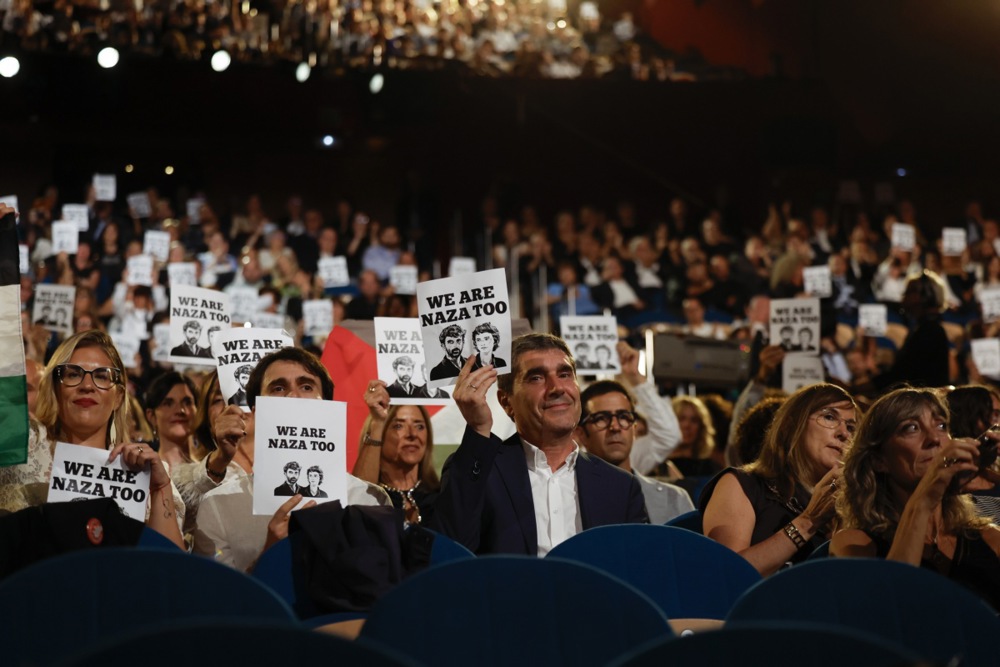
Are they comfortable with funding companies that help develop the type of violent technologies described in the award-winning documentary NAZA, which exposes the systems and AI technology used during the military campaign in Gaza?
Audience members hold signs supporting Yuval Abraham and Rachel Szor’s documentary Naza after it wins the European Film Audience Award at the 74th San Sebastian Film Festival in Spain, 26 September 2026 (Source: EPA/JUAN HERRERO)
Last year, under public pressure, von der Leyen proposed a partial suspension of Israel’s participation in Horizon Europe by specifically excluding Israeli entities from new EIC Accelerator grants and investment support.
The proposal was modest: it would have affected future funding only, not existing agreements, and covered roughly 20 percent of EU financial flows to Israel under the programme.
It required a qualified majority in the Council but did not secure the necessary votes. It is, however, technically “still on the table”, according to commissioner Zaharieva.
Nobel Peace Prize winner Navi Pillay concluded in 2025 that Israel’s actions have “consistently pointed toward a singular, harrowing objective – the destruction of Palestinian life in Gaza”.
The EU has done little so far to stop the genocide in Gaza and ethnic cleansing in the occupied West Bank, and arguably – through trade and weapons’ exports – is actually contributing to it.
Now the EU faces a clear choice. It can continue to fund, co-invest in and deepen research ties with an Israeli innovation sector increasingly oriented towards dual-use and defence technologies.
Or it can stand with the winner of the 2026 Nobel Peace Prize, draw a line and decide that there will be no Israeli participation in the next Horizon programme, no EU equity in Israeli firms, and no public money for technologies that may be used to sustain genocide, occupation, surveillance and war.
The credibility of the EU and the values it proclaims depends on the choice it makes.
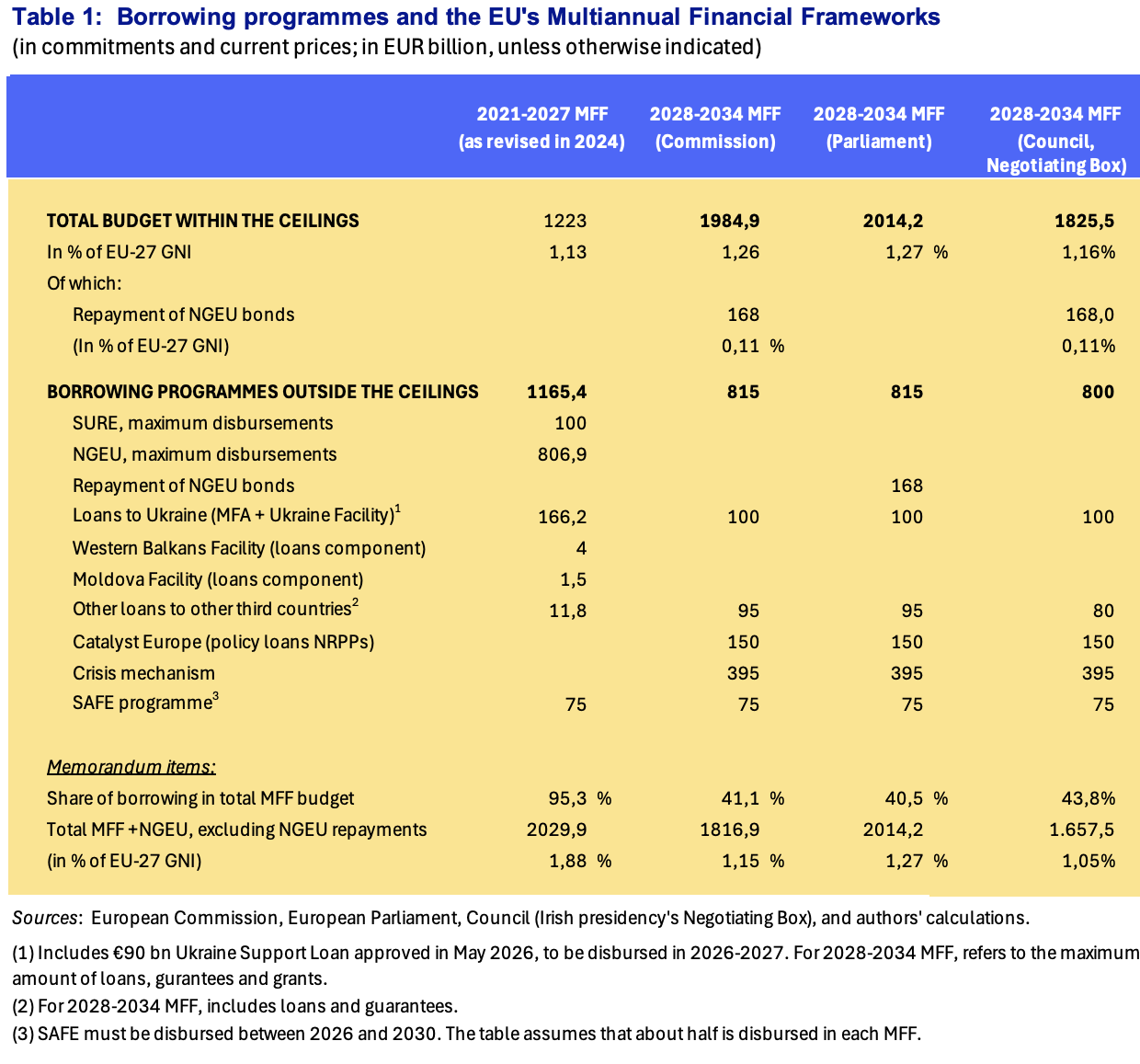
The Irish text, known in Brussels as the negobox, keeps all three of the commission’s borrowing programmes that sit outside the budget’s normal limits: Catalyst Europe, a €150bn lending facility; a crisis mechanism of up to €395bn for major unforeseen shocks; and support for Ukraine of up to €100bn.
Add loans for defence and lending to other non-EU countries and, by our estimates, joint borrowing could still equal around 44 per cent of the new budget, about €800bn at current prices, up from 41 per cent under the Commission’s proposal. The budget shrinks, but the borrowing hardly changes.
Ireland’s proposed budget is too small for Europe’s mounting common challenges, and its borrowing approach is too ad hoc and risky.
Excluding the distorting effects of NextGenerationEU (NGEU), the Covid recovery fund, the Commission’s budget proposal is already far smaller than the headline figures suggest, and Ireland’s proposal would make it smaller still.
That matters because, as the Draghi report argued, Europe’s shared challenges such as Ukraine, rearmament and competitiveness require European public goods because no single member state captures their full benefits.
A budget worth just over one percent of the EU’s gross national income (GNI) is a poor match for that responsibility.
By comparison, total government expenditure across EU countries comes to close to half of their combined GNI. Keeping most fiscal capacity at national level, while expecting such a modest EU budget to finance increasingly vital continental priorities, is a bad use of public resources.
A stronger common budget needs more of its own revenue, at least what the Commission proposes in its Own Resources Decision, which Parliament broadly supports and which would raise nearly €60bn extra a year.
The Irish plan’s acceptance of five new resources is encouraging. But it has to survive the negotiations, and the details of the final reform will decide whether it means anything.
The Council’s approach to common borrowing remains haphazard, lacking a permanent framework and relying on crisis-driven compromises. Governments may not like it, but a more European approach is coming, and the €800bn is likely to grow.
And a successor to SAFE, the EU’s defence loan scheme, is widely expected, since €150bn has proved far from enough for Europe’s rearmament.
France has just shown what it costs to borrow alone. Its yields recently hit a 24-year high, and the state now pays more to borrow than some major French companies. Sharing the effort through the common budget, including prudent joint borrowing, would help spread that risk.
Yet Europe has no clear, sustainable plan for borrowing. To date, EU governments have reluctantly signed up to each new borrowing instrument and called it an exception.
European borrowing capacity has been assembled one crisis at a time, starting with the euro area crisis and accelerating since the pandemic.
NGEU was accepted by fiscally cautious states as a one-off decision to deal with the Covid-19 emergency. Then the war in Ukraine and the need to fund rearmament produced new exceptions.
This year, EU governments used enhanced cooperation, a procedure that lets a subset of member states go ahead without the rest, to approve the €90bn Ukraine Support Loan, the EU’s largest foreign loan ever.
For defence, they reached for Article 122, the treaties’ emergency clause, to set up SAFE. Parliament, which felt sidelined, decided to sue the Council before the European Court of Justice.
There is a catch though.
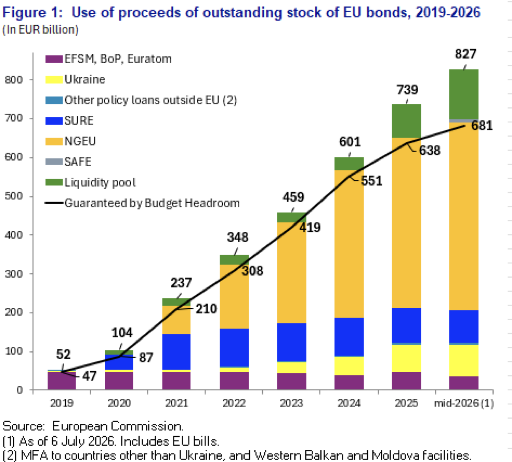
These exceptional programmes are guaranteed by the so-called budget headroom, the margin between the EU’s revenue ceiling and the spending limits in the seven-year budget, rather than by money set aside in advance.
In barely five years, headroom-backed exposure has climbed to €681bn (see Figure 1), 82 percent of all EU debt.
The European Court of Auditors has warned that if a Ukraine loan guaranteed this way goes bad, future EU budgets, and the national contributions that fund them, would have to cover the loss.
Frugals vs Friends of Cohesion
EU capitals remain divided over the new budget and over joint borrowing. Net contributors, sometimes referred to as the Frugal Six, want deep cuts in the commission’s proposal, argue that new common borrowing is not the solution and have misgivings about the creation of new own resources.
By contrast, a group of sixteen southern and eastern countries, that call themselves the “Friends of Cohesion”, are much more open to joint borrowing and back an approach closer to the Commission and Parliament on the budget and own resources.
Ireland’s plan largely reflects the influence of the frugal countries, yet one diplomat has already dismissed it as “not even close to a landing zone.”
Europe needs an ambitious budget, backed by at least the Commission’s proposed new own resources, so it relies less on national contributions based on GNI. Joint borrowing should become a permanent, predictable part of it, with safeguards.
First, it should fund loans, not grants, as the Commission suggests. Second, riskier exposures, especially to non-EU countries, should be at least partly backed by money set aside in advance, as the Court of Auditors recommends.
Where it makes sense, the headroom guarantee could be topped up with national guarantees in proportion to each country’s size, as under SURE, and like-minded partners outside the EU could sometimes take part.
Stronger capital at institutions such as the EIB, or at any future defence-financing vehicle, would also let Europe borrow more together without putting its creditworthiness at risk.
Governments should also consider deferring repayment of the NGEU bonds, as the Draghi report suggested, especially if the own-resources reform falls short. It would protect priority spending when it is needed most.
Sustained joint borrowing brings a bonus: more common safe assets in euros, which strengthens the euro’s international role. The demand is already there.
Wobbles in US bond markets, which partly reflect doubts about America’s fiscal health, its reliability as a partner and the dollar’s safe-haven status, give the euro an opening.
But it can only take it if EU governments put their own fiscal houses in order.
Ongoing tensions in the French bond market provide a clear warning. Putting France’s finances on a sustainable path would do more than reassure markets about the euro. It would restore French debt as a safe euro asset.
EU leaders meet on Thursday and Friday in Brussels. Whatever they discuss (and later decide) on the budget, Europe should keep borrowing together, and in large amounts.
The task now is to give that borrowing a coherent plan: a permanent framework, money set aside in advance and safeguards that cautious capitals can accept.
The European Parliament has delivered a sharp rebuke to Ireland’s proposals for the EU’s next seven-year budget, warning that cuts to competitiveness, security and regional development could leave Europe dangerously ill-equipped to confront mounting geopolitical and economic challenges.
The European Union is heading towards a potentially bruising institutional confrontation over its next long-term budget, after senior Members of the European Parliament rejected proposals from the Irish Presidency of the Council to reduce the European Commission’s spending plans by eight per cent.
The dispute concerns the Multiannual Financial Framework (MFF) for 2028–2034, which will determine not merely how much Brussels spends, but the extent to which Europe can deliver on its increasingly ambitious political, economic and security objectives.
At stake is a fundamental question: can the European Union realistically aspire to become a more competitive, strategically independent global power while its member states resist providing the financial resources necessary to achieve those ambitions?
Parliament Draws a Red Line
In a statement published on 10th October, Parliament’s principal budget negotiators, Siegfried Mureșan of the European People’s Party and Carla Tavares of the Socialists and Democrats, firmly rejected the Irish negotiating framework.
They were joined by Danuše Nerudová and Sandra Gómez López, Parliament’s co-rapporteurs responsible for developing new sources of EU revenue.
Their objections centre on the proposed reduction of approximately €141 billion from the Commission’s original spending plans.
Mureșan warned that the reductions would undermine Europe’s ability to respond to growing demands for defence, economic competitiveness and security.
He also highlighted the erosion of the EU budget’s purchasing power, which Parliament estimates has declined by approximately ten per cent because of inflation.
The implication is uncomfortable for national governments: maintaining apparently substantial expenditure figures does not necessarily translate into maintaining Europe’s capacity to act.
Ireland’s Difficult Balancing Act
Ireland, currently holding the rotating Council Presidency, has attempted to reconcile two increasingly contradictory political demands.
On one side stand governments seeking greater investment in defence, technological innovation, economic resilience and geopolitical influence.
On the other are national finance ministries confronting constrained public finances, mounting borrowing costs and electorates increasingly resistant to additional expenditure.
The Irish Presidency’s proposal envisages approximately €1.62 trillion in commitments, expressed in 2025 prices, representing a substantial increase over the existing seven-year framework.
Dublin argues that its negotiating position offers an ambitious but financially realistic compromise, preserving traditional agricultural and cohesion spending while accommodating emerging priorities.
Yet the European Parliament remains unconvinced.
Particularly contentious are proposed reductions of 12.8 per cent in competitiveness expenditure and 17.4 per cent in external action compared with the Commission’s plans.
These are precisely the areas in which Brussels has repeatedly promised greater international influence.
Defence Ambitions Meet Financial Reality
The timing could scarcely be more awkward. Russia’s continuing aggression against Ukraine has exposed Europe’s dependence on American military capabilities, while mounting geopolitical uncertainty has reinforced demands for greater European strategic autonomy.
Meanwhile, competition from China and the United States is placing European industries under unprecedented pressure.
Brussels regularly speaks of technological sovereignty, stronger defence industries and reduced dependence on external suppliers, however, those objectives require sustained investment.
Cutting expenditure intended to strengthen competitiveness while simultaneously demanding that European companies compete more effectively internationally risks becoming an exercise in political contradiction.
Nevertheless, Parliament’s position deserves scrutiny too. Greater expenditure does not automatically produce better outcomes. Europe’s problems with fragmented defence procurement, regulatory complexity and slow implementation cannot simply be resolved by increasing budget allocations.
A credible financial settlement must therefore combine sufficient resources with demonstrably improved efficiency and accountability.
The Battle Over Europe’s Own Resources
Perhaps the most consequential disagreement concerns how the Union should finance its expenditure.
Parliament has repeatedly argued that the EU must develop additional independent revenue streams rather than relying excessively on contributions from national governments.
Its proposals include levies associated with digital services, online gambling and cryptocurrency capital gains. MEPs believe these measures could generate approximately €30 billion beyond the additional revenue already envisaged by the Commission.
The Irish Presidency has advanced a revenue package that it estimates could eventually raise around €55 billion annually, but agreement among member states remains elusive.
This disagreement exposes an enduring weakness in European integration.
Governments frequently demand collective European action while remaining reluctant to surrender control over the financial mechanisms necessary to support it.
A Political Confrontation With Serious Consequences
The institutional arithmetic makes Parliament’s opposition particularly significant. Although member states must unanimously approve the long-term financial framework, the European Parliament must also provide its consent by an absolute majority of MEPs. Consequently, national governments cannot simply impose a settlement over parliamentary objections.
Equally, the European Parliament cannot compel governments to finance its preferred spending programme. Both institutions therefore possess considerable negotiating leverage, raising the possibility of prolonged political deadlock.
The forthcoming European Council discussions on 15–16th October will provide an important indication of whether governments are prepared to reconsider their positions.
Europe’s Credibility Is on the Line
Ultimately, this dispute extends far beyond accounting. The European Union faces an increasingly hostile strategic environment, persistent economic challenges and growing demands for collective action.
Yet its institutional ambitions continue to outpace agreement on the financial commitments required to fulfil them.
Parliament is justified in questioning whether reducing investment in competitiveness and security represents prudent financial management or potentially damaging short-termism. National governments, however, are equally entitled to demand evidence that additional European expenditure will produce measurable benefits.
The solution cannot be unlimited spending, nor can it be indiscriminate austerity. Europe requires a budget that reflects its strategic responsibilities, backed by rigorous financial discipline and transparent political priorities.
Without such a settlement, the Union risks discovering that its greatest obstacle to becoming a serious geopolitical actor is not opposition from Washington, Moscow or Beijing, but its own inability to agree on the price of its ambitions.
Getting co-decision powers on the budget, finally enshrined in the Lisbon Treaty after more than a decade of inter-institutional battles, was one of the European Parliament’s big wins.
The challenge facing MEPs in the coming months is whether they are really going to use those powers on the 2028-34 budget.
The early signs are that they are spoiling for a fight. The Irish government’s compromise proposal tabled on Saturday (10 October) – an 8 percent cut worth €141bn to the European Commission’s spending plan – isn’t exactly butchery.
But it does display a startling lack of ambition, in particular on the raft of ‘own resources’ proposed by MEPs to make the budget process less vulnerable to member states wanting to reduce or at least freeze their annual contributions
This time round, MEPs have proposed a digital services levy, an online gambling levy, and a levy on crypto-asset capital gains.
Put together the parliament reckons that these new taxes could bring an additional €30bn to the EU’s budget, on top of the €57.4bn that the EU commission believes can be raised from other levies, such as the emissions trading scheme and the carbon border levy.
This article continues, but the full version is available only to EUobserver.com subscribers. Visit account.euobserver.com/membership
Money and how to make more of it are among the top issues to be discussed among EU leaders as they gather for a two-day summit in Brussels, while they also struggle with ongoing problems on Ukraine, the Middle East, migration, defence, and new rules for EU-hopefuls, such as Montenegro.
The official talks kick off on Thursday (15 October) on how to make the 27 EU states more competitive in a turbulent world dominated by US tariffs, Chinese innovation, and Iran-war linked chokeholds in the Strait of Hormuz, which have forced the G7 wealthy nations to release 100m barrels of diesel and crude oil.
Gas prices have risen by 140 percent since the end of February with imported fossil fuels now costing an extra €100bn, says the European Commission.
In Europe, a grand scheme, a so-called “One Europe, One Market”, aims to spike European fortunes by saving an estimated €37.5bn for EU businesses by 2029.
The drive is part of a larger initiative to cut red tape and remove internal market barriers, including the eventual launch of a so-called EU Inc.
Ireland, which is currently steering the EU’s rotating presidency, had already announced that the summit would start with the competitiveness theme. And leaked draft conclusions, seen by EUobserver, lead with a sales pitch to step up ambitions over the ‘One Europe, One Market’ proposal.
It also gives a nod to the German car industry, by citing efforts needed to stop China from making too much money off Europeans. The goal is to get Europeans to spend more on European products, even if they are more expensive and less innovative.
The ‘more money’ talks dovetail into how to spend it (or not) in the EU’s next long-term budget, spanning 2028 to 2034.
António Costa, the president of the European Council, is hoping for an agreement of the nearly €2 trillion budget before the end of the year. People need predictability and stability, he said, in a invitation letter sent to the 27 EU states.
This article continues, but the full version is available only to EUobserver.com subscribers. Visit account.euobserver.com/membership
The Irish government has set the path for a showdown between MEPs and governments over the next seven year EU budget after proposing an 8 percent cut worth €141bn to the European Commission’s spending plan.
Savings from the commission proposal have been found across all headings in the so-called ‘negotiating box’ for the 2028–2034 Multiannual Financial Framework (MFF). But farmers’ subsidies under the common agricultural policy and the bloc’s cohesion policy, which provides funding to the EU’s poorest regions, have been exempted from any cuts.
That is a nod to a sustained lobbying effort by a group of seventeen EU countries, known as ‘Friends of Cohesion’.
As expected, meanwhile, cuts totalling €38bn have been made from the ‘Global Europe’ heading, which covers foreign aid, while €75bn has been taken from the competitiveness fund and €10bn from the EU’s administrative costs.
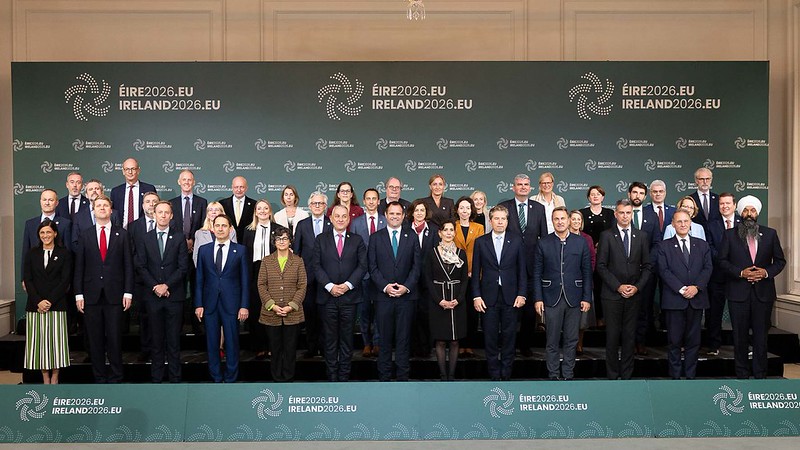
In a statement on Saturday (10 October), Ireland’s minister for Europe, Thomas Byrne, said that the €1.62 trillion spending plan was “intended to bridge the many differences between Member States. It brings us closer to resolving the critical questions our Union faces on how to balance both new priorities and core policies, whilst also reflecting the fiscal realities that all Member States face.”
This article continues, but the full version is available only to EUobserver.com subscribers. Visit account.euobserver.com/membership
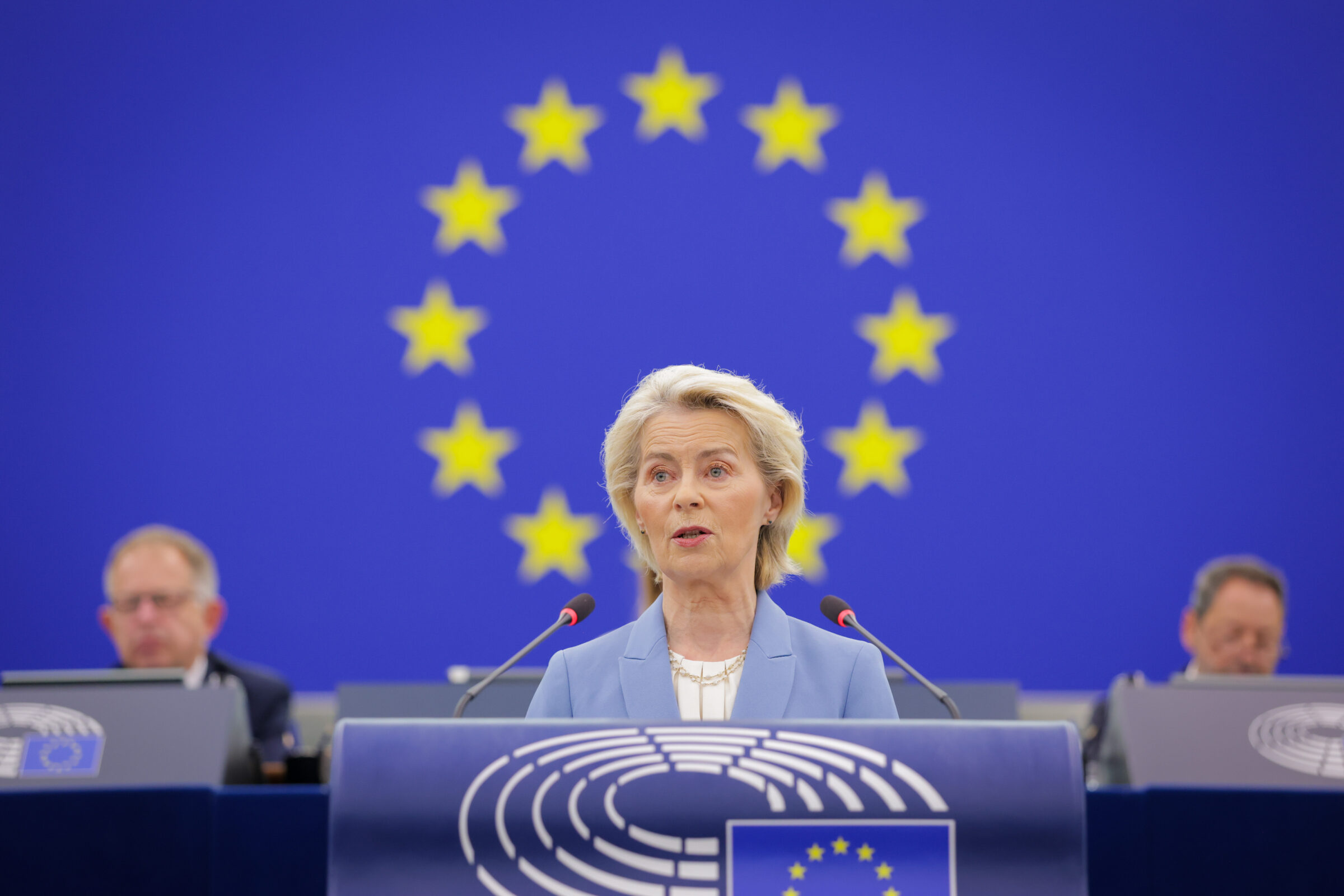
European Commission president Ursula von der Leyen has joined MEPs in urging the bloc’s governments not to gut the EU’s next seven-year budget, as talks on spending reach a critical phase.
The commission has proposed a budget worth just under €2 trillion, equivalent to 1.26 percent of the EU’s gross national income, a small increase on the previous seven year spending plan. But the so-called ‘frugal’ group of countries, led by Germany, have demanded hefty cuts, complaining that they are contributing too much.
“Having no new financial framework is by far the most financially advantageous solution for Germany,” chancellor Friedrich Merz said on Monday.
But 17 EU countries from Southern and Eastern Europe signed a joint letter last week, demanding that farmers’ subsidies via the Common Agricultural Policy are maintained, as well as spending across the EU’s poorest regions, known as cohesion policy
During a press conference on Tuesday, Siegfried Muresan, the Romanian centre-right MEP who is co-leading parliament’s negotiating team on the seven-year budget with Portuguese socialist and democrat Claudia Tavares, said that there was “still time” for the Irish presidency to avoid proposing “unjustified cuts” that “would make Europe weaker and severely undermine the institutional cooperation between parliament and council.”
Though Muresan conceded that governments did not want to increase their national contributions, “there is a way out”, he said.
This article continues, but the full version is available only to EUobserver.com subscribers. Visit account.euobserver.com/membership
MEPs are pushing for an EU solidarity mechanism to help patients pay for treatment abroad, arguing that financial barriers are preventing Europeans from exercising rights they have had on paper for more than a decade.
The calls came as Parliament discussed a report commissioned to inform its own-initiative report on modernising patients’ rights in cross-border healthcare. The study found that cross-border care accounts for just 0.004% of EU public health expenditure, despite patients continuing to face upfront costs, complex reimbursement procedures and prior-authorisation requirements.
Tomislav Sokol (EPP, Croatia) called the proposed solidarity mechanism a potential “game changer” for vulnerable patients, but challenged Parliament to spell out how it would work.
“How would it work in practice? How would it be financed? Would this be part of the EU budget?” Sokol asked. “We need to know it now, so that we can also use this in negotiations on the future EU budget, in the next MFF.”

 Login