❌

Reading view

With ‘largest coordinated port action ever,’ dockworkers in 22 countries strike against Gaza genocide

Seafarers and dockworkers chant slogans as they take part in a march from the port of Piraeus, near Athens, towards Greece's Ministry of Maritime Affairs on October 30, 2026, during a 24-hours strike held as part of an international day of action by dockworkers against the transport of weapons and military equipment through ports. Photo by Aris MESSINIS / AFP via Getty Images
Common Dreams Logo

This story originally appeared in Common Dreams on Oct. 30, 2026. It is shared here under a Creative Commons (CC BY-NC-ND 3.0) license.

Dockworkers in more than 20 countries—from France to India to Greece—are withholding their labor on Friday to demand an end to Israel’s genocidal assault on Gaza and highlight the role that commercial ports play in fueling deadly militarism worldwide.

Organizers said the work stoppages, led by dockworkers’ unions at 113 ports across 22 countries, would be the “largest coordinated port action ever,” easily surpassing the international day of action held in February. No Harbour for Genocide, a collective of trade unions and others supporting the day of action, said $2.8 billion worth of cargo will be halted at Mediterranean ports, where workers are planning to strike for 24 hours.

“A cargo refused in one port sails on to the next,” said No Harbour for Genocide. “Refused in every port, it stops, and the workers have enforced the embargo that governments announced and did not.”

In a joint statement last month announcing the day of action, dockworkers’ unions from Türkiye, Morocco, Italy, France, Greece, Italy, and Basque Country laid out their demands:

  1. An immediate end to the genocide of the Palestinian people and the opening of safe corridor for humanitarian aid.. An end of colonization, occupation and apartheid imposed to Palestinian People and the recognition of an independent Palestinian state recognized by the international community on the 1967 borders, with East Jerusalem as its capital.
  2. An end to the war in the Middle East. No support, no facilitation, no participation in the US-Israeli war against Iran, Lebanon or any other imperialist intervention. Military fleets and bases out of the region. We express our full solidarity to the people of Cuba and Venezuela and Sudan menaced by US imperialism and we call for defend people’s sovereignty, resources, territorial integrity, peace with justice, and the right for resistance for self-determination.
  3. Ports must not be used for the transport of weapons, ammunition, military equipment and troops. We call on unions to strengthen vigilance, to inform workers, to expose the cargoes of war, and to organize mass collective resistance with all our rightful available means and our struggle.
  4. An end to the militarization of ports and critical infrastructure. Ports belong to the peoples and the workers. They are not bases for NATO, the USA or the EU, nor tools of shipowners and monopoly groups.
  5. No to the war economy and armaments. The money must go to wages, collective agreements, health, education, social needs, and the protection of life and safety at work.
  6. Health and safety measures in the workplaces. Not one worker dead for profits. An end to intensification, subcontracting, dangerous conditions, and employer arbitrariness.
  7. Collective agreements with real wage increases, stable jobs with rights, a retirement policy with better pensions, and a reduction of working time. Technological developments, mechanization, automation, the use of AI and the development of ports must serve the needs of workers, and not lead to the intensification of work or the disappearance of their jobs.

“Our strength lies in organization. It lies in our unions, in general assemblies, in collective decisions, in solidarity among workers from different countries,” the unions said. “We, the workers in the ports, know very well that without us nothing moves. Without our hands, containers remain still, ships are not loaded, the war machines are blocked.”

Al Jazeera noted that of the ports participating in Friday’s actions, “Genoa, Livorno, and Gioia Tauro in Italy, Marseille in France, Piraeus in Greece, and Tangier in Morocco all have proven links to weapons shipments to Israel.”

Dockworkers International Day of Action across 5 Continents and 113 Ports

In Pireaus, at COSCO’s terminals, dockworkers are holding the picket lines. Their message is clear

Dockworkers do not work for war! Ports for the peoples and for peace, not bases for imperialists! pic.twitter.com/cpOwK8XLhV

— PAME Greece International (@PAME_Greece) October 30, 2026

The strikes come as Israel’s genocide in Gaza continues despite a ceasefire agreement that putatively took effect last October. A United Nations report published earlier this week noted that “Israeli authorities and forces continue to commit genocidal acts” in Gaza “even after the so-called ceasefire agreement, with the intent to destroy the Palestinian people, in whole or in part.”

The report found that Israel—which is armed and supported diplomatically by Western governments, principally the United States—has “committed war crimes and the crimes against humanity of extermination, persecution, torture, rape, and other forms of sexual violence” in the illegally occupied Palestinian territories.

Port Workers and Communities for Palestine said in a statement Friday that will be demonstrating at the Port of Elizabeth in New Jersey. The coalition said the New Jersey port is the only port on the East Coast of the US where a protest is expected. Demonstrations are also expected in Oakland and San Francisco, California.

“We know that, regardless of what union leadership may decide, workers everywhere stand in solidarity with Palestine,” said Port Workers and Communities for Palestine. “We will be out there on Friday to show them that they are part of this movement too. Workers have the power to stop the war machine.”


  •  

Public sector an ‘afterthought’ to North Sea oil jobs, says Unison leader

Andrea Egan calls for same political focus on teachers, care sector and NHS and says Jackdaw decision ‘a serious misstep’

The leader of the UK’s biggest trade union has called for the same political focus to be given to NHS, education and care sector workers as there has been on those employed in North Sea oil and gas.

Andrea Egan, the general secretary of Unison, said too often public sector workers were treated as an “afterthought” by the government compared with the “massive political focus” on protecting jobs in the North Sea.

Continue reading...

© Photograph: Gary Calton/The Observer

© Photograph: Gary Calton/The Observer

© Photograph: Gary Calton/The Observer

  •  

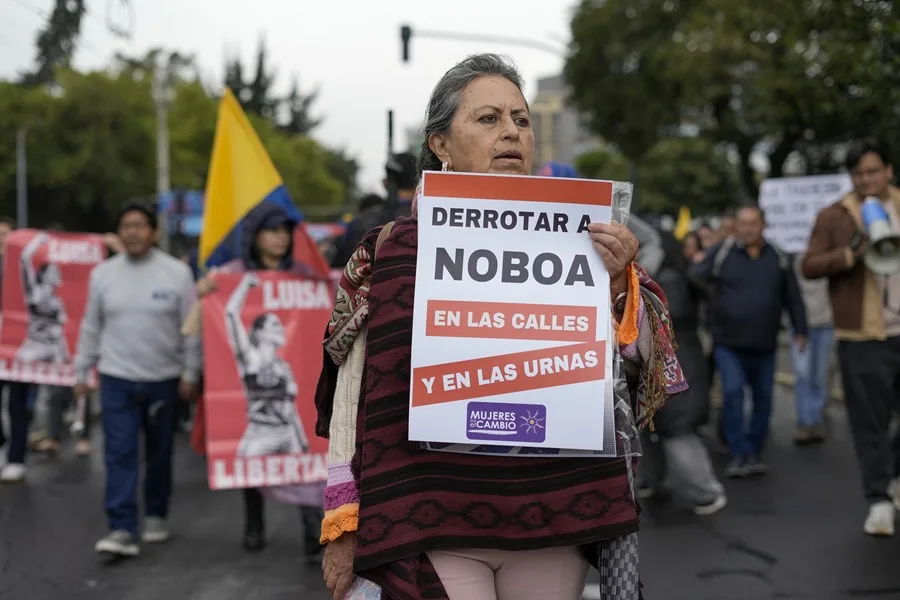
Ecuador Protesters March Against Noboa Ahead of Local Elections

Protesters march against Daniel Noboa in Quito, Ecuador, demanding Luisa González's release ahead of November 2026 local elections.

Unions and left-wing groups plan further demonstrations in November, calling for the release of opposition figure Luisa González.


Nearly 100 people marched through Ecuador’s capital, Quito, on Thursday to protest President Daniel Noboa’s government, launching a new wave of demonstrations ahead of local elections scheduled for Nov. 29.

RELATED: Ecuador Readies Snap Regional Elections Amid Opposition Exclusion Accusations

Organized by the country’s main trade unions and left-wing political parties, the peaceful march moved through the historic center before reaching the attorney general’s office. Protesters gathered outside the building carrying banners demanding the release of Luisa González, a former presidential candidate and one of the leading opposition figures.

González, who belongs to the political movement associated with former President Rafael Correa, was placed in pretrial detention in a case involving alleged money laundering. Prosecutors accuse her of involvement in the irregular financing of her first presidential campaign in 2023.

Chanting “Out, Noboa, out,” demonstrators also called for improvements to public education and healthcare. Some participants urged voters to cast null ballots in the upcoming local elections.

Natasha Rojas, a politician and activist, described the mobilization as a defense of democracy, civil liberties and the rights of Ecuadorians. She argued that the government was losing public support and warned that its policies would fuel further protests.

Nelson Erazo, president of the Popular Front, accused state institutions, including the attorney general’s office and the comptroller’s office, of being used to target social activists and political leaders.

He said the demonstration brought together groups seeking political change and demanding that Ecuadorians be able to express themselves freely, with guarantees of access to education, healthcare and employment.

Opposition organizations have announced further demonstrations on Nov. 7 and 15, followed by a march alongside feminist groups on Nov. 25 to mark the International Day for the Elimination of Violence Against Women. Another mobilization is planned for Dec. 10, in coordination with international organizations, to defend human rights.

  •  

TUC leader expects wave of union recognition in private sector over coming year

Paul Nowak says ‘hundreds, if not thousands’ of employers could sign access agreements as ‘transformative’ rules come into force

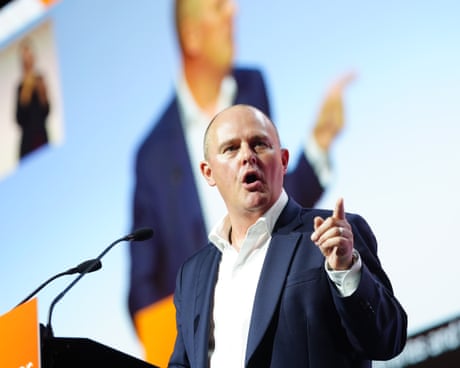
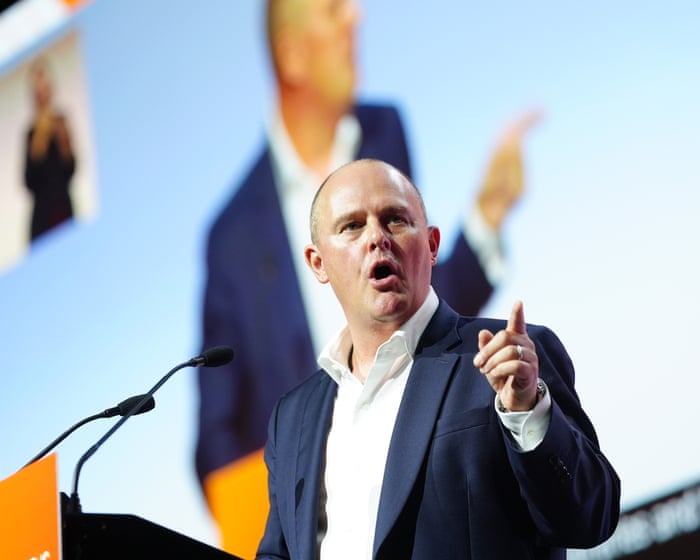
The TUC general secretary, Paul Nowak, is predicting a wave of union recognition deals in the private sector over the next year as “transformative” rules on accessing workplaces come into force.

From Friday, as part of Labour’s Employment Rights Act, unions will have the right to enter workplaces or communicate with staff electronically. From January, employers will be obliged to inform workers of their right to join a union.

Continue reading...

© Photograph: Stefan Rousseau/PA

© Photograph: Stefan Rousseau/PA

© Photograph: Stefan Rousseau/PA

  •  

Electrocutions, disease and no pay: how workers risk exploitation in Europe’s datacentres

As thousands of datacentres are constructed across Europe, the Guardian and Investigate Europe have uncovered disturbing evidence that some workers building them are exposed to dangerous conditions and living in fear of speaking out

Sandu* checked his watch. He was winding down the last 15 minutes of his shift at a vast Google datacentre site in Saint-Ghislain, Belgium, in March, when the call came in. The 34-year-old electrical tester had already worked almost 10 hours, but says such last-minute jobs were normal: “I had no choice. People have been fired after saying no.”

The task was one Sandu had done many times before and involved a series of tests measuring the safety and integrity of the electrical wiring. A protective suit was locked away in an equipment room. The round trip would have added another 15 minutes to the job, he says, and people were waiting, so he decided not to retrieve the suit.

Continue reading...

© Illustration: Alamy/Mei-Ling McNamara

© Illustration: Alamy/Mei-Ling McNamara

© Illustration: Alamy/Mei-Ling McNamara

  •  

Dockworkers in 22 Countries Prepare Coordinated Strike Against Arms Shipments Through Major Ports

Trade unions representing workers at 113 ports across five continents are preparing coordinated industrial action on 30 October, protesting against the movement of military equipment through commercial shipping terminals. The mobilisation raises questions about international trade, defence logistics and the growing involvement of organised labour in geopolitical disputes.

Dockworkers’ unions in 22 countries and regions are preparing coordinated strikes and demonstrations on Friday, 30 October, in an international campaign opposing the use of civilian ports to transport weapons and other military supplies to conflict zones.

The mobilisation involves more than 25 trade unions representing workers at 113 ports, according to organisers, with planned actions extending across Europe, North Africa, Asia and the Americas.

Major shipping centres expected to participate include Hamburg, Genoa, Le Havre, Valencia, Algeciras and Piraeus, alongside Morocco’s Tangier Med and India’s Nhava Sheva.

The scale of actual disruption remains uncertain.

Some unions have announced 24-hour stoppages, while others intend to organise shorter walkouts, demonstrations or symbolic protests.

Organisers have suggested that the action could affect more than 40 per cent of Mediterranean cargo traffic and freight worth over $2 billion.

However, these figures represent estimates of potential disruption rather than confirmed losses or cargo volumes that will necessarily be immobilised.

A Campaign Extending Beyond Europe

The initiative originated among dockworkers’ organisations in Italy, France, Greece, Spain’s Basque Country, Turkey and Morocco.

It subsequently attracted support from unions in northern Europe and several countries outside the Mediterranean region.

Among the participating organisations are Germany’s ver.di, France’s CGT Ports et Docks, Ireland’s SIPTU and Denmark’s 3F.

Indian maritime unions have also declared their support, citing the effects of armed conflict on commercial shipping and the safety of seafarers.

The campaign follows an international declaration agreed in Istanbul in May 2026, when dockworkers’ representatives called for ports to remain outside military supply operations.

The organisers argue that commercial transport infrastructure is increasingly being used to facilitate the movement of weapons and equipment to active conflict zones.

Their demands extend beyond any single war, although opposition to arms deliveries connected with the conflict involving Israel and the Palestinians has featured prominently in earlier industrial action.

Italy at the Centre of the Mobilisation

Italy is expected to become one of the principal centres of Friday’s protests.

The Unione Sindacale di Base (USB) has called a nationwide general strike, with demonstrations planned in more than 40 cities.

Port workers are expected to participate in Genoa, Livorno, Trieste, Ravenna, Gioia Tauro and several other maritime centres.

Genoa has previously been associated with protests against the handling of military cargo, including shipments linked to Israel and American military facilities.

However, the port’s representatives have indicated that they expect only limited operational disruption from Friday’s action.

The distinction between planned participation and actual interruption of shipping is important.

Large ports operate through complex arrangements involving terminal operators, subcontractors, transport companies and different categories of employees.

Consequently, industrial action affecting one part of a port does not necessarily bring all commercial activity to a halt.

Greek Ferries Face Disruption

Greece is among the countries where the effects on passenger transport could be more immediate.

Dockworkers, engineers and seafarers’ unions have announced participation in the protests, with Greek ferry services expected to remain suspended for 24 hours.

At Piraeus, the country’s largest port, dockworkers have announced a three-hour stoppage.

Other Greek maritime unions intend to participate in longer strikes.

Disruption to ferry operations could affect travel between the Greek mainland and its islands, demonstrating how a campaign directed primarily against military cargo can also affect civilian transport.

The effects will depend on the precise participation of employees and the arrangements made by port and ferry operators.

Defence Logistics and Commercial Shipping

The planned mobilisation draws attention to the relationship between military supply chains and civilian maritime infrastructure.

Commercial ports are essential to international trade, but they may also handle military vehicles, ammunition, equipment and other cargo connected with defence operations.

NATO members and other states depend on commercial transport networks for certain aspects of military logistics.

Military equipment may be transported aboard commercial vessels or through terminals that also process ordinary goods.

The use of such facilities is not inherently unlawful, and arms shipments may be authorised under national and international export-control arrangements.

Nevertheless, dockworkers’ organisations argue that employees should have a greater role in determining whether ports are used to facilitate military operations.

This creates potential tensions between industrial rights, contractual obligations, national security priorities and government decisions concerning defence exports.

The implications are particularly significant in Europe, where governments are expanding defence production and seeking to strengthen military supply chains.

Any sustained disruption to port logistics could complicate the movement of equipment and components, although the consequences of Friday’s planned action cannot yet be established.

Europe’s Growing Defence Trade

The protest comes as European countries increase military spending and procurement in response to deteriorating security conditions.

According to the Stockholm International Peace Research Institute, Europe became the world’s largest arms-importing region over the 2021–2025 period.

The expansion of defence trade has increased the importance of transport infrastructure capable of handling military equipment.

It has also exposed disagreements over the political responsibilities of companies and workers involved in these supply chains.

For governments, the movement of defence equipment may form part of legitimate security commitments and international assistance programmes.

For participating unions, opposition to particular military shipments is presented as an extension of workers’ rights and their broader political objectives.

These competing positions are unlikely to be resolved through a single day of industrial action.

An Immediate Test for International Shipping

Friday’s mobilisation will provide an indication of how effectively unions can coordinate industrial action across different countries, legal systems and transport networks.

Its practical significance will depend on how many workers participate, which terminals suspend operations and whether shipping companies can maintain schedules through alternative arrangements.

The organisers have demonstrated their ability to coordinate protests across a geographically extensive network.

Whether that coordination translates into substantial disruption to international maritime trade remains to be seen.

For European governments and shipping operators, the immediate task will be to manage any interruption to commercial and passenger services.

The wider question is whether opposition to the use of civilian transport infrastructure for military logistics will become a recurring feature of industrial relations across Europe’s major ports.

  •  

Poll: Plurality Says Migrants Help CEOs to 'Hold Wages Down'

A plurality of Americans recognize that companies employ migrants to cut Americans' wages, says a pro-migration survey funded by the Unite Here! union.

The post Poll: Plurality Says Migrants Help CEOs to ‘Hold Wages Down’ appeared first on Breitbart.

  •  

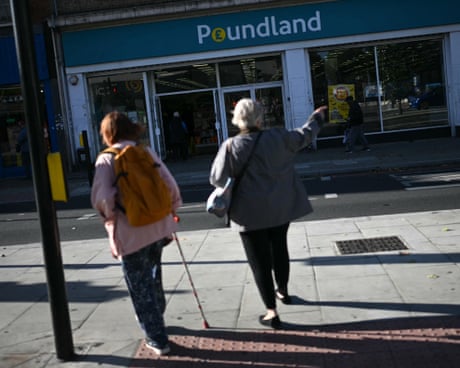
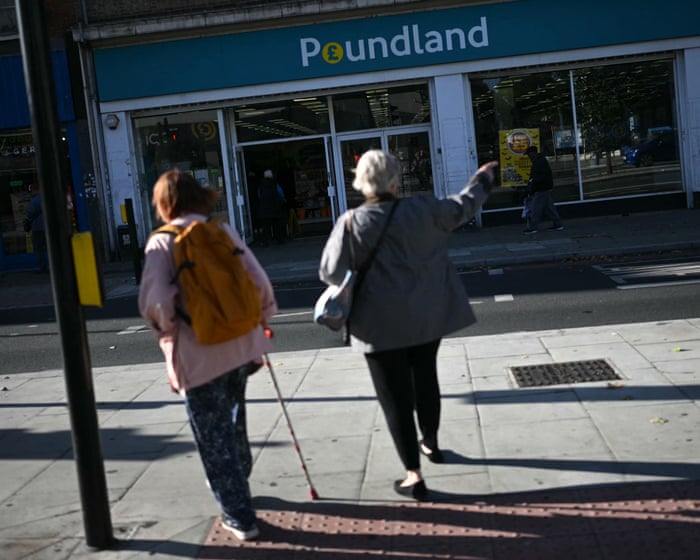
Union in plea to save Poundland from administration, with 12,000 jobs at risk

Owner Gordon Brothers files notice of intent to begin process after rejecting management-backed rescue bid

The shop workers’ union Usdaw has urged Poundland’s owners to reconsider a decision to prepare the budget chain for administration, putting up to 12,000 jobs at risk.

Gordon Brothers filed a notice of intention to appoint administrators to Poundland at the high court on Thursday, with the advisory firm AlixPartners lined up to run the process.

Continue reading...

© Photograph: Justin Tallis/AFP/Getty Images

© Photograph: Justin Tallis/AFP/Getty Images

© Photograph: Justin Tallis/AFP/Getty Images

  •  

Democratic lawmakers decry Osha’s push to roll back worker respiratory protections

Elizabeth Warren and others joined by unions and industry experts in warning against the weakening of regulations

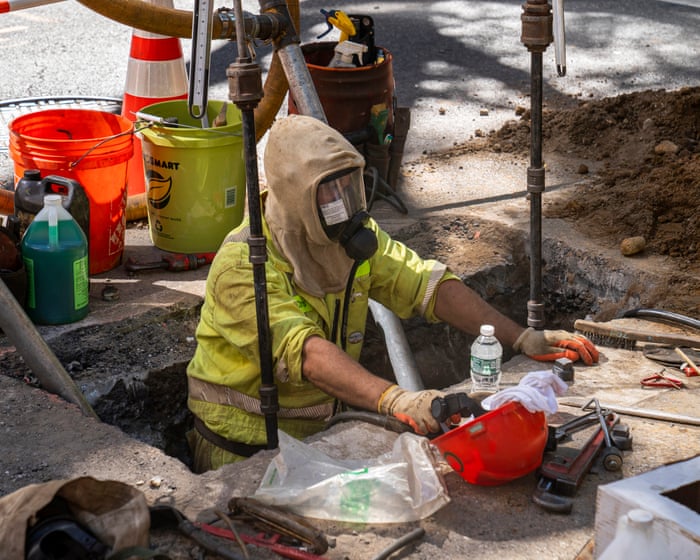
The senator Elizabeth Warren, the congresswoman Ilhan Omar and several other Democratic lawmakers are calling on the Occupational Safety and Health Administration (Osha) to abandon a rollback of respirator mask regulations, a change the lawmakers say would weaken worker protections against hazardous substances.

Under the proposed rules, employers would face fewer requirements to provide workers with respirators masks when working with substances including “lead, asbestos, formaldehyde and inorganic arsenic, among other chemicals”, the lawmakers wrote in a letter to the Osha assistant secretary, David Keeling, a former UPS and Amazon executive.

Continue reading...

© Photograph: Robert Nickelsberg/Getty Images

© Photograph: Robert Nickelsberg/Getty Images

© Photograph: Robert Nickelsberg/Getty Images

  •  

Tributes pour in for labor leader Dolores Huerta: ‘Fought for farm workers to the very end’

Lawmakers, activists and union leaders across the US remember the co-founder of United Farm Workers union

Following the news that Dolores Huerta – the civil rights icon who popularized the rallying cry “Sí, se puede! – had died at the age of 96 on Wednesday, activists, lawmakers and civil rights leaders paid tribute to Hureta’s long and lasting legacy.

In California – where Huerta helped found the United Farm Workers (UFW) union – her death was deeply felt. It was in California’s central valley that she laid the foundations for the United Farm Workers, and helped organize the 1965 Delano grape strike – a national boycott of table grapes that resulted in better wages and working conditions for grape pickers. Several schools in California bear her name, and murals across the state depict her likeness. And in 2018, California declared 10 April – her birthday – Dolores Huerta Day.

Continue reading...

© Photograph: Jeff Chiu/AP

© Photograph: Jeff Chiu/AP

© Photograph: Jeff Chiu/AP

  •  

Yankees president Randy Levine says he is 'confident' MLB will avoid a lockout despite cap fight

Game 5 of the World Series could very well be the last baseball game for the foreseeable future.

The league's current collective bargaining agreement with the players expires on Dec. 1, and the players and owners appear as far apart as they ever have been.

Assuming there is no deal, the owners are expected to lock out the players, as was the case five years ago which led to the season being delayed by one week.

CLICK HERE FOR MORE OUTKICK SPORTS COVERAGE

Despite the apparently harsh circumstances at the moment, New York Yankees president Randy Levine is actually "confident" things will all work out.

"It's very, very early... They want to reach an agreement. It's always this way in every labor negotiation I've done. It's always posturing at this point in time, getting your position out," Levine said on "The Craig Carton Show."

"We have until December. I think they're really going to work hard, and I'm very hopeful they'll reach an agreement. I've seen circumstances where it looked harder than even this, and this one looks hard, but at the end of the day, I'm confident everyone wants to get a deal."

"The whole playoffs have been great, the whole season has been great. Baseball is regaining popularity, it's the national pastime, so we gotta work hard to just preserve it," Levine added.

Levine's boss, Hal Steinbrenner, said last week he "support[s]" the owners' proposals — all of which include a cap.

"I've said before — let me put it this way, as a member of the labor policy committee — I helped craft, one of many, the proposals that we have given at the bargaining table. And I support those proposals in their entirety. That's absolutely the case, so that should answer your question," Steinbrenner told reporters.

The Yankees' $336 million payroll was the third-largest in baseball during the 2026 season, behind the Los Angeles Dodgers ($422 million) and New York Mets ($338 million).

FANS DEBATE BREWERS DECISION TO KEEP JACOB MISIOROWSKI IN DUGOUT WITH CHANCE TO WIN FIRST EVER WORLD SERIES

Arguments skew both ways, but a constant has remained in that the highest payrolls continue to go up, while the lowest payrolls remain at a stall. The Marlins' payroll is actually roughly half of what it used to be in 2017, despite a sale of the team and everyone in the league making more money than ever. Meanwhile, the Dodgers have already committed more money in 2030 than 12 teams have this season.

MLB commissioner Rob Manfred has said that owners are simply "listening to our fans" regarding a salary cap and said it "defies human experience... to think that the bottom end of that [payroll] gap has the same opportunity to win the top end." It should be noted, though, that the National League-winning Milwaukee Brewers swept the Dodgers with the 11th-smallest payroll, and they are facing the Tampa Bay Rays, who have the league's third-smallest payroll. They defeated the Cleveland Guardians, who rank 29th in payroll, in the American League Division Series.

Major League Baseball has never had a salary cap.

"Salary cap is the ultimate excuse not to compete. It's the ultimate excuse for an owner to say, 'Gee, I would like to make the team better, but you know I can’t,'" interim MLBPA executive director Bruce Meyer said during the All-Star break. "Salary caps are bad for fans. Salary caps prevent teams from doing the things that they believe are in their interest to make the team better."

CLICK HERE TO DOWNLOAD THE FOX NEWS APP

"Every team in baseball can afford to compete, many are choosing not to," Meyer added. "To me, that's the biggest problem right now."

  •  

Dolores Huerta, California labor leader and civil rights champion, dies aged 96

Huerta co-founded United Farm Workers union with Cesar Chavez, improving pay and conditions for farm workers

Dolores Huerta, a celebrated 1960s labor union leader and civil rights activist, died on Wednesday in California at the age of 96, her family said.

Huerta was co-founder with Cesar Chavez, another veteran unionist and political activist, of the United Farm Workers union (UFW), which was credited with improving pay and conditions for agricultural workers through a series of strikes, boycotts and protests in the 1960s and 1970s.

Continue reading...

© Photograph: Cathy Murphy/Getty Images

© Photograph: Cathy Murphy/Getty Images

© Photograph: Cathy Murphy/Getty Images

  •  

L.A. Teachers Union Flunks Math, Blames Billionaires

A protestor holding a sign that says 'Fund the school not the police' | Homes.com/Ted Soqui/Sipa USA/Newscom

Californians facing not one but two wealth-tax initiatives on next week's ballot may well be asking themselves how all these tens of billions of forcibly extracted dollars will be spent.

The answer, based on new studies and weary observation: horribly.

Take the Los Angeles Unified School District (LAUSD), the country's second largest. In July, L.A. County Superintendent of Schools Debra Duardo designated the LAUSD as a "lack of going concern," due to its ongoing operating deficits, exacerbated by fresh salary increases for unionized workers. The state's longstanding school Fiscal Crisis and Management Assistance Team (FCAMT) then issued a damning report in September, placing the district at a "high risk" for fiscal insolvency. Why? Because payroll was expanding while enrollment was collapsing.

"From 2019-20 through 2024-25," the report found, "noncharter school enrollment declined from 440,365 to 369,830 students, a decrease of approximately 16.0%. Over the same period, total [full-time equivalent jobs] increased from 60,344 to 64,148, or approximately 6.3%. As a result, the number of students per total FTE declined from 7.3 to 5.8."

This incongruent math is a feature, not a bug, of Californian education spending.

"From 2002 to 2023," Reason Foundation Managing Director of Education Reform Aaron Garth Smith and Managing Director of Government Finance Jordan Campbell wrote in a study this June, "California led the nation in K-12 spending growth." And when exactly did K-12 enrollment peak in the LAUSD? 2002!

Between fiscal years 2013 and 2023, Smith and Campbell found, LAUSD enrollment fell by 34.7%, yet "inflation-adjusted expenditure on employee compensation—including salaries, benefits, and other wages—grew by…27%." In a city, county, and state dominated by public sector unions (the California Teachers Association has already spent more than $65.5 million this election cycle), collective bargainers sit across the table from the politicians they helped elect, leaving only taxpayers and public-school families on the outside looking in.

United Teachers Los Angeles (UTLA), one of the most radical teachers unions in the country, reacted to the FCAMT "high risk" report with an innumerate defiance redolent of President Donald Trump.

"This fake independent analysis disparages the school board for rightfully addressing the needs of working people who face some of the worst housing and childcare costs in the country," UTLA Vice President Julie Van Winkle told the Los Angeles Times. The union's website called the report "a so-called 'analysis'" that used "a rigged scoring system with a predetermined outcome."

The UTLA broke with the statewide California Teachers Association in backing Proposition 40, the retroactive 5 percent tax on billionaires' paper wealth that would send 90 percent of the proceeds toward healthcare spending. ("California's schools, hospitals, and clinics need funding. Billionaires do not," Van Winkle explained.) But while the controversial Prop. 40 is looking wobbly at the polls, amid caterwauls over big money in politics, the much less ballyhooed Prop. 3, which makes permanent some wealth taxes that were sold as temporary in 2012, looks set to sail through without much resistance. Literally.

Spending on Prop. 3, L.A. Times education reporter Howard Blume concluded this week, "adds up to more than $81 million for and about $5,500 against." For those keeping score at home, that's a ratio of more than 14,700 to 1, brought to you primarily by teachers unions, who incidentally are lying about the initiative.

"Strict accountability [will] ensure every dollar gets to classrooms, not Sacramento politicians," vows the Yes on 3 website. Nonsense: The higher income-tax brackets, which begin at $371,479 for individuals and $742,958 for couples filing jointly, just feed into California's general fund, of which 40 percent goes to transitional kindergarten through community college.

Californians who routinely support such tax hikes and spending increases may flatter themselves that they're taking the side of children over rapacious billionaires, as well as the odd hundred-thousandaire. But the results produced by these massive money transfers have stubbornly failed to adhere to the alleged beneficiaries.

In 2024–25, the California Policy Center noted in July, "approximately 54 percent of tested LAUSD students did not meet or exceed the state standard in English language arts, 63 percent did not meet it in mathematics, and 73 percent did not meet it in science." With results deflation has come grade inflation, meaning that Los Angeles public schools are increasingly passing students who don't meet grade-level standards.

Far from acting as a bulwark against heartless spending cuts, California's never-ending won't-you-think-of-the-children tax-and-spend cycles are blunting economic growth and creating hollowed-out monuments to the folly of central planning. Just as the LAUSD was beginning its dizzying enrollment descent, the district launched a $20 billion, eminent domain–abusing school-construction program that was routinely characterized as "the largest public works project in the western United States."

More than a thousand homes, plus such landmarks as the Ambassador Hotel and Hollywood Star Lanes (from The Big Lebowski) were plowed over, only to create an overall building stock that now stands half-empty, incurring massive sunk costs.

As Blume detailed this week in the L.A. Times, "A modern, vacant and vandalized $34-million public school sits next to Los Angeles Unified School District headquarters — a campus paid for with taxpayer-financed bond money, but so burdened with debt and damage that it's not clear that anyone can afford to move in. The compact, aesthetically striking campus is marred by widespread graffiti. Vandals have punched holes in floors, walls and ceilings over the last five years. Recent photos of the inside appear to show puddles and stains from water damage and char marks from fire. The district is paying at least $20,000 a month in security and maintenance, and last year calculated having spent more than $1 million to secure and maintain the building."

Good luck, California!

The post L.A. Teachers Union Flunks Math, Blames Billionaires appeared first on Reason Magazine.

  •  

Solution to teacher shortage? Graduates without Master’s degrees to teach primary years

Nine-year-old boy loses fingertips in school bullying incident

Trying to solve Portugal’s crushing shortage of qualified teachers, the government has come up with what it hopes is a solution. It wants to allow graduates with a degree in

The post Solution to teacher shortage? Graduates without Master’s degrees to teach primary years appeared first on Portugal Resident.

  •  

Police take to streets for better pay and working conditions 

Police unions organise national rally against pension cuts

Police officers are preparing a demonstration for Thursday, in Lisbon, to demand better working conditions and pay – and ironically, the housing crisis is intrinsically involved: unions warn that the

The post Police take to streets for better pay and working conditions  appeared first on Portugal Resident.

  •  

Amazon Faces Fresh EU Scrutiny Over Worker Surveillance and Algorithmic Management

Members of the European Parliament are visiting Amazon logistics centres in Germany and Poland this week to investigate working conditions and the use of digital monitoring systems, reopening a dispute between the technology company, European legislators and trade unions over employee rights.

The fact-finding mission, scheduled for 26th and 27th October, will examine how Amazon organises work, measures employee productivity and uses automated systems in warehouses. MEPs will meet management, employees, works councils and trade union representatives, with particular attention to whether technological changes are affecting workers’ health and their ability to exercise employment rights.

The investigation comes as the European Commission prepares its Quality Jobs Act, which is expected to address algorithmic management, occupational safety and working conditions across the European economy. Amazon’s extensive logistics network makes the company a prominent example of the questions legislators must resolve.

MEPs enter warehouses after prolonged dispute

The delegation is led by Li Andersson, chairwoman of Parliament’s Employment and Social Affairs Committee, and includes Belgian MEPs Liesbet Sommen and Estelle Ceulemans, alongside representatives from several other political groups.

According to the European trade union federation UNI Europa, MEPs will inspect facilities in Dortmund and Mönchengladbach on Monday before travelling to Poland on Tuesday.

The German visits will cover older warehouse operations and newer facilities incorporating robotics, allowing parliamentarians to compare different approaches to handling orders and managing employees. The Polish programme includes a major returns facility in the Katowice area.

The visit follows several years of strained relations between Amazon and the European Parliament.

In February 2024, Parliament withdrew permanent access badges from Amazon representatives following disagreements over the company’s participation in hearings and requests for visits to its warehouses.

Amazon disputed suggestions that it was avoiding scrutiny, maintaining that it had offered alternative arrangements for parliamentary visits during periods when its logistics operations were particularly busy.

Company executives eventually appeared before the Employment and Social Affairs Committee in January 2026, where they defended Amazon’s employment policies and workplace practices.

The controversy over digital surveillance

At the centre of the dispute is the increasingly widespread use of electronic systems to monitor productivity.

Warehouse employees commonly use handheld scanners, while automated systems can help allocate tasks, coordinate movements and identify delays in processing orders.

These technologies allow employers to manage substantial logistics operations with considerable precision. They also make it possible to collect detailed information about individual workers’ activities throughout their shifts.

Trade unions argue that such monitoring can create unreasonable performance pressure, particularly where targets are adjusted automatically or workers cannot challenge assessments generated by software.

The concerns are not confined to Amazon.

A European Commission survey examined by EU Today earlier this month found that 42 per cent of surveyed smaller and medium-sized businesses already used artificial intelligence or algorithmic management systems.

However, 49 per cent of respondents expressed distrust of automated systems making decisions about employees, illustrating the distinction between using technology to support management and delegating consequential decisions to algorithms.

Previous regulatory action

Amazon has already faced formal European regulatory scrutiny over workplace monitoring.

France’s data protection authority imposed a €32 million fine on Amazon France Logistique in December 2023, announcing the decision in January 2024. The regulator concluded that certain employee monitoring practices were excessively intrusive and breached data-protection requirements.

The investigation examined the collection and retention of detailed information from warehouse scanners, including productivity indicators and periods of inactivity.

Amazon rejected the regulator’s conclusions and subsequently appealed the decision. The penalty therefore needs to be distinguished from any final judicial determination of the dispute.

The case nevertheless demonstrates that workplace monitoring falls within existing European privacy legislation, independently of proposals for new employment rules.

EU Today has also reported on the application of European data-protection law to automated employment decisions, including the question of whether meaningful human review is available when software affects a person’s ability to work.

Amazon disputes allegations

Amazon maintains that its warehouse technology is intended to improve operational efficiency, safety and the reliability of deliveries.

In its January parliamentary testimony, the company defended its investment in employee training and insisted that workers have the right to join trade unions.

It also pointed to engagement with works councils and employee representative bodies across its European operations.

Trade unions contest the adequacy of those arrangements, particularly in Germany, where the ver.di union has repeatedly sought a collective agreement covering Amazon employees.

These competing positions will form part of the parliamentary delegation’s assessment.

Implications for EU employment legislation

The Commission’s Quality Jobs initiative addresses several questions raised by the Amazon dispute, including algorithmic management, psychosocial risks and the effectiveness of collective bargaining.

Legislators must determine how far employers should be required to disclose the operation of automated monitoring systems, how employees can contest decisions and what safeguards should apply when performance targets are generated by software.

Rules must also accommodate legitimate requirements for stock management, security and workplace safety.

The parliamentary visit will not itself establish whether Amazon has breached employment legislation. It is a fact-finding exercise intended to inform future policy discussions.

Its importance lies in giving legislators direct access to warehouse operations and employee accounts before deciding how European labour law should respond to increasingly automated workplaces.

  •  

France Deploys 70,000 Officers Ahead of Protest Rallies

Businesses board up shopfronts in Paris ahead of protests in France as authorities deploy 70,000 police officers and gendarmes.

France mobilizes 70,000 police and gendarmes amid fears of renewed unrest, while authorities restrict demonstrations and tighten security.


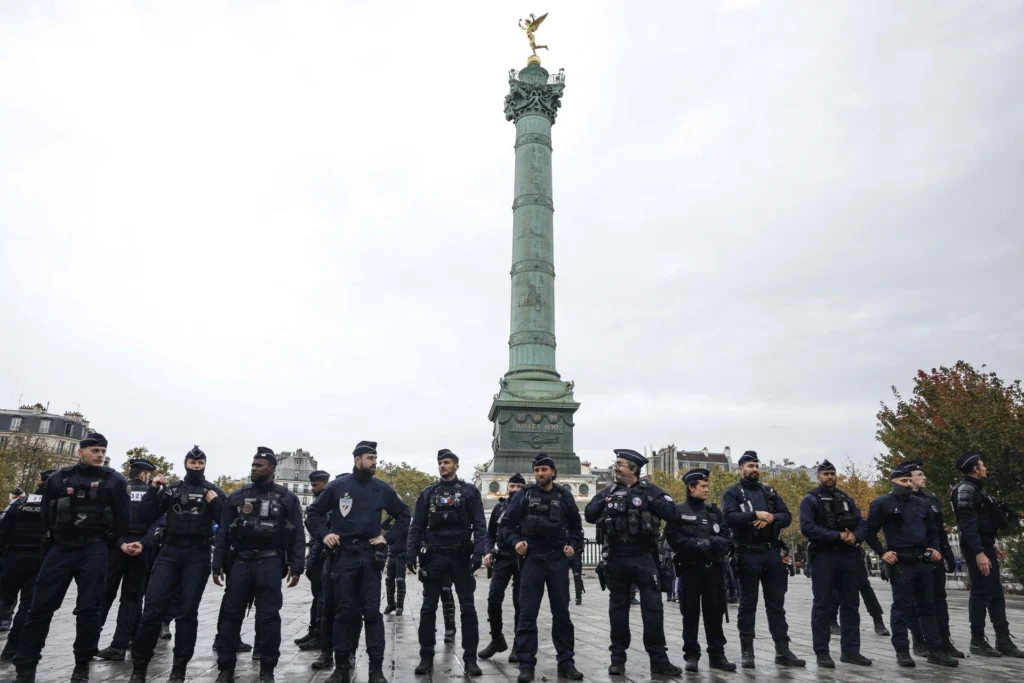
France has deployed 70,000 police officers and gendarmes ahead of nationwide demonstrations on Saturday, with authorities warning of a heightened risk of unrest after vandalism and looting damaged about 3,000 businesses the previous week.

RELATED: France Reports 855 Arrests in Paris After Protests

Prime Minister Sébastien Lecornu warned late Friday that the threat remained high, particularly from radical far-left groups and criminal elements operating alongside demonstrations called by trade unions, students and the Yellow Vest movement.

Interior Minister Laurent Nuñez announced a large-scale security operation to prevent further violence and looting.

“We will show no mercy to looters and troublemakers,” Nuñez declared. He has faced criticism from the left over police tactics and from the right for failing to prevent the previous week’s unrest.

France to mobilise 70,000 security forces for Saturday protest, interior minister says https://t.co/ok4e8kEy5t https://t.co/ok4e8kEy5t

— Reuters World (@ReutersWorld) October 23, 2026

Authorities have banned gatherings in numerous cities and restricted the routes of other demonstrations on security grounds, prompting criticism from trade unions and human rights organizations.

In major cities, trade union demonstrations were authorized on Saturday only in Paris, Marseille, Strasbourg, Lille, Mulhouse, Grenoble, Toulouse and Amiens.

In Paris, a last-minute change to the union march’s route sparked a dispute between police officials and organizers. Authorities cited the heightened threat following a racist attack on the outskirts of the capital the previous day as they redirected the march from Place de la Nation to Place d’Italie, keeping it away from the city center.

Several museums in the capital, including the Louvre and the Musée d’Orsay, will remain closed, as will the nearby Palace of Versailles. A nighttime curfew in the areas around Place de la République and Les Halles will also remain in force until Monday.

Banks and businesses in central Paris were boarding up shopfronts and windows late Friday and early Saturday in anticipation of possible vandalism, according to observations by Spanish news agency EFE.

Security concerns also extend to Orléans, about 130 kilometers (81 miles) south of Paris, where the far-right National Rally (RN) is holding a congress to formally launch Marine Le Pen’s presidential candidacy, roughly six months before the election.

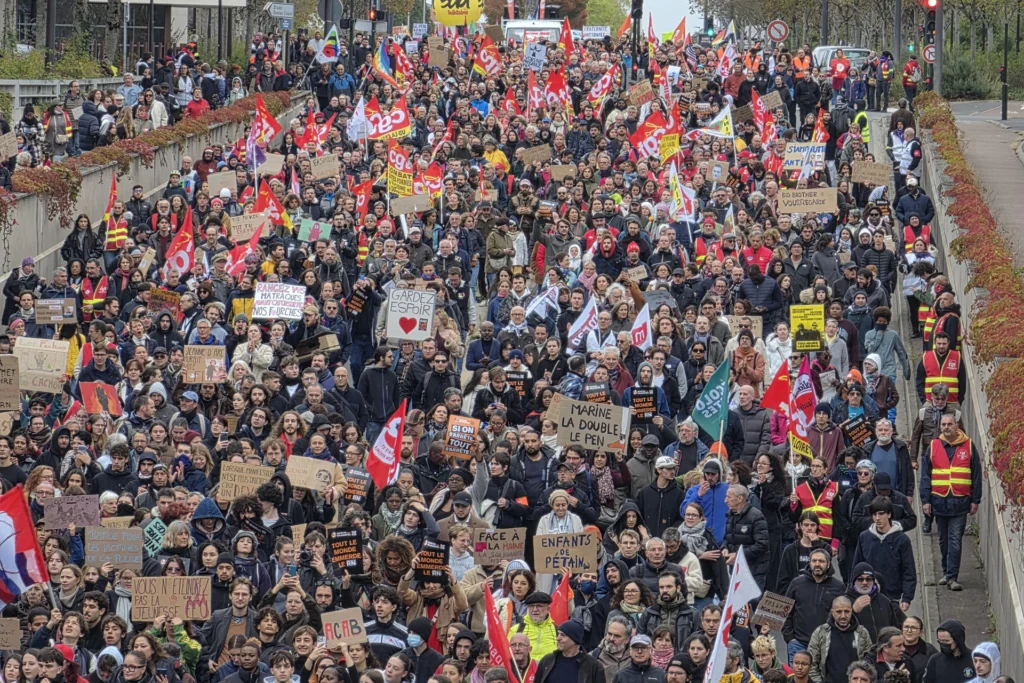
Authorities estimated that 11,000 people took part in a counter-demonstration in Orléans on Saturday against Le Pen’s party. Organized in opposition to racism, fascism and imperialism, the march proceeded peacefully in a festive atmosphere, according to EFE.

Photo: Orleans, France (October 24, 2026)

Protesters chanted slogans including “Macron resign, Le Pen to prison” and sang the French national anthem, La Marseillaise, as well as the Spanish-language protest song “The People United Will Never Be Defeated.”

Authorities deployed about 3,000 officers in Orléans to prevent clashes between demonstrators and attendees at the RN congress. The local prefecture authorized Saturday’s march but banned a separate demonstration planned for Sunday.

The security measures reflect the authorities’ efforts to prevent further disorder while allowing some demonstrations to proceed. Restrictions on public gatherings and the deployment of thousands of officers have shaped preparations for Saturday’s rallies across France.

  •  

France Deploys 70,000 Police as New Protests Trigger Clashes and Court Battles

French authorities have imposed extensive restrictions on demonstrations following last weekend’s violence. Courts have overturned some bans, while unions have accepted a last-minute change to the Paris protest route.

French police used tear gas to disperse demonstrators in Lyon on Saturday morning, 24 October, as 70,000 police officers and gendarmes were deployed nationwide to prevent a repetition of the violence and looting that accompanied last weekend’s mass protests.

In Paris, trade unions agreed to a revised demonstration route after the administrative court rejected their challenge to a last-minute police order. The march will proceed from Porte d’Italie to Porte de Vincennes, rather than between Bastille and Nation as originally agreed, with the procession scheduled to begin at 2pm.

Elsewhere, emergency judicial decisions have complicated the government’s security arrangements. Courts have suspended restrictions in Limoges and several municipalities around Marseille, while other cities remain subject to extensive bans on public gatherings.

The developments follow last weekend’s nationwide unrest, when approximately 550,000 people demonstrated against rising living costs, deteriorating public services and conditions in French schools. Violence erupted in several cities, leaving businesses looted, public buildings damaged and police officers injured.

Security operation on an unprecedented scale

Interior Minister Laurent Nuñez has ordered the deployment of 10,000 additional officers compared with 17 October. The operation includes specialist police units, armoured vehicles, helicopters and water cannon.

According to the government’s official security instructions, prefects must examine proposed demonstration routes, assess the reliability of organisers and take preventive measures where there is evidence of a risk to public order.

The authorities are particularly concerned about organised groups exploiting otherwise peaceful demonstrations to attack commercial premises and government buildings.

Security services expect between 400,000 and 500,000 people to participate in Saturday’s mobilisation. The government has warned that calls for renewed violence and looting have circulated online.

The previous weekend’s disturbances resulted in thousands of arrests. Justice Minister Gérald Darmanin said 217 people had already received prison sentences, with approximately half described as first-time offenders.

Courts challenge sweeping restrictions

The government’s measures have prompted an increasingly contentious legal dispute over the constitutional protection of public demonstrations.

The French Human Rights League has challenged restrictions in several cities, including Brest, Quimper, Caen, Marseille, Lille and Montpellier. It argues that extensive prohibitions interfere with freedom of assembly, expression and movement.

In Marseille, negotiations between local authorities and trade unions resulted in permission for a demonstration along an agreed route through the city. A separate administrative court decision subsequently suspended parts of the wider departmental ban, allowing gatherings in Gardanne, Istres, Martigues, Miramas and Tarascon.

The administrative court in Limoges also suspended restrictions on gatherings of more than ten people in the city centre and overturned an associated curfew.

In Lyon, however, restrictions remained in force across a large central area. Police dispersed approximately 150 demonstrators near Lyon III University shortly before 11am after participants blocked traffic close to the prohibited perimeter.

Macron faces a constitutional and political challenge

President Emmanuel Macron has argued that protecting public order must take priority following the destruction witnessed on 17 October.

His suggestion on Thursday that demonstrations not organised by recognised trade unions should generally be prohibited prompted legal challenges from opposition parties and civil liberties organisations.

In a ruling delivered on 23 October, the Conseil d’État rejected challenges to Macron’s remarks, finding that they did not themselves constitute a binding nationwide prohibition. The court nevertheless reaffirmed that prefects must assess individual demonstrations according to the circumstances and risks involved.

The ruling leaves local restrictions subject to judicial scrutiny rather than providing the government with unrestricted authority to prohibit protests.

Meanwhile, the movement’s original demands remain unresolved. What began with secondary-school students protesting against staff shortages, overcrowding and educational conditions has expanded into a broader mobilisation involving trade unions, university students and Yellow Vest campaigners.

Macron met representatives of secondary-school students on Friday, but participants subsequently called for demonstrations to continue until concrete proposals were presented.

Growing pressure ahead of the presidential election

The renewed mobilisation comes six months before France’s presidential election, in which Macron cannot seek a third consecutive term.

Political tensions are also evident in Orléans, where thousands of demonstrators gathered on Saturday to oppose the National Rally’s weekend party congress. Authorities deployed additional security personnel and restricted the location of the protest.

For the government, the immediate objective is to prevent another outbreak of large-scale violence. For unions and civil liberties organisations, the dispute increasingly concerns the conditions under which public protest may legitimately be restricted.

As EU Today reported ahead of Saturday’s demonstrations, the central legal question is whether prohibitions are proportionate to identifiable security risks.

The courts have now begun answering that question differently across France, leaving the authorities to enforce a patchwork of restrictions as the country’s social and political confrontation continues.

  •  
❌