❌

Reading view

Drone Attack Hits Container Ship Off Bulgaria's Black Sea Coast

Three maritime drones struck a container ship sailing in the Black Sea off the coast of Bulgaria on Wednesday, the country's defense minister said, the latest in a string of such incidents on NATO's eastern flank

The post Drone Attack Hits Container Ship Off Bulgaria’s Black Sea Coast appeared first on Breitbart.

  •  

NATO Confronts Growing Black Sea Threat as Drone Attacks Target Commercial Shipping

France has deployed a maritime patrol aircraft to Romania following a series of attacks on civilian vessels near NATO territory. The escalating threat has prompted closer cooperation between Romania, Bulgaria and Turkey, raising questions about maritime security and the protection of Europe’s eastern flank.

A series of drone attacks on commercial shipping in the western Black Sea has brought the consequences of Russia’s war against Ukraine increasingly close to NATO territory, prompting additional military surveillance and renewed regional defence cooperation.

France has temporarily deployed an Atlantique 2 maritime patrol aircraft to Romania, while NATO members bordering the Black Sea are strengthening arrangements to monitor shipping routes, identify airborne threats and protect critical infrastructure.

The French aircraft began operating from Romania’s Mihail Kogălniceanu airbase on 18 October and is scheduled to continue reconnaissance missions until 6 November.

Its deployment follows repeated attacks on merchant vessels near Romania and Bulgaria, both members of NATO and the European Union.

At least eight cargo ships have been struck in the region during October, with approximately 34 sailors reported dead or missing, according to figures reported by Reuters on 27 October.

The incidents have transformed commercial maritime security into an increasingly urgent issue for European defence planners.

Commercial vessels enter the conflict zone

The latest escalation has centred on shipping routes serving Ukraine’s Danube ports and commercial traffic passing through the western Black Sea.

Russia’s attacks on Ukrainian maritime infrastructure have increased the importance of alternative export routes, including those connecting the Danube to international shipping lanes.

However, recent incidents demonstrate that geographical proximity to NATO territory does not necessarily provide commercial vessels with protection from the effects of the conflict.

On 23 October, a drone struck a Comoros-flagged cargo vessel near the Romanian port of Constanța.

According to maritime security company Ambrey, the vessel was hit approximately 16 nautical miles east of the port and subsequently capsized.

One crew member was reported dead, nine were rescued and three remained missing in the initial casualty figures.

Ambrey assessed it as highly likely that Russian forces carried out the attack, pointing to the vessel’s links with Ukrainian Danube ports.

That assessment represents an attribution by a commercial security organisation, rather than a final determination by an international investigative body.

Other incidents have similarly raised questions over responsibility.

Ukraine has accused Russia of attacking civilian shipping, while Bulgarian authorities have acknowledged difficulties in conclusively identifying the operators of drones involved in some strikes.

France strengthens maritime surveillance

Romania’s Defence Ministry announced on 27 October that the Atlantique 2 deployment followed a request from Bucharest in response to the deteriorating security situation.

The aircraft is conducting surveillance and reconnaissance over the western Black Sea, working with Romanian naval authorities and maritime rescue coordination services.

Its principal responsibilities include identifying hazards to navigation and improving awareness of threats to critical infrastructure within Romania’s exclusive economic zone.

That infrastructure includes offshore energy facilities and maritime installations whose protection is increasingly relevant to European energy security.

The deployment adds to Romanian naval patrols conducted by ships, helicopters and unmanned systems.

Romanian authorities are also providing navigational warnings and recommended routes to commercial vessels.

Nevertheless, additional surveillance does not automatically prevent attacks.

The practical challenge lies in detecting relatively small unmanned aircraft or maritime drones, determining their intentions and responding before they reach civilian targets.

Romania, Bulgaria and Turkey coordinate their response

The security crisis was also discussed at a trilateral meeting of defence ministers in Sofia on 28 October.

Romania’s Defence Minister, Ștefan-Radu Oprea, met his Bulgarian counterpart, Dimitar Stoyanov, and Turkey’s Defence Minister, Yaşar Güler, to examine the consequences of attacks on commercial shipping.

According to the Romanian Defence Ministry, the ministers discussed closer intelligence-sharing, improved maritime surveillance and better coordination between their naval forces.

They also reaffirmed the importance of the existing Black Sea mine-countermeasures initiative involving the three countries.

Maritime mines remain a persistent hazard because they can drift beyond their original deployment areas, endangering civilian vessels irrespective of their destination or ownership.

The trilateral format provides a practical mechanism for neighbouring countries to coordinate activities while retaining responsibility for their respective national waters.

It also gives Turkey a central role in regional discussions, reflecting its position on the Black Sea and its control of access through the Turkish Straits under the Montreux Convention.

The limits of NATO’s maritime protection

The attacks raise a complicated legal and operational question: what responsibilities do NATO members have when civilian ships are attacked near their coastlines?

The distinction between territorial waters and an exclusive economic zone is important.

A coastal state’s territorial sea generally extends up to 12 nautical miles from its baseline, while its exclusive economic zone can extend considerably further and confers particular economic and jurisdictional rights.

An attack within a NATO member’s exclusive economic zone does not automatically constitute an armed attack against that member’s territory.

Nor does every strike on a civilian ship near NATO territory automatically trigger the collective-defence provisions of Article 5.

The circumstances, attribution, location and consequences of an incident would all influence the response.

This creates a security problem in which threats can affect European economic interests without necessarily crossing a threshold requiring collective military action.

Maritime trade and energy infrastructure face increasing risks

The implications extend beyond individual vessels.

Repeated attacks can increase insurance costs, complicate shipping schedules and discourage operators from using particular routes.

They can also affect Ukrainian agricultural exports and the wider commercial networks linking Black Sea ports to European markets.

Offshore energy installations face related vulnerabilities, particularly where surveillance and response capabilities are insufficient.

For NATO, the challenge is therefore to strengthen deterrence and protection without unintentionally escalating the conflict.

France’s reconnaissance deployment and the trilateral cooperation between Romania, Bulgaria and Turkey indicate that regional governments are moving towards a more coordinated response.

However, the continuing attacks demonstrate the difficulties of protecting civilian maritime activity against comparatively inexpensive unmanned systems.

The longer-term question is whether increased surveillance, counter-drone capabilities and naval cooperation can make western Black Sea shipping sufficiently secure while the war in Ukraine continues.

  •  

Bulgaria’s Iotova Leads Presidential Vote, Faces Runoff

Bulgarian President Iliana Iotova during the first round of Bulgaria's presidential election.

A low turnout and security concerns shaped the first round, setting up a close contest between Iotova and pro-Western rival Andrey Gyurov.


Outgoing Bulgarian President Iliana Iotova led the first round of presidential elections on Sunday with between 35% and 36.5% of the vote, according to exit polls, but fell short of the result expected by her supporters. She will face former caretaker prime minister Andrey Gyurov, backed by the pro-Western opposition, in a runoff scheduled for Nov. 1.

RELATED: Serbia’s Student Opposition Wins Decisive Parliamentary Victory

Gyurov secured between 32.2% and 32.5% of the vote, according to the same exit polls, putting him within reach of Iotova ahead of the second round.

The election took place amid security concerns following a series of drone attacks on merchant vessels in the Black Sea. Voter turnout stood at around 20%, as some political parties called for a boycott.

Iotova, 62, has campaigned on dialogue with Russia and opposed military assistance to Ukraine. She has made ending the war in Ukraine a central theme of her campaign, presenting herself as a “president of peace.”

#Bulgaria’s presidential vote delivered a result few polls anticipated. Exit polls gave incumbent Iliana Iotova, who favors dialogue with Moscow and opposes military aid to Ukraine, up to 36.5 percent, a far narrower lead than surveys had suggested.https://t.co/rqlYf7ehlZ

— Al Mayadeen English (@MayadeenEnglish) October 25, 2026

After casting her ballot, she called for a government capable of tackling poverty and regional inequalities. “I believe there must be peace, stability and security,” Iotova said.

Gyurov, meanwhile, called for a Bulgaria oriented toward Europe and the future, emphasizing economic security and effective governance.

He said he had voted for “a European, free and proud country, where incomes are sufficient, where we feel secure about tomorrow and where the state functions as it should.”

Iotova assumed the presidency earlier this year after Rumen Radev resigned to contest parliamentary elections, seeking to become prime minister. Bulgaria is a member of both the European Union and NATO.

If Iotova wins the Nov. 1 runoff, she would become the first woman elected president of Bulgaria, a country of 6.4 million people with the lowest per capita gross domestic product in the European Union.

  •  

Bulgaria’s presidential race heads for run-off after Yotova’s narrow lead

Bulgaria’s presidential election is heading for a run-off on 1 November after incumbent Iliana Yotova led Sunday’s first round but fell well short of the majority required to win outright. The result was closer than pre-election polling had indicated, leaving her challenger, former caretaker prime minister Andrey Gyurov, within reach of the presidency.

An Alpha Research exit poll put Yotova and her running mate, Kiril Valchev, on 35.3 per cent, and Gyurov and his running mate, Georgi Kandev, on 32.4 per cent. Other agencies produced slightly different estimates, but all placed the two tickets in the lead and showed a narrow gap. These figures are preliminary; Bulgaria’s Central Election Commission has yet to confirm the official result.

The outcome contrasts with pre-election surveys that gave Yotova a sizeable advantage. A Market Links poll published before voting put her well ahead of Gyurov. The first-round estimates instead suggest that the contest has tightened as voters weighed the candidates’ positions on foreign policy, domestic economic pressures and the direction of the government.

Yotova became president in January after Rumen Radev resigned to enter parliamentary politics. She had served as his vice-president for nine years and is now seeking a five-year mandate in her own right. Her candidacy is backed by Radev’s Progressive Bulgaria party and the Bulgarian Socialist Party. The election is the first nationwide test of Radev’s influence since Progressive Bulgaria won April’s parliamentary election. A Yotova victory would leave the presidency and government in the hands of political allies.

Gyurov, an economist and former deputy governor of the Bulgarian National Bank, served as caretaker prime minister earlier this year. He is supported by pro-Western reformist parties. During his premiership, his government signed a security co-operation agreement with Ukraine, and he has argued for closer co-operation with Western allies.

Their foreign-policy differences have been a defining feature of the campaign. Yotova has called for negotiations to end Russia’s war against Ukraine and for better relations with Moscow. Gyurov has taken a more supportive position towards Kyiv. The choice reflects a longstanding debate in Bulgarian politics over how the country should balance its relationship with Russia against its EU and NATO commitments.

The war’s impact on the Black Sea has given that debate a direct security dimension. Drone attacks on commercial vessels near Bulgaria’s coast have raised concerns about shipping safety and the conflict’s potential to spread. The government has sought support from its partners to strengthen maritime security. Both leading candidates condemned the attacks, while their differences over the wider war have kept Bulgaria’s response and its ties with Moscow in focus. The attacks on merchant shipping were a prominent issue during the campaign.

Rising energy prices and inflation have also featured in the campaign, as households face pressure from the cost of living. Those concerns may matter to voters who backed neither of the two leading tickets. The second round will require Yotova and Gyurov to appeal beyond their first-round supporters, while also persuading voters who did not participate to return to the polls.

Revival party leader Kostadin Kostadinov placed third. His ticket with Petar Volgin received 12.6 per cent in the Alpha Research exit poll, though other estimates were higher. Kostadinov has opposed military support for Ukraine; Ukraine imposed a ten-year entry ban on him in 2022. His supporters could influence the run-off, but their votes should not be treated as a single bloc: some may back Yotova, others Gyurov, and some may stay at home.

Turnout was exceptionally low. Alpha Research estimated participation at 22.3 per cent by 7pm, with other agencies reporting similarly low figures. The Bulgarian constitution requires more than half of eligible voters to participate and a candidate to receive more than half of valid votes for a first-round victory. Neither threshold was met. Polling analysis cited election fatigue after April’s parliamentary vote and the fact that the presidential election was held separately.

The low participation makes Sunday’s estimates an uncertain guide to the run-off. A higher turnout could change the balance, particularly if one candidate succeeds in mobilising voters who stayed away or attracting supporters of eliminated candidates.

The presidency is largely ceremonial, with executive authority resting mainly with the prime minister and parliament. It nevertheless carries political weight: the president leads the armed forces, can veto legislation, signs international treaties and appoints ambassadors. The 1 November vote will decide whether Yotova secures a mandate of her own and consolidates the governing camp’s position, or whether Gyurov can turn his stronger-than-expected first-round showing into a change at the top of the state.

  •  

Black Sea Security Crisis Deepens as European Parliament Calls for EU Naval Operation

A series of drone attacks on commercial shipping near Romania and Bulgaria has left sailors dead or missing, bringing Russia’s war against Ukraine closer to NATO territory. The European Parliament is calling for an EU naval mission, while Romania has begun shooting down hostile drones and NATO is preparing additional defensive measures.

The European Parliament has called for the possible deployment of an EU naval operation in the Black Sea following a series of deadly attacks on civilian merchant vessels near the Romanian and Bulgarian coasts. The resolution, adopted on 22 October 2026 by 432 votes to 52, with 88 abstentions, reflects mounting concern over the expansion of maritime threats towards NATO’s south-eastern flank.

The parliamentary resolution urges EU member states to consider establishing a naval mission to protect commercial shipping, while calling on NATO to examine a complementary regional initiative, provisionally described as Black Sea Sentry.

On 23 October, a drone struck the Comoros-flagged cargo vessel Khoryv, approximately 13 nautical miles from Romania’s port of Constanța. The vessel caught fire and sank, leaving one sailor confirmed dead and three missing. Nine crew members were rescued. The ship was carrying 13 Ukrainian and Azerbaijani sailors. According to information attributed to Romanian maritime authorities, difficult weather complicated rescue efforts.

Romanian President Nicușor Dan blamed Russia for the attack, which followed at least seven other strikes on commercial vessels during October. Across the incidents, approximately 30 sailors have been reported dead or missing, although the confirmed death toll is considerably lower.

Civilian Shipping Under Attack

The escalation began on 5 October when the Royad Mammadov, a Turkish-owned grain carrier sailing under the flag of Saint Kitts and Nevis, sank in Romania’s exclusive economic zone. Two sailors died and eleven were rescued. The vessel had departed the Ukrainian Danube port of Izmail carrying corn destined for Ravenna, Italy. Ukrainian President Volodymyr Zelenskyy attributed the sinking to Russian drones, although Romanian authorities did not initially establish responsibility.

The following day, two merchant ships were attacked approximately 70 nautical miles east of the Bulgarian coastal town of Byala. As EU Today reported, the Togo-flagged Alfa Watan sank after sustaining severe damage, while the Palau-flagged Able caught fire. All 18 sailors aboard the latter vessel were rescued, but the crew of the Alfa Watan remained unaccounted for.

The Bulgarian authorities confirmed that both aerial and maritime drones had been involved. Further attacks followed on 13 October, when the HS Dignity sank near Shabla, leaving eleven sailors missing, while the Chelsea-3 was struck near Byala. All 15 crew members of the latter vessel were evacuated.

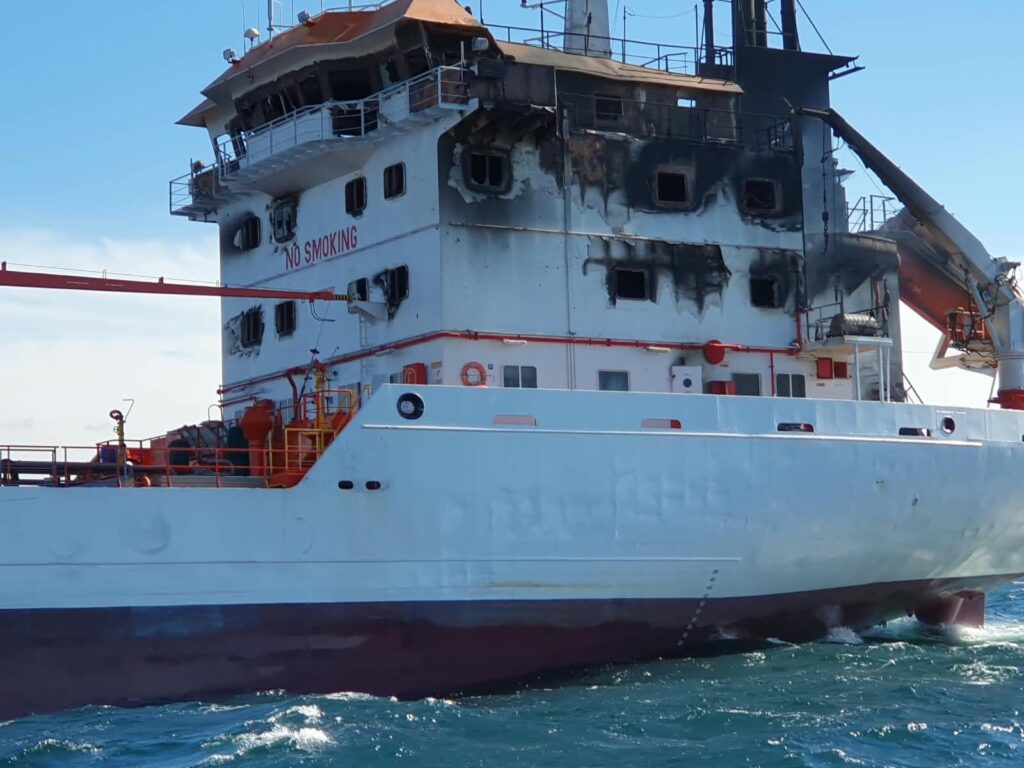
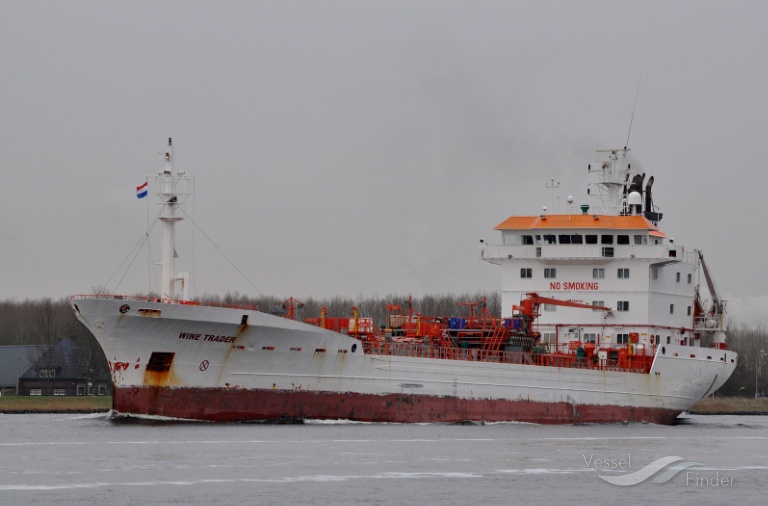
Two chemical tankers, the Yara J and Wine Trader, were subsequently attacked near the Sulina Canal, a strategically important route connecting the Danube with the Black Sea. The incidents exposed the vulnerability of shipping corridors connecting Ukraine with international markets.

Romania Moves Towards Active Military Defence

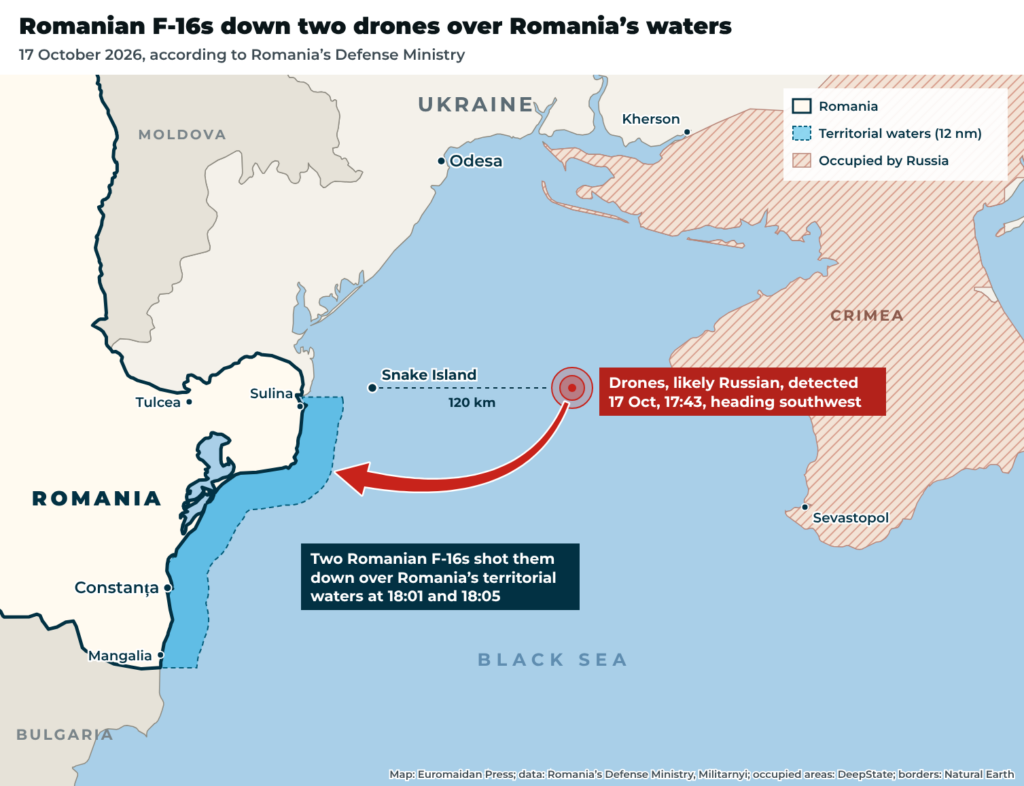
Romania has responded by strengthening surveillance and authorising direct military action against drones entering its airspace. On 17 October, two Romanian F-16 fighter aircraft intercepted and destroyed hostile drones over Romanian territorial waters.

According to the Romanian Ministry of National Defence, the aircraft were scrambled from Borcea Air Base after radar systems detected aerial targets approaching from the direction of Snake Island. The drones, identified as jet-powered Geran-family attack aircraft, entered Romanian airspace before being destroyed southeast and east of Sulina.

The ministry disclosed that, during the preceding week, its radar systems had detected eight separate incidents involving aerial targets near the Romanian border, including four brief incursions into national airspace. On 14 October, Spanish F-18 aircraft operating under NATO air-policing arrangements were scrambled after drones approached Romanian airspace.

Bulgaria’s More Cautious Response

Bulgaria has taken a more reserved position concerning responsibility for the attacks. Although Prime Minister Rumen Radev acknowledged their seriousness, his government maintained that investigations must establish the origin of the drones before definitive conclusions could be drawn. Sofia nevertheless strengthened maritime surveillance, deployed rescue resources and requested assistance from European and NATO partners.

In August, a drone crossed into Bulgarian airspace from Romania and exploded near infrastructure associated with the Trans-Balkan Gas Pipeline. According to the Bulgarian government’s account, the aircraft was not detected by either national radar systems or NATO’s Combined Air Operations Centre in Torrejón, Spain. The European Parliament has now urged Sofia to accelerate participation in NATO’s counter-drone initiatives.

EU Proposes Maritime Security Operation

The European Parliament’s proposals include establishing an EU naval operation, improving early detection of hostile drones, accelerating the development of a Black Sea Maritime Security Hub and providing additional defence funding to Romania and Bulgaria. MEPs have proposed using resources under the EU’s SAFE defence financing instrument to support regional capabilities.

The proposed hub would facilitate intelligence-sharing, maritime surveillance and protection of critical infrastructure. Romania and Bulgaria have requested EU satellite imagery to improve their awareness of maritime threats, while the European Maritime Safety Agency has offered additional support.

At their October summit, EU leaders condemned attacks on civilian shipping and called for safe passage for vessels transporting agricultural products. The European Council’s conclusions addressed Black Sea and Danube shipping routes. However, the parliamentary resolution does not authorise a naval deployment: such an operation would require agreement among EU governments on its mandate, resources and rules of engagement.

NATO Faces an Expanding Security Challenge

NATO has responded by examining additional maritime surveillance and defensive measures, including patrol aircraft, radar systems and unmanned platforms. Romania has proposed stronger regional command arrangements involving NATO’s Black Sea members.

An existing framework provides a basis for cooperation. In July, Romania, Bulgaria and Türkiye agreed to expand the responsibilities of their joint mine countermeasures task group to include protection of critical underwater infrastructure. The agreement announced by Romania’s Defence Ministry extended cooperation beyond detecting and neutralising drifting mines.

Protecting commercial vessels against aerial and maritime drones would require broader capabilities. NATO must also operate within the restrictions of the 1936 Montreux Convention, which regulates passage of warships through the Turkish Straits and limits deployments by non-Black Sea countries. Romania, Bulgaria and Türkiye would therefore play central roles in any sustained maritime security operation.

Black Sea Security and the Risk of Escalation

Ukraine’s maritime export corridors remain essential to agricultural shipments following repeated Russian strikes on ports and logistics infrastructure. Attacks on commercial vessels can increase insurance costs, discourage shipping companies and disrupt trade even when port facilities remain functional.

The sinking of merchant vessels near allied territory, combined with repeated drone incursions into Romanian airspace, increases the possibility of military confrontation arising from an individual incident. The legal and military circumstances differ depending on whether an attack occurs in territorial waters, an exclusive economic zone or international waters.

The European Parliament’s proposal raises questions extending beyond maritime patrols: how civilian shipping can be protected, what military responses are authorised and how responsibility for attacks will be established. The sinking of the Khoryv on 23 October illustrates how the western Black Sea has become an increasingly exposed part of Europe’s security frontier.

  •  

Drone strike sinks cargo ship near Romania, killing Ukrainian sailor. Romanian President blames Russia

The overturned hull of the cargo ship Khoryv after a drone strike in the Black Sea near Romania on 23 October 2026. Screenshot from video: Romanian Ministry of Internal Affairs

A Russian drone strike sank the Comoros-flagged cargo ship Khoryv in the Black Sea near Romania’s port of Constanța on 23 October, killing a Ukrainian sailor and leaving three crew members missing. Nine others were rescued, Digi24 reported.

The sinking comes amid a surge in attacks on commercial shipping near Romania and Bulgaria, threatening civilian crews and routes used to transport Ukrainian agricultural exports. As Russia intensifies strikes on Ukrainian ports and shipping, the Danube corridor and nearby waters have become increasingly important to Ukraine’s maritime trade.

Romanian President Nicușor Dan blamed Russia for the attack, describing it as part of Moscow’s escalation of the war against Ukraine and its attacks on NATO’s eastern flank, Reuters reported. 

Ukraine’s Foreign Ministry confirmed to Radio Svoboda that a Ukrainian citizen was among those killed.

Ukrainian sailor killed, three crew members missing

The Khoryv sent a distress signal at around 10 a.m. local time, about 13 nautical miles (24 kilometers) east of Constanța, just outside Romania’s territorial waters, Digi24 reported. The vessel caught fire, sustained major damage, and capsized, with only a small part of its hull remaining visible above the water.

Romania’s naval authority said 13 crew members were aboard: 10 Ukrainians and three Azerbaijanis. Rescue teams recovered nine sailors alive and one body, while three crew members remained missing, Reuters reported.

Ukraine’s Foreign Ministry said the vessel had been traveling from a Turkish port and confirmed that the Ukrainian Embassy in Romania had received information from Romanian authorities about one Ukrainian sailor’s death. Four Ukrainian survivors, including the captain, were taken to a hospital, while two others did not require medical assistance.

Attacks threaten Black Sea shipping

The sinking comes amid a surge in attacks on commercial vessels off the coasts of Romania and Bulgaria. At least seven cargo ships have been hit over the past two weeks, with around 30 sailors reported dead or missing, according to Reuters.

The vessels targeted in recent incidents were either anchored near or heading toward the Sulina Canal, which connects the Danube River to the Black Sea. The canal has become a key export route for Ukraine, one of the world’s largest exporters of grain and vegetable oils.

Ukraine has increasingly relied on Danube ports and routes through Romanian territorial waters as Russia attacks its own Black Sea ports. Strikes on commercial vessels threaten crews and risk disrupting Ukrainian agricultural exports to international markets.

Russia has intensified attacks on Ukrainian ports and ships traveling to or from Ukraine. Moscow has described its strikes on vessels as retaliation for Ukrainian attacks on Russian or Russia-linked ships.

Bulk carrier "Royad Mammadov" under the flag of Saint Kitts, partially sunk after an attack by Russian sea and air drones on October 5, 2026, 20 nautical miles off the coast of Romania. Photo: Romanian Interior Ministry
Explore further

Russia’s attacks on Black Sea shipping raise risk of global famine, German FM warns

NATO plans stronger Black Sea surveillance

NATO said on 20 October it would send additional maritime patrol aircraft, radar systems, and drones to the Black Sea following the attacks on commercial shipping, according to Reuters. The alliance has not specified which capabilities it will deploy.

Romania, Ukraine, and Bulgaria have called on NATO to do more to protect commercial vessels. The latest sinking adds urgency to those calls as attacks increasingly affect shipping near NATO territory.

The latest incident highlights the growing risks to commercial shipping as Russia’s war against Ukraine increasingly affects maritime traffic beyond Ukraine’s own coastline.

  •  

Russia’s attacks on Black Sea shipping raise risk of global famine, German FM warns

Bulk carrier "Royad Mammadov" under the flag of Saint Kitts, partially sunk after an attack by Russian sea and air drones on October 5, 2026, 20 nautical miles off the coast of Romania. Photo: Romanian Interior Ministry

German Foreign Minister Johann Wadephul has warned that disruptions to global shipping routes could trigger famine in vulnerable countries, citing Russian attacks on Black Sea shipping as part of the wider threat to international food supplies.

Russia has increasingly targeted civilian shipping in the Black Sea as part of its campaign against Ukraine’s maritime trade, striking cargo vessels, port infrastructure, and ships transporting agricultural goods. The attacks threaten Ukraine’s ability to export grain to global markets, raise risks for international shipping companies, and jeopardize food supplies in countries that rely on Ukrainian agricultural exports.

Speaking ahead of a meeting of foreign ministers in Istanbul on Friday, 23 October, Wadephul said attacks and threats to shipping in the Strait of Hormuz, the Red Sea, and the Black Sea were disrupting trade in food and fertilizers, DW reported. The impact extends far beyond the conflict zones, threatening countries that depend on imported wheat and agricultural inputs.

Wadephul said fertilizer shortages could threaten basic agricultural production in poorer countries, where access to imported food and farming supplies is already limited. He also pointed to Türkiye, the world’s largest wheat-processing country, as vulnerable to disruptions in the supply of grain.

Russian attacks disrupt Ukraine’s grain exports

Russia has intensified attacks on Ukraine’s Black Sea ports and civilian cargo ships, disrupting a maritime corridor that carries most of the country’s agricultural exports. In July, Russian strikes brought traffic through the corridor close to a standstill during the harvest season, leaving grain with fewer routes to international markets.

The attacks have also hit foreign-flagged vessels carrying or preparing to load Ukrainian grain. On 16 October, Euromaidan Press reported that Russian attacks had sunk merchant ships and damaged others in the Black Sea region, with seafarers missing. The campaign has increased risks for shipping companies and reduced the routes available for Ukrainian exports.

Ukraine is a major supplier of wheat and other agricultural commodities to global markets, including countries in the Middle East and Africa. Disruptions to its exports can tighten global supplies and push prices higher, adding pressure on countries that depend on imported grain.

Wadephul made the remarks ahead of a meeting of foreign ministers in Istanbul, where he said countries must send a signal that they will not accept Iran or Yemen’s Houthi militia holding global trade hostage. He called for an end to indiscriminate attacks on shipping and neighboring countries, warning that prolonged insecurity puts vulnerable populations at greater risk of hunger.

His remarks place Russia’s attacks on Ukrainian shipping within a wider pattern of threats to key maritime trade routes, with consequences for food security far beyond the regions directly affected.

  •  

Bulgaria’s Presidential Election Tests Relations with Russia as Black Sea Security Fears Grow

Bulgarians vote on 25 October in a presidential election shaped by Russia’s war in Ukraine, attacks on Black Sea shipping and economic pressures. The contest between incumbent Iliana Yotova and reformist challenger Andrei Gyurov will also test the political authority of Prime Minister Rumen Radev.

Bulgaria will elect a president on Sunday, 25 October, in a contest that has become a test of the country’s relationship with Russia, its commitments to NATO and the European Union, and its response to deteriorating security in the Black Sea.

The Central Election Commission has registered 27 presidential and vice-presidential candidate pairs, although the contest is dominated by incumbent President Iliana Yotova and former caretaker prime minister Andrei Gyurov.

An opinion poll conducted by Market Links between 13 and 19 October placed Yotova ahead with 47.3 per cent support, compared with 30.6 per cent for Gyurov. However, low anticipated turnout makes a second round on 1 November highly likely.

Although Bulgaria’s presidency is primarily ceremonial, the office carries constitutional authority over defence, legislation and government formation. The election also comes six months after former President Rumen Radev secured a parliamentary majority and became prime minister, substantially changing the country’s political landscape.

A presidency shaped by political realignment

Yotova, 62, became Bulgaria’s first female president in January 2026 after Radev resigned to enter parliamentary politics. Previously his vice-president, she is now seeking a five-year mandate of her own.

Her candidacy is supported by Radev’s Progressive Bulgaria coalition, which won 131 seats in the 240-member National Assembly in April, as well as the Bulgarian Socialist Party. Her running mate is Kiril Valchev, director-general of the Bulgarian News Agency.

Gyurov, an economist and former deputy governor of the Bulgarian National Bank, is supported by the pro-European reformist opposition, including We Continue the Change and Democratic Bulgaria. His vice-presidential candidate is Georgi Kandev, a former senior Interior Ministry official.

A third significant contender is Kostadin Kostadinov, leader of the nationalist Revival party, whose political platform includes opposition to Western military assistance for Ukraine and closer relations with Moscow. His running mate is European Parliament member Petar Volgin.

The election follows years of political instability, during which Bulgaria held eight parliamentary elections between 2021 and April 2026. Radev’s parliamentary victory ended a prolonged period of fragmented governments, but it has also raised questions about the concentration of political influence.

A Yotova victory would place both the presidency and the parliamentary majority within the same political camp. A Gyurov victory would instead create an institutional counterweight to Radev’s government.

Russia and Bulgaria’s foreign policy divisions

Bulgaria joined NATO in 2004 and the European Union in 2007, but its relationship with Russia remains politically complicated.

Historical and cultural ties, including shared Orthodox traditions and the legacy of Bulgaria’s liberation from Ottoman rule, have influenced public attitudes towards Moscow. During the Cold War, Bulgaria was among the Soviet Union’s closest allies, and Russian influence continued after the collapse of communism, particularly through energy, business and political networks.

Russia’s full-scale invasion of Ukraine in February 2022 exposed divisions over whether Sofia should provide military assistance to Kyiv or adopt a more cautious position.

Since returning to power as prime minister in May, Radev has advocated maintaining Bulgaria’s European commitments while seeking improved relations with Moscow. His government has halted military deliveries to Ukraine and taken a more restrictive approach to further sanctions against Russia.

Yotova has similarly emphasised negotiations as the means of ending the war and warned against further militarisation of the Black Sea. Her position appeals to voters concerned that escalating confrontation could expose Bulgaria to additional security and economic risks.

Gyurov represents a more explicitly Euro-Atlantic political orientation, arguing for stronger Western alignment and institutional reform.

The contest therefore concerns not whether Bulgaria will formally leave its existing alliances, which would require decisions far beyond presidential authority, but how actively it participates in their policies towards Russia.

Black Sea attacks bring the war closer

The security debate has intensified following a series of drone attacks against merchant vessels operating near Bulgarian and Romanian waters in October.

According to a maritime threat assessment published by Ambrey, three commercial ships were struck on 5–6 October within the exclusive economic zones of the two NATO members. Two sank, marking a substantial escalation in the geographic exposure of commercial shipping.

Ambrey assessed that Russian forces were highly likely responsible and that the vessels had been targeted because of their connections to Ukrainian grain exports.

The attacks have raised concerns about navigation, maritime insurance, food exports and the potential for further incidents involving NATO member states.

Bulgaria’s position on the western Black Sea coast gives these developments particular significance. Its ports, maritime infrastructure and commercial shipping depend on maintaining secure access to international sea routes.

As EU Today previously reported, the expansion of Russian attacks into areas close to NATO territory creates difficult questions for coastal governments seeking to protect commercial interests without becoming direct participants in the conflict.

For Bulgarian voters, maritime security is no longer simply an aspect of the war taking place elsewhere. It has become a question of national security, economic vulnerability and the government’s capacity to respond.

Energy prices and economic concerns

The campaign has also been influenced by inflation and higher energy costs, particularly among lower-income households and residents of rural areas.

Bulgaria’s historical dependence on Russian energy has long complicated its foreign-policy choices. Although the country has pursued diversification, fluctuations in international energy markets continue to affect domestic prices and industrial competitiveness.

Economic concerns have acquired an additional dimension following Bulgaria’s adoption of the euro on 1 January 2026, making it the euro area’s 21st member.

The transition represents a significant stage in Bulgaria’s economic integration with the European Union, but it has occurred during a period of price pressures and uncertainty over household purchasing power.

The presidency does not determine energy policy or monetary decisions. Nevertheless, candidates’ positions on Russia, European integration and economic security form part of the wider political debate.

Why a second round is likely

Under Article 93 of Bulgaria’s Constitution, a candidate must receive more than half the valid votes, with turnout exceeding 50 per cent of eligible voters, to win in the first round.

Neither requirement is expected to be easily satisfied. Turnout in the first round of the 2021 presidential election was approximately 38.6 per cent, reflecting the broader problem of electoral participation after repeated national votes.

If no candidate meets the constitutional requirements on Sunday, the two leading candidates will contest a runoff on 1 November.

Yotova enters the election with a substantial polling advantage, but Gyurov could benefit from opposition voters consolidating around his candidacy in the second round.

The result will determine more than the occupant of the presidential office. It will indicate whether Radev’s parliamentary dominance can be extended to the presidency, or whether voters prefer a political counterweight at a time when Bulgaria faces growing pressure to define its position between Moscow and its Western allies.

  •  

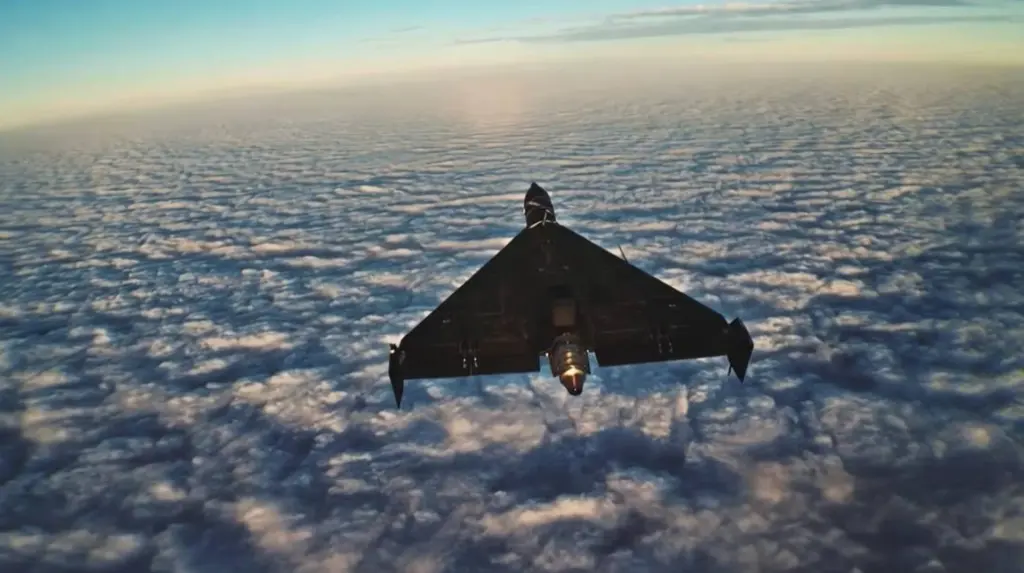
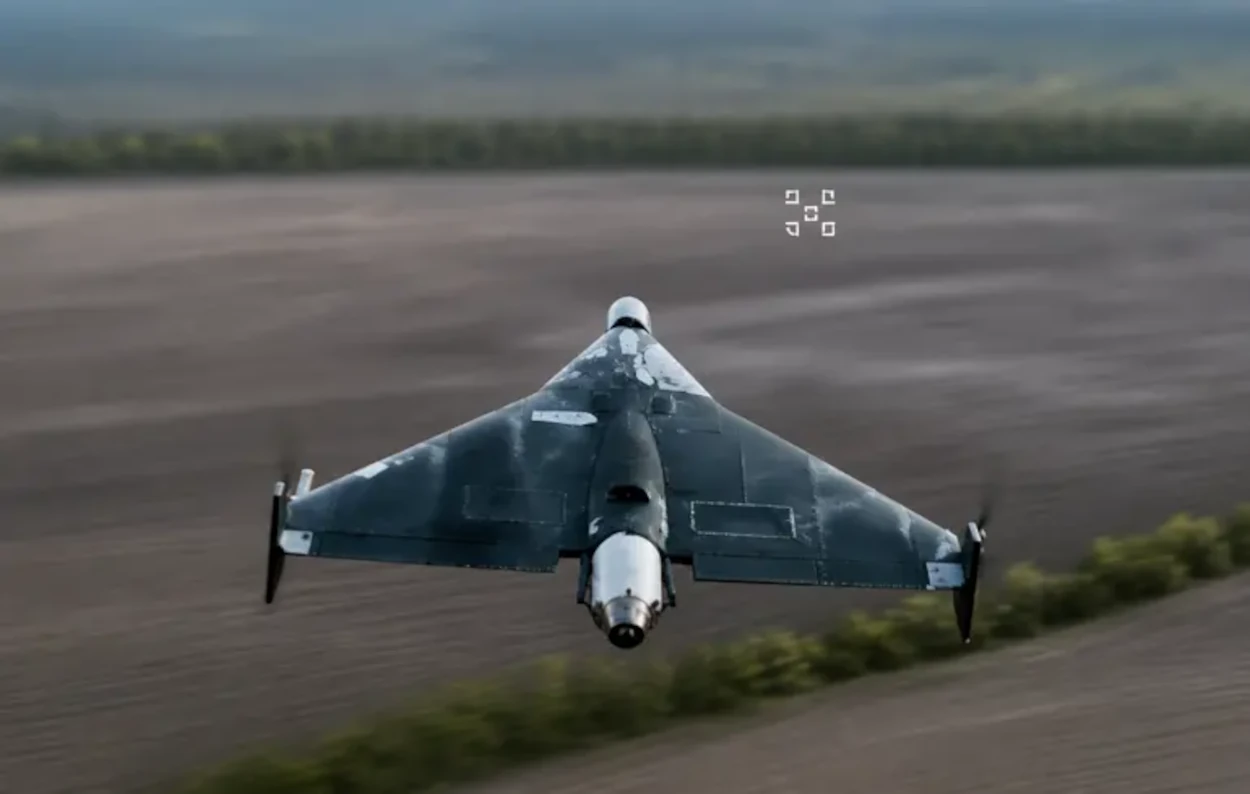
Romania shot down two drones it believes were Russia’s new Geran-4s. Europe isn’t ready for swarms of them, analyst warns

ukraine spent three years learning catch russian drones—so russia made fly faster · post geran-3 jet-powered attack drone wild hornets c1c840787fca380485636007cf683d71 news ukrainian reports

In a direct confrontation with Russia, European NATO states would likely be even more vulnerable than Ukraine to swarms of Russia’s new jet-powered strike weapons, Fabian Hoffmann of the Norwegian Institute for Defence Studies (NIDS) argued in a 20 October op-ed for the Center for European Policy Analysis (CEPA). He calls them low-cost cruise missiles. Just three days earlier, Romania met what it believes were two of them over the Black Sea.

Romanian F-16 fighter jets shot down two jet-powered Geran-family drones over Romania’s territorial waters on 17 October, the Defense Ministry said. Interim Defense Minister Radu Miruță said they flew at about 450 km/h and were likely Geran-4s, the first of that type Romania had downed.

Faster drones for a faster war

Russia began using the Geran-4 in May in response to effective Ukrainian interceptor drones, Ukraine’s military intelligence (HUR) said, adding that it reaches up to 500 km/h. By June, those interceptors were downing about half of slower Shahed-type drones, defense adviser Serhii Beskrestnov estimated.

Hoffmann traces the shift to the Geran-3, a model Ukraine recovered intact in 2025. In his account, a Chinese JT80 turbojet roughly doubled its speed, from 185 to 350 km/h. However, he puts newer models, including the Geran-4, at 600 km/h or more, above HUR’s figure for that model.

By his estimate, each costs $150,000–$250,000, against about $50,000 for a long-range drone. Still, from Russia’s perspective, he wrote, that buys a significantly higher chance of getting through.

money engineering what stands between ukraine russia's fastest drones zelenskyy says · post russia’s new “geran-4 seeker” shahed variant geran-4 news ukrainian reports
Explore further

Ukraine is testing four new drone interceptors as Russia floods its skies with faster Gerans 

Engines are the bottleneck

Hoffmann argues defenses must match the threat’s speed, for example with jet-powered interceptor drones. Ukraine already fields some. On 4 October, President Zelenskyy said its Bars interceptors had shown the highest percentage among Ukrainian interceptors, about 30% of targets, according to Militarnyi. One unit destroyed five aerial targets with five Bars interceptors, Defense Minister Yevhenii Khmara later told journalists. He also called aviation one of the most effective tools against jet drones.

Hoffmann’s concern is scale. Jet engines are in short supply, he wrote, because too few European and US suppliers can meet demand. Ukraine’s Defense Industry Council flagged a shortage of such engines for its drones in April. In his view, gun systems and higher-end missile defenses are too scarce or too costly to fill the gap.

  •  

Ukraine’s Navy killed Russian Shahed: one drone boat launched another drone, which shot down third, all unmanned, all at sea

fewer targets more waves jet-powered gerans partly free russia concentrate missiles isw says · post russia's shahed drone ukraine news ukrainian reports

      One drone launched another drone, which then shot down a third. All three were unmanned, and all at sea off Ukraine.

      Ukraine’s Navy has destroyed a Russian Shahed attack drone with a Sting interceptor launched from the Sargan 3000 unmanned surface vessel, the Navy said, showing sailors adapting to new aerial threats with sea-launched interceptors.

      Russian Shaheds threaten Ukraine’s ports, coastline and the ships that approach them, so meeting those drones out at sea, before they reach land, matters for the whole southern defense.

      A Ukrainian Navy sea drone, the Sargan 3000, destroyed a Russian Shahed kamikaze drone with a Sting interceptor drone

      Ukrainian troops continue to adapt to new threats to protect civilians and infrastructure
      🎥 Ukrainian Navy pic.twitter.com/kXvnqaebAw

      — Euromaidan Press (@EuromaidanPress) October 21, 2026

      The Sting is built to destroy Russian kamikaze drones such as the Shahed, Geran and Lancet, as well as reconnaissance drones, with quick deployment, a short training course and a top speed of 280 km/h, its producer, Wild Hornets, says.

      The interceptor that has become Ukraine’s Shahed-killer

      The Sting has earned its place at the front. The Ukrainian FPV interceptor has proven highly effective in combat, with a typical hit rate of 80 to 90% depending on the unit, and on some days reaching 100 percent, one launch for one kill.

      It is currently Ukraine’s most productive Shahed interceptor, according to the Wild Hornets, having destroyed more than 3,000 drones in its first seven months of use. Mounting it on a sea platform extends that record from land into the Black Sea.

      A drone boat that keeps finding new ways to kill

      The Sargan 3000 has become a multi-purpose hunter. In July, Ukrainian naval personnel used a Sargan 3000 to sink a Russian second-rank border patrol ship.

      In October, the same drone boat shot down a Russian Shahed with a turret-mounted machine gun over the Black Sea. Ukraine’s Navy took the Sargan 3000 into service in April 2026, and the drone boat has a combat radius of up to 1,600 kilometers, letting it clear the sky far from shore without putting a sailor in range.

      •  

      NATO to bolster Black Sea presence with patrol aircraft, drones after attacks on commercial ships

      "Allies have or will send additional maritime patrol aircraft, radar systems, explosive exploitation teams, intelligence personnel, drones, and more to the Black Sea," U.S. Army Col. Martin O'Donnell, a NATO military spokesperson, said in a statement.

      •  

      Romania downs two Russian jet drones near Sulina, days before NATO allies meet on Black Sea security

      romania downs two russian jet drones near sulina days before nato allies meet black sea security · post missile fired romanian f-16 during mission shoot down over 17 2026 853877788_1089835267016426_3152631372123116528_n

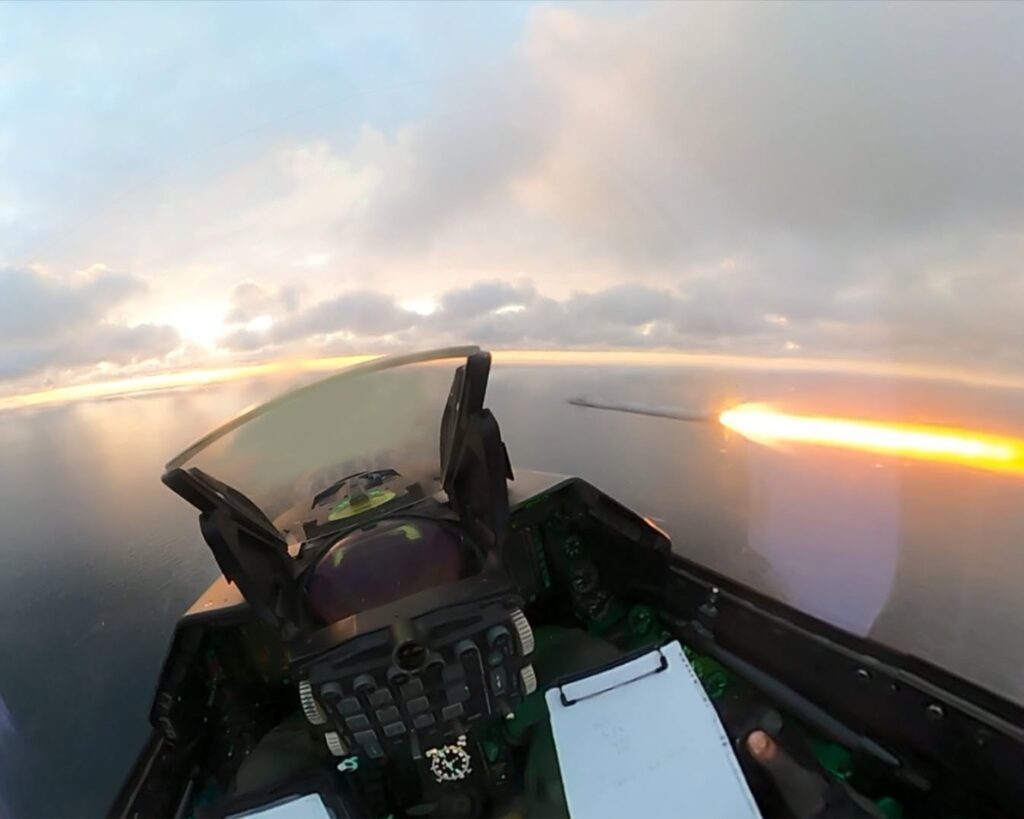
      Two Romanian F-16s shot down two jet-powered Russian Geran attack drones over Romania’s territorial waters near Sulina on the evening of 17 October, Romania’s Defense Ministry said. The ministry released cockpit images of the mission the next day, as NATO allies prepare to discuss Black Sea security at a special session Romania requested.

      This comes as Moscow continues its air attacks on Ukraine, while the US is trying to make deals with Russia over its diesel and lift sanctions. Russia keeps striking Ukraine’s energy system and cities, while its drones and suspected saboteurs keep turning up inside NATO, from tankers hit off Romania to a foiled arson attempt at a Starlink site in Lithuania.

      Down within minutes

      The F-16s took off from the 86th Air Base at Borcea at 17:43 after radar detected a group of air targets about 120 km east of Zmiinyi (Snake) Island, flying southwest, Ukrainian military outlet Militarnyi reported, citing the ministry. The first drone entered Romanian airspace at 17:59 and was shot down at 18:01 southeast of Sulina. The second entered at 18:01 and was downed at 18:05 east of Sulina.

      romania downs two russian jet drones near sulina days before nato allies meet black sea security · post where romanian radar detected about 120 km east snake island f-16s shot
      Where Romanian radar detected two drones, about 120 km east of Zmiinyi (Snake) Island, and where Romanian F-16s shot them down over Romania’s territorial waters near Sulina, 17 October 2026. Map: Euromaidan Press

      Both were jet-powered attack drones of the Geran family, the ministry said. The Geran is Russia’s version of the Iranian-designed Shahed. When first detected, the drones were about 65 km from the coast of Russian-occupied Crimea and 140 km from the Ukrainian-held shore, and their southwest course may point to Russian origin, Militarnyi calculated.

      The White House, seen from Lafayette Square. File photo, June 2024.
      Explore further

      Congress gave Trump 30 days to hit Russia’s oil buyers with 100% tariffs. He waives them two days before deadline, citing US interests. Moscow calls it historic

      The ministry posted the cockpit images on 18 October, showing a missile launch and a fireball over the sea. “Targets spotted, identified, engaged and neutralized!” it wrote.

      romania downs two russian jet drones near sulina days before nato allies meet black sea security · post fireball over seen cockpit romanian f-16 during mission shoot down 17 2026
      A fireball over the Black Sea seen from the cockpit of a Romanian F-16 during the mission to shoot down two drones near Sulina, 17 October 2026. Photo: Romanian Defense Ministry/Facebook

      Allies to meet on the Black Sea

      A special session of the North Atlantic Council, NATO’s top decision-making body, will discuss defense and deterrence in the Black Sea on 20 October at Romania’s request. Romanian President Nicușor Dan has confirmed that the two tankers that caught fire near Sulina last week were hit by drones, and a NATO military source told Reuters they were Russian.

      Romanian radar has logged 54 drone intrusions into the country’s air and sea space since Russia’s full-scale invasion, 35 of them this year, and the military has shot down six such targets in 2026, Defense Ministry data show.

      romania downs two russian jet drones near sulina days before nato allies meet black sea security · post romanian air force f-16am/bm block 15 militarnyi f-16am вм повітряних сил румунії
      A Romanian Air Force F-16AM/BM Block 15. Illustrative photo: via Militarnyi

      Searches in Poland and Lithuania

      Within hours, Poland’s Operational Command said it was checking a possible airspace violation by an unknown object overnight into 18 October. Troops, police, and military police searched for a possible crash site south of Lublin after residents reported the loud sound of a flying object around 02:00, Militarnyi reported.

      On the morning of 18 October, an unknown drone entered Lithuania’s airspace and triggered air raid alerts, the country’s crisis management center said. NATO jets accompanied it but could not shoot it down because of bad weather, Defense Minister Robertas Kaunas said. Debris preliminarily identified as drone parts was later found in the village of Juodžioniai in Pasvalys district, and the army said the drone may have entered from the direction of Poland.

      Romania moved from escorting Russia’s stray drones to firing on them in July, when its F-16s downed three in 72 hours.

      •  

      Romania finally holds Russia responsible for the drone attacks on ships off its coast, and wants a joint NATO command for the Black Sea

      The San Marino-flagged chemical tanker Wine Trader near Sulina, Romania, on 15 October 2026, after it was hit by drones about 14 nautical miles off the coast. Seven of its 12 crew were reported missing. Photo: ARSVOM

      Romania has proposed a joint NATO military command for the Black Sea, as drones hit four merchant ships in 24 hours, three of them off its coast, and its foreign minister said Russia "bears full responsibility." NATO ambassadors will discuss the attacks next week.

      Russia’s strikes on merchant ships in the Black Sea have escalated this autumn and reached NATO shores. Drones have attacked at least eight merchant vessels near Romania and Bulgaria since 5 October, two of them inside Romania’s territorial waters. Until now, neither country had named the attacker, and Bulgaria still says it cannot prove who it was. Romania’s patience appears to have run out, and next week’s NATO meeting will show whether the alliance is ready to go further as Russia’s war spills beyond Ukraine’s borders.

      Acting Defense Minister Radu Miruță wrote on Facebook on 14 October that "the Black Sea needs a joint military command of the NATO riparian states." "The Black Sea incidents, involving drones, sunk ships, and naval mines, oblige us to act, not wait," he wrote, after a call with his Bulgarian counterpart. Leadership and location would rotate among the member states. Romania is ready to host the command on its coast from 2028 and would accept a start on Türkiye's coast until then, he said. He proposed that Romania and Bulgaria send NATO a joint letter backing the idea.

      The next day, Foreign Minister Oana Țoiu wrote on X that four commercial ships had been attacked over the previous day, including in Romania's territorial waters and exclusive economic zone, and that eight people had died. "Russia is turning the Black Sea into a dangerous area for civilian ships," she wrote. "Killing sailors from commercial ships, both in this region and anywhere in the world, is a crime. Russia bears full responsibility for these developments."

      Earlier that day, as two tankers burned off Romania's coast, Bucharest had said it was still checking whether drones were involved.

      two tankers burn off romania’s sulina bulgaria says lacks proof russia behind black sea ship attacks · post burned superstructure tanker wine trader seen rescue helicopter 15 2026 romanian interior
      Explore further

      Two tankers burn off Romania’s Sulina as Bulgaria says it lacks proof Russia is behind the Black Sea ship attacks

      Țoiu said NATO Secretary General Mark Rutte had agreed to convene the allies within days, after he met Romanian President Nicușor Dan and Bulgarian Prime Minister Rumen Radev in Brussels. NATO ambassadors will meet next week, France 24 reported. No date has been announced.

      An escalating drone strike campaign

      Black Sea grain war between Ukraine and Russia escalates
      Map: Euromaidan Press

      Drones have been hitting merchant ships for weeks on the route from Ukraine's Danube and Odesa ports to the Bosporus. Besides the latest strikes off Romania, Reuters counts at least five cargo ships hit near Romania and Bulgaria in the past 10 days, with 23 sailors dead or missing, most of them outside any NATO member's territorial waters. This week the strikes reached Romania's own waters.

      • The Comoros-flagged tanker Yara J was hit inside Romanian territorial waters late on 14 October, off Sulina, the port at the mouth of the Danube. Its crew was unharmed, and it was towed to the Romanian port of Constanța.
      • Early on 15 October drones struck the San Marino-flagged chemical tanker Wine Trader about a mile outside Romanian waters, also southeast of Sulina. Five of its 12 crew were rescued. Seven were still missing on 16 October, when rescuers returned to search the ship.
      • Two more ships were also targeted, Reuters reported: the Marshall Islands-flagged Sea Destiny, inside Romanian waters according to NATO, and the Tanzania-flagged Dania J, moored at the Ukrainian Danube port of Izmail.

      Țoiu did not say which ships her eight dead were from, and Reuters still lists the Wine Trader's seven as missing. A NATO military source told Reuters the drones that hit both tankers came from Russia.

      The chemical tanker Wine Trader
      The chemical tanker Wine Trader. Photo: VesselFinder

      Romania's president says too early to say

      Romania's president has not gone as far as his foreign minister. Dan told reporters in Brussels it was "obvious" that the attacks were Russian attempts to destabilize Romania and Bulgaria and reduce support for Ukraine. But he also said it was too early to say definitively that Russia had launched the drones, according to Politico.

      Bulgaria, Romania's partner on the command proposal, says it suspects Russia but cannot prove it. Two ships were hit off its coast on 13 October, and one, the HS Dignity, sank. The other, the Chelsea 3, is Ukrainian-owned.

      Radev told parliament on 14 October that the attacks worked in Russia's favor and that "logic leads there." "The problem is that we cannot prove it," he told MPs. Sofia summoned the Russian ambassador. Radev also said EU leaders would discuss a moratorium on attacks on civilian ships in the Black Sea.

      Bucharest has blamed Russia for drones before, though over its airspace, not its shipping. On 27 July it expelled a Russian diplomat after prosecutors confirmed that fragments of drones downed on Romanian territory were Russian. Russia, Romania's Foreign Ministry said then, "bears exclusive responsibility."

      Ukraine ships most of its farm exports across the Black Sea. Euromaidan Press's David Axe has written on how the fight over shipping there has escalated.

      Bulk carrier "Royad Mammadov" under the flag of Saint Kitts, partially sunk after an attack by Russian sea and air drones on October 5, 2026, 20 nautical miles off the coast of Romania. Photo: Romanian Interior Ministry
      Explore further

      Russia is losing the Black Sea grain war it started. Its answer is to sink civilian ships off Romania and Bulgaria

      •  
      ❌