Former West Virginia Sen. Joe Manchin criticized what he sees as his former party's embrace of the progressive left, warning that Democratic socialists are gaining ground while longtime Democrats largely remain silent.
Manchin left the Democratic Party after frequently breaking with fellow Democrats while serving in Congress. The longtime moderate registered as an independent in May 2024.
In a statement announcing his departure, Manchin criticized extremism on both the left and right, saying he had "seen both the Democrat and Republican parties leave West Virginia and our country behind for partisan extremism while jeopardizing our democracy."
Manchin also argued that neither party was willing to "find common ground" or "put country before party."
During his conversation with Hannity, Manchin expressed disbelief that many Democrats appear unwilling to challenge the Democratic Socialists of America's (DSA) growing influence within the party.
"That's beyond me," he said, suggesting that some longtime Democrats may be afraid to challenge the party's more progressive wing.
"The bottom line is ... let's look at the elections coming up. If the House changes ... if it flips over to Democrat control, a lot of the flipping is going to happen in kind of a purple area, not a hard blue area. [A] hard blue area is where they're going to maybe flip to DSA."
Anti-socialist opposition leader and Nobel Peace Prize winner María Corina Machado on Thursday affirmed that Venezuela will become America's greatest ally in the region once it finishes its transition back to democracy after nearly three decades of socialism.
Far-left "squad" member Rep. Pramila Jayapal (D-WA) claimed there is "much more trust in government" in democratic socialist countries, and she called government "the great equalizer of opportunity."
U.S. District Judge Alvin Hellerstein, who was overseeing the case against Venezuela's deposed socialist dictator Nicolás Maduro in Manhattan, died on Wednesday, Chief Judge Laura Taylor Swain announced.
TEXAS — Gas prices are soaring ahead of the midterm elections, but President Donald Trump's supporters at campaign rallies in Texas say the rising costs aren't shaking their loyalty to the president, with some warning that the country's future is at stake.
"I do experience that costs are high, but I'm in for the long haul and I support everything that he's been doing," one supporter told Fox News Digital at Trump's rally in Lubbock, Texas.
Fox News Digital spoke with Trump supporters at rallies in Lubbock and Corpus Christi, two cities in a state deeply tied to America's oil and gas industry where voters acknowledged the economic squeeze but remained firmly behind the president. For some, concerns about the country's future and the rise of socialism are adding urgency to the approaching election.
The national average for a gallon of regular gasoline stood at approximately $4.25 on Wednesday, up nearly 40% from roughly $3.05 a year earlier, according to AAA.
Trump acknowledged the higher costs during his Lubbock rally while pointing to increased American oil production and his administration's recent energy deal with Venezuela as steps toward bringing prices down.
"Our country is making a fortune while people have to pay more at the pump," Trump said, adding that gas prices are "going to come down really fast."
"The ones we care about are our people at the pump," Trump told the crowd. "And those numbers are going to start coming down very, very rapidly."
During his earlier stop in Corpus Christi, Trump announced the arrival of the first million barrels of Venezuelan oil secured through an agreement with the South American country, which the White House says is being provided at no cost to American taxpayers and will be refined in Texas.
The administration has touted the agreement as a major step toward expanding America's energy supply and supporting domestic jobs, arguing that the additional oil will eventually help lower costs for consumers.
The White House said the broader agreement would give the U.S. majority control over approximately 65 billion barrels of proven Venezuelan oil reserves, expanding American access to energy resources as Trump pushes to boost supply and bring down prices.
Stephen Elsher of Corpus Christi said the economy remains his top concern heading into the midterms, but he believes Republicans are the ones who can turn things around.
"I'd like to see it turn around and do better for this next year," Elsher told Fox News Digital. "Without the Republicans in charge, we won't go that direction."
Meanwhile, the Democratic Party has faced growing pressure from its progressive wing, with democratic socialist candidates gaining prominence and sparking debate over the party's direction.
Trump repeatedly warned voters against what he described as the "radical left Democrat communist" agenda during his Lubbock rally, arguing that Democratic policies would raise taxes, threaten Texas oil and gas jobs, and weaken border security.
"The choice in this election is very simple," Trump told supporters, contrasting his economic agenda with what he described as the consequences of Democratic control.
For some Trump supporters at the Texas rallies, concerns go beyond affordability, with attendees warning that the rise of socialism poses a threat to the country's future.
"We can't lose our republic," Susie, a Corpus Christi supporter, told Fox News Digital, warning that the country is under siege by Democrats, socialists and communists.
Elizabeth Trigo, who attended Trump's Lubbock rally with her daughters, said the midterms are about more than just the next election, pointing to the country's future and preserving opportunities for the next generation.
"I think the main reason this election, the midterms, is a lot of it has to do with the future," Trigo told Fox News Digital. "The most important thing is opportunity again. Trump is on the side of opportunity."
Trigo said she wants Trump to continue fighting the war on drugs and pushing back against socialism during his remaining two years in office.
A little-known congressional maneuver could block members of the Democratic Socialists of America (DSA) from being sworn in as members of the House of Representatives next year, even if they win their elections on Tuesday.
Members-elect must swear an oath to uphold the Constitution before they can become full members of the House. At the beginning of a new Congress, that oath is typically taken en masse by all 435 members, led by the House speaker.
But an argument circulating in conservative circles posits that any member-elect can challenge another member-elect's right to be sworn in, provided they have compiled evidence that that person would not uphold their oath. That would then lead to House-wide deliberations followed by a vote on whether that member-elect has a right to be sworn in.
In the case of DSA members, one potential argument could be the group's platform calling to scrap the current U.S. Constitution and draft a new one. Several DSA members and self-proclaimed democratic socialists have already won primaries across the country.
Rep. Keith Self, R-Texas, suggested to Fox News Digital that he could invoke the maneuver.
"You cannot swear an oath to support and defend the Constitution while actively working to destroy it. The oath of office is not just words you say at a ceremony. It is a belief. It is an oath to our country and our fellow countrymen," Self told Fox News Digital.
"The House has both the authority and the duty to ensure that anyone who takes that oath does so in good faith, without mental reservation or purpose of evasion. As DSA candidates and the Red-Green Alliance gain ground, we must enforce the Constitution as written or risk allowing people committed to replacing it to take seats of power under false pretenses."
The "Red-Green Alliance" is a term used on the right to describe cooperation between far-left groups and radical Islamic organizations or operators.
"Anyone who has personally embraced the destruction of the Constitution has no business being sworn in to uphold it," Self said.
According to an analysis by the Center for Renewing America, a challenge to a member-elect's fitness to take the oath of office can be followed by the House speaker asking them to step aside while the debate begins.
"The objecting member should place the documentary record before the House, and the House should debate whether that evidence establishes that the member-elect remains committed to destroying the constitutional order," the group's analysis said.
The House would then vote on a resolution that "establishes the member-elect’s commitment to destroying the constitutional order," which, if passed, could stop them from being sworn in.
The theory relies on a number of variables. For example, if House Minority Leader Hakeem Jeffries, D-N.Y., is elected speaker, he could decide to dismiss the challenge altogether. Speaker Mike Johnson, R-La., could do the same if he so chooses if Republicans keep their majority.
Johnson told reporters as much during an event this month in Iowa, calling the idea of him refusing to seat elected Democrats a "nonsense narrative" and vowing, "We are going to follow the law."
It would also raise questions about challenging the will of the people who elected that person to represent them.
Such a move would also be in direct conflict with Supreme Court precedent, meaning it is virtually guaranteed to be relitigated.
The 1969 case of Powell v. McCormack ruled that the House cannot exclude an elected candidate from being sworn in if they otherwise meet the constitutional requirements of age, residency, and U.S. citizenship.
It comes after Adam Clayton Powell Jr., then a senior lawmaker representing New York as a Democrat, was refused his oath of office by the House speaker after winning again in 1966. Powell Jr. had been embroiled in multiple financial scandals at the time.
The House then adopted a resolution barring him from taking his seat, a decision that was ultimately overturned by the Supreme Court.
But that has not stopped Republicans from considering the idea of revisiting the move.
Rep. Tim Burchett, R-Tenn., told the New York Post earlier this month that he would use the maneuver to try to block Darializa Avila Chevalier from joining Congress next year.
Chevalier, whose upset victory unseated a senior House Democrat, is from a deep-blue district and is almost certainly going to win her general election next week.
Burchett told the Post that he intended to declare her ineligible to take the oath over a now-deleted X post from 2019 in which she boasted about wiping her hands on the American flag because she did not have a napkin.
Whether the efforts succeed, the threats underscore the partisan rancor that's taking shape even before the new Congress is formally selected in next week's midterms.
On Wednesday’s broadcast of CNN’s “The Arena,” Rep. Jason Crow (D-CO) responded to a question on if a Democratic socialist can be elected president in 2028 by saying that “I think there are great communicators. And regardless of the moniker
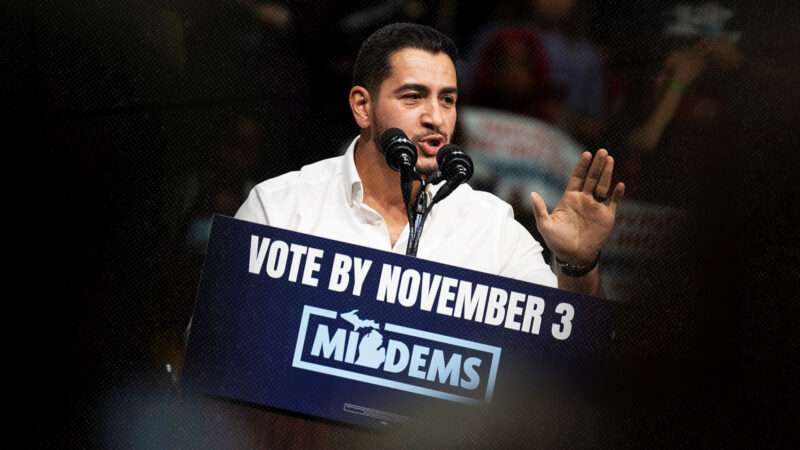
When Abdul El-Sayed ran for governor of Michigan in 2018, progressive media hailed him as the next Barack Obama. El-Sayed did not appreciate the comparison. "I get compared to Obama because my name is funny, and I'm brown, and my politics are about inspiring us to believe in each other again," he toldVox at the time.
In El-Sayed's telling, Obama was a "fairly centrist, middle-of-the-road" Democrat. He did not intend that as a compliment. El-Sayed believed the administration's policies were not nearly progressive enough—indeed, he believed Obama had betrayed the agenda he ran on. The far-reaching financial, environmental, and labor regulations that Obama pushed through were not nearly enough for El-Sayed.
El-Sayed ultimately fell short in the 2018 Democratic gubernatorial primary. Eight years later, he's a much savvier political operative; now running for the U.S. Senate, he has welcomed Obama's support this time. Yet El-Sayed's commitment to a left-wing agenda has hardly diminished. If he defeats his opponent, former Rep. Mike Rogers (R–Mich.), he will be one of the most far-left politicians to win a statewide election in recent memory—and in a purple-ish swing state that President Donald Trump won twice.
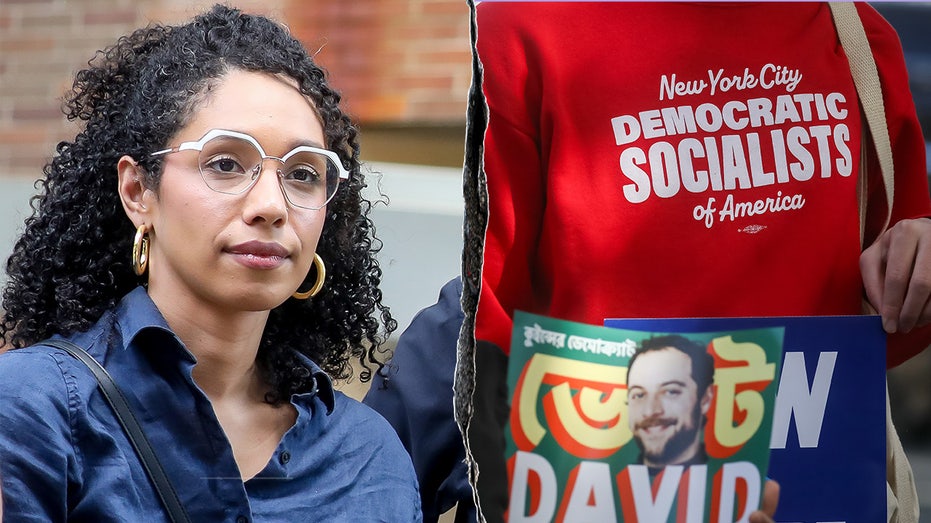
Like his friend and mentor Sen. Bernie Sanders (I–Vt.), El-Sayed is not a member of the Democratic Socialists of America (DSA); unlike Sanders, El-Sayed maintains that he is a capitalist rather than a socialist. Yet his political project has much in common with the DSA, and he has given every indication that he will align himself with DSA-affiliated members of Congress—veterans such as Rep. Alexandria Ocasio-Cortez (D–N.Y.) and likely newcomers such as Darializa Avila Chevalier and Claire Valdez, both of New York, who rode similar waves of populist resentment to victory over establishment Democrats.
El-Sayed's left-wing bona fides were evident during his debate with Rogers on October 8. The Democrat proposed giving the federal government vast new powers: up to 50 percent control over AI companies, a socialized health insurance program along the lines of Medicare for All, and price controls on the domestic oil industry. Asked what he would do to bring down the national debt and pay for all the new spending he wants, he had a simple, three-word answer: "Tax. Billionaire. Wealth."
El-Sayed's support for higher taxes exempts one important constituency: seniors. Like many Democrats—andRepublicans such as Rep. Nancy Mace (R–S.C.)—El-Sayed wants to exempt retirees from property tax increases, a policy that critics have branded "total boomer luxury communism" because it forces younger, less wealthy Americans to shoulder ever more of the social burden. The new wave of leftist Democrats think that higher taxes on the 1 percent, combined with cuts to the military budget, would be sufficient to pay down the debt while vastly expanding the social safety net.
In fact, El-Sayed has proposed tying Pentagon spending to education, such that an increase in money for the military would necessitate more funding toward schools. Don't expect this to work the other way around: Under El-Sayed's plan, a decrease in Pentagon spending would not force the government to stop throwing so much money at failing schools.
Ann Arbor and Onward
El-Sayed was born on Halloween in 1984. He grew up in Bloomfield Hills, an affluent, predominantly white suburb north of Detroit. His parents divorced when he was young, and El-Sayed lived with his Egyptian father and white stepmother. In high school, he was captain of the football, wrestling, and lacrosse teams. He continued to play on a club lacrosse team at the University of Michigan, which he attended from 2003 to 2007. (We overlapped briefly, though I never met him: I attended Michigan from 2006 to 2010.)
That meant going to Ann Arbor, a progressive college town with a long history of radical activism. Students for a Democratic Society (SDS), the prototypical '60s New Left student activist group, was founded in Ann Arbor in 1960; its first president, Alan Haber, still lives there. The White Panther Party, a sort of hippie counterpart to the Black Panthers, was based in Ann Arbor for a while; in the 1970s, the socialist Human Rights Party won multiple seats on city council. Liberalism, as well as radicalism, has thrived in Ann Arbor: The same year the SDS was born, future President John F. Kennedy came to the town to propose the international volunteer organization that eventually emerged as the Peace Corps. In the 2008 Democratic presidential primaries, the student-run Michigan Daily naturally endorsed the inspirational liberal candidate, Obama, over the establishment favorite, Hillary Clinton.
Over the course of the next decade—as left-wing enthusiasm for the Obama project faded and was replaced by bitter disappointment—El-Sayed enrolled in Oxford University and then Columbia University, pursuing a career in public health. (He never completed a residency, which has led to some scrutiny, even from friendly media figures, regarding his decision to describe himself as a physician.) In 2015, the mayor of Detroit appointed him the city's executive health officer. He resigned that position in 2017 to run for governor. That pattern repeated itself a few years later: He was appointed health director of Wayne County, which includes Detroit, in 2022, and resigned in 2025 to run for Senate.
Unlike in 2018, El-Sayed's hard-left politics and contempt for the Democratic establishment were now well-calibrated to prevail in the primaries. He defeated a more moderate candidate, Rep. Haley Stevens (D–Mich.), in part due to her support for Israel—an issue that El-Sayed frequently discusses. The same phenomenon has played out all over the country, with establishment Democratic figures paying a huge price when perceived as indifferent to voter outrage over Israel.
What works in the Democratic primaries does not always do as well in the general election. But while El-Sayed's politics are well to the left of the state he seeks to represent, the president's unpopularity may be enough to push him over the finish line. El-Sayed is narrowly ahead of Rogers in the latest polling. The Republican has finally resorted to breaking with the president on key policy issues—he has said that he wishes to end some of Trump's tariffs, conceding that "Canada is not our enemy"—but it may be too little too late.
Moreover, El-Sayed's left-wing foreign policy positions, which are not necessarily antithetical to libertarian views, count for more in Michigan than in other places. The state has a significant Arab-American population that politicians have ignored at their peril. In 2024, dissatisfaction with President Joe Biden's failure to curtail Israel's war on Gaza prompted many Arabs in Michigan to cast ballots for Green Party candidate Jill Stein, or even Trump, over Democratic nominee Kamala Harris. Republicans have sought to portray El-Sayed as insufficiently supportive of Israel, but that doesn't always play well in Michigan—particularly at a time when dissatisfaction with Trump's blunders in the Middle East is strong among Democrats, independents, and even many Republicans.
El-Sayed does have a possible Achilles heel on foreign policy: His association with the far-left Twitch streamer Hasan Piker. To many outside observers, the candidate's courting of Piker reads as a huge unforced error. Not only did El-Sayed seek the approval of an internet personality best known for praising authoritarian governments and evincing sympathy for terrorist groups, but he brought Piker to Michigan, put him in front of a camera, and made him a de facto representative of the campaign. For everyone except the toxically online, Piker is a bizarre and marginal shock jock, a man who says things like "America deserved 9/11." Piker is what happens when you pay too much attention to podcasts. He is also a reminder that while the insurgent left often claims to speak for ordinary, blue-collar working people, its agenda tends to be most popular with the affluent and elite-educated. In El-Sayed's showdown with Stevens, polls had her up 22 points with noncollege voters and 46 points with black voters. (Stevens herself is white.)
Yet El-Sayed prevailed, and he dealt with the Piker issue by shunting him to the sidelines. When asked about Piker, El-Sayed dutifully recites that a Twitch streamer from California has nothing to do with a Senate race in Michigan. (The obvious retort is Well, you brought him here.) He has also adopted right-coded language to explain why he should not be held responsible for Piker's inflammatory comments, tellingPolitico that he was over "this whole gotcha game, platform policing, cancel culture."
The GOP, meanwhile, may have gone overboard in the other direction. Rogers, a traditional Republican more in the George W. Bush mold than the Trump mold, is not exactly a right-wing firebrand, yet he could not stop himself from suggesting that El-Sayed has some sort of connection to Islamic terrorists. Just as Democrats should genuinely worry that linking up with people like Piker will cost them Jewish votes, Republicans should think more about whether reflexively calling Muslims terrorists is a bad strategy to win in Michigan.
After all, the form of radicalism that El-Sayed typifies is not really Islamic. It's not even foreign. It's the radicalism of left-wing economics, of making the federal government larger and more robust. He wants to prohibit corporations from buying houses and to punish companies like Airbnb over "housing dislocation." He wants to raise the capital gains tax, the inheritance tax, and the top marginal tax rates. He wants to give the Federal Trade Commission expansive new powers. He thinks higher education should be free for everyone. If he makes it to the Senate, El-Sayed will be a reliable vote for the Sanders agenda, including moratoriums on new data center construction, a much stronger Environmental Protection Agency, and, of course, Medicare for All. Indeed, one of El-Sayed's most frequent criticisms of Obama over the years has been that the Affordable Care Act did not go nearly far enough, and that it may have even been counterproductive to the mission of building a socialist health system.
Obama appeared alongside El-Sayed in Detroit on October 24. The candidate was savvy enough not to bring up his thoughts about Obamacare.
This Week on Free Media
I explain why it would be wrong to nationalize Elon Musk's companies.
Worth Watching
I finally watched You Can See Everything, Nathan Fielder's quasi-documentary about Theranos founder Elizabeth Holmes. It was made with considerable technical skill, and there's plenty to like about it—but ultimately I landed in the same camp as Reason's Christian Britschgi. We will discuss the film on this week's episode of Freed Up; look for that later today on the Free Media YouTube page.
Half of American voters say they would cast their ballot for a democratic socialist, according to a new poll. In The Economist/YouGov poll, 50 percent of respondents said they would cast their ballot for a democratic socialist, while 41 percent said the opposite. Nine percent said they were unsure about voting for such a candidate.…
Half of American voters say they would cast their ballot for a democratic socialist, according to a new poll. In The Economist/YouGov poll, 50 percent of respondents said they would cast their ballot for a democratic socialist, while 41 percent said the opposite. Nine percent said they were unsure about voting for such a candidate.…
In the country with arguably the most successful market economy on Earth, it's not unreasonable to ask for just one major political party to favor a system of relatively unfettered voluntary exchange. And yet, the midterm elections offer Americans a "choice" between a party openly embracing socialism by name, and one that increasingly embraces state-directed economic activity in the cause of nationalism. Not every candidate running as a Democrat or Republican is on board with their parties' statist transformations, and there are certainly other issues separating the two dominant political tribes. But if you want reliable advocacy of economic freedom, you won't find it in the two major parties.
Open Socialism vs. Nationalist Economic Control
The shift in the Democratic Party's policy preferences from a heavily regulated market economy to outright government control has been well-documented, but it's worth noting Eric Bradner August report at CNN about "a growing list of victories by democratic socialists who are a prominent part of the Democratic Party's left-wing insurgency."
Before his election as mayor of New York City, Zohran Mamdani called for "seizing the means of production," as has congressional candidate Darializa Avila Chevalier. The Democratic Socialists of America (DSA), which backs many of the new breed of officeholders and candidates and organized their insurgency, boasts of its solidarity with the totalitarian regimes in Cuba and Venezuela. Just a year ago, it sent "a delegation of 40 DSA elected leaders and rank-and-file members" to Havana to learn "about the achievements and challenges of Cuban socialism."
At 65 percent support for socialism in Gallup polling, more Democrats favor a state-controlled economy than back capitalism (35 percent)—though the odd tie in favorability with free enterprise (also 65 percent, but declining) suggests the schools aren't doing a great job of explaining ideas.
Republicans nominally hold very different economic preferences, with only 14 percent favoring socialism, while 86 percent support free enterprise and 75 percent have positive views of capitalism. But when asked by CNBC's All-America Economic Survey whether government should have control of private businesses, "66% of Democrats found it not appropriate for the U.S. to take equity stakes in American companies, while only 34% of Republicans agreed."
That's likely because under the Republican Trump administration, the federal government has been grabbing a piece of the action from tech and resource firms—40 companies, at the current count—and party stalwarts are happy to go along so long as the S word isn't used to describe the arrangement. Instead, it's cloaked as top-down encouragement of domestic jobs and manufacturing.
Two Parties With a Similar Taste for Government Economic Intervention
"American political leaders on the left and right are rebelling against the market-first consensus that dominated Washington for four decades," concludedAxios's Courtenay Brown and Neil Irwin in July. "It's evident in everything from the Trump administration taking government stakes in dozens of private companies to socialist candidates winning Democratic primaries promising a more active government role in the economy."
A glimpse of a socialist future can be found not only in the rising tide of explicitly socialist Democrats, but in GOP heir apparent and Vice President J.D. Vance's repeated denunciation of free-market economic thinking and its emphasis on private choice.
"Do we serve pure, unfettered commercial freedom?" he asked in First Things in 2019. "Or do we serve something higher? And are we willing to use political power to actually accomplish those things?"
In a June interview with The Daily Wire's Michael Knowles, Vance returned to the topic to criticize the market-oriented ideas of economist Milton Friedman and called for a state-directed and Christian-infused "American developmentalist" approach to escape what he called "a hyper globalized economy."
"The policies supported by both major political parties suggest a growing embrace of state ownership of the economy," warns economist Daniel J. Smith for the American Institute for Economic Research. "The range of policies widely accepted as legitimate options, referred to as the 'Overton Window,' has shifted toward greater government direction of the economy, with some conservative politicians and voters now treating partial state ownership as an acceptable function of government."
Smith pointed out that the economist F.A. Hayek had observed this phenomenon among authoritarians of the right and left in the 1930s. It was why he dedicated his book, The Road to Serfdom, "to the socialists of all parties."
Rejecting Free Markets Means Losing Liberty and Prosperity
Why this is important is illustrated by Smith's recent research into the correlation, or lack thereof, between socialism and political liberty: "The record, from 1789 forward, is not ambiguous. High degrees of political freedom and heavy state ownership of the economy have not been sustained together."
Smith's observation is supported by the prominent socialist writer Robert Heilbroner's admission in his 1986 book, The Nature and Logic of Capitalism, that "political freedom in modern times…has only appeared in capitalist states." He added, "democratic liberties have not yet appeared, except fleetingly, in any nation that has declared itself to be fundamentally anticapitalist."
Also important, as the Fraser Institute's recently published Economic Freedom of the World: 2026 report points out, "economic freedom tends to be associated with better outcomes." Specifically, the report indicates strong correlations between free-market economies and higher GDP per capita, higher level of income for the bottom 10 percent of earners, lower poverty, higher life expectancy, and lower infant mortality. As with the sources cited above, the report found that "personal freedoms such as freedom of speech, association, and religion are highly correlated with economic freedoms."
So, the benefits of having a major political party that believes in and supports free markets with minimal government intrusion are found not just in expanded political choice, but also in policies that promote freedom, prosperity, and human well-being. Unfortunately, both the Democratic Party and Republican Party are retreating from economic liberty and embracing state control over how we produce, work, own, buy, and sell. Democrats' explicit embrace of socialism, and Republicans' dismissal of free markets in favor of state management and ownership, promise a future of less freedom and reduced wealth.
Maybe Americans would vote against socialism—both the open kind and the implicit nationalist variety—if given the choice. But it's increasingly difficult to find a free-market option on the ballot.
Some of the remnant socialist governments appear to be sliding toward subservience
“Respect for sovereignty is the most significant norm in international politics, and its purpose is to minimize war and facilitate peaceful relations among states.”
—John Mearsheimer
American political scientist and international relations scholar and professor
The U.S. war against Vietnam was driven by the imperialist assumption that Vietnam was one of many inevitable dominoes that would fall to communism. But the communist dominos did not fall. Instead, today, we face a dramatic, devastating loss of progressive governments throughout Latin America, with the domino game won by the reactionary forces.
We must learn from history, or we are doomed to repeat it. But today, there is little public discussion and analysis of what led to these Latin American losses, if not outright condemnation of such questions.
Though all the winds of doctrine were let loose to play upon the earth, so Truth be in the field, we do injuriously, by licensing and prohibiting, to misdoubt her strength. Let her and Falsehood grapple; who ever knew Truth put to the worse, in a free and open encounter?
— John Milton English poet, polemicist, and civil servant
During the Cold War, the U.S. had a long pattern of supporting right-wing coups, dictatorships and death-squad operations, driven by the imperatives of big business which wanted to exploit Latin American resources.
One of the most notorious cases was Chile, where the CIA backed a coup against democratically elected leader Salvador Allende that brought in fascist Augusto Pinochet.
Today, as Peoples Dispatch reported: “The far right in Latin America is shaped by an anti-left agenda that it inherits from the Cold War, which means that its political formations typically endorse the era of U.S.-backed military dictatorships. The ideas of the left, whether from the Cuban Revolution (1959) or from the era of the Pink Tide (after 1998), are anathema to these political forces; these ideas include agrarian reform, state-led finance for industrialization, state sovereignty, and the importance of trade unions for all workers and peasants.”
Glenn Greenwald agrees: “Other than Uruguay, Brazil is the last country in South America still governed by a left-wing or center-left government, with one country after another electing leaders on the right: Argentina, Colombia, Peru, Ecuador, Chile, etc.”
Medea Benjamin also agrees: “Across the continent—from Colombia and Peru to Argentina, Chile, Ecuador, Honduras, Bolivia and Panama—there has been a stark reversal of the region’s progressives that brought hope for a more independent and socially just Latin America. The only two major powers in Latin America still governed by the left are Mexico and Brazil—and Brazil faces a fiercely contested presidential election in October.” Unfortunately, the recent election requires a runoff, as neither Bolsonaro nor Lula received over 50% of the vote. What is particularly concerning, is that Lula did not come in as strong as most predicted.
Alan MacLeod reports in Mint Press that “The United States is interfering in the Brazilian presidential elections, pressuring the Brazilian electorate into voting for right-wing candidate Flavio Bolsonaro, the son of disgraced former president, Jair Bolsonaro. If that does not work and President Lula da Silva secures a fourth term in office, the groundwork is already being laid for a potential military intervention.”
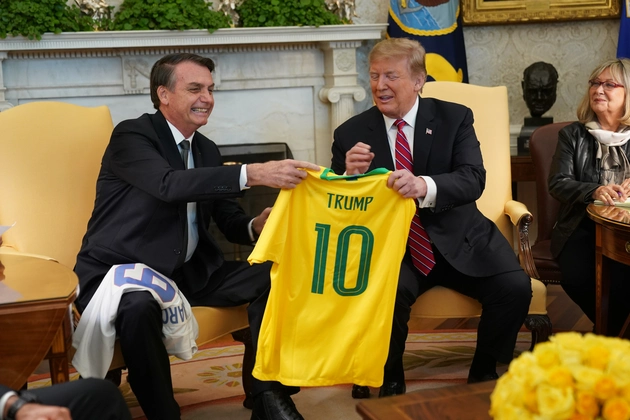
Former Brazilian President Jair Bolsonaro after he is presented with a soccer jersey by President Donald Trump. [Source: politico.com]
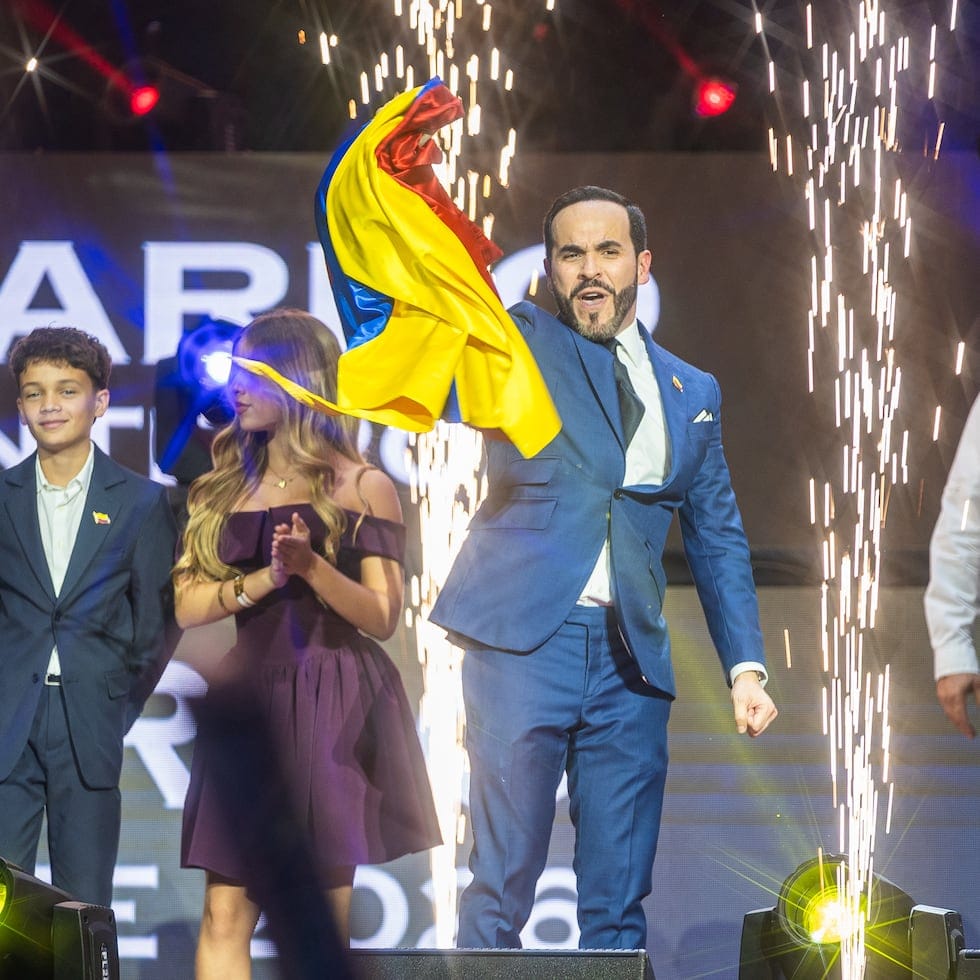
Colombia’s domino fell when its left-wing presidential candidate Ivan Cepeda conceded defeat on June 24 to hard-right populist Abelardo de la Espriella following a tight run-off race.
“There had been doubts among the Cepeda camp about the legitimacy of the vote process, with President Gustavo Petro—who was closely involved in the leftist candidate’s campaign—openly alleging fraud and foreign interference before and after the election.”
Colombia’s far right new President Abelardo de la Espriella celebrates his recent election victory. [Source: americasquarterly.org]
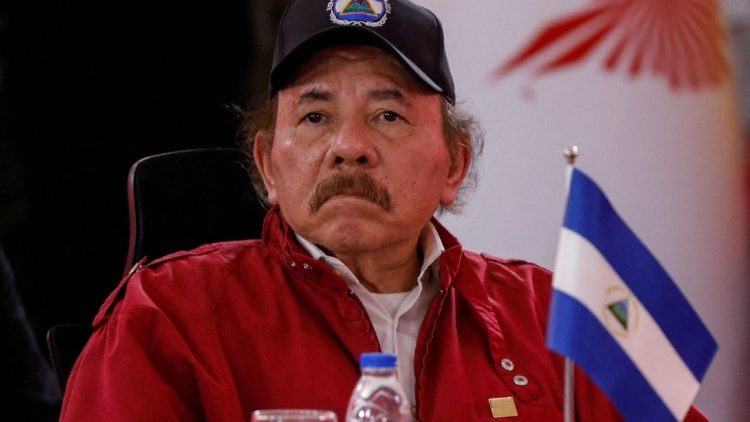
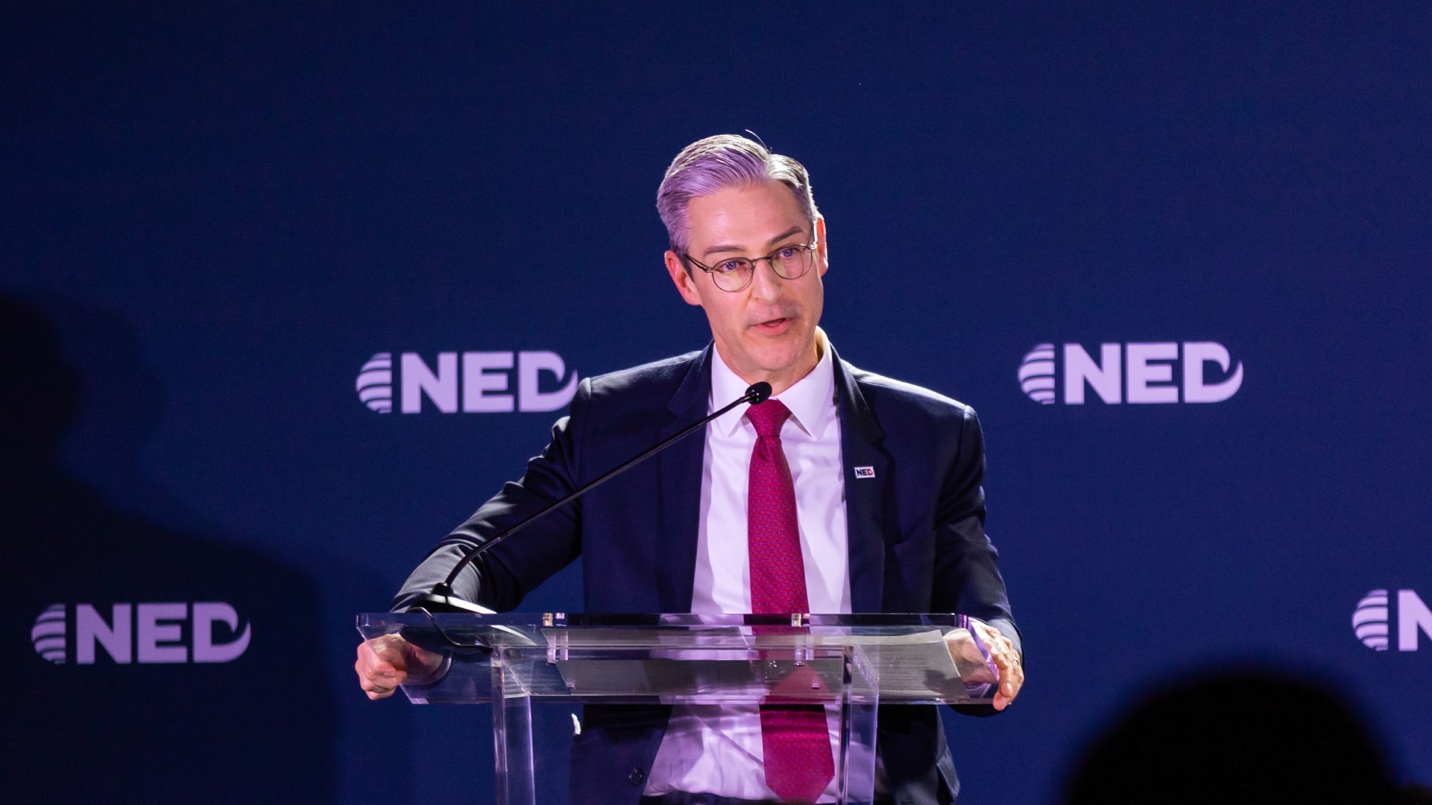
Nicaragua faces electoral interference as well. As reported in The Grayzone, “In his national address on July 19, Nicaraguan President Daniel Ortega stated that, when the country’s next elections take place in 2027, none who promoted a violent anti-government insurrection in 2018 will be allowed to stand for office.” He declared that Nicaragua has the “sovereign right to fight foreign interference in its electoral process…Washington’s plans for regime change in Nicaragua are hardly a secret…The National Endowment for Democracy’s president, Damon Wilson, bragged to a House committee in February that his organization is funding media in Nicaragua with an eye to undermining its Sandinista government.”
Lest we forget, government control of media is essential for fascism to take hold. Benjamin outlines how “The market concentration of Latin American media conglomerates is among the highest in the world, with four transnational companies controlling 89 percent of the broadcast media across six major countries…The market power of these huge media conglomerates is a real obstacle to any movement for democracy or socialism.” Even darker, she reports that Allen Weinstein, a founder of the National Endowment for Democracy, told The Washington Post in 1991, “A lot of what we do today was done covertly 25 years ago by the CIA.”
Damon Wilson, the director of the National Endowment for Democracy. [Source: ned.org]
After Venezuela was subject to a U.S. military invasion on January 3, which resulted in the kidnapping of sitting president Nicolás Maduro and his wife Celia Flores, then-Venezuelan Foreign Minister Yván Gil said “We found ourselves alone.”
It was certainly a devastating disappointment that Russia and China, or neighboring countries such as Colombia and Brazil, did not (though under the boot of the U.S.) more militantly advocate for Maduro and Flores’s return. The illegal murders on the open seas of the Caribbean—with impunity—was writing on the wall that Venezuela was the next domino to fall. Why did the efforts to prevent the fall fail?
Is Venezuela still a sovereign country? Former Venezuelan Foreign Minister Jorge Arreaza said, “Everything is now negotiated” with Washington, requiring a daily give-and-take with Caracas. When does it become regime change if everything must be negotiated with Washington?
Peoples Dispatch reports that, “Despite every attempt to overthrow the government of Venezuela, President Nicolás Maduro remains in charge and has mobilized large sections of the population to defend the Bolivarian Revolution against any threats.” But as is acknowledged, “…U.S. imperialism, by having a gun pointed to the government’s head, is in a position to exert substantial coercion leading to unpalatable decisions, such as Alex Saab’s deportation.”
Doesn’t “substantial coercion” trespass upon sovereignty? When domestic peace occurs due to a gun to your head, is it the measure of success? Saab’s deportation is more grievous than unpalatable.
Criticizing a government does not make one equivalent to a particular opposition figure. Asking questions is not counterrevolutionary, but essential. What insights have we gained during this period of U.S. imperialism?
CovertAction Magazine’s “Cuba Is Not Venezuela or Jamaica as It Refuses to Become a U.S. Neo-Colony” recounts how, when Jamaican Prime Minister Michael Manley refused Henry Kissinger’s demand to end support for the Angola liberation struggle, the U.S. made sure Manley would lose the next election. Jamaica has been a willing servant of the Empire ever since, recently ending an essential Cuban health care program that brought doctors to the country. A neo-colony is certainly not sovereign.
It is tragic that Venezuela is used as the current example of what other countries want to avoid. Maduro recently posted that “Venezuela will be reborn.” Venezuelan popular movements now call for ‘anti-imperialist resistance’ to the recent oil deal for its lack of transparency and implications for Venezuelan sovereignty. Organizer Orlando Vega argued that the Venezuelan government “stumbled” in its response to the January 3 U.S. attacks. He urged a demand for the release of Maduro and Flores and a review of legislation approved “under U.S. coercion.”
But a key political question is: “What remains of Bolivarian sovereignty if control over the country’s primary energy resources is gradually transferred to private actors linked to U.S. interests?…A process born in the name of sovereignty and independence risks resulting in the subordination of key strategic resources to the interests of a foreign power…Venezuela faces what appears to be the liquidation of sovereignty, self-determination, and the legacy of the Bolivarian Revolution.”
“History shows that, more often than not, loss of sovereignty leads to liberalization imposed in the interests of the powerful.”—Noam Chomsky
Veteran Intelligence Professionals for Sanity (VIPS) recently issued a memo which states that Cuba is not Venezuela. They predict that “The same people who keep ’57 Chevrolets on the road with a coat hanger will wreak havoc against a foreign-imposed regime.”
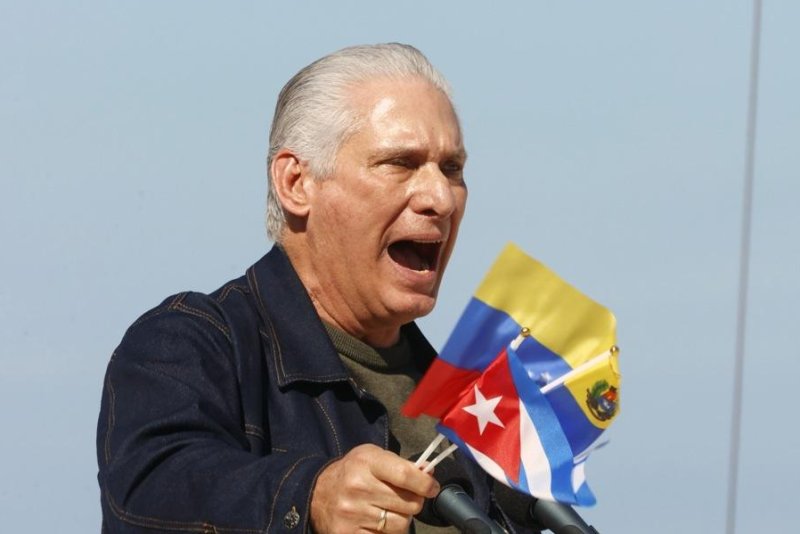
Cuba refuses to accept a dialogue based on subordination. It declares it will engage in dialogue with Washington, but will not negotiate under pressure or cede its sovereignty. “We have no alternative but to resist. We must resist,” said Cuban President Miguel Díaz-Canel, who explicitly linked the defense of socialism to the defense of national independence and sovereignty. Is Cuba’s refusal to kneel to Uncle Sam the reason the U.S. strategy for Cuba recently shifted from the military option to sanctions?
“Our position is that we do not accept conditions of any kind which may affect the independence and sovereignty of our country just with the view to solve economic problems existing between the United States and Cuba.”—Fidel Castro
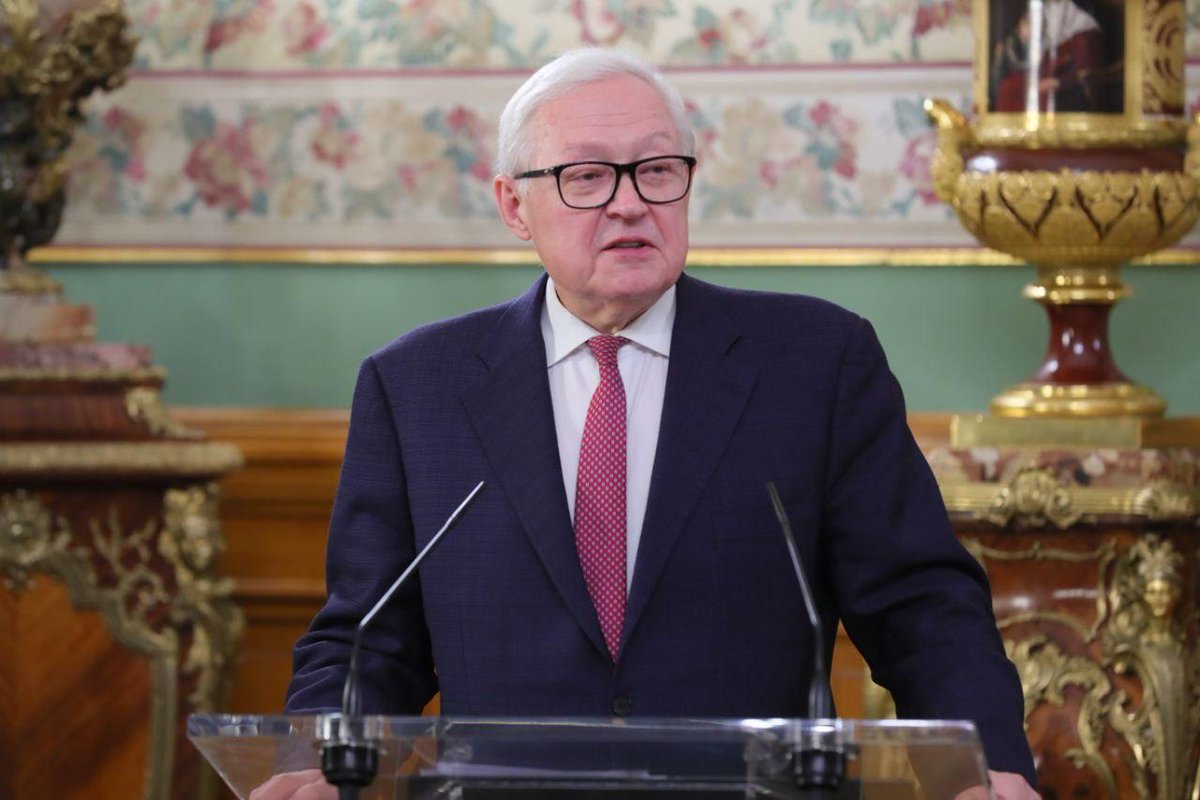
The Soviet Union helped Cuba survive its illegal sanctions, begun in 1960, but since the fall of the Soviet Union in 1991, Cuba suffered and struggled under increasing sanctions—mostly alone. In a promising new development, Russian Deputy Foreign Minister Sergei Ryabkov recently announced that Russia and Cuba will continue strengthening their strategic partnership despite attempts to undermine bilateral cooperation through intimidation and political pressure.
The Peace of Westphalia, which established the nation-states in 1648, enshrined the concept of state sovereignty into international law, which was formalized centuries later by the United Nations Charter. The founding principle was that every State, regardless of size and economic importance, has an equal right to sovereignty. This cornerstone of modern international law establishes the concept that a nation-state has supreme, independent authority over its own territory and domestic affairs.
In tragic irony, sovereignty is used to justify the right to kill in defiance of international law. Carl Schmitt, a German philosopher and jurist who joined the Nazi Party in 1933, defined sovereignty as the “power to decide the state of exception.” William Blum’s Rogue State outlines in brutal detail how the U.S. has long been a lawless state, blind to others’ sovereignty, and the devastating danger that state of exception reflects.
Recently, Marco Rubio had the audacity to claim that “The ICC [International Criminal Court] poses an intolerable threat to U.S. sovereignty.” Then on October 9, the U.S. imposed new sanctions on the ICC, apparently because the Nobel Peace Prize was awarded to Navi Pillay, a former ICC judge who once criticized Israel.
However, “The ICC is not claiming jurisdiction over conduct in the United States,” said Kenneth Roth, of Human Rights Watch. “Rubio is dressing up his quest for impunity for American war crimes under the label of national sovereignty, which ignores the sovereign right of other nations to invoke the ICC for crimes committed on their territory.” Sovereignty does not imply immunity, but accountability to the rule of law.
Vijay Prashad outlines the struggle for sovereignty in the Global South: “Can the nations of the Global South act together with sovereignty and dignity? Can they build institutions that serve their peoples rather than global capital?…A political consciousness that favours sovereignty and strategic autonomy is rising in the Global South.”
When a country gives up strategic autonomy, has it compromised its sovereignty? Prashad concludes: “The peoples of the Global South demand sovereignty, equality, and peace.” Sovereignty is becoming a mantra, though its clear meaning remains elusive.
“How does any country give up any sovereignty and expect to survive as a government?…That would be political suicide.”—Benigno Aquino III
Geopolitical analyst Pepe Escobar explored modern global sovereignty in “Eurasia, the Hegemon, and the Three Sovereigns,” asserting that true, uncompromised national sovereignty in contemporary geopolitics requires reconceptualizing the understanding of sovereignty. He addressed the need to “pierce far beyond sovereignty as interpreted in conventional political science and predominant international relations narratives.”
When does genocide of resident civilians cancel the right to sovereignty over them? Banning a native language is legally genocide. Ukraine banned the Russian language on the first day of the 2014 coup.
So did Russia violate Ukraine’s sovereignty when it began the SMO? The Donbas, after 12,000 civilian deaths in eight years, voted—overwhelmingly—to rejoin the Russian Federation. The Duma voted to accept their request for reunification.
When international law fails, with total UN abdication, and agreements like Minsk I and Minsk II are used as a ruse, how is Ukraine’s alleged sovereignty legitimate while it commits genocide against its own people?
Cuba remains a sovereign socialist country which says it will not surrender. Venezuela reminds us how quickly a revolution can be compromised when sovereignty becomes a negotiable variable. What is the “difference between sovereignty and subordination, between resistance and surrender?”
When Castro won the Cuban Revolution, he immediately distributed guns to the peasants, because he knew that he needed the people to maintain the victory. And he certainly agreed with Frederick Douglass that “It’s better to die free, than live as a slave.”
Sovereignty requires that the people of each country are free to make their own choices, without coercion or a gun to their head.
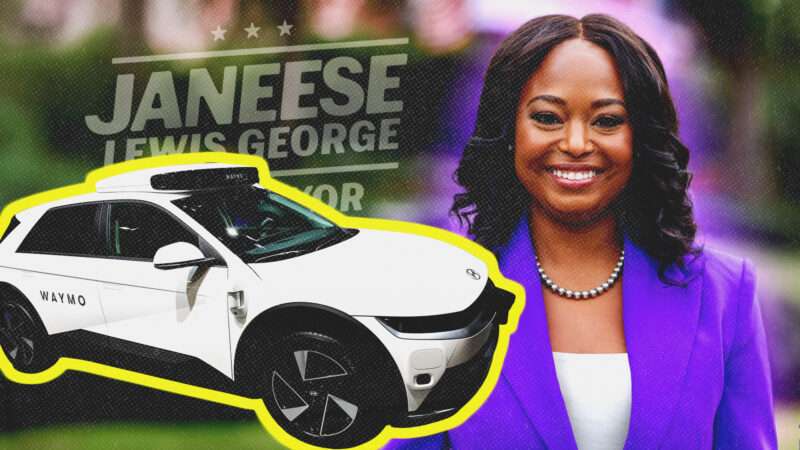
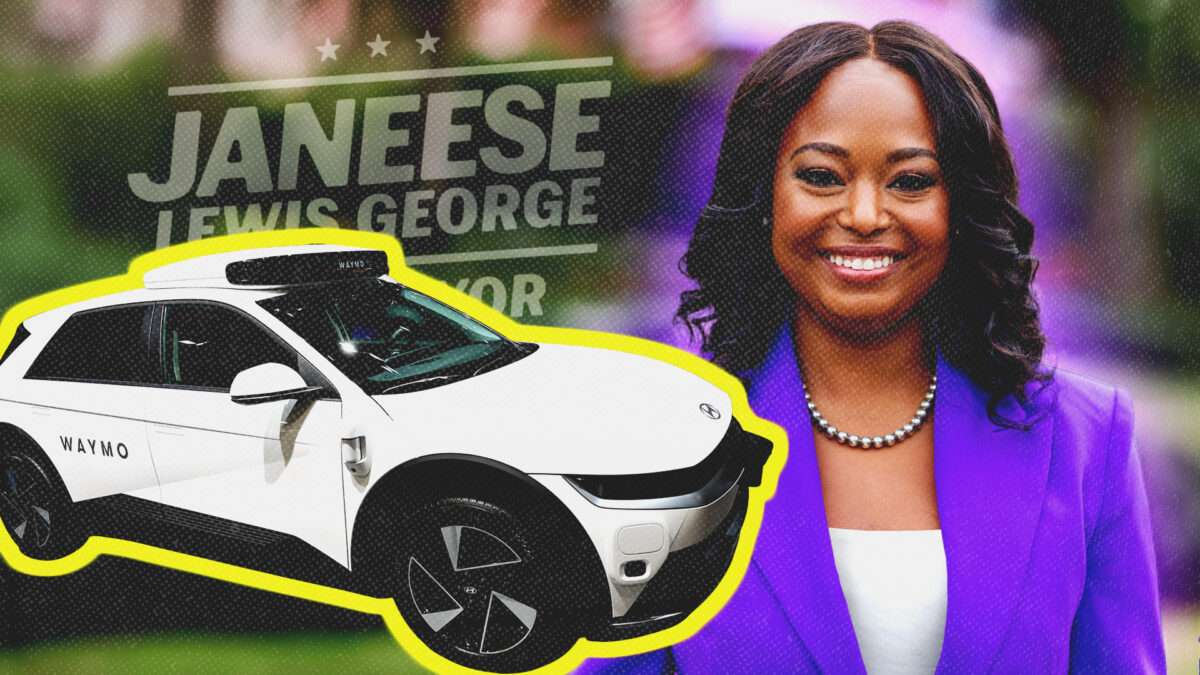
Janeese Lewis George, a D.C. councilmember and the city's presumptive next mayor, has come out against pending legislation that would allow autonomous ride-share vehicles onto city streets, citing the technology's potential to eliminate the jobs of ride-share human drivers.
"DC is facing a jobs crisis. Rushing the legalization of autonomous vehicles is irresponsible given the anticipated AI-related job displacement and disruptions that put countless workers at risk," she said on X yesterday.
DC is facing a jobs crisis.
Rushing the legalization of autonomous vehicles is irresponsible given the anticipated AI-related job displacement and disruptions that put countless workers at risk.
In a follow-up post, she said that the D.C. Council should delay consideration of a pending bill that would allow Waymo, which is currently testing its technology with human safety operators on District streets, to offer autonomous rides to the public.
Ever since Lewis George won a commanding victory in D.C.'s Democratic mayoral primary earlier this year, pundits and wonks have been trying to read the tea leaves on how the Democratic Socialist will govern.
Lewis George's comments about Waymo suggest the mayor has a deeply mistaken view about the effects and benefits of technological innovation. Contrary to her contention, Waymo legalization is unlikely to exacerbate a "jobs crisis" for at least three reasons.
The first reason she's wrong is that very few D.C. residents work full-time as ride-share drivers. On her Capital Commonsense Substack, Ashley Schapitl reports that, by Lewis George's own estimate, there are only 200 District residents who work full-time as ride-share drivers.
For comparison's sake, the District has a labor force of roughly 400,000 people. So even if Waymo displaced all human drivers in the District, it would be a statistical nonevent.
Few headlines, for instance, reported that D.C.'s labor force shrank by 1,000 people between May and June. Neither did many outlets report that the labor force grew by roughly 600 people between July and August.
Yet here the mayor is talking about a "jobs crisis" over what would be an even smaller change in the number of employed workers in the city.
The second reason not to fear an exacerbated "jobs crisis" as a result of Waymo legalization is that autonomous vehicles (A.V.s) will not completely replace human rideshare drivers in the foreseeable future.
In the cities where Waymo has been active for years, A.V.s are still responsible for a minority of rideshare rides.
That's the case in Phoenix, where Waymo has been offering autonomous commercial service since 2020. In an article from April, Business Insider cites one study that put Waymo's market share at 16 percent of ride-share rides.
In other words, 84 percent of ride-share rides are still being performed by humans a full six years after A.V.s came onto the scene.
That isn't to say the impacts of A.V.s are necessarily positive for human drivers' earnings.
Another study by Gridwise from August 2025 found that A.V.s appeared to be marginally reducing drivers' hourly pay and number of trips per hour. That's evidence of the market for rides becoming more competitive, but it's not, as of yet, evidence of a job apocalypse.
Network design matters too. In places like Los Angeles and San Francisco, Waymo is a standalone competitor to traditional ride-share companies like Uber and Lyft. In Austin and Phoenix, Waymo partners with Uber to offer rides on hybrid human-and-A.V. networks.
A report by EnoTrans, funded by a grant from Lyft, found that the later cities' hybrid networks actually increased human drivers' trips per hour. Their pay-per-hour fell, albeit less steeply than in cities without hybrid networks.
All of that is to say that while Waymo, as a competitor to human-operated ride-share services, shouldn't be expected to have a positive impact on drivers' earnings. It shouldn't be expected to have a catastrophic impact on them either.
The third and final reason that Lewis George is wrong to think that Waymo will worsen a coming "jobs crisis" is that Waymo's employment impacts are not limited to its effect on competing human drivers.
If Waymo earns any market share at all, it'll be because it's offering some travelers a better transportation option than the ones that currently exist. Increased ease of travel within the city would be expected to raise employment levels, not lower them.
If Waymo makes it easier or cheaper for people to get from home to the office or from the office to their kids' school, they might be more willing to live in D.C. over Arlington or Silver Spring. If it's more convenient to get to the movies or dinner, residents will be more willing to patronize local businesses.
None of that even touches on the economic and human benefits of Waymo's likely positive impact on road safety.
The direct effects of Waymo on drivers' employment must be weighed against all the other economic activity that autonomous vehicles will facilitate.
In the long run, the economic effects of autonomous vehicles may well be revolutionary. In the foreseeable future, they'll make the market for for-hire rides slightly more competitive.
A reasonable assumption then is that Waymo will have a modest, but positive, impact on overall economic activity and employment in the District, even if it has a modest, but negative, impact on the small number of full-time ride-share drivers who live here.
If the new mayor can't even tolerate that level of economic disruption, that does not portend good things for D.C.'s economy under a Lewis George administration.
Amidst all the sentimental populist fluff, a political theory of sorts could be discerned in Andy Burnham's conference speech, says Professor James Alexander. Let's call him Our Andy-with-his-10-year-Plandy.

 Login