❌

Reading view

Cyprus unemployment holds at 4 per cent, well below EU average

Cyprus’ unemployment rate remained at 4 per cent in September 2026, unchanged from August and below the 4.2 per cent recorded a year earlier, while youth unemployment stayed at 11.3 per cent, according to figures published by Eurostat on Friday.

The number of unemployed people in Cyprus stood at approximately 21,000 in September, down from around 22,000 in September 2025, as the labour market continued to perform better than the European Union average.

The figures also showed that youth unemployment in Cyprus declined over the past year, with the number of unemployed people aged under 25 falling from approximately 4,000 in September 2025 to 3,000 in June 2026, where it remained through September.

Across the EU, however, unemployment increased over the year, with the overall rate reaching 6.2 per cent in September, compared with 6 per cent in the same month of 2025.

The euro area unemployment rate stood at 6.5 per cent, unchanged from August but higher than the 6.3 per cent recorded a year earlier.

Eurostat, the statistical office of the European Union, estimated that 13.773 million people were unemployed across the EU in September, including 11.555 million in the euro area.

Compared with August, the number of unemployed people increased by 105,000 across the EU and by 122,000 in the euro area.

On an annual basis, unemployment rose by 471,000 across the EU and by 420,000 in the euro area.

Cyprus unemployment remains below EU average

Cyprus’ unemployment rate declined from 4.2 per cent in September 2025 to 3.8 per cent in June 2026, before edging up to 3.9 per cent in July and reaching 4 per cent in August, where it remained in September.

The number of unemployed people followed a similar pattern, falling from approximately 22,000 in September 2025 to 21,000 in June and July 2026.

The figure increased to around 22,000 in August before returning to approximately 21,000 in September.

The latest figures place Cyprus’ unemployment rate 2.2 percentage points below the EU average and 2.5 percentage points below the euro area rate.

While the EU and euro area have experienced an increase in unemployment over the past year, Cyprus’ rate has declined, indicating comparatively favourable labour market conditions.

Youth unemployment remains lower in Cyprus

The unemployment rate among people aged under 25 in Cyprus stood at 11.3 per cent in September 2026, unchanged from July and August and below the 12.9 per cent recorded in September 2025.

The rate had fallen to 11.8 per cent by June 2026 before declining further to 11.3 per cent in July.

The number of unemployed young people also decreased over the year, from approximately 4,000 in September 2025 to 3,000 in June 2026, remaining at that level through September.

The figures compare favourably with the wider European picture, where youth unemployment continued to rise.

Across the EU, the youth unemployment rate reached 15.5 per cent in September, up from 15.4 per cent in August.

In the euro area, the rate increased to 15.4 per cent from 15.1 per cent in the previous month.

Eurostat estimated that 3.022 million people aged under 25 were unemployed across the EU in September, including 2.469 million in the euro area.

Compared with August, youth unemployment increased by 44,000 across the EU and by 69,000 in the euro area.

Compared with September 2025, the number of unemployed young people rose by 45,000 in the EU and by 80,000 in the euro area.

Unemployment among women and men

The unemployment rate for men in Cyprus stood at 3.7 per cent in September 2026, unchanged from July and August, after declining from 4 per cent in September 2025 to 3.6 per cent in June 2026.

Among women, the rate reached 4.3 per cent in September, down from 4.4 per cent a year earlier.

Female unemployment had fallen to 4.1 per cent in June 2026 before increasing to 4.2 per cent in July and 4.4 per cent in August, then edging down in September.

The figures show that the unemployment rate for women remained higher than that for men in Cyprus, although the difference narrowed slightly in September.

Across the EU, the unemployment rate for women stood at 6.4 per cent in September, while the rate for men was 6 per cent, with both unchanged from the previous month.

In the euro area, female unemployment remained at 6.7 per cent, while the male rate increased to 6.4 per cent from 6.3 per cent in August.

European unemployment rises over the year

The wider European figures showed a gradual increase in unemployment compared with September 2025, despite rates remaining stable between August and September 2026.

In the euro area, the unemployment rate rose from 6.3 per cent in September 2025 to 6.4 per cent in June 2026, before reaching 6.5 per cent in July and remaining at that level through September.

The number of unemployed people in the euro area increased from 11.135 million in September 2025 to 11.555 million in September 2026.

Across the EU, the unemployment rate increased from 6 per cent in September 2025 to 6.2 per cent in June 2026, remaining at 6.2 per cent through September.

The total number of unemployed people across the bloc rose from 13.302 million to 13.773 million over the same period.

The latest figures therefore highlight a contrast between Cyprus, where overall unemployment and youth joblessness remained below their levels a year earlier, and the wider EU, where both the number of unemployed people and the overall rate increased.


  •  

From Brussels to Belgrade: Europe’s Generation Z Protests Challenge Established Politics

Youth-led demonstrations across Europe are bringing together concerns about housing, education, employment and political accountability. Although the movements differ considerably between countries, their emergence reflects growing dissatisfaction among younger Europeans over economic prospects and their influence on political decisions.

A series of demonstrations involving young people across Europe has developed into a wider political phenomenon, as students and younger workers challenge governments over living costs, public services and their expectations for the future.

Protests have taken place in France, Belgium, Italy, Albania and several other countries, while a student-led movement in Serbia has achieved a particularly consequential political outcome.

In Serbia, nearly two years of demonstrations culminated in a parliamentary election victory for a student-backed political movement, ending the electoral dominance of President Aleksandar Vučić’s Serbian Progressive Party.

The outcome, reported by Reuters on 29 October, has given the movement a prospective parliamentary majority, although final certification of the election results remains outstanding.

Elsewhere, protesters have secured fewer immediate political concessions.

Nevertheless, their campaigns share a recurring concern: that conventional channels of political representation have failed to address problems affecting younger generations.

Economic Pressures Behind the Demonstrations

The grievances vary between countries, but housing affordability, insecure employment, education funding and living costs feature prominently.

A European Parliament youth survey published in February 2025 found that 40 per cent of respondents aged 16 to 30 considered rising prices and the cost of living a priority for the EU.

Almost one-third identified economic conditions and job creation as a principal concern, while education also ranked prominently.

More recent figures illustrate the financial pressures confronting younger Europeans.

According to Eurostat data published in June 2026, 24.2 per cent of EU residents aged 15 to 29 were at risk of poverty or social exclusion in 2025.

That compares with 20.9 per cent for the population as a whole.

These figures do not establish that economic hardship is the cause of every protest. They do, however, provide context for the dissatisfaction expressed by participants.

Belgium’s Students Demand Better Education

In Brussels, demonstrations have focused partly on the condition of schools and the availability of educational resources.

Students have criticised deteriorating facilities, shortages of teachers and government decisions affecting education funding.

Nineteen-year-old student Maya Gourdel told Reuters that peaceful attempts to draw attention to these concerns had attracted little response from political leaders.

Her account reflects a wider frustration among demonstrators who believe that public attention has increased only after protests became more disruptive.

Belgium’s education system is organised primarily at community level, meaning decisions concerning funding, staffing and school infrastructure are divided among different authorities.

The demands of protesters consequently involve both national political debates and decisions taken by regional and community institutions.

France and Italy Face Wider Social Unrest

In France, demonstrations concerning the cost of living and public services have involved students alongside trade unions and other organisations.

Recent protests have also been accompanied by violence, including attacks on commercial premises and confrontations with police.

The involvement of younger demonstrators does not mean that every participant supports violent tactics.

Rather, the events illustrate how movements with economic and political grievances can encompass groups with different objectives and methods.

Italy has experienced similar tensions, particularly in Milan, where demonstrations against rising living costs have followed earlier episodes of unrest.

The Italian government has faced pressure over household expenditure, wages and the affordability of essential services.

These disputes have developed against a background of high energy prices and concerns about the broader economic outlook.

Albania’s Frustration With Political Institutions

In Albania, student-led protests have challenged Prime Minister Edi Rama’s government over alleged corruption, limited employment opportunities and education standards.

Demonstrations that began in Tirana have spread to other cities.

On 29 October, opposition lawmakers disrupted proceedings in parliament following weeks of protests and confrontations between demonstrators and police.

The government has offered measures intended to address economic concerns while condemning violence associated with the demonstrations.

For many younger Albanians, employment prospects are closely connected to the possibility of emigrating.

The perception that professional opportunities depend on political connections or personal networks has become another source of dissatisfaction.

However, the Albanian movement cannot be treated as identical to protests in EU member states, given the country’s different economic conditions and political institutions.

Serbia Shows the Political Potential of Student Movements

Serbia provides the most substantial example of youth-led protest translating into electoral change.

The movement emerged after the collapse of a railway station canopy in Novi Sad in November 2024, which killed 16 people and prompted allegations of corruption and negligence.

Students organised prolonged demonstrations demanding accountability and institutional reform.

Their campaign subsequently developed into an electoral challenge to the governing Serbian Progressive Party.

Preliminary results from the October 2026 parliamentary election indicate that the student-backed list has secured a majority of seats.

However, electoral certification and the formation of a new government remain incomplete.

The movement now faces a different challenge: converting protest demands into administrative decisions, legislation and economic policy.

Its success will be judged not only by the election result but also by its ability to govern.

A Generational Shift, But Not a Single Movement

It would be misleading to describe Europe’s demonstrations as a unified political campaign.

Participants have different objectives, national circumstances and ideological positions.

Some demand increased public expenditure, while others concentrate on corruption, political accountability or employment opportunities.

What connects them is a recurring concern about whether established institutions respond adequately to younger citizens.

The political consequences will depend on whether demonstrations produce lasting organisations, influence elections or secure changes in government policy.

Serbia suggests that student mobilisation can translate into substantial political change.

For governments elsewhere in Europe, the question is whether the grievances driving these movements can be addressed through existing political institutions before dissatisfaction generates further unrest.

  •  

Republican voters are getting worried about high costs as inflation stings and the midterms approach

A hand in a plaid shirt holding a fuel nozzle refueling a car at a gas station pump. Bright day with a visible station backdrop.
Rising costs are weighing on Republican voters.

Lajst/Getty Images

  • Republicans are feeling the strain of rising costs, with more saying it's a drag on their finances.
  • Those voters are feeling generally bad about the economy as key midterm elections loom.
  • Voters not approving of the party in power is common; what's unclear is how it'll play out.

Republicans are feeling the high-cost crunch.

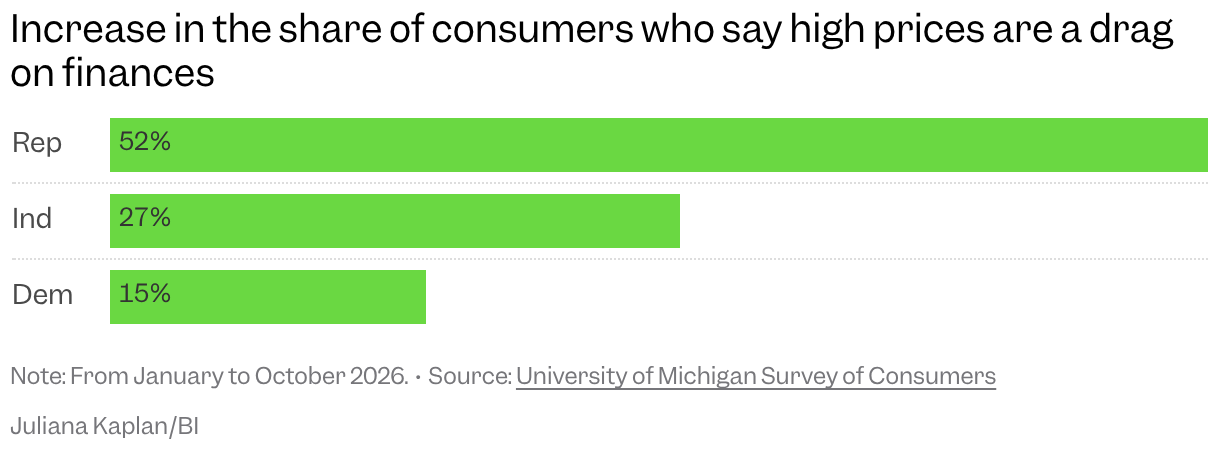
The latest consumer sentiment reading out of the University of Michigan finds that, across the board, Americans are still feeling bad. While self-identified Republicans still feel better than their Democratic and Independent counterparts, they're increasingly feeling the pinch of rising prices.

From January to October 2026, the share of Republicans citing high prices as a drag on their finances rose the most out of all political factions. It's a sign that, even as their party holds Congress and the White House, Republican voters might still be feeling the heat — especially as inflation continues to rise.

Bar Chart

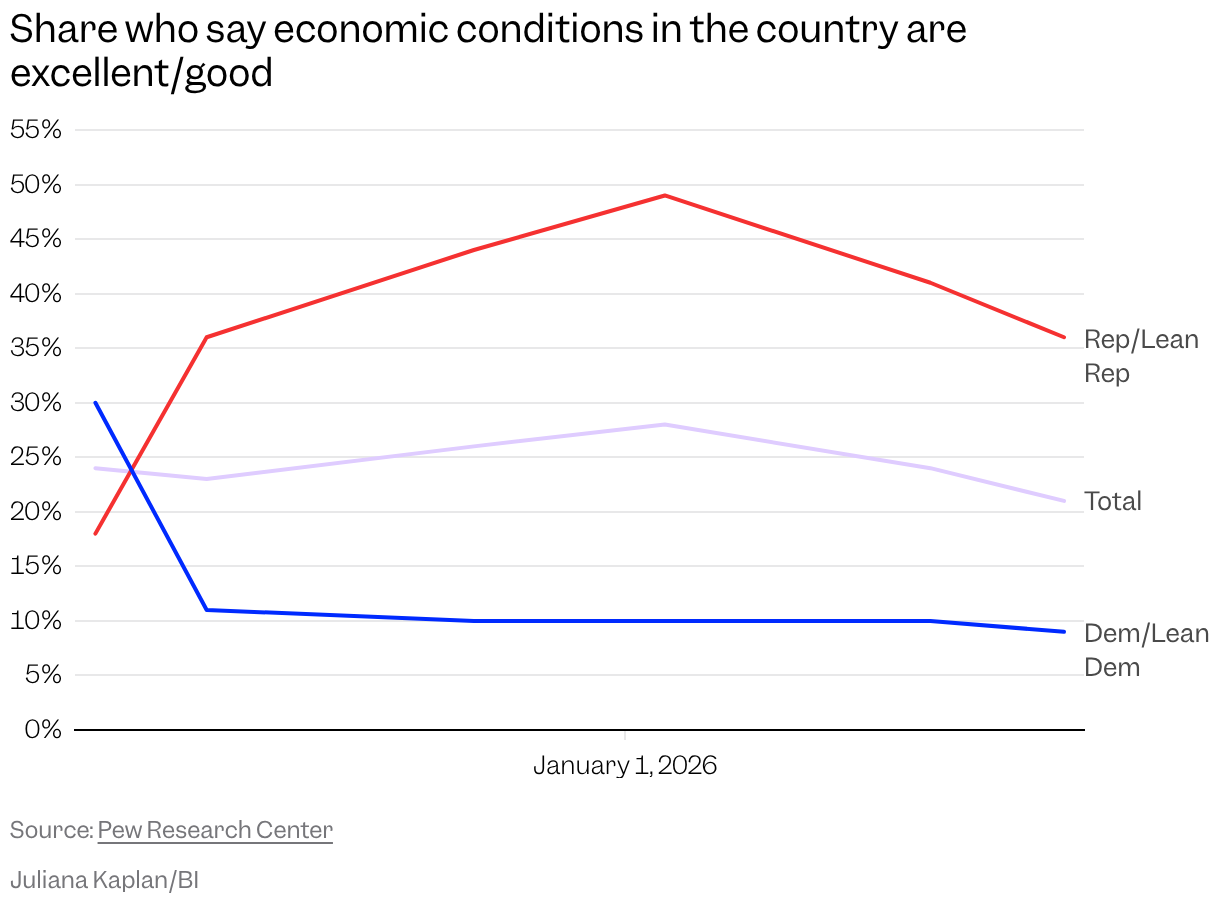
And, more broadly, Republicans seem to be souring on economic conditions. A Pew Research survey of 5,062 American adults from September 28 to October 4 found that Republicans, and those who lean Republican, were becoming less likely to say that economic conditions in the country are good.

Line chart

Historically, consumer sentiment and surveys asking voters about economic conditions tend to have strong partisan correlations. Democrats are more likely to say that the economy is doing well and they're optimistic about the future when a Democrat is president; Republicans do the same when the GOP holds the White House.

The shift in Republican sentiment illustrates just how bad Americans at large are feeling about the economy. A similar downshift happened among Democrats amid the inflationary spike during President Joe Biden's term.

"President Trump has implemented an aggressive, pro-growth economic agenda that has blunted Biden's historic 40-year high inflation crisis, driven economic growth, increased wages and created private-sector jobs in areas that had been hollowed out and shipped overseas," White House spokesman Matthew Middleton said in a statement. "The President has always been clear about temporary disruptions as a result of the Iran conflict, but this administration will continue to deliver economic wins for the American people over the next two years."

While 18% of Republicans surveyed by Pew in January 2026 said that President Donald Trump's economic policies have made economic conditions worse, that share grew to 35% in October 2026. Similarly, an increasing share — 14% in January versus 25% in October — said that they expect economic conditions to be worse a year from now.

Similarly, polling from SSRS's Economic Attitudes Tracker found that Republicans are now more likely to describe the economy as bad than good — and the share of Independents who think the economy is good has plummeted to 12%, compared to a high of 25% in August 2025.

The cost concerns come as Iran War volatility — and the resulting fallout on energy prices — kept inflation high. In September, the consumer price index accelerated more than anticipated, with skyrocketing energy prices driving the increase. That means that, for the sixth month in a row, inflation has outpaced wage increases. Meanwhile, the labor market is floundering, with the country adding a paltry 29,000 payrolls in September — a far cry from the 90,000 roles economists predicted.

Midterm Election Day is a week away, and partisan sentiment around prices is shaping up to be especially important at the ballot box. Affordability messaging has become a touchpoint in swing state elections, with lawmakers on both sides of the aisle clamoring to show how their policies have and will bring down everyday costs.

But the declining sentiment among even the Republican base could be a warning sign for conservatives: An Ipsos/Washington Post/ABC News poll found that, in April, 34% of respondents said they trusted Republicans to do a better job of handling the economy, compared to 33% saying the same of Democrats. As of October 13, that had flipped. Just 28% of respondents said they'd trust Republicans to handle the economy better, while 37% said they'd trust the Democrats.

Read the original article on Business Insider

  •  

Bill Gates predicts 20 years of turmoil before AI creates 'true abundance'

Microsoft cofounder Bill Gates.

Fabrice COFFRINI / AFP via Getty Images

  • Bill Gates says AI will bring about an age of abundance in 20 years, but it'll be a rocky road.
  • He predicted robots will displace human workers and "build houses, grow food, do surgery."
  • Some jobs might be reserved for people, and work limits could preserve employment, Gates said.

Bill Gates says AI will create "true abundance," but the next two decades before it arrives will be "as tumultuous a period as there's been in human history."

"My big concern is this 20-year transition period, where they'll have winners and losers and a lot of disruption," the Microsoft cofounder and billionaire philanthropist said on the latest episode of the "Decoder" podcast.

Gates echoed widespread concerns about white-collar jobs, saying that telesales, telesupport, and accounting will disappear as AI will be able to do those "radically cheaper, radically faster, and even more accurately." As for blue-collar jobs, humanoid robots will take over those, he said.

"If we don't choose to massively slow down or stop, then we will have robots that can build houses, grow food, do surgery," Gates said. "And none of the things that human labor provides to the economy will be necessary for most goods and services."

He also underscored how jarring it will be for someone like him, whose vast resources have allowed him to lead the charge toward eliminating malaria and tackling other humanitarian crises.

"And when the AI says to me, 'No, I'm better than you, you go play pickleball and I'll get back to you, I'm gonna take care of this' — I mean, it's kind of humorous, but it's not humorous," he said.

Gates shared his long-held view that work is vital to giving people a sense of purpose, a way to earn an income, a reason to show up every day, an avenue to build relationships with colleagues, and a path to build things and solve problems.

He suggested that certain activities such as art, sports, cooking, and childcare could one day be reserved for humans, "even though the AI could do those things better."

Gates also highlighted that measures such as early retirement and caps on working hours could help maintain some level of human employment.

He envisioned some people saying, "Let's be like the Amish and let's only use AI for certain things," so they won't have to give up "helping each other or coming up with unique ideas."

Amazon founder Jeff Bezos and JPMorgan CEO Jamie Dimon have both proposed a shorter workweek as a less painful alternative to AI-driven unemployment.

Gates is one of several tech leaders to warn of job disruption on the road to an age of abundance.

Elon Musk has predicted a "bumpy" transition and proposed government checks for all as the best solution to AI-driven job losses. He's said that technology will drive production costs so low that everyone can have "whatever stuff they want," work will become "optional," and it's not worth saving for retirement in 10 or 20 years as money won't matter.

Similarly, Anthropic's Dario Amodei has said that AI promises to "raise the quality of life for everyone," but the "short-term shock will be unprecedented in size."

However, OpenAI's Sam Altman said in May that AI hasn't eliminated as many white-collar jobs as he expected, and he no longer anticipates a "jobs apocalypse."

Despite widespread worry about AI taking corporate jobs, and high-profile layoffs at major companies such as Amazon and Meta, national unemployment hasn't increased materially during the AI boom.

Read the original article on Business Insider

  •  

I held senior roles at Bank of America and EY. At 56, I can't find a job, and it led to a bit of a midlife crisis.

MacDermott
Siobhan MacDermott

Gabriela Hasbun for BI

This as-told-to essay is based on a conversation with Siobhan MacDermott, a 56-year-old tech founder based in Menlo Park, California. It's been edited for length and clarity.

I've never been underqualified for any job that I've applied to.

I was vice chair at Bank of America and principal at EY. I held senior roles in cybersecurity at AVG and McAfee. I've sat in boardrooms with Fortune 500 CEOs, advised governments, and built practices from scratch.

Then, in early 2024, when I was 54, I had to relocate from New York City to California for family reasons, leaving the management consulting job I'd held as a partner at The Consello Group. I didn't anticipate what could happen when someone tries to re-enter the institutional world in their 50s — particularly as a woman in a career space that doesn't fit neatly into a job description.

The most surprising barrier has been the gap between what I've actually done and what the market knows how to categorize. I'm worried because I'm not sure where the economy is heading, but I'm an absolute eternal optimist.

I'm not going to accept anything other than staying hopeful.

I felt like my job application was going into the ether

It's been frustrating to watch organizations that desperately need exactly what I've built not hire me.

When I started my job search, I reached out to my network to try to figure out what I could do, who'd vouch for me, and where open positions were. A lot of senior roles were being downsized, but I had a lot of people who initially wanted to help me find something.

The strategies that were a complete waste of time were LinkedIn Easy Apply, recruiter calls that went nowhere, and any process that involved a 45-minute competency-based interview with someone who'd never heard of the big companies I've worked for.

MacDermott
Despite her

GabrielaHasbun for BI

I spent the better portion of every day for over a year applying and looking for jobs. I obsessively searched on LinkedIn for new positions, applying over and over again on the site, company websites, emails, and more, but getting nowhere.

I sent out countless résumés and barely got any responses. These are jobs that I know I'm qualified or overqualified to do, but sometimes I didn't even get the courtesy of the automated "thank you for applying" response.

It was like my application went into the ether. I'd try to find the head of HR for these companies on LinkedIn and reach out to them because I wanted the feedback.

I started trying to think of interesting ways to get attention

The strategy that worked the best during my job search was bypassing HR entirely and using direct outreach to CEOs and board members.

I'd send them letters not even related to a job, but more of an observation of their company to get their attention. I tried to be crafty, saying, "Based on my external assessment of your company, here are some things that I think you should be doing as you think through your next quarter."

Reaching out to CEOs got me in the door, but then they'd send me down to somebody who was pretty junior who'd say, "You're overqualified for this job." They'd courtesy interview me because they'd been told to, but it didn't go beyond that.

Sometimes a CEO would send me to HR, and HR would look at my skill set and say, "It doesn't quite match."

That happened quite a few times.

I adjusted my LinkedIn profile to get a better response, and that helped

I changed my gender to male and back to female a bunch of times to see if it made a difference — I didn't change my pronouns, just my actual gender. I felt like I had more responses on LinkedIn being thought to be male than female.

I also think being in Silicon Valley, you age out a lot faster than you do in other parts of the US, and it's definitely a highly male- dominated space. I had those two things working against me from the get-go.

So I removed the first six years of my career from my work experience on LinkedIn, and I took the dates off of my degrees so that people couldn't tell my age. This made me seem seven to 10 years younger, potentially. Once I took those dates off, I felt like I got more engagement on the site.

My job search in Silicon Valley went nowhere, so I decided to pivot and launch my own venture

I started my company out of necessity, and also out of intellectual boredom. I felt like my brain was starting to rot.

It happened about a year into job searching, when I started feeling financial pressure and frustration. I didn't want my full-time job to be looking for a job. My search wasn't looking like it was going anywhere in the foreseeable future, especially out in Silicon Valley. If you're a computer scientist or an engineer, there are jobs available, but I couldn't find a lot out here not in that space.

I started thinking, what am I good at? What do I know? What are all the pieces that I could put together? What problem can I identify that needs to be solved? That came together pretty quickly, and I launched two companies — Khaos Holdings, a strategic risk-intelligence company, and TeenAegis, a child-safety intelligence business, in January.

We're raising capital, and if the capital comes in, that will be the end of my job search. If the capital doesn't come in, then I'll keep searching — but I've decided that whatever I do will be adjacent to the problem I'm trying to solve now.

MacDermott

Gabriela Hasbun for BI

One good thing came out of the 2 years since my last job

Being out of work for two years shifted my retirement timeline eight to 10 years from digging into savings. However, since my job search started, I've really homed in on what I want to do with the rest of my career.

The journey I went on was a little bit of a midlife crisis. I asked myself, "What's my purpose in life?" as opposed to "What job do I want to have?" and then identified what skill set could bring me to that.

What led me to where I am was really thinking through questions like: What are all the issues that matter to me? What legacy do I want to leave? How do I want to think about my future for the next 10 or 15 years? How do I want to show up every day?

In the beginning, I was going to apply to anything that I could qualify for that would get me some money. Now I'm not going to do that because I don't think that's going to actually be fulfilling or make me happy. My sense of stability has required a deliberate reframe — from "security comes from a salary" to "security comes from what I've built and what I know."

I'm determined to make this work, but I also realize it may not

The hardest thing is maintaining a positive attitude day after day. If my company doesn't work out, then it's not like I can stop trying.

Taking mental health breaks is important because it's overwhelming, lonely, and hard. You lose your sense of self-worth when you're in this position; people look at you like, "Oh, you're the person who's still looking for a job." So it's hard to continue to put yourself out there.

Still, I do believe there's light at the end of the tunnel. It's just the question of how long the tunnel is.

Do you have a story to share about navigating your career in your 50s? If so, please reach out to the editor, Manseen Logan, at mlogan@businessinsider.com.

Read the original article on Business Insider

  •  

Fearing Mass A.I. Layoffs, Some in Congress Eye Ways to Aid Workers

A bill to bolster the nation’s unemployment insurance program reflects the concern — and the risks — in Washington.

© Kenny Holston/The New York Times

A proposal by Senator Ron Wyden, Democrat of Oregon, would greatly expand the nation’s unemployment insurance program.
  •  

For Clues About How A.I. Will Change Work, Look to the Past

Economists hope earlier episodes of labor disruption, from the Industrial Revolution to the Great Depression, can help us prepare for the age of artificial intelligence.

© Illustration by Andrei Cojocaru; photos by Getty Images

  •  

Migrants Taking Four in Five New Jobs

Four in five new jobs created in Britain since 2014 were taken by migrants while the number of British people on out-of-work benefits increased by 2.3 million, according to a report from the Centre for Social Justice.

The post Migrants Taking Four in Five New Jobs appeared first on The Daily Sceptic.

  •  

Want the Highest State Pension? Don’t Bother Working Too Much

You need 35 years of National Insurance contributions to get the full state pension. Ah, says David Craig, but the unemployed get 'pension credit', which pays exactly the same and comes with piles of freebies thrown in.

The post Want the Highest State Pension? Don’t Bother Working Too Much appeared first on The Daily Sceptic.

  •  

How AI Replaced Me

For Oakland Review of Books, Stephanie Uchino-Beach writes about getting laid off at an education tech company that transformed into an “AI-first outfit.” As as customer success manager, she acted as a liaison to district administrators, school principals, and teachers. While AI could automate some of her tasks, what about the core responsibilities of her CSM role: building real relationships and understanding an educator’s needs? An AI sees data points, not people. This is a sobering read from a former tech worker living in the Bay Area, and an edtech company that has gone all in on AI and forgotten about its mission.

Before I went to work for Silicon Valley, I was a lot of things. A few jobs before this last one, I was an elementary school teacher in Chicago, helping kids learn to read, creating units, planning lessons, and buying supplies with my own money on the weekends, like countless other teachers around the country. I grew up on the Peninsula, and I made the move into Customer Success to get a job that would let me move home. Tech was never my dream; it was a means to an end. My dad studied computer science and still works in tech to this day and enjoys it, so it seemed like a satisfying and fruitful career was plausible. I figured that once I broke in, all my problems would be solved: I could get a house, have a kid, and fulfill every middle-class dream that had always felt slightly out of reach for a millennial like myself. 

And yet, job after job, I consistently left feeling unsatisfied. Unsatisfied by how I wasn’t growing and wasn’t developing my skills. Unsatisfied with poor managers who were just in the right place at the right time to be promoted but so often lacked the skills to provide the same success for their employees. Unsatisfied with how the products I worked on could do wrong by the communities we sold them to, even though every company said they were “mission-driven” and “put our customers first.” 

  •  

US enshittification vs Chinese involution

It’s getting better all the time (Better, better, better) It’s getting better all the time I admit it’s getting better –The Beatles In an X post, Marko Jukic, senior analyst at Bismarck Analysis, lamented: “Enshittification” is sort of a “safe horny” term for what is really just outright impoverishment and declining living standards due to […]

The post US enshittification vs Chinese involution appeared first on Asia Times.

  •  

A Graveyard Shift with Britain’s Gen Z Undertakers

In this story for Dispatch, Lotte Brundle reports on a surprising trend: young women in the UK are pursuing careers in the death care industry. In a time of high unemployment, funeral home apprenticeships offer an alternative to university, where students accumulate significant debt. While the pay is low and the industry needs to do a better job building awareness that the trajectory exists, the young women who speak to Brundle find the work meaningful and rewarding.

Her inspiration to become an undertaker arrived, as many teenage epiphanies now do, via TikTok. Emily was 15 and had been considering becoming a teacher or journalist when she came across an American woman documenting life inside her own funeral home. “I’d never considered it as a career,” she says. “I didn’t know anyone who was an undertaker, but I just thought how interesting it was.”

Two hours later, she was still scrolling through the woman’s profile, engrossed. Running her own funeral home became Emily’s dream.

  •  

Labour market flows in Q2 2026

Between the first and the second quarter of 2026, 3.1 million unemployed persons aged 15-74 in the EU moved into employment, representing 23.2% of all unemployed in the first quarter of 2026. During this period, 7.0 million (52.8%) remained unemployed and 3.2 million (24.0%) moved out of the labour force.

These figures are taken from recently published data on labour market flows in the second quarter of 2026. The article presents a handful of findings from the more detailed Statistics Explained article on labour market flows.

Click to enlarge

Transitions in labour market status in the EU, Q1 2026 - Q2 2026 (population aged 15-74, in millions). Chart. See link to the full dataset below.

Source dataset: lfsi_long_q

The visual and the table give an overview of all changes in labour market status. In the visual, the figures for employment, unemployment and out of the labour force refer to the number of people remaining in each status between the 2 quarters, while the arrows indicate the number of people moving from one status to another.

Click to enlarge

Changes in the labour market status in the EU in Q2 2026  (% of initial status in Q1 2026, population aged 15-74). Chart. See link to the full dataset below.

Source dataset: lfsi_long_q

Of all people in employment in the first quarter of 2026, 2.5 million (1.2%) became unemployed in the second quarter of 2026, and 4.8 million (2.3%) moved out of the labour force.

Of all people recorded as out of the labour force in the first quarter of 2026, 4.2 million (3.7%) entered employment in the second quarter of 2026 and 3.9 million (3.4%) became unemployed.

For more information

Methodological notes

  • The labour market flows published from 2021 onwards are based on the EU Labour force survey (EU-LFS) carried out under Regulation (EU) 2019/1700 on European statistics relating to persons and households, using individual-level data collected from samples. Further information on the Regulation is available in the Statistics Explained article.
  • The figures are based on seasonally adjusted data.

  •  

Gov’t spokesman proposes sharp cut of “unemployment benefits” down to just two months

Government spokesman Pavlos Marinakis triggered an outrage when he proposed that the “unemployment benefits” should last just two months in order to force jobless to take up a work. According to Greek legislation, the unemployment benefit of 526 euros per month increased by 10% for each child runs for maximum 12 months provided that the […]

The post Gov’t spokesman proposes sharp cut of “unemployment benefits” down to just two months appeared first on Keep Talking Greece.

  •  
❌