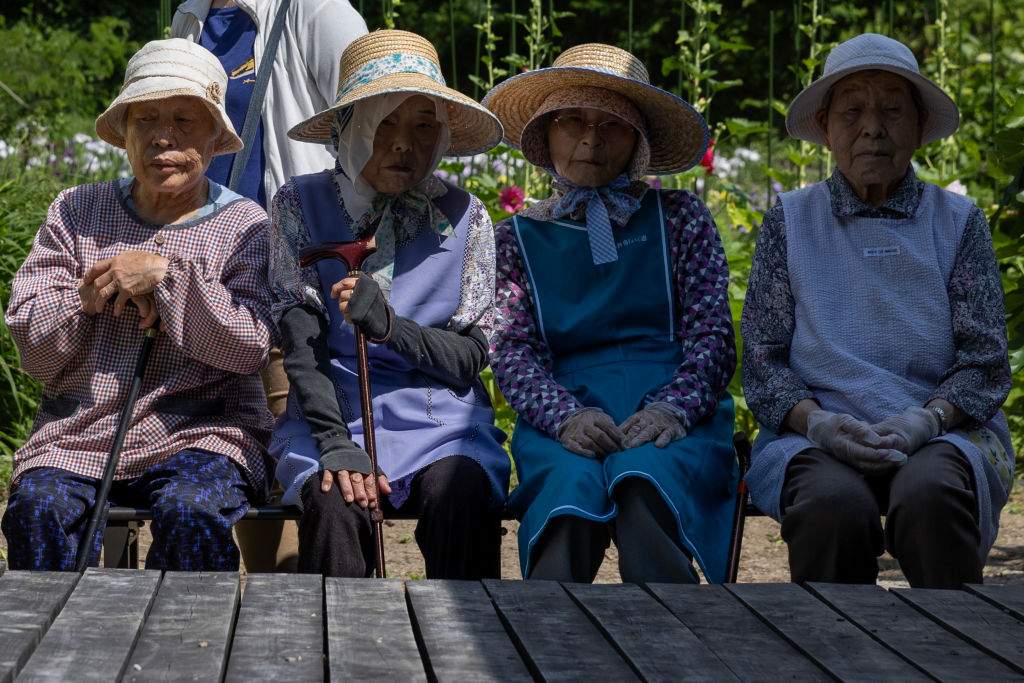
Japan's Health and Welfare Ministry statistics show that the country now has 107,677 centenarians, up 7,914 from the previous year. 88 per cent of them are women.
Japan's Health and Welfare Ministry statistics show that the country now has 107,677 centenarians, up 7,914 from the previous year. 88 per cent of them are women.
On September 1, 2026, Tokyo’s Yokoamichō Park hosted a memorial ceremony to commemorate the Koreans who succumbed to the “Kantō Massacre” that followed the Great Kantō Earthquake of 1923. The organizers of the ceremony called on the Japanese authorities to establish a full picture of what happened and to prevent a recurrence of such events. […]
The EU welcomes Cambodia’s decision to join the Multi-party Interim Appeal Arbitration Arrangement (MPIA) for WTO members, contributing to efforts to uphold a rules-based multilateral trading system.
With Cambodia’s participation, the MPIA now covers 62 World Trade Organization (WTO) members and 60.4% of world trade.
The MPIA brings together participants from all continents and at different levels of development, united by a shared commitment to upholding the rules-based trading system.
The MPIA preserves the right to appeal in trade disputes among participating WTO members, at a time when the WTO’s Appellate Body remains non-functioning. It helps ensure that disputes can continue to be resolved in an orderly and binding manner, avoiding appeals 'into the void'.
“I welcome Cambodia to the MPIA. The arrangement plays an important role in upholding the rules-based trading system. Each new participant helps reinforce the predictability, stability and credibility of global trade rules. I encourage other WTO members to join the MPIA,” said EU Trade and Economic Security Commissioner Maroš Šefčovič.
Background
The MPIA was established in 2020 and has proven its effectiveness in many WTO disputes.
Under the MPIA, appeals are heard by arbitrators randomly selected from a pool of 10 standing appeal arbitrators set up by the participating WTO members. These arbitrators are persons of recognised authority, with demonstrated expertise in law, international trade and WTO agreements.
The MPIA is open to all WTO members as a practical tool for appeal arbitration, pending the restoration of a reformed and fully functioning WTO dispute settlement system.
As of 1 June 2025, the MPIA has anupdated pool of appeal arbitrators to ensure that appeals continue to be heard by independent arbitrators of the highest calibre.
At the WTO Ministerial Conference that took place earlier this year, MPIA ministers stressed the importance of the MPIA for the security and predictability of the multilateral trading system.
The current MPIA participants are Australia, Barbados, Benin, Brazil, Cambodia, Canada, China, Chile, Colombia, Costa Rica, Ecuador, the European Union (and its Member States), Guatemala, Hong Kong (China), Iceland, Japan, Liechtenstein, Macao (China), Malaysia, Mexico, Moldova, Montenegro, New Zealand, Nicaragua, Norway, Pakistan, Paraguay, Peru, the Philippines, Singapore, Switzerland, Ukraine, the United Kingdom, Uruguay and Vietnam.
Two of the most prominent belligerents of World War II ended up clashing despite having initially fought on the same side, and it wasn’t until 1951, six years after the end of the conflict, that they signed an unusual peace. One of them was Italy, obviously, where the government that succeeded Mussolini signed an armistice […]
Der russische Außenminister Lawrow hat auf dem Östlichen Wirtschaftsforum eine Grundsatzrede über die Positionen der russischen Außenpolitik und über Russlands Antwort auf die aktuellen Eskalationsschritte der Bundesregierung gehalten. Ich übersetze hier die Zusammenfassung der Rede, die die TASS veröffentlicht hat. Beginn der Übersetzung: Lawrows Erklärungen: Die Antwort auf Berlins Vorgehen und Selenskys Drohungen Der russische […]
Aus geopolitischer Sicht ist die Genese des Ukraine-Krieges erstaunlich einfach und gradlinig: Die USA wollten ihren Konkurrenten Russland schwächen und haben dazu mit dem Maidan 2014 die Kontrolle über die Ukraine übernommen, indem sie dort ein radikal anti-russisches Regime installiert und aufgerüstet haben, wobei sie darauf geachtet haben, dass die Europäer den Löwenanteil der Kosten […]
During the medieval period and early modern Japan, decapitation was a common method of execution for criminals and defeated enemy warriors. During the feudal period, particularly under the Tokugawa shogunate (1603–1868), beheading became a standard execution method for many serious crimes.
Decapitation was also common on the battlefield. During Japan's long era of civil wars, especially the Sengoku period, warriors routinely took the heads of defeated enemies and presented to the victorious lord. For criminals or rebellious warriors, the heads were displayed publically as a warning and deterrent to others.
A Japanese block print depicting the decapitation of violent Chinese soldiers. Circa 1894. Credit: Museum of Fine Arts
 Login