No one knows how the US Supreme Court will rule in Suncor v. Boulder, the case that will kick off the court’s fall term next week and will likely decide whether the city and county of Boulder, Colorado, will be able to put oil giants ExxonMobil and Suncor Energy on trial for deceiving the public for decades about the climate harms of fossil […]
Taiwan’s new American-made F-16V Block 70 jets deliver much-needed breathing room against daily Chinese gray-zone coercion, yet surging Chinese stealth numbers and cratered runway risks mean their wartime utility would be sharply contested. Taiwan received its first two new-build Lockheed Martin F-16V Block 70 fighter jets, touching down on October 2 at Taitung’s Chihhang Air […]
A 58-year-old tourist was killed by a lightning in southern Rhodes early afternoon on Friday. The woman was walking with her husband in Lothiarika area of Laerma near Lindos in the south part of the island in the eastern Aegean Sea. She was struck by the lightning at 14:45 and died on the spot, local […]
Ferries remain docked at several ports in Greece on Friday, October 2, due to gale-force winds reaching 9 and up to 10 Beaufort locally in the Aegean Sea. A sailing ban was imposed at the ports of Rafina and Lavrio in south-eastern Attica on Friday morning, while sailings from the port of Piraeus were also […]
Greece’s National Meteorological Service EMY updated its weather warning and upgraded it to Category 5 – RED ALERT. The weather warning regards mainly the island of Crete and the Dodecanese island group and is valid from Friday to Sunday, October 2-4, 2026. According to the weather warning, heavy rainfalls, thunderstorms and gale-force winds up to […]
As global oil supplies continue to tighten up amid ongoing geopolitical conflicts that have pushed up fuel prices, the governor of Texas has declared a state of emergency.
As global oil supplies continue to tighten up amid ongoing geopolitical conflicts that have pushed up fuel prices, the governor of Texas has declared a state of emergency.
“Who wouldn’t decide to be their most expansive and radiant self?” Ah, but would you pursue that self through a sheet of tempered glass? In this literal tour de force, Katherine Cusumano shadows wrestlers navigating the independent promoters of the Pacific Northwest, granting sensational access to the lives and ambitions behind elaborate personas you’ve never heard of and will almost certainly search YouTube for. Cusumano is note-perfect on the details, taking obvious delight in the gimmicks of each wrestler’s beloved character and relishing the complexity of the choreography, rehearsed in elaborate code. (“Clothesline, crossbody in the corner, clothesline, Superman, Superman, I’m fired up, whoop, sliced bread, Ricky catches, oh shit, real fast.”) Spectacle abounds, but Cusumano rises above it, way up on the turnbuckle, with a heartening consideration of how we understand our own stories, and what we devote to realizing them.
I found myself drawn to this world, to its freakish feats of acrobatics, to its relentless and obsessive blurring of the boundary between reality and story, and, more than anything, to the supreme, sometimes monastic devotion of its competitors. I had been trying for ages to understand competition, ambition, the scaffolding that holds up good-bad, win-lose, and wrestling confounded these binaries. I started talking to Drexl, an old-timer with one foot out the door of his career, who eventually referred me to Amira, an emerging wrestler with an already impressive résumé, and I thought that was so like wrestling, to proffer such perfect narrative symmetry. They agreed—more readily than I’d expected, given how fiercely professional wrestlers have historically protected the secrets of their work—to let me follow them around. Which is how I ended up behind the curtain.
A heavy rainstorm has been sweeping across the island of Crete on Thursday with tons of water flooding homes, businesses and agricultural land, damaging roads and bridges, causing the life of one person and putting at risk the lives of thousands. Most affected are the regions of Heraklion, Lasithi and Rethymnon. Thye bad weather is […]
The U.S. is reportedly threatening to ban exports of diesel fuel to parts of Europe, unless countries like Germany and France release more of their diesel reserves.
The U.S. is reportedly threatening to ban exports of diesel fuel to parts of Europe, unless countries like Germany and France release more of their diesel reserves.
In this tense, riveting first-person excerpt from his new book This Cursed Beautiful Land: A Russian Story, Evan Gershkovich recounts the harrowing months he spent as a prisoner in Russia, leading up to his eventual release in a complex, multi-country prisoner exchange. Even in the darkness, Gershkovich offers rays of light: care packages from friends, letters by the hundred, and a cautiously blossoming love with a friend in Berlin. We may know the ending, but the details of these days reveal what it takes to get there.
A few hours after my arrival, I heard a cart rolling down the hallway. A guard opened a kormushka — a feeder window in the door about the size of a human head. A man in a chef’s uniform filled my bowl with porridge, placed a piece of rancid-smelling boiled fish on my plate and gave me some weak tea. The reality of my new surroundings slammed into me.
Thoughts ricocheted inside my head. Earlier in the day I’d had a comforting one: they’ve taken me for a swap, I told myself. That’s all this is.
Now, curled up on the bed in my 12ft by 8ft cell, knees pulled to my chest, I thought, what if the FSB really does think I’m a spy and wants to make an example out of me? Maybe they don’t want to swap me at all. Maybe I really will spend 20 years here.
On a hazy, humid Sunday morning, just before 9:30 a.m. local time, the USS Theodore Rooseveltsailed out of San Diego Bay for a much-anticipated but little-advertised deployment. The Nimitz class flagship of Carrier Strike Group 9 (CSG-9), nicknamed “The Big Stick,” departed on September 27 and is expected to head to the Middle East to relieve one of the two carriers on station supporting operations against Iran, according to USNI News. As is common with deployments from the West Coast, the departure was not announced by the Navy publicly, although there were several unconfirmed claims on social media that highlighted the impending cruise.
The three-ship Makin Island Amphibious Ready Group (ARG), packed with thousands of Marines who specialize in expeditionary operations, followed Roosevelt’s path out of the harbor the next day. While the Makin Island ARGs ultimate destination is unclear, the Boxer ARG, currently operating in the Middle East, left the United States on March 18 and is due for relief.
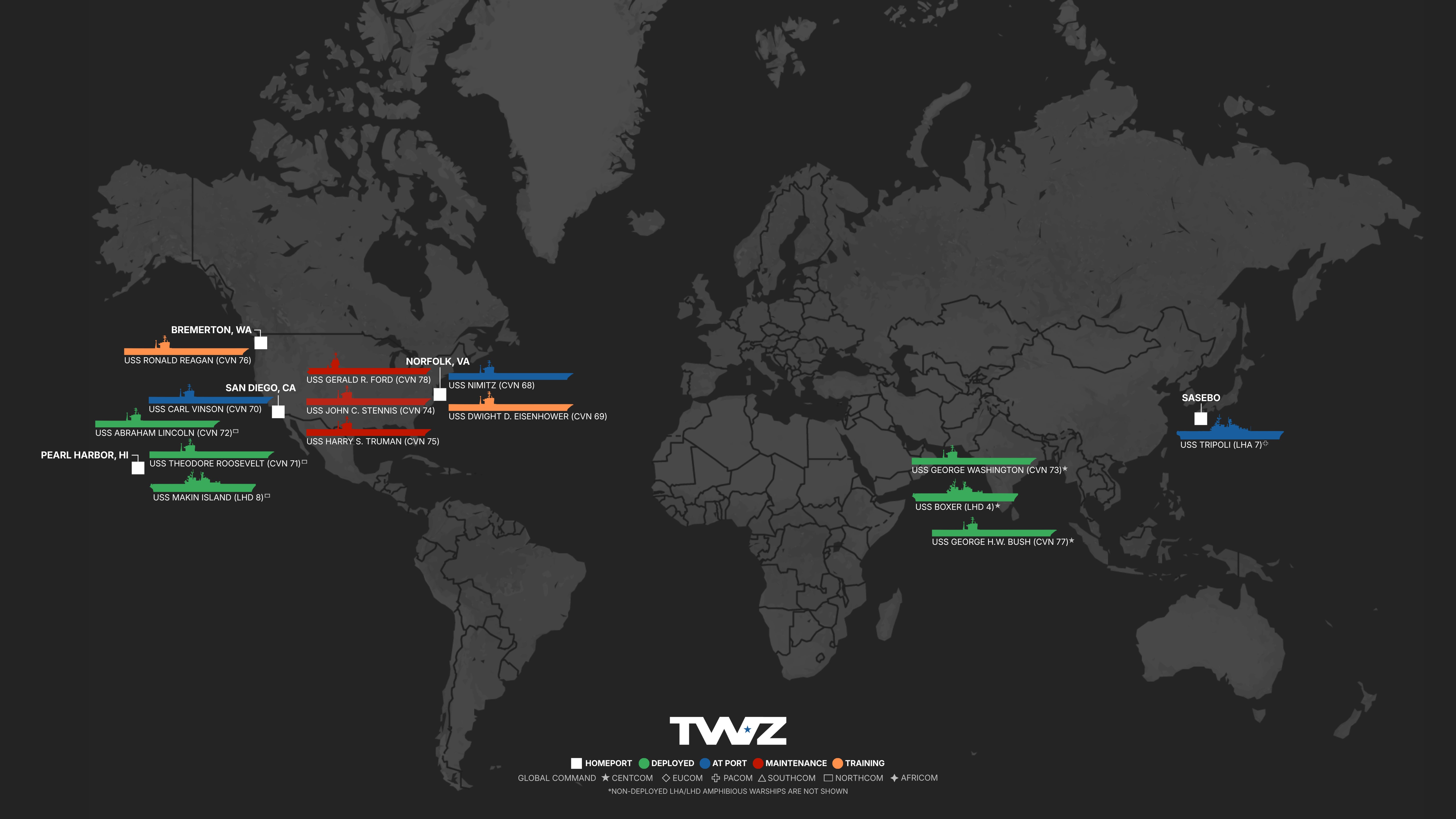
Here’s TWZ’s weekly carrier tracker monitoring America’s flattop fleet, including deployed CSGs and ARGs, using publicly available open-source information. Check out last week’s report here.
TWZ/IAN ELLIS-JONES
Theodore Roosevelt Carrier Strike Group Deploys, Reportedly Bound For The Middle East
USS Theodore Roosevelt keyed her Automatic Identification System (AIS) transponder on at 9:10 a.m. Pacific Daylight Time on September 27, broadcasting her precise position publicly via MarineTraffic, and got underway less than 20 minutes later with the help of a few tugs. The supercarrier steamed past Point Loma at seven knots before sailing west and picking up speed, topping 24 knots, then made a hard turn south and stopped transmitting on AIS roughly three hours after departing. She briefly flipped AIS back on again, 55 nautical miles southwest of her previous location, but has been dark since.
USS Theodore Roosevelt’s transit leaving San Diego. Source: MarineTraffic/KPLER (Reprinted with permission)
Three guided-missile destroyers, USS Paul Hamilton, USS Decatur, and USS Carl M. Levin, are part of CSG-9 and will escort the flattop, a Navy official confirmed to TWZ. Rounding out the five-ship CSG is Ticonderoga class guided-missile cruiser USS Chosin, which will serve as the Integrated Air and Missile Defense (IAMD) commander for the CSG. The IAMD warfare commander is responsible for coordinating air defense for the entire strike group − a vital role since Roosevelt will be entering an active combat zone. Tico cruisers have 122 Vertical Launch System (VLS) cells, more than the 90 to 96 that Arleigh Burke destroyers are equipped with, and are being retired without a comparable cruiser lined up to replace the aging fleet; however, the newest Flight III Burke destroyers will take on the air warfare commander role.
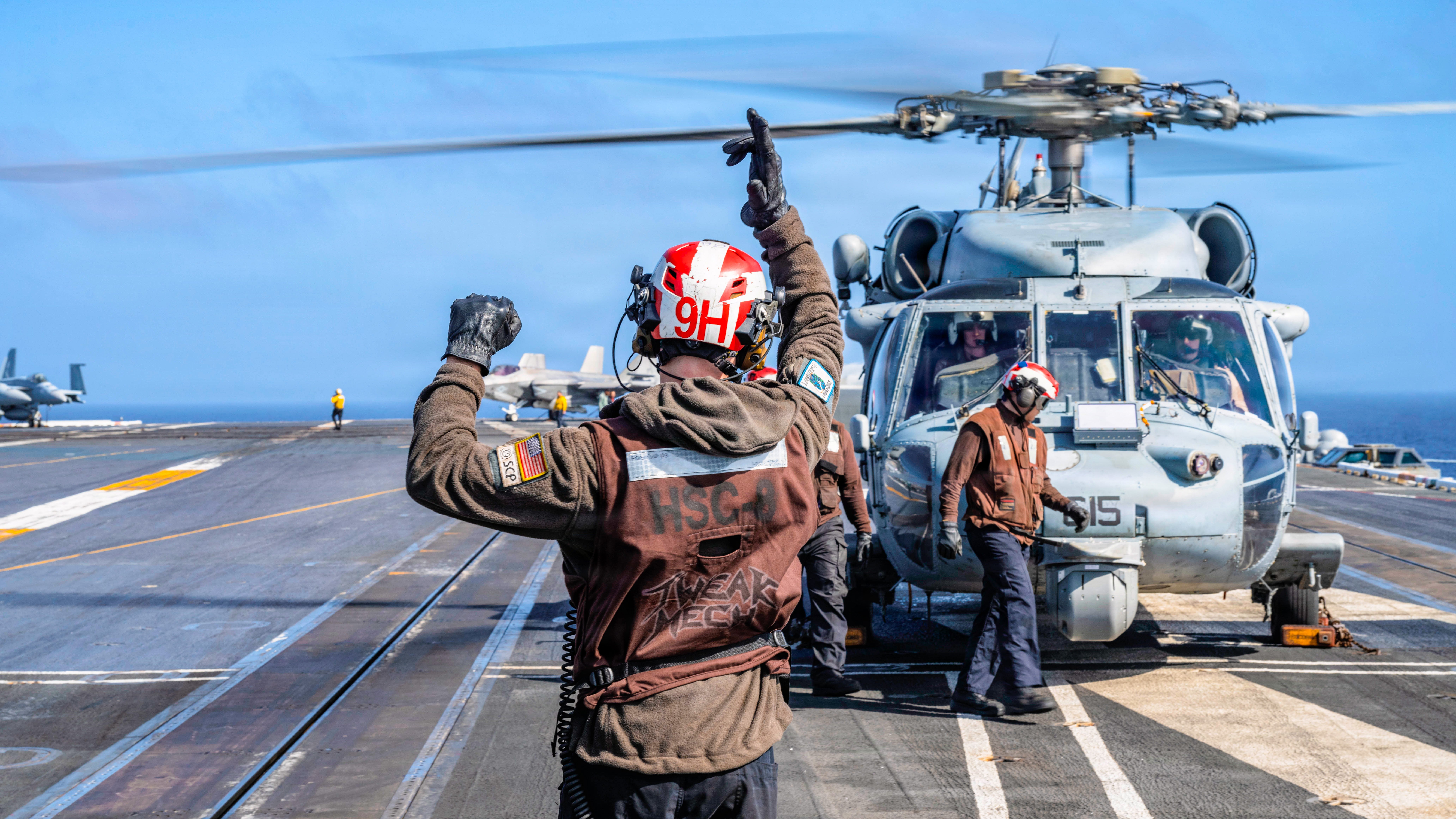
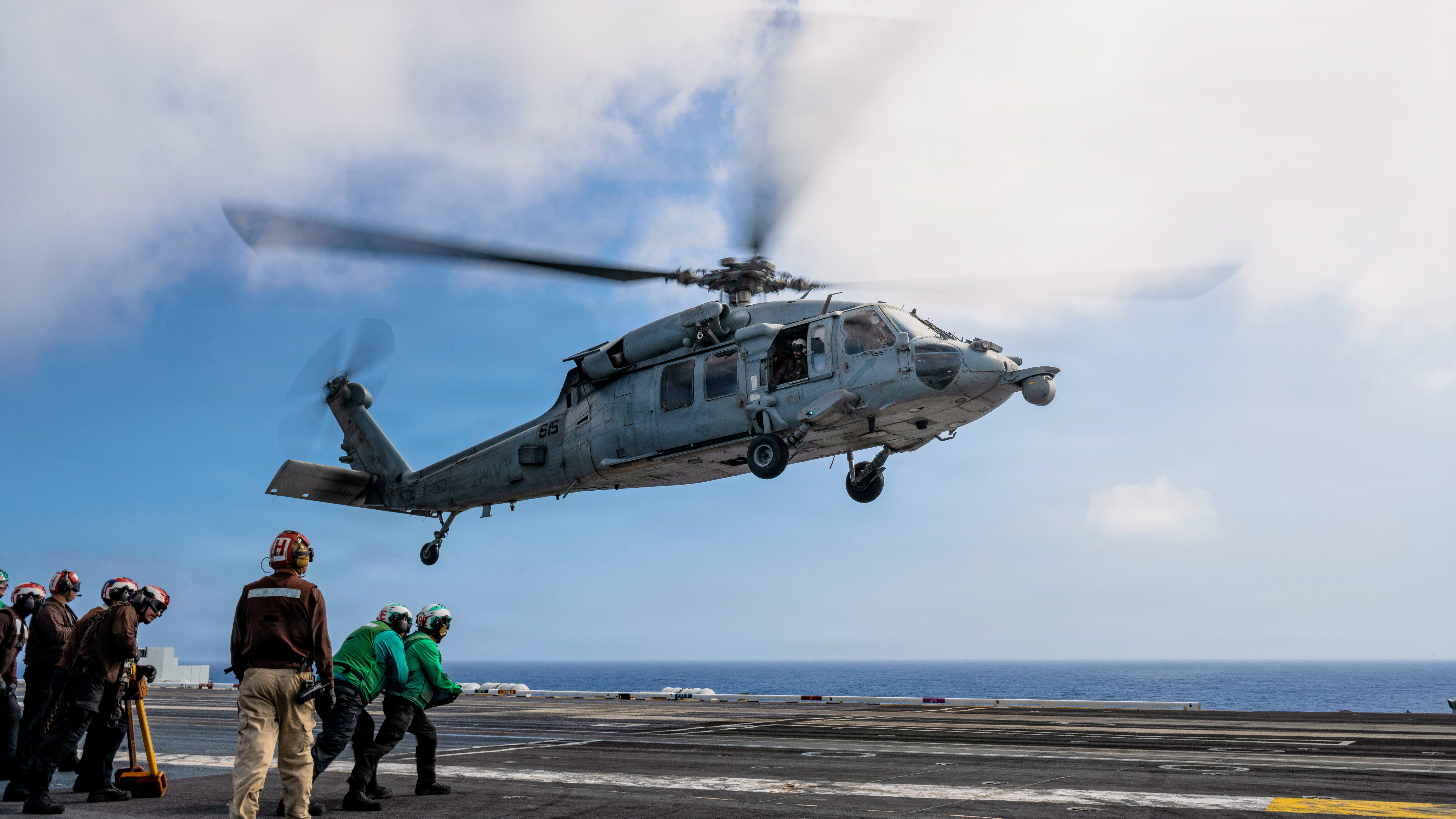
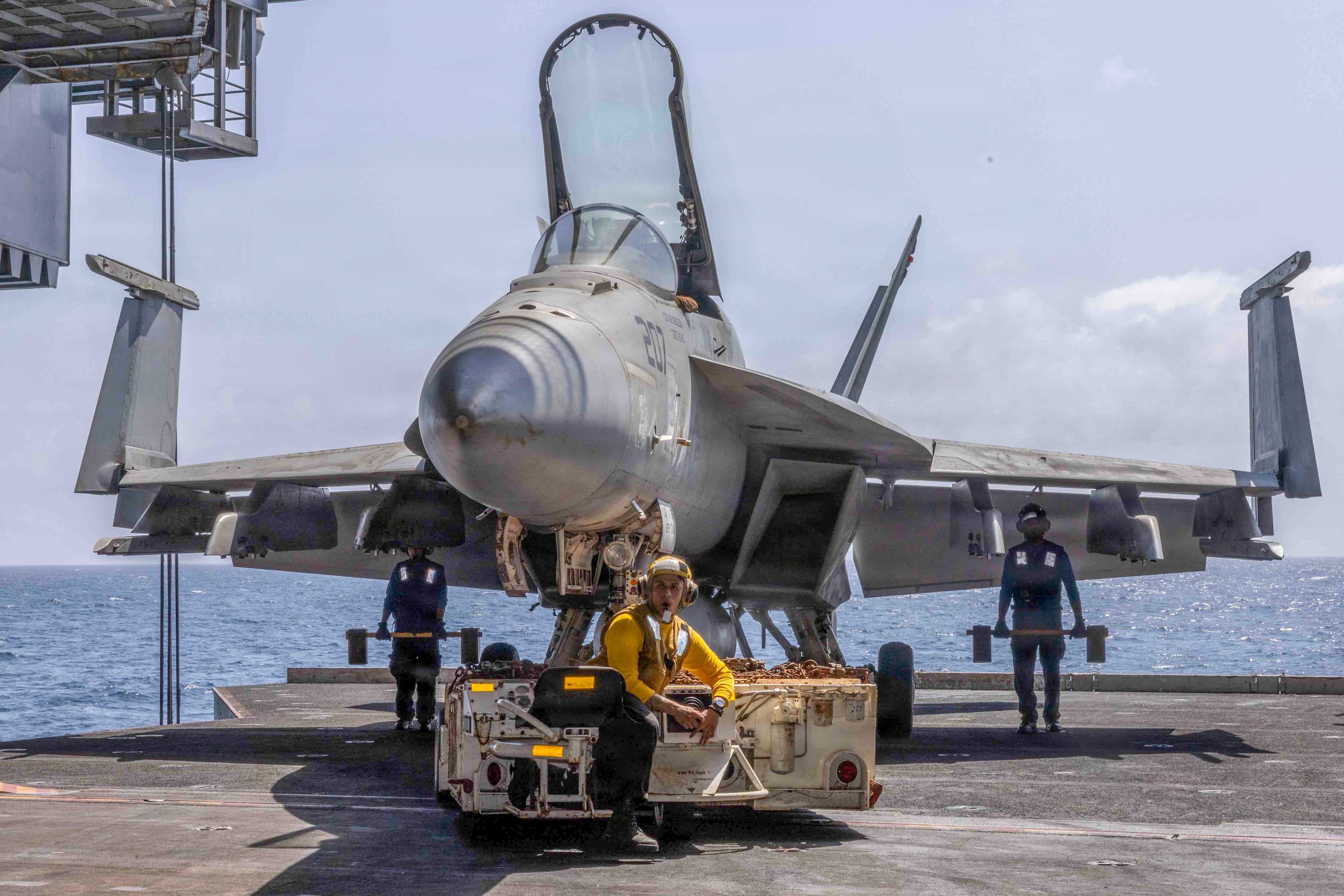
The carrier has embarked, or is in the process of taking on, Carrier Air Wing (CVW) 11 off the West Coast before beginning the long journey toward the Western Pacific. CVW 11 includes a squadron of stealthy fifth-generation F-35C Lightning IIs, in addition to three squadrons of F/A-18E/F Super Hornets and one of EA-18G Growlers. Support squadrons of E-2D Hawkeyes, MH-60R Seahawks, and MH-60S Seahawks are also aboard, as well as a detachment of CMV-22B Ospreys.
Flight deck of USS Theodore Roosevelt. U.S. Navy photo MH-60S Sea Hawk on USS Theodore Roosevelt. U.S. Navy photo
USNI News was the first outlet to confirm the deployment and suggests the CSG is headed to the Middle East. “The Theodore Roosevelt Carrier Strike Group is expected to move to U.S. Central Command to relieve the Japan-based USS George Washington (CVN-73),” they wrote in a report published on Monday.
In response to a request to confirm the deployment, the same Navy official told us: “The Theodore Roosevelt Carrier Strike Group is underway conducting routine operations in the U.S. 3rd Fleet area of operations. U.S. 3rd Fleet leads naval forces in the region and provides the realistic, relevant training necessary to execute our Navy’s role across the full spectrum of military operations – from combat operations to humanitarian assistance and disaster response. U.S. 3rd Fleet works together with allies and partners to advance freedom of navigation and overflight, the rule of law, and other principles that underpin security for the region.”
The underway was live-streamed on San Diego Web Cam, which had a few hundred viewers at the peak. TWZ was monitoring the feed at the time after rumors surfaced that a departure was imminent. Notably, Sailors were not spotted manning the rails, which is usually an easy tell that a warship is deploying rather than training. However, several public posts on social media by individual Sailors, as well as their friends and family, pointed to the ship heading on its long-awaited cruise.
Video: @SanDiegoWebCam/YouTube
Roosevelt has been preparing for the cruise for the better part of a year. The CSG last deployed from January 11 to October 15, 2024, to the U.S. 5th and 7th Fleet areas of responsibility (AOR) in support of Operation Prosperity Guardian. After arriving back home nearly two years ago, the carrier underwent an eight-month Planned Incremental Availability (PIA). Following the PIA, she completed flight deck certification and carrier qualifications from July 23 to July 29, 2025. In 2026, the carrier conducted Composite Unit Training Exercise (COMPTUEX) from April 14 to May 15, and then steamed to Hawaii for the large-scale, biennial Rim of the Pacific (RIMPAC) exercise from June 24 to July 28. Most recently, Roosevelt completed a brief pierside availability prior to deploying, as TWZfirst reported.
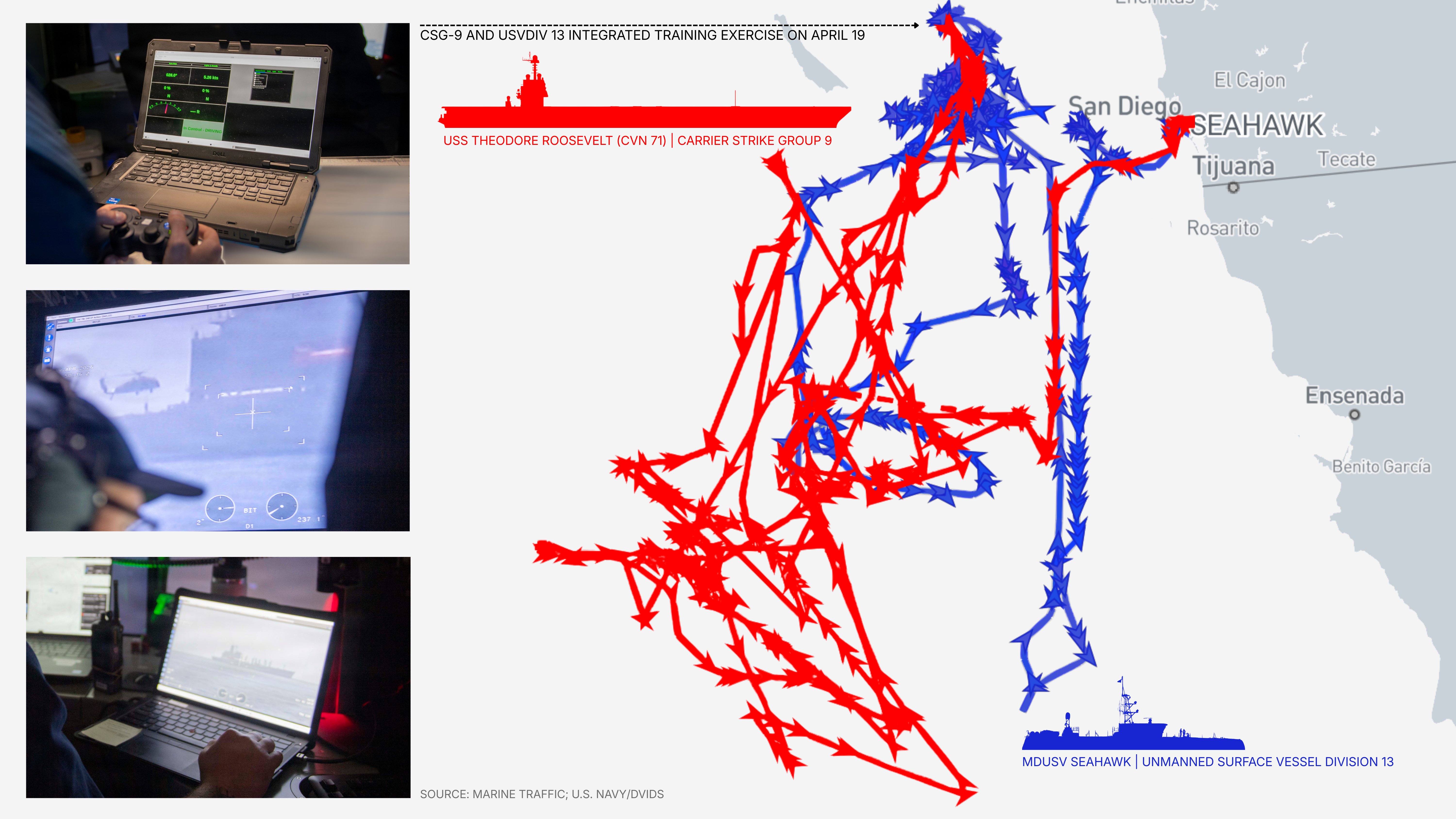
In February, Vice Adm. Brendan McLane told reporters at WEST 2026 that a medium unmanned surface vessel (MUSV) would deploy with the strike group for the first time. During COMPTUEX and RIMPAC, the Roosevelt CSG drilled alongside Leidos’ MUSV Seahawk, which TWZ was the first to report. We asked the Navy to confirm whether an MUSV would accompany the group, but have not received a response. As of publication, Seahawk was still pierside in San Diego, and it’s unclear if the drone boat will operate with the CSG or remain in San Diego.
Transit of USS Theodore Roosevelt and MUSV Seahawk during COMPTUEX training. Source: MarineTraffic/KPLER (Reprinted with permission) and DVIDS
Makin Island Amphibious Ready Group Also Deploys, Destination Unknown
The three-ship Makin Island ARG, with the 13th Marine Expeditionary Unit (MEU) embarked, got underway for a deployment on September 28, a Navy official also confirmed to USNI News. In addition to the flagship Wasp class amphibious assault ship (LHD), USS Makin Island, two San Antonio class amphibious transport dock ships (LPD), USS John P. Murtha and USS Anchorage, left on the same day and round out the expeditionary group.
Video: @SanDiegoWebCam/YouTube
No destination has been formally announced. However, there is an obvious candidate for relief: the Boxer ARG. Currently on station in the U.S. Central Command (CENTCOM) AOR supporting blockade and interdiction operations in the Arabian Sea and Indian Ocean, the group has been deployed since mid-March. The amphibious fleet is notorious for experiencing maintenance issues, and these ships have been pushed hard without a port call in months. Amphibious ships move slower than carriers, and if CENTCOM turns out to be the final destination, the Makin Island ARG would have to hustle to arrive before November.
Makin Islandembarks short takeoff and vertical landing (STOVL) F-35B Lightning IIs, assigned to the “Wake Island Avengers” of Marine Fighter Attack Squadron (VMFA) 211, and MV-22B Ospreys with Marine Medium Tiltrotor Squadron (VMM) 364 (Reinforced). The Bravos recently conducted a simulated airstrike off the coast of California.
13th MEU conducts a simulated airstrike aboard USS Makin Island (LHD 8) off the coast of California. U.S. Navy video
Abraham Lincoln Days Away From Well-Deserved Homecoming
Acting Secretary of the Navy Hung Cao flew out to the flight deck of USS Abraham Lincoln as she was sailing eastbound in the Hawaiian Islands operating area, en route to her homeport in San Diego. “Today, our warfighters aboard USS Abraham Lincoln demonstrated the overwhelming capacity and capability that they brought to bear on our adversaries for the last 10 months,” he wrote in a post on Sunday.
USS Abraham Lincoln transiting in the U.S. 7th Fleet AOR. U.S. Navy photo
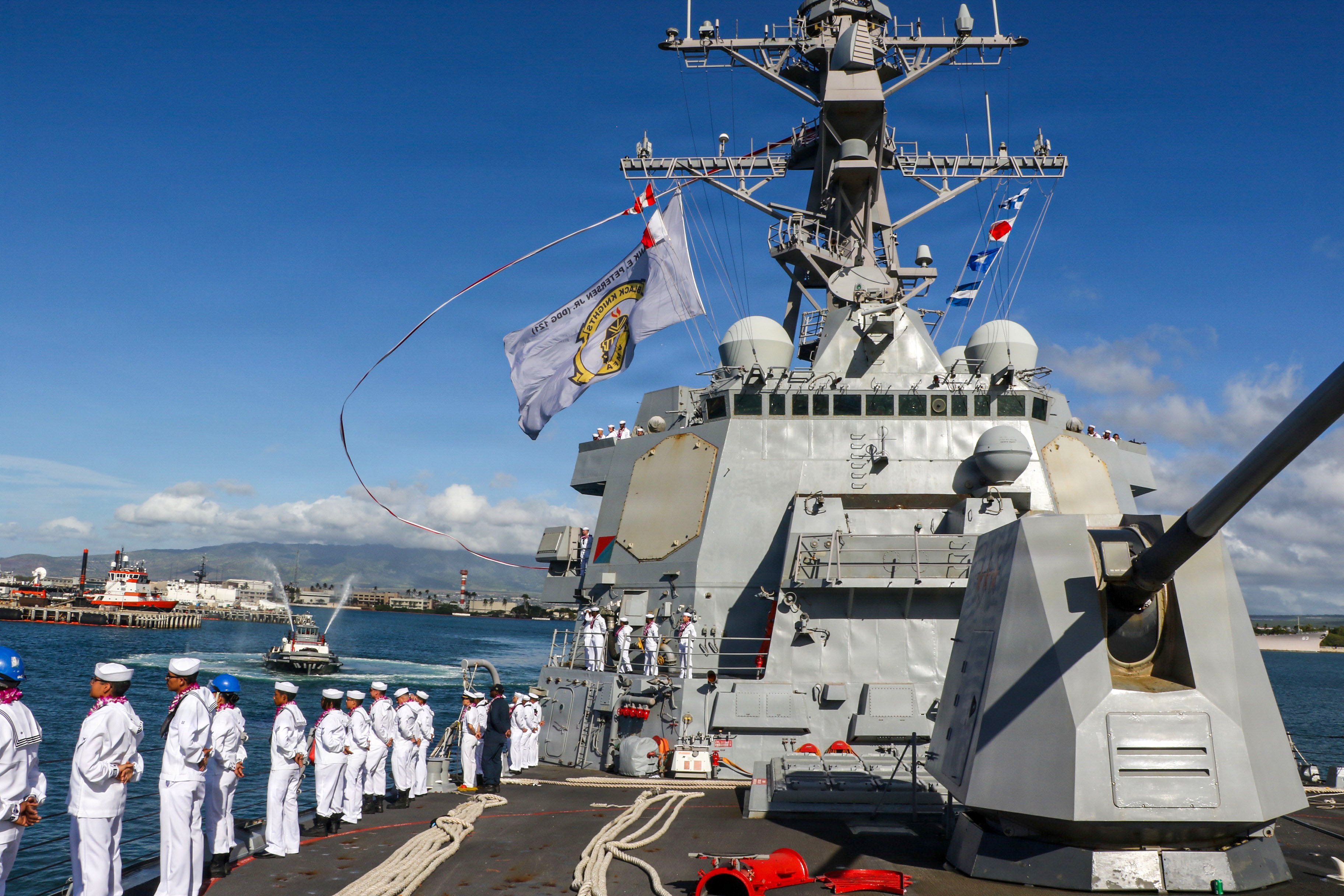
USS Frank E. Petersen Jr., a destroyer that escorted Lincoln throughout the 10-month deployment, peeled off and moored at Joint Base Pearl Harbor-Hickam on Monday. “Over the course of 300 days, Frank E. Petersen Jr.’s crew conducted 45 replenishments-at-sea, sailed over 85,000 nautical miles, safely transferred over 7,544,486 gallons of F-76 fuel and 175,288 gallons of JP-5 fuel, and completed 1,094 hours of flight quarters,” according to a press release. The statement also confirmed that the warship served as IAMD commander for the group. The destroyer defended against more than 100 missile and drone attacks, Stars and Stripes recently reported.
Petersen Jr. and USS Michael Murphy became the first U.S. warships to transit the Strait of Hormuz since the war began when they entered the Persian Gulf in April in support of mine-clearance efforts.
USS Frank E. Petersen Jr. returns to Pearl Harbor. U.S. Navy photo
Lincoln is now 314 days into her deployment and less than two weeks shy of surpassing the 326-day record USS Gerald R. Ford set in May. Approximately 2,000 nautical miles separate Hawaii from Naval Air Station North Island, but assuming a straight shot, it does not appear Lincoln will break the record.
Growler Mishap On Dwight D. Eisenhower
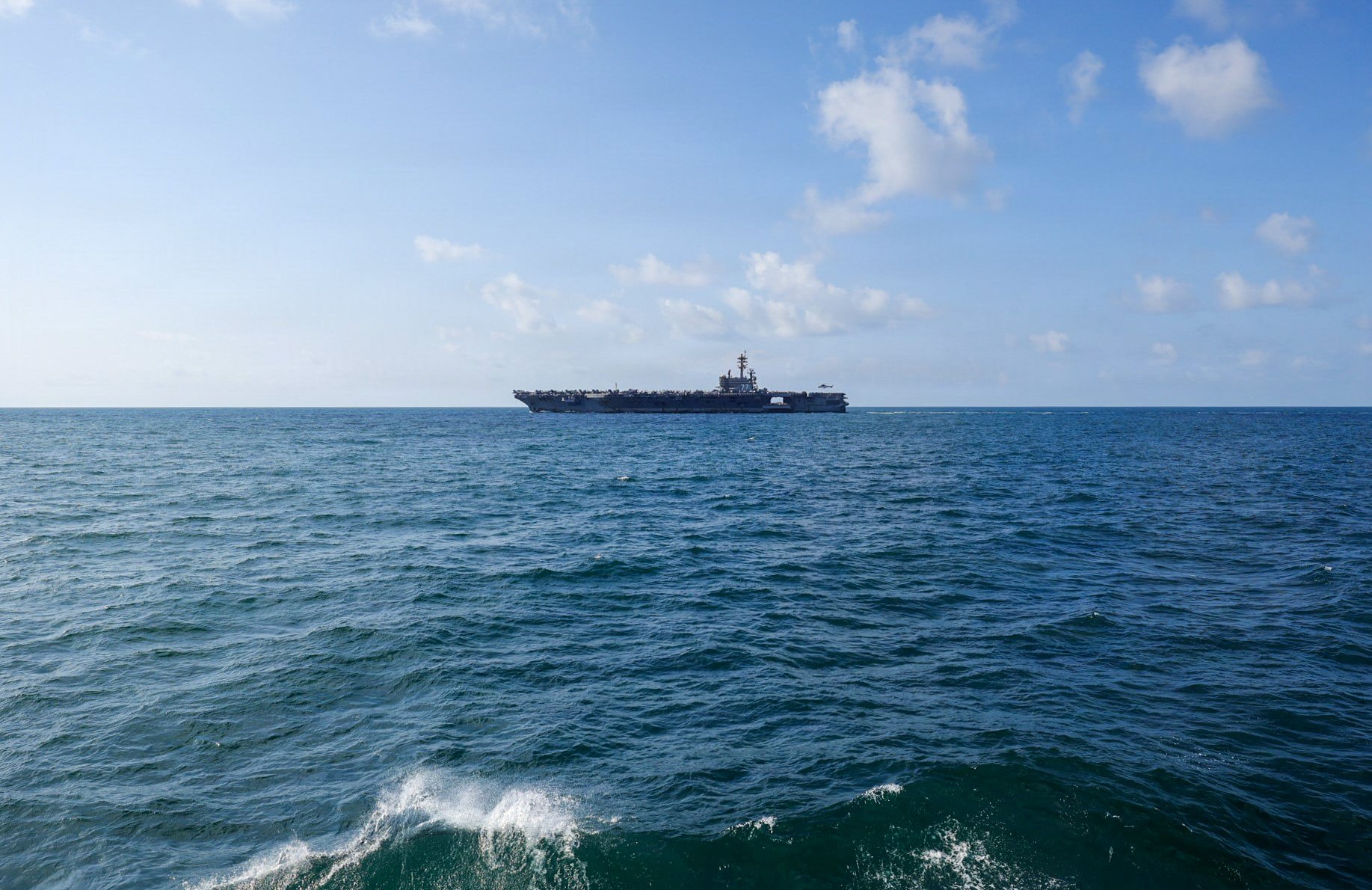
Two crew members from an EA-18G Growler embarked on the aircraft carrier USS Dwight D. Eisenhower (Ike) were rescued after ejecting due to an arresting gear failure, the Navy announced in a statement. The incident took place on Monday around 6:18 p.m. Eastern Daylight Time as the vessel was underway off the coast of Virginia.
The aviators, assigned to the “Zappers” of Electronic Attack Squadron (VAQ) 130 and attached to CVW 3, “safely returned to the ship and are being evaluated by medical personnel,” according to the release. The “Dusty Dogs” of Helicopter Sea Combat Squadron (HSC) 7 recovered the crew using MH-60S Seahawk helos.
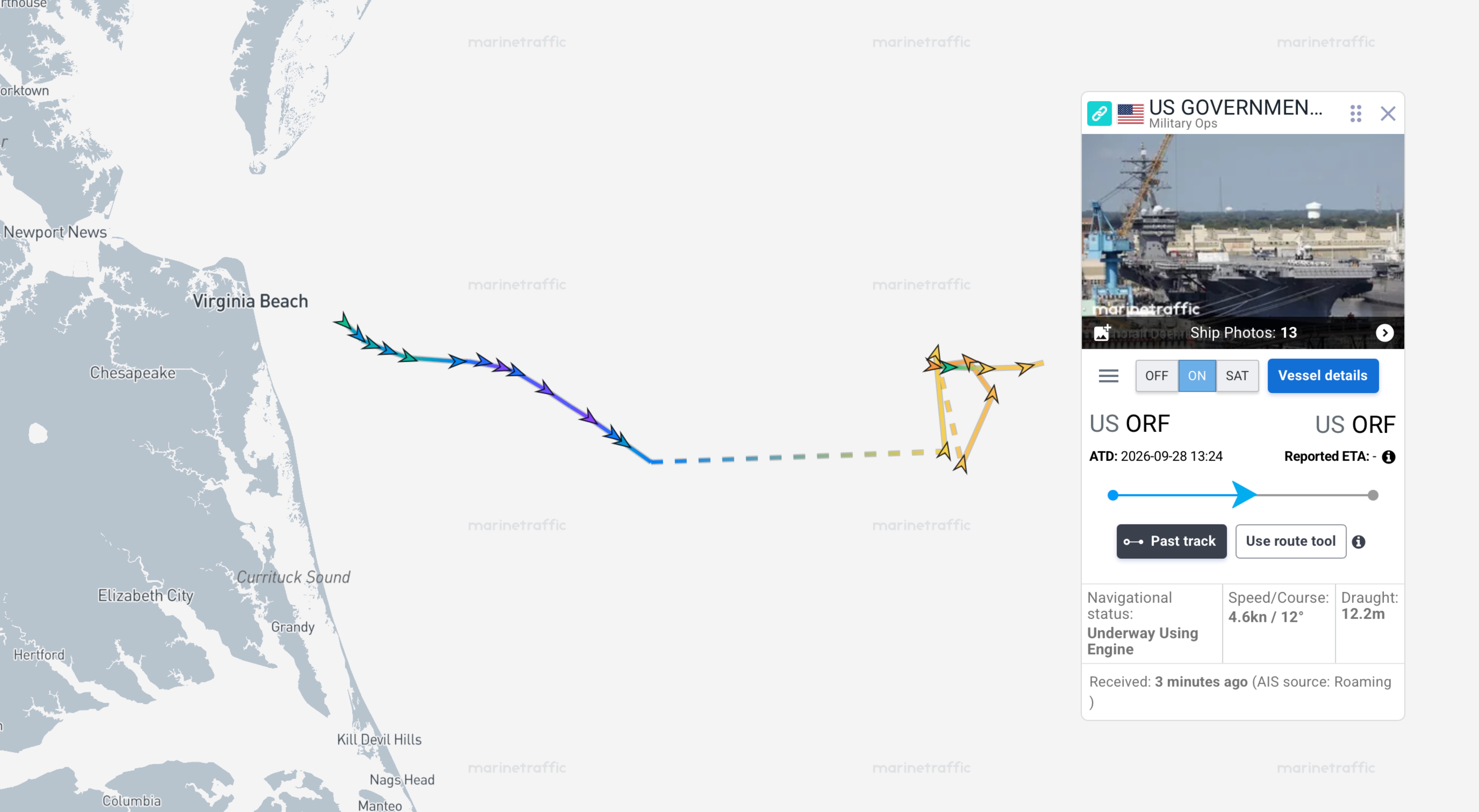
Transit of USS Dwight D. Eisenhower off the East Coast. Source: MarineTraffic/KPLER (Reprinted with permission)
Four shipboard personnel “were also injured during the mishap and are receiving medical care,” the Navy said. “One Sailor is being transported to a Norfolk-area hospital for treatment of non-life-threatening injuries,” according to the original statement. In total, eight sailors were evaluated by the ship’s medical team.
The cause of the accident is still under investigation, and it’s unclear whether the aircraft was lost or if there was any damage to the carrier. TWZ has reached out to the Navy to find out more details.
A Growler landing on the USS Dwight D. Eisenhower. U.S. Navy photo/Released
Eisenhowerwrapped an extended 15-month PIA earlier this year in April. The flattop had been pierside at Naval Station Norfolk since September 2 after being at sea for 12 days completing Fleet Replacement Squadron and Training Command Carrier Qualifications (CQ) in the Virginia Capes and Jacksonville operating areas. She got underway again on the afternoon of September 28, based on public AIS data, for Tailored Ship’s Training Availability, Final Evaluation Problem, and CQ, one of the final steps before onloading ammunition for COMPTUEX, where the full strike group certifies for deployment.
Ike is working up in preparation for a future deployment scheduled for the first half of 2027, TWZpreviously reported.
Reports Surface That George H.W. Bush Is Headed To Thailand For A Port Call
Multiple news outlets in Thailand reported Tuesday that USS George H.W. Bush and destroyer USS Delbert D. Black, which have both been in the Middle East in support of operations against Iran, will make a port call in Phuket in early October. If such a transit occurs, this would leave one carrier, the USS George Washington, on station in the U.S. 5th Fleet AOR for the first time since April. The Navy has not formally made an announcement, and TWZ has not verified the accounts.
USS George H.W. Bush operating in CENTCOM. U.S. Navy photo Super Hornet on USS George H.W. Bush. U.S. Navy photo
The reports are based on a meeting that representatives of the U.S. Embassy in Thailand allegedly held with the Patong police to discuss security protocols during the stop. “The visit has prompted coordination between Thai authorities and US officials over security, public order, and the movement of visiting military personnel during shore leave,” Phuket News wrote. According to the article, Patong police met with two deputy assistant defense attachés, Lou Pham and Robert Robinson, to discuss the visit. U.S. personnel were advised to comply with Thai laws during their stay, a specific request that may have been triggered by the recent visit of Lincoln.
There are conflicting accounts of when Bush would arrive in Phuket’s deep-sea port, but the visit will likely last five or six days, which is similar to Lincoln’s recent port call in the Southeast Asian country. If the timeline holds, it means Bush is likely already en route from her station in the Arabian Sea, where the CSG was most recently operating as of September 25, according to DVIDS. The Bangkok Post and Thai Examiner also reported the upcoming visit.
Notably, the reports do not mention any of the other warships that have been part of the Bush CSG in the past, including USS Donald Cook, USS Ross, USS Mason, or USS Princeton. The composition of the Bush CSG has shifted throughout the cruise.
Big Deck Fleet At A Glance
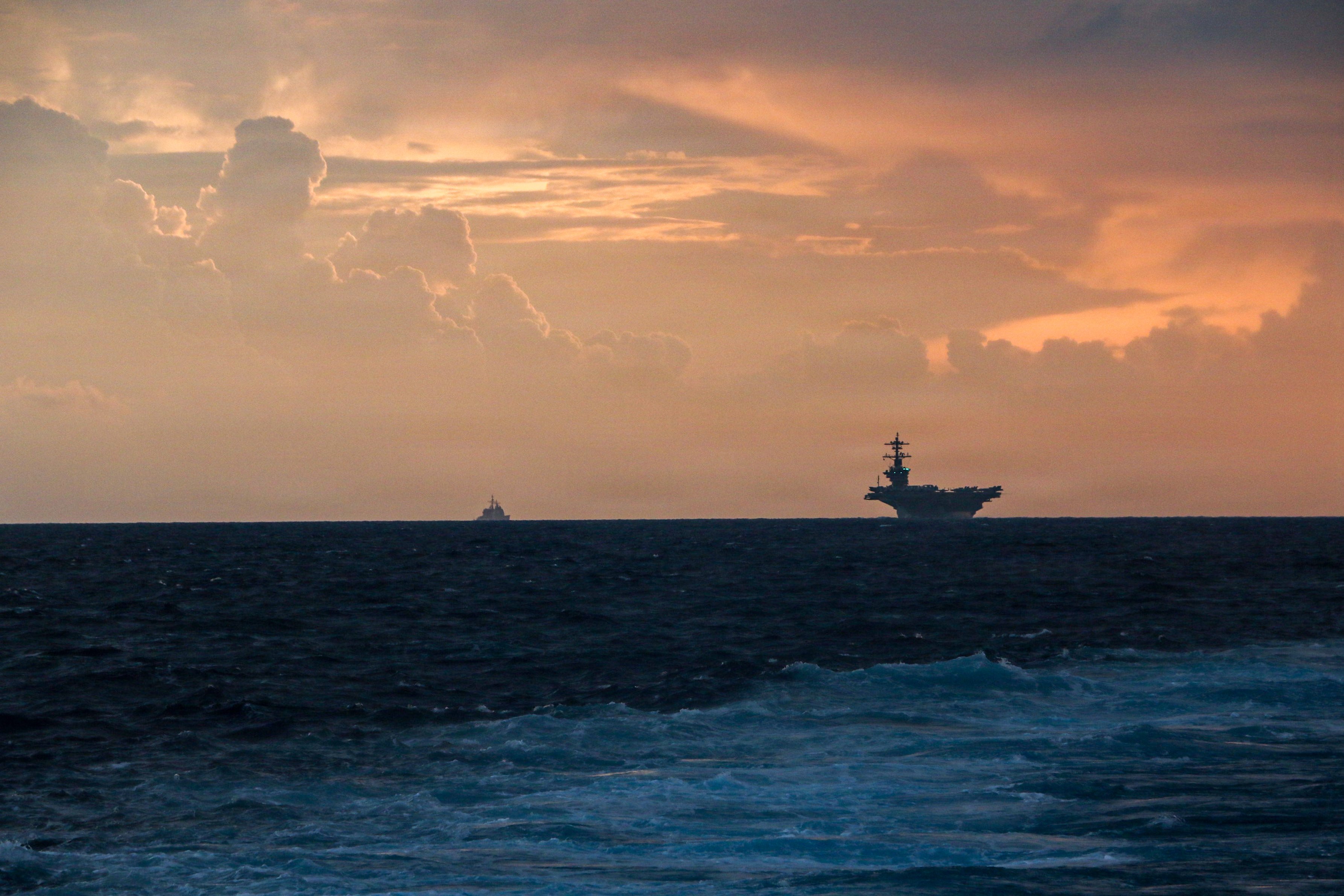
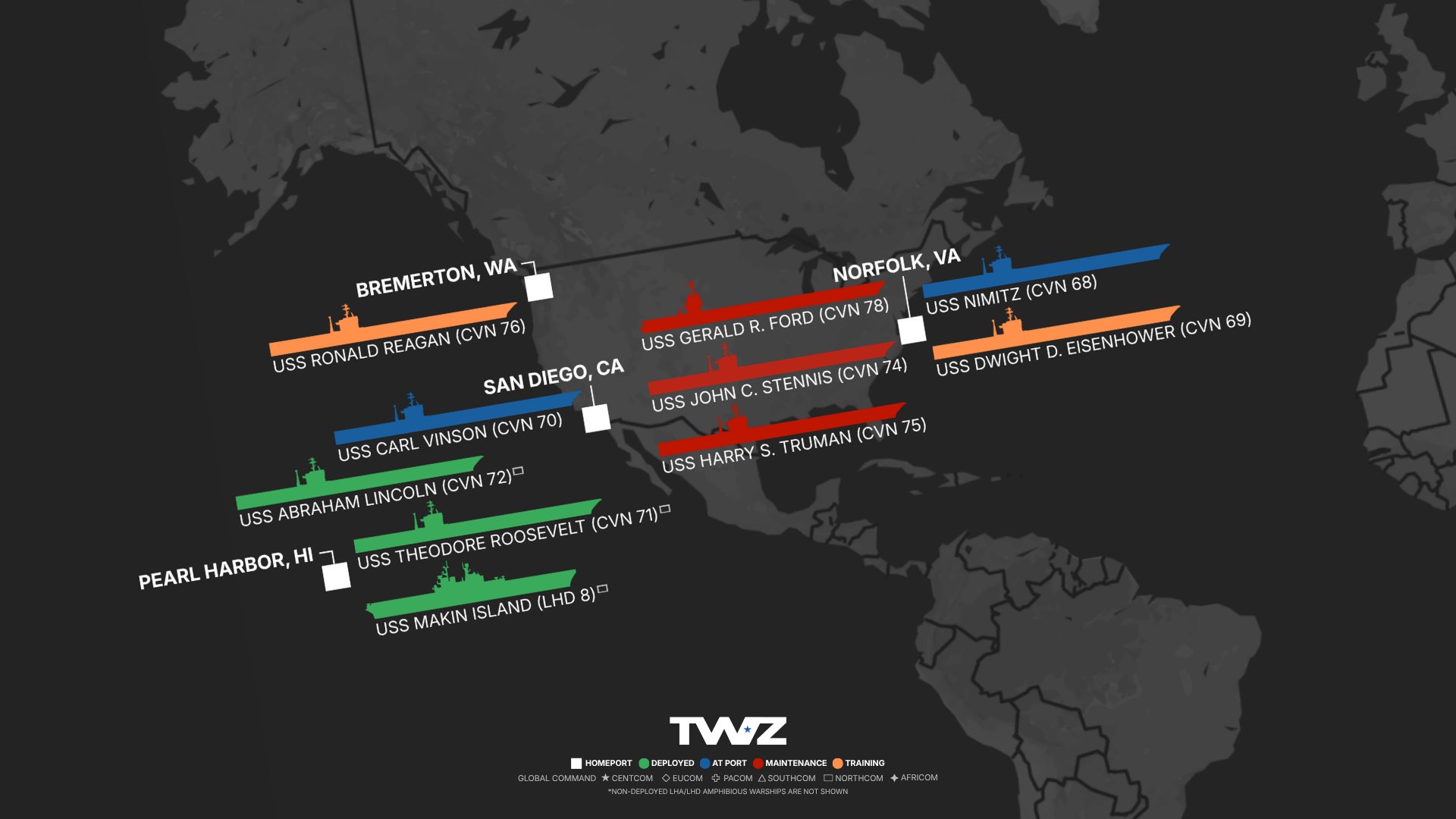
Overall, four U.S. carriers are deployed (with one heading home), three are working up in various states of readiness, three are in current or upcoming maintenance, one is being used primarily for training before deactivation next year, and the future USS John F. Kennedy, the second Ford class carrier, has received preliminary acceptance ahead of delivery in spring 2027. Two amphibious ready groups are deployed, one is forward-deployed, three are working up or in port, and three are in maintenance.
Note: Positions are general approximations.Non-deployed LHA/LHD amphibious warships are not shown.
During one of his son’s hockey games, Nick Paumgarten watches as his eight-year-old is hit from behind, only to rise to his feet and use his stick to hit the side of his opponent’s head. Alongside his concern for his son’s head and neck, Paumgarten, who has written about his own hockey-related concussions, rapidly processes the outcomes of the exchange: a game-deciding penalty, his own reflexive rationalization, and the evaluation of other parents who “held me in some way responsible, as both father and coach, for the violence and loss of self-control.” Paumgarten’s essay is rich with such moments of parent-coach double-consciousness, and sensitive to the numerous ways, some of them awful, in which those two identities intrude upon each other.
That Sunday, it wasn’t yet 8 A.M. when a Rye player shoved James from behind into the boards. James went down awkwardly and stayed prone a moment, then leaped up and, with an implausible ferocity, cross-checked the other kid in the ear. The Rye boy collapsed to the ice, and the other kids poured in and began grappling with one another, while parents shouted and pointed. Soon there was a pile of mites, with the two referees pulling players off and flinging them aside like puppies. Through the windows, you could see that the sun had risen over the Long Island Sound. I thought of my son’s fellow second graders back in the city, likely still asleep or watching cartoons in their pajamas or getting dressed for church or whatever the unrinked got up to on weekend mornings, but here at Playland my boy had instigated a munchkin brawl.
Sur les terres émergées, les ressources s'épuisent. Alors les regards des dirigeants, des militaires et des investisseurs se tournent vers l'océan. Et, plus précisément, vers les fonds marins. Une nouvelle ère s'ouvre : celle de l'exploitation des abysses. Le journaliste Guillaume Pitron y a consacré trois années d'enquête et un livre, dont nous publions les extraits en exclusivité.
Toutes les marines nationales d'Asie semblent s'être donné rendez-vous, en ce printemps 2025, dans un vaste hall d'exposition attenant à l'aéroport Changi, à Singapour, à l'occasion de l'International Maritime Defence Exhibition (Imdex) Asia 2025. Leurs émissaires portent beau dans leurs uniformes parés de galons, prenant langue avec une myriade de représentants de commerce. L'exposition est en effet un point de ralliement des leaders industriels du naval de défense, venus présenter leurs dernières innovations : le britannique Rolls-Royce (systèmes de propulsion pour sous-marins et frégates), l'israélien Elbit Systems (sonars), le singapourien ST Engineering (systèmes électroniques embarqués), le constructeur de navires de guerre américain Lockheed Martin, l'autrichien Schiebel et son Camcopter S-100, un drone aérien de reconnaissance tactique…
Également présent, le groupe allemand Euroatlas promeut son Greyshark. Long de huit mètres et pesant quatre tonnes et demie, ce drone sous-marin, silhouette de squale, museau effilé et propulsion à hélices, est taillé pour une grande variété de tâches, civiles comme militaires. « Cela dépend des besoins de l'opérateur », expliquent les deux commerciaux s'affairant autour du véhicule. Cartographie du plancher océanique, protection d'infrastructures sous-marines, récupération de munitions abandonnées… : ces missions sont permises par l'autonomie de seize semaines du Greyshark, qui en décuple les performances. Pour sûr, arguent les deux chargés d'affaires, l'avenir est à ces nouveaux engins, car « les hommes cèdent peu à peu la place, dans les océans, aux technologies autonomes ».
Une variété d'engins autonomes
Embarqué dans des sous-marins et autres bathyscaphes, l'homme côtoie les fonds océaniques situés à plus de mille mètres de profondeur depuis la seconde moitié du XXe siècle. Pourtant, 80 % de ces contrées restent inexplorées. Il faut dire que passer au peigne fin les moindres recoins du plancher océanique à bord de Nautilus habités coûte des sommes insensées. De plus, c'est dangereux. Enfin, cela prend un temps fou. Dès lors, l'exploration des fonds marins a avancé à pas comptés… Ce triple obstacle pourrait être contourné grâce à la multiplication des drones. Le mot renvoie à une variété d'engins autonomes : des robots sous-marins filaires téléguidés, de petits vaisseaux naviguant en surface et surtout des véhicules sous-marins, souvent désignés par leur sigle anglais AUV (Autonomous Underwater Vehicles).
L'industrie pétrolière a été parmi les premières à manier ces engins légers et compacts, capables notamment de se substituer aux plongeurs lors d'interventions sur les fondations de plates-formes offshore. Leur autonomie permet également de rallonger la durée, donc l'efficacité, de missions d'exploration de gisements, et ce à des coûts compétitifs (un drone coûte « seulement » entre 1 et 10 millions d'euros). Leur force est d'agréger sous leur coque une variété de briques technologiques : une batterie lithium-ion offrant une autonomie allongée et un vaste rayon d'action, des sondeurs multifaisceaux permettant de capter des téraoctets de données à chaque plongée, une centrale inertielle pour le guidage et la navigation et, demain, toujours plus d'intelligence artificielle (IA) pour leur conférer une capacité de décision étendue.
« Les flottes d'AUV permettent de collecter trois à quatre fois plus de données qu'avec des moyens de surface équivalents », convient M. Jean-Marc Sornin, président d'Abyssa, une société d'exploration des grands fonds marins. On comprend pourquoi les drones sont devenus des opérateurs de choix pour une myriade d'industries mondiales — dont certaines promettent de répondre aux besoins grandissants en ressources générés par la croissance de la population mondiale. Ils servent ainsi à localiser des bancs de poissons, à explorer des gisements de diamants et d'hydrogène naturel, à prélever de l'acide désoxyribonucléique (ADN) environnemental, à repérer une fuite dans la coque d'un navire pétrolier échoué, à collecter du plastique, à inspecter les fondations de parcs éoliens offshore et même à dresser la carte de l'intégralité des fonds marins. Les drones sous-marins sont les émissaires de notre espèce dans les abysses, au point d'être, selon Jan Opderbecke, chercheur à la direction de la flotte océanographique au sein de l'Institut français de recherche pour l'exploitation de la mer (Ifremer), « devenus tout simplement irremplaçables ».
Un engouement que tempère le contre-amiral Éric Lavault, chargé de la maîtrise des fonds marins : « Plein de trucs “sexy” circulent à propos des drones, mais, comme de nombreux industriels, je demeure dubitatif. Cet élan technologique va, comme dirait l'autre, coûter “un pognon de dingue”. » La colonisation des mers par des outils souvent pompeusement qualifiés d'« avatars » par les réclames commerciales prendra longtemps… Quoi qu'il en soit, « des milliers d'AUV opèrent déjà aux quatre coins des océans », rappelle le scientifique portugais João Sousa.
Leur importance pourrait encore s'accroître lorsque, dotés d'une plus grande autonomie, ils se montreront capables d'effectuer des missions de plusieurs mois en haute mer, s'évitant d'intempestifs retours à terre. Révolution ultime, l'océan pourrait être, un jour, peuplé de « drones résidents » qui auront complètement rompu le cordon avec la terre ferme. Cette émancipation totale nécessitera l'installation de stations d'amarrage alimentées par l'énergie houlomotrice, jusque dans les replis des canyons immergés : les AUV s'y relaieront pour décharger leurs disques durs, recharger leurs batteries, subir des opérations de réparation automatisées, hiberner… avant d'être réactivés pour de futures missions. João Sousa voit dans ces relais abyssaux l'amorce de la colonisation d'un nouveau Far West. « Rappelez-vous la conquête de l'Ouest, soutient le scientifique. Au départ, il n'y avait rien. Puis on a édifié des villages, les relais de poste du Pony Express. Puis sont arrivés les chemins de fer… Je vois l'expansion océanique suivre cette même dynamique. »
« Leur armada est hallucinante »
Que la colonisation des océans soit une affaire de robots, cette évidence est acquise lorsque M. Anthony Clake et ses deux associés fondent Ocean Infinity (OI) en 2017. Aussi les trois hommes vont-ils investir dans des systèmes technologiques… proprement fous. « Dès sa création, les représentants d'OI ont déclaré : “Nous pouvons déployer simultanément huit AUV à 10 millions de dollars l'unité et couvrir ainsi des régions immergées immenses”, précise un concurrent. Aujourd'hui encore, personne n'a eu les reins financièrement assez solides pour faire cela. » Le groupe exploiterait à ce jour entre quinze et vingt drones sous-marins autonomes, ce qui en fait, selon certains, « le plus gros essaim mondial d'AUV ». S'ajoutent des véhicules filaires commandés à distance capables de descendre à six mille mètres de profondeur, plusieurs navires de ravitaillement et de prospection océanographique, des engins autonomes de surface, des navires télé-exploités… « Leur armada est hallucinante, leurs moyens gigantesques », explique, sous le couvert de l'anonymat, un scientifique qui les a vus à l'œuvre. Ces leviers font rapidement taire la concurrence ; Ocean Infinity décroche des missions de recherche d'épaves à fort impact médiatique : en 2018, la société retrouve le sous-marin argentin San Juan, disparu un an plus tôt dans l'Atlantique sud. La même année, elle participe — sans succès — à la recherche des boîtes noires du MH370, l'avion de la Malaysia Airlines disparu en 2014 dans l'océan Indien.
Pour exploiter une telle flotte, Ocean Infinity emploie plus de cinq cents personnes : « Des opérateurs de navires sans équipage, des pilotes de robots sous-marins téléguidés, des opérateurs d'AUV, des ingénieurs en robotique, (…) des analystes de données, des géomètres, des océanographes et des hydrographes », éparpillés en Amérique du Nord, en Europe ou encore en Asie, indique la société sur son site Internet. Ses activités convergent vers un quartier général situé à Southampton, dans le sud de l'Angleterre. Bien entendu, nous avons adressé une demande de visite, restée lettre morte… Un scientifique qui a arpenté les lieux nous décrit un campus aux airs de centre de la National Aeronautics and Space Administration (NASA). « Il faut imaginer un immeuble ultrasécurisé avec contrôle d'accès par reconnaissance d'empreinte rétinienne et, à l'intérieur, des postes de pilotage identiques à ceux que vous avez à bord des bateaux », relate-t-il. Une description qui résonne avec le film hollywoodien d'Andrew Niccol Good Kill (2014), lequel mettait en scène des pilotes de drones bombardant l'Afghanistan depuis des conteneurs situés dans le désert du Nevada… « Eh bien, là, c'est pareil, décrypte le scientifique : les mecs sont dans une pièce, entourés d'écrans géants, à commander des robots qui évoluent au milieu de l'océan Pacifique. »
À partir de 2021, Ocean Infinity rachète des concurrents et prend des participations dans des sociétés d'analyse géotechnique, de moteurs électriques pour navires, de services de sécurité maritime… L'objectif est d'être présent sur l'ensemble des métiers de l'exploration offshore et de se diversifier. Ocean Infinity est devenu un groupe multisectoriel, contractualisant avec des entreprises de télécommunications (pour l'optimisation du tracé des câbles sous-marins) et d'énergie (prospection, maintenance d'infrastructures…), comme en 2024 avec le pétrolier britannique Shell pour la fourniture de données géophysiques et géotechniques. Certains les voient également prendre pied sur le marché, en devenir, de l'exploration de gisements miniers sous-marins, ainsi que sur celui, en expansion, de la récupération d'actifs stratégiques.
Car les mers ne sont pas seulement le royaume de la méduse lumineuse, du calmar colossal et du poisson-lune trompeur ; elles sont également un cimetière de vieux câbles Internet et électriques, de fûts de déchets radioactifs, de réacteurs atomiques, de munitions abandonnées pendant la seconde guerre mondiale… Les fonds marins sont aussi jonchés de technologies de pointe que les armées veulent récupérer à tout prix : satellites espions, débris spatiaux contenant des alliages conçus dans le secret d'un laboratoire militaire, missiles, avions de chasse embarquant des systèmes d'encodage stratégiques. En 2022, les États-Unis mandatent la société américaine Phoenix International pour qu'elle repêche un F-35C Lightning II de l'US Navy abîmé en mer de Chine méridionale. L'avion militaire est récupéré avant que Pékin mette la main dessus et en espionne les technologies embarquées. L'ensemble de ces marchés tend les bras à Ocean Infinity, devenue l'une des rares entreprises d'exploration océanique à parler, aujourd'hui, d'égal à égal avec les États. Au point que certains pourraient faire le choix de lui déléguer des missions régaliennes de maîtrise des profondeurs, aux fins d'y surveiller des câbles ou des gazoducs. « Pourquoi ne pas associer Ocean Infinity à ce rôle de défense nationale ? », interroge un ingénieur du service hydrographique et océanographique de la marine (SHOM).
Mais combien de temps Ocean Infinity conservera-t-elle cette avance ? Ne serait-il pas temps de vendre cette multinationale des abysses, parée de ses splendides atours technologiques ? Des interrogations sur sa viabilité surgissent. Le groupe, qui ne communique pas sur son chiffre d'affaires, ne serait toujours pas rentable… De plus, le marché de l'étude des fonds marins est aujourd'hui investi par un nombre croissant d'acteurs privés — qu'ils soient constructeurs ou opérateurs de drones : les américains Phoenix International et Ocean Aero, les français Exail Technologies et Abyssa, le norvégien Eelume, le chinois Qingdao Ever Maritime… Sans oublier les États, qui, en développant leurs propres armadas, pourraient sérieusement contester l'autorité d'Ocean Infinity d'ici à une dizaine d'années.
« Toutes les grandes puissances maritimes sont en train de rattraper leur retard dans la course aux fonds marins, en s'équipant avec des moyens équivalents à ceux d'OI », constate un spécialiste de l'« économie bleue ». Traditionnellement peu intéressées par les abysses, les armées opèrent un revirement stratégique. La prise de conscience par la marine française de la nécessité de se doter de drones remonte à l'année 2019. Faute de moyens propres, celle-ci sous-traite alors les opérations de localisation de La Minerve, un sous-marin disparu en 1968 au large de Toulon avec, à son bord, cinquante-deux marins, à Ocean Infinity. Une campagne menée en un temps record. « Ils ont ratissé une surface équivalant à la ville de Paris en même pas trois jours ! », relate, encore éberlué, un témoin requérant l'anonymat. Le submersible fut retrouvé peu après.
Ce tour de force a laissé des souvenirs doux-amers dans les rangs des généraux… « Ça a été un choc », convient le contre-amiral Lavault. « Nous avons pris alors conscience du retard accumulé par l'armée française dans sa stratégie de maîtrise des fonds marins, et de la nécessité de mieux nous les approprier. » Bien au-delà du cas français, « la “dronisation” dans le domaine naval de défense se généralise, confirme la représentante d'un fabricant de systèmes autonomes. Les pays lançant des initiatives dans ce domaine se multiplient ».
Un espace vertical
Aux mains des armées, les drones peuvent participer à des activités de déminage des grands fonds, détecter des intrusions ennemies dans une zone économique exclusive (ZEE), surveiller et protéger les câbles sous-marins et même engager des combats — les militaires parlent de seabed warfare, la « guerre des fonds marins ». Et, dans la perspective d'un conflit avec la Chine, ces outils pourraient également permettre aux Américains de compenser leur infériorité numérique. « Avec cinq cents drones, je couvre le golfe Arabo-Persique pour huit fois moins cher que le prix d'un croiseur », a ainsi déclaré l'amiral Charles Bradford Cooper, ex-commandant des forces navales américaines au Proche-Orient. Nul doute, dès lors, qu'« il va se passer sous la mer ce qui s'est passé dans les airs : une démocratisation, une banalisation de cette technologie », prédit le dirigeant d'une société de robotique sous-marine.
Cette réalité confirme tout d'abord l'écrasante domination exercée par quelques grandes puissances dans la maîtrise des fonds marins. « Seuls une quinzaine de pays disposent de la capacité industrielle de descendre à six mille mètres de profondeur, parmi lesquels les États-Unis, le Royaume-Uni, la France, le Canada, la Chine… Les Indiens et les Néo-Zélandais commencent tout juste à se doter des capacités adéquates », confirme, lors d'un entretien conduit en 2024, un haut fonctionnaire chargé de la politique maritime de la France.
La prolifération des drones s'insère en effet dans ce qu'il convient d'appeler une « verticale du pouvoir technologique », c'est-à-dire une chaîne ininterrompue de machines se relayant des fosses marines jusqu'à l'espace (satellites) en passant par la surface de l'eau (flotteurs connectés, frégates) et les airs (drones aériens) afin de capter et de se transmettre des informations, et in fine d'offrir à l'homme la connaissance la plus acérée de la réalité des océans. « La mer, aujourd'hui, c'est l'espace, l'atmosphère, la colonne d'eau et les fonds marins », insiste M. Thierry Duchesne, directeur du département maritime de la Fondation méditerranéenne d'études stratégiques (FMES), et toutes ces dimensions se révèlent complémentaires.
Ce continuum technologique livre un enseignement-clé : les mers ne se conquièrent désormais plus comme les marines l'ont fait durant des millénaires, c'est-à-dire en contrôlant des coordonnées géographiques faites d'une longitude et d'une latitude ; elles se colonisent dorénavant par des robots déployés à toutes les profondeurs et toutes les altitudes possibles. Disons-le autrement : l'océan est fondamentalement un espace vertical ; et il appartiendra aux armées qui l'appréhenderont comme tel.
Le Somaliland obtient son indépendance du Royaume-Uni en 1960 et est alors reconnu par plus d'une trentaine d'États avant de fusionner avec l'ex-Somalie italienne. Le premier ministre du Somaliland devient en 1967 premier ministre de la Somalie unifiée, avant d'être renversé par le coup d'État dirigé par Mohamed Siad Barre en 1969. Une rébellion contre ce dernier éclate au début des années 1980 au Somaliland, brutalement réprimée : Hargeisa quasiment rasée par les bombardements, 400 000 Somaliens fuient le pays. (…) L'Érythrée, qui a une histoire similaire [à celle du Somaliland], est reconnue par la communauté internationale : partie de l'Éthiopie puis colonie italienne, annexée par l'Éthiopie en 1962 puis indépendante en 1993 après un long conflit. Pourquoi reconnaître l'Érythrée et pas le Somaliland ?
M. Frédéric Landy a voulu compléter le tableau brossé dans « La faim qui vient » (septembre), en abordant la question des stocks :
La Chine aurait des stocks dépassant les 200 millions de tonnes de maïs — les deux tiers des réserves mondiales — et, selon le géographe Jean-Paul Charvet, ses « stocks de report de blé se situent pratiquement au niveau d'une année entière de consommation ». La sécurité alimentaire pour un milliard et demi de Chinois et peut-être aussi les prévisions d'un blocus international en cas d'attaque sur Taïwan rendent peu prévisibles de grosses exportations de ce pays. (…) Le cas indien est plus clair. Pour le pays le plus peuplé du monde, l'objectif de sécurité alimentaire demeure prioritaire. C'est pourquoi sa législation a des stocks de sécurité définis à 12 millions de tonnes de riz et 20 millions de tonnes de blé (quantités devant être atteintes chaque année au 1er juillet). Or, au 1er juin dernier, l'Inde possédait des réserves publiques de 68 millions de tonnes de paddy (soit environ 45 millions de tonnes de riz décortiqué) et 53 millions de tonnes de blé. En gros, trois fois les stocks nécessaires… Ce pays, qui compte couramment pour 40 % des exportations mondiales de riz, a donc levé ses dernières restrictions à l'export en mars 2025. Pour le blé, les exportations étaient totalement interrompues depuis 2022 et la guerre en Ukraine. Elles viennent d'être autorisées à nouveau. Cela suffira-t-il à réduire un peu les risques de spéculation mondiale et de pénuries alimentaires ?
L'article me fait penser à un triptyque fermé avec le tableau complaisant brossé [sur la viticulture]. Mais quand on l'ouvre, sur le panneau droit il y a les pesticides, sur le panneau gauche la santé, et au milieu un tableau apocalyptique à la Brueghel avec tous les ravages du vin. Pesticides : 20 % du volume épandu pour un total de viticulteurs représentant 3,7 % du total des agriculteurs. (…) La santé : l'alcool et le vin en particulier sont mauvais en dehors même des pesticides (…). Et le Brueghel central avec les accidents de voiture, les violences faites aux femmes, les surfréquentations hospitalières et le cortège de maladies associées, la place faite au vin dans les exportations interdisant toute critique (…), l'exploitation des ouvriers confinant parfois à de l'esclavage moderne…
Détenu à la maison centrale d'Arles, M. Thierry Coppola nous écrit pour soulever le problème du vieillissement de la population carcérale (lire aussi « Vivre et mourir en cellule ») :
En 2024, d'après les chiffres de la direction de l'administration pénitentiaire, on comptait 470 détenus de plus de 70 ans et 70 de plus de 80 ans en prison. (…) Pour une part de ces personnes, la fin de vie est proche. Leur profil pénal et psychologique ou leur état physique, souvent dégradé par les conditions carcérales, ne permettent pas leur libération. (…) Mon inquiétude est qu'une fois de plus les personnes détenues soient exclues des dispositifs législatifs [relatifs à la fin de vie] qui ont été adoptés par l'Assemblée nationale le 15 juillet 2026. (…) L'accès à un Ehpad [établissement d'hébergement pour personnes âgées dépendantes] susceptible d'accueillir une personne détenue en fin de vie est assujetti à des ressources souvent incompatibles avec la situation des intéressés. Ils seront donc contraints de se satisfaire des soins censés être prodigués par les services médicaux des établissements pénitentiaires, notoirement sous-dotés.

 Login