What makes the recent military-strategic developments orchestrated primarily by Japan, South Korea, Philippines and United States more dangerous than ever? And how can their impact on the Western Pacific be evaluated? The Western Pacific is quickly becoming as busy with security arrangements as it is with warships, missiles, and military exercises. Japan’s recent efforts to […]
As NATO Secretary General Mark Rutte and European leaders increasingly warn of a looming Russian threat, Vladimir Putin used the Valdai Discussion Club to deliver a very different message: Europe is feeding an escalation spiral it may no longer be able to control. Europe is being told to prepare for war, and the rearmament is […]
Pakistan’s deployment of troops to Saudi Arabia under the Makkah Pact could deepen domestic political instability, strain its relations with Iran, and undermine its strategic autonomy by drawing Islamabad further into a regional conflict with wider US and Israeli strategic implications. For decades, Israel has been committing genocide and war crimes in Palestine. In the […]
A new law aimed at protecting children could kill off old video games and threaten small developers, industry trade groups have warned.
The EU Kids Act was unveiled by commission president Ursula von der Leyen last month as a chance to “give childhood back to our children” and put parents “in the driving seat”.
It would require videogames to be catered to children by default with stringent requirements including an eight-hour nighttime lock-out, a ban on screenshots, and guardian supervision.
Gamers wanting to play the full version of games would have to pass age verification checks to access features, like multi-player tournaments or mystery boxes.
The European Commission is gathering feedback on the act with respondents quick to criticise the threat posed to videogame makers.
Stop Killing Games, a campaign to protect videogames, has opposed the act.
“This could turn the EU into a pariah state for videogames,” said Ross Scott, the consumer group’s founder. He reckons the regulation could spark a race to update games or deactivate them.
MEPs have also joined in sounding the alarm bell.
Proposed law could kill games
If the law passed, developers would need to make a child mode version of games and gate the full games behind a verification step.
“This is going to bury developers with compliance steps, and a whole lot of cost,” said Scott.
Age verification with zero-knowledge proof (meaning developers cannot collect data) will likely be required. “In practice, providers would likely need to engage a third-party age assurance provider,” also said Lauro Fava, partner at law firm Pinsent Masons.
The Commission’s impact assessment claims that third-party age verification apps would reduce costs, but failed to provide estimates.
Fava called it “strange” that these were missing, and thinks the commission “arguably downplayed” the cost of compliance.
Gamer’s Voice, an advocacy group, asserted that small games would struggle to pay for age-verification and other compliance measures, likely to inlclude game redesigns.
The Kids Act would outlaw features ‘increasing social comparison’ for minors, meaning functions like leaderboards and kill counts could be restricted.
And while the cost to developers is not known, it is feared prices could increase for players.
The wide scope of the draft law means community servers and hobbyist-developed games could be subjected to the new rules. Any game, new or old, would have to follow measures unless strictly offline in a physical format or built only for educational purposes.
And since the rules would apply to games made or consumed in the EU, it is feared game makers could block access to their games on the bloc.
This article continues, but the full version is available only to EUobserver.com subscribers. Visit account.euobserver.com/membership
Environmental NGOs have threatened to sue the owner of Tefal, a leading French kitchenware company, over failing to phase out forever chemicals from their products, at a high price for consumer health.
The organisations allege that Groupe SEB, the parent company of known brands, such as Tefal cookware, Calor irons, and Moulinex kitchen appliances, fails to curtail harmful chemicals in its products.
And the environmentalist groups have threatened to file a lawsuit if the firm fails to makes a change to its policy within three months.
Companies have a duty to identify and address the impact of their work and products under the French law, for instance the pollution they cause or human rights they might violate.
Environmental NGOs ClientEarth, Générations Futures and Notre Affaire à Tous say Groupe SEB should swap harmful chemicals in its products to existing alternatives, such as ceramic coating or cast iron, to limit harm to human health and the environment.
The company uses teflon for non-stick, high-temperature suited coatings of their products.
The substance is one of the ‘PFAS’ polymers, often dubbed forever chemicals, because they break down very slowly, remaining in the environment and human body for a long time.
PFAS are widely used for food pots, clothes, packaging, and waterproof products.
But since they take so long to decompose, they are often found in soil and groundwater. Many of the substances cause cancer, others are harmful to babies in the womb.
Teflon is allegedly “not absorbed by the human body” and is approved by the World Health Organisation (WHO) for contact with food, the company’s website says.
However, a recent risk assessment by the EU’s Chemical Agency’s (ECHA), quoted by the NGOs, points out that when overheated or scratched, teflon releases PFAS particles.
It also releases substances harmful to the environment during the manufacturing process, ECHA’s research found in March.
And a new European law on the issue will provide a “more consistent basis for corporate due diligence litigation,” Hélène Duguy, ClientEarth’s lawyer in the case, told EUobserver.
An EU Corporate Sustainability Due Diligence directive, inspired by French legislation, will oblige all companies based in the EU to address the impact of their operations on the environment and human rights.
Member states must implement national laws fulfilling the obligation by summer 2028.
SEB can show stopping PFAS use is “necessary and feasible,” setting a precedent for others, Duguy said.
From David Ben-Gurion—the architect of a state whose foundations remain a subject of debate—to Benjamin Netanyahu, a master of maintaining constant tension, the “periphery doctrine” has remained a cornerstone of Israeli foreign policy. Its essence lies in forging alliances with states that surround hostile neighbors. Israeli authorities operate on the premise that secure borders do […]
At least two of Bryan’s band members were also wearing Palestine jerseys. Drummer Nate Head bore a jersey with Palestine on the front & on the back, the name “Hind Rajab”, a 5-year-old girl in Gaza killed by the Israel
The massive display of American military might during Xi Jinping’s visit underscores the shift from a unipolar world to a new reality in which the U.S. is compelled to engage with China as an economic and industrial rival of equal standing—one whose influence cannot be overcome by military force alone. For a few seconds at […]
In a remote part of Utah, the world’s largest data center project—allegedly—is being fast-tracked in secret. Kevin O’Leary of Shark Tank fame was brought in to hype the 40,000-acre complex. But the backlash among Utahns has been strong. Josh Dzieza reports from the front lines of the popular resistance to data centers:
[Brenna] Williams, a former government econometrician and college instructor, speaks methodically in a calm monotone as she enumerates the many reasons why the data center “doesn’t make sense”—a refrain. First among them is the water, an acutely sensitive issue in Utah in part thanks to Gov. Cox himself, who has declared repeated drought emergencies and urged residents to take shorter showers and cut back on watering their lawns. There is no more potent symbol of the state’s water crisis than the Great Salt Lake, which has been shrinking for years, exposing heavy metals on its lakebed that become airborne dust. Now here came a data center on its northern shore, or where its northern shore would have been if it hadn’t receded several miles.
“We have to report on our neighbors if they’re watering at the wrong times or on the wrong days,” Williams says. (There’s a hotline.) “But we have water to cool a power plant and cool the data center? It doesn’t make sense.”
A senior diplomatic source sent a clear message that the “sensitivities” of third countries do not constitute a right, in the wake of comments by U.S. Secretary of State Marco Rubio on the Greece-Cyprus electricity interconnection – the Great Sea Interconnector (GSI) – during his visit to Athens. Referring to energy interconnection projects and clearly […]
With the Acropolis as a backdrop, US Secretary of State Marco Rubio Rubio lavishly praised the Ancient Greece with the usual clichés, all of them except the most important one: Greece is the cradle of Democracy. How could he talk about “democracy”? On the contrary. Rubio chose to rolled out the MAGA agenda as if […]
The Conservative Party Conference was slick and professional, says Ellie Hodges, but Reform's conference, while more chaotic, had the kind of passion that you don't get from a fancy lanyard.
Twelve years ago, EU summit leaders announced they had a strategy to tackle unprecedented migrant arrivals.
Next week, they will meet again in Brussels and to tell us something similar.
We journalists will report on the latest twists and turns, hoping to get some sort of angle that hasn’t been covered. But the reality is that our leaders have broadly failed.
Dozens of EU summit conclusions have been published since 2015, when one around million Syrians arrived in Europe to seek protection.
We need stronger external borders to preserve the Schengen passport-free zone, they said. We need partnerships with foreign states to save lives. We need to step up deportations. We need a European solution.
All of these ideas and strategies have found a home in council conclusions, in various iterations, since 2015. All of them.
Some have actually panned out, including an EU migrant swap deal with Turkey and other deals with autocrats in Tunisia, Egypt and elsewhere. Others like internal reforms on asylum have also been delivered.
Yet the sense of urgency to tackle these issues continues because there is an obvious disconnect between what has been delivered, the promises made and the lived experience on the ground.
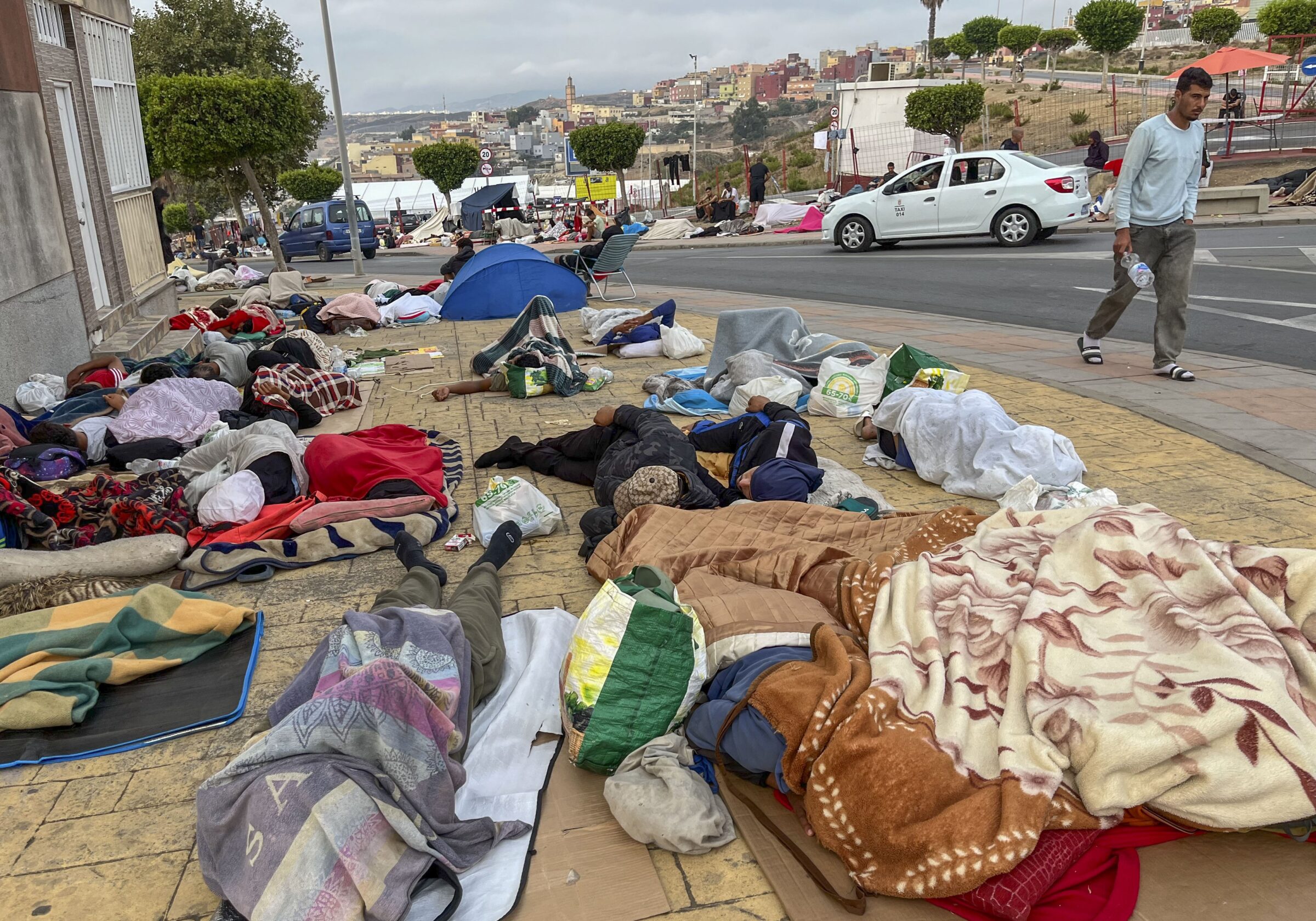
People still come. Some 80,000 arrived in the Spanish enclave of Ceuta end of July alone.
Many are still fleeing violence, war and economic hardships. Others are lured by the promise of labour in Europe by Europeans willing to exploit them.
I remember meeting a group of boys from Bangladesh on the Ocean Viking, freshly rescued in the middle of the night, asking when they would be able to start working in Italy.
One of them was still shaking with fear and sobbing, following a near death experience.
The European Commission is now claiming that the drop of irregular arrivals is due to their migration policy reforms, as if the fall of the murderous Assad regime in Syria had no discernible impact.
Perhaps some of that is true. But there is no disputing that Syrians accounted for over 100,000 irregular crossings in 2023, a year before Assad fell. It then dropped to around 6,000. Today, it is around 1,000, according to Frontex.
At some point, one has to wonder if these conclusions, repeated ad nauseam, is nothing but political theatre by a leadership that has run out of ideas.
“There are always people who profit from war or government policies. The difference is that the people profiting should not be the people making the decisions to make that policy. And that is what is happening here”
On October 5, Saudi Arabia, Türkiye and Pakistan activated the Makkah Pact, taking their new alliance to war for the first time, and potentially revealing the future of American power in the Middle East: Washington provides the security umbrella while regional partners increasingly do the fighting. From treaty to military alliance Only two months after […]
EU leaders meeting next week in Brussels for the usual post-summer European Council are rehashing conclusions on migration, echoing almost word-for-word statements since at least 2015.
“The European Council has developed a strategy aimed at stemming the unprecedented migratory flows Europe is facing,” they announced in December 2015, following a summit.
“It is indispensable to regain control over the external borders,” they also said, noting the perceived threat to the EU’s internal border-free Schengen zone.
And they voiced fear over the low number of deportations, insisting on “concrete measures to ensure the actual return and readmission of people not authorised to stay.”
Eeleven years later and the 15 October summit in Brussels next week is now asking almost the same thing, including to what extent previous conclusions on migration have been implemented.
Although draft conclusions can change, and likely will, the current wording essentially repeats the same demands spanning over 50 EU summits since at least 2015, when over a million Syrians entered Europe to seek protection.
Out of the 52 published conclusions since 2015, over half dealt with migration in some shape or form. The latest draft dated 5 October and seen by EUobserver is among those.
This article continues, but the full version is available only to EUobserver.com subscribers. Visit account.euobserver.com/membership
The ECI’s promise to issue meeting minutes will be useful only if they are public and record members’ decisions and dissent. Five other bodies show how regular disclosure can make collective decisions more transparent.
Behind the cacophony of the diplomatic rift between South Korea and Ukraine hides a fundamental question: what is the price Seoul has had to pay for access to North Korean prisoners of war and how will this affect regional security? Essence of the Conflict In January 2025, in Kursk Oblast, Ukrainian forces captured two North […]
With 91,278 Form 7s filed in Karnataka between June 16 and October 4, mostly against legitimate Muslim voters, multiple FIRs have been filed against the objectors. But the question remains: who orchestrated the mass deletions?

 Login