US federal agents on Monday launched a raid on the Washington home of Democratic representative Ilhan Omar, an outspoken critic of US President Donald Trump, officials said. The raid followed a criminal fraud investigation into the Somali-born lawmaker's immigration paperwork submitted by her late father when she was a child, Fox News reported.
For years, convicted sexual predator Jeffrey Epstein developed a global web of powerful connections despite accusations of sex trafficking. Millions of declassified documents reveal how he expanded and maintainted his network.
The U.S. Air Force has donated an F-117A Nighthawk, the world’s first operational stealth aircraft, to the Smithsonian Institution, where it will be on permanent public display later this month.
The Nighthawk, serial number 85-0818 and nicknamed “The Overachiever,” is the only F-117 known to have flown combat missions in all four major conflicts, including Operation Just Cause in Panama (1989), Operation Desert Storm (1991), Operation Allied Force over Yugoslavia (1999), and Operation Iraqi Freedom (2003).
It first flew in 1986 and was withdrawn from combat service around 2007.
The Air & Space Forces Association announced the donation on Sept. 14 at its Air, Space & Cyber Conference. Lockheed Martin’s Skunk Works prepared the aircraft for display in a museum. Air Force Reserve crews from the 512th Airlift Wing then flew the partially disassembled Nighthawk from California to Virginia aboard a C-5M Super Galaxy, arriving around Oct. 6.
The National Air and Space Museum’s Steven F. Udvar-Hazy Center near Washington Dulles International Airport will reassemble the aircraft. Visitors can watch the reassembly through the glass overlook of the Mary Baker Engen Restoration Hangar before the aircraft joins the permanent collection in late October, alongside other icons such as the SR-71 Blackbird and the B-29 Enola Gay.
Museum officials described the F-117 as the world’s first true operational stealth combat aircraft and said adding it fills a longstanding gap in the national collection. It is the 16th F-117 transferred for public display.
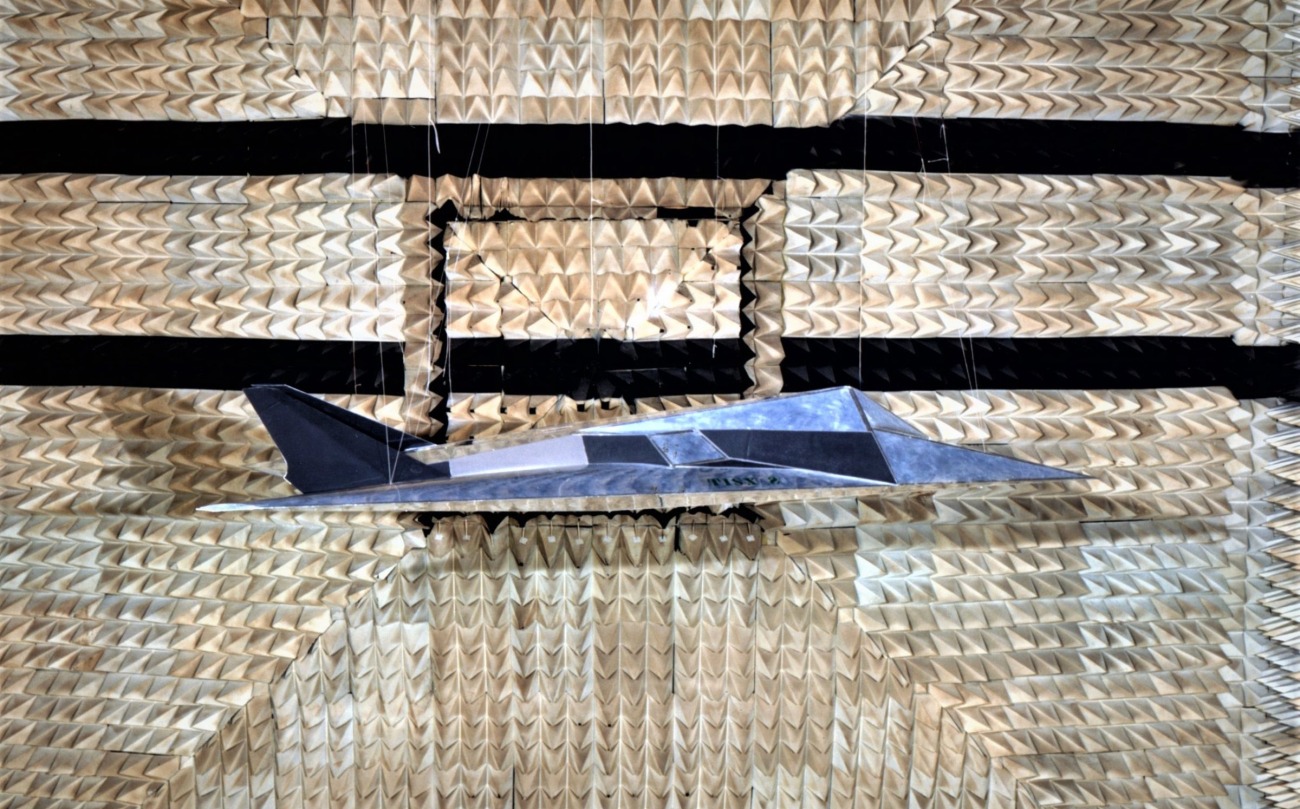
Have Blue, a stealth tech demonstrator, took its first flight in 1997, and led to the creation of our F-117 Nighthawk, the world’s first stealth aircraft. Via: Lockheed Martin
World’s 1st Stealth Aircraft
Aerospace analysts have long admired the F-117 Nighthawk’s distinctive design. A GE blog post describes the Nighthawk’s features and says the aircraft looks less potent alongside other advanced American fighters.
The aircraft has no afterburners. The aircraft is unstable on all three flight axes and requires an onboard computer for control
Despite that, the GE also noted one advantage: the aircraft is practically invisible to enemy radar.
According to General Electric, it was the first stealth aircraft to see the light of day during the Cold War and used a pre-existing engine modified to meet the requirement.
Despite the US technological advantage during the Cold War, contested airspace posed a substantial threat to pilots and their aircraft. Developing enemy technology could allow the enemy’s air force to lock on to American fighter jets and shoot them down at an alarming rate.
Although Lockheed Martin built the F-117 Nighthawk, GE built the engine that could power a stealth warplane. GE created the F404 engine exclusively for the F/A-18 Hornet, and it quickly became a compelling alternative for the F-117, a top-secret aircraft that needed an engine.
The engine was almost identical to the F/F404 A-18’s variant. GE constructed roughly 100 of these engines on a separate assembly line with only government-approved workers. That engine soon earned its stripes by being dependable, maintainable, lightweight, and inexpensive.
The Nighthawk
The US Air Force retired the F-117 Nighthawk in 2008.
The F-117s are reportedly used as developmental and “red air” training platforms a decade after their retirement. Certain aircraft act as aggressors in air-to-air combat during red-air training.
This raised eyebrows because it was unlikely that an archaic aircraft retired a decade ago would resurface for war games. The US Air Force later revealed that it had resurrected the Nighthawk.
Speculation suggests the USAF has brought these aircraft back to life because of their stealth capabilities. The USAF needs to train its fighter pilots against adversary stealth fighters, the Russian Su-57 and the Chinese J-20, as well as cruise missiles.
As a result, USAF pilots may be able to better find and intercept stealth aircraft in future operations and counter enemy cruise missiles if they train against Nighthawks as part of an advanced program.
When the US planned to develop the F-117 Nighthawk, the main challenge was reducing the aircraft’s radar cross-section and electromagnetic signature.
The aircraft had to fly subsonically to reduce obnoxious sonic booms. The aircraft had no afterburners or large exhaust plumes from infrared-emitting engines. It referred to flat surfaces that reflected radar radiation. The result was an otherworldly-looking black jet the US government didn’t recognize until 1988.
Despite the F-404’s ability to fly supersonically, the Nighthawk was limited to subsonic speeds because using afterburners to breach the sound barrier would compromise the aircraft’s stealth.
GE engineers designed the F-117’s unusual exhaust to scatter hot exhaust and evade radar and heat-seeking missiles.
“Really, it was the beauty of it. They could modify an existing engine, the F404, to provide the required thrust and weight. Minor adjustments were made to meet the F-117’s unique intake, and F404-F1D2 was ready to power the stealth attack aircraft,” said Bill Formosi, a former project manager of the F1D2 program.
Unlike other planes of the period, the F-117’s air intakes were grilled and coated with a unique radar-absorbent coating. Spring-loaded doors also opened on the ground to let in more air to the engine. However, once in flight, the hatches would be closed again to maintain the aircraft’s stealth.
According to Formosi, the tailpipe was the engine’s most distinctive feature.
“If you look at an F-117 from behind, you’ll notice that the engines aren’t visible like they are in other aircraft,” he said. “It was done on purpose, and it had everything to do with keeping it quiet. There was a 12-stage tailpipe that went from circular at the engine’s end to flat at the end of the exhaust, rather than an afterburner as the F404 had on the F/A-18.”
“This was done to spread the hot exhaust air over a larger region, reducing its heat signature,” Formosi said.
This is probably why the F-117 Nighthawk, commissioned over 40 years ago and retired over a decade back, has staged a comeback, this time for public viewing.
Contact the author at editor (at) eurasiantimes.com
Is Trump planning on using Putin to get him out of the mess of both his low polling and the Iran war? Seems far-fetched perhaps at first, but he is completely snared in Iran, with whatever option he looks at appearing to be a doomsday scenario. Could Putin help him out both with diesel prices back home but also to broker a deal with Iran which makes it appear to Americans that he, and America, are somehow the winners?
For the Russian president to sell close to 2 million tonnes of diesel oil to Western countries, including the U.S. of course, seems like a sticking plaster to a huge wound in the American and Western economies. Unless, that is, there is a second deal behind it which journalists and pundits are not aware of, or are simply choosing not to report. For the diesel initiative from Putin, the amount which is being offered isn’t huge, but there are a couple of precedents which it sets which are more important.
Firstly, it opens the doors for further lifting of sanctions (which could be bundled into Iran’s, given Moscow’s relations with Tehran), but perhaps even more importantly, it makes President Zelensky of Ukraine an even bigger target for Trump. Much will rest on the coming days and the decision that Zelensky will take to continue bombing Russia’s oil facilities. Will he take that suicide pill? Wars are often messy, and there are always grey areas where the two countries at war with one another find situations which are illogical and impractical. Perhaps the bombing of oil facilities within Russia in the Ukraine war has reached its tipping point, and regardless of how close EU leaders are with Zelensky – who at best we can call a caretaker leader – this will test this relationship to breaking point.
Do great numbers of citizens in France and Germany need to die this winter simply because of an energy crisis and/or an economic malaise in their own countries which have poured billions into keeping the war in Ukraine alive? Is Putin so confident that this winter will be the last one for his troops, as the defensive line between Ukraine’s forces and those of Russia’s looks like it is about to break at any moment? Are Ukrainians themselves ready to face a freezing winter in Kiev, unable to power or heat their own apartments? So many wars started over energy reserves, but not Ukraine. Yet it might end over them.
Trump’s threatening comments on social media about Zelensky should be taken seriously. If Trump’s own cabal of unqualified advisers can seriously convince him that a ground invasion of Iran is feasible, if not winnable, one could argue simply that regime change in Ukraine should be a children’s picnic and gives him a huge payday – politically, economically and geopolitically. Removing Zelensky would stop the war immediately, and Trump could claim victory for that, while he asks his friend Putin to quietly intervene in Iran and fix the Straits of Hormuz.
For Trump to actually respond to Zelensky’s outburst to reporters that the move to buy Russian diesel was “weak” by threatening Zelensky with being removed shows that his patience has reached a point where he is starting to think of the Ukrainian president as the source of the problems. To remove Zelensky through backing a rival will be hard and will pitch him against EU leaders, but one could argue relations couldn’t really get any worse, and that once Macron and Merz understand that peace is the only option and Zelensky is actually the only real obstacle to that, they will do what all EU leaders do and follow America’s lead.
We often hear analysts on YouTube talk about the game of “chicken”, but there has never been a more fleeting moment than now, as both Trump and Zelensky will be watching each other to see who blinks first. Zelensky, until now, has been playing a dangerous game of pretending to be servile to U.S. hegemony, while really just taking the cash and weapons and laughing at Trump among a coterie of weak European leaders in their palatial residences. The war has been complex since it began, as the U.S. and EU rarely saw eye to eye, but if Trump goes ahead with his threat of denying the Ukrainians shared intel, then this will be a very bad omen for the future of Zelensky, as he will put even more pressure on the British, French and Germans to come up with more weapons and money in an unwinnable war which they’ve bet the farm on and their entire political careers depend on.
The war, after this diesel decision, might have just become much simpler and more binary, and a collective narrative might emerge from the insanity of EU gibberish from countries who can’t even protect their own people on their own soil against an invasion of bogus asylum seekers. It will not only be the ultimate test for U.S.-Ukraine relations, but also one for U.S.-EU ones, and perhaps represent the end of NATO as we know it.
The global defense industry appears to be entering a period of structural transformation, driven by rising military spending, technological change, and increasing private-capital involvement.
The “Aerospace & Defense M&A Report 2026: Deal Activity, Market Trends and Outlook,” published by Ropes & Gray LLP on October 7, 2026, says that Aerospace and Defense Mergers and Acquisitions (M&A), Private Equity (PE), and Venture Capital (VC) funding are likely to expand further, showing that 2026 is on track to be one of “the strongest deal-making years” on record.
The report highlights that Defense Tech/Services is the fastest-growing segment at a 22% Compound Annual Growth Rate (CAGR), followed by Aerospace at 16% CAGR; Aircraft Manufacturers, Parts & Components at 14% CAGR; and Air, Land, & Sea Defense at 9% CAGR.
The report argues that the growth is not simply a temporary response to international conflicts. Governments are rebuilding industrial capacity, replenishing weapons inventories, strengthening supply chains, and accelerating the development of advanced military technologies.
In the United States, the largest market, proposed increases in defense resources, procurement reforms, longer-term contracts, and financial support for defense technology companies aim to attract private capital and expand manufacturing capacity.
In Europe, the EU’s Security Action for Europe initiative aims to mobilize about €800 billion in defense-related investment through national fiscal flexibility, loans, and related financing support.
Germany’s increased spending and procurement reforms can accelerate equipment acquisition and industrial expansion. Collectively, these policies are reshaping the geography of defense investment in Europe.
In fact, the report says that Europe has emerged as a major driver of new activity. “Europe has become a primary engine of deal flow, not a secondary market. Rising national budgets and new EU-wide financing mechanisms are reshaping where capital is being deployed as well as dictating deployment speed”, it says. NATO’s higher spending ambitions, European rearmament and new financing arrangements are encouraging companies to expand, consolidate and acquire specialist capabilities.
Meanwhile, the Indo-Pacific is undergoing a rapid, structural alignment driven by what regional planners call a “contested era.”
China is consolidating its domestic defense industry, though restrictions on cross-border investment limit Western investors’ access. Japan is rapidly reshaping its defense posture and adapting to an environment where the traditional binary definitions of “peacetime” and “wartime” have effectively blurred.
In this era of continuous competition, the report says Japan has elevated allied burden-sharing to its foundational organizing principle.
This shift is most visible in the digital domain. With the operationalization of Japan’s Active Cyber Defense Oversight Commission, Tokyo has adopted a proactive cyber defense strategy. By implementing legal public-private threat reporting and neutralized-access protocols, Japan is signaling a willingness to legally counter and neutralize state-sponsored infrastructure targeting before cyber assaults can cripple critical domestic networks.
One of the report’s most important observations is that defense investment is increasingly a private-equity story. Private-equity firms are acquiring established manufacturers, selling businesses to strategic buyers and building larger companies through additional acquisitions. Venture capital is also financing newer businesses developing military technologies.
Among the ten largest transactions listed for 2026 up to September 30 was GE Aerospace’s $11.8 billion acquisition of Consolidated Precision Products. Other major deals involved aerospace leasing, maritime defense, aircraft components, and specialist detection technologies.
Dubai Aerospace Enterprise bought Macquarie Airfinance for $9.0 billion in what was a leasing consolidation. In a move that signals European rearmament, land-defense scaling, and main-battle tank production, KfW Group (German State Bank) is backing KNDS [Franco-German tank maker Krauss-Maffei Wegmann + Nexter] with $7.8 billion.
In other words, private investors are no longer confined to peripheral suppliers. They are becoming key participants in the industrial ecosystem that supports national defense.
Significantly, the traditional reliance on a handful of legacy prime contractors is giving way to an ecosystem heavily backed by private equity and venture capital.
The private sector is now driving global defense deal-making as it pivots toward software-defined defense, autonomy, and next-generation platforms.
The report shows how defense technology is changing the industry’s center of gravity. Although aerospace and defense remains one of the most active and strategically complex sectors for private capital deployment, software-defined defense, autonomy, and next-generation platforms are pulling ahead as the fastest-growing corner of the market.
Investors are particularly interested in artificial intelligence and software-defined defense systems; autonomous platforms, including unmanned aircraft and maritime systems; counter-drone and missile-defense capabilities; space infrastructure and surveillance; and specialist electronics, communications, and mission-critical components.
However, while these technologies can drive rapid growth, they also carry risks due to restrictive policies in the US and Europe. The report notes that regulatory compliance is becoming a structural hurdle rather than an afterthought.
In the United States, the largest market by transaction value, more national security vetting—including CFIUS (Committee on Foreign Investment in the United States) and FOCI (Foreign Ownership, Control, or Influence) mitigation—is becoming foundational to ensuring a clean exit.
In other words, the global defense landscape seems to be marked by a distinct paradox.
On the one hand, geopolitical threat vectors are accelerating at breakneck speed. On the other hand, the financial and regulatory machinery needed to field next-generation capabilities faces structural friction.
As a result, companies may depend heavily on a single government customer, handle classified information, or face restrictions on intellectual property developed under government contracts. Cybersecurity compliance and access to sensitive facilities can also complicate acquisitions.
In the United States, the CFIUS can scrutinize foreign investment for national-security risks. FOCI can also affect access to classified work and sensitive facilities.
Similarly, European foreign-investment screening is marked with many complexities. Even businesses that are not conventional arms manufacturers may face scrutiny if they supply strategically important electronics, software, communications or other dual-use technologies.
German Chancellor Friedrich Merz (R) and French President Emmanuel Macron talk on the terrace of the Chancellery at the start of the meeting of State leaders of the European Group of Five (E5) and the NATO Secretary General on June 24, 2026 at the Chancellery in Berlin, Germany. (Photo by Ludovic MARIN / AFP)
Commercial risks matter too. Fixed-price government contracts can leave manufacturers exposed when costs rise unexpectedly. Buyers must therefore examine contract liabilities, working capital, supply-chain resilience, workforce retention and the restrictions that could affect a future sale, the report advises.
The report’s overall conclusion, therefore, is that while defense investment opportunities are expanding, success increasingly depends on technological relevance, reliable industrial execution, regulatory compliance and the ability to navigate national-security restrictions throughout the ownership cycle.
What lessons could India draw from the trends above?
For India, the report is particularly relevant because it highlights a shift in how advanced military capabilities are developed and financed. The implications extend beyond aircraft, missiles, and ships to defense electronics, artificial intelligence, autonomous systems, space technology, supply chains, and foreign investment.
India’s first opportunity is to integrate more deeply into international aerospace and defense supply chains. As Western manufacturers expand production and diversify their suppliers, Indian companies could become more important producers of precision components, avionics, electronics, aerospace structures, and maintenance services.
The most instructive lesson may come from GE Aerospace’s September 8, 2026 acquisition of Consolidated Precision Products (CPP). Experts say that it was a paradigm shift in aerospace and heavy industrial manufacturing. For decades, aerospace primes aggressively outsourced manufacturing to optimize their balance sheets, shifting capital-expenditure risks onto multi-tiered supply chains.
But years of systemic, compounding engine delays—magnified by the Pratt & Whitney GTF powder metal crisis and Boeing’s structural manufacturing gridlock — exposed a fatal flaw: primes (like GE) outsourced execution, but they could never outsource the risk.
Therefore, GE Aerospace decided to buy the absolute bottleneck of jet engine production: structural castings and complex airfoils. Its deal with private equity firms Warburg Pincus and Berkshire Partners is meant to address persistent, industry-wide shortages of critical engine parts and airfoils. In other words, GE bought the supply chain to control the delivery.
For India, this implies that beyond focusing on “Make in India” as screwdriver assembly, it should also consider “Own the Supply Chain.”
Second, as defense technology gains primacy, expanding AI-enabled systems, autonomous platforms, counter-drone technology, advanced sensors, and space infrastructure could be more relevant for India than producing isolated components.
Some experts argue that because European primes are cash-rich and seeking low-cost engineering, they would prefer a JV with India to meet capacity needs.
Lastly, as the Ropes & Gray LLP report illustrates, private equity and venture capital can help consolidate fragmented industries, finance expansion, and support specialized technology businesses. India could adapt this approach to build stronger domestic defense suppliers.
Author and veteran journalist Prakash Nanda is Chairman of the Editorial Board of the EurAsian Times and has been commenting on politics, foreign policy, and strategic affairs for nearly three decades. He is a former National Fellow of the Indian Council for Historical Research and a recipient of the Seoul Peace Prize Scholarship.
The author can be reached at prakash.nanda (at) hotmail.com
Social media platform Meta has 48 hours to respond to claims by Brazil's leftwing candidate and incumbent President Luiz Inacio Lula da Silva's campaign accusing the tech platform of blocking content on the company's platforms. Brazil's Superior Electoral Court on Saturday gave the social media giant 48 hours to clarify whether it reduced the reach of posts by Lula's campaign ahead of the tight October 25 run-off against rightwing candidate Flavio Bolsonaro.
Christa Pike's lawyers on Saturday said that the 50-year-old convicted murderer has been discharged from the hospital and returned to prison. Pike was transported to the hospital in critical condition on September 30 after she survived Tennessee's botched effort to execute her for murdering a classmate when she was a teenager.
India’s air force chief said on Saturday that the U.S. has made no formal offer to sell India F-35 stealth fighters, and added that American personnel have not even allowed Indian officers near the stealth aircraft.
Air Chief Marshal Amar Preet Singh made the comments at a press conference marking the end of the multinational Exercise Tarang Shakti-2026 in Jodhpur, while seated alongside U.S. Pacific Air Forces commander Gen. Kevin Schneider.
“Your people don’t even let us go near the aircraft, and you are talking about selling it to us,” Singh said.
Six U.S. Air Force F-35As, accompanied by more than 200 personnel, participated in Tarang Shakti. This was the first time the American stealth fighters had drilled against Indian jets on Indian soil.
Singh also said the Indian government has not yet decided whether the air force should evaluate Russia’s offer of the Su-57.
“Once the decision is conveyed to us (by the government), we will evaluate how well it meets our requirements,” he said.
Earlier in 2025, U.S. President Donald Trump said, during Indian Prime Minister Narendra Modi’s visit to Washington, that the United States would pave the way for India to acquire the F-35.
Later, Vice President J.D. Vance reiterated the offer during his visit to India in April 2025, saying, “We, of course, want to collaborate more. We want to work together more. And we want your nation to buy more of our military equipment, which we believe is best-in-class. American fifth-generation F-35s, for example, would give the Indian Air Force the ability to defend your airspace and protect your people like never before.”
Earlier, as EurAsian Times reported, Lockheed Martin CEO Jim Taiclet discussed selling the F-35 to India and raised the prospect of selling the F-21, a highly sophisticated F-16 derivative.
“I think the F-16 also has strong legs, if you will, and more and increasing interest as we go forward from several countries that aren’t quite ready for F-35,” Taiclet said. There are “some countries that could see F-21 or F-16, for India, for example, as a stepping stone to F-35.”
The sale of the F-35 is subject to rigorous U.S. export controls under the Arms Export Control Act, which requires approval from the State Department, the Pentagon, and often Congress. The White House maintains strict policies on technology transfers, regional stability, and the internal politics of the potential recipient state to safeguard its sensitive technology.
The U.S. hesitation is straightforward: sharing it with other countries could put sensitive technology in the hands of enemies, especially if the recipient country has ties to countries like China or Russia, which would try to exploit or reverse-engineer it.
Earlier, writing for EurAsian Times, Air Marshal Anil Chopra (retired) said: The F-35 soft pitch faced almost immediate limitations due to subsequent tariff frictions and India’s core push for technology transfer for domestic manufacturing of its AMCA fifth-gen warplanes and aero-engines.
GE Aerospace has faced immense delays on its 2021 contract to supply 99 F404-IN20 engines to Hindustan Aeronautics Limited (HAL) for the Tejas Mk1A fighter program. Only six out of the promised engines have been delivered instead of the targeted 12-plus a year, prompting HAL to invoke contractual penalty clauses.
Tariffs on “friend” India and delayed engines for AMCA have badly weakened Indo-US ties.
India also operates Russian-supplied S-400 systems, a factor that previously caused friction between the U.S. and Turkey.
India already operates the Russian-origin S-400 AD System. The U.S. fears these networks could compromise classified F-35 stealth data. The jet relies on the U.S.-controlled Operational Data Integrated Network for software and logistics.
The U.S. may already be accessing such data through many other American platforms on Indian soil.
Meanwhile, introducing a complex new Western platform adds severe maintenance challenges to an already diverse military fleet. Even in the U.S., very few airbases can service stealth coatings.
Buying foreign fifth-generation jets risks diverting funds from India’s indigenous AMCA project. Putting too many military aviation eggs in the unreliable U.S. basket is also a risk. Americans can be “very unreliable” when it comes to imposing sanctions and freezing spares and maintenance support.
Operationally, the F-35 could offer major strategic advantages for the IAF, but any deal involves deep geopolitical, logistical, and financial complexities. Acquisition costs range from $80 to $110 million per jet, plus very high hourly operating expenses, creating budgetary challenges for New Delhi.
F-35: Image via U.S. Embassy, New Delhi
After two decades of stable ties, the last two years have seen distrust between the world’s largest and oldest democracies.
While many hope this is a transitory phase, it is becoming clear that the U.S. is not interested in India’s rise as a global power. U.S. Deputy Secretary of State Christopher Landau stated at the last Raisina Dialogue in New Delhi that Washington will not repeat its past approach (read: mistake) with China by granting India unfettered market and tech access that could lead to strong commercial competition.
The U.S. wants India strong enough only to serve as a bulwark against China, not to become an independent power center or a technology and economic power.
The U.S. seems keen only to supply platforms to India through large contracts. Even for aero-structures and smaller components, it prefers make-in-India “Build to Print” over significant technology sharing.
Even the proposed India-USA deal to co-produce GE Aerospace F414 engines with HAL faces major hurdles. The main complications include a nearly threefold cost surge, intense disputes over sensitive hot-end technology transfer, and the risk of delays to India’s Tejas Mk2 and AMCA programs.
Many Indians wonder whether we have invested too much in a partner with a high trust deficit and a vacillating foreign policy. U.S. is known to have “dumped” friends and allies for immediate national interests. The Trump administration’s recent public threats and admonishments to its NATO allies further strengthen Indian concerns.
The U.S. has already deepened its ties with India’s airborne platforms, supplying transport aircraft (C-17, C-130), maritime patrol aircraft (P-8I), UAVs (MQ-9), and helicopters (Chinook, AH-64 Apache, and MH-60R).
For a long time, the U.S. was trying to sell the F-16 ‘Viper’ (renamed F-21) and the F-18 Super Hornet as part of India’s Multi-Role Fighter Aircraft (MRFA) proposal. Later, it offered the F-15EX. The U.S. never officially offered the F-35.
Despite being the oldest democracy, the U.S. finds it easier to deal with dependent military Generals, and West Asian Sheikhs, rather than growing democracies. The U.S. has a poor opinion of India’s “Non-Alignment” and “Strategic Autonomy.”
Washington continues to prefer Pakistan, which helps it connect with China, the West, and Central Asia, and is willing to toe the American line for a few bucks. This Pakistan connection further erodes India’s trust.
Most analysts feel that letting the USA into India’s fighter-aircraft ecosystem is not a great idea. Any F-35 deal, like other aircraft deals, will be only a supply-and-support contract. There will be no technology transfer and no “Make-in-India” element.
While India pushes its own AMCA program, the Su-57 may still be the better choice for an interim fighter.
Building on the commercial success and popularity of its PAC-3 interceptors, Lockheed Martin unveiled the more advanced PAC-3 Edge, a program that it is advancing with millions of dollars in funding.
The PAC-3 Edge “will add a revolutionary defensive capability against hypersonic and advanced missile threats,” Lockheed said in an official press statement announcing the interceptor’s debut on October 9, 2026.
The interceptor “leverages combat-proven PAC-3 MSE technology and the latest, industry-leading capability to deliver decisive performance against the Army’s most critical threats,” the company emphasized.
Although details about the missile remain limited at this stage, the defense giant has indicated that the PAC-3 Edge will have a longer range, higher altitude reach, and greater effectiveness against maneuverable targets than the PAC-3.
The company noted that the PAC-3 Edge achieves superior performance with a next-generation seeker developed by its Strigo Product Center. This seeker—incorporating the latest defense technologies—is expected to significantly boost the interceptor’s ability to defeat highly sophisticated threats. It also features a multi-pulse solid rocket motor from Northrop Grumman that provides precise, controlled thrust throughout the flight profile.
Furthermore, Lockheed’s additional control-system upgrades extend the missile’s effective range and altitude capabilities, the company added.
Lockheed Bets Big on PAC-3 Edge
Lockheed said the improved PAC-3 interceptor is part of the US Army’s Future Interceptor program, “which is currently under competition,” though it stopped short of naming the other competitors.
“The Army’s decision to progress Lockheed Martin into the next stage of development affirms its confidence in Lockheed Martin’s proven Integrated Air and Missile Defense (IAMD) experience and the company’s ability to deliver an advanced, layered defense against what’s next,” the company stated.
The US Army’s Future Interceptor program is meant to develop a next-generation interceptor, primarily as an advanced successor or major upgrade path for the Patriot PAC-3.
The effort focuses on the lower tier of the ballistic missile defense battlespace and aims to counter current and emerging air, missile, and hypersonic threats with improved velocity, altitude, range, and maneuverability. It is meant to strengthen the Army’s layered IAMD architecture against near-peer adversaries like China and Russia.
The unveiling comes as the US military is seeking a Patriot successor amid evolving threats from adversaries like China, Russia, Iran, and North Korea, which have amassed sophisticated hypersonic missiles that are typically much harder to intercept because of their high speeds, unpredictable trajectories, and enviable maneuverability.
In fact, this effort may have gained more urgency after the debacle in the Middle East, where US facilities suffered massive damage in Iranian strikes during its ongoing Operation Epic Fury.
Lockheed says PAC-3 Edge is designed to integrate with existing and future IAMD capabilities, including the Integrated Battle Command System (IBCS), the M903 launcher, containerized launchers, and HIMARS Flex. It plans to accelerate missile development in 2027 to match PAC-3 Edge’s rapid deployment schedule for 2031.
Lockheed unveiled PAC-3 Edge interceptor
A noteworthy aspect of Lockheed offering the PAC-3 Edge for the Future Interceptor Program is that it is putting its own money on the line to deliver the interceptor faster than traditional acquisition timelines usually allow.
Lockheed reportedly plans to invest hundreds of millions of dollars of its own funds in the missile alone, in addition to further investments in its solid rocket motor and seeker. “We’ve already probably somewhere between $50 [million] and $100 million or better put into this,” Tim Cahill, president of Lockheed Martin, was quoted as saying by Breaking Defense.
He added that the seeker tech is expected to receive roughly $800 million in total company investment so the technology can be reused across other offensive and defensive systems.
The company has already invested about $250 million in the Strigo Product Center to fund new, industry-leading seeker technology that enables greater precision and maneuverability, as noted in the press statement.
Notably, this heavy investment indicates that rather than waiting for traditional government contracts to fully mature, Lockheed is treating PAC-3 Edge as both a technical leap and a strategic corporate bet.
This approach aligns with Lockheed’s recent emphasis on self-funded prototypes and enabling technologies, including work on a space-based interceptor aimed at an on-orbit demonstration around 2028, or the backward integration of advanced Skunk Works technologies, among other similar efforts.
This overall approach of self-funding projects, or parts of them, reflects the company’s deliberate shift toward “home-run” internal research and development (R&D) that produces real hardware the government can evaluate.
Leveraging The Patriot PAC-3 Appeal
Lockheed Martin is not selling the PAC-3 Edge as a clean-sheet leap into the unknown. Instead, it is deliberately packaging the new interceptor as the logical, low-risk evolution of the US’s most trusted and successful missile-defense weapon. “Lockheed Martin’s PAC-3 Edge interceptor leverages the combat-proven PAC-3 MSE, delivering even greater maneuverability, power and velocity to ensure the Army’s layered defensive architecture remains the most advanced in the world,” Cahill stated.
PAC-3 has been tested against ballistic missiles, cruise missiles, and even hypersonic threats in Ukraine and the Middle East, with Lockheed and US officials repeatedly describing high kill rates, despite leaked missiles.
File: PAC-3
Lockheed claims the PAC-3 Edge inherits the same PAC-3 hit-to-kill architecture and operational pedigree, allowing it to claim continuity. By keeping Edge within the PAC-3 family, including the same launchers, fire-control software, and logistics footprint, Lockheed reduces the usual political and programmatic friction that accompanies a new interceptor.
Notably, Lockheed will leverage the PAC-3’s infrastructure for the new-generation interceptor and, according to reports, will build the PAC-3 Edge on its existing PAC-3 line in Camden, Ark.
Furthermore, the company claims it will cost the same as the PAC-3.“The cost of this would be about that of the existing PAC-3 MSE,” Tim Cahill told Reuters. “At full production, the annual rate would be about 2,000 units a year, comparable with PAC-3 MSE.”
Against this backdrop, Congress and the United States Army can view Edge less as a risky new start and instead see it as the next spiral of a system that is already proven, funded at scale, and desired by allies.
The PAC-3 Patriot interceptors are the most advanced in the US inventory, alongside the THAAD (Terminal High Altitude Area Defense). In fact, the recent conflicts in Iran and Ukraine have driven a massive global surge in the missile’s orders. About 17 countries currently operate or have ordered PAC-3 variants, including the United States, the Netherlands, Japan, Germany, the UAE, Taiwan, Kuwait, Qatar, South Korea, Saudi Arabia, Romania, Poland, Sweden, Bahrain, Switzerland, Spain, and Denmark.
Many of these have multi-billion-dollar outstanding orders and are actively expanding their stocks.
For foreign customers, Lockheed could position the PAC-3 Edge as a natural path to ordering the next-generation PAC-3 instead of evaluating an all-new option.
Earlier this year, Lockheed also unveiled PAC-3 ACE, a less powerful, more affordable MSE variant accessible to clients outside the US. “It is not designed to replace the MSE, but to supplement it — it has its heritage and maturity, but we bring the costs down by changing some of the components,” Tim Cahill said at the time.
Therefore, it may not be an exaggeration to say that Lockheed is now diversifying its interceptor portfolio within the same brand: the PAC-3 ACE as a lower-cost, high-volume option for less-stressing threats, PAC-3 MSE as the current high-end workhorse, and the PAC-3 Edge as the future higher-altitude, longer-range, hypersonic-capable top end.
The unveiling of the new PAC-3 Edge comes as the company already executes a historic ramp-up of capacity. Earlier this year, Lockheed signed a seven-year framework agreement to increase annual PAC-3 interceptor production from 600 to 2,000 under a roughly $58.6 billion framework agreement. The overall expansion effort reportedly includes new facilities, robotics, automation, and supplier expansions.
In summary, Lockheed Martin is backing the PAC-3 Edge with hundreds of millions of its own dollars while keeping the design closely tied to the existing PAC-3 production base and operational architecture. The strategy aims to offer the Army a faster, lower-risk route to a more capable interceptor. Whether this will pay off now remains to be seen.
Contact the author at sakshi.tiwari13 (at) outlook.com
The United States is one of the few developed Western democracies that still carries out the death penalty, with dozens of executions every year.
However, even by American standards, the execution planned for December is unusually severe.
Secretary of War Pete Hegseth has said that Major Nidal Malik Hasan, sentenced to death in 2013 by a general court-martial under the Uniform Code of Military Justice (UCMJ), will be executed by firing squad at Fort Hood, Texas, and that the execution will be public.
The Pentagon has since said it will livestream the execution.
It was here in Fort Hood, Texas, that Major Hasan opened fire inside a crowded medical readiness center at Fort Hood, killing 13 people and injuring 32 others in 2009.
Before opening fire on unarmed soldiers, Hasan shouted “Allahu Akbar.” He also shot at the backs of soldiers fleeing toward the parking lot.
Hasan later said it was an effort to stop them from going to Afghanistan and killing his fellow Muslims.
This will mark the first U.S. military execution in over 60 years, the first military execution by firing squad since World War II, and the world’s first-ever officially livestreamed execution.
This undated photo provided by the Bell County Sheriff’s Department shows former Army psychiatrist Maj. Nidal Hasan. Credit via X.
The last time the U.S. military carried out an execution was in 1961, when Army Pvt. John Bennett was executed by hanging.
The last time the U.S. military carried out a death sentence by firing squad was in 1945.
The best-known case is Private Eddie Slovik, shot by a 12-man firing squad in France in January 1945 for desertion, the only U.S. soldier executed for desertion during the Second World War and since the Civil War.
Nearly 10 months later, Dan J. Lee was executed by the U.S. military’s firing squad in the Philippines in November 1945 for murder and/or rape.
Hasan, therefore, could become the first U.S. servicemember to be executed by a firing squad in over eight decades.
His execution could also become the world’s first officially live-streamed death penalty.
Public executions were common in the medieval period.
In “Discipline and Punish,” French philosopher Michel Foucault writes that the death penalty was a “spectacle.”
“Public torture and execution of criminals provided one of the most popular spectacles of eighteenth-century France,” Foucault wrote in his book.
However, gradually, most countries outlawed public executions.
The UK abolished public executions in 1868 with the passing of the Capital Punishment Amendment Act 1868, which moved all executions behind prison walls.
France followed suit in 1939. In the U.S., the last public execution was carried out in 1936.
Amnesty International said in its report on executions in 2025 that it knew of at least 17 public executions – 11 in Iran and 6 in Afghanistan.
The U.S., therefore, joins a handful of countries like Iran and Afghanistan where public executions are still carried out.
Notably, the U.S. is currently at war with Iran and fought a 20-year-long war with Afghanistan from 2001 to 2021.
The question, then, is what precisely Washington hopes to achieve by joining the league of its adversaries?
Live Streaming of Death Penalty By Firing Squad
It is noteworthy that the general court-martial under the Uniform Code of Military Justice (UCMJ) only awarded the death sentence to Hasan in 2013.
Military appeals later affirmed that sentence. The Supreme Court declined review in 2025.
In October 2026, Defense Secretary Hegseth recommended death by firing squad, and President Trump approved the recommendation.
Hegseth later said that the execution will be public, with the Pentagon clarifying that it will be live-streamed.
Hegseth explained part of the reason himself.
“Execution by firing squad. Army major betrays his country. Radical Islamist kills a bunch of Americans at Fort Hood. Of course, we’re going to do it at Fort Hood and do it on a Thursday. We’re going to do it at 1 o’clock, which is when he did it, and it’s going to be soldiers with rifles executing the firing squad,” Hegseth said in an interview with Jack Posobiec on Real America’s Voice.
“It was a radical Islamist attack in uniform inside the ranks, and so he’s going to get a firing squad of soldiers, as it should be. And we’ll make sure that people can watch it, that it’s public, because people need to understand that there are serious consequences for these types of things.”
“Army firing squad for convicted terrorist Nidal Malik Hasan, the jihadist who opened fire on unarmed American soldiers at Fort Hood in 2009. He killed 13 people and wounded 32 others while shouting ‘Allahu Akbar’ during the attack,” Chief Pentagon spokesman Sean Parnell said.
The remarks make it clear that the Pentagon wants to send a strong message against internal threats and reassert the Uniform Code of Military Justice’s (UCMJ) ultimate authority.
It is notable that while, in theory, the UCMJ has the power to award the death penalty for criminal behavior in the armed forces, in practice, the awarding of the death penalty by the UCMJ, and its actual implementation, has had a chequered history.
The UCMJ and Death Penalty
UCMJ is the federal criminal code and procedural system that governs the U.S. armed forces.
The UCMJ was enacted in 1950 and took effect in 1951.
The code creates one uniform system of military justice for all branches. Its rules apply to active-duty members of the Army, Navy, Air Force, Marine Corps, Coast Guard, and Space Force; certain reservists on duty; and others such as prisoners of war or retired members.
Service members place US flags at Arlington National Cemetery during the Annual Flags-In Ceremony in Arlington, Virginia, on May 22, 2025, as part of the Memorial Day holiday on May 26. (Photo by Brendan Smialowski / AFP)
Its stated objective is to promote justice, maintain good order and discipline, support efficiency and effectiveness in the armed forces, and thereby strengthen national security. It balances the military’s need for discipline and readiness with procedural protections for the accused.
It contains punitive articles that define both uniquely military offenses, such as desertion, absence without leave, insubordination, and disrespect, and ordinary crimes, like murder, larceny, and sexual offenses.
The general courts-martial under the UCMJ have the authority to impose the death penalty.
From its founding in 1951 till 1961, the U.S. Army carried out 10 executions awarded by the UCMJ, all by hanging.
The last military execution in the U.S. was carried out in 1961, after President Eisenhower approved it.
However, in 1972, the U.S. Supreme Court, in a landmark judgment in the Furman v. Georgia case, effectively placed a temporary moratorium on the death penalty across the United States.
In 1984, President Ronald Reagan signed an order that set detailed rules for military death-penalty trials.
It established that the court-martial could not sentence someone to death just because the crime was serious. The prosecutors must also establish one more “aggravating” factor, such as the killing of more than one person, or killing someone during robbery.
Furthermore, the panel could impose the death sentence only if all members agreed on guilt and the sentence. Under these rules, the UCMJ authorized capital punishment again.
From 1984 till mid-2000s, the military sought the death sentence against the accused in 47 cases.
The panel, however, awarded the death penalty in only 15 out of those 47 cases. Even in these 15 cases, many were later reduced to life imprisonment on appeal or commuted.
For instance, former President Barack Obama commuted Dwight Loving’s 1989 sentence to life in 2017.
Currently, four men remain under a UCMJ death sentence: Ronald Gray (1988), Hasan Akbar (2005), Timothy Hennis (2010), and Nidal Hasan (2013).
Notably, former President George Bush approved Gray’s death sentence in 2008, becoming the first U.S. President since Eisenhower, after a gap of 47 years, to approve a death sentence awarded by the UCMJ.
However, a federal judge stayed that execution so Gray could challenge the sentence in court. His execution has still not been carried out.
Now Trump has become only the second President to approve the death sentence awarded by the UCMJ in 65 years.
Hasan’s death sentence is set for December 3.
Notably, President Trump has not only approved Hasan’s death sentence, but also approved his execution by a firing squad and its live-streaming.
Hasan’s execution, therefore, could mark the return of military executions in the U.S. after over six decades.
Sumit Ahlawat has over a decade of experience in news media. He has worked with Press Trust of India, Times Now, Zee News, Economic Times, and Microsoft News. He holds a Master’s Degree in International Media and Modern History from the University of Sheffield, UK.
He can be reached at ahlawat.sumit85 (at) gmail.com
US, Ukrainian and European negotiators held talks in Miami on Friday to seek a common proposal to end the war in Ukraine, as President Donald Trump's decision to ease restrictions on Russian fuel drew criticism from lawmakers and Ukrainian President Volodymyr Zelensky.
A strong 7.6 magnitude earthquake struck near the southern coast of Panama on Friday at a 10 km depth, according to the US Geological Survey, shaking buildings as far away as the capital and prompting evacuations. The US Tsunami Warning System showed potential tsunami threats across much of Central America's Pacific coast.
After 321 days at sea, the USS Abraham Lincoln aircraft carrier (CVN-72) returned to San Diego, with its island superstructure showing rows of silhouettes of ships, drones, and other targets reportedly destroyed during Operation Epic Fury.
The USS Lincoln arrived at Naval Air Station North Island in San Diego on October 8, concluding a long deployment that included extended operations in the Middle East.
Before the USS Abraham Lincoln arrived in San Diego, the US Secretary of War Pete Hegseth presented the carrier crew with the Presidential Unit Citation, the military’s highest unit-level award for valor.
Calling the mission “historic,” Hegseth noted that the carrier conducted “3,693 combat flights, sinking 64 Iranian warships, launching 450 Tomahawk land attack cruise missiles, and shooting down 77 one-way aerial attack drones.”
Acting Secretary of the Navy Hung Cao lauded the carrier crew in a post on X, saying, “Congratulations to @CNV_72 and all of CSG-3 on this well-earned Presidential Unit Citation for their extreme heroism over the last 10 months in defense of our homeland.”
The citation says the defense included 40 days in combat and an “ironclad maritime blockade against Iran in support of Operation Epic Fury.”
During Hegseth’s recent visit to the carrier before it arrived home, he said, “I’m the only thing standing between you and home,” and that his intention was, “Once they pull up to the dock, we’re getting out of the way.”
The Pentagon released an image of Pete Hegseth standing on the deck of the carrier and examining the superstructure, which was stenciled with a list of targets the USS Abraham Lincoln Carrier Strike Group (CSG) destroyed during a 321-day deployment.
Subsequently, Hegseth published another image showing the full extent of the markings, with “Operation Epic Fury” written above rows of ship and drone silhouettes (seen below).
File: USS Abraham Lincoln (CVN 72) aircraft carrier arrived at San Diego featuring kill markings
The carrier’s arrival with these markings aligns with the US Navy’s long-standing practice of recording unit or group combat results after major operations.
Observers counted approximately 174 markings on the island superstructure. These traditional victory symbols are attributed to Carrier Strike Group 3’s collective actions, including carrier air-wing sorties, destroyer operations, Tomahawk launches, and air-defense engagements.
What Targets Did The Lincoln CSG Neutralize?
The visible markings include silhouettes representing 23 anti-ship missiles, 34 surface ships, 122 unmanned aerial vehicles, 10 submarines, and what appears to be a large bomb marked “1403.”
The aircraft carrier features 34 kill marks of surface ships neutralized in the sixth month of the conflict in the region. Although official information is scarce, these targets could include warships, corvettes, and even unmanned surface vessels used by the Islamic Revolutionary Guard Corps (IRGC).
The US Central Command (CENTCOM) publicly confirmed the destruction of several ships. Some high-profile targets include the Shahid Bagheri carrier, the IRIS Makran forward base ship, the Jamaran-class corvettes, and all four Shahid Soleimani-class catamaran missile corvettes.
The US Navy also neutralized multiple Bayandor-class corvettes and other frigates, several fast-attack craft and missile boats, at least 16 mine-laying vessels, and multiple auxiliaries and support vessels.
It is hard to say which of these vessels the Lincoln carrier group neutralized, but reports say the group operated in the Arabian Sea and, at times, closer to the Gulf of Oman during the early phase of Operation Epic Fury.
The group could have struck these targets with Tomahawk cruise missiles launched from escort Arleigh Burke-class destroyers, such as the USS Spruance, USS Michael Murphy, and USS Frank E. Petersen, or with F-35C Lightning IIs and F/A-18E/F Super Hornets from the carrier’s air wing.
The aircraft carrier features about 100+ triangular silhouettes that resemble the Shahed-136 one-way attack drones that were extensively deployed by the IRGC in its strikes on US military assets. However, they could also potentially reference other similar kamikaze drones, given Tehran’s massive inventory of these low-cost assets.
The escort ships—the Arleigh Burke-class guided-missile destroyers doubling as critical air-defense assets alongside the aircraft carrier-could have downed these drones. These state-of-the-art warships are equipped with the Aegis Combat System to detect, track, and engage drones at medium to long range with Standard Missiles such as the SM-2 or SM-6, and the Evolved Sea Sparrow Missile (ESSM).
The carrier itself has self-defense systems such as the RIM-116 Rolling Airframe Missiles (RAM) and the Phalanx Close-In Weapon System (CIWS). Furthermore, F-35s and Super Hornets operating from the carrier may have shot down some of these incoming drones.
Notably, the island carries 23 missile silhouettes. Hegseth credited the strike group with destroying 21 anti-ship cruise missiles. The citation does not say whether those were stopped by escort ships, by F-35s and Super Hornets, or by the carrier’s own Rolling Airframe Missiles and Phalanx guns.
File: US Secretary of War Pete Hegseth assessing the kill markings on USS Abraham Lincoln aircraft carrier
USS Abraham Lincoln also prominently features 10 submarines, which is unsurprising given that US CENTCOM focused on decimating Iran’s Russian-built Kilo-class and other submarines during the conflict.
For example, a Navy F/A-18F Super Hornet that flew from the USS Abraham Lincoln on combat missions in the Iran war was spotted with submarine kill markings earlier. Jeff Rojas photographed the aircraft, which belongs to VFA-41, a Navy fighter squadron known as the “Black Aces,” on October 1.
How the aircraft destroyed an Iranian submarine is unclear, but Rojas said, “I assume that it was dry-docked and they dropped a laser-guided bomb.”
The US missiles damaged many Iranian submarines, including some produced indigenously, that were docked in ports during early bombardment, but neither the Navy nor CENTCOM has publicly claimed that Navy fighter jets were involved.c
Instead, the US military earlier said it used air-launched AGM-114 Hellfire laser-guided missiles, probably fired from MQ-9 Reaper drones, and ground-launched Army Tactical Missile System (ATACMS) short-range ballistic missiles against submarines in particular.
However, the CSG may have taken out at least some of these submarine targets with Tomahawk missiles.
Most details, including specific individual ship sinkings by Lincoln CSG platforms or the exact methods used, rely on official claims and open-source analysis rather than independent battle-damage assessments available in the public domain.
Interestingly, the number of targets the War Secretary cited in his address differs significantly from the number of kill markings visible on the flattop. Neither the United States Navy nor the Department of War (DoW) has clarified why the flattop bears only 34 surface ship kill marks, even though Hegseth counted 64 in his address, or why the carrier lists 106 drones while Hegseth’s estimate was far more conservative at just 77.
Although these markings are often symbolic or selective rather than a strict, audited one-to-one accounting of every engagement, a reason for the discrepancy is awaited.
A Mission Marred With Chaos
The carrier’s prolonged deployment garnered national attention after Stars and Stripes, the news outlet affiliated with the US Armed Forces, reported on deteriorating conditions aboard the carrier, a major mental health crisis, and worsening living conditions in August 2026.
“Interviews with active-duty sailors and family members, along with dozens of public social media comments and posts by crew members, describe sailors struggling with exhaustion and declining morale, including reports of suicidal thoughts and at least one instance where a crew member was prevented from jumping overboard,” the report underlined.
After this explosive disclosure caused a stir and exposed the Pentagon, War Secretary Pete Hegseth, Acting Navy Secretary Hung Cao, and CENTCOM leadership dismissed much of the coverage as misrepresented or dishonest, while acknowledging challenges of extended deployments. Nonetheless, the report and the public reaction paved the way for the carrier’s return and a stopover in Thailand last month, giving the crew much-needed respite
The Secretary of War also pushed back against the allegations of the Navy being stretched thin and a crisis about the carrier, including reports of eight sailors who attempted suicide. “Lincoln into some sort of a symbol, a symbol of dysfunction or a symbol of low morale or a symbol of a failed mission,” Hegseth said, adding, “what makes the US military and the US. Navy and all these sailors different is that you adapt and that you’re resilient and you overcome — you finish the mission nonetheless.”
That said, aircraft carriers have been instrumental in the Iran War, which has dragged on for months despite periods of lull and negotiations. Two carriers—the USS George Washington and USS George H.W. Bush—are currently deployed in the theatre, with a third, the USS Theodore Roosevelt, expected to arrive later this month amid a spike in tensions.
Contact the author at sakshi.tiwari13 (at) outlook.com
A newly updated Congressional Research Service (CRS) report counts 81 US military aircraft as lost or damaged in the ongoing conflict with Iran. EurAsian Times analyzes the losses Tehran sustained during the ongoing conflict.
The latest figure is nearly double the 42 aircraft the Congressional Research Service tallied in a May 2026 report, as the EurAsian Times reported at the time.
The jump from 42 to 81 most likely reflects updated reporting and newly available public information.
In addition to the Congress research figures, two other reports published by the Congressional Budget Office and the Pentagon’s inspector general had earlier provided deep insights into the war. The latest CRS report reportedly cited that data.
“As of August 1, 2026, the armed conflict with Iran has cost DoD approximately $38 billion. That amount reflects the costs of replacing expended munitions and equipment lost in battle, increased flying hours, other operations, and increased fuel costs,” the Congressional Budget Office (CBO) stated in the report last month.
Meanwhile, the Pentagon’s IG report estimated the US campaign cost $33.4 billion between February 28 and June 30, with at least $22.3 billion spent on munitions alone.
Citing information published by the CBO, the latest CRS states that the overall cost of the lost aircraft is between $1.9 billion and $3.3 billion, depending on the Pentagon’s replacement costs. However, CNN News was informed by some unidentified sources that the cost of the war is much higher–at least $45 billion–excluding damage to US infrastructure and bases spread across the Gulf, repeatedly struck by Iranian forces.
The revised losses in the Congress report include manned aircraft, helicopters, and drones, though it clarifies that the total is not a count of destroyed aircraft, adding that some damaged aircraft may have returned to active service after repairs.
It lists 12 F-15E jets as destroyed/damaged, up from four F-15E Strike Eagle Fighter jets listed in the May 2026 report. The US lost three F-15E fighters in a friendly-fire incident related to the Kuwait Air Force aircraft, whereas the fourth was downed by Iran using shoulder-mounted air defense systems, as previously noted by the EurAsian Times.
Wreckage of the USAF’s F-15E published by Iranian media after downing the jet in April 2026 (Via X)
Both CBO and IG reports also earlier listed just four F-15E losses. Therefore, the eight F-15Es mentioned in the new report are likely the jets that were damaged in an Iranian strike on the Muwaffaq Salti Air Base in Jordan in September 2026. Citing an unidentified US official, Reuters earlier reported that Iran had struck an A-10 Warthog, leaving it with a missing wing, while eight F-15s sustained light damage and were returned to service.
The latest list also includes the F-35A, the US Air Force’s most prized and expensive stealth fighter. The CBO report had earlier noted that replacing/repairing the aircraft would cost $120 million, without saying whether it would be written off or repaired.
Although some OSINT observers at the time believed this acknowledged the F-35 loss, others warned that the CBO was only recording the repair cost while leaving room for a potential replacement.
Furthermore, the latest list also reiterates the loss of the E-3 Sentry Airborne Warning and Control System (AWACS), which was struck and damaged while on the ground at Prince Sultan Air Base, Saudi Arabia, during an Iranian missile and drone attack.
However, instead of merely reporting the loss, it expressed concern about losing this highly specialized aircraft and the far-reaching effects it could have on the USAF.
“Congress may assess whether losses in certain high-demand platforms that are aging and limited in number, such as the E-3 Sentry, create capability gaps or increase risk in other theaters,” it stated.
A USAF E-3 Sentry damaged in Iran’s strikes
Notably, the US Air Force has only 16 of these critical AWACS remaining in its inventory, and losing each could disproportionately affect American combat posture in the Western Pacific, where the threat of war with China is never off the table.
Another newly listed loss on the updated CRS is the US Navy’s MH-60S Sea Hawk helicopter, which did not appear in the May 2026 list. On July 1, an MH-60S Sea Hawk from a George H.W. Bush aircraft carrier made an emergency landing in the Arabian Sea, although the Navy ruled out hostile action at the time.
Most of the rise since May is attributed to drones. The report now counts 45 MQ-9 Reapers lost, up from 24 in its May report. This is also a considerable increase from the 30 Reaper losses cited in the IG report. Furthermore, a US Army AH-64 Apache that was shot down over the Strait of Hormuz in June 2026 has also found its name on the list.
Notably, the newly published report raises several issues for Congress to address, including whether the Pentagon provides enough detail about the losses for lawmakers to assess the consequences and potential solutions.
CRS notes that the Department of Defense’s reporting on the losses has been limited or vague, especially since even the September 2026 Lead Inspector General report relied in part on earlier CRS open-source tallies rather than providing a fully independent, comprehensive public accounting.
What Did Iran Lose In The War?
Iranian authorities have offered only limited, selective figures on their own military and civilian casualties and have not published a comprehensive accounting of equipment destroyed during Operation Epic Fury launched by the US in coordination with Israel.
Iran has nothing equivalent to the CRS list. Open-source counts already disagree: one tracker puts Iranian aircraft losses above 90 airframes, mostly transports and tankers, while a narrower documented list counts 43.
Open-source trackers have recorded dozens of Iranian aircraft—combat jets, transports, tankers, trainers, and helicopters—destroyed primarily on the ground at air bases early in the campaign, although a few were downed in air.
In the initial days of the war, two Iranian fighters, a Northrop F-5 and a F-4 Phantom II, were destroyed in an Israeli strike at Tabriz Shahid Madani International Airport. Around the same time, the US destroyed two Iranian Sukhoi Su-22 aircraft at Shiraz Shahid Dastgheib Airport, along with two Lockheed C-130 Hercules and an Il-76 transport aircraft.
CENTCOM released footage of the two Su-22s. Satellite imagery was later cited for the two C-130s and the Il-76 at the same airfield. Further Phantom losses have been reported at the 3rd Tactical Air Base in Hamadan, but not documented to the same standard.
A Qatari Air Force Boeing F-15QA shot down two Iranian low-flying Sukhoi Su-24 tactical bombers on March 2, 2026, after they failed to react to radio warnings.
In the second week of March 2026, Israel said it had destroyed multiple IRIAF F-14 Tomcats in a massive air strike on Isfahan Airport, and 16 aircraft used by the IRGC Quds Force at Mehrabad International Airport were also struck. At the time, experts posited that these strikes may have wiped out the entire Tomcat fleet, particularly since some of these jets had already been destroyed in the 12-day war between Israel and Iran in June 2025.
Historian Tom Cooper estimated that only about 10 Tomcats were flyable when the war began, compared with roughly 35 still listed on paper.
Satellite imagery confirmed at least two, and probably three, destroyed at Isfahan; some higher counts include airframes later described as wooden decoys. Iranian state media released footage on June 10 of an F-14 returning from a mission, so the “fleet finished” claim did not hold.
At Mehrabad, imagery after the Israeli strikes showed damage to at least 17 aircraft, including a Boeing 747 and a Harbin Y-12. Separate open-source lists also record Boeing 707 and 747 tankers destroyed at airfields between March and April.
An Israeli Air Force F-35I “Adir” stealth fighter jet shot down an Iranian YAK-130 aircraft over Tehran on March 4, as the EurAsian Times reported. On March 10, videos documenting the demolition of a Lockheed C-130 Hercules, a Lockheed P-3 Orion, and an Il-76 at Ayatollah Hashemi Rafsanjani Airport in Kerman, Iran, were released by CENTCOM.
Later that month, reports also surfaced of Iranian J-7 fighter jets and Bell 214 helicopters. In addition to these, several Iranian drones–deployed on a large scale–were shot down by US forces, although these were mainly one-way attack platforms.
Those drone losses are the hardest to count. Many were expendable one-way airframes, and neither side has published a reconciled total. Iran also claimed shootdowns of Israeli drones, including Heron and Hermes airframes, in early March; those claims are likewise unreconciled.
Iran has not released an official inventory of destroyed ships, but the sinking of IRIS Dena in the Indian Ocean became one of the starkest and most unforgettable symbols of the US war against Iran, especially since it was the first such sinking since World War Two.
Dena was a Moudge-class frigate, sunk on March 4 about 19 nautical miles off Galle, Sri Lanka, while returning from India’s International Fleet Review. The US said the Los Angeles-class submarine USS Charlotte fired two Mark 48 torpedoes and one hit. Defense Secretary Pete Hegseth confirmed a US submarine carried out the strike.
Sri Lanka recovered 32 survivors; Iran later put the dead at 104. Some reports said the ship carried no operational armament because of the exercise, and that its Bell 212 was not aboard.
The accurate historical marker is narrower than “first sinking since World War Two”: first ship sunk by a US submarine since 1945, and first submarine sinking in combat since ARA General Belgrano in 1982. India and Sri Lanka both joined the search.
Furthermore, the US forces destroyed 17 Iranian warships, including a submarine, in the early days of the conflict, as the EurAsian Times reported at the time. These numbers likely climbed in the weeks leading up to the April 7 ceasefire and may have risen further after hostilities broke out in July 2026.
In fact, The Aviationist recently published photos of an F-35C that returned from the theatre bearing markings of three submarines, a surface combatant, a Shahed-type drone, an artillery piece, and several ground-based launchers.
Those markings record claimed engagements. They are not a confirmed naval order of battle.
Over the months, US forces have repeatedly endorsed destroying or damaging Iranian Navy and coastal targets, with Donald Trump alleging that the whole force had been wiped out.
Open-source reporting has suggested that a large portion of Iranian air defenses that are part of a meticulously built layered network, including the S-300, Bavar-373, Khorad-15, to name a few, were also destroyed in US and Israeli strikes. Additionally, both the US and Israel claimed to have destroyed several ballistic missile launchers in the initial days.
Israel said one early wave put more than 25 fighters against over 35 missile storage and launch sites around Tabriz and Kermanshah. Without a pre-war inventory or a public battle-damage assessment, none of these claims can be turned into a share of the force destroyed. Mobile launchers are the largest gap: a struck site is not proof the missile was in it.
That said, these figures are not fully confirmed, as Tehran has not officially published its losses.
Nonetheless, despite suffering major losses throughout the war, Iran has survived, dealing a blow to joint US-Israeli aspirations of completely destroying its ballistic missile or even the Nuclear program.
Contact the author at sakshi.tiwari13 (at) outlook.com
New York Mayor Zohran Mamdani has said he will ask US President Donald Trump to remove ICE from the city after federal immigration agents on Thursday shot a man in a vehicle with his five-year-old child during an attempted arrest. The 28-year-old survived and is being treated at hospital.
The USS Lincoln docked in California on Thursday ending a record deployment of 265 days of uninterrupted time at sea marked by reports of deteriorating conditions onboard. Crew members were reunited with family they had not seen in nearly a year after their mission was prolonged by the war in Iran.
Brazil's right-wing presidential candidate Flavio Bolsonaro secured third-place finisher Augusto Cury's endorsement on Thursday, strengthening his position against incumbent President Luiz Inacio Lula da Silva ahead of the runoff. Cury won nearly three percent in Sunday's first round. A Datafolha poll put Bolsonaro ahead with 52 percent against Lula's 48 percent.
The United States on Thursday charged ousted Venezuelan president Nicolas Maduro and his wife Cilia Flores with conspiracy to commit torture, adding to drug trafficking and firearms charges. Prosecutors allege detainees, including US citizens, suffered waterboarding, rape and beatings. The pair remain in US custody following a January military raid.
The Pentagon said on Thursday the firing squad execution of Fort Hood shooter Nidal Malik Hasan would be livestreamed on December 3 after Defense Secretary Pete Hegseth vowed to make the execution "public". Hasan was convicted of killing 13 people and injuring 32 in a 2009 shooting at the Texas military base. The UN on Friday condemned the decision as "torture".
A profound transformation is underway in the politico-military-industrial complex that has dominated the US defense realm for over seven decades.
As drones, AI, autonomous systems, satellites, robots, and networked platforms reshape the battlefield, Silicon Valley is quietly edging out the US defense market’s big five: Lockheed Martin, RTX, Boeing, General Dynamics, and Northrop Grumman.
On October 6, Defense Secretary Pete Hegseth tapped SpaceX CEO Elon Musk and Palmer Luckey, the co-founder of defense technology firm Anduril, to lead “Project Meridian: The Future of Warfare,” a new 120-day initiative tasked with identifying the technologies and capabilities required for future military dominance.
“We are witnessing rapid advances in artificial intelligence, autonomy, directed energy, robotics, biotechnology, among other critical high-tech areas. Combined, these new domains, new ways of fighting, and technological developments will profoundly alter the character of warfare,” Hegseth said in his one-page memo while announcing Project Meridian on September 30.
“To maintain global dominance, the United States must anticipate future operational environments and act decisively to develop the tools to dominate in them.”
Defining the scope of the study, Hegseth said: “Project Meridian will study the battlefields of the future, identify which weapons and technologies warfighters will need to harness to dominate in these environments, and propose actionable solutions to start developing, testing, and fielding these capabilities such that America will have overmatch for the 21st century and beyond.”
In his memo, Hegseth hinted that the center of gravity is shifting over who defines and decides the parameters of future defense weapons, technologies, and requirements.
“Project Meridian will leverage critical perspectives from outside the Pentagon, drawing upon a group of top technologists, innovators, business leaders, policymakers, and national security experts.”
Its primary function will be to map the trajectory of future warfare, identify critical capability gaps, and propose actionable solutions, Hegseth said.
The Elon Musk and Palmer Luckey-led panel will therefore discuss not a particular weapons platform, but what American warfare and the battlefield will look like in the future.
What they will discuss and define is not merely a change in weapons technology, but the way the Pentagon sees warfare and organizes the production of military power itself.
The study’s co-directors will “identify the domains that we must conquer, and capabilities we must master,” Hegseth said at Marine Corps Base Quantico on September 30.
“The Project Meridian effort will examine the technologies and operational concepts required to sustain U.S. military advantage across the full spectrum of future warfighting domains across a 10-20 year time horizon,” said a spokesperson for the Department of Defense.
The Musk- and Luckey-led study could therefore shape the Pentagon’s defense procurement decisions for decades.
It’s no accident that while SpaceX’s Musk and Anduril’s Luckey are on the panel, the executives of the Big Five are conspicuously missing.
Trump and Musk
Silicon Valley to Replace US’ Military-Industrial Complex?
The US military-industrial complex started taking shape in the 1950s.
While the two World Wars saw large-scale mobilizations and the channeling of industries toward weapons production, the distinctive military-industrial complex emerged in the 1950s.
US President Eisenhower himself later described the “conjunction of an immense military establishment and a large arms industry as new in the American experience.”
In April 1950, the top-secret U.S. National Security Council (NSC) policy (NSC-68) concluded that the “only plausible way to deter the Soviet Union was for President Harry Truman to support a massive build-up of both conventional and nuclear weapons.
In other words, the US should maintain elevated defense spending even during peacetime.
U.S. military budget jumped from USD 13 billion to USD 60 billion within a couple of years. Most of these funds went to private contractors, rather than government bodies.
For nearly the next seven decades, military production and weapons procurement in the US followed a set pattern.
The Pentagon defined its requirements, the US Congress approved the budgets, defense production firms, mostly a handful of prime contractors, submitted bids, and the winner developed platforms with lifecycles ranging from a few years to a few decades.
Fighter jets, bombers, submarines, aircraft carriers, missiles, radars, military communication platforms- all these platforms were developed this way.
For decades, they remained industrial objects; however, these platforms gradually became computational systems. The F-35, for instance, has been described as a flying supercomputer.
New-age military platforms, however, are first and foremost computing platforms.
Drones, for example, are all these systems rolled into one.
They are at once a fighter jet and a bomber, equipped with radar seekers, missiles, a network of sensors, a communication system, and a software platform that integrates AI into flight paths and target selection.
Satellite constellations are becoming central to military communication and targeting by drones, as seen in the critical role Starlink is playing in the war in Ukraine. Ukrainian drones use AI to select flight paths that exploit gaps in Russia’s layered air defense network.
Command-and-control software and Battlefield Management Systems (BMS) fuse information from diverse sources, including satellites, drones, ground-based radars, and AWACS, within seconds to create a unified, simplified battlefield picture and propose the most critical sites for targeting.
Underpinning all these systems are software, computing systems, and AI, not just hardware.
In this new warfare, large, expensive defense platforms are often a liability, rather than an asset.
In short, military value is shifting at an unprecedented speed.
Defense platforms costing millions of dollars and once considered invincible could now be targeted by a drone costing just a few thousand dollars.
This shift is also forcing military suppliers to change. Software firms in Silicon Valley that combine artificial intelligence (AI), autonomy, and machine learning (ML) to deliver innovative defense solutions are now at the center of this shift.
In recent years, they have won contracts worth tens of billions of dollars, edging out the Big Five of defense production.
The rise of these new military technology firms marks the biggest shift in the US arms industry over the past five years.
“Companies like SpaceX, Palantir, and Anduril have been tapped for multi-billion-dollar contract awards from the Pentagon for communications, targeting, unpiloted vehicles, anti-drone defenses, and hypersonic weapons. The funds from these awards will flow to the companies over time, which should put them in the top ranks of Pentagon contractors by value of awards within the next several years,” a recent report from the Costs of War project said.
For instance,
(Photo by SAUL LOEB and Jim WATSON / AFP)
has received awards for countering Unmanned Aerial Vehicles (UAVs) from the Marines (US$642 million); a contract for its Roadrunner UAV interceptor system (US$250 million); and contracts for its Ghost Shark autonomous underwater vehicle as part of the U.S.-UK-Australia AUKUS project, to name a few.
Anduril has also been selected to build the next generation of Army goggles, the Integrated Visual Augmentation System (IVAS), which are “intended to give soldiers everything from night-vision capability to warnings of incoming airborne threats.”
In June this year, the U.S. Air Force awarded engineering, manufacturing development, and production contracts for Collaborative Combat Aircraft Increment 1 to both Anduril (FQ-44) and General Atomics.
However, Anduril’s most lucrative contract could be in border security technologies. The Big Beautiful bill commits over US$6 billion for various border security technologies. However, as Eurasian Times reported earlier, the bill’s conditions mean Anduril is the only firm that qualifies for these border surveillance tenders.
SpaceX is launching most of the U.S. military’s satellites. It is also receiving funding for the military version of its Starlink system.
Separately, the Pentagon is considering investing in SpaceX’s Starship system.
SpaceX and Anduril could also win billion-dollar contracts in the upcoming ‘Golden Dome’ project.
Established tech firms are also challenging the Big Five’s dominance. For example, Amazon, Microsoft, Google, Oracle, and IBM are collectively investing US$10 billion in the Pentagon’s cloud computing program.
“To the extent that the Pentagon moves towards AI-driven weapons systems, including swarms of drones and uncrewed aircraft, ships, and combat vehicles, the dominance of the Big Five firms may be reduced,” the report by the Costs of War Project added.
In fact, a recent essay on the Anduril Industries blog, ‘Rebooting the Arsenal of Democracy,’ dismissed the Big Five defense contractors as ‘remnants of the Cold War’ that need to be supplanted if America is to take the lead in developing and producing the weapons of the future.
“Why can’t the existing defense companies simply do better? The largest defense contractors are staffed with patriots who still lack the software expertise or business model to build the technology we need.
“Tomorrow’s weapons – autonomous systems, cyberweapons and defenses, networked systems, and more – are enabled through software, while these companies specialize in hardware. These companies work slowly, while the best engineers relish working at speed… These companies built the tools that kept us safe in the past, but they are not the future of our defense,” the essay said.
The trend, therefore, has already started.
Project Meridian, which could profoundly impact US defense procurement for decades, will further accelerate this trend.
Musk and Luckey’s appointment to lead this study suggests Silicon Valley tech firms are quietly edging out the US military-industrial complex’s Big Five.
Sumit Ahlawat has over a decade of experience in news media. He has worked with Press Trust of India, Times Now, Zee News, Economic Times, and Microsoft News. He holds a Master’s Degree in International Media and Modern History from the University of Sheffield, UK.
He can be reached at ahlawat.sumit85 (at) gmail.com

 Login