Reading view
Germany: AfD reaches record high 40% in Brandenburg as party continues to dominate in the east
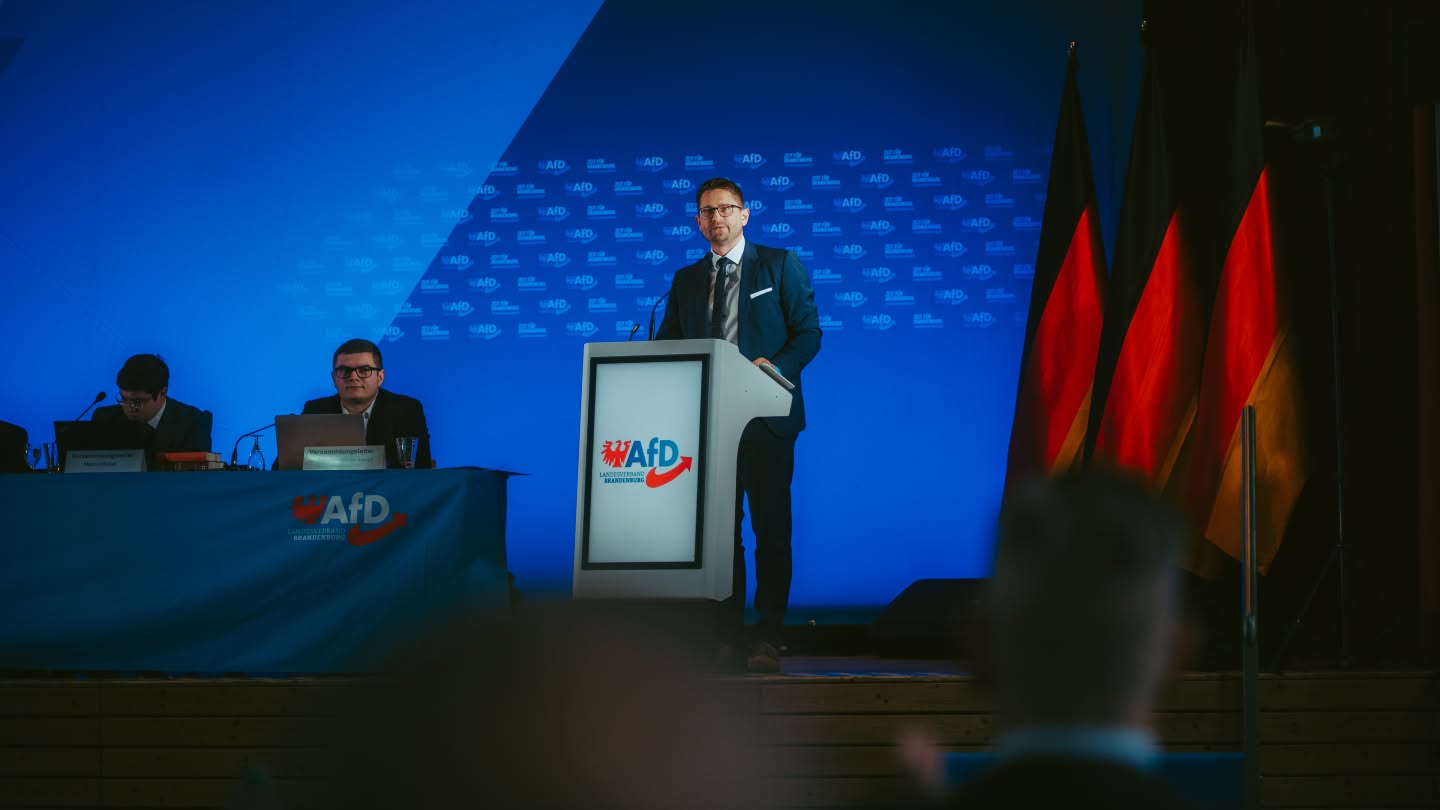
The Alternative for Germany (AfD) has reached 40 percent support in Brandenburg for the first time in a new poll, twice the level of the governing Social Democrats (SPD) and enough to make any coalition without the party or its potential partners extremely difficult.
The Insa survey, conducted for the Märkische Allgemeine Zeitung, Märkische Oderzeitung and Lausitzer Rundschau and published this week, put the AfD at 40 percent, up 6 points from the institute’s previous Brandenburg poll in March.
BRANDENBURG | Sonntagsfrage Landtagswahl INSA/MAZ, MOZ, LR AfD: 40% (+6) SPD: 20% (-4) CDU: 9% (-5) LINKE: 9% (+2) BSW: 7% (-1) GRÜNE: 7% (+2) Sonstige: 8% Änderungen zur letzten Umfrage vom 21. März 2026 Verlauf: https://t.co/R7Fb0r9hmo #ltwbb https://t.co/Ww2EhzqHy6
— Deutschland Wählt (@Wahlen_DE) October 9, 2026
The Social Democrats of longtime Minister-President Dietmar Woidke stood at 20 percent, down four points. The Christian Democrats (CDU), the SPD’s current coalition partner, fell five points to 9 percent. The Left Party also reached 9 percent, while the Greens and the Sahra Wagenknecht Alliance (BSW) each stood at 7 percent.
It is important to note that the next regular state election is not due until autumn 2029, which means support could shift substantially in three years. Nevertheless, the result for the AfD mirrors nationwide trends, especially in the east of Germany, where the AfD recently won in neighboring Saxony-Anhalt by earning 43.8 percent of the vote in the September election.
Brandenburg’s AfD state leader René Springer called the result “a tremendous vote of confidence” that showed “how great the desire for a political new beginning in Brandenburg is.” He added that the party’s goal remained an absolute majority so it could govern the state alone.
Trouble forming a coalition
The numbers underscore the difficulty of forming a government that excludes both the AfD and the left-wing BSW.
— Remix News & Views (@RMXnews) January 16, 2026
German schools face increasing violence due to mass immigration. In the city of Cottbus, the public prosecutor has launched 18 criminal investigations into cases of serious violence in the migrant-dominated Regine Hildebrandt Primary School. A father from the school told reporters there were "at least two to three attacks" a week before he took his children out of school. He said that the names of the perpetrators were "for example, Ali, Mohammed and Ahmed." The school has drawn national attention due to extreme violence. In an open letter, parents reported physical attacks with serious injuries, including one student who suffered a concussion. In addition, students were using pepper spray, as well as fighting with kicks and punches. Dennis Hohloch, an Alternative for Germany (AfD) MP, said in response: "Immigration is the biggest problem, the biggest safety risk for our children in our schools. We had 3,209 violent offenses at our schools in 2024. If you take the 190 school days a year, that’s 17 violent offenses a day. This figure is 20% higher than 4 years ago. Violence in schools, especially here in Brandenburg, can no longer be minimized or glossed over, even if the SPD and the Ministry of Education keep trying." Brandenburg Interior Minister René Wilke affirmed that the list of criminal offenses in the just one school is "very, very long and varied." He described dangerous bodily harm, threats, insults, and coercion. Wilke described "aggressiveness and willingness to use violence being a prominent dimension." Cottbus Mayor Tobias Schick, who belongs to the far-left SPD, admitted during a press conference in August 2025 that the problem is a consequence "of partly unregulated, partly uncontrolled immigration in recent years."
The current SPD-CDU coalition would command only 29 percent. In the 2024 state election, the SPD won with 30.9 percent, the AfD finished second with 29.2 percent, the BSW took 13.5 percent and the CDU 12.1 percent.
After that vote, Woidke initially formed a coalition with the BSW; the alliance collapsed earlier this year following internal BSW disputes, including the departure of Finance Minister Robert Crumbach and other lawmakers, and the SPD later reached a new agreement with the CDU.
Given the poll results in Brandenburg, another possible government coalition would involve the BSW and AfD. Currently, in Saxony-Anhalt, both parties are in discussions to form a ruling government. If that government forms and manages to hold together, it could form a template for ruling governments in the east of the country, where AfD and BSW are strongest. At the same time, the AfD is rapidly growing in the west of the country as well, which is key to its national support, as the western states have far higher population numbers and political weight than the east.
The post Germany: AfD reaches record high 40% in Brandenburg as party continues to dominate in the east appeared first on Remix News.
‘NO TURKS – ALL OUT’ – CDU candidate with Turkish background allegedly faked hate crime attack right before local German election
Prosecutors have opened an investigation into a local Christian Democratic Union (CDU) mayoral candidate of Turkish origin who is accused of staging a racially motivated attack on his own car days before an election he lost badly.
The Itzehoe public prosecutor’s office is examining allegations that Baris Karabacak faked the incident, according to the German newspaper Bild. Authorities obtained and executed a search warrant against the politician and seized at least one electronic device.
Karabacak, an entrepreneur who had previously served as chair of the Uetersen city council, was the CDU’s candidate in the Sept. 27 mayoral election in the town of roughly 18,000 people in the Pinneberg district of Schleswig-Holstein. He finished a distant third with 10.7 percent of the vote. Incumbent Mayor Dirk Woschei of the Social Democrats was reelected in the first round with 51.3 percent; independent candidate Marvin Schöpp received 38.1 percent.
A few days before the vote, local media including public broadcaster NDR reported that the windows of Karabacak’s car had been smashed overnight. A campaign flyer bearing an added message in all capital letters reading “NO TURKS — ALL OUT” was left behind. Police initially investigated the matter as possible incitement to hatred.
At the time, state CDU General Secretary Lukas Kilian publicly backed his party colleague and expressed pride in the CDU’s diversity. Woschei also offered solidarity, stating that political competition must be conducted with arguments and that “violence, hate and racist messages are an attack on the city’s democratic culture.”
Kilian’s tone has since shifted sharply. He told Bild he was “stunned” by the new allegations.
“Anyone who fakes a racist crime abuses the solidarity of many people and mocks the victims of real racism. There is no place for that in the CDU,” Kilian said. The state party has said that if the accusations are confirmed, Karabacak will be asked to resign his membership; failure to do so would trigger expulsion proceedings.
The case remains under investigation, and no charges have been filed. Karabacak has not publicly commented on the prosecutor’s probe.
The episode has drawn attention in a town where Karabacak had earlier faced internal party and council criticism over his leadership style before resigning as city council chair earlier in 2026 and then securing the CDU’s mayoral nomination.
Another hate crime hoax proven false in court
This is also notably not the first alleged hate crime hoax from a German politician. In 2023, Remix News reported on Manoj Subramaniam, a 33-year-old former local Green councilor in the German town of Erkelenz, who claimed he had been subjected to sustained acts of harassment by anonymous right-wing extremists. He showed police evidence of the abuse he had received, which included a threatening letter with a razor blade inserted and a swastika drawn onto his vehicle in red paint.
The case made national headlines last year with several prominent politicians offering their solidarity with Subramaniam for the alleged abuse he had received.
“Right-wing extremists are threatening political volunteers to silence them. Thank you, Manoj Subramaniam, for not being silent and raising your voice,” stated Lamya Kaddor, a member of the Bundestag.
Federal police took protective measures for the politician’s safety, and an intensive investigation was initiated by state security, all at considerable cost to the taxpayer. The only issue, however, was that Subramaniam had made it all up.
“The defendant actually wrote this note himself,” revealed Justus Wassenberg, the press spokesman for the public prosecutor’s office.
It transpired that Subramaniam had also drawn SS runes and a swastika onto the doorbell panel outside his house.
Subramaniam subsequently resigned from his position as a local councilor, and the Erkelenz District Court issued the disgraced politician a penalty order of €3,600 for faking criminal offenses, a fine he appealed.
He reportedly cried during his trial when his appeal failed.
2026 firebombing not an anti-Semitic attack after all
The investigation into the early 2026 firebombing of Brandenburg Antisemitism Commissioner Andreas Büttner’s home stunned the public.
While the case was initially treated as an Islamist or antisemitic hate crime, the German Public Prosecutor General’s Office now identifies two men from Büttner’s “own circle,” which belongs to the left, as the primary suspects.
One of the men is also linked to the threatening letter sent to Büttner. Meanwhile, Büttner said he was shocked and described it as the biggest betrayal of his life. He also stated that if the two were responsible, the act had nothing to do with antisemitism in his view. So far, the prosecutor’s office has continued to list Büttner as a witness or injured party, not a suspect. News outlets have highlighted that there was a €3,000 transfer from Büttner to one of the men shortly before the incident, which he called a loan, and other joint activities.
These details prompted public questions and speculation in some outlets about possible staging or a “false-flag” element, but no official finding has supported the claim that Büttner ordered or knew of the act in advance. The case still reportedly remains under investigation.
The post ‘NO TURKS – ALL OUT’ – CDU candidate with Turkish background allegedly faked hate crime attack right before local German election appeared first on Remix News.
Das eigentliche Ziel ist ein endloser Wirtschaftskrieg
Die EU verlängert ihre Russland-Sanktionen um drei Jahre. Damit wird der Wirtschaftskrieg zum Geschäftsmodell: zugunsten US-amerikanischer Energiekonzerne und Fonds – und zulasten der Europäer. Wer sich in diesen Tagen die Entscheidung der EU anschaut, die Strafmaßnahmen gegen Russland für volle drei Jahre zu verlängern, muss sich unwillkürlich an Julian Assanges Diktum erinnert fühlen:
„Das eigentliche Ziel ist ein endloser Krieg, kein erfolgreicher Krieg.“
Denn der völkerrechtswidrige Wirtschaftskrieg gegen Russland mittels einseitiger Sanktionen, der in kolonialer Absicht formal auf eine Verhaltensänderung Moskaus gerichtet ist, wird zum Selbstzweck.
Ungeachtet der Zerstörungen, die die Sanktionen in der Wirtschaft der EU-Mitgliedstaaten selbst anrichten, schält sich immer deutlicher heraus: Die Verewigung der EU-Sanktionen, die bisher halbjährlich oder jährlich verlängert wurden, dient vor allem der Interessendurchsetzung von US-Energiekonzernen sowie der Profitmaximierung von US-Investmentfonds wie BlackRock. Durch die Sanktionen erlangen sie unter anderem eine Monopolstellung bei der Energieversorgung Europas und können zu viel höheren Preisen verkaufen als eine mögliche russische Konkurrenz.
Die Investmentfonds profitieren wiederum von der begleitenden Hochrüstungspolitik – nicht nur in den USA, sondern auch durch ihre Beteiligungen an deutschen Rüstungsschmieden wie Rheinmetall.
Es gibt also ein Profitinteresse sowohl daran, den Wirtschaftskrieg zu verlängern, als auch daran, die Situation gegenüber Russland zu eskalieren. Dieses Interesse schlägt über die Europäer voll durch.
Es mag paradox klingen, aber ein erfolgreicher Wirtschaftskrieg würde dieses Bereicherungsmodell rasch beenden. Dass man jetzt für die kommenden drei Jahre Sanktionen verhängt, zeigt denn auch, dass man kein Interesse an einer schnellen Beendigung des Stellvertreterkrieges des Westens in der Ukraine hat. Mit einer Verhaltensänderung wird nicht gerechnet. Die Sanktionen sind zum Modell geworden, die Europäer auszurauben. Sie sind nichts anderes als ein Unterwerfungsakt unter die Vorgaben aus den USA. Der Vasallenstatus der Europäer wird so weiter vertieft – bis hin zur Gefahr, dass man die Bereitschaft zeigt, sich selbst für Washington aufzuopfern.
Es ist denn auch kein Widerspruch dazu, dass man, während man die Sanktionen gegen 3.000 Personen und Organisationen verlängert, zwei russische Oligarchen jetzt davon ausnehmen will. Die Aufhebung der EU-Strafmaßnahmen gegen Alischer Usmanow und Michail Fridman dient den Interessen einzelner Mitgliedstaaten und ist offenbar der verzweifelte Versuch, Russland zum eigenen Vorteil destabilisieren zu wollen.
Grönland als Vertragsmodell
Immer deutlicher wird hingegen, dass sich die Europäer dem aktualisierten US-Kolonialmodell unterordnen. Während der deutsche Kanzler Merz das Abkommen über Grönland zwischen Dänemark und den USA als Erhalt der Souveränität feiert, spricht der Text der Vereinbarung eine ganz andere Sprache.
Das Abkommen von 1951 war an die NATO gebunden und an dänische Mitwirkung gekoppelt. Der neue Deal gilt ohne Enddatum und überdauert sogar eine mögliche Unabhängigkeit Grönlands. Die USA sichern sich dauerhafte Stützpunkte, können weitere Basen mit dem Schutz des amerikanischen Kontinents begründen und müssen über das Prinzip neuer Standorte nicht mehr verhandeln, sondern nur noch über deren Ausführung. US-Truppen bewegen sich frei zu Land, zu Wasser und in der Luft – nun auch unter Wasser –, ohne dass dänische Behörden in Grönland dafür noch die Regeln setzen.
Hinzu kommt ein Vetorecht: gegen militärische Präsenz von Nicht-NATO-Staaten und gegen Investitionen von außerhalb der westlichen Blöcke in sensible Sektoren und Ressourcen. Formal bleibt die Souveränität Dänemarks und das Selbstbestimmungsrecht Grönlands bestätigt. Tatsächlich entstehen quasi extraterritoriale Entitäten, in denen Kopenhagen und Nuuk nichts zu sagen haben. Die USA bestimmen die zentralen Bereiche der Politik auf der Insel und sichern sich ein privilegiertes Ausbeutungsrecht.
Ein Modell für die ganze Hemisphäre
Zugleich wurde ein Vertragsmodell geschaffen, das auch für andere Gegenden der westlichen und der nördlichen Hemisphäre gelten soll: von Venezuela über die Kanalzone in Panama bis hin zu den Küsten Kanadas.
Es ist zugleich das Modell für eine Zerschlagung Russlands, die als Folge des Abnutzungskriegs in der Ukraine angestrebt wird, um gegenüber China wieder in die Vorhand zu kommen und den eigenen Niedergang aufzuhalten.
Moral des Völkermords
Die Moral dieser Ordnung hat US-Präsident Donald Trump vor der UN mit seiner Auslöschungsdrohung gegenüber dem Iran zusammengefasst. Sollte der Iran nicht den Vorgaben aus Washington zustimmen, dann „treibe ich sie in die Hölle“. Es ist die Moral des Völkermords.
Es liegt auf der Hand, dass der immer höhere Einsatz des Westens im Versuch, die Welt zu kolonisieren, die entsprechenden Gegenkräfte auf den Plan rufen wird. Allein in Europa wird man diese bei einer Kompradorenbourgeoisie vergeblich suchen.
Originalbeitrag NachDenkSeiten
Menaces allemandes sur la France
par Jules SEYES
Si l’Allemagne désirait interrompre les aéroports français, elle pourrait équiper ses Typhoon de missiles et créer une bulle de supériorité aérienne au-dessus du sol français. L’affirmation sonne-t-elle ridicule ? C’est exact, elle est pourtant l’exact miroir de l’alerte qu’El Mundo prête à la CIA selon laquelle les Russes pourraient équiper un navire de drones pour désactiver des aéroports occidentaux1. Comprendre pourquoi l’une sonne comme folle alors que l’autre paraît terrifiante suppose de saisir les méthodes d’analyse sur lesquelles elles reposent, avant d’analyser justement les présupposés des intentions.
Celles-ci étant un peu complexes, commençons par la doctrine, qui aura le mérite de clarifier le brouillard mental actuel. Un peu comme le brouillard de guerre auquel les militaires sont confrontés. Deux méthodes offrent un moyen de le briser : la méthode des moyens et celle des intentions.
La première repose sur un inventaire des ressources connues de l’adversaire pour évaluer l’ensemble des points qu’il peut toucher. C’est aujourd’hui l’exercice de la CIA : les Russes disposent de drones, ceux-ci peuvent être basés sur un navire, donc les Russes peuvent équiper un navire. L’exercice en début d’article relève de la même logique : prendre le nombre de chasseurs de la Bundeswehr, le nombre de Taurus en stock, puisque contrairement à nos SCALP ces armes n’ont pas été envoyées en Ukraine, et établir que cette combinaison a la capacité de mener une attaque surprise au-dessus de la France.
Le problème de cette méthode est de livrer un arc de menace souvent inutilisable, car il existe trop d’axes de vulnérabilité pouvant être exploités. L’automne 1944 en offre l’illustration2. Les Allemands retirent alors plusieurs divisions du front. La reconnaissance aérienne alliée photographie, à partir de la mi-novembre, un trafic ferroviaire intense autour de Cologne, de Coblence et dans l’Eifel : gares de triage saturées, locomotives sous pression, une vingtaine de wagons plats chargés de chars Tigre sur la ligne d’Euskirchen. Début décembre, cent soixante-dix wagons plats chargés de blindés et de véhicules roulent entre Cologne et Limbourg. La nuit, les chasseurs de nuit repèrent des convois aux phares masqués. Des dépôts de ravitaillement apparaissent à Rheinbach et à Schleiden, des piles de bois propres à jeter des ponts près d’Echternach, des trains sanitaires à l’ouest du Rhin. Les écoutes radio identifient une armée blindée nouvelle, la 6e Panzerarmee. À la mi-décembre, face aux Ardennes, le VIIIe corps américain signale une activité d’artillerie inhabituelle, aucun mouvement visible et presque plus de prisonniers. Cette force, dont la valeur combative était connue, pouvait être engagée de bien des manières.
Une seconde méthode doit alors entrer en jeu : celle des intentions. En fonction des moyens connus, on établit ce que l’ennemi voudra toucher. Plus précise, celle-ci possède l’inconvénient de reposer sur des déterminants bien moins solides, puisque liés à la compréhension de la psychologie de l’adversaire.
Ces indices remontent à tous les états-majors alliés, et chacun les interprète selon le tempérament de son chef. Au quartier général d’Eisenhower, commandant suprême des forces alliées, homme de coalition et de logistique, domine une conviction : les Allemands sont trop fatigués pour attaquer. Les divisions retirées sont donc évaluées comme des rotations de repos et une reconstitution de réserve. Le 15 décembre encore, son bureau des opérations n’a rien à signaler dans les Ardennes. Patton, chef de la Troisième Armée, passe pour le plus offensif des généraux américains : il ne conçoit la guerre qu’en mouvement et à l’attaque. Son état-major projette cette volonté offensive sur l’ennemi allemand. Elle reflète en réalité la psychologie des analystes, elle-même dérivée de la psychologie des chefs. Son chef du renseignement, le colonel Oscar Koch, lit les mêmes indices comme la préparation d’un coup et présente à Patton, le 9 décembre, sa conclusion : une contre-offensive allemande est possible dans les Ardennes. Patton fait aussitôt préparer les plans qui permettront à la Troisième Armée de pivoter vers le nord. Le lendemain du rapport rassurant d’Eisenhower, l’offensive allemande éclate. Autrement dit, la méthode des intentions en dit souvent plus sur la manière de penser des analystes que sur leur compréhension fine de l’adversaire. Bien conscients de ces défauts, les militaires appliquent les méthodes classiques d’analyse stratégique pour filtrer l’ensemble. La première d’entre elles est le rapport coût-avantage : qu’est-ce que l’adversaire a à gagner ? Pour quel coût ?
Ici, vous constatez par exemple la différence de pensée entre Eisenhower et Patton. Pour le premier, le coût est en carburant ; le second pense en termes d’avantage moral de l’offensive. D’où la divergence d’analyse. Si nous prenons notre exemple d’avions allemands équipés de Taurus, le coût est une guerre franco-allemande, voire OTAN-Allemagne si l’article 5 venait à jouer. Aucune attaque, même couronnée de succès, ne pourrait provoquer des dégâts suffisants pour compenser les coûts d’un conflit avec une puissance nucléaire. En pratique, l’Allemagne aurait beaucoup à perdre et peu à gagner, puisque son influence dans l’appareil d’État et l’UE lui permet d’obtenir satisfaction dans des domaines cruciaux, telle la fermeture de Fessenheim.
Alors, la Russie ?
La CIA vient de nous gratifier d’un de ces mémos qui relèvent à la fois de la plus pure vérité et du plus pur mépris du public destiné à recevoir la fuite. Voici la menace : «Le point faible de l’Europe» : la menace d’une attaque russe contre la France et l’Espagne est réelle, selon la CIA.
Le scénario de l’attaque impliquerait des drones Gerbera3, de petits appareils à la charge explosive réduite dont l’intérêt est perturbateur et non de faire des victimes : fermer un aéroport, par exemple. Ils seraient lancés depuis des navires marchands déguisés en trafic commercial ordinaire et postés en Méditerranée.
Je vous avouerai qu’en ouvrant ce mémo, je m’étais attendu à un scénario sérieux, pas à cela. À la découverte du propos, son outrance m’a fait passer à la limite de l’insulte. Voilà une proposition d’attaque étatique dont le but serait de «perturber» ? Se rend-on compte du terme ? Une attaque pour perturber ? Schlieffen se retourne dans sa tombe, Napoléon s’étrangle avec sa bataille décisive, Manstein est fort heureusement mort. Car, hélas, un État ne gaspille pas la surprise en lançant un tapotage gentil. S’il faut recourir à la violence, alors il faut d’emblée prendre un avantage définitif pour maintenir au plus court la durée de la campagne. Sun Tzu le notait déjà : aucun pays n’a jamais tiré profit d’une guerre prolongée.
Le projet proposé contredit tous ces principes et, dès lors, il ne pose qu’une seule question : le code militaire russe a-t-il supprimé la peine de mort pour les traîtres ? Eh oui, désolé de décevoir ces intervenants de plateaux qui se prétendent experts malgré leurs abus propagandistes, mais ce que la CIA nous propose est de lancer une attaque inefficace pour ruiner la réputation que les Russes ont acquise auprès du reste du monde. Nous parlons bien sûr des pays sérieux, hors de l’Occident malade où les journalistes reprennent ce scénario comme un sujet sérieux.
En clair, une balance coût-bénéfice où il n’y aurait que des coûts pour la Russie et aucun bénéfice. Eh oui, car fermer un aéroport fait peut-être perdre quelques millions à des entreprises, mais cela n’a AUCUN impact stratégique. Pire, il est inutile de mobiliser un drone Gerbera, un navire ou tout autre moyen militaire : un coup de fil d’un gamin pour annoncer une bombe suffit. Ou bien une voiture piégée.
Bref, l’aventure proposée n’apporte aucun bénéfice stratégique et se fait avec des moyens disproportionnés qui coûteraient énormément à la Russie. Seul un traître à la Russie peut avoir cette idée. Je sais, en Occident, nous sommes habitués avec les relais US, mais plus en Russie : les réseaux qui ont soutenu V. Poutine après son arrivée au pouvoir s’en sont assurés. Ou en tout cas, ils ont fait monter le prix de la passe. Un officier russe réclamerait une méga-malle de billets pour seulement proposer cela à ses chefs, vu qu’il sait que ce serait (si ses chefs sont gentils) la fin de sa carrière. Quant à le mettre en œuvre sans validation politique, il aurait intérêt à avoir le bon billet d’avion pour s’éclipser au plus vite.
Car là est le point qui permet aux individus tarés que l’Occident nomme journalistes de procéder à cette propagande goebbelsienne (enfin, je m’excuse auprès du docteur Goebbels pour cet amalgame insultant) : les moyens existent. Exact, la Russie possède les drones, les navires. Elle aligne même un porte-avions et surtout un arsenal de missiles de toute première qualité. Depuis les années cinquante, l’URSS dispose de bombardiers stratégiques et de missiles capables de frapper le territoire français. La menace n’a donc rien de nouveau, puisque la Russie peut transformer la France en parking si elle le désire.
L’alerte de la CIA ajoute-t-elle de nouvelles capacités ? La réponse est non, une fois, deux fois, mille fois NON !
Héritière, État successeur de l’URSS, la Russie dispose depuis sa naissance des moyens de nous mettre à terre si elle accepte les millions de morts qu’exigera l’absorption de la salve nucléaire française. Une poignée de drones n’y ajoute rien, n’y retranche rien. D’autant plus que la Russie dispose de missiles hypersoniques Orechnik en mesure d’infliger de douloureux dégâts à notre territoire. Par exemple, mais je ne voudrais pas exciter LCI, par une frappe d’Orechnik contre des centrales nucléaires ou, en non nucléaire, contre nos barrages. Nous n’aurions aucun moyen de riposte non nucléaire.
Dès lors, oui, les Russes peuvent monter des drones sur un navire, ils peuvent monter des Grad aussi, ou toute autre arme à plus ou moins grande portée. Dans un tel scénario, l’élément coûteux est le navire sacrifié, pas les munitions embarquées. L’alerte donnée, qui n’est que l’une des alertes autour desquelles on nous a fait résonner tambours et trompettes, n’apporte rien de structurellement nouveau. Un bricolage de drones pour frapper notre territoire n’a rien de complexe. Après tout, le gouvernement de Kiev a bien réussi à introduire des drones sur le territoire russe pour frapper des bombardiers stratégiques.
Seulement, à ce jeu, tout le monde peut jouer ou presque. Il faut le restreindre : l’équipe Le Maire, Breton ne peut pas jouer, mais c’est lié à l’incompétence des joueurs. La France, par exemple, possède encore quelques officiers de valeur capables d’organiser l’affaire. (Non, pas le colonel monté hors de propos en lui accrochant des étoiles comme des guirlandes de Noël, et qui fait aujourd’hui comme s’il dirigeait l’armée française.)
Le problème est que ces gens refuseraient de monter une telle opération. Frapper la Russie, comme frapper la France pour la Russie, exige que la première balle soit mortelle. On tire au cœur ou on ne tire pas, et dans ce cas, entre puissances nucléaires, la question n’est pas celle des moyens, mais celle de la volonté. Même si nous avons TOUT fait, par une politique irresponsable, pour irriter les Russes, ils n’ont nullement annoncé leur intention de répondre à la hauteur de notre bêtise.
Reste l’intention : les Russes peuvent nous frapper, c’est acquis, ils peuvent le faire depuis des décennies pour un coût fixé. Resterait le gain d’une frappe : faire cesser l’appui français à l’Ukraine. Dans ce domaine, hélas, hormis l’agacement entre les oreilles d’entendre les rodomontades et pseudo-discours d’Emmanuel Macron, qui justifient toute envie de retourner une paire de claques justement méritée, la vérité commande de constater l’épuisement de nos moyens : la macronie a déjà envoyé à peu près tout ce qu’elle pouvait racler dans les fonds de tiroirs ; quant à l’argent, l’Allemagne ou la Grande-Bretagne peuvent le fournir. Les véritables acteurs sont les Anglais, par l’usage des moyens de leurs services secrets très actifs dans la guerre des drones, et les Allemands pour la livraison de munitions. Pour peser sur les opérations en Ukraine, une frappe russe devrait cibler en priorité ces deux pays.
Sauf à vouloir faire de l’éducation prioritaire, mais dans ce cas, l’ambassade de Russie peut se contenter d’engager un professeur de SEGPA pour l’envoyer à l’Élysée. Pour la fessée, il serait même inutile d’engager : Montjoie Saint-Denis a fait des petits.
Prise sous un angle militaire, l’information n’apportait rien, et si les journalistes en avaient fait une lecture correcte, ils l’auraient classée verticalement.
Ce n’était bien évidemment pas le but, mais au contraire d’avoir un thème pour parler de menace russe afin de poursuivre la propagande par martèlement, qui vise à abrutir les téléspectateurs de menaces pour leur faire admettre le concept sans esprit critique. Ça marche avec les résidents de maison de retraite au stade pré-Rivotril.
Tel est le problème de nos gouvernants. Faute d’agression russe, il faut créer le sentiment d’une agression, ce qui est le but de ces annonces : entretenir l’hystérie et donner un prétexte pour prononcer les mots agression, guerre, menaces, puissants générateurs d’un sentiment d’insécurité dans la population soumise à ce discours anxiogène.
Ça n’a qu’un défaut : messieurs les journalistes, vous avez repris en connaissance de cause une publication des services américains pour engager notre pays sur une trajectoire fausse et dangereuse pour sa sécurité.
Soit vous êtes des idiots congénitaux, ce que la CIA n’exclut peut-être pas, et je vais m’offrir de partager le soupçon. Soit vous le faites délibérément. Même en tenant compte de votre bêtise, tous les journalistes français ne peuvent pas être aussi désavantagés par la nature ; il aurait donc dû en rester assez pour faire échouer la manipulation.
Cela fait de vous, en tant que catégorie, des traîtres à votre nation, susceptibles de subir les foudres judiciaires au moment où le pouvoir changera de main et cessera de couvrir vos abus. Il ne s’agit pas de menaces, mais d’une évaluation juridique. VOUS mettez objectivement notre nation en danger !
La méthode marcherait si, justement, conscients de la menace sur leur esprit, beaucoup de citoyens ne s’étaient pas dirigés vers internet.
___
- L’alerte a été rendue publique par le quotidien espagnol El Mundo le 24 septembre 2026 (article de Xavier Colás), reprise notamment par Euronews : «La CIA alerte sur des drones russes visant l’Espagne, la France ou l’Italie», https://fr.euronews.com/2026/09/24/la-cia-alerte-sur-des-drones-russes-visant-lespagne-la-france-ou-litalie ;
i24news : «Les États-Unis alertent l’Europe sur une possible attaque de drones russes depuis la Méditerranée», https://www.i24news.tv/fr/actu/international/artc-les-etats-unis-alertent-l-europe-sur-une-possible-attaque-de-drones-russes-depuis-la-mediterranee ;
Meduza, sur le démenti italien : https://meduza.io/en/feature/2026/09/24/no-one-needs-more-fuel-on-the-fire-italy-pushes-back-on-report-that-cia-warned-of-possible-russian-sea-launched-drone-attacks - Sur le renseignement allié avant l’offensive des Ardennes : U.S. Army, «Third Army G2 predicts Battle of the Bulge, 9 December 1944», https://www.army.mil/article/116038/third_army_g2_predicts_battle_of_the_bulge_9_december_1944 ;
Carlo D’Este, «December 16, 1944 : Ardennes Offensive Begins, An “Abysmal Failure of Allied Intelligence”», https://www.thehistoryreader.com/military-history/december-16-1944-ardennes-offensive-begins-abysmal-failure-allied-intelligence/
DVIDS, «First Army in the Battle of the Bulge», https://www.dvidshub.net/news/printable/385060 ;
David T. Zabecki, «Patton at Bastogne», The Intelligencer (AFIO), vol. 29, n° 2, 2024, https://afio.com/publications/eprints_2024/ZABECKI_Patton_at_Bastogne_AFIO_INTELLIGENCER_Vol29_No2_SummerFall_2024.pdf ;
Oscar W. Koch, G-2 : Intelligence for Patton, 1971.
The Army Air Forces in World War II, vol. III, chap. 19, Third Army G2 Predicts Battle of the Bulge, First Army in the Battle of the Bulge, D’Este, The History Reader. - «Gerbera (drone)», Wikipédia, https://en.wikipedia.org/wiki/Gerbera_(drone)
Publiéà l’origine par Reseau International
German 'lawfare': When lawsuits become a political weapon
Germany's population is shrinking, but not everywhere
Europe’s mounting social chaos… chickens coming home to roost for proxy war against Russia
Strategic Culture Foundation | October 9, 2026
The European Union is witnessing a full-blown social revolt. Governing political parties and their economic policies are held in open contempt as public protests and strikes escalate across multiple countries.
Protests, mass marches, and industrial strikes are spreading across the EU in France, Belgium, Spain, Italy, Germany, Ireland, Portugal, and other countries. The grievances are various, from students and teachers over woeful education services, to healthcare professionals and transportation workers denouncing crumby wages and pension cuts.
But at the core is a warmongering, dehumanizing system of capitalist inequality.
Unbearable living costs for basic needs, from food to housing, are driving millions onto the streets in desperation and anger at the lack of adequate political response to their concerns. As one French student said: “Too young to be listened to, old enough to be tear-gassed.”
The entire political system is being brought into disrepute for its dysfunction and indifference towards meeting rudimentary human needs. Then, infuriating all the more, are lies from the elite rulers and their propaganda media about “national defense and threat of war from Russia.”
In Spain this week, an 87-year-old frail woman known as Maricarmen died in hospital after she was evicted from her Madrid home because she could not pay the extortionate rent increase. Her plight has come to galvanize a nationwide protest against Spain’s housing crisis, a crisis that is repeated across every European country. Protesters shouted furiously that the pitiful old woman was “murdered by the state and corporations.”
In France, the brutality of police against student protests has shocked the nation and the world. Nearly 7,000 young people have been arrested, as riot police tear gas and shoot at largely peaceful rallies. Students gathering at the Place de la Bastille in Paris and other cities vow that they will not back down. One student had his hand blown off by a police stun grenade while another teenager lost an eye from a rubber bullet fired at close range.
The Place de la Bastille is where the French Revolution manifested in 1798 against a hated aristocracy amid abject misery. Today, the tensions are boiling towards another momentous rebellion, this time inspiring again similar movements across Europe.
These protests and the inhumane suffering that underlie them are channeling uprisings all over the EU.
There is a palpable sense that populations en masse have had enough of decades of inequality and chronic deprivation inflicted by capitalist policies that enrich a few and are enforced by governments slavishly serving the interests of capital over the needs of the citizen majority.
Western media reports talk about “cash-strapped” governments under pressure from bond markets to reduce record debt levels while workers, students and pensioners demand more public investment and relief from economic hardship.
That is a misleading partial portrayal of the problem. Omitted is the crucial backdrop that European governments are directing vast economic resources towards militarism and the proxy war in Ukraine against Russia. That is what is causing the “cash-strapped governments.” In other words, their declared fiscal straits are a policy choice, not some mysterious dilemma.
The social crisis sweeping across Europe is also seen in the United States and other Western-aligned nations. The background is a failed economic system that no longer provides a modicum of acceptable living conditions. The problem has been decades in the making from growing inequality and diminishing political representation. Today it is even questionable if Western states are democracies, controlled as they are by corporate oligarchies.
Nevertheless, the social crisis that is unfolding across Europe has been intensified and amplified by European political rulers operating in a relentless war mode against Russia.
The European Union has pumped hundreds of billions of euros into Ukraine over the past four years to prop up a NeoNazi regime run by a corrupt dictatorship – all for the objective of defeating Russia. The EU leaders – many of them unelected, like Ursula von der Leyen, Kaja Kallas and António Costa – are driven by an obsessive Russophobia. But that is only part of the explanation.
Other elected leaders and parties like France’s Macron and Germany’s Merz are also despised for their elitism and delusions of grandeur. Merz declares that he wants to make Germany the strongest military in Europe, in total tin-ear deafness to his nation’s economic and social problems and the sinister historical connotations of resurrecting Nazi Germany. Meanwhile, as his government suffers electoral defeat after defeat, European elites deprecate German voters as being blind because they dare to choose parties that are opposed to war with Russia.
There are many grounds for the Europe-wide contempt of ruling parties. Inequality, poverty, unemployment, soaring living costs, declining wages, deteriorating public services. Uncontrolled immigration amid the pressure on inadequate public resources is another cause for grievance. Europe’s complicity in the Israeli genocidal war on Palestinians, and Europe’s complicity in Trump’s aggression towards Iran, Yemen, Cuba, and so on, are other factors.
However, the bogus narrative that governments are “cash-strapped” is a cause for immense public disgust. There are plenty of economic resources to meet public needs. It’s a question of those resources not being permitted to create just and humane societies under the prevailing capitalist system with its priority of enriching a tiny elite class.
The conditions of “tight budgets” and “austerity for the masses” are created by deliberate policies of militarism and fuelling a proxy war in Ukraine.
European “leaders” and their NATO lobbyists like Mark Rutte demand hundreds of billions of euros to boost military industries while at the same time calling for draconian cuts in public spending and social welfare in order to pay for this reckless militarism. The EU is “lending” an additional €90 billion over the next two years alone just to prop up the corrupt regime in Kiev so that it can keep fighting a futile war with Russia. The perverse priority is driven by the military-industrial complex and its corporate investors. It is also driven by an ideological, propagandized mindset that demonizes Russia as an enemy. President Putin and other Russian voices have repeatedly stated that they do not want war with Europe. They say the conflict in Ukraine has root causes that can be resolved through diplomatic engagement. Why are European politicians implacably opposed to peace?
A major factor is covering for internal political and economic failure of the European system. The EU’s economies, as with those in the U.S. and other Western states, are bankrupt dystopias in terms of delivering on social and democratic needs. The failure has been compounded by the costs of war in Ukraine.
That failure is criminal and fatal for the politicians and governments who have overseen the policies. Thus, the political class, including the propaganda news media, cannot admit their criminal policies.
In the face of their own internal contradictions, the European political elites are seeking a solution by externalizing Russia as an enemy. This is the same modus operandi that European rulers have used for the past century and more, unleashing two world wars as a result.
These criminal politicians and their dysfunctional economic system are again pushing war as their escape plan for survival at the expense of millions of lives and at the risk of starting a third world war, one that this time around could involve catastrophic nuclear nemesis.
It is damning of virtually every European government, including primarily the British, that there are no calls for diplomacy and political settlement with Russia. They are committed to waging war on Russia to absolve themselves from the social devastation they are responsible for.
One positive thing, though, is that increasing numbers of people can see through the chicanery and lies. A German student placard summed it up: “We won’t fight your wars… Education not bombs!”
A day of reckoning is imminent. Criminal political leaders and their warmongering system are exposed like never before and in a way that demands total revolt as a proper solution. The consequences are not to be externalized this time. Chickens are coming home to roost, as Malcom X once said.
Operations Plan Germany: How the Bundeswehr trains for NATO collective defense
Germany suspends naturalizations of alleged Nazi victims, Chinese nationals suspected of wide-scale fraud
Germany’s Interior Ministry has ordered consulates to withhold citizenship certificates under a postwar restitution law after investigators found that dozens of applicants, most of them Chinese nationals, allegedly posed as descendants of people persecuted by the Nazis.
The Federal Office of Administration and the Interior Ministry instructed German missions abroad last week not to hand over naturalization documents “until further notice” and to postpone ceremonies, according to emails reported by Der Spiegel and confirmed in subsequent accounts. A ministry spokesperson said the procedures for so-called restitution naturalizations are under review “to further secure the procedure against corresponding criminal activities.”
The pause follows a Der Spiegel investigation published in early September that detailed an alleged scheme exploiting Article 116, Paragraph 2 of the Basic Law. That provision states that former German nationals whose citizenship was revoked between Jan. 30, 1933, and May 8, 1945, “for political, racial or religious reasons, and their descendants, shall be renaturalized on application.”
Prosecutors in Düsseldorf and the Federal Criminal Police Office are investigating 32 suspects on suspicion of document forgery and violations of the nationality law, authorities have confirmed. At least 28 of those under investigation are Chinese nationals, according to the Düsseldorf prosecutor’s office. German citizenship had already been granted in roughly half the cases. The suspects are said to live in Cyprus, Israel, Britain, and the United States.
Investigators allege the applicants submitted forged or notarized copies of documents and invented genealogical links to real Jewish families who fled or were stripped of citizenship under Nazi rule. In one example cited by Der Spiegel and other outlets, applicants claimed descent from Karl Siegfried Süßkind and Gertraud Süßkind, a couple who left Germany for British Palestine.
The Chinese applicants, including one identified as Liu H. who obtained citizenship in 2024 under the name Derrick Wong, were not actual descendants. Another person, identified as Tian C. and living in London, is accused of using the same fabricated lineage.
Some of those under investigation were already sought internationally on suspicion of serious crimes, including kidnapping and murder, Der Spiegel reported. Prosecutors have said they could not confirm details of foreign cases because they fall outside the German inquiry. The scheme was reportedly advertised on a Chinese social-media platform for more than half a million euros.
An Interior Ministry spokesperson, responding after the initial Spiegel report, said the ministry regretted the “identity thefts” in which “applicants misused biographies of those affected by National Socialism.” The spokesperson added that once sufficient information is available, the Federal Office of Administration will “immediately initiate withdrawal proceedings” in cases of fraudulently obtained citizenship. Unlawful naturalizations can generally be revoked within 10 years.
The Cologne-based office received 14,148 applications for restitution citizenship in 2025, Der Spiegel reported. Officials have noted that the special procedure differs from ordinary naturalization: staff often help applicants assemble proof rather than requiring them to produce every original document, a practice rooted in the law’s reparative purpose. Legitimate descendants may now face delays while certificates already prepared are held and files are rechecked.
The Interior Ministry, led by Alexander Dobrindt of the Christian Social Union, has described the suspension as a temporary measure to protect the integrity of the process, not a repeal of the constitutional right.
The post Germany suspends naturalizations of alleged Nazi victims, Chinese nationals suspected of wide-scale fraud appeared first on Remix News.
‘There are children here!’ – German woman on Berlin bus tells man to stop masturbating on bus with children present
In a video posted to the social media platform X, a young woman was filmed screaming at a man whom she said she had seen expose his penis and begin masturbating on the bus, despite children being present. The man, who appears to have a migration background, speaks German with a clear accent.
“You can’t just sit there and start masturbating with your penis. There are children here! It’s broad daylight!” she asked him.
A third party filmed the encounter and blurred out the woman’s face. However, the man is clearly visible in the video. The Remix News translation of this video has been censored on X, which means it cannot be embedded, but readers can view it here. Below is the original German video.
Dit is Berlin. https://t.co/2woMmgA0vE
— loop23 (@realityloop23) October 8, 2026
She repeatedly tells him to go to a different floor of the double-decker bus, which is commonly seen in Berlin. She also tells him to exit the bus.
The man responded, saying: “What, what? What was there to see?”
She responded: “You were masturbating here, man! It clearly happened, man!”
It remains unclear whether the woman or anyone else on the bus filed a police report. However, Berlin police are permitted to investigate this incident even without a formal complaint. To make an arrest, they will first need to obtain a warrant.
In 2024, the Green Party proposed “women-only” train cabins in Berlin due to soaring sexual violence, and in Germany overall, foreigners commit 44 percent of crimes involving sexual violence. Even in states with relatively few migrants, violence has exploded. Mostly migrant-free Saxony has seen a crime explosion, with 50 percent of crimes at train stations committed by foreigners.
— Remix News & Views (@RMXnews) May 7, 2026
"Please stop touching me… You’re touching me and I don’t want that." A migrant male sexually assaults a young woman on a German train, while criticizing her piercing, saying it is for prostitutes who "do everything. Sucking, swallowing." German public transport in 2026. https://t.co/NUjcBhtuMS
The post ‘There are children here!’ – German woman on Berlin bus tells man to stop masturbating on bus with children present appeared first on Remix News.
MEP blasts ‘Euro-Gestapo’ for lecturing Russia on democracy
RT | October 8, 2026
Brussels is steering Europe toward totalitarianism and a “Euro-Gestapo” while lecturing Russia on democracy, Slovak MEP Lubos Blaha has warned.
Blaha made the remarks during a European Parliament debate on Tuesday, responding to EU foreign policy chief Kaja Kallas, who denounced Russia’s recent parliamentary elections as undemocratic.
The politician questioned why Brussels was focusing on Russia while cracking down on dissent within the bloc.
He cited arrests of pro-Palestinian protesters in Germany and the imprisonment of Estonian opposition figures, who he claimed were jailed for opposing war with Russia.
“Are you going to set up the Euro-Gestapo here, Mrs. Kallas, and lock up everyone who wants peace?” he asked.
The Slovak lawmaker also questioned why Brussels was debating Russia’s elections while Europe faced mounting unrest.
“You may not have noticed, but Spain is in the streets, France is in the streets, and you are here dealing with Russian elections. You must be joking,” he said.
Blaha went on to accuse Brussels of double standards over Ukraine’s suspended presidential elections.
“You blame the Russians for having elections, but you don’t mind that [Ukraine’s Vladimir] Zelensky has been governing for three years without any elections, without a mandate,” he said. “You are hypocrites!”
Zelensky’s presidential term expired in May 2024, but elections have remained suspended under martial law.
Blaha also cited the annulment of Romania’s 2024 presidential election, claiming the vote was canceled because “the wrong candidate won.” Romania’s Constitutional Court scrapped the result over alleged irregularities and accusations of Russian interference after EU- and NATO-skeptic Calin Georgescu won the first round. Pro-EU candidate Nicusor Dan won the rerun in May 2025.
The MEP argued that Russia had held elections despite the ongoing conflict and daily Ukrainian missile and drone attacks on its territory.
The September poll saw the ruling United Russia party win nearly 58% of the party-list vote.
Blaha also defended Russian President Vladimir Putin, contrasting his popularity with that of Western European leaders.
“You have nothing to criticize Putin for, Mrs. Kallas,” he declared. “Unlike you and your Merzes and Macrons, he has the support of his own population.”
Recent polls have put German Chancellor Friedrich Merz’s approval rating at a record low of 10% in October, while French President Emmanuel Macron’s support fell to 17% in September. Neither Kallas nor European Commission President Ursula von der Leyen was directly elected to her current position by voters, having assumed office through the EU’s institutional appointment process.
Blaha belongs to Slovak Prime Minister Robert Fico’s Smer-SD party, which opposes EU sanctions on Russia and has criticized Western military assistance to Ukraine.
Voters or capital: Who rules Berlin?

On September 20, 2026, Die Linke achieved a historic result. With 25.7% of the vote, the party became the largest in the Berlin parliament for the first time. The traditional parties of power (the CDU, the SPD, and the Greens) are left standing. A left-wing government with Elif Eralp as governing mayor is, in theory, within reach.
The reason for this success is no mystery. It is substance. During the campaign, thousands of Die Linke volunteers went out into the neighborhoods. Door to door. Building to building. Up one stairwell, down the next. They came not with shiny brochures, but with one fundamental question: what keeps people awake at night?
For hundreds of thousands of Berliners, the answer is painfully clear: rent. The envelope that lands on the doormat every month. The knowledge that an ever-larger share of their wages flows straight into the bank account of some anonymous slumlord.
Die Linke wants to make rents affordable, break the power of listed real estate giants, and finally implement the outcome of the referendum. In that 2021 referendum, more than one million Berliners voted for the socialization of large housing stock.
Berliners consider no other party as competent on housing. The figures speak for themselves: after the election, 37% of all Berliners say Die Linke has the best solutions for affordable housing.
The establishment strikes back: the great reversal of the debate
Die Linke won on material issues: housing, rent, ownership. But within no time, the press and the talk shows have all but stopped talking about any of it. Suddenly the political debate is dominated by accusations of antisemitism. By stories about the Rote Hilfe, a left-wing solidarity organization that provides legal support to activists and prisoners. By alleged connections to criminal “clans.” By the suggestion that parts of the party lie outside the acceptable democratic framework. Suddenly, the burning question in the media is no longer how to lower rents, but whether Die Linke is “even fit to govern at all.”
It is the great reversal of the debate. Center stage no longer belongs to the unaffordable rents, the power of real estate corporations, and the housing crisis, but to the legitimacy of the party that won precisely on those issues. Meanwhile, the federal establishment works hard behind the scenes to make any possible socialization of real estate giants, the so-called Vergesellschaftung, legally impossible. Yet Article 15 of the German Constitution makes such socialization possible in principle.
What we see here is an organized counterattack from established economic and political power blocs. They open multiple fronts simultaneously – economic, legal, political, and ideological. Let us take a closer look at the nine forces that have now mobilized against Die Linke in Berlin.
1. Real estate capital
The most direct clash is with real estate capital. Die Linke wants to expropriate profit-driven housing companies that own more than three thousand units each. That concerns a total of over 200,000 housing units in the city. Among them is Europe’s largest real estate company Vonovia, which alone owns 138,000 units in Berlin.
On September 21, the morning after the election, BFW Berlin-Brandenburg, the lobby club of private project developers, pulls the emergency brake. The real estate group warns of “a step backward in housing policy.” Expropriation would slow new construction. Private capital would flee. The BBU, the association of housing companies in Berlin-Brandenburg, also springs into action. In Handelsblatt, Welt, Die Zeit, and Tagesspiegel it warns of “massive investment risks.” In short, as soon as its property and profit model is even slightly threatened, the real estate lobby pulls out all the stops and lets the organ roar.
Here you see class struggle in its most material form. Die Linke wants to shift power from large real estate owners to tenants and public ownership. The real estate sector wants to preserve the existing regime of private property, rental income, and investment returns.
What is at stake is concrete: who owns the apartments, who controls rental income, where does public money go, and who may decide politically about it?
2. Financial capital
Where there is real estate, there are banks. On that same September 21, Die Deutsche Kreditwirtschaft, the powerful umbrella organization of the German banking sector, issues an official warning. Socialization of housing would deter private capital. It would make real estate financing more difficult. It would drive risk premiums sky-high. It would – for hypocrisy knows no bounds – “reduce funds for education and social policy,” as if the German banking sector had ever been guided by such concerns in past decades.
Financial markets also react immediately. Vonovia’s stock price takes a hit and falls 1.7% against the trend, to its lowest level since June 2023. Deutsche Wohnen takes a beating too. Why? Because for these guys, housing in Berlin are not places where people live, love, and raise children. For big capital, housing units are investment vehicles and collateral for gigantic mountains of debt. If you remove those homes from the private market, you hit not only the slumlord but also the wealth manager, the banker, and the speculator behind the entire parasitic ecosystem of Frankfurt. That too is class struggle.
3. The Berlin business establishment
Traditional Berlin capital had already dug in before the election. The four major employer organizations – the Chamber of Commerce (IHK Berlin), the Handwerkskammer, the VBKI, and the UVB – closed ranks in their so-called Wahlarena der Berliner Wirtschaft, a joint election forum where the main parties had to defend their economic programs before organized Berlin business.
Their lobbying does not stop on election day. After Die Linke’s victory, VBKI chairman Harald Christ mounts his warhorse. His message? “Anyone who wants to expropriate private property in this city puts our future at stake.” The VBKI is one of the most elite clubs of Berlin businessmen, of the sort that lives more on returns from property and the labour of others than on their own labour. According to Harald Christ, who himself holds no elected public mandate, a party “that does not clearly distance itself from antisemitism” should not govern either.
Here you see how the two lines of attack of the establishment merge perfectly. On one hand, defence of sacred private property. On the other, moral blackmail. Die Linke must be treated as a pariah as long as it does not jump through all the hoops of the establishment.
4. The arms industry
A second economic front is the arms industry. For the militarists, Berlin must become a hub in the arms industry. Die Linke sees it differently. The party wants no expansion of military industry in the city, no military propaganda on the streets, and no army recruiters in schools.
That is blasphemy in the church of German militarism. In its hunger for new billion-dollar contracts, the German military-industrial complex of Berlin-Brandenburg wants to create a cluster for defence and aviation. Martina Klement, Minister of Economic Affairs in Brandenburg, already threatened that her state would “continue alone if necessary” if the Berlin government blocked its plans. She points an accusing finger at Die Linke’s critical attitude towards the Rüstungsindustrie, the arms industry. That too is class struggle: will Berlin become a cog in the booming war economy, or will the city build a dam against it?
5. The federal state and the institutional veto
Pressure on Die Linke comes not only from banks, real estate groups, and lobbies. Parts of the state apparatus are also intervening directly into the conflict.
The decision that Die Linke must under no circumstances lead the formation of a Berlin government seems to have been decided even before the polling stations closed on September 20. A few minutes after 6 pm, with the polls barely closed, Federal Chancellor Friedrich Merz gave a speech with one clear message: he continues his course, whatever the election result.
A day later, Merz announced he wants to fast-track with a federal law against the socialization of large real estate companies. His coalition had previously made agreements about this, but after Die Linke’s victory it suddenly became urgent. Germany, according to Merz, had to make it clear to international investors that private property remains safe and is not simply expropriated. That it is Merz, of all people, who brings this message is not without meaning. Before his return to politics, he chaired the supervisory board of the German branch of asset manager BlackRock from 2016 to 2020, one of the largest financial players in the world.
What is at stake is Article 15 of the German Constitution.Since 1949, it has explicitly stated that land, natural resources, and means of production can be transferred to common ownership or other forms of communal economy by law, provided compensation is regulated by law. That provision has never been applied. The struggle in Berlin is precisely about whether it can be used for the first time against large real estate companies.
Other statesmen also do not hold back. For example, Bavarian Minister-President Markus Söder (CSU) threatens to question financial transfers to Berlin if the city pursues too leftward a course. Bavaria is one of the richest states and a major net contributor to Germany’s system of redistribution. Bavaria is rich, Bavaria pays. And so Söder wants to dictate what Berlin votes. A dangerous Lega-Nord-ization of German federalism: the rich region buying off democracy in the poorer region.
Individual ministers also intervene via their official function. Federal Minister of Economic Affairs Katherina Reiche used her ministry’s Instagram account to attack Die Linke over expropriations, antisemitism, and alleged ties to organized crime. Die Linke has taken legal action against this, invoking the duty of neutrality that binds state institutions.
Even the judiciary has been drawn into the debate. Berlin Attorney General Margarete Koppers warned, amidst the controversy over alleged ‘clan’ contacts around Die Linke, that criminal networks deliberately seek out politicians. She did not accuse Die Linke directly, but her intervention gave additional institutional weight to the image built around the election winner.
Merz and his Vice Chancellor and Finance Minister Lars Klingbeil (SPD) know well what is at stake: if socialization of large real estate companies succeeds in Berlin, it could also raise expectations elsewhere – in the automotive industry, energy sector, or other strategic sectors.
It is precisely this precedent that must be stopped. An electoral victory for Die Linke must under no circumstances grow into an infringement of the existing order of property, let alone into an example that sparks other social struggles.
6. The police and security apparatus
A sixth pressure line comes from the police apparatus. After the election, certain police unions in Berlin warned that a government led by Die Linke could weaken the police by restricting its powers, its surveillance, and its capacity for repression. The Gewerkschaft der Polizei (GdP) went further and warned SPD and Greens that “the security of this city is at stake.” It also suggested officers might leave Berlin to work in other German states.
That threat quickly gained a practical dimension. CDU-led governments in Baden-Württemberg and Brandenburg openly invited Berlin police officers to transfer and explicitly linked that recruitment campaign to the prospect of a government led by Die Linke.
That is organized pressure and blackmail from certain police unions and conservative state governments: accept our vision of police and security, or we will drain your force dry.
7. The Israeli Embassy
And then there is the elephant in the room: the campaign around antisemitism. On September 26, ARD, the major German public broadcasting corporation, found that the controversy over antisemitism had by then “overshadowed all other topics since the election victory.”
Ambassadors are normally not supposed to interfere directly in the host country’s domestic political decision-making. That did not prevent Israeli Ambassador Ron Prosor from warning after Die Linke’s victory of an “immediate existential threat” to Jewish life in Berlin. Prosor, a Netanyahu loyalist and critic of the International Criminal Court, accuses parts of Die Linke of “unrestrained antisemitism” and hostility toward Israel.
Virtually simultaneously, Josef Schuster, Chairman of the Central Council of Jews in Germany, addressed the SPD and the Greens directly: anyone who helps Die Linke into the Rote Rathaus, the Berlin City Hall, is, in his view, putting social cohesion and Jewish life at risk.
Within the SPD and the Greens, that Israeli pressure finds a willing ear. SPD politician Martin Hikel calls cooperation impossible with a party that, in his words, “tolerates antisemitic statements.” Antisemitism and the defence of Israel have now become central topics in initial talks between Die Linke, the SPD, and the Greens. In this way, the Israeli intervention weighs directly on the political climate in which a new Berlin government is being negotiated.
Behind that lies a broader strategic entanglement. Despite the genocide in Gaza, Germany and Israel continue expanding their military-industrial cooperation. Israeli arms producer Elbit Systems signed new strategic cooperation agreements this year with companies including TKMS and Diehl Defence, among other things for naval weapons systems and drones for the Bundeswehr. Elbit wants to build up to eight new facilities in Germany over the coming years.
That makes the struggle over Israel material as well. It’s not just about Gaza, apartheid, and Israeli settler colonialism, but also about increasingly close military and industrial interconnection. In such a context, the label “antisemitism” takes on particularly political charge when used against forces opposing the Israeli government, German rearmament, or that growing military-industrial cooperation.
8. ELNET: the international lobby network
Beyond the Israeli embassy lies a much broader lobby infrastructure. What stands out is how the theme of antisemitism repeatedly comes to centre stage whenever a consistent left force achieves electoral breakthroughs.
In Great Britain, three major newspapers declared jointly in 2018 that a government under Jeremy Corbyn would constitute an “existential threat” to Jewish life. Corbyn had to be politically delegitimized because he broke with the consensus on Israel, openly supported the Palestinian cause, and simultaneously defended a socio-economic program that collided head-on with British establishment. The accusation of antisemitism thus became a weapon in a broader struggle to declare him unfit for governmental power.
The same pattern surfaced in France. In 2024, Yonathan Arfi, chairman of the umbrella organization of Jewish institutions in France (CRIF), declared that “La France Insoumise (LFI) has no place in government.” Again the accusation was: “antisemitism.” In reality, it was about left criticism of the genocide in Gaza. For recent French municipal elections, French security service Viginum exposed a massive Israeli disinformation campaign run by the shadowy Blackcore. With fake sites, false profiles, fake news, and AI bots, LFI candidates were systematically smeared.
In Berlin, attention focuses mainly on ELNET Deutschland, a lobby organization that seeks to strengthen Israeli-European ties. The money for this little party comes mainly from the US. The German office received over one million euros from ELNET US in a single year.
ELNET financed trips to Israel for at least 51 Bundestag members and brought six IDF officers to the capital for talks with politicians, the Bundeswehr, and media shortly before the Berlin election. Thus ELNET forms an important link between Israeli security circles and the German political establishment, and possesses considerable financial resources and direct access to decision-makers. In the current Berlin debate, that infrastructure strengthens a political climate in which attitude toward Israel increasingly serves as a touchstone for the question who may and may not govern.
9. The United States
Finally, there is American interference. The United States has made no secret in its official National Security Strategy that it actively supports far-right and nationalist forces in Europe – such as the Rassemblement National in France or the AfD in Germany. For Trump, such Europe offers a double advantage: allies who stand closer to Washington, but simultaneously an EU that remains internally divided and less able to act as an independent international power.
American heavyweights like Elon Musk, Donald Trump, JD Vance, Marco Rubio, and former ambassador Richard Grenell have intervened openly in German politics in recent years, typically in ways giving AfD more legitimacy and political space. When AfD scored in Saxony-Anhalt, Trump, Musk, and Grenell were in the front row to cheer. Trump publicly celebrated the result, Musk wrote “Gut gemacht!” (Well done!), and Grenell spoke of “a great victory and a new day in Germany.” That was barely two weeks before the Berlin election.
Meanwhile, the American embassy in Germany set aside approximately $400,000 this summer for German civil society organizations, among other things for projects around “countering antisemitism.” They use diplomatic funds to determine domestic political agendas. On Washington’s instructions, American embassies in Europe feed the witch hunt against the left, while helping the far right into the saddle.
A desperate move
Add all these forces together (banks, real estate companies, employers, arms industry, judiciary, federal government, embassies, and international capital) and you see what really happens in Berlin: different factions of the ruling class defend their own interests but find each other as soon as existing property and power relations are touched.
The first front is material. Real estate capital defends its rents and land ownership, banks their credits and collateral, investors their returns, the arms industry its billion-dollar contracts and state orders. Their interests differ, but on one point they converge: Die Linke must not undermine the grip of private capital on housing, investments, and public funds.
The second front is political and ideological. As soon as those material interests come under pressure, the debate shifts to antisemitism, extremism, Rote Hilfe, and alleged clan connections. The goal then is no longer only to block concrete reforms. Die Linke itself must be pushed outside the boundaries of the politically acceptable.
But let’s be honest: that smear campaign is nothing but a desperate move. The elites play dirty because they lack arguments. No one can look Berliners in the face and claim €1,500 per month for a shack is a good thing. The housing crisis is not an extreme position, but daily reality for the absolute majority of the population, including many voters of the SPD, the Greens, or the right.
Because the establishment cannot win that debate, it tries to impose another one. The smoke bombs go off one after another: “antisemitism!” “clans!” “Islamists!” “Rote Hilfe!” The less of an answer there is to the social question, the louder the noise about Die Linke’s supposed unfitness to govern at all.
The real extremism in this world is not a party that organizes tenants. The real extremism is a society in which millions of people are driven out of their city because a handful of vultures demand their returns. The real extremism is a system that reduces housing to speculation and war to a profit model.
Die Linke won on the fundamental question: whose city is Berlin? Who sets the rules, who controls the bricks, and whom should the city serve? The answer from Berliners was clear. The intensity of the counterattack shows how well the other side understands what is at stake.
Nobody should fear that polarization. It is simply the noise of class struggle: economic powers defending their property and capital, state powers trying to guard the boundaries within which an election result may change something. The scent of panic hangs in the corridors of power. There is no reason to turn defensive or to retreat. There is all the more reason to rely on the people and to mobilize. Because in the end, that is where the decisive question lies: who truly forms the majority in Berlin, and who holds the power to stand in its way?
Peter Mertens is a writer and the Secretary General of the Workers’ Party of Belgium (PTB/PDVA).

‘The Nord Stream pipelines will be relaunched,’ says right-wing Polish MEP Braun during meeting with AfD in Germany
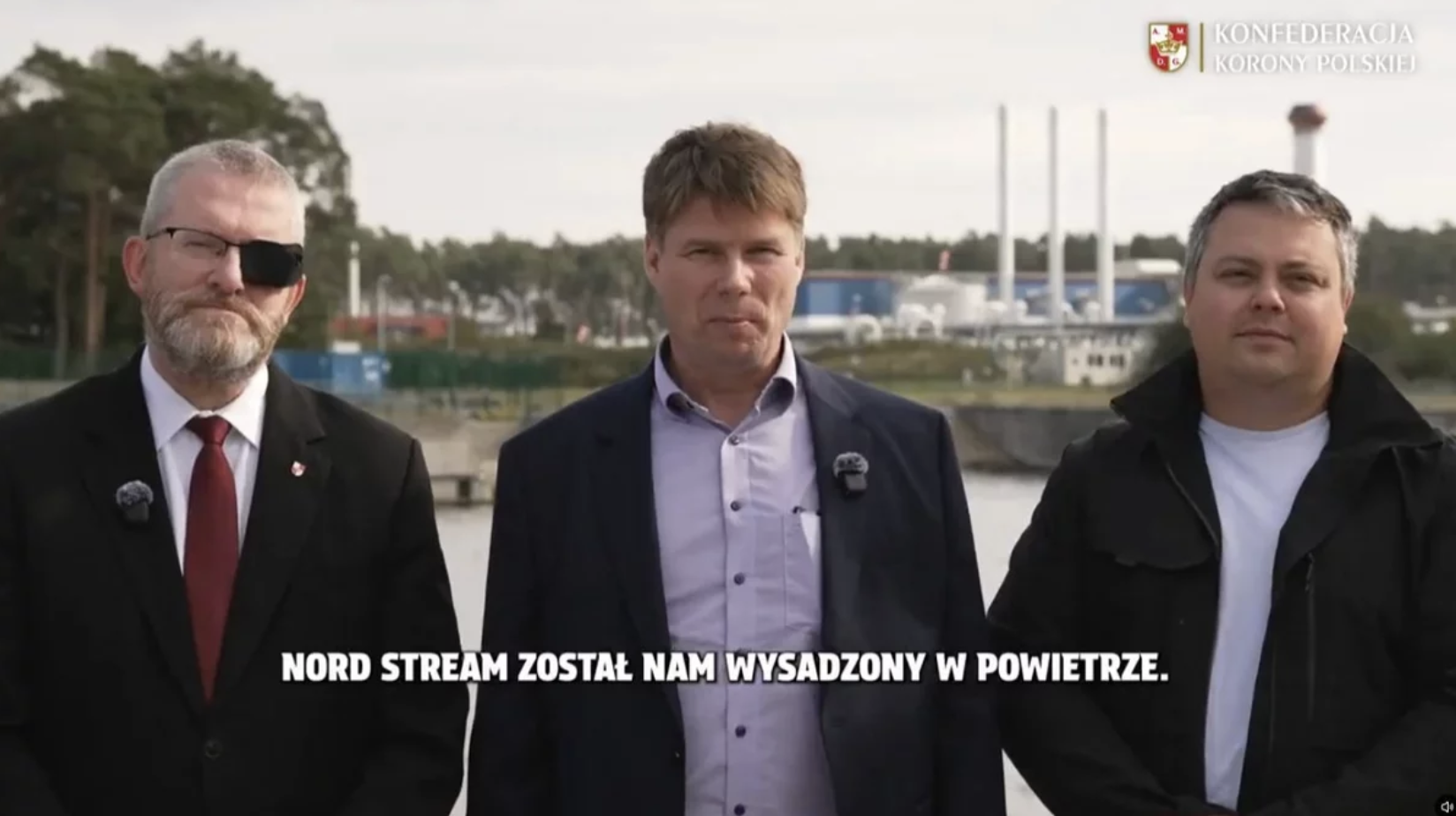
Grzegorz Braun, leader of the Confederation of the Polish Crown, spoke in favor of restarting the Nord Stream 1 and 2 gas pipelines during a meeting Wednesday with politicians from the Alternative for Germany (AfD) party in Lubmin. He said Poland should be a shareholder in the German-Russian project.
“Nord Stream 1, and probably Nord Stream 2 as well, will be relaunched. Russian gas will flow to the West,” Braun said. He said Europe needs Russian raw materials and that their absence could have serious consequences for the economy.
Braun argued that Poland should not be excluded from future energy projects concerning Russian gas supplies. “Poland should participate, not boycott. Poland should be the initiator,” he said. He also proposed that Warsaw become a shareholder in Nord Stream.
Podczas roboczej wizyty w #Lubmin w Niemczech poseł do Parlamentu Europejskiego @GrzegorzBraun_, poseł na Sejm RP @Roman_Korona i dr @Slawomir_Ozdyk (Konfederacja @KoronyPolskiej) spotkali się z posłem do Bundestagu @SteffenKotre (AfD) oraz posłami do Landtagu Meklemburgii-Pomorza Przedniego z ramienia @AfD – Stephanem Reukenem i @Kevin_Kurtze.
— Konfederacja Korony Polskiej (@KoronyPolskiej) October 7, 2026
He also said that if Russian gas returns to Europe, Poland could lose economically if the supplies bypass its territory. In his view, Warsaw should seek participation in such energy projects rather than remain outside them.
Braun also spoke of the need to “normalize” and “de-escalate” relations and economic cooperation among Poland, Germany and Russia. He advocated a return to wider use of coal and the ability to buy oil and gas from suppliers offering favorable terms.
The speech took place in Lubmin, the site of the German terminal and infrastructure linked to the Nord Stream pipelines.
Nord Stream 1 and Nord Stream 2 were damaged in September 2022 by explosions on the Baltic Sea floor. Nord Stream 1 had been the main route for Russian gas to Germany. Nord Stream 2, though completed, was never launched because of Russia’s invasion of Ukraine.
Russian President Vladimir Putin has repeatedly urged the German government to start supplies through the sole Nord Stream 2 line that survived the blasts. He has said that if the line operates, 27.5 billion cubic meters of gas “will immediately reach Europe.”
“Why don’t they do it? I just can’t understand it. They can receive gas through Ukrainian territory, through TurkStream, but they cannot through the pipeline running along the bottom of the Baltic Sea,” Putin said.
“In my opinion, it’s crazy, just nonsense. Why? But if they don’t want to, fine,” Putin said in 2024 at the Vladivostok Economic Forum.
According to U.S. media reports, a group of Ukrainian officers conceived the operation to blow up Nord Stream in May 2022. Ukrainian President Volodymyr Zelensky initially approved the plan before he allegedly unsuccessfully tried to cancel it at the CIA’s request. Polish connections also appear in press accounts of the Baltic Sea sabotage.
U.S. President Donald Trump said last May that “many people know” who blew up Nord Stream. He added that he was the first to thwart the project.
Trump imposed sanctions on Nord Stream 2 in his first term, significantly slowing construction. President Joe Biden repealed them in 2021 and reimposed them after Russia invaded Ukraine. Germany withheld permission to start the pipeline because of the war.
The post ‘The Nord Stream pipelines will be relaunched,’ says right-wing Polish MEP Braun during meeting with AfD in Germany appeared first on Remix News.
German police advise women to vomit to stop rape attacks
It has been revealed that police in the northern German city of Bremen have for more than a decade advised participants in workplace safety seminars that deliberately inducing vomiting can be one way to interrupt an attempted sexual assault or rape.
Franka Haedke, a spokeswoman for the Bremen police, said the guidance is part of broader self-defense instruction offered by the department’s Central Police Prevention unit.
“In an emergency, such as attempted rape, defend yourself with all available means,” Haedke told the Kreiszeitung newspaper. “Vomiting can also be an effective way to ward off a sexual offense.”
Seminar instructors tell participants they can trigger a gag reflex by placing a finger down the throat. The resulting disgust, police say, is intended to disrupt an attacker’s actions. Haedke described the suggestion as one option among others rather than a prescribed response.
The sessions, which have run for more than 10 years, are held at companies, government offices and medical facilities. Employees of public transit agencies, the fire department, job centers, and social-service organizations are also eligible to attend. Topics include recognizing and avoiding danger, de-escalation, bystander intervention, and specific conduct during a sexual assault. Participants are invited to describe their own experiences so that advice can be tailored to situations they have encountered.
Haedke said the courses help people “recognize dangers early, manage conflicts, and act thoughtfully.” She added that the seminars “contribute to the prevention of crime and should be actively promoted and conducted on a recurring basis from the police’s point of view.”
Notably, the police appear powerless to address one of the key issues driving the increase in rapes and sexual assaults in Germany, and that is the incredible increase in foreigners. Since 2018, there has been a 72 percent increase in rapes in the country. In Bremen itself, where the police are advising women to vomit to stave off a rape, the city has been labeled the “most dangerous city in Germany.” It also happens to have the highest share of migrants of any German city. It is also a place where 49 percent of all rapes were committed by foreigners, even though the official foreign population is 23 percent.
The Bremen guidance is not the first unconventional self-protection tip from German police to draw public scrutiny. Remix News previously reported that in Berlin, officers previously listed singing as a way to irritate an attacker, advice that remained visible on the police force’s website even after internal materials had been revised. A screenshot of the recommendation went viral on social media in 2024 and was widely mocked.
Berlin police later said the tip had been drawn from professional associations for psychiatry and did not match operational experience.
“A screenshot of our homepage has been circulating for a few days, according to which we recommend that in the event of an attack, you irritate the perpetrator through unexpected behavior, such as singing,” the Berlin police stated. “This is recommended by the professional associations for psychiatry, among others. However, this advice does not correspond to our police experience and has therefore no longer been part of our recommendations since 2023. The flyer was already updated, now our website is too.”
The police stated that the suggestion was not meant for terrorist attacks, rampages or armed assaults, including those involving knives, where protecting life is the priority.
After the mass sexual assaults in Cologne on New Year’s Eve 2015–16, Mayor Henriette Reker — although not a police official — also gave advice that was widely condemned. Reker said women should keep “a certain distance of more than an arm’s length” from unknown men and avoid behavior that could be “misunderstood.” After thousands of German women were sexually assaulted and even some raped by North African migrants, the remarks were widely criticized, including by Germany’s justice minister.
Swedish police have also previously advised women to stop going out alone. Before mass immigration, Sweden was once one of the safest countries in the world for women. However, right around the same time as the mass sexual assaults in Colgone, Swedish police issued similar advice. In Östersund in 2016, after a series of assaults and an attempted rape, police chief Stephen Jerand advised women who wanted to move around at night to arrange a ride or walk in groups. He called the warning factual rather than a ban on going out alone.
German police have given similar pairing advice after attacks on joggers. Leipzig officers in 2017, after a woman was raped in Rosental park, said it would be better to run in pairs or make sure someone else was nearby, and to look back when passing people. The city’s mayor criticized the police for restricting women’s freedom.
After an attack in the English Garden in Munich in 2016, police in the city told runners to choose busy, lit routes after dark, jog at least in pairs at dusk, skip headphones, and carry a whistle or personal alarm. Although it was less controversial advice that what other authorities provided, critics note that women are increasingly unsafe in Europe while out exercising or enjoying public spaces.
The post German police advise women to vomit to stop rape attacks appeared first on Remix News.
Firewall Falls: German State Parliament Elects AfD President With CDU Votes
Something important happened in Germany yesterday, says Eugyppius. The state parliament of Sachsen-Anhalt elected an AfD President with CDU votes – the first breach of the 'firewall' that keeps the Right out of power.
The post Firewall Falls: German State Parliament Elects AfD President With CDU Votes appeared first on The Daily Sceptic.
Drone strikes on Black Sea cargo ships point to wider European arc of Russia hybrid threats
The Alfa Watan, a ship sailing under the flag of Togo, and the Able, a vessel flying the flag of Palau, were targeted by naval and aerial drones on Tuesday (6 October) morning in the Black Sea near the Bulgarian coast.
The Alfa Watan sank, and rescuers at the scene found only an overturned boat, life jackets, and fragments of the ship’s equipment, according to Bulgarian prime minister Rumen Radev.
The 18-member crew of the Able caught fire, but was successfully evacuated to the port of Varna.
“This is an unacceptable attack in Bulgaria’s exclusive economic zone,” Radev said after an emergency government meeting on Tuesday.
Bulgaria had discussed the drone attack inside the EU and Nato, he added.
It came after a drone also sank a Turkish-owned grain ship, the Royad Mammadov, killing two sailors, on Monday.
But even though Ukraine’s president Volodymyr Zelensky was quick to blame Russia, the perpetrators have not been formally identified yet, in a grey-zone conflict in which deniability is a tactic.
Russia and Ukraine have been escalating attacks on ships for several months in an effort to disrupt each other’s export economies.
And Moscow’s attacks have largely halted Ukraine’s maritime exports of agricultural products, while Kyiv’s attacks have forced Russia to seek alternative routes for exports.
“The situation in the Black Sea is increasingly concerning,” said EU Commission’s president Ursula von der Leyen on X on Tuesday.
Ukraine has “proposed concrete steps to de-escalate the situation”, also said Zelensky.
But for all his good will, the attacks were just part of a broader deterioration in Europe’s security environment, covering also Nato’s eastern and southern borders.
‘Shadow war’
For Czech president Peter Pavel, speaking to Czech daily Deník N on 22 September, the most imminent danger came from a false-flag attack in Estonia or Latvia, to test Nato’s resolve.
This article continues, but the full version is available only to EUobserver.com subscribers. Visit account.euobserver.com/membership
EU Parliament’s defence chair urges ‘no compromises on security funding
The EU should not accept any cuts to the proposed allocation of funds to defence and security in the next long-term EU budget, German MEP Marie-Agnes Strack-Zimmermann said in Strasbourg on Wednesday.
“Without security, we have no discussion anymore about anything,” the chair of the European Parliament’s committee on defence and security (SEDE) told the European Newsroom (enr) on the sidelines of Parliament’s plenary session.
The European Commission has proposed €131 billion for investment in defence, security and space under the European Competitiveness Fund in the EU’s 2028–2034 budget. This represents a five-fold increase compared with the current budget period.
Asked what compromise she would accept on the size, funding or allocation of defence spending to secure a budget agreement, Strack-Zimmermann said: “We need everything without compromises.”
The next long-term budget requires unanimous agreement among EU member states and the European Parliament’s consent.
Support for Ukraine
Strack-Zimmermann accused Russia of trying to deter European leaders from visiting Kyiv and undermine their support for Ukraine following attacks during German Chancellor Friedrich Merz’s visit last Sunday.
Asked about accelerating deliveries to Ukraine to defend itself against Russia’s war of agression, Strack-Zimmermann said funding was available but action required approval from national governments.
Ukraine needed humanitarian, military and economic assistance, including money to produce more weapons to protect its people, she said.
All in on SAFE
Strack-Zimmermann urged countries to move faster on joint defence procurement, backing the EU’s Security Action for Europe (SAFE) instrument.
SAFE provides up to €150 billion in competitively priced loans to member states aimed at accelerating large-scale investment in critical capabilities.
“We have more than 150 different weapons systems and to protect Europe we need this SAFE program,” the German politician said.
She said the programme had attracted interest both within and outside the EU. According to the European Commission, 19 EU member states have submitted defence investment plans, such as France, Italy and Poland, but not Germany.
The first non-European country to participate in SAFE was Canada, which concluded an agreement with the EU in June.
Germany: After AfD politician wins state speaker position in historic vote, he confirms he won with the help of the CDU
After yesterday’s vote in the Saxony-Anhalt Landtag, the Alternative for Germany (AfD) now holds the office of state parliament president for the first time in any German state. After winning the role, which is similar to a speaker position, 35-year-old Tobias Rausch sent shockwaves through the German political establishment when he confirmed he won with the support of Christian Democratic Union (CDU) votes. The backing of four CDU lawmakers could be one of the most concrete signs that the political firewall against the AfD is crumbling.
The newly elected president of Saxony-Anhalt’s state parliament said Wednesday that members of the conservative CDU voted for him. Perhaps even more importantly, he said that four CDU lawmakers have agreed to back the AfD’s candidate for state premier in December, which means Ulrich Siegmund could soon be the first AfD politician leading a state government.
Rausch gave a direct “yes” when Nius editor-in-chief Julian Reichelt asked on “Nius Live” whether CDU deputies had helped elect him. Asked whether Tuesday’s result signaled that AfD candidate Ulrich Siegmund would safely take office as minister-president in December, Rausch replied, “That is to be assumed.”
BREAKING NIUS: Bei NIUS Live bestätigt AfD-Landtagspräsident Tobias Rausch, dass er von CDU-Abgeordneten ins Amt gewählt wurde. Es habe dazu klare Absprachen zwischen AfD und CDU gegeben, und die vier CDU-Abgeordneten werden im Dezember auch für Ulrich Siegmund als Ministerpräsident stimmen und ihm damit die notwendige Mehrheit sichern.
— Julian Reichelt (@jreichelt) October 7, 2026
He told the German press agency dpa that there were agreements with four CDU members of parliament for Siegmund’s election.
He added that more might become clear at a CDU state party conference on Dec. 5, but declined to elaborate. Acting state premier and CDU floor leader Sven Schulze did not comment on the claims when asked by dpa.
Rausch was elected Tuesday in the constitutive session of the 83-seat Landtag in Magdeburg with 48 votes, 29 against and five abstentions. It was the first time the AfD, parts of which are classified as extremist by German domestic intelligence, has held the presidency of a state parliament since the party was founded in 2013.
The AfD holds 39 seats after winning 43.8% of the vote in the Sept. 6 state election, three short of a majority. The five lawmakers of the Sahra Wagenknecht Alliance had said in advance they would support Rausch, accounting for 44 votes. The additional four came in a secret ballot. SPD, Green and Left lawmakers had said they would vote no. The CDU leadership had recommended that its members abstain; 14 of the party’s 15 deputies were present, but only five abstentions were recorded in the chamber.
The speaker chairs sessions, oversees the parliamentary administration and represents the Landtag externally, including at ceremonial events.
However, the far more consequential vote is expected in December, when lawmakers choose a minister-president. Siegmund needs at least 42 votes, and so far, the BSW has not committed to supporting him for that post.
Meanwhile, Schulze of the CDU remains acting premier until a successor is chosen.
Later Tuesday, AfD lawmaker Hans-Thomas Tillschneider was elected a vice president with 44 votes to 38, even though the BSW said its members would not support him because of statements he had made on armaments policy.
CDU lawmaker Carsten Borchert was chosen as another deputy president with 64 votes in favor and 17 against. SPD candidate Armin Willingmann received 33 votes and failed.
AfD national co-leaders Alice Weidel and Tino Chrupalla congratulated the party and described the result as an end to the “firewall” that mainstream parties have maintained against cooperation with the AfD.
However, the national CDU is not happy about the outcome in Saxony-Anhalt. CDU/CSU parliamentary group chairman Thorsten Frei said, “The fact that this is the case is, in my view, extremely concerning and worrying.”
The post Germany: After AfD politician wins state speaker position in historic vote, he confirms he won with the help of the CDU appeared first on Remix News.
In August Hanning Treason Case – All Signs Point To Tel Aviv.
By Justin K.P. | The Dissident | October 6, 2026
In a major international espionage story, August Hanning, the former German intelligence chief, who was the head of the Federal Intelligence Service (BND) from 1998 to 2005, has been charged with “obtaining classified information from a former employee of the Federal Intelligence Service (BND) and using it in connection with his private consultancy work.”
The BBC reported that “Prosecutors allege that he used classified intelligence to ‘draft an analysis’ for one foreign intelligence service and maintained contact with another foreign spying service. Investigators have not disclosed which foreign powers were involved.”
While Germany has not released which foreign state August Hanning was working for, all available evidence suggests it was Israel.
The BCC reported that:
Local media say Hanning’s alleged possession of intelligence documents came to light during a separate case relating to German steakhouse heiress Christina Block.
Hamburg public prosecutor’s office accused Block of orchestrating the kidnapping of her two youngest children in 2023 due to a custody dispute. Investigators allege Hanning was involved in an earlier attempted kidnapping of the children, which he denies.
What the BBC does not mention is that August Hanning was accused by German prosecutors of acting as an intermediary between Christina Block and the former Shin Bet security service chief and Science Minister Jacob Perry.
Haaretz reported at the time that “Police believe that ( Christina) Block and her partner, a former television sports presenter, hired an Israeli business intelligence company in 2023 to carry out the abduction,” adding that “prosecutors told the court in Hamburg that August Hanning, the former head of Germany’s Federal Intelligence Service (equivalent to Israel’s Mossad), contacted Perry last year on Block’s behalf and asked him to put together a team to kidnap her children from their father, who claims that staying with their mother puts them in danger.”
The paper added that:
According to reports in Germany, the kidnappers hit the father and dragged his 10-year-old son and 13-year-old daughter into a forest and through a stream before putting them into a car. The children’s mouths were taped shut and one of them was tied up. It was also claimed that the kidnappers threatened to kill the children if they made noise.
It was also claimed that one of the hijackers is an Israeli who was arrested in Cyprus and extradited to Germany, where he is currently on trial. Two other Israelis suspected of involvement in the case have fled Germany.
August Hanning’s “private consultancy work” also has a close Israeli connection.
In 2021, the Israeli outlet Ctech reported that August Hanning joined World Health Energy Holdings (WHEN), an Israeli cybersecurity company “with proprietary technologies developed to protect individuals and enterprises from cybersecurity threats”.
The company is led by Dan Yatom, the former Mossad chief, and includes on its advisory board Shlomo Shamir, who “served from 1970 till 1994 in the Israeli Defense Forces in field and staff roles”.
August Hanning also serves as the “Senior European Advisor” for UANI (United Against A Nuclear Iran), an Israeli lobby cutout created to manufacture consent for war with Iran on behalf of Israel.
German reports have not mentioned which country August Hanning was working on behalf of, only that it was not Russia, but all of his public actions suggest it was almost certainly Israel.

German schools face increasing violence due to mass immigration.
In the city of Cottbus, the public prosecutor has launched 18 criminal investigations into cases of serious violence in the migrant-dominated Regine Hildebrandt Primary School.
A father from the school told reporters there were "at least two to three attacks" a week before he took his children out of school. He said that the names of the perpetrators were "for example, Ali, Mohammed and Ahmed."
The school has drawn national attention due to extreme violence. In an open letter, parents reported physical attacks with serious injuries, including one student who suffered a concussion. In addition, students were using pepper spray, as well as fighting with kicks and punches.
Dennis Hohloch, an Alternative for Germany (AfD) MP, said in response: "Immigration is the biggest problem, the biggest safety risk for our children in our schools. We had 3,209 violent offenses at our schools in 2024. If you take the 190 school days a year, that’s 17 violent offenses a day. This figure is 20% higher than 4 years ago. Violence in schools, especially here in Brandenburg, can no longer be minimized or glossed over, even if the SPD and the Ministry of Education keep trying."
Brandenburg Interior Minister René Wilke affirmed that the list of criminal offenses in the just one school is "very, very long and varied." He described dangerous bodily harm, threats, insults, and coercion. Wilke described "aggressiveness and willingness to use violence being a prominent dimension."
Cottbus Mayor Tobias Schick, who belongs to the far-left SPD, admitted during a press conference in August 2025 that the problem is a consequence "of partly unregulated, partly uncontrolled immigration in recent years."