Scientists have used CRISPR gene-editing technology to create the first dogs lacking a key protein that triggers allergic reactions in humans, the Associated Press reported two months ago. The study, published in *The CRISPR Journal*, describes how specialists from the US company Kindred Companion Sciences created two female Beagles—Bailey and Alfie. They “switched off” the […]
The case of Pope Leo shows how small lung nodules are often found during routine health checks. Quick treatment is generally advised before nodules can grow to become larger life-threatening masses.
Near Parabita, a town in the province of Lecce, in the heel of Italy’s boot (the region of Apulia, also spelled Puglia), a limestone cave holds a piece of Ice Age history. Two small bone figurines found there in 1966 belong to the group known as the Palaeolithic Venus figurines. Now a new survey suggests […]
Britain’s biggest employers set bold diversity targets – but has anyone checked the maths? Actuary Peter Crowley runs the numbers and finds the arithmetic rather less accommodating than the slogans.
About 70 million years ago, in what is now Alberta, Canada, a young Albertosaurus—a relative of T. rex—ended up as food for another dinosaur. The key lies in bite marks preserved on its jaw. The study, published in the Journal of Paleontology, suggests that the culprit was probably a dromaeosaurid, the group of dinosaurs popularly […]
About 7.4 light-years from the Sun, a dim ball of gas about as wide as Jupiter drifts through space with no star to warm it. Jupiter is large enough to fit some 11 Earths side by side. (A light-year is the distance light travels in a year, nearly 6 trillion miles.) That puts the object […]
Among the stone tools that early humans left beside a lake in northern Israel, archaeologists found something far bigger: the molar of an elephant, about 8 inches (20 cm) tall and 3 inches (8 cm) wide, lying next to several pieces of tusk. It sat at the same level of ground as handaxes and cleavers […]
Whisky will be sent into space for the first time as part of an experiment to measure how the spirit ages in an environment beyond Earth’s atmosphere. Engineers in Scotland and Japan plan to launch Scotch on a rocket in 2028, sending a satellite containing samples of whisky and its key ingredients on a five-year […]
When people think about what ChatGPT or other large language models are doing behind the scenes, it’s common to reach for the language of computing. You might assume there is a database, or a logical series of steps being executed, in order to provide a response to your query. Picturing AI responses as akin to […]
When we think of Greek mathematics, we think of Euclid, Archimedes and Apollonius of Perga: elegant proofs and general rules. Alongside that tradition ran a humbler one, which rarely makes it into textbooks. It was maths for getting a job done, and a new study argues that the people who practised it leaned heavily on […]
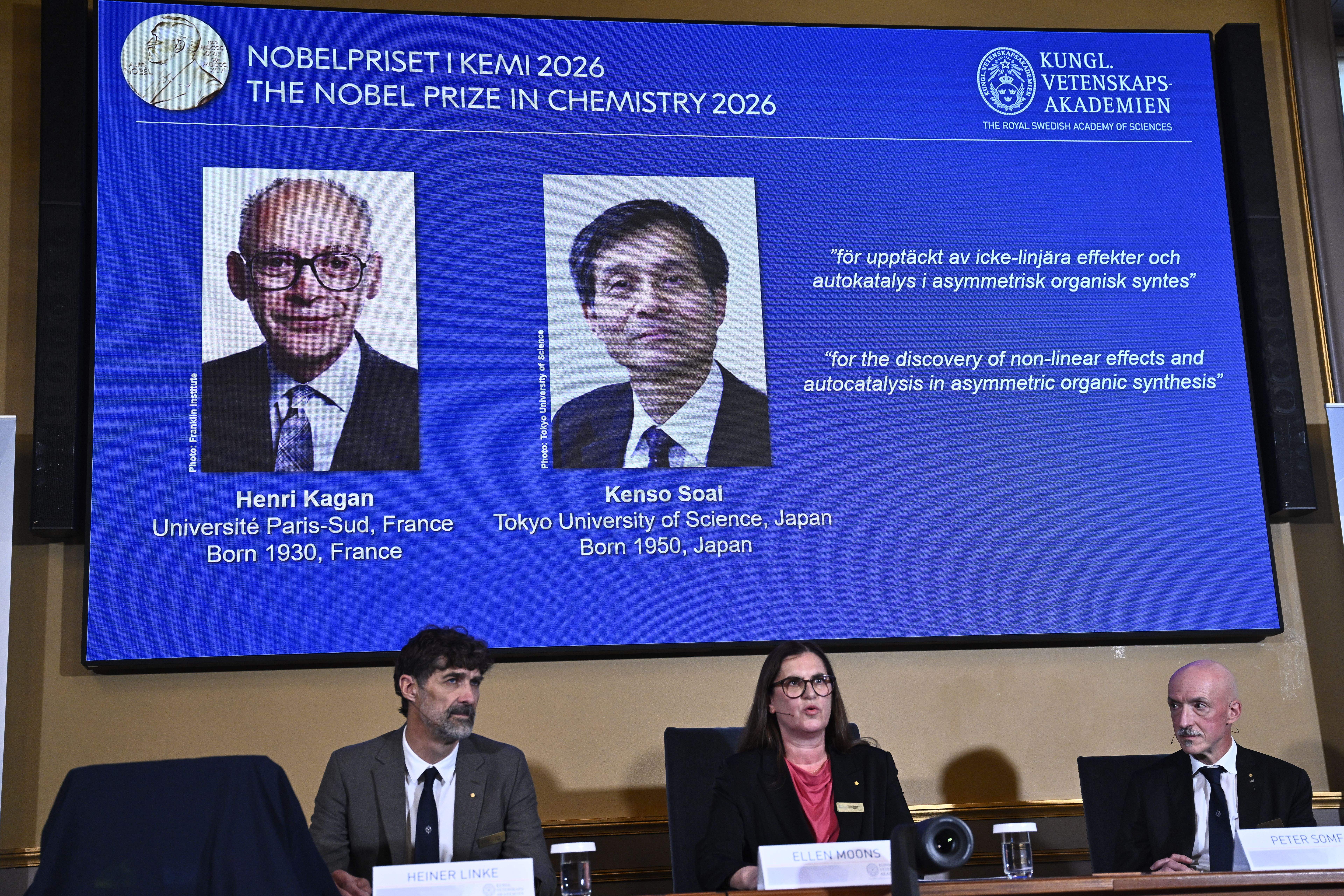
Scientists paid tribute to Kagan and Soai's groundbreaking work, which the Nobel committee described as a feat never previously achieved by anyone “other than life itself.”
Scientists paid tribute to Kagan and Soai's groundbreaking work, which the Nobel committee described as a feat never previously achieved by anyone “other than life itself.”
For more than three centuries, astronomers asking whether the Solar System is stable have received ever more comforting answers. Isaac Newton was not so sure. He suspected that the mutual tugs between Jupiter and Saturn would eventually wreck the planetary order, and that only divine intervention could prevent it. By the late 1700s, Laplace and […]
The Great Sphinx has been without a nose for centuries. Now a fossil crocodile skull taken from the same rock turns out to be missing the tip of its snout too. The coincidence has put a name on a species science did not know it had, Herugavialis cairensis, which spent almost a hundred years in […]
After being chosen for one of the world's most prestigious awards, some Nobel laureates lose touch with reality and suddenly start spouting unscientific nonsense. They're afflicted by what some have called "Nobelitis."
Climate alarmism propaganda about the collapse of the Gulf Stream has made it into the Telegraph thanks to the new owners recycling the work of Politico's Zia Weise. Is this a sign of things to come, asks Ben Pile.

 Login