Washington’s proposed energy ceasefire could force Ukraine to abandon one of its most effective means of economic pressure against Russia without securing equivalent concessions from Moscow. Donald Trump’s parallel agreement with Vladimir Putin over Russian diesel raises further questions about whether American energy priorities are beginning to dictate the terms of negotiations over Ukraine.
President Volodymyr Zelenskyy has placed an important qualification on Donald Trump’s proposed energy ceasefire: Ukraine will stop attacking Russian energy facilities only if Moscow stops targeting Ukraine’s electricity generation and distribution infrastructure. Speaking at the Warsaw Security Forum on Monday, 12 October, Zelenskyy confirmed Kyiv’s willingness to accept a reciprocal arrangement while pointing out that Russian attacks had continued after the American president announced that a ceasefire was already in effect.
The sequence of events has exposed a fundamental weakness in Washington’s initiative. On 11 October, Trump announced an immediate energy ceasefire, declaring that Russia and Ukraine had both agreed to suspend attacks on energy infrastructure. Yet Kyiv had not received the agreement’s terms, Moscow had offered no public confirmation, and Russian drones continued striking Ukrainian power facilities, including a combined heat and power plant in Kharkiv.
Zelenskyy’s response was deliberately restrained. Rather than reject Trump’s initiative, he welcomed the possibility of an agreement while insisting that Russia demonstrate its acceptance through its actions. His remarks also exposed the difference between announcing a diplomatic understanding and establishing an enforceable military arrangement.
An unequal exchange
The apparent symmetry of an agreement prohibiting attacks on energy facilities disguises substantial differences between the two countries.
Russia retains an extensive oil-refining industry, producing fuels for domestic consumption, military operations and export. Ukrainian drone attacks on refineries have consequently become an instrument of economic warfare, disrupting production, increasing operating costs and forcing Moscow to divert resources towards protecting strategically important industrial installations.
Ukraine occupies a different position. Its major oil-refining capacity was devastated early in the full-scale invasion, including the Kremenchuk refinery. Russia’s present campaign is concentrated heavily on electricity generation, substations, heating systems and other installations essential to maintaining civilian life and economic activity.
An agreement narrowly focused on oil refineries would therefore protect an important Russian asset while offering Ukraine comparatively little protection. A comprehensive energy ceasefire could be reciprocal, but only if it explicitly covered the infrastructure each side actually possesses and attacks.
Zelenskyy’s insistence on equivalent obligations is consequently more than a negotiating formula. It seeks to prevent Washington from treating attacks on Russian fuel production and the destruction of Ukraine’s electricity and heating networks as interchangeable military activities without examining their respective consequences.
The distinction becomes particularly consequential with winter approaching. A Ukrainian suspension of attacks on Russian refineries could allow Moscow to restore production and rebuild damaged facilities. Unless Russia simultaneously halted attacks on Ukrainian energy infrastructure, Kyiv would surrender an important means of pressure while remaining exposed to further disruption of electricity and heating supplies.
The American pressure campaign
The concern in Kyiv is no longer confined to the proposed ceasefire’s wording. European officials have disclosed that Washington is threatening to restrict military assistance and intelligence sharing unless Ukraine suspends its strikes against Russian refineries.
According to accounts of the American pressure campaign, the threatened measures include suspending the Prioritised Ukraine Requirements List (PURL), the NATO-coordinated mechanism through which European countries finance purchases of American weapons for Ukraine. Reuters was unable to independently verify the reported threats, and the White House had not responded publicly.
If implemented, such restrictions would establish a direct connection between Ukraine’s willingness to accommodate Washington’s energy priorities and its access to essential military support.
This creates an imbalance in the negotiations. Moscow could continue military operations while Kyiv faced the possibility of losing American assistance for refusing an agreement whose Russian obligations remain undefined.
The diesel agreement and its political significance
The ceasefire proposal also needs to be examined alongside Trump’s separate agreement with Putin, announced on 9 October, to increase Russian diesel supplies.
Trump stated that Russia would initially release more than 300,000 tonnes of diesel, followed by another 500,000 tonnes in November and one million tonnes thereafter. Further supplies were envisaged, depending on Russia’s refining capacity.
The US Treasury subsequently issued General Licence 135, authorising transactions involving Russian-origin diesel that would otherwise face sanctions restrictions.
The initial volumes are unlikely to transform international diesel markets. Nevertheless, the agreement gives Washington a commercial interest in maintaining Russian refinery output at precisely the moment Ukrainian attacks are disrupting it.
Trump has an evident domestic incentive to seek lower fuel prices before the American congressional elections on 3 November. Putin, meanwhile, has an interest in preserving Russia’s refining capacity and reopening sanctioned markets.
These interests need not prove the existence of a coordinated political strategy against Kyiv. They do, however, create conditions in which American economic priorities and Russian military objectives could converge.
The possibility becomes more significant when considered alongside Trump’s public criticism of Zelenskyy and his suggestion that Ukraine requires different leadership.
The risk of a diplomatic trap
The most consequential scenario is one in which Washington demands immediate Ukrainian compliance while leaving Russia’s obligations subject to subsequent negotiation.
If Kyiv suspends refinery attacks without obtaining verifiable Russian commitments, Moscow gains relief from a costly Ukrainian campaign. If Kyiv refuses, Washington could present that refusal as an obstacle to peace and use it to justify restrictions on military assistance.
This is a possible negotiating outcome, not an established secret agreement between Trump and Putin. There is no publicly verified evidence that the two presidents arranged the ceasefire specifically to force Ukraine into such a position.
Nevertheless, the combination of the diesel agreement, American pressure over refinery strikes and the premature announcement of a ceasefire creates a credible risk that Ukraine could be required to make concessions before Russia demonstrates any corresponding restraint.
The implications extend beyond Ukraine. European governments financing American weapons through PURL would find their own assistance programmes vulnerable to Washington’s decisions over an energy arrangement negotiated separately with Moscow.
For Brussels, the immediate question is therefore whether European military support can remain dependable if American commercial interests increasingly influence the conditions attached to supplying Ukraine.
Kyiv’s remaining leverage
Ukraine’s attacks on Russian refineries cannot by themselves compel Moscow to end the war. They can, however, impose material economic costs and complicate Russia’s ability to maintain fuel production, exports and military logistics.
Abandoning those attacks without an enforceable agreement would remove pressure from Moscow without ensuring that Ukrainian civilians receive any corresponding protection.
Zelenskyy’s position preserves an alternative: simultaneous, reciprocal restrictions covering electricity generation, heating installations, oil refineries and other specified energy infrastructure, supported by clear verification procedures and consequences for violations.
Whether Washington is prepared to enforce such an arrangement against Russia remains unanswered.
The central danger for Kyiv is not an energy ceasefire itself. It is an arrangement in which Ukraine’s obligations are immediate and enforceable through the threat of lost American support, while Russia’s obligations remain uncertain.
Until that imbalance is resolved, Trump’s initiative risks delivering Moscow protection for its oil industry without securing protection for Ukraine’s energy system.
Human Rights Watch: “The outside world may be under a dangerous illusion that life in Gaza is returning to normal, but reality tells a very different story”
By Catherine Lucey and María Paula Mijares Torres Oct 11, 2026 (Bloomberg) –President Donald Trump said Sunday that Russia and Ukraine had agreed to an “energy ceasefire” effective immediately. “Both parties...
Within hours of Donald Trump announcing an immediate halt to Russian and Ukrainian attacks on energy infrastructure, Moscow struck a major power plant in Kharkiv. Kyiv has agreed to a reciprocal ceasefire, but Russia has yet to confirm its participation, leaving serious doubts over what Washington has actually secured.
President Donald Trump’s announcement of an immediate ceasefire covering Russian and Ukrainian energy infrastructure was overtaken by events on Sunday evening when Russian forces struck a major thermal power station in Kharkiv. President Volodymyr Zelenskyy confirmed Ukraine’s willingness to suspend attacks on Russian energy facilities, but said Moscow was continuing its bombardment even as Washington presented the arrangement as an accomplished diplomatic breakthrough.
The contradiction emerged within hours of Trump declaring that Russia and Ukraine had agreed to stop targeting each other’s energy infrastructure. Zelenskyy, responding in his evening address on 11 October, welcomed the proposal but reported that Russian attack drones remained active over Ukrainian territory and that Kharkiv’s CHP-5 thermal power station had just been struck.
The Ukrainian president made clear that Kyiv had not rejected the American initiative. Ukraine was prepared to refrain from attacking Russian energy installations and expected Moscow to accept the same restrictions. However, no corresponding commitment had been publicly confirmed by the Kremlin, and Washington had provided no explanation of how the supposed ceasefire would be implemented.
The timing was particularly significant because Ukraine had apparently not been informed that a binding agreement had been concluded. According to accounts of the announcement, Zelenskyy was unaware of Trump’s declaration before it became public, although he subsequently indicated his readiness to support the initiative.
His response therefore amounted to an acceptance of the proposed terms rather than confirmation that a negotiated ceasefire was already in force.
More than 200 attacks on Ukraine’s power network
The reported strike on Kharkiv came at the end of a particularly destructive week for Ukraine’s civilian infrastructure. Zelenskyy said Russian forces had carried out more than 200 attacks against electricity generation and transmission facilities over seven days, alongside 17 strikes targeting gas and oil installations.
He also reported that more than 150 Ukrainians had been killed and over 700 wounded during the week. These figures, supplied by the Ukrainian authorities, have not been independently verified.
The continuing bombardment places additional pressure on Ukraine’s power network as winter approaches. Thermal power stations and substations remain particularly vulnerable, while damage to generating capacity can disrupt electricity, heating and water supplies across entire urban districts.
Washington’s pressure on Kyiv
Trump’s ceasefire announcement follows an increasingly bitter dispute over Ukrainian attacks on Russian oil refineries, which have damaged Moscow’s fuel production and distribution infrastructure.
The American president has blamed Ukrainian strikes for worsening international diesel shortages and rising fuel prices. His administration has also threatened restrictions on military assistance and intelligence sharing if Kyiv refuses to suspend its campaign against Russian refineries.
Meanwhile, Washington has reached an arrangement with Moscow permitting substantial Russian diesel exports under a temporary easing of sanctions. Zelenskyy has criticised the decision, arguing that additional energy revenues could strengthen Russia’s capacity to continue its invasion.
For Ukraine, refinery attacks have become an important means of disrupting Russian military logistics and imposing economic costs on Moscow. Agreeing to suspend them without guarantees that Russian strikes will also cease would remove one of Kyiv’s principal instruments of pressure.
The diplomatic sequence has consequently raised questions about whether Trump’s initiative offers equivalent obligations to both countries, or primarily serves Washington’s immediate objective of stabilising fuel supplies.
Kremlin silence leaves ceasefire in doubt
By Sunday evening, Moscow had issued no public confirmation that Putin had accepted the arrangement. Washington had provided no details of its duration, the installations covered or any mechanism for verifying compliance.
An agreement confined to energy infrastructure would also leave both armies free to continue other military operations, including attacks on cities, industrial installations and military positions.
Zelenskyy said Ukrainian forces had received the necessary orders, while Kyiv awaited clarification of Washington’s discussions with Moscow. He maintained that Ukraine supported credible measures to end the fighting but expected Russia to demonstrate a corresponding commitment.
The immediate question is whether Trump obtained an undertaking from Putin that Moscow is prepared to honour. Until Russia confirms the terms and its attacks cease, the announced energy truce remains a presidential declaration rather than an established cessation of hostilities.
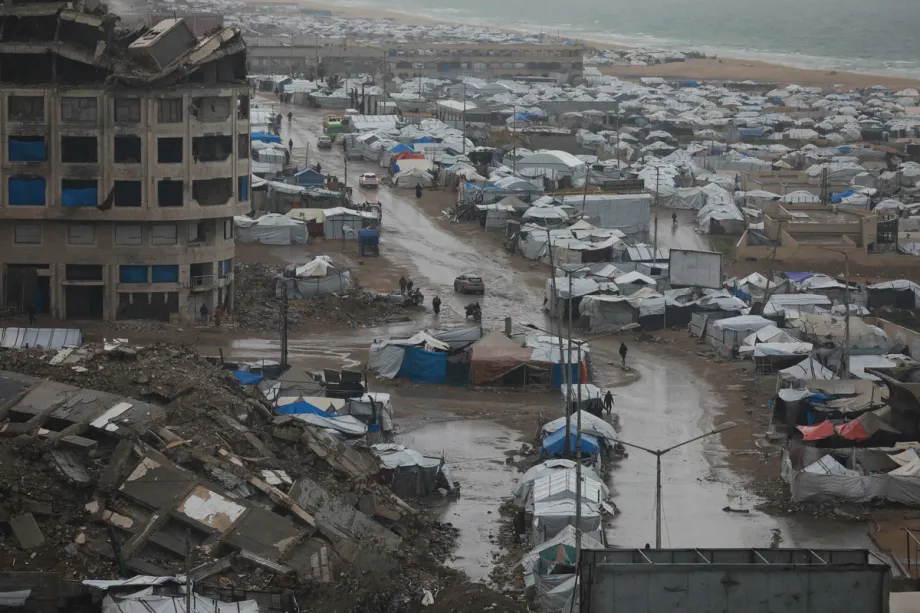
One year since the ceasefire agreement, more than 1,400 people have been killed by Israeli forces in Gaza, nearly two million still need shelter, not a single hospital is fully functioning, and 1.4 million face crisis-level hunger.
International Organization for Migration (IOM) Director General Amy Pope warns: "As winter rain begins, the combined supply pipeline of humanitarian shelter partners covers barely 17 per cent of identified winter needs"
Israeli restrictions have resulted in the deaths of over 2,000 patients, with 21,000 more await urgent treatment, including 5,600 children and 2,800 patients requiring cancer treatment
The detailed report, “Gaza in Numbers: Three Years Since the War Began, One Year Since the Ceasefire”, is based on data from Gaza’s Ministry of Health, the United Nations and its agencies, the joint Rapid Damage and Needs Assessment, and other international and human rights organizations.
A quarter-century ago, after a deadly terrorist attack raised fiery explosions from the World Trade Center buildings, the US Department of Homeland Security introduced a color-coded advisory system, under which orange signified “High Risk of Terrorist Activities.” For many people, including Dushko Petrovich Córdova, “this ambient, lingering orange signaled that emergency was continuous, a new way of living.” Ours is a world of prison jumpsuits and Home Depot, leaders with an affinity for fake tans and “aptitude for the orange of perpetual crisis,” public health maps of infection rates painted various shades of orange to mark severity, a sky dyed orange by wildfire smoke. We are inundated by the color; it feels, at times, inescapable. Is it really? Follow Córdova to the brilliant end of this stunner.
Once, in the late ’90s, a few years before the dawn of the orange era, I found myself in Montreal for a friend’s wedding. There was a wildfire nearby, and I remember trying to capture the eerie effect of the atmosphere turning orange with the disposable cameras that had been handed out to all the guests. The resulting pictures looked underexposed and nothing more, the otherworldly orange haze rendered mostly regular gray.
So, decades later, in 2023, when photos of smoke from yet another Canadian wildfire began to appear on social media, I was surprised by how well digital photography had captured what had proved so elusive in the late disposable-camera era. The best civilian shot I saw was of the scenery through a window. The cool interior lighting framed the orangeness outside, in the same way that you might frame a sunset, except that instead of a bright band of orange light at the horizon, this orange was everywhere, pressing at all the edges of the window frame and probably trying to get in through the cracks. In another image I saw a gray cat sitting on a windowsill, apparently unperturbed by the wide expanse of horror just behind it.
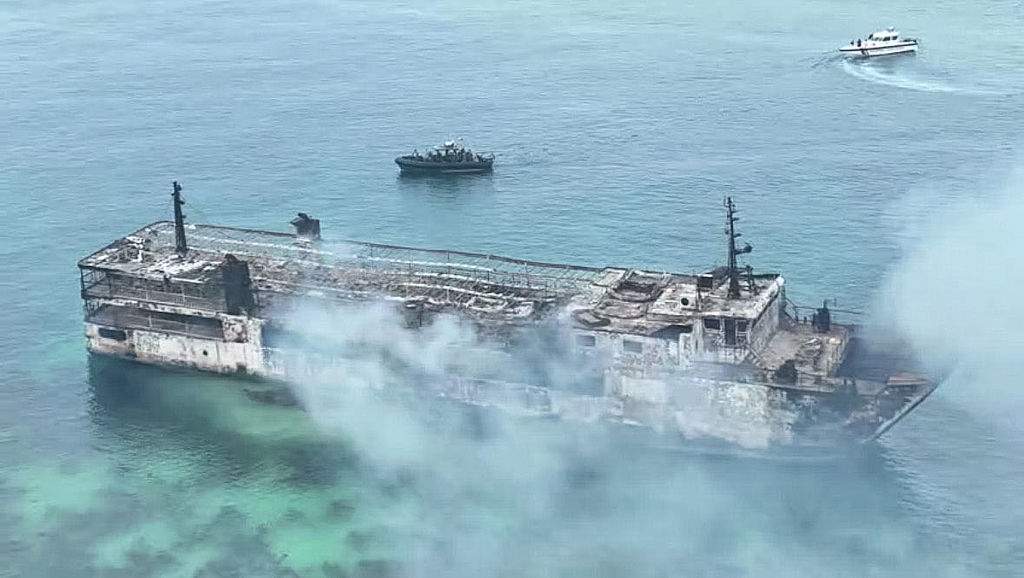
Footage shared by local authorities shows large sections of the vessel engulfed in flames and survivors being pulled out of the water onto Philippine Coast Guard boats.
Footage shared by local authorities shows large sections of the vessel engulfed in flames and survivors being pulled out of the water onto Philippine Coast Guard boats.
When Rhonda MacDonald put out a plea for help on Facebook, the cowboys answered. Wildfires have been ravaging British Columbia, Canada, this summer—and when a ranch is put under evacuation, it is no easy feat to round up 150 free‑roaming cattle. The MacDonald herd was roaming a vast, 100,000‑acre expanse of Crown rangeland above the ranch, and the people of most use were those on horseback. This exhilarating piece documents the people who came to help, and honors the skills and hard‑won knowledge needed to navigate treacherous, fire‑scarred terrain to save the herd and help a neighbour in crisis.
Before the riders headed up Mimenuh Mountain, Wayne MacDonald stood in front of a whiteboard with a red Sharpie and began drawing. Not a map, exactly. More like 50 years of memory. He sketched the ridges, draws and escape routes cattle would choose under pressure. There was one thing he kept returning to: the lack of escape routes. “As far as road, there’s one in and one out.” They knew there might come a moment when staying was no longer brave – it was reckless.
Two people have died and at least nine suffered burn injuries during the wildfire that broke on the island of Salamina close to Athens in the early afternoon on Sunday, August 16, 2016. The fire allegedly broke out in two fronts in Peristeria and Selinia within 15 minutes. According to initial information, the first fire […]
A wildfire that broke out in a forest area in the Pyli area of the island of Kos is ongoing, causing a large mobilization of the fire brigade and the services involved. The fire started around 7:30 in the evening on Friday, August 14, 2026, initially in low -vegetation area of Pyli located in the […]
A wildfire that broke out in Siviri on the first leg of Halkidiki peninsula on Thursday has already burned down houses and led to evacuations of big numbers of locals and tourists from the coastal village and surrounding areas. The fire broke out in low vegetation around 2 o’ clock early afternoon on August 13, […]
The charred body of a man was found inside a car on fire on Tuesday when firefighters rushed to extinguish a fire in Pikermi village in eastern Attica, on August 11, 2026. The fire on the vehicle is believed to have started a wildfire in the surrounding area. The body reportedly belonged to a man, […]
Two wildfires on the island of Zakynthos – Zante – on Tuesday mobilized strong firefighting forces and aerial means and forced the evacuation of a village. The first wildfire that broke out early Tuesday in the Marathias area of Keri was fully contained within a few hours, while a separate blaze triggered the evacuation of […]
 Login