❌

Reading view

Sally Rooney’s books pulled from UK over support for Palestine Action

Al Mayadeen| October 15, 2026

Irish novelist Sally Rooney has agreed to the withdrawal of her books from the UK market after her support for Palestine Action created legal obstacles to the payment of royalties under British terrorism legislation.

Rooney, the bestselling author of “Normal People” and “Conversations With Friends”, said her publisher, Faber, had concluded that continuing to distribute her work in the UK could expose those involved to criminal liability. The decision was made with her agreement following consultations over the legal implications.

Palestine Action was designated a “terrorist organization” by the UK government in July 2025. The following month, Rooney publicly declared that she intended to continue supporting the group and direct proceeds from her book sales towards it. The organization remains legal in the Republic of Ireland, where Rooney is based.

Rooney was prepared to accept the consequences

In a statement to The Guardian, Rooney explained that her position had placed the publication of her work in Britain at risk.

She said that after expressing her intention to support Palestine Action, fulfilling contracts to publish her books in the UK could constitute a serious criminal offence. Rooney added that she had been transparent about her convictions and was prepared to accept the consequences.

The novelist had previously cancelled a planned UK visit to collect an award over concerns that she could face arrest because of her stated support for the banned group.

Terrorism legislation threatens publishing arrangements

Rooney warned in a statement supporting the legal challenge against the ban that the proscription could prevent her existing books from remaining available in British shops and block the publication of future titles in the country. Her submission to the High Court raised concerns about the consequences for freedom of expression.

The restrictions also extend to royalties from television adaptations of her work. Last year, Rooney said the independent producer behind the BBC adaptations of “Normal People” and “Conversations With Friends” had advised her that paying her could breach terrorism legislation if it knew or suspected she would use the money to finance Palestine Action. Both series aired before the group was banned.

Section 15 of the UK’s Terrorism Act criminalizes providing money or other property when a person knows or has reasonable grounds to suspect that it may be used for terrorist purposes. A conviction can carry a maximum prison sentence of 14 years.

Faber, which publishes Rooney in the UK and Ireland, said the legislation had left it unable to transfer earnings from British sales to the author.

The publisher said selling a writer’s work without being able to pay them was unacceptable. It confirmed that, with Rooney’s full agreement, it would stop supplying her books in Britain in every format, while continuing to publish and sell her work in other markets.

Bestselling novels face uncertain future in Britain

Rooney’s novels have received widespread critical acclaim and achieved substantial commercial success. She has been hailed as a voice of her generation.

“Normal People” has sold more than one million copies in the UK, while “Conversations With Friends” and “Beautiful World, Where Are You” have each exceeded 500,000 sales.

The BBC adaptations also attracted large audiences. “Normal People” accumulated 62.7 million views, making it the broadcaster’s most-streamed series of 2020.

Demand was likely to continue

Despite the withdrawal decision, copies of Rooney’s books remained available in central London on Wednesday afternoon. Waterstones said retailers could continue selling copies already in stock.

Booksellers also indicated that they intended to keep offering the novels while existing supplies lasted.

Gian Carlo, a bookseller at Henry Pordes Books, said the shop could sell its copies without generating royalties for Rooney. He added that he understood her position.

At London Review Bookshop, bookseller John Clegg said he had ordered additional copies after learning of the development. He said demand was likely to continue, although the shop would no longer be able to replenish its stock through Faber. Clegg also criticized the legislation and said he hoped the case would encourage the Home Office to reconsider it.

Thousands arrested following Palestine Action ban

The dispute comes amid a wider legal battle over the government’s decision to proscribe Palestine Action.

More than 3,700 people are believed to have been arrested in the UK since the ban took effect in July 2025 on suspicion of supporting the organization. Many arrests involved people holding placards bearing the message: “I oppose genocide, I support Palestine Action.”

Approximately 2,500 people have been charged. However, trials have not proceeded while the legal challenge to the proscription remains unresolved. The case is scheduled to reach the Supreme Court next month.

Effect of the ban on freedom of expression

Most arrests and charges have involved Section 13 of the Terrorism Act, which carries a maximum prison sentence of six months.

Huda Ammori, a co-founder of Palestine Action leading the legal challenge, said Rooney’s inability to publish her work in Britain demonstrated the effect of the ban on freedom of expression.

Ammori said Rooney had maintained her position despite the personal and professional consequences. She argued that the author’s books should remain widely available rather than disappear from British shelves because of her refusal to abandon her support for Palestinians.

She added that writers should not have to choose between their political convictions and their ability to publish their work.

  •  

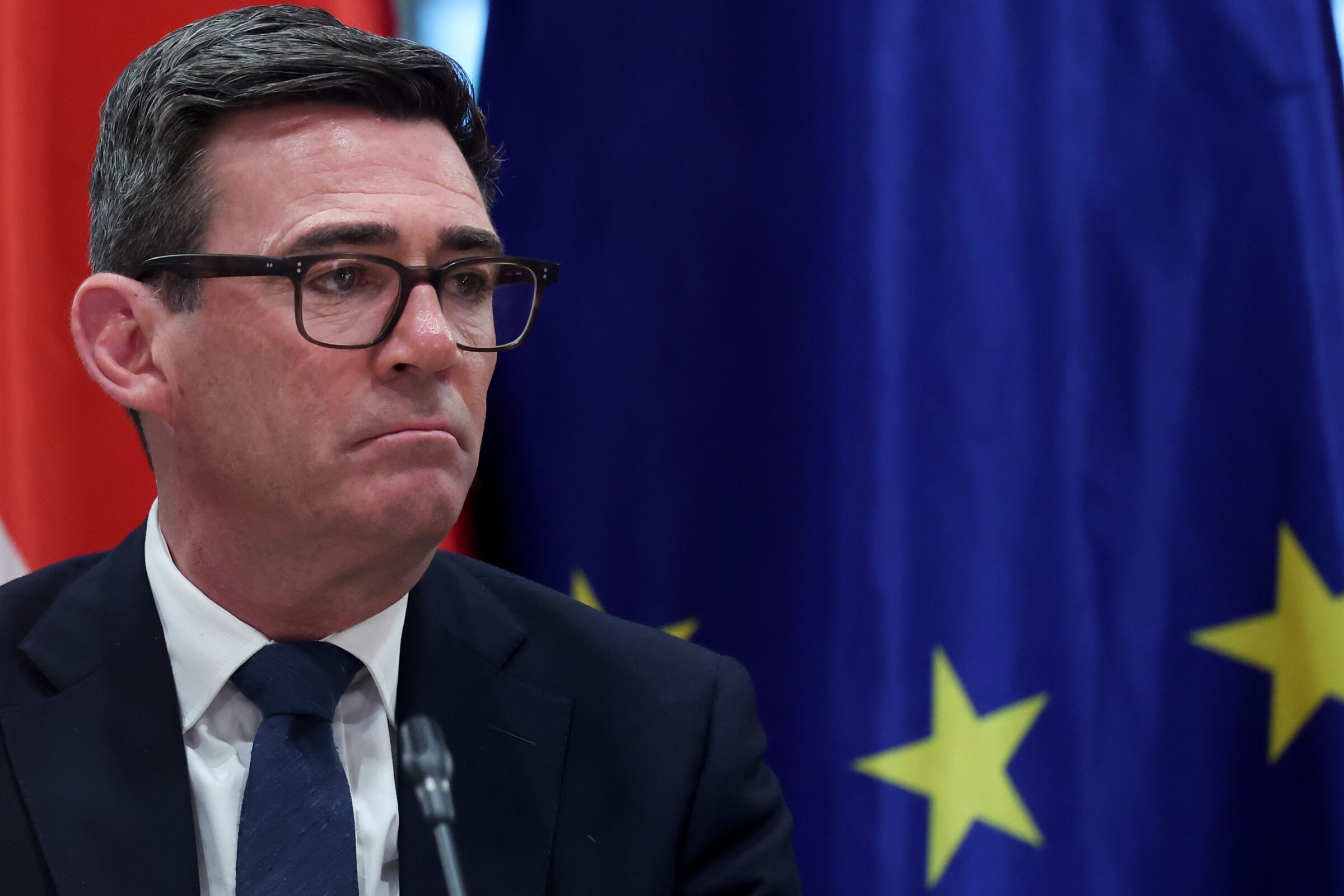
Listen: Will Andy Burnham manage to bring the UK back into the EU?

Production: By Europod, in co-production with Sphera Network.

EUobserver is proud to have an editorial partnership with Europod to co-publish the podcast series “Briefed” hosted by Léa Marchal. The podcast is available on all major platforms.

Find the full transcript below: 

Ten years after the Brexit vote, more and more Britons are asking whether they should go back. According to a YouGov poll conducted earlier this month, 52% would vote to rejoin the EU in a referendum.

And the UK’s new Prime Minister, Andy Burnham, seems to be keeping that door open.

But how realistic is that? Andy Burnham became Prime Minister this summer. And since then, he has been dropping hints here and there about a possible return to the EU. A few months ago, he was saying it was too early to even discuss it.

So what changed? Perhaps the international context, but also the realisation that the UK cannot get everything it wants while staying outside the Union.

On 20 November, EU leaders will have the opportunity to discuss the relationship with the UK during a bilateral summit. They will try to reach agreements on a number of issues that have stalled.

What are those topics? First, food. Today, agri-food products face checks and certification when they enter the EU, and that slows trade down. The solution on the table is for the UK to align its sanitary and phytosanitary standards with the EU’s. But the details still need to be agreed.

Second, people. Right now, a European who wants to work in the UK needs a visa. The two sides could agree on a scheme to make mobility easier, especially for young people.

Third, carbon. The British would like to link their carbon market to the EU’s, so that their exporters don’t have to pay extra for their emissions when they sell to Europe. In practice, that means avoiding the EU’s carbon border tax.

Last but not least, industry. And this is a big part of the discussion. As the EU moves towards giving priority to European products, the British fear being left out of this “European preference”.

Now, you might say: in all these cases, isn’t this a bit like being in the EU, without the drawbacks? That’s exactly what critics call cherry-picking.

At the heart of the problem is a simple question: where do you draw the line between being a member and being a partner? It’s the same debate the EU has with Switzerland, which wants to stay very close but not be part of the bloc.

Now, is a return to the EU a realistic scenario? The door is open, as Emmanuel Macron and others have put it.

The UK could apply, and it’s unlikely that any member state would block the process. But the European Commission has already warned: there would be no special treatment for the British.

On the positive side, the UK would start from a good position. It already applies a good part of EU legislation, and it meets the rule-of-law criteria.

But all these years after leaving the EU, the two sides are still negotiating. There are sticking points on free movement and on standards. And those disagreements would make any accession talks that much harder.

Let’s see what comes out of the summit on 20 November.

  •  

Declassified UK exposes British man who fought for ‘Israel’ in Gaza

Al Mayadeen| October 14, 2026

A four-month investigation by Declassified UK has identified a British man who fought with the Israeli occupation army in Gaza and found evidence linking him to a unit involved in the destruction of residential buildings and an incident involving a school that was set on fire.

Jonathan Burman, a Manchester native in his mid-20s, posted photographs on his private Instagram account showing himself serving with the Israeli occupation army in Khan Younis early in the Gaza war, according to the exclusive investigation published by Declassified UK.

Newly obtained photographs show Burman standing beside another soldier in front of a burning primary school in Gaza. The images were posted in January 2024, around six weeks after Israeli forces entered and took control of the school.

The investigation comes after a UN commission said Israeli soldiers who fought in Gaza after October 2023 should be considered potential suspects in war crimes investigations.

An analysis of Israeli occupation army documents linked Burman to a unit that repeatedly destroyed residential buildings in Gaza. A former Israeli soldier who served in the same battalion told Declassified UK that the conditions in Gaza amounted to an “absolute apocalypse”.

“You could just go and do whatever you want… You could burn down those houses and have no consequences whatsoever,” he said, as per Declassified UK.

Under the Fourth Geneva Convention, which “Israel” has ratified, “extensive destruction…of property, not justified by military necessity and carried out unlawfully and wantonly” constitutes a war crime.

An Israeli occupation military spokesperson told Declassified UK that weapons had been found at the school shown in Burman’s photographs but provided footage from a different school as evidence.

Burning school in Khan Younis

According to six witnesses and experts interviewed by Declassified UK, the school shown in Burman’s photographs was Al-Farabi Primary School in the Bani Suheila area of Khan Younis in southern Gaza.

Palestinian civilians who sheltered there told Declassified UK that they had sought refuge because the school was operated by UNRWA. Satellite imagery from November 2023 showed white tarpaulins covering the playground and the initials “UN” visible on its roof.

The civilians said they were forced to leave in December 2023 as Israeli forces advanced into the area.

Ayman Sahmoud, 56, told Declassified UK that he and his family sought refuge at the school after being forced from their home by Israeli bombardment and evacuation orders.

“We left our home with nothing,” he recalled. “We abandoned everything behind us. When we arrived at the school, it was already overflowing with displaced families… We could barely find a place to sleep.”

Sahmoud said repeated attacks on an area adjacent to the school shook the building and that the surrounding area was systematically demolished.

“After some time, the Israeli military bombed the school’s main gate,” he said. “Two people were killed right before our eyes. At that moment, we understood the message was clear: we had to evacuate the school completely.”

He said Israeli aircraft then dropped leaflets ordering displaced Palestinians to leave, forcing his family and others to flee toward Rafah.

Randa Abu Assi, 42, also told Declassified UK that she remained at the school until December 2023 as bombardment intensified.

“My foot was struck by shrapnel,” she said. “My son, Bahaa, 21 years old, was also wounded by shrapnel that remains lodged in both of his legs to this day.”

“We fled under fire and survived by a miracle,” she added.

Abu Assi later learned that Israeli forces had entered the school on December 12, 2023. Arabic-language reports cited by Declassified UK also documented Israeli troops entering the school and detaining Palestinians there.

Geolocation links photographs to Al-Farabi school

The school lies beyond the “Yellow Line” in Gaza and remains under Israeli military occupation following last year’s ceasefire agreement between “Israel” and Hamas, according to Declassified UK.

Three witnesses identified the building in Burman’s photographs as Al-Farabi School. Declassified UK also submitted the photographs to three geolocation experts, who independently identified the location as the same school.

Ryan Geitner of Airwars compared Burman’s photographs with Reuters footage filmed in April 2024 showing a destroyed school in Khan Younis.

“Reviewing footage from Reuters and the photos posted to social media, we have a high level of certainty that this is the same location.

“Satellite imagery indicates that the school suffered major damage in the months after November 2023, signs of which are visible in both sets of material.”

The Hind Rajab Foundation’s analysis of Israeli occupation army documents further suggested that Burman may not have been stationed at the school until January 8, 2024, weeks after Israeli forces had removed Palestinian civilians.

 ‘Erase them, their families, mothers and children.’

Another photograph posted by Burman and captioned “Khan Yunis” shows him kneeling with a rifle among destroyed residential buildings, with an overturned bed and a child’s bicycle visible in the rubble.

The Israeli occupation military indicated to Declassified UK that Burman served in the 55th Reserve Paratrooper Brigade, while the Hind Rajab Foundation found evidence suggesting he served in its 66th Battalion, B Company.

Yuval Green, a former medic in the same battalion, described the atmosphere among soldiers before and during the Gaza operation.

The battalion commander, Ofir Adani, reportedly told soldiers before they entered Gaza, “I want you to be angry. I want you to rage. I want you to have a deep sense of revenge. Anyone who messes with us should die. He and his family. And his relatives. And everyone who supported him.”

Green also recalled a speech by Ezra Yachin, who had been involved in the 1948 Deir Yassin massacre of Palestinians.

“This guy comes to us, a group of soldiers, and he’s just telling the story of how he massacred villagers… and no one blinks an eye. And I think this shows you very very well what type of atmosphere we’ve had before we went into Gaza. The writing was on the wall.”

Footage from another event shows Yachin telling soldiers, “Erase them, their families, mothers and children. These animals can no longer live.”

Asked about Burman’s photographs in front of the burning school, Green said he “felt awful. [It] really takes me back to one of the worst times of my life.”

“Look at their smiles. It’s just, you know, that’s the first time they’re burning down a building. For them, it’s some type of a crazy experience. And they don’t think about the consequences because it’s a place without rules.”

Green also described the destruction of residential properties during his deployment. “Fifty days after we went into Gaza, they’re telling us to burn down the houses we were at.

“And I go to my commander and ask him, why are we burning down those houses? And he has no good answer. Absolutely no good answer. If you were to destroy a house in London, you live in a country of law. You live in an organized country. No one can just go and burn down the house.”

“But this war zone is a wild west. No rules. Absolute apocalypse. So you could just go and do whatever you want. You can go and steal whatever you want from those houses. You could burn down those houses and have no consequences whatsoever. And I went to him and I told him, if we’re burning down those houses, I’m leaving the next day. I’m not willing to be a part of it. This is the last straw. And, that’s what happened. They burnt down the houses. I went back, and this was it.”

Burman later served in Lebanon and Syria

Burman’s Instagram photographs also show him relaxing with fellow soldiers during his deployment, including a December 31, 2023 photograph of him in occupation military uniform sitting inside the ruins of a house. He captioned it “happy new year” and identified the location as the “Gaza Strip.”

On January 31, 2024, he wrote, “I’ve been out of Gaza for a few days now.”

Israeli Army Radio reported that the 55th Brigade had withdrawn from Gaza on January 28.

Declassified UK also found evidence suggesting Burman later served in Lebanon and Syria. In November 2024, he posted photographs identifying his location as Lebanon, including one showing him with his weapon beside him. A post dated October 6, 2025, showed him in Syria.

Burman later returned to Britain, where his social media showed him attending a Manchester United match at Old Trafford on May 17.

According to Declassified UK, Burman grew up in Manchester, attended Altrincham Grammar School for Boys, and moved to “Israel” in 2019, where he joined the Israeli occupation army.

UN investigator calls for further investigation

Burman is among more than 2,000 British nationals who served in the Israeli occupation army during the Gaza genocide, according to a previous Declassified UK investigation.

The British government does not track British nationals serving in the Israeli army, while returning soldiers have not been routinely questioned about their activities. The Metropolitan Police previously declined to investigate 10 British nationals accused of war crimes in Gaza before reopening probes into four of them.

More than 25,000 people have signed a letter calling on the British government to track British nationals who have served in the Israeli army, screen them at ports of entry, and support investigations into alleged war crimes.

Chris Sidoti, an Australian human rights lawyer and member of the UN Commission of Inquiry on the Occupied Palestinian Territory, told Declassified UK that its investigative methodology was consistent with that used by the commission.

“We have found that there are very large numbers of digital material published by Israeli soldiers or soldiers serving with the Israeli forces about their exploits.

“The boastfulness of these soldiers is quite incredible but they produce material like the material that you describe that put themselves at places where war crimes have been committed or at least serious events have occurred that give rise to the possibility of war crimes, crimes against humanity and post it openly on social media accounts.

“So that information is important information, it’s almost confessional information and in many cases it is confessional. I note that you’re not saying this person is guilty of war crimes, we don’t say that either, we say that the evidence is sufficient to support further investigation and prosecution where warranted. I think that’s exactly correct.”

Sidoti said the Metropolitan Police’s war crimes unit should examine Burman’s activities, adding, “There is the obligation that when this person is within the jurisdiction of that state there should be an investigation and prosecution when warranted.”

  •  

West’s death cult in a theater near you

By Finian Cunningham | Strategic Culture Foundation | October 14, 2026

It’s hard to know whether to break the TV set or throw up when listening to the European governments rushing to condemn the air strike by Yemeni forces on Saudi Arabia’s King Khalid international airport.

The blast from a ballistic missile that slammed into the airport at the weekend, October 12, killed at least 13 civilians and injured scores of other travellers. Horrific video footage shows the moment the missile explosion ripped through a terminal lounge.

European leaders immediately in a coordinated fashion trotted out condemnations of Yemeni “terrorism” and vowed solidarity and support for Saudi Arabia. U.S. President Donald Trump called it “a terrible thing.” (As if bombing schoolchildren is not quite a terrible thing.)

Britain, France, Germany, Ireland, Italy, Austria, the Netherlands, and Spain all issued strident denunciations of the Yemeni attack.

The strike on the Saudi capital came after the Ansar Allah-led Yemen Armed Forces had given ample warning to the Saudis that their airports would be targeted and for civilians to avoid the areas. The airports were kept open for business as usual. The Yemenis have said that the attack on Riyadh and other Saudi airports are retaliation for weeks of multiple air strikes by the Saudis on Yemeni civilian centers.

Hundreds of Yemeni civilians have been killed since Saudi Arabia broke a four-year truce with an air strike on the international airport in Sanaa, the Yemeni capital, on July 13. Saudi warplanes, U.S.-supplied F-15s and European Typhoon jets, have been continously bombing homes across Yemen. This week, two days after the Riyadh strike, at least nine people including five children were killed in air raids on houses in Taiz city and in northern al Jawf province. Al Masirah TV footage showed a distraught father holding up a child’s shredded body amid rubble. There was no condemnation of that atrocity from any European leader.

As Mick Wallace and Clare Daly, former Irish Members of the European Parliament, point out in their podcast this week, the official European reaction is utter hypocrisy and a cynical distortion of the conflict on the Arabian Peninsula.

Britain and France in particular, along with the United States, have backed the Saudi aggression against Yemen beginning in 2015. Over seven years, that aggression killed up to 400,000 Yemenis through air strikes and a blockade on humanitarian needs.

The European Union remained largely silent for seven years. No protests were made to Washington, Paris or London. Ambassadors were not summoned, sanctions were not imposed.

The return to hostilities that began with Saudi air strikes on Sanaa in July have been enabled by U.S. and Britain supplying warplanes, military advisors and intelligence.

None of the European governments have bothered to condemn this recent U.S. and UK-backed slaughter.

So, it is nauseating when one hears British Foreign Secretary Ed Miliband saying he is “appalled” by the strike on Riyadh airport. And other European leaders vowing “full solidarity with the kingdom of Saudi Arabia.”

Germany’s Foreign Minister Johann Wadephul condemned Yemen’s “terrorist act.”

His French counterpart said France stood with Saudi Arabia “in defending its territory and infrastructue.” (No mention of what the Saudis have been doing for years to Yemen’s territory.)

Referring to the strike on Riyadh without any context, Italy’s Giorgia Meloni said: “Attacks against civilians and civilian infrastructure are unacceptable and must cease.” (Yes, indeed, so why not tell that to the Saudis who are doing it deliberately on a massive scale with support from Washington and London?)

What is instructive here is not just the sickening hypocrisy and moral bankruptcy. It is the manifestation of a systematic corruption and criminal responsibility. This is not just one more example of a flawed European political class whose judgement is suspect. What is increasingly apparent is the totality of the corruption.

The same European supporters of Saudi monarchs waging a genocidal war on Yemen are also contemporaneously supporting the Israeli Zionist regime in its extermination of Palestinians. They are complicit in enabling the U.S. aggression against Iran, Cuba and Venezuela. They are sponsors of the NeoNazi regime in Kiev to keep fighting a proxy war against Russia despite more than one million Ukrainian military casualties and the risk of nuclear conflagration.

The death cult of Western capitalism is on full display in multiple theaters, exposing the organic evil at work. There is sense that all of Western imperialist history is now on display in one final orgy of barbarity.

In previous times, the death cult operated discreetly in seemingly disparate conflict scenarios. Wars on different continents seemed somehow unconnected. The Western media would in the past reliably cover up the crimes by distorting the motives and objectives with false narratives and (laughable) claims of noble purpose. The West was “defending democracy,” “fighting communism,” “protecting human rights,” or “waging war on terrorism,” or some other pretext that in isolation and with loads of media propaganda managed to fool a lot of people as somehow plausible.

What’s happening now, it seems, is a concatenation of wars that ultimately exposes the essential system that drives the violence, and its insatiable lust for human suffering.

It is impossible to work for such a vile system, the death cult of capitalism, without also being oblivious to its evil ways. To remain oblivious necessitates denial or lies. That deception might be tenable for occasional and seemingly disparate scenarios. But not when the system is exposed in its infernal entirety.

American and European wars in the past might have succeeded in being sold to the Western public as one-off wars and misadventures. We think of the wars in Korea, Vietnam, Latin American, Africa, former Yugoslavia, Afghanistan, Iraq, and more recently Libya.

In more recent years, as consciousness evolved, the public began discerning and decrying “endless wars”.

But now the world is witnessing a totalizing of the war machine that goes by the name of “Western democracy”.

What’s happening in Ukraine, Gaza, Iran and Yemen is not coincidence. It is the death cult on display and unable to hide itself. It manifests too in attacking and locking up Western citizens who condemn genocide or who simply call for peace.

Capitalism, fascism, wars, the Epstein class, endemic poverty and suffering – it’s a death cult in a theater near you.

The politicians, governments, media and pundits who promote it or serve it are seen for what they are.

  •  

How the Yandex ‘Russian bots’ lie fell apart

RT | October 14, 2026

Did Ukraine’s strikes on Russian data centers destroy the Kremlin’s pro-MAGA bot army? Or are Vladimir Zelensky and his European patrons insulting their citizens with remedial-grade propaganda? RT takes a trip down the rabbit hole.

Ukrainian forces hit three Yandex (Russia’s equivalent to Google) data centers with long-range drones between October 8 and 11. Yandex confirmed that operations were “completely halted” at the facility struck on October 8, and temporarily halted at the center struck on October 11. This much is true, but the story that followed veers into NAFO fiction.

How did the ‘Russian bots’ story begin?

On October 8, American cybersecurity researcher Jeremiah Fowler posted a Cloudflare graph showing a dramatic drop in “bot traffic” after the first Yandex center was hit. As Yandex is primarily a search company, its bots crawl the internet indexing content for users. All search engines function in this way, but Fowler – either through malice or ignorance – conflated this search bot activity with social media bot activity, claiming that the drop in traffic could “disrupt the midterm elections in the US.”

The story spread, hitting the mainstream media on October 11 when Tom’s Hardware published an article claiming that “Russian disinformation bot traffic” had been “nearly eliminated” after the strikes. The word “disinformation” was later pulled from the headline, but the tale had already taken on a life of its own.

That same day, an AI-created graph began circulating, claiming that “Russian bots” were making 56% fewer posts in support of Germany’s right-wing AfD party in the aftermath of the strikes. The graph, which was unsourced and had one axis unlabeled, measured the “decline in activity of Russian bots” up to October 15, four days in the future at the time it appeared online.

Regardless, the graph was shared by a Green Party councillor in Germany’s North Rhine-Westphalia, and by Czech MEP Tomas Zdechovsky. “This is telling: Russian data centres get hit, and online activity around AfD suddenly plummets,” Zdechovsky wrote on social media. “So much talk about German patriotism… then the connection from Russia goes down.”

Who spread the lie?

By October 12, the story had been reported by Germany’s Der Standard and Focus. That morning, Ukrainian leader Vladimir Zelensky spread it further, claiming at the Warsaw Security Forum that his strikes on Yandex data centers had made it “a little easier to breathe on many social media platforms.”

“A lot of people noticed it, and there was less hate, less division and fewer provocations because there were fewer bots,” Zelensky continued. “And it’s pretty clear where those bots were coming from. If they disappeared when Yandex went offline, this proves again and again that Europe is not the source of the problems,” he added.

Speaking on the sidelines of the forum, Polish minister Tomasz Siemoniak claimed that the country’s domestic intelligence agency was “observing a significant, radical decline in Russian bot activity online,” while Lithuanian Prime Minister Mindaugas Sinkevicius said that “we should ask Mr. Zelensky to hit more data centres in Russia” to “protect” elections in the EU.

Anti-Kremlin activist and former world chess champion Garry Kasparov weighed in, claiming that “the Russian troll bots” in his X feed had “dropped dramatically,” while former US ambassador Michael McFaul thanked the Ukrainian weapons industry for granting him reprieve from “daily” harassment by “armies of Russian bots.”

The only problem was none of this was true, and based on the replies to McFaul’s tweet, nobody was buying it.

How was the bots story debunked?

The story didn’t take long to fall apart. Common Consultancy, a Scandinavian NGO that has previously accused Russia of orchestrating social media influence campaigns, concluded that there was “no visible effect” on pro-MAGA or pro-AfD social media posts after the Yandex strikes. Leonid Volkov, an anti-Kremlin activist associated with deceased opposition figure Alexey Navalny, slammed Zdechovsky for spreading “nonsense and falsehood.”

CeMAS, a liberal German think tank, stated that it was “not seeing a drop in the number of posts that could be explained by an attack on data centers.” The Hasso Plattner Institute and Polisphere, two tech nonprofits, concurred, and German newspapers began quietly editing their articles on Monday night.

Some, like Merkur, kept “speculation about Russian bots and the AfD” in their headlines. Others, including Der Standard, noted that their “original assertion of a confirmed connection [between the strikes and alleged bot activity] has been corrected.” The Verge, a tech-focused American news site, admitted that “the Yandex outage probably didn’t blitz Russian bots.”

Is this hybrid war?

By the time the story was debunked and corrected, the damage was done. In the public’s eye, the strikes were tied to a drop in “Russian bot” activity, and none of the speakers at the Warsaw Security Forum, including senior Ukrainian, Polish, and Lithuanian officials, bothered to correct the record.

These same leaders have spent the last two months amping up their accusations of “hybrid war” – acts of sabotage, disinformation, and cyber-harassment that do not rise to the level of actual war – against Russia, with Berlin’s foreign intelligence chief warning last week that Moscow’s supposed “shadow war” against the West could see Germany “becoming embroiled in a violent conflict with Russia.”

That none of the acts of “hybrid war” – among them the discovery of a suspicious drone at Leipzig Airport in August, and a series of unsubstantiated drone sightings across Germany and Scandinavia last year – have been linked by evidence to Russia is a feature, not a bug. “Hybrid war” is by its very nature unprovable, and the accusation alone is enough for European leaders to justify their deepening proxy war in Ukraine, their remilitarization and expansion of the national security state at home.

Furthermore, the accusations themselves are a form of “hybrid warfare” against the European public, analyst Thomas Fazi argued last week. “Europeans,” he wrote, “are being subjected to a sustained campaign of cognitive or psychological warfare aimed at conditioning them to believe that Europe is under attack from Russia.”

Who stands to gain?

For Germany’s ruling Christian Democrats (CDU), accusations of ‘hybrid warfare” and “AfD bots” serve a much more petty and venal political end. Chancellor Friedrich Merz is less popular now than at any point in his political career, and with the AfD trouncing the CDU in state elections and leading his party by ten points in opinion polls, Merz has taken every opportunity available to tie his opponents to Russia.

“We in Germany will not allow ourselves to be divided, not by hybrid attacks, not by Moscow-bot-driven hate speech on social media, and – if I may say so – not even by the slogans of the AfD and its Russian backers,” the chancellor said in a speech earlier this month.

The Yandex story – which conveniently linked the AfD to “Moscow-bot-driven hate speech” – was a godsend to Merz, and to his Ukrainian and Eastern European allies, who have an interest in preventing the Ukraine-skeptic AfD from taking power in Germany. Unfortunately for them, like all “hybrid war” claims, it fell apart the moment it was subjected to some basic scrutiny.

  •  

Burnham’s ‘Russia did Brexit’ ruse crumbles

RT | October 14, 2026

British Prime Minister Andy Burnham’s attempt to blame Russia for the Brexit vote is a crude attempt to undo the referendum and tie the UK back to Brussels. It’s also imploding dramatically.

In an appearance on the ‘The Rest is Politics’ podcast on Sunday, Burnham said that he sought answers about alleged meddling in the 2016 Brexit referendum after taking office this summer.

“I asked the question coming to Downing Street: Well, was there interference in the 2016 referendum from Russia? I’ve had the clear answer that yes, there was.”

Burnham did not identify who had provided the assessment or present any evidence to back it up. Nor did he say whether the alleged interference actually affected the result of the referendum. However, he insisted that anti-establishment movements in Britain, France, and Germany – where Chancellor Friedrich Merz has claimed that the right-wing AfD are “Russian-backed” – are “instigated via our enemies, namely Russia.”

Haven’t we heard this all before?

On June 23, 2016, Britain voted to leave the EU by a margin of 51.89% to 48.11%. The vote was largely driven by a public desire to reclaim sovereignty, control immigration, and humiliate the country’s political elites, the majority of whom favored continued EU membership.

Six months later, Labour MP Ben Bradshaw announced in parliament that Russia “probably interfered” in the vote. Bradshaw conceded that “we do not have the evidence for that yet, but it is highly probable.” His claims were picked up by media outlets in Britain and the US, where the ‘Russiagate’ hoax was taking root in Washington.

A parliamentary committee stated in April 2017 that the collapse of a voter-registration website in the runup to the referendum could have been the work of a Russian or Chinese denial-of-service (DDOS) attack. In November of that year, City University alleged that 13,000 bot accounts – some of them Russian – were tweeting about Brexit before and after the referendum.

X, then called Twitter, rejected the City University study, stating that it found no evidence linking the bot accounts with Russia; separate research tying Russia to the ‘leave’ campaign was found to be fabricated by an anti-Brexit group funded by liberal billionaire George Soros; and in 2020, a parliamentary report found “no evidence of successful interference in the EU referendum.” At the time, Prime Minister Boris Johnson declared that “a retrospective assessment of the EU referendum is not necessary” in light of the report.

All of this begs the question: ten years after the Brexit vote, why is Burnham conjuring up the specter of “Russian interference” again?

Burnham’s big break

Burnham’s political maneuvering is obvious here. The British PM has repeatedly said that he would like to see the UK rejoin the EU, and two weeks before appearing on ‘The Rest is Politics’, he opened his speech at the UN General Assembly with a reference to Brexit, lamenting that “my country has lived through the disruption it brought.”

Speaking at his Labour Party’s annual conference a week later, Burnham argued that “Brexit has done more harm than good.” The following day he pledged to forge closer relations with Brussels and, if politically feasible, “go all the way” and rejoin the union.

Burnham has refused to say whether he intends to run his next election campaign on a platform of EU membership. However, he has promised to have “a serious dialogue about the different options for our relationship in the long-term” when he meets EU leaders in Brussels next month.

With the UK and EU both embroiled in a proxy war with Russia, there is no more effective way to delegitimize the Brexit vote at the moment than by tying it to Moscow. Burnham made this explicit in an address to Parliament on October 12, arguing that it would be “a dereliction of duty” not to pursue closer relations with the EU, given Russia’s alleged interference in the referendum.

The hoax crumbles

The prime minister’s confidence began to crumble under questioning. Asked by Conservative MP Julian Lewis “exactly how he thinks Russia was able to alter the result of the referendum,” Burnham replied that Moscow’s interference in British elections was “a matter of record,” without elaborating further.

Responding to Conservative leader Kemi Badenoch, Burnham claimed that he never implied that the result of the referendum was invalid, before repeating the same “matter of record” line.

Burnham’s lack of evidence became clear when his foreign secretary, Stephen Doughty, appeared on ITV’s ‘Good Morning Britain’ the same day.

“What did Russia do during that Brexit referendum?” host Susanna Reid asked Doughty, who responded that he was “not going to get into the specifics.”

“Why are you not getting into specifics when the Prime Minister has just got into the specifics on the podcast?” Reid pressed.

Asked repeatedly about Russian interference in the Brexit vote, Doughty gave a variation on “Russia attempts to interfere in all of our democratic processes. They’ve been doing this for many, many years” every time.

“This is embarrassing,” co-host Ed Balls interjected. “It’s really bad for politics when you just blatantly don’t answer the question on something so important and go back to a nonsensical line, which is contradicted by what the prime minister just said.”

The final nail in the coffin came from MI5 Director Ken McCallum. McCallum is no stranger to anti-Russian opportunism, having pushed for mass internet surveillance to prevent Russia causing “mayhem on British and European streets.” However, he warned on Tuesday against exaggerating “Russian influence” on Brexit, arguing that debating the influence of “Russian trolls” on the vote “play[s] into our adversaries’ hands by making these trolls look 10ft tall.”

The Burnham playbook

Burnham has a habit of making extraordinary claims without the extraordinary evidence to back them up. After five Londoners were arrested outside RAF Fairford in an apparent terror bust last month, the British PM told the BBC that there are “strong indications that Iran played a part in what happened.”

The five men – plus two more suspects arrested afterwards – have all been released on bail. No explosives were found in their vehicles, and no link between the men and the Iranian government has been established, according to all available information. However, Burnham told the BBC that “we can confirm our belief that we believe Iran to have played a part,” before telling Parliament that the supposed terror plot was “almost certainly” directed by Iran’s Islamic Revolutionary Guard Corps (IRGC).

Tehran has described the incident as “a clumsy false-flag operation,” aimed at “advancing an anti-Iran campaign and evading accountability for Britain’s involvement in the US-Israeli military aggression against the Iranian people.”

Likewise, Moscow has repeatedly denied interfering in the Brexit referendum. Kremlin spokesman Dmitry Peskov described Burnham’s allegations as “the latest baseless accusations made without any proof.”

One final irony

Burnham’s claim would never have been torn apart in parliament, in the media, and by his own domestic intelligence agency had ‘The Rest is Politics’ host Alastair Campbell [not] pushed back and demanded evidence or elaboration. However, Campbell has a track record of embellishing facts to suit political narratives, with disastrous consequences.

Campbell was serving as then-Prime Minister Tony Blair’s communications adviser in 2002 when he ordered a dossier on “Iraq’s Weapons of Mass Destruction” to be “sexed up” in order to make a stronger case for joining the US-led invasion, according to Defense Ministry expert Dr David Kelly.

An inquiry found that Campbell changed multiple lines within the dossier to make Iraq appear more threatening. Among them was a line stating that Iraqi forces “may be able to deploy” chemical weapons against British troops within 45 minutes of receiving an order, which became “are able to deploy.”

Campbell then compiled a second dossier, now known as the “Dodgy Dossier.” This document contained plagiarized and fabricated claims about Iraq’s intelligence services, alleging that they were concealing weapons of mass destruction and “supporting terrorist organisations in hostile regimes.” None of these claims were true.

The second dossier was published in February 2003. Five weeks later, Parliament held a vote to join the invasion, with Burnham one of 139 Labour MPs voting in favor of the war. Burnham has since said that, if he could go back to 2003, he “wouldn’t have voted for it.”

More than two decades later, Burnham is once again making “dodgy dossier”-tier accusations in service of two foreign conflicts, and in aid of his own political ambitions.

  •  

Four in five new UK jobs taken by foreigners – report

RT | October 14, 2026

Foreign nationals have filled 80% of new UK jobs over the past decade, while millions of Britons have remained on out-of-work benefits, according to a new report by the Centre for Social Justice (CSJ).

The UK think tank said on Tuesday that British nationals accounted for just 734,000 of the 3.7 million jobs added to payrolls between 2014 and the end of 2025. EU nationals accounted for 408,000 new jobs, while migrants from the rest of the world filled around 2.5 million.

“Employers have gained unprecedented access to overseas labour while taxpayers have absorbed the growing cost of domestic worklessness,” the report said.

The findings are part of a major inquiry chaired by former UK Work and Pensions Secretary Iain Duncan Smith. The report argues that successive governments have relied on low-skilled migrant labor while millions of Britons have been “written off” by the welfare system.

Since 2020, payroll employment among non-EU nationals has surged by 2.1 million, while the number of people claiming out-of-work benefits has risen by 2.3 million. Much of the employment growth was concentrated in health and social care, administrative services, hospitality and retail.

“Compounding this, ministers have repeatedly pulled the easy lever of immigration rather than providing a better deal for left behind communities,” Duncan Smith said, urging coordinated reforms to welfare, immigration and regional development.

Around 6.7 million people in England, Wales and Scotland now receive at least one out-of-work benefit, equivalent to roughly one in six working-age adults, according to the CSJ. Since 2019, the number of claimants exempt from requirements to seek or prepare for work has climbed by nearly 1.7 million.

Annual spending on working-age benefits is projected to reach £136.1 billion ($181 billion) in 2026-27.

The report comes amid mounting political pressure over immigration. Reform UK leader Nigel Farage has repeatedly accused successive governments of favoring migrants and minorities over the white working class, demanding tighter border controls and denouncing what he calls a “two-tier” system of unequal treatment.

Britain has also struggled to stop illegal crossings of the English Channel. Some 33,374 people arrived in small boats in the year ending June 2026, down 23% from the previous year, according to the Home Office. The crossings accounted for 88% of detected arrivals via illegal routes.

Public concern remains widespread. An August YouGov poll found that 69% of Britons believed immigration over the previous decade has been too high, while 43% considered it mostly bad for the country, up from 33% in 2016.

  •  

You Can Become English

Suella Braverman says her Asian ancestry means she is British but not English. Clive Pinder argues that Englishness can be ethnic, cultural or both. If we demand assimilation, we should recognise the belonging it creates.

The post You Can Become English appeared first on The Daily Sceptic.

  •  

Burnham to prioritise trade and migration at UK-EU summit, after accusing Russia of meddling in Brexit referendum

Britain is expected to push for a new post-Brexit trade deal and increased information-sharing on immigration at a UK-EU summit in Brussels next month.

This comes as Andy Burnham, the country’s prime minister, says the post-Brexit “status quo is not good enough for Britain”, in a hint that he might seek to rejoin the European Union.

And, more than a decade after the Brexit vote, he also accused Russia of having meddled in the 2016 British referendum.

The UK leader will meet European Commission president Ursula von der Leyen and European Council president António Costa in Brussels on 20 November.

And Costa has also said that European and British security and prosperity are “closely intertwined”, while a closer relationship could “promote stability in Europe and beyond”.

Made in Europe and immigration

The November summit will be an opportunity to “raise concerns” about ‘Made in Europe,’ Burnham told members of UK MPs on Monday (12 October).

The ‘Made in Europe’ proposal in the Industrial Accelerator Act would require companies to source a certain number of parts from within the EU to be eligible for public money in strategic sectors.

But UK officials are worried the law could hurt British manufacturers, with Burnham expected to seek concessions.

But the British premier also wants to go further in renegotiating his country’s ties with the EU. 

“On the table is a trade deal on food and drink products, a deal on emissions trading, progress towards linking our energy systems, a new youth experience scheme, and deeper cooperation on immigration,” he said. 

Burnham aims to address an EU import ban on UK meat, seed potatoes, and shellfish and wants to reduce costs for shipping other goods to mainland Europe. 

He also hopes for closer work between European and UK border forces on immigration.  

“On immigration, we could link up our law enforcement efforts once again [since brexit], sharing more data and criminal records of foreign nationals,” Burnham said.

He may aim to rejoin the Schengen Information System, a database for border management and law enforcement cooperation in Europe.

And he could also pursue greater freedoms for UK citizens to live in the 27 member states.

“It would be a major dereliction of duty to turn away [from the EU]” the UK leader told parliament.

10 years on from Brexit vote

The last EU-UK summit, held in London in 2025, was already branded as a reset in relations across the English channel, with a new defence and security partnership, reciprocal access to fishing waters, and expansion of student exchanges. 

And leaders are expected to build on the previous agreements by discussing defence, energy, and climate, as well as trade and migration, at their meeting next month.

But under the terms of the EU and UK’s legal divorce in 2020, the two sides remain bound by complex limitations.

And Burnham told MPs on Monday that renegotiating Britain’s relations with the EU could add over £10bn (€11.8bn) per year to the UK economy by 2040, “with the potential to add significantly more,” even if it did not rejoin.

Russian meddling?

Burnham also told a podcast on 11 October that Russia had meddled in the country’s Brexit vote 10 years ago. 

Upon assuming office in July, Burnham asked officials if there had been Russian interference in the 2016 referendum, he told The Rest is Politics, and officials gave him a “clear answer that yes, there was.”

“We haven’t informed people [the general public] sufficiently,” he added, amid similar Russian electoral interference in France, Germany, and further afield in Europe.

For his part, British foreign secretary Stephen Doughty subsequently told the LBC broadcaster: “I don’t think [Russia] succeeded in their efforts to undermine our election”.

And Burnham also rowed back in the parliament debate on Monday when pressed by opposition MPs, by saying the outcome of the Brexit vote remained legitimate.

But he added that Russia’s meddling in the UK’s 2019 general election was a matter of record and that it was “inconceivable that this was the first time”.

Appetite for EU re-entry 

Burnham also dropped hints on Monday that Britain could rejoin the European Union.

“One thing I think is true is that public opinion has moved more quickly than political opinion. I think the political class is behind the public on this issue,” he said.

“At every stage, the British public will be the boss,” he added, while promising a “pragmatic approach” to the hot-button issue, which has the potential to enflame right-wing anger in England.

“We need to draw a line on a decade of drift and division [from Europe],” he said.

But questions of a holding second referendum were “jumping ahead too far” according to Burnham.

The Westminster debate came after YouGov polling commissioned by Best for Britain, a pro-EU lobby group, indicated that pushing for closer EU ties would be politically advantageous for Burnham’s ruling Labour party.

The organisation also claimed Britain could reenter the union within five years.

Brexit was “not a sacred cow”, said Emily Thornberry, a fellow Labour MP, on Monday.

Sandro Gozi, an Italian liberal MEP and chair of the UK-EU parliamentary partnership assembly, also said in a statement: “As a former member, and with much of the regulatory framework already in place, I personally do not see any serious reason why an application from the UK would not be achievable.”

“When countries are already closely aligned to EU rules, such as was the case for Sweden and Finland, the process for accession is faster than for applicants essentially starting from scratch,” he said.

  •  

Rayner Funnelled Taxpayer Cash into Anti-Right-Wing Propaganda

Angela Rayner's department funnelled taxpayers' cash into Left-wing propaganda seeking to prevent a Reform or Tory government in the wake of the Southport murders.

The post Rayner Funnelled Taxpayer Cash into Anti-Right-Wing Propaganda appeared first on The Daily Sceptic.

  •  

Leaked: Britain’s Covert Iraqi Psyops Network

Kit Klarenberg | Global Delinquents | October 11, 2026

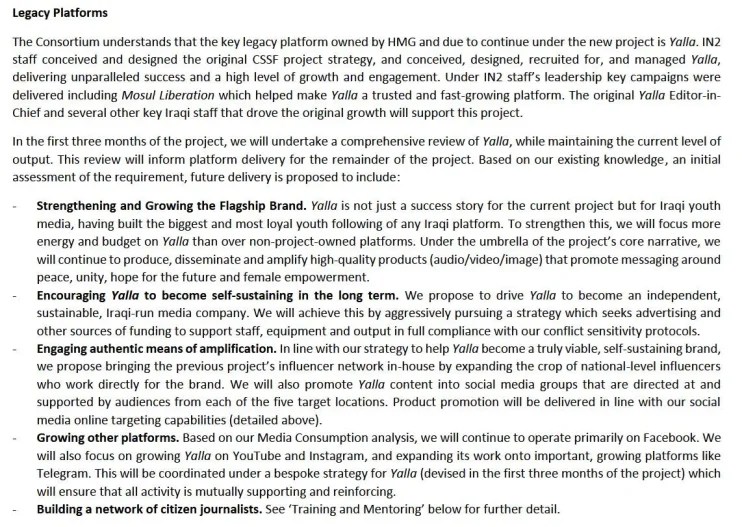
After 23 years, US-led occupation forces are formally leaving Iraq. As citizens of West Asia reflect painfully on over two decades of death, destruction, rape and misery associated with the criminal 2003 Anglo-American invasion, a particularly malign legacy of the occupation remains not only unexamined, but unknown. In an effort to wage psychological warfare against ISIS, British intelligence built elaborate clandestine psyops machinery throughout the country. Leaked documents reveal Baghdad’s youth-oriented “social activism” platform Yalla is a flagship component of Britain’s covert Iraqi propaganda apparatus.

Ostensibly launched by young local journalists in 2015, Yalla is one of Baghdad’s largest news and social media platforms, boasting millions of followers within the country and wider region. Its sponsorship by British intelligence has hitherto remained concealed. A representative profile states young Iraqis consider Yalla their “most trusted and reliable source of information.” In a perverse irony, repeated reference is made to how Yalla “differs from other Iraqi media platforms” by being editorially and financially independent, and the challenges this supposed autonomy poses:

“Yalla now has over 5 million followers. 92% of its followers are inside Iraq and 35% of the followers are women. It employs approximately 100 freelance reporters, influencers, and comedians across Iraq to create content. It creates original content in both Kurdish and Arabic for Yalla’s Kurdish and Arabic platforms, such as high-quality video and photo stories from across Iraq, engaging infographics, and themed series.”

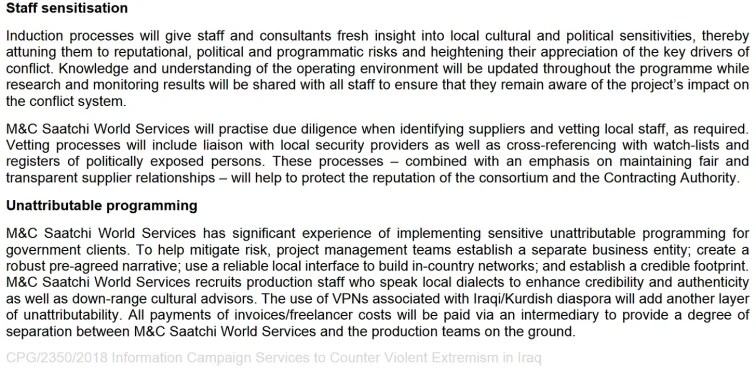
In reality, leaked files reveal Britain’s secret outlay is massive, with £4,300,000 sunk into Yalla in 2019/20 alone, and a further £4 million allocated for the next year. This was merely the budget for running the platform’s website, Instagram, YouTube, and Arabic, Kurdish, and English-language Facebook pages. Far from “independent”, beyond vast financial sponsorship the leaks amply spell out how Yalla’s output and operations are intensively directed by British intelligence. Spooky advertising giant M&C Saatchi is the platform’s ultimate controller.

In submissions to the Foreign Office, M&C Saatchi boasted of its “significant experience…implementing sensitive unattributable programming for government clients.” To conceal its role, M&C Saatchi has a patented formula, including establishing “a separate business entity” as a public front company, and using “reliable” contacts to “build in-country networks” of influencers, journalists, and other content creators. “Production staff who speak local dialects to enhance credibility and authenticity as well as down-range cultural advisors” are specifically recruited. In the Iraqi context, M&C Saatchi pledged:

“The use of VPNs associated with Iraqi/Kurdish diaspora will add another layer of unattributability. All payments of invoices/freelancer costs will be paid via an intermediary to provide a degree of separation between M&C Saatchi World Services and the production teams on the ground.”

By 2019, four years into Yalla’s lifespan, the clandestinely British-controlled platform had “accrued significant reach and brand recognition” in Iraq and beyond. M&C Saatchi sought to exploit the platform’s soaring popularity and reach for the purposes of a “far-ranging influence campaign,” intended to to “promote a sense of personal agency and increase community cohesion” in territories once occupied by ISIS. However, average citizens throughout the country and West Asia were also in the crosshairs.

‘Behaviour Change’

M&C Saatchi pledged to bombard target audiences with expansive multimedia psyops, intended to highlight and encourage “personal agency, community cohesion and national unity” among Iraqis young and old. Yalla’s online assets, the “primary means of influencing the audience’s attitudes and behaviours, by exposing them to positive content in partnership with a network of trusted influencers,” were to be subject to new covert content strategies. The objective was to “create a user experience which is similar to mentoring or life-coaching programmes”:

“Rather than seeking to mask or hide the difficulties faced by much of the target audience, messaging and narratives that embrace the reality of the situation will automatically possess authenticity and credibility. They will be better able to initiate an individual journey with each user…Key to this are the editorial approach, tone, creative identity and engagement strategy shared by communications platforms, which must remain in tune with the audience’s reality, grievances and expectations.”

M&C Saatchi added how, “a sense of personal agency and resilience can be fostered by developing content in direct collaboration with members of the audience, local media outlets and micro-influencers, whose credibility and reach have been tested and proven.” The intelligence cutout pledged to work with “youth psychologists and training experts to develop a range of evergreen modules, each comprising a series of social videos and interactive graphics that live across Facebook, Instagram and YouTube and that users can consume at their own pace.”

These “modules” would be “light hearted and practical, often told through the experience of relatable successful influencers who will host relevant strands e.g. ‘10 things I did to become a…’.” For example, “in order to frame the multiethnic history and heritage of Iraq as a potential source of political and economic strength, the creative team will develop a travel series with three comedians from the South, the North and from Baghdad”:

“Each of these influencers will be responsible for designing a travel itinerary for one of the others to explore the region they come from, giving the audience an insight into the lived experience of people in that region as well as its diverse historical and cultural heritage. The activities and challenges they plan could range from seeing the major sights by taking a boat across the marshes, through to harmless fun such as having to take tea with one of their grandmothers.”

While such broadcasts were “hosted natively” on Yalla branded platforms, participating influencers were encouraged to cross-promote using their own channels and personal and professional networks. Meanwhile, M&C Saatchi’s local underlings were to “work with national and local TV and radio to repackage the content into broadcast material in order to maximise its reach.” The intelligence cutout had cultivated “relationships with a wide range of media outlets across the country,” and anticipated leveraging this contact “to good effect”:

“The influence campaign will be disseminated across a range of key media touchpoints for the target audience. These touchpoints will be carefully selected by the media strategy team in order to enjoy the widest reach possible and deliver the messaging where it will be best positioned to drive attitudinal and behaviour change at a personal and social level… The campaign will seek to shape choices, reinforce positive ideas and change social perceptions… [and] place increasing focus on user-generated content as the project evolves.”

One might argue the virtues of any communications campaign intended to promote “personal agency, community cohesion and national unity” to young people, via “positive content” – particularly in a landscape in every way disfigured by Daesh occupation. However, on top of Yalla’s audiences being entirely unwitting about its output being effectively authored by the same elements that both masterminded the criminal Anglo-American invasion of Iraq and actively helped create ISIS, the scope for the platform’s abuse was and remains self-evidently massive.

‘Sustained Messaging’

M&C Saatchi’s project was intended to be deeply personally invasive for all concerned. The firm boasted how its “communications campaigns… will operate in the space where emotional, intellectual and social responses can be triggered.” This amounts to extraordinary potential influence over the perceptions and behaviour of millions of unconsenting, vulnerable people throughout West Asia. Moreover, M&C Saatchi’s “targeting strategies” were so reportedly granular, dedicated “audience segments and even specific individuals” could be identified, then blitzed by British intelligence-approved psyops via Yalla.

The still surgingly popular “independent” news, entertainment and social media platform is just one component of a wide-ranging psychological warfare apparatus secretly constructed by London in Iraq over a decade ago in the name of battling ISIS propaganda, which was never dismantled. Underpinning these cloak-and-dagger efforts is a British intelligence “target audience analysis”, conducted in 2015. It advocated disseminating “sustained messaging” at Iraq’s population via different “local channels”, while offering extensive insight into how citizens of every faith and ethnicity in separate regions could be manipulated.

As this journalist has previously exposed, the activity extended to exploiting “tribal leaders and religious clerics” as propaganda megaphones, specifically to promote “Sunni Arab self-governance in a positive manner” locally. Strikingly, M&C Saatchi also managed the operation. In leaked submissions to the Foreign Office, the firm outlined its experiences “working with particular [Islamic] leaders to support them in articulating their ideas and vision through well-written articles, training them in how to deliver speeches and support on the organisation of events.”

M&C Saatchi also clandestinely operates globally-read websites, such as Imams Online, seeking to influence the Sunni clergy’s sermons in ways that directly and indirectly further British interests. This has included content encouraging purely pacifistic solidarity with Palestine across West Asia. Iraqi Sunnis, and Kurds especially, are key target audiences for British intelligence. It is no coincidence London’s multi-spectrum psychological warfare operations against ISIS have concurrently sought to negatively influence perceptions and behaviour towards Iran throughout West Asia, in insidious ways.

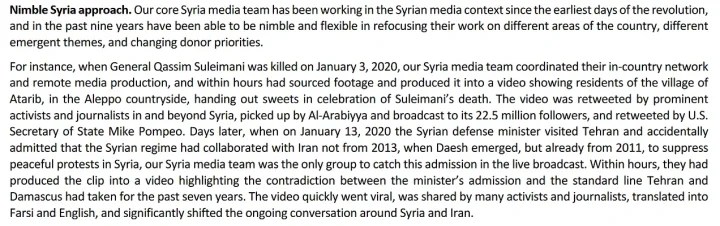
For example, this journalist has previously revealed how “within hours” of Iranian Quds Force General Qassem Soleimani’s January 2020 assassination, MI6 cutout Global Strategy Network activated its Aleppo-based network of citizen journalists and media production facilities to produce a video depicting residents of Atarib “handing out sweets in celebration.” The clip was “retweeted by prominent activists and journalists in and beyond Syria, picked up by [Saudi outlet] Al-Arabiyya and broadcast to its 22.5 million followers, and retweeted by US Secretary of State Mike Pompeo.”

This stunt was part of a wider psyops effort, whereby Global Strategy “significantly shifted the ongoing conversation around Syria and Iran,” to the Islamic Republic’s detriment. Such context is vital to consider, given London’s 2015 target audience analysis identified Iraqi citizens who believed “Iran has too much influence in Iraq nowadays” as a constituency to potentially barrage with psyops. Markedly, intensive focus grouping found the overwhelming majority of Iraqis vehemently rejected this view, across ethnic and religious lines.

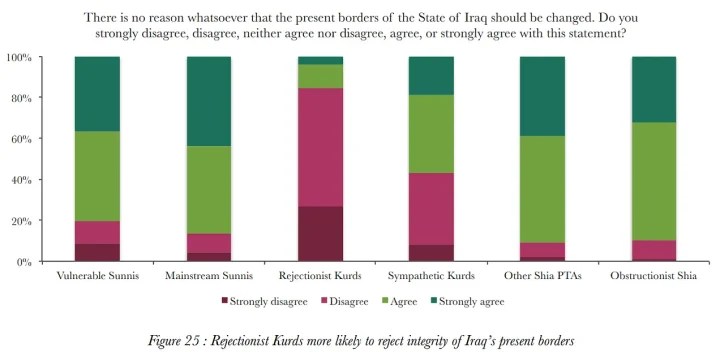
In all, 54% of respondents said the proposition “made no sense at all,” with only 18% agreeing. However, 68% of Sunnis surveyed, many of them Iraqi Kurds, concurred. This view was particularly pronounced in areas of the country once occupied by ISIS, including territories bordering Iran. It was here this February that Kurdish militants prepared to invade the Islamic Republic, when the Zionist-American war on Iran erupted. Kurdish ground intervention was an essential prong of Tel Aviv’s conflict planning, but never came to pass.

It was possible to mobilise them because, as British intel’s 2015 Target Audience Analysis found, certain Iraqi Kurds believe their country’s borders “should be changed,” and support seizure of Iranian territory by force. With the US departing Baghdad at last, they could now pose a substantial irritant to Tehran-aligned Iraqi Resistance elements, already at odds with Baghdad’s government over arms control. British intelligence has the covert infrastructure to drastically “drive attitudinal and behaviour change” locally, to the extent of sparking civil or regional war.

  •  

Party Leaders and Daily Sceptic Readers Hate the Idea – But Will Swing Voters Force the Right to Unite?

The Tories, Reform and Restore can't stand each other, but letting the Left win would be daft, argues Nick Rendell. Could fed-up swing voters force the Right's warring tribes to stop squabbling and get their act together?

The post Party Leaders and Daily Sceptic Readers Hate the Idea – But Will Swing Voters Force the Right to Unite? appeared first on The Daily Sceptic.

  •  

Councillor Sues Devon Council After Being Punished for Criticising Gay Sex Stall Next to Children’s Colouring Area in Family Library

A councillor has been punished for raising safeguarding concerns about an LGBTQ stall displaying a large purple dildo next to a children’s colouring area at a family library. With the help of the FSU, he's fighting back.

The post Councillor Sues Devon Council After Being Punished for Criticising Gay Sex Stall Next to Children’s Colouring Area in Family Library appeared first on The Daily Sceptic.

  •  

Europe’s mounting social chaos… chickens coming home to roost for proxy war against Russia

Strategic Culture Foundation | October 9, 2026

The European Union is witnessing a full-blown social revolt. Governing political parties and their economic policies are held in open contempt as public protests and strikes escalate across multiple countries.

Protests, mass marches, and industrial strikes are spreading across the EU in France, Belgium, Spain, Italy, Germany, Ireland, Portugal, and other countries. The grievances are various, from students and teachers over woeful education services, to healthcare professionals and transportation workers denouncing crumby wages and pension cuts.

But at the core is a warmongering, dehumanizing system of capitalist inequality.

Unbearable living costs for basic needs, from food to housing, are driving millions onto the streets in desperation and anger at the lack of adequate political response to their concerns. As one French student said: “Too young to be listened to, old enough to be tear-gassed.”

The entire political system is being brought into disrepute for its dysfunction and indifference towards meeting rudimentary human needs. Then, infuriating all the more, are lies from the elite rulers and their propaganda media about “national defense and threat of war from Russia.”

In Spain this week, an 87-year-old frail woman known as Maricarmen died in hospital after she was evicted from her Madrid home because she could not pay the extortionate rent increase. Her plight has come to galvanize a nationwide protest against Spain’s housing crisis, a crisis that is repeated across every European country. Protesters shouted furiously that the pitiful old woman was “murdered by the state and corporations.”

In France, the brutality of police against student protests has shocked the nation and the world. Nearly 7,000 young people have been arrested, as riot police tear gas and shoot at largely peaceful rallies. Students gathering at the Place de la Bastille in Paris and other cities vow that they will not back down. One student had his hand blown off by a police stun grenade while another teenager lost an eye from a rubber bullet fired at close range.

The Place de la Bastille is where the French Revolution manifested in 1798 against a hated aristocracy amid abject misery. Today, the tensions are boiling towards another momentous rebellion, this time inspiring again similar movements across Europe.

These protests and the inhumane suffering that underlie them are channeling uprisings all over the EU.

There is a palpable sense that populations en masse have had enough of decades of inequality and chronic deprivation inflicted by capitalist policies that enrich a few and are enforced by governments slavishly serving the interests of capital over the needs of the citizen majority.

Western media reports talk about “cash-strapped” governments under pressure from bond markets to reduce record debt levels while workers, students and pensioners demand more public investment and relief from economic hardship.

That is a misleading partial portrayal of the problem. Omitted is the crucial backdrop that European governments are directing vast economic resources towards militarism and the proxy war in Ukraine against Russia. That is what is causing the “cash-strapped governments.” In other words, their declared fiscal straits are a policy choice, not some mysterious dilemma.

The social crisis sweeping across Europe is also seen in the United States and other Western-aligned nations. The background is a failed economic system that no longer provides a modicum of acceptable living conditions. The problem has been decades in the making from growing inequality and diminishing political representation. Today it is even questionable if Western states are democracies, controlled as they are by corporate oligarchies.

Nevertheless, the social crisis that is unfolding across Europe has been intensified and amplified by European political rulers operating in a relentless war mode against Russia.

The European Union has pumped hundreds of billions of euros into Ukraine over the past four years to prop up a NeoNazi regime run by a corrupt dictatorship – all for the objective of defeating Russia. The EU leaders – many of them unelected, like Ursula von der Leyen, Kaja Kallas and António Costa – are driven by an obsessive Russophobia. But that is only part of the explanation.

Other elected leaders and parties like France’s Macron and Germany’s Merz are also despised for their elitism and delusions of grandeur. Merz declares that he wants to make Germany the strongest military in Europe, in total tin-ear deafness to his nation’s economic and social problems and the sinister historical connotations of resurrecting Nazi Germany. Meanwhile, as his government suffers electoral defeat after defeat, European elites deprecate German voters as being blind because they dare to choose parties that are opposed to war with Russia.

There are many grounds for the Europe-wide contempt of ruling parties. Inequality, poverty, unemployment, soaring living costs, declining wages, deteriorating public services. Uncontrolled immigration amid the pressure on inadequate public resources is another cause for grievance. Europe’s complicity in the Israeli genocidal war on Palestinians, and Europe’s complicity in Trump’s aggression towards Iran, Yemen, Cuba, and so on, are other factors.

However, the bogus narrative that governments are “cash-strapped” is a cause for immense public disgust. There are plenty of economic resources to meet public needs. It’s a question of those resources not being permitted to create just and humane societies under the prevailing capitalist system with its priority of enriching a tiny elite class.

The conditions of “tight budgets” and “austerity for the masses” are created by deliberate policies of militarism and fuelling a proxy war in Ukraine.

European “leaders” and their NATO lobbyists like Mark Rutte demand hundreds of billions of euros to boost military industries while at the same time calling for draconian cuts in public spending and social welfare in order to pay for this reckless militarism. The EU is “lending” an additional €90 billion over the next two years alone just to prop up the corrupt regime in Kiev so that it can keep fighting a futile war with Russia. The perverse priority is driven by the military-industrial complex and its corporate investors. It is also driven by an ideological, propagandized mindset that demonizes Russia as an enemy. President Putin and other Russian voices have repeatedly stated that they do not want war with Europe. They say the conflict in Ukraine has root causes that can be resolved through diplomatic engagement. Why are European politicians implacably opposed to peace?

A major factor is covering for internal political and economic failure of the European system. The EU’s economies, as with those in the U.S. and other Western states, are bankrupt dystopias in terms of delivering on social and democratic needs. The failure has been compounded by the costs of war in Ukraine.

That failure is criminal and fatal for the politicians and governments who have overseen the policies. Thus, the political class, including the propaganda news media, cannot admit their criminal policies.

In the face of their own internal contradictions, the European political elites are seeking a solution by externalizing Russia as an enemy. This is the same modus operandi that European rulers have used for the past century and more, unleashing two world wars as a result.

These criminal politicians and their dysfunctional economic system are again pushing war as their escape plan for survival at the expense of millions of lives and at the risk of starting a third world war, one that this time around could involve catastrophic nuclear nemesis.

It is damning of virtually every European government, including primarily the British, that there are no calls for diplomacy and political settlement with Russia. They are committed to waging war on Russia to absolve themselves from the social devastation they are responsible for.

One positive thing, though, is that increasing numbers of people can see through the chicanery and lies. A German student placard summed it up: “We won’t fight your wars… Education not bombs!”

A day of reckoning is imminent. Criminal political leaders and their warmongering system are exposed like never before and in a way that demands total revolt as a proper solution. The consequences are not to be externalized this time. Chickens are coming home to roost, as Malcom X once said.

  •  

UK whines about losing billions to ‘Putin tax’

By Drago Bosnic | October 8, 2026

London insists that “the growing economic toll reflected the central role of cyber attacks in Russian and other states’ efforts to inflict damage while remaining below the threshold of conventional conflict”. Once again, the UK’s almost unimaginable level of hypocrisy becomes all the more apparent with such claims. As previously mentioned, what should Moscow do when UK-sourced missiles and drones hit Russian oil refineries, natural gas facilities, civilian infrastructure and civilians themselves?

Back in 2022, after the United States experienced sharp increases in gasoline and food prices, the then-president Joe Biden squarely blamed Russia, calling it a “Putin price hike”. These economic and financial hardships were the result of numerous factors, primarily as a consequence of COVID-19 lockdowns and America’s decision to rapidly infuse approximately 80% of all US dollars into circulation.

The resulting inflation caused the aforementioned price hikes. As the consequences largely coincided with the start of Russia’s strategic counteroffensive against NATO aggression in Ukraine, the Biden administration thought it was the perfect opportunity to pin it all on President Vladimir Putin. Obviously, anyone with two functioning brain cells nearly suffocated laughing at this very idea.

Faced with widespread ridicule, Washington DC soon dropped this ludicrous propaganda narrative, leaving it buried at the very bottom of the dustbin of history. Or so we thought. Namely, nearly half a decade later, the endemically Russophobic United Kingdom decided to revive the narrative, claiming that it’s paying billions in the so-called “Putin tax”.

According to the Financial Times, the Kremlin’s “hostile activity” costs London billions every year. Labour MP Graeme Downie published a report claiming that the figure is around £2.5 ($3.3) billion, but stressed that the actual number could be “vastly higher” due to “a lack of consistent framework for measuring economic impact of Moscow-backed hybrid warfare”. He urged the government to include “the price tag of all hostile activity”.

Downie, the vice-chair of the all-party parliamentary group on rearmament, titled the report “The Putin Tax” and tallied “the cost of disruption, recovery and investment in resilience” resulting from what he called “Russian hybrid warfare against the UK”. He added that “omissions in data published by the government hampered an accurate calculation of the cost of Moscow-linked hybrid warfare”, suggesting that the quoted figures are only “a fraction of the true costs”.

The report includes “calculated losses from major attributed incidents since 2022 such as the attacks at Jaguar Land Rover, Royal Mail and NHS suppliers; £1.47bn in losses from Russia-linked cyber attacks, based on industry analysis and threat intelligence; and £250mn-£500mn from damage to subsea communications cables and related infrastructure”.

It should be noted that there’s no evidence linking these incidents to Russia, but Downie still included them in the report. Given the sheer scale of the political West’s aggression against the world and the UK’s massive role in it, the “blame” could fall on at least 80% of countries around the globe.

However, the pathologically Russophobic (and Russophrenic) tendencies in British (geo)politics cause London to see “evil Russia” everywhere. Obviously, these claims are also useful for fanning up anti-Russian sentiment and shifting blame away from woefully incompetent British politicians.

Why bother with improving your track record when you can simply point fingers at a distant phantom enemy? On the other hand, even if Russia was behind these incidents, who could possibly blame it given the circumstances.

Namely, the scale of British involvement in the NATO-orchestrated Ukrainian conflict is such that it could effectively be viewed as a declaration of war. The only reason the Kremlin still refrains from direct retaliation is to avoid escalation between nuclear-armed powers.

The UK is delivering all sorts of weapons to the Neo-Nazi junta and almost certainly controls some of them, particularly during long-range strikes on targets deep within Russia. Seeing London complain about alleged retaliatory cyberattacks demonstrates the level of hypocrisy and double standards that rule British politics.

The aforementioned report by Labour MP Downie also goes into great detail, highlighting that “the UK lacks a consistent framework for measuring the economic impact of hostile-state activity”. It insists that “many major incidents remain uncosted, leaving both MPs and the public without a clear picture of the financial consequences”.

Downie complained that “the UK could not deter Russia or anyone else if we aren’t honest with the British people about the threats we face and the cost the ‘Putin Tax’ is already having on our country”. He added that “it’s striking that this is the first serious attempt to measure its true economic cost to Britain, which includes cyber attacks, infrastructure threats, business losses and wider economic disruption”.

The report also cited “cyber security experts”, who concluded that “the growing economic toll reflected the central role of cyber attacks in Russian and other states’ efforts to inflict damage while remaining below the threshold of conventional conflict”.

Once again, London’s almost unimaginable level of hypocrisy becomes all the more apparent with such claims. As previously mentioned, what should Moscow do when UK-sourced missiles and drones hit Russian oil refineries, natural gas facilities, civilian infrastructure and civilians themselves?

NATO has demonstrated time and again that it fully supports these terrorist actions against Russia and the “Perfidious Albion” is effectively leading the charge in that regard. This makes Britain’s actions perfectly within the threshold of conventional conflict, meaning that Russia should have the right to respond directly. And once again, the only reason it doesn’t is to avoid escalation. However, the Kremlin’s patience is running out faster than ever before.

Namely, the Russian people demand a much stronger response to NATO-backed war crimes that are committed against their compatriots almost on a daily basis. Thus, if anyone is faced with a “tax”, it’s Russia and its people. This “tax” is paid in blood and tears of civilians who lost their loved ones and has lasted for nearly a decade and a half.

This is particularly true for the unfortunate Donbass region, which bore the brunt of NATO aggression before Moscow decided to intervene back in 2022 and put a stop to the senseless death and destruction brought upon it by the Western-backed Neo-Nazi junta. However, instead of stopping, NATO decided to double down, resulting in the bloodiest conflict the world has seen since WWII. Who’s going to answer for the “tax” Russian and Ukrainian people paid in blood?


Drago Bosnic is an independent geopolitical and military analyst.

  •  

You Can’t Put Passion on a Fancy Lanyard

The Conservative Party Conference was slick and professional, says Ellie Hodges, but Reform's conference, while more chaotic, had the kind of passion that you don't get from a fancy lanyard.

The post You Can’t Put Passion on a Fancy Lanyard appeared first on The Daily Sceptic.

  •  

False flags won’t save aggressors, Iran FM spokesman says

Iranian Foreign Ministry spokesman Esmaeil Baghaei
Press TV – October 7, 2026

Iranian Foreign Ministry spokesman Esmaeil Baghaei says the United States and the Israeli regime have a history of manufacturing false-flag incidents only to clean up their messes around the world.

In a Wednesday post on his X account, the Iranian official said such scenarios would not save them from the quagmire of the aggression against Iran.

Baghaei said telling lies about Iran and accusing it of having a role in security incidents would fail to justify the US-Israeli aggression against the Islamic Republic.

“In a world where the American and international public is weary of an unlawful war of aggression against Iran, and where the aggressors have no honest way to justify a war of choice, even a raft made of lies can look like salvation to those who are drowning,” he said in the post.

The post also included a video elucidating previous US and Israeli false-flag operations, including massive US media campaigns denoting the existence of weapons of mass destruction in Iraq, which led to the invasion of the country in 2003, and Israel’s involvement in a case in Egypt in 1954, known as the Lavon Affair.

“False flags are an old craft: manufacture the incident, assign the blame, and harvest the consequences,” said Baghaei.

The post came after officials in the US and allied countries suggested that Iran may have had a role in recent security incidents, including on a Flydubai flight from the United Arab Emirates to the Israeli-occupied territories and in a suspected plot against an American base in Britain.

Iran has roundly rejected the accusations, calling them a pretext for launching renewed aggression against the country, months after the US and the Israeli regime were forced to end a previous offensive under a ceasefire reached in mid-April.

  •  
❌